
Exodus 2:3

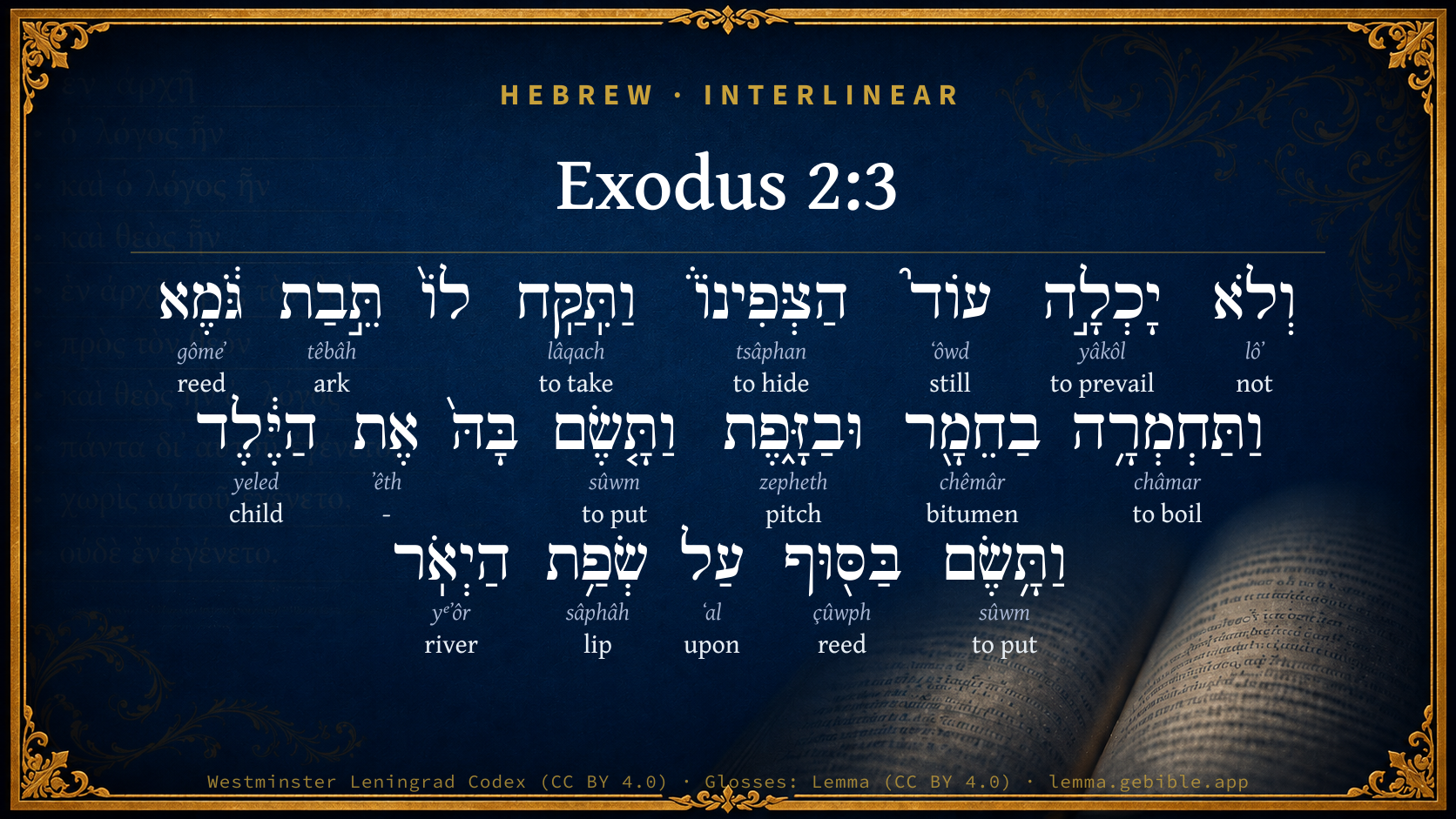
Hebrew (Westminster Leningrad Codex) Exodus 2:3 appears in the Hebrew Old Testament. The text above is from the Westminster Leningrad Codex. Each word links to its Strong’s number, a concise gloss, and parsing drawn from the Open Scriptures Hebrew Bible morphology. Click any word for its full Brown-Driver-Briggs (BDB) entry.
Download image
Cite this verse

Exodus 2:3 (World English Bible). Public Domain. Lemma interlinear Bible study tool, https://lemma.gebible.app/v/exodus/2/3.

Show BibTeX & RIS
BibTeX
RIS
English Translation
When she could no longer hide him, she took a papyrus basket for him, and coated it with tar and with pitch. She put the child in it, and laid it in the reeds by the river's bank.
World English Bible · Public Domain
Highlights
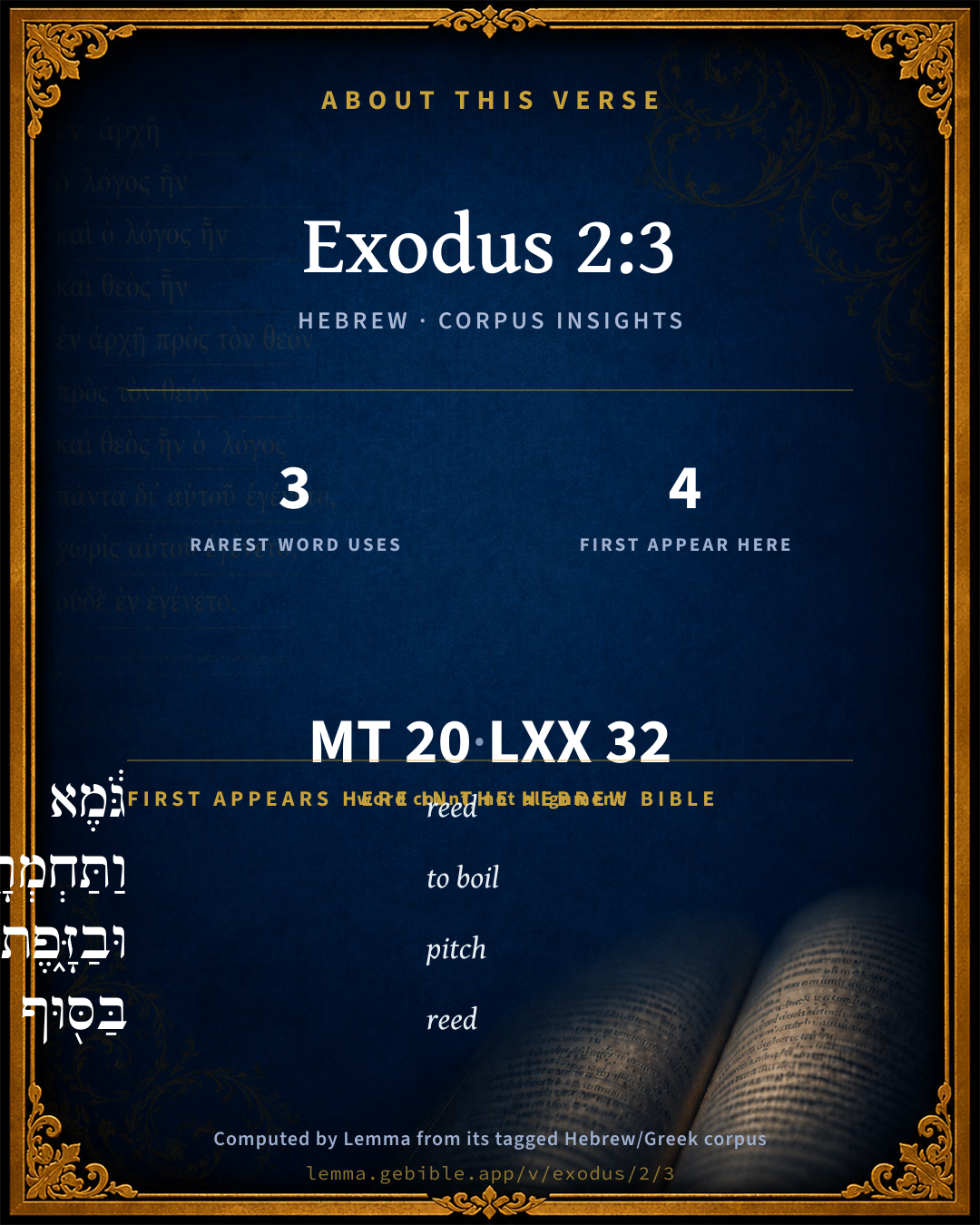
  • 4 first appearances in the Hebrew Bible
Full analysis ↓
Download a study sheet

One document with this verse’s original text, its word-by-word gloss line, the meaning frame, cross-references with their text, attributed commentary, and full source and license credits — printable, and it pastes into notes with its structure intact.

This verse Autodidact and up

Study sheet (.html) Plain text (.txt)

A passage Seminary Student

Up to 50 verses in one chapter. A passage sheet keeps up to 6 commentary sources and 12 cross-references per verse, in the order this page ranks them, and says so on the sheet whenever that leaves anything out. Ask for a single verse and you get the Autodidact verse sheet above.

Everything on this page stays free to read, with no account — the sheet is a download of what is already on screen, not access to it.

Want to remove ads? Support Godless Engineer
Compare translations 3

The same verse in 3 English versions, stacked beneath the original-language interlinear above. Click any original word for its lexicon entry.

Each is an independent rendering of the whole verse — the interlinear is not word-aligned to these translations.

Highlighted words mark where these versions differ — a whole-verse word diff, not a word-by-word alignment.

  • World English Bible Public Domain
    When she could no longer hide him, she took a papyrus basket for him, and coated it with tar and with pitch. She put the child in it, and laid it in the reeds by the river's bank.
  • King James Version Public Domain
    And when she could not longer hide him, she took for him an ark of bulrushes, and daubed it with slime and with pitch, and put the child therein; and she laid it in the flags by the river's brink.
  • unfoldingWord Literal Text CC BY-SA 4.0
    And she was not able to hide him still, and she took for him an ark of papyrus reeds and she daubed it with bitumen and with pitch. And she placed the child in it, and she placed it in the reeds along the shore of the river.

unfoldingWord Literal Text — © unfoldingWord, licensed CC BY-SA 4.0. Word-aligned USFM3 via Door43 (git.door43.org/unfoldingWord/en_ult).

Versions to compare (up to 4)

3 of 4 selected

Show all 18 translations

Every available English version of this verse, each an independent rendering of the whole verse.

  • World English Bible Public Domain
    When she could no longer hide him, she took a papyrus basket for him, and coated it with tar and with pitch. She put the child in it, and laid it in the reeds by the river's bank.
  • Berean Standard Bible Public Domain
    But when she could no longer hide him, she got him a papyrus basket and coated it with tar and pitch. Then she placed the child in the basket and set it among the reeds along the bank of the Nile.
  • Majority Standard Bible Public Domain
    But when she could no longer hide him, she got him a papyrus basket and coated it with tar and pitch. Then she placed the child in the basket and set it among the reeds along the bank of the Nile.
  • King James Version Public Domain
    And when she could not longer hide him, she took for him an ark of bulrushes, and daubed it with slime and with pitch, and put the child therein; and she laid it in the flags by the river's brink.
  • American Standard Version (1901) Public Domain
    And when she could not longer hide him, she took for him an ark of bulrushes, and daubed it with slime and with pitch; and she put the child therein, and laid it in the flags by the river's brink.
  • Revised Version (1885) Public Domain
    And when she could not longer hide him, she took for him an ark of bulrushes, and daubed it with slime and with pitch; and she put the child therein, and laid it in the flags by the river’s brink.
  • Geneva Bible (1599) Public Domain
    But when she could no longer hide him, she tooke for him an arke made of reede, and daubed it with slime and with pitch, and laide the childe therein, and put it among the bulrushes by the riuers brinke.
  • Douay-Rheims (1899) Public Domain
    And when she could hide him no longer, she took a basket made of bulrushes, and daubed it with slime and pitch: and put the little babe therein, and laid him in the sedges by the river's brink,
  • Young's Literal Translation Public Domain
    and she hath not been able any more to hide him, and she taketh for him an ark of rushes, and daubeth it with bitumen and with pitch, and putteth the lad in it, and putteth `it' in the weeds by the edge of the River;
  • Literal Standard Version CC BY-SA 4.0
    and she has not been able to hide him anymore, and she takes an ark of rushes for him, and covers it with bitumen and with pitch, and puts the boy in it, and puts [it] in the weeds by the edge of the River;
  • Unlocked Literal Bible CC BY-SA 4.0
    But when she could no longer hide him, she took a papyrus basket and sealed it with bitumen and pitch. Then she put the child in it and placed it among the reeds in the water along the side of the river.
  • unfoldingWord Literal Text CC BY-SA 4.0
    And she was not able to hide him still, and she took for him an ark of papyrus reeds and she daubed it with bitumen and with pitch. And she placed the child in it, and she placed it in the reeds along the shore of the river.
  • Darby Bible Public Domain
    And when she could no longer hide him, she took for him an ark of reeds, and plastered it with resin and with pitch, and put the child in it, and laid [it] in the sedge on the bank of the river.
  • World Messianic Bible Public Domain
    When she could no longer hide him, she took a papyrus basket for him, and coated it with tar and with pitch. She put the child in it, and laid it in the reeds by the river’s bank.
  • Webster's Bible Public Domain
    And when she could no longer hide him, she took for him an ark of bulrushes, and daubed it with slime and with pitch, and put the child therein; and she laid it in the flags by the river's brink.
  • Free Bible Version CC BY-SA 4.0
    But when she couldn't hide him anymore, she got a papyrus basket and covered it with tar and pitch. Then she put her baby in the basket and placed it among the reeds along the bank of the Nile.
  • Bible in Basic English Public Domain
    And when she was no longer able to keep him secret, she made him a basket out of the stems of water-plants, pasting sticky earth over it to keep the water out; and placing the baby in it she put it among the plants by the edge of the Nile.
  • JPS Tanakh (1917) Public Domain
    And when she could not longer hide him, she took for him an ark of bulrushes, and daubed it with slime and with pitch; and she put the child therein, and laid it in the flags by the river's brink.

Literal Standard Version (2020), Covenant Press — licensed CC BY-SA 4.0. Text via the HelloAO Bible API (eBible.org). Unlocked Literal Bible (unfoldingWord) — licensed CC BY-SA 4.0. Text via the HelloAO Bible API (eBible.org). unfoldingWord Literal Text — © unfoldingWord, licensed CC BY-SA 4.0. Word-aligned USFM3 via Door43 (git.door43.org/unfoldingWord/en_ult). Free Bible Version, Dr. Jonathan Gallagher — licensed CC BY-SA 4.0. Text via the HelloAO Bible API (eBible.org).

Word by word

More ways to search: Search by grammar → Find every occurrence → Compare this word →

Practice this passage: Drill this verse → Learn its vocabulary →

בַחֵמָ֖ר
chêmâr
H2564
“in/at the · bitumen”
Preposition, Determined + Noun, Common, Masculine, Singular, Absolute
Part of Speech
Preposition + Noun
Type
Common
Gender
Masculine
Number
Singular
State
Absolute
Full BDB Definition

Origin: from H2560

TWOT: TWOT- 683b

slime, pitch, asphalt, bitumen
  1. וְלֹא lôʼ H3808 “and · not” Conjunction + Particle, Negative
  2. יָכְלָ֣ה yâkôl H3201 “to prevail” Verb, Qal, Perfect, 3rd Person, Feminine, Singular
  3. עוֹד֮ ʻôwd H5750 “still” Adverb
  4. הַצְּפִינוֹ֒ tsâphan H6845 “to hide · him” Verb, Hiphil, Infinitive Construct + Suffix, Personal, 3rd Person, Masculine, Singular
  5. וַתִּֽקַּֽח lâqach H3947 “and · to take” Conjunction + Verb, Qal, Sequential Imperfect, 3rd Person, Feminine, Singular
  6. תֵּ֣בַת têbâh H8392 “ark of” Noun, Common, Feminine, Singular, Construct
  7. גֹּ֔מֶא gômeʼ H1573 “reed” Noun, Common, Masculine, Singular, Absolute
  8. וַתַּחְמְרָ֥ה châmar H2560 “and · to boil · her” Conjunction + Verb, Qal, Sequential Imperfect, 3rd Person, Feminine, Singular + Suffix, Personal, 3rd Person, Feminine, Singular
  9. וּבַזָּ֑פֶת zepheth H2203 “and · in/at the · pitch” Conjunction + Preposition, Determined + Noun, Common, Feminine, Singular, Absolute
  10. וַתָּ֤שֶׂם sûwm H7760 “and · to put” Conjunction + Verb, Qal, Sequential Imperfect, 3rd Person, Feminine, Singular
  11. אֶת ʼêth H853 “-” Particle, Direct Object
  12. הַיֶּ֔לֶד yeled H3206 “the · child” Particle, Definite Article + Noun, Common, Masculine, Singular, Absolute
  13. וַתָּ֥שֶׂם sûwm H7760 “and · to put” Conjunction + Verb, Qal, Sequential Imperfect, 3rd Person, Feminine, Singular
  14. בַּסּ֖וּף çûwph H5488 “in/at the · reed” Preposition, Determined + Noun, Common, Masculine, Singular, Absolute
  15. עַל ʻal H5921 “upon” Preposition
  16. שְׂפַ֥ת sâphâh H8193 “lip of” Noun, Common, Feminine, Singular, Construct
  17. הַיְאֹֽר yᵉʼôr H2975 “the · river” Particle, Definite Article + Noun, Proper

About this verse

These counts appear in no published source. They are computed here, from the morphology-tagged text and Lemma’s own curated glosses. What Lemma adds →

20
words
17
distinct lemmas
Pentateuch
section

Notable vocabulary

The rarest word here is בַחֵמָ֖ר bitumen H2564 — appearing just 3 times in the whole Hebrew Bible.

First appearance in Scripture

These words make their first canonical appearance in the Hebrew Bible here:

  • גֹּ֔מֶא reed H1573
  • וַתַּחְמְרָ֥ה to boil H2560
  • וּבַזָּ֑פֶת pitch H2203
  • בַּסּ֖וּף reed H5488

Shared distinctive vocabulary

בַחֵמָ֖ר bitumen H2564 occurs in 3 verses of the Hebrew Bible. Also found in:

Grammatical profile

  • 6 verbs
  • 8 nouns
  • 3 prepositions
  • 1 adverb
  • 2 particles

Verb forms

  • יָכְלָ֣ה Qal · Perfect
  • הַצְּפִינוֹ֒ Hiphil · Infinitive Construct
  • וַתִּֽקַּֽח Qal · Sequential Imperfect
  • וַתַּחְמְרָ֥ה Qal · Sequential Imperfect
  • וַתָּ֤שֶׂם Qal · Sequential Imperfect
  • וַתָּ֥שֶׂם Qal · Sequential Imperfect

Repetition

A word recurs within this verse — often emphatic in Hebrew:

  • וַתָּ֤שֶׂם to put H7760 ×2

Hebrew & Septuagint length

In English translation the verse runs 38 words from the Hebrew and 35 from the Septuagint (LXX English) — closely comparable.

A rough comparison of the two English renderings, which tokenize alike — not a word-level alignment.

Word counts can differ between the Hebrew and the Greek without any difference in meaning — e.g. the Hebrew direct-object marker אֵת has no separate Greek word, and Greek often adds the article ὁ.

In the original languages it is 20 Hebrew tokens and 32 Greek tokens — but the two are counted differently (Hebrew bundles its prefixes and suffixes into one token; the Greek is in lemma form), so that isn’t a like-for-like length.

Cross-references

9

Topical passages linked to Exodus 2:3 in the Treasury of Scripture Knowledge — connected by theme and wording, ordered by reader-vote popularity; previews shown in the World English Bible.

  • Exodus 1:22 Pharaoh charged all his people, saying, "You shall cast every son who is born into the river, and every daughter you shall save alive."
  • Genesis 6:14 Make an ark of gopher wood. You shall make rooms in the ark, and shall seal it inside and outside with pitch.
  • Acts 7:19 The same took advantage of our race, and mistreated our fathers, and forced them to throw out their babies, so that they wouldn't stay alive.
  • Isaiah 18:2 that sends ambassadors by the sea, even in vessels of papyrus on the waters, [saying], Go, you swift messengers, to a nation tall and smooth, to a people awesome from their beginning onward, a nation that measures out and treads down, whose land the rivers divide!
  • Matthew 2:16 Then Herod, when he saw that he was mocked by the wise men, was exceedingly angry, and sent out, and killed all the male children who were in Bethlehem and in all the surrounding countryside, from two years old and under, according to the exact time which he had learned from the wise men.
  • Matthew 2:13 Now when they had departed, behold, an angel of the Lord appeared to Joseph in a dream, saying, "Arise and take the young child and his mother, and flee into Egypt, and stay there until I tell you, for Herod will seek the young child to destroy him."
  • Genesis 11:3 They said one to another, "Come, let's make brick, and burn them thoroughly." They had brick for stone, and they used tar for mortar.
  • Genesis 14:10 Now the valley of Siddim was full of tar pits; and the kings of Sodom and Gomorrah fled, and they fell there, and those who remained fled to the mountain.
  • Isaiah 19:6 The rivers shall become foul; the streams of Egypt shall be diminished and dried up; the reeds and flags shall wither away.

Cross-references courtesy of OpenBible.info (CC BY 4.0).

Hebrew and Greek witnesses Masoretic Hebrew ↔ Greek Septuagint

The same verse in the two great witnesses to the Old Testament, shown verse-for-verse.

These are two independent witnesses, not word-aligned to each other, and the Septuagint is shown in lemma (dictionary) form.

Hebrew Exodus 2:3 Masoretic · Westminster Leningrad Codex

וְלֹא יָכְלָ֣ה עוֹד֮ הַצְּפִינוֹ֒ וַתִּֽקַּֽח לוֹ֙ תֵּ֣בַת גֹּ֔מֶא וַתַּחְמְרָ֥ה בַחֵמָ֖ר וּבַזָּ֑פֶת וַתָּ֤שֶׂם בָּהּ֙ אֶת הַיֶּ֔לֶד וַתָּ֥שֶׂם בַּסּ֖וּף עַל שְׂפַ֥ת הַיְאֹֽר

When she could no longer hide him, she took a papyrus basket for him, and coated it with tar and with pitch. She put the child in it, and laid it in the reeds by the river's bank.

World English Bible · Public Domain

Greek LXX Exodus 2:3 Septuagint · lemma form

ἐπεί δέ οὐ δύναμαι αὐτός ἔτι κρύπτω λαμβάνω αὐτός ὁ μήτηρ αὐτός θῖβις καί καταχρίω αὐτός ἀσφαλτόπισσα καί ἐνβάλλω ὁ παιδίον εἰς αὐτός καί τίθημι αὐτός εἰς ὁ ἕλος παρά ὁ ποταμός

And when they could no longer hide him, his mother took for him an ark, and besmeared it with bitumen, and cast the child into it, and put it in the ooze by the river.

LXX2012 (modern English Septuagint) · Public Domain

Hebrew: Westminster Leningrad Codex (CC BY 4.0). Greek: Septuagint (public domain); English from LXX2012 (modern English Septuagint) (Public Domain). How the Septuagint differs from the Hebrew →

Targum (Aramaic paraphrase)

2

The Targum is the ancient Jewish Aramaic paraphrase of the Hebrew Scriptures — an interpretive translation, not the Hebrew text itself. Onkelos (literal) and Pseudo-Jonathan (expansive) render the Torah, and Jonathan the Prophets. Coverage is partial: where no permissively-licensed English translation exists for a verse, only the Aramaic is shown. This is verse-level text, not a word-by-word alignment to the Hebrew.

  1. Targum Onkelos Torah (Genesis–Deuteronomy)
    וְלָא יְכֵילַת עוֹד לְאַטְמָרוּתֵהּ וּנְסֵיבַת לֵהּ תֵּבוּתָא דְגוֹמֶא וְחַפָּתַהּ בְּחֵמָרָא וּבְזִפְתָּא וְשַׁוִיאַת בַּהּ יָת רַבְיָא וְשַׁוִיתַהּ בְּיַעֲרָא עַל כֵּיף נַהֲרָא:

    (no public-domain English translation for this verse)

    Targum Onkelos — Aramaic: “Onkelos Genesis” (public domain); “Onkelos Exodus” (public domain); “Onkelos Leviticus” (public domain); “Onkelos Numbers” (public domain); “Onkelos Deuteronomy” (public domain). English: “Sefaria Community Translation” (CC0 1.0 (public-domain dedication)); “J.W. Etheridge. The Targums of Onkelos and Jonathan Ben Uzziel on the Pentateuch. London: Longmans, Green, 1862” (public domain). Text via Sefaria.

  2. Targum Pseudo-Jonathan Torah (Genesis–Deuteronomy)
    וְלָא הֲוַת אֶפְשַׁר לָהּ תּוּב לְאַטְמַרְתֵּיהּ דְמִצְרַיִם מַרְגִישִׁין עֲלָהּ וּנְסִיבַת לֵיהּ תֵּיבוּתָא דְטוּנֵס וַחֲפָהָא בְּחֵימְרָא וּבְזֵיפָתָא וְשַׁוְיַית בְּגַווָהּ יַת טַלְיָא וְשַׁוְיָתֵיהּ בְּגוֹ גוּמַיָא עַל גֵיף נַהֲרָא

    But she could conceal him no longer, for the Mizraee had become aware of him. And she took an ark of papyrus, (tunes,) and coated it with bitumen and pitch, and placed the child within it, and laid him among the reeds on the bank of the river.

    Targum Pseudo-Jonathan — Aramaic: “Targum Jonathan on Genesis” (public domain); “Targum Jonathan on Exodus” (public domain); “Targum Jonathan on Leviticus” (public domain); “Targum Jonathan on Numbers” (public domain); “Targum Jonathan on Deuteronomy” (public domain). English: “The Targum of Jonathan ben Uzziel, trans. J. W. Etheridge, London, 1862” (public domain). Text via Sefaria.

Commentary

Notes on Exodus 2:3 from classic Christian and Jewish commentators (each source and its license shown beneath its notes). The classic Christian expositions comment on the surrounding passage and are grouped to its opening verse, so a note may address several verses; the Jewish commentaries on the Tanakh (Rashi and others) are per-verse, so they appear only where the commentator wrote on this verse.

Lemma curates 59 commentaries, every one of them public domain or Creative Commons licensed, each selected and text-cleaned for this edition rather than reprinted as found. About our sources →

Adam Clarke's Commentary

Verse 3. An ark of bulrushes] תבת גמא tebath gome, a small boat or basket made of the Egyptian reed called papyrus, so famous in all antiquity. This plant grows on the banks of the Nile, and in marshy grounds; the stalk rises to the height of six or seven cubits above the water, is triangular, and terminates in a crown of small filaments resembling hair, which the ancients used to compare to a thyrsus. This reed was of the greatest use to the inhabitants of Egypt, the pith contained in the stalk serving them for food, and the woody part to build vessels with; which vessels frequently appear on engraved stones and other monuments of Egyptian antiquity. For this purpose they made it up like rushes into bundles, and by tying them together gave their vessels the necessary figure and solidity. "The vessels of bulrushes or papyrus," says Dr. Shaw, "were no other than large fabrics of the same kind with that of Moses, Ex 2:3, which from the late introduction of planks and stronger materials are now laid aside." Thus Pliny, lib. vi., cap. 16, takes notice of the naves papyraceas armamentaque Nili, "ships made of papyrus and the equipments of the Nile:" and lib. xiii., cap. 11, he observes, Ex ipsa quidem papyro navigia texunt: "Of the papyrus itself they construct sailing vessels." Herodotus and Diodorus have recorded the same fact; and among the poets, Lucan, lib. iv., ver. 136: Conseritur bibula Memphitis cymba papyro, "The Memphian or Egyptian boat is constructed from the soaking papyrus." The epithet bibula is particularly remarkable, as corresponding with great exactness to the nature of the plant, and to its Hebrew name גמא gome, which signifies to soak, to drink up. See Parkhurst sub voce.

She laid it in the flags] Not willing to trust it in the stream for fear of a disaster; and probably choosing the place to which the Egyptian princess was accustomed to come for the purpose specified in the note on the following verse.

Adam Clarke's Commentary on the Bible (1810–1826) — public domain. Text from a community e-Sword/MySword module.

The Cambridge Bible for Schools and Colleges

gen. ed. J. J. S. Perowne

3. an ark] i.e. a chest. The Heb. is tçbâh (only used besides of the ‘ark’ of Noah, Genesis 6-9), an Egypt, word, têbet, a ‘chest.’

papyrus (RVm.)] Heb. gômĕ’ (Job_8:12; Isa_18:2; Isa_35:7 †: deriv. uncertain). A tall reed, consisting of a bare stem, 6 ft. or mon in height, with a large tuft of leaves and flowers at the top (see ill. in NHB. 434, EB. iii. 3557), extinct now in Egypt, and found only by the banks of the ‘Blue’ and ‘White’ Nile, but abundant in ancient times along the banks of the lower Nile. The pith of the stem was cut into thin strips, which were then laid together side by side to form a sheet; and two such sheets, with the strips in one at right angles to those in the other, placed one upon another, and glued together, were used by the ancients as writing material; the stems themselves, also, bound together and caulked, were used to form light boats (Isa_18:2, ‘vessels of gômĕ’’; probably also Job_9:26 : Theophr. H.P. iv. 8, 4; Pliny H.N. vii. 57, &c.)1[98]. Here a small chest, or ‘ark,’ is made of it.

[98] Cf. Wilkinson-Birch, Anc. Egyptians (1878), ii. 179–82 (with transl. of Pliny’s description, H.N. xiii. 11, 12), 205 f., 208; Erman, pp. 12, 235, 236, 447, 479 f.

daubed it with bitumen (Gen_11:3; Gen_14:10 †) and pitch (Isa_34:9 †)] to make it water-tight. Bitumen, or asphalt, was brought into Egypt from the Dead Sea; it was used particularly for embalming (Diod. Sic. xix. 99).

flags] or reeds: Heb. suph, usually of the water-growth (see on Exo_13:18), which gave the ‘Red Sea’ its Heb. name, once (Jon_2:6) of sea-weed; here, v. 5, and Isa_19:6, of some water-growth along the banks of the Nile, or, in Isa_19:6 (see RVm.), of the Nile-canals (see on Exo_7:19). What suph was, is not certainly known. It is commonly supposed to have been some kind of reed. At the present time, the banks of the Nile in the S. half of the Delta are completely bare: but reed-growths are abundant in the Delta, in disused canals in which the level of the water does not change—for instance, in those running through the site of Goshen—and in pools and ponds (see an ill. in R. T. Kelly’s Egypt (1902), opp. to p. 154): Forskål, also, Flora Aeg.-Arab. (1775), p. 24, attests for his time the abundance of the Arundo donax (see ill. in NHB. 436) on the banks of the Nile, apparently in general; and J. Russegger, Reisen (1841), i. 122 (both referred to by Kn.) speaks of the ‘impenetrable reeds’ on its bank, where the canal from Alexandria to Cairo joins the river. Compare the illustrations in Ebers, Egypt, i. 112, ii. 20 (if the artist may be trusted not to have idealized his picture). What we require is some water-growth which will (1) suit Exo_2:3; Exo_2:5, Isa_19:6; (2) explain reasonably the name ‘Sea of suph’ (see on Exo_13:18); and (3), unless the late passage Jon_2:6 is not to be pressed, sufficiently resemble ‘sea-weed’ to be called by the same name. Careful observation in Egypt itself might result in the required plant being found2[99].

[99] Might it be the sari of Theophr. H.P. iv. 9, Pliny, H.N. xiii. 45? Cf. Dillm. on xiii. 18.

The Cambridge Bible for Schools and Colleges (gen. ed. J. J. S. Perowne; Cambridge University Press, 1878–1918) — public domain. Text from a community e-Sword module.

Trapp's Complete Commentary

John Trapp

Exo 2:3 And when she could not longer hide him, she took for him an ark of bulrushes, and daubed it with slime and with pitch, and put the child therein; and she laid [it] in the flags by the river’s brink.

Ver. 3. And she laid it in the flags.] This she did by the force of her faith; {Heb 11:23} casting the child upon God, and "against hope believing in hope."

John Trapp, A Commentary or Exposition upon All the Books of the Old and New Testament (1647–1656) — public domain. Text from a community e-Sword module.

Joseph Benson's Commentary

Exo 2:3. When she could no longer hide him — For fear of being informed against by some of her Egyptian neighbours, with whom the Israelites lived intermixed, Exo 3:22. Thus Moses, who was afterward to be the deliverer of Israel, was himself upon the point of falling a sacrifice to the fury of the oppressor; God so ordered it, that being told of this he might be the more animated with zeal for the deliverance of his brethren out of the hands of such bloody men. She took for him an ark of bulrushes — A small basket made of rushes, and water-proof by being coated within and without by a kind of bitumen and pitch. Or, perhaps, it might be formed of the tree called papyrus, of which the Egyptians made their paper, and which grew especially on the banks of the Nile. This ark or basket Moses’s mother laid in the flags by the river’s brink — That it might not be carried away by the stream, intending, we may suppose, to come by night to suckle the child. God undoubtedly put it into her heart to do this, to bring about his own purposes: that Moses might, by this means, be brought into the hands of Pharaoh’s daughter, and that, by his deliverance, a specimen might be given of the deliverance of God’s church.

Joseph Benson's Commentary on the Old and New Testaments (1811–1818) — public domain. Text from a community e-Sword module.

Tyndale Open Study Notes

Tyndale Open Resources

2:3 Papyrus reeds grew plentifully along the many streams into which the Nile River divided in the delta region of northern Egypt. They were light and flexible, well-suited for basket weaving. It is possible that Moses’ mother placed the basket in the water exactly where it was most likely to be found by the Egyptian princess.

Tyndale Open Study Notes — © Tyndale Open Resources, licensed CC BY-SA 4.0. Text via the HelloAO Bible API.

Geneva Bible (1599)

Geneva Bible translators

Committing him to the providence of God, whom she could not keep from the rage of the tyrant.

Geneva Bible (1599) marginal notes — public domain. Text via Bolls.life.

Jamieson, Fausset & Brown

Robert Jamieson, A. R. Fausset & David Brown

she took for him an ark of bulrushes--papyrus, a thick, strong, and tough reed.

slime--the mud of the Nile, which, when hardened, is very tenacious.

pitch--mineral tar. Boats of this description are seen daily floating on the surface of the river, with no other caulking than Nile mud (compare Isa 18:2), and they are perfectly watertight, unless the coating is forced off by stormy weather.

flags--a general term for sea or river weed. The chest was not, as is often represented, committed to the bosom of the water but laid on the bank, where it would naturally appear to have been drifted by the current and arrested by the reedy thicket. The spot is traditionally said to be the Isle of Rodah, near Old Cairo.

Jamieson, Fausset & Brown — Commentary Critical and Explanatory on the Whole Bible (1871) — public domain (CC PDM 1.0). Text via the HelloAO Bible API.

Ellicott's Commentary for English Readers

(3) An ark of bulrushes.—Literally, a chest of the papyrus plant. The words used are both of Egyptian origin. Teb, teba, or tebat, is a “box” or chest in Egyptian, and is well Hebraised by tebah, or, as it is here vocalised, têybah. The papyrus plant was in Egyptian kam, as in modern Coptic, whence probably the Hebrew gôme. It was a material frequently used by the Egyptians for boats and even larger vessels (Isa_18:2; Theophrast. Hist. Plant, iv. 8, §4; P1in. H. N. 13:11).

Slime and pitoh.—By “slime” seems to be meant bitumen, or mineral pitch, as in Gen. ad. 3; by “pitch” (zaphath), the ordinary vegetable pitch of commerce. Mineral pitch, though not a product of Egypt, was imported into the country from Mesopotamia, and was largely used for embalming (Brugsch, History of Egypt, vol. i. p. 361).

In the flags.—A rank aquatic vegetation abounds on the Lower Nile, and in all the back-waters and marshy tracts connected with it. Jochebed placed her child “in the flags,” that the ark might not float away down the river, and so be lost to her sight. The word used for “flag”—suph—seems to be a Hebraised form of tufi, a common Egyptian word, having this sense.

A Bible Commentary for English Readers, edited by Charles John Ellicott (1878–1897) — public domain. Text from a community e-Sword module.

John Gill's Exposition

And when she could no longer hide him,.... Because of her neighbours, who might hear the crying of the child, or because of the diligent search made by Pharaoh's officers, which some think was made every three months: the Jews (a) have a notion that his mother was delivered of him at six months' end, and therefore when the other three months were up women usually go with child, she could hide him no longer, a birth of a child being then expected, and would be inquired about:

she took for him an ark of bulrushes; the word, according to Kimchi (b), signifies a kind of wood exceeding light, so Gersom and Ben Melech; an Arabic writer (c) calls it an ark of wood; it is generally taken to be the "papyrus" or reed of Egypt, which grew upon the banks of the Nile, and of which, many writers say, small vessels or little ships were made; see Gill on Isa 18:2.

and daubed it with slime and with pitch; with pitch without and slime within, as Jarchi observes; which being of a glutinous nature, made the rushes or reeds stick close together, and so kept out the water:

and put the child therein; committing it to the care and providence of God, hoping and believing that by some means or another it would be preserved; for this, no doubt, was done in faith, as was the hiding him three months, to which the apostle ascribes that, Heb 11:23.

and she laid it in the flags by the river's brink; among the sedge, weeds, and rushes, that grew upon the banks of the river Nile; there she laid it, that it might not be carried away with the stream of the river, and that it might be seen and taken up by somebody that would have compassion on it, and take care of it: the Arabic writers (d) say, that Jochebed made an ark of the papyrus, though in the law it is said to be of cork, and pitched within and without, and put the child into it, and laid it on the bank of the Nile, where the water was not so deep, by the city Tzan (or Zoan, that is, Tanis), which was the metropolis of the Tanitic nome; but very wrongly adds, that it might be killed by the dashing of the waves, and she might not see its death.

(a) Targum Jon. & Jarchi in loc. (b) Sepher Shorash. rad. (c) Elmacius apud Hottinger. p. 402. (d) Patricides, p. 25. Elmacinus, p. 46. apud Hottinger. Smegma, c. 8. p. 400.

John Gill's Exposition of the Whole Bible (1746–1763) — public domain (CC PDM 1.0). Text via the HelloAO Bible API.

Albert Barnes' Notes on the Bible

The ark was made of the papyrus which was commonly used by the Egyptians for light and swift boats. The species is no longer found in the Nile below Nubia. It is a strong rush, like the bamboo, about the thickness of a finger, three cornered, and attains the height of 10 to 15 feet. It is represented with great accuracy on the most ancient monuments of Egypt.

Slime and pitch - The “slime” is probably the mud, of which bricks were usually made in Egypt, and which in this case was used to bind the stalks of the papyrus into a compact mass, and perhaps also to make the surface smooth for the infant. The pitch or bitumen, commonly used in Egypt, made the small vessel water-tight.

In the flags - This is another species of the papyrus, called tuff, or sufi (an exact equivalent of the Hebrew סוּף sûph), which was less in size and height than the rush of which the ark was made.

Albert Barnes' Notes on the Bible (1834–1885) — public domain. Text from a community e-Sword/MySword module.

Haydock's Catholic Bible Commentary

Bulrushes, or paper plant, growing on the banks of the Nile. Such little vessels were used in Egypt in Lucan’s time. Conseritur bibula Memphitis cymba papyro. (Menochius) --- Sedges, to prevent it from being carried away by the stream. Cajetan thinks the Hebrews did not drown their children; but by thus exposing them, abandoned them to the king’s use, Acts vii. 19.

George Leo Haydock (1774–1849), Haydock's Catholic Family Bible and Commentary, 1859 edition — public domain. Excludes Psalms (Douay-Rheims chapter numbering differs from Protestant) and Deuterocanonical books (Catholic canon only).

Matthew Poole's English Annotations

She could not longer hide him, with safety to herself, because they now grew more violent in executing that bloody decree, and the child growing up was more likely to be discovered, especially seeing the Egyptians dwelt among them, Exo 3:22. That boats were made of such materials as

bulrushes in those parts, is evident from Isa 18:2, and from the testimonies of Herod, Pliny, and others.

Slime and pitch; slime within, and pitch without.

She hid it in the flags, which grew near the river’s side; partly that the vessel might not be carried away, and overturned by the violence of the winds and water, and partly that the child might be sooner discerned, and more easily taken out thence by any kind hand, which she hoped for.

Matthew Poole's English Annotations on the Holy Bible (1683–1685) — public domain. Text from a community e-Sword/MySword module.

Whedon's Commentary on the Bible

Daniel D. Whedon

3. When she could not longer hide him — She had already concealed him three months.

She took for him an ark of bulrushes — Papyrus. The papyrus, or paper reed, from which paper was first made and named, has a triangular stalk, as thick as the finger, about a dozen feet high. Light, strong boats were made of it; also mats, mattresses, sails, and many other articles. The famous Egyptian papyri, whose contents are now being deciphered, were made from slices of the pith, dried and then pressed and glued together, forming strips of indefinite length.

Daubed it with slime — Either bitumen or Nile mud. Jochebed cemented the rushes together with the Nile mud or bitumen, and then smeared the seams with liquid pitch to make it water-tight. Similar boats are common on the Tigris now.

Flags — Rather, the Nile grass. She placed the child where she knew that the princess would see him, trusting for his safety to his captivating beauty and to God.

Daniel D. Whedon (gen. ed.), Commentary on the Old and New Testaments (1874–1909) — public domain. Text from a community e-Sword module.

The Pulpit Commentary

She took for him an ark of bulrushes. The words translated "ark" and "bulrushes" are both of Egyptian origin, the former corresponding to the ordinary word for "chest," which is feb, teba, or tebat, and the latter corresponding to the Egyptian kam, which is the same in Coptic, and designates the papyrus plant. This is a strong-growing rush, with a triangular stem, which attains the height of from 10 to 15 feet. The Egyptian paper was made from its pith. The rush itself was used for various purposes among others for boat-building (Plin. "H. N." 6:22; 7:16; Theophrast, 4:9; Pint. "De Isid. et Osir." 18, etc.), as appears from the monuments. It would be a very good material for the sort of purpose to which Jochebed applied it. She daubed it with slime and with pitch. The word translated "slime" is the same as that used in Gen_11:3, which is generally thought to mean "mineral pitch" or "bitumen." According to Strabo and Dioderus, that material was largely used by the Egyptians for the embalming of corpses, and was imported into Egypt from Palestine. Boats are sometimes covered with it externally at the present day (Ker Porter, Travels, vol. 2. p. 260; Layard,"Nineveh and its Remains," pt. 2. ch. 5.); but Jochebed seems to have used vegetable pitch- the ordinary pitch of commerce for the purpose. Here again the Hebrew word is taken from the Egyptian. She laid it in the flags. "Suph," the word translated "flags," is a modification of the Egyptian tuff, which has that meaning. Water-plants of all kinds abound in the backwaters of the Nile. and the marshy tracts communicating with it. The object of placing the ark in a thicket of reeds probably was, that it might not float away out of sight. The river"s brink. Literally, the lip of the river an Egyptian idiom.

Vers. 3-9. The escape of Moses.

The escape of Moses teaches three things especially

1. God"s over-ruling providence, and his power to make wicked men workout his will;

2. The blessing that rests upon a mother"s faithful love and care; and

3. The fact that natural virtue is acceptable in God"s sight.

I GOD"S OVER-RULING PROVIDENCE turned the cruel king"s edict to the advantage of the child whom he designed for great things. Had it not been for the edict, Moses would never have been exposed, and Pharaoh"s daughter would probably never have seen him. Had she not come down to the river when she did had any little circumstance occurred to prevent her, as might easily have happened, the child might have died of hunger or exposure before she saw it, or might have been found by an unfriendly Egyptian and thrown from the ark into the water. Moreover, had the child not happened to be in tears when she opened the ark, it might not have moved her compassion, or at any rate not have so stirred it as to make her take the boy for her son. In any of these contingencies, Moses, even if saved by some further device of his mother"s, would not have had the education which alone fitted him to be the nation"s leader and guide, nor the familiarity with court life which enabled him. to stand up boldly before the Pharaoh of his time and contend with him as an equal. Thus Pharaoh"s pet weapon, the edict, was turned against himself, and brought about that Exodus of the Israelites which he was so anxious to hinder. (Exo_1:10) It was an aggravation of his punishment that the hand by which his designs were frustrated was that of his own daughter, who unwittingly preserved the child which, of all others, he was most concerned to destroy.

II GOD"S BLESSING ON A MOTHER"S FAITHFUL LOVE AND CARE. "By faith Moses, when he was born, was hid three months of his parents". (Heb_11:23) Disobedience to the edict of the king would in Egypt, if detected, have been punished either by death or mutilation. Amram and Jochebed, but especially Jochebed, who must have been the main agent in the concealment, braved these penalties did not allow their fear of them to influence their conduct had faith in God that he would, somehow or other, give success to their endeavours to preserve their child, and either save them from.punishment or reward them in another world. And it was done to them according as they believed. The concealment of the birth was undetected for the long space of three months the ark was placed, no one perceiving, among the flags at the edge ofthe river the daughter of Pharaoh made her appearance at the time expected compassion" on the babe accepted without hesitation Miriam"s suggestion that she should fetch a nurse accepted without demur or suspicion the mother as the nurse-gave him back to her care for a space of nearly two years and finally assigned the child the highest position possible, almost that of a prince of the blood royal allowed him to be called and considered her son and had him educated accordingly. Jochebed"s utmost hope had probably been to save her child"s life. God"s blessing brought it to pass that she not only obtained that result, but procured him the highest social rank and the best possible cultivation of all his powers, whether of mind or body. Mothers should lay this lesson to heart, and whatever danger threatens their children hope for the best, plan for the best, work for the best; they may not always, like Jochebed, find all their plans crowned with success; but they may trust God to.bless their endeavours in his own way and in his own good time, if only they be made in faith, and with due submission of their own wills to his.

III NATURAL VIRTUE ACCEPTABLE IN GOD"S SIGHT. There runs through both the Old and the New Testament a continual protest against the view that God is "a respecter of persons" in the sense of confining his favour to those who have been brought by the appointed mode into actual covenant with him. The lesson is taught with frequent iteration, that "in every nation he that feareth God and worketh righteousness is accepted with him". (Act_10:35) Here it is an Egyptian Pharaoh"s daughter that is evidently regarded favourably. Elsewhere it is Rahab of Jericho, or Ruth the Moabitess, or Arannah the Jebusite, or Darius the Mede, or Cyrus the Persian, or Artaxerxes, or the Syro-Phcenician woman, or Cornelius the centurion all of whom are examples of the same universal law, which is, that God locks graciously upon all his creatures, and accepts every sincere effort towards good that is made by any of them. In his house are "many mansions in his future kingdom are many gradations. No one is shut out of his kingdom by the circumstances of his birth or profession. Let a man but seek honestly to do his will according to his lights, and persevere to the end, he will obtain acceptance, whatever the belief in which he has been brought up, and whatever his professed religion. His profession will not save him; but his love of goodness, his efforts to do what is right, his earnest cleaving to truth, and right, and virtue, will be accepted, through the merits of Christ, and counted to him for righteousness. Man may be very far gone from his original perfectness; but he was made in God"s image he has an instinctive sense of right and wrong. When he refuses the evil and chooses the good whether he be in covenant with God or out of covenant his conduct is pleasing and acceptable for Christ"s sake, who has enlightened him and sustained him, and enabled him to do his good works, and presents them to the Father and obtains for them acceptance through his merits. Pharaoh"s daughter stands to us here as a type of the heathen world a world lying in wickedness, but still salvable, still on the verge of salvation she has the approval of the writer, and of the Holy Spirit, who inspired him she had only to continue to act compassionately, kindly according to her lights, rightly and she was secure of final acceptance by him who "judges the folkrighteously, and governs all the nations upon earth". (Psa_67:4) We hear much in these days of God"s supposed exclusiveness and favouritism. Scripture does not sanction any such. views. He is there presented to us as "no respecter of persons," but "a rewarder of them that diligently seek. (Heb_11:6)

The Pulpit Commentary (1880–1919), ed. H.D.M. Spence-Jones & Joseph S. Exell — public domain. Text from a community e-Sword module.

John Wesley's Explanatory Notes

And when she could no longer hide him, she put him in an ark of bulrushes - By the river side. God put it into their hearts to do this, to bring about his own purposes: that Moses might by this means be brought into the hands of Pharaoh's daughter, and that by his deliverance, a specimen might be given of the deliverance of God's church.

John Wesley, Explanatory Notes Upon the Whole Bible (1754–1765) — public domain. Text via the GEBible commentary corpus.

unfoldingWord translationNotes

Door43 World Missions Community

papyrus basket

This is a basket made from a tall grass that grows by the Nile River in Egypt.

sealed it with bitumen and pitch

You could explicitly state that this was to keep out water. AT: "spread tar on it to keep water from getting into it" (See: Assumed Knowledge and Implicit Information)

sealed

Here "sealed" means that she applied a waterproof coating.

bitumen

This is a sticky black paste made from petroleum. It can be used to keep out water. AT: "tar" (See: Translate Unknowns)

pitch

This is a sticky brown or black paste that can be made from tree sap or from petroleum. Therefore, "pitch" would include not only "bitumen" but also plant-based resins. It too can be used to keep out water. AT: "tar" or "resin" (See: Translate Unknowns)

reeds

These "reeds" were a type of tall grass that grew in flat, wet areas.

at a distance

This means she stood far enough away so that she would not be noticed, but close enough to see the basket.

translationWords

seal

unfoldingWord translationNotes — © Distant Shores Media and the Door43 World Missions Community, licensed CC BY-SA 4.0. Source: git.door43.org/Door43/en_tn.

Rashi

Rabbi Shlomo Yitzchaki (Rashi)

ולא יכלה עוד הצפינו AND SHE COULD NO LONGER CONCEAL HIM, because the Egyptians calculated the period from when he (Amram) took her back. She, however, bore him after a term of six months and one day — for a woman who gives birth to a child in the seventh month may do so in incomplete months (i. e. the seventh month of pregnancy may not be completed) (Niddah 38b) — and they (the Egyptians) made enquiry regarding her at the end of nine months (the normal term of pregnancy, but in this case three months after the child’s birth; therefore “she could no longer conceal him”).

גמא PAPER-REED — In the language of the Mishna it is called גמי (Shabbat 78a), and in old French junc. It is a flexible substance that offers resistance to the pressure of both soft and hard things (Sotah 12a).

בחמר ובזפת — with pitch (זפת) outside, but with slime (חמר) inside, in order that that righteous child might not smell the disagreeable odour of the pitch (Sotah 12a).

ותשם בסוף AND SHE PUT IT IN THE FLAGS — It (סוף) has the same meaning as אגם. old French rosel. Another example of the word is (Isaiah 19:6) “And reeds and flags (סוף) shall wither”.

Rashi on the Tanakh — English translations: “The Judaica Press complete Tanach with Rashi, translated by A. J. Rosenberg” (CC BY 4.0); “Pentateuch with Rashi's commentary by M. Rosenbaum and A.M. Silbermann, 1929-1934” (public domain); “The Metsudah Tanach series, Lakewood, N.J” (CC BY 4.0); and “The Book of Joshua, Metsudah Publications, 1997” (CC BY 4.0). Text via Sefaria.

Lesson kit

Teaching starters — assembled from the data on this page, not authored interpretation. Every prompt links to the verse data it draws on. Edit before teaching.

Exodus, in the Pentateuch, opens this verse with 20 words (17 distinct Hebrew lemmas). Its most distinctive word is chêmâr (“bitumen”). A historical commentator’s framing appears above. Read the whole chapter for the surrounding context.

Discussion questions

  1. How does “bitumen” (chêmâr) shape what this verse is saying?
  2. 4 words make their first appearance in Scripture here. What does this debut establish?
  3. How does Genesis 11:3, which shares the word «bitumen», read alongside this verse?
  4. What does the repetition of “to put” (2× in this one verse) do in this verse?
  5. The translations on this page render this verse differently — a whole-verse word diff, not a word-by-word alignment. What might account for the different wordings?
  6. «יָכְלָ֣ה» is a Qal Perfect verb. How does that grammatical form shape the action described?
  7. Compare how Adam Clarke's Commentary and The Cambridge Bible for Schools and Colleges read this verse. Where do they agree or differ?

Things to notice

Reading settings

Reading text

Shown beneath each verse's original-language words.

Old Testament
Old Testament edition

Read the OT as the Masoretic Hebrew (MT) or the Greek Septuagint (LXX).

English shown for the Greek Septuagint (in the Hebrew ↔ Greek comparison).

Comparing translations? Open the Compare panel on any verse page to stack up to four side by side.