
Numbers 22:38

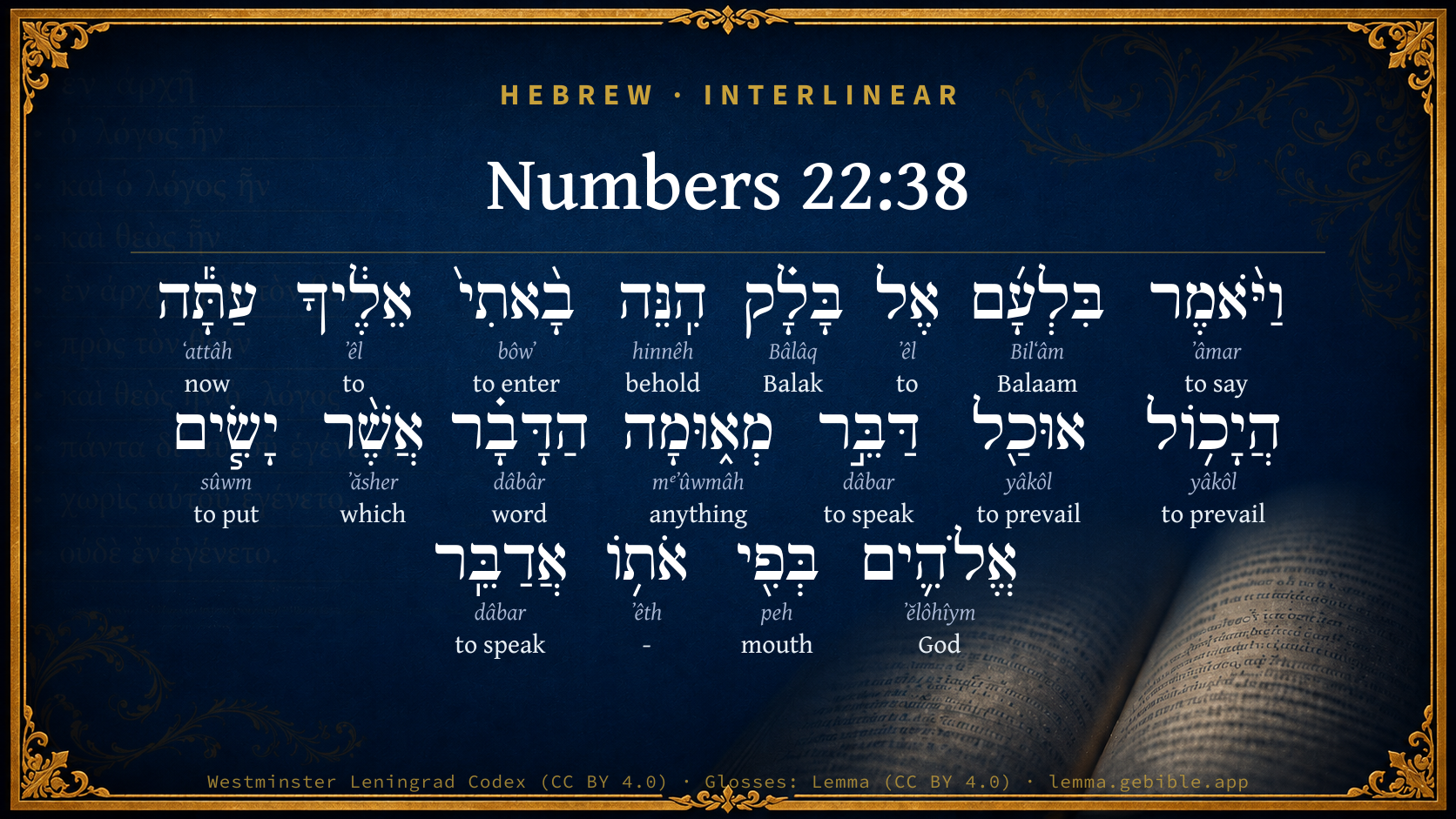
Hebrew (Westminster Leningrad Codex) Numbers 22:38 appears in the Hebrew Old Testament. The text above is from the Westminster Leningrad Codex. Each word links to its Strong’s number, a concise gloss, and parsing drawn from the Open Scriptures Hebrew Bible morphology. Click any word for its full Brown-Driver-Briggs (BDB) entry.
Download image
Cite this verse

Numbers 22:38 (World English Bible). Public Domain. Lemma interlinear Bible study tool, https://lemma.gebible.app/v/numbers/22/38.

Show BibTeX & RIS
BibTeX
RIS
English Translation
Balaam said to Balak, Behold, I have come to you: have I now any power at all to speak anything? the word that God puts in my mouth, that shall I speak.
World English Bible · Public Domain
Download a study sheet

One document with this verse’s original text, its word-by-word gloss line, the meaning frame, cross-references with their text, attributed commentary, and full source and license credits — printable, and it pastes into notes with its structure intact.

This verse Autodidact and up

Study sheet (.html) Plain text (.txt)

A passage Seminary Student

Up to 50 verses in one chapter. A passage sheet keeps up to 6 commentary sources and 12 cross-references per verse, in the order this page ranks them, and says so on the sheet whenever that leaves anything out. Ask for a single verse and you get the Autodidact verse sheet above.

Everything on this page stays free to read, with no account — the sheet is a download of what is already on screen, not access to it.

Want to remove ads? Support Godless Engineer
Compare translations 3

The same verse in 3 English versions, stacked beneath the original-language interlinear above. Click any original word for its lexicon entry.

Each is an independent rendering of the whole verse — the interlinear is not word-aligned to these translations.

Highlighted words mark where these versions differ — a whole-verse word diff, not a word-by-word alignment.

  • World English Bible Public Domain
    Balaam said to Balak, Behold, I have come to you: have I now any power at all to speak anything? the word that God puts in my mouth, that shall I speak.
  • King James Version Public Domain
    And Balaam said unto Balak, Lo, I am come unto thee: have I now any power at all to say any thing? the word that God putteth in my mouth, that shall I speak.
  • unfoldingWord Literal Text CC BY-SA 4.0
    And Balaam said to Balak, “Behold, I have come to you. Now, am I at all able to speak anything? The word that God puts in my mouth, it I will speak.”

unfoldingWord Literal Text — © unfoldingWord, licensed CC BY-SA 4.0. Word-aligned USFM3 via Door43 (git.door43.org/unfoldingWord/en_ult).

Versions to compare (up to 4)

3 of 4 selected

Show all 18 translations

Every available English version of this verse, each an independent rendering of the whole verse.

  • World English Bible Public Domain
    Balaam said to Balak, Behold, I have come to you: have I now any power at all to speak anything? the word that God puts in my mouth, that shall I speak.
  • Berean Standard Bible Public Domain
    “See, I have come to you,” Balaam replied, “but can I say just anything? I must speak only the word that God puts in my mouth.”
  • Majority Standard Bible Public Domain
    “See, I have come to you,” Balaam replied, “but can I say just anything? I must speak only the word that God puts in my mouth.”
  • King James Version Public Domain
    And Balaam said unto Balak, Lo, I am come unto thee: have I now any power at all to say any thing? the word that God putteth in my mouth, that shall I speak.
  • American Standard Version (1901) Public Domain
    And Balaam said unto Balak, Lo, I am come unto thee: have I now any power at all to speak anything? the word that God putteth in my mouth, that shall I speak.
  • Revised Version (1885) Public Domain
    And Balaam said unto Balak, Lo, I am come unto thee: have I now any power at all to speak any thing? the word that God putteth in my mouth, that shall I speak.
  • Geneva Bible (1599) Public Domain
    And Balaam made answere vnto Balak, Lo, I am come vnto thee, and can I nowe say any thing at all? the worde that God putteth in my mouth, that shall I speake.
  • Douay-Rheims (1899) Public Domain
    He answered him: Lo, here I am: shall I have power to speak any other thing but that which God shall put in my mouth?
  • Young's Literal Translation Public Domain
    And Balaam saith unto Balak, `Lo, I have come unto thee; now -- am I at all able to speak anything? the word which God setteth in my mouth -- it I do speak.'
  • Literal Standard Version CC BY-SA 4.0
    And Balaam says to Balak, “Behold, I have come to you; now, am I able to speak anything at all? The word which God sets in my mouth—it I speak.”
  • Unlocked Literal Bible CC BY-SA 4.0
    Then Balaam replied to Balak, “See, I have come to you. Do I now have any power to say anything? I can only say the words that God puts into my mouth.”
  • unfoldingWord Literal Text CC BY-SA 4.0
    And Balaam said to Balak, “Behold, I have come to you. Now, am I at all able to speak anything? The word that God puts in my mouth, it I will speak.”
  • Darby Bible Public Domain
    And Balaam said to Balak, Lo, I am come to thee; but shall I now be able at all to say anything? the word that God puts in my mouth, that shall I speak.
  • World Messianic Bible Public Domain
    Balaam said to Balak, “Behold, I have come to you. Have I now any power at all to speak anything? I will speak the word that God puts in my mouth.”
  • Webster's Bible Public Domain
    And Balaam said to Balak, Lo, I have come to thee: have I now any power at all to say any thing? the word that God putteth in my mouth, that shall I speak.
  • Free Bible Version CC BY-SA 4.0
    “Look, I'm here with you now, aren't I?” Balaam replied. “But do you think I can just say anything? I can only speak the words that God gives me to say.”
  • Bible in Basic English Public Domain
    Then Balaam said to Balak, Now I have come to you; but have I power to say anything? Only what God puts into my mouth may I say.
  • JPS Tanakh (1917) Public Domain
    And Balaam said unto Balak: 'Lo, I am come unto thee; have I now any power at all to speak any thing? the word that God putteth in my mouth, that shall I speak.'

Literal Standard Version (2020), Covenant Press — licensed CC BY-SA 4.0. Text via the HelloAO Bible API (eBible.org). Unlocked Literal Bible (unfoldingWord) — licensed CC BY-SA 4.0. Text via the HelloAO Bible API (eBible.org). unfoldingWord Literal Text — © unfoldingWord, licensed CC BY-SA 4.0. Word-aligned USFM3 via Door43 (git.door43.org/unfoldingWord/en_ult). Free Bible Version, Dr. Jonathan Gallagher — licensed CC BY-SA 4.0. Text via the HelloAO Bible API (eBible.org).

Word by word

More ways to search: Search by grammar → Find every occurrence → Compare this word →

Practice this passage: Drill this verse → Learn its vocabulary →

מְא֑וּמָה
mᵉʼûwmâh
H3972
“anything”
Noun, Common, Feminine, Singular, Absolute
Part of Speech
Noun
Type
Common
Gender
Feminine
Number
Singular
State
Absolute
Full BDB Definition

Origin: apparently a form of H3971

TWOT: 1136

anything
  1. וַיֹּ֨אמֶר ʼâmar H559 “and · to say” Conjunction + Verb, Qal, Sequential Imperfect, 3rd Person, Masculine, Singular
  2. בִּלְעָ֜ם Bilʻâm H1109 “Balaam” Noun, Proper
  3. אֶל ʼêl H413 “to” Preposition
  4. בָּלָ֗ק Bâlâq H1111 “Balak” Noun, Proper
  5. הִֽנֵּה hinnêh H2009 “behold” Particle, Demonstrative
  6. בָ֨אתִי֙ bôwʼ H935 “to enter” Verb, Qal, Perfect, 1st Person, Common, Singular
  7. אֵלֶ֔יךָ ʼêl H413 “to · you” Preposition + Suffix, Personal, 2nd Person, Masculine, Singular
  8. עַתָּ֕ה ʻattâh H6258 “now” Adverb
  9. הֲיָכ֥וֹל yâkôl H3201 “to prevail” Particle, Interrogative + Verb, Qal, Infinitive Absolute
  10. אוּכַ֖ל yâkôl H3201 “to prevail” Verb, Qal, Imperfect, 1st Person, Common, Singular
  11. דַּבֵּ֣ר dâbar H1696 “to speak” Verb, Piel, Infinitive Construct
  12. הַדָּבָ֗ר dâbâr H1697 “the · word” Particle, Definite Article + Noun, Common, Masculine, Singular, Absolute
  13. אֲשֶׁ֨ר ʼăsher H834 “which” Particle, Relative
  14. יָשִׂ֧ים sûwm H7760 “to put” Verb, Qal, Imperfect, 3rd Person, Masculine, Singular
  15. אֱלֹהִ֛ים ʼĕlôhîym H430 “God(s)” Noun, Common, Masculine, Plural, Absolute
  16. בְּפִ֖י peh H6310 “in/at · mouth · my” Preposition + Noun, Common, Masculine, Singular, Construct + Suffix, Personal, 1st Person, Common, Singular
  17. אֹת֥וֹ ʼêth H853 “- · him” Particle, Direct Object + Suffix, Personal, 3rd Person, Masculine, Singular
  18. אֲדַבֵּֽר dâbar H1696 “to speak” Verb, Piel, Imperfect, 1st Person, Common, Singular

About this verse

These counts appear in no published source. They are computed here, from the morphology-tagged text and Lemma’s own curated glosses. What Lemma adds →

19
words
16
distinct lemmas
Pentateuch
section

Shared distinctive vocabulary

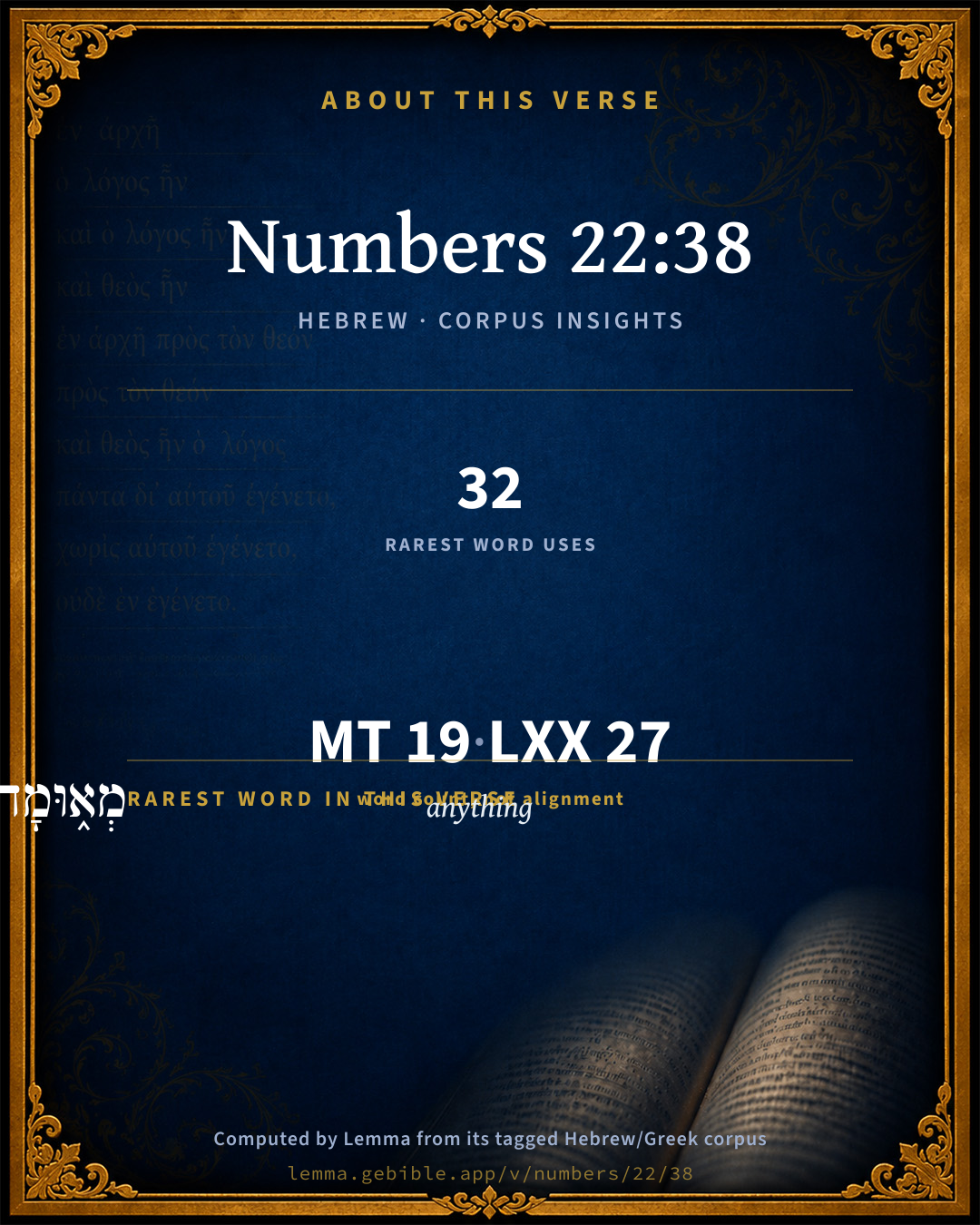
מְא֑וּמָה anything H3972 occurs in 32 verses of the Hebrew Bible. Also found in:

Grammatical profile

  • 7 verbs
  • 6 nouns
  • 2 prepositions
  • 1 adverb
  • 3 particles

Verb forms

  • וַיֹּ֨אמֶר Qal · Sequential Imperfect
  • בָ֨אתִי֙ Qal · Perfect
  • הֲיָכ֥וֹל Qal · Infinitive Absolute
  • אוּכַ֖ל Qal · Imperfect
  • דַּבֵּ֣ר Piel · Infinitive Construct
  • יָשִׂ֧ים Qal · Imperfect
  • אֲדַבֵּֽר Piel · Imperfect

Repetition

Words recur within this verse — often emphatic in Hebrew:

  • הֲיָכ֥וֹל to prevail H3201 ×2
  • דַּבֵּ֣ר to speak H1696 ×2
  • אֶל to H413 ×2

Hebrew & Septuagint length

In English translation the verse runs 32 words from the Hebrew and 32 from the Septuagint (LXX English) — the same length.

A rough comparison of the two English renderings, which tokenize alike — not a word-level alignment.

Word counts can differ between the Hebrew and the Greek without any difference in meaning — e.g. the Hebrew direct-object marker אֵת has no separate Greek word, and Greek often adds the article ὁ.

In the original languages it is 19 Hebrew tokens and 27 Greek tokens — but the two are counted differently (Hebrew bundles its prefixes and suffixes into one token; the Greek is in lemma form), so that isn’t a like-for-like length.

Cross-references

12

Topical passages linked to Numbers 22:38 in the Treasury of Scripture Knowledge — connected by theme and wording, ordered by reader-vote popularity; previews shown in the World English Bible.

  • Numbers 22:18 Balaam answered the servants of Balak, If Balak would give me his house full of silver and gold, I can't go beyond the word of Yahweh my God, to do less or more.
  • Proverbs 19:21 There are many plans in a man's heart, But Yahweh's counsel will prevail.
  • Numbers 23:16 Yahweh met Balaam, and put a word in his mouth, and said, Return to Balak, and thus shall you speak.
  • Numbers 23:26 But Balaam answered Balak, Didn't I tell you, saying, All that Yahweh speaks, that I must do?
  • Numbers 24:13 If Balak would give me his house full of silver and gold, I can't go beyond the word of Yahweh, to do either good or bad of my own mind; what Yahweh speaks, that will I speak?
  • 1 Kings 22:14 Micaiah said, As Yahweh lives, what Yahweh says to me, that will I speak.
  • 2 Chronicles 18:13 Micaiah said, As Yahweh lives, what my God says, that will I speak.
  • Psalms 33:10 Yahweh brings the counsel of the nations to nothing. He makes the thoughts of the peoples to be of no effect.
  • Psalms 76:10 Surely the wrath of man praises you. The survivors of your wrath are restrained.
  • Isaiah 44:25 who frustrates the signs of the liars, and makes diviners mad; who turns wise men backward, and makes their knowledge foolish;
  • Isaiah 46:10 declaring the end from the beginning, and from ancient times things that are not [yet] done; saying, My counsel shall stand, and I will do all my pleasure;
  • Isaiah 47:12 Stand now with your enchantments, and with the multitude of your sorceries, in which you have labored from your youth; if so be you shall be able to profit, if so be you may prevail.

Cross-references courtesy of OpenBible.info (CC BY 4.0).

Hebrew and Greek witnesses Masoretic Hebrew ↔ Greek Septuagint

The same verse in the two great witnesses to the Old Testament, shown verse-for-verse.

These are two independent witnesses, not word-aligned to each other, and the Septuagint is shown in lemma (dictionary) form.

Hebrew Numbers 22:38 Masoretic · Westminster Leningrad Codex

וַיֹּ֨אמֶר בִּלְעָ֜ם אֶל בָּלָ֗ק הִֽנֵּה בָ֨אתִי֙ אֵלֶ֔יךָ עַתָּ֕ה הֲיָכ֥וֹל אוּכַ֖ל דַּבֵּ֣ר מְא֑וּמָה הַדָּבָ֗ר אֲשֶׁ֨ר יָשִׂ֧ים אֱלֹהִ֛ים בְּפִ֖י אֹת֥וֹ אֲדַבֵּֽר

Balaam said to Balak, Behold, I have come to you: have I now any power at all to speak anything? the word that God puts in my mouth, that shall I speak.

World English Bible · Public Domain

Greek LXX Numbers 22:38 Septuagint · lemma form

καί εἶπον βαλααμ πρός βαλακ ἰδού ἥκω πρός σύ νῦν δυνατός εἰμί λαλέω τις ὁ ῥῆμα ὅς ἐάν βάλλω ὁ θεός εἰς ὁ στόμα ἐγώ οὗτος λαλέω

And Balaam said to Balac, Behold, I am now come to you: shall I be able to say anything? the word which God shall put into my mouth, that I shall speak.

LXX2012 (modern English Septuagint) · Public Domain

Hebrew: Westminster Leningrad Codex (CC BY 4.0). Greek: Septuagint (public domain); English from LXX2012 (modern English Septuagint) (Public Domain). How the Septuagint differs from the Hebrew →

Targum (Aramaic paraphrase)

2

The Targum is the ancient Jewish Aramaic paraphrase of the Hebrew Scriptures — an interpretive translation, not the Hebrew text itself. Onkelos (literal) and Pseudo-Jonathan (expansive) render the Torah, and Jonathan the Prophets. Coverage is partial: where no permissively-licensed English translation exists for a verse, only the Aramaic is shown. This is verse-level text, not a word-by-word alignment to the Hebrew.

  1. Targum Onkelos Torah (Genesis–Deuteronomy)
    וַאֲמַר בִּלְעָם לְבָלָק הָא אֲתֵיתִי לְוָתָךְ כְּעַן הֲמֵיכַל יְכִלְנָא לְמַלָלָא מִדַעַם פִּתְגָמָא דִי יְשַׁוֵי יְיָ בְּפוּמִי יָתֵיהּ אֲמַלֵיל

    (no public-domain English translation for this verse)

    Targum Onkelos — Aramaic: “Onkelos Genesis” (public domain); “Onkelos Exodus” (public domain); “Onkelos Leviticus” (public domain); “Onkelos Numbers” (public domain); “Onkelos Deuteronomy” (public domain). English: “Sefaria Community Translation” (CC0 1.0 (public-domain dedication)); “J.W. Etheridge. The Targums of Onkelos and Jonathan Ben Uzziel on the Pentateuch. London: Longmans, Green, 1862” (public domain). Text via Sefaria.

  2. Targum Pseudo-Jonathan Torah (Genesis–Deuteronomy)
    וַאֲמַר בִּלְעָם לְבָלָק הָא אָתֵיתִי לְוָתָךְ כְּדוֹן הֲמֵיכַל יְכִילְנָא לְמַלָלָא מִדַעַם פִּתְגָמָא דִיזַמֵן יְיָ בְּפוּמִי יָתֵיהּ אֲמַלֵיל

    And Bileam said to Balak, Behold, I have come to thee; yet now am I able to say any thing to thee? But the word that the Lord shall ordain for my mouth, that I must speak.

    Targum Pseudo-Jonathan — Aramaic: “Targum Jonathan on Genesis” (public domain); “Targum Jonathan on Exodus” (public domain); “Targum Jonathan on Leviticus” (public domain); “Targum Jonathan on Numbers” (public domain); “Targum Jonathan on Deuteronomy” (public domain). English: “The Targum of Jonathan ben Uzziel, trans. J. W. Etheridge, London, 1862” (public domain). Text via Sefaria.

Commentary

Notes on Numbers 22:38 from classic Christian and Jewish commentators (each source and its license shown beneath its notes). The classic Christian expositions comment on the surrounding passage and are grouped to its opening verse, so a note may address several verses; the Jewish commentaries on the Tanakh (Rashi and others) are per-verse, so they appear only where the commentator wrote on this verse.

Lemma curates 59 commentaries, every one of them public domain or Creative Commons licensed, each selected and text-cleaned for this edition rather than reprinted as found. About our sources →

Tyndale Open Study Notes

Tyndale Open Resources

22:38 Balaam’s reply reflected the lesson he had learned in the donkey incident (cp. 22:20, 35).

Tyndale Open Study Notes — © Tyndale Open Resources, licensed CC BY-SA 4.0. Text via the HelloAO Bible API.

Geneva Bible (1599)

Geneva Bible translators

Of myself I can speak nothing: only what God revealeth, that will I utter, seem it good or bad.

Geneva Bible (1599) marginal notes — public domain. Text via Bolls.life.

Jamieson, Fausset & Brown

Robert Jamieson, A. R. Fausset & David Brown

the word that God putteth in my mouth, that shall I speak--This appears a pious answer. It was an acknowledgment that he was restrained by a superior power.

Jamieson, Fausset & Brown — Commentary Critical and Explanatory on the Whole Bible (1871) — public domain (CC PDM 1.0). Text via the HelloAO Bible API.

Adam Clarke's Commentary

Verse 38. The word that God putteth in my mouth, that shall I speak.] Here was a noble resolution, and he was certainly faithful to it: though he wished to please the king, and get wealth and honour, yet he would not displease God to realize even these bright prospects. Many who slander this poor semi-antinomian prophet, have not half his piety.

Adam Clarke's Commentary on the Bible (1810–1826) — public domain. Text from a community e-Sword/MySword module.

John Gill's Exposition

And it came to pass on the morrow,.... The day after the arrival of Balaam at Balak's royal seat, and after the entertainment given him, and the princes, "on the morning" (y) of that day, as the word signifies; and perhaps early in the morning, the king eager to be about business, and get the people of Israel cursed if possible as soon as could be:

that Balak took Balaam and brought him up into the high places of Baal; where groves were planted, and altars erected to that "idol" and which the Targum of Jonathan calls the idol Peor, the same with Baalpeor, Num 25:3 which might be their god Chemosh, the same with Bacchus or Priapus:

that thence he might see the utmost part of the people; the whole host of Israel, even to the extreme part of it; the camp of Dan, as the Targum of Jonathan, which brought up the rear; he had him to those high places, both that he might have a better view of the whole body of the people, and know how they lay, and to direct his curses at them, and that success might attend the undertaking, these being places of religious worship. Josephus says (z) those high places were sixty furlongs or seven and one half miles from the camp of Israel.

(y) in matutino, Montanus; mane, V. L. Junius & Tremellius, Piscator. (z) Antiqu. l. 4. c. 6. sect. 4.

Next: Numbers Chapter 23

John Gill's Exposition of the Whole Bible (1746–1763) — public domain (CC PDM 1.0). Text via the HelloAO Bible API.

Matthew Poole's English Annotations

Any thing, to wit, agreeable to thy expectation or my own inclination.

That shall I speak; I am forced to do so by his superior power, and therefore be not offended with me, if I speak things unpleasing to thee.

Matthew Poole's English Annotations on the Holy Bible (1683–1685) — public domain. Text from a community e-Sword/MySword module.

Whedon's Commentary on the Bible

Daniel D. Whedon

38. That shall I speak — With this reply he sought, at the very outset, to soften down the expectations of Balak, inasmuch as he concluded at once that his coming was a proof of his willingness to curse. For the angel with his drawn sword was still before his eyes, and the miraculous words were sounding in his ears, and he dared not do otherwise than as he was commanded. It is a singular fact that we find the remainder of this interesting dialogue not in the Mosaic record but in the prophet Micah, Mic_6:5-8; Num_22:6-7, disclose the agony of the king, and Num_22:8 the lofty conceptions of the Gentile seer. This reply of Balaam breathes a spirit of righteousness as lofty as any utterance found in Mosaism.

Daniel D. Whedon (gen. ed.), Commentary on the Old and New Testaments (1874–1909) — public domain. Text from a community e-Sword module.

Keil & Delitzsch

C. F. Keil & F. Delitzsch

But Balaam, being still mindful of the warning which he had just received from God, replied, "Lo, I am come unto thee now: have I then any power to speak anything (sc., of my own accord)? "The word which God puts into my mouth, that will I speak." With this reply he sought, at the very outset, to soften down the expectations of Balak, inasmuch as he concluded at once that his coming was a proof of his willingness to curse (Hengstenberg). As a matter of fact, Balaam did not say anything different to the king form what he had explained to his messengers at the very first (cf. Num 22:18). But just as he had not told them the whole truth, but had concealed the fact that Jehovah, his God, had forbidden the journey at first, on the ground that he was not to curse the nation that was blessed (Num 22:12), so he could not address the king in open, unambiguous words.

Keil & Delitzsch — Biblical Commentary on the Old Testament (1861–1891) — public domain (CC PDM 1.0). Text via the HelloAO Bible API. (Old Testament only.)

unfoldingWord translationNotes

Door43 World Missions Community

Do I now have any power to say anything?

Balaam uses this rhetorical question to tell Balak that he will not be able to do everything that Balak asks him to do. This can be translated as a statement. AT: "But I have no power to say anything I want" (See: Rhetorical Question)

the words that God puts into my mouth

The message is spoken of as if it is something that God put into his mouth. AT: "the message that God wants me to say" (See: Metaphor)

Kiriath Huzoth

This is the name of a town. (See: How to Translate Names)

some meat

"some of the meat from the sacrifices"

translationWords

power

word

God

sacrifice

cow

ewe

unfoldingWord translationNotes — © Distant Shores Media and the Door43 World Missions Community, licensed CC BY-SA 4.0. Source: git.door43.org/Door43/en_tn.

Lesson kit

Teaching starters — assembled from the data on this page, not authored interpretation. Every prompt links to the verse data it draws on. Edit before teaching.

Numbers, in the Pentateuch, opens this verse with 19 words (16 distinct Hebrew lemmas). Its most distinctive word is mᵉʼûwmâh (“anything”). A historical commentator’s framing appears above. Read the whole chapter for the surrounding context.

Discussion questions

  1. The word mᵉʼûwmâh carries the sense “anything.” How does it shape the verse?
  2. How does Genesis 22:12, which shares the word «anything», read alongside this verse?
  3. What does the repetition of “to prevail” (2× in this one verse) do in this verse?
  4. The translations on this page render this verse differently — a whole-verse word diff, not a word-by-word alignment. What might account for the different wordings?
  5. «וַיֹּ֨אמֶר» is a Qal Sequential Imperfect verb. How does that grammatical form shape the action described?
  6. Compare how Tyndale Open Study Notes and Geneva Bible (1599) read this verse. Where do they agree or differ?

Things to notice

Reading settings

Reading text

Shown beneath each verse's original-language words.

Old Testament
Old Testament edition

Read the OT as the Masoretic Hebrew (MT) or the Greek Septuagint (LXX).

English shown for the Greek Septuagint (in the Hebrew ↔ Greek comparison).

Comparing translations? Open the Compare panel on any verse page to stack up to four side by side.