1 Samuel 3:2

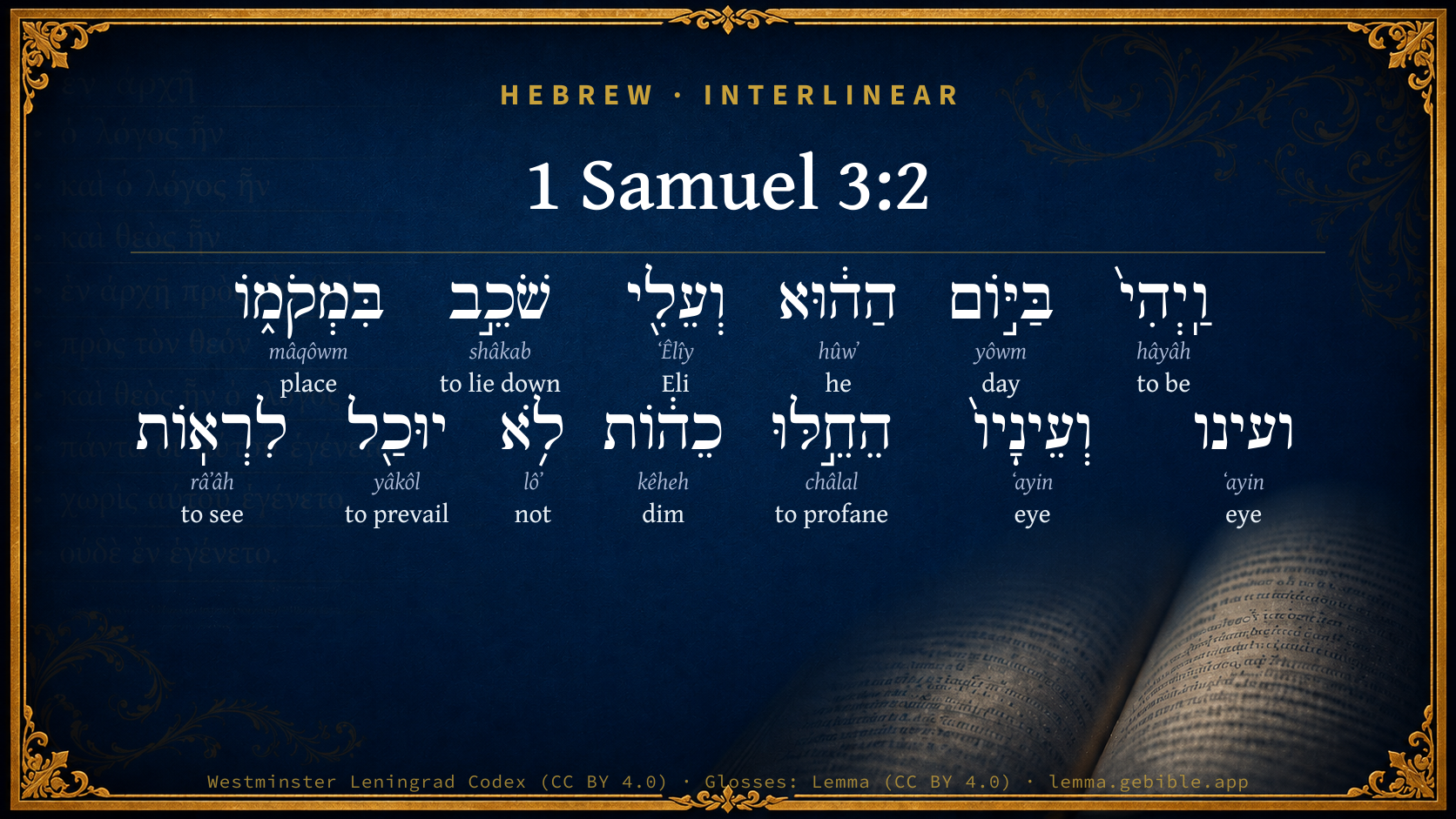
Hebrew (Westminster Leningrad Codex) 1 Samuel 3:2 appears in the Hebrew Old Testament. The text above is from the Westminster Leningrad Codex. Each word links to its Strong’s number, a concise gloss, and parsing drawn from the Open Scriptures Hebrew Bible morphology. Click any word for its full Brown-Driver-Briggs (BDB) entry.
Download image
Cite this verse

1 Samuel 3:2 (World English Bible). Public Domain. Lemma interlinear Bible study tool, https://lemma.gebible.app/v/1-samuel/3/2.

Show BibTeX & RIS
BibTeX
RIS
English Translation
It happened at that time, when Eli was laid down in his place (now his eyes had begun to grow dim, so that he could not see),
World English Bible · Public Domain
Download a study sheet

One document with this verse’s original text, its word-by-word gloss line, the meaning frame, cross-references with their text, attributed commentary, and full source and license credits — printable, and it pastes into notes with its structure intact.

This verse Autodidact and up

Study sheet (.html) Plain text (.txt)

A passage Seminary Student

Up to 50 verses in one chapter. A passage sheet keeps up to 6 commentary sources and 12 cross-references per verse, in the order this page ranks them, and says so on the sheet whenever that leaves anything out. Ask for a single verse and you get the Autodidact verse sheet above.

Everything on this page stays free to read, with no account — the sheet is a download of what is already on screen, not access to it.

Want to remove ads? Support Godless Engineer
Compare translations 3

The same verse in 3 English versions, stacked beneath the original-language interlinear above. Click any original word for its lexicon entry.

Each is an independent rendering of the whole verse — the interlinear is not word-aligned to these translations.

Highlighted words mark where these versions differ — a whole-verse word diff, not a word-by-word alignment.

  • World English Bible Public Domain
    It happened at that time, when Eli was laid down in his place (now his eyes had begun to grow dim, so that he could not see),
  • King James Version Public Domain
    And it came to pass at that time, when Eli was laid down in his place, and his eyes began to wax dim, that he could not see;
  • unfoldingWord Literal Text CC BY-SA 4.0
    And it happened in that day that Eli was lying down in his place. Now his eyes had begun dim; he was not able to see.

unfoldingWord Literal Text — © unfoldingWord, licensed CC BY-SA 4.0. Word-aligned USFM3 via Door43 (git.door43.org/unfoldingWord/en_ult).

Versions to compare (up to 4)

3 of 4 selected

Show all 18 translations

Every available English version of this verse, each an independent rendering of the whole verse.

  • World English Bible Public Domain
    It happened at that time, when Eli was laid down in his place (now his eyes had begun to grow dim, so that he could not see),
  • Berean Standard Bible Public Domain
    And at that time Eli, whose eyesight had grown so dim that he could not see, was lying in his room.
  • Majority Standard Bible Public Domain
    And at that time Eli, whose eyesight had grown so dim that he could not see, was lying in his room.
  • King James Version Public Domain
    And it came to pass at that time, when Eli was laid down in his place, and his eyes began to wax dim, that he could not see;
  • American Standard Version (1901) Public Domain
    And it came to pass at that time, when Eli was laid down in his place (now his eyes had begun to wax dim, so that he could not see),
  • Revised Version (1885) Public Domain
    And it came to pass at that time, when Eli was laid down in his place, (now his eyes had begun to wax dim, that he could not see,)
  • Geneva Bible (1599) Public Domain
    And at that time, as Eli lay in his place, his eyes began to waxe dimme that he could not see.
  • Douay-Rheims (1899) Public Domain
    And it came to pass one day when Heli lay in his place, and his eyes were grown dim, that he could not see:
  • Young's Literal Translation Public Domain
    And it cometh to pass, at that time, that Eli is lying down in his place, and his eyes have begun to be dim -- he is not able to see.
  • Literal Standard Version CC BY-SA 4.0
    And it comes to pass, at that time, that Eli is lying down in his place, and his eyes have begun [to be] faded—he is not able to see.
  • Unlocked Literal Bible CC BY-SA 4.0
    At that time, when Eli, whose eyesight had begun to grow dim so that he could not see well, was lying down in his own bed.
  • unfoldingWord Literal Text CC BY-SA 4.0
    And it happened in that day that Eli was lying down in his place. Now his eyes had begun dim; he was not able to see.
  • Darby Bible Public Domain
    And it came to pass at that time, when Eli lay in his place (now his eyes began to grow dim, he could not see),
  • World Messianic Bible Public Domain
    At that time, when Eli was laid down in his place (now his eyes had begun to grow dim, so that he could not see),
  • Webster's Bible Public Domain
    And it came to pass at that time, when Eli was laid down in his place, and his eyes began to grow dim, that he could not see;
  • Free Bible Version CC BY-SA 4.0
    One evening, Eli had gone to bed in his room. His eyes were now so weak that he couldn't see.
  • Bible in Basic English Public Domain
    And at that time, when Eli was resting in his place, (now his eyes were becoming clouded so that he was not able to see,)
  • JPS Tanakh (1917) Public Domain
    And it came to pass at that time, when Eli was laid down in his place — now his eyes had begun to wax dim, that he could not see—

Literal Standard Version (2020), Covenant Press — licensed CC BY-SA 4.0. Text via the HelloAO Bible API (eBible.org). Unlocked Literal Bible (unfoldingWord) — licensed CC BY-SA 4.0. Text via the HelloAO Bible API (eBible.org). unfoldingWord Literal Text — © unfoldingWord, licensed CC BY-SA 4.0. Word-aligned USFM3 via Door43 (git.door43.org/unfoldingWord/en_ult). Free Bible Version, Dr. Jonathan Gallagher — licensed CC BY-SA 4.0. Text via the HelloAO Bible API (eBible.org).

Word by word

More ways to search: Search by grammar → Find every occurrence → Compare this word →

Practice this passage: Drill this verse → Learn its vocabulary →

כֵה֔וֹת
kêheh
H3544
“dim”
Adjective, Adjective, Feminine, Plural, Absolute
Part of Speech
Adjective
Type
Adjective
Gender
Feminine
Number
Plural
State
Absolute
Full BDB Definition

Origin: from H3543

TWOT: 957a

dim, dull, colourless, be dark, faint
  1. וַֽיְהִי֙ hâyâh H1961 “and · to be” Conjunction + Verb, Qal, Sequential Imperfect, 3rd Person, Masculine, Singular
  2. בַּיּ֣וֹם yôwm H3117 “in/at the · day” Preposition, Determined + Noun, Common, Masculine, Singular, Absolute
  3. הַה֔וּא hûwʼ H1931 “the · he” Particle, Definite Article + Pronoun, Personal, 3rd Person, Masculine, Singular
  4. וְעֵלִ֖י ʻÊlîy H5941 “and · Eli” Conjunction + Noun, Proper
  5. שֹׁכֵ֣ב shâkab H7901 “lying down” Verb, Qal, Participle Active, Masculine, Singular, Absolute
  6. בִּמְקֹמ֑וֹ mâqôwm H4725 “in/at · place · his” Preposition + Noun, Common, Masculine, Singular, Construct + Suffix, Personal, 3rd Person, Masculine, Singular
  7. ועינו ʻayin H5869 “and · eye · his” Conjunction + Noun, Common, Both, Singular, Construct + Suffix, Personal, 3rd Person, Masculine, Singular
  8. וְעֵינָיו֙ ʻayin H5869 “and · eyes · his” Conjunction + Noun, Common, Both, Dual, Construct + Suffix, Personal, 3rd Person, Masculine, Singular
  9. הֵחֵ֣לּוּ châlal H2490 “to profane” Verb, Hiphil, Perfect, 3rd Person, Common, Plural
  10. לֹ֥א lôʼ H3808 “not” Particle, Negative
  11. יוּכַ֖ל yâkôl H3201 “to prevail” Verb, Qal, Imperfect, 3rd Person, Masculine, Singular
  12. לִרְאֽוֹת râʼâh H7200 “to see” Preposition + Verb, Qal, Infinitive Construct

About this verse

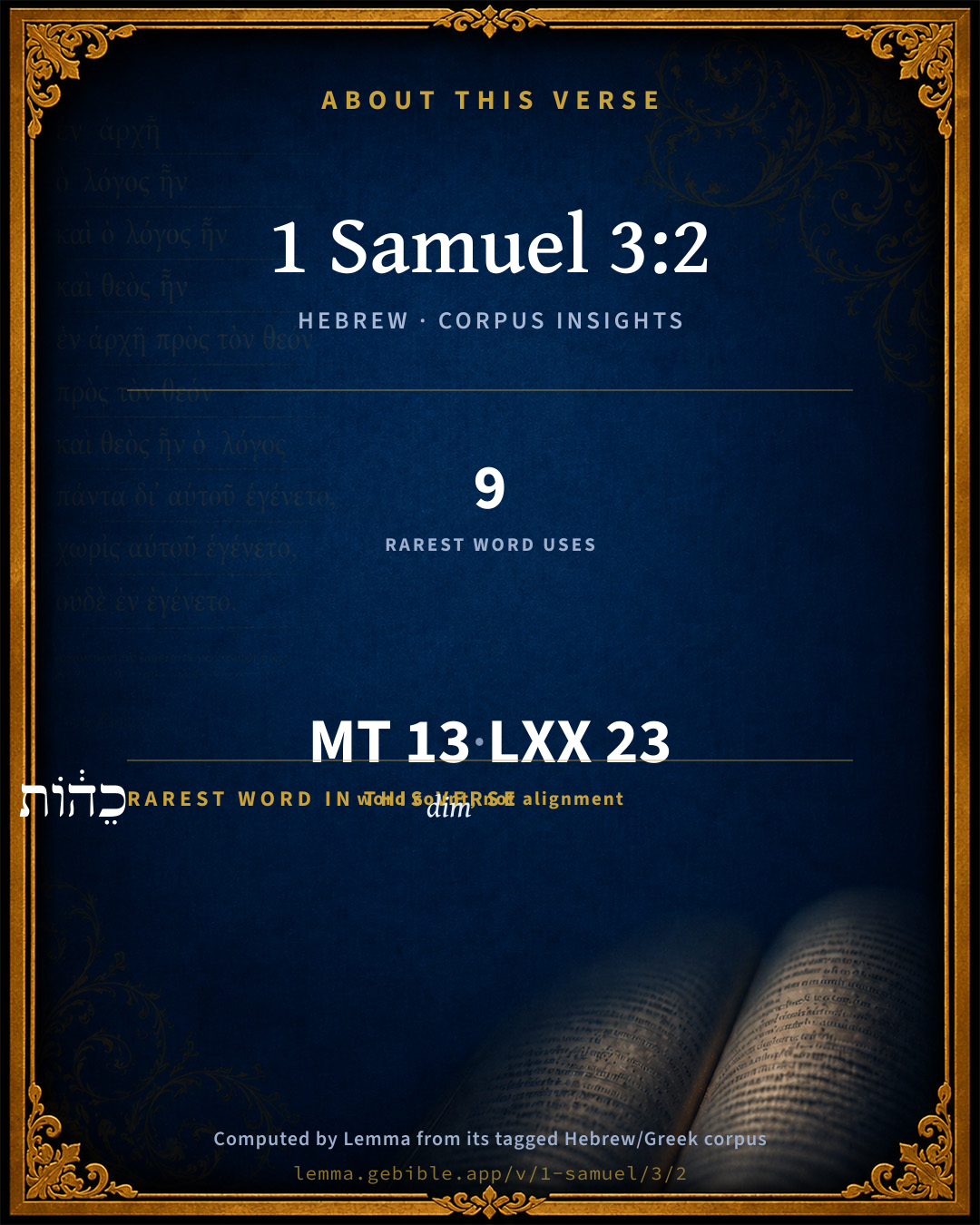
These counts appear in no published source. They are computed here, from the morphology-tagged text and Lemma’s own curated glosses. What Lemma adds →

13
words
12
distinct lemmas
Historical
section

Notable vocabulary

The rarest word here is כֵה֔וֹת dim H3544 — appearing just 9 times in the whole Hebrew Bible.

Shared distinctive vocabulary

כֵה֔וֹת dim H3544 occurs in 9 verses of the Hebrew Bible. Also found in:

Grammatical profile

  • 5 verbs
  • 5 nouns
  • 1 adjective
  • 1 pronoun
  • 1 particle

Verb forms

  • וַֽיְהִי֙ Qal · Sequential Imperfect
  • שֹׁכֵ֣ב Qal · Participle Active
  • הֵחֵ֣לּוּ Hiphil · Perfect
  • יוּכַ֖ל Qal · Imperfect
  • לִרְאֽוֹת Qal · Infinitive Construct

Repetition

A word recurs within this verse — often emphatic in Hebrew:

  • ועינו eye H5869 ×2

Hebrew & Septuagint length

In English translation the verse runs 27 words from the Hebrew and 25 from the Septuagint (LXX English) — closely comparable.

A rough comparison of the two English renderings, which tokenize alike — not a word-level alignment.

Word counts can differ between the Hebrew and the Greek without any difference in meaning — e.g. the Hebrew direct-object marker אֵת has no separate Greek word, and Greek often adds the article ὁ.

In the original languages it is 13 Hebrew tokens and 23 Greek tokens — but the two are counted differently (Hebrew bundles its prefixes and suffixes into one token; the Greek is in lemma form), so that isn’t a like-for-like length.

Cross-references

7

Topical passages linked to 1 Samuel 3:2 in the Treasury of Scripture Knowledge — connected by theme and wording, ordered by reader-vote popularity; previews shown in the World English Bible.

  • 1 Samuel 4:15 Now Eli was ninety-eight years old; and his eyes were set, so that he could not see.
  • Genesis 27:1 It happened, that when Isaac was old, and his eyes were dim, so that he could not see, he called Esau his elder son, and said to him, "My son?" He said to him, "Here I am."
  • Genesis 48:10 Now the eyes of Israel were dim for age, so that he couldn't see. He brought them near to him; and he kissed them, and embraced them.
  • Psalms 90:10 The days of our years are seventy, Or even by reason of strength eighty years; Yet their pride is but labor and sorrow, For it passes quickly, and we fly away.
  • Genesis 48:19 His father refused, and said, "I know, my son, I know. He also will become a people, and he also will be great. However, his younger brother will be greater than he, and his seed will become a multitude of nations."
  • 1 Samuel 2:22 Now Eli was very old; and he heard all that his sons did to all Israel, and how that they lay with the women who served at the door of the tent of meeting.
  • Ecclesiastes 12:3 In the day when the keepers of the house shall tremble, And the strong men shall bow themselves, And the grinders cease because they are few, And those who look out of the windows are darkened,

Cross-references courtesy of OpenBible.info (CC BY 4.0).

Hebrew and Greek witnesses Masoretic Hebrew ↔ Greek Septuagint

The same verse in the two great witnesses to the Old Testament, shown verse-for-verse.

These are two independent witnesses, not word-aligned to each other, and the Septuagint is shown in lemma (dictionary) form.

Hebrew 1 Samuel 3:2 Masoretic · Westminster Leningrad Codex

וַֽיְהִי֙ בַּיּ֣וֹם הַה֔וּא וְעֵלִ֖י שֹׁכֵ֣ב בִּמְקֹמ֑וֹ ועינו וְעֵינָיו֙ הֵחֵ֣לּוּ כֵה֔וֹת לֹ֥א יוּכַ֖ל לִרְאֽוֹת

It happened at that time, when Eli was laid down in his place (now his eyes had begun to grow dim, so that he could not see),

World English Bible · Public Domain

Greek LXX 1 Samuel 3:2 Septuagint · lemma form

καί γίγνομαι ἐν ὁ ἡμέρα ἐκεῖνος καί ηλι καταεὕδω ἐν ὁ τόπος αὐτός καί ὁ ὀφθαλμός αὐτός ἄρχω βαρύνω καί οὐ δύναμαι βλέπω

And it came to pass at that time that Heli was sleeping in his place; and his eyes began to fail, and could not see.

LXX2012 (modern English Septuagint) · Public Domain

On this verse, The Cambridge Bible for Schools and Colleges discusses the Septuagint’s reading. Read the note in Commentary ↓

Hebrew: Westminster Leningrad Codex (CC BY 4.0). Greek: Septuagint (public domain); English from LXX2012 (modern English Septuagint) (Public Domain). How the Septuagint differs from the Hebrew →

Targum (Aramaic paraphrase)

1

The Targum is the ancient Jewish Aramaic paraphrase of the Hebrew Scriptures — an interpretive translation, not the Hebrew text itself. Onkelos (literal) and Pseudo-Jonathan (expansive) render the Torah, and Jonathan the Prophets. Coverage is partial: where no permissively-licensed English translation exists for a verse, only the Aramaic is shown. This is verse-level text, not a word-by-word alignment to the Hebrew.

  1. Targum Jonathan Prophets (Joshua–Malachi)
    וַהֲוָה בְּיוֹמַיָא הָאִינוּן וְעֵלִי שְׁכִיב בְּאַתְרֵיהּ וְעֵינוֹהִי שְׁרִיאוּ לְמִכְהֵי לָא יָכִיל לְמֶחֱזֵי:

    (no public-domain English translation for this verse)

    Targum Jonathan — Aramaic: “Mikraot Gedolot” (public domain). English: “Sefaria Community Translation” (CC0 1.0 (public-domain dedication)); “London "Chaldee Paraphrase," 1871” (public domain). Text via Sefaria.

Commentary

Notes on 1 Samuel 3:2 from classic Christian and Jewish commentators (each source and its license shown beneath its notes). The classic Christian expositions comment on the surrounding passage and are grouped to its opening verse, so a note may address several verses; the Jewish commentaries on the Tanakh (Rashi and others) are per-verse, so they appear only where the commentator wrote on this verse.

Lemma curates 59 commentaries, every one of them public domain or Creative Commons licensed, each selected and text-cleaned for this edition rather than reprinted as found. About our sources →

Trapp's Complete Commentary

John Trapp

1Sa 3:2 And it came to pass at that time, when Eli [was] laid down in his place, and his eyes began to wax dim, [that] he could not see;

Ver. 2. At that time.] Much about that time that the aforesaid prophet had spoken to Eli, {1Sa 2:27-36} or not long after. Clouds cluster against a storm. Or rather, At that time when the word of God was precious.

That he could not see.] Tηλαυγες, clearly, and far off. The Rabbins interpret it of the eyes of his mind also, as that he had lost the gift of prophecy: and do therefore note a special providence, that when one light failed, God set up another, viz., Samuel.

John Trapp, A Commentary or Exposition upon All the Books of the Old and New Testament (1647–1656) — public domain. Text from a community e-Sword module.

The Biblical Illustrator

Joseph S. Exell

1Sa_3:2-14

And it came to pass at that time, when Eli was laid down in his place.

The character of Eli

Eli and Samuel.

1. They are contrasted in point of years: for the one is a boy, the other a grey-headed old man; and if it were for only this, the chapter would be one of deep interest. For it is interesting always to see a friendship between the old and the young. It is striking to see the aged one retaining so much of freshness and simplicity as not to repel the sympathies of boyhood. It is surprising to see the younger one so advanced and thoughtful, as not to find dull the society of one who has outlived excitability and passion.

2. They are contrasted again in point of office Both are judges of Israel. But Eli is a judge rendering up his trust, and closing his public career. Samuel is a judge entering upon his office. The venerable judge of forty years is sentenced by the judge elect.

3. Still more striking is the contrast in point of character. Here the difference of inferiority is on the wrong side. It is the young who is counselling, supporting, admonishing the old

4. Once more, we have here the contrast between sludge by office and a judge by Divine call. It is wise after an earthly sort to have an appointed succession. Hereditary judges, hereditary nobles, hereditary sovereigns: without them human life would run into inextricable confusion. Nevertheless, such earthly arrangements only represent the heavenly order. The Divine order of Government is the rule of the Wise and Good. From time to time, one who has qualifications direct from God is made, in Scripture, to stand side by side with one who has his qualifications only from office or earthly appointment; and then the contrast is marvellous indeed. And thus by the side of Eli, the judge by office, stands Samuel, the judge by Divine call: qualified by wisdom, insight, will, resting on obedience, to guide and judge Gods people Israel. Very instructive are the contrasts of this chapter.

I. Elis character.

II. Elis doom. Elis character has two sides; we will take the bright side first. The first point remarkable in him is the absence of envy. Eli furthers Samuels advancement, and assists it to his own detriment. Gods priest and Gods judge, to whom so fitly as to him could God send a message? But, another is preferred: the inspiration comes to Samuel, and Eli is superseded and disgraced. Gods message for all Israel comes to a boy: to one who had been Elis pupil, to one beneath him, who had performed for him servile offices. This was the bitter cup put into his hand to drink. And yet Eli assists him to attain this dignity. He perceives that God has called the child. He does not say in petulance--Then, let this favoured child find out for himself all he has to do, I will leave him to himself. Consider how difficult this conduct of Elis was. Remember how difficult it is to be surpassed by a younger brother, and bear it with temper. It is hard to give information which we have collected with pains, but which we cannot use, to another who can make use of it Where is the professional man, secular or clerical, who will so speak of another of the same profession, while struggling with him in honourable rivalry, or so assist him, as to ensure that the brightest lustre shall shine upon what he really is? Whoever will ponder these things will feel that Elis was no common act. It was easy for Eli to have instructed anyone else how to approach God. But the difficulty was how to instruct Samuel. Samuel alone, in all Israel, crossed his path. And yet Eli stood the test. He was unswervingly just. He threw no petty hindrances in his way.

2. Remark the absence of all priestly pretensions. Eli might with ease have assumed the priestly tone. When Samuel came with his strange story that he bad beard a voice calling to him in the dark, Eli might bare fixed upon him a clear, cold unsympathising eye, and said, This is excitement--mere enthusiasm. I am the appointed channel of Gods communications; I am the priest Hear the Church. Unordained, unanointed with priestly oil, a boy, a child, it is presumption from you to pretend to communications from Jehovah! A layman has no right to bear Voices; it is fanaticism. On the other hand, Eli might have given his own authoritative interpretation to Samuel, of that word of God which he had heard. But suppose that interpretation had been wrong? Eli did neither of these things. He sent Samuel to God. He taught him to inquire for himself There are two sorts of men who exercise influence. The first are those who perpetuate their own opinions, bequeath their own names, form a sect, gather a party round them who speak their words, believe their belief Such men were the ancient Rabbis. And of such men, in and out of the Church, we have abundance now. It is the influence most aimed at and most loved The second class is composed of those who stir up faith, conscience, thought, to do their own work. Such men propagate not many views; but they propagate Life itself in inquiring minds and earnest hearts. Now this is Gods real best work. Men do not think so They like to be guided. They ask, what am I to think? and what am I to believe? and what am I to feel? Save me the trouble of reflecting and the anguish of inquiring. And this is the Ministry and its work--not to drill hearts, and minds, and consciences, into right forms of thought and mental postures, but to guide to the Living God who speaks. To bring the soul face to face with God, and supersede ourselves, that is the work of the Christian ministry.

3. There was in Eli a resolve to know the whole truth. What is the thing that the Lord hath said unto thee? I pray thee hide it not from me: God do so to thee, end more also, if thou hide any thing from me of all the things that He said unto thee. Eli asked in earnest to know the worst. It would be a blessed thing to know what God thinks of us. But next best to this would be to sea ourselves in the light in which we appear to others: other mens opinion is a mirror in which we learn to see ourselves. Therefore it is a blessing to have a friend like Samuel, who can dare to tell us truth, judicious, candid, wise. True friendship will not retail tormenting trifles; but what we want is one friend at least, who will extenuate nothing, but with discretion tell the worst, using unflinchingly the sharp knife which is to cut away the fault.

4. There was pious acquiescence in the declared Will of God. When Samuel had told him every whit, Eli replied, It is the Lord. The highest religion could say no more. Free from envy, free from priestcraft, earnest, humbly submissive--that is the bright side of Elis character, and the side least known or thought of. There is another side to Elis character. He was a wavering, feeble, powerless man, with excellent intentions, but an utter want of will; and if we look at it deeply, it is will that makes the difference between man sod man; not knowledge, not opinions, not devoutness, not feeling, but will--the power to be. Let us look at the causes of this feebleness. There are apparently two

1. A recluse life--he lived in the temple. And such are the really fatal men in the work of life, those who look out on human life from e cloister, or who know nothing of men except through hooks. Doubtless there is a danger in knowing too much of the world. But, beyond all comparison, of the two extremes the worst is knowing too little of life.

2. That feebleness arose out of original temperament, in sentiment Eli might be always trusted: in action he was forever false, because he was a weak, vacillating man. Therefore his virtues were all of a negative character.

Let us look at the result of such a character

1. It had no influence. Eli was despised by his own sons He was not respected by the nation.

2. It manifested incorrigibility. Eli was twice warned; once by a prophet, once by Samuel. Both times he was warned in vain. There are persons who go through life sinning and sorrowing--sorrowing and sinning. No experience teaches them, Torrents of tears flow from their eyes. They are full of eloquent regrets. But tears, heart breaks, repentance, warnings, are ell in vain. Where they did wrong once, they do wrong again.

3. It resulted in misery to others. (F. W. Robertson, M. A.)

The Biblical Illustrator, edited by Joseph S. Exell (c. 1880s–1900s) — public domain. Text from a community e-Sword module.

Joseph Benson's Commentary

1Sa 3:2-4. At that time — After the man of God, mentioned in the foregoing chapter, (1Sa 2:27,) had been with Eli; perhaps the very night after he had delivered his message: when Eli was laid down in his place — In the court of the tabernacle, where there were divers rooms for several uses of the priests, as there were afterward at the temple. That he could not see — Clearly to do his duty, after it became duskish. This, it is likely, made him go to bed betimes, and leave directions with Samuel what to do, till it was time for him also to repose himself. Ere the lamp of God went out — Before the lights of the gold en candlestick were put out in the morning. It has been inferred by some, from Exo 27:20-21, that the lamp in the great shaft of this candlestick, which bent toward the most holy place, never went out. Some others of them, however, did go out, or were put out when it was morning. The meaning, therefore, here is, that ere it was day the Lord called Samuel, which, it appears, he did, out of the most holy place. So the Targum, A voice was heard out of the temple of the Lord. He answered, Here am I — It is likely Eli lay nearer the tabernacle than Samuel did. It appears, however, he heard nothing, the voice passing by him to Samuel, to whom it was directed, and who alone heard it.

Joseph Benson's Commentary on the Old and New Testaments (1811–1818) — public domain. Text from a community e-Sword module.

Tyndale Open Study Notes

Tyndale Open Resources

3:2 Eli was almost blind, both physically and spiritually (3:1).

Tyndale Open Study Notes — © Tyndale Open Resources, licensed CC BY-SA 4.0. Text via the HelloAO Bible API.

Geneva Bible (1599)

Geneva Bible translators

In the Court next to the Tabernacle.

Geneva Bible (1599) marginal notes — public domain. Text via Bolls.life.

Adam Clarke's Commentary

Verse 2. Eli was laid down in his place] It is very likely that as the ark was a long time at Shiloh, they had built near to it certain apartments for the high priest and others more immediately employed about the tabernacle. In one of these, near to that of Eli, perhaps under the same roof, Samuel lay when he was called by the Lord.

Adam Clarke's Commentary on the Bible (1810–1826) — public domain. Text from a community e-Sword/MySword module.

The Cambridge Bible for Schools and Colleges

gen. ed. J. J. S. Perowne

2. at that time] This rendering is possible, but the Heb. literally means on that day, the memorable day which left such a deep mark upon Samuel’s life. So the LXX. and Vulg.

The words from ‘when Eli’ to ‘was laid down to sleep’ form a parenthesis, describing the circumstances under which Samuel’s call took place. (1) Eli was lying down in his place. (2) His eyes had begun to grow dim so that he could not see. These clauses serve to explain why Samuel ran to Eli when he heard the Voice. He would naturally suppose that the infirm and half-blind old man required some assistance. (3) The lamp of God was not yet extinguished. This marks the time of night as shortly before daybreak, when the sacred light in the Sanctuary would burn dim or be put out. (4) Samuel was lying down in the temple of Jehovah, where the ark of God was. The order of the Hebrew requires this translation. The term ‘temple’ includes the buildings round the Tabernacle (see note on 1Sa_1:9), in some of the chambers of which Eli and Samuel were sleeping, not of course in the Tabernacle itself. The Ark is expressly mentioned because it was the visible symbol of the Presence of Him from whom the Voice proceeded.

to wax] i.e. to grow, from A. S. weaxan, Germ. wachsen. The word has passed out of general use in modern English. Wiclif has ‘Biholde ye the lilies of the feeld hou thei wexen.’

the lamp of God] The seven-branched golden candlestick, now mentioned for the last time, stood on the south side of the Holy Place, opposite the Table of Shewbread (Exo_25:31-37). It was lighted every evening (Exo_27:20-21; Exo_30:7-8), and was extinguished in the morning. In Solomon’s temple it was superseded by ten separate candlesticks, but in the second temple the single candlestick was restored. It was carried to Rome by Titus after the capture of Jerusalem, and figures conspicuously among the trophies sculptured on his triumphal arch, from which the familiar representation of it is derived.

The Cambridge Bible for Schools and Colleges (gen. ed. J. J. S. Perowne; Cambridge University Press, 1878–1918) — public domain. Text from a community e-Sword module.

John Gill's Exposition

And it came to pass at that time,.... When the word of the Lord was scarce and precious, and there was no open vision; or, as Ben Gersom, the same day the man of God came to Eli at night, the following affair happened:

when Eli was laid down in his place; on his bed to sleep, in one of the chambers or apartments of the tabernacle; for as there were such in the temple for the priests, so in that:

and his eyes began to wax dim, that he could not see; to help himself to anything he might want when in bed; which seems to be the reason Samuel lay near him, and why, when he heard his voice, he immediately ran to him, supposing he needed his assistance. Some, as Kimchi and others, understand this not of the eyes of his body, but of his mind; and that the Holy Spirit, as a spirit of prophecy, was departing from him, because of his connivance at the sins of his sons; and so the following prophecy came not to him, but to Samuel.

John Gill's Exposition of the Whole Bible (1746–1763) — public domain (CC PDM 1.0). Text via the HelloAO Bible API.

Albert Barnes' Notes on the Bible

The passage should be rendered thus: “And it came to pass at that time that Eli was sleeping in his place; and his eyes had begun to grow dim; he could not see. And the lamp of God was not yet gone out, and Samuel was sleeping in the temple of the Lord where the ark of God was; and the Lord called Samuel, etc.” Eli’s old age and dimness of sight is probably mentioned as the reason why Samuel thought Eli had called him. Being a blind and feeble old man, he was likely to do so if he wanted anything, either for himself, or for the service of the temple.

Albert Barnes' Notes on the Bible (1834–1885) — public domain. Text from a community e-Sword/MySword module.

Matthew Poole's English Annotations

In his place; in the court of the tabernacle.

He could not see, to wit, clearly and distinctly. This is added as an evidence of his old age, partly to show God’s contempt of him, notwithstanding his venerable age, and his preferring the child Samuel before him in this vision; and partly as the reason why Samuel so readily ran to him upon the first call, because his great age made him more to need his servants’ help.

Matthew Poole's English Annotations on the Holy Bible (1683–1685) — public domain. Text from a community e-Sword/MySword module.

Whedon's Commentary on the Bible

Daniel D. Whedon

2. It came to pass at that time — Not the night following the day on which the man of God appeared to Eli, (1Sa_2:27,) as Drusius, Patrick, and others suppose, for, as a part of this call of God to Samuel contained a prophecy against Eli, it is probable that some considerable time had elapsed since the man of God delivered his message; but the words at that time (Hebrews, in that day) refer more naturally to the period designated by those days in the first verse, when the word of God was rare, than to any particular day or part of a day.

In his place — In his sleeping apartment, either in the court of the tabernacle or near by it.

His eyes began to wax dim — By reason of old age. This statement seems to be introduced here to explain why Samuel ran so hastily to Eli when he heard his name called, as though he supposed the high priest, being partially blind, needed his assistance.

Daniel D. Whedon (gen. ed.), Commentary on the Old and New Testaments (1874–1909) — public domain. Text from a community e-Sword module.

John Wesley's Explanatory Notes

His place - In the court of the tabernacle.

John Wesley, Explanatory Notes Upon the Whole Bible (1754–1765) — public domain. Text via the GEBible commentary corpus.

Lesson kit

Teaching starters — assembled from the data on this page, not authored interpretation. Every prompt links to the verse data it draws on. Edit before teaching.

1 Samuel, in the Historical, opens this verse with 13 words (12 distinct Hebrew lemmas). Its most distinctive word is kêheh (“dim”). A historical commentator’s framing appears above. Read the whole chapter for the surrounding context.

Discussion questions

  1. What does “dim” (kêheh) contribute to the verse as a whole?
  2. How does Leviticus 13:6, which shares the word «dim», read alongside this verse?
  3. What does the repetition of “eye” (2× in this one verse) do in this verse?
  4. The translations on this page render this verse differently — a whole-verse word diff, not a word-by-word alignment. What might account for the different wordings?
  5. «וַֽיְהִי֙» is a Qal Sequential Imperfect verb. How does that grammatical form shape the action described?
  6. Compare how Trapp's Complete Commentary and The Biblical Illustrator read this verse. Where do they agree or differ?

Things to notice

Reading settings

Reading text

Shown beneath each verse's original-language words.

Old Testament
Old Testament edition

Read the OT as the Masoretic Hebrew (MT) or the Greek Septuagint (LXX).

English shown for the Greek Septuagint (in the Hebrew ↔ Greek comparison).

Comparing translations? Open the Compare panel on any verse page to stack up to four side by side.