Judges 21:18

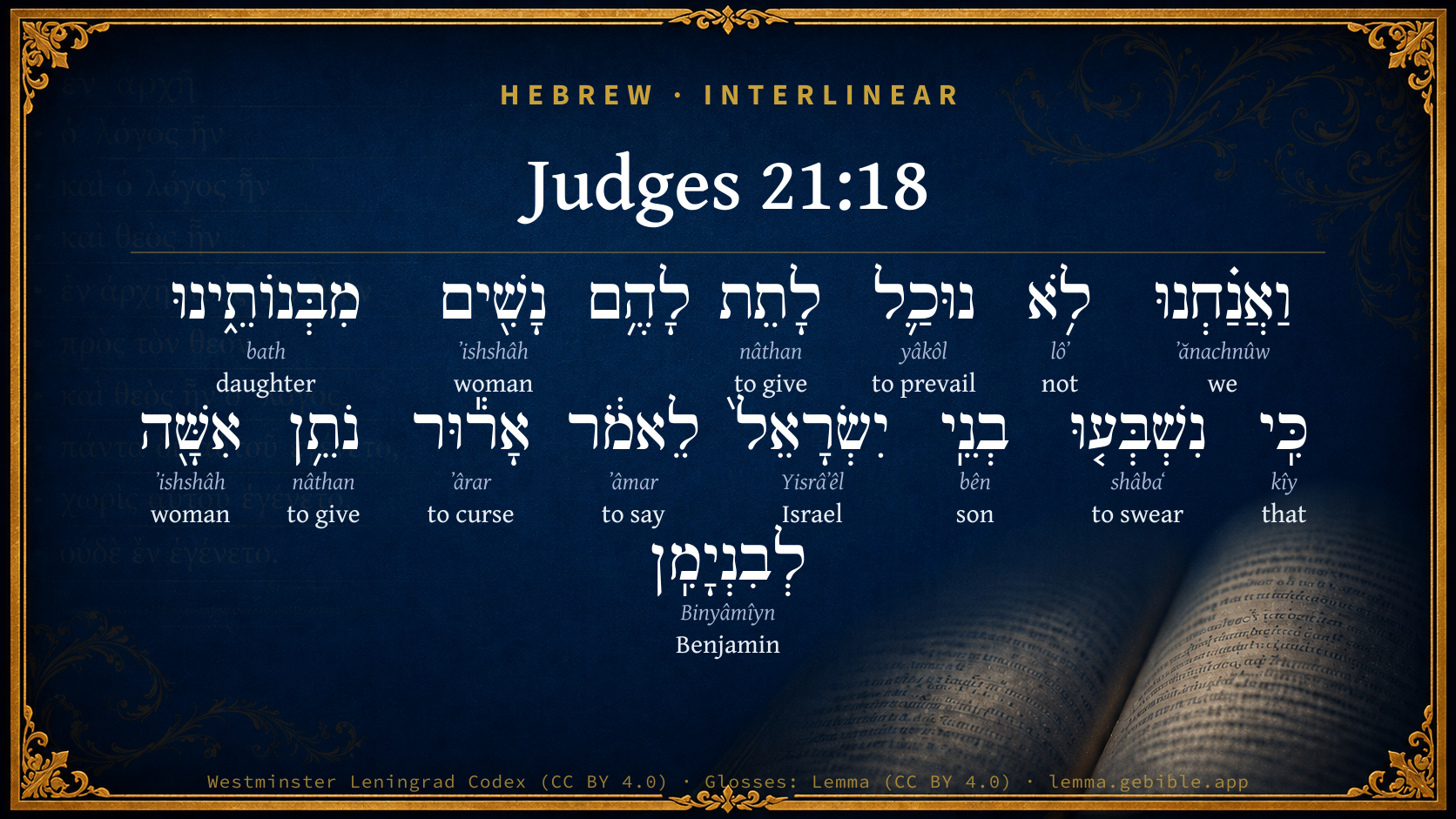
Hebrew (Westminster Leningrad Codex) Judges 21:18 appears in the Hebrew Old Testament. The text above is from the Westminster Leningrad Codex. Each word links to its Strong’s number, a concise gloss, and parsing drawn from the Open Scriptures Hebrew Bible morphology. Click any word for its full Brown-Driver-Briggs (BDB) entry.
Download image
Cite this verse

Judges 21:18 (World English Bible). Public Domain. Lemma interlinear Bible study tool, https://lemma.gebible.app/v/judges/21/18.

Show BibTeX & RIS
BibTeX
RIS
English Translation
However we may not give them wives of our daughters, for the children of Israel had sworn, saying, Cursed be he who gives a wife to Benjamin.
World English Bible · Public Domain
Download a study sheet

One document with this verse’s original text, its word-by-word gloss line, the meaning frame, cross-references with their text, attributed commentary, and full source and license credits — printable, and it pastes into notes with its structure intact.

This verse Autodidact and up

Study sheet (.html) Plain text (.txt)

A passage Seminary Student

Up to 50 verses in one chapter. A passage sheet keeps up to 6 commentary sources and 12 cross-references per verse, in the order this page ranks them, and says so on the sheet whenever that leaves anything out. Ask for a single verse and you get the Autodidact verse sheet above.

Everything on this page stays free to read, with no account — the sheet is a download of what is already on screen, not access to it.

Want to remove ads? Support Godless Engineer
Compare translations 3

The same verse in 3 English versions, stacked beneath the original-language interlinear above. Click any original word for its lexicon entry.

Each is an independent rendering of the whole verse — the interlinear is not word-aligned to these translations.

Highlighted words mark where these versions differ — a whole-verse word diff, not a word-by-word alignment.

  • World English Bible Public Domain
    However we may not give them wives of our daughters, for the children of Israel had sworn, saying, Cursed be he who gives a wife to Benjamin.
  • King James Version Public Domain
    Howbeit we may not give them wives of our daughters: for the children of Israel have sworn, saying, Cursed be he that giveth a wife to Benjamin.
  • unfoldingWord Literal Text CC BY-SA 4.0
    But we ourselves are not able to give wives to them from our daughters, because the sons of Israel have sworn, saying, ‘Cursed the one giving a wife to Benjamin.’”

unfoldingWord Literal Text — © unfoldingWord, licensed CC BY-SA 4.0. Word-aligned USFM3 via Door43 (git.door43.org/unfoldingWord/en_ult).

Versions to compare (up to 4)

3 of 4 selected

Show all 18 translations

Every available English version of this verse, each an independent rendering of the whole verse.

  • World English Bible Public Domain
    However we may not give them wives of our daughters, for the children of Israel had sworn, saying, Cursed be he who gives a wife to Benjamin.
  • Berean Standard Bible Public Domain
    But we cannot give them our daughters as wives.” For the Israelites had sworn, “Cursed is he who gives a wife to a Benjamite.”
  • Majority Standard Bible Public Domain
    But we cannot give them our daughters as wives.” For the Israelites had sworn, “Cursed is he who gives a wife to a Benjamite.”
  • King James Version Public Domain
    Howbeit we may not give them wives of our daughters: for the children of Israel have sworn, saying, Cursed be he that giveth a wife to Benjamin.
  • American Standard Version (1901) Public Domain
    Howbeit we may not give them wives of our daughters, for the children of Israel had sworn, saying, Cursed be he that giveth a wife to Benjamin.
  • Revised Version (1885) Public Domain
    Howbeit we may not give them wives of our daughters: for the children of Israel had sworn, saying, Cursed be he that giveth a wife to Benjamin.
  • Geneva Bible (1599) Public Domain
    Howbeit we may not giue them wiues of our daughters: for the childre of Israel had sworne, saying, Cursed be he that giueth a wise to Beniamin.
  • Douay-Rheims (1899) Public Domain
    For as to our own daughters we cannot give them, being bound with an oath and a curse, whereby we said: Cursed be he that shall give Benjamin any of his daughters to wife.
  • Young's Literal Translation Public Domain
    and we -- we are not able to give to them wives out of our daughters, for the sons of Israel have sworn, saying, Cursed `is' he who is giving a wife to Benjamin.'
  • Literal Standard Version CC BY-SA 4.0
    and we are not able to give wives to them out of our daughters, for the sons of Israel have sworn, saying, Cursed [is] he who is giving a wife to Benjamin.”
  • Unlocked Literal Bible CC BY-SA 4.0
    We cannot give them wives from our daughters, for the people of Israel had made a promise, 'Cursed be anyone who gives a wife to Benjamin.'”
  • unfoldingWord Literal Text CC BY-SA 4.0
    But we ourselves are not able to give wives to them from our daughters, because the sons of Israel have sworn, saying, ‘Cursed the one giving a wife to Benjamin.’”
  • Darby Bible Public Domain
    Yet we cannot give them wives of our daughters." For the people of Israel had sworn, "Cursed be he who gives a wife to Benjamin."
  • World Messianic Bible Public Domain
    However, we may not give them wives of our daughters, for the children of Israel had sworn, saying, ‘Cursed is he who gives a wife to Benjamin.’”
  • Webster's Bible Public Domain
    But, we may not give them wives of our daughters: for the children of Israel have sworn, saying, Cursed be he that giveth a wife to Benjamin.
  • Free Bible Version CC BY-SA 4.0
    But we can't let them have our daughters as wives, since we as the people of Israel swore a sacred oath, saying, ‘Anyone who gives a wife to a Benjamite is cursed!’”
  • Bible in Basic English Public Domain
    Seeing that we may not give them our daughters as wives? For the children of Israel had taken an oath, saying, Cursed is he who gives a wife to Benjamin.
  • JPS Tanakh (1917) Public Domain
    Howbeit we may not give them wives of our daughters.' For the children of Israel had sworn, saying: 'Cursed be he that giveth a wife to Benjamin.'

Literal Standard Version (2020), Covenant Press — licensed CC BY-SA 4.0. Text via the HelloAO Bible API (eBible.org). Unlocked Literal Bible (unfoldingWord) — licensed CC BY-SA 4.0. Text via the HelloAO Bible API (eBible.org). unfoldingWord Literal Text — © unfoldingWord, licensed CC BY-SA 4.0. Word-aligned USFM3 via Door43 (git.door43.org/unfoldingWord/en_ult). Free Bible Version, Dr. Jonathan Gallagher — licensed CC BY-SA 4.0. Text via the HelloAO Bible API (eBible.org).

Word by word

More ways to search: Search by grammar → Find every occurrence → Compare this word →

Practice this passage: Drill this verse → Learn its vocabulary →

אָר֕וּר
ʼârar
H779
“cursed”
Verb, Qal, Participle Passive, Masculine, Singular, Absolute
Part of Speech
Verb
Stem
Qal
Form
Participle Passive
Gender
Masculine
Number
Singular
State
Absolute
Full BDB Definition

Origin: a primitive root

TWOT: 168

to curse - (Qal) - to curse - cursed be he (participle used pr in curses) - (Niphal) to be cursed, cursed - (Piel) to curse, lay under a curse, put a curse on - (Hophal) to be made a curse, be cursed
  1. וַאֲנַ֗חְנוּ ʼănachnûw H587 “and · we” Conjunction + Pronoun, Personal, 1st Person, Common, Plural
  2. לֹ֥א lôʼ H3808 “not” Particle, Negative
  3. נוּכַ֛ל yâkôl H3201 “to prevail” Verb, Qal, Imperfect, 1st Person, Common, Plural
  4. לָתֵת nâthan H5414 “to give” Preposition + Verb, Qal, Infinitive Construct
  5. נָשִׁ֖ים ʼishshâh H802 “women” Noun, Common, Feminine, Plural, Absolute
  6. מִבְּנוֹתֵ֑ינוּ bath H1323 “from · daughters · our” Preposition + Noun, Common, Feminine, Plural, Construct + Suffix, Personal, 1st Person, Common, Plural
  7. כִּֽי kîy H3588 “that” Conjunction
  8. נִשְׁבְּע֤וּ shâbaʻ H7650 “to swear” Verb, Niphal, Perfect, 3rd Person, Common, Plural
  9. בְנֵֽי bên H1121 “sons of” Noun, Common, Masculine, Plural, Construct
  10. יִשְׂרָאֵל֙ Yisrâʼêl H3478 “Israel” Noun, Proper
  11. לֵאמֹ֔ר ʼâmar H559 “to say” Preposition + Verb, Qal, Infinitive Construct
  12. נֹתֵ֥ן nâthan H5414 “giving” Verb, Qal, Participle Active, Masculine, Singular, Absolute
  13. אִשָּׁ֖ה ʼishshâh H802 “woman” Noun, Common, Feminine, Singular, Absolute
  14. לְבִנְיָמִֽן Binyâmîyn H1144 “to/for · Benjamin” Preposition + Noun, Proper

About this verse

These counts appear in no published source. They are computed here, from the morphology-tagged text and Lemma’s own curated glosses. What Lemma adds →

16
words
13
distinct lemmas
Historical
section

Grammatical profile

  • 6 verbs
  • 6 nouns
  • 1 pronoun
  • 1 preposition
  • 1 conjunction
  • 1 particle

Verb forms

  • נוּכַ֛ל Qal · Imperfect
  • לָתֵת Qal · Infinitive Construct
  • נִשְׁבְּע֤וּ Niphal · Perfect
  • לֵאמֹ֔ר Qal · Infinitive Construct
  • אָר֕וּר Qal · Participle Passive
  • נֹתֵ֥ן Qal · Participle Active

Repetition

Words recur within this verse — often emphatic in Hebrew:

  • לָתֵת to give H5414 ×2
  • נָשִׁ֖ים woman H802 ×2

Hebrew & Septuagint length

In English translation the verse runs 27 words from the Hebrew and 31 from the Septuagint (LXX English) — closely comparable.

A rough comparison of the two English renderings, which tokenize alike — not a word-level alignment.

Word counts can differ between the Hebrew and the Greek without any difference in meaning — e.g. the Hebrew direct-object marker אֵת has no separate Greek word, and Greek often adds the article ὁ.

In the original languages it is 16 Hebrew tokens and 23 Greek tokens — but the two are counted differently (Hebrew bundles its prefixes and suffixes into one token; the Greek is in lemma form), so that isn’t a like-for-like length.

Cross-references

2

Topical passages linked to Judges 21:18 in the Treasury of Scripture Knowledge — connected by theme and wording, ordered by reader-vote popularity; previews shown in the World English Bible.

  • Judges 21:1 Now the men of Israel had sworn in Mizpah, saying, There shall not any of us give his daughter to Benjamin as wife.
  • Judges 11:35 It happened, when he saw her, that he tore his clothes, and said, Alas, my daughter! you have brought me very low, and you are one of those who trouble me; for I have opened my mouth to Yahweh, and I can't go back.

Cross-references courtesy of OpenBible.info (CC BY 4.0).

Hebrew and Greek witnesses Masoretic Hebrew ↔ Greek Septuagint

The same verse in the two great witnesses to the Old Testament, shown verse-for-verse.

These are two independent witnesses, not word-aligned to each other, and the Septuagint is shown in lemma (dictionary) form.

Hebrew Judges 21:18 Masoretic · Westminster Leningrad Codex

וַאֲנַ֗חְנוּ לֹ֥א נוּכַ֛ל לָתֵת לָהֶ֥ם נָשִׁ֖ים מִבְּנוֹתֵ֑ינוּ כִּֽי נִשְׁבְּע֤וּ בְנֵֽי יִשְׂרָאֵל֙ לֵאמֹ֔ר אָר֕וּר נֹתֵ֥ן אִשָּׁ֖ה לְבִנְיָמִֽן

However we may not give them wives of our daughters, for the children of Israel had sworn, saying, Cursed be he who gives a wife to Benjamin.

World English Bible · Public Domain

Greek LXX Judges 21:18 Septuagint · lemma form

ὅτι ἐγώ οὐ δύναμαι δίδωμι αὐτός γυνή ἀπό ὁ θυγάτηρ ἐγώ ὅτι ὄμνυμι ἐν υἱός ἰσραήλ λέγω ἐπικατάρατος ὁ δίδωμι γυνή ὁ βενιαμίν

For we shall not be able to give them wives of our daughters, because we swore among the children of Israel, saying, Cursed is he that gives a wife to Benjamin.

LXX2012 (modern English Septuagint) · Public Domain

Hebrew: Westminster Leningrad Codex (CC BY 4.0). Greek: Septuagint (public domain); English from LXX2012 (modern English Septuagint) (Public Domain). How the Septuagint differs from the Hebrew →

Targum (Aramaic paraphrase)

1

The Targum is the ancient Jewish Aramaic paraphrase of the Hebrew Scriptures — an interpretive translation, not the Hebrew text itself. Onkelos (literal) and Pseudo-Jonathan (expansive) render the Torah, and Jonathan the Prophets. Coverage is partial: where no permissively-licensed English translation exists for a verse, only the Aramaic is shown. This is verse-level text, not a word-by-word alignment to the Hebrew.

  1. Targum Jonathan Prophets (Joshua–Malachi)
    וַאֲנַחְנָא לָא נֵיכוּל לְמִתַּן לְהוֹן נְשִׁין מִבְּנָתָנָא אֲרֵי קַיְימוּ בְנֵי יִשְׂרָאֵל לְמֵימָר לִיט דִי יִתֵּן אִתְּתָא לִדְבֵית בִּנְיָמִין:

    (no public-domain English translation for this verse)

    Targum Jonathan — Aramaic: “Mikraot Gedolot” (public domain). English: “Sefaria Community Translation” (CC0 1.0 (public-domain dedication)); “London "Chaldee Paraphrase," 1871” (public domain). Text via Sefaria.

Commentary

Notes on Judges 21:18 from classic Christian and Jewish commentators (each source and its license shown beneath its notes). The classic Christian expositions comment on the surrounding passage and are grouped to its opening verse, so a note may address several verses; the Jewish commentaries on the Tanakh (Rashi and others) are per-verse, so they appear only where the commentator wrote on this verse.

Lemma curates 59 commentaries, every one of them public domain or Creative Commons licensed, each selected and text-cleaned for this edition rather than reprinted as found. About our sources →

Trapp's Complete Commentary

John Trapp

Jdg 21:18 Howbeit we may not give them wives of our daughters: for the children of Israel have sworn, saying, Cursed [be] he that giveth a wife to Benjamin.

Ver. 18. Howbeit we may not give them wives of our daughters.] And unless those daughters were given them by their parents, they would not marry with the Benjamites, though it were to be made mistresses of such large inheritances. It is of the law of nature, that parents have the dispose of their children in marriage. But the Pope taketh upon him to dispense in that case. Potest de iniustitia facere iustitiam, saith Bellarmine {a} out of the Canonists. Ex nihilo aliquid, ex virtute vitium. Papae!

Cursed be he that giveth a wife to Benjamin.] They had backed their oath with an imprecation. This was to be too hot in a cold matter. They will not break their unlawful oath; but they devise how to elude it, which was worse. Dum vitant stulti vitium, &c.

{a} De Pontif. Rom., lib. iv.

John Trapp, A Commentary or Exposition upon All the Books of the Old and New Testament (1647–1656) — public domain. Text from a community e-Sword module.

John Gill's Exposition

Howbeit, we may not give them wives of our daughters,.... Though their case was so very necessitous and desperate:

for the children of Israel have sworn, saying, cursed be he that giveth a wife to Benjamin, Jdg 21:1 and therefore without the violation of their oath could not give any of their daughters in marriage to them: wherefore some other way must be devised to help them.

John Gill's Exposition of the Whole Bible (1746–1763) — public domain (CC PDM 1.0). Text via the HelloAO Bible API.

Albert Barnes' Notes on the Bible

For the children of Israel have sworn - See Jdg 21:1. Compare Saul’s rash oath 1Sa 14:24, and his breach of the oath made to the Gideonites 2Sa 21:2. For the guilt of a broken oath, see Eze 17:15-20; Exo 20:7.

Albert Barnes' Notes on the Bible (1834–1885) — public domain. Text from a community e-Sword/MySword module.

Matthew Poole's English Annotations

i.e. To this generation of Benjamites who have made themselves guilty of this foul wickedness; but this oath did not extend to their posterity. And some think it had another exception, to wit, unless the surviving Benjamites could not otherwise be supplied with wives.

Matthew Poole's English Annotations on the Holy Bible (1683–1685) — public domain. Text from a community e-Sword/MySword module.

The Pulpit Commentary

We are not able. Note again the evil of rash vows, and how often chicanery is necessary in order to evade their evil consequences.

The Pulpit Commentary (1880–1919), ed. H.D.M. Spence-Jones & Joseph S. Exell — public domain. Text from a community e-Sword module.

unfoldingWord translationNotes

Door43 World Missions Community

a wife to Benjamin

Here Benjamin refers to the male descendants of Benjamin. AT: "a wife to the men of Benjamin" (See: Synecdoche)

which is north of Bethel, east of the road that goes up from Bethel to Shechem, and south of Lebonah

This is background information to explain to the reader where the city of Shiloh is located. (See: Background Information)

Lebonah

This is the name of a city. (See: How to Translate Names)

translationWords

Israel

promise

curse

Benjamin

Yahweh

Shiloh

Bethel

Shechem

unfoldingWord translationNotes — © Distant Shores Media and the Door43 World Missions Community, licensed CC BY-SA 4.0. Source: git.door43.org/Door43/en_tn.

Lesson kit

Teaching starters — assembled from the data on this page, not authored interpretation. Every prompt links to the verse data it draws on. Edit before teaching.

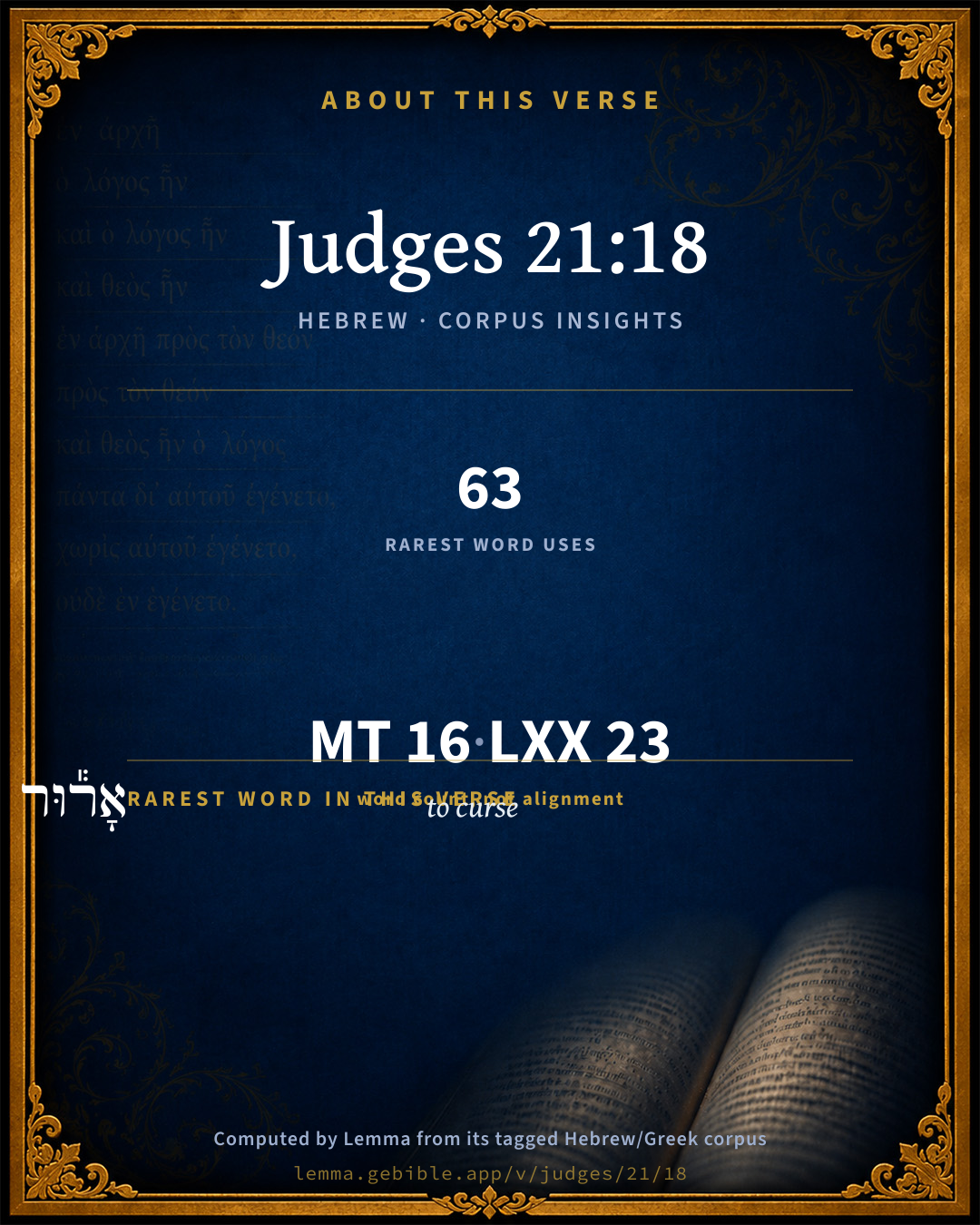
Judges, in the Historical, opens this verse with 16 words (13 distinct Hebrew lemmas). Its most distinctive word is ʼârar (“to curse”). A historical commentator’s framing appears above. Read the whole chapter for the surrounding context.

Discussion questions

  1. How does “to curse” (ʼârar) shape what this verse is saying?
  2. Judges 21:1 shares this passage’s theme. How do the two illuminate each other?
  3. “to give” occurs 2× in this one verse. What is the effect of the repetition?
  4. The translations on this page render this verse differently — a whole-verse word diff, not a word-by-word alignment. What might account for the different wordings?
  5. The verb «נוּכַ֛ל» is Qal Imperfect. How does its form color the action?
  6. Reading how Trapp's Complete Commentary and John Gill's Exposition read this verse, where do the two commentators agree and where do they part?

Things to notice

Reading settings

Reading text

Shown beneath each verse's original-language words.

Old Testament
Old Testament edition

Read the OT as the Masoretic Hebrew (MT) or the Greek Septuagint (LXX).

English shown for the Greek Septuagint (in the Hebrew ↔ Greek comparison).

Comparing translations? Open the Compare panel on any verse page to stack up to four side by side.