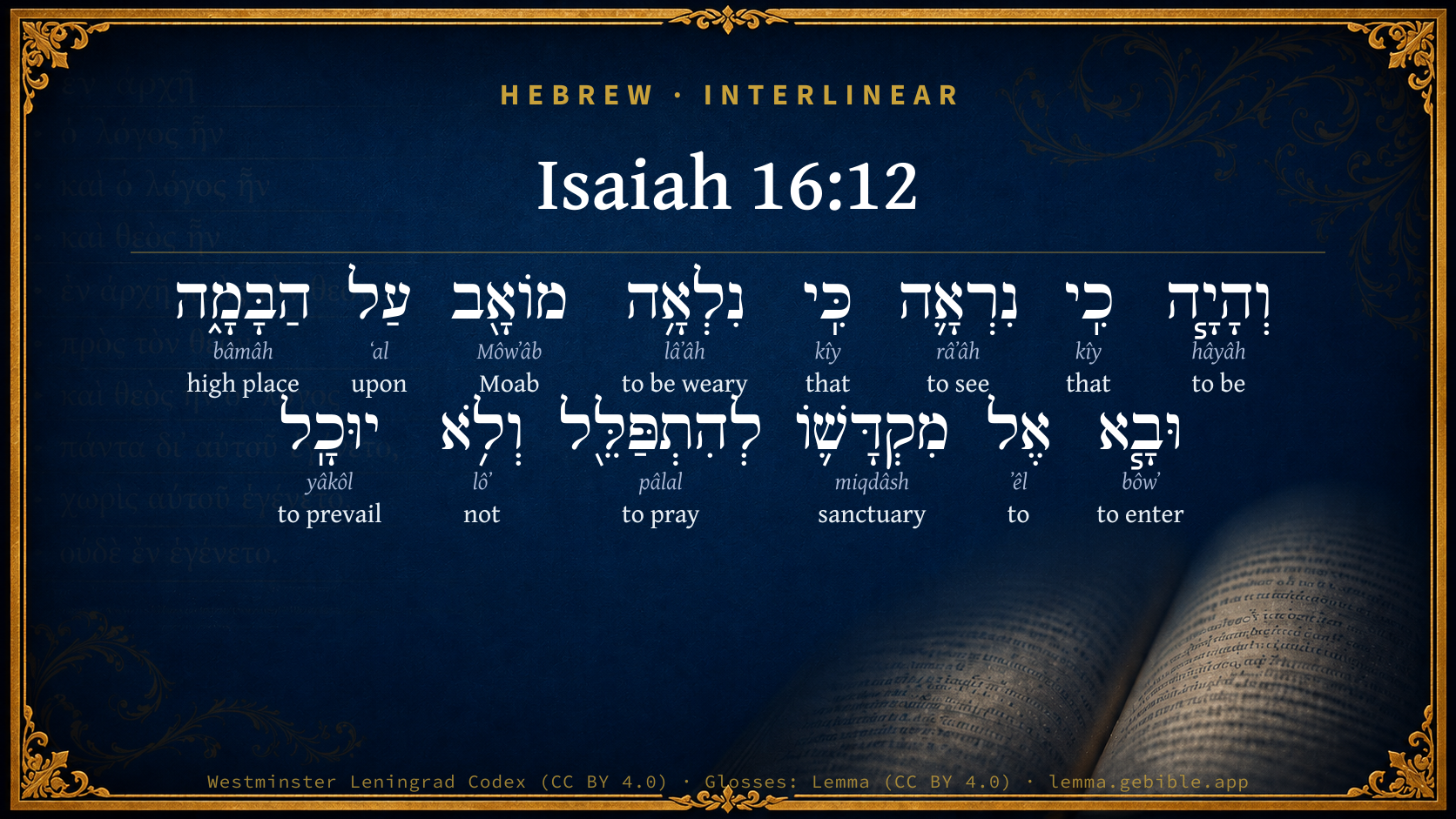
Isaiah 16:12

Hebrew (Westminster Leningrad Codex) Isaiah 16:12 appears in the Hebrew Old Testament. The text above is from the Westminster Leningrad Codex. Each word links to its Strong’s number, a concise gloss, and parsing drawn from the Open Scriptures Hebrew Bible morphology. Click any word for its full Brown-Driver-Briggs (BDB) entry.
Download image
Cite this verse

Isaiah 16:12 (World English Bible). Public Domain. Lemma interlinear Bible study tool, https://lemma.gebible.app/v/isaiah/16/12.

Show BibTeX & RIS
BibTeX
RIS
English Translation
It shall happen, when Moab presents himself, when he wearies himself on the high place, and shall come to his sanctuary to pray, that he shall not prevail.
World English Bible · Public Domain
Download a study sheet

One document with this verse’s original text, its word-by-word gloss line, the meaning frame, cross-references with their text, attributed commentary, and full source and license credits — printable, and it pastes into notes with its structure intact.

This verse Autodidact and up

Study sheet (.html) Plain text (.txt)

A passage Seminary Student

Up to 50 verses in one chapter. A passage sheet keeps up to 6 commentary sources and 12 cross-references per verse, in the order this page ranks them, and says so on the sheet whenever that leaves anything out. Ask for a single verse and you get the Autodidact verse sheet above.

Everything on this page stays free to read, with no account — the sheet is a download of what is already on screen, not access to it.

Want to remove ads? Support Godless Engineer
Compare translations 3

The same verse in 3 English versions, stacked beneath the original-language interlinear above. Click any original word for its lexicon entry.

Each is an independent rendering of the whole verse — the interlinear is not word-aligned to these translations.

Highlighted words mark where these versions differ — a whole-verse word diff, not a word-by-word alignment.

  • World English Bible Public Domain
    It shall happen, when Moab presents himself, when he wearies himself on the high place, and shall come to his sanctuary to pray, that he shall not prevail.
  • King James Version Public Domain
    And it shall come to pass, when it is seen that Moab is weary on the high place, that he shall come to his sanctuary to pray; but he shall not prevail.
  • unfoldingWord Literal Text CC BY-SA 4.0
    And it will happen, when it is seen that Moab is wearied on the high place, that it will come to its sanctuary to pray, but it will not be able.

unfoldingWord Literal Text — © unfoldingWord, licensed CC BY-SA 4.0. Word-aligned USFM3 via Door43 (git.door43.org/unfoldingWord/en_ult).

Versions to compare (up to 4)

3 of 4 selected

Show all 18 translations

Every available English version of this verse, each an independent rendering of the whole verse.

  • World English Bible Public Domain
    It shall happen, when Moab presents himself, when he wearies himself on the high place, and shall come to his sanctuary to pray, that he shall not prevail.
  • Berean Standard Bible Public Domain
    When Moab appears on the high place, when he wearies himself and enters his sanctuary to pray, it will do him no good.
  • Majority Standard Bible Public Domain
    When Moab appears on the high place, when he wearies himself and enters his sanctuary to pray, it will do him no good.
  • King James Version Public Domain
    And it shall come to pass, when it is seen that Moab is weary on the high place, that he shall come to his sanctuary to pray; but he shall not prevail.
  • American Standard Version (1901) Public Domain
    And it shall come to pass, when Moab presenteth himself, when he wearieth himself upon the high place, and shall come to his sanctuary to pray, that he shall not prevail.
  • Revised Version (1885) Public Domain
    And it shall come to pass, when Moab presenteth himself, when he wearieth himself upon the high place, and shall come to his sanctuary to pray, that he shall not prevail.
  • Geneva Bible (1599) Public Domain
    And when it shall appeare that Moab shall be wearie of his hie places, then shall hee come to his temple to praie, but he shall not preuaile.
  • Douay-Rheims (1899) Public Domain
    And it shall come to pass, when it is seen that Moab is wearied on his high places, that he shall go in to his sanctuaries to pray, and shall not prevail.
  • Young's Literal Translation Public Domain
    And it hath come to pass, when it hath been seen, That weary hath been Moab on the high place, And he hath come unto his sanctuary to pray, And is not able.
  • Literal Standard Version CC BY-SA 4.0
    And it has come to pass, when it has been seen, || That Moab has been weary on the high place, || And he has come to his sanctuary to pray, || And is not able.
  • Unlocked Literal Bible CC BY-SA 4.0
    When Moab wears himself out on the high place and enters his temple to pray, his prayers will accomplish nothing.
  • unfoldingWord Literal Text CC BY-SA 4.0
    And it will happen, when it is seen that Moab is wearied on the high place, that it will come to its sanctuary to pray, but it will not be able.
  • Darby Bible Public Domain
    And it shall come to pass, when Moab shall appear, shall weary himself on the high place, and enter into his sanctuary to pray, that he shall not prevail.
  • World Messianic Bible Public Domain
    It will happen that when Moab presents himself, when he wearies himself on the high place, and comes to his sanctuary to pray, that he will not prevail.
  • Webster's Bible Public Domain
    And it shall come to pass, when it is seen that Moab is weary on the high place, that he shall come to his sanctuary to pray; but he shall not prevail.
  • Free Bible Version CC BY-SA 4.0
    The Moabites go and wear themselves out worshiping at their high places. They go to their shrines to pray, but it does them no good.
  • Bible in Basic English Public Domain
    And when Moab goes up to the high place, and makes prayer in the house of his god, it will have no effect.
  • JPS Tanakh (1917) Public Domain
    And it shall come to pass, when it is seen that Moab hath wearied himself upon the high place, that he shall come to his sanctuary to pray; but he shall not prevail

Literal Standard Version (2020), Covenant Press — licensed CC BY-SA 4.0. Text via the HelloAO Bible API (eBible.org). Unlocked Literal Bible (unfoldingWord) — licensed CC BY-SA 4.0. Text via the HelloAO Bible API (eBible.org). unfoldingWord Literal Text — © unfoldingWord, licensed CC BY-SA 4.0. Word-aligned USFM3 via Door43 (git.door43.org/unfoldingWord/en_ult). Free Bible Version, Dr. Jonathan Gallagher — licensed CC BY-SA 4.0. Text via the HelloAO Bible API (eBible.org).

Word by word

More ways to search: Search by grammar → Find every occurrence → Compare this word →

Practice this passage: Drill this verse → Learn its vocabulary →

נִלְאָ֥ה
lâʼâh
H3811
“to be weary”
Verb, Niphal, Perfect, 3rd Person, Masculine, Singular
Part of Speech
Verb
Stem
Niphal
Form
Perfect
Person
3rd Person
Gender
Masculine
Number
Singular
Full BDB Definition

Origin: a primitive root

TWOT: 1066

to be weary, be impatient, be grieved, be offended - (Qal) to be weary, be impatient - (Niphal) to be tired of something, weary oneself - (Hiphil) to weary, make weary, exhaust
  1. וְהָיָ֧ה hâyâh H1961 “and · to be” Conjunction + Verb, Qal, Sequential Perfect, 3rd Person, Masculine, Singular
  2. כִֽי kîy H3588 “that” Conjunction
  3. נִרְאָ֛ה râʼâh H7200 “to see” Verb, Niphal, Perfect, 3rd Person, Masculine, Singular
  4. כִּֽי kîy H3588 “that” Conjunction
  5. מוֹאָ֖ב Môwʼâb H4124 “Moab” Noun, Proper
  6. עַל ʻal H5921 “upon” Preposition
  7. הַבָּמָ֑ה bâmâh H1116 “the · high place” Particle, Definite Article + Noun, Common, Feminine, Singular, Absolute
  8. וּבָ֧א bôwʼ H935 “and · to enter” Conjunction + Verb, Qal, Sequential Perfect, 3rd Person, Masculine, Singular
  9. אֶל ʼêl H413 “to” Preposition
  10. מִקְדָּשׁ֛וֹ miqdâsh H4720 “sanctuary · his” Noun, Common, Masculine, Singular, Construct + Suffix, Personal, 3rd Person, Masculine, Singular
  11. לְהִתְפַּלֵּ֖ל pâlal H6419 “to pray” Preposition + Verb, Hithpael, Infinitive Construct
  12. וְלֹ֥א lôʼ H3808 “and · not” Conjunction + Particle, Negative
  13. יוּכָֽל yâkôl H3201 “to prevail” Verb, Qal, Imperfect, 3rd Person, Masculine, Singular

About this verse

These counts appear in no published source. They are computed here, from the morphology-tagged text and Lemma’s own curated glosses. What Lemma adds →

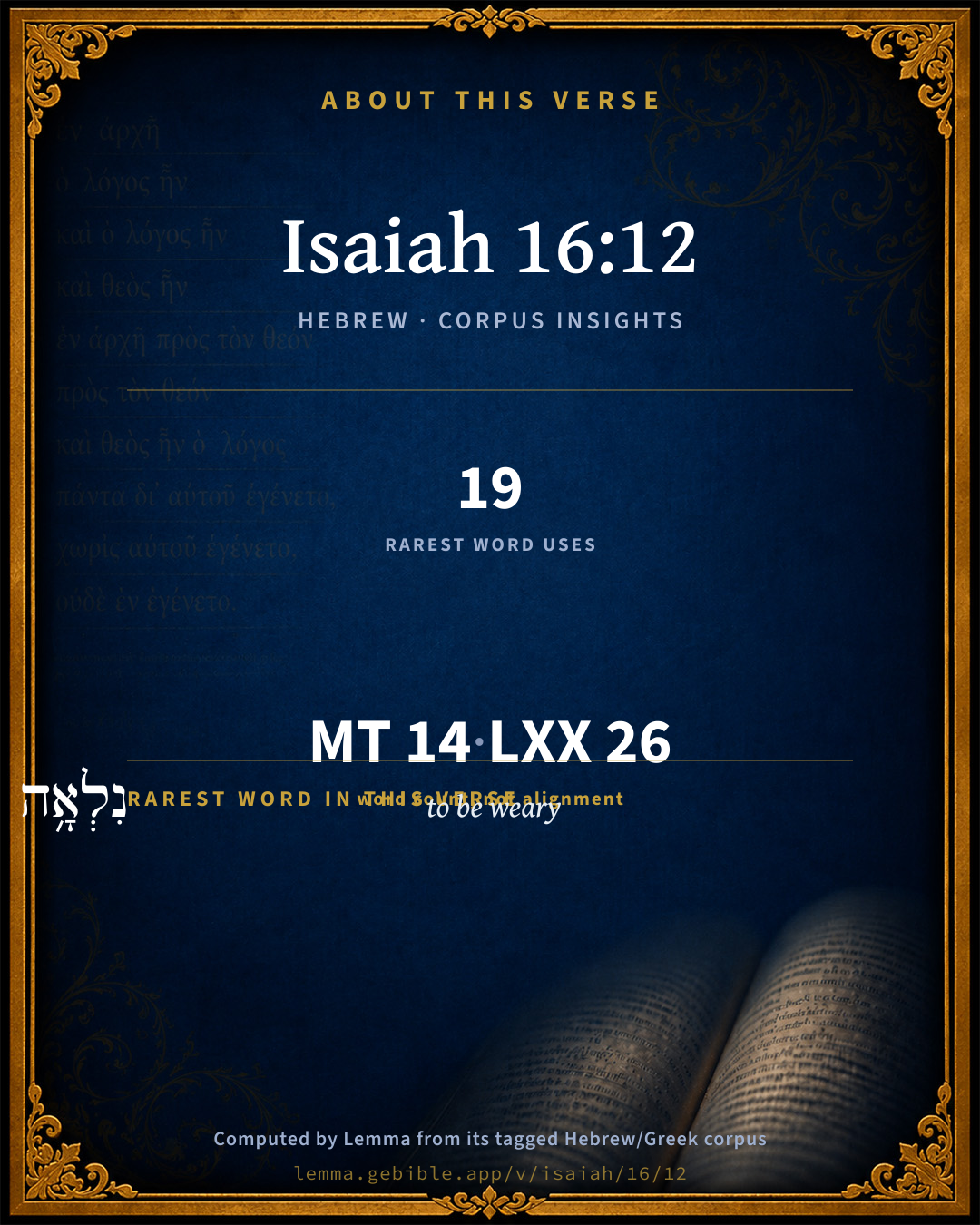
14
words
13
distinct lemmas
Prophets
section

Notable vocabulary

The rarest word here is נִלְאָ֥ה to be weary H3811 — appearing just 19 times in the whole Hebrew Bible.

Shared distinctive vocabulary

נִלְאָ֥ה to be weary H3811 occurs in 18 verses of the Hebrew Bible. Also found in:

Grammatical profile

  • 6 verbs
  • 3 nouns
  • 2 prepositions
  • 2 conjunctions
  • 1 particle

Verb forms

  • וְהָיָ֧ה Qal · Sequential Perfect
  • נִרְאָ֛ה Niphal · Perfect
  • נִלְאָ֥ה Niphal · Perfect
  • וּבָ֧א Qal · Sequential Perfect
  • לְהִתְפַּלֵּ֖ל Hithpael · Infinitive Construct
  • יוּכָֽל Qal · Imperfect

Repetition

A word recurs within this verse — often emphatic in Hebrew:

  • כִֽי that H3588 ×2

Hebrew & Septuagint length

In English translation the verse runs 28 words from the Hebrew and 36 from the Septuagint (LXX English) — closely comparable.

A rough comparison of the two English renderings, which tokenize alike — not a word-level alignment.

Word counts can differ between the Hebrew and the Greek without any difference in meaning — e.g. the Hebrew direct-object marker אֵת has no separate Greek word, and Greek often adds the article ὁ.

In the original languages it is 14 Hebrew tokens and 26 Greek tokens — but the two are counted differently (Hebrew bundles its prefixes and suffixes into one token; the Greek is in lemma form), so that isn’t a like-for-like length.

Cross-references

21

Topical passages linked to Isaiah 16:12 in the Treasury of Scripture Knowledge — connected by theme and wording, ordered by reader-vote popularity; previews shown in the World English Bible.

  • Isaiah 15:2 They are gone up to Bayith, and to Dibon, to the high places, to weep: Moab wails over Nebo, and over Medeba; on all their heads is baldness, every beard is cut off.
  • 1 Kings 18:29 It was so, when midday was past, that they prophesied until the time of the offering of the [evening] offering; but there was neither voice, nor any to answer, nor any who regarded.
  • Jeremiah 48:35 Moreover I will cause to cease in Moab, says Yahweh, him who offers in the high place, and him who burns incense to his gods.
  • Numbers 22:39 Balaam went with Balak, and they came to Kiriath Huzoth.
  • Numbers 23:14 He took him into the field of Zophim, to the top of Pisgah, and built seven altars, and offered up a bull and a ram on every altar.
  • Numbers 23:28 Balak took Balaam to the top of Peor, that looks down on the desert.
  • Jeremiah 48:7 For, because you have trusted in your works and in your treasures, you also shall be taken: and Chemosh shall go forth into captivity, his priests and his princes together.
  • Jeremiah 48:46 Woe to you, O Moab! the people of Chemosh is undone; for your sons are taken away captive, and your daughters into captivity.
  • Numbers 22:41–23:3 It happened in the morning, that Balak took Balaam, and brought him up into the high places of Baal; and he saw from there the utmost part of the people.
  • Numbers 24:17 I see him, but not now; I see him, but not near: There shall come forth a star out of Jacob, A scepter shall rise out of Israel, Shall strike through the corners of Moab, Break down all the sons of tumult.
  • 1 Kings 11:7 Then did Solomon build a high place for Chemosh the abomination of Moab, on the mountain that is before Jerusalem, and for Molech the abomination of the children of Ammon.
  • 2 Kings 3:27 Then he took his eldest son who would have reigned in his place, and offered him for a burnt offering on the wall. There was great wrath against Israel: and they departed from him, and returned to their own land.
  • 2 Kings 19:12 Have the gods of the nations delivered them, which my fathers have destroyed, Gozan, and Haran, and Rezeph, and the children of Eden that were in Telassar?
  • 2 Kings 19:16–19 Incline your ear, Yahweh, and hear; open your eyes, Yahweh, and see; and hear the words of Sennacherib, with which he has sent him to defy the living God.
  • Psalms 115:3–7 But our God is in the heavens. He does whatever he pleases.
  • Proverbs 1:28 Then will they call on me, but I will not answer. They will seek me diligently, but they will not find me;
  • Isaiah 26:16 Yahweh, in trouble have they visited you; they poured out a prayer [when] your chastening was on them.
  • Isaiah 37:38 It happened, as he was worshipping in the house of Nisroch his god, that Adrammelech and Sharezer his sons struck him with the sword; and they escaped into the land of Ararat. Esar Haddon his son reigned in his place.
  • Isaiah 47:13 You are wearied in the multitude of your counsels: let now the astrologers, the star-gazers, the monthly prognosticators, stand up, and save you from the things that shall come on you.
  • Jeremiah 10:5 They are like a palm tree, of turned work, and don't speak: they must be carried, because they can't go. Don't be afraid of them; for they can't do evil, neither is it in them to do good."
  • Jeremiah 48:13 Moab shall be ashamed of Chemosh, as the house of Israel was ashamed of Bethel their confidence.

Cross-references courtesy of OpenBible.info (CC BY 4.0).

Hebrew and Greek witnesses Masoretic Hebrew ↔ Greek Septuagint

The same verse in the two great witnesses to the Old Testament, shown verse-for-verse.

These are two independent witnesses, not word-aligned to each other, and the Septuagint is shown in lemma (dictionary) form.

Hebrew Isaiah 16:12 Masoretic · Westminster Leningrad Codex

וְהָיָ֧ה כִֽי נִרְאָ֛ה כִּֽי נִלְאָ֥ה מוֹאָ֖ב עַל הַבָּמָ֑ה וּבָ֧א אֶל מִקְדָּשׁ֛וֹ לְהִתְפַּלֵּ֖ל וְלֹ֥א יוּכָֽל

It shall happen, when Moab presents himself, when he wearies himself on the high place, and shall come to his sanctuary to pray, that he shall not prevail.

World English Bible · Public Domain

Greek LXX Isaiah 16:12 Septuagint · lemma form

καί εἰμί εἰς ὁ ἐντρέπω σύ ὅτι κοπιάω μωαβ ἐπί ὁ βωμός καί εἰςἔρχομαι εἰς ὁ χειροποίητος αὐτός ὥστε προςεὔχομαι καί οὐ μή δύναμαι ἐκαἱρέω αὐτός

And it shall be to your shame, (for Moab is wearied at the altars,) that he shall go in to the idols thereof to pray, but they shall not be at all able to deliver him.

LXX2012 (modern English Septuagint) · Public Domain

Hebrew: Westminster Leningrad Codex (CC BY 4.0). Greek: Septuagint (public domain); English from LXX2012 (modern English Septuagint) (Public Domain). How the Septuagint differs from the Hebrew →

Targum (Aramaic paraphrase)

1

The Targum is the ancient Jewish Aramaic paraphrase of the Hebrew Scriptures — an interpretive translation, not the Hebrew text itself. Onkelos (literal) and Pseudo-Jonathan (expansive) render the Torah, and Jonathan the Prophets. Coverage is partial: where no permissively-licensed English translation exists for a verse, only the Aramaic is shown. This is verse-level text, not a word-by-word alignment to the Hebrew.

  1. Targum Jonathan Prophets (Joshua–Malachi)
    וִיהֵי אֲרֵי יֶחֱזֵי אֲרֵי יִלְאָה מוֹאָב עַל בָּמָתָא וְיֵעוּל לְבֵית טַעֲוָתֵיהּ לְמִבְעֵי וְלָא יִכּוּל:

    And it shall come to pass, that one shall see, that when Moab is wearied out upon his high place, he shall enter his idol-temple to pray, yet he shall not prevail.

    Targum Jonathan — Aramaic: “Mikraot Gedolot” (public domain). English: “Sefaria Community Translation” (CC0 1.0 (public-domain dedication)); “London "Chaldee Paraphrase," 1871” (public domain). Text via Sefaria.

Commentary

Notes on Isaiah 16:12 from classic Christian and Jewish commentators (each source and its license shown beneath its notes). The classic Christian expositions comment on the surrounding passage and are grouped to its opening verse, so a note may address several verses; the Jewish commentaries on the Tanakh (Rashi and others) are per-verse, so they appear only where the commentator wrote on this verse.

Lemma curates 59 commentaries, every one of them public domain or Creative Commons licensed, each selected and text-cleaned for this edition rather than reprinted as found. About our sources →

Trapp's Complete Commentary

John Trapp

Isa 16:12 And it shall come to pass, when it is seen that Moab is weary on the high place, that he shall come to his sanctuary to pray; but he shall not prevail.

Ver. 12. That Moab is weary on the high place.] Tired out in his superstitious services, by all which he is not a button the better, but a great deal the worse.

But he shall not prevail.] This is every wicked man’s case and curse; for "we know that God heareth not sinners." {Joh 9:31} He will never accept of a good motion from a bad mouth. {Isa 1:1-31} The very heathen could say,

“Oς κε Yεοις επιπειθηται, μαλα τ’ εκλυον αυτου.”

John Trapp, A Commentary or Exposition upon All the Books of the Old and New Testament (1647–1656) — public domain. Text from a community e-Sword module.

The Biblical Illustrator

Joseph S. Exell

Isa_16:12

He shall come to his sanctuary to pray

Fruitless supplications

This line in this dark picture reminds us of two fasts in the life of the men of our own time, who see clearly the folly of idolatry.

I. IN TIMES OF SORROW THEY ARE OFTEN SEEN IN THE SANCTUARY.

II. MANY OF THE SUPPLICATIONS THAT ARE OFFERED IN THE SANCTUARY ARE OFFERED IN VAIN. How is this to be explained? In such ways as these--

1. Many of the suppliants have little or no faith, and faith is the essential condition of blessing.

2. Many of the suppliants are not really in earnest, and lukewarmness is an offence to the Divine Being.

3. Many of the suppliants are not really penitent. (W. Manning.)

.

The Biblical Illustrator, edited by Joseph S. Exell (c. 1880s–1900s) — public domain. Text from a community e-Sword module.

The Preacher's Complete Homiletical Commentary

Joseph S. Exell (gen. ed.)

FRUITLESS SUPPLICATIONS [1039]

[1039] See Outlines: WORTHLESS HUSKS, and REASONS FOR THE REJECTION OF PRAYER, chap. Isa_1:15.

Isa_16:12. He shall come to his sanctuary to pray; but he shall not prevail.

In the profoundly affecting picture which the prophet draws of the calamities coming on the Moabites, he represents them as at length, every other means of relief being exhausted, coming with sad and weary hearts to their sanctuary to call upon their god for deliverance. Their supplications were destined to fail, for they were presented to that which had no power to hear or save (Psa_115:4-8). This line in this dark picture reminds us of two facts in the life of the men of our own time, who see clearly the folly of idolatry.

I. In times of sorrow they are often seen in the sanctuary. Many who at other times lead openly irreligious lives are then seen using the forms of devotion. This is natural (H. E. I., 3718); it is not wrong; that which is wrong is the infrequency with which the sanctuary is visited and prayer offered by them (H. E. I, 3878, 3879). It is natural and fitting that in time of trouble men should seek God in the sanctuary, tor the sanctuary is the place—

1. Of special promise (Exo_20:24; Deu_12:5; 1Ki_9:3; Mat_18:20).

2. Of special means. Everything there tends to the production and increase of a devotional spirit (H. E. I., 5078).

3. Of special memory—of memories of help obtained, of sorrows solaced in former times.

II. But all this makes more remarkable the other fact of which these words may well remind us, that many of the supplications that are offered in the sanctuary are offered in vain. We know that this is a fact: how is it to be explained? In such ways as these—

1. Many of the suppliants have little or no faith, and faith is the essential condition of blessing (H. E. I., 3827–3830).

2. Many of the suppliants are not really in earnest, and lukewarmness is an offence to the Divine Being (H. E. I., 3814, 3815, 3831–3838).

3. Many of the suppliants are not really penitent. Their prayers are mere calls for help in time of distress, and God has nowhere promised to help the impenitent and rebellious (H. E. I., 3846, 3858; P. D., 3595).

To point out the causes of the weakness and failure of such prayers is also to point out the remedies that must be applied if the suppliants would have their prayers “prevail.”—William Manning.

In times of trouble, men—

1. Feel their need of help.

2. Generally have recourse to fallacious sources (H. E. I., 172–175).

3. Meet with disappointment, because God is forgotten or unknown.—J. Lyth, D.D.: Homiletical Treasury, part i. p. 23.

The Preacher's Complete Homiletical Commentary (gen. ed. Joseph S. Exell; Funk & Wagnalls, c. 1892) — public domain (pre-1929). A full-Bible homiletical/sermon-outline anthology covering 65 of 66 books (2 John is absent from the source module). Text from a community e-Sword module.

Tyndale Open Study Notes

Tyndale Open Resources

16:12 The hilltops were sites for pagan shrines (see 15:2). • No one will be able to save them, including the idols the Moabites called on for protection (see 40:18-19; 44:18-19).

Tyndale Open Study Notes — © Tyndale Open Resources, licensed CC BY-SA 4.0. Text via the HelloAO Bible API.

Geneva Bible (1599)

Geneva Bible translators

They shall use all means to seek help of their idols, and all in vain: for Chemosh their great god shall not be able to help them.

Geneva Bible (1599) marginal notes — public domain. Text via Bolls.life.

Jamieson, Fausset & Brown

Robert Jamieson, A. R. Fausset & David Brown

when it is seen that--rather, "When Moab shall have appeared (before his gods; compare Exo 23:15), when he is weary (that is, when he shall have fatigued himself with observing burdensome rites; Kg1 18:26, &c.), on the high place (compare Isa 15:2), and shall come to his sanctuary (of the idol Chemosh on Mount Nebo) to pray, he shall not prevail"; he shall effect nothing by his prayers [MAURER].

Jamieson, Fausset & Brown — Commentary Critical and Explanatory on the Whole Bible (1871) — public domain (CC PDM 1.0). Text via the HelloAO Bible API.

Adam Clarke's Commentary

Verse 12. When it is seen that Moab, &c. - "When Moab shall see," &c.] For נראה nirah, a MS. reads ראה raah, and so the Syriac and Chaldee. "Perhaps כי נראה ki nirah is only a various reading of כי נלאה ki nilah." SECKER. A very probable conjecture.

Adam Clarke's Commentary on the Bible (1810–1826) — public domain. Text from a community e-Sword/MySword module.

Ellicott's Commentary for English Readers

(12) When it is seen . . .—Better thus: When Moab appeareth (sc., as a worshipper), when he wearies himself on the high place (the scene of Chemosh-worship), though he enter into the sanctuary to pray, yet shall he not prevail. The prophet draws a picture of the unavailing litanies which Moab, like the priests of Baal in 1Ki_18:26, shall offer to his gods.

A Bible Commentary for English Readers, edited by Charles John Ellicott (1878–1897) — public domain. Text from a community e-Sword module.

The Cambridge Bible for Schools and Colleges

gen. ed. J. J. S. Perowne

12. The failure of Moab’s religious confidence. The verse reproduces the thought of Isa_15:2, at the beginning of the elegy. It reads thus: and when Moab appears, when he wearies himself, upon the high place, and enters his sanctuary to pray, he shall prevail nothing. Ewald however turns the verse into a promise of the conversion of Moab, by continuing the protasis to the end of the present text, and completing the sense as follows (guided by Jer_48:13): … “and prevails nothing, then he shall be ashamed of Chemosh, and turn to Jehovah.”

The Cambridge Bible for Schools and Colleges (gen. ed. J. J. S. Perowne; Cambridge University Press, 1878–1918) — public domain. Text from a community e-Sword module.

John Gill's Exposition

And it shall come to pass, when it is seen that Moab is weary on the high place,.... With weeping there, Isa 15:2 or with frequent sacrifices, and going from one high place to another, as Balak king of Moab did; and by comparing places together, it looks as if this was the way of the Moabites in their distress, to offer up a multitude of sacrifices in different places; now, when it should be seen by others, and appear to themselves, that they wearied themselves in vain, and all their cries and sacrifices were to no purpose, they should then be ashamed of them, leave off, and betake themselves to some other method; though Jarchi interprets it of their being weary of fighting on the high places of their towers, which when observed, they would take another course, and apply to devotion:

that he shall come to his sanctuary to pray; to the temple of Chemosh, and to pray to that idol to help him, Kg1 11:7,

but he shall not prevail; his prayers shall be ineffectual; his suit will be fruitless, and without success; or "he cannot", that is, his idol cannot help him. So Kimchi interprets his sanctuary of the house of his God; and the Targum, of the house of his idolatry; yet since the house or temple of an idol is never called a sanctuary, it may be understood of God's sanctuary, the temple at Jerusalem; and the sense be, that when Moab shall see that his praying and sacrificing to idols are in vain, and he has tired himself with his superstition and idolatry, without having any redress, he shall think and express his desire of going up to the temple of Jerusalem, and of praying to the God of Israel; but he shall not be able to do it, because of the enemy; and could he get thither, he would not prevail with God, for the decree was gone forth, which could not be frustrated, as follows. Ben Melech interprets it of the palace of the king.

John Gill's Exposition of the Whole Bible (1746–1763) — public domain (CC PDM 1.0). Text via the HelloAO Bible API.

Albert Barnes' Notes on the Bible

When it is seen - When it occurs; that is, when Moab actually “becomes” weary.

Is weary on the high place - The “high place” denotes the place of idolatrous worship, and here means the same as the temple of Chemosh or his sanctuary. Temples and altars were usually constructed on such places, and especially the temples of the pagan gods. Moab is represented here as looking to her gods for protection. Weary, exhausted, worn down with calamities, she is represented as fleeing from the desolate towns and cities, and taking refuge at the altar, and seeking assistance there. This, says Jerome, is the final misery. She is now forsaken of those aids to which she had always trusted, and on which she had relied. Her people slain; her towns destroyed; her strong places broken down; her once fertile fields languishing and desolate, she flees to the shrine of her god, and finds even her god unable to aid and defend her.

Shall come to his sanctuary - To his “principle” sanctuary; or to the temple of the principal god which they worshipped - the god “Chemosh” 1Ki 11:7. This does not mean the temple at Jerusalem, though Kimchi so understands it; but the temple of the chief divinity of Moab. Jerome says that this temple was on mount Nebo.

Shall not prevail - That is, her prayer shall not be heard.

Albert Barnes' Notes on the Bible (1834–1885) — public domain. Text from a community e-Sword/MySword module.

Haydock's Catholic Bible Commentary

Prevail. Chamos shall not be able to help them.

George Leo Haydock (1774–1849), Haydock's Catholic Family Bible and Commentary, 1859 edition — public domain. Excludes Psalms (Douay-Rheims chapter numbering differs from Protestant) and Deuterocanonical books (Catholic canon only).

Matthew Poole's English Annotations

When it is seen that Moab is weary on the high place; when it shall appear to them and others that all their other devotions are vain and ineffectual.

To his sanctuary; to the temple of his great god, Chemosh, Num 21:29; 1Ki 11:7; Jer 48:46, from whom he shall seek and expect succour.

He shall not prevail; his god can neither hear nor help him.

Matthew Poole's English Annotations on the Holy Bible (1683–1685) — public domain. Text from a community e-Sword/MySword module.

Whedon's Commentary on the Bible

Daniel D. Whedon

12-14. From times long, long past, Jehovah denounced calamity to Moab. Poole refers to Num_21:27-30, as intended. To the nation as a whole there was no relief.

Moab is weary on the high place — “Weary” with offering unanswered prayer to Chemosh, his god, in his sanctuary, always on hills. “Weary,” also, with calamities.

Word… since that time — Or, hitherto. “Word,” here, signifies former predictions respecting Moab; other prophets uttered them. They embodied the same principles contained in this entire prophecy. Isaiah now reiterates them as still applicable; and while his prophecy is in part generic, there is a reference in the fourteenth verse to a specific time when the ruin of Moab by some northern power shall be completed, and but the smallest remnant left of the people; they being chiefly those who abandon Chemosh for the worship of Jehovah. “The clause, as the years of a hireling, here, and Isa_21:16, must render the designation of time somewhat more definite, inasmuch as the hired labourer serves out his time but no more. Hence the sense is, ‘No longer and no shorter.’ See Isaiah 18:25.” — Gesenius.

The prophecy, as a whole, is very obscure. The theory of it as a generic prophecy, covering conditions of Moab at different periods, helps to some solution of it, but its comparative historic relations are so slight as to keep it still obscure.

Daniel D. Whedon (gen. ed.), Commentary on the Old and New Testaments (1874–1909) — public domain. Text from a community e-Sword module.

The Pulpit Commentary

When it is seen that Moab is weary; rather, when Moab shows himself, and has wearied himself. The heathen "thought to be heard for their much speaking". (Mat_6:7) They endeavored to weary their gods into granting their prayers, (1Ki_18:26) and frequently sue-ceeded in wearying themselves. On the high place. "High places" (bamoth) were common to the Moabites, with the other nations of Syria and Palestine. Mesha, in his inscription, speaks of having rebuilt a city called "Beth-Bamoth", (Isa_1:27) which must have been a "city of high places;" and he even calls the stele which he dedicates to Chemosh, whereon his inscription is written, a bamah, or "high place." That he shall come to his sanctuary... but he shall not, etc.; rather, and has come into his sanctuary, that he shall not prevail.

Unavailing prayer.

Moab "will come to his sanctuary to pray, but he shall not prevail." There are two kinds of unavailing prayer

I THE PRAYER WHICH IS ADDRESSED TO NON-EXISTENT BEINGS. How pitiable that, as the consequence of the blinding influence of sin, men should have spent so much thought and effort in devotion that must have been absolutely barren of all good result! It is painful to think of the multitude of sacrifices even human sacrifices that have been offered up beneath every sky, of the labors that have been undergone, of the pilgrimages that have been made, of the tortures that have been inflicted, of the privations that have been endured, of the observances that have been gone through, and, if last not least, of the prayers that have been presented from full and burdened hearts, that have all been wasted, inasmuch as the devotees have all been making their appeal to an ear that could not hear, to a hand that could not help.

II THE PRAYER WHICH IS UNAVAILINGLY ADDRESSED TO GOD. It is almost equally sad to think that there must have been, and must be, a vast amount of devotion vainly and fruitlessly directed to the living God. There is

(1) the format prayer the prayer which goeth forth from feigned lips, in which men honor God with their lips, but their hearts are far removed from him"; (Isa_29:13)

(2) the prayer of pride; (see Luk_18:9-14)

(3) the prayer of impenitence; (Psa_66:18 Pro_15:29 Pro_28:9 Isa_1:15)

(4) the prayer of unbelief; (Heb_11:6)

(5) the prayer of irreverence; (Heb_5:7)

(6) the prayer which is unacceptable by reason of the nature of the request. If we ask God for his interposition in the spirit of vindictiveness rather than of generosity, or if we ask for material enrichment or earthly honors rather than the Divine favor and spiritual progress, we may be asking for that which our heavenly Father will deny in mercy to ourselves. For he may know that the very thing we crave would prove to be the most mischievous thing we could possibly possess. It may be worth our while to look also at

III THE PRAYER WHICH DOES NOT SEEM TO PREVAIL, BUT WHICH IS NOT INEFFECTUAL. There are many acts of devotion which do not bring any immediate, desired result, but they are far from being vain and fruitless. Such are:

1. The prayers which are not supplicatory at all those which begin and end in communion; those in which the reverent and loving heart of the human child finds a holy and satisfying joy in holding fellowship with the heavenly Father, the redeemed spirit with its gracious Savior, its unchanging Friend.

2. The prayers which are not answered at the time, but after some patient waiting.

3. The prayers which are answered in a way altogether different from that expected by the soul. As the prophet of the Lord met Naaman"s request in a way which surprised and even angered him, so the Lord himself often meets our requests in a way which surprises and even "offends" us. We should prefer the immediate touch of his mighty hand, renewing, cleansing, enlarging, enlightening. But instead of this, he employs some simple and common instrumentality, or some unpleasant discipline, which brings about the change that "is to be desired. Thus in Newton"s hymn"I asked the Lord that I might grow In faith and love and every grace.

But instead of "his love"s constraining power" subduing sin and giving rest, come assaults from without and wrestlings within; and when the disturbed and questioning spirit asks, "Why is this?" the answer comesThese inward trials I employ From self and pride to set thee free, And break thy schemes of earthly joy, That thou may"st seek thine all in me. C.

Prayer that may not prevail.

The immediate reference of this verse is to the vain and hopeless prayers of Moab, offered in his time of distress to his idol-god Chemosh. Idols are only gods for sunshiny days, when their worshippers want nothing. There is no prevailing to secure help from them when life is full of calamities, and when hearts ache. But the expression reminds us that prayer offered to the true God does not always prevail at least, prevail to the securing of the precise thing asked for; though this comes about, not by reason of the Divine inability, but by reason of the Divine wisdom and love. Our prayer may not always prevail with Jehovah, for such reasons as the following

I BECAUSE THE ATTITUDE OF HIM WHO OFFERS IT IS WRONG.

1. He may demand, and that God can never allow.

2. He may not have clean hands; and man must put away his evil doings before he seeks God.

3. He may be unforgiving towards his brother; and if we forgive not our brother his trespass, God will heed no prayer from us for the forgiveness of ours.

4. He may fail in that importunity which is before God the sign of earnestness.

5. He may ask with purely selfish intentions to consume the blessing sought upon his lusts.

II BECAUSE THE PRAYER IS ONLY A CRY OF DESPAIR. Not a quiet, thoughtful turning to God, but only a feeling, "Nobody can help me let us see if even God can." There is nothing in such a cry to which God can hopefully respond. For prayer to prevail with God there must be some trust in it.

III BECAUSE GOD"S GOOD TIME FOR BLESSING MAY NOT HAVE COME. Prayer often only seems not to prevail, because the answer is held over until God"s best time has come. And Divine delayings are tests of sincerity and inspirations to importunity. "Though it tarry, wait fur it; it will surely come, it will not tarry.

IV BECAUSE OTHER PRAYERS MAY BE PRAYING AGAINST OUR PRAYERS. Other people"s prayers, and the voice of some things in ourselves. Sodom"s iniquity was crying hard against Abraham"s prayer, and Abraham could not prevail. Jerusalem was crying hard against the Lord Jesus, and his prayer could not prevail. St. Paul"s infirmities of temper were crying hard against his prayer that the thorn in the flesh should be removed; and they prevailed, not Paul, and the thorn stayed piercing on. Here is a hidden secret unfolded. Why have we so often seemed to pray only to feel the heavens like brass above us? We should know if we could hear all the prayers that rise to God, and know how many and how loud are the prayers that plead against us. God weighs them all, and the answer to us is always that which is best, on the whole. R.T.

The Pulpit Commentary (1880–1919), ed. H.D.M. Spence-Jones & Joseph S. Exell — public domain. Text from a community e-Sword module.

John Wesley's Explanatory Notes

When - When it shall appear that all their other devotions are vain. His sanctuary - To the temple of his great God Chemosh. But - His God can neither hear nor help him.

John Wesley, Explanatory Notes Upon the Whole Bible (1754–1765) — public domain. Text via the GEBible commentary corpus.

Keil & Delitzsch

C. F. Keil & F. Delitzsch

The ultimate reason for this restlessness is, that Moab does not know the living God. "And it will come to pass, when it is seen that Moab is weary with weeping upon the mountain height, and enters into its sanctuary to pray, it will not gain anything." נלאה נראה, a pictorial assonance, such as Isaiah delights in. נראה .ni st is transferred from the Israelitish worship (appearance before God in His temple) to the heathen; syntactically, si apparuerit, etc., with Vav before the apodosis. It would be with the Moabites as with the priests of Baal in the time of Elijah (Kg1 18:26.).

Keil & Delitzsch — Biblical Commentary on the Old Testament (1861–1891) — public domain (CC PDM 1.0). Text via the HelloAO Bible API. (Old Testament only.)

J. A. Alexander on Isaiah

Joseph Addison Alexander

From the impending ruin Moab attempts in vain to save himself by supplication to his gods. They are powerless and he is desperate. “And it shall be (or come to pass), when Moab has appeared (before his gods), when he has wearied himself (with vain oblations) on the high place, then (literally and) he shall enter into his sanctuary to pray, and shall not be able (to obtain an answer).” Another construction, equally grammatical, though not so natural, is, ‘when he has appeared etc. and enters into his sanctuary to pray, he shall not be able.’ The weariness here spoken of is understood by some as referring to the complicated and laborious ritual of the heathen worship; by others, simply to the multitude of offerings; by others, still more simply, to the multitude of prayers put up in vain. The last clause may either represent the worshipper as passing from the open high place to the shrine or temple where his god resided, in continuation of the same religious service, or it may represent him as abandoning the ordinary altars, and resorting to some noted temple, or to the shrine of some chief idol, such as Chemosh (1Ki 11:7). It does not mean that he should not be able to reach or to enter the sanctuary on account of his exhaustion, but that he should not be able to obtain what he desired, or indeed to effect anything whatever by his prayers.

Joseph Addison Alexander, The Prophecies of Isaiah (1846–1847; New York: Scribner, 1870–1878) — public domain. Text from a community e-Sword module.

Rashi

Rabbi Shlomo Yitzchaki (Rashi)

that Moab has wearied on the high place to wage war on the high places of the towers.

and he shall enter his sanctuary to the place where they prepare themselves and ready themselves there to pray.

Rashi on the Tanakh — English translations: “The Judaica Press complete Tanach with Rashi, translated by A. J. Rosenberg” (CC BY 4.0); “Pentateuch with Rashi's commentary by M. Rosenbaum and A.M. Silbermann, 1929-1934” (public domain); “The Metsudah Tanach series, Lakewood, N.J” (CC BY 4.0); and “The Book of Joshua, Metsudah Publications, 1997” (CC BY 4.0). Text via Sefaria.

Ibn Ezra

Rabbi Abraham ibn Ezra

Moab is weary, etc. He is tired of going up to the high place for the worship of idols; or it is to be taken in the same sense as ולא יוכל And he shall not prevail. The second explanation is preferable.

Ibn Ezra on the Tanakh — English translations: “Sefaria Community Translation” (CC0 1.0 (public-domain dedication)); “Yalkut, Sifsei Chachomim Chumash, Metsudah Publications, 2009” (CC BY 4.0); and “Commentary of Ibn Ezra on Isaiah - trans. by M. Friedlander, 1873” (public domain). Text via Sefaria.

Lesson kit

Teaching starters — assembled from the data on this page, not authored interpretation. Every prompt links to the verse data it draws on. Edit before teaching.

Isaiah, in the Prophets, opens this verse with 14 words (13 distinct Hebrew lemmas). Its most distinctive word is lâʼâh (“to be weary”). A historical commentator’s framing appears above. Read the whole chapter for the surrounding context.

Discussion questions

  1. What does “to be weary” (lâʼâh) contribute to the verse as a whole?
  2. How does Genesis 19:11, which shares the word «to be weary», read alongside this verse?
  3. What does the repetition of “that” (2× in this one verse) do in this verse?
  4. These translations render this verse differently. What is at stake in choosing one wording over another?
  5. «וְהָיָ֧ה» is a Qal Sequential Perfect verb. How does that grammatical form shape the action described?
  6. Compare how Trapp's Complete Commentary and The Biblical Illustrator read this verse. Where do they agree or differ?

Things to notice

Reading settings

Reading text

Shown beneath each verse's original-language words.

Old Testament
Old Testament edition

Read the OT as the Masoretic Hebrew (MT) or the Greek Septuagint (LXX).

English shown for the Greek Septuagint (in the Hebrew ↔ Greek comparison).

Comparing translations? Open the Compare panel on any verse page to stack up to four side by side.