
Jeremiah 5:22

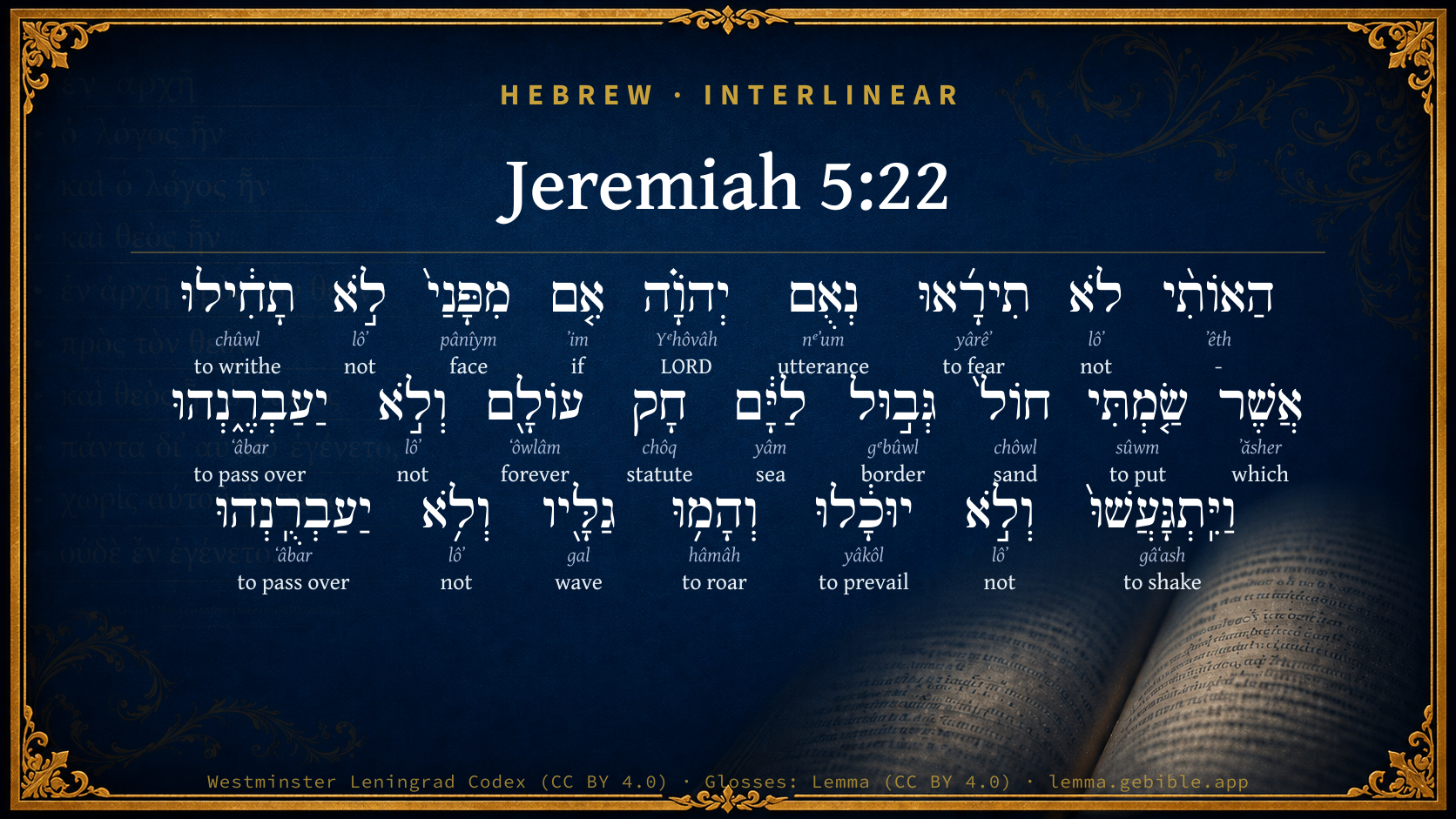
Hebrew (Westminster Leningrad Codex) Jeremiah 5:22 appears in the Hebrew Old Testament. The text above is from the Westminster Leningrad Codex. Each word links to its Strong’s number, a concise gloss, and parsing drawn from the Open Scriptures Hebrew Bible morphology. Click any word for its full Brown-Driver-Briggs (BDB) entry.
Download image
Cite this verse

Jeremiah 5:22 (World English Bible). Public Domain. Lemma interlinear Bible study tool, https://lemma.gebible.app/v/jeremiah/5/22.

Show BibTeX & RIS
BibTeX
RIS
English Translation
Don't you fear me? says Yahweh: won't you tremble at my presence, who have placed the sand for the bound of the sea, by a perpetual decree, that it can't pass it? and though the waves of it toss themselves, yet they can't prevail; though they roar, yet they can't pass over it.
World English Bible · Public Domain
Download a study sheet

One document with this verse’s original text, its word-by-word gloss line, the meaning frame, cross-references with their text, attributed commentary, and full source and license credits — printable, and it pastes into notes with its structure intact.

This verse Autodidact and up

Study sheet (.html) Plain text (.txt)

A passage Seminary Student

Up to 50 verses in one chapter. A passage sheet keeps up to 6 commentary sources and 12 cross-references per verse, in the order this page ranks them, and says so on the sheet whenever that leaves anything out. Ask for a single verse and you get the Autodidact verse sheet above.

Everything on this page stays free to read, with no account — the sheet is a download of what is already on screen, not access to it.

Want to remove ads? Support Godless Engineer
Compare translations 3

The same verse in 3 English versions, stacked beneath the original-language interlinear above. Click any original word for its lexicon entry.

Each is an independent rendering of the whole verse — the interlinear is not word-aligned to these translations.

Highlighted words mark where these versions differ — a whole-verse word diff, not a word-by-word alignment.

  • World English Bible Public Domain
    Don't you fear me? says Yahweh: won't you tremble at my presence, who have placed the sand for the bound of the sea, by a perpetual decree, that it can't pass it? and though the waves of it toss themselves, yet they can't prevail; though they roar, yet they can't pass over it.
  • King James Version Public Domain
    Fear ye not me? saith the LORD: will ye not tremble at my presence, which have placed the sand for the bound of the sea by a perpetual decree, that it cannot pass it: and though the waves thereof toss themselves, yet can they not prevail; though they roar, yet can they not pass over it?
  • unfoldingWord Literal Text CC BY-SA 4.0
    Should you not fear me—the declaration of Yahweh— or should you not tremble from my face? For I have placed sand a border for the sea, an eternal decree and it does not cross over it, and it rises and falls, still it would not prevail, and its waves roar, still they do not cross over it.

unfoldingWord Literal Text — © unfoldingWord, licensed CC BY-SA 4.0. Word-aligned USFM3 via Door43 (git.door43.org/unfoldingWord/en_ult).

Versions to compare (up to 4)

3 of 4 selected

Show all 18 translations

Every available English version of this verse, each an independent rendering of the whole verse.

  • World English Bible Public Domain
    Don't you fear me? says Yahweh: won't you tremble at my presence, who have placed the sand for the bound of the sea, by a perpetual decree, that it can't pass it? and though the waves of it toss themselves, yet they can't prevail; though they roar, yet they can't pass over it.
  • Berean Standard Bible Public Domain
    Do you not fear Me?” declares the LORD. “Do you not tremble before Me, the One who set the sand as the boundary for the sea, an enduring barrier it cannot cross? The waves surge, but they cannot prevail. They roar but cannot cross it.
  • Majority Standard Bible Public Domain
    Do you not fear Me?” declares the LORD. “Do you not tremble before Me, the One who set the sand as the boundary for the sea, an enduring barrier it cannot cross? The waves surge, but they cannot prevail. They roar but cannot cross it.
  • King James Version Public Domain
    Fear ye not me? saith the LORD: will ye not tremble at my presence, which have placed the sand for the bound of the sea by a perpetual decree, that it cannot pass it: and though the waves thereof toss themselves, yet can they not prevail; though they roar, yet can they not pass over it?
  • American Standard Version (1901) Public Domain
    Fear ye not me? saith Jehovah: will ye not tremble at my presence, who have placed the sand for the bound of the sea, by a perpetual decree, that it cannot pass it? and though the waves thereof toss themselves, yet can they not prevail; though they roar, yet can they not pass over it.
  • Revised Version (1885) Public Domain
    Fear ye not me? saith the LORD: will ye not tremble at my presence, which have placed the sand for the bound of the sea, by a perpetual decree, that it cannot pass it? and though the waves thereof toss themselves, yet can they not prevail; though they roar, yet can they not pass over it.
  • Geneva Bible (1599) Public Domain
    Feare ye not me, saith the Lord? or will ye not be afraide at my presence, which haue placed the sand for the bounds of the sea by the perpetuall decree that it cannot passe it, and though the waues thereof rage, yet can they not preuaile, though they roare, yet can they not passe ouer it?
  • Douay-Rheims (1899) Public Domain
    Will not you then fear me, saith the Lord: and will you not repent at my presence? I have set the sand a bound for the sea, an everlasting ordinance, which it shall not pass over: and the waves thereof shall toss themselves, and shall not prevail: they shall swell, and shall not pass over it.
  • Young's Literal Translation Public Domain
    Me do ye not fear, an affirmation of Jehovah? From My presence are ye not pained? Who hath made sand the border of the sea, A limit age-during, and it passeth not over it, They shake themselves, and they are not able, Yea, sounded have its billows, and they pass not over.
  • Literal Standard Version CC BY-SA 4.0
    Do you not fear Me?” A declaration of YHWH; “Are you not pained from My presence? Who has made sand the border of the sea, || A perpetual limit, and it does not pass over it, || They shake themselves, and they are not able, || Indeed, its billows have sounded, and they do not pass over.
  • Unlocked Literal Bible CC BY-SA 4.0
    Do you not fear me—this is Yahweh's declaration—or tremble before my face? I have placed a border of sand against the sea, an ongoing decree that it does not violate— even though the sea rises and falls, still it does not violate it. Even though its waves roar, they do not cross it.
  • unfoldingWord Literal Text CC BY-SA 4.0
    Should you not fear me—the declaration of Yahweh— or should you not tremble from my face? For I have placed sand a border for the sea, an eternal decree and it does not cross over it, and it rises and falls, still it would not prevail, and its waves roar, still they do not cross over it.
  • Darby Bible Public Domain
    Will ye not fear me? saith Jehovah. Will ye not tremble at my presence, who have set the sand a bound for the sea by a perpetual decree, and it shall not pass it? and its waves toss themselves, but they do not prevail; and they roar, yet can they not pass over it?
  • World Messianic Bible Public Domain
    Don’t you fear me?’ says the LORD; ‘Won’t you tremble at my presence, who have placed the sand for the bound of the sea by a perpetual decree, that it can’t pass it? Though its waves toss themselves, yet they can’t prevail. Though they roar, they still can’t pass over it.’
  • Webster's Bible Public Domain
    Fear ye not me? saith the LORD: will ye not tremble at my presence, who have placed the sand for the bound of the sea by a perpetual decree, that it cannot pass it: and though its waves toss themselves, yet can they not prevail; though they roar, yet can they not pass over it?
  • Free Bible Version CC BY-SA 4.0
    Aren't you afraid of what I can do? declares the Lord. Don't you think you should tremble in my presence? I am the one who set up the shore as the sea's boundary, an everlasting limit that it can't cross. The waves crash against it, but they can't defeat it. They roar, but they can't cross the barrier.
  • Bible in Basic English Public Domain
    Have you no fear of me? says the Lord; will you not be shaking with fear before me, who have put the sand as a limit for the sea, by an eternal order, so that it may not go past it? and though it is ever in motion, it is not able to have its way; though the sound of its waves is loud, they are not able to go past it.
  • JPS Tanakh (1917) Public Domain
    Fear ye not Me? saith the LORD; Will ye not tremble at My presence? Who have placed the sand for the bound of the sea, an everlasting ordinance, which it cannot pass; and though the waves thereof toss themselves, yet can they not prevail; though they roar, yet can they not pass over it.

Literal Standard Version (2020), Covenant Press — licensed CC BY-SA 4.0. Text via the HelloAO Bible API (eBible.org). Unlocked Literal Bible (unfoldingWord) — licensed CC BY-SA 4.0. Text via the HelloAO Bible API (eBible.org). unfoldingWord Literal Text — © unfoldingWord, licensed CC BY-SA 4.0. Word-aligned USFM3 via Door43 (git.door43.org/unfoldingWord/en_ult). Free Bible Version, Dr. Jonathan Gallagher — licensed CC BY-SA 4.0. Text via the HelloAO Bible API (eBible.org).

Word by word

More ways to search: Search by grammar → Find every occurrence → Compare this word →

Practice this passage: Drill this verse → Learn its vocabulary →

וַיִּֽתְגָּעֲשׁוּ֙
gâʻash
H1607
“and · to shake”
Conjunction + Verb, Hithpael, Sequential Imperfect, 3rd Person, Masculine, Plural
Part of Speech
Conjunction + Verb
Stem
Hithpael
Form
Sequential Imperfect
Person
3rd Person
Gender
Masculine
Number
Plural
Full BDB Definition

Origin: a primitive root

TWOT: 371

to shake, quake - (Qal) to shake - (Pual) to be shaken up, convulsed - (Hithpael) to shake back and forth, toss or reel to and fro - (Hithpoel) to reel to and fro
  1. הַאוֹתִ֨י ʼêth H853 “- · me” Particle, Interrogative + Particle, Direct Object + Suffix, Personal, 1st Person, Common, Singular
  2. לֹא lôʼ H3808 “not” Particle, Negative
  3. תִירָ֜אוּ yârêʼ H3372 “to fear” Verb, Qal, Imperfect, 2nd Person, Masculine, Plural
  4. נְאֻם nᵉʼum H5002 “utterance of” Noun, Common, Masculine, Singular, Construct
  5. יְהֹוָ֗ה Yᵉhôvâh H3068 “LORD” Noun, Proper
  6. אִ֤ם ʼim H518 “if” Conjunction
  7. מִפָּנַי֙ pânîym H6440 “from · face(s) · my” Preposition + Noun, Common, Both, Plural, Construct + Suffix, Personal, 1st Person, Common, Singular
  8. לֹ֣א lôʼ H3808 “not” Particle, Negative
  9. תָחִ֔ילוּ chûwl H2342 “to writhe” Verb, Qal, Imperfect, 2nd Person, Masculine, Plural
  10. אֲשֶׁר ʼăsher H834 “which” Particle, Relative
  11. שַׂ֤מְתִּי sûwm H7760 “to put” Verb, Qal, Perfect, 1st Person, Common, Singular
  12. חוֹל֙ chôwl H2344 “sand” Noun, Common, Masculine, Singular, Absolute
  13. גְּב֣וּל gᵉbûwl H1366 “border” Noun, Common, Masculine, Singular, Absolute
  14. לַיָּ֔ם yâm H3220 “to/for the · sea” Preposition, Determined + Noun, Common, Masculine, Singular, Absolute
  15. חָק chôq H2706 “statute of” Noun, Common, Masculine, Singular, Construct
  16. עוֹלָ֖ם ʻôwlâm H5769 “forever” Noun, Common, Masculine, Singular, Absolute
  17. וְלֹ֣א lôʼ H3808 “and · not” Conjunction + Particle, Negative
  18. יַעַבְרֶ֑נְהוּ ʻâbar H5674 “to pass over · him” Verb, Qal, Imperfect, 3rd Person, Masculine, Singular + Suffix, Personal, 3rd Person, Masculine, Singular
  19. וְלֹ֣א lôʼ H3808 “and · not” Conjunction + Particle, Negative
  20. יוּכָ֔לוּ yâkôl H3201 “to prevail” Verb, Qal, Imperfect, 3rd Person, Masculine, Plural
  21. וְהָמ֥וּ hâmâh H1993 “and · to roar” Conjunction + Verb, Qal, Sequential Perfect, 3rd Person, Common, Plural
  22. גַלָּ֖יו gal H1530 “waves · his” Noun, Common, Masculine, Plural, Construct + Suffix, Personal, 3rd Person, Masculine, Singular
  23. וְלֹ֥א lôʼ H3808 “and · not” Conjunction + Particle, Negative
  24. יַעַבְרֻֽנְהוּ ʻâbar H5674 “to pass over · him” Verb, Qal, Imperfect, 3rd Person, Masculine, Plural + Suffix, Personal, 3rd Person, Masculine, Singular

About this verse

These counts appear in no published source. They are computed here, from the morphology-tagged text and Lemma’s own curated glosses. What Lemma adds →

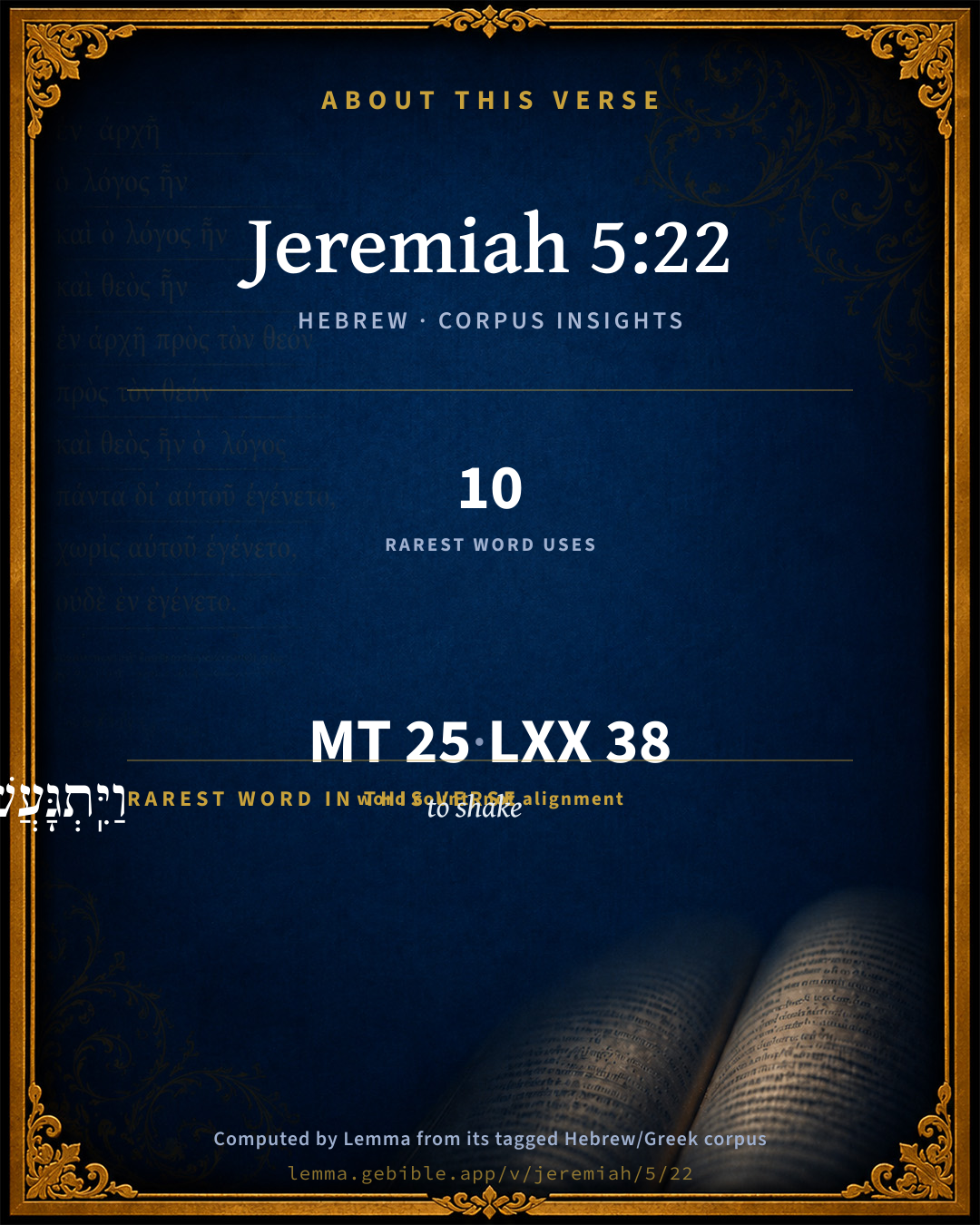
25
words
20
distinct lemmas
Prophets
section

Notable vocabulary

The rarest word here is וַיִּֽתְגָּעֲשׁוּ֙ to shake H1607 — appearing just 10 times in the whole Hebrew Bible.

Shared distinctive vocabulary

וַיִּֽתְגָּעֲשׁוּ֙ to shake H1607 occurs in 7 verses of the Hebrew Bible. Also found in:

Grammatical profile

  • 8 verbs
  • 9 nouns
  • 1 conjunction
  • 7 particles

Verb forms

  • תִירָ֜אוּ Qal · Imperfect
  • תָחִ֔ילוּ Qal · Imperfect
  • שַׂ֤מְתִּי Qal · Perfect
  • יַעַבְרֶ֑נְהוּ Qal · Imperfect
  • וַיִּֽתְגָּעֲשׁוּ֙ Hithpael · Sequential Imperfect
  • יוּכָ֔לוּ Qal · Imperfect
  • וְהָמ֥וּ Qal · Sequential Perfect
  • יַעַבְרֻֽנְהוּ Qal · Imperfect

Repetition

Words recur within this verse — often emphatic in Hebrew:

  • יַעַבְרֶ֑נְהוּ to pass over H5674 ×2
  • לֹא not H3808 ×5

Hebrew & Septuagint length

In the original languages it is 25 Hebrew tokens and 38 Greek tokens — but the two are counted differently (Hebrew bundles its prefixes and suffixes into one token; the Greek is in lemma form), so that isn’t a like-for-like length.

Cross-references

19

Topical passages linked to Jeremiah 5:22 in the Treasury of Scripture Knowledge — connected by theme and wording, ordered by reader-vote popularity; previews shown in the World English Bible.

  • Job 38:10–11 Marked out for it my bound, Set bars and doors,
  • Psalms 104:9 You have set a boundary that they may not pass over; That they don't turn again to cover the earth.
  • Job 26:10 He has described a boundary on the surface of the waters, And to the confines of light and darkness.
  • Deuteronomy 28:58 If you will not observe to do all the words of this law that are written in this book, that you may fear this glorious and fearful name, YAHWEH YOUR GOD;
  • Psalms 119:120 My flesh trembles for fear of you. I am afraid of your judgments.
  • Proverbs 8:29 When he gave to the sea its boundary, That the waters should not violate his commandment, When he marked out the foundations of the earth;
  • Jeremiah 10:7 Who should not fear you, King of the nations? for to you does it appertain; because among all the wise men of the nations, and in all their royal estate, there is none like you.
  • Nahum 1:4 He rebukes the sea, and makes it dry, and dries up all the rivers. Bashan languishes, and Carmel; and the flower of Lebanon languishes.
  • Mark 4:39 He awoke, and rebuked the wind, and said to the sea, "Peace! Be still!" The wind ceased, and there was a great calm.
  • Revelation 15:4 Who wouldn't fear you, Lord, And glorify your name? For you only are holy. For all the nations will come and worship before you. For your righteous acts have been revealed."
  • Amos 9:6 It is he who builds his chambers in the heavens, and has founded his vault on the earth; he who calls for the waters of the sea, and pours them out on the surface of the earth; Yahweh is his name.
  • Psalms 33:7 He gathers the waters of the sea together as a heap. He lays up the deeps in storehouses.
  • Psalms 99:1 Yahweh reigns! Let the peoples tremble. He sits enthroned among the cherubim. Let the earth be moved.
  • Psalms 93:3–4 The floods have lifted up, Yahweh, The floods have lifted up their voice. The floods lift up their waves.
  • Isaiah 50:2 Why, when I came, was there no man? when I called, was there none to answer? Is my hand shortened at all, that it can't redeem? or have I no power to deliver? Behold, at my rebuke I dry up the sea, I make the rivers a wilderness: their fish stink, because there is no water, and die for thirst.
  • Matthew 10:28 Don't be afraid of those who kill the body, but are not able to kill the soul. Rather, fear him who is able to destroy both soul and body in Gehenna.
  • Isaiah 66:5 Hear the word of Yahweh, you who tremble at his word: Your brothers who hate you, who cast you out for my name's sake, have said, Let Yahweh be glorified, that we may see your joy; but it is those who shall be disappointed.
  • Daniel 6:26 I make a decree, that in all the dominion of my kingdom men tremble and fear before the God of Daniel; for he is the living God, and steadfast forever, His kingdom that which shall not be destroyed; and his dominion shall be even to the end.
  • Luke 12:5 But I will warn you whom you should fear. Fear him, who after he has killed, has power to cast into Gehenna. Yes, I tell you, fear him.

Cross-references courtesy of OpenBible.info (CC BY 4.0).

Hebrew and Greek witnesses Masoretic Hebrew ↔ Greek Septuagint

The same verse in the two great witnesses to the Old Testament, shown verse-for-verse.

These are two independent witnesses, not word-aligned to each other, and the Septuagint is shown in lemma (dictionary) form.

Hebrew Jeremiah 5:22 Masoretic · Westminster Leningrad Codex

הַאוֹתִ֨י לֹא תִירָ֜אוּ נְאֻם יְהֹוָ֗ה אִ֤ם מִפָּנַי֙ לֹ֣א תָחִ֔ילוּ אֲשֶׁר שַׂ֤מְתִּי חוֹל֙ גְּב֣וּל לַיָּ֔ם חָק עוֹלָ֖ם וְלֹ֣א יַעַבְרֶ֑נְהוּ וַיִּֽתְגָּעֲשׁוּ֙ וְלֹ֣א יוּכָ֔לוּ וְהָמ֥וּ גַלָּ֖יו וְלֹ֥א יַעַבְרֻֽנְהוּ

Don't you fear me? says Yahweh: won't you tremble at my presence, who have placed the sand for the bound of the sea, by a perpetual decree, that it can't pass it? and though the waves of it toss themselves, yet they can't prevail; though they roar, yet they can't pass over it.

World English Bible · Public Domain

Greek LXX Structure differs

In the Septuagint, Jeremiah is about an eighth shorter than the Hebrew and arranges its material differently — the Oracles Against the Nations (Hebrew chapters 46–51) appear in the middle of the Greek book, after 25:13. Because the chapter and verse boundaries do not line up, a verse-for-verse comparison with the Hebrew is not shown.

A verse-for-verse comparison isn’t shown here because the chapters and verses don’t line up. Switch to the LXX edition with the MT / LXX toggle above to read the Greek directly.

Hebrew: Westminster Leningrad Codex (CC BY 4.0). Greek: Septuagint (public domain); English from a public-domain English Septuagint. How the Septuagint differs from the Hebrew →

Targum (Aramaic paraphrase)

1

The Targum is the ancient Jewish Aramaic paraphrase of the Hebrew Scriptures — an interpretive translation, not the Hebrew text itself. Onkelos (literal) and Pseudo-Jonathan (expansive) render the Torah, and Jonathan the Prophets. Coverage is partial: where no permissively-licensed English translation exists for a verse, only the Aramaic is shown. This is verse-level text, not a word-by-word alignment to the Hebrew.

  1. Targum Jonathan Prophets (Joshua–Malachi)
    הֲמִן קֳדָמַי לָא תִדַחֲלוּן אֲמַר יְיָ אִם מִן קֳדָם מֵימְרִי לָא תְזוּעוּן דְשַׁוֵיתִי חָלָא תְּחוּמָא לְיַמָא קְיָם עֲלַם וְלָא עָדֵי לֵיהּ וּמְטָרְפִין וְלָא יָכְלִין וְהָמָן גַלוֹהִי וְלָא עָדָן לֵיהּ:

    (no public-domain English translation for this verse)

    Targum Jonathan — Aramaic: “Mikraot Gedolot” (public domain). English: “Sefaria Community Translation” (CC0 1.0 (public-domain dedication)); “London "Chaldee Paraphrase," 1871” (public domain). Text via Sefaria.

Commentary

Notes on Jeremiah 5:22 from classic Christian and Jewish commentators (each source and its license shown beneath its notes). The classic Christian expositions comment on the surrounding passage and are grouped to its opening verse, so a note may address several verses; the Jewish commentaries on the Tanakh (Rashi and others) are per-verse, so they appear only where the commentator wrote on this verse.

Lemma curates 59 commentaries, every one of them public domain or Creative Commons licensed, each selected and text-cleaned for this edition rather than reprinted as found. About our sources →

Trapp's Complete Commentary

John Trapp

Jer 5:22 Fear ye not me? saith the LORD: will ye not tremble at my presence, which have placed the sand [for] the bound of the sea by a perpetual decree, that it cannot pass it: and though the waves thereof toss themselves, yet can they not prevail; though they roar, yet can they not pass over it?

Ver. 22. Fear ye not me? saith the Lord.] What! not me, whom the sea itself, that tumultuous and unruly creature, feareth and obeyeth? See Psa 65:7; Psa 93:4.

Who have placed the sand for a bound to the sea.] A weak bound for so furious an element. Vis maris infirmissimo sabuli pulvere cohibetur. But so I will have it; and then who or what can gainstand it? Now, who can but be moved at such miracles? Know you not that I can soon make your arable, satiable? and that I can shake the earth as oft as there is a tempest in the ocean, since the earth is founded not upon solid rocks but fluid waters? See 2Pe 3:5.

By a perpetual decree.] Heb., By an ordinance of antiquity or of perpetuity, clapping it up close prisoner.

John Trapp, A Commentary or Exposition upon All the Books of the Old and New Testament (1647–1656) — public domain. Text from a community e-Sword module.

Joseph Benson's Commentary

Jer 5:22-24. Fear ye not me? saith the Lord — He ascribes their stupidity and foolishness to their want of the fear of God. As if he had said, If you would but call to mind God’s almighty power, and your own weakness, and keep an awe of him upon your minds, you would be more observant of his commands, and be afraid to disobey them. Which have placed the sand for the bound of the sea — Who need not place rocks or walls to keep it in; but can give an effectual check to it by a little despicable sand. “The keeping of the waters within bounds, so that they cannot overflow the earth, is often mentioned in Scripture as an immediate effect of God’s overruling power and providence. For water being specifically lighter than earth, by the common laws of gravitation it should rise above it, and overflow it. And then the adjusting the proportion of the tides, that they rise no higher, to the prejudice of the lower grounds, is another remarkable instance of God’s special providence.” — Lowth. But this people are more ungovernable than the unruly waves of the sea: they have a revolting and a rebellious heart — They have not only revolted from me and gone back, but they continue obstinate, and will not return. They persist in their evil courses, and are determined so to do: they are gone quite away, and are irreclaimable. Neither say they in their heart — They are so careless that they never trouble themselves about any thing of the kind; or are so obdurate that they never lay it to heart, nor consider that it is God, who disposeth of all things according to his own pleasure, both in the great deep and on dry land. Let us now fear the Lord our God — Or, worship and obey him; all acceptable service to God being both performed in his fear, and proceeding from it. That giveth rain — Without which the earth could produce no fruits. By this the true God is distinguished from all false gods, Jer 14:22; and in this appears not only his power in appointing and preparing it, (Psa 147:8,) and his sovereignty in withholding it, (Amo 4:7,) but his general goodness in bestowing it, (Deu 28:12,) and his special providence in distributing it according as there is need. As in the former instance God shows how insensible his people were of his power and glorious greatness in taming such an unruly element as the sea; so here he further sets forth their inattention to, and disregard of, his providence and goodness; implying that they were grown so stupid, unfeeling, and obstinate, that they neither stood in awe of him for his greatness, nor feared to offend him for his goodness. “The vicissitudes of seasons, of cold and heat, of drought and moisture, so wisely fitted for the growth of the fruits of the earth, and other uses of human life, are so remarkable a proof of the being and attributes of God and his providence, as to be obvious to the meanest capacity, and on this account they are frequently insisted on by the inspired writers.” — Lowth. Concerning the former and latter rain, see note on Deu 11:14; and Pro 16:15. He reserveth, &c., the appointed weeks of the harvest — He gives seasonable harvests, according to his appointment. The sum is: the prophet would let them know what a foolish as well as wicked thing it was to set themselves against that God who kept, as he still keeps, the whole order of nature at his disposal, governing and changing it as he sees men behave toward him.

Joseph Benson's Commentary on the Old and New Testaments (1811–1818) — public domain. Text from a community e-Sword module.

Tyndale Open Study Notes

Tyndale Open Resources

5:22 The people should at least respect the Lord for his power and tremble at the thought of his unleashing that power against them. If even the mighty sea was unable to pass the boundaries the Lord had set for it, surely the rebellion of little Jerusalem would fail.

Tyndale Open Study Notes — © Tyndale Open Resources, licensed CC BY-SA 4.0. Text via the HelloAO Bible API.

Geneva Bible (1599)

Geneva Bible translators

Job 26:10

Geneva Bible (1599) marginal notes — public domain. Text via Bolls.life.

Jamieson, Fausset & Brown

Robert Jamieson, A. R. Fausset & David Brown

sand--Though made up of particles easily shifting about, I render it sufficient to curb the violence of the sea. Such is your monstrous perversity, that the raging, senseless sea sooner obeys Me, than ye do who profess to be intelligent [CALVIN], (Job 26:10; Job 38:10-11; Pro 8:29; Rev 15:4).

Jamieson, Fausset & Brown — Commentary Critical and Explanatory on the Whole Bible (1871) — public domain (CC PDM 1.0). Text via the HelloAO Bible API.

Adam Clarke's Commentary

Verse 22. Which have placed the sand for the bound of the sea] What can I not do, who confine the sea, that enormous mass of waters, and prevent it from overflowing the earth; not by immense mountains and rocks, but by the sand, no particle of which is in cohesion with another? The most tremendous waves cannot displace nor pass over this simple barrier.

Adam Clarke's Commentary on the Bible (1810–1826) — public domain. Text from a community e-Sword/MySword module.

John Calvin's Commentaries

God shews here why he had said that the people were foolish and without understanding. It was indeed a monstrous stupidity, not to fear at the presence of God, since even inanimate elements obey his bidding: and he takes the sea especially as an example; for there is nothing more terrific than a tempestuous sea. It appears as if it would overwhelm the whole world, when its waves swell with so much violence. No one can in this case do otherwise than tremble. But the sea itself, which makes the stoutest to tremble, quietly obeys God; for however furious may be its tossings, they are yet under restraint. Now, if any inquires how this is, it must be confessed to be a miracle which cannot be accounted for; for the sea, we know, as other elements, is spherical. As the earth is round, so also is the element of water, as well as the air and fire. Since then the form of this element is spherical, we must know that it is not lower than the earth: but it being lighter than the earth shews that it stands above it. How then comes it that the sea does not overflow the whole earth? for it is a liquid, and cannot stand in one place, except retained by some secret power of God. It hence follows, that the sea is confined to its own place, because of God’s appointment, according to what is said by Moses,

“Let the dry land,” said God, “appear,” (Genesis 1:9:)

for he intimates that the earth was covered with water, and no part of it appeared, until God formed the sea. Now the word of God, though it is not heard by us, nor resounds in the air, is yet heard by the sea; for the sea is confined within its own limits. Were the sea tranquil, it would still be a wonderful work of God, as he has given the earth to be the habitation of men: but when it is moved, as I have said, by a tempest, and heaven and earth seem to blend together, there is no one, being nigh such a sight, who does not feel dread. Hence then the power of God, and his dread might, appear more evident when he calms the turbulent sea.

We now see the scope of the Prophet’s words: He shews that the Jews were monsters, and unworthy not only to be counted men, but even to be classed with brute animals; for there was more sense and understanding in the tempestuous and raging sea than in men, who seemed endued with reason and understanding. This is the design of the comparison.

But as it was a heavy complaint, the Prophet asks a question, Will ye not fear me? As though God had said, “What do you mean? How is it that I am not feared by you? The sea obeys me, and its fury is checked by my secret bidding; for I have once for all commanded the sea to remain within its own limits, and though it may be violently agitated by storms and tempests, it does not yet exceed my orders. Will not you men, endowed with reason, fear me? will you not tremble at my presence?” And he says, that he had set the sand to be the boundary of the sea: and this is much more expressive than if he had said that he had set boundaries to the sea; for the sand is movable and driven by a small breath of wind, and the sand is also penetrable. Were there rocks along all the shores of the sea, it would not be so wonderful. Had God then restrained the violence of the sea by firm and strong mounds, the keeping of it within its limits might be ascribed to nature; but what firmness is there in sand? for a little water thrown on it will soon penetrate through it. How then is it, that the sea, when tossed by violent storms, does not remove the sand, which is so easily shifted? We hence see that this word is not in vain introduced. And there is a similar passage in Job 38:11, where God, speaking of his infinite power, says among other things,

“Hitherto shalt thou come, but no further:”

for doubtless no storm arises, except when it pleases God. He might indeed keep the sea in the same quiet state; but he does not do so: on the contrary, he gives it as it were loose reins, but he says, “Hitherto shall it come.” When therefore high mountains seem to threaten all mortals, and the earth seems nigh an overthrow, then suddenly the impetuous waves are repressed and become calm.

And he adds, A perpetual ordinance It is indeed true that the sea sometimes overflows its limits; for many cities, we know, have been swallowed up by a flood; but still it is rightly said, that it is a perpetual ordinance or decree, that God confines the sea within its own limits. For whenever the sea overflows a small portion of land, we hence learn what it might do without that restraint, mentioned here by Jeremiah and in the book of Job. We hence learn, that there is nothing to hinder the sea from overflowing the whole earth, but the command of God which it obeys. In the mean time the perpetuity of which the Prophet speaks remains generally the same: for though many storms arise every year, yet the fury of the sea is still quieted, but not otherwise than by the command of God. True then is this — that the sea has prescribed limits, over which its waves are not permitted to pass. And hence he says, Move themselves and not prevail shall its waves; and again, Resound, or tumultuate shall they, and shall not pass over

We now apprehend the design of this verse: God complains, that there was so much madness and stupidity in the people, that they did not obey him as much as the sea, even the stormy sea. He then condemns here the Jews, as though they were monsters; for nothing can be more contrary to nature than for the tempestuous sea to have more understanding than man, created in God’s image and endued with reason. He then adds —

John Calvin's Commentaries (1540-1563) — public domain. Text from the Calvin Translation Society English edition (1840s-50s) via the Christian Classics Ethereal Library (ccel.org). Calvin's coverage is partial (roughly two-thirds of the Bible); uncommented books and verses are honest gaps, never fabricated. The 19th-century editor's footnotes and remarks are omitted so the notes are faithfully Calvin's own voice.

Ellicott's Commentary for English Readers

(22) Which have placed the sand . . .—The greatness of Jehovah is shown by the majesty of His work in nature. As in Job_38:8-11, so, probably, here also there is something of the wonder of one to whom, as dwelling in an inland village, the billows breaking on the shore was an unfamiliar sight. Here was the token that even the forces which seem wildest and least restrained are subject to an overruling law. Even the sand which seems so shifting keeps in the surging waters.

A Bible Commentary for English Readers, edited by Charles John Ellicott (1878–1897) — public domain. Text from a community e-Sword module.

The Cambridge Bible for Schools and Colleges

gen. ed. J. J. S. Perowne

22. In MT. “the waves” belongs to the next clause. No subject is supplied to “toss themselves,” but Jer_46:7 f. suggests that the waters thereof (which form one word in Hebrew) should be supplied as accidentally omitted.

The Cambridge Bible for Schools and Colleges (gen. ed. J. J. S. Perowne; Cambridge University Press, 1878–1918) — public domain. Text from a community e-Sword module.

John Gill's Exposition

Fear ye not me? saith the Lord,.... They did not fear the Lord, and this is a reproof to them for the want of it, which is a reproof of their ignorance and folly; for the fear of the Lord is the beginning of wisdom, Pro 9:10, and where that is there is true wisdom; but, where it is not, there is nothing but ignorance and stupidity:

will ye not tremble at my presence? or "face"; his wrath and anger, justly resenting their carriage to him. The Targum is,

"from before my Word;''

the essential Word, his Son: or, "will ye not be in pain?" as a woman in travail; as Kimchi observes the word (b) signifies:

which have placed the sand for the bound of the sea by a perpetual decree, that it cannot pass it. This is a very wonderful thing in nature, that the earth and sea, being spherical, and making one terraqueous globe, and the waters of the sea being higher than the earth, should be so bounded and restrained, by the power and providence of God, as not to overflow the earth, and that by means of the sand, which is penetrable, flexible, and movable; and yet this is set as a bound, and by the decree of God remains firm and stable, and that for ever, so that the sea cannot bear it down, go through it, or over it:

and though the waves thereof toss themselves, yet can they not prevail; though they roar, yet can they not pass over it; even when the sea is the most tumultuous and raging. This is an instance of the mighty power of God, and carries in it an argument and reason why he should be feared; and yet such was the stupidity of this people, that though they saw this with their eyes, the sea and the tossings of it, and the sand set as a bound to it, and an effectual one, and heard the roarings and ragings of the waves of it in vain; yet they feared not the Lord that did all this; and so showed themselves more stupid and disobedient than the sea and its waves, which obeyed their Maker, though destitute of sense and reason; see Job 26:10.

(b) "Significantissima impimis vox est" "quae significat ita angi ut parturiens", Schmidt.

John Gill's Exposition of the Whole Bible (1746–1763) — public domain (CC PDM 1.0). Text via the HelloAO Bible API.

Haydock's Catholic Bible Commentary

It. Nature and chance are improper terms. God regulates all, and has established those laws which preserve the world.

George Leo Haydock (1774–1849), Haydock's Catholic Family Bible and Commentary, 1859 edition — public domain. Excludes Psalms (Douay-Rheims chapter numbering differs from Protestant) and Deuterocanonical books (Catholic canon only).

Matthew Poole's English Annotations

Fear ye not me: either a convincing argument to persuade them to submit unto him; Will ye not submit to me, that can rule the sea? which, as unruly a thing as it is, yet quietly yields to my will: or rather, a very angry challenge and expostulation; Do you think that I, that can tame the boisterous sea, cannot tame you?

Which have placed the sand for the bound of the sea; that stand not in need to make rocks for walls and bounds unto it, but can give a check to it by so small a matter as the sand, that of itself is not only yielding and penetrable, but subject to be blown away with every wind.

By a perpetual decree; either looking backward, that it never could, or forward, that it never shall. Whether this decree have respect to the creation, or to the deluge, it is not much material; the former of which times it could not have been contained within its bounds, neither in the latter could it have exceeded them, without God’s special order, as no time since.

Though the waves thereof toss themselves; though they swell, rage, roar, and threaten never so much, as if they would swallow up all before them; though they foam against the rocks that stand in their way; yet, when they come to their bounds appointed, shall tamely yield unto the sand, and retire back.

Yet can they not prevail; not get any ground upon or against God’s decree and appointment; either the

decree or the

sand; which in regard of their form, situation, unruliness, and fluxibility would overflow the whole earth, were it not for the limits and restraints that are laid upon it, Job 38:11. By this instance, God may show what he could do with reference to that enraged and raging army that is about to come upon them like a torrent, if his people would repent. Or rather be hereby upbraids the Jews with their unreasonable sottishness, that they are more mad in their rebellions against God, than the raging waters of the sea, that, as boisterous as they are, yet obey his will.

Matthew Poole's English Annotations on the Holy Bible (1683–1685) — public domain. Text from a community e-Sword/MySword module.

Whedon's Commentary on the Bible

Daniel D. Whedon

22. Fear ye not me — The greatness of God measures the greatness of sin. They have set at defiance that God against whom the furious sea cannot successfully rebel.

Placed the sand — What so resistless as the sea? What so yielding as the sand? And yet by the appointment of God this contemptible thing is the conqueror!

Daniel D. Whedon (gen. ed.), Commentary on the Old and New Testaments (1874–1909) — public domain. Text from a community e-Sword module.

The Pulpit Commentary

Fear ye not me? The Hebrew places "me" emphatically at the beginning of the sentence. By a perpetual decree. This is one of the evidences, few but sufficient, of the recognition of natural laws by the Biblical writers; of laws, however, which are but the description of the Divine mode of working, "covenants" (Jer_33:20; comp. Gen_9:18) made for man"s good, but capable of being annulled. (Isa_54:10) Comp. Pro_8:29 Job_38:8-12.

Vers. 22-24. Man rebuked by nature.

Man considers himself to be the lord of creation." He alone of all creatures is made in the image of God. Yet there are things in nature which should put him to shame. Jeremiah indicates two of these.

I THE DIVINE ORDER OF NATURE REBUKES THE WILFUL DISOBEDIENCE OF MAN.

1. Nature is ever obedient to the law of God.

(1) The greatest powers of nature submit to Divine ordinances. The sea, vast and mighty, is bound by his decree. (Job_38:8-11)

(2) The wildest convulsions of nature do not transgress these ordinances. The waves may toss and roar, but they cannot pass the bounds that God has set them. Hurricanes, thunder-storms, earthquakes, are as subservient to law as the silent sunshine and the peaceful growth of spring.

(3) The simplest means in accordance with Divine laws are sufficient to restrain the fiercest forces of nature. God has placed the sand as a bound of the sea, and the storms are driven back from the sandy beach as surely as from the coast of iron crags.

(4) The obedience of nature to these Divine ordinances is everlasting and without exception. The sea is bound by perpetual decrees.

2. Man alone is disobedient to the Law of God. He is the great exception to the order of the universe. The wild sea never transgresses God"s decrees; man is the sole transgressor. The possibility of this strange, solitary rebellion among all the orders of God"s kingdoms of nature is explained by the constitution of man and the character of the obedience which is required by this. Nature is under necessity; man is free. Nature"s obedience is unconscious, material; man"s is deliberate, moral. He is to fear, to tremble, i.e. to obey under the influence of thoughts and feelings of reverence. Lacking these, he can be bound to the throne of God by no chains of compulsion. But how terrible to use the high endowment of liberty only to set at defiance the august decrees before which all other creatures bow unceasingly!

II THE DIVINE BENEFICENCE OF NATURE REBUKES THE UNGRATEFUL REBELLION OF MAN.

1. The order of nature is beneficent. God gives the rain "in its season." He keeps for men "the appointed weeks of the harvest." The regularity and harmony of the physical world are beneficial to men. The sun never fails to rise. If it once failed, what disasters would follow! If the motion of the earth were irregular no life could continue to exist. The order of the seasons is a distinct blessing. (Gen_8:22) Instead of shrinking from "the reign of law" as from a cruel tyranny, we should welcome it when we remember that the laws of nature are but the material expression of the will of God, and that will the outcome of his goodness.

2. This beneficence of nature shows all sin to be a mark of ingratitude. God smiles on us in nature. (Mat_5:45) How then can we, while blessed by the very sunshine of that smile, rise up in revolt against him? If the grandeur and splendid harmony of nature do not awe us, shall not its gentleness and kindliness attract us to loyal obedience to him who is at once the Fountain of law and the Father of mercies?

God"s power in restraining the forces of nature.

An old, yet ever new, illustration of his power. The tiny grains of sand, the "Portland Beach" of shingle or pebbles, is enough to bold back the mighty ocean. It is but one of many impressive illustrations of his restraining power and goodness.

I IT IS CALCULATED TO INSPIRE REVERENCE AND LOVE.

II OUR HELPLESS DEPENDENCE UPON HIM IS THUS SHOWN.

III THE POWER OF GOD IN THE SPHERE OF MORAL INFLUENCE AND SAVING GRACE as thereby suggested. Thus far and no further," when addressed To the wild waves, or wilder human breast, Implies authority that never can, And never ought to be the lot of man.

It is God"s prerogative. Let us not defy him or arrogate to ourselves that which is his. Let us rather yield ourselves to his gracious dealings and fatherly purpose. M.

A lesson from the raging sea.

I WE OBSERVE GOD FIXING LIMITS WITHIN WHICH HIS CREATURES EXERCISE THEIR POWER. Jehovah speaks here of the sea in particular, but just because it happens to be an excellent representative, for the purpose in view, of the rest of his creation. We may notice God"s boundaries in many places and at different seasons, and surely it must often strike thoughtful minds, as they walk by the mighty deep, that there is, in the arrangement of sea and land, an exquisite illustration of the unfailing wisdom of God. Here is this vast mass of water, covering the surface of the globe, ever in motion and yet ever keeping its place. The true state of the case is even more wonderful than that which was presented to Jeremiah. To him the earth was a flat expanse, and the beach would have the aspect of an embankment which really kept the water back. We, aided by the discoveries of science, know that the real limiting forces of the sea work in a much more mysterious manner. But, of course, the fundamental truth is the same. There must be a great and loving intelligence at work, keeping the waters within their appointed bounds.

II OBSERVE THE COMPARISON WHICH IS MADE BETWEEN DISOBEDIENT MAN AND THE SEA IN A STATE OF STORM. The sea easily gets a kind of personality, and the sea in a storm is very like a proud man chafing against the barriers, which confine him, and trying to break them down. More than that, when God looks down into human society, underneath the (to us) often calm surface, he must see little else than stormy agitation, one human billow dashing against another, each individual in his self-assertion contributing to make a general disturbance, and a disturbance which apparently will not soon have an end. And yet the sea, with all its fury and roar and threatening, with all the destruction it may work out in its own sphere, is powerless to overwhelm the solid land. In the strength of their confidence, men would build large cities close to the ocean-brink and inhabit them without fear. They will go down and look at the tempest in its utmost fury, sure that they are safe. A few yards make all the difference between the agony of deadly peril and perfect ease of mind. The more furious the storm is, the grander it makes the sight without in any wise diminishing the feeling of safety.

III HENCE THERE IS INDICATED THE FOLLY OF ALL HUMAN OPPOSITION TO GOD. The storm rises; it may destroy many ships and lives; but in due time the calm returns and the great features of the scene appear the same. The land is still there. And so men may chafe against the commandments and purposes of God, and may go on without intervals of calm, even exceeding the sea in the continuity of their violence. But what does all the strife avail? The boundaries are fixed. If in that which is natural God has taken so much care in the line between sea and land, is it not certain that he will take equal care in that which is spiritual? God"s work continues on the solid land, away from all disturbance of his foes. Nay, more, looking at the figure here from the Christian point of view, we see that even within what seems its own sphere, the raging of the sea can soon be stopped. Let us think of Jesus quelling the waves, and we shall feel that the greatest storms of opposition and persecution are entirely in the hands of God. How long these storms may rage and what they may do entirely depend on the purpose which he wishes them to subserve. Y.

The Pulpit Commentary (1880–1919), ed. H.D.M. Spence-Jones & Joseph S. Exell — public domain. Text from a community e-Sword module.

John Wesley's Explanatory Notes

The sand - That need not make rocks for walls unto it, but can give a check to it by so small a matter as the sand.

John Wesley, Explanatory Notes Upon the Whole Bible (1754–1765) — public domain. Text via the GEBible commentary corpus.

Rashi

Rabbi Shlomo Yitzchaki (Rashi)

Will you not fear Me? Does not the sea, which is not concerned about retribution and does not look forward to receiving reward, fear Me and not cross the boundary that I set around it?

do you not quake Heb. תחילו, an expression of fear.

and toss themselves i.e., its waves, and they lift themselves to cross the border but cannot cross.

and its waves roar A loud sound of roaring.

but they do not pass it The waves do not pass the border.

Rashi on the Tanakh — English translations: “The Judaica Press complete Tanach with Rashi, translated by A. J. Rosenberg” (CC BY 4.0); “Pentateuch with Rashi's commentary by M. Rosenbaum and A.M. Silbermann, 1929-1934” (public domain); “The Metsudah Tanach series, Lakewood, N.J” (CC BY 4.0); and “The Book of Joshua, Metsudah Publications, 1997” (CC BY 4.0). Text via Sefaria.

Lesson kit

Teaching starters — assembled from the data on this page, not authored interpretation. Every prompt links to the verse data it draws on. Edit before teaching.

Jeremiah, in the Prophets, opens this verse with 25 words (20 distinct Hebrew lemmas). Its most distinctive word is gâʻash (“to shake”). A historical commentator’s framing appears above. Read the whole chapter for the surrounding context.

Discussion questions

  1. The word gâʻash carries the sense “to shake.” How does it shape the verse?
  2. 2 Samuel 22:8 shares the word «to shake» with this verse. How do the two illuminate each other?
  3. “to pass over” occurs 2× in this one verse. What is the effect of the repetition?
  4. The translations on this page render this verse differently — a whole-verse word diff, not a word-by-word alignment. What might account for the different wordings?
  5. The verb «תִירָ֜אוּ» is Qal Imperfect. How does its form color the action?
  6. Reading how Trapp's Complete Commentary and Joseph Benson's Commentary read this verse, where do the two commentators agree and where do they part?

Things to notice

Reading settings

Reading text

Shown beneath each verse's original-language words.

Old Testament
Old Testament edition

Read the OT as the Masoretic Hebrew (MT) or the Greek Septuagint (LXX).

English shown for the Greek Septuagint (in the Hebrew ↔ Greek comparison).

Comparing translations? Open the Compare panel on any verse page to stack up to four side by side.