
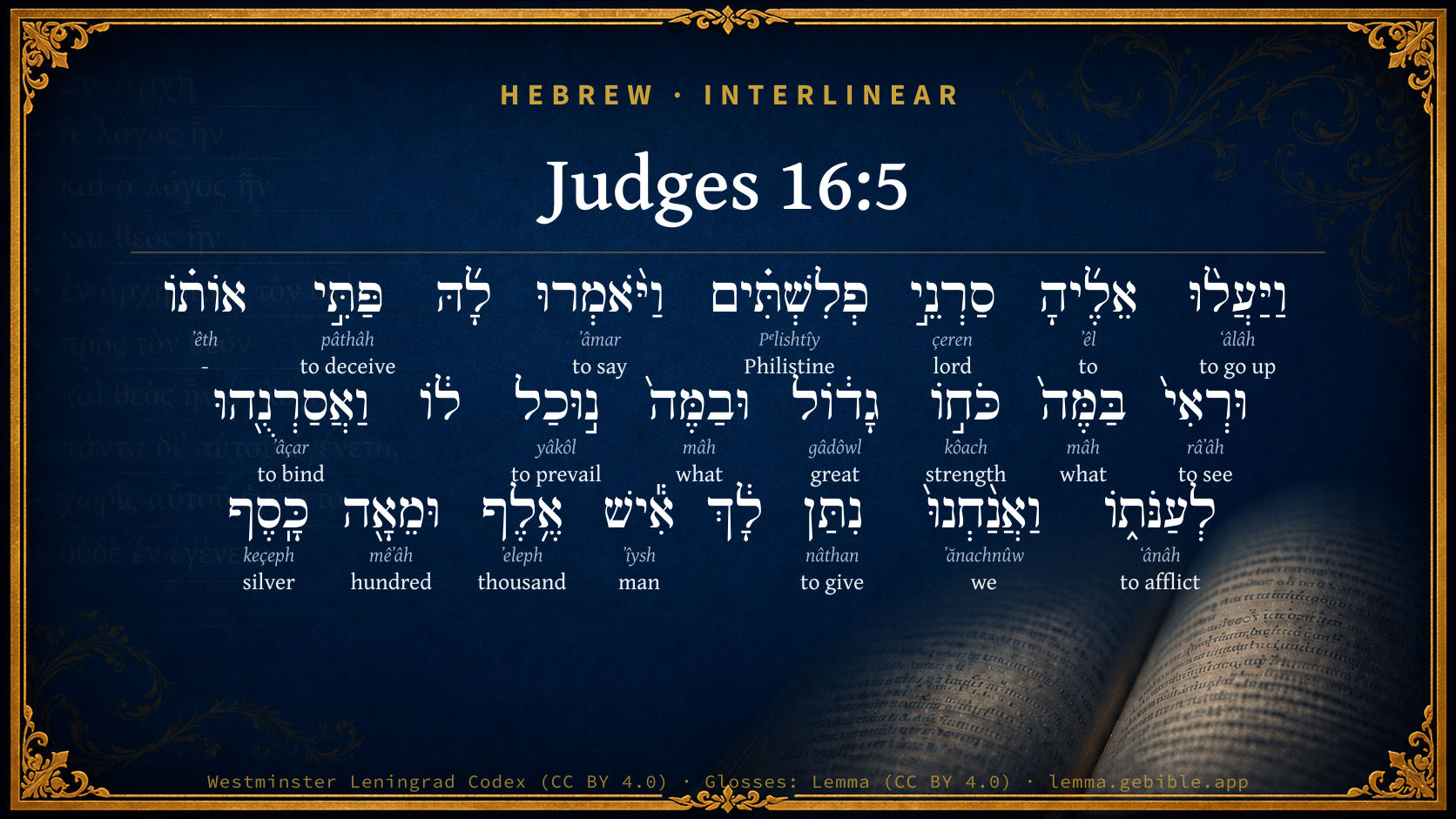
Judges 16:5

Hebrew (Westminster Leningrad Codex) Judges 16:5 appears in the Hebrew Old Testament. The text above is from the Westminster Leningrad Codex. Each word links to its Strong’s number, a concise gloss, and parsing drawn from the Open Scriptures Hebrew Bible morphology. Click any word for its full Brown-Driver-Briggs (BDB) entry.
Download image
Cite this verse

Judges 16:5 (World English Bible). Public Domain. Lemma interlinear Bible study tool, https://lemma.gebible.app/v/judges/16/5.

Show BibTeX & RIS
BibTeX
RIS
English Translation
The lords of the Philistines came up to her, and said to her, Entice him, and see in which his great strength lies, and by what means we may prevail against him, that we may bind him to afflict him: and we will each give you of us eleven hundred [pieces] of silver.
World English Bible · Public Domain
Download a study sheet

One document with this verse’s original text, its word-by-word gloss line, the meaning frame, cross-references with their text, attributed commentary, and full source and license credits — printable, and it pastes into notes with its structure intact.

This verse Autodidact and up

Study sheet (.html) Plain text (.txt)

A passage Seminary Student

Up to 50 verses in one chapter. A passage sheet keeps up to 6 commentary sources and 12 cross-references per verse, in the order this page ranks them, and says so on the sheet whenever that leaves anything out. Ask for a single verse and you get the Autodidact verse sheet above.

Everything on this page stays free to read, with no account — the sheet is a download of what is already on screen, not access to it.

Want to remove ads? Support Godless Engineer
Compare translations 3

The same verse in 3 English versions, stacked beneath the original-language interlinear above. Click any original word for its lexicon entry.

Each is an independent rendering of the whole verse — the interlinear is not word-aligned to these translations.

Highlighted words mark where these versions differ — a whole-verse word diff, not a word-by-word alignment.

  • World English Bible Public Domain
    The lords of the Philistines came up to her, and said to her, Entice him, and see in which his great strength lies, and by what means we may prevail against him, that we may bind him to afflict him: and we will each give you of us eleven hundred [pieces] of silver.
  • King James Version Public Domain
    And the lords of the Philistines came up unto her, and said unto her, Entice him, and see wherein his great strength lieth, and by what means we may prevail against him, that we may bind him to afflict him; and we will give thee every one of us eleven hundred pieces of silver.
  • unfoldingWord Literal Text CC BY-SA 4.0
    And the lords of the Philistines came up to her and they said to her, “Entice him and see in what his great strength and in what we shall overcome him, that we may bind him to humble him. And we ourselves will give to you, a man, 1,100 silver.”

unfoldingWord Literal Text — © unfoldingWord, licensed CC BY-SA 4.0. Word-aligned USFM3 via Door43 (git.door43.org/unfoldingWord/en_ult).

Versions to compare (up to 4)

3 of 4 selected

Show all 18 translations

Every available English version of this verse, each an independent rendering of the whole verse.

  • World English Bible Public Domain
    The lords of the Philistines came up to her, and said to her, Entice him, and see in which his great strength lies, and by what means we may prevail against him, that we may bind him to afflict him: and we will each give you of us eleven hundred [pieces] of silver.
  • Berean Standard Bible Public Domain
    The lords of the Philistines went to her and said, “Entice him and find out the source of his great strength and how we can overpower him to tie him up and subdue him. Then each one of us will give you eleven hundred shekels of silver.”
  • Majority Standard Bible Public Domain
    The lords of the Philistines went to her and said, “Entice him and find out the source of his great strength and how we can overpower him to tie him up and subdue him. Then each one of us will give you eleven hundred shekels of silver.”
  • King James Version Public Domain
    And the lords of the Philistines came up unto her, and said unto her, Entice him, and see wherein his great strength lieth, and by what means we may prevail against him, that we may bind him to afflict him; and we will give thee every one of us eleven hundred pieces of silver.
  • American Standard Version (1901) Public Domain
    And the lords of the Philistines came up unto her, and said unto her, Entice him, and see wherein his great strength lieth, and by what means we may prevail against him, that we may bind him to afflict him: and we will give thee every one of us eleven hundred `pieces' of silver.
  • Revised Version (1885) Public Domain
    And the lords of the Philistines came up unto her, and said unto her, Entice him, and see wherein his great strength lieth, and by what means we may prevail against him, that we may bind him to afflict him: and we will give thee every one of us eleven hundred pieces of silver.
  • Geneva Bible (1599) Public Domain
    Vnto whome came the princes of the Philistims, and said vnto her, Entise him, and see wherein his great strength lieth, and by what meane we may ouercome him, that we may binde him, and punish him, and euery one of vs shall giue thee eleuen hundreth shekels of siluer.
  • Douay-Rheims (1899) Public Domain
    And the princes of the Philistines came to her, and said: Deceive him, and learn of him wherein his great strength lieth, and how we may be able to overcome him, to bind and afflict him: which if thou shalt do, we will give thee every one of us eleven hundred pieces of silver.
  • Young's Literal Translation Public Domain
    and the princes of the Philistines come up unto her, and say to her, `Entice him, and see wherein his great power `is', and wherein we are able for him -- and we have bound him to afflict him, and we -- we give to thee, each one, eleven hundred silverlings.'
  • Literal Standard Version CC BY-SA 4.0
    and the princes of the Philistines come up to her, and say to her, “Entice him, and see wherein his great power [is], and wherein we are able for him—and we have bound him to afflict him, and each one of us gives eleven hundred pieces of silver to you.”
  • Unlocked Literal Bible CC BY-SA 4.0
    The rulers of the Philistines came up to her, and said to her, “Trick Samson to see where his great strength lies, and by what means we may overpower him, that we may bind him in order to humiliate him. Do this, and each one of us will give you 1,100 pieces of silver.”
  • unfoldingWord Literal Text CC BY-SA 4.0
    And the lords of the Philistines came up to her and they said to her, “Entice him and see in what his great strength and in what we shall overcome him, that we may bind him to humble him. And we ourselves will give to you, a man, 1,100 silver.”
  • Darby Bible Public Domain
    And the lords of the Philistines came to her and said to her, "Entice him, and see wherein his great strength lies, and by what means we may overpower him, that we may bind him to subdue him; and we will each give you eleven hundred pieces of silver."
  • World Messianic Bible Public Domain
    The lords of the Philistines came up to her and said to her, “Entice him, and see in which his great strength lies, and by what means we may prevail against him, that we may bind him to afflict him; and we will each give you eleven hundred pieces of silver.”
  • Webster's Bible Public Domain
    And the lords of the Philistines came to her, and said to her, Entice him, and see in what his great strength lieth, and by what means we may prevail against him, that we may bind him to afflict him: and we will give thee every one of us eleven hundred pieces of silver.
  • Free Bible Version CC BY-SA 4.0
    The Philistine leaders approached her, saying, “See if you can seduce him and get him to show you the secret of his incredible strength, and find out how we can overpower him and tie him up so he can't do anything. We'll all give you eleven hundred shekels of silver each.”
  • Bible in Basic English Public Domain
    And the chiefs of the Philistines came up to her, and said to her, Make use of your power over him and see what is the secret of his great strength, and how we may get the better of him, and put bands on him, so that we may make him feeble; and every one of us will give you eleven hundred shekels of silver.
  • JPS Tanakh (1917) Public Domain
    And the lords of the Philistines came up unto her, and said unto her: 'Entice him, and see wherein his great strength lieth, and by what means we may prevail against him, that we may bind him to afflict him; and we will give thee every one of us eleven hundred pieces of silver.'

Literal Standard Version (2020), Covenant Press — licensed CC BY-SA 4.0. Text via the HelloAO Bible API (eBible.org). Unlocked Literal Bible (unfoldingWord) — licensed CC BY-SA 4.0. Text via the HelloAO Bible API (eBible.org). unfoldingWord Literal Text — © unfoldingWord, licensed CC BY-SA 4.0. Word-aligned USFM3 via Door43 (git.door43.org/unfoldingWord/en_ult). Free Bible Version, Dr. Jonathan Gallagher — licensed CC BY-SA 4.0. Text via the HelloAO Bible API (eBible.org).

Word by word

More ways to search: Search by grammar → Find every occurrence → Compare this word →

Practice this passage: Drill this verse → Learn its vocabulary →

סַרְנֵ֣י
çeren
H5633
“lords of”
Noun, Common, Masculine, Plural, Construct
Part of Speech
Noun
Type
Common
Gender
Masculine
Number
Plural
State
Construct
Full BDB Definition

Origin: from an unused root of uncertain meaning

TWOT: 1546 , 1547

lord, ruler, tyrant - axle
  1. וַיַּעֲל֨וּ ʻâlâh H5927 “and · to go up” Conjunction + Verb, Qal, Sequential Imperfect, 3rd Person, Masculine, Plural
  2. אֵלֶ֜יהָ ʼêl H413 “to · her” Preposition + Suffix, Personal, 3rd Person, Feminine, Singular
  3. פְלִשְׁתִּ֗ים Pᵉlishtîy H6430 “Philistines” Noun, Gentilic, Masculine, Plural, Absolute
  4. וַיֹּ֨אמְרוּ ʼâmar H559 “and · to say” Conjunction + Verb, Qal, Sequential Imperfect, 3rd Person, Masculine, Plural
  5. פַּתִּ֣י pâthâh H6601 “deceive” Verb, Piel, Imperative, 2nd Person, Feminine, Singular
  6. אוֹת֗וֹ ʼêth H853 “- · him” Particle, Direct Object + Suffix, Personal, 3rd Person, Masculine, Singular
  7. וּרְאִי֙ râʼâh H7200 “and · see” Conjunction + Verb, Qal, Imperative, 2nd Person, Feminine, Singular
  8. בַּמֶּה֙ mâh H4100 “in/at · what” Preposition + Particle, Interrogative
  9. כֹּח֣וֹ kôach H3581 “strength · his” Noun, Common, Masculine, Singular, Construct + Suffix, Personal, 3rd Person, Masculine, Singular
  10. גָד֔וֹל gâdôwl H1419 “great” Adjective, Adjective, Masculine, Singular, Absolute
  11. וּבַמֶּה֙ mâh H4100 “and · in/at · what” Conjunction + Preposition + Particle, Interrogative
  12. נ֣וּכַל yâkôl H3201 “to prevail” Verb, Qal, Imperfect, 1st Person, Common, Plural
  13. וַאֲסַרְנֻ֖הוּ ʼâçar H631 “and · to bind · him” Conjunction + Verb, Qal, Perfect, 1st Person, Common, Plural + Suffix, Personal, 3rd Person, Masculine, Singular
  14. לְעַנֹּת֑וֹ ʻânâh H6031 “to afflict · him” Preposition + Verb, Piel, Infinitive Construct + Suffix, Personal, 3rd Person, Masculine, Singular
  15. וַאֲנַ֨חְנוּ֙ ʼănachnûw H587 “and · we” Conjunction + Pronoun, Personal, 1st Person, Common, Plural
  16. נִתַּן nâthan H5414 “to give” Verb, Qal, Imperfect, 1st Person, Common, Plural
  17. אִ֕ישׁ ʼîysh H376 “man” Noun, Common, Masculine, Singular, Absolute
  18. אֶ֥לֶף ʼeleph H505 “thousand” Adjective, Cardinal number, Both, Singular, Absolute
  19. וּמֵאָ֖ה mêʼâh H3967 “and · hundred” Conjunction + Adjective, Cardinal number, Both, Singular, Absolute
  20. כָּֽסֶף keçeph H3701 “silver” Noun, Common, Masculine, Singular, Absolute

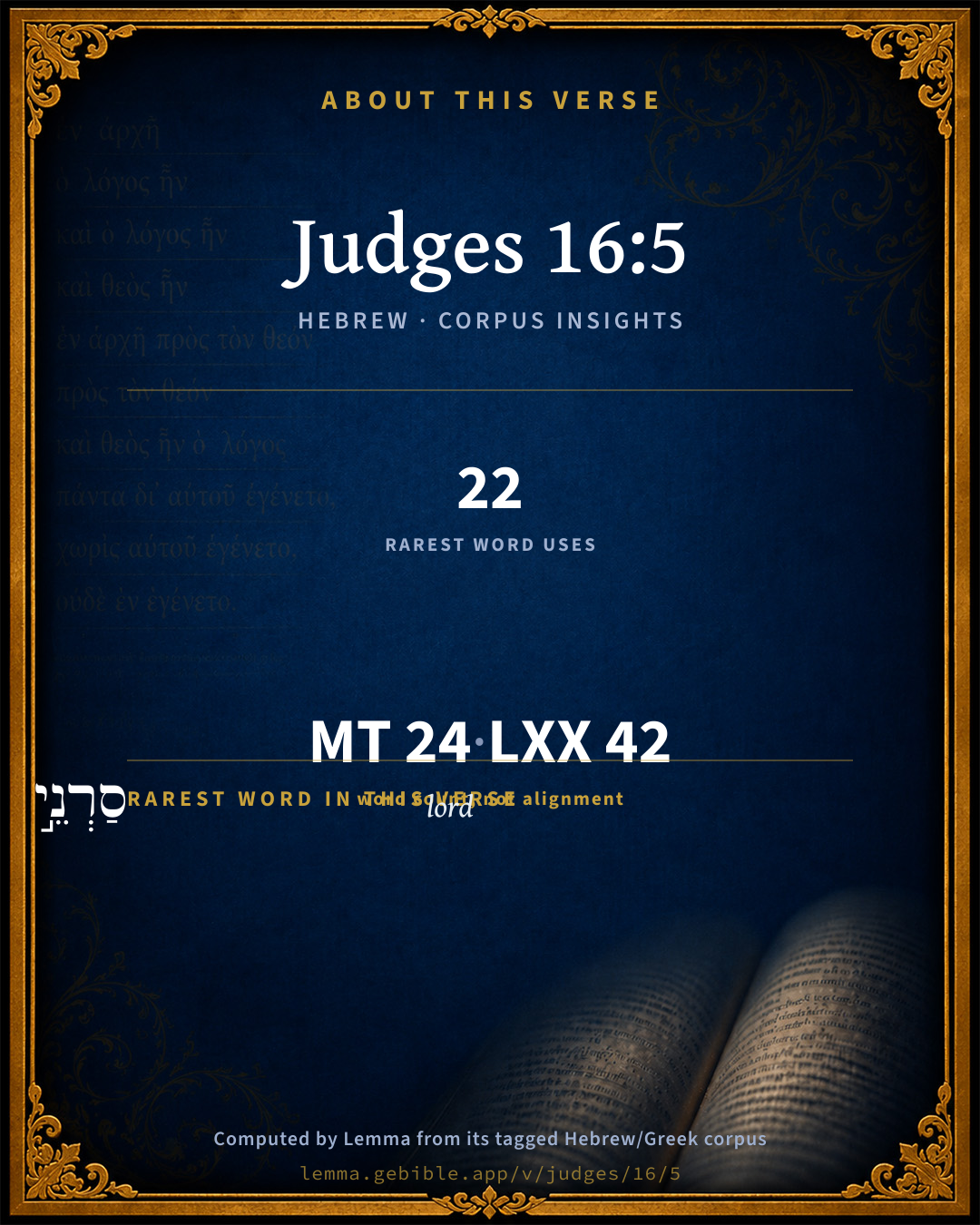
About this verse

These counts appear in no published source. They are computed here, from the morphology-tagged text and Lemma’s own curated glosses. What Lemma adds →

24
words
20
distinct lemmas
Historical
section

Notable vocabulary

The rarest word here is סַרְנֵ֣י lord H5633 — appearing just 22 times in the whole Hebrew Bible.

Shared distinctive vocabulary

סַרְנֵ֣י lord H5633 occurs in 20 verses of the Hebrew Bible. Also found in:

Grammatical profile

  • 8 verbs
  • 5 nouns
  • 3 adjectives
  • 1 pronoun
  • 4 prepositions
  • 3 particles

Verb forms

  • וַיַּעֲל֨וּ Qal · Sequential Imperfect
  • וַיֹּ֨אמְרוּ Qal · Sequential Imperfect
  • פַּתִּ֣י Piel · Imperative
  • וּרְאִי֙ Qal · Imperative
  • נ֣וּכַל Qal · Imperfect
  • וַאֲסַרְנֻ֖הוּ Qal · Perfect
  • לְעַנֹּת֑וֹ Piel · Infinitive Construct
  • נִתַּן Qal · Imperfect

Repetition

A word recurs within this verse — often emphatic in Hebrew:

  • בַּמֶּה֙ what H4100 ×2

Hebrew & Septuagint length

In English translation the verse runs 53 words from the Hebrew and 47 from the Septuagint (LXX English) — closely comparable.

A rough comparison of the two English renderings, which tokenize alike — not a word-level alignment.

Word counts can differ between the Hebrew and the Greek without any difference in meaning — e.g. the Hebrew direct-object marker אֵת has no separate Greek word, and Greek often adds the article ὁ.

In the original languages it is 24 Hebrew tokens and 42 Greek tokens — but the two are counted differently (Hebrew bundles its prefixes and suffixes into one token; the Greek is in lemma form), so that isn’t a like-for-like length.

Cross-references

15

Topical passages linked to Judges 16:5 in the Treasury of Scripture Knowledge — connected by theme and wording, ordered by reader-vote popularity; previews shown in the World English Bible.

  • Joshua 13:3 from the Shihor, which is before Egypt, even to the border of Ekron northward, [which] is reckoned to the Canaanites; the five lords of the Philistines; the Gazites, and the Ashdodites, the Ashkelonites, the Gittites, and the Ekronites; also the Avvim,
  • Judges 14:15 It happened on the seventh day, that they said to Samson's wife, Entice your husband, that he may declare to us the riddle, lest we burn you and your father's house with fire: have you called us to impoverish us? is it not [so]?
  • 1 Timothy 6:9–10 But those who are determined to be rich fall into a temptation and a snare and many foolish and harmful lusts, such as drown men in ruin and destruction.
  • 1 Corinthians 6:15–18 Don't you know that your bodies are members of Christ? Shall I then take the members of Christ, and make them members of a prostitute? May it never be!
  • Genesis 33:16 So Esau returned that day on his way to Seir.
  • Numbers 22:17–18 for I will promote you to very great honor, and whatever you say to me I will do. Please come therefore, and curse this people for me.
  • Judges 3:3 [namely], the five lords of the Philistines, and all the Canaanites, and the Sidonians, and the Hivites who lived on Mount Lebanon, from Mount Baal Hermon to the entrance of Hamath.
  • Judges 17:2 He said to his mother, The eleven hundred [pieces] of silver that were taken from you, about which you did utter a curse, and did also speak it in my ears, behold, the silver is with me; I took it. His mother said, Blessed be my son of Yahweh.
  • 1 Samuel 29:6 Then Achish called David, and said to him, As Yahweh lives, you have been upright, and your going out and your coming in with me in the host is good in my sight; for I have not found evil in you since the day of your coming to me to this day: nevertheless the lords don't favor you.
  • Proverbs 2:16–19 To deliver you from the strange woman, Even from the foreigner who flatters with her words;
  • Proverbs 5:3–11 For the lips of an adulteress drip honey. Her mouth is smoother than oil,
  • Proverbs 6:24–26 To keep you from the immoral woman, From the flattery of the wayward wife's tongue.
  • Proverbs 7:21–27 With persuasive words, she led him astray. With the flattering of her lips, she seduced him.
  • Micah 7:3 Their hands are on that which is evil to do it diligently. The ruler and judge ask for a bribe; And the powerful man dictates the evil desire of his soul. Thus they conspire together.
  • Matthew 26:15 and said, "What are you willing to give me, that I should deliver him to you?" They weighed out for him thirty pieces of silver.

Cross-references courtesy of OpenBible.info (CC BY 4.0).

Hebrew and Greek witnesses Masoretic Hebrew ↔ Greek Septuagint

The same verse in the two great witnesses to the Old Testament, shown verse-for-verse.

These are two independent witnesses, not word-aligned to each other, and the Septuagint is shown in lemma (dictionary) form.

Hebrew Judges 16:5 Masoretic · Westminster Leningrad Codex

וַיַּעֲל֨וּ אֵלֶ֜יהָ סַרְנֵ֣י פְלִשְׁתִּ֗ים וַיֹּ֨אמְרוּ לָ֜הּ פַּתִּ֣י אוֹת֗וֹ וּרְאִי֙ בַּמֶּה֙ כֹּח֣וֹ גָד֔וֹל וּבַמֶּה֙ נ֣וּכַל ל֔וֹ וַאֲסַרְנֻ֖הוּ לְעַנֹּת֑וֹ וַאֲנַ֨חְנוּ֙ נִתַּן לָ֔ךְ אִ֕ישׁ אֶ֥לֶף וּמֵאָ֖ה כָּֽסֶף

The lords of the Philistines came up to her, and said to her, Entice him, and see in which his great strength lies, and by what means we may prevail against him, that we may bind him to afflict him: and we will each give you of us eleven hundred [pieces] of silver.

World English Bible · Public Domain

Greek LXX Judges 16:5 Septuagint · lemma form

καί ἀναβαίνω πρός αὐτός ὁ ἄρχων ὁ ἀλλόφυλος καί εἶπον αὐτός ἀπατάω αὐτός καί ὁράω ἐν τίς ὁ ἰσχύς αὐτός ὁ μέγας καί ἐν τίς δύναμαι αὐτός καί δέω αὐτός ὁ ταπεινόω αὐτός καί ἐγώ δίδωμι σύ ἀνήρ χίλιοι καί ἑκατόν ἀργύριον

And the princes of the Philistines came up to her, and said to her, Beguile him, and see wherein his great strength is, and wherewith we shall prevail against him, and bind him to humble him; and we will give you each eleven hundred pieces of silver.

LXX2012 (modern English Septuagint) · Public Domain

On this verse, Ellicott's Commentary for English Readers discusses the Septuagint’s reading. Read the note in Commentary ↓

Hebrew: Westminster Leningrad Codex (CC BY 4.0). Greek: Septuagint (public domain); English from LXX2012 (modern English Septuagint) (Public Domain). How the Septuagint differs from the Hebrew →

Targum (Aramaic paraphrase)

1

The Targum is the ancient Jewish Aramaic paraphrase of the Hebrew Scriptures — an interpretive translation, not the Hebrew text itself. Onkelos (literal) and Pseudo-Jonathan (expansive) render the Torah, and Jonathan the Prophets. Coverage is partial: where no permissively-licensed English translation exists for a verse, only the Aramaic is shown. This is verse-level text, not a word-by-word alignment to the Hebrew.

  1. Targum Jonathan Prophets (Joshua–Malachi)
    וּסְלִיקוּ לְוָתָהּ טוּרְנֵי פְּלִשְׁתָּאֵי וַאֲמַרוּ לָהּ שְׁדִילִי יָתֵיהּ וַחֲזִי בַּמֶה חֵילֵיהּ רַבָּא וּבַמֶה נֵיכוּל לֵיהּ וְנִסְרִינֵיהּ לְעַנָיוּתֵיהּ וַאֲנַחְנָא נִתַּן לָךְ גְבַר אֲלַף וּמְאָה סַלְעִין דִכְסַף:

    (no public-domain English translation for this verse)

    Targum Jonathan — Aramaic: “Mikraot Gedolot” (public domain). English: “Sefaria Community Translation” (CC0 1.0 (public-domain dedication)); “London "Chaldee Paraphrase," 1871” (public domain). Text via Sefaria.

Commentary

Notes on Judges 16:5 from classic Christian and Jewish commentators (each source and its license shown beneath its notes). The classic Christian expositions comment on the surrounding passage and are grouped to its opening verse, so a note may address several verses; the Jewish commentaries on the Tanakh (Rashi and others) are per-verse, so they appear only where the commentator wrote on this verse.

Lemma curates 59 commentaries, every one of them public domain or Creative Commons licensed, each selected and text-cleaned for this edition rather than reprinted as found. About our sources →

Trapp's Complete Commentary

John Trapp

Jdg 16:5 And the lords of the Philistines came up unto her, and said unto her, Entice him, and see wherein his great strength [lieth], and by what [means] we may prevail against him, that we may bind him to afflict him: and we will give thee every one of us eleven hundred [pieces] of silver.

Ver. 5. Entice him, and see wherein, &c.] Two engines they use against Samson, Muliere et Munere: these were as bad as those two great pieces of ordnance cast by Alphonsus, duke of Ferrara, the one whereof he called the Earthquake, and the other Grandiabolo, or the great devil.

That we may bind him to afflict him.] Or, To humble him. They would not say to kill him, lest that should sound harsh in her ears who had entertained him for her paramour, and pretended love to him, but only to tame him, and take him a link lower, as they say.

Eleven hundred pieces of silver.] Which is held to be more than a thousand pounds. Wicked men care not what they part with, nor how they lavish out of the bag, for the satisfying of their lusts. Haman offered ten thousand talents to have the Jews rooted out. Decius Mundus, a nobleman of Rome, offered Paulina six thousand pounds for one night’s lodging with her, as Josephus reporteth. {a}

{a} Lib. xviii, cap. 4.

John Trapp, A Commentary or Exposition upon All the Books of the Old and New Testament (1647–1656) — public domain. Text from a community e-Sword module.

Joseph Benson's Commentary

Jdg 16:5. The lords of the Philistines came unto her — The lords of their five principal cities, which were leagued together against him as their common enemy. See wherein his great strength lieth — They probably imagined that Samson attained his great strength by the use of some magic art; that we may bind him to afflict him — To chastise him for his injuries to us. They meant to punish him severely, but they expressed it in mild words, lest it might move her to pity him. Every one eleven hundred pieces of silver — That is, shekels, as that phrase commonly signifies.

Joseph Benson's Commentary on the Old and New Testaments (1811–1818) — public domain. Text from a community e-Sword module.

Geneva Bible (1599)

Geneva Bible translators

Of the value of a shekel, read Gen. 23:15.

Geneva Bible (1599) marginal notes — public domain. Text via Bolls.life.

Jamieson, Fausset & Brown

Robert Jamieson, A. R. Fausset & David Brown

the lords of the Philistines--The five rulers deemed no means beneath their dignity to overcome this national enemy.

Entice him, and see wherein his great strength lieth--They probably imagined that he carried some amulet about his person, or was in the possession of some important secret by which he had acquired such herculean strength; and they bribed Delilah, doubtless by a large reward, to discover it for them. She undertook the service and made several attempts, plying all her arts of persuasion or blandishment in his soft and communicative moods, to extract his secret.

Jamieson, Fausset & Brown — Commentary Critical and Explanatory on the Whole Bible (1871) — public domain (CC PDM 1.0). Text via the HelloAO Bible API.

Adam Clarke's Commentary

Verse 5. See wherein his great strength lieth] They saw that his stature was not remarkable: and that, nevertheless, he had most extraordinary strength; therefore they supposed that it was the effect of some charm or amulet. The lords of the Philistines were the five following: Gaza, Gath, Askelon, Ekron, and Ashdod. All these considered Samson as a public enemy; and they promised this bad woman a large sum of money if she would obtain from him the important secret wherein his strength lay, that, depriving him of this supernatural power, they might be able to reduce him to bondage.

Adam Clarke's Commentary on the Bible (1810–1826) — public domain. Text from a community e-Sword/MySword module.

Ellicott's Commentary for English Readers

(5) The lords of the Philistines.—The five “satraps.” (See Note on Jdg_3:3.) If she were what Josephus asserts, the Philistines might both get access to her, and tempt the cupidity of an unprincipled and degraded mind. Had she been of their own race, threats would probably have been even more effectual with her than with the lady of Timnath (Jdg_13:15). The LXX. here begin to call the Philistines allophuloi, or “aliens.”

Entice him.—See Pro_2:16; Pro_2:18-19.

Wherein his great strength lieth.—Rather, wherein his strength is great. They attributed his strength to some amulet which might be removed.

Eleven hundred pieces of silver.—That is, “eleven hundred silver shekels.” The same sum recurs in Jdg_17:2 as the amount laid by for the construction of teraphim by the mother of Micah. If the five lords each gave 1,100 shekels, the amount would be nearly two talents of silver (Exo_38:25-26)—a most enormous bribe for that age, and especially to such a woman as Delilah. It may be regarded as an almost conclusive proof that Milton is mistaken in making her a Philistine.

A Bible Commentary for English Readers, edited by Charles John Ellicott (1878–1897) — public domain. Text from a community e-Sword module.

The Cambridge Bible for Schools and Colleges

gen. ed. J. J. S. Perowne

5. his great strength lieth] his strength is great; render similarly in Jdg_16:6; Jdg_16:15.

eleven hundred pieces of silver] in uncoined metal, calculated by the scales (Gen_23:16): a large bribe when multiplied by five (Jdg_3:3). The odd number means a full thousand, cf. Jdg_17:2. In Jdg_14:15 the Philistines work upon the woman’s fear; now they appeal to the cupidity of the courtezan.

The Cambridge Bible for Schools and Colleges (gen. ed. J. J. S. Perowne; Cambridge University Press, 1878–1918) — public domain. Text from a community e-Sword module.

John Gill's Exposition

And the lords of the Philistines came up unto her,.... Having heard that Samson kept company with her, she being a noted strumpet, like Lais among the Grecians. These were in number five, as appears from Jdg 3:3 and had under them five principalities, into which Palestine was divided; and these, if not united in their government, which possibly might be the case at this time, yet were united against their common enemy Samson; and being great personages, it is thought by some they came not themselves to this harlot's house, but sent a deputation of five persons in their names, though the text is very express here and after: they are said to come up to her, because their country lay on the shore of the sea, and lower than Judea:

and said unto her, entice him; persuade him with soothing and flattering words; take an opportunity when in an amorous mood to improve her interest in his affections:

and see wherein his great strength lieth; for it might not appear by the size of his body, or from his natural constitution, and in the common actions of life, but only at certain times, and as it should seem when he pleased; and he might have been heard to say that it was a secret he kept to himself, and no man knew it; or they might suspect something of magic in the case, that he carried something about with him, which, if it could be gotten from him, would deprive him of his strength:

and by what means we may prevail against him, that we may bind him to afflict him; to humble him, bring him low, and reduce him to the common condition of men; they did not propose to kill him, which they might think she would not agree to, and so reject their proposal at once, but at most to distress him, and to chastise him with mockings and scourgings, bonds and imprisonment, for the mischief he had indeed done them, and prevent him from doing more:

and we will give thee, everyone of us, eleven hundred pieces of silver or shekels; it may seem strange that they should promise each 1100: some think their principalities offered each 1000 shekels, and the princes themselves one hundred; but Abarbinel supposes that this was, on some account or another, in those times an usual sum or computation, since the same is mentioned in the following chapter; though it may be observed that these five several sums put together make a round number, 5500 pieces of silver; which, taking them to be shekels, according to Waserus (d): they amounted to 1375 rix dollars, and of Helvetian money 3666 pounds, and a little more, and of our money near seven hundred pounds sterling; a considerable bribe, and very tempting to a person of such a character, and which she readily embraced, as appears by what follows.

(d) De Antiquis Numis, l. 2. c. 5.

John Gill's Exposition of the Whole Bible (1746–1763) — public domain (CC PDM 1.0). Text via the HelloAO Bible API.

Albert Barnes' Notes on the Bible

And the lords of the Philistines - See Jdg 3:3 note.

His great strength lieth - Rather, “wherein his strength is great.”

Eleven hundred pieces of silver - The greatness of the bribe offered to Delilah, 5,500 shekels of silver, nearly two talents (Exo 38:24, note), shows the importance attached to Samson’s capture.

Albert Barnes' Notes on the Bible (1834–1885) — public domain. Text from a community e-Sword/MySword module.

Haydock's Catholic Bible Commentary

Princes, (seranim;) the five satraps, who had the chief sway in the nation, either came in person or sent messengers to Cephar-Sorec. They were convinced that the strength of Samson was supernatural; but they wished to learn whether it depended on some magical charm, or on some religious observation, or whether he was vulnerable only in some particular part, like Achilles, who could only be slain by a wound in the heel, according to the pagans. (Calmet) --- If Dalila would learn, and endeavour to remove the obstacle, these princes engaged to give her each 1100 pieces (or sicles, Calmet) of silver. (Salien)

George Leo Haydock (1774–1849), Haydock's Catholic Family Bible and Commentary, 1859 edition — public domain. Excludes Psalms (Douay-Rheims chapter numbering differs from Protestant) and Deuterocanonical books (Catholic canon only).

Matthew Poole's English Annotations

The lords of the Philistines; the lords of their five principal cities, who seem to have been united together at this time in one aristocratical government; or at least were leagued together against him as their common enemy. To afflict him; to chastise him for his injuries done to us. They mean to punish him severely, as they did; but they express it in mild words, lest the horror of it might move her to pity him.

Pieces of silver, i.e. shekels, as that phrase is commonly used, as Num 7:13,85; 2Sa 18:12; 2Ki 6:25.

Matthew Poole's English Annotations on the Holy Bible (1683–1685) — public domain. Text from a community e-Sword/MySword module.

Whedon's Commentary on the Bible

Daniel D. Whedon

5. Entice him — The same demand put upon his first female betrayer.

Jdg_14:15. The lords of the Philistines well knew wherein Samson’s great weakness lay, and by taking advantage of that knowledge they at last found out wherein his great strength lay; but the secret of his strength was yet to them a mystery. They thought, perhaps, that it arose from some amulet or charm which he wore about him.

Eleven hundred pieces of silver — The silver shekel was worth about sixty-two cents of our currency, and eleven hundred shekels would be six hundred and eighty-two dollars. This amount from each of the five lords would make three thousand four hundred and ten dollars. Surely a tempting bribe.

Daniel D. Whedon (gen. ed.), Commentary on the Old and New Testaments (1874–1909) — public domain. Text from a community e-Sword module.

The Pulpit Commentary

Lords. See Jud_1:3:3, note," His great strength lieth literally, wherein (or by what means) his strength is great. They guessed that it was through some charm or secret amulet that his Herculean might was nourished. Eleven hundred pieces, or shekels, of silver. The whole sum promised by the five lords would be no less than 5500 shekels, equal to about of our money. The curious notation, eleven hundred pieces, occurs again Jud_1:17:2. The reason of it is unknown.

The Pulpit Commentary (1880–1919), ed. H.D.M. Spence-Jones & Joseph S. Exell — public domain. Text from a community e-Sword module.

John Wesley's Explanatory Notes

The lords - The lords of their five principal cities, who were leagued together against him as their common enemy. Afflict - To chastise him for his injuries done to us. They mean to punish him severely, but they express it in mild words, lest it might move her to pity him. Pieces of silver - Shekels, as that phrase is commonly used.

John Wesley, Explanatory Notes Upon the Whole Bible (1754–1765) — public domain. Text via the GEBible commentary corpus.

Lesson kit

Teaching starters — assembled from the data on this page, not authored interpretation. Every prompt links to the verse data it draws on. Edit before teaching.

Judges, in the Historical, opens this verse with 24 words (20 distinct Hebrew lemmas). Its most distinctive word is çeren (“lord”). A historical commentator’s framing appears above. Read the whole chapter for the surrounding context.

Discussion questions

  1. How does “lord” (çeren) shape what this verse is saying?
  2. Joshua 13:3 shares the word «lord» with this verse. How do the two illuminate each other?
  3. “what” occurs 2× in this one verse. What is the effect of the repetition?
  4. These translations render this verse differently; the difference is in the English rendering, not the original. What questions does that raise?
  5. The verb «וַיַּעֲל֨וּ» is Qal Sequential Imperfect. How does its form color the action?
  6. Reading how Trapp's Complete Commentary and Joseph Benson's Commentary read this verse, where do the two commentators agree and where do they part?

Things to notice

Reading settings

Reading text

Shown beneath each verse's original-language words.

Old Testament
Old Testament edition

Read the OT as the Masoretic Hebrew (MT) or the Greek Septuagint (LXX).

English shown for the Greek Septuagint (in the Hebrew ↔ Greek comparison).

Comparing translations? Open the Compare panel on any verse page to stack up to four side by side.