
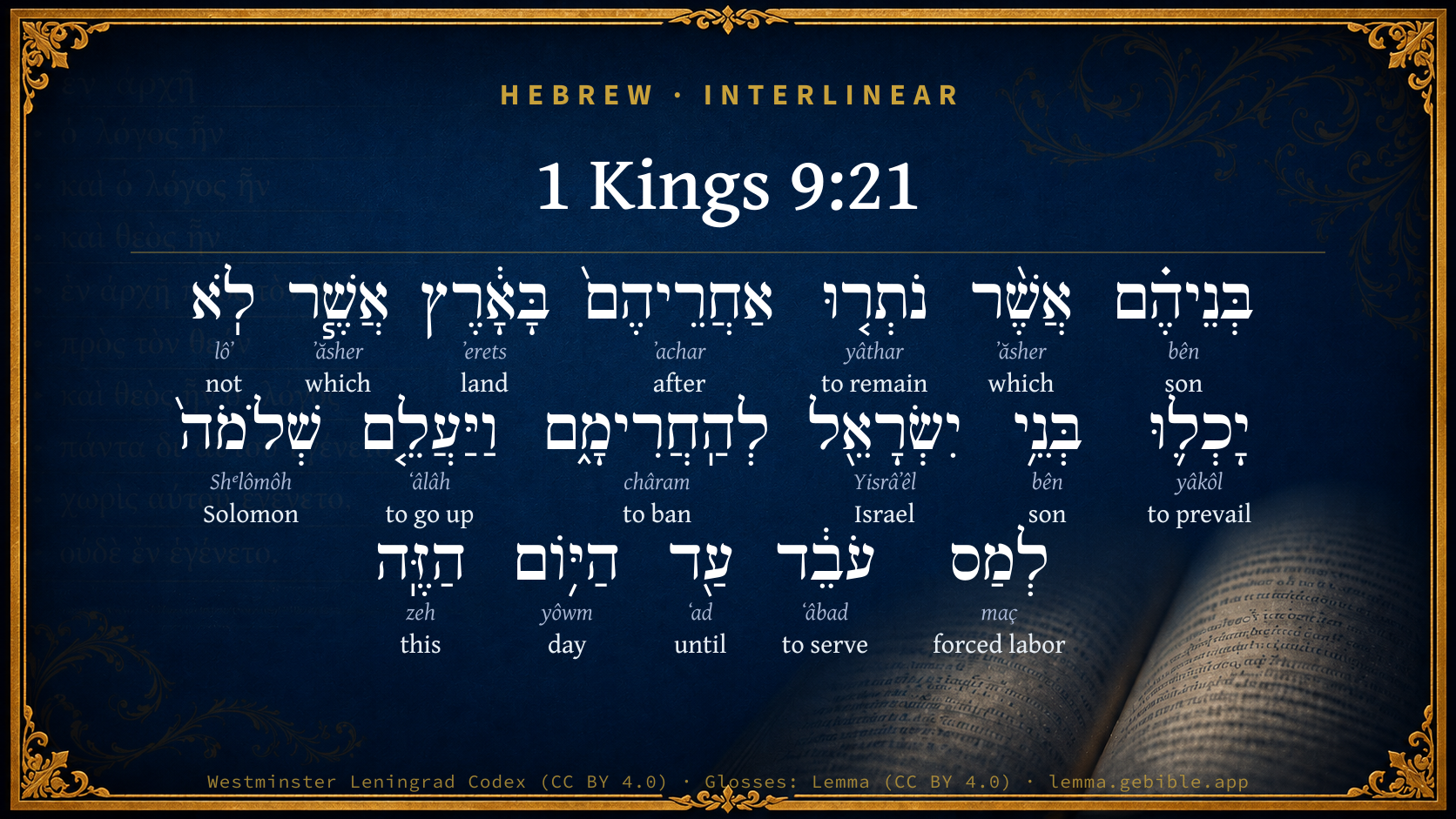
1 Kings 9:21

Hebrew (Westminster Leningrad Codex) 1 Kings 9:21 appears in the Hebrew Old Testament. The text above is from the Westminster Leningrad Codex. Each word links to its Strong’s number, a concise gloss, and parsing drawn from the Open Scriptures Hebrew Bible morphology. Click any word for its full Brown-Driver-Briggs (BDB) entry.
Download image
Cite this verse

1 Kings 9:21 (World English Bible). Public Domain. Lemma interlinear Bible study tool, https://lemma.gebible.app/v/1-kings/9/21.

Show BibTeX & RIS
BibTeX
RIS
English Translation
their children who were left after them in the land, whom the children of Israel were not able utterly to destroy, of them did Solomon raise a levy of bondservants to this day.
World English Bible · Public Domain
Download a study sheet

One document with this verse’s original text, its word-by-word gloss line, the meaning frame, cross-references with their text, attributed commentary, and full source and license credits — printable, and it pastes into notes with its structure intact.

This verse Autodidact and up

Study sheet (.html) Plain text (.txt)

A passage Seminary Student

Up to 50 verses in one chapter. A passage sheet keeps up to 6 commentary sources and 12 cross-references per verse, in the order this page ranks them, and says so on the sheet whenever that leaves anything out. Ask for a single verse and you get the Autodidact verse sheet above.

Everything on this page stays free to read, with no account — the sheet is a download of what is already on screen, not access to it.

Want to remove ads? Support Godless Engineer
Compare translations 3

The same verse in 3 English versions, stacked beneath the original-language interlinear above. Click any original word for its lexicon entry.

Each is an independent rendering of the whole verse — the interlinear is not word-aligned to these translations.

Highlighted words mark where these versions differ — a whole-verse word diff, not a word-by-word alignment.

  • World English Bible Public Domain
    their children who were left after them in the land, whom the children of Israel were not able utterly to destroy, of them did Solomon raise a levy of bondservants to this day.
  • King James Version Public Domain
    Their children that were left after them in the land, whom the children of Israel also were not able utterly to destroy, upon those did Solomon levy a tribute of bondservice unto this day.
  • unfoldingWord Literal Text CC BY-SA 4.0
    their sons who were left after them in the land, whom the sons of Israel were not able to devote them, Solomon brought them up for the forced labor of working, to this day.

unfoldingWord Literal Text — © unfoldingWord, licensed CC BY-SA 4.0. Word-aligned USFM3 via Door43 (git.door43.org/unfoldingWord/en_ult).

Versions to compare (up to 4)

3 of 4 selected

Show all 18 translations

Every available English version of this verse, each an independent rendering of the whole verse.

  • World English Bible Public Domain
    their children who were left after them in the land, whom the children of Israel were not able utterly to destroy, of them did Solomon raise a levy of bondservants to this day.
  • Berean Standard Bible Public Domain
    their descendants who remained in the land, those whom the Israelites were unable to devote to destruction—Solomon conscripted these people to be forced laborers, as they are to this day.
  • Majority Standard Bible Public Domain
    their descendants who remained in the land, those whom the Israelites were unable to devote to destruction—Solomon conscripted these people to be forced laborers, as they are to this day.
  • King James Version Public Domain
    Their children that were left after them in the land, whom the children of Israel also were not able utterly to destroy, upon those did Solomon levy a tribute of bondservice unto this day.
  • American Standard Version (1901) Public Domain
    their children that were left after them in the land, whom the children of Israel were not able utterly to destroy, of them did Solomon raise a levy of bondservants unto this day.
  • Revised Version (1885) Public Domain
    their children that were left after them in the land, whom the children of Israel were not able utterly to destroy, of them did Solomon raise a levy of bondservants, unto this day.
  • Geneva Bible (1599) Public Domain
    To wit, their children that were left after them in the lande, whome the children of Israel were not able to destroy, those did Salomon make tributaries vnto this day.
  • Douay-Rheims (1899) Public Domain
    Their children, that were left in the land, to wit, such as the children of Israel had not been able to destroy, Solomon made tributary unto this day.
  • Young's Literal Translation Public Domain
    their sons who are left behind them in the land, whom the sons of Israel have not been able to devote -- he hath even lifted up `on' them a tribute of service unto this day.
  • Literal Standard Version CC BY-SA 4.0
    their sons who are left behind them in the land, whom the sons of Israel have not been able to devote—he has even lifted up a tribute of service [on] them to this day.
  • Unlocked Literal Bible CC BY-SA 4.0
    their descendants who were left after them in the land, whom the people of Israel were not able to totally destroy—Solomon made them into forced laborers, which they are to this day.
  • unfoldingWord Literal Text CC BY-SA 4.0
    their sons who were left after them in the land, whom the sons of Israel were not able to devote them, Solomon brought them up for the forced labor of working, to this day.
  • Darby Bible Public Domain
    their children that were left after them in the land, whom the children of Israel were not able utterly to destroy, upon them did Solomon impose a tribute of bondservice until this day.
  • World Messianic Bible Public Domain
    their children who were left after them in the land, whom the children of Israel were not able utterly to destroy—of them Solomon raised a levy of bondservants to this day.
  • Webster's Bible Public Domain
    Their children that were left after them in the land, whom the children of Israel also were not able utterly to destroy, upon those did Solomon levy a tribute of bond-service to this day.
  • Free Bible Version CC BY-SA 4.0
    who remained in the land—those whom the Israelites were unable to destroy completely—were conscripted by Solomon to work as forced laborers, as they continue to do to this day.
  • Bible in Basic English Public Domain
    Their children who were still in the land, and whom the children of Israel had not been able to put to complete destruction, them did Solomon put to forced work, to this day.
  • JPS Tanakh (1917) Public Domain
    even their children that were left after them in the land, whom the children of Israel were not able utterly to destroy, of them did Solomon raise a levy of bondservants, unto this day.

Literal Standard Version (2020), Covenant Press — licensed CC BY-SA 4.0. Text via the HelloAO Bible API (eBible.org). Unlocked Literal Bible (unfoldingWord) — licensed CC BY-SA 4.0. Text via the HelloAO Bible API (eBible.org). unfoldingWord Literal Text — © unfoldingWord, licensed CC BY-SA 4.0. Word-aligned USFM3 via Door43 (git.door43.org/unfoldingWord/en_ult). Free Bible Version, Dr. Jonathan Gallagher — licensed CC BY-SA 4.0. Text via the HelloAO Bible API (eBible.org).

Word by word

More ways to search: Search by grammar → Find every occurrence → Compare this word →

Practice this passage: Drill this verse → Learn its vocabulary →

לְמַס
maç
H4522
“to/for · forced labor of”
Preposition + Noun, Common, Masculine, Singular, Construct
Part of Speech
Preposition + Noun
Type
Common
Gender
Masculine
Number
Singular
State
Construct
Full BDB Definition

Origin: from H4549

TWOT: 1218

gang or body of forced labourers, task-workers, labour band or gang, forced service, task-work, serfdom, tributary, tribute, levy, taskmasters, discomfited - labour-band, labour-gang, slave gang - gang-overseers - forced service, serfdom, tribute, enforced payment
  1. בְּנֵיהֶ֗ם bên H1121 “sons · their” Noun, Common, Masculine, Plural, Construct + Suffix, Personal, 3rd Person, Masculine, Plural
  2. אֲשֶׁ֨ר ʼăsher H834 “which” Particle, Relative
  3. נֹתְר֤וּ yâthar H3498 “to remain” Verb, Niphal, Perfect, 3rd Person, Common, Plural
  4. אַחֲרֵיהֶם֙ ʼachar H310 “after · them” Preposition + Suffix, Personal, 3rd Person, Masculine, Plural
  5. בָּאָ֔רֶץ ʼerets H776 “in/at the · land” Preposition, Determined + Noun, Common, Both, Singular, Absolute
  6. אֲשֶׁ֧ר ʼăsher H834 “which” Particle, Relative
  7. לֹֽא lôʼ H3808 “not” Particle, Negative
  8. יָכְל֛וּ yâkôl H3201 “to prevail” Verb, Qal, Perfect, 3rd Person, Common, Plural
  9. בְּנֵ֥י bên H1121 “sons of” Noun, Common, Masculine, Plural, Construct
  10. יִשְׂרָאֵ֖ל Yisrâʼêl H3478 “Israel” Noun, Proper
  11. לְהַֽחֲרִימָ֑ם châram H2763 “to ban · them” Preposition + Verb, Hiphil, Infinitive Construct + Suffix, Personal, 3rd Person, Masculine, Plural
  12. וַיַּעֲלֵ֤ם ʻâlâh H5927 “and · to go up · them” Conjunction + Verb, Hiphil, Sequential Imperfect, 3rd Person, Masculine, Singular + Suffix, Personal, 3rd Person, Masculine, Plural
  13. שְׁלֹמֹה֙ Shᵉlômôh H8010 “Solomon” Noun, Proper
  14. עֹבֵ֔ד ʻâbad H5647 “serving” Verb, Qal, Participle Active, Masculine, Singular, Absolute
  15. עַ֖ד ʻad H5704 “until” Preposition
  16. הַיּ֥וֹם yôwm H3117 “the · day” Particle, Definite Article + Noun, Common, Masculine, Singular, Absolute
  17. הַזֶּֽה zeh H2088 “the · this” Particle, Definite Article + Pronoun, Demonstrative, Masculine, Singular

About this verse

These counts appear in no published source. They are computed here, from the morphology-tagged text and Lemma’s own curated glosses. What Lemma adds →

18
words
16
distinct lemmas
Historical
section

Notable vocabulary

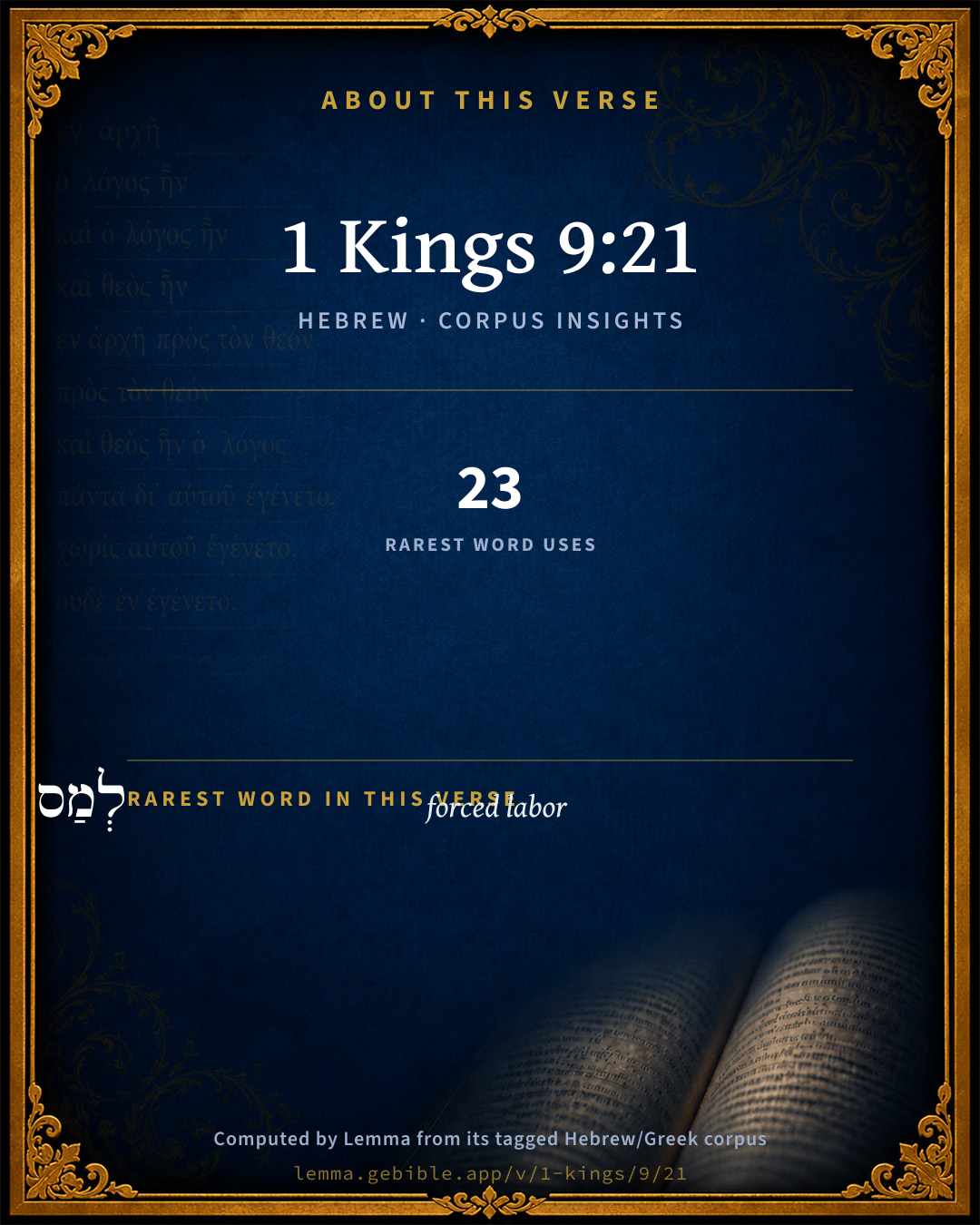
The rarest word here is לְמַס forced labor H4522 — appearing just 23 times in the whole Hebrew Bible.

Shared distinctive vocabulary

לְמַס forced labor H4522 occurs in 22 verses of the Hebrew Bible. Also found in:

Grammatical profile

  • 5 verbs
  • 7 nouns
  • 1 pronoun
  • 2 prepositions
  • 3 particles

Verb forms

  • נֹתְר֤וּ Niphal · Perfect
  • יָכְל֛וּ Qal · Perfect
  • לְהַֽחֲרִימָ֑ם Hiphil · Infinitive Construct
  • וַיַּעֲלֵ֤ם Hiphil · Sequential Imperfect
  • עֹבֵ֔ד Qal · Participle Active

Repetition

Words recur within this verse — often emphatic in Hebrew:

  • בְּנֵיהֶ֗ם son H1121 ×2
  • אֲשֶׁ֨ר which H834 ×2

Cross-references

13

Topical passages linked to 1 Kings 9:21 in the Treasury of Scripture Knowledge — connected by theme and wording, ordered by reader-vote popularity; previews shown in the World English Bible.

  • Joshua 15:63 As for the Jebusites, the inhabitants of Jerusalem, the children of Judah couldn't drive them out: but the Jebusites dwell with the children of Judah at Jerusalem to this day.
  • Joshua 17:12 Yet the children of Manasseh couldn't drive out [the inhabitants of] those cities; but the Canaanites would dwell in that land.
  • Judges 1:21 The children of Benjamin did not drive out the Jebusites who inhabited Jerusalem; but the Jebusites dwell with the children of Benjamin in Jerusalem to this day.
  • Genesis 9:25–26 He said, "Cursed be Canaan; A servant of servants will he be to his brothers."
  • Ezra 2:55–58 The children of Solomon's servants: the children of Sotai, the children of Hassophereth, the children of Peruda,
  • Nehemiah 7:57 The children of Solomon's servants: the children of Sotai, the children of Sophereth, the children of Perida,
  • Nehemiah 11:3 Now these are the chiefs of the province who lived in Jerusalem: but in the cities of Judah lived everyone in his possession in their cities, [to wit], Israel, the priests, and the Levites, and the Nethinim, and the children of Solomon's servants.
  • Joshua 17:16–18 The children of Joseph said, The hill-country is not enough for us: and all the Canaanites who dwell in the land of the valley have chariots of iron, both they who are in Beth-shean and its towns, and they who are in the valley of Jezreel.
  • Judges 1:27–35 Manasseh did not drive out [the inhabitants of] Beth-shean and its towns, nor [of] Taanach and its towns, nor the inhabitants of Dor and its towns, nor the inhabitants of Ibleam and its towns, nor the inhabitants of Megiddo and its towns; but the Canaanites would dwell in that land.
  • Judges 2:20–3:4 The anger of Yahweh was kindled against Israel; and he said, Because this nation have transgressed my covenant which I commanded their fathers, and have not listened to my voice;
  • 1 Kings 5:13 King Solomon raised a levy out of all Israel; and the levy was thirty thousand men.
  • 1 Kings 9:15 This is the reason of the levy which king Solomon raised, to build the house of Yahweh, and his own house, and Millo, and the wall of Jerusalem, and Hazor, and Megiddo, and Gezer.
  • Psalms 106:34–36 They didn't destroy the peoples, As Yahweh commanded them,

Cross-references courtesy of OpenBible.info (CC BY 4.0).

Hebrew and Greek witnesses Masoretic Hebrew ↔ Greek Septuagint

The same verse in the two great witnesses to the Old Testament, shown verse-for-verse.

These are two independent witnesses, not word-aligned to each other, and the Septuagint is shown in lemma (dictionary) form.

Hebrew 1 Kings 9:21 Masoretic · Westminster Leningrad Codex

בְּנֵיהֶ֗ם אֲשֶׁ֨ר נֹתְר֤וּ אַחֲרֵיהֶם֙ בָּאָ֔רֶץ אֲשֶׁ֧ר לֹֽא יָכְל֛וּ בְּנֵ֥י יִשְׂרָאֵ֖ל לְהַֽחֲרִימָ֑ם וַיַּעֲלֵ֤ם שְׁלֹמֹה֙ לְמַס עֹבֵ֔ד עַ֖ד הַיּ֥וֹם הַזֶּֽה

their children who were left after them in the land, whom the children of Israel were not able utterly to destroy, of them did Solomon raise a levy of bondservants to this day.

World English Bible · Public Domain

Hebrew: Westminster Leningrad Codex (CC BY 4.0). Greek: Septuagint (public domain); English from a public-domain English Septuagint. How the Septuagint differs from the Hebrew →

Targum (Aramaic paraphrase)

1

The Targum is the ancient Jewish Aramaic paraphrase of the Hebrew Scriptures — an interpretive translation, not the Hebrew text itself. Onkelos (literal) and Pseudo-Jonathan (expansive) render the Torah, and Jonathan the Prophets. Coverage is partial: where no permissively-licensed English translation exists for a verse, only the Aramaic is shown. This is verse-level text, not a word-by-word alignment to the Hebrew.

  1. Targum Jonathan Prophets (Joshua–Malachi)
    בְּנֵיהוֹן דְאִשְׁתָּאֲרוּ בַתְרֵיהוֹן בְּאַרְעָא דְלָא יְכִילוּ בְּנֵי יִשְׂרָאֵל לְגַמָרוּתְהוֹן וּמַנִינוּן שְׁלֹמֹה לְמַסְקֵי מִסִין עַד יוֹמָא הָדֵין:

    (no public-domain English translation for this verse)

    Targum Jonathan — Aramaic: “Mikraot Gedolot” (public domain). English: “Sefaria Community Translation” (CC0 1.0 (public-domain dedication)); “London "Chaldee Paraphrase," 1871” (public domain). Text via Sefaria.

Commentary

Notes on 1 Kings 9:21 from classic Christian and Jewish commentators (each source and its license shown beneath its notes). The classic Christian expositions comment on the surrounding passage and are grouped to its opening verse, so a note may address several verses; the Jewish commentaries on the Tanakh (Rashi and others) are per-verse, so they appear only where the commentator wrote on this verse.

Lemma curates 59 commentaries, every one of them public domain or Creative Commons licensed, each selected and text-cleaned for this edition rather than reprinted as found. About our sources →

Trapp's Complete Commentary

John Trapp

1Ki 9:21 Their children that were left after them in the land, whom the children of Israel also were not able utterly to destroy, upon those did Solomon levy a tribute of bondservice unto this day.

Ver. 21. Were not able utterly to destroy.] Once they could, but did not; afterwards they would have done it, but were not able.

John Trapp, A Commentary or Exposition upon All the Books of the Old and New Testament (1647–1656) — public domain. Text from a community e-Sword module.

Tyndale Open Study Notes

Tyndale Open Resources

9:21 completely destroyed: See “Complete Destruction” Theme Note.

Tyndale Open Study Notes — © Tyndale Open Resources, licensed CC BY-SA 4.0. Text via the HelloAO Bible API.

Adam Clarke's Commentary

Verse 21. A tribute of bond-service] He made them do the most laborious part of the public works, the Israelites being generally exempt. When Sesostris, king of Egypt, returned from his wars, he caused temples to be built in all the cities of Egypt, but did not employ one Egyptian in the work, having built the whole by the hands of the captives which he had taken in his wars. Hence he caused this inscription to be placed upon each temple: -

Ουδεις εγχωριος εις αυτα μεμοχθηκε .

No native has laboured in these.

Diodor. Sic. Bibl., lib. i., c. 56.

It appears that Solomon might with propriety have placed a similar inscription on most of his works.

Adam Clarke's Commentary on the Bible (1810–1826) — public domain. Text from a community e-Sword/MySword module.

The Cambridge Bible for Schools and Colleges

gen. ed. J. J. S. Perowne

21. whom the children of Israel also were not able utterly to destroy] There is no word to represent ‘also’ in the original, nor does the English sentence require it. The utter destruction spoken of here is that which had been decreed upon them by God’s judgement, and which Israel was to be the agent in executing.

upon those did Solomon levy a tribute of bondservice] The Hebrew noun מם here rendered ‘tribute’ is applied in a concrete sense to the ‘renderers of the tribute.’ The verb also here is literally ‘he caused to go up.’ As the narrative in this verse is dealing entirely with the persons it is better to render (as R.V.) of these did Solomon raise a levy of bondservants. Theirs was slave service, such as is alluded to in Jos_16:10.

unto this day] A faithful copying by the compiler of the Books of Kings from some earlier record which lay before him, and which noted the continuation of this forced service for some time after the reign of Solomon.

The Cambridge Bible for Schools and Colleges (gen. ed. J. J. S. Perowne; Cambridge University Press, 1878–1918) — public domain. Text from a community e-Sword module.

John Gill's Exposition

These were the chief of the officers over Solomon's work,.... In building the above houses and cities:

five hundred and fifty which bore rule over the people that wrought in the work; in Ch2 8:10 they are said to be but two hundred and fifty; now it may be observed, as is by the Jewish writers, that there were three sorts of those rulers; the lowest rank and order of them consisted of 3300, the next of three hundred which were over the 3300, and being numbered with them made 3600, Ch2 2:18 and the highest rank of them were two hundred and fifty, and the middlemost and highest being joined together, as they are here, made five hundred and fifty. Abarbinel reconciles the places thus, the two hundred and fifty were only over those that wrought in the temple; and the five hundred and fifty here were those that were over such that were employed in the various parts of the kingdom.

John Gill's Exposition of the Whole Bible (1746–1763) — public domain (CC PDM 1.0). Text via the HelloAO Bible API.

Albert Barnes' Notes on the Bible

See 1Ki 5:15 note.

Albert Barnes' Notes on the Bible (1834–1885) — public domain. Text from a community e-Sword/MySword module.

Haydock's Catholic Bible Commentary

Day. After the captivity, some were found who had perhaps come from Phœnicia, 1 Esdras ix. 1. Solomon reduced the natives of the country to the most abject condition, forcing them to work like slaves. (Josephus, [Antiquities?] viii. 6.) --- Hebrew, "upon those, Solomon imposed a tribute of bond-service, until this day." (Haydock) --- Esdras (1 Esdras ii. 58.) calls them who returned from captivity, the children of the servants of Solomon, 392. Their fathers were probably styled proselytes; and were in number, 153,600. See 1 Paralipomenon xxii. 2., and 2 Paralipomenon ii. 17. (Calmet)

George Leo Haydock (1774–1849), Haydock's Catholic Family Bible and Commentary, 1859 edition — public domain. Excludes Psalms (Douay-Rheims chapter numbering differs from Protestant) and Deuterocanonical books (Catholic canon only).

Matthew Poole's English Annotations

He used them as bond-men, and imposed burdens and bodily labours upon them. See 2Ch 2:18. Hence some think they are called Solomon’s servants, Ezr 2:55,58.

Quest. Why did not Solomon destroy them, as God had commanded, when now it was fully in his power to do so?

Answ. First, The command of destroying them, Deu 7:2, did chiefly, if not only, concern that generation of Canaanites who lived in or near the time of the Israelites’ entering into Canaan. Secondly, That command seems not to be absolute and universal, but conditional, and with some exception for those who should submit to them, and embrace the true religion, as may be gathered both from Jos 11:19, and from the history of the Gibeonites, Jos 9, whom Joshua did not sin in sparing, when he had sworn to do so; and Saul did sin in endeavouring to destroy them. But if God’s command had been absolute, the oaths of Joshua, and of the princes, could not have obliged them, nor dispensed with such a command.

Matthew Poole's English Annotations on the Holy Bible (1683–1685) — public domain. Text from a community e-Sword/MySword module.

Whedon's Commentary on the Bible

Daniel D. Whedon

21. Levy a tribute of bondservice — A considerable portion of the levies of men employed by Solomon in his public works was doubtless drawn from the ranks of the subjugated nations.

Daniel D. Whedon (gen. ed.), Commentary on the Old and New Testaments (1874–1909) — public domain. Text from a community e-Sword module.

The Pulpit Commentary

Their children that were left after them in the land this is explicative of ver.Their children that were left after them in the land this is explicative of ver. 20), whom the children of Israel also also is not in the Hebrew, and is meaningless were not able utterly to destroy, upon those did Solomon levy a tribute of bond service (see on 1Ki_5:13, and cf. Judges 1., passim, and 1Ch_22:2) unto this day.

The Pulpit Commentary (1880–1919), ed. H.D.M. Spence-Jones & Joseph S. Exell — public domain. Text from a community e-Sword module.

John Wesley's Explanatory Notes

Those - He used them as bondmen, and imposed bodily labours upon them. "But why did not Solomon destroy them as God had commanded, when now it was fully in his power to do so?" The command of destroying them, Deut. vii, 2, did chiefly, if not only, concern that generation of Canaanites, who lived in, or, near the time of the Israelites entering into Canaan. And that command seems not to be absolute, but conditional, and with some exception for those who should submit and embrace the true religion, as may be gathered both from Josh. xi, 19, and from the history of the Gibeonites. For if God's command had been absolute, the oaths of Joshua, and of the princes, could not have obliged them, nor dispensed with such a command.

John Wesley, Explanatory Notes Upon the Whole Bible (1754–1765) — public domain. Text via the GEBible commentary corpus.

Lesson kit

Teaching starters — assembled from the data on this page, not authored interpretation. Every prompt links to the verse data it draws on. Edit before teaching.

1 Kings, in the Historical, opens this verse with 18 words (16 distinct Hebrew lemmas). Its most distinctive word is maç (“forced labor”). A historical commentator’s framing appears above. Read the whole chapter for the surrounding context.

Discussion questions

  1. How does “forced labor” (maç) shape what this verse is saying?
  2. How does Genesis 49:15, which shares the word «forced labor», read alongside this verse?
  3. What does the repetition of “son” (2× in this one verse) do in this verse?
  4. These translations render this verse differently; the difference is in the English rendering, not the original. What questions does that raise?
  5. «נֹתְר֤וּ» is a Niphal Perfect verb. How does that grammatical form shape the action described?
  6. Compare how Trapp's Complete Commentary and Tyndale Open Study Notes read this verse. Where do they agree or differ?

Things to notice

Reading settings

Reading text

Shown beneath each verse's original-language words.

Old Testament
Old Testament edition

Read the OT as the Masoretic Hebrew (MT) or the Greek Septuagint (LXX).

English shown for the Greek Septuagint (in the Hebrew ↔ Greek comparison).

Comparing translations? Open the Compare panel on any verse page to stack up to four side by side.