

Psalms 13:5

Hebrew (Westminster Leningrad Codex) Psalms 13:5 appears in the Hebrew Old Testament. The text above is from the Westminster Leningrad Codex. Each word links to its Strong’s number, a concise gloss, and parsing drawn from the Open Scriptures Hebrew Bible morphology. Click any word for its full Brown-Driver-Briggs (BDB) entry.
Download image
Cite this verse

Psalms 13:5 (World English Bible). Public Domain. Lemma interlinear Bible study tool, https://lemma.gebible.app/v/psalms/13/5.

Show BibTeX & RIS
BibTeX
RIS
English Translation
But I trust in your loving kindness. My heart rejoices in your salvation.
World English Bible · Public Domain
Download a study sheet

One document with this verse’s original text, its word-by-word gloss line, the meaning frame, cross-references with their text, attributed commentary, and full source and license credits — printable, and it pastes into notes with its structure intact.

This verse Autodidact and up

Study sheet (.html) Plain text (.txt)

A passage Seminary Student

Up to 50 verses in one chapter. A passage sheet keeps up to 6 commentary sources and 12 cross-references per verse, in the order this page ranks them, and says so on the sheet whenever that leaves anything out. Ask for a single verse and you get the Autodidact verse sheet above.

Everything on this page stays free to read, with no account — the sheet is a download of what is already on screen, not access to it.

Want to remove ads? Support Godless Engineer
Compare translations 3

The same verse in 3 English versions, stacked beneath the original-language interlinear above. Click any original word for its lexicon entry.

Each is an independent rendering of the whole verse — the interlinear is not word-aligned to these translations.

Highlighted words mark where these versions differ — a whole-verse word diff, not a word-by-word alignment.

  • World English Bible Public Domain
    But I trust in your loving kindness. My heart rejoices in your salvation.
  • King James Version Public Domain
    But I have trusted in thy mercy; my heart shall rejoice in thy salvation.
  • unfoldingWord Literal Text CC BY-SA 4.0
    But I have trusted in your covenant faithfulness; let my heart rejoice in your salvation.

unfoldingWord Literal Text — © unfoldingWord, licensed CC BY-SA 4.0. Word-aligned USFM3 via Door43 (git.door43.org/unfoldingWord/en_ult).

Versions to compare (up to 4)

3 of 4 selected

Show all 18 translations

Every available English version of this verse, each an independent rendering of the whole verse.

  • World English Bible Public Domain
    But I trust in your loving kindness. My heart rejoices in your salvation.
  • Berean Standard Bible Public Domain
    But I have trusted in Your loving devotion; my heart will rejoice in Your salvation.
  • Majority Standard Bible Public Domain
    But I have trusted in Your loving devotion; my heart will rejoice in Your salvation.
  • King James Version Public Domain
    But I have trusted in thy mercy; my heart shall rejoice in thy salvation.
  • American Standard Version (1901) Public Domain
    But I have trusted in thy lovingkindness; My heart shall rejoice in thy salvation.
  • Revised Version (1885) Public Domain
    But I have trusted in thy mercy; my heart shall rejoice in thy salvation:
  • Geneva Bible (1599) Public Domain
    But I trust in thy mercie: mine heart shall reioyce in thy saluation: I will sing to the Lord, because he hath delt louingly with me.
  • Douay-Rheims (1899) Public Domain
    lest at any time my enemy say: I have prevailed against him. They that trouble me will rejoice when I am moved:
  • Young's Literal Translation Public Domain
    And I, in Thy kindness I have trusted, Rejoice doth my heart in Thy salvation.
  • Literal Standard Version CC BY-SA 4.0
    And I have trusted in Your kindness, || My heart rejoices in Your salvation.
  • Unlocked Literal Bible CC BY-SA 4.0
    But I have trusted in your covenant faithfulness; my heart rejoices in your salvation.
  • unfoldingWord Literal Text CC BY-SA 4.0
    But I have trusted in your covenant faithfulness; let my heart rejoice in your salvation.
  • Darby Bible Public Domain
    As for me, I have confided in thy loving-kindness; my heart shall be joyful in thy salvation.
  • World Messianic Bible Public Domain
    But I trust in your loving kindness. My heart rejoices in your salvation.
  • Webster's Bible Public Domain
    But I have trusted in thy mercy; my heart shall rejoice in thy salvation.
  • Free Bible Version CC BY-SA 4.0
    But I trust in your never-failing love, I will be happy because you save me.
  • Bible in Basic English Public Domain
    But I have had faith in your mercy; my heart will be glad in your salvation.
  • JPS Tanakh (1917) Public Domain
    (13-6) But as for me, in Thy mercy do I trust; my heart shall rejoice in Thy salvation.

Literal Standard Version (2020), Covenant Press — licensed CC BY-SA 4.0. Text via the HelloAO Bible API (eBible.org). Unlocked Literal Bible (unfoldingWord) — licensed CC BY-SA 4.0. Text via the HelloAO Bible API (eBible.org). unfoldingWord Literal Text — © unfoldingWord, licensed CC BY-SA 4.0. Word-aligned USFM3 via Door43 (git.door43.org/unfoldingWord/en_ult). Free Bible Version, Dr. Jonathan Gallagher — licensed CC BY-SA 4.0. Text via the HelloAO Bible API (eBible.org).

Word by word

More ways to search: Search by grammar → Find every occurrence → Compare this word →

Practice this passage: Drill this verse → Learn its vocabulary →

About this verse

These counts appear in no published source. They are computed here, from the morphology-tagged text and Lemma’s own curated glosses. What Lemma adds →

6
words
6
distinct lemmas
Wisdom
section

Shared distinctive vocabulary

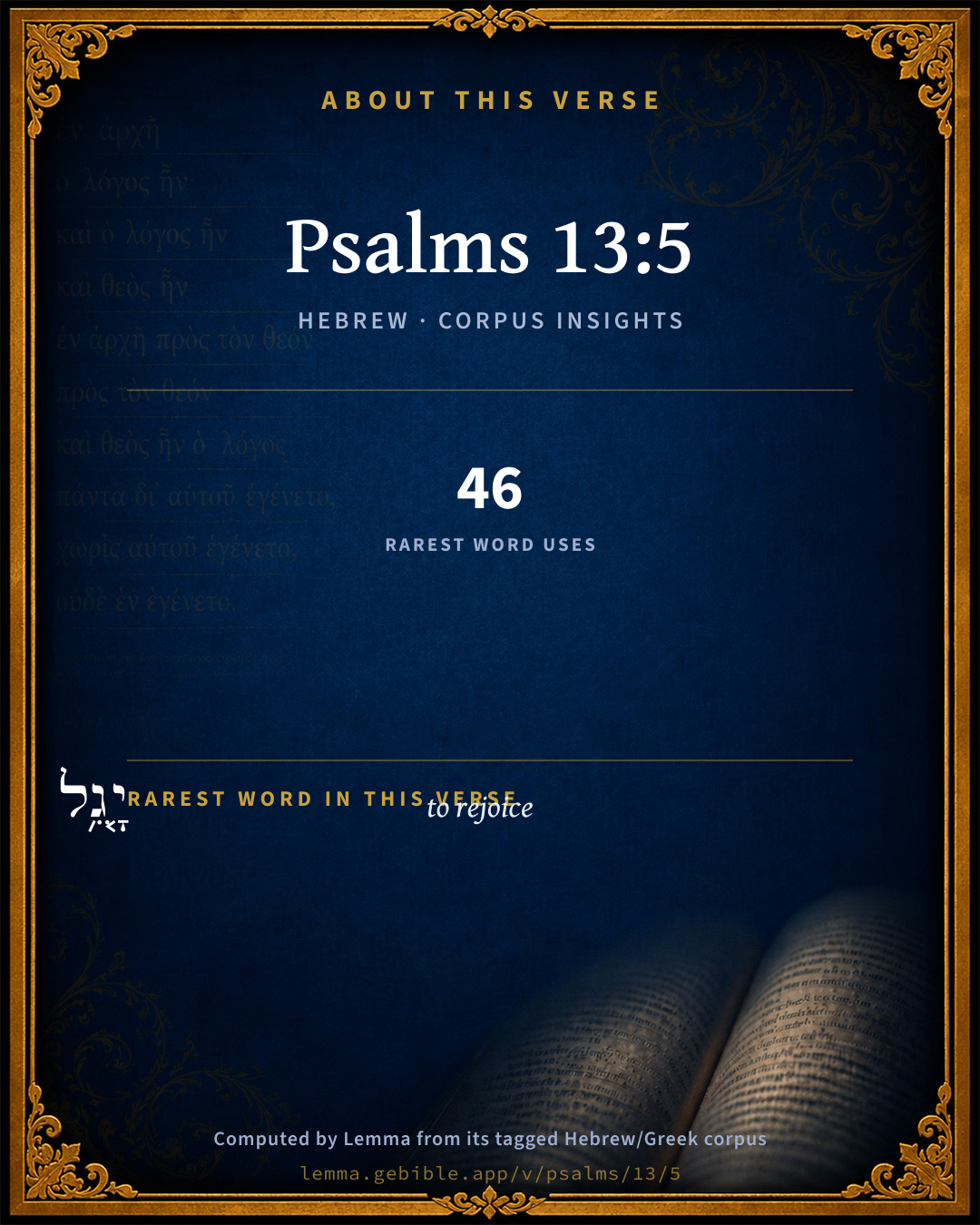
יָ֤גֵ֥ל to rejoice H1523 occurs in 44 verses of the Hebrew Bible. Also found in:

Grammatical profile

  • 2 verbs
  • 3 nouns
  • 1 pronoun

Verb forms

  • בָטַחְתִּי֮ Qal · Perfect
  • יָ֤גֵ֥ל Qal · Imperfect

Hebrew & Septuagint length

In English translation the verse runs 13 words from the Hebrew and 14 from the Septuagint (LXX English) — closely comparable.

A rough comparison of the two English renderings, which tokenize alike — not a word-level alignment.

Word counts can differ between the Hebrew and the Greek without any difference in meaning — e.g. the Hebrew direct-object marker אֵת has no separate Greek word, and Greek often adds the article ὁ.

Cross-references

16

Topical passages linked to Psalms 13:5 in the Treasury of Scripture Knowledge — connected by theme and wording, ordered by reader-vote popularity; previews shown in the World English Bible.

  • Isaiah 12:2 Behold, God is my salvation. I will trust, and will not be afraid; for Yah, Yahweh, is my strength and song; and he has become my salvation."
  • Jude 1:21 Keep yourselves in the love of God, looking for the mercy of our Lord Jesus Christ to eternal life.
  • Habakkuk 3:18 Yet I will rejoice in Yahweh. I will be joyful in the God of my salvation!
  • Psalms 52:8 But as for me, I am like a green olive tree in God's house. I trust in God's loving kindness forever and ever.
  • Psalms 36:7 How precious is your loving kindness, God! The children of men take refuge under the shadow of your wings.
  • Psalms 119:81 My soul faints for your salvation. I hope in your word.
  • Psalms 9:14 That I may show forth all your praise. In the gates of the daughter of Zion, I will rejoice in your salvation.
  • Psalms 33:18 Behold, Yahweh's eye is on those who fear him, On those who hope in his loving kindness;
  • Psalms 33:21–22 For our heart rejoices in him, Because we have trusted in his holy name.
  • Psalms 51:12 Restore to me the joy of your salvation. Uphold me with a willing spirit.
  • 1 Samuel 2:1 Hannah prayed, and said: My heart exults in Yahweh; My horn is exalted in Yahweh; My mouth is enlarged over my enemies; Because I rejoice in your salvation.
  • Psalms 32:10 Many sorrows shall be to the wicked, But he who trusts in Yahweh, loving kindness shall surround him.
  • Luke 2:20 The shepherds returned, glorifying and praising God for all the things that they had heard and seen, just as it was told them.
  • Psalms 147:11 Yahweh takes pleasure in those who fear him, In those who hope in his loving kindness.
  • Luke 1:47 My spirit has rejoiced in God my Savior,
  • Psalms 43:4–5 Then I will go to the altar of God, To God, my exceeding joy. I will praise you on the harp, God, my God.

Cross-references courtesy of OpenBible.info (CC BY 4.0).

Hebrew and Greek witnesses Masoretic Hebrew ↔ Greek Septuagint

The same verse in the two great witnesses to the Old Testament, shown verse-for-verse.

You’re reading Greek Psalm 12 (Hebrew Psalm 13). The Septuagint counts the superscription, so verse numbers can differ from the Hebrew — chapter-level alignment, not verse-by-verse. Numbering follows Rahlfs.

These are two independent witnesses, not word-aligned to each other, and the Septuagint is shown in lemma (dictionary) form.

Hebrew Psalms 13:5 Masoretic · Westminster Leningrad Codex

וַאֲנִ֤י בְּחַסְדְּךָ֣ בָטַחְתִּי֮ יָ֤גֵ֥ל לִבִּ֗י בִּֽישׁוּעָ֫תֶ֥ךָ

But I trust in your loving kindness. My heart rejoices in your salvation.

World English Bible · Public Domain

Greek LXX Greek Psalm 12:5 Septuagint · lemma form

μήποτε εἶπον ὁ ἐχθρός ἐγώ ἰσχύω πρός αὐτός ὁ θλίβω ἐγώ ἀγαλλιάομαι ἐάν σαλεύω

But I have hoped in your mercy; my heart shall exult in your salvation.

LXX2012 (modern English Septuagint) · Public Domain

On this verse, John Calvin's Commentaries discusses the Septuagint’s reading. Read the note in Commentary ↓

Hebrew: Westminster Leningrad Codex (CC BY 4.0). Greek: Septuagint (public domain); English from LXX2012 (modern English Septuagint) (Public Domain). How the Septuagint differs from the Hebrew →

Commentary

Notes on Psalms 13:5 from classic Christian and Jewish commentators (each source and its license shown beneath its notes). The classic Christian expositions comment on the surrounding passage and are grouped to its opening verse, so a note may address several verses; the Jewish commentaries on the Tanakh (Rashi and others) are per-verse, so they appear only where the commentator wrote on this verse.

Lemma curates 59 commentaries, every one of them public domain or Creative Commons licensed, each selected and text-cleaned for this edition rather than reprinted as found. About our sources →

Trapp's Complete Commentary

John Trapp

Psa 13:5 But I have trusted in thy mercy; my heart shall rejoice in thy salvation.

Ver. 5. But I have trusted in thy mercy] Notwithstanding all the endeavours of earth and of hell to cast down this castle of my confidence, I will not quit it; but be still as a green olive tree in the house of God: I will trust in the mercy of God for ever and ever, Psa 52:8.

John Trapp, A Commentary or Exposition upon All the Books of the Old and New Testament (1647–1656) — public domain. Text from a community e-Sword module.

The Biblical Illustrator

Joseph S. Exell

Psa_13:5

But I have trusted in Thy mercy.

On the mercy of God

I. What is meant by the mercy of God? Mercy differs from goodness in that it supposes guilt. Without the fall of man there could have been no occasion for his redemption; and without the plan of redemption it does not appear that we could have formed any opinion of the Divine mercy.

II. How does it remedy mans misery? The two evils to which man is exposed are sin and death. Yet they differ only as cause and effect. Sin is the distemper, and death the issue of it. Against sin God hath provided by giving us the light of Scripture; against death by the new principle of life infused into the Christian from the time of his baptismal regeneration.

III. What is it to trust in this mercy? We cannot do so till we know what we have to fear. But men are insensible of this, because self-satisfied and resting in a mistaken confidence. To trust in God is to renounce all self-confidence, and to rely on the mercy of God. Do not mistake presumption for trust. They who do, think that Gods mercy is only to deliver from punishment. It is to deliver from sin.

IV. The joy and comfort following. My heart shall rejoice in Thy salvation. (A. Jones, M. A.)

Mercy and joy

The minister of the Gospel is to proclaim free grace everywhere. But the heart must be awakened ere it can receive the truth of Gods grace.

I. The experimental statement of David. I have trusted in Thy mercy. He was a sinner, but here was all his hope. This the test of true discipleship, whether we have come to trust as David did, and to hope in the mercy of God through Jesus Christ. And he knew this experimentally. Dry doctrines will not suffice alone. They would starve a soul. There must be experience. David here tells out his sorrow. He mourns Gods delays. But he trusts in God.

II. His experience. My heart shall rejoice in Thy salvation. He had trusted, and he anticipates rejoicing. Here was the shelter, the anchor of his soul. The Church and the Christian can never be ship wrecked, for the anchor holds. He speaks of a heart joy. No one can know anything about heart rejoicing but those who have been heartachers. Blessed are they that mourn, for they shall be comforted. How blessed it is to experience the stillness and the quietness of the peace of God. Compared with this, what is the world worth? (J. J. West, M. A.)

My heart shall rejoice in Thy salvation.

A renovation of heart essential to a state of salvation

1. Without the renovation of the heart there can be no distinct knowledge of the Gospel. The natural mind cannot receive the things of God; they are spiritually discerned. The mind must be renewed, that the man may become spiritual.

2. Nor can there be a new nature. This is essential to the enjoyment of salvation. For how can we enjoy that which is opposed to our feelings, desires, habits? We have no enjoyment in the society of those who are the objects of our aversion. The enmity of the mind must be slain by the constraining power of the love of Christ; but this involves renovation.

3. Unless the heart is renewed by the Spirit of God there is no possibility of accounting for the discovery and preparation of a plan of redemption at all. Was it worthy of the Divinity to do all that He has done in redemption for the sake of saving those He never intended to change and purify?

4. This renovation of heart is essential to the enjoyment of heaven. Take an individual from the lowest ranks of society, and place him in the midst of the high born, the educated, the refined; where will be his enjoyment? The unrenewed man, set in the midst of those who have their conversation in heaven, has no relish for the company, and gladly turns from it. The reason for finding no interest in heaven is--unrenewedness of heart. (J. Burnet.)

The Biblical Illustrator, edited by Joseph S. Exell (c. 1880s–1900s) — public domain. Text from a community e-Sword module.

Tyndale Open Study Notes

Tyndale Open Resources

13:5-6 The psalmist no longer hears the ridicule of his foes. Instead, because of his trust in the Lord, he is full of joy.

Tyndale Open Study Notes — © Tyndale Open Resources, licensed CC BY-SA 4.0. Text via the HelloAO Bible API.

Geneva Bible (1599)

Geneva Bible translators

Both by the benefits past, and by others to come.

The mercy of God is the cause of our salvation.

Geneva Bible (1599) marginal notes — public domain. Text via Bolls.life.

Jamieson, Fausset & Brown

Robert Jamieson, A. R. Fausset & David Brown

Trust is followed by rejoicing in the deliverance which God effects, and, instead of his enemy, he can lift the song of triumph.

Next: Psalms Chapter 14

Jamieson, Fausset & Brown — Commentary Critical and Explanatory on the Whole Bible (1871) — public domain (CC PDM 1.0). Text via the HelloAO Bible API.

Adam Clarke's Commentary

Verse 5. But I have trusted in thy mercy] Thou wilt not suffer me to fall; or if I have fallen, wilt thou not, for his sake who died for sinners, once more lift up the light of thy countenance upon me? Wilt thou not cover my sin?

My heart shall rejoice in thy salvation.] There is no true joy but of the heart; and the heart cannot rejoice till all guilt is taken away from the conscience.

Adam Clarke's Commentary on the Bible (1810–1826) — public domain. Text from a community e-Sword/MySword module.

John Calvin's Commentaries

The Psalmist does not as yet feel how much he has profited by praying; but depending upon the hope of deliverance, which the faithful promise of God enabled him to entertain, he makes use of this hope as a shield to repel those temptations with the terror of which he might be greatly distressed. Although, therefore, he is severely afflicted, and a multiplicity of cares urge him to despair, he, notwithstanding, declares it to be his resolution to continue firm in his reliance upon the grace of God, and in the hope of salvation. With the very same confidence ought all the godly to be furnished and sustained, that they may duly persevere in prayer. Whence, also, we gather what I have formerly adverted to, that it is by faith we apprehend the grace of God, which is hidden from and unknown to the understanding of the flesh. As the verbs which the Psalmist uses are not put in the same tense, different meanings may be drawn from the different tenses; but David, I have no doubt, here wishes to testify that he continued firm in the hope of the deliverance promised to him, and would continue so even to the end, however heavy the burden of temptations which might press upon him. Accordingly, the word exult is put in the future tense, to denote the continued exercise of the affection spoken of, and that no affliction shall ever shake out of his heart the joy of faith. It is to be observed, that he places the goodness of God first in order, as being the cause of his deliverance, — I will sing unto the Lord I translate this into the future tense. David, it is true, had not yet obtained what he earnestly desired, but being fully convinced that God was already at hand to grant him deliverance, he pledges himself to give thanks to him for it. And surely it becomes us to engage in prayer in such a frame of mind as at the same time to be ready to sing the praises of God; a thing which is impossible, unless we are fully persuaded that our prayers will not be ineffectual. We may not be wholly free from sorrow, but it is nevertheless necessary that this cheerfulness of faith rise above it, and put into our mouth a song on account of the joy which is reserved for us in the future although not as yet experienced by us; “Qui ne nous est point encore presente.” — Fr.

גמל Signifies “to return, to requite, to recompense, in whatever manner, whether evil for evil, good for evil, evil for good, or good for good.” — Parkhurst. Those who argue from this passage for the merit of good works, make the argument to rest on the notion of retribution attached to the word. But although it uniformly mean, to reward, no conclusive argument could here be drawn from this passage in support of that doctrine. What God bestows upon his people is sometimes called a reward in Scripture; not, however, because they can claim it as due to them by justice, but to express God’s approbation of obedience, and the connection between obedience and happiness. Besides, גמל, also means to deal kindly with, especially when applied to God, See Psalm 119:17, and 142:7. The word has this meaning in Arabic; and that it is to be thus understood in the passage before us is supported by the ancient versions. The Septuagint reads εὐεργετήσαντι; and the Vulgate, bona tribuit, hath bestowed upon me good. The Arabic and Ethiopic adopt the same reading.

John Calvin's Commentaries (1540-1563) — public domain. Text from the Calvin Translation Society English edition (1840s-50s) via the Christian Classics Ethereal Library (ccel.org). Calvin's coverage is partial (roughly two-thirds of the Bible); uncommented books and verses are honest gaps, never fabricated. The 19th-century editor's footnotes and remarks are omitted so the notes are faithfully Calvin's own voice.

Ellicott's Commentary for English Readers

(5) But I.—Emphatic, but as for me. The most complete peace has taken the place of the despair with which the psalm opens. The rhythm of the Hebrew seems to express the restfulness of the thought. “It hath a dying fall.” The LXX. and Vulg. (comp. the Prayer Book version) have an additional clause not found in any MS., “Yea, I will praise the name of the Lord most high.”

A Bible Commentary for English Readers, edited by Charles John Ellicott (1878–1897) — public domain. Text from a community e-Sword module.

The Cambridge Bible for Schools and Colleges

gen. ed. J. J. S. Perowne

5. More exactly:

But as for me, in thy lovingkindness do I trust. Cp. Psa_5:7.

My heart shall rejoice … I will sing] Better: let my heart rejoice … let me sing. Faith has triumphed. He can look forward with confidence. But humility transforms his resolution to give thanks into a prayer.

Because he hath dealt bountifully with me] He looks back from the stand-point of deliverance granted. P.B. V. follows the LXX in adding from Psa_7:17, Yea, I will praise the Name of the Lord most Highest.

5, 6. The joy of deliverance.

The Cambridge Bible for Schools and Colleges (gen. ed. J. J. S. Perowne; Cambridge University Press, 1878–1918) — public domain. Text from a community e-Sword module.

John Gill's Exposition

But I have trusted in thy mercy,.... The faith, hope, and comfort of the psalmist grew and increased by prayer; from complaining he goes to praying, from praying to believing; he trusted not in himself, not in his own heart, nor in his own righteousness and merits, but in the mercy of God; and not in the bare absolute mercy of God, but in the grace and goodness of God, as the word (x) here used signifies, as it is displayed in the plenteous redemption which is by Christ; which is a sufficient ground of faith and hope; see Psa 130:7;

my heart shall rejoice in thy salvation; which God is the contriver, author, and giver of, and in which the glory of his perfections is so greatly displayed: and a true believer rejoices more on account that God is glorified by it than because of his own interest in it; and this joy is an inward one, it is joy in the heart, and is real and unfeigned, and is what continues, and will be felt and expressed both here and hereafter.

(x) "in bonitate tua", Vatablus; "in benignitate tua", Junius & Tremellius, Piscator; "in benignissima voluntate tua", Gejerus.

John Gill's Exposition of the Whole Bible (1746–1763) — public domain (CC PDM 1.0). Text via the HelloAO Bible API.

Albert Barnes' Notes on the Bible

But I have trusted in thy mercy - In thy favor; thy friendship; thy promises. His original confidence had been in God only, and not in himself. That confidence he still maintained; and now, as the result of that, he begins to exult in the confidence that he would be safe. The idea is, “I have trusted in the mercy of God; I still trust, and I will trust forever.”

My heart shall rejoice in thy salvation - The word “salvation” here does not refer to salvation in the future world, but to deliverance from his present troubles, or to God’s interposition in putting him into a condition of safety. The idea is, that he had entire confidence that God would interpose, and that there would yet be cause to rejoice in that salvation as actually accomplished. He now calls on his heart to rejoice in the assurance that it would be his. So with us. There will not only be rejoicing in salvation when actually accomplished, but there may, and should be, in the firm conviction that it will be ours.

Albert Barnes' Notes on the Bible (1834–1885) — public domain. Text from a community e-Sword/MySword module.

Matthew Poole's English Annotations

Neither their threats and brags, nor my own dangers, shall shake my confidence in thy mercy promised to me.

Matthew Poole's English Annotations on the Holy Bible (1683–1685) — public domain. Text from a community e-Sword/MySword module.

The Treasury of David

Charles H. Spurgeon

Ver. 5. What a change is here! Lo, the rain is over and gone, and the time of the singing of birds is come. The mercyseat has so refreshed the poor weeper, that he clears his throat for a song. If we have mourned with him, let us now dance with him. David's heart was more often out of tune than his harp, He begins many of his psalms sighing, and ends them singing; and others he begins in joy and ends in sorrow; "so that one would think, "says Peter Moulin, "that those Psalms had been composed by two men of a contrary humour." It is worthy to be observed that the joy is all the greater because of the previous sorrow, as calm is all the more delightful in recollection of the preceding tempest.

"Sorrows remembered sweeten present joy."

Here is his avowal of his confidence:

But I have trusted in thy mercy. For many a year it had been his wont to make the Lord his castle and tower of defence, and he smiles from behind the same bulwark still. He is sure of his faith, and his faith makes him sure; had he doubted the reality of his trust in God, he would have blocked up one of the windows through which the sun of heaven delights to shine. Faith is now in exercise, and consequently is readily discovered; there is never a doubt in our heart about the existence of faith while it is in action: when the hare or partridge is quiet we see it not, but let the same be in motion and we soon perceive it. All the powers of his enemies had not driven the psalmist from his stronghold. As the shipwrecked mariner clings to the mast, so did David cling to his faith; he neither could nor would give up his confidence in the Lord his God. O that we may profit by his example and hold by our faith as by our very life! Now hearken to the music which faith makes in his soul. The bells of the mind are all ringing,

My heart shall rejoice in thy salvation. There is joy and feasting within doors, for a glorious guest has come, and the fatted calf is killed. Sweet is the music which sounds from the strings of the heart. But this is not all; the voice joins itself in the blessed work, and the tongue keeps tune with the soul, while the writer declares,

I will sing unto the Lord.

"I will praise thee every day, Now thine anger's past away;

Comfortable thoughts arise From the bleeding sacrifice."

Ver. 5. I have trusted in thy mercy; my heart shall rejoice in thy salvation. Faith rejoices in tribulation, and triumphs before the victory. The patient is glad when he feels his physic to work, though it make him sick for the time; because he hopes it will procure health. We rejoice in afflictions, not that they are joyous for the present, but because they shall work for our good. As faith rejoices, so it triumphs in assurance of good success; for it sees not according to outward appearance, but when all means fail, it keepeth God in sight, and beholdeth him present for our succour. John Ball.

Ver. 5. I have trusted in thy mercy; my heart shall rejoice in thy salvation. Though passion possess our bodies, let "patience possess our souls." The law of our profession binds us to a warfare; patiendo vincimus, our troubles shall end, our victory is eternal. Here David's triumph (Ps 18:38-40), "I have wounded them, that they were not able to rise; they are fallen under my feet. Thou hast subdued under me those that rose up against me. Thou hast also given me the neck of mine enemies, "etc. They have wounds for their wounds; and the treaders down of the poor are trodden down by the poor. The Lord will subdue those to us that would have subdued us to themselves; and though for a short time they rode over our heads, yet now at last we shall everlastingly tread upon their necks. Lo, then, the reward of humble patience and confident hope. Speramus et superamus. De 32:31. "Our God is not as their God, even our enemies being judges." Ps 20:7. "Some put their trust in chariots, and some in horses." But no chariot hath strength to oppose, nor horse swiftness to escape, when God pursues. Ps 20:8. "They are brought down and fallen; we are risen and stand upright." Their trust hath deceived them; down they fall, and never to rise. Our God hath helped us; we are risen, not for a breathing space, but to stand upright for ever. Thomas Adams.

Ver. 5. None live so easily, so pleasantly, as those that live by faith. Matthew Henry.

Ver. 5. Wherefore I say again, "Live by faith; "again I say, always live by it, rejoice through faith in the Lord. I dare boldly say it is thy fault and neglect of its exercise if thou suffer either thy own melancholy humour or Satan to interrupt thy mirth and spiritual alacrity, and to detain thee in dumps and pensiveness at any time. What if you are of a sad constitution? of a dark complexion? Is not faith able to rectify nature? Is it not stronger than any hellebore? Doth not an experienced divine and physician worthily prefer one dram of it before all the drugs in the apothecary's shop for this effect? Hath it not sovereign virtue in it, to excerebrate all cares, expectorate all fears and griefs, evacuate the mind of all ill thoughts and passions, to exhilarate the whole man? But what good doth it to any to have a cordial by him if he use it not? To wear a sword, soldier like, by his side, and not to draw it forth in an assault? When a dump overtakes thee, if thou wouldst say to thy soul in a word or two, "Soul, why art thou disquieted? know and consider in whom thou believest, "would it not presently return to its rest again? Would not the Master rebuke the winds and storms, and calm thy troubled mind presently? Hath not every man something or other he useth to put away dumps, to drive away the evil spirit, as David with his harp? Some with merry company, some with a cup of sack, most with a pipe of tobacco, without which they cannot ride or go. If they miss it a day together they are troubled with rheums, dulness of spirits. They that live in fens and ill airs dare not stir out without a morning draught of some strong liquor. Poor, silly, smoky helps, in comparison with the least taste (but for dishonouring faith I would say whiff) or draught of faith. Samuel Ward, 1577-1653.

Ver. 5. Experience and perseverance. I have, my heart shall.

Psalms 13:6*

Charles H. Spurgeon's The Treasury of David (1869–1885) — public domain. Psalms only. Text from a community e-Sword/MySword module.

Whedon's Commentary on the Bible

Daniel D. Whedon

5. But I have trusted—The past tense indicates the habit of his life. Until now he has trusted, and he is suddenly strengthened in hope by the memory.

Daniel D. Whedon (gen. ed.), Commentary on the Old and New Testaments (1874–1909) — public domain. Text from a community e-Sword module.

The Pulpit Commentary

But I have trusted (or, I trust) in thy mercy. I know, i.e. , that thou wilt not suffer me to be overcome by my enemy. Thou wilt save me; and therefore my heart shall rejoice in thy salvation, whereof I entertain no doubt.

The Pulpit Commentary (1880–1919), ed. H.D.M. Spence-Jones & Joseph S. Exell — public domain. Text from a community e-Sword module.

Keil & Delitzsch

C. F. Keil & F. Delitzsch

(Heb.: 13:6) Three lines of joyous anticipation now follow the five of lament and four of prayer. By יאני he sets himself in opposition to his foes. The latter desire his death, but he trusts in the mercy of God, who will turn and terminate his affliction. בּטח בּ denotes faith as clinging fast to God, just as חסה בּ denotes it as confidence which hides itself in Him. The voluntative יגל pre-supposes the sure realisation of the hope. The perfect in Psa 13:6 is to be properly understood thus: the celebration follows the fact that inspires him to song. גּמל על to do good to any one, as in Psa 116:7; Psa 119:17, cf. the radically cognate (על) גּמר Psa 57:3. With the two iambics gamal‛alaj the song sinks to rest. In the storm-tossed soul of the suppliant all has now become calm. Though it rage without as much now as ever - peace reigns in the depth of his heart.

Keil & Delitzsch — Biblical Commentary on the Old Testament (1861–1891) — public domain (CC PDM 1.0). Text via the HelloAO Bible API. (Old Testament only.)

J. A. Alexander on Psalms

Joseph Addison Alexander

6. (Psa 15:5, 6). And I in thy mercy have trusted; let my heart exult in thy salvation; I will sing to Jehovah, for he hath done me good, or acted kindly towards me. The transition indicated by the phrase and I, is the same as in Psa 2:6 above. Such are the enemies and dangers which environ me, and (yet) I have trusted in thy mercy. The past tense of the verb describes the trust, not as something to be felt hereafter, or as just beginning to be felt at present, but as already entertained and cherished, and therefore likely to be still continued. I have trusted, and do still trust, and will trust here-after.—There is a beautiful gradation in the clauses of this verse. First, a fact is stated: "I have trusted in thy mercy;" then a desire is expressed: "let my heart rejoice in thy salvation;" then a fixed purpose is announced:"I will sing unto Jehovah." The reason annexed to this determination or engagement, implies an assured expectation of a favourable issue. As if he had said, I know the Lord will treat me kindly, and I am resolved to praise him for so doing.—In thy salvation, not merely on account of it, but in the contemplation, the possession, the enjoyment of it. See above, Psa 5:12 (11), Psa 9:3 (2). The verb which occurs above in Psa 7:5 (4), corresponds most nearly to the English treat, in the sense of dealing with or acting towards; but when absolutely used, as here, almost invariably has a good sense, and specifically means to treat well or deal kindly with a person. The idea of requital or reward, which is frequently attached to it in the English version, is suggested, if at all, not by the word itself, but by the context. The Septuagint has an additional clause, which is retained in the Prayer Book version, and thus rendered: Yea, I will praise the name of the Lord most Highest. The words are not found in any Hebrew manuscript.

Joseph Addison Alexander, The Psalms Translated and Explained (1850) — public domain. Text from a community e-Sword module.

unfoldingWord translationNotes

Door43 World Missions Community

I have trusted in your covenant faithfulness

The abstract noun "faithfulness" can be translated as an adjective. AT: "I have trusted that you are faithful to your covenant" or "I have trusted you because you are faithful to your covenant" (See: Abstract Nouns)

my heart rejoices in your salvation

Here "my heart" represents the whole person. AT: "I will rejoice because you have rescued me" (See: Synecdoche)

translationWords

trust

covenant faithfulness

heart

joy

save

Yahweh

unfoldingWord translationNotes — © Distant Shores Media and the Door43 World Missions Community, licensed CC BY-SA 4.0. Source: git.door43.org/Door43/en_tn.

Lesson kit

Teaching starters — assembled from the data on this page, not authored interpretation. Every prompt links to the verse data it draws on. Edit before teaching.

Psalms, in the Wisdom, opens this verse with 6 words (6 distinct Hebrew lemmas). Its most distinctive word is gîyl (“to rejoice”). A historical commentator’s framing appears above. Read the whole chapter for the surrounding context.

Discussion questions

  1. How does “to rejoice” (gîyl) shape what this verse is saying?
  2. How does 1 Chronicles 16:31, which shares the word «to rejoice», read alongside this verse?
  3. These translations render this verse differently; the difference is in the English rendering, not the original. What questions does that raise?
  4. «בָטַחְתִּי֮» is a Qal Perfect verb. How does that grammatical form shape the action described?
  5. Compare how Trapp's Complete Commentary and The Biblical Illustrator read this verse. Where do they agree or differ?

Things to notice

Reading settings

Reading text

Shown beneath each verse's original-language words.

Old Testament
Old Testament edition

Read the OT as the Masoretic Hebrew (MT) or the Greek Septuagint (LXX).

English shown for the Greek Septuagint (in the Hebrew ↔ Greek comparison).

Comparing translations? Open the Compare panel on any verse page to stack up to four side by side.