Jeremiah 3:5

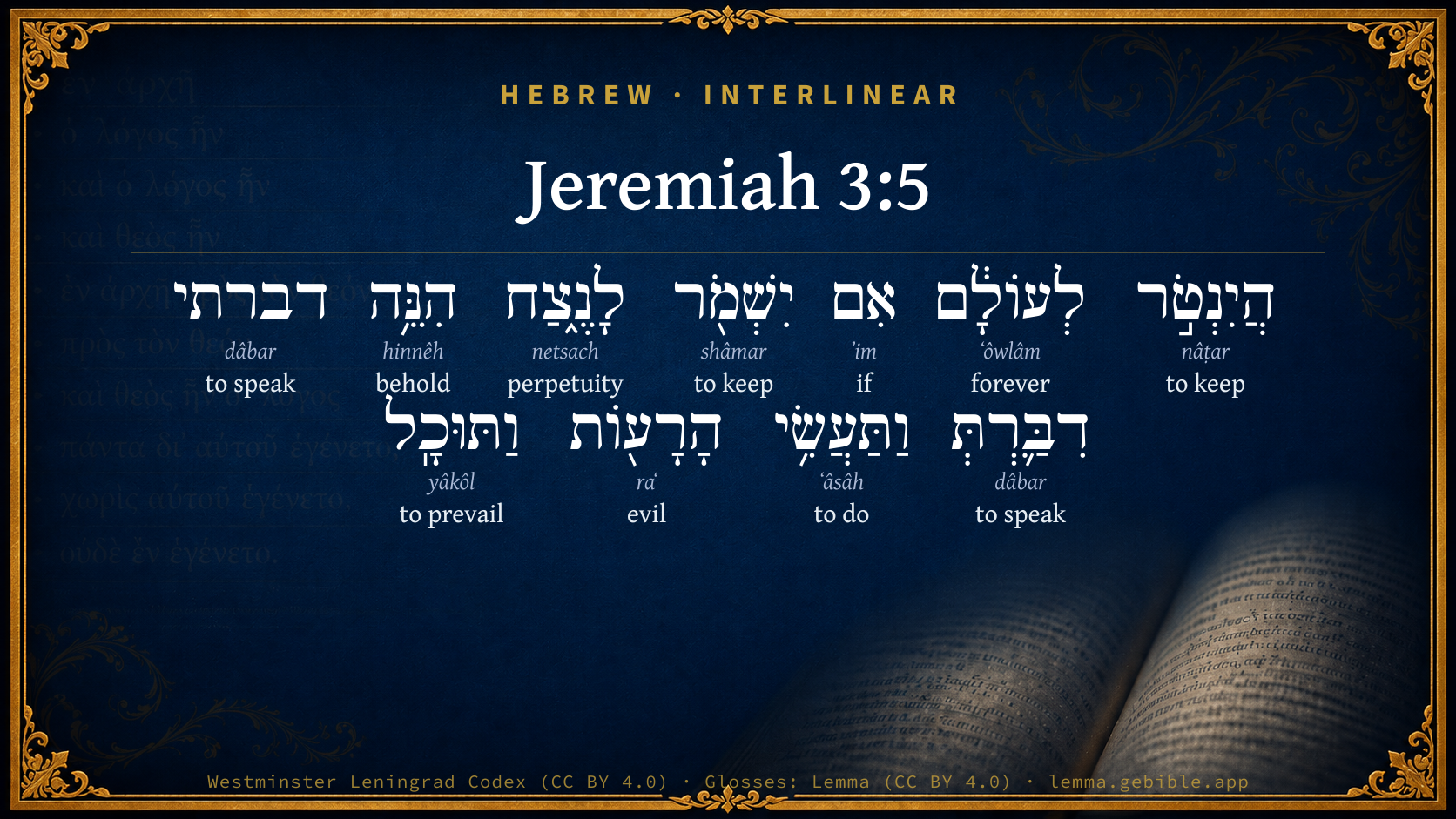
Hebrew (Westminster Leningrad Codex) Jeremiah 3:5 appears in the Hebrew Old Testament. The text above is from the Westminster Leningrad Codex. Each word links to its Strong’s number, a concise gloss, and parsing drawn from the Open Scriptures Hebrew Bible morphology. Click any word for its full Brown-Driver-Briggs (BDB) entry.
Download image
Cite this verse

Jeremiah 3:5 (World English Bible). Public Domain. Lemma interlinear Bible study tool, https://lemma.gebible.app/v/jeremiah/3/5.

Show BibTeX & RIS
BibTeX
RIS
English Translation
Will he retain [his anger] forever? will he keep it to the end? Behold, you have spoken and have done evil things, and have had your way.
World English Bible · Public Domain
Download a study sheet

One document with this verse’s original text, its word-by-word gloss line, the meaning frame, cross-references with their text, attributed commentary, and full source and license credits — printable, and it pastes into notes with its structure intact.

This verse Autodidact and up

Study sheet (.html) Plain text (.txt)

A passage Seminary Student

Up to 50 verses in one chapter. A passage sheet keeps up to 6 commentary sources and 12 cross-references per verse, in the order this page ranks them, and says so on the sheet whenever that leaves anything out. Ask for a single verse and you get the Autodidact verse sheet above.

Everything on this page stays free to read, with no account — the sheet is a download of what is already on screen, not access to it.

Want to remove ads? Support Godless Engineer
Compare translations 3

The same verse in 3 English versions, stacked beneath the original-language interlinear above. Click any original word for its lexicon entry.

Each is an independent rendering of the whole verse — the interlinear is not word-aligned to these translations.

Highlighted words mark where these versions differ — a whole-verse word diff, not a word-by-word alignment.

  • World English Bible Public Domain
    Will he retain [his anger] forever? will he keep it to the end? Behold, you have spoken and have done evil things, and have had your way.
  • King James Version Public Domain
    Will he reserve his anger for ever? will he keep it to the end? Behold, thou hast spoken and done evil things as thou couldest.
  • unfoldingWord Literal Text CC BY-SA 4.0
    Will he keep forever? Or will he keep watch to eternity?’ Behold, you have spoken, but you have done the evils as you can!”

unfoldingWord Literal Text — © unfoldingWord, licensed CC BY-SA 4.0. Word-aligned USFM3 via Door43 (git.door43.org/unfoldingWord/en_ult).

Versions to compare (up to 4)

3 of 4 selected

Show all 18 translations

Every available English version of this verse, each an independent rendering of the whole verse.

  • World English Bible Public Domain
    Will he retain [his anger] forever? will he keep it to the end? Behold, you have spoken and have done evil things, and have had your way.
  • Berean Standard Bible Public Domain
    Will He be angry forever? Will He be indignant to the end?’ This you have spoken, but you keep doing all the evil you can.”
  • Majority Standard Bible Public Domain
    Will He be angry forever? Will He be indignant to the end?’ This you have spoken, but you keep doing all the evil you can.”
  • King James Version Public Domain
    Will he reserve his anger for ever? will he keep it to the end? Behold, thou hast spoken and done evil things as thou couldest.
  • American Standard Version (1901) Public Domain
    Will he retain `his anger' for ever? will he keep it to the end? Behold, thou hast spoken and hast done evil things, and hast had thy way.
  • Revised Version (1885) Public Domain
    Will he retain his anger for ever? will he keep it to the end? Behold, thou hast spoken and hast done evil things, and hast had thy way.
  • Geneva Bible (1599) Public Domain
    Wil he keepe his anger for euer? will he reserue it to the ende? thus hast thou spoken, but thou doest euill, euen more and more.
  • Douay-Rheims (1899) Public Domain
    Wilt thou be angry for ever, or wilt thou continue until the end? Behold, thou hast spoken, and hast done evil things, and hast been able.
  • Young's Literal Translation Public Domain
    Doth He keep to the age? watch for ever?' Lo, these things thou hast spoken, And thou dost the evil things, and prevailest.
  • Literal Standard Version CC BY-SA 4.0
    Does He keep for all time? Watch forever? Behold, you have spoken these things, || And you do evil, and prevail.”
  • Unlocked Literal Bible CC BY-SA 4.0
    Will he always be angry? Will he always keep his wrath to the end?' Look! This is what you have said, but you do all the evil you can!”
  • unfoldingWord Literal Text CC BY-SA 4.0
    Will he keep forever? Or will he keep watch to eternity?’ Behold, you have spoken, but you have done the evils as you can!”
  • Darby Bible Public Domain
    Will he keep [his anger] for ever? Will he preserve it perpetually? Behold, thou hast spoken and hast done evil things, and thou art [so] determined.
  • World Messianic Bible Public Domain
    “‘Will he retain his anger forever? Will he keep it to the end?’ Behold, you have spoken and have done evil things, and have had your way.”
  • Webster's Bible Public Domain
    Will he retain his anger for ever? will he keep it to the end? Behold, thou hast spoken and done evil things as thou couldst.
  • Free Bible Version CC BY-SA 4.0
    You won't be angry with me for a long time, will you? You won't go on being like that forever?” This is what you've said, but you keep on sinning as much as you can.
  • Bible in Basic English Public Domain
    Will he be angry for ever? will he keep his wrath to the end? These things you have said, and have done evil and have had your way.
  • JPS Tanakh (1917) Public Domain
    Will He bear grudge for ever? Will He keep it to the end?' Behold, thou hast spoken, but hast done evil things, and hast had thy way.

Literal Standard Version (2020), Covenant Press — licensed CC BY-SA 4.0. Text via the HelloAO Bible API (eBible.org). Unlocked Literal Bible (unfoldingWord) — licensed CC BY-SA 4.0. Text via the HelloAO Bible API (eBible.org). unfoldingWord Literal Text — © unfoldingWord, licensed CC BY-SA 4.0. Word-aligned USFM3 via Door43 (git.door43.org/unfoldingWord/en_ult). Free Bible Version, Dr. Jonathan Gallagher — licensed CC BY-SA 4.0. Text via the HelloAO Bible API (eBible.org).

Word by word

More ways to search: Search by grammar → Find every occurrence → Compare this word →

Practice this passage: Drill this verse → Learn its vocabulary →

הֲיִנְטֹ֣ר
nâṭar
H5201
“to keep”
Particle, Interrogative + Verb, Qal, Imperfect, 3rd Person, Masculine, Singular
Part of Speech
Particle + Verb
Stem
Qal
Form
Imperfect
Person
3rd Person
Gender
Masculine
Number
Singular
Full BDB Definition

Origin: a primitive root

TWOT: 1356

to keep, keep guard, reserve, maintain - (Qal) - to keep, maintain - to keep, guard
  1. לְעוֹלָ֔ם ʻôwlâm H5769 “to/for · forever” Preposition + Noun, Common, Masculine, Singular, Absolute
  2. אִם ʼim H518 “if” Conjunction
  3. יִשְׁמֹ֖ר shâmar H8104 “to keep” Verb, Qal, Imperfect, 3rd Person, Masculine, Singular
  4. לָנֶ֑צַח netsach H5331 “to/for · perpetuity” Preposition + Noun, Common, Masculine, Singular, Absolute
  5. הִנֵּ֥ה hinnêh H2009 “behold” Particle, Demonstrative
  6. דברתי dâbar H1696 “to speak” Verb, Piel, Perfect, 1st Person, Common, Singular
  7. דִבַּ֛רְתְּ dâbar H1696 “to speak” Verb, Piel, Perfect, 2nd Person, Feminine, Singular
  8. וַתַּעֲשִׂ֥י ʻâsâh H6213 “and · to do” Conjunction + Verb, Qal, Sequential Imperfect, 2nd Person, Feminine, Singular
  9. הָרָע֖וֹת raʻ H7451 “the · evils” Particle, Definite Article + Noun, Common, Feminine, Plural, Absolute
  10. וַתּוּכָֽל yâkôl H3201 “and · to prevail” Conjunction + Verb, Qal, Sequential Imperfect, 2nd Person, Masculine, Singular

About this verse

These counts appear in no published source. They are computed here, from the morphology-tagged text and Lemma’s own curated glosses. What Lemma adds →

11
words
10
distinct lemmas
Prophets
section

Notable vocabulary

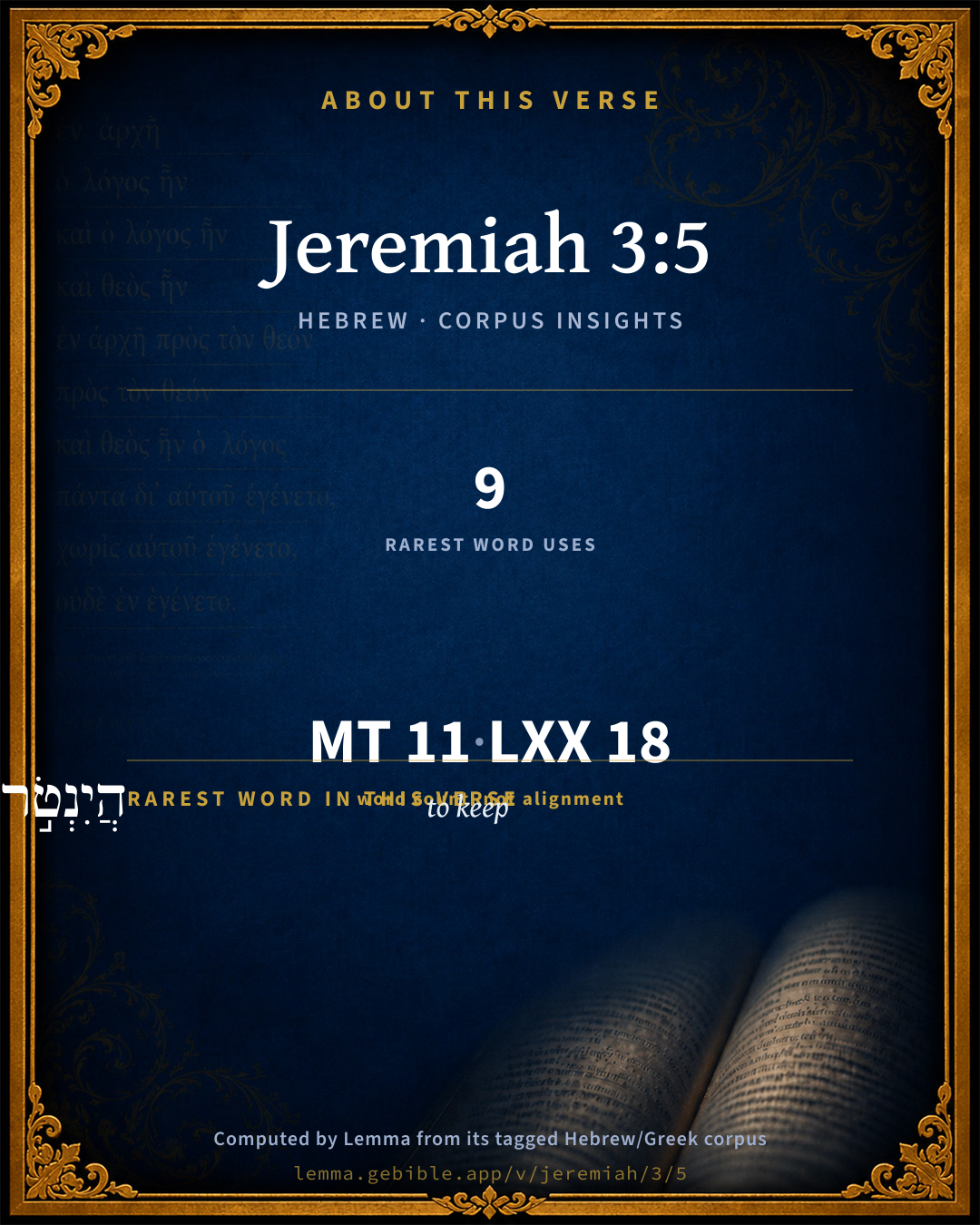
The rarest word here is הֲיִנְטֹ֣ר to keep H5201 — appearing just 9 times in the whole Hebrew Bible.

Shared distinctive vocabulary

הֲיִנְטֹ֣ר to keep H5201 occurs in 8 verses of the Hebrew Bible. Also found in:

Grammatical profile

  • 6 verbs
  • 3 nouns
  • 1 conjunction
  • 1 particle

Verb forms

  • הֲיִנְטֹ֣ר Qal · Imperfect
  • יִשְׁמֹ֖ר Qal · Imperfect
  • דברתי Piel · Perfect
  • דִבַּ֛רְתְּ Piel · Perfect
  • וַתַּעֲשִׂ֥י Qal · Sequential Imperfect
  • וַתּוּכָֽל Qal · Sequential Imperfect

Repetition

A word recurs within this verse — often emphatic in Hebrew:

  • דברתי to speak H1696 ×2

Hebrew & Septuagint length

In the original languages it is 11 Hebrew tokens and 18 Greek tokens — but the two are counted differently (Hebrew bundles its prefixes and suffixes into one token; the Greek is in lemma form), so that isn’t a like-for-like length.

Cross-references

10

Topical passages linked to Jeremiah 3:5 in the Treasury of Scripture Knowledge — connected by theme and wording, ordered by reader-vote popularity; previews shown in the World English Bible.

  • Isaiah 57:16 For I will not contend forever, neither will I be always angry; for the spirit would faint before me, and the souls who I have made.
  • Jeremiah 3:12 Go, and proclaim these words toward the north, and say, Return, you backsliding Israel, says Yahweh; I will not look in anger on you; for I am merciful, says Yahweh, I will not keep [anger] forever.
  • Ezekiel 22:6 Behold, the princes of Israel, everyone according to his power, have been in you to shed blood.
  • Micah 2:1 Woe to those who devise iniquity And work evil on their beds! When the morning is light, they practice it, Because it is in the power of their hand.
  • Micah 7:3 Their hands are on that which is evil to do it diligently. The ruler and judge ask for a bribe; And the powerful man dictates the evil desire of his soul. Thus they conspire together.
  • Psalms 77:7–9 "Will the Lord reject us forever? Will he be favorable no more?
  • Psalms 85:5 Will you be angry with us forever? Will you draw out your anger to all generations?
  • Psalms 103:8–9 Yahweh is merciful and gracious, Slow to anger, and abundant in loving kindness.
  • Isaiah 64:9 Don't be angry very sore, Yahweh, neither remember iniquity forever: see, look, we beg you, we are all your people.
  • Zephaniah 3:1–5 Woe to her who is rebellious and polluted, the oppressing city!

Cross-references courtesy of OpenBible.info (CC BY 4.0).

Hebrew and Greek witnesses Masoretic Hebrew ↔ Greek Septuagint

The same verse in the two great witnesses to the Old Testament, shown verse-for-verse.

These are two independent witnesses, not word-aligned to each other, and the Septuagint is shown in lemma (dictionary) form.

Hebrew Jeremiah 3:5 Masoretic · Westminster Leningrad Codex

הֲיִנְטֹ֣ר לְעוֹלָ֔ם אִם יִשְׁמֹ֖ר לָנֶ֑צַח הִנֵּ֥ה דברתי דִבַּ֛רְתְּ וַתַּעֲשִׂ֥י הָרָע֖וֹת וַתּוּכָֽל

Will he retain [his anger] forever? will he keep it to the end? Behold, you have spoken and have done evil things, and have had your way.

World English Bible · Public Domain

Greek LXX Structure differs

In the Septuagint, Jeremiah is about an eighth shorter than the Hebrew and arranges its material differently — the Oracles Against the Nations (Hebrew chapters 46–51) appear in the middle of the Greek book, after 25:13. Because the chapter and verse boundaries do not line up, a verse-for-verse comparison with the Hebrew is not shown.

A verse-for-verse comparison isn’t shown here because the chapters and verses don’t line up. Switch to the LXX edition with the MT / LXX toggle above to read the Greek directly.

Hebrew: Westminster Leningrad Codex (CC BY 4.0). Greek: Septuagint (public domain); English from a public-domain English Septuagint. How the Septuagint differs from the Hebrew →

Targum (Aramaic paraphrase)

1

The Targum is the ancient Jewish Aramaic paraphrase of the Hebrew Scriptures — an interpretive translation, not the Hebrew text itself. Onkelos (literal) and Pseudo-Jonathan (expansive) render the Torah, and Jonathan the Prophets. Coverage is partial: where no permissively-licensed English translation exists for a verse, only the Aramaic is shown. This is verse-level text, not a word-by-word alignment to the Hebrew.

  1. Targum Jonathan Prophets (Joshua–Malachi)
    הַאֶפְשַׁר דִתְנַטְרוּן לִיךְ חוֹבַיִךְ לְעָלַם אִם תִּתְקַף עֲלָךְ מְחָא לְאַפְרֵישׁ הָא מַלֵילְתְּ וַעֲבַדְתְּ בִּישִׁין וְאַתְנֵית:

    (no public-domain English translation for this verse)

    Targum Jonathan — Aramaic: “Mikraot Gedolot” (public domain). English: “Sefaria Community Translation” (CC0 1.0 (public-domain dedication)); “London "Chaldee Paraphrase," 1871” (public domain). Text via Sefaria.

Commentary

Notes on Jeremiah 3:5 from classic Christian and Jewish commentators (each source and its license shown beneath its notes). The classic Christian expositions comment on the surrounding passage and are grouped to its opening verse, so a note may address several verses; the Jewish commentaries on the Tanakh (Rashi and others) are per-verse, so they appear only where the commentator wrote on this verse.

Lemma curates 59 commentaries, every one of them public domain or Creative Commons licensed, each selected and text-cleaned for this edition rather than reprinted as found. About our sources →

Trapp's Complete Commentary

John Trapp

Jer 3:5 Will he reserve [his anger] for ever? will he keep [it] to the end? Behold, thou hast spoken and done evil things as thou couldest.

Ver. 5. Will he reserve his anyer for ever?] Will he not? {Nah 1:2} and is there not good reason he should do so, so long as you speak and do evil things as you can, obstinately persisting in thy sinful practices? He that repenteth with a contradiction, saith Tertullian, God will pardon him with a contradiction. Thou repentest, and yet continuest in thy sins. God will pardon thee, and yet send thee to hell: there is a pardon with a contradiction.

As thou couldst,] i.e., To thine utmost. Nolunt solita peccare, saith Seneca of some; they strive to outsin themselves and others.

John Trapp, A Commentary or Exposition upon All the Books of the Old and New Testament (1647–1656) — public domain. Text from a community e-Sword module.

The Biblical Illustrator

Joseph S. Exell

Jer_3:5

Thou hast spoken and done evil things as thou couldest.

The limitation of evil

I. Some of the restraining influences of life. As thou couldest. By many considerations we are restrained from fulfilling the evil impulses and designs of which we are conscious; our potential wickedness is not allowed to become actual.

1. There is the restraint imposed by revelation. The possession of Gods Word was a grand discipline to the people of Israel. To know the moral perfections of God, to discern the moral significance of human life, to possess the moral law expressed with such clearness, fulness, and force, was a rare privilege. This kept Israel back from the things of lust and cruelty and shame which defiled and destroyed their heathen neighbours. Are we not today restrained by the same gracious influence? Our poet speaks of the silver streak that comes between us and the Continent, delivering our nation from fears, wars, and contagions. Is not that revelation which is in our hands a silver streak coming between us and contemporaneous paganism?

2. There is the restraint imposed by grace. The direct Divine action on our mind, will, conscience, feeling. This was the master-restraint of the antediluvian world. As a horse is held in by bit and bridle, as a ship on some rocky coast is held by her anchor, so have we all in dangerous clays been restrained by the Spirit of grace. Let men quench that Spirit, and the disastrous consequence is soon revealed.

3. There is the restraint imposed by society. Our civilisation, which is the grace of God organised, is full of restraining influences to which we owe far more than we sometimes think. The civil law. Public opinion. Social etiquette. Business. Domesticity. If it should be suggested that the laws, institutions, and properties of society which forbid excess are themselves expressions of the moral sense, it will at once be palpable to most that these circumscriptions are dictated by fear, policy, and selfishness rather than by any love of righteousness for its own sake. That one wolf holds another wolf in check must not be construed to mean that we are a flock of lambs.

II. Notwithstanding the restraints of life, we discover the wickedness of our nature by going as far as possible in the direction of transgression. Israel hitherto had abstained from the extreme acts of transgression which would have involved immediate retribution, but they showed their disposition by playing with the fire, by trifling on the edge of the abyss. So in these days we show what we really are by going as far as we dare or can in actual disobedience. We go as far as our material will permit. As thou couldest. As thou couldest with impunity. We are intemperate, with a due regard to our health; freer indulgence would destroy us, and that is not what we mean. We are uncharitable, with a due regard to our reputation; we must not infringe the law of libel. We are ambitious and vain; but our ostentation must be limited by considerations of pride and covetousness. As thou couldest with decency. We must not qualify our reputation; we must not be guilty of bad manners, bad form, bad taste. As thou couldest with advantage. Carrying out unrighteousness right up to the point where it ceases to be lucrative, and breaking it off just there. And let none conclude that sins toned down by such considerations are of less malignant quality, or less offensive before God, than are sins of a more violent or exaggerated order.

III. Many would at once proceed to greater lengths of wickedness if the restrictive influences of life were withdrawn.

1. Note the extent to which men resist these saving influences. As some engineers are wishful to drive a tunnel under the Channel and establish immediate relations with the Continent, so men are busy in all directions ingeniously attempting to evade the silver streaks which heaven has mercifully placed between them and the excesses of passion and appetite. The criticism of the Bible in the literary world, the impatience felt with it in the individual life, are frequently nothing more than a revolt against its noble righteousness. We fret at the narrowness of the way which leadeth unto life. In the name of free thought, of a free press, of free restitutions, the nude m art must be encouraged, outspoken writings protected, sexual life must be unfettered. With what strange infatuation do we rebel against and seek to escape the crystal deep which God has established between us and ruin!

2. The second sign of the irregularity and inordinativeness of our desire is found in the popularity of certain imaginative literature Modern society has put distinct and authoritative limits to many forms of indulgence; but human nature shows its old quality unchanged, for when it can no longer gratify itself in the actual world it betakes itself to the ideal world.

Conclusion--

1. Let us recognise the glory of Gods preventing grace. The Dutch call the chain of dykes which protects their fields and their firesides from the wild sea, the golden border. Gods grace directly affecting our heart, or expressed in the constitution of society and the circumstances of life, is a golden border shutting out a raging threatening sea of evil.

(2) Let us confess the folly of our self-righteousness. The consciousness of a self-righteousness often stands in the way of men attaining the righteousness which is of God, but the foregoing reflections show how little our self-righteousness is worth. Looking into our heart, we know ourselves to be worse than the world takes us to be. As Victor Hugo expresses it, Our dark side is unfathomable . . . One of the hardest labours of the just man is to expunge from his soul a malevolence which it is difficult to efface. Almost all our desires, when examined, contain what we dare not avow.

(3) We see the necessity and urgency of the grace which converts and perfects. It is by no means wholly satisfactory that we are kept by restraining grace; the grace which converts us into a new self is what we must most earnestly covet and pursue. Christianity brings us a motive of unparalleled grandeur; it fills the soul with the highest visions, convictions, loves, ambitions. And there is a sublime concurrence of forces in its motive. (W. L. Watkinson.)

The sinners desperate depravity

I. God in His providence has surrounded the sinner with many circumstances operating powerfully to modify human character.

1. Education. This makes Christendom differ from the dark places of the earth, which are full of the habitations of cruelty.

2. Human law. Look at some country in a state of anarchy. Look at some city or village where law is suspended. Look at France, while under the reign of terror, when law was abrogated, and see one company after another pass under the guillotine; and the executioners of today the victims of tomorrow; and, tell us, is not character greatly modified by municipal law?

3. The law of God. If men have no other belief in it, but that which may be denominated the faith of history, it still greatly modifies human character.

4. The troublesome supervision of conscience. This everlasting censorship, while it has held men back from sin, has been hated, warred against, scowled upon, by the whole human family.

5. The whole Gospel has modified human character beyond all calculation. It so commends itself to their reason, and applies such power to their consciences, that it becomes exceedingly difficult to understand it. It is so tender, majestic, commanding, and reasonable, that it for a time melts and overawes many who ultimately reject its provisions.

6. All the Gospel institutions--every thing associated with Christian worship operates in modifying human character, and rendering it in appearance better than it is.

7. The desire of heaven has the same effect. None, perhaps, are so abandoned as not to hope that they may, after all, live and be happy after death.

8. The fear of hell

9. The expectation of judgment.

10. Public sentiment.

11. Domestic affection. The silken cords which entwine round the family circle prevent the commission of many a crime.

II. By these circumstances every sinner is actually restrained in his wickedness and held down in his downward career.

1. Men are uneasy under these circumstances, which shows them to be restraints. Let men be unrestrained, and they will be easy. It is only pain of some kind that renders them uneasy, and willing to change their position. Hence they will not come to the light, lest their deeds should be reproved.

2. Men are constantly trying to alter their circumstances. But they are too indolent by nature to try to alter their circumstances, unless they are circumstances of restraint.

3. When men at length alter their circumstances in any of these respects, they often show out a worse character; manifesting what they would have been before, if they might, if these restraints had been sundered and they let loose upon the world.

4. When these restraints are all removed, men are uniformly far more wicked than if they had not been imposed.

III. Every sinner does make the attempt and succeeds as far as God will let him to sunder these ligatures that would hold him fast to reason, hope, and heaven.

1. See how he breaks over and breaks through the restraints of education. He Cries to throw off what he knew of God, and all he had learned of the Saviour, and of the operations of the Holy Spirit; all he had learned of the operations of the Godhead, in the history of the Church. And when he cannot forget, he raves at his own recollections.

2. When he has tried for a time, but has tried in vain, to retrace the process of education, he finds himself reined in by human laws. If he cannot forget God, perhaps he can snap asunder the power of human control. He can evade all human ties. He can rise above the law, and tread it down like the mire of the street. Or he can violate its precepts and despise its regulations, and hold on and hold out in despite of all its sanctions, presuming in his heart that God will not know, neither will the Almighty consider it. Thus he blesses himself in his own delusion, and trusts for safety in his own righteousness. But he meets with more disturbance yet.

3. From the law of God. Impenitent and unbelieving, he has read in that law what, if he cannot put down, he is a ruined man: Thou shalt have no other gods before Me. Thus is dashed, at the first stroke, the whole fabric of a dark and fatal idolatry. If man worships his money, or his merchandise, or his farm, or his friend, or anything but God, or gives anything else his supreme affection, even if he does not professedly worship it, he is condemned of God. And He adds, Thou shalt not take the name of the Lord thy God in vain. But how unfashionable it would be to care about this commandment, and let the apprehension that God will not hold him guiltless that taketh His name in vain, produce a serious moment, or a pang of distress!

4. Not quite so easily does he dispose of the troublesome supervision of conscience. This vicegerent of Heaven stays often many a month after open war is declared. It sometimes will hold close conference with the heart, although the heart may wish to be alone. It will not go to sleep in the grave: it will watch, even while the wretch is dying, to secure the honour of God, and gather courage for a fresh attack just by the dying pillow And the agony of its first onset in the unseen world, hard by the place of dying, devils cannot know. For they have never spurned a dying Saviour, and they have never died. But all the embrasures that can be opened upon the soul by this moral avenger must be closed, or its eternal thunders will be heard and felt.

5. But still he has a slight conflict with the institutions of the Gospel. Every church-going bell fills his conscience with guilt, and each return of the day of rest reminds him of a mothers prayers. He must pervert its holy design, or writhe under the lashes of a guilty conscience.

6. The hardened sinner would dislodge himself from all thought of heaven or fear of hell. And yet these are very powerful ligatures, and often the last to be sundered. When men think of relinquishing heaven, they sometimes forget, that awakening previous question, If I abandon the thought of heaven, where shall I then be? What means that worm which never dies? What mean those chains of darkness--and that gnashing of teeth--and that quenchless fire?

7. The sinner must have broken through all the restraints of public sentiment, before we can know how bad he would be; and this ligature he tries to snap asunder. But he will find that public very populous, before he gets through. After he has gone his round with mortals, and has learned not to care what men think of his conduct, he must cease, too, to care what is thought of his deeds in heaven.

8. There yet remains to be noticed one of the most powerful motives of restraint, the domestic affections. It is impossible to guess what men would be, till they throw off the hold, for instance, that a mother has upon a profligate son. (D. A. Clark.)

The Biblical Illustrator, edited by Joseph S. Exell (c. 1880s–1900s) — public domain. Text from a community e-Sword module.

Jamieson, Fausset & Brown

Robert Jamieson, A. R. Fausset & David Brown

he--"thou," the second person, had preceded. The change to the third person implies a putting away of God to a greater distance from them; instead of repenting and forsaking their idols, they merely deprecate the continuance of their punishment. Jer 3:12 and Psa 103:9, answer their question in the event of their penitence.

spoken and--rather (God's reply to them), "Thou hast spoken (thus), and yet (all the while) thou hast done evil," &c.

as thou couldest--with all thy might; with incorrigible persistency [CALVIN].

Jamieson, Fausset & Brown — Commentary Critical and Explanatory on the Whole Bible (1871) — public domain (CC PDM 1.0). Text via the HelloAO Bible API.

Adam Clarke's Commentary

Verse 5. Will he reserve his anger for ever?] Why should not wrath be continued against thee, as thou continuest transgression against the Lord?

Adam Clarke's Commentary on the Bible (1810–1826) — public domain. Text from a community e-Sword/MySword module.

John Calvin's Commentaries

God shews that it was the fault of the Jews, that he did not receive them into favor. And here he takes the argument from his own nature, and speaks of himself in the third person; and it is the same as though the Prophet had interposed this reasoning, “God is not inexorable, for he is as ready to forgive as he is long — suffering: now, then, what prevents you from living happily again under his government? for he will spare you, provided he finds in you genuine repentance.” We now then see, what the Prophet means here: for as God had kindly exhorted the people to repent, the Prophet speaks now generally of God’s own nature, — that he keeps not for ever, nor reserves perpetually

These words, when put alone, mean that he does not cherish vengeance, and in our language we imitate the Hebrews, Il lui garde. This garde, when put without anything added to it, means, as I have said, that vengeance is cherished within. But nothing is more contrary than this to the nature of God. It hence follows, that the Jews had no obstacle in their way, except that they shunned God, and that being addicted to their own vices, they were unwilling to receive the pardon that was freely offered to them.

As to the second clause, it admits of being explained in two ways. We may regard an adversative particle to be understood, “though thou hast spoken and hast done, “etc.; as if God had said, that he would be propitious to the Jews, however atrociously they might have sinned. But another view is more simple, — that God here complains that there was no hope of amendment, as they had become hardened in their vices, “Thou hast spoken,” he says, “thou hast done, and thou hast been able.” And interpreters further vary in their views: for the copulative is explained by some as a particle of comparison, in the sense of כאשר, keasher, “according to what thou wert able, thou hast done wickedness.” But others take the words more simply and more correctly, as I think, “Thou hast been very strong;” that is, thou hast exerted all thy power, so that thou hast put forth all thy strength in doing evil, as we say in Latin, pro virili, with all thy might; that is, as far as thy capacity extended, thou hast devoted thyself to wickedness.

I therefore give this explanation: God had before put on, as it were, the character of one in grief and sorrow, and kindly exhorted the people to repent, and testified that he would be ready to pardon them, and at the same time shewed in general that he would be propitious, as he is by nature inclined to mercy. After having set forth these things, he now adds, that he despaired of that people, because they gloried in their own wickedness: for to speak and to do means the same as if he had said, that the people were so impudent, that they boasted of their rebellion against God, and dared to call darkness light; for the superstitious, we know, glory against God without any shame. Now, such was the state of the people; for God, by his prophets, condemned this especially in them — that they had corrupted the pure worship of the law; but they with a meretricious front dared to set up against him their own devotions and good intentions, as they are commonly called. As then, they thus presumptuously defended their wicked deeds, God here complains that they were in no way healable, and so he leaves them as past remedy. This I regard as the real meaning of the Prophet: and of similar import is the verb תוכל, tucal; “thou hast put forth all thy might,” he says, that is, thou hast observed no limits in sinning, but, on the contrary, hast given thyself up to unbridled licentiousness. It now follows —

John Calvin's Commentaries (1540-1563) — public domain. Text from the Calvin Translation Society English edition (1840s-50s) via the Christian Classics Ethereal Library (ccel.org). Calvin's coverage is partial (roughly two-thirds of the Bible); uncommented books and verses are honest gaps, never fabricated. The 19th-century editor's footnotes and remarks are omitted so the notes are faithfully Calvin's own voice.

Ellicott's Commentary for English Readers

(5) Will he reserve his anger for ever . . .?—The questions were such as might well be asked in the first burst of sorrowing though superficial repentance. The implied answer was in the negative, “No, He will not keep His anger to the end.” Yet, so far, facts were against that yearning hope. It will be noted that the word “anger” is not in the Hebrew. It is, however, rightly inserted, after the precedent of Nah_1:2; Psa_103:9. The words seem, indeed, almost a quotation from the latter, and Jer_3:4-5 may probably be looked on as cited from the penitential litanies in which the people had joined, and which were too soon followed by a return to the old evils (Jer_2:1-13).

Thou hast spoken and done evil things as thou couldest.—i.e., resolutely and obstinately. That pathetic appeal to the mercy and love of Jehovah was followed by no amendment, but by a return to evil. Here the first prophecy, as reproduced from memory, ends, and the next verse begins a separate discourse.

A Bible Commentary for English Readers, edited by Charles John Ellicott (1878–1897) — public domain. Text from a community e-Sword module.

The Cambridge Bible for Schools and Colleges

gen. ed. J. J. S. Perowne

5. The continued expression of Israel’s ill-founded confidence and God’s reply.

thou hast spoken, etc.] rather (as mg.) thou hast spoken thus, but hast done, etc.

hast had thy way] Heb. been able, carried thy purposes into effect. For the thought of the whole verse cp. Hos_6:1-4.

The Cambridge Bible for Schools and Colleges (gen. ed. J. J. S. Perowne; Cambridge University Press, 1878–1918) — public domain. Text from a community e-Sword module.

John Gill's Exposition

Will he reserve his anger for ever?.... These words may be considered as a continuation of the speech put into their mouths to make to the Lord and plead with him, as well as what follows:

will he keep it to the end? that is, his anger: no; he will not: this is not according to the nature of God; he retains not his anger for ever, Mic 7:18, though, according to some versions, this is to be understood of the sins of these people being reserved and kept forever, as their impudence and obstinacy; so the Syriac and Arabic versions; and to which agrees the Targum,

"is it possible that thy sins should be kept for thee for ever, or the stroke (of punishment) be strengthened upon thee to the end?''

so Kimchi,

"says the prophet, if thou dost this (call him my father, &c.) will God reserve thine iniquity for thee for ever, or keep thy sin unto the end? he will not do so; but when thou returnest unto him, he will return unto thee, and do thee good; but thou hast not done so.''

The sense is much the same:

behold, thou hast spoken, and done evil things as thou couldest; which were enough to cause the Lord to reserve and keep his anger for ever. There is a double reading here; the Cetib, or writing, is "I have spoken"; the prophet had spoken to them to return; or the Lord by the prophet had spoken to them, and put the above words into their mouths, and told them what they should say when they returned to the Lord; "but thou hast done evil things" (y); notwithstanding such declarations of grace, and dost continue to do them:

and thou hast prevailed (z); as the last clause may be rendered; that I cannot turn away mine anger from thee, but must reserve it, and keep it for ever. The Keri, or reading, is "thou hast spoken"; thou hast said thou wilt do evil things, and thou hast done them as thou hast said, and hast prevailed; thou hast sinned with all thy might and main, and hast spoken and done as evil things as possibly could be done. Some choose to render the words thus, "if thou hadst spoken"; the words that were put into their mouths before mentioned; "though thou hast done evil things, yet thou wouldest have prevailed" (a); that is, with God, to have turned away his anger from thee.

(y) "sed fecisit mala", Schmidt. (z) "et praevaluisti", Vatablus, Schmidt; "et preavales", Piscator, Gataker; "et evaluisti", Cocceius. (a) "Si ita loquereris, quanquam mala plurirma fecisti, praevaleres", Grotius.

John Gill's Exposition of the Whole Bible (1746–1763) — public domain (CC PDM 1.0). Text via the HelloAO Bible API.

Albert Barnes' Notes on the Bible

Rather, “Will he, the young husband,” retain, “keep up His anger forever!” These words should be joined to Jer 3:4.

Behold ... - Rather, “Behold, thou hast spoken” thus, but thou hast “done evil things” persistently. The King James Version translates as if Judah’s words and deeds were both evil. Really her words were fair, but her deeds proved them to be false.

And here ends the prophecy, most interesting as showing what was the general nature of Jeremiah’s exhortations to his countrymen, during the 14 years of Josiah’s reign. He sets before them God and Israel united by a covenant of marriage, to the conditions of which Yahweh is ever true, while Israel practices with zest every form of idolatry. Therefore, the divine blessing is withheld. It is an honest and manly warning, and the great lesson it teaches us is, that with God nothing avails but a real and heartfelt repentance followed by a life of holiness and sincere devotion to His service.

Jer. 3:6–4:4 - “The Call to Repentance”

The former prophecy ended with the denunciation of God’s perpetual anger because of Israel’s obstinate persistence in sin. Now there is an invitation to repentance, and the assurance of forgiveness. The argument is as follows: Israel had been guilty of apostasy, and therefore God bad put her away. Unwarned by this example her more guilty sister Judah persists in the same sins Jer 3:6-11. Israel therefore is invited to, return to the marriage-covenant by repentance Jer 3:12-14, in which case she and Judah, accepted upon the like condition, shall become joint members of a spiritual theocracy. Jer 3:15-18. The repentance which God requires must be real Jer. 3:19–4:4.

Albert Barnes' Notes on the Bible (1834–1885) — public domain. Text from a community e-Sword/MySword module.

Haydock's Catholic Bible Commentary

Wilt. Hebrew, "will he," &c. The faithless people will not use this language, but do all the evil possible.

George Leo Haydock (1774–1849), Haydock's Catholic Family Bible and Commentary, 1859 edition — public domain. Excludes Psalms (Douay-Rheims chapter numbering differs from Protestant) and Deuterocanonical books (Catholic canon only).

Matthew Poole's English Annotations

Will he reserve his anger for ever? here being a defect of the noun, the Jews supply it with thy sin, Isa 43:25, but the most and best, as we do,

his anger. Compare it with Jer 3:12; Psa 103:9; Nah 1:2, in which texts there is a defect of the same word. This may seem to be the words of the prophet, and so the connexion is easy with the foregoing words: q.d. If thou wouldst do so, try me now, &c.: would he reserve his anger? would he not be reconciled? but thou hast taken quite another course. Or they may be the words of God, as it were, teaching his people how they should accost him: God is more forward and earnest for reconciliation than sinners themselves.

The end; the same with the former for ever.

Behold, thou hast spoken and done evil things as thou couldest: God’s challenge of the people, charging them, either with their resolved wickedness, that they had made good all their evil words by their evil actions, they had even done as they said; or rather, with their hypocrisy: q.d. Notwithstanding all thy former promises, yet thou persistest still in thy lewdness and obstinacy, Isa 58:2; Hos 7:14.

Matthew Poole's English Annotations on the Holy Bible (1683–1685) — public domain. Text from a community e-Sword/MySword module.

Whedon's Commentary on the Bible

Daniel D. Whedon

5. Thou hast spoken — Thus do the people speak, but they DO evil. Their words are friendly, but their actions are rebellious.

Daniel D. Whedon (gen. ed.), Commentary on the Old and New Testaments (1874–1909) — public domain. Text from a community e-Sword module.

The Pulpit Commentary

Will he reserve? rather, Will he retain, etc.? It is a continuation of the supposed address of Judah. To the end? rather, everlastingly? Behold, thou hast spoken, etc.; rather, Behold, thou hast spoken it, but hast done these evil things, and hast prevailed (i.e. succeeded). The substance of the two verses (4 and 5) is well given by Ewald: "Unhappily her power truly to return has been exhausted, as not long ago after fresh signs of the Divine displeasure she prayed in beautiful language to Jehovah for new favor and abatement of the old sufferings, but she immediately fell again into her sin, and carried it out with cool determination.

Actions speak louder than words.

Israel, we see, is represented as speaking with a very pathetic remembrance of God"s great favors in the remote past. At present, indeed, there is a withholding of the rain that means fruitfulness and prosperity, but that Father who has been the Guide of Israel"s youth, surely he will soon bring the rain, with all that follows it, in spite of any appearances to the contrary, such as his anger with Israel suggests. Such is the way that Israel speaks; but how does it act? Is there to be alteration in God without alteration in man? It is of no use for the sinning nation simply to wait as if God"s righteous chastisements would be exhausted by lapse of time. There might have to be waiting, but assuredly there would have to be repenting, and the bringing forth of fruits meet for repentance. But instead of this God is confronted with persistent transgression. He who had been Friend, Companion, and Guide in youth could not have been so without a docile acceptance of the companionship. The guidance in youth meant that Jehovah had a right to expect a manhood of holy service. But so far from the people giving this, the expectation in their heart is that God will still provide for them and let them do as they like. They do not seem to understand that it is they who by their transgressions provide for the sustenance and continuance of the anger of Jehovah. That anger is not like a storm which rises one knows not how, and presently subsides without man being able to do anything for its removal. God"s anger was as a fire, and the wickedness of the people was like dry and highly combustible fuel before the flame. The one thing needful was to stop the fuel, and the fire would then very speedily burn out. To say with the lips, "My Father, thou wast the Guide of my youth," will only be of use when there is something like correspondence between what is spoken and what is done. Y.

The Pulpit Commentary (1880–1919), ed. H.D.M. Spence-Jones & Joseph S. Exell — public domain. Text from a community e-Sword module.

John Wesley's Explanatory Notes

Will he - Will he not be reconciled?

John Wesley, Explanatory Notes Upon the Whole Bible (1754–1765) — public domain. Text via the GEBible commentary corpus.

Rashi

Rabbi Shlomo Yitzchaki (Rashi)

Behold, you have spoken with your mouth, “We will no longer come to You,” and that evil you will do, and you will not give any thought of returning.

and you were able And you prevailed in rebelling with a victorious and irrefutable reply.

Rashi on the Tanakh — English translations: “The Judaica Press complete Tanach with Rashi, translated by A. J. Rosenberg” (CC BY 4.0); “Pentateuch with Rashi's commentary by M. Rosenbaum and A.M. Silbermann, 1929-1934” (public domain); “The Metsudah Tanach series, Lakewood, N.J” (CC BY 4.0); and “The Book of Joshua, Metsudah Publications, 1997” (CC BY 4.0). Text via Sefaria.

Lesson kit

Teaching starters — assembled from the data on this page, not authored interpretation. Every prompt links to the verse data it draws on. Edit before teaching.

Jeremiah, in the Prophets, opens this verse with 11 words (10 distinct Hebrew lemmas). Its most distinctive word is nâṭar (“to keep”). A historical commentator’s framing appears above. Read the whole chapter for the surrounding context.

Discussion questions

  1. The word nâṭar carries the sense “to keep.” How does it shape the verse?
  2. How does Leviticus 19:18, which shares the word «to keep», read alongside this verse?
  3. What does the repetition of “to speak” (2× in this one verse) do in this verse?
  4. These translations render this verse differently; the difference is in the English rendering, not the original. What questions does that raise?
  5. «הֲיִנְטֹ֣ר» is a Qal Imperfect verb. How does that grammatical form shape the action described?
  6. Compare how Trapp's Complete Commentary and The Biblical Illustrator read this verse. Where do they agree or differ?

Things to notice

Reading settings

Reading text

Shown beneath each verse's original-language words.

Old Testament
Old Testament edition

Read the OT as the Masoretic Hebrew (MT) or the Greek Septuagint (LXX).

English shown for the Greek Septuagint (in the Hebrew ↔ Greek comparison).

Comparing translations? Open the Compare panel on any verse page to stack up to four side by side.