1 Kings 8:11

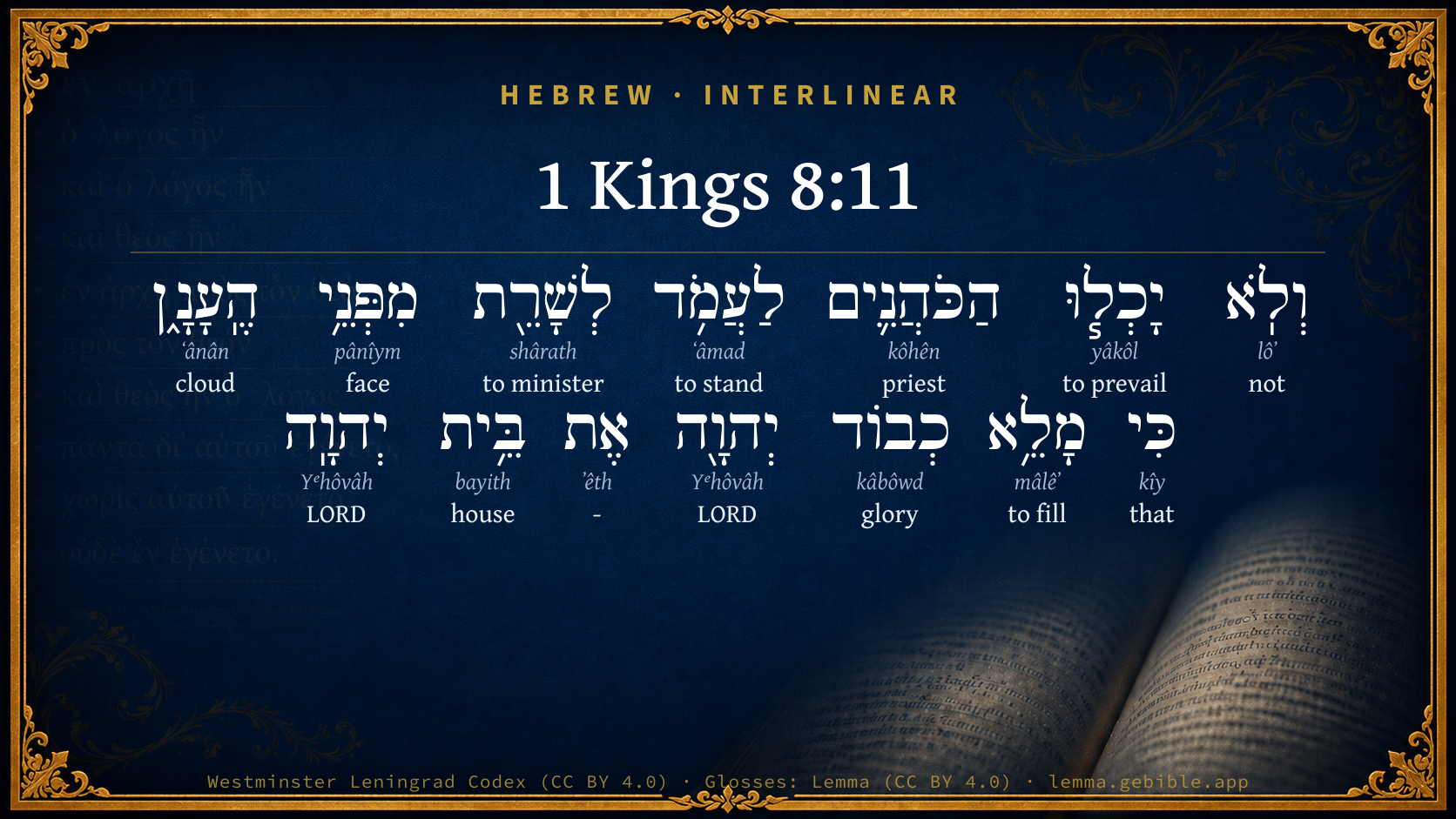
Hebrew (Westminster Leningrad Codex) 1 Kings 8:11 appears in the Hebrew Old Testament. The text above is from the Westminster Leningrad Codex. Each word links to its Strong’s number, a concise gloss, and parsing drawn from the Open Scriptures Hebrew Bible morphology. Click any word for its full Brown-Driver-Briggs (BDB) entry.
Download image
Cite this verse

1 Kings 8:11 (World English Bible). Public Domain. Lemma interlinear Bible study tool, https://lemma.gebible.app/v/1-kings/8/11.

Show BibTeX & RIS
BibTeX
RIS
English Translation
so that the priests could not stand to minister by reason of the cloud; for the glory of Yahweh filled the house of Yahweh.
World English Bible · Public Domain
Download a study sheet

One document with this verse’s original text, its word-by-word gloss line, the meaning frame, cross-references with their text, attributed commentary, and full source and license credits — printable, and it pastes into notes with its structure intact.

This verse Autodidact and up

Study sheet (.html) Plain text (.txt)

A passage Seminary Student

Up to 50 verses in one chapter. A passage sheet keeps up to 6 commentary sources and 12 cross-references per verse, in the order this page ranks them, and says so on the sheet whenever that leaves anything out. Ask for a single verse and you get the Autodidact verse sheet above.

Everything on this page stays free to read, with no account — the sheet is a download of what is already on screen, not access to it.

Want to remove ads? Support Godless Engineer
Compare translations 3

The same verse in 3 English versions, stacked beneath the original-language interlinear above. Click any original word for its lexicon entry.

Each is an independent rendering of the whole verse — the interlinear is not word-aligned to these translations.

Highlighted words mark where these versions differ — a whole-verse word diff, not a word-by-word alignment.

  • World English Bible Public Domain
    so that the priests could not stand to minister by reason of the cloud; for the glory of Yahweh filled the house of Yahweh.
  • King James Version Public Domain
    So that the priests could not stand to minister because of the cloud: for the glory of the LORD had filled the house of the LORD.
  • unfoldingWord Literal Text CC BY-SA 4.0
    And the priests were not able to stand to minister from the face of the cloud, for the glory of Yahweh filled the house of Yahweh.

unfoldingWord Literal Text — © unfoldingWord, licensed CC BY-SA 4.0. Word-aligned USFM3 via Door43 (git.door43.org/unfoldingWord/en_ult).

Versions to compare (up to 4)

3 of 4 selected

Show all 18 translations

Every available English version of this verse, each an independent rendering of the whole verse.

  • World English Bible Public Domain
    so that the priests could not stand to minister by reason of the cloud; for the glory of Yahweh filled the house of Yahweh.
  • Berean Standard Bible Public Domain
    so that the priests could not stand there to minister because of the cloud; for the glory of the LORD filled the house of the LORD.
  • Majority Standard Bible Public Domain
    so that the priests could not stand there to minister because of the cloud. For the glory of the LORD filled the house of the LORD.
  • King James Version Public Domain
    So that the priests could not stand to minister because of the cloud: for the glory of the LORD had filled the house of the LORD.
  • American Standard Version (1901) Public Domain
    so that the priests could not stand to minister by reason of the cloud; for the glory of Jehovah filled the house of Jehovah.
  • Revised Version (1885) Public Domain
    so that the priests could not stand to minister by reason of the cloud: for the glory of the LORD filled the house of the LORD.
  • Geneva Bible (1599) Public Domain
    So that the Priestes could not stande to minister, because of the cloude: for the glorie of the Lord had filled the house of the Lord.
  • Douay-Rheims (1899) Public Domain
    And the priests could not stand to minister because of the cloud: for the glory of the Lord had filled the house of the Lord.
  • Young's Literal Translation Public Domain
    and the priests have not been able to stand to minister because of the cloud, for the honour of Jehovah hath filled the house of Jehovah.
  • Literal Standard Version CC BY-SA 4.0
    and the priests have not been able to stand to minister because of the cloud, for the glory of YHWH has filled the house of YHWH.
  • Unlocked Literal Bible CC BY-SA 4.0
    The priests could not stand to serve because of the cloud, for the glory of Yahweh filled his house.
  • unfoldingWord Literal Text CC BY-SA 4.0
    And the priests were not able to stand to minister from the face of the cloud, for the glory of Yahweh filled the house of Yahweh.
  • Darby Bible Public Domain
    and the priests could not stand to do their service because of the cloud; for the glory of Jehovah had filled the house of Jehovah.
  • World Messianic Bible Public Domain
    so that the priests could not stand to minister by reason of the cloud; for the LORD’s glory filled the LORD’s house.
  • Webster's Bible Public Domain
    So that the priests could not stand to minister because of the cloud: for the glory of the LORD had filled the house of the LORD.
  • Free Bible Version CC BY-SA 4.0
    Due to the cloud, the priests could not stay there to carry out their service, for the glory of the Lord had filled the Lord's Temple.
  • Bible in Basic English Public Domain
    So that the priests were not able to keep their places to do their work because of the cloud, for the house of the Lord was full of the glory of the Lord.
  • JPS Tanakh (1917) Public Domain
    so that the priests could not stand to minister by reason of the cloud; for the glory of the LORD filled the house of the LORD.

Literal Standard Version (2020), Covenant Press — licensed CC BY-SA 4.0. Text via the HelloAO Bible API (eBible.org). Unlocked Literal Bible (unfoldingWord) — licensed CC BY-SA 4.0. Text via the HelloAO Bible API (eBible.org). unfoldingWord Literal Text — © unfoldingWord, licensed CC BY-SA 4.0. Word-aligned USFM3 via Door43 (git.door43.org/unfoldingWord/en_ult). Free Bible Version, Dr. Jonathan Gallagher — licensed CC BY-SA 4.0. Text via the HelloAO Bible API (eBible.org).

Word by word

More ways to search: Search by grammar → Find every occurrence → Compare this word →

Practice this passage: Drill this verse → Learn its vocabulary →

הֶֽעָנָ֑ן
ʻânân
H6051
“the · cloud”
Particle, Definite Article + Noun, Common, Masculine, Singular, Absolute
Part of Speech
Particle + Noun
Type
Common
Gender
Masculine
Number
Singular
State
Absolute
Full BDB Definition

Origin: from H6049

TWOT: 1655a

cloud, cloudy, cloud-mass - cloud-mass (of theophanic cloud) - cloud
  1. וְלֹֽא lôʼ H3808 “and · not” Conjunction + Particle, Negative
  2. יָכְל֧וּ yâkôl H3201 “to prevail” Verb, Qal, Perfect, 3rd Person, Common, Plural
  3. הַכֹּהֲנִ֛ים kôhên H3548 “the · priests” Particle, Definite Article + Noun, Common, Masculine, Plural, Absolute
  4. לַעֲמֹ֥ד ʻâmad H5975 “to stand” Preposition + Verb, Qal, Infinitive Construct
  5. לְשָׁרֵ֖ת shârath H8334 “to minister” Preposition + Verb, Piel, Infinitive Construct
  6. מִפְּנֵ֥י pânîym H6440 “from · face(s) of” Preposition + Noun, Common, Both, Plural, Construct
  7. כִּי kîy H3588 “that” Conjunction
  8. מָלֵ֥א mâlêʼ H4390 “to fill” Verb, Qal, Perfect, 3rd Person, Masculine, Singular
  9. כְבוֹד kâbôwd H3519 “glory of” Noun, Common, Both, Singular, Construct
  10. יְהוָ֖ה Yᵉhôvâh H3068 “LORD” Noun, Proper
  11. אֶת ʼêth H853 “-” Particle, Direct Object
  12. בֵּ֥ית bayith H1004 “house of” Noun, Common, Masculine, Singular, Construct
  13. יְהוָֽה Yᵉhôvâh H3068 “LORD” Noun, Proper

About this verse

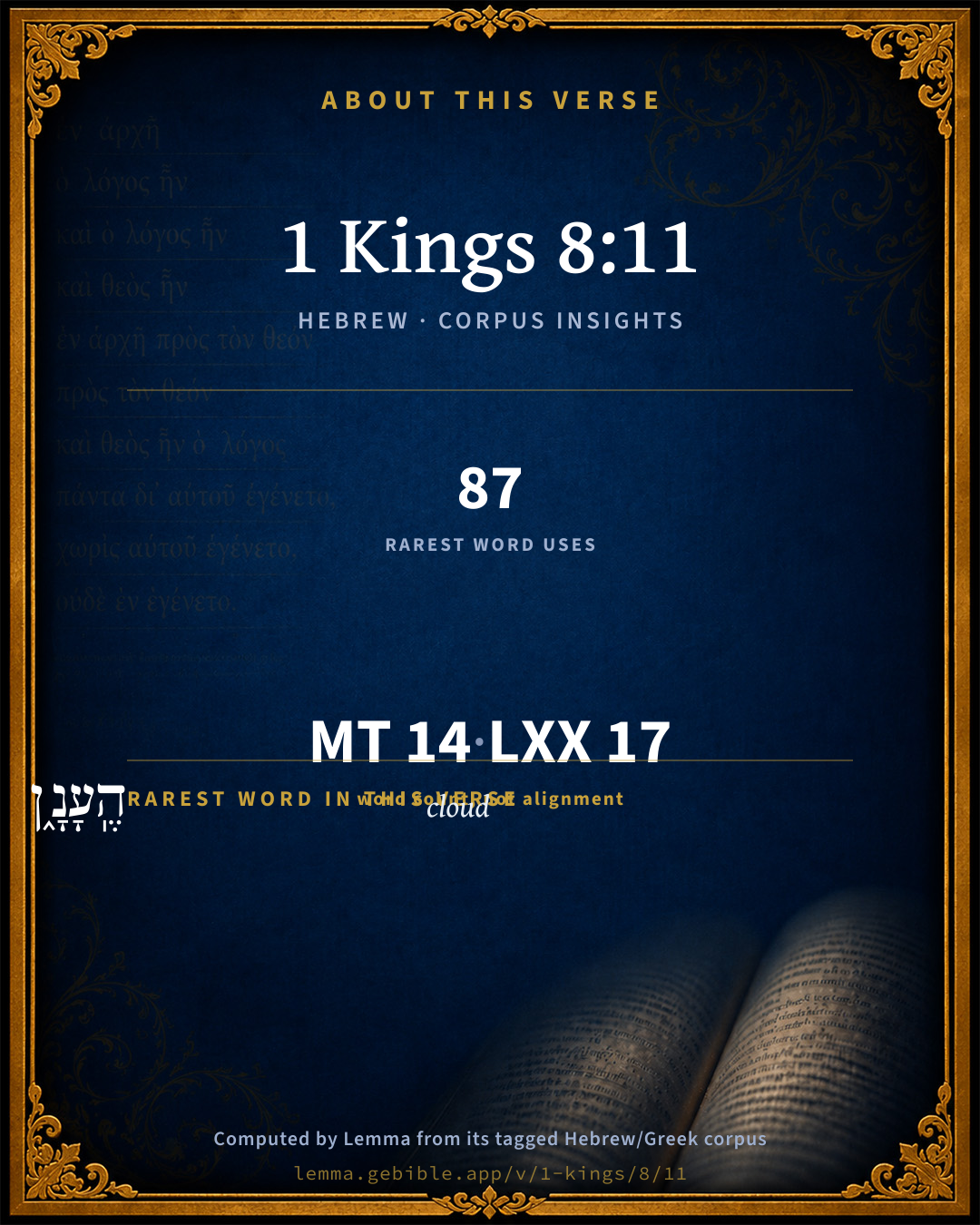
These counts appear in no published source. They are computed here, from the morphology-tagged text and Lemma’s own curated glosses. What Lemma adds →

14
words
13
distinct lemmas
Historical
section

Grammatical profile

  • 4 verbs
  • 7 nouns
  • 1 conjunction
  • 2 particles

Verb forms

  • יָכְל֧וּ Qal · Perfect
  • לַעֲמֹ֥ד Qal · Infinitive Construct
  • לְשָׁרֵ֖ת Piel · Infinitive Construct
  • מָלֵ֥א Qal · Perfect

Repetition

A word recurs within this verse — often emphatic in Hebrew:

  • יְהוָ֖ה LORD H3068 ×2

Hebrew & Septuagint length

In English translation the verse runs 24 words from the Hebrew and 21 from the Septuagint (LXX English) — closely comparable.

A rough comparison of the two English renderings, which tokenize alike — not a word-level alignment.

Word counts can differ between the Hebrew and the Greek without any difference in meaning — e.g. the Hebrew direct-object marker אֵת has no separate Greek word, and Greek often adds the article ὁ.

In the original languages it is 14 Hebrew tokens and 17 Greek tokens — but the two are counted differently (Hebrew bundles its prefixes and suffixes into one token; the Greek is in lemma form), so that isn’t a like-for-like length.

Cross-references

11

Topical passages linked to 1 Kings 8:11 in the Treasury of Scripture Knowledge — connected by theme and wording, ordered by reader-vote popularity; previews shown in the World English Bible.

  • Ezekiel 43:4–5 The glory of Yahweh came into the house by the way of the gate whose prospect is toward the east.
  • Ezekiel 44:4 Then he brought me by the way of the north gate before the house; and I looked, and, behold, the glory of Yahweh filled the house of Yahweh: and I fell on my face.
  • Leviticus 9:23 Moses and Aaron went into the Tent of Meeting, and came out, and blessed the people: and the glory of Yahweh appeared to all the people.
  • 2 Corinthians 3:18 But we all, with unveiled face beholding as in a mirror the glory of the Lord, are transformed into the same image from glory to glory, even as from the Lord, the Spirit.
  • 2 Corinthians 4:6 seeing it is God who said, "Light will shine out of darkness," who has shone in our hearts, to give the light of the knowledge of the glory of God in the face of Jesus Christ.
  • Ezekiel 43:2 Behold, the glory of the God of Israel came from the way of the east: and his voice was like the sound of many waters; and the earth shined with his glory.
  • John 1:14 The Word became flesh, and lived among us. We saw his glory, such glory as of the one and only Son of the Father, full of grace and truth.
  • Revelation 21:23 The city has no need for the sun, neither of the moon, to shine, for the very glory of God illuminated it, and its lamp is the Lamb.
  • Leviticus 9:6 Moses said, "This is the thing which Yahweh commanded that you should do: and the glory of Yahweh shall appear to you."
  • Acts 7:55 But he, being full of the Holy Spirit, looked up steadfastly into heaven, and saw the glory of God, and Jesus standing on the right hand of God,
  • Revelation 21:11 having the glory of God. Her light was like a most precious stone, as if it was a jasper stone, clear as crystal;

Cross-references courtesy of OpenBible.info (CC BY 4.0).

Hebrew and Greek witnesses Masoretic Hebrew ↔ Greek Septuagint

The same verse in the two great witnesses to the Old Testament, shown verse-for-verse.

These are two independent witnesses, not word-aligned to each other, and the Septuagint is shown in lemma (dictionary) form.

Hebrew 1 Kings 8:11 Masoretic · Westminster Leningrad Codex

וְלֹֽא יָכְל֧וּ הַכֹּהֲנִ֛ים לַעֲמֹ֥ד לְשָׁרֵ֖ת מִפְּנֵ֥י הֶֽעָנָ֑ן כִּי מָלֵ֥א כְבוֹד יְהוָ֖ה אֶת בֵּ֥ית יְהוָֽה

so that the priests could not stand to minister by reason of the cloud; for the glory of Yahweh filled the house of Yahweh.

World English Bible · Public Domain

Greek LXX 1 Kings 8:11 Septuagint · lemma form

καί οὐ δύναμαι ὁ ἱερεύς ἵστημι λειτουργέω ἀπό πρόσωπον ὁ νεφέλη ὅτι πίμπλημι δόξα κύριος ὁ οἶκος

And the priests could not stand to minister because of the cloud, because the glory of the Lord filled the house.

LXX2012 (modern English Septuagint) · Public Domain

Hebrew: Westminster Leningrad Codex (CC BY 4.0). Greek: Septuagint (public domain); English from LXX2012 (modern English Septuagint) (Public Domain). How the Septuagint differs from the Hebrew →

Targum (Aramaic paraphrase)

1

The Targum is the ancient Jewish Aramaic paraphrase of the Hebrew Scriptures — an interpretive translation, not the Hebrew text itself. Onkelos (literal) and Pseudo-Jonathan (expansive) render the Torah, and Jonathan the Prophets. Coverage is partial: where no permissively-licensed English translation exists for a verse, only the Aramaic is shown. This is verse-level text, not a word-by-word alignment to the Hebrew.

  1. Targum Jonathan Prophets (Joshua–Malachi)
    וְלָא יָכִילוּ כַּהֲנַיָא לְמֵיקַם לְשַׁמָשָׁא מִן קֳדָם עֲנָנָא אֲרֵי אִתְמְלֵי יְקָרָא דַייָ יַת בֵּית מַקְדְשָׁא דַיָי:

    (no public-domain English translation for this verse)

    Targum Jonathan — Aramaic: “Mikraot Gedolot” (public domain). English: “Sefaria Community Translation” (CC0 1.0 (public-domain dedication)); “London "Chaldee Paraphrase," 1871” (public domain). Text via Sefaria.

Commentary

Notes on 1 Kings 8:11 from classic Christian and Jewish commentators (each source and its license shown beneath its notes). The classic Christian expositions comment on the surrounding passage and are grouped to its opening verse, so a note may address several verses; the Jewish commentaries on the Tanakh (Rashi and others) are per-verse, so they appear only where the commentator wrote on this verse.

Lemma curates 59 commentaries, every one of them public domain or Creative Commons licensed, each selected and text-cleaned for this edition rather than reprinted as found. About our sources →

Trapp's Complete Commentary

John Trapp

1Ki 8:11 So that the priests could not stand to minister because of the cloud: for the glory of the LORD had filled the house of the LORD.

Ver. 11. So that the priests could not stand,] sc., With the safeguard of their lives, their eyes at least. The holy angels clap their wings upon their faces, as it were a double scarf, - or as a man doth his hands before his eyes, when he beholdeth an exceeding great light, - before the brightness of God’s presence, that would put out their eyes else. {Isa 6:2-3} Pellican saith, by the priests being driven out by this cloud appearing, was showed that the time should come when this priesthood should minister no more by carnal rites in this place.

John Trapp, A Commentary or Exposition upon All the Books of the Old and New Testament (1647–1656) — public domain. Text from a community e-Sword module.

Adam Clarke's Commentary

Verse 11. The glory of the Lord had filled the house] The cloud, the symbol of the Divine glory and presence, appears to have filled not only the holy of holies, but the whole temple, court and all, and to have become evident to the people; and by this Solomon knew that God had honoured the place with his presence, and taken it for his habitation in reference to the people of Israel.

Adam Clarke's Commentary on the Bible (1810–1826) — public domain. Text from a community e-Sword/MySword module.

Ellicott's Commentary for English Readers

(11) The priests could not stand to minister.—So in Exo_40:35, “Moses was not able to enter into the Tabernacle; for the cloud rested thereon, and the glory of the Lord filled the Tabernacle.” They shrank from the glory of the Lord, whom none could see and live; just as Isaiah (Isa_6:5) felt “undone” when he beheld the glory of the Lord in the Temple; and as even the Apostles trembled, when they entered into “the bright cloud which overshadowed them” on the Mount of Transfiguration, and “knew not what they said” (Luk_9:33-34). But it was not so much from terror of the Lord, who is “a consuming fire,” as simply from awe and reverence of His unspeakable glory.

A Bible Commentary for English Readers, edited by Charles John Ellicott (1878–1897) — public domain. Text from a community e-Sword module.

The Cambridge Bible for Schools and Colleges

gen. ed. J. J. S. Perowne

11. could not stand to minister] i.e. At the altar of incense which stood within the holy place. God’s presence was diffused through every part of the edifice, thus claiming the whole as set apart to Him.

The Cambridge Bible for Schools and Colleges (gen. ed. J. J. S. Perowne; Cambridge University Press, 1878–1918) — public domain. Text from a community e-Sword module.

John Gill's Exposition

So that the priests could not stand to minister, because of the cloud,.... Either through the darkness it first caused, or through the light that broke out of it, which was dazzling to them, or through the terror it struck their minds with; they could neither minister in the holy place, by offering incense there; and as for the most holy place, none but the high priest could minister there, and that on one day only; nor in the court of the priests, at the altar of burnt offerings:

for the glory of the Lord had filled the house of the Lord; a bright and glorious stream came forth from the cloud, and spread itself all over the house, and then took up its abode in the most holy place as in the tabernacle, Exo 40:34.

John Gill's Exposition of the Whole Bible (1746–1763) — public domain (CC PDM 1.0). Text via the HelloAO Bible API.

Albert Barnes' Notes on the Bible

As in the case of Moses Exo 40:35, so now the glory of the Lord, the manifestation of the divine presence, which the cloud usually veiled, shone forth from it with such brilliancy, that mortal man could not bear the sight.

Albert Barnes' Notes on the Bible (1834–1885) — public domain. Text from a community e-Sword/MySword module.

Matthew Poole's English Annotations

Because of the cloud; because the cloud was either so bright that it dazzled their eyes; or rather so dark, that it struck them with horror and amazement, as is implied in the next verse.

Matthew Poole's English Annotations on the Holy Bible (1683–1685) — public domain. Text from a community e-Sword/MySword module.

The Pulpit Commentary

So that the priests could not stand to rainwater because of the cloud. They were overpowered by the manifestation, precisely as Moses had been before. (Exo_40:35) It was at the moment when the singers and trumpeters, standing at the east end of the altar, began their service of praise and the reappearance of the priests may well have been the signal for them to begin (2Ch_5:13) that "the house was filled with a cloud." Possibly the priests were about to burn incense. Evidently ministrations of some sort were intended and were interrupted. The exact correspondence with Exo_40:35 (cf. Eze_44:4) is not to be overlooked. The idea obviously is that the Divine approval vouchsafed to the tabernacle was now in turn granted to the temple, for the glory of the Lord had filled the house of the Lord. Is the "glory of the Lord" identical with the cloud, or is something additional intended by these words? It is certainly noticeable that what ver. 10 says of the cloud that it "filled the house ver. 11 says of the glory. It is also true thatthere is no mention of any light or fire. And the "darkness" of ver. 12 might naturally seem to refer to the cloud, and therefore to exclude the idea of light. But surely the words yy dwObK are to be interpreted here by their signification and use elsewhere, and we find "the glory of the Lord elsewhere mentioned as something distinct from the cloud. We must remember that what by day was a pillar of cloud, by night was a pillar of. (Exo_13:21, Exo_13:22) In Exo_19:9, Exo_19:16, the mention of the "thick cloud" is followed by the statement that "Mount Sinai was altogether on a smoke because the Lord descended upon it in fire" (ver. 18). Similarly, in Exodus 24., we are told that "the glory of the Lord appeared upon Mount Sinai, and the cloud covered it (the glory?) six days; and the seventh day He called unto Moses out of the midst of the cloud. And the sight of the glory of the Lord was like devouring fire" (vers. 16, 17). But perhaps the most decisive passage in this connexion is Exo_40:34, where we are told that "the cloud abode upon" the tent of meeting, while "the glory of the Lord filled the (interior of the) tabernacle." Compare Exo_16:7, 10 Lev_9:6, 23 Num_14:10 Num_16:19, Num_16:42. It would appear, therefore, that "the glory of the Lord" was not the cloud, but, as the word almost seems to imply, a "light from heaven above the brightness of the sun". (Act_26:13; cf. Rev_1:14, Rev_1:16) It is hardly necessary to add that the glory, though apparently resident in the cloud, was not always luminous; the cloud veiled it from the eyes of men.

The Pulpit Commentary (1880–1919), ed. H.D.M. Spence-Jones & Joseph S. Exell — public domain. Text from a community e-Sword module.

Lesson kit

Teaching starters — assembled from the data on this page, not authored interpretation. Every prompt links to the verse data it draws on. Edit before teaching.

1 Kings, in the Historical, opens this verse with 14 words (13 distinct Hebrew lemmas). Its most distinctive word is ʻânân (“cloud”). A historical commentator’s framing appears above. Read the whole chapter for the surrounding context.

Discussion questions

  1. How does “cloud” (ʻânân) shape what this verse is saying?
  2. How does Ezekiel 43:4–5, which shares this passage’s theme, read alongside this verse?
  3. What does the repetition of “LORD” (2× in this one verse) do in this verse?
  4. These translations render this verse differently. What is at stake in choosing one wording over another?
  5. «יָכְל֧וּ» is a Qal Perfect verb. How does that grammatical form shape the action described?
  6. Compare how Trapp's Complete Commentary and Adam Clarke's Commentary read this verse. Where do they agree or differ?

Things to notice

Reading settings

Reading text

Shown beneath each verse's original-language words.

Old Testament
Old Testament edition

Read the OT as the Masoretic Hebrew (MT) or the Greek Septuagint (LXX).

English shown for the Greek Septuagint (in the Hebrew ↔ Greek comparison).

Comparing translations? Open the Compare panel on any verse page to stack up to four side by side.