
Ezekiel 7:19

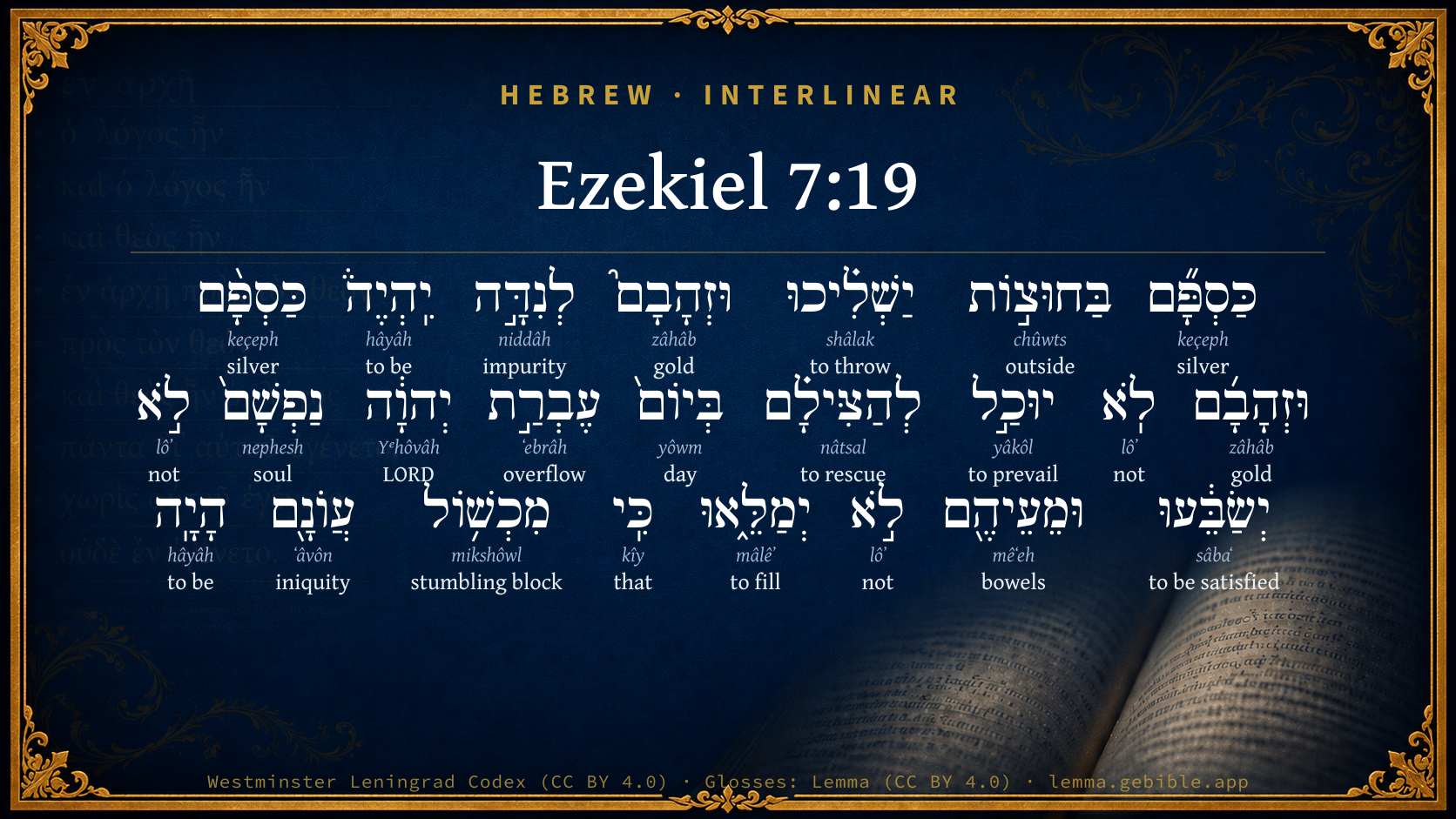
Hebrew (Westminster Leningrad Codex) Ezekiel 7:19 appears in the Hebrew Old Testament. The text above is from the Westminster Leningrad Codex. Each word links to its Strong’s number, a concise gloss, and parsing drawn from the Open Scriptures Hebrew Bible morphology. Click any word for its full Brown-Driver-Briggs (BDB) entry.
Download image
Cite this verse

Ezekiel 7:19 (World English Bible). Public Domain. Lemma interlinear Bible study tool, https://lemma.gebible.app/v/ezekiel/7/19.

Show BibTeX & RIS
BibTeX
RIS
English Translation
They shall cast their silver in the streets, and their gold shall be as an unclean thing; their silver and their gold shall not be able to deliver them in the day of the wrath of Yahweh: they shall not satisfy their souls, neither fill their bowels; because it has been the stumbling block of their iniquity.
World English Bible · Public Domain
Download a study sheet

One document with this verse’s original text, its word-by-word gloss line, the meaning frame, cross-references with their text, attributed commentary, and full source and license credits — printable, and it pastes into notes with its structure intact.

This verse Autodidact and up

Study sheet (.html) Plain text (.txt)

A passage Seminary Student

Up to 50 verses in one chapter. A passage sheet keeps up to 6 commentary sources and 12 cross-references per verse, in the order this page ranks them, and says so on the sheet whenever that leaves anything out. Ask for a single verse and you get the Autodidact verse sheet above.

Everything on this page stays free to read, with no account — the sheet is a download of what is already on screen, not access to it.

Want to remove ads? Support Godless Engineer
Compare translations 3

The same verse in 3 English versions, stacked beneath the original-language interlinear above. Click any original word for its lexicon entry.

Each is an independent rendering of the whole verse — the interlinear is not word-aligned to these translations.

Highlighted words mark where these versions differ — a whole-verse word diff, not a word-by-word alignment.

  • World English Bible Public Domain
    They shall cast their silver in the streets, and their gold shall be as an unclean thing; their silver and their gold shall not be able to deliver them in the day of the wrath of Yahweh: they shall not satisfy their souls, neither fill their bowels; because it has been the stumbling block of their iniquity.
  • King James Version Public Domain
    They shall cast their silver in the streets, and their gold shall be removed: their silver and their gold shall not be able to deliver them in the day of the wrath of the LORD: they shall not satisfy their souls, neither fill their bowels: because it is the stumblingblock of their iniquity.
  • unfoldingWord Literal Text CC BY-SA 4.0
    They will throw their silver into the streets and their gold will be like refuse. Their silver and their gold will not be able to rescue them in the day of Yahweh’s rage. Their lives will not be saved, and their hunger will not be satisfied, because their iniquity has become a stumbling block.

unfoldingWord Literal Text — © unfoldingWord, licensed CC BY-SA 4.0. Word-aligned USFM3 via Door43 (git.door43.org/unfoldingWord/en_ult).

Versions to compare (up to 4)

3 of 4 selected

Show all 18 translations

Every available English version of this verse, each an independent rendering of the whole verse.

  • World English Bible Public Domain
    They shall cast their silver in the streets, and their gold shall be as an unclean thing; their silver and their gold shall not be able to deliver them in the day of the wrath of Yahweh: they shall not satisfy their souls, neither fill their bowels; because it has been the stumbling block of their iniquity.
  • Berean Standard Bible Public Domain
    They will throw their silver into the streets, and their gold will seem unclean. Their silver and gold cannot save them in the day of the wrath of the LORD. They cannot satisfy their appetites or fill their stomachs with wealth, for it became the stumbling block that brought their iniquity.
  • Majority Standard Bible Public Domain
    They will throw their silver into the streets, and their gold will seem unclean. Their silver and gold cannot save them in the day of the wrath of the LORD. They cannot satisfy their appetites or fill their stomachs with wealth, for it became the stumbling block that brought their iniquity.
  • King James Version Public Domain
    They shall cast their silver in the streets, and their gold shall be removed: their silver and their gold shall not be able to deliver them in the day of the wrath of the LORD: they shall not satisfy their souls, neither fill their bowels: because it is the stumblingblock of their iniquity.
  • American Standard Version (1901) Public Domain
    They shall cast their silver in the streets, and their gold shall be as an unclean thing; their silver and their gold shall not be able to deliver them in the day of the wrath of Jehovah: they shall not satisfy their souls, neither fill their bowels; because it hath been the stumblingblock of their iniquity.
  • Revised Version (1885) Public Domain
    They shall cast their silver in the streets, and their gold shall be as an unclean thing; their silver and their gold shall not be able to deliver them in the day of the wrath of the LORD; they shall not satisfy their souls, neither fill their bowels: because it hath been the stumblingblock of their iniquity.
  • Geneva Bible (1599) Public Domain
    They shall cast their siluer in the streetes, and their golde shalbe cast farre off: their siluer and their gold can not deliuer them in the day of the wrath of the Lord: they shall not satisfie their soules, neither fill their bowels: for this ruine is for their iniquitie.
  • Douay-Rheims (1899) Public Domain
    Their silver shall be cast forth, and their gold shall become a dunghill. Their silver and their gold shall not be able to deliver them in the day of the wrath of the Lord. They shall not satisfy their soul, and their bellies shall not be filled: because it hath been the stumblingblock of their iniquity.
  • Young's Literal Translation Public Domain
    Their silver into out-places they cast, And their gold impurity becometh. Their silver and their gold is not able to deliver them, In a day of the wrath of Jehovah, Their soul they do not satisfy, And their bowels they do not fill, For the stumbling-block of their iniquity it hath been.
  • Literal Standard Version CC BY-SA 4.0
    They cast their silver into out-places, || And their gold becomes impurity. Their silver and gold are not able to deliver them, || In a day of the wrath of YHWH, || They do not satisfy their soul, || And they do not fill their bowels, || For it has been the stumbling-block of their iniquity.
  • Unlocked Literal Bible CC BY-SA 4.0
    They will throw their silver into the streets and their gold will be like refuse. Their silver and their gold will not be able to rescue them in the day of Yahweh's rage. Their lives will not be saved, and their hunger will not be satisfied, because their iniquity has become a stumbling block.
  • unfoldingWord Literal Text CC BY-SA 4.0
    They will throw their silver into the streets and their gold will be like refuse. Their silver and their gold will not be able to rescue them in the day of Yahweh’s rage. Their lives will not be saved, and their hunger will not be satisfied, because their iniquity has become a stumbling block.
  • Darby Bible Public Domain
    They shall cast their silver in the streets, and their gold shall be as an impurity: their silver and their gold shall not be able to deliver them in the day of Jehovah's wrath; they shall not satisfy their souls, neither fill their belly; for it hath been the stumbling-block of their iniquity.
  • World Messianic Bible Public Domain
    They will cast their silver in the streets, and their gold will be as an unclean thing. Their silver and their gold won’t be able to deliver them in the day of the LORD’s wrath. They won’t satisfy their souls or fill their bellies; because it has been the stumbling block of their iniquity.
  • Webster's Bible Public Domain
    They shall cast their silver in the streets, and their gold shall be removed: their silver and their gold shall not be able to deliver them in the day of the wrath of the LORD: they shall not satisfy their souls, neither fill their bowels because it is the stumbling-block of their iniquity.
  • Free Bible Version CC BY-SA 4.0
    They will throw away their silver in the streets and treat their gold as if it's something unclean. Their silver and gold won't be able to save them when the day of the Lord's anger comes. Their money won't satisfy their hunger or fill their stomachs. In fact this was the problem that caused their sin in the first place.
  • Bible in Basic English Public Domain
    They will put out their silver into the streets, and their gold will be as an unclean thing; their silver and their gold will not be able to keep them safe in the day of the wrath of the Lord; they will not get their desire or have food for their need: because it has been the cause of their falling into sin.
  • JPS Tanakh (1917) Public Domain
    They shall cast their silver in the streets, and their gold shall be as an unclean thing; their silver and their gold shall not be able to deliver them in the day of the wrath of the LORD; they shall not satisfy their souls, neither fill their bowels; because it hath been the stumblingblock of their iniquity.

Literal Standard Version (2020), Covenant Press — licensed CC BY-SA 4.0. Text via the HelloAO Bible API (eBible.org). Unlocked Literal Bible (unfoldingWord) — licensed CC BY-SA 4.0. Text via the HelloAO Bible API (eBible.org). unfoldingWord Literal Text — © unfoldingWord, licensed CC BY-SA 4.0. Word-aligned USFM3 via Door43 (git.door43.org/unfoldingWord/en_ult). Free Bible Version, Dr. Jonathan Gallagher — licensed CC BY-SA 4.0. Text via the HelloAO Bible API (eBible.org).

Word by word

More ways to search: Search by grammar → Find every occurrence → Compare this word →

Practice this passage: Drill this verse → Learn its vocabulary →

מִכְשׁ֥וֹל
mikshôwl
H4383
“stumbling block of”
Noun, Common, Masculine, Singular, Construct
Part of Speech
Noun
Type
Common
Gender
Masculine
Number
Singular
State
Construct
Full BDB Definition

Origin: from H3782

TWOT: 1050c

a stumbling, means or occasion of stumbling, stumbling block - stumbling, fall - means or occasion of stumbling, stumbling block
  1. כַּסְפָּ֞ם keçeph H3701 “silver · their” Noun, Common, Masculine, Singular, Construct + Suffix, Personal, 3rd Person, Masculine, Plural
  2. בַּחוּצ֣וֹת chûwts H2351 “in/at the · streets” Preposition, Determined + Noun, Common, Masculine, Plural, Absolute
  3. יַשְׁלִ֗יכוּ shâlak H7993 “to throw” Verb, Hiphil, Imperfect, 3rd Person, Masculine, Plural
  4. וּזְהָבָם֮ zâhâb H2091 “and · gold · their” Conjunction + Noun, Common, Masculine, Singular, Construct + Suffix, Personal, 3rd Person, Masculine, Plural
  5. לְנִדָּ֣ה niddâh H5079 “to/for · impurity” Preposition + Noun, Common, Feminine, Singular, Absolute
  6. יִֽהְיֶה֒ hâyâh H1961 “to be” Verb, Qal, Imperfect, 3rd Person, Masculine, Singular
  7. כַּסְפָּ֨ם keçeph H3701 “silver · their” Noun, Common, Masculine, Singular, Construct + Suffix, Personal, 3rd Person, Masculine, Plural
  8. וּזְהָבָ֜ם zâhâb H2091 “and · gold · their” Conjunction + Noun, Common, Masculine, Singular, Construct + Suffix, Personal, 3rd Person, Masculine, Plural
  9. לֹֽא lôʼ H3808 “not” Particle, Negative
  10. יוּכַ֣ל yâkôl H3201 “to prevail” Verb, Qal, Imperfect, 3rd Person, Masculine, Singular
  11. לְהַצִּילָ֗ם nâtsal H5337 “to rescue · them” Preposition + Verb, Hiphil, Infinitive Construct + Suffix, Personal, 3rd Person, Masculine, Plural
  12. בְּיוֹם֙ yôwm H3117 “in/at · day of” Preposition + Noun, Common, Masculine, Singular, Construct
  13. עֶבְרַ֣ת ʻebrâh H5678 “overflow of” Noun, Common, Feminine, Singular, Construct
  14. יְהוָ֔ה Yᵉhôvâh H3068 “LORD” Noun, Proper
  15. נַפְשָׁם֙ nephesh H5315 “soul · their” Noun, Common, Both, Singular, Construct + Suffix, Personal, 3rd Person, Masculine, Plural
  16. לֹ֣א lôʼ H3808 “not” Particle, Negative
  17. יְשַׂבֵּ֔עוּ sâbaʻ H7646 “to be satisfied” Verb, Piel, Imperfect, 3rd Person, Masculine, Plural
  18. וּמֵעֵיהֶ֖ם mêʻeh H4578 “and · bowels · their” Conjunction + Noun, Common, Masculine, Plural, Construct + Suffix, Personal, 3rd Person, Masculine, Plural
  19. לֹ֣א lôʼ H3808 “not” Particle, Negative
  20. יְמַלֵּ֑אוּ mâlêʼ H4390 “to fill” Verb, Piel, Imperfect, 3rd Person, Masculine, Plural
  21. כִּֽי kîy H3588 “that” Conjunction
  22. עֲוֺנָ֖ם ʻâvôn H5771 “iniquity · their” Noun, Common, Both, Singular, Construct + Suffix, Personal, 3rd Person, Masculine, Plural
  23. הָיָֽה hâyâh H1961 “to be” Verb, Qal, Perfect, 3rd Person, Masculine, Singular

About this verse

These counts appear in no published source. They are computed here, from the morphology-tagged text and Lemma’s own curated glosses. What Lemma adds →

24
words
19
distinct lemmas
Prophets
section

Notable vocabulary

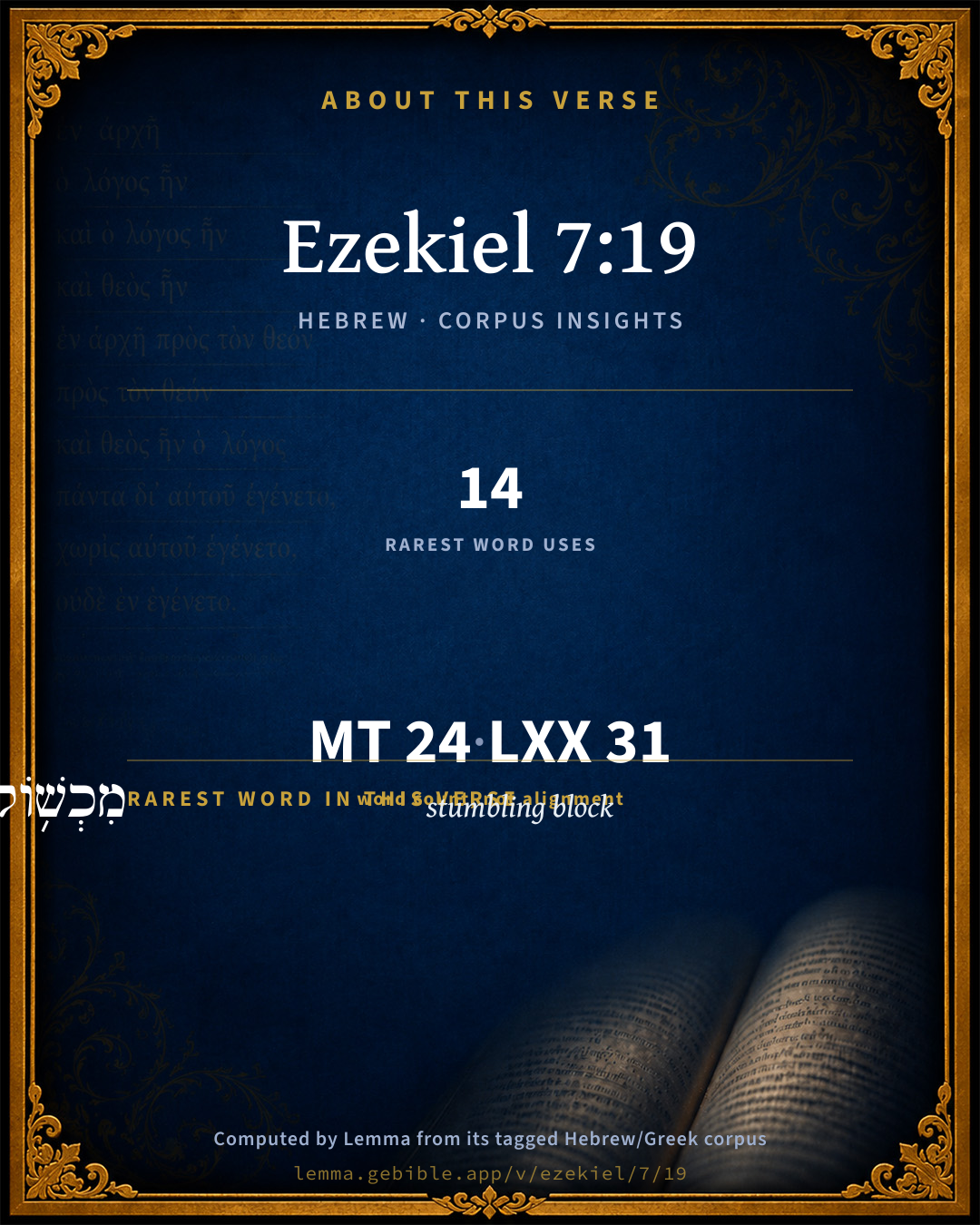
The rarest word here is מִכְשׁ֥וֹל stumbling block H4383 — appearing just 14 times in the whole Hebrew Bible.

Shared distinctive vocabulary

מִכְשׁ֥וֹל stumbling block H4383 occurs in 14 verses of the Hebrew Bible. Also found in:

Grammatical profile

  • 7 verbs
  • 13 nouns
  • 1 conjunction
  • 3 particles

Verb forms

  • יַשְׁלִ֗יכוּ Hiphil · Imperfect
  • יִֽהְיֶה֒ Qal · Imperfect
  • יוּכַ֣ל Qal · Imperfect
  • לְהַצִּילָ֗ם Hiphil · Infinitive Construct
  • יְשַׂבֵּ֔עוּ Piel · Imperfect
  • יְמַלֵּ֑אוּ Piel · Imperfect
  • הָיָֽה Qal · Perfect

Repetition

Words recur within this verse — often emphatic in Hebrew:

  • כַּסְפָּ֞ם silver H3701 ×2
  • וּזְהָבָם֮ gold H2091 ×2
  • יִֽהְיֶה֒ to be H1961 ×2
  • לֹֽא not H3808 ×3

Hebrew & Septuagint length

In English translation the verse runs 57 words from the Hebrew and 36 from the Septuagint (LXX English) — the Septuagint runs noticeably shorter here. See the side-by-side →

A rough comparison of the two English renderings, which tokenize alike — not a word-level alignment.

Word counts can differ between the Hebrew and the Greek without any difference in meaning — e.g. the Hebrew direct-object marker אֵת has no separate Greek word, and Greek often adds the article ὁ.

In the original languages it is 24 Hebrew tokens and 31 Greek tokens — but the two are counted differently (Hebrew bundles its prefixes and suffixes into one token; the Greek is in lemma form), so that isn’t a like-for-like length.

Cross-references

16

Topical passages linked to Ezekiel 7:19 in the Treasury of Scripture Knowledge — connected by theme and wording, ordered by reader-vote popularity; previews shown in the World English Bible.

  • Proverbs 11:4 Riches don't profit in the day of wrath, But righteousness delivers from death.
  • Zephaniah 1:18 Neither their silver nor their gold will be able to deliver them in the day of Yahweh's wrath, but the whole land will be devoured by the fire of his jealousy; for he will make an end, yes, a terrible end, of all those who dwell in the land.
  • Ezekiel 14:7 For everyone of the house of Israel, or of the strangers who sojourn in Israel, who separates himself from me, and takes his idols into his heart, and puts the stumbling block of his iniquity before his face, and comes to the prophet to inquire for himself of me; I Yahweh will answer him by myself:
  • Luke 12:19–20 I will tell my soul, "Soul, you have many goods laid up for many years. Take your ease, eat, drink, be merry."'
  • Isaiah 2:20 In that day, men shall cast away their idols of silver, And their idols of gold, Which have been made for themselves to worship, To the moles and to the bats;
  • Job 20:12–23 "Though wickedness is sweet in his mouth, Though he hide it under his tongue,
  • Ecclesiastes 5:10 He who loves silver shall not be satisfied with silver; nor he who loves abundance, with increase: this also is vanity.
  • Ezekiel 14:3–4 Son of man, these men have taken their idols into their heart, and put the stumbling block of their iniquity before their face: should I be inquired of at all by them?
  • Ezekiel 44:12 Because they ministered to them before their idols, and became a stumbling block of iniquity to the house of Israel; therefore have I lifted up my hand against them, says the Lord Yahweh, and they shall bear their iniquity.
  • Matthew 16:26 For what will it profit a man, if he gains the whole world, and forfeits his life? Or what will a man give in exchange for his life?
  • Psalms 78:30–31 They didn't turn from their cravings. Their food was yet in their mouths,
  • Isaiah 30:22 You shall defile the overlaying of your engraved images of silver, and the plating of your molten images of gold: you shall cast them away as an unclean thing; you shall tell it, Get you hence.
  • Isaiah 55:2 Why do you spend money for that which is not bread? and your labor for that which doesn't satisfy? listen diligently to me, and eat you that which is good, and let your soul delight itself in fatness.
  • Romans 11:9 David says, "Let their table be made a snare, and a trap, A stumbling block, and a retribution to them.
  • 2 Kings 7:7–8 Therefore they arose and fled in the twilight, and left their tents, and their horses, and their donkeys, even the camp as it was, and fled for their life.
  • 2 Kings 7:15 They went after them to the Jordan: and, behold, all the way was full of garments and vessels, which the Syrians had cast away in their haste. The messengers returned, and told the king.

Cross-references courtesy of OpenBible.info (CC BY 4.0).

Hebrew and Greek witnesses Masoretic Hebrew ↔ Greek Septuagint

The same verse in the two great witnesses to the Old Testament, shown verse-for-verse.

Here the Septuagint runs noticeably shorter than the Hebrew — LXX2012 (modern English Septuagint) 36 words vs World English Bible 57. A rough length comparison of the two English translations, not a word-level alignment — read both below.

These are two independent witnesses, not word-aligned to each other, and the Septuagint is shown in lemma (dictionary) form.

Hebrew Ezekiel 7:19 Masoretic · Westminster Leningrad Codex

כַּסְפָּ֞ם בַּחוּצ֣וֹת יַשְׁלִ֗יכוּ וּזְהָבָם֮ לְנִדָּ֣ה יִֽהְיֶה֒ כַּסְפָּ֨ם וּזְהָבָ֜ם לֹֽא יוּכַ֣ל לְהַצִּילָ֗ם בְּיוֹם֙ עֶבְרַ֣ת יְהוָ֔ה נַפְשָׁם֙ לֹ֣א יְשַׂבֵּ֔עוּ וּמֵעֵיהֶ֖ם לֹ֣א יְמַלֵּ֑אוּ כִּֽי מִכְשׁ֥וֹל עֲוֺנָ֖ם הָיָֽה

They shall cast their silver in the streets, and their gold shall be as an unclean thing; their silver and their gold shall not be able to deliver them in the day of the wrath of Yahweh: they shall not satisfy their souls, neither fill their bowels; because it has been the stumbling block of their iniquity.

World English Bible · Public Domain

Greek LXX Ezekiel 7:19 Septuagint · lemma form

ὁ ἀργύριον αὐτός ῥίπτω ἐν ὁ πλατύς καί ὁ χρυσίον αὐτός ὑπερὁράω ὁ ψυχή αὐτός οὐ μή ἐνπίμπλημι καί ὁ κοιλία αὐτός οὐ μή πληρόω διότι βάσανος ὁ ἀδικία αὐτός γίγνομαι

Their silver shall be cast forth in the streets, and their gold shall be despised: their souls shall not be satisfied, and their bellies shall not be filled: for it was the punishment of their iniquities.

LXX2012 (modern English Septuagint) · Public Domain

Hebrew: Westminster Leningrad Codex (CC BY 4.0). Greek: Septuagint (public domain); English from LXX2012 (modern English Septuagint) (Public Domain). How the Septuagint differs from the Hebrew →

Targum (Aramaic paraphrase)

1

The Targum is the ancient Jewish Aramaic paraphrase of the Hebrew Scriptures — an interpretive translation, not the Hebrew text itself. Onkelos (literal) and Pseudo-Jonathan (expansive) render the Torah, and Jonathan the Prophets. Coverage is partial: where no permissively-licensed English translation exists for a verse, only the Aramaic is shown. This is verse-level text, not a word-by-word alignment to the Hebrew.

  1. Targum Jonathan Prophets (Joshua–Malachi)
    כַּסְפֵּהוֹן בְּשׁוּקִין יִרְמוֹן וּדְהַבְהוֹן לְבוּסְרָן יְהֵי כַּסְפֵּיהוֹן וּדְהַבְהוֹן לָא יִכּוּל לְשֵׁיזָבוּתְהוֹן בְּיוֹם רוּגְזָא דַייָ נַפְשֵׁיהוֹן לָא יִסְבְּעוּן וּמֵעֵיהוֹן לָא יִמְלוּן אֲרֵי לְתַקְלַת חוֹבִין יְהֵי:

    (no public-domain English translation for this verse)

    Targum Jonathan — Aramaic: “Mikraot Gedolot” (public domain). English: “Sefaria Community Translation” (CC0 1.0 (public-domain dedication)); “London "Chaldee Paraphrase," 1871” (public domain). Text via Sefaria.

Commentary

Notes on Ezekiel 7:19 from classic Christian and Jewish commentators (each source and its license shown beneath its notes). The classic Christian expositions comment on the surrounding passage and are grouped to its opening verse, so a note may address several verses; the Jewish commentaries on the Tanakh (Rashi and others) are per-verse, so they appear only where the commentator wrote on this verse.

Lemma curates 59 commentaries, every one of them public domain or Creative Commons licensed, each selected and text-cleaned for this edition rather than reprinted as found. About our sources →

Trapp's Complete Commentary

John Trapp

Eze 7:19 They shall cast their silver in the streets, and their gold shall be removed: their silver and their gold shall not be able to deliver them in the day of the wrath of the LORD: they shall not satisfy their souls, neither fill their bowels: because it is the stumblingblock of their iniquity.

Ver. 19. They shall cast their silver in the streets.] As burdensome, and not beneficial to them {a} Thus Judas threw away his wages of wickedness; and many, on their deathbeds, detest their cursed hoards of ill gotten goods, saying unto them, as once Charles V did, Abite hinc, abite longe, - Away from me, away, away.

Their gold shall be removed.] Shall be for a dunghill, saith the Vulgate; it shall be esteemed, as it is, the guts and garbage of the earth.

Their silver and their gold.] See Pro 11:4 Zep 1:18 Ecc 5:8, {See Trapp on "Pro 11:4"} {See Trapp on "Zep 1:18"} {See Trapp on "Ecc 5:8"}

They shall not satisfy {b} their souls.] Silver and gold are not eatable, as Midas found, and the great Caliph of Babylon, whom Haabon the great Khan of Tartary starved to death in the midst of his infinite treasures, which though they were in valour great, and with great care laid together, yet served they him not now to suffice nature best contented with a little. {c}

Because it is the stumblingblock of their iniquity.] Their wealth is the occasion of their wickedness, and they are much the worse men for their worldly substance. See Psa 52:7, with the margin; Jer 5:27-28 Luk 16:9; Luk 16:13.

{a} Ne sit ponderi quod prius fuit luxuriae. - Jerome.

{b} Plato in Cratylo scribit Tantalum dictum esse quas παλαντατον, i.e., infelicissimum

{c} Turkish History, 113.

John Trapp, A Commentary or Exposition upon All the Books of the Old and New Testament (1647–1656) — public domain. Text from a community e-Sword module.

Tyndale Open Study Notes

Tyndale Open Resources

7:19 Even silver and gold, the traditional last resorts in times of crisis, would be unable to save or satisfy their owners. They would dispose of them like worthless trash (literally impurity), something hateful and disgusting that they could not wait to be rid of.

Tyndale Open Study Notes — © Tyndale Open Resources, licensed CC BY-SA 4.0. Text via the HelloAO Bible API.

Jamieson, Fausset & Brown

Robert Jamieson, A. R. Fausset & David Brown

cast . . . silver in . . . streets--just retribution; they had abused their silver and gold by converting them into idols, "the stumbling-block of their iniquity" (Eze 14:3-4, that is, an occasion of sinning); so these silver and gold idols, so far from "being able to deliver them in the day of the Lord's wrath" (see Pro 11:4), shall, in despair, be cast by them into the streets as a prey to the foe, by whom they shall be "removed" (GROTIUS translates as the Margin, "shall be despised as an unclean thing"); or rather, as suits the parallelism, "shall be put away from them" by the Jews [CALVIN]. "They (the silver and gold) shall not satisfy their souls," that is, their cravings of appetite and other needs.

Jamieson, Fausset & Brown — Commentary Critical and Explanatory on the Whole Bible (1871) — public domain (CC PDM 1.0). Text via the HelloAO Bible API.

Adam Clarke's Commentary

Verse 19. They shall cast their silver in the streets] Their riches can be of no use; as in a time of famine there is no necessary of life to be purchased, and gold and silver cannot fill their bowels.

It is the stumbling-block of their iniquity.] They loved riches, and placed in the possession of them their supreme happiness. Now they find a pound of gold not worth an ounce of bread.

Adam Clarke's Commentary on the Bible (1810–1826) — public domain. Text from a community e-Sword/MySword module.

John Calvin's Commentaries

Now the Prophet threatens that the desperation of the people would be so great that they would forget both gold and silver: for we know that men are more anxious about those possessions than about life itself. But gold, unless it be prepared for use, has no value in itself: yet we see that the majority are so inflamed with the desire of gold, that they cast themselves into the certain danger of death. For how many neglect their own life to acquire wealth: hence when men despise gold, they are assuredly astonished by fear and anxiety so as to lose their natural senses. The Prophet means this when he says, they shall cast their gold into the streets, because if they thought they should survive, and if there were any hope of life left, doubtless they would hide their gold and silver. But when gold is cast away, it is certain, as I have said, that all things are full of despair. Their gold, says he, shall be cast away I prefer this interpretation to an unclean thing. נדה, nedeh, signifies pollution, defilement, and separation. If any prefer-the translation “separation,” I do not object, only let us understand that the Jews would treat their gold as valueless, and so willingly separated from it. For we know that men are so attached to their gold and silver that it grieves them to be torn from what they so much love: no less than if you tore away their entrails. But the word “a casting away” is clearer, and will answer to the former member of the sentence better. He adds, their gold and silver will be unable to preserve them in the day of Jehovah’s anger Here the Prophet derides the perverse confidence of those who thought themselves safe, because fortified with great wealth. For when men see themselves protected by guards they fear nothing, and such security is not easily wrested from them. For this cause also, Ezekiel pronounces that gold and silver would be useless to the Jews when God was fierce against them. And at the same time he obliquely reproves their sloth, because they despised God’s judgments since they were spared at the time. Hence he declares — the day of God’s burning wrath shall come: then he says, they shall not satisfy their souls, and they shall not fill their bellies Here he means that the richest even should be famished. When any famine presses upon the people, yet those who have money at home do not suffer; besides, the rich have all kinds of produce in their barns and granaries. But the Prophet says, that the penury shall be such as to involve the rich, so that they should not have food to refresh themselves. Thus the reason is added, because it was the stumblingblock of their iniquity Some take this clause generally, that the Jews should stumble on account of their iniquity, that is, then shall be the time of receiving their reward. For God had seemed to pardon them, and not to notice so many iniquities with which they provoked him. He says therefore, in that day shall be a stumblingblock, if that sense pleases you, but I would rather restrict it to money itself, since silver and gold shall profit nothing, inasmuch as it shall be a stumblingblock of iniquity, that is, it shall be the material or occasion of sinning: and the next verse confirms this sense when it says —

John Calvin's Commentaries (1540-1563) — public domain. Text from the Calvin Translation Society English edition (1840s-50s) via the Christian Classics Ethereal Library (ccel.org). Calvin's coverage is partial (roughly two-thirds of the Bible); uncommented books and verses are honest gaps, never fabricated. The 19th-century editor's footnotes and remarks are omitted so the notes are faithfully Calvin's own voice.

Ellicott's Commentary for English Readers

(19) Cast their silver in the streets.—As in the rout of an army the soldier throws away everything, even his most valuable things, as impediments to his flight and temptations to the pursuing enemy, so the Israelites in their terror should abandon everything. Their riches will be utterly unavailing. The expression in the original is even stronger: their gold shall be to them “an unclean thing,” “filth,” because they shall perceive that it has been to them an occasion of sin.

A Bible Commentary for English Readers, edited by Charles John Ellicott (1878–1897) — public domain. Text from a community e-Sword module.

The Cambridge Bible for Schools and Colleges

gen. ed. J. J. S. Perowne

19. Amidst the famine they cast their silver and gold away in the streets, it cannot procure them food. On the horrors of famine during the siege of Jerusalem, comp. Lam_4:4; Lam_4:8-10; Lam_2:11-12; Lam_2:19-20; Lam_1:11.

gold shall be removed] Rather: shall be a thing unclean, lit. uncleanness. The term refers properly to female impurity, and is the strongest expression for “object of abhorrence;” cf. ch. Eze_36:17, where the people’s idolatries are in Jehovah’s eyes as a woman’s impurity. Lev_20:21.

is the stumblingblock] hath been. Their gold and silver has been to them something on which they have stumbled and fallen, i.e. a cause of their sinning; cf. ch. Eze_14:3, Eze_44:12.

The Cambridge Bible for Schools and Colleges (gen. ed. J. J. S. Perowne; Cambridge University Press, 1878–1918) — public domain. Text from a community e-Sword module.

John Gill's Exposition

As for the beauty of his ornament, he set it in majesty,.... Or, "for pride" (i). The gold, silver, jewels, riches, and treasure, which the Lord gave to this people, they made a bad use of; and instead of contributing to the support of his worship and interest, and of giving liberally to the poor, they converted it to their own pride and luxury: or rather the temple, as Jarchi and Kimchi interpret it, is meant; which was a beautiful structure, and adorned with gifts, and set for glory, majesty, and excellency by the Lord; yea, where his excellent Majesty dwelt himself:

but they made the images of their abominations and of their detestable things therein; or, "of it" (k); that is, of their gold and silver, which is another bad use they put their riches to: or rather "in it" (l); that is, the temple; where, having made their idols, they placed them; see Jer 7:30;

therefore have I set it far from them; that being destroyed, and they being carried away captive into a strange land, far from that.

(i) "in superbiam", V. L. Calvin, Starckius. (k) "ex eo", Tigurine version. (l) "In eo". Pagninus, Montanus, Polanus, Junius & Tremellius, Piscator, Starckius.

John Gill's Exposition of the Whole Bible (1746–1763) — public domain (CC PDM 1.0). Text via the HelloAO Bible API.

Albert Barnes' Notes on the Bible

Shall be removed - literally, “shall be an unclean thing” Lev 20:21; their gold shall be unclean and abominable in their eyes.

The stumblingblock of their iniquity - See Eze 3:20. Their gold and silver used in making images was the occasion of their sin.

Albert Barnes' Notes on the Bible (1834–1885) — public domain. Text from a community e-Sword/MySword module.

Haydock's Catholic Bible Commentary

Iniquity. Riches have fostered their passions: they will not now procure food or liberty, Sophonias i. 18. (Calmet) --- The riches of the idols invited the enemy to plunder. (Worthington)

George Leo Haydock (1774–1849), Haydock's Catholic Family Bible and Commentary, 1859 edition — public domain. Excludes Psalms (Douay-Rheims chapter numbering differs from Protestant) and Deuterocanonical books (Catholic canon only).

Matthew Poole's English Annotations

They shall cast their silver; either,

1. The Jews themselves, that they be the lighter to flee, and might stop the pursuer, whom they hope silver may stop a while, and give them some space to get away; or, might occasion quarrels among soldiers of fortune, which might set them one against another till the distressed Jews could get away from them all. Or,

2. The Chaldeans, who in this day of their own rage and God’s wrath against the Jews did (as the Medes and Persians shall, Isa 13:17) not regard silver or gold, Pro 11:4. Or,

3. Because Nebuchadnezzar might possibly reserve it all to himself, having those vast thoughts of enlarging his empire by arms; which could not be done without great treasures.

Removed; carried away into Babylon, to the royal treasury; or laid aside as despised, when offered a ransom of their life; or hid by the Jews in polluted places, which perhaps the Jew might think would be securest from searching, forasmuch as the Chaldean knew their law forbade them to touch any unclean tiring.

Silver and gold shall not be able to deliver them: this is the sum of it, these treasures shall stand them in no stead. If the self-flattering Jews should think much silver and gold might ransom their life when the city is taken, the prophet removes this confidence, and tells them they should not have enough to buy bread to fill their own bellies.

It is the stumbling-block of their iniquity; this silver and gold they valued too much, coveted immeasurably, abused to pride, luxury, idolatry, and oppression; this that they stumbled at and fell into sin, this now they stumble at and fall into deepest misery and danger.

Matthew Poole's English Annotations on the Holy Bible (1683–1685) — public domain. Text from a community e-Sword/MySword module.

Whedon's Commentary on the Bible

Daniel D. Whedon

19. Their gold shall be removed — Literally, shall be an impurity.

Is the stumbling-block — Literally, was. The meaning seems to be that it is the rich men of the city who are now seeking most anxiously to escape. But the rich men, who have previously depended upon their wealth to help them out of every difficulty, will find their money now an impediment; they will drop it in the streets, as they fly from the city and count it an abhorrence (Eze_36:17). It is of no value in obtaining the luxuries of life, or even food (see 2Ki_6:25), and probably is a hindrance in obtaining help in the flight. Brotherhood, not money, is the only thing that wins assistance in such hours.

Because it is the stumbling-block — The love of money led to the oppression of the poor, and the possession of it led them away from the simplicity of Jehovah worship into the luxurious manners and worship of the heathen. They stumbled then over a golden idol into guilt; they will now stumble over the same golden idol into punishment.

Daniel D. Whedon (gen. ed.), Commentary on the Old and New Testaments (1874–1909) — public domain. Text from a community e-Sword module.

The Pulpit Commentary

They shall cast their silver, etc. The words remind us of Isa_2:20 and Isa_30:22, with the difference that here it is the silver and gold as such, and not the idols made of them, that are to be flung away. They had made the actual metal their idol, and their confidence in it should be powerless to deliver them. (Zep_1:18) Their gold shall be removed; better, with the Revised Version, as an unclean thing. The word implies the kind of impurity of Eze_18:6 Eze_22:10 Eze_36:17; Isa_30:22. Instead of gloating, as they had done, over their money, men shouldshrink from it, as though its very touch brought pollution. The Vulgate gives in sterquilinium, "to the dunghill." They shall not satisfy their souls. In the horrors of the siege, with everything at famine prices, (2Ki_6:25) and little or nothing to be had for them, their money would not stop the cravings of hunger. It is characteristic that he applies to riches as such the very same epithet, stumbling block of their iniquity, as he had applied before (Eze_3:20) to actual idolatry. (comp. Col_3:5)

Gold and silver.

Gold and silver are here referred to as precious things that have become worthless in the confusion consequent on the sack of Jerusalem. Inasmuch as they are usually regarded as of great value and guarded with especial care, kept in purses and safe places, to throw them in the streets is to reverse the normal treatment of them.

I THE VALUE OF GOLD AND SILVER IS NOT STABLE. Financially, this fact is recognized in the Money Market, but it goes further than men of business generally admit. The precious metals have a certain utility and beauty of their own; but there are circumstances under which they become mere incumbrances; e.g. on hoard a sinking ship, in a besieged city, on a desert island, in great sickness, at death. They are chiefly valued as money, i.e. as a medium of exchange. But when there is nothing to exchange them for, their money value is lost. This must be the case in a state of social insecurity, when no one can depend upon holding his property from one day to another. Then the purchasing power of money will fall, even though there be plenty of articles for sale, because the purchase of goods may be nullified by the loss of them. In a famine at first the rich man may buy dear food which the poor man can not afford to get; but when all the food is exhausted, he cannot feed on his gold and silver. In times of great sorrow the value of gold and silver falls almost to nil. It will not supply the vacant place of the dead, nor will it heal the smart of unkindness or ingratitude. He is poor indeed whose wealth consists in nothing better than gold and silver. The worship of Mammon is a miserable idolatry, certain to be most fatal to the most devoted worshipper and, alas! how many such our money loving age produces! What Wordsworth wrote of the plutocracy of his day is little less true now.

The wealthiest man among us is the best: No grandeur now in nature or in book Delights us. Rapine, avarice, expense, This is idolatry: and these we adore:

Plain living and high thinking are no more: The homely beauty of the good old cause Is gone; our peace, our fearful innocence, And pure religion breathing household laws.

II THERE ARE CIRCUMSTANCES WHICH LEAD TO THE ABANDONMENT OF GOLD AND SILVER.

1. Necessity. "All that a man hath will he give for his life." The drowning man will drop his money bags rather than be dragged down to death with them. Yet there are men who behave as slaves to their money, consenting to a slow death of exhaustion from devotion to business rather than preserve health and life at the cost of pecuniary loss.

2. Folly. Extravagant people "cast their silver in the streets." Money spent in sin is worse than lost; it is invested in funds from which the dividends will be pain and death.

3. Charity. There are the poor of the streets, and the rich and well clad man who sees his brethren shivering and hungry has a good call to cast his silver in the streets not, indeed, for a loose scramble in which the most worthless will seize most, not in indiscriminate charity which breeds idle paupers and neglects modest poverty, but in wise and thoughtful alleviation of misery. The young man whom Jesus loved was bidden to sell all and give to the poor. (Mat_19:21) St. Francis of Assissi and many another did so. Those who do not practise this "counsel of perfection" should see the duty of making real sacrifices for their brethren as for Christ. (Mat_25:40)

4. Consecration. Men may cast aside their care of wealth, and even let the proceeds lie in neglect while they devote themselves to a higher ministry; or they may bring their wealth and lay it at the feet of Christ, to be spent on his work in the streets of earth.

The limitations to the power of wealth.

The description of the text is remarkably picturesque. We seem to behold the panic-stricken remnant escaping from the city with trembling forms and anxious countenances. Horror and shame impel their flight, as, girded in coarse sackcloth, they hurry away, barely hoping that they may save their lives. As they go, in their terror they cast away their silver and gold, the burden of which may impede their fight, and which have lost their interest in the all-absorbing endeavour to escape from the hands of the foe. The action thus graphically described is suggestive of a great principle.

I THE WEALTHY ARE USUALLY PRONE TO PLACE TOO GREAT RELIANCE UPON THEIR RICHES. Money can purchase many things, and it is not surprising that the rich should have a latent belief that it can procure for them everything that they may need.

II THE VANITY OF SUCH RESOURCES BECOMES MANIFEST EVEN IN ORDINARY EARTHLY CALAMITIES. In sickness, in sorrow of heart, in many calamities, especially in distressing bereavement, the powerlessness of wealth to deliver or to aid is made painfully apparent. In how many circumstances are the rich and the poor almost upon a level! How often would the wealthy be glad to exchange their riches for the poor man"s poverty, might they enjoy the poor man"s health!

III SUCH POWERLESSNESS IS YET MORE EVIDENT IN THE PRESENCE OF SUCH CALAMITIES AS ARE THE SIGN OF DIVINE DISPLEASURE. Judah was fated to experience the catastrophe designated by the prophet as "the day of the wrath of the Lord." This awful expression conveys a distinct declaration concerning the Divine government, concerning human responsibility for rebellion and defection. From this wrath no worldly agency could possibly deliver. In the day when the Eternal enters into judgment with the sons of men, earth can offer no immunity, no protection. Release, exemption from righteous judgment can be purchased by no treasures, no gifts, no sacrifice.

IV WEALTH, WHEN ABUSED, MAY EVEN BE A DISADVANTAGE AND HINDRANCE TO ITS POSSESSOR. In a shipwreck, in a fire, in flight from a besieged or captured city, men have been known, by clutching their gold and burdening themselves with its weight, to lose their chance of escape, and consequently miserably to perish. Their wealth has been their stumbling block. Such action and such a fate are a picture, a figure, of the conduct and the doom of not a few. They trust in uncertain riches instead of trusting in the living God. They make an idol of their possessions. That which they might have used for good ends they misuse to their own destruction.

V HENCE APPEARS THE REASONABLENESS, THE WISDOM, OF SEEKING BETTER RESOURCES AND MAKING BETTER PROVISION FOR THE DAY OF TRIAL. Silver and gold must fail their possessor; the time must come when they will be cast aside. But there are true riches; there is a steadfast and unfailing prop; there are riches of Divine mercy and compassion. It is not what a man has, it is what a man is, which is of supreme concern. He who has repented of sin and forsaken sin, who has sought and obtained through Christ acceptance with God, whose attitude towards the great King is no longer an attitude of opposition and rebellion, but one of subjection and obedience, he only can look forward with calm confidence to the day of trial; for he knows whom he has trusted, and is persuaded that the Lord will keep that which he has committed to him against that day. T.

The Pulpit Commentary (1880–1919), ed. H.D.M. Spence-Jones & Joseph S. Exell — public domain. Text from a community e-Sword module.

John Wesley's Explanatory Notes

Cast - That they may be the lighter to fly. Removed - Carried away into Babylon. Not satisfy - They shall afford them no comfort. Stumbling-block - This silver and gold they coveted immeasurably, and abused to pride, luxury, idolatry and oppression; this that they stumbled at and fell into sin, now they stumble at and fall into the deepest misery.

John Wesley, Explanatory Notes Upon the Whole Bible (1754–1765) — public domain. Text via the GEBible commentary corpus.

Rashi

Rabbi Shlomo Yitzchaki (Rashi)

will be repugnant It will be disgusting for them.

Rashi on the Tanakh — English translations: “The Judaica Press complete Tanach with Rashi, translated by A. J. Rosenberg” (CC BY 4.0); “Pentateuch with Rashi's commentary by M. Rosenbaum and A.M. Silbermann, 1929-1934” (public domain); “The Metsudah Tanach series, Lakewood, N.J” (CC BY 4.0); and “The Book of Joshua, Metsudah Publications, 1997” (CC BY 4.0). Text via Sefaria.

Lesson kit

Teaching starters — assembled from the data on this page, not authored interpretation. Every prompt links to the verse data it draws on. Edit before teaching.

Ezekiel, in the Prophets, opens this verse with 24 words (19 distinct Hebrew lemmas). Its most distinctive word is mikshôwl (“stumbling block”). The Greek Septuagint runs shorter here. A historical commentator’s framing appears above. Read the whole chapter for the surrounding context.

Discussion questions

  1. How does “stumbling block” (mikshôwl) shape what this verse is saying?
  2. Leviticus 19:14 shares the word «stumbling block» with this verse. How do the two illuminate each other?
  3. “silver” occurs 2× in this one verse. What is the effect of the repetition?
  4. Compared with the Hebrew, the Septuagint runs shorter here. What questions does that raise?
  5. The translations on this page render this verse differently — a whole-verse word diff, not a word-by-word alignment. What might account for the different wordings?
  6. The verb «יַשְׁלִ֗יכוּ» is Hiphil Imperfect. How does its form color the action?
  7. Reading how Trapp's Complete Commentary and Tyndale Open Study Notes read this verse, where do the two commentators agree and where do they part?

Things to notice

Reading settings

Reading text

Shown beneath each verse's original-language words.

Old Testament
Old Testament edition

Read the OT as the Masoretic Hebrew (MT) or the Greek Septuagint (LXX).

English shown for the Greek Septuagint (in the Hebrew ↔ Greek comparison).

Comparing translations? Open the Compare panel on any verse page to stack up to four side by side.