
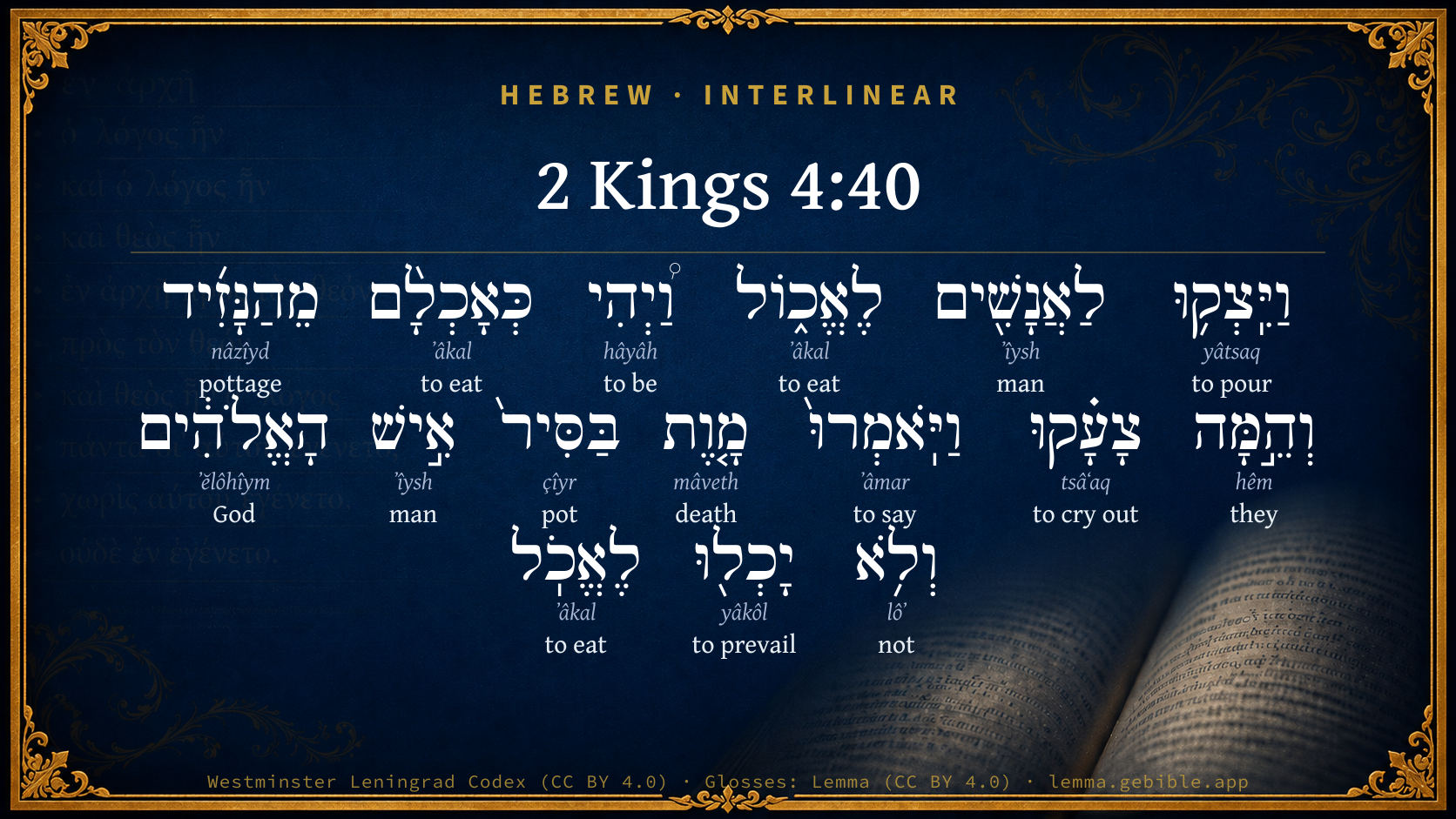
2 Kings 4:40

Hebrew (Westminster Leningrad Codex) 2 Kings 4:40 appears in the Hebrew Old Testament. The text above is from the Westminster Leningrad Codex. Each word links to its Strong’s number, a concise gloss, and parsing drawn from the Open Scriptures Hebrew Bible morphology. Click any word for its full Brown-Driver-Briggs (BDB) entry.
Download image
Cite this verse

2 Kings 4:40 (World English Bible). Public Domain. Lemma interlinear Bible study tool, https://lemma.gebible.app/v/2-kings/4/40.

Show BibTeX & RIS
BibTeX
RIS
English Translation
So they poured out for the men to eat. It happened, as they were eating of the stew, that they cried out, and said, man of God, there is death in the pot. They could not eat of it.
World English Bible · Public Domain
Download a study sheet

One document with this verse’s original text, its word-by-word gloss line, the meaning frame, cross-references with their text, attributed commentary, and full source and license credits — printable, and it pastes into notes with its structure intact.

This verse Autodidact and up

Study sheet (.html) Plain text (.txt)

A passage Seminary Student

Up to 50 verses in one chapter. A passage sheet keeps up to 6 commentary sources and 12 cross-references per verse, in the order this page ranks them, and says so on the sheet whenever that leaves anything out. Ask for a single verse and you get the Autodidact verse sheet above.

Everything on this page stays free to read, with no account — the sheet is a download of what is already on screen, not access to it.

Want to remove ads? Support Godless Engineer
Compare translations 3

The same verse in 3 English versions, stacked beneath the original-language interlinear above. Click any original word for its lexicon entry.

Each is an independent rendering of the whole verse — the interlinear is not word-aligned to these translations.

Highlighted words mark where these versions differ — a whole-verse word diff, not a word-by-word alignment.

  • World English Bible Public Domain
    So they poured out for the men to eat. It happened, as they were eating of the stew, that they cried out, and said, man of God, there is death in the pot. They could not eat of it.
  • King James Version Public Domain
    So they poured out for the men to eat. And it came to pass, as they were eating of the pottage, that they cried out, and said, O thou man of God, there is death in the pot. And they could not eat thereof.
  • unfoldingWord Literal Text CC BY-SA 4.0
    And they poured out for the men to eat. And it happened, as they ate from the stew, that they, they cried out and said, “Death in the pot, man of God!” And they were not able to eat.

unfoldingWord Literal Text — © unfoldingWord, licensed CC BY-SA 4.0. Word-aligned USFM3 via Door43 (git.door43.org/unfoldingWord/en_ult).

Versions to compare (up to 4)

3 of 4 selected

Show all 18 translations

Every available English version of this verse, each an independent rendering of the whole verse.

  • World English Bible Public Domain
    So they poured out for the men to eat. It happened, as they were eating of the stew, that they cried out, and said, man of God, there is death in the pot. They could not eat of it.
  • Berean Standard Bible Public Domain
    And they poured it out for the men to eat, but when they tasted the stew they cried out, “There is death in the pot, O man of God!” And they could not eat it.
  • Majority Standard Bible Public Domain
    And they poured it out for the men to eat, but when they tasted the stew they cried out, “There is death in the pot, O man of God!” And they could not eat it.
  • King James Version Public Domain
    So they poured out for the men to eat. And it came to pass, as they were eating of the pottage, that they cried out, and said, O thou man of God, there is death in the pot. And they could not eat thereof.
  • American Standard Version (1901) Public Domain
    So they poured out for the men to eat. And it came to pass, as they were eating of the pottage, that they cried out, and said, O man of God, there is death in the pot. And they could not eat thereof.
  • Revised Version (1885) Public Domain
    So they poured out for the men to eat. And it came to pass, as they were eating of the pottage, that they cried out, and said, O man of God, there is death in the pot. And they could not eat thereof.
  • Geneva Bible (1599) Public Domain
    So they powred out for the men to eate: and when they did eate of the pottage, they cryed out, and sayde, O thou man of God, death is in the pot: and they could not eate thereof.
  • Douay-Rheims (1899) Public Domain
    And they poured it out for their companions to eat: and when they had tasted of the pottage, they cried out, saying: Death is in the pot, O man of God. And they could not eat thereof.
  • Young's Literal Translation Public Domain
    and they pour out for the men to eat, and it cometh to pass at their eating of the pottage, that they have cried out, and say, `Death `is' in the pot, O man of God!' and they have not been able to eat.
  • Literal Standard Version CC BY-SA 4.0
    and they pour out for the men to eat, and it comes to pass at their eating of the stew, that they have cried out, and say, “Death [is] in the pot, O man of God!” And they have not been able to eat.
  • Unlocked Literal Bible CC BY-SA 4.0
    So they poured out the stew for the men to eat. Later, as they were eating, they cried out and said, “Man of God, there is death in the pot!” So they could not eat it anymore.
  • unfoldingWord Literal Text CC BY-SA 4.0
    And they poured out for the men to eat. And it happened, as they ate from the stew, that they, they cried out and said, “Death in the pot, man of God!” And they were not able to eat.
  • Darby Bible Public Domain
    And they poured out for the men to eat. And it came to pass, as they were eating of the pottage, that they cried out and said, Man of God, there is death in the pot! And they could not eat [it].
  • World Messianic Bible Public Domain
    So they poured out for the men to eat. As they were eating some of the stew, they cried out and said, “Man of God, there is death in the pot!” And they could not eat it.
  • Webster's Bible Public Domain
    So they poured out for the men to eat. And it came to pass, as they were eating of the pottage, that they cried out, and said, O thou man of God, there is death in the pot. And they could not eat of it.
  • Free Bible Version CC BY-SA 4.0
    They served it to the men to eat, but when they tasted the stew they shouted, “There's death in the pot, man of God!” They couldn't eat it.
  • Bible in Basic English Public Domain
    Then they gave the men soup from the pot. And while they were drinking the soup, they gave a cry, and said, O man of God, there is death in the pot; and they were not able to take any more food.
  • JPS Tanakh (1917) Public Domain
    So they poured out for the men to eat. And it came to pass, as they were eating of the pottage, that they cried out, and said: 'O man of God, there is death in the pot.' And they could not eat thereof.

Literal Standard Version (2020), Covenant Press — licensed CC BY-SA 4.0. Text via the HelloAO Bible API (eBible.org). Unlocked Literal Bible (unfoldingWord) — licensed CC BY-SA 4.0. Text via the HelloAO Bible API (eBible.org). unfoldingWord Literal Text — © unfoldingWord, licensed CC BY-SA 4.0. Word-aligned USFM3 via Door43 (git.door43.org/unfoldingWord/en_ult). Free Bible Version, Dr. Jonathan Gallagher — licensed CC BY-SA 4.0. Text via the HelloAO Bible API (eBible.org).

Word by word

More ways to search: Search by grammar → Find every occurrence → Compare this word →

Practice this passage: Drill this verse → Learn its vocabulary →

מֵהַנָּזִ֜יד
nâzîyd
H5138
“from · the · pottage”
Preposition + Particle, Definite Article + Noun, Common, Masculine, Singular, Absolute
Part of Speech
Preposition + Particle + Noun
Type
Common
Gender
Masculine
Number
Singular
State
Absolute
Full BDB Definition

Origin: from H2102

TWOT: 547d

boiled food, soup, pottage, thing sodden or boiled
  1. וַיִּֽצְק֥וּ yâtsaq H3332 “and · to pour” Conjunction + Verb, Qal, Sequential Imperfect, 3rd Person, Masculine, Plural
  2. לַאֲנָשִׁ֖ים ʼîysh H376 “to/for · men” Preposition + Noun, Common, Masculine, Plural, Absolute
  3. לֶאֱכ֑וֹל ʼâkal H398 “to eat” Preposition + Verb, Qal, Infinitive Construct
  4. וַ֠יְהִי hâyâh H1961 “and · to be” Conjunction + Verb, Qal, Sequential Imperfect, 3rd Person, Masculine, Singular
  5. כְּאָכְלָ֨ם ʼâkal H398 “like/as · to eat · them” Preposition + Verb, Qal, Infinitive Construct + Suffix, Personal, 3rd Person, Masculine, Plural
  6. וְהֵ֣מָּה hêm H1992 “and · they” Conjunction + Pronoun, Personal, 3rd Person, Masculine, Plural
  7. צָעָ֗קוּ tsâʻaq H6817 “to cry out” Verb, Qal, Perfect, 3rd Person, Common, Plural
  8. וַיֹּֽאמְרוּ֙ ʼâmar H559 “and · to say” Conjunction + Verb, Qal, Sequential Imperfect, 3rd Person, Masculine, Plural
  9. מָ֤וֶת mâveth H4194 “death” Noun, Common, Masculine, Singular, Absolute
  10. בַּסִּיר֙ çîyr H5518 “in/at the · pot” Preposition, Determined + Noun, Common, Both, Singular, Absolute
  11. אִ֣ישׁ ʼîysh H376 “man of” Noun, Common, Masculine, Singular, Construct
  12. הָאֱלֹהִ֔ים ʼĕlôhîym H430 “the · God(s)” Particle, Definite Article + Noun, Common, Masculine, Plural, Absolute
  13. וְלֹ֥א lôʼ H3808 “and · not” Conjunction + Particle, Negative
  14. יָכְל֖וּ yâkôl H3201 “to prevail” Verb, Qal, Perfect, 3rd Person, Common, Plural
  15. לֶאֱכֹֽל ʼâkal H398 “to eat” Preposition + Verb, Qal, Infinitive Construct

About this verse

These counts appear in no published source. They are computed here, from the morphology-tagged text and Lemma’s own curated glosses. What Lemma adds →

16
words
13
distinct lemmas
Historical
section

Notable vocabulary

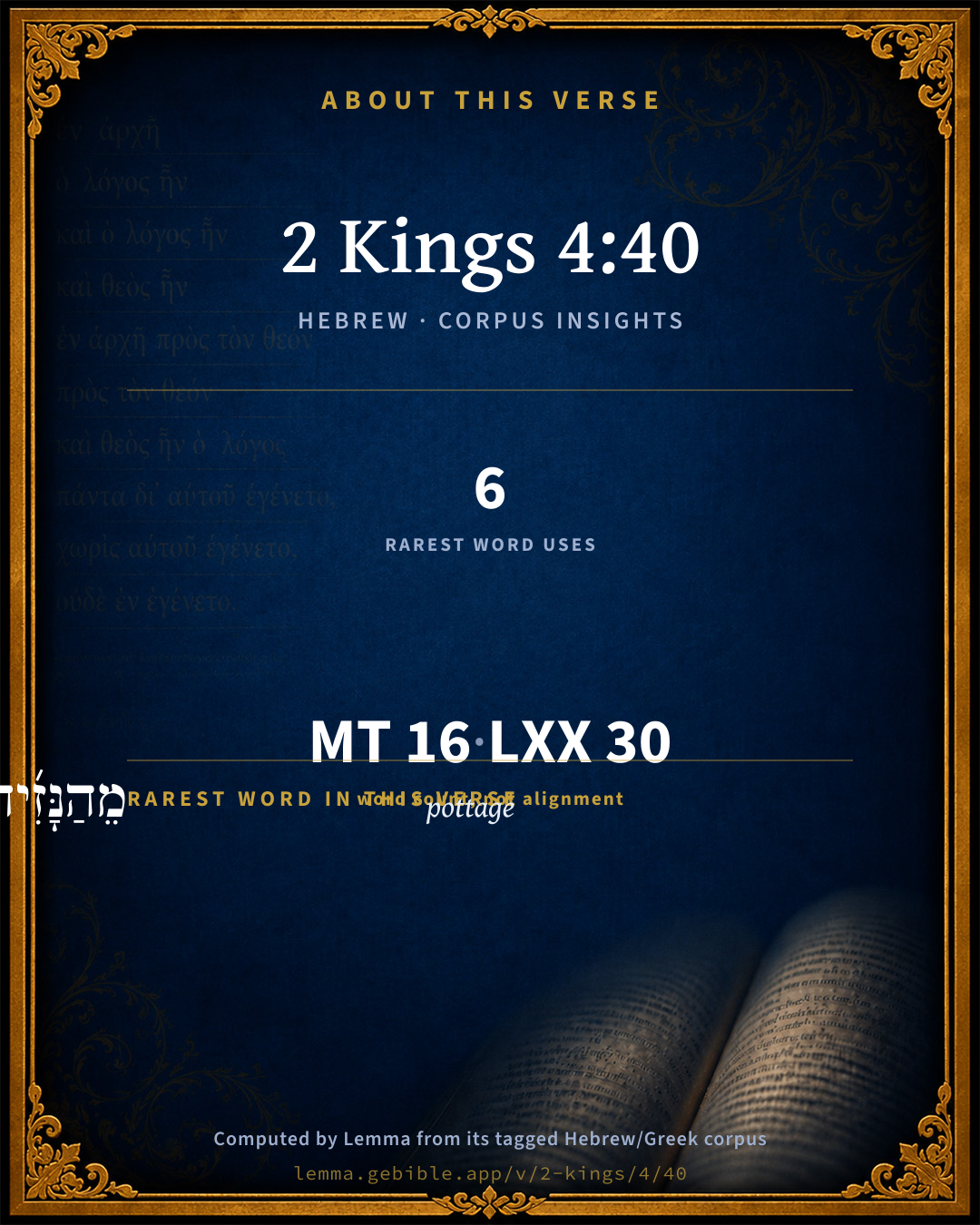
The rarest word here is מֵהַנָּזִ֜יד pottage H5138 — appearing just 6 times in the whole Hebrew Bible.

Shared distinctive vocabulary

מֵהַנָּזִ֜יד pottage H5138 occurs in 6 verses of the Hebrew Bible. Also found in:

Grammatical profile

  • 8 verbs
  • 6 nouns
  • 1 pronoun
  • 1 particle

Verb forms

  • וַיִּֽצְק֥וּ Qal · Sequential Imperfect
  • לֶאֱכ֑וֹל Qal · Infinitive Construct
  • וַ֠יְהִי Qal · Sequential Imperfect
  • כְּאָכְלָ֨ם Qal · Infinitive Construct
  • צָעָ֗קוּ Qal · Perfect
  • וַיֹּֽאמְרוּ֙ Qal · Sequential Imperfect
  • יָכְל֖וּ Qal · Perfect
  • לֶאֱכֹֽל Qal · Infinitive Construct

Repetition

Words recur within this verse — often emphatic in Hebrew:

  • לֶאֱכ֑וֹל to eat H398 ×3
  • לַאֲנָשִׁ֖ים man H376 ×2

Hebrew & Septuagint length

In English translation the verse runs 39 words from the Hebrew and 44 from the Septuagint (LXX English) — closely comparable.

A rough comparison of the two English renderings, which tokenize alike — not a word-level alignment.

Word counts can differ between the Hebrew and the Greek without any difference in meaning — e.g. the Hebrew direct-object marker אֵת has no separate Greek word, and Greek often adds the article ὁ.

In the original languages it is 16 Hebrew tokens and 30 Greek tokens — but the two are counted differently (Hebrew bundles its prefixes and suffixes into one token; the Greek is in lemma form), so that isn’t a like-for-like length.

Cross-references

9

Topical passages linked to 2 Kings 4:40 in the Treasury of Scripture Knowledge — connected by theme and wording, ordered by reader-vote popularity; previews shown in the World English Bible.

  • Mark 16:18 they will take up serpents; and if they drink any deadly thing, it will in no way hurt them; they will lay hands on the sick, and they will recover."
  • Exodus 10:17 Now therefore please forgive my sin again, and pray to Yahweh your God, that he may also take away from me this death."
  • Exodus 15:23 When they came to Marah, they couldn't drink from the waters of Marah, for they were bitter. Therefore the name of it was called Marah.
  • Deuteronomy 33:1 This is the blessing, with which Moses the man of God blessed the children of Israel before his death.
  • 1 Kings 17:18 She said to Elijah, What have I to do with you, you man of God? You have come to me to bring my sin to memory, and to kill my son!
  • 2 Kings 1:11 Again he sent to him another captain of fifty and his fifty. He answered him, man of God, thus has the king said, Come down quickly.
  • 2 Kings 1:13 Again he sent the captain of a third fifty with his fifty. The third captain of fifty went up, and came and fell on his knees before Elijah, and begged him, and said to him, man of God, please let my life, and the life of these fifty your servants, be precious in your sight.
  • 2 Kings 4:9 She said to her husband, See now, I perceive that this is a holy man of God, that passes by us continually.
  • 2 Kings 1:9 Then [the king] sent to him a captain of fifty with his fifty. He went up to him: and, behold, he was sitting on the top of the hill. He spoke to him, man of God, the king has said, Come down.

Cross-references courtesy of OpenBible.info (CC BY 4.0).

Hebrew and Greek witnesses Masoretic Hebrew ↔ Greek Septuagint

The same verse in the two great witnesses to the Old Testament, shown verse-for-verse.

These are two independent witnesses, not word-aligned to each other, and the Septuagint is shown in lemma (dictionary) form.

Hebrew 2 Kings 4:40 Masoretic · Westminster Leningrad Codex

וַיִּֽצְק֥וּ לַאֲנָשִׁ֖ים לֶאֱכ֑וֹל וַ֠יְהִי כְּאָכְלָ֨ם מֵהַנָּזִ֜יד וְהֵ֣מָּה צָעָ֗קוּ וַיֹּֽאמְרוּ֙ מָ֤וֶת בַּסִּיר֙ אִ֣ישׁ הָאֱלֹהִ֔ים וְלֹ֥א יָכְל֖וּ לֶאֱכֹֽל

So they poured out for the men to eat. It happened, as they were eating of the stew, that they cried out, and said, man of God, there is death in the pot. They could not eat of it.

World English Bible · Public Domain

Greek LXX 2 Kings 4:40 Septuagint · lemma form

καί ἐνἔχω ὁ ἀνήρ ἐσθίω καί γίγνομαι ἐν ὁ ἐσθίω αὐτός ἐκ ὁ ἕψεμα καί ἰδού ἀναβοάω καί εἶπον θάνατος ἐν ὁ λέβης ἄνθρωπος ὁ θεός καί οὐ δύναμαι ἐσθίω

And he poured it out for the men to eat: and it came to pass, when they were eating of the pottage, that behold! they cried out, and said, There is death in the pot, O man of God. And they could not eat.

LXX2012 (modern English Septuagint) · Public Domain

Hebrew: Westminster Leningrad Codex (CC BY 4.0). Greek: Septuagint (public domain); English from LXX2012 (modern English Septuagint) (Public Domain). How the Septuagint differs from the Hebrew →

Targum (Aramaic paraphrase)

1

The Targum is the ancient Jewish Aramaic paraphrase of the Hebrew Scriptures — an interpretive translation, not the Hebrew text itself. Onkelos (literal) and Pseudo-Jonathan (expansive) render the Torah, and Jonathan the Prophets. Coverage is partial: where no permissively-licensed English translation exists for a verse, only the Aramaic is shown. This is verse-level text, not a word-by-word alignment to the Hebrew.

  1. Targum Jonathan Prophets (Joshua–Malachi)
    וַאֲרִיקוּ לְגַבְרַיָא לְמֵיכַל וַהֲוָה כְּמֵיכַלְהוֹן מִתַּבְשִׁילָא וְאִינוּן צְוָחוּ וַאֲמַרוּ מוֹתָא בְדוּדָא נְבִיָא דַייָ וְלָא יְכִילוּ לְמֵיכַל:

    (no public-domain English translation for this verse)

    Targum Jonathan — Aramaic: “Mikraot Gedolot” (public domain). English: “Sefaria Community Translation” (CC0 1.0 (public-domain dedication)); “London "Chaldee Paraphrase," 1871” (public domain). Text via Sefaria.

Commentary

Notes on 2 Kings 4:40 from classic Christian and Jewish commentators (each source and its license shown beneath its notes). The classic Christian expositions comment on the surrounding passage and are grouped to its opening verse, so a note may address several verses; the Jewish commentaries on the Tanakh (Rashi and others) are per-verse, so they appear only where the commentator wrote on this verse.

Lemma curates 59 commentaries, every one of them public domain or Creative Commons licensed, each selected and text-cleaned for this edition rather than reprinted as found. About our sources →

Trapp's Complete Commentary

John Trapp

2Ki 4:40 So they poured out for the men to eat. And it came to pass, as they were eating of the pottage, that they cried out, and said, O [thou] man of God, [there is] death in the pot. And they could not eat [thereof].

Ver. 40. Death in the pot.] For this drug is not only bitter, but poisonous and pernicious, causing cruel torments.

John Trapp, A Commentary or Exposition upon All the Books of the Old and New Testament (1647–1656) — public domain. Text from a community e-Sword module.

The Biblical Illustrator

Joseph S. Exell

2Ki_4:40-41

There is death in the pot.

Poisons

Nature grows poison as well as food. The sons of the prophets little knew the hurtful quality of the food that was being poured into the pot. In all things nature has its poisonous side as well as its sustaining and comforting aspect. The bane and antidote are both before us in nature. Death lies very near to life in the great open fields. Even our most natural passions lie but a single step from their destructive application. Can it be possible that a son of the prophets went out to gather food for a natural appetite, and came back with poison? This is what is being done every day. We may turn honest commerce into a means of felony. We may go into the market-place to buy food, and yet by some action we may perpetrate in connection with the purchase we may take all virtue out of the food and make it contribute to our worst qualifies. Blessed are they who eat honest bread: everywhere the great law of trespass is written in nature. By putting poisons upon the earth so plentifully, what does the Lord say in effect but, Take care, be wise, examine your standing-ground, and do nothing foolishly? Thus nature is turned into a great training-school, within whose walls men are trained to sagacity and discrimination, so that they may know the right hand from the left, and the good from the bad, and thus may turn natural processes and customary daily duties into means of culture. (J. Parker, D. D.)

Poison in the cauldron

There are now in the world a great many cauldrons of death. The coloquintida of mighty temptations fills them. Some taste and quit, and are saved; others taste and eat on, and die. Is not that minister of Christ doing the right thing when he points out these cauldrons of iniquity and cries the alarm, saying, Beware! There is death in the pot? Iniquity is a coarse, jagged thing, that needs to be roughly handled. I want to go back of all public iniquity and find out its hiding-place. I want to know what are the sources of its power.

I. Unhappy and undisciplined homes are the source of much iniquity. A good home is deathless in its influences. Parents may be gone. The old homestead may be sold and have passed out of the possession of the family. Yet that place will never lose its charm over your soul. That first earthly home will thrill through your everlasting career. Rascally and vagabond people for the most part come forth from unhappy homes. Parents harsh and cruel on the one hand, or on the other lenient to perfect looseness, are raising up a generation of vipers. A home in which scolding and fault-finding predominate is blood relation to the gallows and penitentiary. Petulance is a reptile that may crawl up into the family nest and crush it. There are parents who disgust their children even with religion. They scold their little ones for not loving God. They go about even their religious duties in an exasperating way. Their house is full of the war-whoop of contention, and from such scenes husbands and children dash out into places of dissipation to find their lost peace, or the peace they never had. I verily believe that three-fourths of the wickedness of the great city runs out rank and putrid from undisciplined homes. Sometimes I know there is an exception.

II. The second cauldron of iniquity to which I point you is an indolent life. You will get out of this world just so much as, under God, you earn by your own hand and brain. Horatius was told he might have so much land as he could plough around in one day with a yoke of oxen, and I have noticed that men get nothing in this world, that is worth possessing, of a financial, moral, or spiritual nature, save they get it by their own hard work. It is lust so much as, from the morning to the evening of your life, you can plough around by your own continuous and hard-sweating industries. Go to the ant, thou sluggard, consider her ways, and be wise.

III. Another cauldron of iniquity is the dram-shop. Surely there is death in the pot. Anacharsis said that the vine had three grapes: pleasure, drunkenness, misery. Then I remember what Gladstone, the Prime Minister of England, said to a committee of men engaged in that traffic when they came to him to deplore that they were not treated with more consideration: Gentlemen, dont be uneasy about the revenue. Give me thirty million sober people, and I will pay all the revenue, and have a large surplus. But the ruin to property is a very small part of the evil. It takes everything that is sacred in the family, everything that is holy in religion, everything that is infinite in the soul, and tramples it into the mire. (T. De Witt Talmage, D. D.)

The deadly pottage

The acts of Elisha are like rays of divine glory shining through his poverty and humiliation. Elisha came again to Gilgal: and there was a dearth in the land. This is a picture of our world. Dearth is on every side. Of every stream that runs through it it may indeed be said, Whosoever drinketh of this water shall thirst again. But in the midst of this dearth Elisha has a table spread for all his children. So the Lord Jesus has a table for His children in this land of dearth. And mark, this table is especially prepared not for Elisha but for the sons of the prophets. The Lord takes care of His children. In the desert they shall never want. But in this land of dearth there is always danger near. The poison is always liable to find its way into the feast of the Lord. And so it was here. And one went out into the field to gather herbs. But here lies the danger: we are poor, weak, blind creatures, and the wild vine mingles with the true everywhere around us. Worst of all, we know it not. And the danger is worse from the fact of it being a vine. If it were a thorn, a thistle, or some growth bearing the danger on its very front, we should avoid it. There would be no temptation to stoop down and gather it. But it is not from the thorn or the thistle that the danger arises. And is it not so still? Our danger lies not in the open blasphemer, the avowed atheist; not in the open vice, or profligacy, or crime; not in the sin that lifts itself up with unblushing front in our way. These are the thorn and the thistle that carry their own character on the surface. No; our danger lies in that which is so like the vine and yet not it. It lies in that which looks so good, so Christian, so generous, so liberal, so praiseworthy--Rationalism under a great display of the love of Christ, yet denying the innate depravity of the heart. It lies in the theatre, the ball, the concert, under the specious gilding of charity. It lies in the worlds follies and amusements, while yet maintaining family prayer, regular attendance at church and its ordinances. In these and a thousand other ways we see the wild vine. We think it is the true vine, and so, like the man here, we gather plenty of it. We carry the poison home with us. We shred it into the pottage. We carry the spirit of the wild vine into our hearts, our thoughts, our spirit, our whole life. And what was it we needed? To see the true character of this vine that it was wild; to see the true nature of these gourds that they were deadly. Yes, we wanted more spiritual sight, more prayer, more communion with God, more distrustfulness of self, more watchfulness, more of the Spirit of God. For lack of these we were unable to distinguish between the true vine and the wild, between Christ and mere religion, between Christ and popular Christianity, between Christ and mere benevolence and charity, between Christ and the world. There is death in the pot!--everywhere Gods truth blended with wild gourds. In ten thousand different forms it is presented to us--in the Church and in the world, in doctrines, in preaching, in services, in private life and public life, at home and abroad. So they poured out for the men to eat. How many in this day do the same thing! They literally pour out this mixture of truth and error, light and darkness,--Christ and the world, self and Jesus, for men to drink! In the day in which we are living, this blending of opposites and pouring them out for men to drink is most conspicuous. And it will become more and more so. Strict and clearly drawn lines are not palatable to mans fallen nature. The death in the pot was only discovered in the eating. And then it is said, they could not eat thereof. It is so still. It is in the eating that the proof lies. It is when the soul tries to enjoy Christ and the world it finds out the death--that is, if there be any conscience left, if it has ever known,, the joy of Gods presence. Then it feels how impossible is this blending. Ye cannot serve God and mammon. It is then that the soul of the true child of God feels the force of this cannot. We say it again: if the man has ever tasted the joy of Gods presence, of abiding communion with Him, and if there is any conscience left in harmony with this, then it will be felt most keenly that there is death in the pot; then it will be felt that he cannot live nor grow in grace on this mingling of wild gourds with the pottage of the Lord. A spiritually sensitive soul will feel that, to enjoy the feast of the Lord, it must draw sharp lines between truth and error, light and darkness, Christ and the world. There is death in the pot will be felt, and there will be found no real food but in the true vine, Christ alone. We notice here that the Divine mode of healing is not by taking out the evil, but by putting in something to counteract it. When Elisha found the spring of Jericho bad he did not strive to draw out the evil, but put in the salt to counteract it. When Moses found the waters of Marah bitter he put in the tree to sweeten them. Throughout the Bible this is Gods way. Mans is exactly the opposite. He begins by cutting off what he conceives to be the fruitless branches. He begins by reformation, forgetting that it is not reformation man needs, but revolution. Thus man cuts off the branches and leaves the tree unchanged. God lays the axe at the root of the tree. The Holy Spirit is given to the sinner. It is a new and Divine power working from within. It is the meal cast into the pot, the tree cast into the bitter waters. Thus Gods new creation begins. Hence the spiritual conflict--a redeemed soul in an unredeemed body--the new nature inside the old. Hence the struggle, the agony, the cry, O wretched man that I am! This goes on to the end, for the old nature is never made new. It is the old Adam to the last. When the Lord comes again we shall then have the redeemed body. This body will match the redeemed soul, and the conflict will end. Not till then. There will then be a redeemed soul in a redeemed body, and its result everlasting joy and blessedness. What is this meal? It is, spiritually, Christ. It is the Holy Spirit bringing Christ into the soul, into the house, into the duty, into all things. Christ is the one great antidote to all error. Christ is the life of all things. He that eateth Me, he shall live by Me. The soul will find food in everything where He is, but it will starve without. (F. Whitfield, M. A.)

The poisonous pottage healed

Notice here--

I. A supernatural interposition to counteract a natural mistake. When the Son of God was invited to the marriage feast in Cana, He found there had been a mistake on the part of the provider as to the quantity of wine required, and He rectified the mistake by making more. Here the mistake was not in the quantity; there was enough--there was too much there was death in the pot. But the mistake was in the quality of the food, and was such a mistake as could be rectified by supernatural intervention only.

II. A supernatural intervention watch did not take place until the very moment when it was needed. And as they were eating, etc. (2Ki_4:40). Mans extremity is often reached before God interposes. The wine was quite exhausted at Cana before the Saviour made more. Abrahams knife was lifted to slay his son, when the angel of Jehovah called to him (Gen_22:11). Israel came to the very border of the Red Sea before the waters were divided. So here the hungry men tasted the pottage before the miracle was wrought.

III. A supernatural intervention in which human effort was required to be put forth. When Jesus was about to raise Lazarus, He said, Take ye away the stone. So in the miracle at Cana, Fill the water-pots with water. Elisha could have rendered the pottage harmless by the power of God without the meal, and the Saviour could have filled empty water-pots with wine quite as easily as those filled with water. But human effort must do what it can. Lessons:

1. Mistakes made through mans ignorance can be made right by Divine power and wisdom.

2. Sincerity of purpose and good intentions are no guarantees of the harmlessness of actions.

3. We ought to seek to know for what work we are qualified. The man who volunteered to gather herbs for the pottage might have been well fitted for other work; but his undertaking that for which ignorance of the nature of herbs disqualified him had well-nigh been the death of all the sons of the prophets. (Outlines of Sermons.)

Inexorableness of law

Gods laws will not be suspended to accommodate our disobediences, or indolences, or ignorances, or mistakes. If you sweeten your coffee with arsenic, it will kill you as surely that you did it by mistake as if you did it of wilful purpose. Natures commandment is, Thou shalt not make mistakes, thou shalt not be ignorant, thou shalt not be deceived, thou shalt not transgress any natural law.

The Biblical Illustrator, edited by Joseph S. Exell (c. 1880s–1900s) — public domain. Text from a community e-Sword module.

Geneva Bible (1599)

Geneva Bible translators

They feared that they were poisoned, because of the bitterness.

Geneva Bible (1599) marginal notes — public domain. Text via Bolls.life.

Adam Clarke's Commentary

Verse 40. There is death in the pot.] As if they had said, "We have here a deadly mixture; if we eat of it, we shall all die."

Adam Clarke's Commentary on the Bible (1810–1826) — public domain. Text from a community e-Sword/MySword module.

Ellicott's Commentary for English Readers

(40) There is death in the pot.—The bitter taste, and perhaps incipient effect of the pottage, made them think of poison.

A Bible Commentary for English Readers, edited by Charles John Ellicott (1878–1897) — public domain. Text from a community e-Sword module.

The Cambridge Bible for Schools and Colleges

gen. ed. J. J. S. Perowne

40. they cried out] The bitter taste shewed them that something was wrong, and their thoughts at once suggested that what they had eaten was poisonous. The fruit of the colocynth would produce sickness very soon, but there is no reason to suppose that there was enough in the pottage to kill.

O thou man of God] The R.V. omits ‘thou’, and thus improves both rhythm and language.

they could not eat thereof] They had only just tasted the noxious dish and so no ill effects had followed.

The Cambridge Bible for Schools and Colleges (gen. ed. J. J. S. Perowne; Cambridge University Press, 1878–1918) — public domain. Text from a community e-Sword module.

John Gill's Exposition

So they poured out for the men to eat,.... When the pottage was boiled, they poured it out into dishes or basins, for the sons of the prophets to eat:

and it came to pass, as they were eating of the pottage, that they cried out, and said, O thou man of God, there is death in the pot; poison, the cause of death; the pottage was so exceeding bitter, that they concluded there must be some poisonous herb in it; and coloquintida is so bitter, that it is called "the gall of the earth":

and they could not eat thereof: they stopped eating, it being so very disagreeable, and, as they supposed, dangerous.

John Gill's Exposition of the Whole Bible (1746–1763) — public domain (CC PDM 1.0). Text via the HelloAO Bible API.

Haydock's Catholic Bible Commentary

Death, poison, &c. Matthiole accounts this fruit poisonous.

George Leo Haydock (1774–1849), Haydock's Catholic Family Bible and Commentary, 1859 edition — public domain. Excludes Psalms (Douay-Rheims chapter numbering differs from Protestant) and Deuterocanonical books (Catholic canon only).

Matthew Poole's English Annotations

There is death in the pot, i.e. some deadly thing; which they gathered from its excessive bitterness, by which possibly some of them might discern what it was.

Matthew Poole's English Annotations on the Holy Bible (1683–1685) — public domain. Text from a community e-Sword/MySword module.

Whedon's Commentary on the Bible

Daniel D. Whedon

40. Death in the pot — That is, some deadly poison. We need not suppose that there was any thing really poisonous in the pot, but the extreme bitterness of the wild gourds, which had been mistaken for oroth, caused their alarm, and they at once supposed that the pottage was really poisoned.

Daniel D. Whedon (gen. ed.), Commentary on the Old and New Testaments (1874–1909) — public domain. Text from a community e-Sword module.

The Pulpit Commentary

So they poured out for the men to eat. And it came to pass, as they were eating of the pottage, that they cried out and said, O thou man of God, there is death in the pot. Either the bitter flavor alarmed them, or they began to feel ill effects from what they had swallowed, which, if it was colocynth, might very soon have produced stomachache or nausea. Rushing, therefore, at once to the worst possible supposition, they concluded that they were poisoned, and exclaimed, "O man of God, there is death in the pot!" "If eaten in any large quantity," says Keil, "colocynths might really produce death." And they could not eat thereof; i.e. they could not continue to eat the pottage all stopped eating.

The Pulpit Commentary (1880–1919), ed. H.D.M. Spence-Jones & Joseph S. Exell — public domain. Text from a community e-Sword module.

John Wesley's Explanatory Notes

Death - That is, some deadly thing.

John Wesley, Explanatory Notes Upon the Whole Bible (1754–1765) — public domain. Text via the GEBible commentary corpus.

unfoldingWord translationNotes

Door43 World Missions Community

they poured out the stew

"they poured the stew into bowls"

there is death in the pot

This means that there was something in the pot that could kill them, not that there is something dead in the pot. AT: "there is something in the pot that will kill us" (See: Metonymy)

He threw it into the pot

"He added it to the stew in the pot"

Pour it out for the people

"Serve it to the people"

unfoldingWord translationNotes — © Distant Shores Media and the Door43 World Missions Community, licensed CC BY-SA 4.0. Source: git.door43.org/Door43/en_tn.

Lesson kit

Teaching starters — assembled from the data on this page, not authored interpretation. Every prompt links to the verse data it draws on. Edit before teaching.

2 Kings, in the Historical, opens this verse with 16 words (13 distinct Hebrew lemmas). Its most distinctive word is nâzîyd (“pottage”). A historical commentator’s framing appears above. Read the whole chapter for the surrounding context.

Discussion questions

  1. The word nâzîyd carries the sense “pottage.” How does it shape the verse?
  2. Genesis 25:29 shares the word «pottage» with this verse. How do the two illuminate each other?
  3. “to eat” occurs 3× in this one verse. What is the effect of the repetition?
  4. These translations render this verse differently. What is at stake in choosing one wording over another?
  5. The verb «וַיִּֽצְק֥וּ» is Qal Sequential Imperfect. How does its form color the action?
  6. Reading how Trapp's Complete Commentary and The Biblical Illustrator read this verse, where do the two commentators agree and where do they part?

Things to notice

Reading settings

Reading text

Shown beneath each verse's original-language words.

Old Testament
Old Testament edition

Read the OT as the Masoretic Hebrew (MT) or the Greek Septuagint (LXX).

English shown for the Greek Septuagint (in the Hebrew ↔ Greek comparison).

Comparing translations? Open the Compare panel on any verse page to stack up to four side by side.