
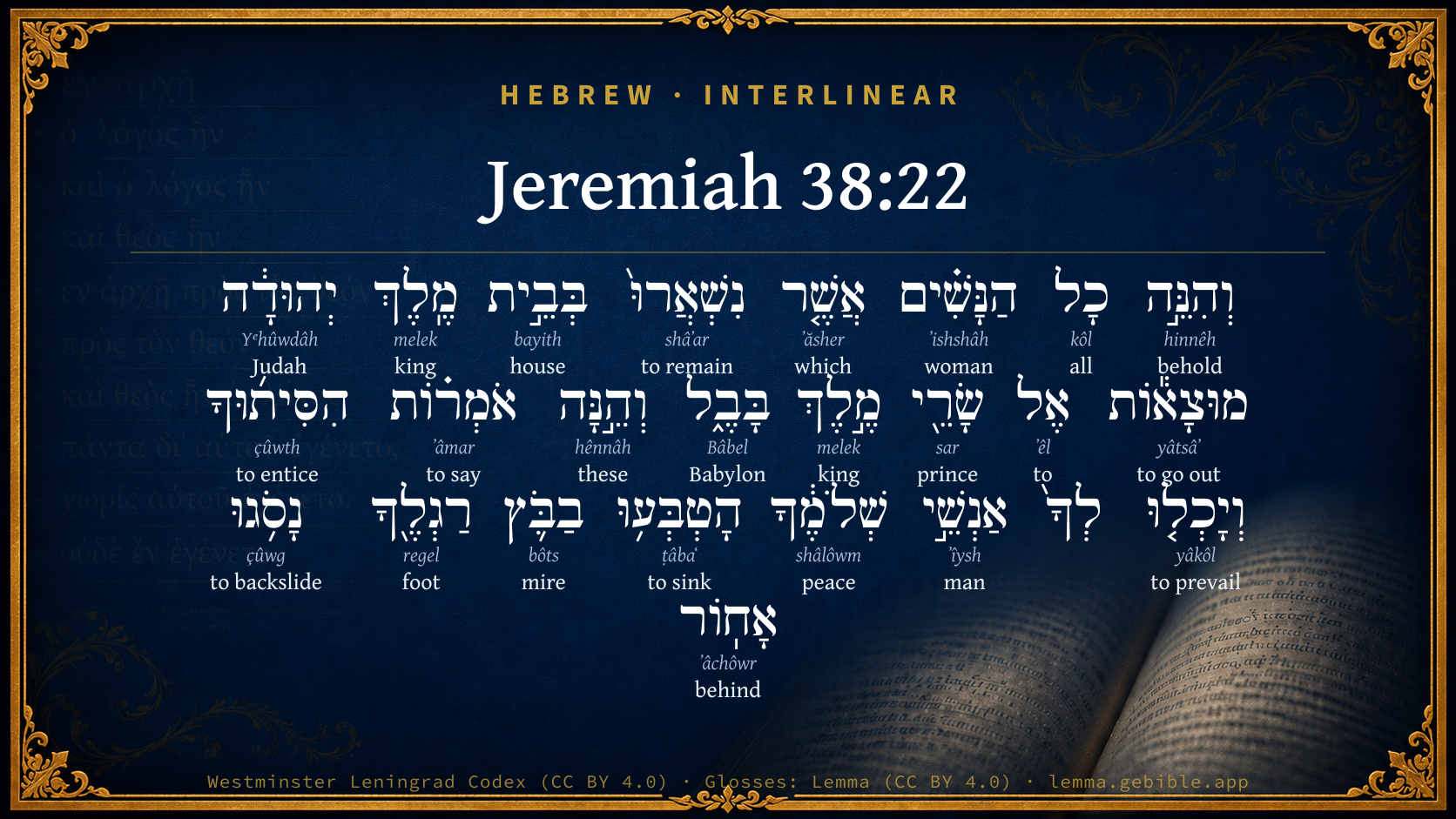
Jeremiah 38:22

Hebrew (Westminster Leningrad Codex) Jeremiah 38:22 appears in the Hebrew Old Testament. The text above is from the Westminster Leningrad Codex. Each word links to its Strong’s number, a concise gloss, and parsing drawn from the Open Scriptures Hebrew Bible morphology. Click any word for its full Brown-Driver-Briggs (BDB) entry.
Download image
Cite this verse

Jeremiah 38:22 (World English Bible). Public Domain. Lemma interlinear Bible study tool, https://lemma.gebible.app/v/jeremiah/38/22.

Show BibTeX & RIS
BibTeX
RIS
English Translation
behold, all the women who are left in the king of Judah's house shall be brought forth to the king of Babylon's princes, and those women shall say, Your familiar friends have set you on, and have prevailed over you: [now that] your feet are sunk in the mire, they are turned away back.
World English Bible · Public Domain
Highlights
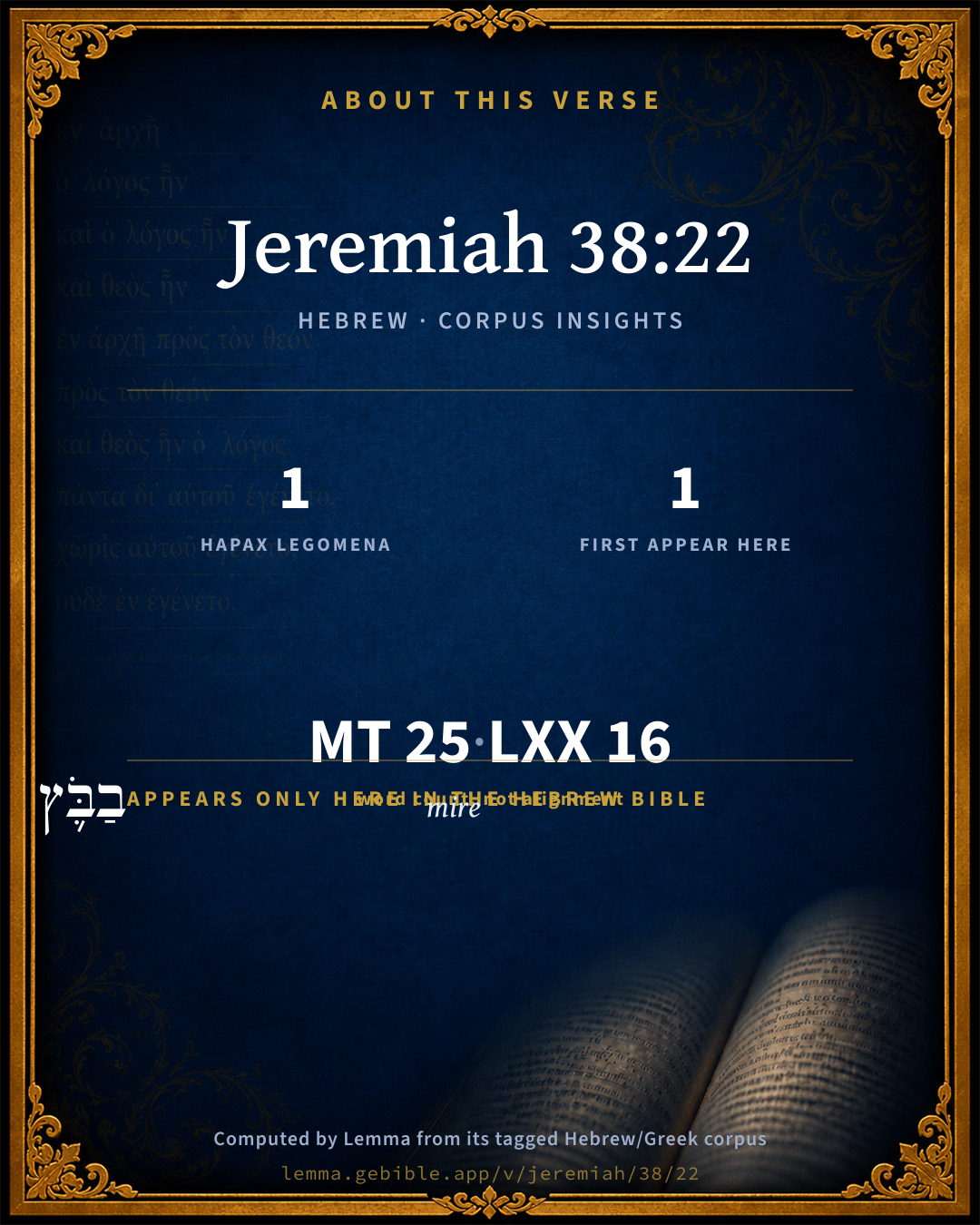
  • 1 hapax legomenon — only here in the Hebrew Bible
  • 1 first appearance in the Hebrew Bible
Full analysis ↓
Download a study sheet

One document with this verse’s original text, its word-by-word gloss line, the meaning frame, cross-references with their text, attributed commentary, and full source and license credits — printable, and it pastes into notes with its structure intact.

This verse Autodidact and up

Study sheet (.html) Plain text (.txt)

A passage Seminary Student

Up to 50 verses in one chapter. A passage sheet keeps up to 6 commentary sources and 12 cross-references per verse, in the order this page ranks them, and says so on the sheet whenever that leaves anything out. Ask for a single verse and you get the Autodidact verse sheet above.

Everything on this page stays free to read, with no account — the sheet is a download of what is already on screen, not access to it.

Want to remove ads? Support Godless Engineer
Compare translations 3

The same verse in 3 English versions, stacked beneath the original-language interlinear above. Click any original word for its lexicon entry.

Each is an independent rendering of the whole verse — the interlinear is not word-aligned to these translations.

Highlighted words mark where these versions differ — a whole-verse word diff, not a word-by-word alignment.

  • World English Bible Public Domain
    behold, all the women who are left in the king of Judah's house shall be brought forth to the king of Babylon's princes, and those women shall say, Your familiar friends have set you on, and have prevailed over you: [now that] your feet are sunk in the mire, they are turned away back.
  • King James Version Public Domain
    And, behold, all the women that are left in the king of Judah's house shall be brought forth to the king of Babylon's princes, and those women shall say, Thy friends have set thee on, and have prevailed against thee: thy feet are sunk in the mire, and they are turned away back.
  • unfoldingWord Literal Text CC BY-SA 4.0
    Look! All the women who are left in your house, king of Judah, will be brought out to the officials of the king of Babylon. These women will say to you, ‘You have been deceived by your friends; they have ruined you. Your feet are now sunk into the mud, and your friends will run away.’

unfoldingWord Literal Text — © unfoldingWord, licensed CC BY-SA 4.0. Word-aligned USFM3 via Door43 (git.door43.org/unfoldingWord/en_ult).

Versions to compare (up to 4)

3 of 4 selected

Show all 18 translations

Every available English version of this verse, each an independent rendering of the whole verse.

  • World English Bible Public Domain
    behold, all the women who are left in the king of Judah's house shall be brought forth to the king of Babylon's princes, and those women shall say, Your familiar friends have set you on, and have prevailed over you: [now that] your feet are sunk in the mire, they are turned away back.
  • Berean Standard Bible Public Domain
    All the women who remain in the palace of the king of Judah will be brought out to the officials of the king of Babylon, and those women will say: ‘They misled you and overcame you—those trusted friends of yours. Your feet sank into the mire, and they deserted you.’
  • Majority Standard Bible Public Domain
    All the women who remain in the palace of the king of Judah will be brought out to the officials of the king of Babylon, and those women will say: ‘They misled you and overcame you—those trusted friends of yours. Your feet sank into the mire, and they deserted you.’
  • King James Version Public Domain
    And, behold, all the women that are left in the king of Judah's house shall be brought forth to the king of Babylon's princes, and those women shall say, Thy friends have set thee on, and have prevailed against thee: thy feet are sunk in the mire, and they are turned away back.
  • American Standard Version (1901) Public Domain
    behold, all the women that are left in the king of Judah's house shall be brought forth to the king of Babylon's princes, and those women shall say, Thy familiar friends have set thee on, and have prevailed over thee: `now that' thy feet are sunk in the mire, they are turned away back.
  • Revised Version (1885) Public Domain
    behold, all the women that are left in the king of Judah’s house shall be brought forth to the king of Babylon’s princes, and those women shall say, Thy familiar friends have set thee on, and have prevailed over thee: now that thy feet are sunk in the mire: they are turned away back.
  • Geneva Bible (1599) Public Domain
    And beholde, all the women that are left in the King of Iudahs house, shalbe brought forth to the King of Babels princes: and those women shall say, Thy friends haue perswaded thee, and haue preuailed against thee: thy feete are fastened in the myre, and they are turned backe.
  • Douay-Rheims (1899) Public Domain
    Behold all the women that are left in the house of the king of Juda, shall be brought out to the princes of the king of Babylon: and they shall say: Thy men of peace have deceived thee, and have prevailed against thee, they have plunged thy feet in the mire, and in a slippery place, and they have departed from thee.
  • Young's Literal Translation Public Domain
    That, lo, all the women who have been left in the house of the king of Judah are brought forth unto the heads of the king of Babylon, and lo, they are saying: Persuaded thee, and prevailed against thee, Have thine allies, Sunk into mire have thy feet, They have been turned backward.
  • Literal Standard Version CC BY-SA 4.0
    That, behold, all the women who have been left in the house of the king of Judah are brought forth to the heads of the king of Babylon, and behold, they are saying: Persuaded you, and prevailed against you, || Have your allies, || Your feet have sunk into mire, || They have been turned backward.
  • Unlocked Literal Bible CC BY-SA 4.0
    Look! All the women who are left in your house, king of Judah, will be brought out to the officials of the king of Babylon. These women will say to you, 'You have been deceived by your friends; they have ruined you. Your feet are now sunk into the mud, and your friends will run away.'
  • unfoldingWord Literal Text CC BY-SA 4.0
    Look! All the women who are left in your house, king of Judah, will be brought out to the officials of the king of Babylon. These women will say to you, ‘You have been deceived by your friends; they have ruined you. Your feet are now sunk into the mud, and your friends will run away.’
  • Darby Bible Public Domain
    Behold, all the women that are left in the king of Judah's house shall be brought forth to the king of Babylon's princes; and they shall say, Thy familiar friends have set thee on, and have prevailed over thee; thy feet are sunk in the mire, they are turned away back.
  • World Messianic Bible Public Domain
    ‘Behold, all the women who are left in the king of Judah’s house will be brought out to the king of Babylon’s princes, and those women will say, “Your familiar friends have turned on you, and have prevailed over you. Your feet are sunk in the mire, they have turned away from you.”
  • Webster's Bible Public Domain
    And behold, all the women that are left in the king of Judah's house shall be brought forth to the king of Babylon's princes, and those women shall say, Thy friends have set thee on, and have prevailed against thee: thy feet are sunk in the mire, and they are turned away back.
  • Free Bible Version CC BY-SA 4.0
    All the women who are left in the palace of the king of Judah will be led out and handed over to the officials of the king of Babylon Those women will say: ‘Those good friends of yours! You were taken in by them and conquered by them. Your feet got stuck in the mud, so they abandoned you.’
  • Bible in Basic English Public Domain
    See, all the rest of the women in the house of the king of Judah will be taken out to the king of Babylon's captains, and these women will say, Your nearest friends have been false to you and have got the better of you: they have made your feet go deep into the wet earth, and they are turned away back from you.
  • JPS Tanakh (1917) Public Domain
    Behold, all the women that are left in the king of Judah's house shall be brought forth to the king of Babylon's princes, and those women shall say: Thy familiar friends have set thee on, and have prevailed over thee; thy feet are sunk in the mire, and they are turned away back.

Literal Standard Version (2020), Covenant Press — licensed CC BY-SA 4.0. Text via the HelloAO Bible API (eBible.org). Unlocked Literal Bible (unfoldingWord) — licensed CC BY-SA 4.0. Text via the HelloAO Bible API (eBible.org). unfoldingWord Literal Text — © unfoldingWord, licensed CC BY-SA 4.0. Word-aligned USFM3 via Door43 (git.door43.org/unfoldingWord/en_ult). Free Bible Version, Dr. Jonathan Gallagher — licensed CC BY-SA 4.0. Text via the HelloAO Bible API (eBible.org).

Word by word

More ways to search: Search by grammar → Find every occurrence → Compare this word →

Practice this passage: Drill this verse → Learn its vocabulary →

בַבֹּ֛ץ
bôts
H1206
“in/at the · mire”
Preposition, Determined + Noun, Common, Masculine, Singular, Absolute
Part of Speech
Preposition + Noun
Type
Common
Gender
Masculine
Number
Singular
State
Absolute
Full BDB Definition

Origin: probably the same as H948

TWOT: 268a

mire
  1. וְהִנֵּ֣ה hinnêh H2009 “and · behold” Conjunction + Particle, Demonstrative
  2. כָל kôl H3605 “all of” Noun, Common, Masculine, Singular, Construct
  3. הַנָּשִׁ֗ים ʼishshâh H802 “the · women” Particle, Definite Article + Noun, Common, Feminine, Plural, Absolute
  4. אֲשֶׁ֤ר ʼăsher H834 “which” Particle, Relative
  5. נִשְׁאֲרוּ֙ shâʼar H7604 “to remain” Verb, Niphal, Perfect, 3rd Person, Common, Plural
  6. בְּבֵ֣ית bayith H1004 “in/at · house of” Preposition + Noun, Common, Masculine, Singular, Construct
  7. מֶֽלֶךְ melek H4428 “king of” Noun, Common, Masculine, Singular, Construct
  8. יְהוּדָ֔ה Yᵉhûwdâh H3063 “Judah” Noun, Proper
  9. מוּצָא֕וֹת yâtsâʼ H3318 “gone out” Verb, Hophal, Participle Passive, Feminine, Plural, Absolute
  10. אֶל ʼêl H413 “to” Preposition
  11. שָׂרֵ֖י sar H8269 “princes of” Noun, Common, Masculine, Plural, Construct
  12. מֶ֣לֶךְ melek H4428 “king of” Noun, Common, Masculine, Singular, Construct
  13. בָּבֶ֑ל Bâbel H894 “Babylon” Noun, Proper
  14. וְהֵ֣נָּה hênnâh H2007 “and · these” Conjunction + Pronoun, Personal, 3rd Person, Feminine, Plural
  15. אֹמְר֗וֹת ʼâmar H559 “saying” Verb, Qal, Participle Active, Feminine, Plural, Absolute
  16. הִסִּית֜וּךָ çûwth H5496 “to entice · you” Verb, Hiphil, Perfect, 3rd Person, Common, Plural + Suffix, Personal, 2nd Person, Masculine, Singular
  17. וְיָכְל֤וּ yâkôl H3201 “and · to prevail” Conjunction + Verb, Qal, Perfect, 3rd Person, Common, Plural
  18. אַנְשֵׁ֣י ʼîysh H376 “men of” Noun, Common, Masculine, Plural, Construct
  19. שְׁלֹמֶ֔ךָ shâlôwm H7965 “peace · your” Noun, Common, Masculine, Singular, Construct + Suffix, Personal, 2nd Person, Masculine, Singular
  20. הָטְבְּע֥וּ ṭâbaʻ H2883 “to sink” Verb, Hophal, Perfect, 3rd Person, Common, Plural
  21. רַגְלֶ֖ךָ regel H7272 “feet · your” Noun, Common, Feminine, Dual, Construct + Suffix, Personal, 2nd Person, Masculine, Singular
  22. נָסֹ֥גוּ çûwg H5472 “to backslide” Verb, Niphal, Perfect, 3rd Person, Common, Plural
  23. אָחֽוֹר ʼâchôwr H268 “behind” Noun, Common, Masculine, Singular, Absolute

About this verse

These counts appear in no published source. They are computed here, from the morphology-tagged text and Lemma’s own curated glosses. What Lemma adds →

25
words
23
distinct lemmas
Prophets
section

Notable vocabulary

1 hapax legomenon — a word that appears only here in the entire Hebrew Bible:

  • בַבֹּ֛ץ mire H1206

First appearance in Scripture

This word makes its first canonical appearance in the Hebrew Bible here:

  • בַבֹּ֛ץ mire H1206

Shared distinctive vocabulary

הָטְבְּע֥וּ to sink H2883 occurs in 10 verses of the Hebrew Bible. Also found in:

Grammatical profile

  • 7 verbs
  • 13 nouns
  • 1 pronoun
  • 2 prepositions
  • 2 particles

Verb forms

  • נִשְׁאֲרוּ֙ Niphal · Perfect
  • מוּצָא֕וֹת Hophal · Participle Passive
  • אֹמְר֗וֹת Qal · Participle Active
  • הִסִּית֜וּךָ Hiphil · Perfect
  • וְיָכְל֤וּ Qal · Perfect
  • הָטְבְּע֥וּ Hophal · Perfect
  • נָסֹ֥גוּ Niphal · Perfect

Repetition

A word recurs within this verse — often emphatic in Hebrew:

  • מֶֽלֶךְ king H4428 ×2

Hebrew & Septuagint length

In the original languages it is 25 Hebrew tokens and 16 Greek tokens — but the two are counted differently (Hebrew bundles its prefixes and suffixes into one token; the Greek is in lemma form), so that isn’t a like-for-like length.

Cross-references

16

Topical passages linked to Jeremiah 38:22 in the Treasury of Scripture Knowledge — connected by theme and wording, ordered by reader-vote popularity; previews shown in the World English Bible.

  • Jeremiah 43:6 the men, and the women, and the children, and the king's daughters, and every person who Nebuzaradan the captain of the guard had left with Gedaliah the son of Ahikam, the son of Shaphan; and Jeremiah the prophet, and Baruch the son of Neriah;
  • Lamentations 1:2 She weeps sore in the night, and her tears are on her cheeks; Among all her lovers she has none to comfort her: All her friends have dealt treacherously with her; they are become her enemies.
  • Lamentations 5:11 They ravished the women in Zion, The virgins in the cities of Judah.
  • Psalms 41:9 Yes, my own familiar friend, in whom I trusted, Who ate bread with me, Has lifted up his heel against me.
  • Psalms 69:2 I sink in deep mire, where there is no foothold. I have come into deep waters, where the floods overflow me.
  • Psalms 69:14 Deliver me out of the mire, and don't let me sink. Let me be delivered from those who hate me, and out of the deep waters.
  • Isaiah 42:17 They shall be turned back, they shall be utterly disappointed, who trust in engraved images, who tell molten images, You are our gods.
  • Jeremiah 6:12 Their houses shall be turned to others, their fields and their wives together; for I will stretch out my hand on the inhabitants of the land, says Yahweh.
  • Jeremiah 20:10 For I have heard the defaming of many, terror on every side. Denounce, and we will denounce him, [say] all my familiar friends, those who watch for my fall; peradventure he will be persuaded, and we shall prevail against him, and we shall take our revenge on him.
  • Jeremiah 38:4–6 Then the princes said to the king, Let this man, we pray you, be put to death; because he weakens the hands of the men of war who remain in this city, and the hands of all the people, in speaking such words to them: for this man doesn't seek the welfare of this people, but the hurt.
  • Jeremiah 38:19 Zedekiah the king said to Jeremiah, I am afraid of the Jews who are fallen away to the Chaldeans, lest they deliver me into their hand, and they mock me.
  • Jeremiah 41:10 Then Ishmael carried away captive all the residue of the people who were in Mizpah, even the king's daughters, and all the people who remained in Mizpah, whom Nebuzaradan the captain of the guard had committed to Gedaliah the son of Ahikam; Ishmael the son of Nethaniah carried them away captive, and departed to go over to the children of Ammon.
  • Lamentations 1:13 From on high has he sent fire into my bones, and it prevails against them; He has spread a net for my feet, he has turned me back: He has made me desolate and faint all the day.
  • Micah 7:5 Don't trust in a neighbor. Don't put confidence in a friend. With the woman lying in your embrace, Be careful of the words of your mouth!
  • Jeremiah 46:5 Why have I seen it? they are dismayed and are turned backward; and their mighty ones are beaten down, and have fled apace, and don't look back: terror is on every side, says Yahweh.
  • Jeremiah 46:21 Also her hired men in the midst of her are like calves of the stall; for they also are turned back, they are fled away together, they didn't stand: for the day of their calamity is come on them, the time of their visitation.

Cross-references courtesy of OpenBible.info (CC BY 4.0).

Hebrew and Greek witnesses Masoretic Hebrew ↔ Greek Septuagint

The same verse in the two great witnesses to the Old Testament, shown verse-for-verse.

These are two independent witnesses, not word-aligned to each other, and the Septuagint is shown in lemma (dictionary) form.

Hebrew Jeremiah 38:22 Masoretic · Westminster Leningrad Codex

וְהִנֵּ֣ה כָל הַנָּשִׁ֗ים אֲשֶׁ֤ר נִשְׁאֲרוּ֙ בְּבֵ֣ית מֶֽלֶךְ יְהוּדָ֔ה מוּצָא֕וֹת אֶל שָׂרֵ֖י מֶ֣לֶךְ בָּבֶ֑ל וְהֵ֣נָּה אֹמְר֗וֹת הִסִּית֜וּךָ וְיָכְל֤וּ לְךָ֙ אַנְשֵׁ֣י שְׁלֹמֶ֔ךָ הָטְבְּע֥וּ בַבֹּ֛ץ רַגְלֶ֖ךָ נָסֹ֥גוּ אָחֽוֹר

behold, all the women who are left in the king of Judah's house shall be brought forth to the king of Babylon's princes, and those women shall say, Your familiar friends have set you on, and have prevailed over you: [now that] your feet are sunk in the mire, they are turned away back.

World English Bible · Public Domain

Greek LXX Structure differs

In the Septuagint, Jeremiah is about an eighth shorter than the Hebrew and arranges its material differently — the Oracles Against the Nations (Hebrew chapters 46–51) appear in the middle of the Greek book, after 25:13. Because the chapter and verse boundaries do not line up, a verse-for-verse comparison with the Hebrew is not shown.

A verse-for-verse comparison isn’t shown here because the chapters and verses don’t line up. Switch to the LXX edition with the MT / LXX toggle above to read the Greek directly.

Hebrew: Westminster Leningrad Codex (CC BY 4.0). Greek: Septuagint (public domain); English from a public-domain English Septuagint. How the Septuagint differs from the Hebrew →

Targum (Aramaic paraphrase)

1

The Targum is the ancient Jewish Aramaic paraphrase of the Hebrew Scriptures — an interpretive translation, not the Hebrew text itself. Onkelos (literal) and Pseudo-Jonathan (expansive) render the Torah, and Jonathan the Prophets. Coverage is partial: where no permissively-licensed English translation exists for a verse, only the Aramaic is shown. This is verse-level text, not a word-by-word alignment to the Hebrew.

  1. Targum Jonathan Prophets (Joshua–Malachi)
    הָא כָּל נְשַׁיָא דְאִשְׁתְּאָרָא בְּבֵית מְלַךְ שִׁבְטָא דְבֵית יְהוּדָה מִתַּפִקָן לְוַת רַבְרְבֵי מַלְכָּא דְבָבֶל וְאִינוּן אָמְרִין אַטְעֲיוּךְ וִיכִילוּ לָךְ אֱנַשׁ שְׁלָמָךְ אִשְׁתְּקָעָא בִּבְהָתָא רִגְלָךְ אַסְתַּחָרָא לַאֲחָרָא:

    (no public-domain English translation for this verse)

    Targum Jonathan — Aramaic: “Mikraot Gedolot” (public domain). English: “Sefaria Community Translation” (CC0 1.0 (public-domain dedication)); “London "Chaldee Paraphrase," 1871” (public domain). Text via Sefaria.

Commentary

Notes on Jeremiah 38:22 from classic Christian and Jewish commentators (each source and its license shown beneath its notes). The classic Christian expositions comment on the surrounding passage and are grouped to its opening verse, so a note may address several verses; the Jewish commentaries on the Tanakh (Rashi and others) are per-verse, so they appear only where the commentator wrote on this verse.

Lemma curates 59 commentaries, every one of them public domain or Creative Commons licensed, each selected and text-cleaned for this edition rather than reprinted as found. About our sources →

Trapp's Complete Commentary

John Trapp

Jer 38:22 And, behold, all the women that are left in the king of Judah’s house [shall be] brought forth to the king of Babylon’s princes, and those [women] shall say, Thy friends have set thee on, and have prevailed against thee: thy feet are sunk in the mire, [and] they are turned away back.

Ver. 22. And, behold, all the women that are left.] These shall mock thee and make songs of thee, exagitantes regem socordissimum, for a simple and sorry man, who hath undone them altogether with himself, by listening to flatterers and false prophets.

Thy feet are sunk in the mire.] In the mire of misery, where the prophet’s unworthy usage in the miry dungeon is hinted, and the king twitted with it, as some hold. Some again think that Zedekiah in his flight did run into some quagmire, where he was taken.

And they are turned away backward.] Thy flatterers have now left thee in the lurch.

John Trapp, A Commentary or Exposition upon All the Books of the Old and New Testament (1647–1656) — public domain. Text from a community e-Sword module.

Geneva Bible (1599)

Geneva Bible translators

When Jeconiah and his mother, with others, were carried away, these women of the king’s house were left: which shall be taken, saith the Prophet, and tell the king of Babel how Zedekiah hath been seduced by his familiar friends and false prophets, which have left him in the mire.

Geneva Bible (1599) marginal notes — public domain. Text via Bolls.life.

Jamieson, Fausset & Brown

Robert Jamieson, A. R. Fausset & David Brown

women--The very evil which Zedekiah wished to escape by disobeying the command to go forth shall befall him in its worst form thereby. Not merely the Jewish deserters shall "mock" him (Jer 38:19), but the very "women" of his own palace and harem, to gratify their new lords, will taunt him. A noble king in sooth, to suffer thyself to be so imposed on!

Thy friends--Hebrew, "men of thy peace" (see Jer 20:10; Psa 41:9, Margin). The king's ministers and the false prophets who misled him.

sunk in . . . mire--proverbial for, Thou art involved by "thy friends'" counsels in inextricable difficulties. The phrase perhaps alludes to Jer 38:6; a just retribution for the treatment of Jeremiah, who literally "sank in the mire."

they are turned . . . back--Having involved thee in the calamity, they themselves shall provide for their own safety by deserting to the Chaldeans (Jer 38:19).

Jamieson, Fausset & Brown — Commentary Critical and Explanatory on the Whole Bible (1871) — public domain (CC PDM 1.0). Text via the HelloAO Bible API.

Adam Clarke's Commentary

Verse 22. All the women - brought forth] I think this place speaks of a kind of defection among the women of the harem; many of whom had already gone forth privately to the principal officers of the Chaldean army, and made the report mentioned in the end of this verse. These were the concubines or women of the second rank.

Adam Clarke's Commentary on the Bible (1810–1826) — public domain. Text from a community e-Sword/MySword module.

John Calvin's Commentaries

Behold, the women who as yet remain in the palace of the king, shall go forth to the princes of the king of Babylon, that is, having left the city they will betray thee to thine enemies; and they shall say, The men of thy peace have deceived thee, or persuaded thee, and have prevailed; thus fixed in the mire are thy feet, and they have turned backward There is here a part stated for the whole, for under one thing is included the whole calamity of the city. We indeed know that the female sex do not stand in the ranks to fight, and that when a city is taken, women are commonly spared. When, therefore, the Prophet says, Go forth shall women who are yet remaining in the king’s palace, it is the same thing as if he had said, “Even the women shall be compelled to go forth to the enemies, and give themselves up into their power; what then will become of the men, when such shall be the hard condition of the women?”

We now perceive the meaning of the Prophet: Go forth then shall women, that is, when the city is taken, the women in the palace shall be drawn forth from their hiding-places, and be constrained to appear before their enemies. And then he adds, and, behold, they shall say, etc. He used the particle הנה, ene, twice, in order to lead Zedekiah into the very scene itself; for it is necessary thus to rouse those who are torpid in their apathy. And, behold, he says, they will say Here Jeremiah declares that women would be witnesses to bear testimony to the folly of the king, and also to the wickedness and obstinacy of the princes, as though he had said, “Thou wilt not obey me to-day, and thy counsel-lors also pertinaciously resist; God has already pronounced judgment on you: ye despise, and regard it as nothing: God will at length rouse up women, who will openly proclaim thy folly, O king, and the perverseness of thy counselors, for having despised all the prophecies.”

John Calvin's Commentaries (1540-1563) — public domain. Text from the Calvin Translation Society English edition (1840s-50s) via the Christian Classics Ethereal Library (ccel.org). Calvin's coverage is partial (roughly two-thirds of the Bible); uncommented books and verses are honest gaps, never fabricated. The 19th-century editor's footnotes and remarks are omitted so the notes are faithfully Calvin's own voice.

The Cambridge Bible for Schools and Colleges

gen. ed. J. J. S. Perowne

22. all the women that are left] the women of the harem generally, concubines and their attendants. If Zedekiah prove obstinate, these also will join in the reproaches that shall be heaped upon him.

Thy familiar friends, etc.] lit. as mg. The men of thy peace. The women’s reproaches are in the Ḳinah measure.

have set thee on] incited, instigated thee. Cp. Oba_1:7.

thy feet are sunk in the mire] “The metaphor answers to the experience through which the prophet had passed.… He had been cast by his enemies into the cistern, and his feet had sunk in the mire; Zedekiah had been misled by his friends, but when his feet sank in the mire, no one drew him out.” Peake.

The Cambridge Bible for Schools and Colleges (gen. ed. J. J. S. Perowne; Cambridge University Press, 1878–1918) — public domain. Text from a community e-Sword module.

John Gill's Exposition

And, behold, all the women that are left in the king of Judah's house,.... That were left in the royal palace when Jehoiakim and Jeconiah were carried captives; or which were left of the famine and pestilence in, Zedekiah's house; or would be left there when he should flee and make his escape; meaning his concubines, or maids of honour, and court ladies;

shall be brought forth to the king of Babylon's princes: who shall use them as they think fit, and dispose of them at pleasure:

and those women shall say, thy friends have set thee on, and have prevailed against thee: or, "the men of thy peace" (a); the false prophets, and the princes that hearkened to them, and promised and flattered him with peace and prosperity, these deceived him; they set him on to hold out against the Chaldeans, and not believe the Prophet Jeremiah; and they prevailed with him to do so, though it was against himself, and his own interest:

thy feet are sunk in the mire; not literally, as some Jewish writers suppose, that he got into a quagmire when he fled; though there may be a hint in the expression to the miry dungeon in which he suffered the prophet to be cast; and was now got into one himself, in a figurative sense, being involved in difficulties, out of which he could not extricate himself:

and they are turned away back; meaning either his feet, which were distorted, and had turned aside from the right way; or now could go on no further against the enemy, but were obliged to turn back and flee; or else the men of his peace, the false prophets and princes, who had fed him with vain hopes of safety, now left him, and every man shifted for himself. This would be said by the women, either in a mournful manner, by way of complaint; or as scoffing at the king, as a silly foolish man, to hearken to such persons; and so he that was afraid of being mocked by the Jews is jeered at by the women of his house.

(a) "viri pacis tuae", Pagninus, Montanus, Vatablus, Schmidt.

John Gill's Exposition of the Whole Bible (1746–1763) — public domain (CC PDM 1.0). Text via the HelloAO Bible API.

Albert Barnes' Notes on the Bible

All the women that are left - Belonging to the harems of former kings (compare 1Ki 2:22), attendants, and slaves.

Thy friends ... - This satirical song (compare Oba 1:7) should be translated as a distich:

Thy friends have urged thee on and prevailed upon thee:

Thy feet are stuck in the mire; they have turned back.

Thy friends - literally “men of thy peace,” thy acquaintance Jer 20:10. They urge Zedekiah on to a hopeless struggle with the Chaldaeans, and when he gets into difficulties leave him in the lurch.

Albert Barnes' Notes on the Bible (1834–1885) — public domain. Text from a community e-Sword/MySword module.

Haydock's Catholic Bible Commentary

Say. At parting, bewailing thy blindness, which has entailed misery upon all. (Haydock) --- Of peace. That is, thy false friends, promising thee peace and happiness, and by their evil counsels involving thee in misery. (Challoner) --- Mire. He alludes to his own treatment, (Calmet) which he had received from these false counsellors or princes, ver. 4. (Haydock)

George Leo Haydock (1774–1849), Haydock's Catholic Family Bible and Commentary, 1859 edition — public domain. Excludes Psalms (Douay-Rheims chapter numbering differs from Protestant) and Deuterocanonical books (Catholic canon only).

Matthew Poole's English Annotations

Thou that art afraid of the insultings of men that are thy subjects shalt fall under the insultings and taunts of the women: either the court ladies who were left when Jehoiachin was carried away, or the women belonging to thine own court, shall be taken and brought forth to the king of Babylon’s princes, to be disposed of at their pleasure; and these women shall deride thee, and tell thee, for this thou mayst thank thy hearkening to thy priests and false prophets, called, in the Hebrew, the men of thy peace, because they soothed up the king with the promises of peace.

Thy feet are sunk in the mire: now they have left thee in evils out of which thou canst not escape.

And they are turned away back; and as for them whom thou believedst and trustedst to, and by whose words thou art brought into these snares, they have forsaken thee, every one shifting for himself.

Matthew Poole's English Annotations on the Holy Bible (1683–1685) — public domain. Text from a community e-Sword/MySword module.

Whedon's Commentary on the Bible

Daniel D. Whedon

22. All the women — As the alternative of the mocking that might come to him should he go over to the Chaldeans, the prophet intimates that if he fails to do so the women of his household shall be insulted, and shall take up a satire against him.

In the mire — A very expressive figure, setting forth the difficulties into which he had been led, and then deserted by his friends.

Daniel D. Whedon (gen. ed.), Commentary on the Old and New Testaments (1874–1909) — public domain. Text from a community e-Sword module.

The Pulpit Commentary

All the women that are left; i.e. probably the wives of Zedekiah"s royal predecessors, who had passed into his own harem as concubines. Even Hezekiah, as Payne Smith well points out, had a numerous harem ("Records of the Past," 1:39, where "daughters" is equivalent to "girls"). Zedekiah"s own wives are spoken of in the next verse. Thy friends have set thee on, etc. The first half of this taunting song (mashal) reminds of Oba_1:7. (for other points of contact with Obadiah, see on Jer_49:7-22) The meaning is that, after urging the weak-minded Zedekiah on to a conflict with the Chaldeans, they have left him involved in hopeless difficulties.

The Pulpit Commentary (1880–1919), ed. H.D.M. Spence-Jones & Joseph S. Exell — public domain. Text from a community e-Sword module.

John Wesley's Explanatory Notes

The women - Thou that art afraid of the insultings of men, shalt fall under the insultings of the women. Thy friends - For this thou mayest thank thy priests, and false prophets. And they - Have forsaken thee, every one shifting for himself.

John Wesley, Explanatory Notes Upon the Whole Bible (1754–1765) — public domain. Text via the GEBible commentary corpus.

unfoldingWord translationNotes

Door43 World Missions Community

General Information:

Jeremiah continues speaking with King Zedekiah.

All the women who are left ... will be brought out to the officials of the king of Babylon

The reader should understand that the officials will take these women as slaves. AT: "Soldiers will bring all the women who are left ... out to the officials of the king of Babylon" (See: Active or Passive)

You have been deceived by your friends

This can be translated in active form. AT: "Your friends have deceived you" (See: Active or Passive)

Your feet are now sunk into the mud

The king is now helpless. (See: Metaphor)

For all of your wives and children will be brought out to the Chaldeans

The reader should understand that the officials will take these people as slaves. AT: "Soldiers will bring your wives and children out to the Chaldeans" (See: Active or Passive)

will not escape from their hand

The word "hand" is a metonym for the power or control that the hand exercises. AT: "will not escape from their power" (See: Metonymy)

You will be captured by the hand of the king of Babylon, and this city will be burned

The word "hand" is a metonym for the power or control that the hand exercises. This can be translated in active form. The reader should probably understand that many people will help the king do this. AT: "The army of the king of Babylon will capture you and will burn the city" (See: Metonymy and Active or Passive)

translationWords

deceive

ruin

Chaldea

hand

unfoldingWord translationNotes — © Distant Shores Media and the Door43 World Missions Community, licensed CC BY-SA 4.0. Source: git.door43.org/Door43/en_tn.

Rashi

Rabbi Shlomo Yitzchaki (Rashi)

“Your cohorts” [lit. the men of your peace,] the false prophets, who told you that you would not be caught.

into the mire Heb. בבץ, mire, an expression as in (Job 8:11): “Can the rush shoot up without mire (בצה)?”

Rashi on the Tanakh — English translations: “The Judaica Press complete Tanach with Rashi, translated by A. J. Rosenberg” (CC BY 4.0); “Pentateuch with Rashi's commentary by M. Rosenbaum and A.M. Silbermann, 1929-1934” (public domain); “The Metsudah Tanach series, Lakewood, N.J” (CC BY 4.0); and “The Book of Joshua, Metsudah Publications, 1997” (CC BY 4.0). Text via Sefaria.

Lesson kit

Teaching starters — assembled from the data on this page, not authored interpretation. Every prompt links to the verse data it draws on. Edit before teaching.

Jeremiah, in the Prophets, opens this verse with 25 words (23 distinct Hebrew lemmas). Its most distinctive word is bôts (“mire”). A historical commentator’s framing appears above. Read the whole chapter for the surrounding context.

Discussion questions

  1. How does “mire” (bôts) shape what this verse is saying?
  2. This verse holds 1 word here found nowhere else in the Hebrew Bible. What might the rare word draw attention to?
  3. The word “mire” first appears here in Scripture. What is being introduced at this debut?
  4. Exodus 15:4 shares the word «to sink» with this verse. How do the two illuminate each other?
  5. “king” occurs 2× in this one verse. What is the effect of the repetition?
  6. These translations render this verse differently. What is at stake in choosing one wording over another?
  7. The verb «נִשְׁאֲרוּ֙» is Niphal Perfect. How does its form color the action?
  8. Reading how Trapp's Complete Commentary and Geneva Bible (1599) read this verse, where do the two commentators agree and where do they part?

Things to notice

  • 1 word in this verse appears nowhere else in the Hebrew Bible.
  • 1 word makes its first canonical appearance in Scripture here.
  • This verse counts 25 Hebrew ↔ 16 Greek words.
  • These translations choose different wording for 29 words in this verse.
  • “king” occurs 2× in this single verse.

Reading settings

Reading text

Shown beneath each verse's original-language words.

Old Testament
Old Testament edition

Read the OT as the Masoretic Hebrew (MT) or the Greek Septuagint (LXX).

English shown for the Greek Septuagint (in the Hebrew ↔ Greek comparison).

Comparing translations? Open the Compare panel on any verse page to stack up to four side by side.