
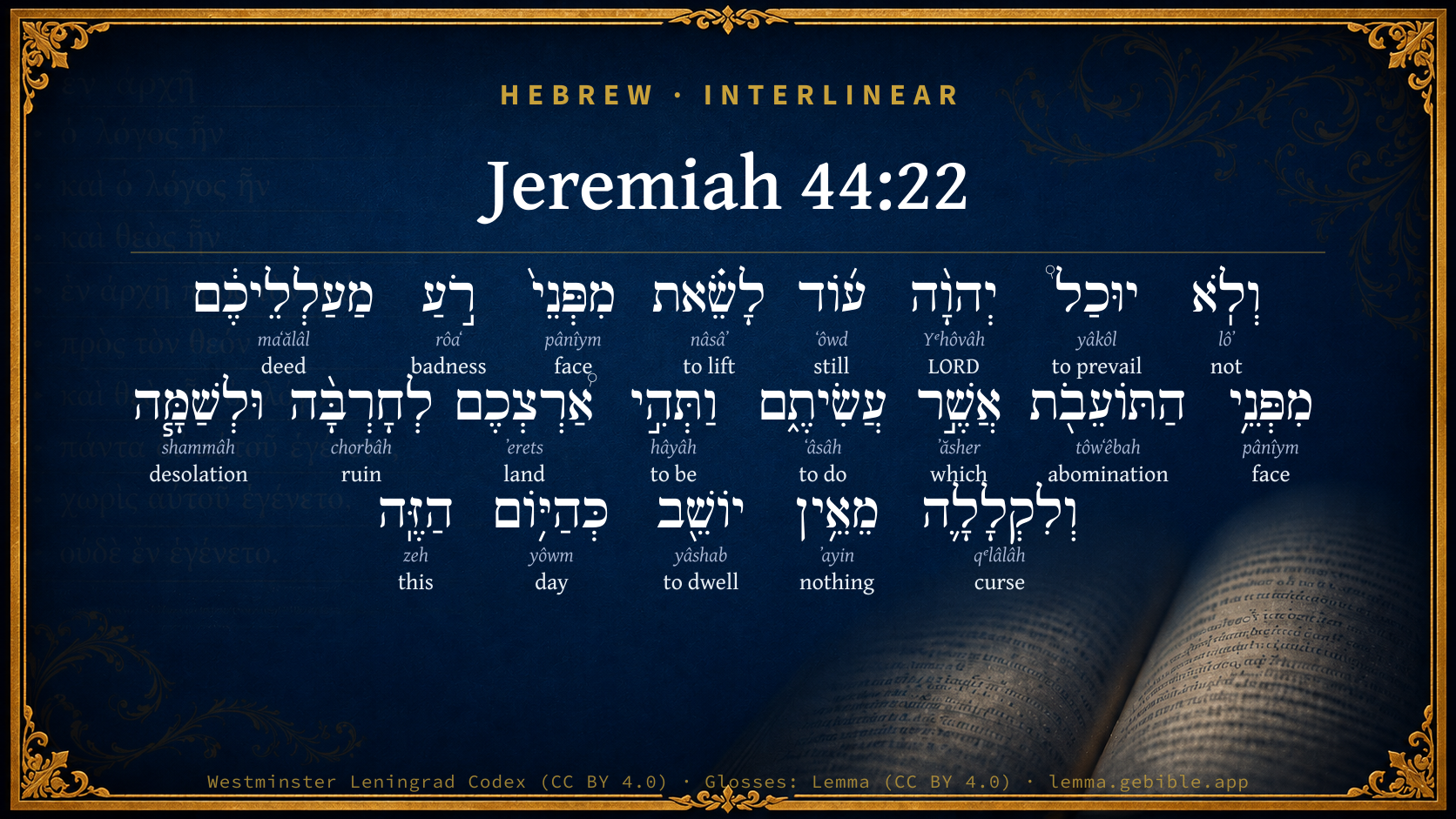
Jeremiah 44:22

Hebrew (Westminster Leningrad Codex) Jeremiah 44:22 appears in the Hebrew Old Testament. The text above is from the Westminster Leningrad Codex. Each word links to its Strong’s number, a concise gloss, and parsing drawn from the Open Scriptures Hebrew Bible morphology. Click any word for its full Brown-Driver-Briggs (BDB) entry.
Download image
Cite this verse

Jeremiah 44:22 (World English Bible). Public Domain. Lemma interlinear Bible study tool, https://lemma.gebible.app/v/jeremiah/44/22.

Show BibTeX & RIS
BibTeX
RIS
English Translation
so that Yahweh could no longer bear, because of the evil of your doings, and because of the abominations which you have committed; therefore is your land become a desolation, and an astonishment, and a curse, without inhabitant, as it is this day.
World English Bible · Public Domain
Download a study sheet

One document with this verse’s original text, its word-by-word gloss line, the meaning frame, cross-references with their text, attributed commentary, and full source and license credits — printable, and it pastes into notes with its structure intact.

This verse Autodidact and up

Study sheet (.html) Plain text (.txt)

A passage Seminary Student

Up to 50 verses in one chapter. A passage sheet keeps up to 6 commentary sources and 12 cross-references per verse, in the order this page ranks them, and says so on the sheet whenever that leaves anything out. Ask for a single verse and you get the Autodidact verse sheet above.

Everything on this page stays free to read, with no account — the sheet is a download of what is already on screen, not access to it.

Want to remove ads? Support Godless Engineer
Compare translations 3

The same verse in 3 English versions, stacked beneath the original-language interlinear above. Click any original word for its lexicon entry.

Each is an independent rendering of the whole verse — the interlinear is not word-aligned to these translations.

Highlighted words mark where these versions differ — a whole-verse word diff, not a word-by-word alignment.

  • World English Bible Public Domain
    so that Yahweh could no longer bear, because of the evil of your doings, and because of the abominations which you have committed; therefore is your land become a desolation, and an astonishment, and a curse, without inhabitant, as it is this day.
  • King James Version Public Domain
    So that the LORD could no longer bear, because of the evil of your doings, and because of the abominations which ye have committed; therefore is your land a desolation, and an astonishment, and a curse, without an inhabitant, as at this day.
  • unfoldingWord Literal Text CC BY-SA 4.0
    Then he was no longer able to bear it because of your wicked practices, because of the abominations that you did. Then your land became a desolation, a horror, and a curse so there was no longer an inhabitant as at this present day.

unfoldingWord Literal Text — © unfoldingWord, licensed CC BY-SA 4.0. Word-aligned USFM3 via Door43 (git.door43.org/unfoldingWord/en_ult).

Versions to compare (up to 4)

3 of 4 selected

Show all 18 translations

Every available English version of this verse, each an independent rendering of the whole verse.

  • World English Bible Public Domain
    so that Yahweh could no longer bear, because of the evil of your doings, and because of the abominations which you have committed; therefore is your land become a desolation, and an astonishment, and a curse, without inhabitant, as it is this day.
  • Berean Standard Bible Public Domain
    So the LORD could no longer endure the evil deeds and detestable acts you committed, and your land became a desolation, a horror, and an object of cursing, without inhabitant, as it is this day.
  • Majority Standard Bible Public Domain
    So the LORD could no longer endure the evil deeds and detestable acts you committed, and your land became a desolation, a horror, and an object of cursing, without inhabitant, as it is this day.
  • King James Version Public Domain
    So that the LORD could no longer bear, because of the evil of your doings, and because of the abominations which ye have committed; therefore is your land a desolation, and an astonishment, and a curse, without an inhabitant, as at this day.
  • American Standard Version (1901) Public Domain
    so that Jehovah could not longer bear, because of the evil of your doings, and because of the abominations which ye have committed; therefore is your land become a desolation, and an astonishment, and a curse, without inhabitant, as it is this day.
  • Revised Version (1885) Public Domain
    so the LORD could no longer bear, because of the evil of your doings, and because of the abominations which ye have committed; therefore is your land become a desolation, and an astonishment, and a curse, without inhabitant, as it is this day.
  • Geneva Bible (1599) Public Domain
    So that the Lord could no longer forbeare, because of the wickednes of your inuentions, and because of the abominations, which ye haue committed: therefore is your lande desolate and an astonishment, and a curse and without inhabitant, as appeareth this day.
  • Douay-Rheims (1899) Public Domain
    So that the Lord could no longer bear, because of the evil of your doings, and because of the abominations which you have committed: therefore your land is become a desolation, and an astonishment, and a curse, without an inhabitant, as at this day.
  • Young's Literal Translation Public Domain
    And Jehovah is not able any more to accept `you', because of the evil of your doings, because of the abominations that ye have done, and your land is for a waste, and for an astonishment, and for a reviling, without inhabitant, as `at' this day.
  • Literal Standard Version CC BY-SA 4.0
    And YHWH is not able to accept [you] anymore, because of the evil of your doings, because of the abominations that you have done, and your land is for a ruin, and for an astonishment, and for a reviling, without inhabitant, as [at] this day.
  • Unlocked Literal Bible CC BY-SA 4.0
    Then he was no longer able to bear it because of your wicked practices, because of the abominations that you did. Then your land became a desolation, a horror, and a curse so there was no longer an inhabitant as at this present day.
  • unfoldingWord Literal Text CC BY-SA 4.0
    Then he was no longer able to bear it because of your wicked practices, because of the abominations that you did. Then your land became a desolation, a horror, and a curse so there was no longer an inhabitant as at this present day.
  • Darby Bible Public Domain
    And Jehovah could no longer bear, because of the evil of your doings, [and] because of the abominations that ye had committed; and your land is become a waste, and an astonishment, and a curse, without inhabitant, as at this day.
  • World Messianic Bible Public Domain
    Thus the LORD could no longer bear it, because of the evil of your doings and because of the abominations which you have committed. Therefore your land has become a desolation, an astonishment, and a curse, without inhabitant, as it is today.
  • Webster's Bible Public Domain
    So that the LORD could no longer bear, because of the evil of your doings, and because of the abominations which ye have committed; therefore is your land a desolation, and an astonishment, and a curse, without an inhabitant, as at this day.
  • Free Bible Version CC BY-SA 4.0
    The Lord couldn't take it anymore—the evil things you did and your disgusting acts—so your country was turned into an uninhabited wasteland, a place of horror and a curse word to others, as it still is today.
  • Bible in Basic English Public Domain
    And the Lord was no longer able to put up with the evil of your doings and the disgusting things you did; and because of this your land has become a waste and a cause of wonder and a curse, with no one living in it, as at this day.
  • JPS Tanakh (1917) Public Domain
    So that the LORD could no longer bear, because of the evil of your doings, and because of the abominations which ye have committed; therefore is your land become a desolation, and an astonishment, and a curse, without an inhabitant, as at this day.

Literal Standard Version (2020), Covenant Press — licensed CC BY-SA 4.0. Text via the HelloAO Bible API (eBible.org). Unlocked Literal Bible (unfoldingWord) — licensed CC BY-SA 4.0. Text via the HelloAO Bible API (eBible.org). unfoldingWord Literal Text — © unfoldingWord, licensed CC BY-SA 4.0. Word-aligned USFM3 via Door43 (git.door43.org/unfoldingWord/en_ult). Free Bible Version, Dr. Jonathan Gallagher — licensed CC BY-SA 4.0. Text via the HelloAO Bible API (eBible.org).

Word by word

More ways to search: Search by grammar → Find every occurrence → Compare this word →

Practice this passage: Drill this verse → Learn its vocabulary →

רֹ֣עַ
rôaʻ
H7455
“badness of”
Noun, Common, Masculine, Singular, Construct
Part of Speech
Noun
Type
Common
Gender
Masculine
Number
Singular
State
Construct
Full BDB Definition

Origin: from H7489

TWOT: 2191b

badness, evil - badness, bad quality - wilfulness - evil, badness (ethical) - sadness
  1. וְלֹֽא lôʼ H3808 “and · not” Conjunction + Particle, Negative
  2. יוּכַל֩ yâkôl H3201 “to prevail” Verb, Qal, Imperfect, 3rd Person, Masculine, Singular
  3. יְהוָ֨ה Yᵉhôvâh H3068 “LORD” Noun, Proper
  4. ע֜וֹד ʻôwd H5750 “still” Adverb
  5. לָשֵׂ֗את nâsâʼ H5375 “to lift” Preposition + Verb, Qal, Infinitive Construct
  6. מִפְּנֵי֙ pânîym H6440 “from · face(s) of” Preposition + Noun, Common, Both, Plural, Construct
  7. מַעַלְלֵיכֶ֔ם maʻălâl H4611 “deeds · your” Noun, Common, Masculine, Plural, Construct + Suffix, Personal, 2nd Person, Masculine, Plural
  8. מִפְּנֵ֥י pânîym H6440 “from · face(s) of” Preposition + Noun, Common, Both, Plural, Construct
  9. הַתּוֹעֵבֹ֖ת tôwʻêbah H8441 “the · abominations” Particle, Definite Article + Noun, Common, Feminine, Plural, Absolute
  10. אֲשֶׁ֣ר ʼăsher H834 “which” Particle, Relative
  11. עֲשִׂיתֶ֑ם ʻâsâh H6213 “to do” Verb, Qal, Perfect, 2nd Person, Masculine, Plural
  12. וַתְּהִ֣י hâyâh H1961 “and · to be” Conjunction + Verb, Qal, Sequential Imperfect, 3rd Person, Feminine, Singular
  13. אַ֠רְצְכֶם ʼerets H776 “land · your” Noun, Common, Both, Singular, Construct + Suffix, Personal, 2nd Person, Masculine, Plural
  14. לְחָרְבָּ֨ה chorbâh H2723 “to/for · ruin” Preposition + Noun, Common, Feminine, Singular, Absolute
  15. וּלְשַׁמָּ֧ה shammâh H8047 “and · to/for · desolation” Conjunction + Preposition + Noun, Common, Feminine, Singular, Absolute
  16. וְלִקְלָלָ֛ה qᵉlâlâh H7045 “and · to/for · curse” Conjunction + Preposition + Noun, Common, Feminine, Singular, Absolute
  17. מֵאֵ֥ין ʼayin H369 “from · nothing” Preposition + Particle, Negative
  18. יוֹשֵׁ֖ב yâshab H3427 “dwelling” Verb, Qal, Participle Active, Masculine, Singular, Absolute
  19. כְּהַיּ֥וֹם yôwm H3117 “like/as · the · day” Preposition + Particle, Definite Article + Noun, Common, Masculine, Singular, Absolute
  20. הַזֶּֽה zeh H2088 “the · this” Particle, Definite Article + Pronoun, Demonstrative, Masculine, Singular

About this verse

These counts appear in no published source. They are computed here, from the morphology-tagged text and Lemma’s own curated glosses. What Lemma adds →

21
words
20
distinct lemmas
Prophets
section

Notable vocabulary

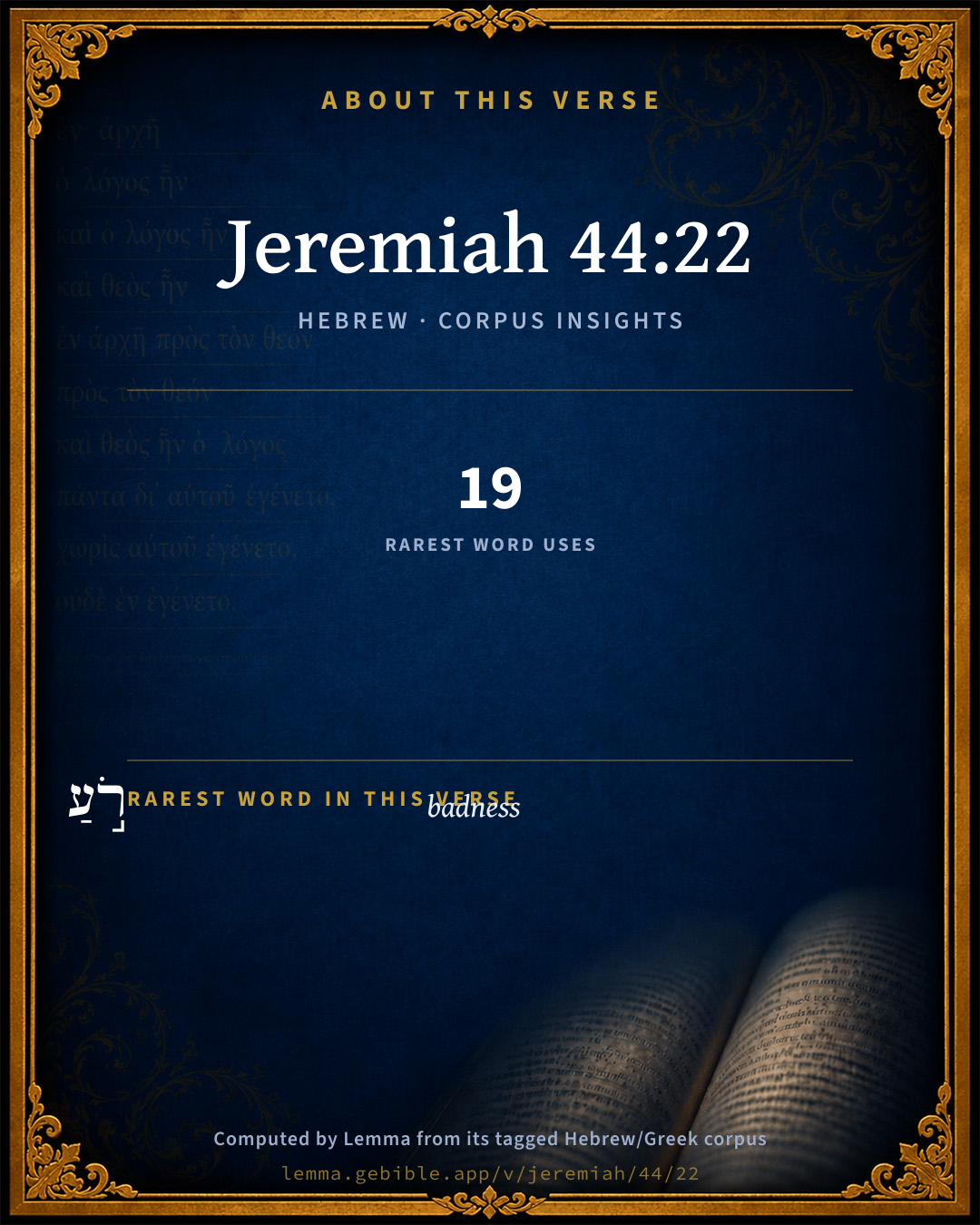
The rarest word here is רֹ֣עַ badness H7455 — appearing just 19 times in the whole Hebrew Bible.

Shared distinctive vocabulary

רֹ֣עַ badness H7455 occurs in 19 verses of the Hebrew Bible. Also found in:

Grammatical profile

  • 5 verbs
  • 11 nouns
  • 1 pronoun
  • 1 adverb
  • 3 particles

Verb forms

  • יוּכַל֩ Qal · Imperfect
  • לָשֵׂ֗את Qal · Infinitive Construct
  • עֲשִׂיתֶ֑ם Qal · Perfect
  • וַתְּהִ֣י Qal · Sequential Imperfect
  • יוֹשֵׁ֖ב Qal · Participle Active

Repetition

A word recurs within this verse — often emphatic in Hebrew:

  • מִפְּנֵי֙ face H6440 ×2

Cross-references

28

Topical passages linked to Jeremiah 44:22 in the Treasury of Scripture Knowledge — connected by theme and wording, ordered by reader-vote popularity; previews shown in the World English Bible.

  • Jeremiah 25:18 [to wit], Jerusalem, and the cities of Judah, and the kings of it, and the princes of it, to make them a desolation, an astonishment, a hissing, and a curse, as it is this day;
  • Isaiah 7:13 He said, "Listen now, house of David: Is it not enough for you to try the patience of men, that you will try the patience of my God also?
  • Isaiah 43:24 You have bought me no sweet cane with money, neither have you filled me with the fat of your sacrifices; but you have burdened me with your sins, you have wearied me with your iniquities.
  • Jeremiah 18:16 to make their land an astonishment, and a perpetual hissing; everyone who passes thereby shall be astonished, and shake his head.
  • Jeremiah 25:11 This whole land shall be a desolation, and an astonishment; and these nations shall serve the king of Babylon seventy years.
  • Jeremiah 25:38 He has left his covert, as the lion; for their land is become an astonishment because of the fierceness of the oppressing [sword], and because of his fierce anger.
  • Jeremiah 44:12 I will take the remnant of Judah, that have set their faces to go into the land of Egypt to sojourn there, and they shall all be consumed; in the land of Egypt shall they fall; they shall be consumed by the sword and by the famine; they shall die, from the least even to the greatest, by the sword and by the famine; and they shall be an object of horror, [and] an astonishment, and a curse, and a reproach.
  • Malachi 2:17 You have wearied Yahweh with your words. Yet you say, 'How have we wearied him?' In that you say, 'Everyone who does evil is good in the sight of Yahweh, and he delights in them;' or 'Where is the God of justice?'
  • Genesis 6:3 Yahweh said, "My Spirit will not strive with man forever, because he also is flesh; yet will his days be one hundred twenty years."
  • Genesis 6:5–7 Yahweh saw that the wickedness of man was great in the earth, and that every imagination of the thoughts of his heart was only evil continually.
  • Genesis 19:13 for we will destroy this place, because the cry of them is grown great before Yahweh. Yahweh has sent us to destroy it."
  • 1 Kings 9:7–8 then will I cut off Israel out of the land which I have given them; and this house, which I have made holy for my name, will I cast out of my sight; and Israel shall be a proverb and a byword among all peoples.
  • Psalms 95:10–11 Forty long years I was grieved with that generation, And said, "It is a people that errs in their heart. They have not known my ways."
  • Psalms 107:33–34 He turns rivers into a desert, Water springs into a thirsty ground,
  • Isaiah 1:24 Therefore the Lord, Yahweh of Hosts, The Mighty One of Israel, says: "Ah, I will get relief from my adversaries, And avenge myself of my enemies;
  • Jeremiah 15:6 You have rejected me, says Yahweh, you are gone backward: therefore have I stretched out my hand against you, and destroyed you; I am weary with repenting.
  • Jeremiah 24:9 I will even give them up to be tossed back and forth among all the kingdoms of the earth for evil; to be a reproach and a proverb, a taunt and a curse, in all places where I shall drive them.
  • Jeremiah 26:6 then will I make this house like Shiloh, and will make this city a curse to all the nations of the earth.
  • Jeremiah 29:19 because they have not listened to my words, says Yahweh, with which I sent to them my servants the prophets, rising up early and sending them; but you would not hear, says Yahweh.
  • Jeremiah 44:2 Thus says Yahweh of Hosts, the God of Israel: You have seen all the evil that I have brought on Jerusalem, and on all the cities of Judah; and, behold, this day they are a desolation, and no man dwells therein,
  • Jeremiah 44:6 Therefore my wrath and my anger was poured forth, and was kindled in the cities of Judah and in the streets of Jerusalem; and they are wasted and desolate, as it is this day.
  • Lamentations 2:15–16 All that pass by clap their hands at you; They hiss and wag their head at the daughter of Jerusalem, [saying], Is this the city that men called The perfection of beauty, The joy of the whole earth?
  • Ezekiel 5:13 Thus shall my anger be accomplished, and I will cause my wrath toward them to rest, and I shall be comforted; and they shall know that I, Yahweh, have spoken in my zeal, when I have accomplished my wrath on them.
  • Daniel 9:12 He has confirmed his words, which he spoke against us, and against our judges who judged us, by bringing on us a great evil; for under the whole sky has not been done as has been done on Jerusalem.
  • Amos 2:13 Behold, I will crush you in your place, As a cart crushes that is full of grain.
  • Romans 2:4–5 Or do you despise the riches of his goodness, forbearance, and patience, not knowing that the goodness of God leads you to repentance?
  • Romans 9:22 What if God, willing to show his wrath, and to make his power known, endured with much patience vessels of wrath made for destruction,
  • 2 Peter 3:7–9 But the heavens that now are, and the earth, by the same word have been stored up for fire, being reserved against the day of judgment and destruction of ungodly men.

Cross-references courtesy of OpenBible.info (CC BY 4.0).

Hebrew and Greek witnesses Masoretic Hebrew ↔ Greek Septuagint

The same verse in the two great witnesses to the Old Testament, shown verse-for-verse.

These are two independent witnesses, not word-aligned to each other, and the Septuagint is shown in lemma (dictionary) form.

Hebrew Jeremiah 44:22 Masoretic · Westminster Leningrad Codex

וְלֹֽא יוּכַל֩ יְהוָ֨ה ע֜וֹד לָשֵׂ֗את מִפְּנֵי֙ רֹ֣עַ מַעַלְלֵיכֶ֔ם מִפְּנֵ֥י הַתּוֹעֵבֹ֖ת אֲשֶׁ֣ר עֲשִׂיתֶ֑ם וַתְּהִ֣י אַ֠רְצְכֶם לְחָרְבָּ֨ה וּלְשַׁמָּ֧ה וְלִקְלָלָ֛ה מֵאֵ֥ין יוֹשֵׁ֖ב כְּהַיּ֥וֹם הַזֶּֽה

so that Yahweh could no longer bear, because of the evil of your doings, and because of the abominations which you have committed; therefore is your land become a desolation, and an astonishment, and a curse, without inhabitant, as it is this day.

World English Bible · Public Domain

Greek LXX Structure differs

In the Septuagint, Jeremiah is about an eighth shorter than the Hebrew and arranges its material differently — the Oracles Against the Nations (Hebrew chapters 46–51) appear in the middle of the Greek book, after 25:13. Because the chapter and verse boundaries do not line up, a verse-for-verse comparison with the Hebrew is not shown.

A verse-for-verse comparison isn’t shown here because the chapters and verses don’t line up. Switch to the LXX edition with the MT / LXX toggle above to read the Greek directly.

Hebrew: Westminster Leningrad Codex (CC BY 4.0). Greek: Septuagint (public domain); English from a public-domain English Septuagint. How the Septuagint differs from the Hebrew →

Targum (Aramaic paraphrase)

1

The Targum is the ancient Jewish Aramaic paraphrase of the Hebrew Scriptures — an interpretive translation, not the Hebrew text itself. Onkelos (literal) and Pseudo-Jonathan (expansive) render the Torah, and Jonathan the Prophets. Coverage is partial: where no permissively-licensed English translation exists for a verse, only the Aramaic is shown. This is verse-level text, not a word-by-word alignment to the Hebrew.

  1. Targum Jonathan Prophets (Joshua–Malachi)
    וְלָא הֲוַת רַעֲוָא קֳדָם יְיָ עוֹד דְלָא לְמִשְׁבַּק מִן קֳדָם בִישׁוּת עוֹבָדֵיכוֹן מִן קֳדָם תּוֹעֵבְתָּא דַעֲבַדְתּוּן וַהֲוַת אַרְעֲכוֹן לְחוּרְבָּא וּלְצָדוּ וְלִלְוָטָא מִבְּלִי יָתֵיב כְּיוֹמָא הָדֵין:

    (no public-domain English translation for this verse)

    Targum Jonathan — Aramaic: “Mikraot Gedolot” (public domain). English: “Sefaria Community Translation” (CC0 1.0 (public-domain dedication)); “London "Chaldee Paraphrase," 1871” (public domain). Text via Sefaria.

Commentary

Notes on Jeremiah 44:22 from classic Christian and Jewish commentators (each source and its license shown beneath its notes). The classic Christian expositions comment on the surrounding passage and are grouped to its opening verse, so a note may address several verses; the Jewish commentaries on the Tanakh (Rashi and others) are per-verse, so they appear only where the commentator wrote on this verse.

Lemma curates 59 commentaries, every one of them public domain or Creative Commons licensed, each selected and text-cleaned for this edition rather than reprinted as found. About our sources →

Trapp's Complete Commentary

John Trapp

Jer 44:22 So that the LORD could no longer bear, because of the evil of your doings, [and] because of the abominations which ye have committed; therefore is your land a desolation, and an astonishment, and a curse, without an inhabitant, as at this day.

Ver. 22. So that the Lord could no longer bear.] His abused mercy turned into fury. See Jer 15:6.

John Trapp, A Commentary or Exposition upon All the Books of the Old and New Testament (1647–1656) — public domain. Text from a community e-Sword module.

Adam Clarke's Commentary

Verse 22. Therefore is your land a desolation] I grant that ye and your husbands have joined together in these abominations; and what is the consequence? "The Lord could no longer bear because of your evil doings; and therefore is your land a desolation, and an astonishment, and a curse, without an inhabitant, this day."

Adam Clarke's Commentary on the Bible (1810–1826) — public domain. Text from a community e-Sword/MySword module.

John Calvin's Commentaries

And hence he adds, Jehovah could not endure the wickedness of your works and the abominations which ye have done: therefore, he says, your land has been reduced to a waste The Prophet, in short, shews that had they not been justly exposed to God’s judgment, they would not have been destroyed. For he assumes this principle, that God is not angry without reason; and then he assumes another principle, that as God had chosen the seed of Abraham, and had been always propitious even to the unworthy, they would have been made partakers of his kindness, had not God been wholly alienated from them. It then follows, that God’s vengeance had not been thus kindled by some slight offense, but by many and daily offenses, so that it could no longer be deferred: for the atrocity of punishment shews the atrocity of sin; and hence he says, Jehovah could not endure the wickedness of your works, and the abominations which ye have done: therefore, he adds, your land has been made a waste, an astonishment, and a curse, or execration, so that there is no inhabitant

John Calvin's Commentaries (1540-1563) — public domain. Text from the Calvin Translation Society English edition (1840s-50s) via the Christian Classics Ethereal Library (ccel.org). Calvin's coverage is partial (roughly two-thirds of the Bible); uncommented books and verses are honest gaps, never fabricated. The 19th-century editor's footnotes and remarks are omitted so the notes are faithfully Calvin's own voice.

The Cambridge Bible for Schools and Colleges

gen. ed. J. J. S. Perowne

22. could no longer bear] These words contain the pith of the answer to the people’s argument that they had been more prosperous while openly practising idolatry than afterwards. Jeremiah points out that even though their national misfortunes were subsequent to Josiah’s reformation, and therefore after what they might have called the golden age of idolatry had ceased, yet it was owing to the idolatry so long rampant, and even afterwards cherished and practised as far as its votaries dared, that the overthrow came. The long-suffering of God was at last exhausted.

The Cambridge Bible for Schools and Colleges (gen. ed. J. J. S. Perowne; Cambridge University Press, 1878–1918) — public domain. Text from a community e-Sword module.

John Gill's Exposition

So that the Lord could no longer forbear,.... He did forbear a long time, and did not stir up all his wrath, but waited to see if these people would repent of their sins, and turn from them; during which time of his forbearance, things might be well with them, as they had said, and they enjoyed peace and plenty; but persisting in their sins, and growing worse and worse, he could bear with them no longer, but brought down his judgments upon them. The reason is expressed,

because of the evil of your doings, and because of the abominations which ye have committed; the incense they had burnt; the drink offerings they had poured out to idols; and such like idolatrous practices, which were evil in themselves, contrary to the law and will of God, and abominable unto him:

therefore is your land a desolation, and an astonishment, and a curse,

without an inhabitant, as at this day; the land of Israel, wasted by the Chaldeans, and left uncultivated, was like a barren wilderness, to the astonishment of all that passed through it, who had known what a fruitful country it had been; the curse of God being apparently on it, and scarce an inhabitant left in it; which was the case at this present instant, as the Jews, to whom the prophet directs his discourse, well knew; and to whom he appeals for the truth of it: now all this was for the sins, particularly the idolatry, they had been guilty of; as is further explained in Jer 44:23.

John Gill's Exposition of the Whole Bible (1746–1763) — public domain (CC PDM 1.0). Text via the HelloAO Bible API.

Albert Barnes' Notes on the Bible

Could no longer bear - The prophet corrects in these words the error of their argument in Jer 44:17. God is long-suffering, and therefore punishment follows slowly upon sin.

Albert Barnes' Notes on the Bible (1834–1885) — public domain. Text from a community e-Sword/MySword module.

Whedon's Commentary on the Bible

Daniel D. Whedon

22. Therefore is your land a desolation — This is the substance of Jeremiah’s answer. That to which they attributed their prosperity was the one cause of their ruin. The Lord had borne with them for many years, and this explains the prosperity mentioned in Jer_44:17; but when he could no longer bear, calamity and destruction came.

Daniel D. Whedon (gen. ed.), Commentary on the Old and New Testaments (1874–1909) — public domain. Text from a community e-Sword module.

The Pulpit Commentary

The limit of God"s forbearance.

I GOD"S FORBEARANCE IS LIMITED. There is no limit to his love. His mercy "endureth forever." There is no limit to his patience, his endurance of the most provoking wickedness. But there is a limit to God"s forbearance. Consider what determines this.

1. Justice. There is a point where necessary justice must interfere to prevent further wrong and punish what is already done.

2. The good of the community. Mercy to the criminal may involve injustice to the victim. There are abandoned wretches whom the world would find inestimable advantage in caging up out of the power of doing further mischief. There must be a point where their rights cease and the rights of others step in. In the Divine government this must be noted and acted on.

3. The advantage of the offender. It is a curse to a man to leave him forever unchecked and unpunished. He may be left for a season to give all necessary scope for the operation of milder measures and for his own free repentance. But when the gentleness has failed, the only chance lies in some drastic treatment.

II IT IS POSSIBLE TO REACH THE LIMIT OF GOD"S FORBEARANCE. It was reached by the antediluvians, by the cities of the plain, by the Jews at the time of the Captivity, by the Jews when Jerusalem was destroyed by Titus, by many a nation and many a man since. It may be reached by us, This subject, therefore, is not a question of abstract theology, touching only the ideal relations of Divine attributes. It is tremendously practical.

1. The limit may be reached in our lifetime. Men presume on their prosperity till God providentially strikes them down in desolation, and they learn in their anguish the folly of their long abuse of God"s long suffering mercy.

2. It will come to the impenitent in the next life. Death will bring it if it has been stayed during all the earthly life. The longer it is delayed the more fearful will be its consequences to those who "treasure up to themselves wrath in the day of wrath.

III IT MUST BE UNSPEAKABLY TERRIBLE TO REACH THE LIMIT OF GOD"S FORBEARANCE. Then all the vials of wrath will be outpoured. The horror of the judgment ensuing can only be measured by the greatness of the forbearance which restrains it. If that were not very fearful, why should God hesitate so long in letting it loose? Why should he use all other possible means to prevent the necessity of resorting to it? Why should he urge and plead with us to hear his voice today and harden not our hearts?

The Pulpit Commentary (1880–1919), ed. H.D.M. Spence-Jones & Joseph S. Exell — public domain. Text from a community e-Sword module.

unfoldingWord translationNotes

Door43 World Missions Community

was no longer able to bear it

"was no longer able to tolerate it"

because of the abominations that you did

The abstract noun "abominations" can be stated as "things he hated." AT: "because you did things that he hated" (See: Abstract Nouns)

Then your land became a desolation, a horror, and a curse so there was no longer an inhabitant as at this present day

This can be restated to remove the abstract nouns "a desolation," "a horror," and "a curse." AT: "Then Yahweh caused it so that no one lives in the land. He made it a desolate and horrifying place. People use its name to curse others. And this is how it is even to this day" (See: Abstract Nouns)

burned incense

Why people burn incense can be stated clearly. AT: "burned incense to false gods" (See: Assumed Knowledge and Implicit Information)

you would not listen to his voice

Here "voice" refers to Yahweh's commands. AT: "you would not obey his commands" (See: Metonymy)

translationWords

evil

abomination

desolate

curse

sin

voice

law, laws

statute

covenant

decree

unfoldingWord translationNotes — © Distant Shores Media and the Door43 World Missions Community, licensed CC BY-SA 4.0. Source: git.door43.org/Door43/en_tn.

Rashi

Rabbi Shlomo Yitzchaki (Rashi)

And He could no longer bear Heb. ולא יוּכַל, like ולא יָכוֹל, and He could not.

Rashi on the Tanakh — English translations: “The Judaica Press complete Tanach with Rashi, translated by A. J. Rosenberg” (CC BY 4.0); “Pentateuch with Rashi's commentary by M. Rosenbaum and A.M. Silbermann, 1929-1934” (public domain); “The Metsudah Tanach series, Lakewood, N.J” (CC BY 4.0); and “The Book of Joshua, Metsudah Publications, 1997” (CC BY 4.0). Text via Sefaria.

Lesson kit

Teaching starters — assembled from the data on this page, not authored interpretation. Every prompt links to the verse data it draws on. Edit before teaching.

Jeremiah, in the Prophets, opens this verse with 21 words (20 distinct Hebrew lemmas). Its most distinctive word is rôaʻ (“badness”). A historical commentator’s framing appears above. Read the whole chapter for the surrounding context.

Discussion questions

  1. How does “badness” (rôaʻ) shape what this verse is saying?
  2. How does Genesis 41:19, which shares the word «badness», read alongside this verse?
  3. What does the repetition of “face” (2× in this one verse) do in this verse?
  4. These translations render this verse differently. What is at stake in choosing one wording over another?
  5. «יוּכַל֩» is a Qal Imperfect verb. How does that grammatical form shape the action described?
  6. Compare how Trapp's Complete Commentary and Adam Clarke's Commentary read this verse. Where do they agree or differ?

Things to notice

Reading settings

Reading text

Shown beneath each verse's original-language words.

Old Testament
Old Testament edition

Read the OT as the Masoretic Hebrew (MT) or the Greek Septuagint (LXX).

English shown for the Greek Septuagint (in the Hebrew ↔ Greek comparison).

Comparing translations? Open the Compare panel on any verse page to stack up to four side by side.