
Deuteronomy 31:2

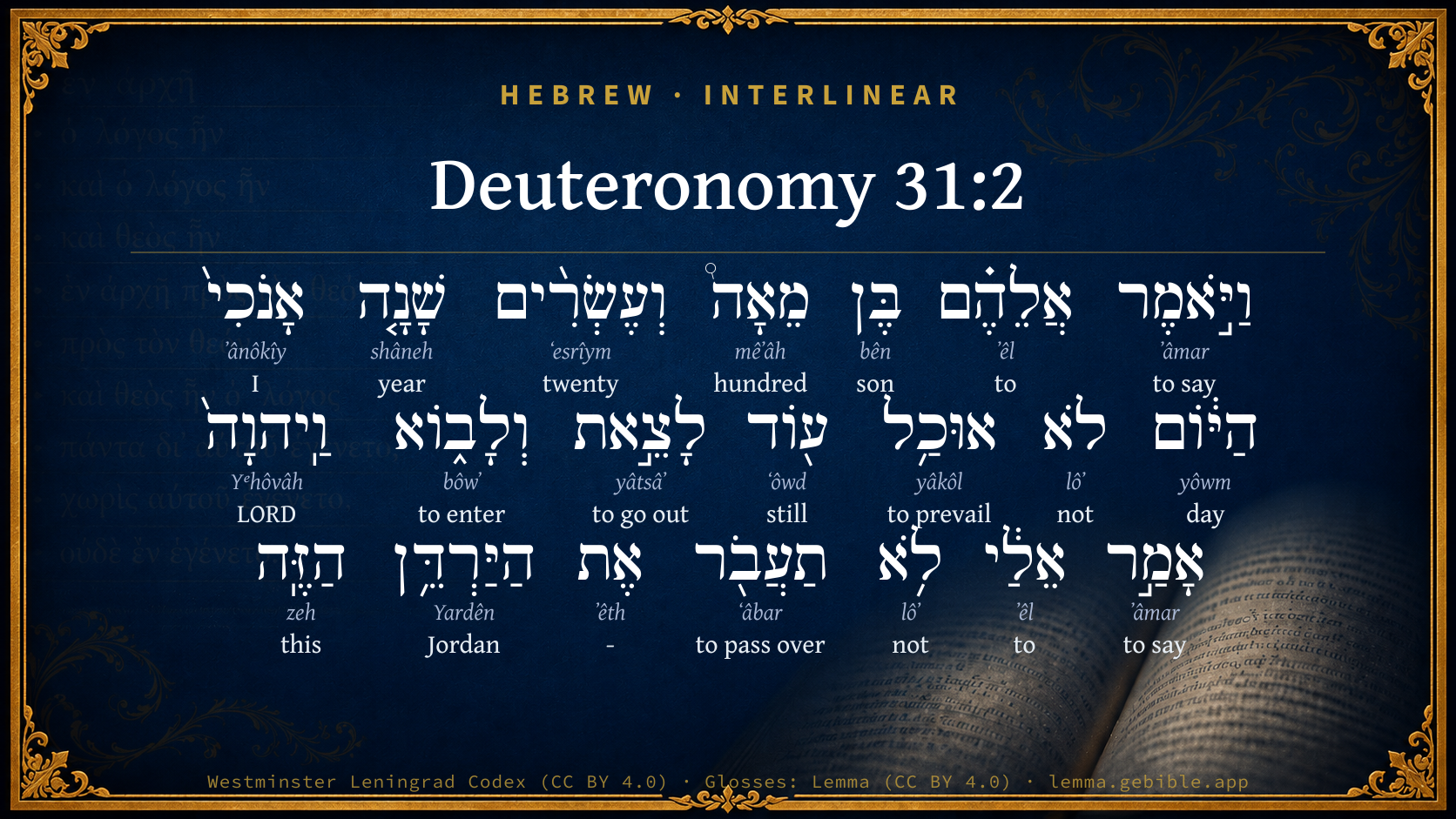
Hebrew (Westminster Leningrad Codex) Deuteronomy 31:2 appears in the Hebrew Old Testament. The text above is from the Westminster Leningrad Codex. Each word links to its Strong’s number, a concise gloss, and parsing drawn from the Open Scriptures Hebrew Bible morphology. Click any word for its full Brown-Driver-Briggs (BDB) entry.
Download image
Cite this verse

Deuteronomy 31:2 (World English Bible). Public Domain. Lemma interlinear Bible study tool, https://lemma.gebible.app/v/deuteronomy/31/2.

Show BibTeX & RIS
BibTeX
RIS
English Translation
He said to them, I am one hundred twenty years old this day; I can no more go out and come in: and Yahweh has said to me, You shall not go over this Jordan.
World English Bible · Public Domain
Download a study sheet

One document with this verse’s original text, its word-by-word gloss line, the meaning frame, cross-references with their text, attributed commentary, and full source and license credits — printable, and it pastes into notes with its structure intact.

This verse Autodidact and up

Study sheet (.html) Plain text (.txt)

A passage Seminary Student

Up to 50 verses in one chapter. A passage sheet keeps up to 6 commentary sources and 12 cross-references per verse, in the order this page ranks them, and says so on the sheet whenever that leaves anything out. Ask for a single verse and you get the Autodidact verse sheet above.

Everything on this page stays free to read, with no account — the sheet is a download of what is already on screen, not access to it.

Want to remove ads? Support Godless Engineer
Compare translations 3

The same verse in 3 English versions, stacked beneath the original-language interlinear above. Click any original word for its lexicon entry.

Each is an independent rendering of the whole verse — the interlinear is not word-aligned to these translations.

Highlighted words mark where these versions differ — a whole-verse word diff, not a word-by-word alignment.

  • World English Bible Public Domain
    He said to them, I am one hundred twenty years old this day; I can no more go out and come in: and Yahweh has said to me, You shall not go over this Jordan.
  • King James Version Public Domain
    And he said unto them, I am an hundred and twenty years old this day; I can no more go out and come in: also the LORD hath said unto me, Thou shalt not go over this Jordan.
  • unfoldingWord Literal Text CC BY-SA 4.0
    And he said to them, “I am 120 years old today; I am not able anymore to go out and come in, and Yahweh has said to me, ‘You will not go over this Jordan.’

unfoldingWord Literal Text — © unfoldingWord, licensed CC BY-SA 4.0. Word-aligned USFM3 via Door43 (git.door43.org/unfoldingWord/en_ult).

Versions to compare (up to 4)

3 of 4 selected

Show all 18 translations

Every available English version of this verse, each an independent rendering of the whole verse.

  • World English Bible Public Domain
    He said to them, I am one hundred twenty years old this day; I can no more go out and come in: and Yahweh has said to me, You shall not go over this Jordan.
  • Berean Standard Bible Public Domain
    he said to them, “I am now a hundred and twenty years old; I am no longer able to come and go, and the LORD has said to me, ‘You shall not cross the Jordan.’
  • Majority Standard Bible Public Domain
    he said to them, “I am now a hundred and twenty years old; I am no longer able to come and go, and the LORD has said to me, ‘You shall not cross the Jordan.’
  • King James Version Public Domain
    And he said unto them, I am an hundred and twenty years old this day; I can no more go out and come in: also the LORD hath said unto me, Thou shalt not go over this Jordan.
  • American Standard Version (1901) Public Domain
    And he said unto them, I am a hundred and twenty years old this day; I can no more go out and come in: and Jehovah hath said unto me, Thou shalt not go over this Jordan.
  • Revised Version (1885) Public Domain
    And he said unto them, I am an hundred and twenty years old this day; I can no more go out and come in: and the LORD hath said unto me, Thou shalt not go over this Jordan.
  • Geneva Bible (1599) Public Domain
    And said vnto them, I am an hundreth and twentie yeere olde this day: I can no more goe out and in: also the Lord hath saide vnto me, Thou shalt not goe ouer this Iorden.
  • Douay-Rheims (1899) Public Domain
    And he said to them: I am this day a hundred and twenty years old, I can no longer go out and come in, especially as the Lord also hath said to me: O Thou shalt not pass over this Jordan.
  • Young's Literal Translation Public Domain
    and he saith unto them, `A son of a hundred and twenty years `am' I to-day; I am not able any more to go out and to come in, and Jehovah hath said unto me, Thou dost not pass over this Jordan,
  • Literal Standard Version CC BY-SA 4.0
    and he says to them, “I [am] a son of one hundred and twenty years today; I am not able to go out and to come in anymore, and YHWH has said to me, You do not pass over this Jordan.
  • Unlocked Literal Bible CC BY-SA 4.0
    He said to them, “I am now one hundred twenty years old; I can no more go out and come in; Yahweh has said to me, 'You will not go over this Jordan.'
  • unfoldingWord Literal Text CC BY-SA 4.0
    And he said to them, “I am 120 years old today; I am not able anymore to go out and come in, and Yahweh has said to me, ‘You will not go over this Jordan.’
  • Darby Bible Public Domain
    and he said unto them, I am a hundred and twenty years old this day, I can no more go out and come in; and Jehovah hath said unto me, Thou shalt not go over this Jordan.
  • World Messianic Bible Public Domain
    He said to them, “I am one hundred twenty years old today. I can no more go out and come in. The LORD has said to me, ‘You shall not go over this Jordan.’
  • Webster's Bible Public Domain
    And he said to them, I am a hundred and twenty years old this day; I can no more go out and come in: also the LORD hath said to me, thou shalt not go over this Jordan.
  • Free Bible Version CC BY-SA 4.0
    he told them, I'm now a hundred and twenty years old. I can't get around like I used to, and the Lord has told me, “You are not to cross the Jordan.”
  • Bible in Basic English Public Domain
    Then he said to them, I am now a hundred and twenty years old; I am no longer able to go out and come in: and the Lord has said to me, You are not to go over Jordan.
  • JPS Tanakh (1917) Public Domain
    And he said unto them: 'I am a hundred and twenty years old this day; I can no more go out and come in; and the LORD hath said unto me: Thou shalt not go over this Jordan.

Literal Standard Version (2020), Covenant Press — licensed CC BY-SA 4.0. Text via the HelloAO Bible API (eBible.org). Unlocked Literal Bible (unfoldingWord) — licensed CC BY-SA 4.0. Text via the HelloAO Bible API (eBible.org). unfoldingWord Literal Text — © unfoldingWord, licensed CC BY-SA 4.0. Word-aligned USFM3 via Door43 (git.door43.org/unfoldingWord/en_ult). Free Bible Version, Dr. Jonathan Gallagher — licensed CC BY-SA 4.0. Text via the HelloAO Bible API (eBible.org).

Word by word

More ways to search: Search by grammar → Find every occurrence → Compare this word →

Practice this passage: Drill this verse → Learn its vocabulary →

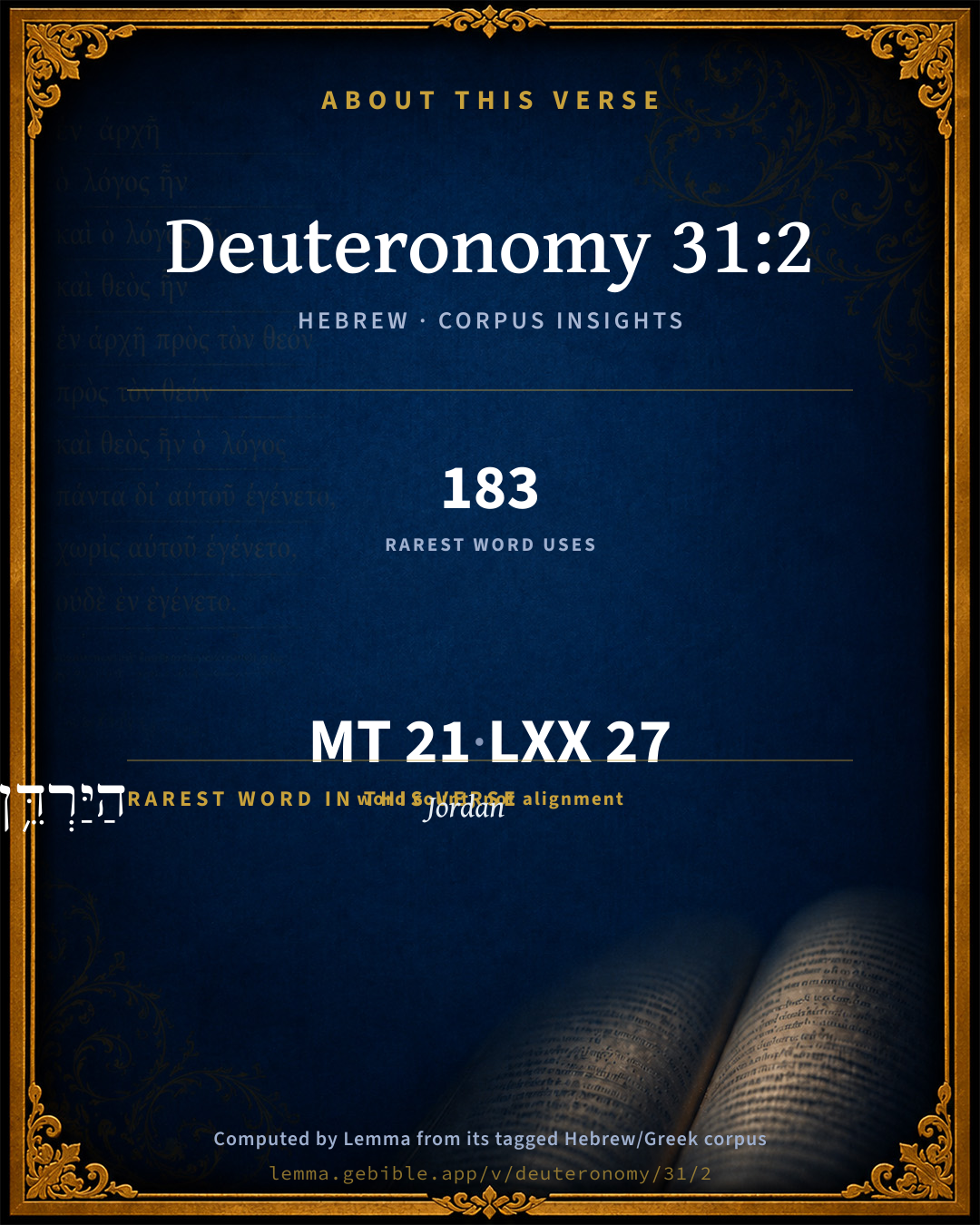
הַיַּרְדֵּ֥ן
Yardên
H3383
“the · Jordan”
Particle, Definite Article + Noun, Proper
Part of Speech
Particle + Noun
Type
Proper
Full BDB Definition

Origin: from H3381

TWOT: None

Jordan = "descender" - the river of Palestine running from the roots of Anti-Lebanon to the Dead Sea a distance of approx 200 miles (320 kilometers)
  1. וַיֹּ֣אמֶר ʼâmar H559 “and · to say” Conjunction + Verb, Qal, Sequential Imperfect, 3rd Person, Masculine, Singular
  2. אֲלֵהֶ֗ם ʼêl H413 “to · them” Preposition + Suffix, Personal, 3rd Person, Masculine, Plural
  3. בֶּן bên H1121 “son of” Noun, Common, Masculine, Singular, Construct
  4. מֵאָה֩ mêʼâh H3967 “hundred” Adjective, Cardinal number, Both, Singular, Absolute
  5. וְעֶשְׂרִ֨ים ʻesrîym H6242 “and · twenty” Conjunction + Adjective, Cardinal number, Both, Plural, Absolute
  6. שָׁנָ֤ה shâneh H8141 “year” Noun, Common, Feminine, Singular, Absolute
  7. אָנֹכִי֙ ʼânôkîy H595 “I” Pronoun, Personal, 1st Person, Common, Singular
  8. הַיּ֔וֹם yôwm H3117 “the · day” Particle, Definite Article + Noun, Common, Masculine, Singular, Absolute
  9. לֹא lôʼ H3808 “not” Particle, Negative
  10. אוּכַ֥ל yâkôl H3201 “to prevail” Verb, Qal, Imperfect, 1st Person, Common, Singular
  11. ע֖וֹד ʻôwd H5750 “still” Adverb
  12. לָצֵ֣את yâtsâʼ H3318 “to go out” Preposition + Verb, Qal, Infinitive Construct
  13. וְלָב֑וֹא bôwʼ H935 “and · to enter” Conjunction + Preposition + Verb, Qal, Infinitive Construct
  14. וַֽיהוָה֙ Yᵉhôvâh H3068 “and · LORD” Conjunction + Noun, Proper
  15. אָמַ֣ר ʼâmar H559 “to say” Verb, Qal, Perfect, 3rd Person, Masculine, Singular
  16. אֵלַ֔י ʼêl H413 “to · me” Preposition + Suffix, Personal, 1st Person, Common, Singular
  17. לֹ֥א lôʼ H3808 “not” Particle, Negative
  18. תַעֲבֹ֖ר ʻâbar H5674 “to pass over” Verb, Qal, Imperfect, 2nd Person, Masculine, Singular
  19. אֶת ʼêth H853 “-” Particle, Direct Object
  20. הַזֶּֽה zeh H2088 “the · this” Particle, Definite Article + Pronoun, Demonstrative, Masculine, Singular

About this verse

These counts appear in no published source. They are computed here, from the morphology-tagged text and Lemma’s own curated glosses. What Lemma adds →

21
words
18
distinct lemmas
Pentateuch
section

Grammatical profile

  • 6 verbs
  • 5 nouns
  • 2 adjectives
  • 2 pronouns
  • 2 prepositions
  • 1 adverb
  • 3 particles

Verb forms

  • וַיֹּ֣אמֶר Qal · Sequential Imperfect
  • אוּכַ֥ל Qal · Imperfect
  • לָצֵ֣את Qal · Infinitive Construct
  • וְלָב֑וֹא Qal · Infinitive Construct
  • אָמַ֣ר Qal · Perfect
  • תַעֲבֹ֖ר Qal · Imperfect

Repetition

Words recur within this verse — often emphatic in Hebrew:

  • וַיֹּ֣אמֶר to say H559 ×2
  • אֲלֵהֶ֗ם to H413 ×2
  • לֹא not H3808 ×2

Hebrew & Septuagint length

In English translation the verse runs 35 words from the Hebrew and 40 from the Septuagint (LXX English) — closely comparable.

A rough comparison of the two English renderings, which tokenize alike — not a word-level alignment.

Word counts can differ between the Hebrew and the Greek without any difference in meaning — e.g. the Hebrew direct-object marker אֵת has no separate Greek word, and Greek often adds the article ὁ.

In the original languages it is 21 Hebrew tokens and 27 Greek tokens — but the two are counted differently (Hebrew bundles its prefixes and suffixes into one token; the Greek is in lemma form), so that isn’t a like-for-like length.

Cross-references

16

Topical passages linked to Deuteronomy 31:2 in the Treasury of Scripture Knowledge — connected by theme and wording, ordered by reader-vote popularity; previews shown in the World English Bible.

  • Deuteronomy 34:7 Moses was one hundred twenty years old when he died: his eye was not dim, nor his natural force abated.
  • Numbers 27:17 who may go out before them, and who may come in before them, and who may lead them out, and who may bring them in; that the congregation of Yahweh not be as sheep which have no shepherd.
  • 1 Kings 3:7 Now, Yahweh my God, you have made your servant king instead of David my father: and I am but a little child; I don't know how to go out or come in.
  • Exodus 7:7 Moses was eighty years old, and Aaron eighty-three years old, when they spoke to Pharaoh.
  • Numbers 20:12 Yahweh said to Moses and Aaron, Because you didn't believe in me, to sanctify me in the eyes of the children of Israel, therefore you shall not bring this assembly into the land which I have given them.
  • Deuteronomy 3:26–27 But Yahweh was angry with me for your sakes, and didn't listen to me; and Yahweh said to me, Let it suffice you; speak no more to me of this matter.
  • Numbers 27:13–14 When you have seen it, you also shall be gathered to your people, as Aaron your brother was gathered;
  • Deuteronomy 1:37 Also Yahweh was angry with me for your sakes, saying, You also shall not go in there:
  • Deuteronomy 4:21–22 Furthermore Yahweh was angry with me for your sakes, and swore that I should not go over the Jordan, and that I should not go in to that good land, which Yahweh your God gives you for an inheritance:
  • Deuteronomy 32:48–52 Yahweh spoke to Moses that same day, saying,
  • Joshua 14:10–11 Now, behold, Yahweh has kept me alive, as he spoke, these forty-five years, from the time that Yahweh spoke this word to Moses, while Israel walked in the wilderness: and now, behold, I am this day eighty-five years old.
  • 2 Samuel 21:17 But Abishai the son of Zeruiah helped him, and struck the Philistine, and killed him. Then the men of David swore to him, saying, You shall go no more out with us to battle, that you don't quench the lamp of Israel.
  • Psalms 90:10 The days of our years are seventy, Or even by reason of strength eighty years; Yet their pride is but labor and sorrow, For it passes quickly, and we fly away.
  • Acts 7:23 But when he was forty years old, it came into his heart to visit his brothers, the children of Israel.
  • Acts 20:25 Now, behold, I know that you all, among whom I went about preaching the Kingdom of God, will see my face no more.
  • 2 Peter 1:13–14 I think it right, as long as I am in this tent, to stir you up by reminding you;

Cross-references courtesy of OpenBible.info (CC BY 4.0).

Hebrew and Greek witnesses Masoretic Hebrew ↔ Greek Septuagint

The same verse in the two great witnesses to the Old Testament, shown verse-for-verse.

These are two independent witnesses, not word-aligned to each other, and the Septuagint is shown in lemma (dictionary) form.

Hebrew Deuteronomy 31:2 Masoretic · Westminster Leningrad Codex

וַיֹּ֣אמֶר אֲלֵהֶ֗ם בֶּן מֵאָה֩ וְעֶשְׂרִ֨ים שָׁנָ֤ה אָנֹכִי֙ הַיּ֔וֹם לֹא אוּכַ֥ל ע֖וֹד לָצֵ֣את וְלָב֑וֹא וַֽיהוָה֙ אָמַ֣ר אֵלַ֔י לֹ֥א תַעֲבֹ֖ר אֶת הַיַּרְדֵּ֥ן הַזֶּֽה

He said to them, I am one hundred twenty years old this day; I can no more go out and come in: and Yahweh has said to me, You shall not go over this Jordan.

World English Bible · Public Domain

Greek LXX Deuteronomy 31:2 Septuagint · lemma form

καί εἶπον πρός αὐτός ἑκατόν καί εἴκοσι ἔτος ἐγώ εἰμί σήμερον οὐ δύναμαι ἔτι εἰςπορεύομαι καί ἐκπορεύομαι κύριος δέ εἶπον πρός ἐγώ οὐ διαβαίνω ὁ ἰορδάνης οὗτος

and said to them, I am this day one hundred and twenty years old; I shall not be able any longer to come in or go out; and the Lord said to me, You shall not go over this Jordan.

LXX2012 (modern English Septuagint) · Public Domain

Hebrew: Westminster Leningrad Codex (CC BY 4.0). Greek: Septuagint (public domain); English from LXX2012 (modern English Septuagint) (Public Domain). How the Septuagint differs from the Hebrew →

Targum (Aramaic paraphrase)

2

The Targum is the ancient Jewish Aramaic paraphrase of the Hebrew Scriptures — an interpretive translation, not the Hebrew text itself. Onkelos (literal) and Pseudo-Jonathan (expansive) render the Torah, and Jonathan the Prophets. Coverage is partial: where no permissively-licensed English translation exists for a verse, only the Aramaic is shown. This is verse-level text, not a word-by-word alignment to the Hebrew.

  1. Targum Onkelos Torah (Genesis–Deuteronomy)
    וַאֲמַר לְהוֹן בַּר מְאָה וְעֶשְׂרִין שְׁנִין אֲנָא יוֹמָא דֵין לֵית אֲנָא יָכִיל עוֹד לְמִפַּק וּלְמֵעָל וַיְיָ אֲמַר לִי לָא תֵעִבַר יָת יַרְדְנָא הָדֵין

    (no public-domain English translation for this verse)

    Targum Onkelos — Aramaic: “Onkelos Genesis” (public domain); “Onkelos Exodus” (public domain); “Onkelos Leviticus” (public domain); “Onkelos Numbers” (public domain); “Onkelos Deuteronomy” (public domain). English: “Sefaria Community Translation” (CC0 1.0 (public-domain dedication)); “J.W. Etheridge. The Targums of Onkelos and Jonathan Ben Uzziel on the Pentateuch. London: Longmans, Green, 1862” (public domain). Text via Sefaria.

  2. Targum Pseudo-Jonathan Torah (Genesis–Deuteronomy)
    וַאֲמַר לְהוֹן בַּר מְאָה וְעֶשְרִין שְׁנִין אֲנָא יוֹמָנָא לֵית אֲנָא יָכִיל תּוּב לְמִפַּק וּלְמֵיעַל וּמֵימְרָא דַיְיָ אֲמַר לִי לָא תְעִיבַר יַת יוֹרְדְנָא הָדֵין

    and said to them: I am the son of a hundred and twenty years this day. I am no more able to go out and come in, and the Word of the Lord hath said to me: Thou shalt not go over this Jordan.

    Targum Pseudo-Jonathan — Aramaic: “Targum Jonathan on Genesis” (public domain); “Targum Jonathan on Exodus” (public domain); “Targum Jonathan on Leviticus” (public domain); “Targum Jonathan on Numbers” (public domain); “Targum Jonathan on Deuteronomy” (public domain). English: “The Targum of Jonathan ben Uzziel, trans. J. W. Etheridge, London, 1862” (public domain). Text via Sefaria.

Commentary

Notes on Deuteronomy 31:2 from classic Christian and Jewish commentators (each source and its license shown beneath its notes). The classic Christian expositions comment on the surrounding passage and are grouped to its opening verse, so a note may address several verses; the Jewish commentaries on the Tanakh (Rashi and others) are per-verse, so they appear only where the commentator wrote on this verse.

Lemma curates 59 commentaries, every one of them public domain or Creative Commons licensed, each selected and text-cleaned for this edition rather than reprinted as found. About our sources →

Trapp's Complete Commentary

John Trapp

Deu 31:2 And he said unto them, I [am] an hundred and twenty years old this day; I can no more go out and come in: also the LORD hath said unto me, Thou shalt not go over this Jordan.

Ver. 2. I am a hundred and twenty, &c.] And so might well bespeak them, as Augustus once did his army, and pacified them thereby when they were in a mutiny; Audite senem iuvenes, quem iuvenem senes audierunt. {a}

{a} Suetonius.

John Trapp, A Commentary or Exposition upon All the Books of the Old and New Testament (1647–1656) — public domain. Text from a community e-Sword module.

Geneva Bible (1599)

Geneva Bible translators

I can no longer execute mine office.

Geneva Bible (1599) marginal notes — public domain. Text via Bolls.life.

Jamieson, Fausset & Brown

Robert Jamieson, A. R. Fausset & David Brown

also the Lord hath said--should be "for the Lord hath said" thou shalt not go over this Jordan. While taking a solemn leave of the people, Moses exhorted them not to be intimidated by the menacing opposition of enemies; to take encouragement from the continued presence of their covenanted God; and to rest assured that the same divine power, which had enabled them to discomfit their first assailants on the east of Jordan, would aid them not less effectually in the adventurous enterprise which they were about to undertake, and by which they would obtain possession of "the land which He had sworn unto their fathers to give them."

Jamieson, Fausset & Brown — Commentary Critical and Explanatory on the Whole Bible (1871) — public domain (CC PDM 1.0). Text via the HelloAO Bible API.

Adam Clarke's Commentary

Verse 2. I am a hundred and twenty years old] The life of Moses, the great prophet of God and lawgiver of the Jews, was exactly the same in length as the time Noah employed in preaching righteousness to the antediluvian world. These one hundred and twenty years were divided into three remarkable periods: forty years he lived in Egypt, in Pharaoh's court, acquiring all the learning and wisdom of the Egyptians; (see Ac 7:20; Ac 7:23); forty years he sojourned in the land of Midian in a state of preparation for his great and important mission; (Ac 7:29-30); and forty years he guided, led, and governed the Israelites under the express direction and authority of God: in all, one hundred and twenty years.

Adam Clarke's Commentary on the Bible (1810–1826) — public domain. Text from a community e-Sword/MySword module.

The Cambridge Bible for Schools and Colleges

gen. ed. J. J. S. Perowne

2. an hundred and twenty years old] So P Deu_34:7, cp. Exo_7:7. As we have seen, dates in the Pent. are nearly all from P; 120 = 3 × 40, the usual round number for a generation.

go out and come in] See on Deu_13:13 (14) and Deu_28:6.

the Lord hath said, etc.] Deu_3:27.

The Cambridge Bible for Schools and Colleges (gen. ed. J. J. S. Perowne; Cambridge University Press, 1878–1918) — public domain. Text from a community e-Sword module.

John Gill's Exposition

The Lord thy God, he will go over before thee,.... This he said to encourage the people of Israel; that though he should die, and not go over with them, their ever living and true God, the great Jehovah, the Lord of hosts, he would go before them, and fight their battles for them; so that they had nothing to fear from their enemies:

and he will destroy those nations from before thee; the seven nations which then inhabited the land:

and thou shalt possess them; their countries, cities, and houses, fields, and vineyards:

and Joshua, he shall go over before thee; as their general to fight for them, subdue their enemies, and put them into the possession of the land, and divide it to them:

as the Lord hath said; Deu 3:28.

John Gill's Exposition of the Whole Bible (1746–1763) — public domain (CC PDM 1.0). Text via the HelloAO Bible API.

Albert Barnes' Notes on the Bible

I am an hundred and twenty years old - The 40 years of the wandering had passed since Moses, then 80 years old, “spake unto Pharaoh” (Exo 7:7; Compare Deu 34:7).

I can, no more go out and come in - Render I shall not longer be able to go out and come in: i. e., discharge my duties among you. There is no inconsistency with Deu 34:7. Moses here adverts to his own age as likely to render him in future unequal to the active discharge of his office as leader of the people: the writer of Deu 34:1-12, one of Moses’ contemporaries, remarks of him that up to the close of life “his eye was not dim, nor his natural force abated” Deu 31:7; i. e. that he was to the last, in the judgment of others, in full possession of faculties and strength.

Albert Barnes' Notes on the Bible (1834–1885) — public domain. Text from a community e-Sword/MySword module.

Haydock's Catholic Bible Commentary

Come in, to conduct you. (Menochius) --- Especially. Hebrew, "and the Lord." It was not the want of strength which hindered Moses from continuing to perform his arduous functions, as he was still full of vigour both in soul and body; (chap. xxxiv. 7.; Calmet) but it was his submission to the will of God, who had resolved thus to punish his former diffidence. (Haydock)

George Leo Haydock (1774–1849), Haydock's Catholic Family Bible and Commentary, 1859 edition — public domain. Excludes Psalms (Douay-Rheims chapter numbering differs from Protestant) and Deuterocanonical books (Catholic canon only).

Matthew Poole's English Annotations

Go out and come in, i.e. perform the office of a leader or governor, either because I now find a decay of my mind and body, which seems not well to agree with Deu 34:7, or because I foresee the time of my death approaches.

Matthew Poole's English Annotations on the Holy Bible (1683–1685) — public domain. Text from a community e-Sword/MySword module.

Whedon's Commentary on the Bible

Daniel D. Whedon

2. I am a hundred and twenty years old this day — The life of Moses is divided into three periods of forty years each. He was forty years old when he fled from Egypt to Midian. He was eighty when he stood before Pharaoh and told him to let the people go. And forty years of wandering in the wilderness are now drawing to a close. Compare the speech of Stephen in Acts 7; also Exo_7:7; Deu_34:7.

I can no more go out and come in — Though his eye is not dim nor his natural force abated, Moses is conscious that the infirmities of age will render him unsuited for the burdens he has hitherto borne.

Also the Lord hath said unto me, Thou shalt not go over this Jordan — There is a sad reminder in these words both of his own and the people’s sin. Comp. Deu_3:27.

Daniel D. Whedon (gen. ed.), Commentary on the Old and New Testaments (1874–1909) — public domain. Text from a community e-Sword module.

The Pulpit Commentary

I am a hundred and twenty years old this day. When Moses stood before Pharaoh he was eighty years old; (Exo_7:7) since then forty years had elapsed during the wanderings in the wilderness. I can no more go out and come in; I am no longer able to work among and for the nation as I have hitherto done (cf. Num_27:17) This does not conflict with the statement in Deu_34:7, that up to the time of his death his eyes were not dim nor his natural strength abated, for this is the statement of an observer, and it often happens that an individual feels himself to be failing, when to those around him he appears to possess unabated vigor. There is no need, therefore, for resorting, with Raschi and others, to the expedient of reading "for" instead of "and" in the following clause; as if the cause why Moses could no longer go in and out among the people was God"s prohibition of his going over Jordan. This is simply another and collateral reason why he had now to retire flora his post as leader.

The Pulpit Commentary (1880–1919), ed. H.D.M. Spence-Jones & Joseph S. Exell — public domain. Text from a community e-Sword module.

John Wesley's Explanatory Notes

Go out and come in - Perform the office of a leader or governor, because the time of my death approaches.

John Wesley, Explanatory Notes Upon the Whole Bible (1754–1765) — public domain. Text via the GEBible commentary corpus.

Rashi

Rabbi Shlomo Yitzchaki (Rashi)

וילך משה וגו'... אנכי היום AND MOSES WENT... I AM [HUNDRED AND TWENTY YEARS OLD] THIS DAY — Today my days and my years become full: for on this day (the seventh of Adar; cf. Rashi on Deuteronomy 1:3) I was born and on this day I must die (Sotah 13b).

לא אוכל עוד לצאת ולבוא I CAN NO LONGER GO OUT AND COME IN — One might think that this was because his physical strength failed him! Scripture, however, states (Deuteronomy 34:7) “His eye was not dim nor his natural force abated!” What then is the meaning of לא אוכל? It means: “I am not permitted” (cf. Rashi on Deuteronomy 12:17 and Deuteronomy 24:4), because the power (leadership) is being taken from me and given to Joshua. — Another explanation of לצאת ולבוא is: I can no more take the lead in the matter of the Law; this teaches us that the traditions and the well-springs of wisdom were stopped up for him (cf. Sotah 13b).

וה' אמר אלי — This (according to the previous comment) is the explanation of לא אוכל עוד לצאת ולבוא: I can no more go out and come in because (ו = because) the Lord has said unto Me, [Thou shalt not pass over this Jordan].

Rashi on the Tanakh — English translations: “The Judaica Press complete Tanach with Rashi, translated by A. J. Rosenberg” (CC BY 4.0); “Pentateuch with Rashi's commentary by M. Rosenbaum and A.M. Silbermann, 1929-1934” (public domain); “The Metsudah Tanach series, Lakewood, N.J” (CC BY 4.0); and “The Book of Joshua, Metsudah Publications, 1997” (CC BY 4.0). Text via Sefaria.

Ramban (Nachmanides)

Rabbi Moshe ben Nachman (Ramban / Nachmanides)

AND HE SAID UNTO THEM: ‘I AM A HUNDRED AND TWENTY YEARS OLD THIS DAY.’ This was to comfort them concerning his condition [i.e., about his approaching death], as if to say, “I am old and you have no more benefit from me. Moreover, G-d has commanded me that I should not go over there. Do not dread and do not be fearful, for the Eternal will go over with you; He will not remove His Presence from you on my account [i.e., because of my absence], and Joshua, he shall go over before you in my place.” Now, although Moses our teacher retained his vigor and health, as Scripture testifies, his eye was not dim, nor his natural force abated, 34:7. he told them this [“I am old and you have no more benefit of me”] in order to comfort them [over the transfer of leadership to Joshua].Now, Rashi wrote: “I can no longer go out and go in, because the Eternal hath said unto me: Thou shalt not go over this Jordan.” But it is not correct. (‘and’ the Eternal) said unto me. Now, Rashi explains that the connective vav, which generally means “and,” signifies “because.” It is this interpretation which Ramban considers incorrect because vav always means “and,” not “because.” Mizrachi, too, raised this objection to Rashi and left it unanswered. See, however, in Ma’aravi where a different version of Rashi’s text is cited, in which the connective vav has its usual meaning. And in the opinion of Rabbi Abraham ibn Ezra the expression I can no longer go out and come in means to war, because his powers weakened in his old age. This too, is not correct. (further, 34:7). And our Rabbis have said: “This teaches us that the well-springs of wisdom were stopped for him.” This was a miraculous event in order that Moses should not be troubled [about the transfer of leadership to Joshua] and [G-d] bestowing honor upon Joshua in his [Moses’] presence.

Ramban (Nachmanides) on the Tanakh — English translation: “Commentary on the Torah by Ramban (Nachmanides). Translated and annotated by Charles B. Chavel. New York, Shilo Pub. House, 1971-1976” (CC BY 4.0). Text via Sefaria.

Sforno

Rabbi Ovadia Sforno

I am 120 years old today. Do not be sad at my death, for I was would not have lived any longer by the laws of nature.

I cannot any longer go forth and return. Even if I would have lied longer, I would no longer be able to come and go before the people, due to my old age.

For Hashem has said to me: Even If I was able to come and go, Hashem has said to me that I may not cross the Yardein, and if so, it is better for you that I die now so that you can cross.

Sforno on the Tanakh — English translation: “Yalkut, Sifsei Chachomim Chumash, Metsudah Publications, 2009” (CC BY 4.0). Text via Sefaria.

Lesson kit

Teaching starters — assembled from the data on this page, not authored interpretation. Every prompt links to the verse data it draws on. Edit before teaching.

Deuteronomy, in the Pentateuch, opens this verse with 21 words (18 distinct Hebrew lemmas). Its most distinctive word is Yardên (“Jordan”). A historical commentator’s framing appears above. Read the whole chapter for the surrounding context.

Discussion questions

  1. How does “Jordan” (Yardên) shape what this verse is saying?
  2. How does Deuteronomy 34:7, which shares this passage’s theme, read alongside this verse?
  3. What does the repetition of “to say” (2× in this one verse) do in this verse?
  4. These translations render this verse differently; the difference is in the English rendering, not the original. What questions does that raise?
  5. «וַיֹּ֣אמֶר» is a Qal Sequential Imperfect verb. How does that grammatical form shape the action described?
  6. Compare how Trapp's Complete Commentary and Geneva Bible (1599) read this verse. Where do they agree or differ?

Things to notice

Reading settings

Reading text

Shown beneath each verse's original-language words.

Old Testament
Old Testament edition

Read the OT as the Masoretic Hebrew (MT) or the Greek Septuagint (LXX).

English shown for the Greek Septuagint (in the Hebrew ↔ Greek comparison).

Comparing translations? Open the Compare panel on any verse page to stack up to four side by side.