
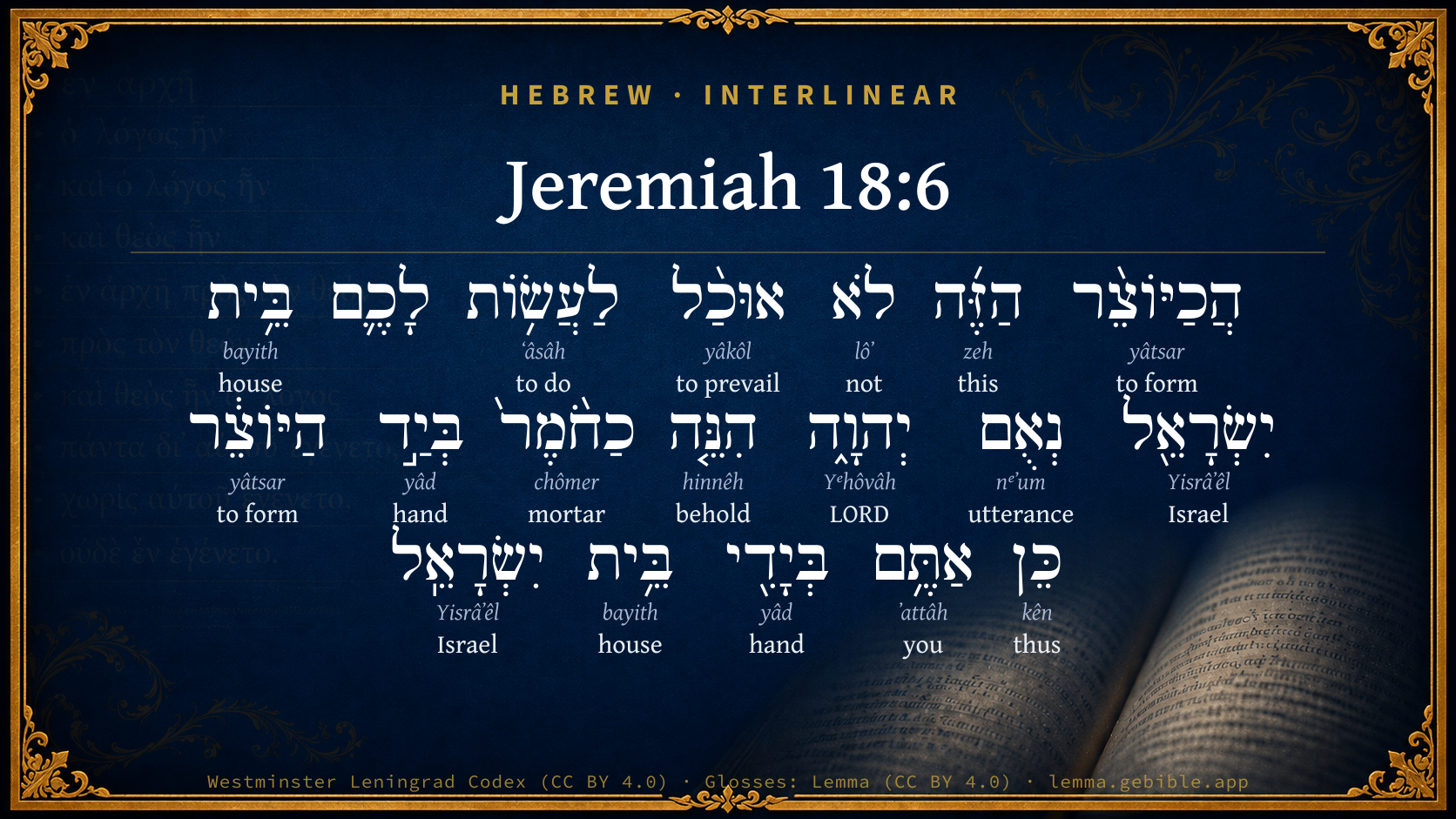
Jeremiah 18:6

Hebrew (Westminster Leningrad Codex) Jeremiah 18:6 appears in the Hebrew Old Testament. The text above is from the Westminster Leningrad Codex. Each word links to its Strong’s number, a concise gloss, and parsing drawn from the Open Scriptures Hebrew Bible morphology. Click any word for its full Brown-Driver-Briggs (BDB) entry.
Download image
Cite this verse

Jeremiah 18:6 (World English Bible). Public Domain. Lemma interlinear Bible study tool, https://lemma.gebible.app/v/jeremiah/18/6.

Show BibTeX & RIS
BibTeX
RIS
English Translation
House of Israel, can't I do with you as this potter? says Yahweh. Behold, as the clay in the potter's hand, so are you in my hand, house of Israel.
World English Bible · Public Domain
Download a study sheet

One document with this verse’s original text, its word-by-word gloss line, the meaning frame, cross-references with their text, attributed commentary, and full source and license credits — printable, and it pastes into notes with its structure intact.

This verse Autodidact and up

Study sheet (.html) Plain text (.txt)

A passage Seminary Student

Up to 50 verses in one chapter. A passage sheet keeps up to 6 commentary sources and 12 cross-references per verse, in the order this page ranks them, and says so on the sheet whenever that leaves anything out. Ask for a single verse and you get the Autodidact verse sheet above.

Everything on this page stays free to read, with no account — the sheet is a download of what is already on screen, not access to it.

Want to remove ads? Support Godless Engineer
Compare translations 3

The same verse in 3 English versions, stacked beneath the original-language interlinear above. Click any original word for its lexicon entry.

Each is an independent rendering of the whole verse — the interlinear is not word-aligned to these translations.

Highlighted words mark where these versions differ — a whole-verse word diff, not a word-by-word alignment.

  • World English Bible Public Domain
    House of Israel, can't I do with you as this potter? says Yahweh. Behold, as the clay in the potter's hand, so are you in my hand, house of Israel.
  • King James Version Public Domain
    O house of Israel, cannot I do with you as this potter? saith the LORD. Behold, as the clay is in the potter's hand, so are ye in mine hand, O house of Israel.
  • unfoldingWord Literal Text CC BY-SA 4.0
    “Like this potter, am I not able to do to you, house of Israel?”—the declaration of Yahweh—“Behold, like the clay in the hand of the potter, so you in my hand, house of Israel.

unfoldingWord Literal Text — © unfoldingWord, licensed CC BY-SA 4.0. Word-aligned USFM3 via Door43 (git.door43.org/unfoldingWord/en_ult).

Versions to compare (up to 4)

3 of 4 selected

Show all 18 translations

Every available English version of this verse, each an independent rendering of the whole verse.

  • World English Bible Public Domain
    House of Israel, can't I do with you as this potter? says Yahweh. Behold, as the clay in the potter's hand, so are you in my hand, house of Israel.
  • Berean Standard Bible Public Domain
    “O house of Israel, declares the LORD, can I not treat you as this potter treats his clay? Just like clay in the potter’s hand, so are you in My hand, O house of Israel.
  • Majority Standard Bible Public Domain
    “O house of Israel, declares the LORD, can I not treat you as this potter treats his clay? Just like clay in the potter’s hand, so are you in My hand, O house of Israel.
  • King James Version Public Domain
    O house of Israel, cannot I do with you as this potter? saith the LORD. Behold, as the clay is in the potter's hand, so are ye in mine hand, O house of Israel.
  • American Standard Version (1901) Public Domain
    O house of Israel, cannot I do with you as this potter? saith Jehovah. Behold, as the clay in the potter's hand, so are ye in my hand, O house of Israel.
  • Revised Version (1885) Public Domain
    O house of Israel, cannot I do with you as this potter? saith the LORD. Behold, as the clay in the potter’s hand, so are ye in mine hand, O house of Israel.
  • Geneva Bible (1599) Public Domain
    O house of Israel, cannot I doe with you as this potter, sayth the Lord? beholde, as the clay is in the potters hande, so are you in mine hande, O house of Israel.
  • Douay-Rheims (1899) Public Domain
    Cannot I do with you as this potter, saith the Lord? behold as clay is in the hand of the potter, so are you in my hand, O house of Israel.
  • Young's Literal Translation Public Domain
    As this potter am I not able to do to you? O house of Israel, an affirmation of Jehovah. Lo, as clay in the hand of the potter, So `are' ye in My hand, O house of Israel.
  • Literal Standard Version CC BY-SA 4.0
    “O house of Israel, am I not able to do to you as this potter?” A declaration of YHWH. “Behold, as clay in the hand of the potter, || So [are] you in My hand, O house of Israel.
  • Unlocked Literal Bible CC BY-SA 4.0
    “Should I not be able to act like this potter with you, house of Israel?—this is Yahweh's declaration. Behold! Like clay in a potter's hand—that is how you are in my hand, house of Israel.
  • unfoldingWord Literal Text CC BY-SA 4.0
    “Like this potter, am I not able to do to you, house of Israel?”—the declaration of Yahweh—“Behold, like the clay in the hand of the potter, so you in my hand, house of Israel.
  • Darby Bible Public Domain
    House of Israel, cannot I do with you as this potter? saith Jehovah. Behold, as the clay in the potter's hand, so are ye in my hand, house of Israel.
  • World Messianic Bible Public Domain
    “House of Israel, can’t I do with you as this potter?” says the LORD. “Behold, as the clay in the potter’s hand, so are you in my hand, house of Israel.
  • Webster's Bible Public Domain
    O house of Israel, cannot I do with you as this potter? saith the LORD. Behold, as the clay is in the potter's hand, so are ye in my hand, O house of Israel.
  • Free Bible Version CC BY-SA 4.0
    People of Israel, declares the Lord, can't I deal with you just like this potter does with his clay? I hold you in my hand just like clay in the potter's hand, people of Israel.
  • Bible in Basic English Public Domain
    O Israel, am I not able to do with you as this potter does? says the Lord. See, like earth in the potter's hand are you in my hands, O Israel.
  • JPS Tanakh (1917) Public Domain
    'O house of Israel, cannot I do with you as this potter? saith the LORD. Behold, as the clay in the potter's hand, so are ye in My hand, O house of Israel.

Literal Standard Version (2020), Covenant Press — licensed CC BY-SA 4.0. Text via the HelloAO Bible API (eBible.org). Unlocked Literal Bible (unfoldingWord) — licensed CC BY-SA 4.0. Text via the HelloAO Bible API (eBible.org). unfoldingWord Literal Text — © unfoldingWord, licensed CC BY-SA 4.0. Word-aligned USFM3 via Door43 (git.door43.org/unfoldingWord/en_ult). Free Bible Version, Dr. Jonathan Gallagher — licensed CC BY-SA 4.0. Text via the HelloAO Bible API (eBible.org).

Word by word

More ways to search: Search by grammar → Find every occurrence → Compare this word →

Practice this passage: Drill this verse → Learn its vocabulary →

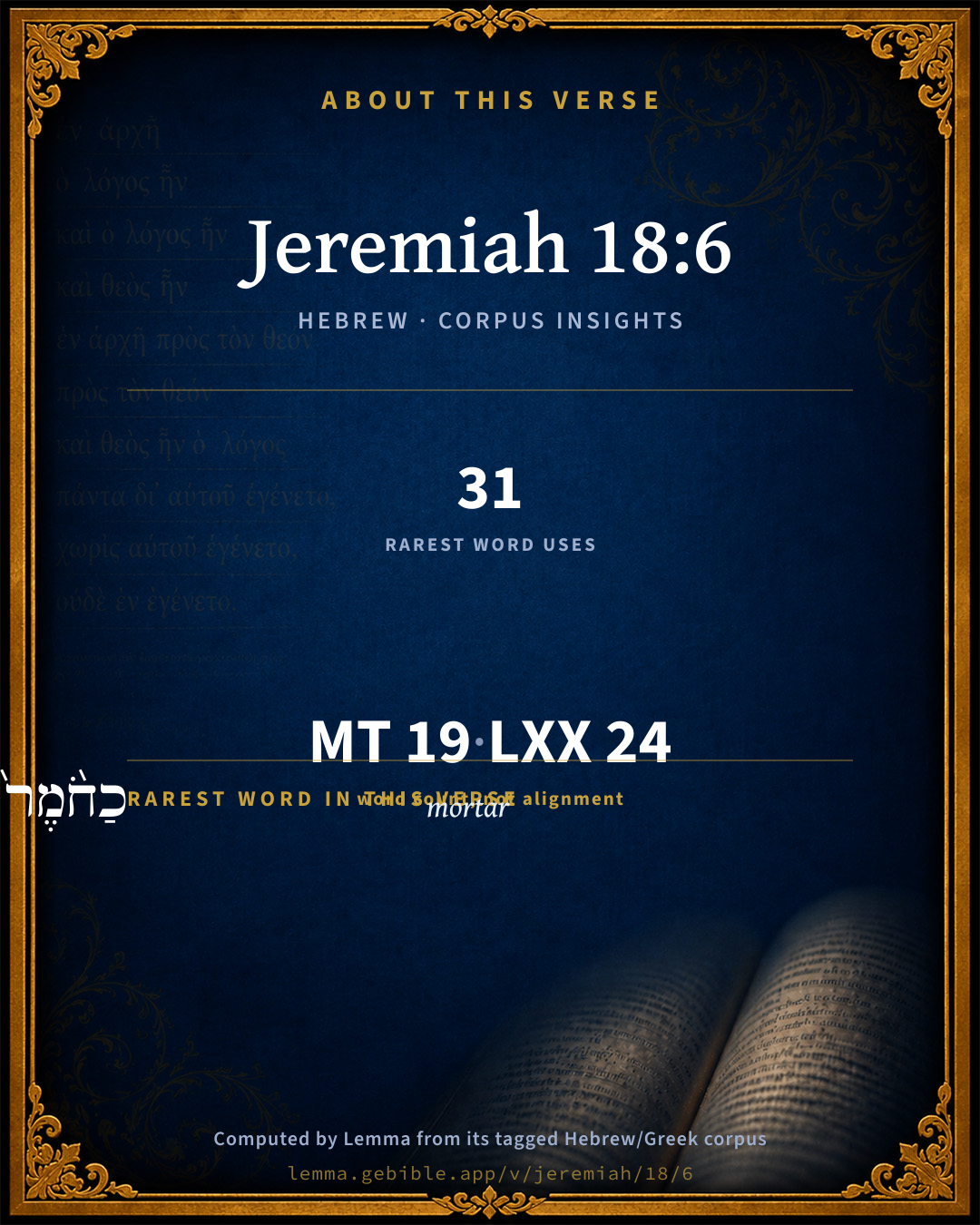
כַחֹ֨מֶר֙
chômer
H2563
“like/as the · mortar”
Preposition, Determined + Noun, Common, Masculine, Singular, Absolute
Part of Speech
Preposition + Noun
Type
Common
Gender
Masculine
Number
Singular
State
Absolute
Full BDB Definition

Origin: from H2560

TWOT: TWOT- 683c

cement, mortar, clay - mortar, cement - clay - mire - heap - swelling, surging (of water) - homer - a unit of dry measure about 65 imperial gallons (300 liters)
  1. הֲכַיּוֹצֵ֨ר yâtsar H3335 “like/as the · forming” Particle, Interrogative + Preposition, Determined + Verb, Qal, Participle Active, Masculine, Singular, Absolute
  2. הַזֶּ֜ה zeh H2088 “the · this” Particle, Definite Article + Pronoun, Demonstrative, Masculine, Singular
  3. לֹא lôʼ H3808 “not” Particle, Negative
  4. אוּכַ֨ל yâkôl H3201 “to prevail” Verb, Qal, Imperfect, 1st Person, Common, Singular
  5. לַעֲשׂ֥וֹת ʻâsâh H6213 “to do” Preposition + Verb, Qal, Infinitive Construct
  6. בֵּ֥ית bayith H1004 “house of” Noun, Common, Masculine, Singular, Construct
  7. יִשְׂרָאֵ֖ל Yisrâʼêl H3478 “Israel” Noun, Proper
  8. נְאֻם nᵉʼum H5002 “utterance of” Noun, Common, Masculine, Singular, Construct
  9. יְהוָ֑ה Yᵉhôvâh H3068 “LORD” Noun, Proper
  10. הִנֵּ֤ה hinnêh H2009 “behold” Particle, Demonstrative
  11. בְּיַ֣ד yâd H3027 “in/at · hand of” Preposition + Noun, Common, Both, Singular, Construct
  12. הַיּוֹצֵ֔ר yâtsar H3335 “the · forming” Particle, Definite Article + Verb, Qal, Participle Active, Masculine, Singular, Absolute
  13. כֵּן kên H3651 “thus” Particle, Demonstrative
  14. אַתֶּ֥ם ʼattâh H859 “you” Pronoun, Personal, 2nd Person, Masculine, Plural
  15. בְּיָדִ֖י yâd H3027 “in/at · hand · my” Preposition + Noun, Common, Both, Singular, Construct + Suffix, Personal, 1st Person, Common, Singular
  16. בֵּ֥ית bayith H1004 “house of” Noun, Common, Masculine, Singular, Construct
  17. יִשְׂרָאֵֽל Yisrâʼêl H3478 “Israel” Noun, Proper

About this verse

These counts appear in no published source. They are computed here, from the morphology-tagged text and Lemma’s own curated glosses. What Lemma adds →

19
words
14
distinct lemmas
Prophets
section

Shared distinctive vocabulary

כַחֹ֨מֶר֙ mortar H2563 occurs in 26 verses of the Hebrew Bible. Also found in:

Grammatical profile

  • 4 verbs
  • 9 nouns
  • 2 pronouns
  • 1 preposition
  • 3 particles

Verb forms

  • הֲכַיּוֹצֵ֨ר Qal · Participle Active
  • אוּכַ֨ל Qal · Imperfect
  • לַעֲשׂ֥וֹת Qal · Infinitive Construct
  • הַיּוֹצֵ֔ר Qal · Participle Active

Repetition

Words recur within this verse — often emphatic in Hebrew:

  • הֲכַיּוֹצֵ֨ר to form H3335 ×2
  • בֵּ֥ית house H1004 ×2
  • יִשְׂרָאֵ֖ל Israel H3478 ×2
  • בְּיַ֣ד hand H3027 ×2

Hebrew & Septuagint length

In the original languages it is 19 Hebrew tokens and 24 Greek tokens — but the two are counted differently (Hebrew bundles its prefixes and suffixes into one token; the Greek is in lemma form), so that isn’t a like-for-like length.

Cross-references

7

Topical passages linked to Jeremiah 18:6 in the Treasury of Scripture Knowledge — connected by theme and wording, ordered by reader-vote popularity; previews shown in the World English Bible.

  • Isaiah 64:8 But now, Yahweh, you are our Father; we are the clay, and you our potter; and we all are the work of your hand.
  • Romans 9:20–21 But indeed, O man, who are you to reply against God? Will the thing formed ask him who formed it, "Why did you make me like this?"
  • Isaiah 45:9 Woe to him who strives with his Maker--a potsherd among the potsherds of the earth! Shall the clay ask him who fashions it, "What are you making?" or your work, "He has no hands?"
  • Jeremiah 18:4 When the vessel that he made of the clay was marred in the hand of the potter, he made it again another vessel, as seemed good to the potter to make it.
  • Matthew 20:15 Isn't it lawful for me to do what I want to with what I own? Or is your eye evil, because I am good?'
  • Daniel 4:23 Whereas the king saw a watcher and a holy one coming down from the sky, and saying, Hew down the tree, and destroy it; nevertheless leave the stump of the roots of it in the earth, even with a band of iron and brass, in the tender grass of the field, and let it be wet with the dew of the sky: and let his portion be with the animals of the field, until seven times pass over him;
  • Romans 11:34 "For who has known the mind of the Lord? Or who has been his counselor?"

Cross-references courtesy of OpenBible.info (CC BY 4.0).

Hebrew and Greek witnesses Masoretic Hebrew ↔ Greek Septuagint

The same verse in the two great witnesses to the Old Testament, shown verse-for-verse.

These are two independent witnesses, not word-aligned to each other, and the Septuagint is shown in lemma (dictionary) form.

Hebrew Jeremiah 18:6 Masoretic · Westminster Leningrad Codex

הֲכַיּוֹצֵ֨ר הַזֶּ֜ה לֹא אוּכַ֨ל לַעֲשׂ֥וֹת לָכֶ֛ם בֵּ֥ית יִשְׂרָאֵ֖ל נְאֻם יְהוָ֑ה הִנֵּ֤ה כַחֹ֨מֶר֙ בְּיַ֣ד הַיּוֹצֵ֔ר כֵּן אַתֶּ֥ם בְּיָדִ֖י בֵּ֥ית יִשְׂרָאֵֽל

House of Israel, can't I do with you as this potter? says Yahweh. Behold, as the clay in the potter's hand, so are you in my hand, house of Israel.

World English Bible · Public Domain

Greek LXX Structure differs

In the Septuagint, Jeremiah is about an eighth shorter than the Hebrew and arranges its material differently — the Oracles Against the Nations (Hebrew chapters 46–51) appear in the middle of the Greek book, after 25:13. Because the chapter and verse boundaries do not line up, a verse-for-verse comparison with the Hebrew is not shown.

A verse-for-verse comparison isn’t shown here because the chapters and verses don’t line up. Switch to the LXX edition with the MT / LXX toggle above to read the Greek directly.

On this verse, Keil & Delitzsch discusses the Septuagint’s reading. Read the note in Commentary ↓

Hebrew: Westminster Leningrad Codex (CC BY 4.0). Greek: Septuagint (public domain); English from a public-domain English Septuagint. How the Septuagint differs from the Hebrew →

Targum (Aramaic paraphrase)

1

The Targum is the ancient Jewish Aramaic paraphrase of the Hebrew Scriptures — an interpretive translation, not the Hebrew text itself. Onkelos (literal) and Pseudo-Jonathan (expansive) render the Torah, and Jonathan the Prophets. Coverage is partial: where no permissively-licensed English translation exists for a verse, only the Aramaic is shown. This is verse-level text, not a word-by-word alignment to the Hebrew.

  1. Targum Jonathan Prophets (Joshua–Malachi)
    הַכְּפַחֲרָא הָדֵין הֲלָא יוּכְלָא קֳדָמַי לְמֶעְבַּד לְכוֹן בֵּית יִשְׂרָאֵל אֲמַר יְיָ הָא כְּמָא דְטִינָא בְיַד פַּחֲרָא כֵּן אַתּוּן חֲשִׁיבִין קֳדָמַי בֵּית יִשְׂרָאֵל:

    (no public-domain English translation for this verse)

    Targum Jonathan — Aramaic: “Mikraot Gedolot” (public domain). English: “Sefaria Community Translation” (CC0 1.0 (public-domain dedication)); “London "Chaldee Paraphrase," 1871” (public domain). Text via Sefaria.

Commentary

Notes on Jeremiah 18:6 from classic Christian and Jewish commentators (each source and its license shown beneath its notes). The classic Christian expositions comment on the surrounding passage and are grouped to its opening verse, so a note may address several verses; the Jewish commentaries on the Tanakh (Rashi and others) are per-verse, so they appear only where the commentator wrote on this verse.

Lemma curates 59 commentaries, every one of them public domain or Creative Commons licensed, each selected and text-cleaned for this edition rather than reprinted as found. About our sources →

Trapp's Complete Commentary

John Trapp

Jer 18:6 O house of Israel, cannot I do with you as this potter? saith the LORD. Behold, as the clay [is] in the potter’s hand, so [are] ye in mine hand, O house of Israel.

Ver. 6. O house of Israel, cannot I do with you.] Make you or mar you at my pleasure: have I not an absolute sovereignty over you, that ye lift up the heel against me, and awake my power by your provocations?

As the clay is in the potter’s hand.] What, then, hath vain man to vaunt of? or why should any proud Arminian {a} say, Quod potui, miserentis est Dei; quod volui, id meae est potestatis? That I can do good, is of God’s mercy; that I will do it, is merely in mine own power? This man was sure his own potter, and not willing to owe overmuch of himself to God.

{a} Grevinchovius.

John Trapp, A Commentary or Exposition upon All the Books of the Old and New Testament (1647–1656) — public domain. Text from a community e-Sword module.

Joseph Benson's Commentary

Jer 18:6. Cannot I do with you as this potter? — Have I not as absolute an authority and power over you? Nay, God has an infinitely clearer title to dominion over us than the potter has over the clay, for the potter only gives the clay its form; whereas we have both matter and form from God. As the work of his hands, made and preserved by him, and yet more as sinners redeemed by him, we are entirely in his hands, and at his disposal, and he has an undoubted right to do with us what he pleases. But as a being infinitely holy, just, and gracious, in all his conduct toward his intelligent, free, and immortal offspring, he acts by fixed rules of perfect equity and infinite goodness. He frequently dispenses favours, indeed, to individuals, families, and nations, in a way of sovereignty, but never punishes by arbitrary power. Strong is his hand, and high is his right hand, (Psa 89:13,) but, as it there follows, justice and judgment are the habitation of his throne. He asserts his absolute power, and tells us what he might do; but at the same time assures us that he will act as a merciful and righteous judge.

Joseph Benson's Commentary on the Old and New Testaments (1811–1818) — public domain. Text from a community e-Sword module.

Keil & Delitzsch

C. F. Keil & F. Delitzsch

In Jer 18:6-10 the Lord discloses to the prophet the truth lying in the potter's treatment of the clay. The power the potter has over the clay to remould, according to his pleasure, the vessel he had formed from it if it went wrong; the same power God possesses over the people of Israel. This unlimited power of God over mankind is exercised according to man's conduct, not according to a decretum absolutum or unchangeable determination. If he pronounces a people's overthrow or ruin, and if that people turn from its wickedness, He repeals His decree (Jer 18:7.); and conversely, if He promises a people welfare and prosperity, and if that people turn away from Him to wickedness, then too He changes His resolve to do good to it (Jer 18:9.). Inasmuch as He is even now making His decree known by the mouth of the prophet, it follows that the accomplishment of Jeremiah's last utterances is conditioned by the impression God's word makes on men. רגע, adv., in the moment, forthwith, and when repeated = now...now, now...again. Ng. maintains that the arrangement here is paratactic, so that the רגע does not belong to the nearest verb, but to the main idea, i.e., to the apodosis in this case. The remark is just; but the word does not mean suddenly, but immediately, and the sense is: when I have spoken against a people, and this people repents, then immediately I let it repent me. נחם על as in Joe 2:13, etc. With "to pluck up," etc., "to build," etc., cf. Jer 1:10. "Against which I spake," Jer 18:8, belongs to "that people," and seems as if it might be dispensed with; but is not therefore spurious because the lxx have omitted it. For הרעה the Keri has הרע, the most usual form, Jer 7:30, Num 32:13; Jdg 2:11, etc.; but the Chet. is called for by the following הטּובה and מרעתו. להיטיב הטּובה, to show kindness, cf. Num 10:32.

The emblematical interpretation of the potter with the clay lays a foundation for the prophecy that follows, Jer 18:11-17, in which the people are told that it is only by reason of their stiffnecked persistency in wickedness that they render threatened judgment certain, whereas by return to their God they might prevent the ruin of the kingdom.

Keil & Delitzsch — Biblical Commentary on the Old Testament (1861–1891) — public domain (CC PDM 1.0). Text via the HelloAO Bible API. (Old Testament only.)

Jamieson, Fausset & Brown

Robert Jamieson, A. R. Fausset & David Brown

Refuting the Jews' reliance on their external privileges as God's elect people, as if God could never cast them off. But if the potter, a mere creature, has power to throw away a marred vessel and raise up other clay from the ground, a fortiori God, the Creator, can east away the people who prove unfaithful to His election and can raise others in their stead (compare Isa 45:9; Isa 64:8; Rom 9:20-21). It is curious that the potter's field should have been the purchase made with the price of Judas' treachery (Mat 27:9-10 : a potter's vessel dashed to pieces, compare Psa 2:8-9; Rev 2:27), because of its failing to answer the maker's design, being the very image to depict God's sovereign power to give reprobates to destruction, not by caprice, but in the exercise of His righteous judgment. Matthew quotes Zechariah's words (Zac 11:12-13) as Jeremiah's because the latter (Jer. 18:1-19:15) was the source from which the former derived his summary in Zac 11:12-13 [HENGSTENBERG].

Jamieson, Fausset & Brown — Commentary Critical and Explanatory on the Whole Bible (1871) — public domain (CC PDM 1.0). Text via the HelloAO Bible API.

Adam Clarke's Commentary

Verse 6. Cannot I do with you as this potter?] Have I not a right to do with a people whom I have created as reason and justice may require? If they do not answer my intentions, may I not reject and destroy them; and act as this potter, make a new vessel out of that which at first did not succeed in his hands?

It is generally supposed that St. Paul has made a very different use of this similitude from that mentioned above. See Ro 9:20, c. His words are, "Hath not the potter power over the clay, of the same lump to make one vessel unto honour, and another unto dishonour?" To this every sensible and pious man will answer, Undoubtedly he has. But would any potter make an exceedingly fair and good vessel on purpose to dash it to pieces when he had done? Surely no! And would or could, the God of infinite perfection and love make millions of immortal souls on purpose for eternal perdition, as the horrible decree of reprobation states? No! This is a lie against all the attributes of God. But does not the text state that he can, out of the same lump, the same mass of human nature, make one vessel to honour, and another to dishonour? Yes. But the text does not say, what the horrible decree says, that he makes one part, and indeed the greater, for eternal perdition. But what then is the meaning of the text? Why evidently this: As out of the same mass of clay a potter may make a flagon for the table and a certain utensil for the chamber, the one for a more honourable, the other for a less honourable use, though both equally necessary to the owner so God, out of the same flesh and blood, may make the tiller of the field and the prophet of the Most High; the one in a more honourable, the other in a less honourable employ; yet both equally necessary in the world, and equally capable of bringing glory to God in their respective places. But if the vessel be marred in his hand, under his providential and gracious dealings, he may reject it as he did the Jews, and make another vessel, such as he is pleased with, of the Gentiles; yet even these marred vessels, the reprobate Jews, are not finally rejected; for all Israel shall be saved in (through) the Lord, i.e., Jesus Christ. And should the Gentiles act as the Jews have done, then they also shall be cut off, and God will call his Church by another name. See Clarke on Ro 9:22 and below.

Adam Clarke's Commentary on the Bible (1810–1826) — public domain. Text from a community e-Sword/MySword module.

John Calvin's Commentaries

Now, in the application, we must notice how things correspond: As the clay is at the will and under the power of the potter, so men are at the will of God: God then is compared to the potter. There is indeed no comparison between things which are equal, but the Prophet argues from the less to the greater. Then God, with respect to men, is said to be the potter, for we are the clay before him. We must also notice the variety in what was formed: from the same clay one vessel is made, then another different from the first. These three things that are compared ought to be specially observed. It is then said, cannot I, as the potter, do with you, O house of Israel? God includes here two of these comparisons, he compares himself to the potter, and he compares the people to clay. We know that God has much greater power over men than a mortal man over the clay; for however he may form it into vessels he is yet not the creator of the clay. Then much greater authority has God over men than the potter over the clay. But the comparison, as I have said, is of the greater with the less, as though he had said, “The potter can form the clay at his will; am I inferior to him? or, is not my power at least, equal to the power of the artificer, who is a mortal and of an abject condition?” Then he adds, with you, or to you, O house of Israel? as though he had said, “Trust ye in your own excellency as you please, yet ye are not better than the clay, when ye consider what I am and what I can do to you.”

We have now seen two of the comparisons; the third follows--that God can turn us here and there, and change us at his will. Then how foolishly do men trust in their present good fortune; for in a single moment their condition can be altered, as there is nothing certain on the earth.

But we must bear in mind what I have already stated — that vain was the confidence by which the Jews deluded themselves; for they thought that God was bound to them, and so they promised themselves a state of perpetuity, and, as though they could with impunity despise the whole law, they ever boasted that the covenant, by which God had adopted the seed of Abraham, was hereditary. Now the Prophet shews that the covenant was in such a way hereditary, that yet the Jews ought to have regarded it as it were an adventitious benefit, as though he had said, “What God gave you he can take away at any time; there is then nothing certain to you, except so far as God will be propitious to you.” In short, he reminds them that the whole of their safety depended on God’s gratuitous layout, as though he had said, “Ye have nothing as your own, but what God has conferred on you is at his will and pleasure; he can to-day take away even what he had yesterday given you. What meaneth then this foolish boasting, when ye say that ye are exempted from the common lot of men?”

The Jews might indeed have rightly disregarded all the dangers of the world, for God had gathered them under his own protection; they would indeed have been safe under his guardianship, had they observed mutual faithfulness, so as to be really his people as he had promised to be their God; but as they esteemed as nothing his whole law, and made void the covenant in which they foolishly gloried, the Prophet, as we see, did not without reason shake off that confidence by which they deceived themselves.

We may hence gather a useful doctrine: With regard to the whole race of man there is nothing certain or permanent in this life; for God can change our condition at any time, so as to cast down the rich and the eminent from their elevation, and also to raise up the most despised of men, according to what is said in Psalm 113:7. And we know this to be true, not only as to individuals, but also as to nations and kingdoms. Many kings have so increased their power as to think themselves beyond the reach of harm; and yet we have seen that God laid them prostrate as by a sudden whirlwind: so also it has happened to powerful nations. With regard then to the condition of mankind, God shews here as in a mirror, or by a vivid spectacle, that sudden changes are often in the world: which ought to awaken us from our torpor, so that no one of us may dare to promise himself another day, or even another hour, or another moment. This is one thing; but this doctrine has a peculiar application to us; for as God has by a peculiar favor separated us from the rest of the world, so he would have us to depend wholly on his mere good will. Faith indeed ought to be tranquil, nay, it ought to disregard whatever may bring on us any terror or anxiety; but faith, where has it its seat? In heaven. Then courage is required in all the children of God, so that they may with a quiet mind disregard all the changes of the world. But we must see that the tranquillity of faith be well founded, that is, in humility. For as we cast our anchor in heaven, so also, with regard to ourselves, we ought always to he low and be humble. Whosoever then flies in vain confidence boasts in vain of faith, and falsely pretends that he trusts in God. Let it then ever come to our minds, and constantly recur to us, that our condition is not through ourselves safe and secure, but through the gratuitous goodness of God. We now see the application of this doctrine. The Prophet proceeds, —

John Calvin's Commentaries (1540-1563) — public domain. Text from the Calvin Translation Society English edition (1840s-50s) via the Christian Classics Ethereal Library (ccel.org). Calvin's coverage is partial (roughly two-thirds of the Bible); uncommented books and verses are honest gaps, never fabricated. The 19th-century editor's footnotes and remarks are omitted so the notes are faithfully Calvin's own voice.

Ellicott's Commentary for English Readers

(6) Cannot I do with you as this potter?—The question implies a theory of the universe, which is neither (as some have thought) one of absolute fatalism, crushing man’s freedom, nor, on the other hand, one which merges God’s sovereignty in man’s power of choice. The clay can resist the potter, or can yield itself willingly to his hands to be shaped as he wills. Its being “marred” is through no fault of the potter, but—in the framework of the parable—through the defect of the material, and, in its application, through the resistance of the human agents whom God is fashioning. And when it is so marred one of two courses is open to the potter. He can again re-mould and fashion it to his purpose, to a new work which may be less honourable than that for which it was originally designed; or, if it be hopelessly marred, can break it and cast it away, and with fresh clay mould a fresh vessel. The history of nations and churches and individual men offers many examples of both processes. They frustrate God’s gracious purpose by their self-will, but His long-suffering leads them to repentance, and gives them, to speak after the manner of men, yet another chance of being moulded by His hands. Here the prophet invites the people, as the clay, to accept the former alternative. St. Paul, taking the same analogy, looks forward to the time when the marred vessel of Israel shall be restored to the Master’s house and be honoured in His service (Rom_9:21; Rom_11:26). The closing verses of Browning’s poem, “Rabbi Ben-Ezra,” in Men and Women, may be referred to as embodying the same thought :—

“But I need Thee, as then,

Thee, God, who mouldest men;

And since, not even while the whirl was worst,

Did I—to the wheel of life,

With shapes and colours rife,

Bound dizzily—mistake my end, to slake Thy thirst,

“So take and use Thy work!

Amend what flaws may lurk,

What strain o’ the stuff, what warpings past the aim!

My times be in Thy hand;

Perfect the cup as planned!

Let age approve of youth, and death complete the same.”

A Bible Commentary for English Readers, edited by Charles John Ellicott (1878–1897) — public domain. Text from a community e-Sword module.

The Cambridge Bible for Schools and Colleges

gen. ed. J. J. S. Perowne

6. “First of the prophets, Jeremiah proclaims distinctly what had been more or less implied throughout, that predictions were subject to no overruling necessity, but depended for their fulfilment on the moral state of those to whom they were addressed; that the most confident assurance of blessing could be frustrated by sin; that the most awful warnings of calamity could be averted by repentance.” Stanley’s J. Ch. II. 445. Cp. the story of Jonah, and in Ezekiel (Jer_18:21 ff., Jer_33:12 ff.) the application of the same thought to individuals.

The Cambridge Bible for Schools and Colleges (gen. ed. J. J. S. Perowne; Cambridge University Press, 1878–1918) — public domain. Text from a community e-Sword module.

John Gill's Exposition

If that nation against whom I have pronounced,.... Such a sentence as this, should immediately, upon the above declaration, do as Nineveh did:

turn from their evil; their evil of sin, their evil ways and works, as an evidence of the truth of their repentance for former sins:

I will repent of the evil that one thought to do unto them; as they change their course of life, God will change the dispensations of his providence towards them, and not bring upon them the evil of punishment he threatened them with; in which sense repentance can only be understood of God, he doing that which is similar to what men do when they repent of anything; they stop their proceedings, and change their outward conduct; so God proceeds not to do what he threatened to do, and changes his outward behaviour to men; he wills a change, and makes one in his methods of acting, but never changes his will.

John Gill's Exposition of the Whole Bible (1746–1763) — public domain (CC PDM 1.0). Text via the HelloAO Bible API.

Albert Barnes' Notes on the Bible

So are ye in mine hand - When a vessel was ruined, the potter did not throw it away, but crushed it together, dashed it back upon the wheel, and began his work afresh, until the clay had taken the predetermined shape. It was God’s purpose that Judaea should become the proper scene for the manifestation of the Messiah, and her sons be fit to receive the Saviour’s teaching and carry the good tidings to all lands. If therefore at any stage of the preparation the Jewish nation took such a course as would have frustrated this purpose of Providence, it was crushed by affliction into an unresisting mass, in which the formative process began again immediately.

Albert Barnes' Notes on the Bible (1834–1885) — public domain. Text from a community e-Sword/MySword module.

Matthew Poole's English Annotations

God now expoundeth to the prophet his design in bidding him go to the potter’s house, it was to instruct or confirm him in the power that he had over his creatures. For, saith he, as is the clay to the potter, so is the house of Israel (and indeed so are all the sons and daughters of men) unto God; God hath the same power over them that a potter hath over the clay, and a greater right to do what he pleaseth with them, than any potter hath relating to the clay; the clay is but the potter’s purchase, not his creature, but man is God’s creature. God, by his prophet Isaiah, made use of the same similitude, Isa 45:9. So doth the apostle, Rom 9:20. That God hath an absolute sovereign power to do what he pleaseth with the work of his hands, can be denied by no men of sense, whether God useth this his sovereignty in the eternal punishment of sinners, that is another thing; he hath a sovereign power, but he acteth as a just judge, rendering to every man according to his works.

Matthew Poole's English Annotations on the Holy Bible (1683–1685) — public domain. Text from a community e-Sword/MySword module.

The Pulpit Commentary

HOMILIES BY J. WAITE Ver. 6. The potter and the clay.

The analogy here instituted enshrines truths that are of universal application. They have their individual quite as much as their national beatings. Nowhere does the representative character of the house of Israel appear mere clearly than in this passage; nowhere do we get a more striking view of the general method of the Divine dealings with the human race. It suggests

I GOD"S ABSOLUTE SOVEREIGNTY OVER THE BEING AND LIFE OF EVERY MAN. The figure of the potter and the clay is one of frequent occurrence in Holy Scripture. (vide Job_10:9 Isa_64:8 Rom_9:10) It vividly represents the subjection of our nature and our personal history to the Divine control. The fact of our moral freedom, the mysterious prerogative that belongs to us of choosing and following our own way, must needs make the comparison defective. There is some point at which all such physical analogies fail duly to set forth the realities of moral and spiritual life. But it is deeply true as suggestive of the power God has over us to mold us as he pleases. Free as our will may be, is not our whole nature as plastic material in the hands of him who made us? Free as we may be to pursue our own chosen course of life, can we ever escape the "Divinity that shapes our ends?" There is a hidden power, whether we acknowledge it or not, the mastery of which over thought, feeling, purpose, and action is the deepest reality of our existence.

II HIS FORMATIVE PURPOSE. Distinguish between a sovereign power and one that is arbitrary and capricious. Complete as the Divine mastery over us may be, it is not lawless or purposeless. It has always a definite end in view, and that end is wise and holy and good. As the potter seeks to fashion the clay into some beautiful or useful form that his own brain has first conceived, so God, by his providential and spiritual control, seeks to work out a Divine idea in our being and life, to body forth in us some archetype of moral beauty that exists in his own eternal mind. He would fain fashion us into a noble form and fit us for some noble use. In God"s "great house" there are many utilities. And even the vessel "unto dishonor" has its place and its purpose. Our faith in the infinitely wise and holy love that governs all leads us to rest in the thought"That nothing walks with aimless feet; That not one life shall be destroyed Or cast as rubbish to the void, When God hath made the pile complete.

But he who formed us for himself would not have any of us to be content with an inferior position and a lower aim. He would so mold and fashion us that we shall be "vessels unto honor, sanctified, and meet for the Master"s. (2Ti_2:21)

III HIS LONG-SUFFERING PATIENCE. When the potter"s work is marred, he presses the clay into a shapeless mass and casts it upon the wheel again. We are reminded of the various methods God employs in molding us to his will, and how if one fails he will often subject us to another. There are events that sometimes break up the whole form of a man"s life; old ties are severed, old associations pass away; he beans an altogether new career, with new responsibilities, new moral tests, new possibilities of good. There are afflictions that change the whole tenor of a man"s inward life; his spirit is crushed, wounded, softened, that it may the better receive Divine impressions. "God maketh my heart soft, etc. (Job_23:16) "My heart is like wax". (Psa_22:14) Thus does God "humble us to prove us, to know what is in our heart, whether we will keep his commandments or not". (Deu_8:2) There may come a time when all these Divine methods fail and the soul is found to be reprobate. In Jer_19:1-11 we have a figurative prophecy of the ultimate abandonment of the Jewish people to their fate. In this case the vessel has been baked in the fire; it is incapable of taking a new shape, and is broken so "that it cannot be made whole again." Such is the doom of the finally impenitent and intractable. But God"s patience is very wonderful. In this world at least the door of mercy is always open. There is always the possibility of a new and nobler life. He "is long-suffering to usward, not willing that any should perish, but that all should come to repentance". W. (2Pe_3:9)

The Pulpit Commentary (1880–1919), ed. H.D.M. Spence-Jones & Joseph S. Exell — public domain. Text from a community e-Sword module.

John Wesley's Explanatory Notes

Cannot I do - That God hath an absolute sovereign power to do what he pleases with the work of his hands: but he acts as a just judge, rendering to every man according to his works.

John Wesley, Explanatory Notes Upon the Whole Bible (1754–1765) — public domain. Text via the GEBible commentary corpus.

Lesson kit

Teaching starters — assembled from the data on this page, not authored interpretation. Every prompt links to the verse data it draws on. Edit before teaching.

Jeremiah, in the Prophets, opens this verse with 19 words (14 distinct Hebrew lemmas). Its most distinctive word is chômer (“mortar”). A historical commentator’s framing appears above. Read the whole chapter for the surrounding context.

Discussion questions

  1. What does “mortar” (chômer) contribute to the verse as a whole?
  2. Genesis 11:3 shares the word «mortar» with this verse. How do the two illuminate each other?
  3. “to form” occurs 2× in this one verse. What is the effect of the repetition?
  4. These translations render this verse differently; the difference is in the English rendering, not the original. What questions does that raise?
  5. The verb «הֲכַיּוֹצֵ֨ר» is Qal Participle Active. How does its form color the action?
  6. Reading how Trapp's Complete Commentary and Joseph Benson's Commentary read this verse, where do the two commentators agree and where do they part?

Things to notice

Reading settings

Reading text

Shown beneath each verse's original-language words.

Old Testament
Old Testament edition

Read the OT as the Masoretic Hebrew (MT) or the Greek Septuagint (LXX).

English shown for the Greek Septuagint (in the Hebrew ↔ Greek comparison).

Comparing translations? Open the Compare panel on any verse page to stack up to four side by side.