Genesis 30:8

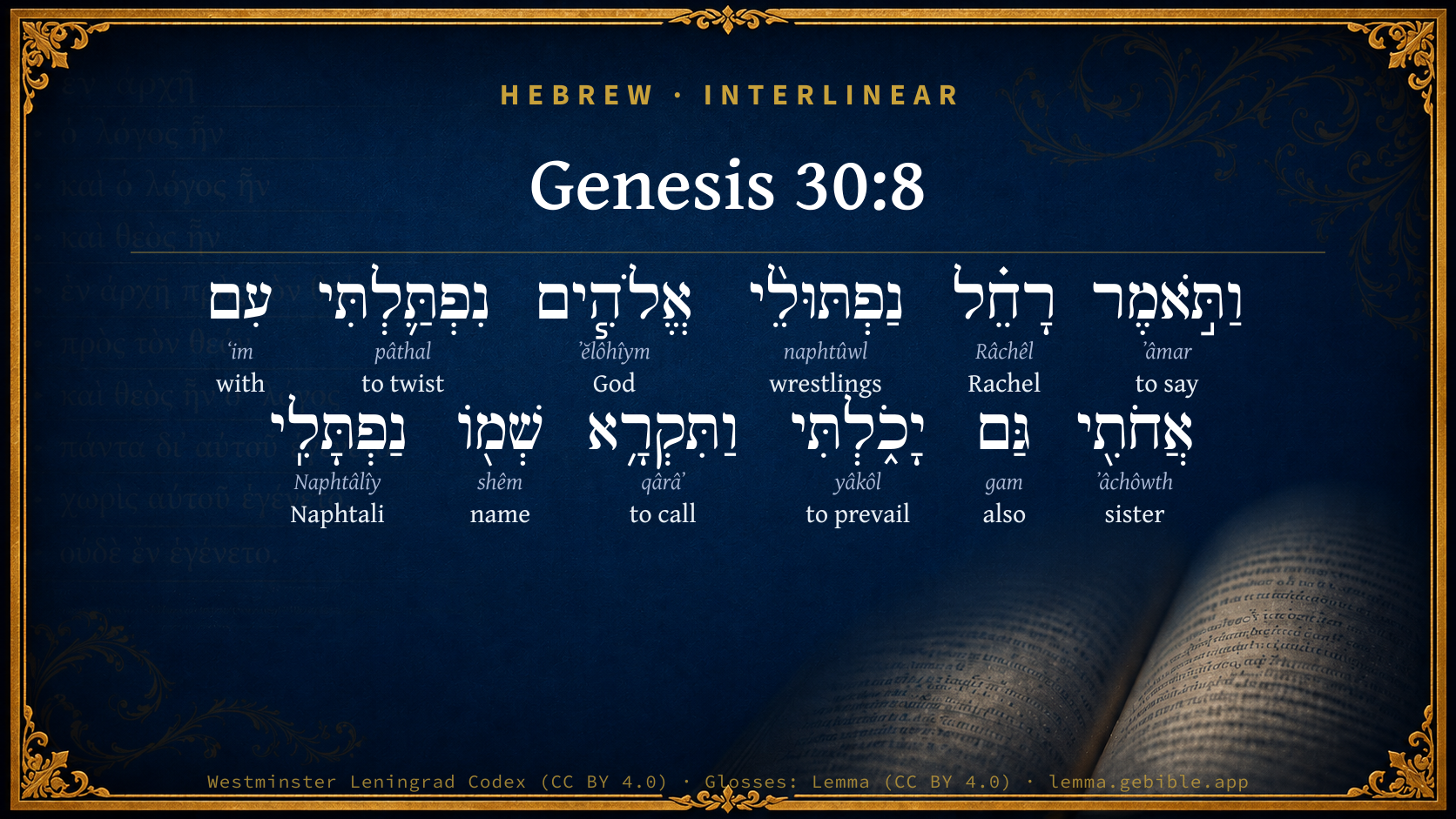
Hebrew (Westminster Leningrad Codex) Genesis 30:8 appears in the Hebrew Old Testament. The text above is from the Westminster Leningrad Codex. Each word links to its Strong’s number, a concise gloss, and parsing drawn from the Open Scriptures Hebrew Bible morphology. Click any word for its full Brown-Driver-Briggs (BDB) entry.
Download image
Cite this verse

Genesis 30:8 (World English Bible). Public Domain. Lemma interlinear Bible study tool, https://lemma.gebible.app/v/genesis/30/8.

Show BibTeX & RIS
BibTeX
RIS
English Translation
Rachel said, "With mighty wrestlings have I wrestled with my sister, and have prevailed." She named him Naphtali.
World English Bible · Public Domain
Highlights
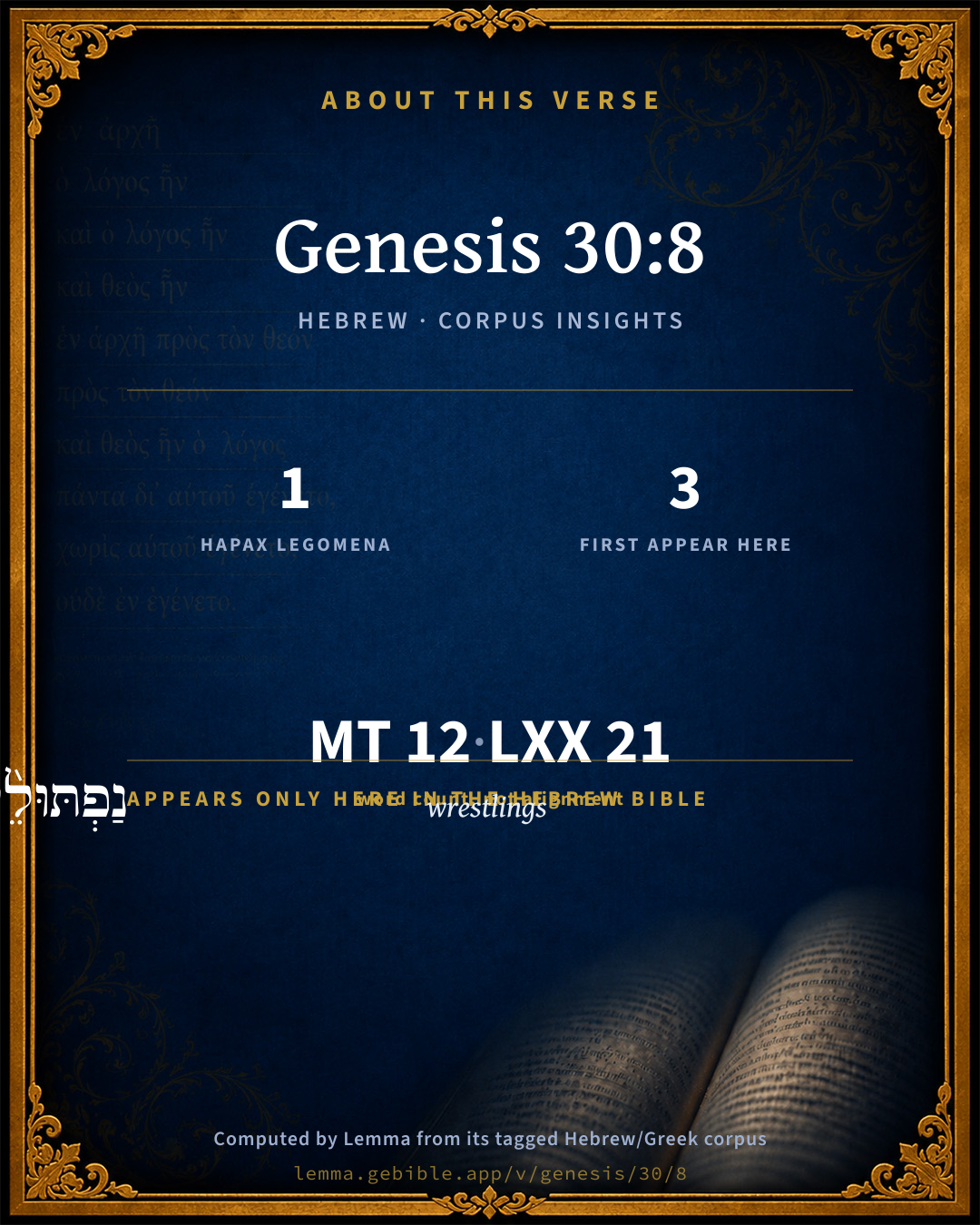
  • 1 hapax legomenon — only here in the Hebrew Bible
  • 3 first appearances in the Hebrew Bible
Full analysis ↓
Download a study sheet

One document with this verse’s original text, its word-by-word gloss line, the meaning frame, cross-references with their text, attributed commentary, and full source and license credits — printable, and it pastes into notes with its structure intact.

This verse Autodidact and up

Study sheet (.html) Plain text (.txt)

A passage Seminary Student

Up to 50 verses in one chapter. A passage sheet keeps up to 6 commentary sources and 12 cross-references per verse, in the order this page ranks them, and says so on the sheet whenever that leaves anything out. Ask for a single verse and you get the Autodidact verse sheet above.

Everything on this page stays free to read, with no account — the sheet is a download of what is already on screen, not access to it.

Want to remove ads? Support Godless Engineer
Compare translations 3

The same verse in 3 English versions, stacked beneath the original-language interlinear above. Click any original word for its lexicon entry.

Each is an independent rendering of the whole verse — the interlinear is not word-aligned to these translations.

Highlighted words mark where these versions differ — a whole-verse word diff, not a word-by-word alignment.

  • World English Bible Public Domain
    Rachel said, "With mighty wrestlings have I wrestled with my sister, and have prevailed." She named him Naphtali.
  • King James Version Public Domain
    And Rachel said, With great wrestlings have I wrestled with my sister, and I have prevailed: and she called his name Naphtali.
  • unfoldingWord Literal Text CC BY-SA 4.0
    So Rachel said, “ mighty wrestlings I have wrestled with my sister. Indeed I have prevailed!” And she called his name Naphtali.

unfoldingWord Literal Text — © unfoldingWord, licensed CC BY-SA 4.0. Word-aligned USFM3 via Door43 (git.door43.org/unfoldingWord/en_ult).

Versions to compare (up to 4)

3 of 4 selected

Show all 18 translations

Every available English version of this verse, each an independent rendering of the whole verse.

  • World English Bible Public Domain
    Rachel said, "With mighty wrestlings have I wrestled with my sister, and have prevailed." She named him Naphtali.
  • Berean Standard Bible Public Domain
    Then Rachel said, “In my great struggles, I have wrestled with my sister and won.” So she named him Naphtali.
  • Majority Standard Bible Public Domain
    Then Rachel said, “In my great struggles, I have wrestled with my sister and won.” So she named him Naphtali.
  • King James Version Public Domain
    And Rachel said, With great wrestlings have I wrestled with my sister, and I have prevailed: and she called his name Naphtali.
  • American Standard Version (1901) Public Domain
    And Rachel said, With mighty wrestlings have I wrestled with my sister, and have prevailed: and she called his name Naphtali.
  • Revised Version (1885) Public Domain
    And Rachel said, With mighty wrestlings have I wrestled with my sister, and have prevailed: and she called his name Naphtali.
  • Geneva Bible (1599) Public Domain
    Then Rahel said, with excellent wrestlings haue I wrestled with my sister, and haue gotten the vpper hande: and shee called his name, Naphtali.
  • Douay-Rheims (1899) Public Domain
    For whom Rachel said: God hath compared me with my sister, and I have prevailed: and she called him Nephtali.
  • Young's Literal Translation Public Domain
    and Rachel saith, `With wrestlings of God I have wrestled with my sister, yea, I have prevailed;' and she calleth his name Napthali.
  • Literal Standard Version CC BY-SA 4.0
    and Rachel says, “With wrestlings of God I have wrestled with my sister, indeed, I have prevailed”; and she calls his name Napthali.
  • Unlocked Literal Bible CC BY-SA 4.0
    Rachel said, “With mighty wrestlings have I wrestled with my sister and have prevailed.” She called his name Naphtali.
  • unfoldingWord Literal Text CC BY-SA 4.0
    So Rachel said, “ mighty wrestlings I have wrestled with my sister. Indeed I have prevailed!” And she called his name Naphtali.
  • Darby Bible Public Domain
    And Rachel said, Wrestlings of God have I wrestled with my sister, and have prevailed; and she called his name Naphtali.
  • World Messianic Bible Public Domain
    Rachel said, “I have wrestled with my sister with mighty wrestlings, and have prevailed.” She named him Naphtali.
  • Webster's Bible Public Domain
    And Rachel said, With great wrestlings have I wrestled with my sister, and I have prevailed: and she called his name Naphtali.
  • Free Bible Version CC BY-SA 4.0
    Rachel said, “I've had a hard struggle with my sister, but I've won.” So she named him Naphtali.
  • Bible in Basic English Public Domain
    And Rachel said, I have had a great fight with my sister, and I have overcome her: and she gave the child the name Naphtali.
  • JPS Tanakh (1917) Public Domain
    And Rachel said: 'With mighty wrestlings have I wrestled with my sister, and have prevailed.' And she called his name Naphtali.

Literal Standard Version (2020), Covenant Press — licensed CC BY-SA 4.0. Text via the HelloAO Bible API (eBible.org). Unlocked Literal Bible (unfoldingWord) — licensed CC BY-SA 4.0. Text via the HelloAO Bible API (eBible.org). unfoldingWord Literal Text — © unfoldingWord, licensed CC BY-SA 4.0. Word-aligned USFM3 via Door43 (git.door43.org/unfoldingWord/en_ult). Free Bible Version, Dr. Jonathan Gallagher — licensed CC BY-SA 4.0. Text via the HelloAO Bible API (eBible.org).

Word by word

More ways to search: Search by grammar → Find every occurrence → Compare this word →

Practice this passage: Drill this verse → Learn its vocabulary →

נַפְתּוּלֵ֨י
naphtûwl
H5319
“wrestlings of”
Noun, Common, Masculine, Plural, Construct
Part of Speech
Noun
Type
Common
Gender
Masculine
Number
Plural
State
Construct
Full BDB Definition

Origin: from H6617

TWOT: 1857c

wrestlings
  1. וַתֹּ֣אמֶר ʼâmar H559 “and · to say” Conjunction + Verb, Qal, Sequential Imperfect, 3rd Person, Feminine, Singular
  2. רָחֵ֗ל Râchêl H7354 “Rachel” Noun, Proper
  3. אֱלֹהִ֧ים ʼĕlôhîym H430 “God(s)” Noun, Common, Masculine, Plural, Absolute
  4. נִפְתַּ֛לְתִּי pâthal H6617 “to twist” Verb, Niphal, Perfect, 1st Person, Common, Singular
  5. עִם ʻim H5973 “with” Preposition
  6. אֲחֹתִ֖י ʼâchôwth H269 “sister · my” Noun, Common, Feminine, Singular, Construct + Suffix, Personal, 1st Person, Common, Singular
  7. גַּם gam H1571 “also” Particle, Accusative
  8. יָכֹ֑לְתִּי yâkôl H3201 “to prevail” Verb, Qal, Perfect, 1st Person, Common, Singular
  9. וַתִּקְרָ֥א qârâʼ H7121 “and · to call” Conjunction + Verb, Qal, Sequential Imperfect, 3rd Person, Feminine, Singular
  10. שְׁמ֖וֹ shêm H8034 “name · his” Noun, Common, Masculine, Singular, Construct + Suffix, Personal, 3rd Person, Masculine, Singular
  11. נַפְתָּלִֽי Naphtâlîy H5321 “Naphtali” Noun, Proper

About this verse

These counts appear in no published source. They are computed here, from the morphology-tagged text and Lemma’s own curated glosses. What Lemma adds →

12
words
12
distinct lemmas
Pentateuch
section

Notable vocabulary

1 hapax legomenon — a word that appears only here in the entire Hebrew Bible:

  • נַפְתּוּלֵ֨י wrestlings H5319

First appearance in Scripture

These words make their first canonical appearance in the Hebrew Bible here:

  • נַפְתּוּלֵ֨י wrestlings H5319
  • נִפְתַּ֛לְתִּי to twist H6617
  • נַפְתָּלִֽי Naphtali H5321

Shared distinctive vocabulary

נִפְתַּ֛לְתִּי to twist H6617 occurs in 5 verses of the Hebrew Bible. Also found in:

Grammatical profile

  • 4 verbs
  • 6 nouns
  • 1 preposition
  • 1 particle

Verb forms

  • וַתֹּ֣אמֶר Qal · Sequential Imperfect
  • נִפְתַּ֛לְתִּי Niphal · Perfect
  • יָכֹ֑לְתִּי Qal · Perfect
  • וַתִּקְרָ֥א Qal · Sequential Imperfect

Hebrew & Septuagint length

In English translation the verse runs 18 words from the Hebrew and 21 from the Septuagint (LXX English) — closely comparable.

A rough comparison of the two English renderings, which tokenize alike — not a word-level alignment.

Word counts can differ between the Hebrew and the Greek without any difference in meaning — e.g. the Hebrew direct-object marker אֵת has no separate Greek word, and Greek often adds the article ὁ.

In the original languages it is 12 Hebrew tokens and 21 Greek tokens — but the two are counted differently (Hebrew bundles its prefixes and suffixes into one token; the Greek is in lemma form), so that isn’t a like-for-like length.

Cross-references

9

Topical passages linked to Genesis 30:8 in the Treasury of Scripture Knowledge — connected by theme and wording, ordered by reader-vote popularity; previews shown in the World English Bible.

  • Genesis 32:24–25 Jacob was left alone, and wrestled with a man there until the breaking of the day.
  • Genesis 23:6 "Hear us, my lord. You are a prince of God among us. In the choice of our tombs bury your dead. None of us will withhold from you his tomb, but that you may bury your dead."
  • Genesis 49:21 "Naphtali is a doe set free, Who bears beautiful fawns.
  • Matthew 4:13 Leaving Nazareth, he came and lived in Capernaum, which is by the sea, in the region of Zebulun and Naphtali,
  • Genesis 35:25 The sons of Bilhah (Rachel's handmaid): Dan and Naphtali.
  • Genesis 46:24 The sons of Naphtali: Jahzeel, Guni, Jezer, and Shillem.
  • Exodus 9:28 Pray to Yahweh; for there has been enough of mighty thunderings and hail. I will let you go, and you shall stay no longer."
  • Deuteronomy 33:23 Of Naphtali he said, Naphtali, satisfied with favor, Full with the blessing of Yahweh, Possess you the west and the south.
  • 1 Samuel 14:15 There was a trembling in the camp, in the field, and among all the people; the garrison, and the spoilers, they also trembled; and the earth quaked: so there was an exceeding great trembling.

Cross-references courtesy of OpenBible.info (CC BY 4.0).

Hebrew and Greek witnesses Masoretic Hebrew ↔ Greek Septuagint

The same verse in the two great witnesses to the Old Testament, shown verse-for-verse.

These are two independent witnesses, not word-aligned to each other, and the Septuagint is shown in lemma (dictionary) form.

Hebrew Genesis 30:8 Masoretic · Westminster Leningrad Codex

וַתֹּ֣אמֶר רָחֵ֗ל נַפְתּוּלֵ֨י אֱלֹהִ֧ים נִפְתַּ֛לְתִּי עִם אֲחֹתִ֖י גַּם יָכֹ֑לְתִּי וַתִּקְרָ֥א שְׁמ֖וֹ נַפְתָּלִֽי

Rachel said, "With mighty wrestlings have I wrestled with my sister, and have prevailed." She named him Naphtali.

World English Bible · Public Domain

Greek LXX Genesis 30:8 Septuagint · lemma form

καί εἶπον ραχηλ συνλαμβάνω ἐγώ ὁ θεός καί συν ἀναστρέφω ὁ ἀδελφή ἐγώ καί δύναμαι καί καλέω ὁ ὄνομα αὐτός νεφθαλι

And Rachel said, God has helped me, and I contended with my sister and prevailed; and she called his name, Nephthalim.

LXX2012 (modern English Septuagint) · Public Domain

On this verse, Adam Clarke's Commentary discusses the Septuagint’s reading. Read the note in Commentary ↓

Hebrew: Westminster Leningrad Codex (CC BY 4.0). Greek: Septuagint (public domain); English from LXX2012 (modern English Septuagint) (Public Domain). How the Septuagint differs from the Hebrew →

Targum (Aramaic paraphrase)

2

The Targum is the ancient Jewish Aramaic paraphrase of the Hebrew Scriptures — an interpretive translation, not the Hebrew text itself. Onkelos (literal) and Pseudo-Jonathan (expansive) render the Torah, and Jonathan the Prophets. Coverage is partial: where no permissively-licensed English translation exists for a verse, only the Aramaic is shown. This is verse-level text, not a word-by-word alignment to the Hebrew.

  1. Targum Onkelos Torah (Genesis–Deuteronomy)
    וַאֲמֶרֶת רָחֵל קַבִּיל יְיָ בָּעוּתִי בְּאִתְחַנָּנוּתִי בִּצְלוֹתִי חֲמֵידַת דִּיהֵי לִי וְלַד כַּאֲחָתִי אַף אִתְיְהִיב לִי וּקְרַת שְׁמֵהּ נַפְתָּלִי

    (no public-domain English translation for this verse)

    Targum Onkelos — Aramaic: “Onkelos Genesis” (public domain); “Onkelos Exodus” (public domain); “Onkelos Leviticus” (public domain); “Onkelos Numbers” (public domain); “Onkelos Deuteronomy” (public domain). English: “Sefaria Community Translation” (CC0 1.0 (public-domain dedication)); “J.W. Etheridge. The Targums of Onkelos and Jonathan Ben Uzziel on the Pentateuch. London: Longmans, Green, 1862” (public domain). Text via Sefaria.

  2. Targum Pseudo-Jonathan Torah (Genesis–Deuteronomy)
    וַאֲמָרַת רָחֵל מְדַחֲקָא דְחִיקִית קֳדָם יְיָ בִּצְלוֹ בְּרַם קַבֵּיל בָּעוּתִי דִיהֵי לִי בַּר כַּאֲחָתִי אוּף יְהַב לִי תְּרֵין וְהֵיכְדֵין עֲתִידִין בְּנוֹי לְאִתְפְּרָקָא מִן יַד בַּעֲלֵי דְבָבֵיהוֹם בְּדַחֲקוּתְהוֹן בִּצְלוֹ קֳדָם יְיָ וּקְרַת שְׁמֵיהּ נַפְתָּלִי

    And Rahel said, With affliction afflicted was I before the Lord in prayer; therefore He hath received my request that I might have a son as my sister, and hath given me two. Even so are my children to be redeemed from the hand of their enemies when they shall afflict themselves in prayer before the Lord; and she called his name Naphtali.

    Targum Pseudo-Jonathan — Aramaic: “Targum Jonathan on Genesis” (public domain); “Targum Jonathan on Exodus” (public domain); “Targum Jonathan on Leviticus” (public domain); “Targum Jonathan on Numbers” (public domain); “Targum Jonathan on Deuteronomy” (public domain). English: “The Targum of Jonathan ben Uzziel, trans. J. W. Etheridge, London, 1862” (public domain). Text via Sefaria.

Commentary

Notes on Genesis 30:8 from classic Christian and Jewish commentators (each source and its license shown beneath its notes). The classic Christian expositions comment on the surrounding passage and are grouped to its opening verse, so a note may address several verses; the Jewish commentaries on the Tanakh (Rashi and others) are per-verse, so they appear only where the commentator wrote on this verse.

Lemma curates 59 commentaries, every one of them public domain or Creative Commons licensed, each selected and text-cleaned for this edition rather than reprinted as found. About our sources →

Trapp's Complete Commentary

John Trapp

Gen 30:8 And Rachel said, With great wrestlings have I wrestled with my sister, and I have prevailed: and she called his name Naphtali.

Ver. 8. With great wrestlings.] Heb., With wrestlings of God; that is, with excellent and most earnest wrestlings and endeavours; by storms of sighs, and showers of tears. {a} Stupidity is the low extreme, like the dull earth. Despair is as much too high, as it were in the element of fire, which scorches up the spirit. The middle region of air and water, sighs and tears, is the best.

{a} Magno desiderio, precibus, suspiriis luctata est adversus sororem . - Pareus, in loc.

John Trapp, A Commentary or Exposition upon All the Books of the Old and New Testament (1647–1656) — public domain. Text from a community e-Sword module.

The Biblical Illustrator

Joseph S. Exell

Gen_30:8

With great wrestlings have I wrestled

Great wrestlings

Thus speaks Rachel; and this womans experience, multiplied as it is a thousand-fold in hearts that never told their struggles, shows us that life is not so calm as it seems.

Beneath many a placid stream there are deep and dangerous under-currents. Often a quiet face hides the deep things, which even the dearest intimacies cannot draw out, and which constitute the tragedies of the hearts history. It is well that we learn the need of wrestling; for life, especially Christian life, has flesh and blood to battle with. Paul says, we wrestle; and goodness, even at its best, is dearly bought and hardly won.

I. THIS IS TRUE OF THOSE WHO ARE OUTWARDLY THE WEAKEST. Nothing betokens the warrior; there is no mailed breast, no gauntleted hand. The character seems like the face perhaps, to be common-place and dull. But what a world there is within the humblest forms that move to and fro amongst us! That plain face that we mark no loveliness in, is beautiful perhaps in the eyes of angels--that unillustrious life is associated with paths where some Goliath has been laid low, and where the Philistine host has been dispersed.

II. THIS IS TO BE THE LOT OF OUR CHILDREN. Listen, and you may hear a sigh as of a distant storm, in the spring breeze of childhoods morning, which may break into a weird tempest over their heads before the evening comes. These children of ours cannot do without religion, without Christ--the Brother and the Saviour of men. Do these little ones look made forthe endurance of hard wrestlings? Perhaps not. But these little hands will be stretched out in the dark night; these little feet will have to climb in loneliness the toilsome way, when you and I are gone. Who can wonder that we wish to see them before we die in the covert of the great rock?

III. THIS IS THE ONLY PATH TO VICTORY. God sees that it is best. The oak that struggles with the tempest strikes deeper root in the soil; and the faith that has struggled with doubt is the firmest of beliefs. The love which has learnt human insincerity, learns to prize beyond all price the less demonstrative love of true natures. We gain conquest through hardship, defeat, and peril. We wrestle with great wrestlings over inborn tastes and desires, over habits that have steadily risen to dominance, over affections that are carnal and corrupt, and over enemies visible and invisible. For ease is death. When we cease to wrestle, the enemy binds us with fetters of iron. Conquer we may and can--through the faith that looks upward all through the wrestling years. To him that overcometh the glorious promise of victory is vouchsafed. But the struggle will be severe; we shall have not only ordinary sorrows, superficial anxieties, but great wrestlings; and this is the victory that overcometh the world, even our faith. These wrestlings are not mere matters of mental energy; they are connected with moral pain. Dispositions natural to us have to be overcome; human nature, like a child, likes to be spoiled and petted--it can ill-endure rebuke and resistance I Consequently the battle is hard, and there is no plaudit of honour, no noise of conquest, no palm-wreath on the brow.

IV. THIS IS THE ANCIENT WAY. It leads us back to Moses, to Abraham, and to Jacob who was left alone--and there wrestled a man with him till the break of day (Gen_32:24). And that we have a Divine nature is proven by mans spiritual wrestlings from the earliest dawn of history. And the rendering of this text, as you will see in the margin of your Bibles, leads us to think of God. With great God-wrestlings have I wrestled. And this ancient way will be our way too. (W. M. Statham, M. A.)

The Biblical Illustrator, edited by Joseph S. Exell (c. 1880s–1900s) — public domain. Text from a community e-Sword module.

Geneva Bible (1599)

Geneva Bible translators

Hebrew, wrestlings of God.

The arrogancy of man’s nature appeareth in that she contemneth her sister, after she hath received this benefit of God to bear children.

Geneva Bible (1599) marginal notes — public domain. Text via Bolls.life.

Adam Clarke's Commentary

Verse 8. She called his name Naphtali] נפתלי naphtali, my wrestling, according to the common mode of interpretation; but it is more likely that the root פתל pathal signifies to twist or entwine. Hence Mr. Parkhurst translates the verse, "By the twistings-agency or operation, of God, I am entwisted with my sister; that is, my family is now entwined or interwoven with my sister's family, and has a chance of producing the promised Seed." The Septuagint, Aquila, and the Vulgate, have nearly the same meaning. It is, however, difficult to fix the true meaning of the original.

Adam Clarke's Commentary on the Bible (1810–1826) — public domain. Text from a community e-Sword/MySword module.

John Calvin's Commentaries

8. With great wrestlings Others translate it, “I am joined with the joinings of God;” as if she exulted in having recovered what she had lost; or, certainly, in having obtained an equal degree of honor with her sister. Others render it, I am doubled with the duplications of God. But both derive the noun and the verb from the root פתל (patal,) which signifies a twisted thread. The former of these senses comes to this; that since Rachel has attained a condition equal to that of her sister, there is no reason why her sister should claim any superiority over her. But the latter sense expresses more confident boasting, since she proclaims herself a conqueror, and doubly superior. But a more simple meaning is (in my opinion) adduced by others, namely, that she “wrestled with divine or excellent wrestlings.” For the Hebrews indicate all excellence by adding the name of God; because the more excellent anything is, the more does the glory of God shine in it. But perverse is that boasting with which she glories over her sister, when she ought rather suppliantly to have implored forgiveness. In Rachel the pride of the human mind is depicted; because they whom God has endowed with his benefits, for the most part are so elated, that they rage contumeliously against their neighbors. Besides, she foolishly prefers herself to her sister in fruitfulness, in which she is still manifestly inferior. But they who are puffed up with pride have also the habit of malignantly depreciating those gifts which the Lord has bestowed on others, in comparison with their own smaller gifts. Perhaps, also, she expected a numerous progeny, as if God were under obligation to her. She did not, as pious persons are wont to do, conceive hope from benefits received; but, by a confident presumption of the flesh, made herself sure of everything she wished. Hitherto, then, she gave no sign of pious modesty. Whence is this, but because her temporary barrenness had not yet thoroughly subdued her? Therefore we ought the more to beware, lest if God relaxes our punishments, we, being inflated by his kindness, should perish.

John Calvin's Commentaries (1540-1563) — public domain. Text from the Calvin Translation Society English edition (1840s-50s) via the Christian Classics Ethereal Library (ccel.org). Calvin's coverage is partial (roughly two-thirds of the Bible); uncommented books and verses are honest gaps, never fabricated. The 19th-century editor's footnotes and remarks are omitted so the notes are faithfully Calvin's own voice.

Ellicott's Commentary for English Readers

(8) With great wrestlings.—Heb., wrestlings of God, but the Authorised Version undoubtedly gives the right sense. (See Note on Gen_23:6.) By wrestling, some commentators understand prayer, but the connection of the two ideas of wrestling and prayer is taken from Gen_32:24, where an entirely different verb is used. Rachel’s was a discreditable victory, won by making use of a bad custom, and it consisted in weaning her husband still more completely from the unloved Leah. Now that Bilhah and children were added to the attractiveness of her tent, her sister, she boasts, will be thought of no more.

A Bible Commentary for English Readers, edited by Charles John Ellicott (1878–1897) — public domain. Text from a community e-Sword module.

The Cambridge Bible for Schools and Colleges

gen. ed. J. J. S. Perowne

8. mighty wrestlings] Heb. wrestlings of God. The “wrestlings of God” may mean either “mighty wrestlings,” “of God” being added as an intensive or superlative (cf. Gen_23:6, “a mighty prince”); or “wrestlings,” i.e. “strugglings in prayer for God’s blessing” of children. The original meaning has probably been lost.

wrestled] Lit. “twisted myself.” The participle niphtâl means “crooked” (Pro_8:8).

The Cambridge Bible for Schools and Colleges (gen. ed. J. J. S. Perowne; Cambridge University Press, 1878–1918) — public domain. Text from a community e-Sword module.

John Gill's Exposition

When Leah saw that she had left bearing,.... For a little while, for she afterwards bore again, and observing also what her sister had done:

she took Zilpah her maid, and gave her Jacob to wife: in this she was less excusable than Rachel, since she had four children of her own, and therefore might have been content without desiring others by her maid; nor had she long left off bearing, and therefore had no reason to give up hope of having any more.

John Gill's Exposition of the Whole Bible (1746–1763) — public domain (CC PDM 1.0). Text via the HelloAO Bible API.

Haydock's Catholic Bible Commentary

Compared me, &c. As Lia treacherously got my husband, so I have craftily surmounted the difficulties of barrenness; I have struggled earnestly, and have got the victory. Patal, means to act with cunning. (Psalm xvii. 27.) (Calmet) --- Nephtali, "a crafty wrestler." (Menochius)

George Leo Haydock (1774–1849), Haydock's Catholic Family Bible and Commentary, 1859 edition — public domain. Excludes Psalms (Douay-Rheims chapter numbering differs from Protestant) and Deuterocanonical books (Catholic canon only).

Matthew Poole's English Annotations

With great wrestlings, Heb. With wrestlings of God; either with great and hard wrestlings or strivings, or by wrestling with God in fervent prayer, and by God’s grace and strength. Cir. 1747

I have prevailed; which was not true; for her sister exceeded her both in the number of her children, and in her propriety in them, being the fruit of her own womb, not of her handmaid’s, as Rachel’s were. Here is an instance how partial judges most persons are in their own causes and concernments.

Matthew Poole's English Annotations on the Holy Bible (1683–1685) — public domain. Text from a community e-Sword/MySword module.

Whedon's Commentary on the Bible

Daniel D. Whedon

8. Naphtali — Which means, my wrestling, in allusion to the struggle of rivalry between herself and Leah. Her words are, literally: wrestlings of God have I wrestled with my sister; also I have prevailed. The words, perhaps, have some allusion to Jacob’s reproof, Gen_30:2, “Am I in God’s stead?” She assumes to have struggled as with God for this victory, and glories in a seeming victory over her sister. But what a vain boasting!

Daniel D. Whedon (gen. ed.), Commentary on the Old and New Testaments (1874–1909) — public domain. Text from a community e-Sword module.

Rashi

Rabbi Shlomo Yitzchaki (Rashi)

נפתולי אלהים WRESTLINGS OF GOD — Menachem ben Seruk explains in his Machbereth (Dictionary) that the word נפתולי is of the same root as פתיל in (Numbers 19:15) “a covering (פתיל) closely bound upon it”, so that the words here mean: By bonds from God have I been joined to my sister (made equal to her) to merit the privilege of having children. I, however, explain it in the same sense as (Deuteronomy 32:5) “perverse and crooked (עקש ופתלתול)”. I have been persistent and have made many importunities and wrestlings with God that I may become like my sister.

גם יכלתי AND I HAVE PREVAILED — He has yielded to my importunities. Onkelos translated it in the sense of prayer (תפלה), in this way: נפתולי אלהים נפתלתי means prayers that were pleasing to God I offered and I was accepted and was answered like my sister.

נפתלתי means my prayer was accepted. There are many Midrashic explanations in the manner of Notaricon (i.e. making the letters of the word the initial letters of phrases having reference to the matter in question) (Genesis Rabbah 71:8).

Rashi on the Tanakh — English translations: “The Judaica Press complete Tanach with Rashi, translated by A. J. Rosenberg” (CC BY 4.0); “Pentateuch with Rashi's commentary by M. Rosenbaum and A.M. Silbermann, 1929-1934” (public domain); “The Metsudah Tanach series, Lakewood, N.J” (CC BY 4.0); and “The Book of Joshua, Metsudah Publications, 1997” (CC BY 4.0). Text via Sefaria.

Radak

Rabbi David Kimhi (Radak)

ותהר...ותאמר נפתולי אלוקים, “I have engaged in a difficult contest with my sister;” the root פתל means to twist or be twisted as in פתיל תכלת, a string made of blue wool, i.e. two strands of yarn combined to make a cord, twisted. By pulling the two strands together the whole string becomes stronger. ותהר...ותאמר נפתולי אלוקים, “I have engaged in a difficult contest with my sister;” the root פתל means to twist or be twisted as in פתיל תכלת, a string made of blue wool, i.e. two strands of yarn combined to make a cord, twisted. By pulling the two strands together the whole string becomes stronger.

אלוהים. The use of the word אלוהים is symbolic of the fierceness of the sisters’ competition, When we want to emphasise something as being extraordinary, we sometimes use the word “elohim” to do this, as for instance in the description of the size of the city of Nineveh in Jonah 3,3 where it is described as עיר גדולה לאלוהים. A similar expression in Psalms 36,7 כהררי א-ל describes towering mountains by using the word elohim as the appropriate adjective to describe this. Psalms 80,11 Jeremiah 2,31, and Song of Songs 8,6 are some more examples of the use of the word el or elohim as such an adjective.

Radak on the Tanakh — English translations: “Sefaria Community Translation” (CC0 1.0 (public-domain dedication)); “Eliyahu Munk, HaChut Hameshulash” (CC BY 4.0); “Rabbi Mike Feuer, Jerusalem Anthology” (CC BY 4.0); and “R. David Kimhi on the first book of Psalms, Translated by R.G. Finch, London, 1919” (public domain). Text via Sefaria.

Lesson kit

Teaching starters — assembled from the data on this page, not authored interpretation. Every prompt links to the verse data it draws on. Edit before teaching.

Genesis, in the Pentateuch, opens this verse with 12 words (12 distinct Hebrew lemmas). Its most distinctive word is naphtûwl (“wrestlings”). A historical commentator’s framing appears above. Read the whole chapter for the surrounding context.

Discussion questions

  1. How does “wrestlings” (naphtûwl) shape what this verse is saying?
  2. 1 word here appears nowhere else in the Hebrew Bible. Why might the author reach for such rare wording?
  3. 3 words make their first appearance in Scripture here. What does this debut establish?
  4. How does 2 Samuel 22:27, which shares the word «to twist», read alongside this verse?
  5. These translations render this verse differently; the difference is in the English rendering, not the original. What questions does that raise?
  6. «וַתֹּ֣אמֶר» is a Qal Sequential Imperfect verb. How does that grammatical form shape the action described?
  7. Compare how Trapp's Complete Commentary and The Biblical Illustrator read this verse. Where do they agree or differ?

Things to notice

Reading settings

Reading text

Shown beneath each verse's original-language words.

Old Testament
Old Testament edition

Read the OT as the Masoretic Hebrew (MT) or the Greek Septuagint (LXX).

English shown for the Greek Septuagint (in the Hebrew ↔ Greek comparison).

Comparing translations? Open the Compare panel on any verse page to stack up to four side by side.