
Isaiah 47:11

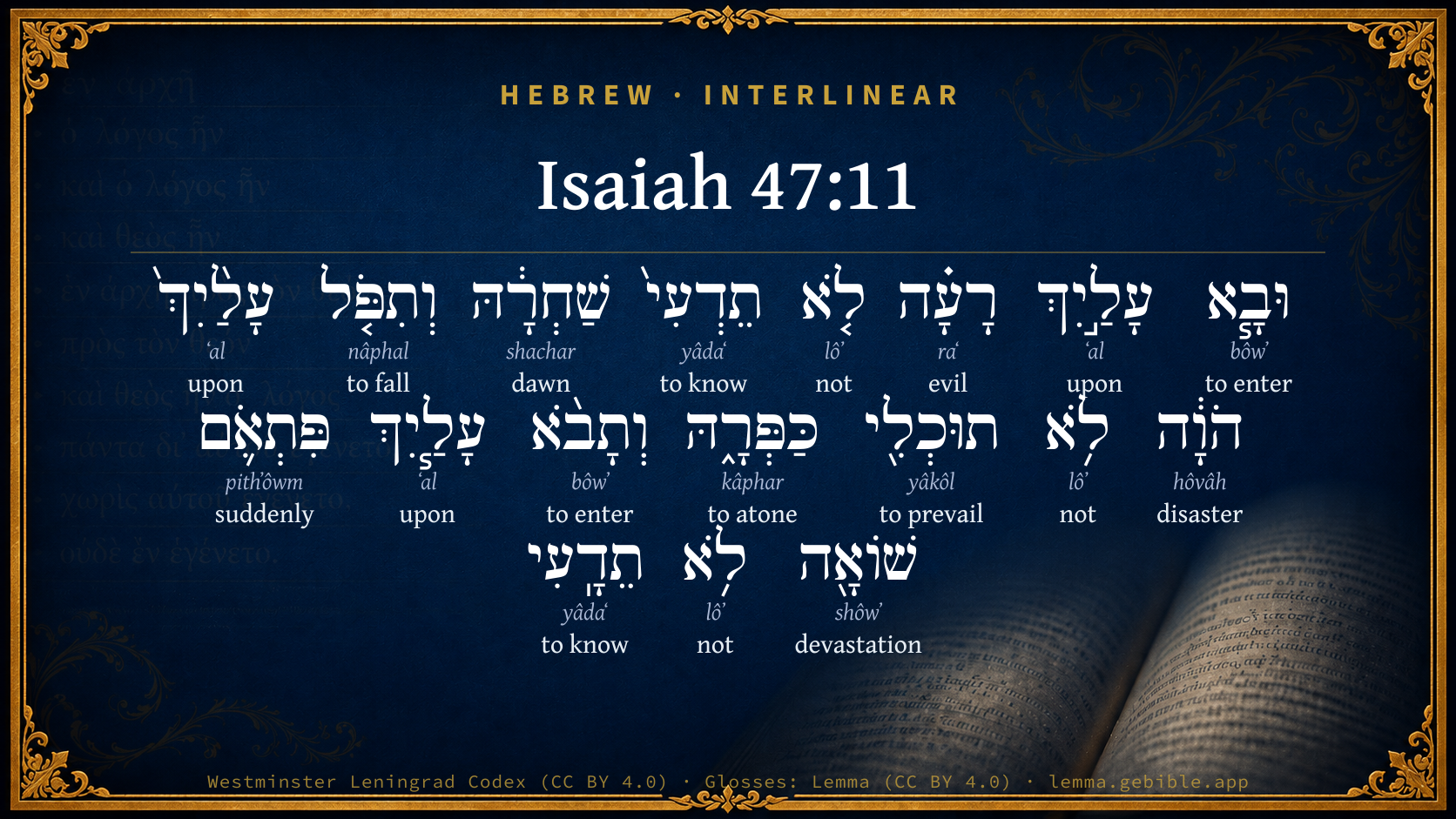
Hebrew (Westminster Leningrad Codex) Isaiah 47:11 appears in the Hebrew Old Testament. The text above is from the Westminster Leningrad Codex. Each word links to its Strong’s number, a concise gloss, and parsing drawn from the Open Scriptures Hebrew Bible morphology. Click any word for its full Brown-Driver-Briggs (BDB) entry.
Download image
Cite this verse

Isaiah 47:11 (World English Bible). Public Domain. Lemma interlinear Bible study tool, https://lemma.gebible.app/v/isaiah/47/11.

Show BibTeX & RIS
BibTeX
RIS
English Translation
Therefore shall evil come on you; you shall not know the dawning of it: and mischief shall fall on you; you shall not be able to put it away: and desolation shall come on you suddenly, which you don't know.
World English Bible · Public Domain
Highlights
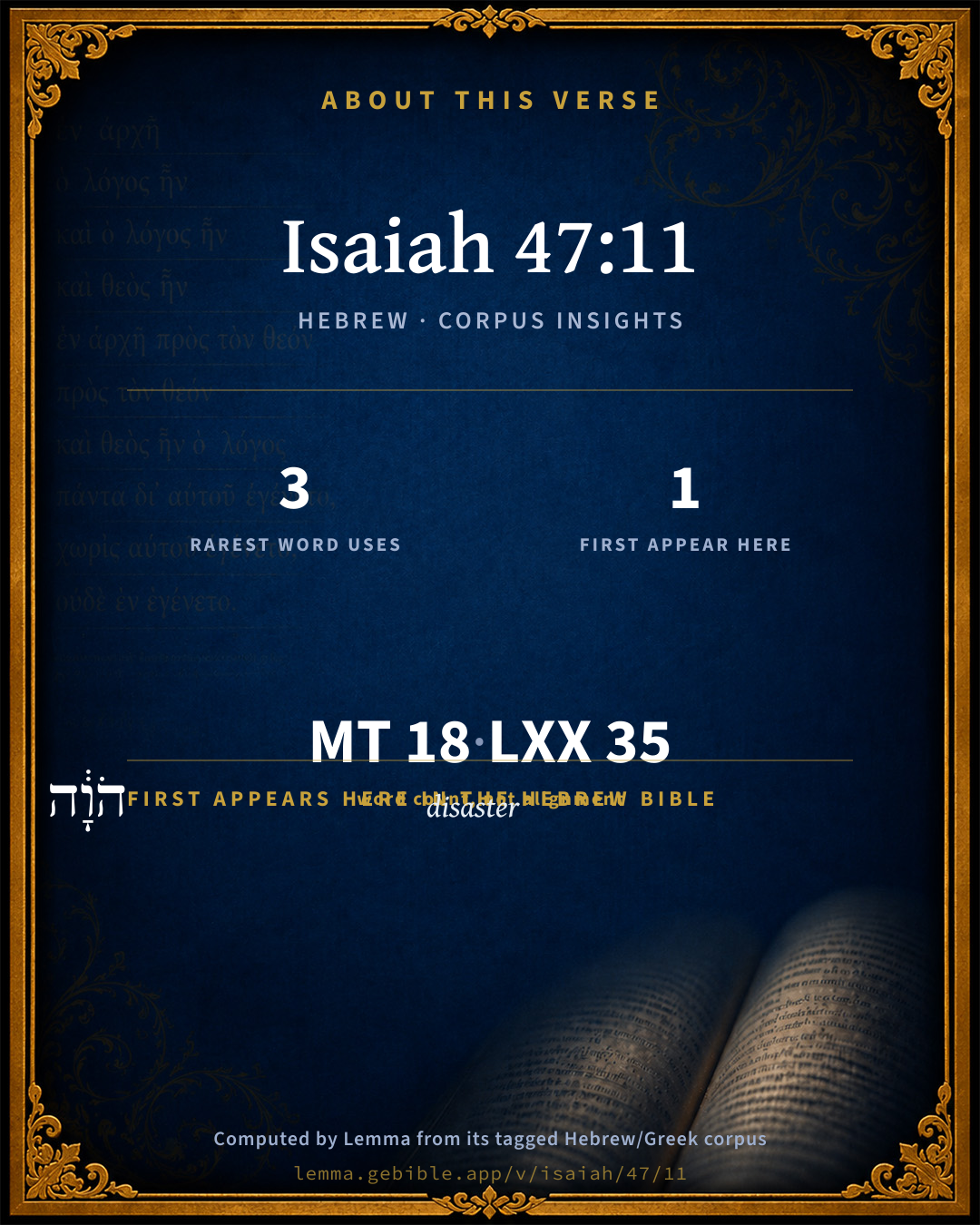
  • 1 first appearance in the Hebrew Bible
Full analysis ↓
Download a study sheet

One document with this verse’s original text, its word-by-word gloss line, the meaning frame, cross-references with their text, attributed commentary, and full source and license credits — printable, and it pastes into notes with its structure intact.

This verse Autodidact and up

Study sheet (.html) Plain text (.txt)

A passage Seminary Student

Up to 50 verses in one chapter. A passage sheet keeps up to 6 commentary sources and 12 cross-references per verse, in the order this page ranks them, and says so on the sheet whenever that leaves anything out. Ask for a single verse and you get the Autodidact verse sheet above.

Everything on this page stays free to read, with no account — the sheet is a download of what is already on screen, not access to it.

Want to remove ads? Support Godless Engineer
Compare translations 3

The same verse in 3 English versions, stacked beneath the original-language interlinear above. Click any original word for its lexicon entry.

Each is an independent rendering of the whole verse — the interlinear is not word-aligned to these translations.

Highlighted words mark where these versions differ — a whole-verse word diff, not a word-by-word alignment.

  • World English Bible Public Domain
    Therefore shall evil come on you; you shall not know the dawning of it: and mischief shall fall on you; you shall not be able to put it away: and desolation shall come on you suddenly, which you don't know.
  • King James Version Public Domain
    Therefore shall evil come upon thee; thou shalt not know from whence it riseth: and mischief shall fall upon thee; thou shalt not be able to put it off: and desolation shall come upon thee suddenly, which thou shalt not know.
  • unfoldingWord Literal Text CC BY-SA 4.0
    And trouble will come upon you; you will not know its dawning. And ruin will fall upon you; you will not be able to atone it. And desolation will come upon you suddenly; you will not know. q1

unfoldingWord Literal Text — © unfoldingWord, licensed CC BY-SA 4.0. Word-aligned USFM3 via Door43 (git.door43.org/unfoldingWord/en_ult).

Versions to compare (up to 4)

3 of 4 selected

Show all 18 translations

Every available English version of this verse, each an independent rendering of the whole verse.

  • World English Bible Public Domain
    Therefore shall evil come on you; you shall not know the dawning of it: and mischief shall fall on you; you shall not be able to put it away: and desolation shall come on you suddenly, which you don't know.
  • Berean Standard Bible Public Domain
    But disaster will come upon you; you will not know how to charm it away. A calamity will befall you that you will be unable to ward off. Devastation will happen to you suddenly and unexpectedly.
  • Majority Standard Bible Public Domain
    But disaster will come upon you; you will not know how to charm it away. A calamity will befall you that you will be unable to ward off. Devastation will happen to you suddenly and unexpectedly.
  • King James Version Public Domain
    Therefore shall evil come upon thee; thou shalt not know from whence it riseth: and mischief shall fall upon thee; thou shalt not be able to put it off: and desolation shall come upon thee suddenly, which thou shalt not know.
  • American Standard Version (1901) Public Domain
    Therefore shall evil come upon thee; thou shalt not know the dawning thereof: and mischief shall fall upon thee; thou shalt not be able to put it away: and desolation shall come upon thee suddenly, which thou knowest not.
  • Revised Version (1885) Public Domain
    Therefore shall evil come upon thee; thou shalt not know the dawning thereof: and mischief shall fall upon thee; thou shalt not be able to put it away: and desolation shall come upon thee suddenly, which thou knowest not.
  • Geneva Bible (1599) Public Domain
    Therefore shall euill come vpon thee, and thou shalt not knowe the morning thereof: destruction shall fal vpon thee, which thou shalt not be able to put away: destruction shall come vpon thee suddenly, or thou beware.
  • Douay-Rheims (1899) Public Domain
    Evil shall come upon thee, and then shalt not know the rising thereof: and calamity shall fall violently upon thee, which thou canst not keep off: misery shall come upon thee suddenly, which thou shalt not know.
  • Young's Literal Translation Public Domain
    And come in on thee hath evil, Thou knowest not its rising, And fall on thee doth mischief, Thou art not able to pacify it, And come on thee suddenly doth desolation, Thou knowest not.
  • Literal Standard Version CC BY-SA 4.0
    And evil has come in on you, || You do not know its rising, || And disaster falls on you, || You are not able to pacify it, || And desolation comes on you suddenly, || You do not know.
  • Unlocked Literal Bible CC BY-SA 4.0
    Disaster will overcome you; you will not be able to drive it away with your incantations. Destruction will fall on you; you will not be able to ward it off. Calamity will strike you suddenly, before you know it.
  • unfoldingWord Literal Text CC BY-SA 4.0
    And trouble will come upon you; you will not know its dawning. And ruin will fall upon you; you will not be able to atone it. And desolation will come upon you suddenly; you will not know. q1
  • Darby Bible Public Domain
    But evil shall come upon thee -- thou shalt not know from whence it riseth; and mischief shall fall upon thee, which thou shalt not be able to ward off; and desolation that thou suspectest not shall come upon thee suddenly.
  • World Messianic Bible Public Domain
    Therefore disaster will come on you. You won’t know when it dawns. Mischief will fall on you. You won’t be able to put it away. Desolation will come on you suddenly, which you don’t understand.
  • Webster's Bible Public Domain
    Therefore shall evil come upon thee; thou shalt not know from whence it riseth: and mischief shall fall upon thee; thou shalt not be able to put it off: and desolation shall come upon thee suddenly, which thou shalt not know.
  • Free Bible Version CC BY-SA 4.0
    Evil is going to strike you, and you won't be able to magic it away. Disaster will fall on you that you can't stop by paying a ransom. Destruction will suddenly hit you that you weren't expecting.
  • Bible in Basic English Public Domain
    Because of this evil will come on you, which may not be turned away for any price: and trouble will overtake you, from which no money will give salvation: destruction will come on you suddenly, without your knowledge.
  • JPS Tanakh (1917) Public Domain
    Yet shall evil came upon thee; thou shalt not know how to charm it away; and calamity shall fall upon thee; thou shalt not be able to put it away; and ruin shall come upon thee suddenly, before thou knowest.

Literal Standard Version (2020), Covenant Press — licensed CC BY-SA 4.0. Text via the HelloAO Bible API (eBible.org). Unlocked Literal Bible (unfoldingWord) — licensed CC BY-SA 4.0. Text via the HelloAO Bible API (eBible.org). unfoldingWord Literal Text — © unfoldingWord, licensed CC BY-SA 4.0. Word-aligned USFM3 via Door43 (git.door43.org/unfoldingWord/en_ult). Free Bible Version, Dr. Jonathan Gallagher — licensed CC BY-SA 4.0. Text via the HelloAO Bible API (eBible.org).

Word by word

More ways to search: Search by grammar → Find every occurrence → Compare this word →

Practice this passage: Drill this verse → Learn its vocabulary →

הֹוָ֔ה
hôvâh
H1943
“disaster”
Noun, Common, Feminine, Singular, Absolute
Part of Speech
Noun
Type
Common
Gender
Feminine
Number
Singular
State
Absolute
Full BDB Definition

Origin: another form for H1942

TWOT: 483c

ruin, disaster
  1. וּבָ֧א bôwʼ H935 “and · to enter” Conjunction + Verb, Qal, Perfect, 3rd Person, Masculine, Singular
  2. עָלַ֣יִךְ ʻal H5921 “upon · you” Preposition + Suffix, Personal, 2nd Person, Feminine, Singular
  3. רָעָ֗ה raʻ H7451 “evil” Noun, Common, Feminine, Singular, Absolute
  4. לֹ֤א lôʼ H3808 “not” Particle, Negative
  5. תֵדְעִי֙ yâdaʻ H3045 “to know” Verb, Qal, Imperfect, 2nd Person, Feminine, Singular
  6. שַׁחְרָ֔הּ shachar H7837 “dawn · her” Verb, Piel, Infinitive Construct + Suffix, Personal, 3rd Person, Feminine, Singular
  7. וְתִפֹּ֤ל nâphal H5307 “and · to fall” Conjunction + Verb, Qal, Imperfect, 3rd Person, Feminine, Singular
  8. עָלַ֨יִךְ֙ ʻal H5921 “upon · you” Preposition + Suffix, Personal, 2nd Person, Feminine, Singular
  9. לֹ֥א lôʼ H3808 “not” Particle, Negative
  10. תוּכְלִ֖י yâkôl H3201 “to prevail” Verb, Qal, Imperfect, 2nd Person, Feminine, Singular
  11. כַּפְּרָ֑הּ kâphar H3722 “to atone · her” Verb, Piel, Infinitive Construct + Suffix, Personal, 3rd Person, Feminine, Singular
  12. וְתָבֹ֨א bôwʼ H935 “and · to enter” Conjunction + Verb, Qal, Imperfect, 3rd Person, Feminine, Singular
  13. עָלַ֧יִךְ ʻal H5921 “upon · you” Preposition + Suffix, Personal, 2nd Person, Feminine, Singular
  14. פִּתְאֹ֛ם pithʼôwm H6597 “suddenly” Adverb
  15. שׁוֹאָ֖ה shôwʼ H7722 “devastation” Noun, Common, Feminine, Singular, Absolute
  16. לֹ֥א lôʼ H3808 “not” Particle, Negative
  17. תֵדָֽעִי yâdaʻ H3045 “to know” Verb, Qal, Imperfect, 2nd Person, Feminine, Singular

About this verse

These counts appear in no published source. They are computed here, from the morphology-tagged text and Lemma’s own curated glosses. What Lemma adds →

18
words
12
distinct lemmas
Prophets
section

Notable vocabulary

The rarest word here is הֹוָ֔ה disaster H1943 — appearing just 3 times in the whole Hebrew Bible.

First appearance in Scripture

This word makes its first canonical appearance in the Hebrew Bible here:

  • הֹוָ֔ה disaster H1943

Shared distinctive vocabulary

הֹוָ֔ה disaster H1943 occurs in 2 verses of the Hebrew Bible. Also found in:

Grammatical profile

  • 8 verbs
  • 3 nouns
  • 3 prepositions
  • 1 adverb
  • 3 particles

Verb forms

  • וּבָ֧א Qal · Perfect
  • תֵדְעִי֙ Qal · Imperfect
  • שַׁחְרָ֔הּ Piel · Infinitive Construct
  • וְתִפֹּ֤ל Qal · Imperfect
  • תוּכְלִ֖י Qal · Imperfect
  • כַּפְּרָ֑הּ Piel · Infinitive Construct
  • וְתָבֹ֨א Qal · Imperfect
  • תֵדָֽעִי Qal · Imperfect

Repetition

Words recur within this verse — often emphatic in Hebrew:

  • עָלַ֣יִךְ upon H5921 ×3
  • וּבָ֧א to enter H935 ×2
  • תֵדְעִי֙ to know H3045 ×2
  • לֹ֤א not H3808 ×3

Hebrew & Septuagint length

In English translation the verse runs 40 words from the Hebrew and 50 from the Septuagint (LXX English) — closely comparable.

A rough comparison of the two English renderings, which tokenize alike — not a word-level alignment.

Word counts can differ between the Hebrew and the Greek without any difference in meaning — e.g. the Hebrew direct-object marker אֵת has no separate Greek word, and Greek often adds the article ὁ.

In the original languages it is 18 Hebrew tokens and 35 Greek tokens — but the two are counted differently (Hebrew bundles its prefixes and suffixes into one token; the Greek is in lemma form), so that isn’t a like-for-like length.

Cross-references

11

Topical passages linked to Isaiah 47:11 in the Treasury of Scripture Knowledge — connected by theme and wording, ordered by reader-vote popularity; previews shown in the World English Bible.

  • 1 Thessalonians 5:3 For when they are saying, "Peace and safety," then sudden destruction will come on them, like birth pains on a pregnant woman; and they will in no way escape.
  • Revelation 18:9–10 The kings of the earth, who committed sexual immorality and lived wantonly with her, will weep and wail over her, when they look at the smoke of her burning,
  • Exodus 12:29–30 It happened at midnight, that Yahweh struck all the firstborn in the land of Egypt, from the firstborn of Pharaoh who sat on his throne to the firstborn of the captive who was in the dungeon; and all the firstborn of cattle.
  • Nehemiah 4:11 Our adversaries said, They shall not know, neither see, until we come into the midst of them, and kill them, and cause the work to cease.
  • Psalms 50:22 "Now consider this, you who forget God, Lest I tear you into pieces, and there be none to deliver.
  • Jeremiah 51:39–42 When they are heated, I will make their feast, and I will make them drunken, that they may rejoice, and sleep a perpetual sleep, and not wake, says Yahweh.
  • Daniel 5:25–30 This is the writing that was inscribed: MENE, MENE, TEKEL, UPHARSIN.
  • Luke 12:59 I tell you, you will by no means get out of there, until you have paid the very last penny."
  • Revelation 3:3 Remember therefore how you have received and heard. Keep it, and repent. If therefore you won't watch, I will come as a thief, and you won't know what hour I will come upon you.
  • Isaiah 37:36 The angel of Yahweh went forth, and struck in the camp of the Assyrians one hundred and eighty-five thousand; and when men arose early in the morning, behold, these were all dead bodies.
  • Matthew 18:34 His lord was angry, and delivered him to the tormentors, until he should pay all that was due to him.

Cross-references courtesy of OpenBible.info (CC BY 4.0).

Hebrew and Greek witnesses Masoretic Hebrew ↔ Greek Septuagint

The same verse in the two great witnesses to the Old Testament, shown verse-for-verse.

These are two independent witnesses, not word-aligned to each other, and the Septuagint is shown in lemma (dictionary) form.

Hebrew Isaiah 47:11 Masoretic · Westminster Leningrad Codex

וּבָ֧א עָלַ֣יִךְ רָעָ֗ה לֹ֤א תֵדְעִי֙ שַׁחְרָ֔הּ וְתִפֹּ֤ל עָלַ֨יִךְ֙ הֹוָ֔ה לֹ֥א תוּכְלִ֖י כַּפְּרָ֑הּ וְתָבֹ֨א עָלַ֧יִךְ פִּתְאֹ֛ם שׁוֹאָ֖ה לֹ֥א תֵדָֽעִי

Therefore shall evil come on you; you shall not know the dawning of it: and mischief shall fall on you; you shall not be able to put it away: and desolation shall come on you suddenly, which you don't know.

World English Bible · Public Domain

Greek LXX Isaiah 47:11 Septuagint · lemma form

καί ἥκω ἐπί σύ ἀπώλεια καί οὐ μή γιγνώσκω βόθυνος καί ἐνπίπτω εἰς αὐτός καί ἥκω ἐπί σύ ταλαιπωρία καί οὐ μή δύναμαι καθαρός γίγνομαι καί ἥκω ἐπί σύ ἐξαπίνης ἀπώλεια καί οὐ μή γιγνώσκω

And destruction shall come upon you, and you shall not be aware; there shall be a pit, and you shall fall into it: and grief shall come upon you, and you shall not be able to be clear; and destruction shall come suddenly upon you, and you shall not know.

LXX2012 (modern English Septuagint) · Public Domain

Hebrew: Westminster Leningrad Codex (CC BY 4.0). Greek: Septuagint (public domain); English from LXX2012 (modern English Septuagint) (Public Domain). How the Septuagint differs from the Hebrew →

Targum (Aramaic paraphrase)

1

The Targum is the ancient Jewish Aramaic paraphrase of the Hebrew Scriptures — an interpretive translation, not the Hebrew text itself. Onkelos (literal) and Pseudo-Jonathan (expansive) render the Torah, and Jonathan the Prophets. Coverage is partial: where no permissively-licensed English translation exists for a verse, only the Aramaic is shown. This is verse-level text, not a word-by-word alignment to the Hebrew.

  1. Targum Jonathan Prophets (Joshua–Malachi)
    וְתֵיתֵי עֲלָךְ בִּישְׁתָּא לָא תֵדְעִין לְמִבְעֵי עֲלָהּ וְתִיפּוֹל עֲלָךְ עָקָא לָא תִיכְּלִין לְאַעְדָיוּתָהּ וְתֵיתֵי עֲלָךְ בִּתְכֵּיף אִתְרְגוּשָׁא לָא תִידְעִין:

    Therefore shall evil come upon thee: thou shalt not know how to deprecate it; distress shall fall upon thee, and thou shalt not be able to remove it; a tumult shall come upon thee suddenly, unawares.

    Targum Jonathan — Aramaic: “Mikraot Gedolot” (public domain). English: “Sefaria Community Translation” (CC0 1.0 (public-domain dedication)); “London "Chaldee Paraphrase," 1871” (public domain). Text via Sefaria.

Commentary

Notes on Isaiah 47:11 from classic Christian and Jewish commentators (each source and its license shown beneath its notes). The classic Christian expositions comment on the surrounding passage and are grouped to its opening verse, so a note may address several verses; the Jewish commentaries on the Tanakh (Rashi and others) are per-verse, so they appear only where the commentator wrote on this verse.

Lemma curates 59 commentaries, every one of them public domain or Creative Commons licensed, each selected and text-cleaned for this edition rather than reprinted as found. About our sources →

Trapp's Complete Commentary

John Trapp

Isa 47:11 Therefore shall evil come upon thee; thou shalt not know from whence it riseth: and mischief shall fall upon thee; thou shalt not be able to put it off: and desolation shall come upon thee suddenly, [which] thou shalt not know.

Ver. 11. Therefore shall evil come upon thee.] An evil, "an only evil," {as Eze 7:5} both unexpected and inexpiable; such as thou canst neither avoid nor abide.

John Trapp, A Commentary or Exposition upon All the Books of the Old and New Testament (1647–1656) — public domain. Text from a community e-Sword module.

The Biblical Illustrator

Joseph S. Exell

Isa_47:11-15

Therefore shall evil come upon thee

Sudden destruction

The predicted calamity is represented as a great storm, which suddenly arises in eastern countries, and blows with such violence as to Spread devastation and ruin wherever its fury extends.

(R. Macculloch)

False securities: an exposure and a challenge

Can you find a solitary instance in which God approved iniquity? Was ever His sword sheathed in presence of evil? This constancy of judgment upon corrupt ways is itself an argument. One act of moral hesitation would have destroyed God! Time cannot modify Divine judgments. What was wrong in Babylon is wrong here: what was right in the most ancient time will be right on the worlds last day. We should remind ourselves of these elementary principles; for their very simplicity may cause us to neglect their claims. We shall regard the solemn denunciations as if spoken to our own city.

I. LOOK AT THIS PICTURE OF UTTER AND MOST PAINFUL BEWILDERMENT. Evil shall come upon thee; thou shalt not know from whence it riseth: and desolation shall come upon thee suddenly, which thou shalt not know. There are times when the wind seems to be blowing from all quarters at once. There are times when all things seem to have a controversy with us. We set down our feet, and, lo, they are fastened to the ground: we put forth our hand, and an invisible weapon smites it: we look round, and behold the path is ploughed up, so that there is no way of retreat. We lose our own sagacity. Our wit fails us. Once our mind was quick, now it is dead or helpless. We lose confidence in ourselves; substances become shadows; the strongest of our fortresses melt away; and in our friends face there are discovered lines of suspicion or of mortal hate. This is the necessary and inevitable result of sin.

1. We have been warned of it.

2. A way of escape has been made.

II. HEAR THE DIVINE CHALLENGE ADDRESSED TO THE FALSE POWERS IN WHICH WE HAVE TRUSTED. Stand now with thine enchantments, &c. (Isa_47:12). Think that we are now called upon to set out in order the false securities in which we have trusted! There is one,--Money; there is two,--Chance; there is three,--Self-confidence; there is four--Atheisticspeculation. Now let them do for us all they can. God has challenged them!

1. They ought to be most useful when most needed.

2. They should show their sufficiency by their fearlessness. It is a challenge. I hear the whirlwind coming,--get out your money. You thought something would happen--something is happening,--Gods judgment is descending; where is your God Chance? You have confidence in yourself; be it so; make bare your arm,--see, it is but lightning,--it is but flood upon flood,--it is but world dashing against world, &c. Let now the astrologers, the stargazers, the monthly prognosticators, stand up, and save thee from these things that shall come upon thee. There is to be a great collision. In that collision only the true can stand.

III. SEE THE DOOM OF FALSE SECURITIES. Behold, they shall be as stubble, &c. (Isa_47:14).

1. Let no man complain of want of opportunity of observing the value of his moral securities.

2. Let no man complain of having been allowed to live unwarned.

3. Think of so living that at last a man shall be left without a coal at which to warm himself! This is the end of sin,--this is the worthlessness of false gods! So far as we have had experience of life, we have seen the terrible failure of all false things. We have seen the judgment of God in parts. It is not all left to be revealed. We are entitled to reason from the past to the future; and when our own experience has, as a matter of fact, confirmed the revelation of God, we may know that future to be a terrible one to the servants of unrighteousness. What is the duty of man as dictated by mere common sense? It is to seek and trust that which is true.

(1) We cannot escape the trial of our securities.

(2) If we set ourselves against God, we challenge all the forces of His creation, fire, wind, flood, pestilence, &c. It is a fearful thing to fall into the hands of the living God. (J. Parker, D. D.)

Monthly prognosticators

(Isa_47:13):--The special reference is to the preparation of monthly almanacs (based on astrological calculations) in which coming (disasters were foretold, lucky and unlucky days pointed out, &c. A specimen of these almanacs is translated by Sayce in Transactions of the Society of Biblical Archeology. (Prof. J. Skinner, D. D.)

The Biblical Illustrator, edited by Joseph S. Exell (c. 1880s–1900s) — public domain. Text from a community e-Sword module.

The Preacher's Complete Homiletical Commentary

Joseph S. Exell (gen. ed.)

FALSE SECURITIES

Isa_47:11-15, Therefore shall evil come upon thee, &c.

I. Look at this picture of utter and painful bewilderment. This is the necessary and inevitable result of sin.

1. We have been warned of it.

2. A way of escape has been made.

II. Hear the divine challenge addressed to the false powers in which we have trusted, as money, chance, self-confidence, atheism.

1. They ought to be most useful when most needed.

2. They should show their sufficiency by their fearlessness. See text.

(1.) There is to be a great collision.

(2.) In that collision only the true can stand.

III. See the doom of false securities.

1. Let no man complain of want of opportunity of estimating the value of his moral securities; or,

2. Of having been allowed to live unwarned.

APPLICATION.—

1. We cannot escape the trial of our securities.

2. If we set ourselves against God, we challenge all the forces of His creation—fire, wind, flood, pestilence, &c.—J. C. Gray: Biblical Museum, in loco.

THE PORTION OF THE UNGODLY. [1474]

[1474] A minister, living at Wisbech, authenticates the following singular case of conversion through our sermon on “The Portion of the Ungodly,” No. 444. The writer says in a recent letter to us, “Seventeen years ago it pleased the Lord to permit me to dream that the end of the world was come, and in my dream I saw the saints rising with the Lord Jesus to glory. I was left, and near me, upon a large quantity of stubble stood an acquaintance who addressed me thus:—They used to say in the other world that we should be in fire, but it is not so.’ In a moment flames burst out, and in my fright I awoke. A few days after my dream my friend and I heard you preach at the Tabernacle. Judge how great was our surprise when you announced for your text, Isa_47:14, ‘Behold, they shall be as stubble; the fire shall burn them; they shall not deliver themselves from the power of the flame: there shall not be a coal to warm at, nor fire to sit before it.’ ” In August, 1876, a severe affliction, the dream, and our sermon resulted in our friend’s conversion.—Rev. C H. Spurgeon, in the Sword and Trowel, vol. xv. pp. 294, 295.

Isa_47:14. Behold, they shall be as stubble, &c.

Part of a terrible description of God’s judgment upon Babylon and Chaldea. It is a truth beyond dispute that God’s justice is not partial; that the description of the destruction which He awards to one class of sinners is a most fair picture of what He will do with others, for God hath not two or three ways of dealing with men in His justice. The ruin of Chaldea is to us, to-day, a representation and metaphorical description of the destruction which shall surely come upon impenitent sinners when the Lord cometh out of His place to “judge His enemies,” &c. At first sight the figures in our text seem contradictory.

I. THE FIRST FIGURE. The punishment of the wicked will be,

1. “easily inflicted.” “They shall be as stubble.” Nothing can be more easy than to kindle stubble when it is fully dry. So shall it be with impenitent sinners.

(1.) The power of memory shall become a vehicle of sorrow.

(2.) Conscience.

(3.) Increased knowledge. Now you know enough to leave you without excuse, but then your knowledge shall increase so as to leave thee without pretence of apology.

(4.) Companions.

2. Most searching and terrible. The metaphor of fire is used in Scripture, because it is that which of all things causeth most pain, and is the most searching and trying.

3. Most inevitable. “They shall not,” &c. There is hope now; there shall be no hope then. How can it be avoided? Man has no strength to match the Most High; no wisdom to invent another plan of salvation; no ability to hide from God’s presence.

If you profess to be a Christian nominally, you believe this—one of the fundamental truths of revelation.

II. THE SECOND FIGURE. “There shall not be a coal,” &c.; by which is meant that there shall be nothing in hell that can give the sinner a moment’s comfort. Nothing as the soul lifts its eye to heaven, for that is lost. Nothing in hell itself, for the more there are, the more wretched. Nothing in themselves, nor in their thoughts. Nothing in God, for the sting of all the punishment will be—“I deserve it; I brought this on myself.” Nothing in the past, for that will give agony. Nothing in the soul’s present condition. Nothing in their future condition, for they shall never see the shadow of a hope.

III. “BEHOLD.” Turn not away your eyes from this meditation. Children of God, behold it; it will make you grateful; make you love poor sinners. Unconverted sinner, behold it. Better to think of it now than to think of it for ever. If false, reject it; but if real, meditate upon these things; and may God lead you out of self to Christ. “Turn ye,” &c.—C. H. Spurgeon: Metropolitan Tabernacle Pulpit, No. 444.

The Preacher's Complete Homiletical Commentary (gen. ed. Joseph S. Exell; Funk & Wagnalls, c. 1892) — public domain (pre-1929). A full-Bible homiletical/sermon-outline anthology covering 65 of 66 books (2 John is absent from the source module). Text from a community e-Sword module.

Jamieson, Fausset & Brown

Robert Jamieson, A. R. Fausset & David Brown

from whence it riseth--Hebrew, "the dawn thereof," that is, its first rising. Evil shall come on thee without the least previous intimation [ROSENMULLER]. But dawn is not applied to "evil," but to prosperity shining out after misery (Isa 21:12). Translate, "Thou shall not see any dawn" (of alleviation) [MAURER].

put . . . off--rather, as Margin, "remove by expiation"; it shall be never ending.

not know--unawares: which thou dost not apprehend. Proving the fallacy of thy divinations and astrology (Job 9:5; Psa 35:8).

Jamieson, Fausset & Brown — Commentary Critical and Explanatory on the Whole Bible (1871) — public domain (CC PDM 1.0). Text via the HelloAO Bible API.

Adam Clarke's Commentary

Verse 11. Thou shalt not know from whence it riseth - "Thou shalt not know how to deprecate"] שחרה shachrah; so the Chaldee renders it, which is approved by Jarchi on the place; and Michaelis Epim. in Praelect. xix.; see Ps 78:34.

Videtur in fine hujus commatis deese verbum, ut hoc membrum prioribus respondeat. "A word appears to be wanting at the end of this clause to connect it properly with the two preceding. - SECKER.

In order to set in a proper light this judicious remark, it is necessary to give the reader an exact verbal translation of the whole verse: -

"And evil shall come upon thee, thou shalt not know how to

deprecate it;

And mischief shall fall upon thee, thou shalt not be able

to expiate it;

And destruction shall come suddenly upon thee, thou shalt

not know" --

What? how to escape, to avoid it, to be delivered from it? perhaps צאת ממנה tseth mimmennah, "they could not go out from it," Jer 11:11. I am persuaded that a phrase is here lost out of the text. But as the ancient versions retain no traces of it, and a wide field lies open to uncertain conjecture, I have not attempted to fill up the chasm, but have in the translation, as others have done before me, palliated and disguised the defect, which I cannot with any assurance pretend to supply. - L.

Adam Clarke's Commentary on the Bible (1810–1826) — public domain. Text from a community e-Sword/MySword module.

Ellicott's Commentary for English Readers

(11) Thou shalt not be able to put it off . . .—The words have been variously rendered: (1) of which thou shalt know no dawn, i.e., after the night of calamity; and (2) which thou shalt not be able to charm away. Stress is laid on the destruction being at once unforeseen and irretrievable.

A Bible Commentary for English Readers, edited by Charles John Ellicott (1878–1897) — public domain. Text from a community e-Sword module.

The Cambridge Bible for Schools and Colleges

gen. ed. J. J. S. Perowne

11. evil] is the same word as “wickedness” in Isa_47:10; the play on the two meanings of the word is intentional.

from whence it riseth] The literal rendering is given in R.V. “the dawning thereof.” But the metaphor is unnatural (of calamity), and the parallelism of the next line shews that an inf. must be read. A similar Arabic verb means “to charm”; accordingly most commentators now translate which thou shalt not know (how) to charm away (see R.V. marg.). Some, however, prefer a slight alteration of the text, reading “to buy off” (שׁחדהּ for שׁחרחּ; cf. the parallelism in Pro_6:35).

to put off] is literally to expiate, i.e. avert by an offering. “They try to avert evil and procure good, either by purifications, sacrifices, or enchantments.” (Diodorus Siculus, quoted by Lenormant, l.c. p. 12.)

which thou shalt not know] The parallelism with the other two lines of the tristich suggests that an inf. should be supplied at the end: which thou shalt not know how to … (so Duhm).

The Cambridge Bible for Schools and Colleges (gen. ed. J. J. S. Perowne; Cambridge University Press, 1878–1918) — public domain. Text from a community e-Sword module.

John Gill's Exposition

Therefore shall evil come upon thee,.... The evil of punishment, a great calamity; so Nebuchadnezzar foretold, as Abydenus relates (o), that a calamity, should come upon the Babylonians; a day of evil, because of the above sins Babylon was guilty of:

thou shall not know from whence it riseth; from what quarter it will come, little dreaming of Cyrus, with whom the Chaldeans had had no quarrel. So mystical Babylon will not know from whence her ruin will come; little thinking that the kings of the earth, who have committed fornication with her, and have given their kingdoms to her, will hate her, and burn her flesh with fire: or, "thou shall not know the morning of it" (p): that is, on what day, or at what time, it will be. Babylon was taken when it was not thought of, as appears from the book of Daniel, and profane history. Aristotle (q) reports, that it was said, that the third day after Babylon was taken, one part of the city did not know that it was taken. Or the sense is, this day of evil and calamity should be such a dark and gloomy day, there should be no light in it, it should be as the night, and therefore its morning or light should not be known, so Aben Ezra: "and mischief shall fall upon thee"; contrived for others; the pit dug for others she should fall into herself: though the phrase seems to denote the mischief coming from above, by the hand of heaven, and suddenly and irresistibly; which should fall with weight and vengeance upon her, to the crushing and utter destruction of her:

thou shalt not be able to put it off; or, "to expiate it" (r); and atone for it, either by prayers and entreaties, which God will not regard, Isa 47:3 or by gifts, or by ransom price, by gold and silver, which the Medes and Persians were no lovers of, Isa 13:17,

and desolation shall come upon thee suddenly, which thou shalt not know; that is, before hand; neither the persons from whom nor the time when it shall come; notwithstanding their astrologers, diviners, and monthly prognosticators, pretended to tell what would come to pass every day; but not being able by their art to give the least hint of Babylon's destruction, as to either time or means, the Chaldeans were in great security, quite ignorant of their ruin at hand, and which therefore came suddenly and unawares upon them; as will the destruction of mystical Babylon.

(o) Ib. c. 41. p. 456. (p) "non scis auroram ejus", Montanus, Vatablus, Cocceius; "cujus non cognoscis auroram", Vitringa. That is, as Ben Melech explains it, thou shalt not know the time of its coming; for it shall come suddenly, as a thing comes in a morning, which a man is not aware of till he sees it. (q) Politic. l. 3. c. 3. (r) "non potens placare eam", Montanus; "expiare", Tigurine version, Junius & Tremellius, Piscator, Cocceius, Vitringa.

John Gill's Exposition of the Whole Bible (1746–1763) — public domain (CC PDM 1.0). Text via the HelloAO Bible API.

Albert Barnes' Notes on the Bible

Therefore shall evil come upon thee - In consequence of thy pride and self-confidence; of the prevalence of corruption, licentiousness, and sin; of the prevalence of the arts of magic and of divination abounding there; and of the cruel and unfeeling oppression of the people of God; for all these crimes ruin shall come certainly and suddenly upon thee.

Thou shalt not know from whence it cometh - Margin, ‘The morning thereof.’ The margin expresses the true sense of the phrase. The word used here (שׁחר shachar) means “the aurora,” the dawn, the morning (see the notes at Isa 14:12). Lowth has strangely rendered it, ‘Evil shall come upon thee, which thou shalt not know how to deprecate.’ But the word properly means the dawning of the morning, the aurora; and the sense is, that calamity should befall them whose rising or dawning they did not see, or anticipate. It would come unexpectedly and suddenly, like the first rays of the morning. It would spring up as if from no antecedent cause which would seem to lead to it, as the light comes suddenly out of the darkness.

And mischief - Destruction; ruin.

Thou shalt not be able to put it off - Margin, ‘Expiate.’ This is the sense of the Hebrew (see the notes at Isa 43:3). The meaning is, that they could not then avert these calamities by any sacrifices, deprecations, or prayers. Ruin would suddenly and certainly come; and they had nothing which they could offer to God as an expiation by which it could then be prevented. We need not say how strikingly descriptive this is of the destruction of Babylon. Her ruin came silently and suddenly upon her, as the first rays of morning light steal upon the world, and in such a way that she could not meet it, or turn it away.

Albert Barnes' Notes on the Bible (1834–1885) — public domain. Text from a community e-Sword/MySword module.

Haydock's Catholic Bible Commentary

Know. All this shews the vanity of magic, which cannot announce future events to do any good. (Calmet)

George Leo Haydock (1774–1849), Haydock's Catholic Family Bible and Commentary, 1859 edition — public domain. Excludes Psalms (Douay-Rheims chapter numbering differs from Protestant) and Deuterocanonical books (Catholic canon only).

Matthew Poole's English Annotations

Therefore shall evil come upon thee; or rather, when it shall come: Heb. the morning of it, the day or time of its approach. And they are justly upbraided and derided for this ignorance, because the astrologers, the star-gazers, and the monthly prognosticators, mentioned here, Isa 17:13, pretended punctually to foretell the particular time of all future events. And this explication agrees with the history, Babylon being surprised by Cyrus when they were in deep security, as is manifest, both from Scripture, Jer 51:31; Da 5, and from other histories.

Desolation shall come upon thee suddenly; or, when thou shalt not know it. Thou shalt not apprehend thy danger till it be too late.

Matthew Poole's English Annotations on the Holy Bible (1683–1685) — public domain. Text from a community e-Sword/MySword module.

The Pulpit Commentary

Therefore shall evil come upon thee. Connect this with the first clause of ver. 10, "Thou hast trusted in thine own evil (moral), therefore shall evil (physical) fall upon thee." The same word, ra"ah, is used in both places. Thou shalt not know from whence it riseth. So the Vulgate, Vitringa, Gesenius, and Dr. Kay. But the bulk of modern commentators (Hitzig, Ewald, Delitzsch, Nagelsbach, Weir, Cheyne) render, "Thou wilt not know how to charm it away. " Both meanings are possible, and are almost equally good; but the parallelism of the clauses is in favour of the latter rendering. Shakhrah should correspond in construction, as in sound, with kappRah. to put it off; literally, to expiate; i.e. to get rid of it by means of expiatory rites. Which thou shalt not know; or, of which thou shalt not be aware. (On the carelessness and want of foresight displayed by the Babylonians, see the comment on ver. 8.)

Man"s helplessness in presence of Divine calamities.

The point impressed is that disaster takes unexpected and overwhelming forms, against which the wisest man fails to take precautions. Man can only affect the smallest of circumstances that are put into his control, and the few persons who are under his immediate influence. But each one of us belongs to a great whole, and is affected by great forces, which God alone controls. We are carried whither we would not. We are borne down by evils which we seem to have done nothing to create. We are helpless before the hurricanes and earthquakes and pestilences with which God can smite. After illustrating and impressing this point, show how we ought to stand to the Divine order. We may so stand that no event arranged by the Divine wisdom can take shape for us as calamity.

I WE MAY STRIVE TO BE FREE OF THE DIVINE ORDER.

II WE MAY RESIST THE DIVINE ORDER.

III WE MAY PUT OURSELVES IN HARMONY WITH THE DIVINE ORDER, That involves our fitting our will to the Divine will; and that self-seeking man will never do until he is "humbled under God"s mighty hand. R.T.

The Pulpit Commentary (1880–1919), ed. H.D.M. Spence-Jones & Joseph S. Exell — public domain. Text from a community e-Sword module.

John Wesley's Explanatory Notes

Therefore - This agrees with the history. Babylon being surprized by Cyrus, when they were in deep security.

John Wesley, Explanatory Notes Upon the Whole Bible (1754–1765) — public domain. Text via the GEBible commentary corpus.

J. A. Alexander on Isaiah

Joseph Addison Alexander

“And (so) there cometh (or has come) upon thee evil;” with an evident allusion to the use of wickedness in the verse preceding, so as to suggest an antithesis between natural and moral evil, sin and suffering, evil done and evil experienced. The common version (therefore shall evil come) is not strictly accurate. Most of the modern writers make it present; but the strict sense of the preterit is perfectly consistent with the context and the usage of the Prophet, who continually depicts occurrences still future, first as coming, then as come, not in fact but in vision, both as certain to occur and as historically represented to his own mind. “And there shall fall upon thee (a still stronger expression than the one before it, there shall come upon thee) ruin.” According to the modern lexicographers the noun itself means fall, but in its figurative application to destruction or calamity. It occurs only here and in Eze 7:26. “Thou shalt not be able to avert it,” or resolving the detached Hebrew clauses into one English period, ‘which thou shalt not be able to avert.’ The exact meaning of the last word is ‘atone for, expiate,’ and in this connection, ‘to avert by expiation’, whether in the strict sense of atoning sacrifice or in the wider one of satisfaction and propitiation. If we assume a personification of the evil, the verb may mean to appease, as in Gen 32:20; Pro 16:14. In any case, the clause describes the threatened judgment as inexorable and inevitable. “And there shall come upon thee suddenly a crash,” or as it has been rendered, ‘a crashing fall,’ a common metaphor for sudden ruin, “(which) thou shalt not know.” This may either mean, ‘of which thou shalt have no previous experience’, or ‘of which thou shalt have no previous expectation’. The former meaning is the one most readily suggested by the words. The latter may be justified by the analogy of Job 9:5, ‘who removeth the mountains and they know not,’ which can only mean that he removes them suddenly or unawares.

Joseph Addison Alexander, The Prophecies of Isaiah (1846–1847; New York: Scribner, 1870–1878) — public domain. Text from a community e-Sword module.

Rashi

Rabbi Shlomo Yitzchaki (Rashi)

you shall not know how to remove it by prayer Heb. לֹֹא תֵדְעִי שַׁחְרָהּ. You shall not know to pray about it (Jonathan). Whom will you beseech to extricate you therefrom?

to rid yourself of it Heb. כַּפְּרָהּ, to wipe it away and to remove it, and this is every expression of atonement (כַּפָּרָה). It is an expression of wiping and taking away.

Rashi on the Tanakh — English translations: “The Judaica Press complete Tanach with Rashi, translated by A. J. Rosenberg” (CC BY 4.0); “Pentateuch with Rashi's commentary by M. Rosenbaum and A.M. Silbermann, 1929-1934” (public domain); “The Metsudah Tanach series, Lakewood, N.J” (CC BY 4.0); and “The Book of Joshua, Metsudah Publications, 1997” (CC BY 4.0). Text via Sefaria.

Ibn Ezra

Rabbi Abraham ibn Ezra

יום רעה═רעה A day of evil.

לא תדעי שחרה Thou shalt not know its light. It will be like a night, which is not relieved by daylight; שחר means light.

הׂוׇה Mischief. It is derived from הוה to become; comp. ואתה הוה that thou mayest become (Neh. 6:6); it signifies an evil that comes suddenly; of the same root is והותי and my calamity (Job 6:2).

כפרה To put it off by ransom; comp. כפר ransom (Ex. 30:12); or to annul it; comp. יכפרנה will remove it (Prov. 16:14).

שואה Desolation.

Ibn Ezra on the Tanakh — English translations: “Sefaria Community Translation” (CC0 1.0 (public-domain dedication)); “Yalkut, Sifsei Chachomim Chumash, Metsudah Publications, 2009” (CC BY 4.0); and “Commentary of Ibn Ezra on Isaiah - trans. by M. Friedlander, 1873” (public domain). Text via Sefaria.

Lesson kit

Teaching starters — assembled from the data on this page, not authored interpretation. Every prompt links to the verse data it draws on. Edit before teaching.

Isaiah, in the Prophets, opens this verse with 18 words (12 distinct Hebrew lemmas). Its most distinctive word is hôvâh (“disaster”). A historical commentator’s framing appears above. Read the whole chapter for the surrounding context.

Discussion questions

  1. The word hôvâh carries the sense “disaster.” How does it shape the verse?
  2. The word “disaster” first appears here in Scripture. What is being introduced at this debut?
  3. Ezekiel 7:26 shares the word «disaster» with this verse. How do the two illuminate each other?
  4. “upon” occurs 3× in this one verse. What is the effect of the repetition?
  5. The translations on this page render this verse differently — a whole-verse word diff, not a word-by-word alignment. What might account for the different wordings?
  6. The verb «וּבָ֧א» is Qal Perfect. How does its form color the action?
  7. Reading how Trapp's Complete Commentary and The Biblical Illustrator read this verse, where do the two commentators agree and where do they part?

Things to notice

Reading settings

Reading text

Shown beneath each verse's original-language words.

Old Testament
Old Testament edition

Read the OT as the Masoretic Hebrew (MT) or the Greek Septuagint (LXX).

English shown for the Greek Septuagint (in the Hebrew ↔ Greek comparison).

Comparing translations? Open the Compare panel on any verse page to stack up to four side by side.