
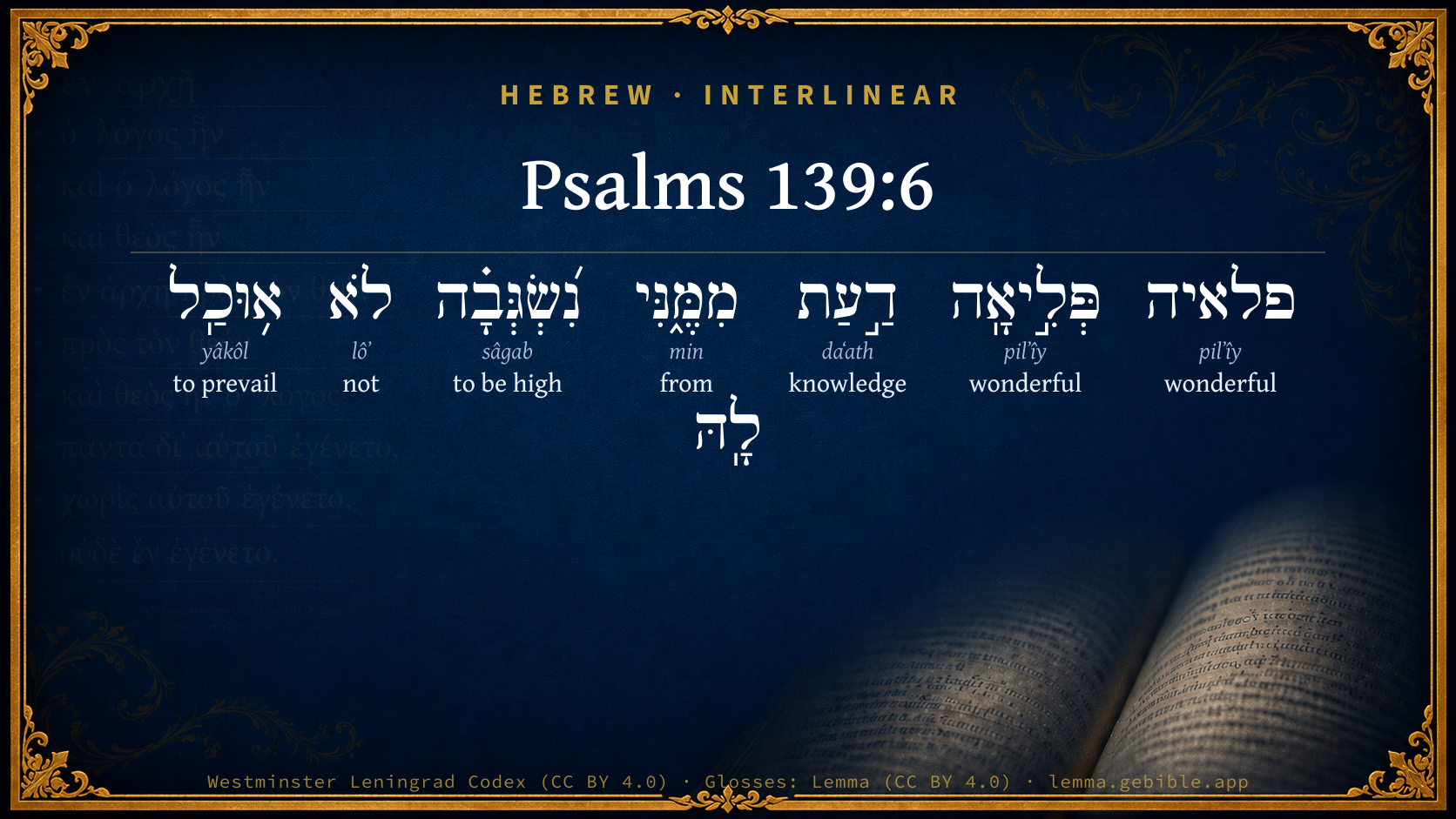
Psalms 139:6

Hebrew (Westminster Leningrad Codex) Psalms 139:6 appears in the Hebrew Old Testament. The text above is from the Westminster Leningrad Codex. Each word links to its Strong’s number, a concise gloss, and parsing drawn from the Open Scriptures Hebrew Bible morphology. Click any word for its full Brown-Driver-Briggs (BDB) entry.
Download image
Cite this verse

Psalms 139:6 (World English Bible). Public Domain. Lemma interlinear Bible study tool, https://lemma.gebible.app/v/psalms/139/6.

Show BibTeX & RIS
BibTeX
RIS
English Translation
This knowledge is beyond me. It's lofty. I can't attain it.
World English Bible · Public Domain
Download a study sheet

One document with this verse’s original text, its word-by-word gloss line, the meaning frame, cross-references with their text, attributed commentary, and full source and license credits — printable, and it pastes into notes with its structure intact.

This verse Autodidact and up

Study sheet (.html) Plain text (.txt)

A passage Seminary Student

Up to 50 verses in one chapter. A passage sheet keeps up to 6 commentary sources and 12 cross-references per verse, in the order this page ranks them, and says so on the sheet whenever that leaves anything out. Ask for a single verse and you get the Autodidact verse sheet above.

Everything on this page stays free to read, with no account — the sheet is a download of what is already on screen, not access to it.

Want to remove ads? Support Godless Engineer
Compare translations 3

The same verse in 3 English versions, stacked beneath the original-language interlinear above. Click any original word for its lexicon entry.

Each is an independent rendering of the whole verse — the interlinear is not word-aligned to these translations.

Highlighted words mark where these versions differ — a whole-verse word diff, not a word-by-word alignment.

  • World English Bible Public Domain
    This knowledge is beyond me. It's lofty. I can't attain it.
  • King James Version Public Domain
    Such knowledge is too wonderful for me; it is high, I cannot attain unto it.
  • unfoldingWord Literal Text CC BY-SA 4.0
    knowledge too wonderful for me; it is high; I am not capable of it.

unfoldingWord Literal Text — © unfoldingWord, licensed CC BY-SA 4.0. Word-aligned USFM3 via Door43 (git.door43.org/unfoldingWord/en_ult).

Versions to compare (up to 4)

3 of 4 selected

Show all 18 translations

Every available English version of this verse, each an independent rendering of the whole verse.

  • World English Bible Public Domain
    This knowledge is beyond me. It's lofty. I can't attain it.
  • Berean Standard Bible Public Domain
    Such knowledge is too wonderful for me, too lofty for me to attain.
  • Majority Standard Bible Public Domain
    Such knowledge is too wonderful for me, too lofty for me to attain.
  • King James Version Public Domain
    Such knowledge is too wonderful for me; it is high, I cannot attain unto it.
  • American Standard Version (1901) Public Domain
    `Such' knowledge is too wonderful for me; It is high, I cannot attain unto it.
  • Revised Version (1885) Public Domain
    Such knowledge is too wonderful for me; it is high, I cannot attain unto it.
  • Geneva Bible (1599) Public Domain
    Thy knowledge is too wonderfull for mee: it is so high that I cannot attaine vnto it.
  • Douay-Rheims (1899) Public Domain
    For the Lord is high, and looketh on the low: and the high he knoweth afar off.
  • Young's Literal Translation Public Domain
    Knowledge too wonderful for me, It hath been set on high, I am not able for it.
  • Literal Standard Version CC BY-SA 4.0
    Knowledge too wonderful for me, || It has been set on high, || I am not able for it.
  • Unlocked Literal Bible CC BY-SA 4.0
    Such knowledge is too much for me; it is too high, and I cannot reach it.
  • unfoldingWord Literal Text CC BY-SA 4.0
    knowledge too wonderful for me; it is high; I am not capable of it.
  • Darby Bible Public Domain
    O knowledge too wonderful for me! it is high, I cannot [attain] unto it.
  • World Messianic Bible Public Domain
    This knowledge is beyond me. It’s lofty. I can’t attain it.
  • Webster's Bible Public Domain
    Such knowledge is too wonderful for me; it is high, I cannot attain to it.
  • Free Bible Version CC BY-SA 4.0
    This amazing knowledge you have is far beyond me, way beyond my understanding!
  • Bible in Basic English Public Domain
    Such knowledge is a wonder greater than my powers; it is so high that I may not come near it.
  • JPS Tanakh (1917) Public Domain
    Such knowledge is too wonderful for me; too high, I cannot attain unto it.

Literal Standard Version (2020), Covenant Press — licensed CC BY-SA 4.0. Text via the HelloAO Bible API (eBible.org). Unlocked Literal Bible (unfoldingWord) — licensed CC BY-SA 4.0. Text via the HelloAO Bible API (eBible.org). unfoldingWord Literal Text — © unfoldingWord, licensed CC BY-SA 4.0. Word-aligned USFM3 via Door43 (git.door43.org/unfoldingWord/en_ult). Free Bible Version, Dr. Jonathan Gallagher — licensed CC BY-SA 4.0. Text via the HelloAO Bible API (eBible.org).

Word by word

More ways to search: Search by grammar → Find every occurrence → Compare this word →

Practice this passage: Drill this verse → Learn its vocabulary →

About this verse

These counts appear in no published source. They are computed here, from the morphology-tagged text and Lemma’s own curated glosses. What Lemma adds →

8
words
6
distinct lemmas
Wisdom
section

Notable vocabulary

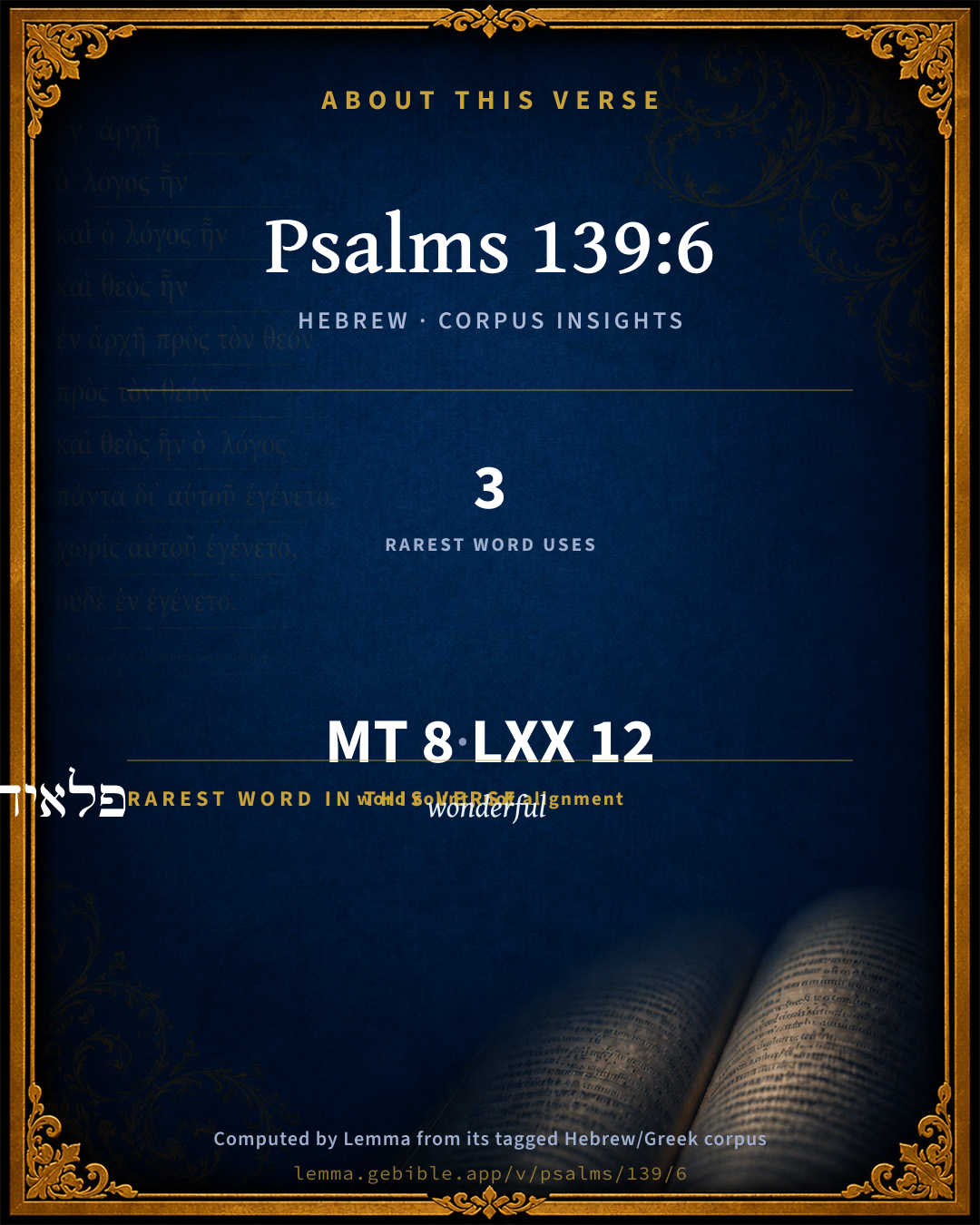
The rarest word here is פלאיה wonderful H6383 — appearing just 3 times in the whole Hebrew Bible.

Shared distinctive vocabulary

פלאיה wonderful H6383 occurs in 2 verses of the Hebrew Bible. Also found in:

Grammatical profile

  • 2 verbs
  • 1 noun
  • 2 adjectives
  • 2 prepositions
  • 1 particle

Verb forms

  • נִ֝שְׂגְּבָ֗ה Niphal · Participle Active
  • א֥וּכַֽל Qal · Imperfect

Repetition

A word recurs within this verse — often emphatic in Hebrew:

  • פלאיה wonderful H6383 ×2

Hebrew & Septuagint length

In English translation the verse runs 11 words from the Hebrew and 18 from the Septuagint (LXX English) — closely comparable.

A rough comparison of the two English renderings, which tokenize alike — not a word-level alignment.

Word counts can differ between the Hebrew and the Greek without any difference in meaning — e.g. the Hebrew direct-object marker אֵת has no separate Greek word, and Greek often adds the article ὁ.

In the original languages it is 8 Hebrew tokens and 12 Greek tokens — but the two are counted differently (Hebrew bundles its prefixes and suffixes into one token; the Greek is in lemma form), so that isn’t a like-for-like length.

Cross-references

7

Topical passages linked to Psalms 139:6 in the Treasury of Scripture Knowledge — connected by theme and wording, ordered by reader-vote popularity; previews shown in the World English Bible.

  • Romans 11:33 Oh the depth of the riches both of the wisdom and the knowledge of God! How unsearchable are his judgments, and his ways past tracing out!
  • Job 42:3 You asked, 'Who is this who hides counsel without knowledge?' Therefore I have uttered that which I did not understand, Things too wonderful for me, which I didn't know.
  • Job 11:7–9 "Can you fathom the mystery of God? Or can you probe the limits of the Almighty?
  • Job 26:14 Behold, these are but the outskirts of his ways. How small a whisper do we hear of him! But the thunder of his power who can understand?"
  • Psalms 40:5 Many, Yahweh, my God, are the wonderful works which you have done, And your thoughts which are toward us. They can't be set in order to you; If I would declare and speak of them, they are more than can be numbered.
  • Proverbs 30:2–4 "Surely I am the most ignorant man, And don't have a man's understanding.
  • Psalms 13:1 How long, Yahweh? Will you forget me forever? How long will you hide your face from me?

Cross-references courtesy of OpenBible.info (CC BY 4.0).

Hebrew and Greek witnesses Masoretic Hebrew ↔ Greek Septuagint

The same verse in the two great witnesses to the Old Testament, shown verse-for-verse.

You’re reading Greek Psalm 138 (Hebrew Psalm 139). The Septuagint counts the superscription, so verse numbers can differ from the Hebrew — chapter-level alignment, not verse-by-verse. Numbering follows Rahlfs.

These are two independent witnesses, not word-aligned to each other, and the Septuagint is shown in lemma (dictionary) form.

Hebrew Psalms 139:6 Masoretic · Westminster Leningrad Codex

פלאיה פְּלִ֣יאָֽה דַ֣עַת מִמֶּ֑נִּי נִ֝שְׂגְּבָ֗ה לֹא א֥וּכַֽל לָֽהּ

This knowledge is beyond me. It's lofty. I can't attain it.

World English Bible · Public Domain

Greek LXX Greek Psalm 138:6 Septuagint · lemma form

θαυμαστόω ὁ γνῶσις σύ ἐκ ἐγώ κραταιόω οὐ μή δύναμαι πρός αὐτός

The knowledge of you is too wonderful for me; it is very difficult, I can’t attain to it.

LXX2012 (modern English Septuagint) · Public Domain

On this verse, Ellicott's Commentary for English Readers discusses the Septuagint’s reading. Read the note in Commentary ↓

Hebrew: Westminster Leningrad Codex (CC BY 4.0). Greek: Septuagint (public domain); English from LXX2012 (modern English Septuagint) (Public Domain). How the Septuagint differs from the Hebrew →

Commentary

Notes on Psalms 139:6 from classic Christian and Jewish commentators (each source and its license shown beneath its notes). The classic Christian expositions comment on the surrounding passage and are grouped to its opening verse, so a note may address several verses; the Jewish commentaries on the Tanakh (Rashi and others) are per-verse, so they appear only where the commentator wrote on this verse.

Lemma curates 59 commentaries, every one of them public domain or Creative Commons licensed, each selected and text-cleaned for this edition rather than reprinted as found. About our sources →

Trapp's Complete Commentary

John Trapp

Psa 139:6 [Such] knowledge [is] too wonderful for me; it is high, I cannot [attain] unto it.

Ver. 6. Such knowledge is too wonderful for me] I can hardly conceive of this thine omniscience and omnipresence, but am ready to measure thee by myself, and according to mine own model. And, indeed, for a creature to believe the infinite attributes of God, he is never able to do it thoroughly without supernatural grace.

It is high, I cannot attain unto it] Since it far exceedeth the reach of reason, and is much above my capacity and understanding. I stand at gaze, and am aghast, and that is the nearest that I, a poor finite, foolish creature, can come to so infinite a wisdom. It was, therefore, a good speech of them who, being asked what God was? answered, Si scirem, Deus essem, If I knew that, I should be a God.

John Trapp, A Commentary or Exposition upon All the Books of the Old and New Testament (1647–1656) — public domain. Text from a community e-Sword module.

The Biblical Illustrator

Joseph S. Exell

Psa_139:6

Such knowledge is too wonderful for me.

Gods all-knowledge

If we had to take our trial for our lives before the tribunal of an earthly judge, there are probably three questions which we should ask ourselves with no little anxiety: Has the judge himself the power, or does he represent some one who has the power, to enforce the sentence which he may pronounce? Is the judge a man of that integrity of character which is fearless when interpreting the plain sense of the law that is to be administered, and equitable when some indistinctness in that law obliges the interpreter to fall back on his own sense of what is probably right? Can the judge command the means of knowing enough of those facts upon which his decision must be based to judge righteous judgment, to have himself and to inspire others with the assurance that innocence is acquitted and that guilt is punished? When we turn our thoughts upwards to the Judge of all men, we know how a serious believer in God must answer such questions as these.

I. But, as we look more closely at the subject, certain features of the knowledge which is possessed by the Divine mind stand out before us more distinctly. They show how that knowledge differs from knowledge as it exists in ourselves, and they enable us to understand how the knowledge which belongs to God, as God, is knowledge of an extent and of a kind which makes it certain that when seated on the throne of judgment the Holy Judge of all the earth does right.

1. And first of all, then, so far as we know, all, or nearly all, of our knowledge is acquired, and most of it is acquired at very considerable cost of time and labour. Now, nothing corresponding to this can hold good of the mind of God. God does not acquire His knowledge; He ever possessed it. Acquisition implies ignorance to begin with; it implies a limited prospect which is gradually enlarged by effort; it implies dependence upon intermediate sources of knowledge, upon books, teachers, the testimony of others, evidence, experiment. All this is inadmissible in conceiving of the Divine Mind which never could have been ignorant, never dependent upon anything or any person external to itself for obtaining information. Man may be very--nay, utterly ignorant--not, indeed, without grave loss, but certainly without forfeiting his manhood. In man, knowledge, however important, is yet an accident of his life: it is conceivably separated from it. In God, on the other hand, knowledge is not a separable accident, a dispensable attribute of His existence. As God, He cannot but know, and know on an infinite scale. In God, as St. Augustine finely says, to know is the same thing as to exist. There can be in Him no progress from a lower to a higher plane of knowledge, still less from ignorance to knowledge. In Him all the treasures of wisdom and knowledge have ever been exactly what they are. Now, consider how this bears on the duties of a judge. A human judge, whatever his knowledge of the statute book, whatever his experience of proceedings in the courts, is dependent upon the evidence which is brought before him, when charging the jury or when forming his own judgment. If the evidence is confused or imperfect, if it is perjured or untrustworthy, still it is all he has to go upon; he must do the best he can with it; he has no means of arriving at a bound at the truth of the facts independently of that which is deposed to before him. Alas! however excellent his intentions, however absolute his integrity, he cannot escape a liability--the human liability--to make mistakes. In the Divine Judge this liability does not exist, because His knowledge of facts, not being acquired by weighing evidence, is ever and immediately present to His mind. He sees everything--men, events, characters--at a glance, and as they are.

2. And as human knowledge is acquired, so it is liable to decompose in our minds. It is less easily acquired than it is forgotten. Here, again, we must see that nothing corresponding to this process, so familiar in the experience of the human mind, is even imaginable in the mind of God. It knows no variableness, neither shadow of turning. All that is, all that might have been and is not, all that might yet be, whether it is to be or is not to be, is eternally present to it, and it could not forfeit its hold upon any part of this, to us, inconceivably vast field of knowledge without ceasing to be itself. And here, again, the Divine Judge must differ from any human judge. No human judge can prudently trust his memory even to retain what is brought before him in a case that lasts but a few hours; he can only trust his notes. Memory, he knows, is treacherous; it gives way just when we need it most; it refuses to recall a date, a name, a figure, a fact, unimportant generally, but of critical importance then and now Its impotence is, so we think, as capricious as are its good services. In the Awful Mind above and around us nothing like this is possible, because it does not ever, as we do, look back upon any fact as upon something past; it is always in contact with all facts, whether, from our point of view, they be past or present or future, as eternally present to it.

3. And, once more, human knowledge is very limited. We know in part. As the generations of men who devote themselves to the work of marshalling and increasing the stock of human knowledge succeed each other, each generation is largely occupied in showing how defective was the knowledge of those who immediately preceded it, while it knows that in turn it, too, will be exposed to a like criticism on the part of its successors. So far are we men from possessing the field of universal knowledge that a man never entirely masters any single subject. In the Divine Mind, on the contrary, we cannot conceive partial knowledge of any subject whatever. God knows all, because He is everywhere. The Omnipresent cannot but be also omniscient. What need is there to say that the knowledge of the human judge is, I will not say partial, but very limited indeed? Were it otherwise, how superfluous would be the machinery which now justice adopts in order to achieve its ends. How different with the Divine Judge! He can gain nothing from any external source of knowledge, and nothing can intercept or divert His all-surveying, all-penetrating, all-comprehending intelligence.

II. Of this knowledge possessed by God there are some features which, from their bearing on life and conduct, deserve special attention.

1. Thus God knows not only what is known to the world, or to our relations about each one of us; He knows that which each of us only knows about himself. His eye surveys our secret thoughts and words and ways. He has sometimes revealed this knowledge through the mouth of an inspired servant, as when Elisha discovered his double-dealing with Naaman to the astonished Gehazi, or when St. Peter proclaimed their crime and its punishment to the terrified Ananias and Sapphira.

2. He knows, too, the exact measure of our individual responsibility for the corporate acts of the societies to which we belong--the Church, the nation, the parish, the family.

3. And, once more, He knows what each one of us would be in other circumstances than those with which He has surrounded us. He knows this because He sees our inmost dispositions, and sees us as we are. Yes, in thinking of the judgment we have to think not only of the power, not only of the goodness of the Judge, but of His limitless knowledge, that awful attribute of a knowledge which searches us out in the depths of our being, which plays upon us, around us, within us, every moment of our lives with a penetrating scrutiny that nothing can elude; that knowledge before which the night is as the day, and the future as the present, and the possible as the actual, and the secret things of darkness as the most ordinary facts of daylight; that knowledge which nothing can impair, nothing can disturb, nothing can exaggerate or discolour; the calm, majestic, resistless outlook of the Eternal Mind will become real to us--real to you and to me--as never before in our experience. There are two resolutions which the thought of that meeting should surely suggest. The first resolution, if we can, to know something really about ourselves before we die, to dwell no longer, if hitherto we have so dwelt, on the surface of life, to see ourselves with eyes not of our friends, not of our own self-love, but, so far as may be, as the holy angels see us, as He sees us who is the Lord of angels, our Maker and our Judge. Each day some few minutes should surely be spent in the regular and fruitful practice of self-examination. And the second resolution is to fly for refuge to that one Friend who can make a true knowledge of self bearable to each of us. We can dare to be true not only because our Redeemer and our God is Himself the Faithful and the True, but because He is the All-merciful, because, if we so will, He has searched us out and known us even here, that at the last great day He may make us trophies not of His awful justice, but of His redeeming grace. (Canon Liddon.)

The Biblical Illustrator, edited by Joseph S. Exell (c. 1880s–1900s) — public domain. Text from a community e-Sword module.

Joseph Benson's Commentary

Psa 139:6. Such knowledge is too wonderful for me, &c. — It is such a knowledge as I cannot comprehend, much less describe. I cannot conceive, or even form any idea in what manner thou dost so perfectly know all things, especially things which have yet no being, and seem to depend on many casualties and uncertainties. Dr. Hammond renders the verse, Such knowledge is admirable, above me: it is high; I cannot deal with it. But the sense of the original of the last clause, לא אוכל לה, seems better expressed in our translation. The mind of the psalmist, when he uttered these words, was evidently impressed “with such a veneration and awe of the infinite Jehovah, the fountain and support of universal life and being; and he found his faculties so swallowed up, and, as it were, lost in meditating on so deep and immense a subject; that man’s reason, in its utmost pride and glory, and with its most boasted improvements and acquisitions of knowledge, seemed now so debased, so weak, so narrow, and, in comparison with infinity, so despicable, that he could proceed no further without expressing his admiration at such a boundless scope of intelligence as he could neither explain nor comprehend:” see Foster’s Discourses, vol. Psa 1:4 to. p. 76.

Joseph Benson's Commentary on the Old and New Testaments (1811–1818) — public domain. Text from a community e-Sword module.

J. A. Alexander on Psalms

Joseph Addison Alexander

6. (Psa 139:6) Such knowledge is too wonderful for me; it is exalted, I cannot (attain) to it. The literal meaning of the Hebrew word is, wonderful knowledge away from me, or more than I (can comprehend); it is exalted, I cannot (do anything) as to it. With the word wonderful compare the use of the cognate verb, Deu 30:11, Pro 30:18. The knowledge meant is man's finite knowledge of the infinite.

Joseph Addison Alexander, The Psalms Translated and Explained (1850) — public domain. Text from a community e-Sword module.

Tyndale Open Study Notes

Tyndale Open Resources

139:6 The Lord’s wonderful understanding lies beyond the psalmist’s ability to comprehend (see Judg 13:18).

Tyndale Open Study Notes — © Tyndale Open Resources, licensed CC BY-SA 4.0. Text via the HelloAO Bible API.

Adam Clarke's Commentary

Verse 6. Such knowledge is too wonderful] I think, with Kennicott, that פלאיה דעת pelaiah daath should be read פלאי הדעת peli haddaath, "THIS knowledge," ממני mimmenni, "is beyond or above me." This change is made by taking the ה he from the end of פלאיה pelaiah, which is really no word, and joining it with דעת daath; which, by giving it an article, makes it demonstrative, הדעת haddaath, "THIS knowledge." This kind of knowledge, God's knowledge, that takes in all things, and their reasons, essences, tendencies, and issues, is far beyond me.

Adam Clarke's Commentary on the Bible (1810–1826) — public domain. Text from a community e-Sword/MySword module.

John Calvin's Commentaries

6. Thy knowledge is wonderful above me Two meanings may be attached to ממני: mimmenni. We may read upon me, or, in relation to me, and understand David to mean that God’s knowledge is seen to be wonderful in forming such a creature as man, who, to use an old saying’, may be called a little world in himself; nor can we think without astonishment of the consummate artifice apparent in the structure of the human body, and of the excellent endowments with which the human soul is invested. But the context demands another interpretation; and we are to suppose that David, prosecuting the same idea upon which he had already insisted, exclaims against the folly of measuring God’s knowledge by our own, when it rises prodigiously above us. Many when they hear God spoken of conceive of him as like unto themselves, and such presumption is most condemnable. Very commonly they will not allow his knowledge to be greater than what comes up to their own apprehensions of things. David, on the contrary, confesses it to be beyond his comprehension, virtually declaring that words could not express this truth of the absoluteness with which all things stand patent to the eye of God, this being a knowledge having’ neither bound nor measure, so that he could only contemplate the extent of it with conscious imbecility.

John Calvin's Commentaries (1540-1563) — public domain. Text from the Calvin Translation Society English edition (1840s-50s) via the Christian Classics Ethereal Library (ccel.org). Calvin's coverage is partial (roughly two-thirds of the Bible); uncommented books and verses are honest gaps, never fabricated. The 19th-century editor's footnotes and remarks are omitted so the notes are faithfully Calvin's own voice.

Ellicott's Commentary for English Readers

(6) Such . . .—God’s omniscience is for man at once transcendent, unattainable, impossible. Possibly the article has dropped away, and we should read this knowledge. LXX. and Vulg. have “thy knowledge.”

For the thought comp. Psa_139:17-18, and Rom_11:33.

A Bible Commentary for English Readers, edited by Charles John Ellicott (1878–1897) — public domain. Text from a community e-Sword module.

The Cambridge Bible for Schools and Colleges

gen. ed. J. J. S. Perowne

6. A concluding exclamation of reverent awe. Such infinite knowledge baffles human thought to comprehend it. Cp. Rom_11:33.

(so) exalted (that) I cannot attain unto it] “The word used implies ‘high so as to be inaccessible’; it is used, for instance, of an impregnable city, Deu_2:36” (Driver). It is also used of God, Isa_2:11; Isa_2:17; Isa_12:4.

The Cambridge Bible for Schools and Colleges (gen. ed. J. J. S. Perowne; Cambridge University Press, 1878–1918) — public domain. Text from a community e-Sword module.

John Gill's Exposition

Whither shall I go from thy spirit?.... Or, "from thy wind?" which some interpret literally, the wind being God's creature; which he brings out of his treasures, and holds in his fists, and disposes of as he pleases; this takes its circuit through all the points of the heavens, and blows everywhere, more or less. Rather God himself is meant, who is a Spirit, Joh 4:24 not a body, or consisting of corporeal parts, which are only ascribed to him in a figurative sense; and who has something analogous to spirit, being simple and uncompounded, invisible, incorruptible, immaterial, and immortal; but is different from all other spirits, being uncreated, eternal, infinite, and immense; so that there is no going from him, as to be out of his sight; nor to any place out of his reach, nor from his wrath and justice, nor so as to escape his righteous judgment. It may signify his all-conscious mind, his all-comprehending understanding and knowledge, which reaches to all persons, places, and things; compare Isa 40:13; with Rom 11:34; though it seems best of all to understand it of the third Person, the blessed Spirit, which proceeds from the Father and the Son; and who is possessed of the same perfections, of omniscience, omnipresence, and immensity, as they are; who is the Creator of the heavens and the earth, and pervades them all; and is the Maker of all men, and is present with them to uphold their souls in life, and there is no going from him; particularly he is in all believers, and dwells with them; nor do they desire to go from him, but deprecate his departure from them;

or whither shall I flee from thy presence? which is everywhere, for God's presence is omnipresence; his powerful presence and providence are with all his creatures, to support and uphold them in being; he is not far from, but near to them; in him they live, move, and have their being: and so there is no fleeing from him or that; and as to his gracious presence, which is with all his people, in all places at the same time; they do not desire to flee from it, but always to have it; and are concerned for it, if at any time it is removed from them, as to their apprehension of it. Or, "from thy face" (e); that is, from Christ, who is the face of Jehovah; the image of the invisible God, the express image of his person, in whom all the perfections of God are displayed; and such a likeness, that he that has seen the one has seen the other; he is the Angel of his face or presence, and who always appears before him, and in whom he is seen. Now there is no fleeing from him, for he is everywhere; where God is, his face is: and a sensible sinner desires to flee to him, and not from him; for there is no other refuge to flee unto for life and salvation but to him; and gracious souls desire to be always with him now, and hope to be for ever with him hereafter; they seek him, the face of God, now, and expect to see it more clearly in the world to come.

(e) "a facie tua", Pagninus, Junius & Tremellius, Piscator.

John Gill's Exposition of the Whole Bible (1746–1763) — public domain (CC PDM 1.0). Text via the HelloAO Bible API.

Albert Barnes' Notes on the Bible

Such knowledge is too wonderful for me - literally, “Wonderful knowledge away from me,” or, more than I can comprehend. It is beyond my reach; it surpasses all my powers to comprehend it.

It is high, I cannot attain unto it - It is so exalted that I cannot grasp it; I cannot understand how it can be.

Albert Barnes' Notes on the Bible (1834–1885) — public domain. Text from a community e-Sword/MySword module.

Matthew Poole's English Annotations

I am so far from equalling thy knowledge, that I cannot apprehend it, in what manner thou dost so perfectly know all things, even such as are most secret, and have yet no being, and seem to depend upon many casualties and uncertainties.

Matthew Poole's English Annotations on the Holy Bible (1683–1685) — public domain. Text from a community e-Sword/MySword module.

The Treasury of David

Charles H. Spurgeon

Ver. 6. Such knowledge is too wonderful for me. I cannot grasp it. I can hardly endure to think of it. The theme overwhelms me. I am amazed and astounded at it. Such knowledge not only surpasses my comprehension, but even my imagination.

It is high, I cannot attain unto it. Mount as I may, this truth is too lofty for my mind. It seems to be always above me, even when I soar into the loftiest regions of spiritual thought. Is it not so with every attribute of God? Can we attain to any idea of his power, his wisdom, his holiness? Our mind has no line with which to measure the Infinite. Do we therefore question? Say, rather, that we therefore believe and adore. We are not surprised that the Most Glorious God should in his knowledge be high above all the knowledge to which we can attain: it must of necessity be so, since we are such poor limited beings; and when we stand a tip toe we cannot reach to the lowest step of the throne of the Eternal.

Ver. 6. Such knowledge is too wonderful for me, etc. When we are about to look upon God's perfections, we should observe our own imperfections, and thereby learn to be the more modest in our searching of God's unsearchable perfection: Such knowledge, saith David, is too high for me, I cannot attain unto it. Then do we see most of God, when we see him incomprehensible, and do see ourselves swallowed up in the thoughts of his perfection, and are forced to fall in admiration of God, as here. "Such knowledge is too wonderful for me; it is high, I cannot attain unto it." David Dickson.

Ver. 6. Such knowledge is too wonderful for me. Compared with our stinted knowledge, how amazing is the knowledge of God! As he made all things, he must be intimately acquainted, not only with their properties, but with their very essence. His eye, at the same instant, surveys all the works of his immeasurable creation. He observes, not only the complicated system of the universe, but the slightest motion of the most microscopic insect; not only the most sublime conception of angels, but the meanest propensity of the most worthless of his creatures. At this moment he is listening to the praises breathed by grateful hearts in distant worlds, and reading every grovelling thought which passes though the polluted minds of the fallen race of Adam...At one view, he surveys the past, the present, and the future. No inattention prevents him from observing; no defect of memory or of judgment obscures his comprehension. In his remembrance are stored not only the transactions of this world, but of all the worlds in the universe; not only the events of the six thousand years which have passed since the earth was created, but of a duration without beginning. Nay, things to come extending to a duration without end, are also before him. An eternity past and an eternity to come are, at the same moment, in his eye; and with that eternal eye he surveys infinity. How amazing! How inconceivable! Henry Duncan (1774-1846), in "Sacred Philosophy of the Seasons."

Ver. 6. Such knowledge is too wonderful for me. There is a mystery about the Divine Omnipresence, which we do not learn to solve, after years of meditation. As God is a simple spirit, without dimensions, parts, or susceptibility of division, he is equally, that is, fully, present at all times in all places. At any given moment he is not present partly here and partly in the utmost skirt of the furthest system which revolves about the dimmest telescopic star, as if like a galaxy of perfection he stretched a sublime magnificence through universal space, which admitted of separation and partition; but he is present, with the totality of his glorious properties in every point of space. This results undeniably from the simple spirituality of the Great Supreme. All that God is in one place he is in all places. All there is of God is in every place. Indeed, his presence has no dependence on space or matter. His attribute of essential presence were the same if universal matter were blotted out. Only by a figure can God be said to be in the universe; for the universe is comprehended by him. All the boundless glory of the Godhead is essentially present at every spot in his creation, however various may be the manifestations of this glory at different times and places.

Here we have a case which ought to instruct and sober those, who, in their shallow philosophy, demand a religion without mystery. It would be a religion without God; for "who by searching can find out God?" James W. Alexander, in "The (American) National Preacher", 1860.

Ver. 6.

1. God imperfectly known to man.

2. Man perfectly known to God. It has been said that wise men never wonder; to us it appears they are always wondering.

G.R.

Ver. 6. Theme: the facts of our religion, too wonderful to understand, are just those in which we have most reason to rejoice.

1. Prove it.

a) The incomprehensible attributes of God give unspeakable value to his promises.

b) The Incarnation is at once the most complete and most endearing manifestation of God we possess, yet it is the most inexplicable.

c) Redemption by the death of Christ is the highest guarantee of salvation we can conceive; but who can explain it?

d) Inspiration makes the Bible the word of God, though none can give an account of its mode of operation in the minds of those "moved by the Holy Ghost."

e) The resurrection of the body, and its glorification, satisfy the deepest yearning of our soul (Ro 8:23 2Co 5:2-4); but none can conceive the how.

2. Apply its lessons.

a) Let us not stumble at doctrines simply because they are mysterious.

b) Let us be thankful God has not kept back the great mysteries of our religion simply because there would be some offended at them.

c) Let us readily receive all the joy which the mysteries bring, and calmly wait the light of heaven to make them better understood.

J.F.

Psalms 139:7*

Charles H. Spurgeon's The Treasury of David (1869–1885) — public domain. Psalms only. Text from a community e-Sword/MySword module.

Whedon's Commentary on the Bible

Daniel D. Whedon

6. Too wonderful for me—Above the reach of the human faculties. Same as “it is high, I cannot attain to it,” in the next line. Thus far the psalmist describes omniscience. He next proceeds to connect omnipresence, omnipotence, and wisdom.

Daniel D. Whedon (gen. ed.), Commentary on the Old and New Testaments (1874–1909) — public domain. Text from a community e-Sword module.

The Pulpit Commentary

Such knowledge is too wonderful for me; it is high, I cannot attain unto it. The psalmist does not say, "such knowledge," but simply "knowledge," i.e. real true knowledge, such as deserves the name. "The thought of God"s omniscience makes him feel as if real knowledge were beyond his reach" (Kay).

The oppression of the Divine omniscience.

"Such knowledge is too wonderful for me." "Nowhere are the great attributes of God his omniscience, his omnipresence, his omnipotence set forth so strikingly as they are in this magnificent psalm. Nowhere is there a more overwhelming sense of the fact that man is beset and compassed about by God, pervaded by his Spirit, unable to take a step without his control; and yet nowhere is there a more emphatic assertion of the personality of man as distinct from, not absorbed in, the Deity" (Perowne). A philosopher was asked by a monarch about God, and he desired a day for his answer. He then asked for another day in which to give his answer. The more he thought about God, the more he seemed unable rightly to describe him. At last the monarch asked the philosopher why he so often delayed to tell him what he knew about God; and he replied, "The more I think about God, the more incomprehensible he seems to be." The kind of oppression which comes from feeling that God knows even the very minutest things about us, and even everything that will come to us, may be illustrated by the oppressed feeling that the persons skilled in palmistry give us. Looking at our hands, they seem able to read our character and our destiny; and we shun them with a kind of fear, lest, knowing so much, they become mischief-makers. It really is an awe-ful thing that God should know us altogether. This is seen in Hagar"s oppressed exclamation," Thou God seest me!" and in a better way, in Jacob"s devout utterance, when he had seen the ladder of God"s care, "How dreadful is this place!" Notice

I HOW PERFECT THE DIVINE OMNISCIENCE IS! The psalm illustrates the Divine knowledge, not of things in general, but of us knowest me," my doing this or that;

(1) my imaginations;

(2) my designs and undertakings;

(3) even my retirements and hidings;

(4) my sayings;

(5) my entire history;

(6) every part of me ("Beset me behind and before").

II HOW OPPRESSIVE THE DIVINE OMNISCIENCE IS! Even when we are in right relations with God, it is oppressive. It is an awful feeling that we can never be alone. We can never escape the eye. The only relief comes by the knowledge that it is our Father"s eye. He knows only that he may help. What is Divine omniscience to those who neither know nor love God? R.T.

The Pulpit Commentary (1880–1919), ed. H.D.M. Spence-Jones & Joseph S. Exell — public domain. Text from a community e-Sword module.

John Wesley's Explanatory Notes

I cannot - Apprehend in what manner thou dost so presently know all things.

John Wesley, Explanatory Notes Upon the Whole Bible (1754–1765) — public domain. Text via the GEBible commentary corpus.

Rashi

Rabbi Shlomo Yitzchaki (Rashi)

Knowledge is hidden from me, etc. A place to escape from You is covered up and hidden from me. (I found this.)

Rashi on the Tanakh — English translations: “The Judaica Press complete Tanach with Rashi, translated by A. J. Rosenberg” (CC BY 4.0); “Pentateuch with Rashi's commentary by M. Rosenbaum and A.M. Silbermann, 1929-1934” (public domain); “The Metsudah Tanach series, Lakewood, N.J” (CC BY 4.0); and “The Book of Joshua, Metsudah Publications, 1997” (CC BY 4.0). Text via Sefaria.

Lesson kit

Teaching starters — assembled from the data on this page, not authored interpretation. Every prompt links to the verse data it draws on. Edit before teaching.

Psalms, in the Wisdom, opens this verse with 8 words (6 distinct Hebrew lemmas). Its most distinctive word is pilʼîy (“wonderful”). A historical commentator’s framing appears above. Read the whole chapter for the surrounding context.

Discussion questions

  1. The word pilʼîy carries the sense “wonderful.” How does it shape the verse?
  2. How does Judges 13:18, which shares the word «wonderful», read alongside this verse?
  3. What does the repetition of “wonderful” (2× in this one verse) do in this verse?
  4. These translations render this verse differently; the difference is in the English rendering, not the original. What questions does that raise?
  5. «נִ֝שְׂגְּבָ֗ה» is a Niphal Participle Active verb. How does that grammatical form shape the action described?
  6. Compare how Trapp's Complete Commentary and The Biblical Illustrator read this verse. Where do they agree or differ?

Things to notice

Reading settings

Reading text

Shown beneath each verse's original-language words.

Old Testament
Old Testament edition

Read the OT as the Masoretic Hebrew (MT) or the Greek Septuagint (LXX).

English shown for the Greek Septuagint (in the Hebrew ↔ Greek comparison).

Comparing translations? Open the Compare panel on any verse page to stack up to four side by side.