
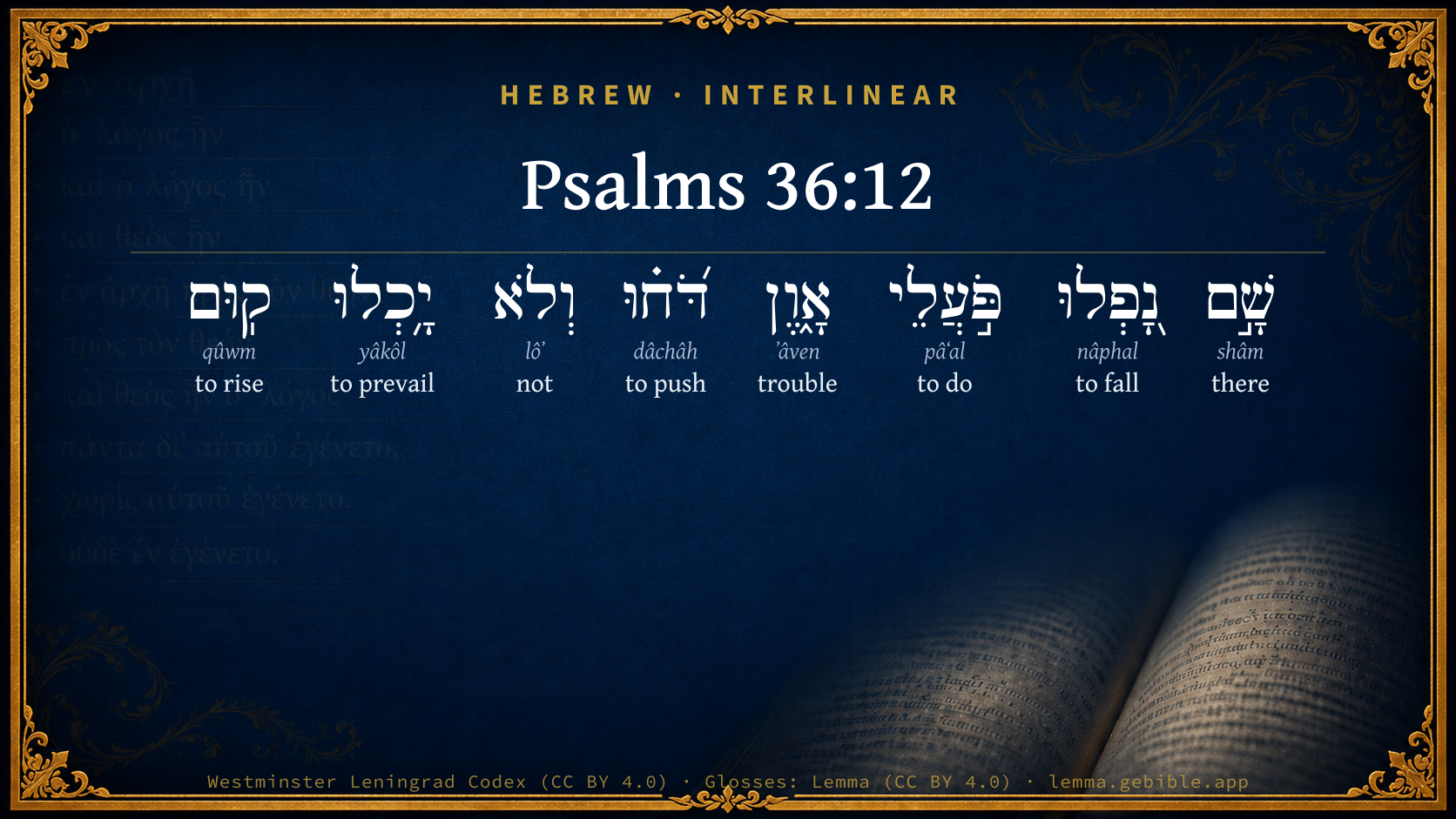
Psalms 36:12

Hebrew (Westminster Leningrad Codex) Psalms 36:12 appears in the Hebrew Old Testament. The text above is from the Westminster Leningrad Codex. Each word links to its Strong’s number, a concise gloss, and parsing drawn from the Open Scriptures Hebrew Bible morphology. Click any word for its full Brown-Driver-Briggs (BDB) entry.
Download image
Cite this verse

Psalms 36:12 (World English Bible). Public Domain. Lemma interlinear Bible study tool, https://lemma.gebible.app/v/psalms/36/12.

Show BibTeX & RIS
BibTeX
RIS
English Translation
There the workers of iniquity are fallen. They are thrust down, and shall not be able to rise.
World English Bible · Public Domain
Download a study sheet

One document with this verse’s original text, its word-by-word gloss line, the meaning frame, cross-references with their text, attributed commentary, and full source and license credits — printable, and it pastes into notes with its structure intact.

This verse Autodidact and up

Study sheet (.html) Plain text (.txt)

A passage Seminary Student

Up to 50 verses in one chapter. A passage sheet keeps up to 6 commentary sources and 12 cross-references per verse, in the order this page ranks them, and says so on the sheet whenever that leaves anything out. Ask for a single verse and you get the Autodidact verse sheet above.

Everything on this page stays free to read, with no account — the sheet is a download of what is already on screen, not access to it.

Want to remove ads? Support Godless Engineer
Compare translations 3

The same verse in 3 English versions, stacked beneath the original-language interlinear above. Click any original word for its lexicon entry.

Each is an independent rendering of the whole verse — the interlinear is not word-aligned to these translations.

Highlighted words mark where these versions differ — a whole-verse word diff, not a word-by-word alignment.

  • World English Bible Public Domain
    There the workers of iniquity are fallen. They are thrust down, and shall not be able to rise.
  • King James Version Public Domain
    There are the workers of iniquity fallen: they are cast down, and shall not be able to rise.
  • unfoldingWord Literal Text CC BY-SA 4.0
    There the doers of iniquity have fallen; they are thrust down and are not able to rise.

unfoldingWord Literal Text — © unfoldingWord, licensed CC BY-SA 4.0. Word-aligned USFM3 via Door43 (git.door43.org/unfoldingWord/en_ult).

Versions to compare (up to 4)

3 of 4 selected

Show all 18 translations

Every available English version of this verse, each an independent rendering of the whole verse.

  • World English Bible Public Domain
    There the workers of iniquity are fallen. They are thrust down, and shall not be able to rise.
  • Berean Standard Bible Public Domain
    There the evildoers lie fallen, thrown down and unable to rise.
  • Majority Standard Bible Public Domain
    There the evildoers lie fallen, thrown down and unable to rise.
  • King James Version Public Domain
    There are the workers of iniquity fallen: they are cast down, and shall not be able to rise.
  • American Standard Version (1901) Public Domain
    There are the workers of iniquity fallen: They are thrust down, and shall not be able to rise. Psalm 37 `A Psalm' of David.
  • Revised Version (1885) Public Domain
    There are the workers of iniquity fallen: they are thrust down, and shall not be able to rise.
  • Geneva Bible (1599) Public Domain
    There they are fallen that worke iniquity: they are cast downe, and shall not be able to rise.
  • Douay-Rheims (1899) Public Domain
    Let not the foot of pride come to me, and let not the hand of the sinner move me.
  • Young's Literal Translation Public Domain
    There have workers of iniquity fallen, They have been overthrown, And have not been able to arise!
  • Literal Standard Version CC BY-SA 4.0
    Workers of iniquity have fallen there, || They have been overthrown, || And have not been able to arise!
  • Unlocked Literal Bible CC BY-SA 4.0
    Over there the evildoers have fallen; they are knocked down and are not able to get up.
  • unfoldingWord Literal Text CC BY-SA 4.0
    There the doers of iniquity have fallen; they are thrust down and are not able to rise.
  • Darby Bible Public Domain
    There are the workers of iniquity fallen: they are cast down, and are not able to rise.
  • World Messianic Bible Public Domain
    There the workers of iniquity are fallen. They are thrust down, and shall not be able to rise.
  • Webster's Bible Public Domain
    \\36:11\\Let not the foot of pride come against me, and let not the hand of the wicked remove me.
  • Free Bible Version CC BY-SA 4.0
    Now look! See how those who do evil have fallen—thrown down, unable to get up.
  • Bible in Basic English Public Domain
    There the workers of evil have come down: they have been made low, and will not be lifted up.
  • JPS Tanakh (1917) Public Domain
    (36-13) There are the workers of iniquity fallen; they are thrust down, and are not able to rise.

Literal Standard Version (2020), Covenant Press — licensed CC BY-SA 4.0. Text via the HelloAO Bible API (eBible.org). Unlocked Literal Bible (unfoldingWord) — licensed CC BY-SA 4.0. Text via the HelloAO Bible API (eBible.org). unfoldingWord Literal Text — © unfoldingWord, licensed CC BY-SA 4.0. Word-aligned USFM3 via Door43 (git.door43.org/unfoldingWord/en_ult). Free Bible Version, Dr. Jonathan Gallagher — licensed CC BY-SA 4.0. Text via the HelloAO Bible API (eBible.org).

Word by word

More ways to search: Search by grammar → Find every occurrence → Compare this word →

Practice this passage: Drill this verse → Learn its vocabulary →

About this verse

These counts appear in no published source. They are computed here, from the morphology-tagged text and Lemma’s own curated glosses. What Lemma adds →

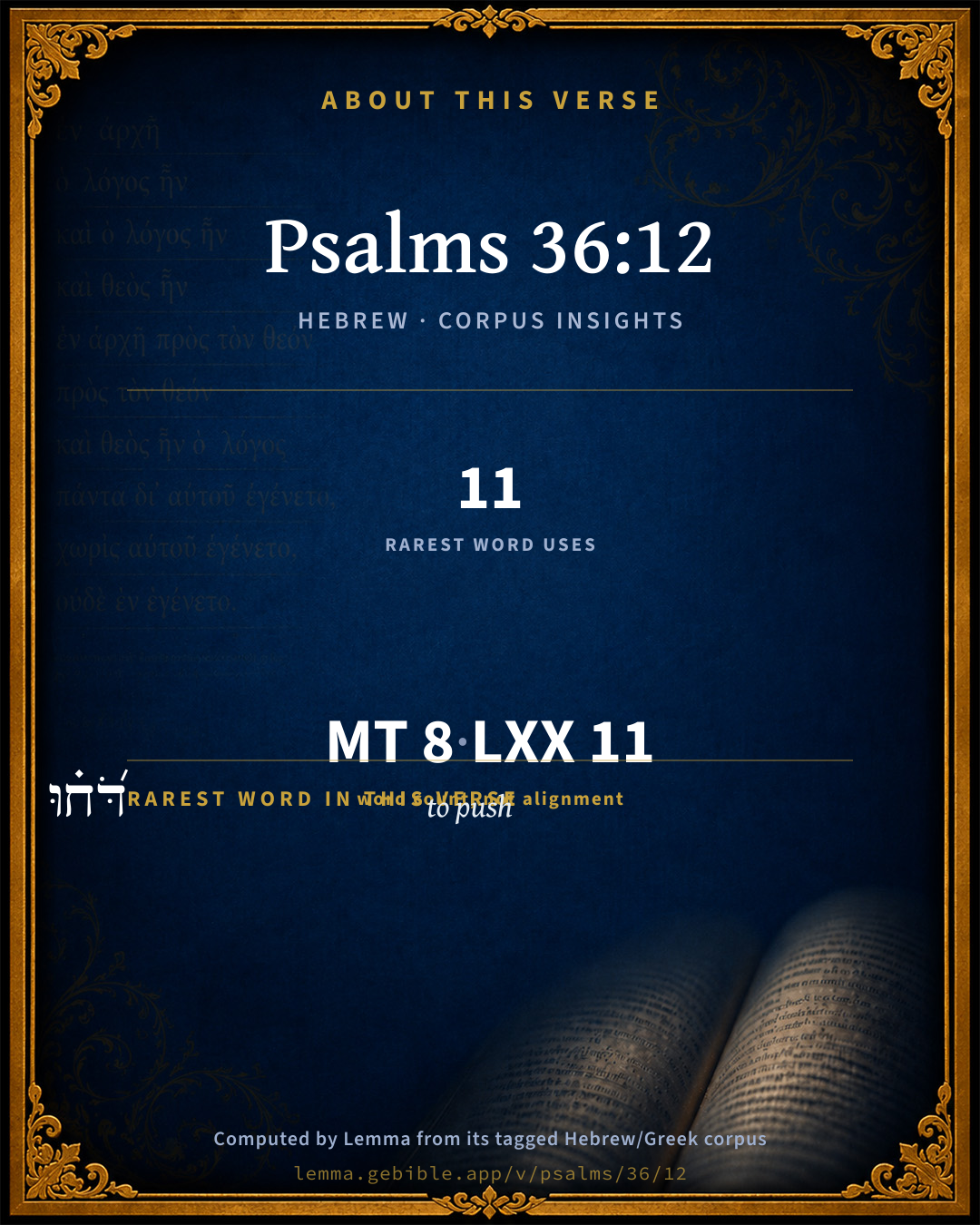
8
words
8
distinct lemmas
Wisdom
section

Notable vocabulary

The rarest word here is דֹּ֝ח֗וּ to push H1760 — appearing just 11 times in the whole Hebrew Bible.

Shared distinctive vocabulary

דֹּ֝ח֗וּ to push H1760 occurs in 10 verses of the Hebrew Bible. Also found in:

Grammatical profile

  • 5 verbs
  • 1 noun
  • 1 adverb
  • 1 particle

Verb forms

  • נָ֭פְלוּ Qal · Perfect
  • פֹּ֣עֲלֵי Qal · Participle Active
  • דֹּ֝ח֗וּ Pual · Perfect
  • יָ֥כְלוּ Qal · Perfect
  • קֽוּם Qal · Infinitive Construct

Hebrew & Septuagint length

In English translation the verse runs 18 words from the Hebrew and 19 from the Septuagint (LXX English) — closely comparable.

A rough comparison of the two English renderings, which tokenize alike — not a word-level alignment.

Word counts can differ between the Hebrew and the Greek without any difference in meaning — e.g. the Hebrew direct-object marker אֵת has no separate Greek word, and Greek often adds the article ὁ.

In the original languages it is 8 Hebrew tokens and 11 Greek tokens — but the two are counted differently (Hebrew bundles its prefixes and suffixes into one token; the Greek is in lemma form), so that isn’t a like-for-like length.

Cross-references

12

Topical passages linked to Psalms 36:12 in the Treasury of Scripture Knowledge — connected by theme and wording, ordered by reader-vote popularity; previews shown in the World English Bible.

  • Psalms 1:5 Therefore the wicked shall not stand in the judgment, Nor sinners in the congregation of the righteous.
  • 2 Thessalonians 1:8–9 giving vengeance to those who don't know God, and to those who don't obey the Gospel of our Lord Jesus,
  • Judges 5:31 So let all your enemies perish, Yahweh: But let those who love him be as the sun when he goes forth in his might. The land had rest forty years.
  • Psalms 9:16 Yahweh has made himself known. He has executed judgment. The wicked is snared by the work of his own hands. Meditation. Selah.
  • Psalms 18:38 I will strike them through, so that they will not be able to rise. They shall fall under my feet.
  • Psalms 55:23 But you, God, will bring them down into the pit of destruction. Bloodthirsty and deceitful men shall not live out half their days, But I will trust in you.
  • Psalms 58:10–11 The righteous shall rejoice when he sees the vengeance. He shall wash his feet in the blood of the wicked;
  • Psalms 64:7–9 But God will shoot at them. They will be suddenly struck down with an arrow.
  • Psalms 140:10 Let burning coals fall on them. Let them be thrown into the fire, Into miry pits, from where they never rise.
  • Jeremiah 51:64 and you shall say, Thus shall Babylon sink, and shall not rise again because of the evil that I will bring on her; and they shall be weary. Thus far are the words of Jeremiah.
  • Revelation 15:4 Who wouldn't fear you, Lord, And glorify your name? For you only are holy. For all the nations will come and worship before you. For your righteous acts have been revealed."
  • Revelation 19:1–6 After these things I heard something like a loud voice of a great multitude in heaven, saying, "Hallelujah! Salvation, power, and glory belong to our God:

Cross-references courtesy of OpenBible.info (CC BY 4.0).

Hebrew and Greek witnesses Masoretic Hebrew ↔ Greek Septuagint

The same verse in the two great witnesses to the Old Testament, shown verse-for-verse.

You’re reading Greek Psalm 35 (Hebrew Psalm 36). The Septuagint counts the superscription, so verse numbers can differ from the Hebrew — chapter-level alignment, not verse-by-verse. Numbering follows Rahlfs.

These are two independent witnesses, not word-aligned to each other, and the Septuagint is shown in lemma (dictionary) form.

Hebrew Psalms 36:12 Masoretic · Westminster Leningrad Codex

שָׁ֣ם נָ֭פְלוּ פֹּ֣עֲלֵי אָ֑וֶן דֹּ֝ח֗וּ וְלֹא יָ֥כְלוּ קֽוּם

There the workers of iniquity are fallen. They are thrust down, and shall not be able to rise.

World English Bible · Public Domain

Greek LXX Greek Psalm 35:12 Septuagint · lemma form

μή ἔρχομαι ἐγώ πούς ὑπερηφανία καί χείρ ἁμαρτωλός μή σαλεύω ἐγώ

There have all the workers of iniquity fallen: they are cast out, and shall not be able to stand.

LXX2012 (modern English Septuagint) · Public Domain

Hebrew: Westminster Leningrad Codex (CC BY 4.0). Greek: Septuagint (public domain); English from LXX2012 (modern English Septuagint) (Public Domain). How the Septuagint differs from the Hebrew →

Commentary

Notes on Psalms 36:12 from classic Christian and Jewish commentators (each source and its license shown beneath its notes). The classic Christian expositions comment on the surrounding passage and are grouped to its opening verse, so a note may address several verses; the Jewish commentaries on the Tanakh (Rashi and others) are per-verse, so they appear only where the commentator wrote on this verse.

Lemma curates 59 commentaries, every one of them public domain or Creative Commons licensed, each selected and text-cleaned for this edition rather than reprinted as found. About our sources →

Trapp's Complete Commentary

John Trapp

Psa 36:12 There are the workers of iniquity fallen: they are cast down, and shall not be able to rise.

Ver. 12. There are the workers of iniquity fallen] There, where they plotted or practised the downfall of the righteous; as Henry III of France was stabbed in the same chamber where he and others had contrived the Parisian massacre. God taketh notice of the very place where sin is committed, to punish accordingly; as he did Abimelech, Ahab, the Jews, that cried, "Crucify him! crucify him!" &c.

They are cast down] With a force; the angel of God chasing them, according to my prayer, which now methinks I see to be graciously answered. It must needs go ill with the wicked when the saints shall turn them over to God to be tamed, and taken an order with.

And shall not be able to rise] Because laid for dead by an almighty hand. The righteous falleth seven times in a day, and riseth again; not so the workers of iniquity.

John Trapp, A Commentary or Exposition upon All the Books of the Old and New Testament (1647–1656) — public domain. Text from a community e-Sword module.

Joseph Benson's Commentary

Psa 36:12. There are the workers of iniquity fallen — There, where they came against me, and hoped to ruin me. He seems, as it were, to point at the place with his finger, as if their downfall were already effected, and he could tell all the circumstances of it. Upon the very spot where they practise their treachery, they receive their downfall, which is the proper force of the word שׁם, sham, as אז, az, denotes the very instant of time.

Joseph Benson's Commentary on the Old and New Testaments (1811–1818) — public domain. Text from a community e-Sword module.

J. A. Alexander on Psalms

Joseph Addison Alexander

13. (Psa 36:12). There are the doers of iniquity fallen; they are struck down and cannot rise (or stand). The prayer is followed by a sudden assurance of its being answered, in the strength of which the Psalmist speaks of his desire as already accomplished. See above, on Psa 20:7 (6).—There has very much the same sense as in common parlance, when uttered as a sudden exclamation. There! they have fallen (already). Strictly explained, it means on the very spot and in the very midst of their anticipated triumph. See above, on Psa 14:5, where the same use of the particle occurs, and compare Psa 132:17, and Jdg 5:11, in all which places it is betterto retain the lo6a1 sense of there than to exchange it for the supposititious one of then, which never occurs elsewhere.—Iniquity, vanity or falsehood, in the sense explained above, on Psa 36:5 (4).—Struck, or smitten down, a stronger phrase than cast down. See above, Psa 35:5.—The last words may either mean, they cannot stand their ground, save themselves from falling, or they cannot rise again when fallen. See above, Psa 1:5; Psa 18:39 (38), and compare Pro 24:16.

Joseph Addison Alexander, The Psalms Translated and Explained (1850) — public domain. Text from a community e-Sword module.

Tyndale Open Study Notes

Tyndale Open Resources

36:12 The psalmist remains confident that the disorder caused by the wicked (36:1-4) will end when they meet their demise.

Tyndale Open Study Notes — © Tyndale Open Resources, licensed CC BY-SA 4.0. Text via the HelloAO Bible API.

Geneva Bible (1599)

Geneva Bible translators

That is, in their pride wherein they flatter themselves.

Geneva Bible (1599) marginal notes — public domain. Text via Bolls.life.

Jamieson, Fausset & Brown

Robert Jamieson, A. R. Fausset & David Brown

There--in the acting of violence, they are overthrown. A signal defeat.

Next: Psalms Chapter 37

Jamieson, Fausset & Brown — Commentary Critical and Explanatory on the Whole Bible (1871) — public domain (CC PDM 1.0). Text via the HelloAO Bible API.

Adam Clarke's Commentary

Verse 12. There are the workers of iniquity fallen] THERE, in Babylon, are the workers of iniquity fallen, and so cast down that they shall not be able to rise. A prophecy of the destruction of the Babylonish empire by Cyrus. That it was destroyed, is an historical fact; that they were never able to recover their liberty, is also a fact; and that Babylon itself is now blotted out of the map of the universe, so that the site of it is no longer known, is confirmed by every traveller who has passed over those regions.

The word שם sham, THERE, has been applied by many of the fathers to the pride spoken of in the preceding verse. There, in or by pride, says Augustine, do all sinners perish. There, in heaven, have the evil angels fallen through pride, says St. Jerome. There, in paradise, have our first parents fallen, through pride and disobedience. There, in hell, have the proud and disobedient angels been precipitated. - Eusebius, c. THERE, by pride, have the persecutors brought God's judgments upon themselves. See Calmet. But the first interpretation is the best.

ANALYSIS OF THE THIRTY-SIXTH PSALM

The object of this Psalm is to implore God, out of his goodness, that he would deliver the upright from the pride and malice of the wicked.

I. The psalmist sets down the character of a wicked man, and his fearful state, Ps 36:1-5.

II. He makes a narrative in commendation of God's mercy, Ps 36:6-10.

III. He prays for a continuance of God's goodness to his people, petitions against his proud enemy, and exults at his fall, Ps 36:10-12.

I. The character of a wicked man: -

1. "There is no fear of God before his eyes" and from this, as an evil root, all the other evils spring: and thus he enters on an induction of particulars.

2. "He flattereth himself in his own eyes." A great sin, in his eyes, is no sin: vice is virtue; falsehood, truth.

3. In this he continues, "until his iniquity be found to be hateful;" - till God, by some heavy judgment, has passed his sentence against it.

4. He is full of hypocrisy and deceit; "the words of his mouth are iniquity and deceit;" he gives goodly words, but evil is in his heart.

5. He has renounced all wisdom and goodness: "He hath left off to be wise, and to do good."

6. He enters deliberately and coolly into evil plans and designs: 1. "He deviseth mischief upon his bed." 2. "He sets himself (of firm purpose) in the way that is not good. 3. "He abhors not evil." He invents wickedness; he labours to perfect it; yea, though it be of the deepest stain, he abhors it not.

II. How comes it that such wicked men are permitted to live? How is it that God can bear patiently with such workers of iniquity? The psalmist answers this question by pointing out God's mercy, from which this long-suffering proceeds; which he considers in a twofold point of view: 1. Absolute and general, extending to all. 2. Particular, which is exhibited to the faithful only.

1. General. God is good to all; which is seen in his bountifulness, fidelity, justice; and in his preservation of all things: 1. "Thy mercy, O Lord, is in the heavens." Thou preservest them. Thy faithfulness reacheth unto the clouds. They water the earth, as thou hast promised. 3. "Thy righteousness is like the great mountains." Immovable. 4. "Thy judgments are a great deep." Unsearchable, and past finding out. 5. "Thou Lord, preservest man and beast." In thee we live, move, and have our being.

2. In particular. He is especially careful of his followers. The providence by which he sustains them is, 1. A precious thing: "O, how excellent (quam pretiosa) how precious is thy loving-kindness, O Lord!" The operation of which, in behalf of the faithful, is hope, confidence, and comfort in distress: "Therefore the children of men shall put their trust under the shadow," c. 2. The effects of this, the plenty of all good things prepared for them: 1. "They shall be abundantly satisfied with the goodness of thy house." 2. "Thou shalt make them drink of the river of thy pleasures." To which he adds the cause: "For with thee is the fountain of life in thy light we shall see light."

III. He concludes with a prayer, 1. For all God's people. 2. For himself.

1. He prays that this excellent and precious mercy may light on all those who serve God sincerely: "O continue thy loving-kindness to them that know thee."

2. He prays for himself; that he may be defended from the pride and violence of wicked men: "Let not the foot of pride come against me; and let not the hand of the wicked remove me."

3. Lastly, he closes all with this exultation: "There are the workers of iniquity fallen!" There, when they promised themselves peace and security, and said, Tush! no harm shall happen to us; there and then are they fallen: "They are cast down, and shall not be able to rise."

Adam Clarke's Commentary on the Bible (1810–1826) — public domain. Text from a community e-Sword/MySword module.

John Calvin's Commentaries

12. There the workers of iniquity are fallen. Here he derives confidence from his prayer, not doubting that he has already obtained his request. And thus we see how the certainty of faith directs the saints to prayer. Besides, still farther to confirm his confidence and hope in God, he shows, as it were, by pointing to it with the finger, the certain destruction of the wicked, even though it lay as yet concealed in the future. In this respect, the adverb there is not superfluous; for while the ungodly boast of their good fortune, and the world applaud them, David beholds by the eye of faith, as if from a watch-tower, their destruction, and speaks of it with as much confidence as if he had already seen it realised. That we also may attain a similar assurance, let us remember, that those who would hasten prematurely the time of God’s vengeance upon the wicked, according to the ardor of their desires, do indeed err, and that we ought to leave it to the providence of God to fix the period when, in his wisdom, he shall rise up to judgment. When it is said, They are thrust down, the meaning is, that they are agitated with doubt, and totter as in a slippery place, so that in the midst of their prosperity they have no security. Finally, it is added, that they shall fall into utter destruction, so that it can never be expected that they shall rise again.

John Calvin's Commentaries (1540-1563) — public domain. Text from the Calvin Translation Society English edition (1840s-50s) via the Christian Classics Ethereal Library (ccel.org). Calvin's coverage is partial (roughly two-thirds of the Bible); uncommented books and verses are honest gaps, never fabricated. The 19th-century editor's footnotes and remarks are omitted so the notes are faithfully Calvin's own voice.

Ellicott's Commentary for English Readers

(12) There . . .—Of place. The poet has some definite incident in his mind, but has not told enough for us to identify it.

A Bible Commentary for English Readers, edited by Charles John Ellicott (1878–1897) — public domain. Text from a community e-Sword module.

The Cambridge Bible for Schools and Colleges

gen. ed. J. J. S. Perowne

12. With the eye of faith he beholds the certain and irreparable ruin of the “workers of iniquity” (Psa_36:3-4 : cp. Psa_5:5; Psa_6:8; Psa_14:4). There points to the scene of their discomfiture. Cp. Psa_14:5; Psa_64:8.

they are cast down] R.V. they are thrust down (Psa_5:10; Psa_35:5), and overthrown for ever. Cp. Isa_26:14. Such judgements are an earnest of the final triumph (Rom_16:20).

The Cambridge Bible for Schools and Colleges (gen. ed. J. J. S. Perowne; Cambridge University Press, 1878–1918) — public domain. Text from a community e-Sword module.

John Gill's Exposition

There are the workers, of iniquity fallen,.... Either in the pit they dug for others; or into hell, where they shall be turned at last; See Gill on Psa 5:5 and See Gill on Psa 6:8;

they are cast down, and shall not be able to rise; which will be the case of Babylon when fallen, Rev 18:21, and this distinguishes the falls of the wicked from those of the righteous; for though the righteous fall, whether into sin, or into any calamity, they rise again; not so the wicked; see Psa 37:24; and thus, as the psalm begins with the transgression of the wicked, it ends with their ruin.

Next: Psalms Chapter 37

John Gill's Exposition of the Whole Bible (1746–1763) — public domain (CC PDM 1.0). Text via the HelloAO Bible API.

Albert Barnes' Notes on the Bible

There are the workers of iniquity fallen - The meaning of this seems to be, that the psalmist saw his prayer answered already. He speaks as if that which he desired and had prayed for was already done, and as if he himself saw it. He was so certain that it would be done, he had such an assurance that his prayer would be answered, that he seemed, by faith, to see the events already occurring before his own eyes, and felt that he might speak of what he prayed for as if it were already granted. Such is the nature of faith; and such strong confidence in God, and in his faithfulness to his promises, may all have who pray in faith. It is remarkable, as has been observed already in reference to the Psalms, how often a psalm begins in depression and ends in triumph; how often the author is desponding and sad as he surveys, at the beginning of the psalm, the troubles which surround him, and how in the progress of the psalm the clouds disperse; the mind becomes calm; and the soul becomes triumphant.

They are cast down, and shall not be able to rise - They are utterly overthrown. Their discomfiture is complete. They shall never be able to rally again. So faith looks on all enemies of truth and righteousness as hereafter to be utterly overthrown, and it regards this as so certain that it may speak already in the exulting language of victory. So certainly will all the spiritual foes of those who trust in God be vanquished - so certainly will the righteous triumph - that, on the wings of faith, they may look beyond all conflicts and struggles, and see the victory won, and break forth into songs of exulting praise. Faith often converts the promises into reality, and in the bright anticipations and the certain hopes of heaven sings and rejoices as if it were already in our possession - anticipating only by a few short days, weeks, or years, what will certainly be ours.

Albert Barnes' Notes on the Bible (1834–1885) — public domain. Text from a community e-Sword/MySword module.

Matthew Poole's English Annotations

There, where they come against me, and hope to ruin me. He seems as it were to point at the place with his finger, as if it were already done, and he could tell all the circumstances of it. Or, then, i.e. when they thought all sure, and me irrecoverably lost.

Fallen, i.e. they shall certainly and suddenly fall; which the prophets use to express in the time past.

Matthew Poole's English Annotations on the Holy Bible (1683–1685) — public domain. Text from a community e-Sword/MySword module.

The Treasury of David

Charles H. Spurgeon

Ver. 12. There are the workers of iniquity fallen. Faith sees them scattered on the plain. There! before our very eyes sin, death, and hell, lie prostrate. Behold the vanquished foes! They are cast down. Providence and grace have dashed them from their vantage ground. Jesus has already thrown all the foes of his people upon their faces, and in due time all sinners shall find it so. And shall not be able to rise. The defeat of the ungodly and of the powers of evil is final, total, irretrievable. Glory be to God, however high the powers of darkness may carry it at this present, the time hastens on when God shall defend the right, and give to evil such a fall as shall for ever crush the hopes of hell; while those who trust in the Lord shall eternally praise him and rejoice in his holy name.

Ver. 12. There are the workers of iniquity fallen. This is said as if the psalmist pointed, when he said it, to a particular place with his finger; and the same mode of expression occurs in Ps 14:5; or, it may be rendered, then (i.e., when the just are satisfied with the plenteousness of thy house, being rewarded for sincerely worshipping thee in it), shall they fall, all that work wickedness; they shall be cast down, and shall not be able to rise, as is the case with persons who have been thrown with violence upon the hard ground. Daniel Cresswell.

Ver. 12. A view of the overthrow of evil powers, principles, and men.

Charles H. Spurgeon's The Treasury of David (1869–1885) — public domain. Psalms only. Text from a community e-Sword/MySword module.

Whedon's Commentary on the Bible

Daniel D. Whedon

12. There are the workers of iniquity fallen—The adverb is emphatic. “There,” where they had laid all their plans and rested their hopes of success, even “there” have they fallen. The place and moment which they had fixed upon for the triumph of their evil purposes God has chosen as the fittest for their overthrow. See note on Psa_2:5.

Daniel D. Whedon (gen. ed.), Commentary on the Old and New Testaments (1874–1909) — public domain. Text from a community e-Sword module.

The Pulpit Commentary

There are the workers of iniquity fallen; or, yonder (Kay). It is as if the psalmist suddenly saw a vision. "There on a spot that presents itself to his eyes are the wicked actually "fallen;" they lie prostrate in the dust. They are cast down, and shall not be able to rise; or, to rise up again. (comp. Psa_18:38) Whereas the righteous may fall into misfortune repeatedly, and recover themselves, (Pro_24:16) the workers of iniquity, when their time comes to fail, usually perish. At any rate, this would be the result of the overthrow which the psalmist sees in a sort of vision.

The Pulpit Commentary (1880–1919), ed. H.D.M. Spence-Jones & Joseph S. Exell — public domain. Text from a community e-Sword module.

John Wesley's Explanatory Notes

There - He seems as it were to point at the place, as if it were already done.

John Wesley, Explanatory Notes Upon the Whole Bible (1754–1765) — public domain. Text via the GEBible commentary corpus.

Rashi

Rabbi Shlomo Yitzchaki (Rashi)

Let the foot of haughtiness not come with me Let the foot of these wicked men not come with me at the time of the reception of reward, [because] their lot should [not] be with the righteous.

neither shall the hand of the wicked cause me to wander from my place when I return to inherit a double [portion]: my portion and the portion of the wicked man, in the goodness, as the matter that is stated (in Isa. 61:7): “Therefore, in their land they shall inherit twofold.” And then...

Rashi on the Tanakh — English translations: “The Judaica Press complete Tanach with Rashi, translated by A. J. Rosenberg” (CC BY 4.0); “Pentateuch with Rashi's commentary by M. Rosenbaum and A.M. Silbermann, 1929-1934” (public domain); “The Metsudah Tanach series, Lakewood, N.J” (CC BY 4.0); and “The Book of Joshua, Metsudah Publications, 1997” (CC BY 4.0). Text via Sefaria.

Lesson kit

Teaching starters — assembled from the data on this page, not authored interpretation. Every prompt links to the verse data it draws on. Edit before teaching.

Psalms, in the Wisdom, opens this verse with 8 words (8 distinct Hebrew lemmas). Its most distinctive word is dâchâh (“to push”). A historical commentator’s framing appears above. Read the whole chapter for the surrounding context.

Discussion questions

  1. How does “to push” (dâchâh) shape what this verse is saying?
  2. Psalms 35:5 shares the word «to push» with this verse. How do the two illuminate each other?
  3. These translations render this verse differently. What is at stake in choosing one wording over another?
  4. The verb «נָ֭פְלוּ» is Qal Perfect. How does its form color the action?
  5. Reading how Trapp's Complete Commentary and Joseph Benson's Commentary read this verse, where do the two commentators agree and where do they part?

Things to notice

Reading settings

Reading text

Shown beneath each verse's original-language words.

Old Testament
Old Testament edition

Read the OT as the Masoretic Hebrew (MT) or the Greek Septuagint (LXX).

English shown for the Greek Septuagint (in the Hebrew ↔ Greek comparison).

Comparing translations? Open the Compare panel on any verse page to stack up to four side by side.