
1 Kings 5:3

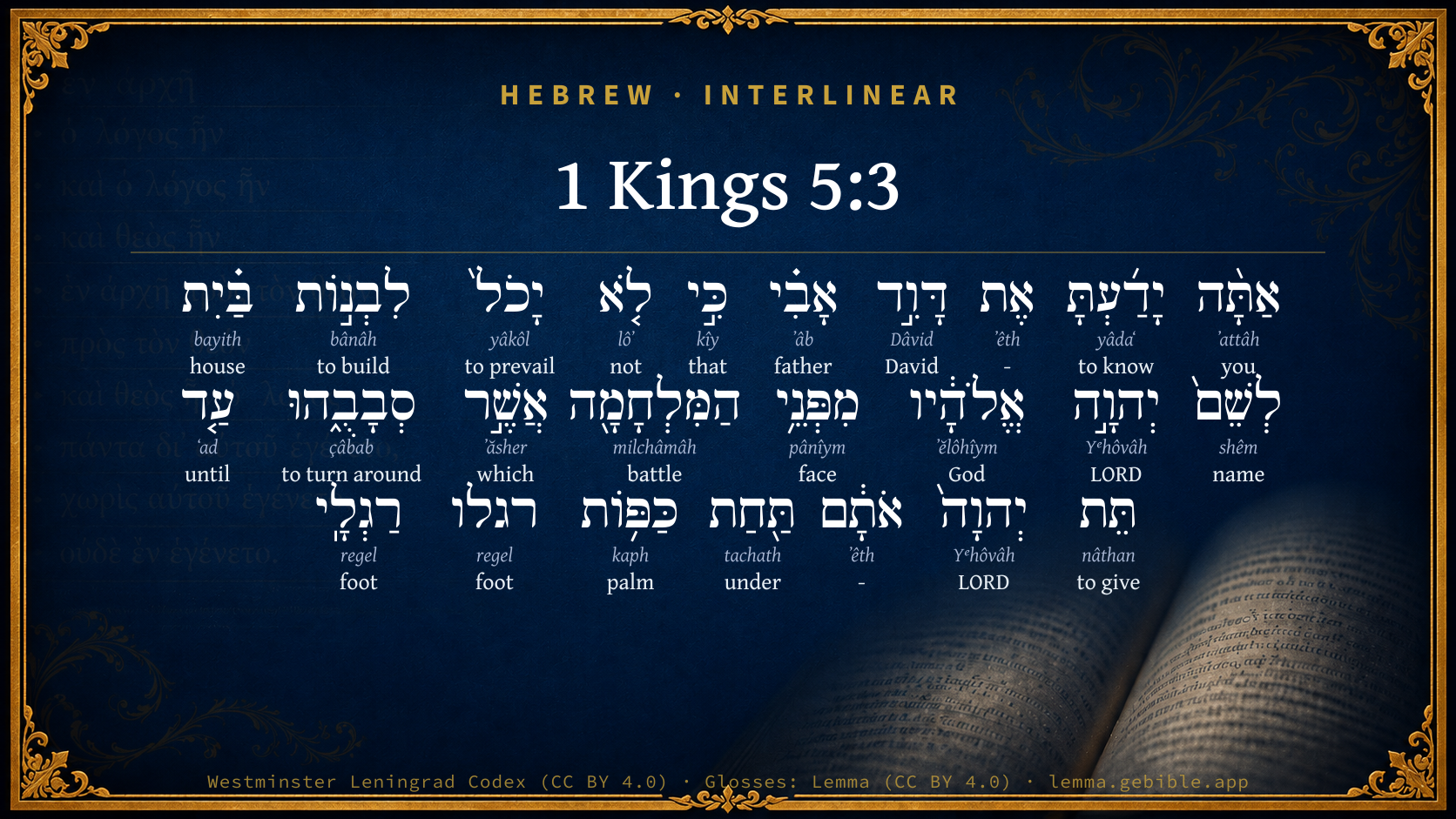
Hebrew (Westminster Leningrad Codex) 1 Kings 5:3 appears in the Hebrew Old Testament. The text above is from the Westminster Leningrad Codex. Each word links to its Strong’s number, a concise gloss, and parsing drawn from the Open Scriptures Hebrew Bible morphology. Click any word for its full Brown-Driver-Briggs (BDB) entry.
Download image
Cite this verse

1 Kings 5:3 (World English Bible). Public Domain. Lemma interlinear Bible study tool, https://lemma.gebible.app/v/1-kings/5/3.

Show BibTeX & RIS
BibTeX
RIS
English Translation
You know how that David my father could not build a house for the name of Yahweh his God for the wars which were about him on every side, until Yahweh put them under the soles of his feet.
World English Bible · Public Domain
Download a study sheet

One document with this verse’s original text, its word-by-word gloss line, the meaning frame, cross-references with their text, attributed commentary, and full source and license credits — printable, and it pastes into notes with its structure intact.

This verse Autodidact and up

Study sheet (.html) Plain text (.txt)

A passage Seminary Student

Up to 50 verses in one chapter. A passage sheet keeps up to 6 commentary sources and 12 cross-references per verse, in the order this page ranks them, and says so on the sheet whenever that leaves anything out. Ask for a single verse and you get the Autodidact verse sheet above.

Everything on this page stays free to read, with no account — the sheet is a download of what is already on screen, not access to it.

Want to remove ads? Support Godless Engineer
Compare translations 3

The same verse in 3 English versions, stacked beneath the original-language interlinear above. Click any original word for its lexicon entry.

Each is an independent rendering of the whole verse — the interlinear is not word-aligned to these translations.

Highlighted words mark where these versions differ — a whole-verse word diff, not a word-by-word alignment.

  • World English Bible Public Domain
    You know how that David my father could not build a house for the name of Yahweh his God for the wars which were about him on every side, until Yahweh put them under the soles of his feet.
  • King James Version Public Domain
    Thou knowest how that David my father could not build an house unto the name of the LORD his God for the wars which were about him on every side, until the LORD put them under the soles of his feet.
  • unfoldingWord Literal Text CC BY-SA 4.0
    “You, you know David my father, that he was not able to build a house for the name of Yahweh his God from the face of the warfare which they surrounded him until Yahweh put them under the soles of his foot.

unfoldingWord Literal Text — © unfoldingWord, licensed CC BY-SA 4.0. Word-aligned USFM3 via Door43 (git.door43.org/unfoldingWord/en_ult).

Versions to compare (up to 4)

3 of 4 selected

Show all 18 translations

Every available English version of this verse, each an independent rendering of the whole verse.

  • World English Bible Public Domain
    You know how that David my father could not build a house for the name of Yahweh his God for the wars which were about him on every side, until Yahweh put them under the soles of his feet.
  • Berean Standard Bible Public Domain
    “As you are well aware, due to the wars waged on all sides against my father David, he could not build a house for the Name of the LORD his God until the LORD had put his enemies under his feet.
  • Majority Standard Bible Public Domain
    “As you are well aware, due to the wars waged on all sides against my father David, he could not build a house for the Name of the LORD his God until the LORD had put his enemies under his feet.
  • King James Version Public Domain
    Thou knowest how that David my father could not build an house unto the name of the LORD his God for the wars which were about him on every side, until the LORD put them under the soles of his feet.
  • American Standard Version (1901) Public Domain
    Thou knowest how that David my father could not build a house for the name of Jehovah his God for the wars which were about him on every side, until Jehovah put them under the soles of his feet.
  • Revised Version (1885) Public Domain
    Thou knowest how that David my father could not build an house for the name of the LORD his God for the wars which were about him on every side, until the LORD put them under the soles of his feet.
  • Geneva Bible (1599) Public Domain
    Thou knowest that Dauid my father could not build an house vnto the Name of the Lord his God, for the warres which were about him on euery side, vntill the Lord had put them vnder the soles of his feete.
  • Douay-Rheims (1899) Public Domain
    Thou knowest the will of David my father, and that he could not build a house to the name of the Lord his God, because of the wars that were round about him, until the Lord put them under the soles of his feet.
  • Young's Literal Translation Public Domain
    `Thou hast known David my father, that he hath not been able to build a house to the name of Jehovah his God, because of the wars that have been round about him, till Jehovah's putting them under the soles of his feet.
  • Literal Standard Version CC BY-SA 4.0
    “You have known my father David, that he has not been able to build a house for the Name of his God YHWH, because of the wars that have been all around him, until YHWH’s putting them under the soles of his feet.
  • Unlocked Literal Bible CC BY-SA 4.0
    “You know that David my father could not build a house for the name of Yahweh his God because of the wars that surrounded him, for during his lifetime Yahweh was putting his enemies under the soles of his feet.
  • unfoldingWord Literal Text CC BY-SA 4.0
    “You, you know David my father, that he was not able to build a house for the name of Yahweh his God from the face of the warfare which they surrounded him until Yahweh put them under the soles of his foot.
  • Darby Bible Public Domain
    Thou knowest that David my father could not build a house unto the name of Jehovah his God, because of the wars which were about him on every side, until Jehovah put them under the soles of his feet.
  • World Messianic Bible Public Domain
    “You know that David my father could not build a house for the name of the LORD his God because of the wars which were around him on every side, until the LORD put his enemies under the soles of his feet.
  • Webster's Bible Public Domain
    Thou knowest how that David my father could not build a house to the name of the LORD his God, for the wars which were about him on every side, until the LORD put them under the soles of his feet.
  • Free Bible Version CC BY-SA 4.0
    “As you know, my father David was not able to build a Temple to honor the Lord his God because of the wars fought against him from every direction, until the Lord had conquered his enemies.
  • Bible in Basic English Public Domain
    You have knowledge that David my father was not able to make a house for the name of the Lord his God, because of the wars which were round him on every side, till the Lord put all those who were against him under his feet.
  • JPS Tanakh (1917) Public Domain
    (5-17) 'Thou knowest how that David my father could not build a house for the name of the LORD his God for the wars which were about him on every side, until the LORD put them under the soles of my feet.

Literal Standard Version (2020), Covenant Press — licensed CC BY-SA 4.0. Text via the HelloAO Bible API (eBible.org). Unlocked Literal Bible (unfoldingWord) — licensed CC BY-SA 4.0. Text via the HelloAO Bible API (eBible.org). unfoldingWord Literal Text — © unfoldingWord, licensed CC BY-SA 4.0. Word-aligned USFM3 via Door43 (git.door43.org/unfoldingWord/en_ult). Free Bible Version, Dr. Jonathan Gallagher — licensed CC BY-SA 4.0. Text via the HelloAO Bible API (eBible.org).

Word by word

More ways to search: Search by grammar → Find every occurrence → Compare this word →

Practice this passage: Drill this verse → Learn its vocabulary →

סְבָבֻ֑הוּ
çâbab
H5437
“to turn around · him”
Verb, Qal, Perfect, 3rd Person, Common, Plural + Suffix, Personal, 3rd Person, Masculine, Singular
Part of Speech
Verb
Stem
Qal
Form
Perfect
Person
3rd Person
Gender
Common
Number
Plural
Full BDB Definition

Origin: a primitive root

TWOT: 1456

to turn, turn about or around or aside or back or towards, go about or around, surround, encircle, change direction - (Qal) - to turn, turn about, be brought round, change - to march or walk around, go partly around, circle about, skirt, make a round, make a circuit, go about to, surround, encompass - (Niphal) - to turn oneself, close round, turn round - to be turned over to - (Piel) to turn about, change, transform - (Poel) - to encompass, surround - to come about, assemble round - to march, go about - to enclose, envelop - (Hiphil) - to turn, cause to turn, turn back, reverse, bring over, turn into, bring round - to cause to go around, surround, encompass - (Hophal) - to be turned - to be surrounded
  1. אַתָּ֨ה ʼattâh H859 “you” Pronoun, Personal, 2nd Person, Masculine, Singular
  2. יָדַ֜עְתָּ yâdaʻ H3045 “to know” Verb, Qal, Perfect, 2nd Person, Masculine, Singular
  3. אֶת ʼêth H853 “-” Particle, Direct Object
  4. דָּוִ֣ד Dâvid H1732 “David” Noun, Proper
  5. אָבִ֗י ʼâb H1 “father · my” Noun, Common, Masculine, Singular, Construct + Suffix, Personal, 1st Person, Common, Singular
  6. כִּ֣י kîy H3588 “that” Conjunction
  7. לֹ֤א lôʼ H3808 “not” Particle, Negative
  8. יָכֹל֙ yâkôl H3201 “to prevail” Verb, Qal, Perfect, 3rd Person, Masculine, Singular
  9. לִבְנ֣וֹת bânâh H1129 “to build” Preposition + Verb, Qal, Infinitive Construct
  10. בַּ֗יִת bayith H1004 “house” Noun, Common, Masculine, Singular, Absolute
  11. לְשֵׁם֙ shêm H8034 “to/for · name of” Preposition + Noun, Common, Masculine, Singular, Construct
  12. יְהוָ֣ה Yᵉhôvâh H3068 “LORD” Noun, Proper
  13. אֱלֹהָ֔יו ʼĕlôhîym H430 “God(s) · his” Noun, Common, Masculine, Plural, Construct + Suffix, Personal, 3rd Person, Masculine, Singular
  14. מִפְּנֵ֥י pânîym H6440 “from · face(s) of” Preposition + Noun, Common, Both, Plural, Construct
  15. הַמִּלְחָמָ֖ה milchâmâh H4421 “the · battle” Particle, Definite Article + Noun, Common, Feminine, Singular, Absolute
  16. אֲשֶׁ֣ר ʼăsher H834 “which” Particle, Relative
  17. עַ֤ד ʻad H5704 “until” Preposition
  18. תֵּת nâthan H5414 “to give” Verb, Qal, Infinitive Construct
  19. יְהוָה֙ Yᵉhôvâh H3068 “LORD” Noun, Proper
  20. אֹתָ֔ם ʼêth H853 “- · them” Particle, Direct Object + Suffix, Personal, 3rd Person, Masculine, Plural
  21. תַּ֖חַת tachath H8478 “under” Preposition
  22. כַּפּ֥וֹת kaph H3709 “palms of” Noun, Common, Feminine, Plural, Construct
  23. רגלו regel H7272 “foot · his” Noun, Common, Feminine, Singular, Construct + Suffix, Personal, 3rd Person, Masculine, Singular
  24. רַגְלָֽי regel H7272 “feet · my” Noun, Common, Feminine, Dual, Construct + Suffix, Personal, 1st Person, Common, Singular

About this verse

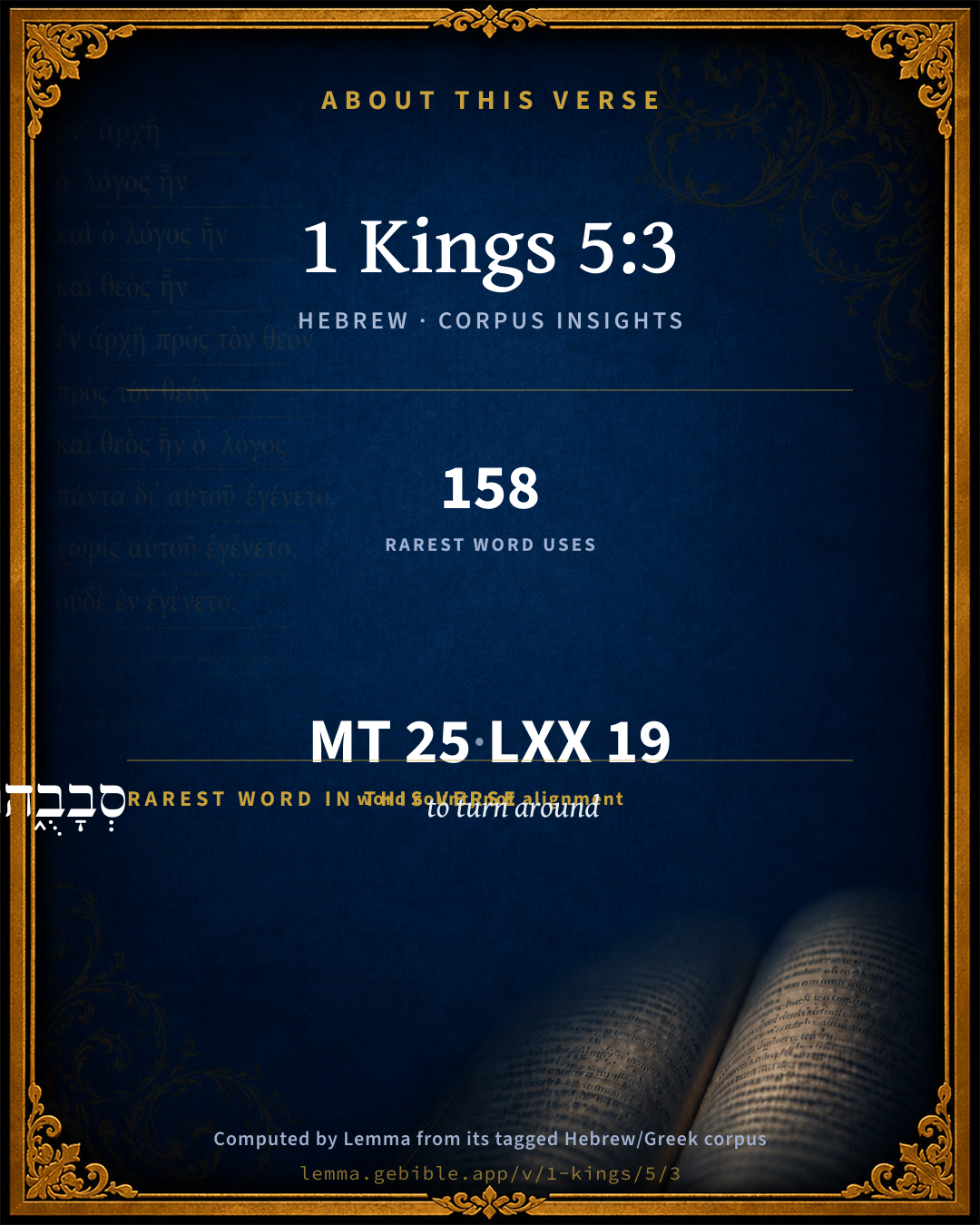
These counts appear in no published source. They are computed here, from the morphology-tagged text and Lemma’s own curated glosses. What Lemma adds →

25
words
22
distinct lemmas
Historical
section

Grammatical profile

  • 5 verbs
  • 12 nouns
  • 1 pronoun
  • 2 prepositions
  • 1 conjunction
  • 4 particles

Verb forms

  • יָדַ֜עְתָּ Qal · Perfect
  • יָכֹל֙ Qal · Perfect
  • לִבְנ֣וֹת Qal · Infinitive Construct
  • סְבָבֻ֑הוּ Qal · Perfect
  • תֵּת Qal · Infinitive Construct

Repetition

Words recur within this verse — often emphatic in Hebrew:

  • יְהוָ֣ה LORD H3068 ×2
  • רגלו foot H7272 ×2

Hebrew & Septuagint length

In English translation the verse runs 39 words from the Hebrew and 39 from the Septuagint (LXX English) — the same length.

A rough comparison of the two English renderings, which tokenize alike — not a word-level alignment.

Word counts can differ between the Hebrew and the Greek without any difference in meaning — e.g. the Hebrew direct-object marker אֵת has no separate Greek word, and Greek often adds the article ὁ.

In the original languages it is 25 Hebrew tokens and 19 Greek tokens — but the two are counted differently (Hebrew bundles its prefixes and suffixes into one token; the Greek is in lemma form), so that isn’t a like-for-like length.

Cross-references

11

Topical passages linked to 1 Kings 5:3 in the Treasury of Scripture Knowledge — connected by theme and wording, ordered by reader-vote popularity; previews shown in the World English Bible.

  • 1 Chronicles 28:3 But God said to me, You shall not build a house for my name, because you are a man of war, and have shed blood.
  • 1 Chronicles 22:8 But the word of Yahweh came to me, saying, You have shed blood abundantly, and have made great wars: you shall not build a house to my name, because you have shed much blood on the earth in my sight.
  • Psalms 110:1 Yahweh says to my Lord, "Sit at my right hand, Until I make your enemies your footstool for your feet."
  • 1 Chronicles 22:4–6 and cedar trees without number: for the Sidonians and they of Tyre brought cedar trees in abundance to David.
  • Psalms 8:6 You make him ruler over the works of your hands. You have put all things under his feet:
  • 1 Corinthians 15:25 For he must reign until he has put all his enemies under his feet.
  • Joshua 10:24 It happened, when they brought forth those kings to Joshua, that Joshua called for all the men of Israel, and said to the chiefs of the men of war who went with him, Come near, put your feet on the necks of these kings. They came near, and put their feet on the necks of them.
  • 2 Samuel 7:5–11 Go and tell my servant David, Thus says Yahweh, Shall you build me a house for me to dwell in?
  • 2 Chronicles 6:6–8 but I have chosen Jerusalem, that my name might be there; and have chosen David to be over my people Israel.
  • Malachi 4:3 You shall tread down the wicked; for they will be ashes under the soles of your feet in the day that I make," says Yahweh of Hosts.
  • Ephesians 1:22 He put all things in subjection under his feet, and gave him to be head over all things for the assembly,

Cross-references courtesy of OpenBible.info (CC BY 4.0).

Hebrew and Greek witnesses Masoretic Hebrew ↔ Greek Septuagint

The same verse in the two great witnesses to the Old Testament, shown verse-for-verse.

These are two independent witnesses, not word-aligned to each other, and the Septuagint is shown in lemma (dictionary) form.

Hebrew 1 Kings 5:3 Masoretic · Westminster Leningrad Codex

אַתָּ֨ה יָדַ֜עְתָּ אֶת דָּוִ֣ד אָבִ֗י כִּ֣י לֹ֤א יָכֹל֙ לִבְנ֣וֹת בַּ֗יִת לְשֵׁם֙ יְהוָ֣ה אֱלֹהָ֔יו מִפְּנֵ֥י הַמִּלְחָמָ֖ה אֲשֶׁ֣ר סְבָבֻ֑הוּ עַ֤ד תֵּת יְהוָה֙ אֹתָ֔ם תַּ֖חַת כַּפּ֥וֹת רגלו רַגְלָֽי

You know how that David my father could not build a house for the name of Yahweh his God for the wars which were about him on every side, until Yahweh put them under the soles of his feet.

World English Bible · Public Domain

Greek LXX 1 Kings 5:3 Septuagint · lemma form

καί δέκα μόσχος ἐκλεκτός καί εἴκοσι βοῦς νομάς καί ἑκατόν πρόβατον ἐκτός ἔλαφος καί δορκάς καί ὄρνις ἐκλεκτός σιτευτός

You knew my father David, that he could not build a house to the name of the Lord my God because of the wars that compassed him about, until the Lord put them under the soles of his feet.

LXX2012 (modern English Septuagint) · Public Domain

Hebrew: Westminster Leningrad Codex (CC BY 4.0). Greek: Septuagint (public domain); English from LXX2012 (modern English Septuagint) (Public Domain). How the Septuagint differs from the Hebrew →

Targum (Aramaic paraphrase)

1

The Targum is the ancient Jewish Aramaic paraphrase of the Hebrew Scriptures — an interpretive translation, not the Hebrew text itself. Onkelos (literal) and Pseudo-Jonathan (expansive) render the Torah, and Jonathan the Prophets. Coverage is partial: where no permissively-licensed English translation exists for a verse, only the Aramaic is shown. This is verse-level text, not a word-by-word alignment to the Hebrew.

  1. Targum Jonathan Prophets (Joshua–Malachi)
    עַסְרָא תוֹרִין דְפִטְמָא וְעַסְרִין תּוֹרִין דְרַעֲיָא וּמְאָה עָנָא בַּר מֵאַיָלִין וְטַבְיָן וְיַחְמוֹרִין וְעוֹפַיָא פַּטִימַיָא:

    (no public-domain English translation for this verse)

    Targum Jonathan — Aramaic: “Mikraot Gedolot” (public domain). English: “Sefaria Community Translation” (CC0 1.0 (public-domain dedication)); “London "Chaldee Paraphrase," 1871” (public domain). Text via Sefaria.

Commentary

Notes on 1 Kings 5:3 from classic Christian and Jewish commentators (each source and its license shown beneath its notes). The classic Christian expositions comment on the surrounding passage and are grouped to its opening verse, so a note may address several verses; the Jewish commentaries on the Tanakh (Rashi and others) are per-verse, so they appear only where the commentator wrote on this verse.

Lemma curates 59 commentaries, every one of them public domain or Creative Commons licensed, each selected and text-cleaned for this edition rather than reprinted as found. About our sources →

Trapp's Complete Commentary

John Trapp

1Ki 5:3 Thou knowest how that David my father could not build an house unto the name of the LORD his God for the wars which were about him on every side, until the LORD put them under the soles of his feet.

Ver. 3. For the wars that were about him.] He saith not for his shedding of blood, which elsewhere is made the reason why David might not build a house, {1Ch 28:3} but only for his continual wars, by reason whereof he had not time to do it. The best things are to be spoken of parents: to speak evil to them, {a} or of them, was death by God’s law; {Mat 15:5} yea, by Solon’s laws, though a heathen.

{a} κακολογων.

John Trapp, A Commentary or Exposition upon All the Books of the Old and New Testament (1647–1656) — public domain. Text from a community e-Sword module.

Joseph Benson's Commentary

1Ki 5:3-5. A house unto the name of the Lord — For his worship and service. For the wars which were about him on every side — Which diverted his cares and thoughts to other things, and occasioned God’s denying him the honour of that work. Until the Lord put them under the soles of his feet — That is, made them subject to him, that he could trample upon them at his pleasure. Compare Psa 8:6; 1Co 15:27. I purpose to build a house unto the name of the Lord — That shall be called by his name, namely, the house of Jehovah; and be appropriated to his honour and glory.

Joseph Benson's Commentary on the Old and New Testaments (1811–1818) — public domain. Text from a community e-Sword module.

Tyndale Open Study Notes

Tyndale Open Resources

5:3 gave him victory over all his enemies (literally put them under the soles of his feet): Ancient Near Eastern inscriptions and paintings often depict victorious kings with their feet upon the necks of vanquished foes or with enemies subdued at their feet.

Tyndale Open Study Notes — © Tyndale Open Resources, licensed CC BY-SA 4.0. Text via the HelloAO Bible API.

Geneva Bible (1599)

Geneva Bible translators

Or, his enemies.

Geneva Bible (1599) marginal notes — public domain. Text via Bolls.life.

Ellicott's Commentary for English Readers

(3) Thou knowest.—In the description (1Ch_22:4) of David’s collection of materials for the Temple, it is noted that “the Zidonians and they of Tyre brought much cedar wood to David.” Hence Hiram knew well his desire of building the Temple, and the care with which, when disappointed of it, he prepared for the happier experience of his successor.

A Bible Commentary for English Readers, edited by Charles John Ellicott (1878–1897) — public domain. Text from a community e-Sword module.

The Cambridge Bible for Schools and Colleges

gen. ed. J. J. S. Perowne

3. Thou knowest] David’s preparations must have been well known throughout the Phœnician kingdom, and so to Hiram even though he was not himself king. Cf. 1Ch_22:4 where we are told that the Zidonians and they of Tyre brought much cedar wood to David. The reason why David himself did not begin to build the temple may also have been known to the northern king.

could not build a house] He was forbidden to do this by the word of the Lord (cf. 1Ch_22:8; 1Ch_28:3) because he had shed blood abundantly and made great wars.

unto the name of the Lord] See above on 1Ki_3:2.

for the wars which were about him] The concord in this clause is not strictly grammatical, the noun rendered ‘wars’ being singular while the verb which follows is plural. It has therefore been proposed to render ‘because of the war wherewith they (i.e. his enemies) surrounded him.’ It seems better however to consider the singular noun as equivalent to a plural = enemies. And thus the rendering of the A. V. gives the correct sense. Another solution proposed has been to consider the words ‘men of’ as fallen out before ‘war,’ thus making the sense ‘because of the men of war who encompassed him.’ But such emendation of the text has no support in the versions.

put them under the soles of his feet] A phrase not uncommon to denote entire conquest. Cf. Psa_8:6; 1Co_15:27; Eph_1:22.

The Cambridge Bible for Schools and Colleges (gen. ed. J. J. S. Perowne; Cambridge University Press, 1878–1918) — public domain. Text from a community e-Sword module.

John Gill's Exposition

Thou knowest how that David my father could not build an house unto the name of the Lord his God,.... As he designed, and was desirous of; and which Hiram might know not only by common fame, but from David himself, between whom there was an intercourse, and that in relation to cedars for building, which David had of Hiram, Ch2 2:3;

for the wars which were about him on every side; or warriors, as the Targum, the Philistines, Moabites, Edomites, and Syrians:

until the Lord put them under the soles of his feet; made them subject and tributary to him, as he did at length, see Sa2 7:1, &c. so the "Cetib", or textual reading, is; but the "Keri", or marginal reading, is, "under the soles of my feet"; that is, Solomon's, which agrees with what follows; it was true of both.

John Gill's Exposition of the Whole Bible (1746–1763) — public domain (CC PDM 1.0). Text via the HelloAO Bible API.

Albert Barnes' Notes on the Bible

Solomon’s presumption that Hiram knew David’s design has not appeared in the previous history, but it is in accordance with 1Ch 22:4.

Albert Barnes' Notes on the Bible (1834–1885) — public domain. Text from a community e-Sword/MySword module.

Haydock's Catholic Bible Commentary

Wars. Many interpreters assert that this was the real impediment, (Tostat; Salien, &c.) rather than the blood, which David had already spilt, 2 Kings vii., and 1 Paralipomenon xxii. 8.

George Leo Haydock (1774–1849), Haydock's Catholic Family Bible and Commentary, 1859 edition — public domain. Excludes Psalms (Douay-Rheims chapter numbering differs from Protestant) and Deuterocanonical books (Catholic canon only).

Matthew Poole's English Annotations

Thou knowest, by common fame, and by particular information.

Could not build an house unto the name of the Lord his God, i.e. either, first, For the worship and service of God, 1Ki 3:2. Or, secondly, For the Lord himself, as that phrase is used, Deu 28:58; Psa 20:1; 52:9.

Which were about him on every side; which diverted his cares and thoughts to other things, and withal occasioned God’s denial of the honour of that work to him.

Put them under the soles of his feet, i.e. made them subject to him, that he might trample upon them at his pleasure. Compare Psa 8:6; 1Co 15:27.

Matthew Poole's English Annotations on the Holy Bible (1683–1685) — public domain. Text from a community e-Sword/MySword module.

Whedon's Commentary on the Bible

Daniel D. Whedon

3. My father could not build — There was a moral incapacity in David on account of his many wars, or, as expressed in 1Ch_22:8, because he had shed so much blood in the sight of the Lord. He that builds the Lord’s house must not be a noted shedder of blood. Solomon assumes that Hiram knew this.

Daniel D. Whedon (gen. ed.), Commentary on the Old and New Testaments (1874–1909) — public domain. Text from a community e-Sword module.

The Pulpit Commentary

Thou knowest how that David my father could not build an house Hiram could not fail to know this, as his relations with David had been close and intimate. Not only had he "sent cedar trees and carpenters and masons" to build David"s house, (2Sa_5:11) but "they of Tyro brought much cedar wood to David" (1Ch_22:4) for the house of the Lord unto the name of the Lord i.e. , to be dedicated to the Lord as His shrine and habitation (cf. Deu_12:5, Deu_12:11; and ch. 8:18, 19, 20, etc.) for the wars Heb., war. As we have singular noun and plural verb, Ewald, Rawlinson, al. assume that war stands for adversaries, as the next clause seems to imply. Bahr and Keil, however, with greater reason, interpret, "for the war with which they surrounded him;" a construction (bbs with double accusative) which is justified by Psa_109:3 until the Lord put them under the soles of his feet until, i.e., He trampled them down. The same image is found in some of David"s psalms, (e.g., Psa_7:5 Psa_60:12; cf. Psa_8:6 Psa_91:13; Isa_63:3; Romans Eph_1:22; Heb_2:8)

The Pulpit Commentary (1880–1919), ed. H.D.M. Spence-Jones & Joseph S. Exell — public domain. Text from a community e-Sword module.

Rashi

Rabbi Shlomo Yitzchaki (Rashi)

Fat. Fattened in the stall.

Pastured. [I.e.,] on the grass.

And fattened fowl. Among our Rabbis there are those who say [it refers to] roosters which were fattened.

Rashi on the Tanakh — English translations: “The Judaica Press complete Tanach with Rashi, translated by A. J. Rosenberg” (CC BY 4.0); “Pentateuch with Rashi's commentary by M. Rosenbaum and A.M. Silbermann, 1929-1934” (public domain); “The Metsudah Tanach series, Lakewood, N.J” (CC BY 4.0); and “The Book of Joshua, Metsudah Publications, 1997” (CC BY 4.0). Text via Sefaria.

Lesson kit

Teaching starters — assembled from the data on this page, not authored interpretation. Every prompt links to the verse data it draws on. Edit before teaching.

1 Kings, in the Historical, opens this verse with 25 words (22 distinct Hebrew lemmas). Its most distinctive word is çâbab (“to turn around”). A historical commentator’s framing appears above. Read the whole chapter for the surrounding context.

Discussion questions

  1. What does “to turn around” (çâbab) contribute to the verse as a whole?
  2. How does 1 Chronicles 28:3, which shares this passage’s theme, read alongside this verse?
  3. What does the repetition of “LORD” (2× in this one verse) do in this verse?
  4. These translations render this verse differently; the difference is in the English rendering, not the original. What questions does that raise?
  5. «יָדַ֜עְתָּ» is a Qal Perfect verb. How does that grammatical form shape the action described?
  6. Compare how Trapp's Complete Commentary and Joseph Benson's Commentary read this verse. Where do they agree or differ?

Things to notice

Reading settings

Reading text

Shown beneath each verse's original-language words.

Old Testament
Old Testament edition

Read the OT as the Masoretic Hebrew (MT) or the Greek Septuagint (LXX).

English shown for the Greek Septuagint (in the Hebrew ↔ Greek comparison).

Comparing translations? Open the Compare panel on any verse page to stack up to four side by side.