Numbers 14:16

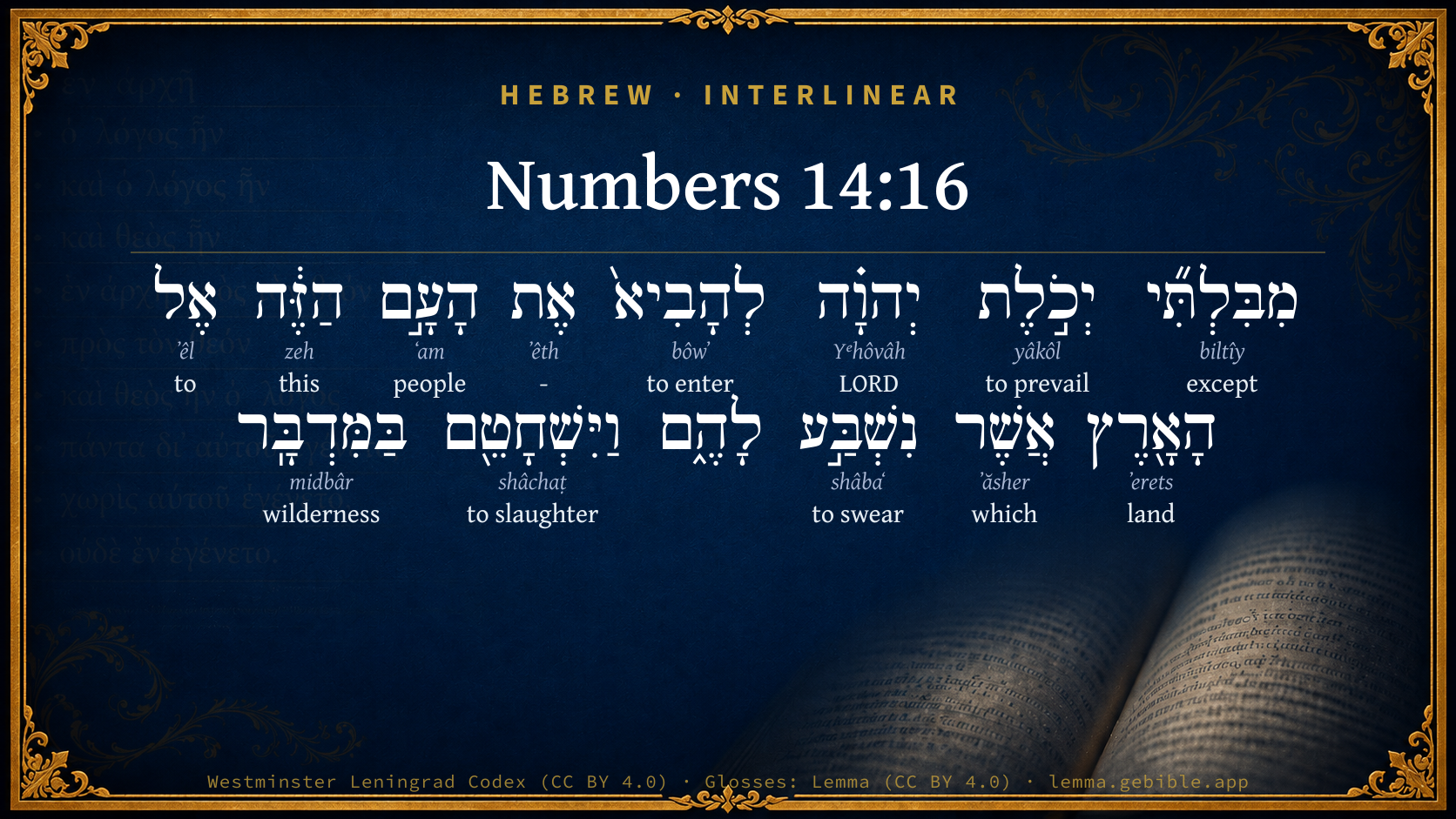
Hebrew (Westminster Leningrad Codex) Numbers 14:16 appears in the Hebrew Old Testament. The text above is from the Westminster Leningrad Codex. Each word links to its Strong’s number, a concise gloss, and parsing drawn from the Open Scriptures Hebrew Bible morphology. Click any word for its full Brown-Driver-Briggs (BDB) entry.
Download image
Cite this verse

Numbers 14:16 (World English Bible). Public Domain. Lemma interlinear Bible study tool, https://lemma.gebible.app/v/numbers/14/16.

Show BibTeX & RIS
BibTeX
RIS
English Translation
Because Yahweh was not able to bring this people into the land which he swore to them, therefore he has slain them in the wilderness.
World English Bible · Public Domain
Download a study sheet

One document with this verse’s original text, its word-by-word gloss line, the meaning frame, cross-references with their text, attributed commentary, and full source and license credits — printable, and it pastes into notes with its structure intact.

This verse Autodidact and up

Study sheet (.html) Plain text (.txt)

A passage Seminary Student

Up to 50 verses in one chapter. A passage sheet keeps up to 6 commentary sources and 12 cross-references per verse, in the order this page ranks them, and says so on the sheet whenever that leaves anything out. Ask for a single verse and you get the Autodidact verse sheet above.

Everything on this page stays free to read, with no account — the sheet is a download of what is already on screen, not access to it.

Want to remove ads? Support Godless Engineer
Compare translations 3

The same verse in 3 English versions, stacked beneath the original-language interlinear above. Click any original word for its lexicon entry.

Each is an independent rendering of the whole verse — the interlinear is not word-aligned to these translations.

Highlighted words mark where these versions differ — a whole-verse word diff, not a word-by-word alignment.

  • World English Bible Public Domain
    Because Yahweh was not able to bring this people into the land which he swore to them, therefore he has slain them in the wilderness.
  • King James Version Public Domain
    Because the LORD was not able to bring this people into the land which he sware unto them, therefore he hath slain them in the wilderness.
  • unfoldingWord Literal Text CC BY-SA 4.0
    ‘From Yahweh not being able to bring this people to the land that he swore to them, so he slaughtered them in the wilderness.’

unfoldingWord Literal Text — © unfoldingWord, licensed CC BY-SA 4.0. Word-aligned USFM3 via Door43 (git.door43.org/unfoldingWord/en_ult).

Versions to compare (up to 4)

3 of 4 selected

Show all 18 translations

Every available English version of this verse, each an independent rendering of the whole verse.

  • World English Bible Public Domain
    Because Yahweh was not able to bring this people into the land which he swore to them, therefore he has slain them in the wilderness.
  • Berean Standard Bible Public Domain
    ‘Because the LORD was unable to bring this people into the land He swore to give them, He has slaughtered them in the wilderness.’
  • Majority Standard Bible Public Domain
    ‘Because the LORD was unable to bring this people into the land He swore to give them, He has slaughtered them in the wilderness.’
  • King James Version Public Domain
    Because the LORD was not able to bring this people into the land which he sware unto them, therefore he hath slain them in the wilderness.
  • American Standard Version (1901) Public Domain
    Because Jehovah was not able to bring this people into the land which he sware unto them, therefore he hath slain them in the wilderness.
  • Revised Version (1885) Public Domain
    Because the LORD was not able to bring this people into the land which he sware unto them, therefore he hath slain them in the wilderness.
  • Geneva Bible (1599) Public Domain
    Because the Lord was not able to bring this people into the lande, which he sware vnto them, therefore hath he slaine them in the wildernesse.
  • Douay-Rheims (1899) Public Domain
    He could not bring the people into the land for which he had sworn, therefore did he kill them in the wilderness.
  • Young's Literal Translation Public Domain
    From Jehovah's want of ability to bring in this people unto the land which He hath sworn to them -- He doth slaughter them in the wilderness.
  • Literal Standard Version CC BY-SA 4.0
    From YHWH’s want of ability to bring in this people to the land which He has sworn to them, He slaughters them in the wilderness.
  • Unlocked Literal Bible CC BY-SA 4.0
    'Because Yahweh could not take this people into the land that he swore to give them, he has killed them in the wilderness.'
  • unfoldingWord Literal Text CC BY-SA 4.0
    ‘From Yahweh not being able to bring this people to the land that he swore to them, so he slaughtered them in the wilderness.’
  • Darby Bible Public Domain
    Because Jehovah was not able to bring this people into the land that he had sworn unto them, he has therefore slain them in the wilderness.
  • World Messianic Bible Public Domain
    ‘Because the LORD was not able to bring this people into the land which he swore to them, therefore he has slain them in the wilderness.’
  • Webster's Bible Public Domain
    Because the LORD was not able to bring this people into the land which he swore to them, therefore he hath slain them in the wilderness.
  • Free Bible Version CC BY-SA 4.0
    ‘The Lord killed these people in the desert because he wasn't able to take them to the country he promised to give them. He's killed them all in desert!’
  • Bible in Basic English Public Domain
    Because the Lord was not able to take this people into the land which he made an oath to give them, he sent destruction on them in the waste land.
  • JPS Tanakh (1917) Public Domain
    Because the LORD was not able to bring this people into the land which He swore unto them, therefore He hath slain them in the wilderness.

Literal Standard Version (2020), Covenant Press — licensed CC BY-SA 4.0. Text via the HelloAO Bible API (eBible.org). Unlocked Literal Bible (unfoldingWord) — licensed CC BY-SA 4.0. Text via the HelloAO Bible API (eBible.org). unfoldingWord Literal Text — © unfoldingWord, licensed CC BY-SA 4.0. Word-aligned USFM3 via Door43 (git.door43.org/unfoldingWord/en_ult). Free Bible Version, Dr. Jonathan Gallagher — licensed CC BY-SA 4.0. Text via the HelloAO Bible API (eBible.org).

Word by word

More ways to search: Search by grammar → Find every occurrence → Compare this word →

Practice this passage: Drill this verse → Learn its vocabulary →

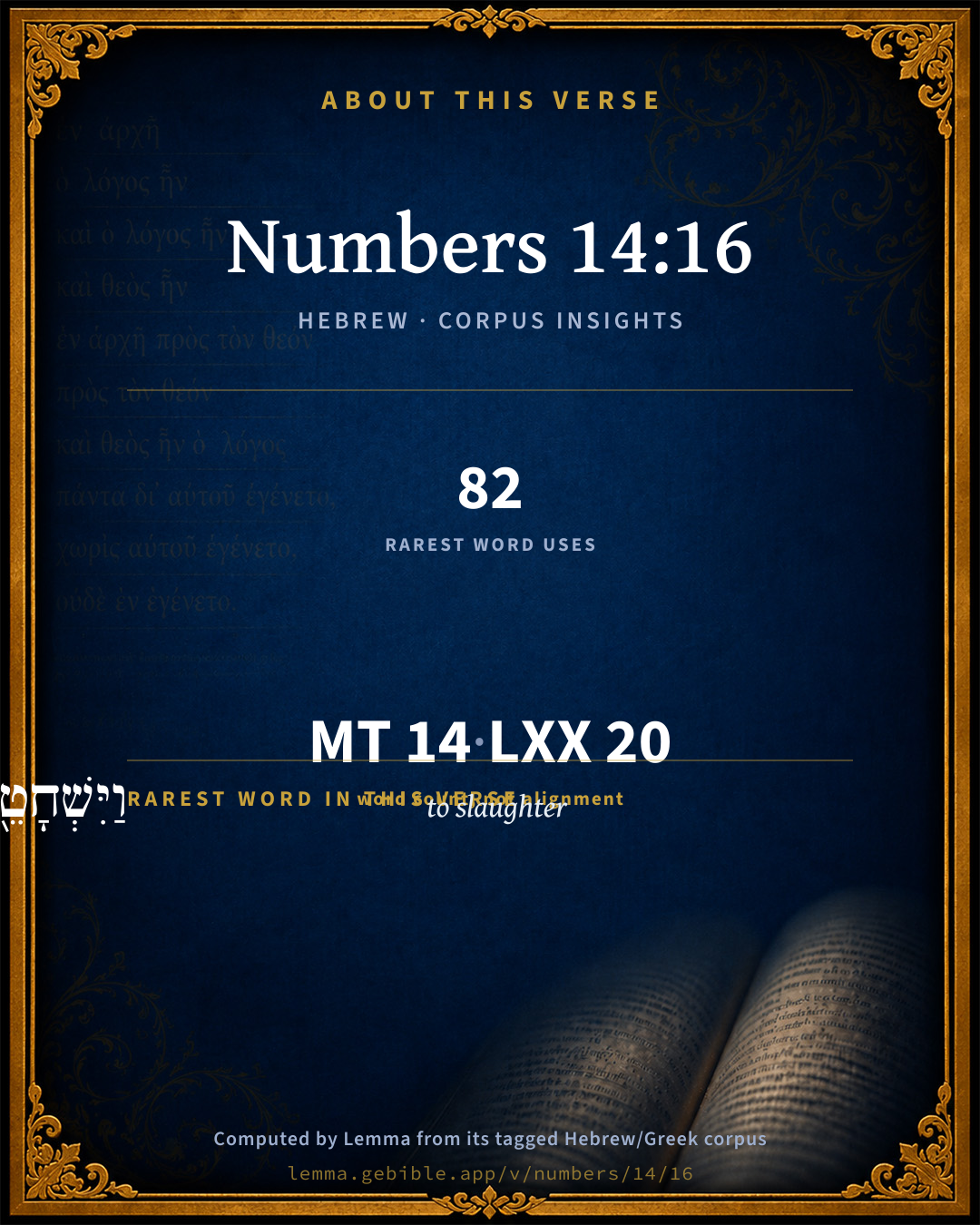
וַיִּשְׁחָטֵ֖ם
shâchaṭ
H7819
“and · to slaughter · them”
Conjunction + Verb, Qal, Sequential Imperfect, 3rd Person, Masculine, Singular + Suffix, Personal, 3rd Person, Masculine, Plural
Part of Speech
Conjunction + Verb
Stem
Qal
Form
Sequential Imperfect
Person
3rd Person
Gender
Masculine
Number
Singular
Full BDB Definition

Origin: a primitive root

TWOT: 2362

to kill, slaughter, beat (verb) - (Qal) - to slaughter - beast for food - sacrifice - person in human sacrifice - beaten, hammered (of shekels) - (Niphal) to be slaughtered, be slain (of food or sacrifice) - (BDB) slaughtering (noun feminine) - word doubtful
  1. מִבִּלְתִּ֞י biltîy H1115 “from · except” Preposition + Particle, Negative
  2. יְכֹ֣לֶת yâkôl H3201 “to prevail” Verb, Qal, Infinitive Construct
  3. יְהוָ֗ה Yᵉhôvâh H3068 “LORD” Noun, Proper
  4. לְהָבִיא֙ bôwʼ H935 “to enter” Preposition + Verb, Hiphil, Infinitive Construct
  5. אֶת ʼêth H853 “-” Particle, Direct Object
  6. הָעָ֣ם ʻam H5971 “the · people” Particle, Definite Article + Noun, Common, Masculine, Singular, Absolute
  7. הַזֶּ֔ה zeh H2088 “the · this” Particle, Definite Article + Pronoun, Demonstrative, Masculine, Singular
  8. אֶל ʼêl H413 “to” Preposition
  9. הָאָ֖רֶץ ʼerets H776 “the · land” Particle, Definite Article + Noun, Common, Both, Singular, Absolute
  10. אֲשֶׁר ʼăsher H834 “which” Particle, Relative
  11. נִשְׁבַּ֣ע shâbaʻ H7650 “to swear” Verb, Niphal, Perfect, 3rd Person, Masculine, Singular
  12. בַּמִּדְבָּֽר midbâr H4057 “in/at the · wilderness” Preposition, Determined + Noun, Common, Masculine, Singular, Absolute

About this verse

These counts appear in no published source. They are computed here, from the morphology-tagged text and Lemma’s own curated glosses. What Lemma adds →

14
words
13
distinct lemmas
Pentateuch
section

Grammatical profile

  • 4 verbs
  • 4 nouns
  • 1 pronoun
  • 2 prepositions
  • 3 particles

Verb forms

  • יְכֹ֣לֶת Qal · Infinitive Construct
  • לְהָבִיא֙ Hiphil · Infinitive Construct
  • נִשְׁבַּ֣ע Niphal · Perfect
  • וַיִּשְׁחָטֵ֖ם Qal · Sequential Imperfect

Hebrew & Septuagint length

In English translation the verse runs 25 words from the Hebrew and 23 from the Septuagint (LXX English) — closely comparable.

A rough comparison of the two English renderings, which tokenize alike — not a word-level alignment.

Word counts can differ between the Hebrew and the Greek without any difference in meaning — e.g. the Hebrew direct-object marker אֵת has no separate Greek word, and Greek often adds the article ὁ.

In the original languages it is 14 Hebrew tokens and 20 Greek tokens — but the two are counted differently (Hebrew bundles its prefixes and suffixes into one token; the Greek is in lemma form), so that isn’t a like-for-like length.

Cross-references

4

Topical passages linked to Numbers 14:16 in the Treasury of Scripture Knowledge — connected by theme and wording, ordered by reader-vote popularity; previews shown in the World English Bible.

  • Deuteronomy 9:28 lest the land whence you brought us out say, Because Yahweh was not able to bring them into the land which he promised to them, and because he hated them, he has brought them out to kill them in the wilderness.
  • Joshua 7:7 Joshua said, Alas, Lord Yahweh, why have you at all brought this people over the Jordan, to deliver us into the hand of the Amorites, to cause us to perish? would that we had been content and lived beyond the Jordan!
  • Joshua 7:9 For the Canaanites and all the inhabitants of the land will hear of it, and will compass us round, and cut off our name from the earth: and what will you do for your great name?
  • Deuteronomy 32:26–27 I said, I would scatter them afar, I would make the memory of them to cease from among men;

Cross-references courtesy of OpenBible.info (CC BY 4.0).

Hebrew and Greek witnesses Masoretic Hebrew ↔ Greek Septuagint

The same verse in the two great witnesses to the Old Testament, shown verse-for-verse.

These are two independent witnesses, not word-aligned to each other, and the Septuagint is shown in lemma (dictionary) form.

Hebrew Numbers 14:16 Masoretic · Westminster Leningrad Codex

מִבִּלְתִּ֞י יְכֹ֣לֶת יְהוָ֗ה לְהָבִיא֙ אֶת הָעָ֣ם הַזֶּ֔ה אֶל הָאָ֖רֶץ אֲשֶׁר נִשְׁבַּ֣ע לָהֶ֑ם וַיִּשְׁחָטֵ֖ם בַּמִּדְבָּֽר

Because Yahweh was not able to bring this people into the land which he swore to them, therefore he has slain them in the wilderness.

World English Bible · Public Domain

Greek LXX Numbers 14:16 Septuagint · lemma form

παρά ὁ μή δύναμαι κύριος εἰςἄγω ὁ λαός οὗτος εἰς ὁ γῆ ὅς ὄμνυμι αὐτός καταστρώννυμι αὐτός ἐν ὁ ἔρημος

Because the Lord could not bring this people into the land which he swore to them, he has overthrown them in the wilderness.

LXX2012 (modern English Septuagint) · Public Domain

Hebrew: Westminster Leningrad Codex (CC BY 4.0). Greek: Septuagint (public domain); English from LXX2012 (modern English Septuagint) (Public Domain). How the Septuagint differs from the Hebrew →

Targum (Aramaic paraphrase)

2

The Targum is the ancient Jewish Aramaic paraphrase of the Hebrew Scriptures — an interpretive translation, not the Hebrew text itself. Onkelos (literal) and Pseudo-Jonathan (expansive) render the Torah, and Jonathan the Prophets. Coverage is partial: where no permissively-licensed English translation exists for a verse, only the Aramaic is shown. This is verse-level text, not a word-by-word alignment to the Hebrew.

  1. Targum Onkelos Torah (Genesis–Deuteronomy)
    מִדְלֵית יוּכְלָא קֳדָם יְיָ לְאָעָלָא יָת עַמָא הָדֵין לְאַרְעָא דִי קַיֵם לְהוֹן וְקַטְלִנוּן בְּמַדְבְּרָא

    (no public-domain English translation for this verse)

    Targum Onkelos — Aramaic: “Onkelos Genesis” (public domain); “Onkelos Exodus” (public domain); “Onkelos Leviticus” (public domain); “Onkelos Numbers” (public domain); “Onkelos Deuteronomy” (public domain). English: “Sefaria Community Translation” (CC0 1.0 (public-domain dedication)); “J.W. Etheridge. The Targums of Onkelos and Jonathan Ben Uzziel on the Pentateuch. London: Longmans, Green, 1862” (public domain). Text via Sefaria.

  2. Targum Pseudo-Jonathan Torah (Genesis–Deuteronomy)
    מִן בִּגְלַל דְלָא הֲוָת יוּכְלָא מִן קֳדָם יְיָ לְאַעֲלָאָה יַת עַמָא הָדֵין לְאַרְעָא דְקַיֵים לְהוֹן וּקְטָלִינוּן בְּמַדְבְּרָא

    Because there was no (more) strength with the Lord to bring this people into the land which swearing He a promised to them, He hath killed them in the wilderness!

    Targum Pseudo-Jonathan — Aramaic: “Targum Jonathan on Genesis” (public domain); “Targum Jonathan on Exodus” (public domain); “Targum Jonathan on Leviticus” (public domain); “Targum Jonathan on Numbers” (public domain); “Targum Jonathan on Deuteronomy” (public domain). English: “The Targum of Jonathan ben Uzziel, trans. J. W. Etheridge, London, 1862” (public domain). Text via Sefaria.

Commentary

Notes on Numbers 14:16 from classic Christian and Jewish commentators (each source and its license shown beneath its notes). The classic Christian expositions comment on the surrounding passage and are grouped to its opening verse, so a note may address several verses; the Jewish commentaries on the Tanakh (Rashi and others) are per-verse, so they appear only where the commentator wrote on this verse.

Lemma curates 59 commentaries, every one of them public domain or Creative Commons licensed, each selected and text-cleaned for this edition rather than reprinted as found. About our sources →

Joseph Benson's Commentary

Num 14:16-17. Not able — His power was quite spent in bringing them out of Egypt, and could not finish the work he had begun and had sworn to do. Let the power of my Lord be great — That is, appear to be great; discover its greatness; namely, the power of his grace and mercy, or the greatness of his mercy, in pardoning this and their other sins: for to this the following words manifestly restrain it, where the pardon of their sins is the only instance of this power, both described in God’s titles, Num 14:18; and prayed for by Moses, Num 14:19; and granted by God in answer to him, Num 14:20.

Nor is it strange that the pardon of sin, especially such great sins, is spoken of as an act of power in God, because undoubtedly it is an act of omnipotent and infinite goodness.

Joseph Benson's Commentary on the Old and New Testaments (1811–1818) — public domain. Text from a community e-Sword module.

John Gill's Exposition

Because the Lord was not able to bring this people into the land which he sware unto them,.... That though he brought them out of Egypt, he was not able to bring them through the wilderness into Canaan; and that though he had wrought many signs and wonders for them, he could work no more, his power failed him, he had exhausted all his might, and could not perform the promise and oath he had made:

therefore he hath slain them in the wilderness; because he could not fulfil his word, and so made short work of it, destroying them all together, which Moses suggests would greatly reflect dishonour on him; and in this he shows, that he was more concerned for the glory of God than for his own.

John Gill's Exposition of the Whole Bible (1746–1763) — public domain (CC PDM 1.0). Text via the HelloAO Bible API.

Haydock's Catholic Bible Commentary

Sworn. God swore to give this land to the Hebrews, but not to this particular generation. His oath would be equally fulfilled by raising posterity to Moses, ver. 13. But, at his entreaty, he spared the descendants of this people, and gave the land to their children under Josue. (Haydock)

George Leo Haydock (1774–1849), Haydock's Catholic Family Bible and Commentary, 1859 edition — public domain. Excludes Psalms (Douay-Rheims chapter numbering differs from Protestant) and Deuterocanonical books (Catholic canon only).

Matthew Poole's English Annotations

His power was quite spent in bringing them out of Egypt, and could not finish the work he had begun and had sworn to do.

Matthew Poole's English Annotations on the Holy Bible (1683–1685) — public domain. Text from a community e-Sword/MySword module.

Whedon's Commentary on the Bible

Daniel D. Whedon

16. Because the Lord was not able — The unbelieving world can appreciate only omnipotent power. When this is withdrawn, God fails. They have no conception of the divine holiness, justice, wisdom, and truth, as influencing the government of God. That is a very shallow theology which teaches that men will be saved from hell by sheer omnipotence, without respect to character. But Moses appeals to all the moral attributes of God, and he prevails.

Daniel D. Whedon (gen. ed.), Commentary on the Old and New Testaments (1874–1909) — public domain. Text from a community e-Sword module.

The Pulpit Commentary

Because the Lord was not able to bring this people into the land. Moral or religious difficulties could not be comprehended by those heathen nations as standing in the way of God"s purposes. Physical hindrances were the only ones they could understand; and they would certainly infer that if he slew the Israelites in the wilderness, it could only be in order to cover his own defeat and failure before the rival deities of Palestine.

The Pulpit Commentary (1880–1919), ed. H.D.M. Spence-Jones & Joseph S. Exell — public domain. Text from a community e-Sword module.

John Wesley's Explanatory Notes

Not able - His power was quite spent in bringing them out of Egypt, and could not finish the work he had begun and had sworn to do.

John Wesley, Explanatory Notes Upon the Whole Bible (1754–1765) — public domain. Text via the GEBible commentary corpus.

Rashi

Rabbi Shlomo Yitzchaki (Rashi)

מבלתי יכלת וגו׳ BECAUSE THE LORD IS UNABLE etc., — “He is unable to bring them into the land on Canaan because the inhabitants of the land are strong and mighty; and besides, one king, Pharaoh, is not like thirty-one kings, who inhabit Canaan”. — This is what they will say concerning the inhabitants of this land (these kings): מבלתי יכלת because He had no power to bring them into the Land He hath slaughtered them (Midrash Tanchuma, Sh'lach 13).

יכלת is a noun form.

Rashi on the Tanakh — English translations: “The Judaica Press complete Tanach with Rashi, translated by A. J. Rosenberg” (CC BY 4.0); “Pentateuch with Rashi's commentary by M. Rosenbaum and A.M. Silbermann, 1929-1934” (public domain); “The Metsudah Tanach series, Lakewood, N.J” (CC BY 4.0); and “The Book of Joshua, Metsudah Publications, 1997” (CC BY 4.0). Text via Sefaria.

Lesson kit

Teaching starters — assembled from the data on this page, not authored interpretation. Every prompt links to the verse data it draws on. Edit before teaching.

Numbers, in the Pentateuch, opens this verse with 14 words (13 distinct Hebrew lemmas). Its most distinctive word is shâchaṭ (“to slaughter”). A historical commentator’s framing appears above. Read the whole chapter for the surrounding context.

Discussion questions

  1. How does “to slaughter” (shâchaṭ) shape what this verse is saying?
  2. Deuteronomy 9:28 shares this passage’s theme. How do the two illuminate each other?
  3. The translations on this page render this verse differently — a whole-verse word diff, not a word-by-word alignment. What might account for the different wordings?
  4. The verb «יְכֹ֣לֶת» is Qal Infinitive Construct. How does its form color the action?
  5. Reading how Joseph Benson's Commentary and John Gill's Exposition read this verse, where do the two commentators agree and where do they part?

Things to notice

Reading settings

Reading text

Shown beneath each verse's original-language words.

Old Testament
Old Testament edition

Read the OT as the Masoretic Hebrew (MT) or the Greek Septuagint (LXX).

English shown for the Greek Septuagint (in the Hebrew ↔ Greek comparison).

Comparing translations? Open the Compare panel on any verse page to stack up to four side by side.