
1 Kings 13:4

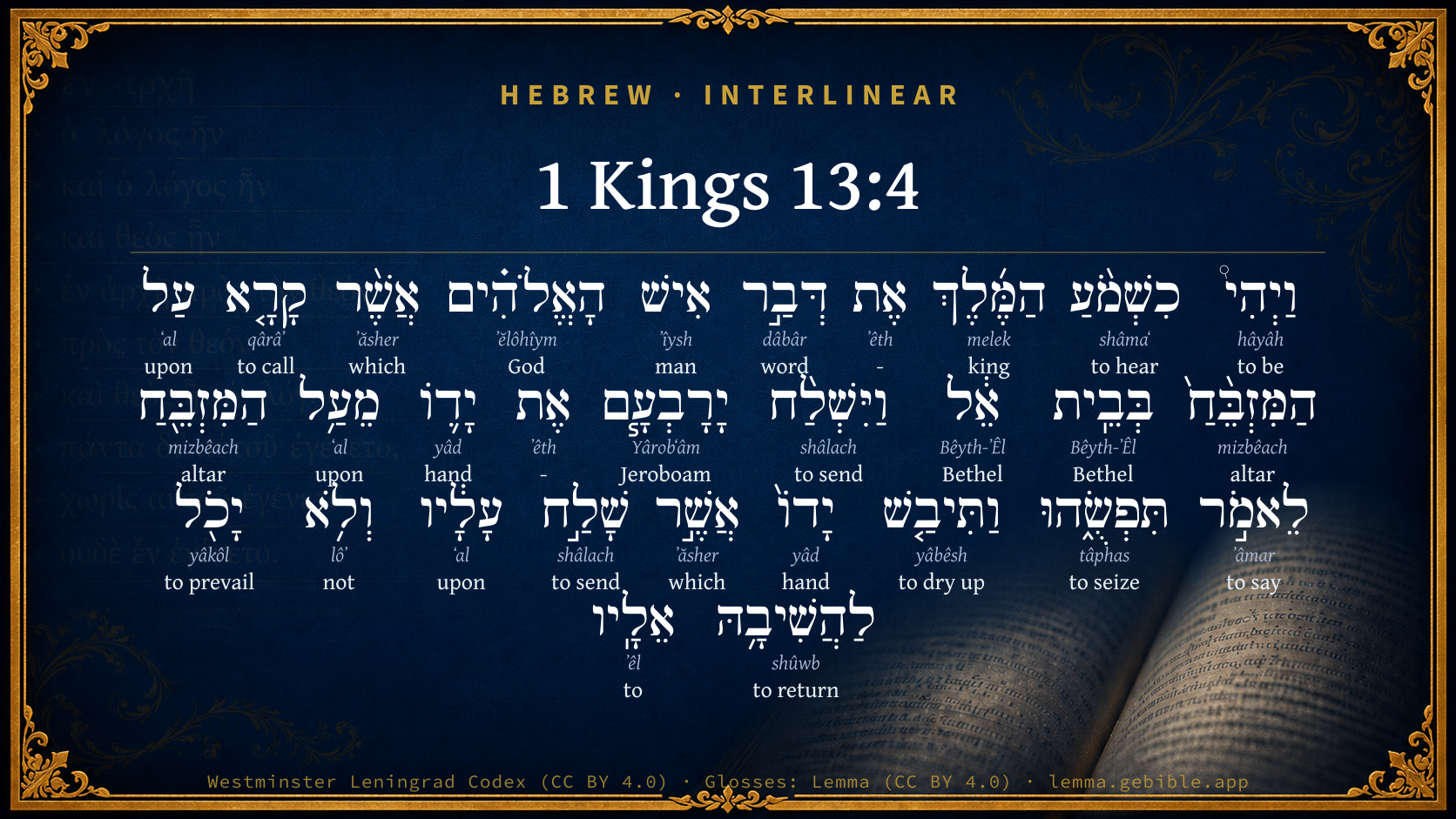
Hebrew (Westminster Leningrad Codex) 1 Kings 13:4 appears in the Hebrew Old Testament. The text above is from the Westminster Leningrad Codex. Each word links to its Strong’s number, a concise gloss, and parsing drawn from the Open Scriptures Hebrew Bible morphology. Click any word for its full Brown-Driver-Briggs (BDB) entry.
Download image
Cite this verse

1 Kings 13:4 (World English Bible). Public Domain. Lemma interlinear Bible study tool, https://lemma.gebible.app/v/1-kings/13/4.

Show BibTeX & RIS
BibTeX
RIS
English Translation
It happened, when the king heard the saying of the man of God, which he cried against the altar in Bethel, that Jeroboam put forth his hand from the altar, saying, Lay hold on him. His hand, which he put forth against him, dried up, so that he could not draw it back again to him.
World English Bible · Public Domain
Download a study sheet

One document with this verse’s original text, its word-by-word gloss line, the meaning frame, cross-references with their text, attributed commentary, and full source and license credits — printable, and it pastes into notes with its structure intact.

This verse Autodidact and up

Study sheet (.html) Plain text (.txt)

A passage Seminary Student

Up to 50 verses in one chapter. A passage sheet keeps up to 6 commentary sources and 12 cross-references per verse, in the order this page ranks them, and says so on the sheet whenever that leaves anything out. Ask for a single verse and you get the Autodidact verse sheet above.

Everything on this page stays free to read, with no account — the sheet is a download of what is already on screen, not access to it.

Want to remove ads? Support Godless Engineer
Compare translations 3

The same verse in 3 English versions, stacked beneath the original-language interlinear above. Click any original word for its lexicon entry.

Each is an independent rendering of the whole verse — the interlinear is not word-aligned to these translations.

Highlighted words mark where these versions differ — a whole-verse word diff, not a word-by-word alignment.

  • World English Bible Public Domain
    It happened, when the king heard the saying of the man of God, which he cried against the altar in Bethel, that Jeroboam put forth his hand from the altar, saying, Lay hold on him. His hand, which he put forth against him, dried up, so that he could not draw it back again to him.
  • King James Version Public Domain
    And it came to pass, when king Jeroboam heard the saying of the man of God, which had cried against the altar in Bethel, that he put forth his hand from the altar, saying, Lay hold on him. And his hand, which he put forth against him, dried up, so that he could not pull it in again to him.
  • unfoldingWord Literal Text CC BY-SA 4.0
    And it happened, when the king heard the word of the man of God that he had cried out against the altar at Bethel, that Jeroboam stretched out his hand from over the altar, saying, “Seize him!” And his hand that he had stretched out against him dried up, and he was not able to bring it back to himself.

unfoldingWord Literal Text — © unfoldingWord, licensed CC BY-SA 4.0. Word-aligned USFM3 via Door43 (git.door43.org/unfoldingWord/en_ult).

Versions to compare (up to 4)

3 of 4 selected

Show all 18 translations

Every available English version of this verse, each an independent rendering of the whole verse.

  • World English Bible Public Domain
    It happened, when the king heard the saying of the man of God, which he cried against the altar in Bethel, that Jeroboam put forth his hand from the altar, saying, Lay hold on him. His hand, which he put forth against him, dried up, so that he could not draw it back again to him.
  • Berean Standard Bible Public Domain
    Now when King Jeroboam, who was at the altar in Bethel, heard the word that the man of God had cried out against it, he stretched out his hand and said, “Seize him!” But the hand he stretched out toward him withered, so that he could not pull it back.
  • Majority Standard Bible Public Domain
    Now when King Jeroboam, who was at the altar in Bethel, heard the word that the man of God had cried out against it, he stretched out his hand and said, “Seize him!” But the hand he stretched out toward him withered, so that he could not pull it back.
  • King James Version Public Domain
    And it came to pass, when king Jeroboam heard the saying of the man of God, which had cried against the altar in Bethel, that he put forth his hand from the altar, saying, Lay hold on him. And his hand, which he put forth against him, dried up, so that he could not pull it in again to him.
  • American Standard Version (1901) Public Domain
    And it came to pass, when the king heard the saying of the man of God, which he cried against the altar in Beth-el, that Jeroboam put forth his hand from the altar, saying, Lay hold on him. And his hand, which he put forth against him, dried up, so that he could not draw it back again to him.
  • Revised Version (1885) Public Domain
    And it came to pass, when the king heard the saying of the man of God, which he cried against the altar in Beth-el, that Jeroboam put forth his hand from the altar, saying, Lay hold on him. And his hand, which he put forth against him, dried up, so that he could not draw it back again to him.
  • Geneva Bible (1599) Public Domain
    And when the King had heard the saying of the man of God, which he had cryed against the altar in Beth-el, Ieroboam stretched out his hand from the altar, saying, Lay holde on him: but his hande which he put foorth against him, dryed vp, and he could not pull it in againe to him.
  • Douay-Rheims (1899) Public Domain
    And when the king had heard the word of the man of God, which he had cried out against the altar in Bethel, he stretched forth his hand from the altar, saying: Lay hold on him. And his hand which he stretched forth against him withered: and he was not able to draw it back again to him.
  • Young's Literal Translation Public Domain
    And it cometh to pass, at the king's hearing the word of the man of God that he calleth against the altar in Beth-El, that Jeroboam putteth forth his hand from off the altar, saying, `Catch him;' and his hand is dried up that he hath put forth against him, and he is not able to bring it back unto him,
  • Literal Standard Version CC BY-SA 4.0
    And it comes to pass, at the king’s hearing the word of the man of God that he calls against the altar in Beth-El, that Jeroboam puts forth his hand from off the altar, saying, “Catch him”; and his hand that he has put forth against him is dried up, and he is not able to bring it back to himself,
  • Unlocked Literal Bible CC BY-SA 4.0
    When the king heard what the man of God said, that he had cried out against the altar at Bethel, Jeroboam reached out with his hand from the altar, saying, “Seize him.” Then the hand with which he had reached out against the man dried up, so that he could not draw it back to himself.
  • unfoldingWord Literal Text CC BY-SA 4.0
    And it happened, when the king heard the word of the man of God that he had cried out against the altar at Bethel, that Jeroboam stretched out his hand from over the altar, saying, “Seize him!” And his hand that he had stretched out against him dried up, and he was not able to bring it back to himself.
  • Darby Bible Public Domain
    And it came to pass when the king heard the word of the man of God, which he cried against the altar in Bethel, that Jeroboam stretched forth his hand from the altar, saying, Lay hold on him. And his hand which he stretched out against him dried up, so that he could not bring it back again to him.
  • World Messianic Bible Public Domain
    When the king heard the saying of the man of God, which he cried against the altar in Bethel, Jeroboam put out his hand from the altar, saying, “Seize him!” His hand, which he put out against him, dried up, so that he could not draw it back again to himself.
  • Webster's Bible Public Domain
    And it came to pass when king Jeroboam heard the saying of the man of God, who had cried against the altar in Beth-el, that he put forth his hand from the altar, saying, Lay hold on him. And his hand, which he put forth against him, dried up, so that he could not draw it to him again.
  • Free Bible Version CC BY-SA 4.0
    When King Jeroboam heard the condemnation the man of God had shouted out against the altar in Bethel, he pointed his hand at him and said, “Arrest him!” But the hand the king had pointed at him had become paralyzed and he couldn't draw it back.
  • Bible in Basic English Public Domain
    Then the king, hearing the man of God crying out against the altar at Beth-el, put out his hand from the altar, saying, Take him prisoner. And his hand, stretched out against him, became dead, and he had no power of pulling it back.
  • JPS Tanakh (1917) Public Domain
    And it came to pass, when the king heard the saying of the man of God, which he cried against the altar in Beth-el, that Jeroboam put forth his hand from the altar, saying: 'Lay hold on him.' And his hand, which he put forth against him, dried up, so that he could not draw it back to him.

Literal Standard Version (2020), Covenant Press — licensed CC BY-SA 4.0. Text via the HelloAO Bible API (eBible.org). Unlocked Literal Bible (unfoldingWord) — licensed CC BY-SA 4.0. Text via the HelloAO Bible API (eBible.org). unfoldingWord Literal Text — © unfoldingWord, licensed CC BY-SA 4.0. Word-aligned USFM3 via Door43 (git.door43.org/unfoldingWord/en_ult). Free Bible Version, Dr. Jonathan Gallagher — licensed CC BY-SA 4.0. Text via the HelloAO Bible API (eBible.org).

Word by word

More ways to search: Search by grammar → Find every occurrence → Compare this word →

Practice this passage: Drill this verse → Learn its vocabulary →

תִּפְשֻׂ֑הוּ
tâphas
H8610
“seize · him”
Verb, Qal, Imperative, 2nd Person, Masculine, Plural + Suffix, Personal, 3rd Person, Masculine, Singular
Part of Speech
Verb
Stem
Qal
Form
Imperative
Person
2nd Person
Gender
Masculine
Number
Plural
Full BDB Definition

Origin: a primitive root

TWOT: 2538

to catch, handle, lay hold, take hold of, seize, wield - (Qal) - to lay hold of, seize, arrest, catch - to grasp (in order to) wield, wield, use skilfully - (Niphal) to be seized, be arrested, be caught, be taken, captured - (Piel) to catch, grasp (with the hands)
  1. וַיְהִי֩ hâyâh H1961 “and · to be” Conjunction + Verb, Qal, Sequential Imperfect, 3rd Person, Masculine, Singular
  2. כִשְׁמֹ֨עַ shâmaʻ H8085 “like/as · to hear” Preposition + Verb, Qal, Infinitive Construct
  3. הַמֶּ֜לֶךְ melek H4428 “the · king” Particle, Definite Article + Noun, Common, Masculine, Singular, Absolute
  4. אֶת ʼêth H853 “-” Particle, Direct Object
  5. דְּבַ֣ר dâbâr H1697 “word of” Noun, Common, Masculine, Singular, Construct
  6. אִישׁ ʼîysh H376 “man of” Noun, Common, Masculine, Singular, Construct
  7. הָאֱלֹהִ֗ים ʼĕlôhîym H430 “the · God(s)” Particle, Definite Article + Noun, Common, Masculine, Plural, Absolute
  8. אֲשֶׁ֨ר ʼăsher H834 “which” Particle, Relative
  9. קָרָ֤א qârâʼ H7121 “to call” Verb, Qal, Perfect, 3rd Person, Masculine, Singular
  10. עַל ʻal H5921 “upon” Preposition
  11. הַמִּזְבֵּ֨חַ֙ mizbêach H4196 “the · altar” Particle, Definite Article + Noun, Common, Masculine, Singular, Absolute
  12. בְּבֵֽית Bêyth-ʼÊl H1008 “in/at · Bethel” Preposition + Noun, Proper
  13. אֵ֔ל Bêyth-ʼÊl H1008 “Bethel” Noun, Proper
  14. וַיִּשְׁלַ֨ח shâlach H7971 “and · to send” Conjunction + Verb, Qal, Sequential Imperfect, 3rd Person, Masculine, Singular
  15. יָרָבְעָ֧ם Yârobʻâm H3379 “Jeroboam” Noun, Proper
  16. אֶת ʼêth H853 “-” Particle, Direct Object
  17. יָד֛וֹ yâd H3027 “hand · his” Noun, Common, Both, Singular, Construct + Suffix, Personal, 3rd Person, Masculine, Singular
  18. מֵעַ֥ל ʻal H5921 “from · upon” Preposition + Preposition
  19. הַמִּזְבֵּ֖חַ mizbêach H4196 “the · altar” Particle, Definite Article + Noun, Common, Masculine, Singular, Absolute
  20. לֵאמֹ֣ר ʼâmar H559 “to say” Preposition + Verb, Qal, Infinitive Construct
  21. וַתִּיבַ֤שׁ yâbêsh H3001 “and · to dry up” Conjunction + Verb, Qal, Sequential Imperfect, 3rd Person, Feminine, Singular
  22. יָדוֹ֙ yâd H3027 “hand · his” Noun, Common, Both, Singular, Construct + Suffix, Personal, 3rd Person, Masculine, Singular
  23. אֲשֶׁ֣ר ʼăsher H834 “which” Particle, Relative
  24. שָׁלַ֣ח shâlach H7971 “to send” Verb, Qal, Perfect, 3rd Person, Masculine, Singular
  25. עָלָ֔יו ʻal H5921 “upon · him” Preposition + Suffix, Personal, 3rd Person, Masculine, Singular
  26. וְלֹ֥א lôʼ H3808 “and · not” Conjunction + Particle, Negative
  27. יָכֹ֖ל yâkôl H3201 “to prevail” Verb, Qal, Perfect, 3rd Person, Masculine, Singular
  28. לַהֲשִׁיבָ֥הּ shûwb H7725 “to return · her” Preposition + Verb, Hiphil, Infinitive Construct + Suffix, Personal, 3rd Person, Feminine, Singular
  29. אֵלָֽיו ʼêl H413 “to · him” Preposition + Suffix, Personal, 3rd Person, Masculine, Singular

About this verse

These counts appear in no published source. They are computed here, from the morphology-tagged text and Lemma’s own curated glosses. What Lemma adds →

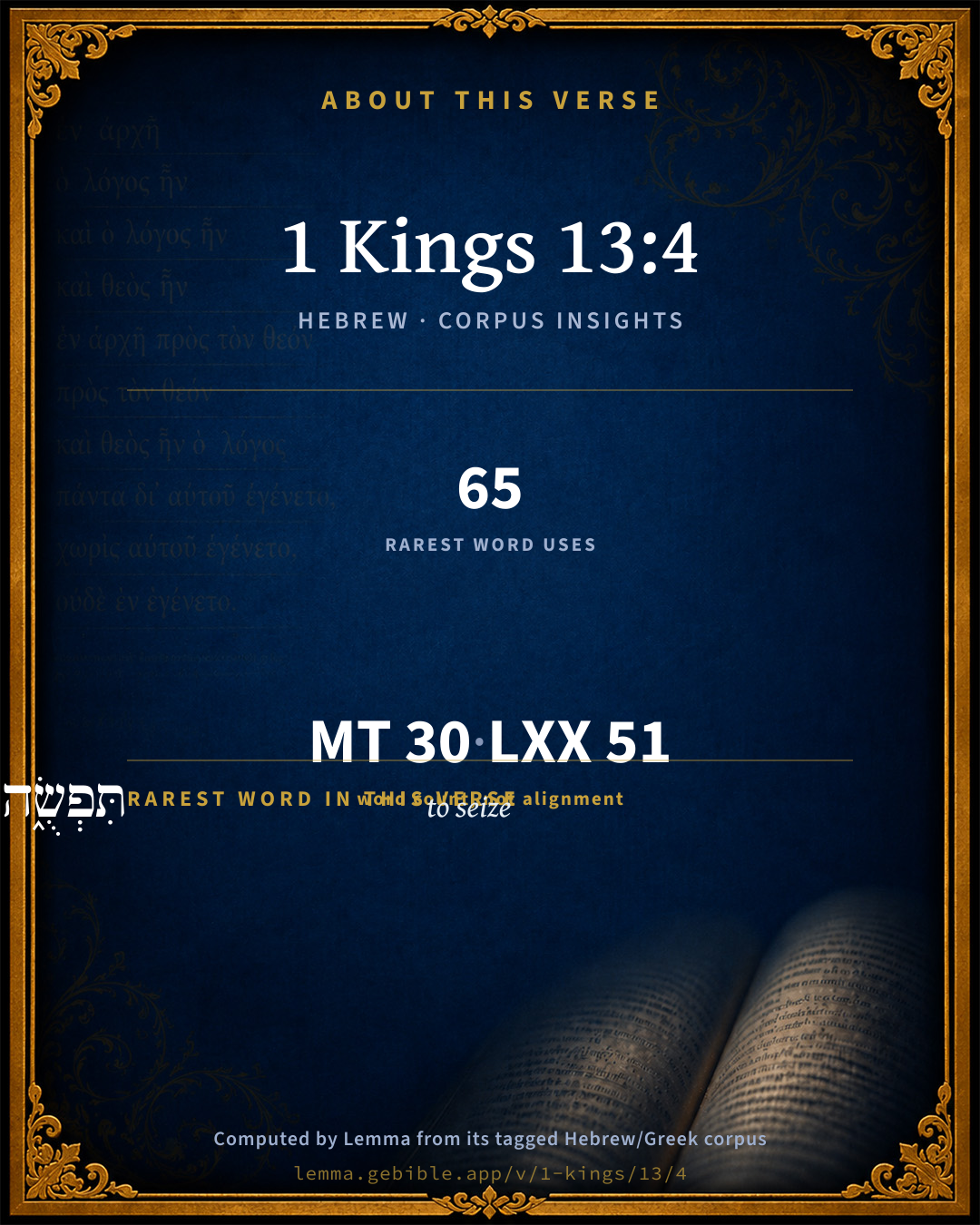
30
words
22
distinct lemmas
Historical
section

Grammatical profile

  • 10 verbs
  • 11 nouns
  • 4 prepositions
  • 5 particles

Verb forms

  • וַיְהִי֩ Qal · Sequential Imperfect
  • כִשְׁמֹ֨עַ Qal · Infinitive Construct
  • קָרָ֤א Qal · Perfect
  • וַיִּשְׁלַ֨ח Qal · Sequential Imperfect
  • לֵאמֹ֣ר Qal · Infinitive Construct
  • תִּפְשֻׂ֑הוּ Qal · Imperative
  • וַתִּיבַ֤שׁ Qal · Sequential Imperfect
  • שָׁלַ֣ח Qal · Perfect
  • יָכֹ֖ל Qal · Perfect
  • לַהֲשִׁיבָ֥הּ Hiphil · Infinitive Construct

Repetition

Words recur within this verse — often emphatic in Hebrew:

  • עַל upon H5921 ×3
  • הַמִּזְבֵּ֨חַ֙ altar H4196 ×2
  • בְּבֵֽית Bethel H1008 ×2
  • וַיִּשְׁלַ֨ח to send H7971 ×2
  • יָד֛וֹ hand H3027 ×2
  • אֲשֶׁ֨ר which H834 ×2

Hebrew & Septuagint length

In English translation the verse runs 56 words from the Hebrew and 60 from the Septuagint (LXX English) — closely comparable.

A rough comparison of the two English renderings, which tokenize alike — not a word-level alignment.

Word counts can differ between the Hebrew and the Greek without any difference in meaning — e.g. the Hebrew direct-object marker אֵת has no separate Greek word, and Greek often adds the article ὁ.

In the original languages it is 30 Hebrew tokens and 51 Greek tokens — but the two are counted differently (Hebrew bundles its prefixes and suffixes into one token; the Greek is in lemma form), so that isn’t a like-for-like length.

Cross-references

22

Topical passages linked to 1 Kings 13:4 in the Treasury of Scripture Knowledge — connected by theme and wording, ordered by reader-vote popularity; previews shown in the World English Bible.

  • Revelation 11:5 If anyone desires to harm them, fire proceeds out of their mouth and devours their enemies. If anyone desires to harm them, he must be killed in this way.
  • 2 Chronicles 18:25–27 The king of Israel said, Take Micaiah, and carry him back to Amon the governor of the city, and to Joash the king's son;
  • Genesis 19:11 They struck the men who were at the door of the house with blindness, both small and great, so that they wearied themselves to find the door.
  • 2 Kings 6:18–20 When they came down to him, Elisha prayed to Yahweh, and said, Please smite this people with blindness. He struck them with blindness according to the word of Elisha.
  • 2 Chronicles 16:10 Then Asa was angry with the seer, and put him in the prison-house; for he was in a rage with him because of this thing. Asa oppressed some of the people at the same time.
  • 2 Chronicles 25:15–16 Therefore the anger of Yahweh was kindled against Amaziah, and he sent to him a prophet, who said to him, Why have you sought after the gods of the people, which have not delivered their own people out of your hand?
  • Psalms 105:15 "Don't touch my anointed ones! Do my prophets no harm!"
  • Jeremiah 20:2–6 Then Pashhur struck Jeremiah the prophet, and put him in the stocks that were in the upper gate of Benjamin, which was in the house of Yahweh.
  • Jeremiah 26:8–11 It happened, when Jeremiah had made an end of speaking all that Yahweh had commanded him to speak to all the people, that the priests and the prophets and all the people laid hold on him, saying, You shall surely die.
  • Jeremiah 26:20–23 There was also a man who prophesied in the name of Yahweh, Uriah the son of Shemaiah of Kiriath Jearim; and he prophesied against this city and against this land according to all the words of Jeremiah:
  • Jeremiah 38:4–6 Then the princes said to the king, Let this man, we pray you, be put to death; because he weakens the hands of the men of war who remain in this city, and the hands of all the people, in speaking such words to them: for this man doesn't seek the welfare of this people, but the hurt.
  • Amos 7:10–17 Then Amaziah the priest of Beth El sent to Jeroboam king of Israel, saying, "Amos has conspired against you in the midst of the house of Israel. The land is not able to bear all his words.
  • Matthew 25:40 "The King will answer them, 'Most assuredly I tell you, inasmuch as you did it to one of the least of these my brothers, you did it to me.'
  • Matthew 26:57 Those who had taken Jesus led him away to Caiaphas the high priest, where the scribes and the elders were gathered together.
  • Mark 14:44–46 Now he who betrayed him had given them a sign, saying, "Whoever I will kiss, that is he. Seize him, and lead him away safely."
  • Luke 3:19–20 but Herod the tetrarch, being reproved by him for Herodias, his brother's wife, and for all the evil things which Herod had done,
  • Luke 6:10 He looked around at them all, and said to the man, "Stretch out your hand." He did, and his hand was restored as sound as the other.
  • John 13:20 Most assuredly I tell you, he who receives whomever I send, receives me; and he who receives me, receives him who sent me."
  • John 18:6 When therefore he said to them, "I AM," they went backward, and fell to the ground.
  • Acts 6:12–14 They stirred up the people, the elders, and the scribes, and came against him and seized him, and brought him in to the council,
  • Acts 9:4–5 He fell on the earth, and heard a voice saying to him, "Saul, Saul, why do you persecute me?"
  • Acts 13:8–11 But Elymas the sorcerer (for so is his name by interpretation) withstood them, seeking to turn aside the proconsul from the faith.

Cross-references courtesy of OpenBible.info (CC BY 4.0).

Hebrew and Greek witnesses Masoretic Hebrew ↔ Greek Septuagint

The same verse in the two great witnesses to the Old Testament, shown verse-for-verse.

These are two independent witnesses, not word-aligned to each other, and the Septuagint is shown in lemma (dictionary) form.

Hebrew 1 Kings 13:4 Masoretic · Westminster Leningrad Codex

וַיְהִי֩ כִשְׁמֹ֨עַ הַמֶּ֜לֶךְ אֶת דְּבַ֣ר אִישׁ הָאֱלֹהִ֗ים אֲשֶׁ֨ר קָרָ֤א עַל הַמִּזְבֵּ֨חַ֙ בְּבֵֽית אֵ֔ל וַיִּשְׁלַ֨ח יָרָבְעָ֧ם אֶת יָד֛וֹ מֵעַ֥ל הַמִּזְבֵּ֖חַ לֵאמֹ֣ר תִּפְשֻׂ֑הוּ וַתִּיבַ֤שׁ יָדוֹ֙ אֲשֶׁ֣ר שָׁלַ֣ח עָלָ֔יו וְלֹ֥א יָכֹ֖ל לַהֲשִׁיבָ֥הּ אֵלָֽיו

It happened, when the king heard the saying of the man of God, which he cried against the altar in Bethel, that Jeroboam put forth his hand from the altar, saying, Lay hold on him. His hand, which he put forth against him, dried up, so that he could not draw it back again to him.

World English Bible · Public Domain

Greek LXX 1 Kings 13:4 Septuagint · lemma form

καί γίγνομαι ὡς ἀκούω ὁ βασιλεύς ιεροβοαμ ὁ λόγος ὁ ἄνθρωπος ὁ θεός ὁ ἐπικαλέω ἐπί ὁ θυσιαστήριον ὁ ἐν βαιθηλ καί ἐκτείνω ὁ βασιλεύς ὁ χείρ αὐτός ἀπό ὁ θυσιαστήριον λέγω συνλαμβάνω αὐτός καί ἰδού ξηραίνω ὁ χείρ αὐτός ὅς ἐκτείνω ἐπί αὐτός καί οὐ ἀδυνάω ἐπιστρέφω αὐτός πρός ἑαυτοῦ

And it came to pass when king Jeroboam heard the words of the man of God who called on the altar that was in Baethel, that the king stretched forth his hand from the altar, saying, Take hold of him. And, behold, his hand, which he stretched forth against him, withered, and he could not draw it back to himself.

LXX2012 (modern English Septuagint) · Public Domain

On this verse, Trapp's Complete Commentary discusses the Septuagint’s reading. Read the note in Commentary ↓

Hebrew: Westminster Leningrad Codex (CC BY 4.0). Greek: Septuagint (public domain); English from LXX2012 (modern English Septuagint) (Public Domain). How the Septuagint differs from the Hebrew →

Targum (Aramaic paraphrase)

1

The Targum is the ancient Jewish Aramaic paraphrase of the Hebrew Scriptures — an interpretive translation, not the Hebrew text itself. Onkelos (literal) and Pseudo-Jonathan (expansive) render the Torah, and Jonathan the Prophets. Coverage is partial: where no permissively-licensed English translation exists for a verse, only the Aramaic is shown. This is verse-level text, not a word-by-word alignment to the Hebrew.

  1. Targum Jonathan Prophets (Joshua–Malachi)
    וַהֲוָה כַּד שְׁמַע מַלְכָּא יַת פִּתְגָמָא דִנְבִיָא דַייָ דְאִתְנַבִּי עַל אֱגוֹרָא בְּבֵית אֵל וְאוֹשִׁיט יָרָבְעָם יַת יְדֵיהּ מֵעִילַוֵי מַדְבְּחָא לְמֵימַר אַחֲדוּהִי וִיבֵשַׁת יְדֵיהּ דְאוֹשִׁיט עֲלוֹהִי וְלָא יָכִיל לַאֲתָבוּתֵיהּ לְוָתֵיהּ:

    (no public-domain English translation for this verse)

    Targum Jonathan — Aramaic: “Mikraot Gedolot” (public domain). English: “Sefaria Community Translation” (CC0 1.0 (public-domain dedication)); “London "Chaldee Paraphrase," 1871” (public domain). Text via Sefaria.

Commentary

Notes on 1 Kings 13:4 from classic Christian and Jewish commentators (each source and its license shown beneath its notes). The classic Christian expositions comment on the surrounding passage and are grouped to its opening verse, so a note may address several verses; the Jewish commentaries on the Tanakh (Rashi and others) are per-verse, so they appear only where the commentator wrote on this verse.

Lemma curates 59 commentaries, every one of them public domain or Creative Commons licensed, each selected and text-cleaned for this edition rather than reprinted as found. About our sources →

Trapp's Complete Commentary

John Trapp

1Ki 13:4 And it came to pass, when king Jeroboam heard the saying of the man of God, which had cried against the altar in Bethel, that he put forth his hand from the altar, saying, Lay hold on him. And his hand, which he put forth against him, dried up, so that he could not pull it in again to him.

Ver. 4. That he put forth his hand.] To apprehend the prophet, or for a sign to others to do it. "Hear and give ear," saith the prophet, "be not proud, for the Lord hath spoken it." {Jer 13:15} But

“ Corde stat inflato pauper honore dato. ”

Jeroboam - a poor widow’s son, {1Ki 11:26} or, as the Septuagint hath it, a harlot’s son - being advanced by God to a kingdom, rebelleth, and becometh a ringleader of rebellion against him putting forth the same hand against the prophet, that he had lifted up before against his prince. {1Ki 11:26} But what came of it?

And his hand which he put forth against him dried, &c.] A fearful stroke, had he well considered it: but his heart was as hard as his hand withered. Jeroboam had as great a miracle wrought before him herein, as St Paul had at his conversion; but without the Spirit’s concurrence neither miracle, nor ministry, nor misery, nor mercy, can in the least measure mollify the heart of an obdurate and obstinate sinner. Valens, the Arian emperor, would have signed a sentence of banishment against Basil, but could not, by reason of a sudden trembling of his right hand, so that he could not write one letter of his own name, but for anger tore the paper in pieces, and let Basil alone. {a} There is a story of one of our late innovators, who, turning with the times, and beginning to bow toward altars, never went upright more: and of another, who, hearing perjury condemned by a godly preacher, and how it never escaped unpunished, said in a bravery, "I have often forsworn myself, and yet my right hand is no shorter than my left." These words he had scarce uttered, when such an inflammation arose in that hand, that he was forced to go to the surgeon, and cut it off, lest it should have infected the whole body; and so it became shorter than the other {b} The Jews tell us, that when Jeroboam’s hand was dried up, the false prophets told him that this happened by chance, and so kept him from thinking of God who had smitten him. Let the saints learn to put their confidence in God: for if he deny concourse and influence, the arm of all adverse power shrinketh up presently.

{a} Nullum spicem complere potuit. - Hist. Tripart.

{b} Mr Clark’s Mirror, 204.

John Trapp, A Commentary or Exposition upon All the Books of the Old and New Testament (1647–1656) — public domain. Text from a community e-Sword module.

The Biblical Illustrator

Joseph S. Exell

1Ki_13:4-6

He put forth his hand.

The prophecy against Jeroboam and its attendant circumstances

I. All human power and skill engaged against God will wither. The hand of man is the bodily mark of his superiority to the animal creation; it represents his power and skill. It is the bread winner of the body. By its skilful use he imitates the works of God in nature, and by its means he sends down his thoughts to posterity. Jeroboams outstretched hand was the type of all human opposition to Gods rule, especially the opposition of the rulers of the world. Its withering was the exposition of No weapon formed against thee shall prosper (Isa_54:17); He that sitteth in the heavens shall laugh (Psa_2:4, etc.)

II. Physical blessing is of more importance to the ungodly man than morality of character. Christs teaching is, If thy hand offend thee, cut it off (Mat_18:8), count no earthly loss worthy of a thought compared with an injury to the spiritual life. (Outline from Sermons by a London Minister.)

Hospitality refused

As the man of God from Judah so nobly refuses Jeroboams royal hospitality, I am reminded of Lord Napier. On one occasion his lordship was sent down to Scotland by the Queen on a royal errand of review and arbitration between a great duke and his poor crofters. The duke, the administration of whose estate was to be inquired into, was good enough to offer his lordship his ducal hospitality for as long as the royal session of review lasted. But Her Majestys Deputy felt that neither his Royal Mistress nor himself could afford to be for one moment compromised, or even suspected, by her poorest subject; and therefore it was that his lordship excused himself from the dukes table, and took up his quarters in the little wayside inn. At any rate, you will come to the manse, said the minister, who was on the crofters side. Thank you, said Napier. But in your college days you must have read Plutarch about Caesars wife. No, thank you. And his lordship lodged all his time in the little hotel, and went back to his Royal Mistress when his work was done, not only with clean hands, but without even a suspicion attaching to her or to him. Come home with me and refresh thyself. But the man of God said to the king, If thou wilt give me half thine house, I will not go in with thee, neither will I eat bread nor drink water with thee. So he went another way, and returned not by the way that he came to Bethel. (A. Whyte, D. D.)

The Biblical Illustrator, edited by Joseph S. Exell (c. 1880s–1900s) — public domain. Text from a community e-Sword module.

Joseph Benson's Commentary

1Ki 13:4-5. He put forth his hand — To point out the man on whom he would have the people to lay hands. From the altar — Where he stood, and where his hand was employed in offering something upon it. And his hand dried up — Or withered, the muscles and sinews, the instruments of motion, shrinking up or becoming relaxed. This God did, not only to give another token, besides those which the man of God had mentioned, that his words would be fulfilled; but also to chastise Jeroboam for offering violence to the Lord’s prophet; to secure the prophet against further violence, and that in this example God might show how highly he resents the injuries done to his ministers for the faithful discharge of their office. The altar also was rent, &c. — This train of miracles, instantly wrought, and confirming so evidently the prophet’s mission, so amazed all the people, that we do not find any of them attempted to lay hold on him. And Jeroboam himself, for the present, was astonished and confounded at the sight of the effects produced by God’s miraculous power.

Joseph Benson's Commentary on the Old and New Testaments (1811–1818) — public domain. Text from a community e-Sword module.

Tyndale Open Study Notes

Tyndale Open Resources

13:4-5 The paralysis of Jeroboam’s shoulder and arm and the fulfillment of the prophetic sign concerning the altar confirmed God’s omnipotence as well as his direct displeasure with Jeroboam’s apostate religion.

Tyndale Open Study Notes — © Tyndale Open Resources, licensed CC BY-SA 4.0. Text via the HelloAO Bible API.

Geneva Bible (1599)

Geneva Bible translators

The wicked rage against the Prophets of God, when they declare them God’s judgments.

Geneva Bible (1599) marginal notes — public domain. Text via Bolls.life.

Adam Clarke's Commentary

Verse 4. Lay hold on him.] No doubt, stretching out his own hand at the same time, through rage, pride, and haste, to execute his own orders.

And his hand dried up] The whole arm became suddenly rigid; the nerves no longer communicated their influence, and the muscles ceased to obey the dictates of the will.

Adam Clarke's Commentary on the Bible (1810–1826) — public domain. Text from a community e-Sword/MySword module.

The Cambridge Bible for Schools and Colleges

gen. ed. J. J. S. Perowne

4. he put forth his hand from the altar] He was busy in the operations connected with the sacrifice, but the words of the prophet roused his anger, and the raised hand is the sign of his wrath, as well as a signal to those who were near him, pointing out that the speaker was to be seized. Hence it is said immediately ‘which he put forth against him.’ The R.V. has observed the order of the Hebrew in which the proper name Jeroboam comes in the second clause of the verse and not in the first: thus ‘when the king heard … Jeroboam put forth, &c.’

dried up] The effect described is that of a limb becoming rigid, not so much shrivelling, as stiffening. Josephus says it was ‘numbed and dead’.

The Cambridge Bible for Schools and Colleges (gen. ed. J. J. S. Perowne; Cambridge University Press, 1878–1918) — public domain. Text from a community e-Sword module.

John Gill's Exposition

And it came to pass, when King Jeroboam heard the saying of the man of God, who had cried against the altar in Bethel,.... He was highly provoked: so that he put forth his hand from the altar; on which he was burning incense:

saying, lay hold on him; he put forth his hand, and either shook it at the prophet, threatening what he would do to him; or as beckoning to the people to seize him, and which he also expressed:

and his hand, which he put forth against him, dried up, so that he could not pull it in again to him; he could not move it one way nor another, but it remained in the same position, the nerves and muscles being shrunk; which was a further confirmation of the prophet's mission from God, being one of those concerning whom he says, "do my prophets no harm", and a fresh token of the certain performance of what he had said.

John Gill's Exposition of the Whole Bible (1746–1763) — public domain (CC PDM 1.0). Text via the HelloAO Bible API.

Matthew Poole's English Annotations

He put forth his hand, to point out the man whom he would have the people lay hands on, and to stir them up to do so.

From the altar; where it was employed in offering something upon it. Dried up, or withered; the muscles and sinews, the instruments of motion, were shrunk up. This God did, partly, to chastise Jeroboam for offering violence to the Lord’s prophet; partly, to secure the prophet against further violence; and partly, that in this example God might show how highly he resents the injuries done to his ministers in and for the faithful discharge of their office.

Matthew Poole's English Annotations on the Holy Bible (1683–1685) — public domain. Text from a community e-Sword/MySword module.

Whedon's Commentary on the Bible

Daniel D. Whedon

4. Put forth his hand from the altar — This seems to show that he was at the time actually performing priestly functions. Compare above 1Ki_13:1 and 1Ki_12:32.

His hand… dried up — Here was another miracle, wrought, not by the agency of the prophet, but by God himself. It confuses, and for the time terrifies, the king, but produces in him no reformation.

Daniel D. Whedon (gen. ed.), Commentary on the Old and New Testaments (1874–1909) — public domain. Text from a community e-Sword module.

The Pulpit Commentary

And it came to pass when king Jeroboam The A.V follows the LXX The Heb. omits "Jeroboam" heard the saying of the man of God, which had cried against the altar in Bethel, that he put forth his hand instinctively. His first thought was, not to wait and see whether the promised sign was given, but to seize and punish the man who had dared thus to denounce and thwart him. And we may imagine how extremely mortifying this interruption must have been to him. It threatened the complete frustration of his policy at the very moment when it seemed certain of suceess from the altar the ledge or platform, i.e., where he stood. He did not leave it, but shouted his commands to his servants, saying, Lay hold on him. "Arrest him," "let him not escape." One word in the Heb. And his hand, which he put forth against him, dried up Possibly the result of paralysis or tetanus (Ackermann in Bahr). It was like the "withered hand" of the New Testament (Mat_12:10, etc.) deprived of feeling and vital force, as the next words show, so that he could not pull it in again to him. It was not only powerless to punish, it was punished. "Now stands the king of Israel, like some antique statue, in a posture of impotent endeavour" (Hall). This was a warning to the king, not so much against his unauthorized and schismatical rites, as against his attempt to avenge himself on the messenger of God. (Psa_105:14, Psa_105:15)

Vers. 4-6.

The Man of Sin.

When the man of God predicted the confusion of the political religion of Jeroboam, and gave the sign that the altar at Bethel should be rent and its ashes poured out, the pride of the king who stood there as a priest was mortified, and his resentment was manifested as described in the text.

I JEROBOAM WAS A TYPICAL SINNER.

1. He transgressed God"s law

(1) In making images. The law forbad this. (Exo_20:4, Exo_20:5) But he made two golden calves. Note: Images of God must be caricatures, and God will not be mocked, solemnly or otherwise, with impunity. How many frightful caricatures of Deity has the "man of sin" perpetrated! (2Th_2:3-12)

(2) In multiplying altars. Legal worship was limited to one altar "in the place which the Lord should choose". (Deu_16:16) This was to keep before men the one only Mediator (Joh_14:6; 1Ti_2:5) Therefore other altars than that at Jerusalem were "altars unto sin". (Hos_8:11)

(3) In creating priests. According to the law, none but sons of Aaron had a Divine vocation to the priesthood (Exo_30:7, Exo_30:8; 2 Chronicles. (Heb_5:4) According to the gospel, Christ is sole Priest. Jeroboam, an Ephrathite, invaded the law principle, making himself high priest, and making subordinate priests of the lowest of the people.

2. He did so impudently.

(1) His sin was not of ignorance, for he had access to the Scriptures; but it did not serve his purpose to refer to them.

(2) Prophecy was particularly distasteful to him, for his doom is written there. Jeroboam had this from the lips of Ahijah, and now has it from the man of God from Judah. Beware of the spirit that would discourage a study upon which God has pronounced a blessing. (Rev_1:3)

(3) The spirit of his religion was political. He would not have troubled himself with it had he not political ends to serve. (1Ki_12:26-29) And to carry out these he dissembled: "It is too much for you to go to Jerusalem!

II HIS DOOM ALSO WAS TYPICAL.

1. He was confronted by the word of God.

(1) With this the man of God from Judah withstood him at his altar. So by the word of the Lord, and especially with the spirit of prophecy, has the man of sin been confronted by Waldenses, Paulikiaus, Hussites, Lutherans, and such like men "from Judah.

(2) But against this testimony he invoked the civil power under his usurped control (ver. 4). The spirit of persecution was there. The modern Jeroboam carried it further (Dan_12:2; Rev_13:7 Rev_17:6)

2. He was humbled by the power of God.

(1) His hand was withered; his power to persecute was paralyzed. How powerless is the hand of man when arrested by the hand of God! Behind the political restraints which now hold the persecuting hand of our enemies we must discern the invisible hand of God.

(3) The altar, then, was cloven, and the ashes of the spurious sacrifices poured out as with contempt. This also was effected by the same invisible hand. Who can resist the might of God?

(4) Constrained by these judgments, he confessed the finger of God, and entreated the man of God to pray for the restoration of his hand (see Exo_10:16, Exo_10:17; Num_21:7; Mat_5:23, Mat_5:24)

3. Yet he persisted in his sin.

(1) His humiliation was selfish. It was the creature of his terror and suffering, so it was transient.

(2) True repentance is of a loftier principle, and is enduring. It is a life, as faith also is a life.

(3) Instead of using his restored hand to demolish his high places, he used it to repair the altar at Bethel, and persisted in his sin (vers. 33, 34; 2Ch_13:20) But Josiah executed the judgments of prophecy in due time, So will the modern Jeroboam and his monstrous organization of sin perish in the fires of the judgment (Dan_7:10, Dan_7:11; 2Th_2:8) Note: Let those come out of Babylon who would escape her plagues.

J.A.M.

The Pulpit Commentary (1880–1919), ed. H.D.M. Spence-Jones & Joseph S. Exell — public domain. Text from a community e-Sword module.

John Wesley's Explanatory Notes

Put forth, &c. - To point out the man whom he would have the people lay hands on. The altar - Where it was employed in offering something upon it. Dried up - Or, withered, the muscles and sinews, the instruments of motion, shrunk up. This God did, to chastise Jeroboam for offering violence to the Lord's prophet: to secure the prophet against farther violence: and, that in this example God might shew, how highly he resents the injuries done to his ministers, for the faithful discharge of their office.

John Wesley, Explanatory Notes Upon the Whole Bible (1754–1765) — public domain. Text via the GEBible commentary corpus.

unfoldingWord translationNotes

Door43 World Missions Community

the hand with which he had reached out against the man dried up

This can be stated in active form. AT: "Yahweh dried up the hand with which he had reached out against the man" (See: Active or Passive)

dried up

"withered" or "became paralyzed"

The altar was also split apart

This can be stated in active form. AT: "Yahweh also split the altar apart" (See: Active or Passive)

as described by the sign that the man of God had given by the word of Yahweh

This can be stated in active form. AT: "as the man of God had described by the word of Yahweh as a sign" (See: Active or Passive)

the word of Yahweh

"the message of Yahweh" or "Yahweh's message"

translationWords

king

hand

seize

unfoldingWord translationNotes — © Distant Shores Media and the Door43 World Missions Community, licensed CC BY-SA 4.0. Source: git.door43.org/Door43/en_tn.

Rashi

Rabbi Shlomo Yitzchaki (Rashi)

But his hand dried up [stiffened]. The Holy One Blessed Is He, avenged the honor of a righteous person more than His own honor. [When] he was standing and offering sacrifices to idols, his hand did not stiffen, yet, because of slandering the righteous person, his hand stiffened.

Rashi on the Tanakh — English translations: “The Judaica Press complete Tanach with Rashi, translated by A. J. Rosenberg” (CC BY 4.0); “Pentateuch with Rashi's commentary by M. Rosenbaum and A.M. Silbermann, 1929-1934” (public domain); “The Metsudah Tanach series, Lakewood, N.J” (CC BY 4.0); and “The Book of Joshua, Metsudah Publications, 1997” (CC BY 4.0). Text via Sefaria.

Lesson kit

Teaching starters — assembled from the data on this page, not authored interpretation. Every prompt links to the verse data it draws on. Edit before teaching.

1 Kings, in the Historical, opens this verse with 30 words (22 distinct Hebrew lemmas). Its most distinctive word is tâphas (“to seize”). A historical commentator’s framing appears above. Read the whole chapter for the surrounding context.

Discussion questions

  1. How does “to seize” (tâphas) shape what this verse is saying?
  2. How does Revelation 11:5, which shares this passage’s theme, read alongside this verse?
  3. What does the repetition of “upon” (3× in this one verse) do in this verse?
  4. These translations render this verse differently; the difference is in the English rendering, not the original. What questions does that raise?
  5. «וַיְהִי֩» is a Qal Sequential Imperfect verb. How does that grammatical form shape the action described?
  6. Compare how Trapp's Complete Commentary and The Biblical Illustrator read this verse. Where do they agree or differ?

Things to notice

Reading settings

Reading text

Shown beneath each verse's original-language words.

Old Testament
Old Testament edition

Read the OT as the Masoretic Hebrew (MT) or the Greek Septuagint (LXX).

English shown for the Greek Septuagint (in the Hebrew ↔ Greek comparison).

Comparing translations? Open the Compare panel on any verse page to stack up to four side by side.