
Jeremiah 15:20

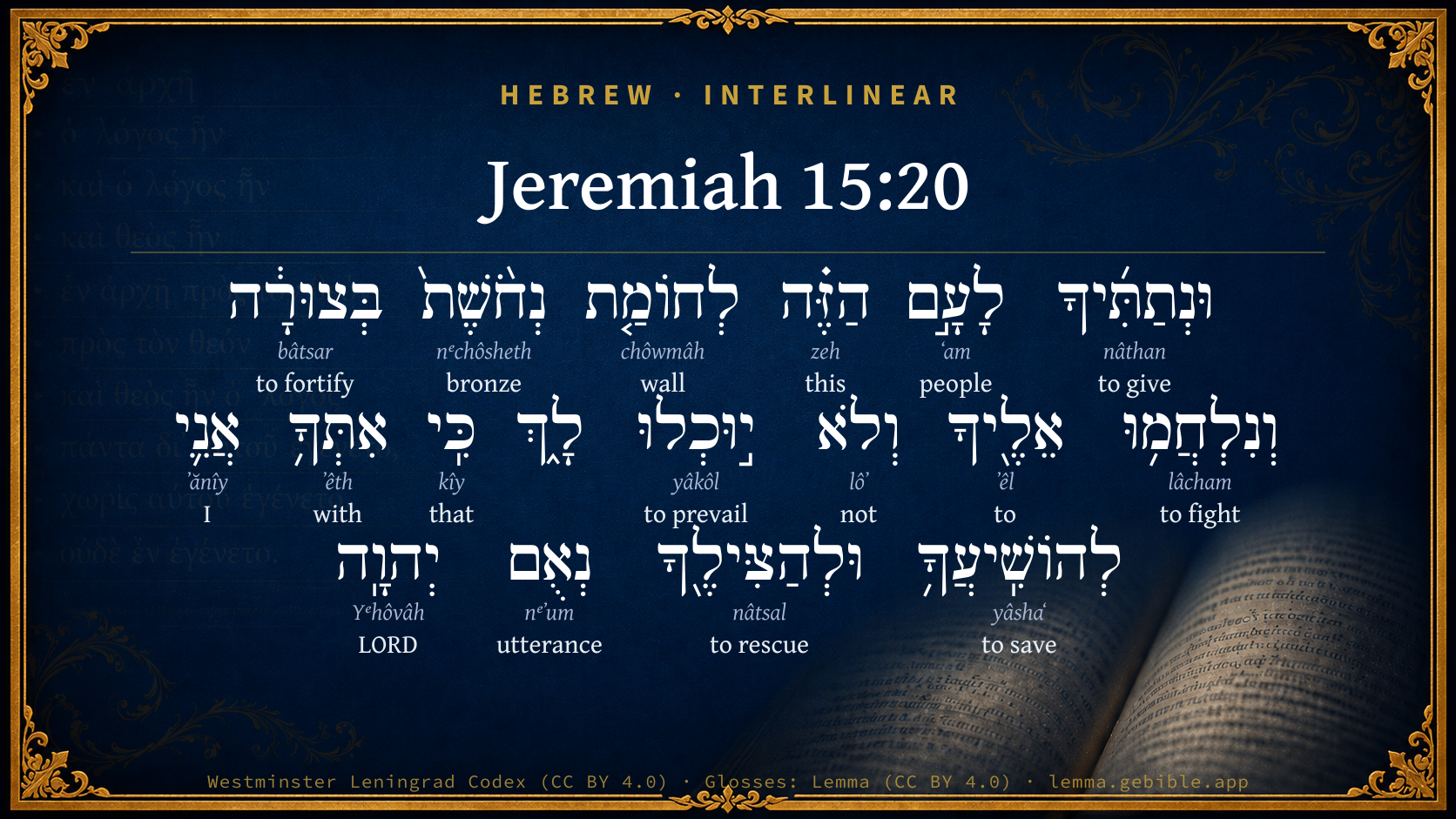
Hebrew (Westminster Leningrad Codex) Jeremiah 15:20 appears in the Hebrew Old Testament. The text above is from the Westminster Leningrad Codex. Each word links to its Strong’s number, a concise gloss, and parsing drawn from the Open Scriptures Hebrew Bible morphology. Click any word for its full Brown-Driver-Briggs (BDB) entry.
Download image
Cite this verse

Jeremiah 15:20 (World English Bible). Public Domain. Lemma interlinear Bible study tool, https://lemma.gebible.app/v/jeremiah/15/20.

Show BibTeX & RIS
BibTeX
RIS
English Translation
I will make you to this people a fortified brazen wall; and they shall fight against you, but they shall not prevail against you; for I am with you to save you and to deliver you, says Yahweh.
World English Bible · Public Domain
Download a study sheet

One document with this verse’s original text, its word-by-word gloss line, the meaning frame, cross-references with their text, attributed commentary, and full source and license credits — printable, and it pastes into notes with its structure intact.

This verse Autodidact and up

Study sheet (.html) Plain text (.txt)

A passage Seminary Student

Up to 50 verses in one chapter. A passage sheet keeps up to 6 commentary sources and 12 cross-references per verse, in the order this page ranks them, and says so on the sheet whenever that leaves anything out. Ask for a single verse and you get the Autodidact verse sheet above.

Everything on this page stays free to read, with no account — the sheet is a download of what is already on screen, not access to it.

Want to remove ads? Support Godless Engineer
Compare translations 3

The same verse in 3 English versions, stacked beneath the original-language interlinear above. Click any original word for its lexicon entry.

Each is an independent rendering of the whole verse — the interlinear is not word-aligned to these translations.

Highlighted words mark where these versions differ — a whole-verse word diff, not a word-by-word alignment.

  • World English Bible Public Domain
    I will make you to this people a fortified brazen wall; and they shall fight against you, but they shall not prevail against you; for I am with you to save you and to deliver you, says Yahweh.
  • King James Version Public Domain
    And I will make thee unto this people a fenced brasen wall: and they shall fight against thee, but they shall not prevail against thee: for I am with thee to save thee and to deliver thee, saith the LORD.
  • unfoldingWord Literal Text CC BY-SA 4.0
    I will make you to this people a wall of fortified bronze, and they will fight against you, but they shall not prevail against you, for I with you to save you and to deliver you,” the declaration of Yahweh.

unfoldingWord Literal Text — © unfoldingWord, licensed CC BY-SA 4.0. Word-aligned USFM3 via Door43 (git.door43.org/unfoldingWord/en_ult).

Versions to compare (up to 4)

3 of 4 selected

Show all 18 translations

Every available English version of this verse, each an independent rendering of the whole verse.

  • World English Bible Public Domain
    I will make you to this people a fortified brazen wall; and they shall fight against you, but they shall not prevail against you; for I am with you to save you and to deliver you, says Yahweh.
  • Berean Standard Bible Public Domain
    Then I will make you a wall to this people, a fortified wall of bronze; they will fight against you but will not overcome you, for I am with you to save and deliver you, declares the LORD.
  • Majority Standard Bible Public Domain
    Then I will make you a wall to this people, a fortified wall of bronze; they will fight against you but will not overcome you, for I am with you to save and deliver you, declares the LORD.
  • King James Version Public Domain
    And I will make thee unto this people a fenced brasen wall: and they shall fight against thee, but they shall not prevail against thee: for I am with thee to save thee and to deliver thee, saith the LORD.
  • American Standard Version (1901) Public Domain
    And I will make thee unto this people a fortified brazen wall; and they shall fight against thee, but they shall not prevail against thee; for I am with thee to save thee and to deliver thee, saith Jehovah.
  • Revised Version (1885) Public Domain
    And I will make thee unto this people a fenced brasen wall; and they shall fight against thee, but they shall not prevail against thee: for I am with thee to save thee and to deliver thee, saith the LORD.
  • Geneva Bible (1599) Public Domain
    And I will make thee vnto this people a strong brasen wall, and they shall fight against thee, but they shall not preuaile against thee: for I am with thee to saue thee and to deliuer thee, saith ye Lord.
  • Douay-Rheims (1899) Public Domain
    And I will make thee to this people as a strong wall of brass: and they shall fight against thee, and shall not prevail: for I am with thee to save thee, and to deliver thee, saith the Lord.
  • Young's Literal Translation Public Domain
    And I have made thee to this people For a wall -- brazen -- fenced, And they have fought against thee, And they do not prevail against thee, For with thee `am' I to save thee, And to deliver thee -- an affirmation of Jehovah,
  • Literal Standard Version CC BY-SA 4.0
    And I have made you to this people || For a wall—bronze—fortified, || And they have fought against you, || And they do not prevail against you, || For I [am] with you to save you, || And to deliver you,” || A declaration of YHWH,
  • Unlocked Literal Bible CC BY-SA 4.0
    I will make you like an impenetrable bronze wall to this people, and they will wage war against you. But they will not defeat you, for I am with you to save and rescue you—this is Yahweh's declaration—
  • unfoldingWord Literal Text CC BY-SA 4.0
    I will make you to this people a wall of fortified bronze, and they will fight against you, but they shall not prevail against you, for I with you to save you and to deliver you,” the declaration of Yahweh.
  • Darby Bible Public Domain
    And I will make thee unto this people a strong brazen wall; and they shall fight against thee, but they shall not prevail against thee: for I am with thee, to save thee and to deliver thee, saith Jehovah;
  • World Messianic Bible Public Domain
    I will make you to this people a fortified bronze wall. They will fight against you, but they will not prevail against you; for I am with you to save you and to deliver you,” says the LORD.
  • Webster's Bible Public Domain
    And I will make thee to this people a fortified brazen wall: and they shall fight against thee, but they shall not prevail against thee: for I am with thee to save thee and to deliver thee, saith the LORD.
  • Free Bible Version CC BY-SA 4.0
    Then I will make you a wall to these people, a strong wall of bronze. They will fight against you but they won't defeat you. I am with you to save you and rescue you, declares the Lord.
  • Bible in Basic English Public Domain
    And I will make you a strong wall of brass to this people; they will be fighting against you, but they will not overcome you: for I am with you to keep you safe, says the Lord.
  • JPS Tanakh (1917) Public Domain
    And I will make thee unto this people a fortified brazen wall; and they shall fight against thee, but they shall not prevail against thee; for I am with thee to save thee and to deliver thee, saith the LORD.

Literal Standard Version (2020), Covenant Press — licensed CC BY-SA 4.0. Text via the HelloAO Bible API (eBible.org). Unlocked Literal Bible (unfoldingWord) — licensed CC BY-SA 4.0. Text via the HelloAO Bible API (eBible.org). unfoldingWord Literal Text — © unfoldingWord, licensed CC BY-SA 4.0. Word-aligned USFM3 via Door43 (git.door43.org/unfoldingWord/en_ult). Free Bible Version, Dr. Jonathan Gallagher — licensed CC BY-SA 4.0. Text via the HelloAO Bible API (eBible.org).

Word by word

More ways to search: Search by grammar → Find every occurrence → Compare this word →

Practice this passage: Drill this verse → Learn its vocabulary →

בְּצוּרָ֔ה
bâtsar
H1219
“fortified”
Adjective, Adjective, Feminine, Singular, Absolute
Part of Speech
Adjective
Type
Adjective
Gender
Feminine
Number
Singular
State
Absolute
Full BDB Definition

Origin: a primitive root

TWOT: 270

to gather, restrain, fence, fortify, make inaccessible, enclose - (Qal) - to cut off - fortified, cut off, made inaccessible (passive participle) - secrets, mysteries, inaccessible things (substantive) - (Niphal) to be withheld - (Piel) to fortify
  1. וּנְתַתִּ֜יךָ nâthan H5414 “and · to give · you” Conjunction + Verb, Qal, Sequential Perfect, 1st Person, Common, Singular + Suffix, Personal, 2nd Person, Masculine, Singular
  2. לָעָ֣ם ʻam H5971 “to/for the · people” Preposition, Determined + Noun, Common, Masculine, Singular, Absolute
  3. הַזֶּ֗ה zeh H2088 “the · this” Particle, Definite Article + Pronoun, Demonstrative, Masculine, Singular
  4. לְחוֹמַ֤ת chôwmâh H2346 “to/for · wall of” Preposition + Noun, Common, Feminine, Singular, Construct
  5. נְחֹ֨שֶׁת֙ nᵉchôsheth H5178 “bronze” Noun, Common, Feminine, Singular, Absolute
  6. וְנִלְחֲמ֥וּ lâcham H3898 “and · to fight” Conjunction + Verb, Niphal, Sequential Perfect, 3rd Person, Common, Plural
  7. אֵלֶ֖יךָ ʼêl H413 “to · you” Preposition + Suffix, Personal, 2nd Person, Masculine, Singular
  8. וְלֹא lôʼ H3808 “and · not” Conjunction + Particle, Negative
  9. י֣וּכְלוּ yâkôl H3201 “to prevail” Verb, Qal, Imperfect, 3rd Person, Masculine, Plural
  10. כִּֽי kîy H3588 “that” Conjunction
  11. אִתְּךָ֥ ʼêth H854 “with · you” Preposition + Suffix, Personal, 2nd Person, Masculine, Singular
  12. אֲנִ֛י ʼănîy H589 “I” Pronoun, Personal, 1st Person, Common, Singular
  13. לְהוֹשִֽׁיעֲךָ֥ yâshaʻ H3467 “to save · you” Preposition + Verb, Hiphil, Infinitive Construct + Suffix, Personal, 2nd Person, Masculine, Singular
  14. וּלְהַצִּילֶ֖ךָ nâtsal H5337 “and · to rescue · you” Conjunction + Preposition + Verb, Hiphil, Infinitive Construct + Suffix, Personal, 2nd Person, Masculine, Singular
  15. נְאֻם nᵉʼum H5002 “utterance of” Noun, Common, Masculine, Singular, Construct
  16. יְהוָֽה Yᵉhôvâh H3068 “LORD” Noun, Proper

About this verse

These counts appear in no published source. They are computed here, from the morphology-tagged text and Lemma’s own curated glosses. What Lemma adds →

18
words
17
distinct lemmas
Prophets
section

Shared distinctive vocabulary

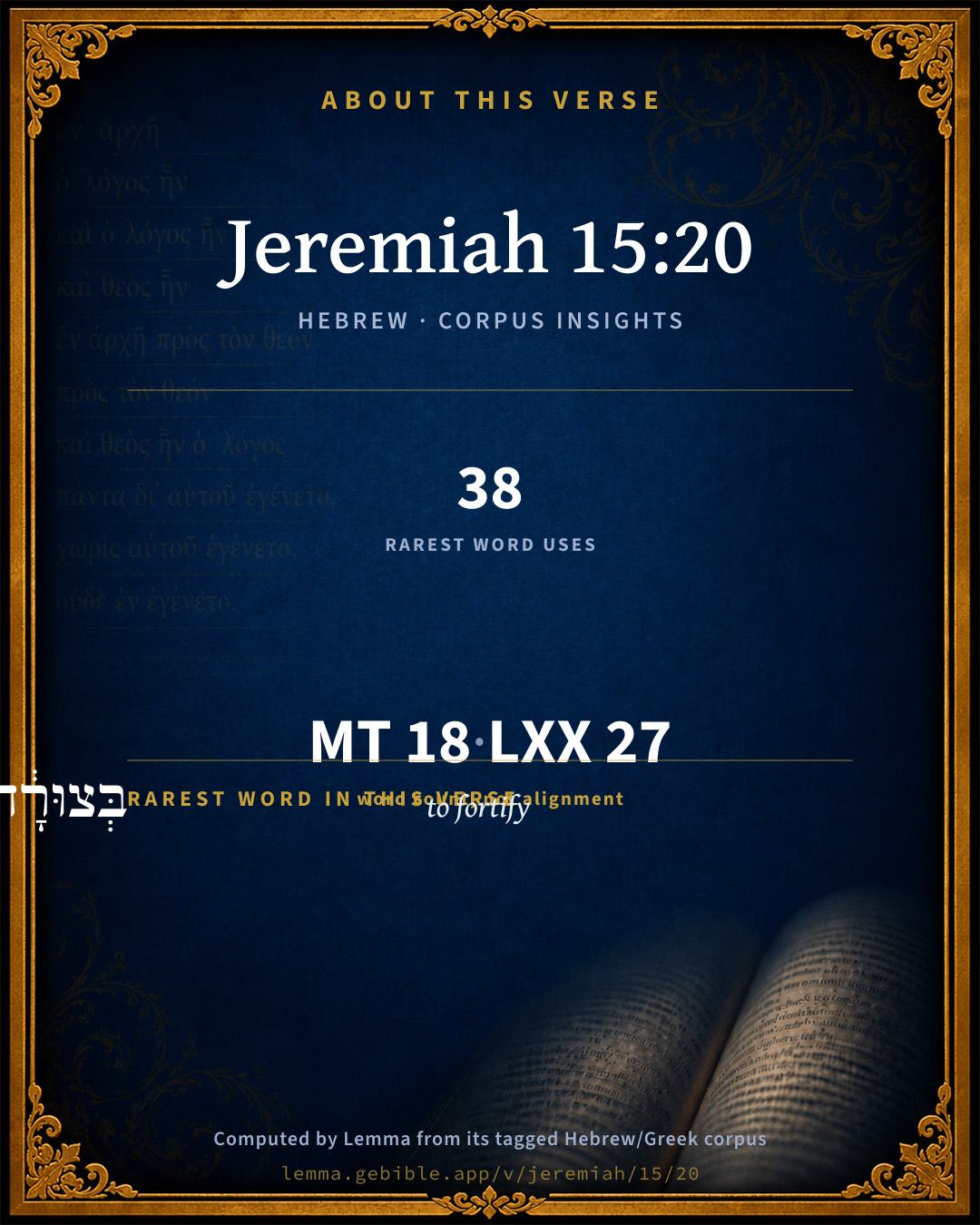
בְּצוּרָ֔ה to fortify H1219 occurs in 38 verses of the Hebrew Bible. Also found in:

Grammatical profile

  • 5 verbs
  • 5 nouns
  • 1 adjective
  • 2 pronouns
  • 3 prepositions
  • 1 conjunction
  • 1 particle

Verb forms

  • וּנְתַתִּ֜יךָ Qal · Sequential Perfect
  • וְנִלְחֲמ֥וּ Niphal · Sequential Perfect
  • י֣וּכְלוּ Qal · Imperfect
  • לְהוֹשִֽׁיעֲךָ֥ Hiphil · Infinitive Construct
  • וּלְהַצִּילֶ֖ךָ Hiphil · Infinitive Construct

Hebrew & Septuagint length

In the original languages it is 18 Hebrew tokens and 27 Greek tokens — but the two are counted differently (Hebrew bundles its prefixes and suffixes into one token; the Greek is in lemma form), so that isn’t a like-for-like length.

Cross-references

19

Topical passages linked to Jeremiah 15:20 in the Treasury of Scripture Knowledge — connected by theme and wording, ordered by reader-vote popularity; previews shown in the World English Bible.

  • Jeremiah 1:18–19 For, behold, I have made you this day a fortified city, and an iron pillar, and brazen walls, against the whole land, against the kings of Judah, against the princes of it, against the priests of it, and against the people of the land.
  • Ezekiel 3:9 As an adamant harder than flint have I made your forehead: don't be afraid of them, neither be dismayed at their looks, though they are a rebellious house.
  • Psalms 46:7 Yahweh of Hosts is with us. The God of Jacob is our refuge. Selah.
  • Psalms 124:1–3 If it had not been Yahweh who was on our side, Let Israel now say,
  • Acts 18:9–10 The Lord said to Paul in the night by a vision, "Don't be afraid, but speak and don't be silent;
  • Psalms 46:11 Yahweh of Hosts is with us. The God of Jacob is our refuge. Selah.
  • Psalms 129:1–2 Many times they have afflicted me from my youth up. Let Israel now say,
  • Isaiah 8:9–10 Make an uproar, O you peoples, and be broken in pieces! And give ear, all you of far countries: gird yourselves, and be broken in pieces! Gird yourselves, and be broken in pieces!
  • Isaiah 41:10 Don't you be afraid, for I am with you; don't be dismayed, for I am your God; I will strengthen you; yes, I will help you; yes, I will uphold you with the right hand of my righteousness.
  • Jeremiah 1:8 Don't be afraid because of them; for I am with you to deliver you, says Yahweh.
  • Jeremiah 20:11–12 But Yahweh is with me as an awesome mighty one: therefore my persecutors shall stumble, and they shall not prevail; they shall be utterly disappointed, because they have not dealt wisely, even with an everlasting dishonor which shall never be forgotten.
  • 2 Timothy 4:16–17 At my first defense, no one came to help me, but all left me. May it not be held against them.
  • Jeremiah 6:27 I have made you a tester of metals [and] a fortress among my people; that you may know and try their way.
  • Acts 4:8–13 Then Peter, filled with the Holy Spirit, said to them, "You rulers of the people, and elders of Israel,
  • Acts 4:29–31 Now, Lord, look at their threats, and grant to your servants to speak your word with all boldness,
  • Acts 5:29–32 But Peter and the apostles answered, "We must obey God rather than men.
  • Romans 8:31–39 What then shall we say about these things? If God is for us, who can be against us?
  • 2 Timothy 4:22 The Lord Jesus Christ be with your spirit. Grace be with you. Amen.
  • Isaiah 7:14 Therefore the Lord himself will give you a sign. Behold, the virgin will conceive, and bear a son, and shall call his name Immanuel.

Cross-references courtesy of OpenBible.info (CC BY 4.0).

Hebrew and Greek witnesses Masoretic Hebrew ↔ Greek Septuagint

The same verse in the two great witnesses to the Old Testament, shown verse-for-verse.

These are two independent witnesses, not word-aligned to each other, and the Septuagint is shown in lemma (dictionary) form.

Hebrew Jeremiah 15:20 Masoretic · Westminster Leningrad Codex

וּנְתַתִּ֜יךָ לָעָ֣ם הַזֶּ֗ה לְחוֹמַ֤ת נְחֹ֨שֶׁת֙ בְּצוּרָ֔ה וְנִלְחֲמ֥וּ אֵלֶ֖יךָ וְלֹא י֣וּכְלוּ לָ֑ךְ כִּֽי אִתְּךָ֥ אֲנִ֛י לְהוֹשִֽׁיעֲךָ֥ וּלְהַצִּילֶ֖ךָ נְאֻם יְהוָֽה

I will make you to this people a fortified brazen wall; and they shall fight against you, but they shall not prevail against you; for I am with you to save you and to deliver you, says Yahweh.

World English Bible · Public Domain

Greek LXX Structure differs

In the Septuagint, Jeremiah is about an eighth shorter than the Hebrew and arranges its material differently — the Oracles Against the Nations (Hebrew chapters 46–51) appear in the middle of the Greek book, after 25:13. Because the chapter and verse boundaries do not line up, a verse-for-verse comparison with the Hebrew is not shown.

A verse-for-verse comparison isn’t shown here because the chapters and verses don’t line up. Switch to the LXX edition with the MT / LXX toggle above to read the Greek directly.

Hebrew: Westminster Leningrad Codex (CC BY 4.0). Greek: Septuagint (public domain); English from a public-domain English Septuagint. How the Septuagint differs from the Hebrew →

Targum (Aramaic paraphrase)

1

The Targum is the ancient Jewish Aramaic paraphrase of the Hebrew Scriptures — an interpretive translation, not the Hebrew text itself. Onkelos (literal) and Pseudo-Jonathan (expansive) render the Torah, and Jonathan the Prophets. Coverage is partial: where no permissively-licensed English translation exists for a verse, only the Aramaic is shown. This is verse-level text, not a word-by-word alignment to the Hebrew.

  1. Targum Jonathan Prophets (Joshua–Malachi)
    וְאֶתְּנִינָךְ לְעַמָא הָדֵין כְּשׁוּר דִנְחַשׁ כְּרִיךְ וִיגִיחוּן לְקִבְּלָךְ וְלָא יִכְלוּן לָךְ אֲרֵי בְסַעֲדָךְ מֵימְרִי לְמַפְרָקָךְ וּלְשֵׁיזָבוּתָךְ אָמַר יְיָ:

    (no public-domain English translation for this verse)

    Targum Jonathan — Aramaic: “Mikraot Gedolot” (public domain). English: “Sefaria Community Translation” (CC0 1.0 (public-domain dedication)); “London "Chaldee Paraphrase," 1871” (public domain). Text via Sefaria.

Commentary

Notes on Jeremiah 15:20 from classic Christian and Jewish commentators (each source and its license shown beneath its notes). The classic Christian expositions comment on the surrounding passage and are grouped to its opening verse, so a note may address several verses; the Jewish commentaries on the Tanakh (Rashi and others) are per-verse, so they appear only where the commentator wrote on this verse.

Lemma curates 59 commentaries, every one of them public domain or Creative Commons licensed, each selected and text-cleaned for this edition rather than reprinted as found. About our sources →

Trapp's Complete Commentary

John Trapp

Jer 15:20 And I will make thee unto this people a fenced brasen wall: and they shall fight against thee, but they shall not prevail against thee: for I [am] with thee to save thee and to deliver thee, saith the LORD.

Ver. 20. And I will make thee.] See on Jer 1:18-19.

John Trapp, A Commentary or Exposition upon All the Books of the Old and New Testament (1647–1656) — public domain. Text from a community e-Sword module.

Tyndale Open Study Notes

Tyndale Open Resources

15:20-21 The Lord reaffirmed the promises he had made to Jeremiah when he called him to be a prophet (see 1:18-19).

Tyndale Open Study Notes — © Tyndale Open Resources, licensed CC BY-SA 4.0. Text via the HelloAO Bible API.

Geneva Bible (1599)

Geneva Bible translators

I will learn thee with an invincible strength and constancy, so that all the powers of the world shall not overcome thee.

Geneva Bible (1599) marginal notes — public domain. Text via Bolls.life.

Jamieson, Fausset & Brown

Robert Jamieson, A. R. Fausset & David Brown

The promise of Jer 1:18-19, in almost the same words, but with the addition, adapted to the present attacks of Jeremiah's formidable enemies, "I will deliver thee out of . . . wicked . . . redeem . . . terrible"; the repetition is in order to assure Jeremiah that God is the same now as when He first made the promise, in opposition to the prophet's irreverent accusation of unfaithfulness (Jer 15:18).

Next: Jeremiah Chapter 16

Jamieson, Fausset & Brown — Commentary Critical and Explanatory on the Whole Bible (1871) — public domain (CC PDM 1.0). Text via the HelloAO Bible API.

Adam Clarke's Commentary

Verse 20. I will make thee - a fenced brazen wall] While thou art faithful to me, none of them shall be able to prevail against thee.

Adam Clarke's Commentary on the Bible (1810–1826) — public domain. Text from a community e-Sword/MySword module.

John Calvin's Commentaries

As Jeremiah might have objected and said, that the burden was too heavy for him, if he only attempted to break down the contumacy of the people, for he was alone, and we have seen how great was the ferocity and also the cruelty of his adversaries, — as he might have shunned his commission, it being too much for his strength, hence God comes to his aid and bids him to take courage, for he was fortified by a help from heaven, I have set thee, he says, for a brazen fortified wall to this people The word for “fortified” is from בצר, betsar; were it בצרה betsare, derived from צור tsur, to besiege, it would much better suit this place. I know not whether the passage has been corrupted: however, I will not depart from the common reading. As then interpreters agree in this, I will change nothing; and indeed the difference is not very material.

We see then what God meant by these words: As the Prophet was almost alone, and God had bidden him to contend with many and powerful enemies, he promises to stand on his side; as though he had said, — “Though thou art defenceless and unarmed, and they are furnished with wealth and great power, thou shalt yet be like a well-fortified city; thou shalt indeed be impregnable, notwithstanding all their assaults and whatever they may attempt against thee.”

But God proceeds lay degrees; for he first declares that his Prophet would be like a brazen and a fortified wall, that is, like an invincible city: for by stating a part for the whole, a wall means a city that is impregnable. It then follows, They indeed will fight against thee. This warning was very necessary; for Jeremiah was doubtless willing to serve God in exercising authority over teachable and humble men, and in gently inducing them to render obedience to God; but he is reminded here that he would have many hard contests with a rebellious people, They will fight, he says, against thee We see how God does not promise ease to Jeremiah, nor gives him a hope of a better lot in future; but, on the centrary, he exhorts him to fight; and why? because the people would not bear the yoke of God, but kindled into rage against him. But another promise follows, They shall not prevail against thee, or overcome thee.

It was indeed necessary for Jeremiah of his own self to disturb the Jews; for nothing would have been more agreeable to them than his silence; and the object of all their attempts was to drive him to despair. But it is not without reason that they are said to fight with him; for it is contrary to nature for men to resist God and to set themselves against him when he invites them to himself; for what can be more natural than for the whole world to hasten to God? It is then something monstrous for men to oppose God, nay, furiously to rise up against hhn, when he kindly calls them to himself. Hence it is that God here makes the Jews the authors of all this disturbance. For since they loaded the Prophet with the most wicked calumnies, as we have seen, and said, that he was a turbulent man and confounded all things by his morosity, God here shews, on the other hand, that all the commotions and the rightings ought to be attributed to them, because they ought to have obediently received the doctrine set before them.

But though this was said only once to Jeremiah, yet the condition of all God’s servants is here set before us as in a mirror; for they cannot perform what God commands them without having to encounter many and grievous assaults; for the world is never so prepared to obey God, but the greater part furiously resists, and, as far as it can, stifles the word of God and checks his ministers.

He states the reason, For I am with thee to save thee and to deliver thee By these words God exhorts his Prophet to prayer; for we know how dangerous is self-security to all the children of God, and especially to teachers. As then they have at all times need of God’s aid, they are to be exhorted to have recourse to solitude and prayer. This is the import of the words which God uses, I am with thee; as though he had said, “Thou indeed wilt not stand by thyself, or through thine own painstaking, nor wilt thou be a conqueror by carrying on war thyself; but thou must learn to flee to me.” It afterwards follows —

John Calvin's Commentaries (1540-1563) — public domain. Text from the Calvin Translation Society English edition (1840s-50s) via the Christian Classics Ethereal Library (ccel.org). Calvin's coverage is partial (roughly two-thirds of the Bible); uncommented books and verses are honest gaps, never fabricated. The 19th-century editor's footnotes and remarks are omitted so the notes are faithfully Calvin's own voice.

Ellicott's Commentary for English Readers

(20) I will make thee unto this people . . .—It is significant that the promise reproduced the very words which the prophet had heard when he was first summoned to his work (see Note on Jer_1:18-19). Jehovah had not been unfaithful to His word, but, like all promises, it depended on implied conditions, and these the faint-hearted, desponding prophet had but imperfectly fulfilled. Let him “return” to the temper of trust, and there should be an abundant deliverance for him.

A Bible Commentary for English Readers, edited by Charles John Ellicott (1878–1897) — public domain. Text from a community e-Sword module.

The Cambridge Bible for Schools and Colleges

gen. ed. J. J. S. Perowne

20, 21. Cp. Jer_1:18 f.

21 the terrible] The chief men in Jerusalem, probably meaning Jehoiakim and his counsellors. See note on ch. Jer_12:7.

The Cambridge Bible for Schools and Colleges (gen. ed. J. J. S. Perowne; Cambridge University Press, 1878–1918) — public domain. Text from a community e-Sword module.

John Gill's Exposition

And I will deliver thee out of the hand of the wicked,.... The wicked Jews, Zedekiah and his courtiers, who imprisoned him:

and I will redeem thee out of the hand of the terrible; as kings and great men of the earth seem to be; or, "the violent", or "strong" (t), and mighty; that were stronger than he, that would use him with violence, and inject terror into him.

(t) "violentorum", Junius & Tremellius, Piscator, Cocceius, Schmidt; "fortium", V. L.

Next: Jeremiah Chapter 16

John Gill's Exposition of the Whole Bible (1746–1763) — public domain (CC PDM 1.0). Text via the HelloAO Bible API.

Matthew Poole's English Annotations

And I will make thee unto this people a fenced brazen wall: these words are expounded by those that follow.

They shall fight against thee, but they shall not prevail against thee: look, as men may throw stones or strike at a brazen wall, but do it no hurt; so, saith God, though thou shalt have enemies that will be offering at thee, yet if thou continuest steady in the doing of thy duty, they shall do thee no harm; for thou shalt have my power engaged for thee, to deliver and save thee from their malice.

Matthew Poole's English Annotations on the Holy Bible (1683–1685) — public domain. Text from a community e-Sword/MySword module.

Whedon's Commentary on the Bible

Daniel D. Whedon

20, 21. These verses contain an amplified repetition of the promise given at the very outset of his ministry, Jer_1:18-19.

Daniel D. Whedon (gen. ed.), Commentary on the Old and New Testaments (1874–1909) — public domain. Text from a community e-Sword module.

The Pulpit Commentary

And I will make thee, etc.; a solemn confirmation of the promises in Jer_1:18, Jer_1:19.

The Pulpit Commentary (1880–1919), ed. H.D.M. Spence-Jones & Joseph S. Exell — public domain. Text from a community e-Sword module.

Lesson kit

Teaching starters — assembled from the data on this page, not authored interpretation. Every prompt links to the verse data it draws on. Edit before teaching.

Jeremiah, in the Prophets, opens this verse with 18 words (17 distinct Hebrew lemmas). Its most distinctive word is bâtsar (“to fortify”). A historical commentator’s framing appears above. Read the whole chapter for the surrounding context.

Discussion questions

  1. The word bâtsar carries the sense “to fortify.” How does it shape the verse?
  2. How does Genesis 11:6, which shares the word «to fortify», read alongside this verse?
  3. The translations on this page render this verse differently — a whole-verse word diff, not a word-by-word alignment. What might account for the different wordings?
  4. «וּנְתַתִּ֜יךָ» is a Qal Sequential Perfect verb. How does that grammatical form shape the action described?
  5. Compare how Trapp's Complete Commentary and Tyndale Open Study Notes read this verse. Where do they agree or differ?

Things to notice

Reading settings

Reading text

Shown beneath each verse's original-language words.

Old Testament
Old Testament edition

Read the OT as the Masoretic Hebrew (MT) or the Greek Septuagint (LXX).

English shown for the Greek Septuagint (in the Hebrew ↔ Greek comparison).

Comparing translations? Open the Compare panel on any verse page to stack up to four side by side.