Genesis 48:10

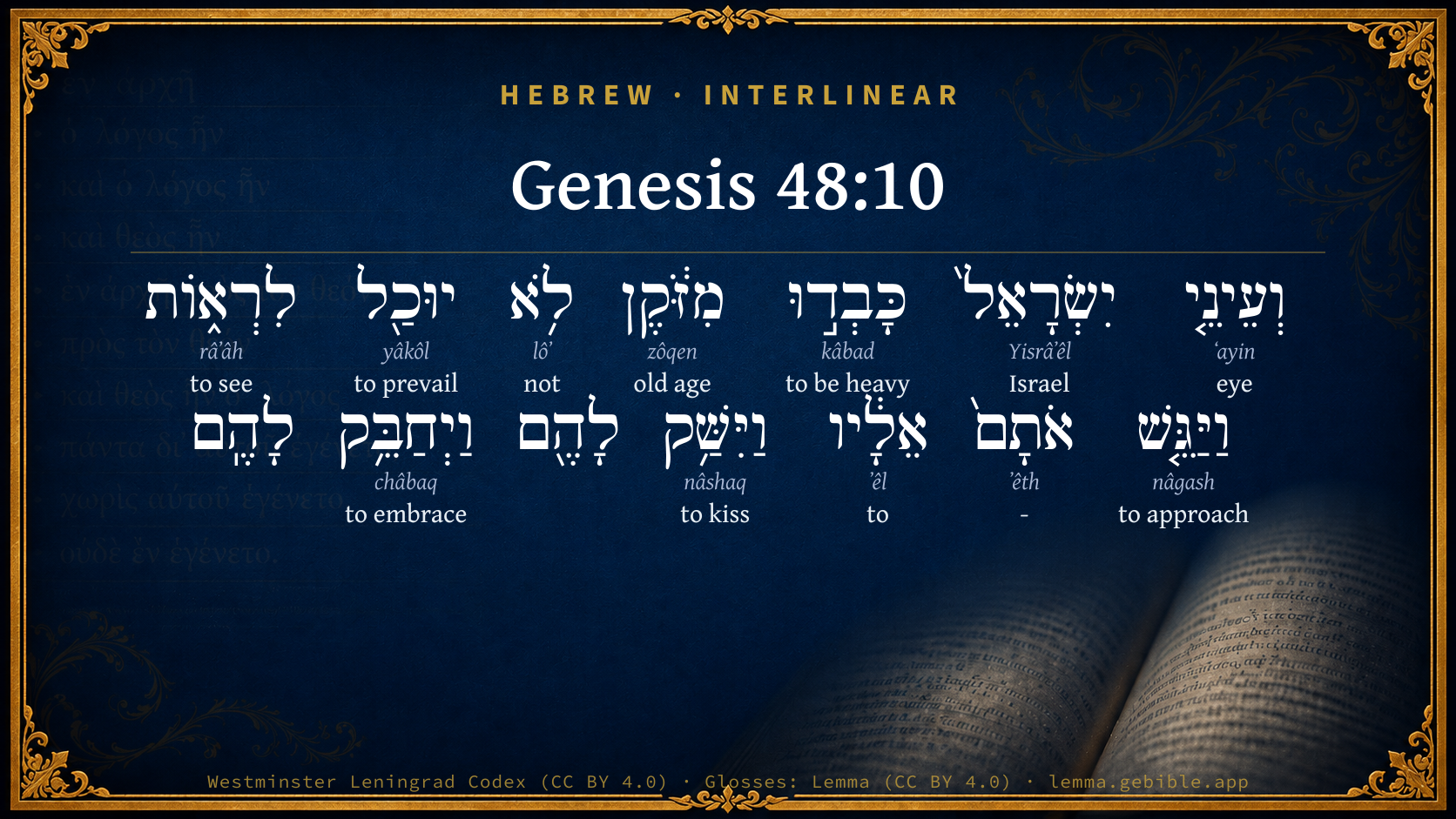
Hebrew (Westminster Leningrad Codex) Genesis 48:10 appears in the Hebrew Old Testament. The text above is from the Westminster Leningrad Codex. Each word links to its Strong’s number, a concise gloss, and parsing drawn from the Open Scriptures Hebrew Bible morphology. Click any word for its full Brown-Driver-Briggs (BDB) entry.
Download image
Cite this verse

Genesis 48:10 (World English Bible). Public Domain. Lemma interlinear Bible study tool, https://lemma.gebible.app/v/genesis/48/10.

Show BibTeX & RIS
BibTeX
RIS
English Translation
Now the eyes of Israel were dim for age, so that he couldn't see. He brought them near to him; and he kissed them, and embraced them.
World English Bible · Public Domain
Highlights
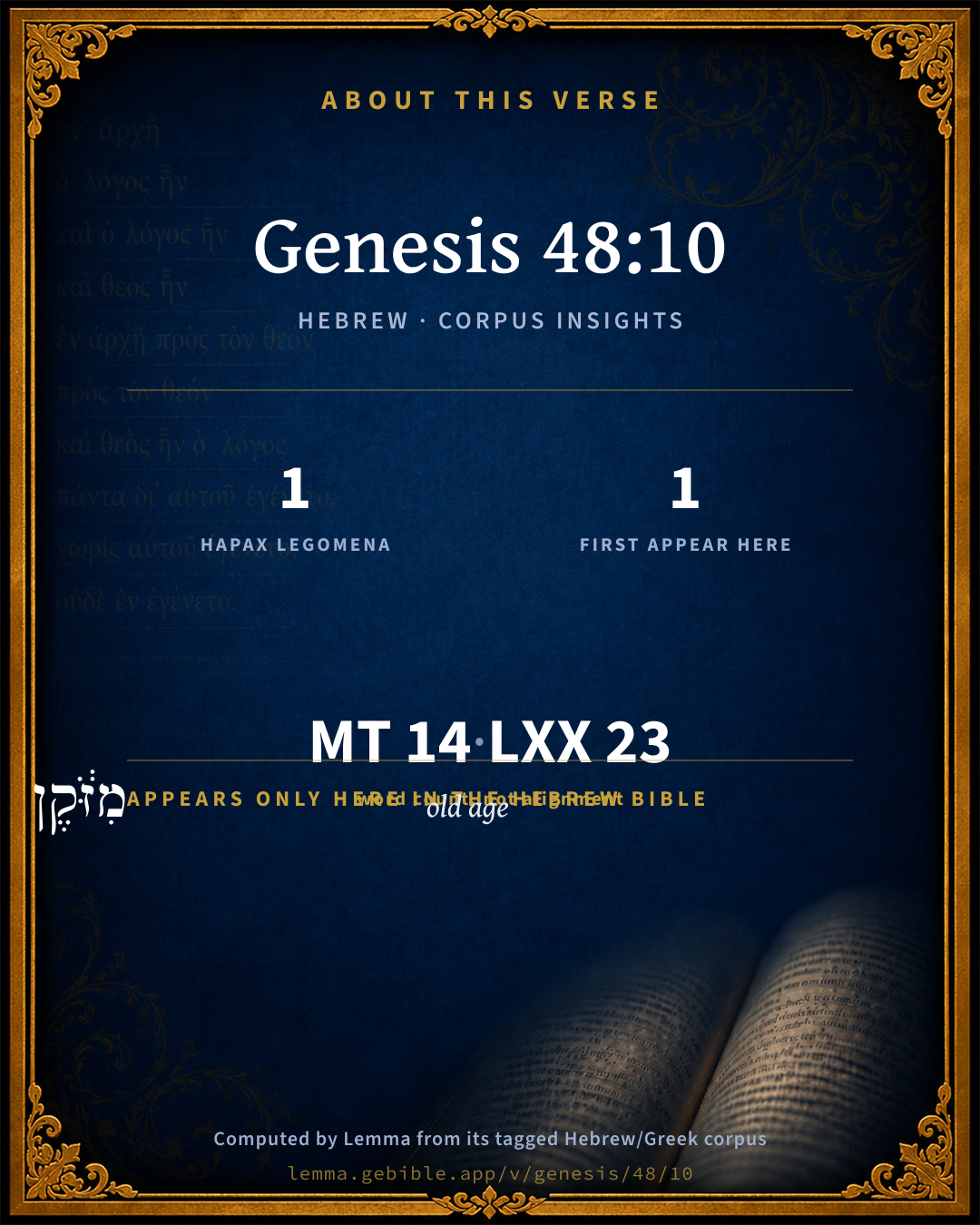
  • 1 hapax legomenon — only here in the Hebrew Bible
  • 1 first appearance in the Hebrew Bible
Full analysis ↓
Download a study sheet

One document with this verse’s original text, its word-by-word gloss line, the meaning frame, cross-references with their text, attributed commentary, and full source and license credits — printable, and it pastes into notes with its structure intact.

This verse Autodidact and up

Study sheet (.html) Plain text (.txt)

A passage Seminary Student

Up to 50 verses in one chapter. A passage sheet keeps up to 6 commentary sources and 12 cross-references per verse, in the order this page ranks them, and says so on the sheet whenever that leaves anything out. Ask for a single verse and you get the Autodidact verse sheet above.

Everything on this page stays free to read, with no account — the sheet is a download of what is already on screen, not access to it.

Want to remove ads? Support Godless Engineer
Compare translations 3

The same verse in 3 English versions, stacked beneath the original-language interlinear above. Click any original word for its lexicon entry.

Each is an independent rendering of the whole verse — the interlinear is not word-aligned to these translations.

Highlighted words mark where these versions differ — a whole-verse word diff, not a word-by-word alignment.

  • World English Bible Public Domain
    Now the eyes of Israel were dim for age, so that he couldn't see. He brought them near to him; and he kissed them, and embraced them.
  • King James Version Public Domain
    Now the eyes of Israel were dim for age, so that he could not see. And he brought them near unto him; and he kissed them, and embraced them.
  • unfoldingWord Literal Text CC BY-SA 4.0
    Now the eyes of Israel were heavy from age, he was not able to see. So he brought them near to him, and he kissed them and embraced them.

unfoldingWord Literal Text — © unfoldingWord, licensed CC BY-SA 4.0. Word-aligned USFM3 via Door43 (git.door43.org/unfoldingWord/en_ult).

Versions to compare (up to 4)

3 of 4 selected

Show all 18 translations

Every available English version of this verse, each an independent rendering of the whole verse.

  • World English Bible Public Domain
    Now the eyes of Israel were dim for age, so that he couldn't see. He brought them near to him; and he kissed them, and embraced them.
  • Berean Standard Bible Public Domain
    Now Israel’s eyesight was poor because of old age; he could hardly see. Joseph brought his sons to him, and his father kissed them and embraced them.
  • Majority Standard Bible Public Domain
    Now Israel’s eyesight was poor because of old age; he could hardly see. Joseph brought his sons to him, and his father kissed them and embraced them.
  • King James Version Public Domain
    Now the eyes of Israel were dim for age, so that he could not see. And he brought them near unto him; and he kissed them, and embraced them.
  • American Standard Version (1901) Public Domain
    Now the eyes of Israel were dim for age, so that he could not see. And he brought them near unto him; and he kissed them, and embraced them.
  • Revised Version (1885) Public Domain
    Now the eyes of Israel were dim for age, so that he could not see. And he brought them near unto him; and he kissed them, and embraced them.
  • Geneva Bible (1599) Public Domain
    (For the eyes of Israel were dimme for age, so that hee coulde not well see) Then he caused them to come to him, and he kissed them and embraced them.
  • Douay-Rheims (1899) Public Domain
    For Israel's eyes were dim by reason of his great age, and he could not see clearly. And when they were brought to him, he kissed and embraced them.
  • Young's Literal Translation Public Domain
    And the eyes of Israel have been heavy from age, he is unable to see; and he bringeth them nigh unto him, and he kisseth them, and cleaveth to them;
  • Literal Standard Version CC BY-SA 4.0
    And the eyes of Israel have been heavy from age—he is unable to see; and he brings them near to him, and he kisses them and cleaves to them;
  • Unlocked Literal Bible CC BY-SA 4.0
    Now Israel's eyes were failing because of his age, so he could not see. So Joseph brought them near to him, and he kissed them and embraced them.
  • unfoldingWord Literal Text CC BY-SA 4.0
    Now the eyes of Israel were heavy from age, he was not able to see. So he brought them near to him, and he kissed them and embraced them.
  • Darby Bible Public Domain
    But the eyes of Israel were heavy from age: he could not see. And he brought them nearer to him; and he kissed them, and embraced them.
  • World Messianic Bible Public Domain
    Now the eyes of Israel were dim for age, so that he couldn’t see well. Joseph brought them near to him; and he kissed them, and embraced them.
  • Webster's Bible Public Domain
    (Now the eyes of Israel were dim for age, so that he could not see:) And he brought them near to him; and he kissed them, and embraced them.
  • Free Bible Version CC BY-SA 4.0
    Israel's eyesight was failing because of his age and he couldn't see well, so Joseph brought them close to his father, and he kissed and hugged them.
  • Bible in Basic English Public Domain
    Now because Israel was old, his eyes were no longer clear, and he was not able to see. So he made them come near to him, and he gave them a kiss, folding them in his arms.
  • JPS Tanakh (1917) Public Domain
    Now the eyes of Israel were dim for age, so that he could not see. And he brought them near unto him; and he kissed them, and embraced them.

Literal Standard Version (2020), Covenant Press — licensed CC BY-SA 4.0. Text via the HelloAO Bible API (eBible.org). Unlocked Literal Bible (unfoldingWord) — licensed CC BY-SA 4.0. Text via the HelloAO Bible API (eBible.org). unfoldingWord Literal Text — © unfoldingWord, licensed CC BY-SA 4.0. Word-aligned USFM3 via Door43 (git.door43.org/unfoldingWord/en_ult). Free Bible Version, Dr. Jonathan Gallagher — licensed CC BY-SA 4.0. Text via the HelloAO Bible API (eBible.org).

Word by word

More ways to search: Search by grammar → Find every occurrence → Compare this word →

Practice this passage: Drill this verse → Learn its vocabulary →

מִזֹּ֔קֶן
zôqen
H2207
“from · old age”
Preposition + Noun, Common, Masculine, Singular, Absolute
Part of Speech
Preposition + Noun
Type
Common
Gender
Masculine
Number
Singular
State
Absolute
Full BDB Definition

Origin: from H2204

TWOT: 574c

old age
  1. וְעֵינֵ֤י ʻayin H5869 “and · eyes of” Conjunction + Noun, Common, Both, Dual, Construct
  2. יִשְׂרָאֵל֙ Yisrâʼêl H3478 “Israel” Noun, Proper
  3. כָּבְד֣וּ kâbad H3513 “to be heavy” Verb, Qal, Perfect, 3rd Person, Common, Plural
  4. לֹ֥א lôʼ H3808 “not” Particle, Negative
  5. יוּכַ֖ל yâkôl H3201 “to prevail” Verb, Qal, Imperfect, 3rd Person, Masculine, Singular
  6. לִרְא֑וֹת râʼâh H7200 “to see” Preposition + Verb, Qal, Infinitive Construct
  7. וַיַּגֵּ֤שׁ nâgash H5066 “and · to approach” Conjunction + Verb, Hiphil, Sequential Imperfect, 3rd Person, Masculine, Singular
  8. אֹתָם֙ ʼêth H853 “- · them” Particle, Direct Object + Suffix, Personal, 3rd Person, Masculine, Plural
  9. אֵלָ֔יו ʼêl H413 “to · him” Preposition + Suffix, Personal, 3rd Person, Masculine, Singular
  10. וַיִּשַּׁ֥ק nâshaq H5401 “and · to kiss” Conjunction + Verb, Qal, Sequential Imperfect, 3rd Person, Masculine, Singular
  11. וַיְחַבֵּ֥ק châbaq H2263 “and · to embrace” Conjunction + Verb, Piel, Sequential Imperfect, 3rd Person, Masculine, Singular

About this verse

These counts appear in no published source. They are computed here, from the morphology-tagged text and Lemma’s own curated glosses. What Lemma adds →

14
words
12
distinct lemmas
Pentateuch
section

Notable vocabulary

1 hapax legomenon — a word that appears only here in the entire Hebrew Bible:

  • מִזֹּ֔קֶן old age H2207

First appearance in Scripture

This word makes its first canonical appearance in the Hebrew Bible here:

  • מִזֹּ֔קֶן old age H2207

Shared distinctive vocabulary

וַיְחַבֵּ֥ק to embrace H2263 occurs in 12 verses of the Hebrew Bible. Also found in:

Grammatical profile

  • 6 verbs
  • 3 nouns
  • 3 prepositions
  • 2 particles

Verb forms

  • כָּבְד֣וּ Qal · Perfect
  • יוּכַ֖ל Qal · Imperfect
  • לִרְא֑וֹת Qal · Infinitive Construct
  • וַיַּגֵּ֤שׁ Hiphil · Sequential Imperfect
  • וַיִּשַּׁ֥ק Qal · Sequential Imperfect
  • וַיְחַבֵּ֥ק Piel · Sequential Imperfect

Hebrew & Septuagint length

In English translation the verse runs 27 words from the Hebrew and 28 from the Septuagint (LXX English) — closely comparable.

A rough comparison of the two English renderings, which tokenize alike — not a word-level alignment.

Word counts can differ between the Hebrew and the Greek without any difference in meaning — e.g. the Hebrew direct-object marker אֵת has no separate Greek word, and Greek often adds the article ὁ.

In the original languages it is 14 Hebrew tokens and 23 Greek tokens — but the two are counted differently (Hebrew bundles its prefixes and suffixes into one token; the Greek is in lemma form), so that isn’t a like-for-like length.

Cross-references

9

Topical passages linked to Genesis 48:10 in the Treasury of Scripture Knowledge — connected by theme and wording, ordered by reader-vote popularity; previews shown in the World English Bible.

  • Genesis 27:1 It happened, that when Isaac was old, and his eyes were dim, so that he could not see, he called Esau his elder son, and said to him, "My son?" He said to him, "Here I am."
  • Genesis 27:27 He came near, and kissed him. He smelled the smell of his clothing, and blessed him, and said, "Behold, the smell of my son Is as the smell of a field which Yahweh has blessed.
  • Genesis 31:55 Early in the morning, Laban rose up, and kissed his sons and his daughters, and blessed them. Laban departed and returned to his place.
  • Genesis 45:15 He kissed all his brothers, and wept on them. After that his brothers talked with him.
  • 1 Samuel 3:2 It happened at that time, when Eli was laid down in his place (now his eyes had begun to grow dim, so that he could not see),
  • 1 Samuel 4:15 Now Eli was ninety-eight years old; and his eyes were set, so that he could not see.
  • 1 Kings 19:20 He left the oxen, and ran after Elijah, and said, Let me, I pray you, kiss my father and my mother, and then I will follow you. He said to him, Go back again; for what have I done to you?
  • Isaiah 6:10 Make the heart of this people fat; Make their ears heavy, and shut their eyes; Lest they see with their eyes, And hear with their ears, And understand with their heart, And turn again, and be healed."
  • Isaiah 59:1 Behold, Yahweh's hand is not shortened, that it can't save; neither his ear heavy, that it can't hear:

Cross-references courtesy of OpenBible.info (CC BY 4.0).

Hebrew and Greek witnesses Masoretic Hebrew ↔ Greek Septuagint

The same verse in the two great witnesses to the Old Testament, shown verse-for-verse.

These are two independent witnesses, not word-aligned to each other, and the Septuagint is shown in lemma (dictionary) form.

Hebrew Genesis 48:10 Masoretic · Westminster Leningrad Codex

וְעֵינֵ֤י יִשְׂרָאֵל֙ כָּבְד֣וּ מִזֹּ֔קֶן לֹ֥א יוּכַ֖ל לִרְא֑וֹת וַיַּגֵּ֤שׁ אֹתָם֙ אֵלָ֔יו וַיִּשַּׁ֥ק לָהֶ֖ם וַיְחַבֵּ֥ק לָהֶֽם

Now the eyes of Israel were dim for age, so that he couldn't see. He brought them near to him; and he kissed them, and embraced them.

World English Bible · Public Domain

Greek LXX Genesis 48:10 Septuagint · lemma form

ὁ δέ ὀφθαλμός ἰσραήλ βαρυωπέω ἀπό ὁ γῆρας καί οὐ δύναμαι βλέπω καί ἐγγίζω αὐτός πρός αὐτός καί φιλέω αὐτός καί περιλαμβάνω αὐτός

Now the eyes of Israel were dim through age, and he could not see; and he brought them near to him, and he kissed them, and embraced them.

LXX2012 (modern English Septuagint) · Public Domain

Hebrew: Westminster Leningrad Codex (CC BY 4.0). Greek: Septuagint (public domain); English from LXX2012 (modern English Septuagint) (Public Domain). How the Septuagint differs from the Hebrew →

Targum (Aramaic paraphrase)

2

The Targum is the ancient Jewish Aramaic paraphrase of the Hebrew Scriptures — an interpretive translation, not the Hebrew text itself. Onkelos (literal) and Pseudo-Jonathan (expansive) render the Torah, and Jonathan the Prophets. Coverage is partial: where no permissively-licensed English translation exists for a verse, only the Aramaic is shown. This is verse-level text, not a word-by-word alignment to the Hebrew.

  1. Targum Onkelos Torah (Genesis–Deuteronomy)
    וְעֵינֵי יִשְׂרָאֵל יְקָרָן מִסֵּיבוּ לָא יִכּוּל לְמֶחֱזֵי וְקָרִיב יָתְהוֹן לְוָתֵהּ וְנַשִּׁיק לְהוֹן וְגַפִּיף לְהוֹן

    (no public-domain English translation for this verse)

    Targum Onkelos — Aramaic: “Onkelos Genesis” (public domain); “Onkelos Exodus” (public domain); “Onkelos Leviticus” (public domain); “Onkelos Numbers” (public domain); “Onkelos Deuteronomy” (public domain). English: “Sefaria Community Translation” (CC0 1.0 (public-domain dedication)); “J.W. Etheridge. The Targums of Onkelos and Jonathan Ben Uzziel on the Pentateuch. London: Longmans, Green, 1862” (public domain). Text via Sefaria.

  2. Targum Pseudo-Jonathan Torah (Genesis–Deuteronomy)
    וְעֵינֵי יִשְרָאֵל יְקָרָן מִן סֵיבוּ וְלָא יָכִיל לְמֵיחְמֵי וּקְרִיב יַתְהוֹן לְוָתֵיהּ וּנְשַׁק לְהוֹן וְגַפֵיף לְהוֹן

    But Israel's eyes were heavy from age, and he could not see. And he brought them to him, and he kissed them and embraced them.

    Targum Pseudo-Jonathan — Aramaic: “Targum Jonathan on Genesis” (public domain); “Targum Jonathan on Exodus” (public domain); “Targum Jonathan on Leviticus” (public domain); “Targum Jonathan on Numbers” (public domain); “Targum Jonathan on Deuteronomy” (public domain). English: “The Targum of Jonathan ben Uzziel, trans. J. W. Etheridge, London, 1862” (public domain). Text via Sefaria.

Commentary

Notes on Genesis 48:10 from classic Christian and Jewish commentators (each source and its license shown beneath its notes). The classic Christian expositions comment on the surrounding passage and are grouped to its opening verse, so a note may address several verses; the Jewish commentaries on the Tanakh (Rashi and others) are per-verse, so they appear only where the commentator wrote on this verse.

Lemma curates 59 commentaries, every one of them public domain or Creative Commons licensed, each selected and text-cleaned for this edition rather than reprinted as found. About our sources →

Tyndale Open Study Notes

Tyndale Open Resources

48:10 As Isaac his father had done, Jacob now gave the blessing when his eyesight was failing (cp. 27:1).

Tyndale Open Study Notes — © Tyndale Open Resources, licensed CC BY-SA 4.0. Text via the HelloAO Bible API.

The Cambridge Bible for Schools and Colleges

gen. ed. J. J. S. Perowne

10. the eyes of Israel] Cf. the similar account of Isaac, Gen_27:1.

The Cambridge Bible for Schools and Colleges (gen. ed. J. J. S. Perowne; Cambridge University Press, 1878–1918) — public domain. Text from a community e-Sword module.

John Gill's Exposition

Now the eyes of Israel were dim for age,.... Or "heavy" (p), that he could not lift them up easily and see clearly; his eyebrows hung over, his eyes were sunk in his head, and the humours pressed them through old age, that it was with difficulty he could perceive an object, at least not distinctly:

so that he could not see; very plainly, otherwise he did see the sons of Joseph, though he could not discern who they were, Gen 49:8,

and he brought them near unto him; that he might have a better sight of them and bless them:

and he kissed them, and embraced them: as a token of his affection for them.

(p) "graves erant", Pagninus, Montanus, Junius & Tremellius, Piscator, &c.

John Gill's Exposition of the Whole Bible (1746–1763) — public domain (CC PDM 1.0). Text via the HelloAO Bible API.

The Pulpit Commentary

Now (literally, and) the eyes of Israel were dim (literally, heavy) for age, so that he could not see. This explains why he did not earlier recognize his grandchildren, and why he asked them to be set close by his bed. And he (their father) brought them near unto him; and he (their old grandfather) kissed them, and embraced them. (cf. Isaac"s blessing of Jacob, Gen_27:26, Gen_27:27)

The Pulpit Commentary (1880–1919), ed. H.D.M. Spence-Jones & Joseph S. Exell — public domain. Text from a community e-Sword module.

Radak

Rabbi David Kimhi (Radak)

ויגש אותם אליו, not in this order.

Radak on the Tanakh — English translations: “Sefaria Community Translation” (CC0 1.0 (public-domain dedication)); “Eliyahu Munk, HaChut Hameshulash” (CC BY 4.0); “Rabbi Mike Feuer, Jerusalem Anthology” (CC BY 4.0); and “R. David Kimhi on the first book of Psalms, Translated by R.G. Finch, London, 1919” (public domain). Text via Sefaria.

Lesson kit

Teaching starters — assembled from the data on this page, not authored interpretation. Every prompt links to the verse data it draws on. Edit before teaching.

Genesis, in the Pentateuch, opens this verse with 14 words (12 distinct Hebrew lemmas). Its most distinctive word is zôqen (“old age”). A historical commentator’s framing appears above. Read the whole chapter for the surrounding context.

Discussion questions

  1. What does “old age” (zôqen) contribute to the verse as a whole?
  2. 1 word here appears nowhere else in the Hebrew Bible. Why might the author reach for such rare wording?
  3. This is the first place “old age” appears in Scripture (first appears here). What does its debut here establish?
  4. How does Genesis 29:13, which shares the word «to embrace», read alongside this verse?
  5. These translations render this verse differently. What is at stake in choosing one wording over another?
  6. «כָּבְד֣וּ» is a Qal Perfect verb. How does that grammatical form shape the action described?
  7. Compare how Tyndale Open Study Notes and The Cambridge Bible for Schools and Colleges read this verse. Where do they agree or differ?

Things to notice

Reading settings

Reading text

Shown beneath each verse's original-language words.

Old Testament
Old Testament edition

Read the OT as the Masoretic Hebrew (MT) or the Greek Septuagint (LXX).

English shown for the Greek Septuagint (in the Hebrew ↔ Greek comparison).

Comparing translations? Open the Compare panel on any verse page to stack up to four side by side.