Psalms 101:5

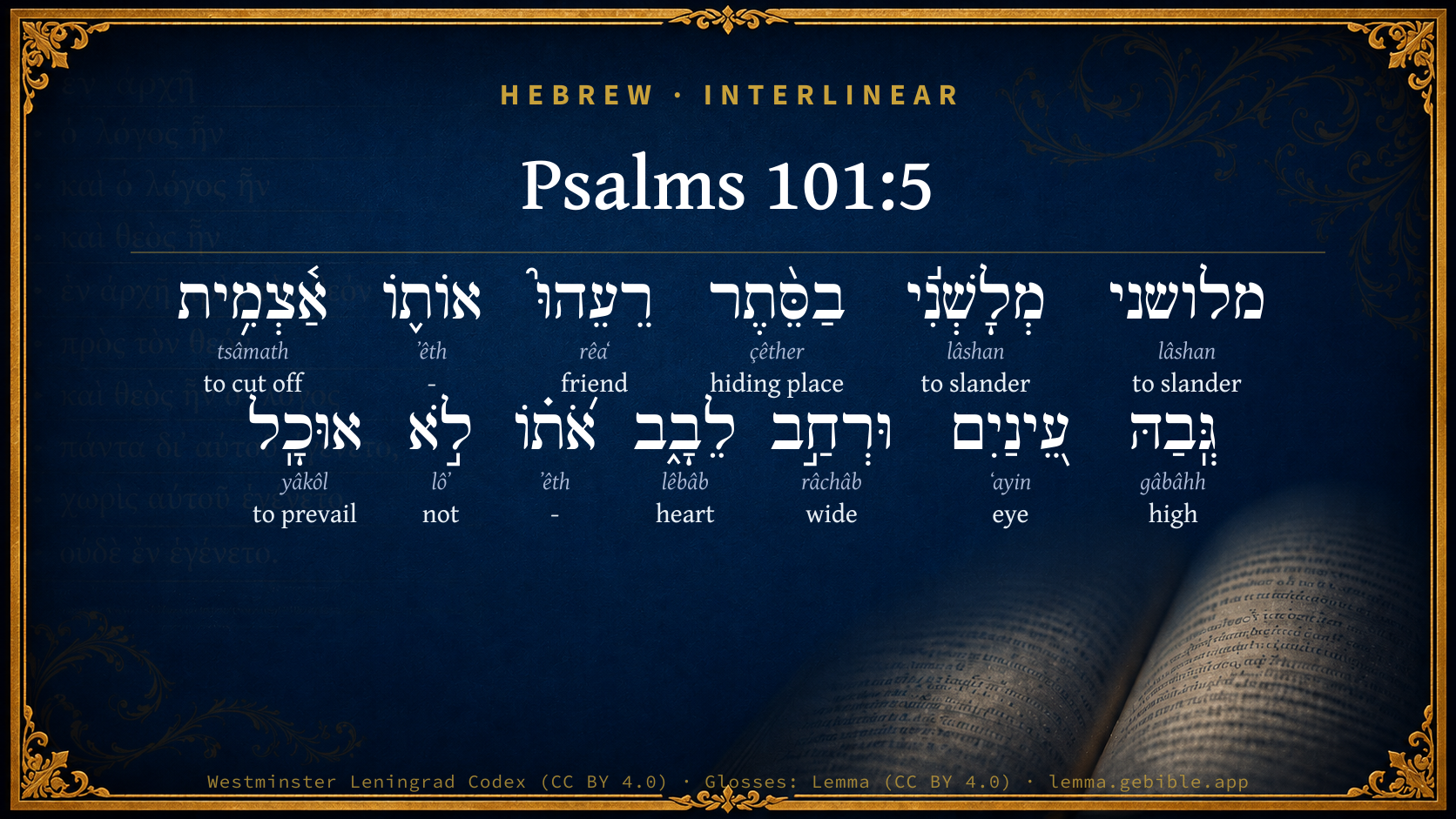
Hebrew (Westminster Leningrad Codex) Psalms 101:5 appears in the Hebrew Old Testament. The text above is from the Westminster Leningrad Codex. Each word links to its Strong’s number, a concise gloss, and parsing drawn from the Open Scriptures Hebrew Bible morphology. Click any word for its full Brown-Driver-Briggs (BDB) entry.
Download image
Cite this verse

Psalms 101:5 (World English Bible). Public Domain. Lemma interlinear Bible study tool, https://lemma.gebible.app/v/psalms/101/5.

Show BibTeX & RIS
BibTeX
RIS
English Translation
I will silence whoever secretly slanders his neighbor. I won't tolerate one who is haughty and conceited.
World English Bible · Public Domain
Highlights
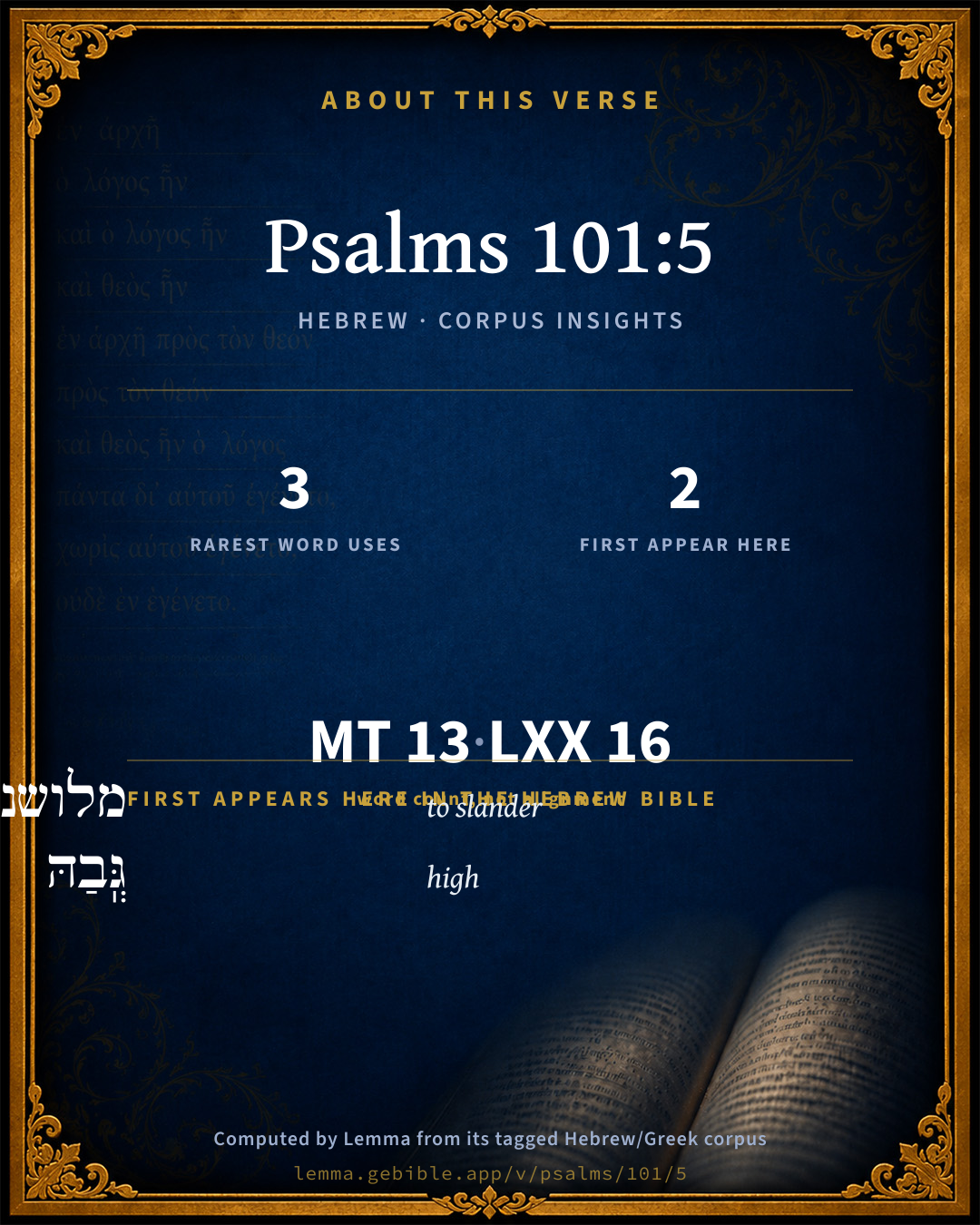
  • 2 first appearances in the Hebrew Bible
Full analysis ↓
Download a study sheet

One document with this verse’s original text, its word-by-word gloss line, the meaning frame, cross-references with their text, attributed commentary, and full source and license credits — printable, and it pastes into notes with its structure intact.

This verse Autodidact and up

Study sheet (.html) Plain text (.txt)

A passage Seminary Student

Up to 50 verses in one chapter. A passage sheet keeps up to 6 commentary sources and 12 cross-references per verse, in the order this page ranks them, and says so on the sheet whenever that leaves anything out. Ask for a single verse and you get the Autodidact verse sheet above.

Everything on this page stays free to read, with no account — the sheet is a download of what is already on screen, not access to it.

Want to remove ads? Support Godless Engineer
Compare translations 3

The same verse in 3 English versions, stacked beneath the original-language interlinear above. Click any original word for its lexicon entry.

Each is an independent rendering of the whole verse — the interlinear is not word-aligned to these translations.

Highlighted words mark where these versions differ — a whole-verse word diff, not a word-by-word alignment.

  • World English Bible Public Domain
    I will silence whoever secretly slanders his neighbor. I won't tolerate one who is haughty and conceited.
  • King James Version Public Domain
    Whoso privily slandereth his neighbour, him will I cut off: him that hath an high look and a proud heart will not I suffer.
  • unfoldingWord Literal Text CC BY-SA 4.0
    The one slandering his neighbor in secret, him I will destroy. The lofty of eyes and the wide of heart, him I cannot.

unfoldingWord Literal Text — © unfoldingWord, licensed CC BY-SA 4.0. Word-aligned USFM3 via Door43 (git.door43.org/unfoldingWord/en_ult).

Versions to compare (up to 4)

3 of 4 selected

Show all 18 translations

Every available English version of this verse, each an independent rendering of the whole verse.

  • World English Bible Public Domain
    I will silence whoever secretly slanders his neighbor. I won't tolerate one who is haughty and conceited.
  • Berean Standard Bible Public Domain
    Whoever slanders his neighbor in secret, I will put to silence; the one with haughty eyes and a proud heart, I will not endure.
  • Majority Standard Bible Public Domain
    Whoever slanders his neighbor in secret, I will put to silence; the one with haughty eyes and a proud heart, I will not endure.
  • King James Version Public Domain
    Whoso privily slandereth his neighbour, him will I cut off: him that hath an high look and a proud heart will not I suffer.
  • American Standard Version (1901) Public Domain
    Whoso privily slandereth his neighbor, him will I destroy: Him that hath a high look and a proud heart will I not suffer.
  • Revised Version (1885) Public Domain
    Whoso privily slandereth his neighbour, him will I destroy: him that hath an high look and a proud heart will I not suffer.
  • Geneva Bible (1599) Public Domain
    Him that priuily slandereth his neighbour, wil I destroy: him that hath a proude looke and hie heart, I cannot suffer.
  • Douay-Rheims (1899) Public Domain
    The man that in private detracted his neighbour, him did I persecute. With him that had a proud eye, and an unsatiable heart, I would not eat.
  • Young's Literal Translation Public Domain
    Whoso slandereth in secret his neighbour, Him I cut off, The high of eyes and proud of heart, him I endure not.
  • Literal Standard Version CC BY-SA 4.0
    Whoever slanders his neighbor in secret, || Him I cut off, || The high of eyes and proud of heart, || Him I do not endure.
  • Unlocked Literal Bible CC BY-SA 4.0
    I will destroy whoever secretly slanders his neighbor. I will not tolerate anyone who has a proud demeanor and an arrogant attitude.
  • unfoldingWord Literal Text CC BY-SA 4.0
    The one slandering his neighbor in secret, him I will destroy. The lofty of eyes and the wide of heart, him I cannot.
  • Darby Bible Public Domain
    Whoso secretly slandereth his neighbour, him will I destroy; him that hath a high look and a proud heart will I not suffer.
  • World Messianic Bible Public Domain
    I will silence whoever secretly slanders his neighbor. I won’t tolerate one who is arrogant and conceited.
  • Webster's Bible Public Domain
    Whoever privily slandereth his neighbor, him will I cut off: him that hath a high look and a proud heart I will not suffer.
  • Free Bible Version CC BY-SA 4.0
    I will silence anyone who secretly slanders their neighbor. I won't tolerate anyone who is proud and arrogant.
  • Bible in Basic English Public Domain
    I will put to death anyone who says evil of his neighbour secretly; the man with a high look and a heart of pride is disgusting to me.
  • JPS Tanakh (1917) Public Domain
    Whoso slandereth his neighbour in secret, him will I destroy; whoso is haughty of eye and proud of heart, him will I not suffer.

Literal Standard Version (2020), Covenant Press — licensed CC BY-SA 4.0. Text via the HelloAO Bible API (eBible.org). Unlocked Literal Bible (unfoldingWord) — licensed CC BY-SA 4.0. Text via the HelloAO Bible API (eBible.org). unfoldingWord Literal Text — © unfoldingWord, licensed CC BY-SA 4.0. Word-aligned USFM3 via Door43 (git.door43.org/unfoldingWord/en_ult). Free Bible Version, Dr. Jonathan Gallagher — licensed CC BY-SA 4.0. Text via the HelloAO Bible API (eBible.org).

Word by word

More ways to search: Search by grammar → Find every occurrence → Compare this word →

Practice this passage: Drill this verse → Learn its vocabulary →

מלושני
lâshan
H3960
“slandering”
Verb, Poel, Participle Active, Masculine, Singular, Construct
Part of Speech
Verb
Stem
Poel
Form
Participle Active
Gender
Masculine
Number
Singular
State
Construct
Full BDB Definition

Origin: a primitive root

TWOT: 1131

to use the tongue, slander - (Poel) to slander - (Piel) to slander - (Hiphil) to accuse
  1. מְלָשְׁנִ֬י lâshan H3960 “slandering” Verb, Poel, Participle Active, Masculine, Singular, Construct
  2. בַסֵּ֨תֶר çêther H5643 “in/at the · hiding place” Preposition, Determined + Noun, Common, Masculine, Singular, Absolute
  3. רֵעֵהוּ֮ rêaʻ H7453 “friend · his” Noun, Common, Masculine, Singular, Construct + Suffix, Personal, 3rd Person, Masculine, Singular
  4. אוֹת֪וֹ ʼêth H853 “- · him” Particle, Direct Object + Suffix, Personal, 3rd Person, Masculine, Singular
  5. אַ֫צְמִ֥ית tsâmath H6789 “to cut off” Verb, Hiphil, Imperfect, 1st Person, Common, Singular
  6. גְּֽבַהּ gâbâhh H1362 “high of” Adjective, Adjective, Masculine, Singular, Construct
  7. עֵ֭ינַיִם ʻayin H5869 “eyes” Noun, Common, Both, Dual, Absolute
  8. וּרְחַ֣ב râchâb H7342 “and · wide of” Conjunction + Adjective, Adjective, Masculine, Singular, Construct
  9. לֵבָ֑ב lêbâb H3824 “heart” Noun, Common, Masculine, Singular, Absolute
  10. אֹ֝ת֗וֹ ʼêth H853 “- · him” Particle, Direct Object + Suffix, Personal, 3rd Person, Masculine, Singular
  11. לֹ֣א lôʼ H3808 “not” Particle, Negative
  12. אוּכָֽל yâkôl H3201 “to prevail” Verb, Qal, Imperfect, 1st Person, Common, Singular

About this verse

These counts appear in no published source. They are computed here, from the morphology-tagged text and Lemma’s own curated glosses. What Lemma adds →

13
words
11
distinct lemmas
Wisdom
section

Notable vocabulary

The rarest word here is מלושני to slander H3960 — appearing just 3 times in the whole Hebrew Bible.

First appearance in Scripture

These words make their first canonical appearance in the Hebrew Bible here:

  • מלושני to slander H3960
  • גְּֽבַהּ high H1362

Shared distinctive vocabulary

מלושני to slander H3960 occurs in 2 verses of the Hebrew Bible. Also found in:

Grammatical profile

  • 4 verbs
  • 4 nouns
  • 2 adjectives
  • 3 particles

Verb forms

  • מלושני Poel · Participle Active
  • מְלָשְׁנִ֬י Poel · Participle Active
  • אַ֫צְמִ֥ית Hiphil · Imperfect
  • אוּכָֽל Qal · Imperfect

Repetition

A word recurs within this verse — often emphatic in Hebrew:

  • מלושני to slander H3960 ×2

Hebrew & Septuagint length

In English translation the verse runs 17 words from the Hebrew and 29 from the Septuagint (LXX English) — closely comparable.

A rough comparison of the two English renderings, which tokenize alike — not a word-level alignment.

Word counts can differ between the Hebrew and the Greek without any difference in meaning — e.g. the Hebrew direct-object marker אֵת has no separate Greek word, and Greek often adds the article ὁ.

In the original languages it is 13 Hebrew tokens and 16 Greek tokens — but the two are counted differently (Hebrew bundles its prefixes and suffixes into one token; the Greek is in lemma form), so that isn’t a like-for-like length.

Cross-references

24

Topical passages linked to Psalms 101:5 in the Treasury of Scripture Knowledge — connected by theme and wording, ordered by reader-vote popularity; previews shown in the World English Bible.

  • Psalms 15:3 He who doesn't slander with his tongue, Nor does evil to his friend, Nor casts slurs against his fellow man;
  • Psalms 18:27 For you will save the afflicted people, But the haughty eyes you will bring down.
  • Psalms 50:20 You sit and speak against your brother. You slander your own mother's son.
  • Proverbs 20:19 He who goes about as a tale-bearer reveals secrets; Therefore don't keep company with him who opens wide his lips.
  • Proverbs 30:13 There is a generation, oh how lofty are their eyes! Their eyelids are lifted up.
  • Obadiah 1:3–4 The pride of your heart has deceived you, you who dwell in the clefts of the rock, whose habitation is high, who says in his heart, 'Who will bring me down to the ground?'
  • Luke 18:14 I tell you, this man went down to his house justified rather than the other; for everyone who exalts himself will be humbled, but he who humbles himself will be exalted."
  • 1 Corinthians 5:11 But as it is, I wrote to you not to associate with anyone who is called a brother who is a sexual sinner, or covetous, or an idolater, or a slanderer, or a drunkard, or an extortioner. Don't even eat with such a person.
  • Titus 2:3 and that older women likewise be reverent in behavior, not slanderers nor enslaved to much wine, teachers of that which is good;
  • Proverbs 6:16–19 There are six things which Yahweh hates; Yes, seven which are an abomination to him:
  • Daniel 4:37 Now I, Nebuchadnezzar, praise and extol and honor the King of heaven; for all his works are truth, and his ways justice; and those who walk in pride he is able to abase.
  • 1 Peter 5:5–6 Likewise, you younger ones, be subject to the elder. Yes, all of you gird yourselves with humility, to subject yourselves to one another; for "God resists the proud, but gives grace to the humble."
  • Exodus 20:16 "You shall not give false testimony against your neighbor.
  • Exodus 23:1 "You shall not spread a false report. Don't join your hand with the wicked to be a malicious witness.
  • Leviticus 19:16 "'You shall not go up and down as a slanderer among your people; neither shall you stand against the life of your neighbor. I am Yahweh.
  • 1 Samuel 2:3 Talk no more so exceeding proudly; Don't let arrogance come out of your mouth; For Yahweh is a God of knowledge, By him actions are weighed.
  • Job 40:11–12 Pour forth the fury of your anger. Look on everyone who is proud, and bring him low.
  • Psalms 10:2–4 In arrogance, the wicked hunt down the weak; They are caught in the schemes that they devise.
  • Psalms 138:6 For though Yahweh is high, yet he looks after the lowly; But the proud, he knows from afar.
  • Proverbs 10:18 He who hides hatred has lying lips. He who utters a slander is a fool.
  • Proverbs 25:23 The north wind brings forth rain: So a backbiting tongue brings an angry face.
  • Isaiah 2:11 The lofty looks of man will be brought low, The haughtiness of men will be bowed down, And Yahweh alone will be exalted in that day.
  • Ezekiel 22:9 Slanderous men have been in you to shed blood; and in you they have eaten on the mountains: in the midst of you they have committed lewdness.
  • 1 Timothy 3:11 Their wives in the same way must be reverent, not slanderers, temperate, faithful in all things.

Cross-references courtesy of OpenBible.info (CC BY 4.0).

Hebrew and Greek witnesses Masoretic Hebrew ↔ Greek Septuagint

The same verse in the two great witnesses to the Old Testament, shown verse-for-verse.

You’re reading Greek Psalm 100 (Hebrew Psalm 101). The Septuagint counts the superscription, so verse numbers can differ from the Hebrew — chapter-level alignment, not verse-by-verse. Numbering follows Rahlfs.

These are two independent witnesses, not word-aligned to each other, and the Septuagint is shown in lemma (dictionary) form.

Hebrew Psalms 101:5 Masoretic · Westminster Leningrad Codex

מלושני מְלָשְׁנִ֬י בַסֵּ֨תֶר רֵעֵהוּ֮ אוֹת֪וֹ אַ֫צְמִ֥ית גְּֽבַהּ עֵ֭ינַיִם וּרְחַ֣ב לֵבָ֑ב אֹ֝ת֗וֹ לֹ֣א אוּכָֽל

I will silence whoever secretly slanders his neighbor. I won't tolerate one who is haughty and conceited.

World English Bible · Public Domain

Greek LXX Greek Psalm 100:5 Septuagint · lemma form

ὁ καταλαλέω λάθρα ὁ πλησίον αὐτός οὗτος ἐκδιώκω ὑπερήφανος ὀφθαλμός καί ἄπληστος καρδία οὗτος οὐ συνἐσθίω

Him that privily speaks against his neighbor, him have I driven from me: he that is proud in look and insatiable in heart, —with him I have not eaten.

LXX2012 (modern English Septuagint) · Public Domain

On this verse, Ellicott's Commentary for English Readers discusses the Septuagint’s reading. Read the note in Commentary ↓

Hebrew: Westminster Leningrad Codex (CC BY 4.0). Greek: Septuagint (public domain); English from LXX2012 (modern English Septuagint) (Public Domain). How the Septuagint differs from the Hebrew →

Commentary

Notes on Psalms 101:5 from classic Christian and Jewish commentators (each source and its license shown beneath its notes). The classic Christian expositions comment on the surrounding passage and are grouped to its opening verse, so a note may address several verses; the Jewish commentaries on the Tanakh (Rashi and others) are per-verse, so they appear only where the commentator wrote on this verse.

Lemma curates 59 commentaries, every one of them public domain or Creative Commons licensed, each selected and text-cleaned for this edition rather than reprinted as found. About our sources →

Trapp's Complete Commentary

John Trapp

Psa 101:5 Whoso privily slandereth his neighbour, him will I cut off: him that hath an high look and a proud heart will not I suffer.

Ver. 5. Whoso privily slandereth his neighbour] Heb. Him that in secret tongue smiteth his fellow friend, will I suppress. This David purposed to do, but this he did not so thoroughly in the case of poor Mephibosheth, belied by false Ziba; his resolution was maledicos et maleficos a se depellere, to drive away from him sycophants, backbiters, flatterers; but there is a great sympathy between princes and such pests, those harpies and gaping crows of courts, as one calleth them. ( Sorices et tineas palatii appellabat Constant. Mag.). David promiseth fair to purge and eliminate from his house and court of such, and to cut them off, secundum leges regni, according to the laws of the kingdom, as Aben Ezra glosseth.

Him that hath an high look] Pride will sit and show itself in the eyes as soon as anywhere. A man is seen for what he is, in oculis, in poculis, in loculis, say the Rabbis. See Pro 6:17.

And a proud heart] Heb. a wide or broad heart, that thinketh great things of himself, and seeketh great things for himself.

I will not suffer] Heb. I will not, sc. away with, or endure at any hand. The Greeks, and after them others, read, I will not eat with them. Legunt ocal pro ucal; and by large of heart, they understand belly gods, men of large appetites, such as were the two sons of Eli, Belialists, and Hellicones.

John Trapp, A Commentary or Exposition upon All the Books of the Old and New Testament (1647–1656) — public domain. Text from a community e-Sword module.

The Biblical Illustrator

Joseph S. Exell

Psa_101:5

Whoso privily slandereth his neighbour.

Sins of the tongue

Mr. Spurgeon used to say that if all mens sins were divided into two bundles, halt of them would be sins of the tongue. And if any one thinks that is a preachers exaggeration, let him read what is written in the Book of Proverbs and the Psalms on the matter, and he will find that the preacher has good authority for his strong words. The sins of the tongue, who can number them? The mischief of the tale-bearer, who can measure it? When St. Paul commands aged women that they be not slanderers, the word he uses means, literally, devils; it is the word which has given us our adjective diabolical; and verily there is no temper that is so wholly un-Christian and anti-Christian, that so well deserves the ugly name of devilish, as the temper of the slanderer and the back-biter. The Apostle James is, if possible, more emphatic still: If any man thinketh himself to be religious, he says, while he bridleth not his tongue but deceiveth his heart, this mans religion is vain. But on the other hand, If any stumbleth not in word, the same is a perfect man, able to bridle the whole body also. It is said that St. Augustine had engraved upon his table these words: There is no place at this table for any one who loves scandal. Shall not we make a like resolve, speak no slander--no, nor listen to it? For, if for every idle word that men shall speak they shall give account in the day of judgment, where shall the slanderer and the back-biter appear? (George Jackson, M.A.)

The Biblical Illustrator, edited by Joseph S. Exell (c. 1880s–1900s) — public domain. Text from a community e-Sword module.

Joseph Benson's Commentary

Psa 101:5-6. Whoso privily slandereth his neighbour — Such as by secret and false informations, and accusations of others, seek to gain my favour, and to advance themselves by the ruin of others; him will I cut off — From my family and court. Him that hath a high look, &c. — Those who think highly of themselves, and look down with contempt upon others, or treat them with insolence; or, whose insatiable covetousness and ambition make them study their own advancement more than the public good; will not I suffer — In my house nor among my servants. Mine eyes shall be upon the faithful — I will endeavour to find out, and will favour and encourage, men of truth, justice, and integrity, men of religion and virtue, who will be faithful, first to God, and then to me and to my people; that they may dwell with me — Hebrew, לשׁבת, lashebeth,, to sit, abide, or converse with me, in my house, and counsels, and public administrations. These he would use as his familiars and friends, employ them in the domestic services of his palace, and advance them to public offices and stations in his kingdom. He that walketh in a perfect way — In the way of God’s precepts, which are pure and perfect; he shall serve me — In domestic and public employments.

Joseph Benson's Commentary on the Old and New Testaments (1811–1818) — public domain. Text from a community e-Sword module.

J. A. Alexander on Psalms

Joseph Addison Alexander

5. (Psa 101:5) (One) slandering in secret his fellow—him I will destroy; (one)-; lofty of eyes and wide of heart—him I will not bear. ... Having declared what his own course of life should be, he now describes the conduct which he should require in his confidential servants. Here again the statement is both negative and positive, but in this case beginning with the former. See above, on Psa 101:3. It is not an improbable conjecture that in specifying slander, David had reference to his sufferings from that cause in the days of Saul. See above, on Psa 18:1; Psa 52:2-5, and compare Psa 15:3. The verb translared slandering occurs, in any of its forms, only here and Pro 30:10. Wide of heart means neither magnanimous nor greedy, but proud, self-confident, as appears from Pro 28:25. Both figurative phrases here used are combined again in Pro 21:4. The last verb in the sentence usually means to be able, but is here used absolutely, as in Isa 1:13.

Joseph Addison Alexander, The Psalms Translated and Explained (1850) — public domain. Text from a community e-Sword module.

Geneva Bible (1599)

Geneva Bible translators

In promising to punish these vices, which are most pernicious in them that are about Kings, he declareth that he will punish all.

Geneva Bible (1599) marginal notes — public domain. Text via Bolls.life.

Adam Clarke's Commentary

Verse 5. Whoso privily slandereth his neighbour] All flatterers and time-servers, and those who by insinuations and false accusations endeavour to supplant the upright, that they may obtain their offices for themselves or their dependants, will I consider as enemies to the state, I will abominate, and expel them from my court.

The Chaldee gives a remarkable meaning to the Hebrew, מלשני בסתר רעהו melasheni bassether reehu, which we translate, Whoso privily slandereth his neighbour, and which it renders thus, דמשתעי לישן תליתי על חבריה demishtaey lishan telitai al chabreyah: "He who speaks with the triple tongue against his neighbour." That is, the tongue by which he slays three persons, viz.,

1. The man whom he slanders;

2. Him to whom he communicates the slander; and,

3. Himself, the slanderer.

Every slanderer has his triple tongue, and by every slander inflicts those three deadly wounds. Such a person deserves to be cut off. On this subject St. Jerome speaks nearly in the same way: Ille qui detrahit, et se, et illum qui audit, demergit; "He who slanders ruins both himself and him who hears him;" he might have added, and him who is slandered, for this is often the case; the innocent are ruined by detraction.

A high look and a proud heart] One who is seeking preferment; who sticks at nothing to gain it; and one who behaves himself haughtily and insolently in his office.

Will not I suffer.] לא אוכל lo uchal, I cannot away with. These persons especially will I drive from my presence, and from all state employments.

Adam Clarke's Commentary on the Bible (1810–1826) — public domain. Text from a community e-Sword/MySword module.

John Calvin's Commentaries

5 Whoso slandereth his neighbor in secret, him will I destroy. In this verse he speaks more distinctly of the duty of a king who is armed with the sword, for the purpose of restraining evil-doers. Detraction, pride, and vices of every description, are justly offensive to all good men; but all men have not the power or right to cut off the proud or detractors, because they are not invested with public authority, and consequently have their hands bound. It is of importance to attend to this distinction, that the children of God may keep themselves within the bounds of moderation, and that none may pass beyond the province of his own calling. It is certain, that so long as David lived merely in the rank of a private member of society, he never dared to attempt any such thing. But after being placed on the royal throne, he received a sword from the hand of God, which he employed in punishing evil deeds. He particularises certain kinds of wickedness, that under one species, by the figure synecdoche, he might intimate his determination to punish all sorts of wickedness. To detract from the reputation of another privily, and by stealth, is a plague exceedingly destructive. It is as if a man killed a fellow-creature from a place of ambush; or rather a calumniator, like one who administers poison to his unsuspecting victim, destroys men unawares. It is a sign of a perverse and treacherous disposition to wound the good name of another, when he has no opportunity of defending himself. This vice, which is too prevalent every where, while yet it ought not to be tolerated among men, David undertakes to punish.

He next characterises the proud by two forms of expression. He describes them as those whose eyes are lofty, not that all who are proud look with a lofty countenance, but because they commonly betray the superciliousness of their proud hearts by the loftiness of their countenance. He farther describes them as wide of heart, because those who aspire after great things must necessarily be puffed up and swollen. They are never satisfied unless they swallow up the whole world. From this we learn that good order cannot exist, unless princes are sedulously on the watch to repress pride, which necessarily draws after it and engenders outrage and cruelty, contemptuous language, rapine, and all kinds of ill treatment. Thus it would come to pass, that the simple and the peaceable would be at the mercy of the more powerful, did not the authority of princes interfere to curb the audacity of the latter. As it is the will of God that good and faithful kings should hold pride in detestation, this vice is unquestionably the object of his own hatred. What he therefore requires from his children is gentleness and meekness, for he is the declared enemy of all who strive to elevate themselves above their condition.

John Calvin's Commentaries (1540-1563) — public domain. Text from the Calvin Translation Society English edition (1840s-50s) via the Christian Classics Ethereal Library (ccel.org). Calvin's coverage is partial (roughly two-thirds of the Bible); uncommented books and verses are honest gaps, never fabricated. The 19th-century editor's footnotes and remarks are omitted so the notes are faithfully Calvin's own voice.

Ellicott's Commentary for English Readers

(5) Whoso . . .—The “informer” and the “haughty favourite” are no unknown characters in an Oriental court.

Proud heart.—Literally, broad, that is, extended with pride. (Comp. Pro_21:4.) But LXX. and Vulg., “insatiable.”

Will not I suffer.—In Hebrew a simple and expressive “I cannot,” to which we can supply “bear,” from Jer_44:22. (Comp. Isa_1:13 : “I cannot away with.”)

A Bible Commentary for English Readers, edited by Charles John Ellicott (1878–1897) — public domain. Text from a community e-Sword module.

The Cambridge Bible for Schools and Colleges

gen. ed. J. J. S. Perowne

5. him will I cut off] Or, destroy, as in Psa_101:8 a, as in himself evil and moreover an evil counsellor for a king.

a high look] The visible token of a haughty heart within (Psa_18:27; Pro_21:4).

5–8. He will not tolerate falsehood and pride and injustice around him, but will seek to fill his court with faithful ministers.

The Cambridge Bible for Schools and Colleges (gen. ed. J. J. S. Perowne; Cambridge University Press, 1878–1918) — public domain. Text from a community e-Sword module.

John Gill's Exposition

Whoso privily slandereth his neighbour, him will I cut off,.... That raises and spreads a false report of him; that insinuates evil things of him; that brings false charges and accusations against him, in a private manner, when he has no opportunity to defend himself: such an one David threatens to cut off from his presence, as Kimchi interprets it; from all communion and conversation with him; and yet he listened to the slanders of Ziba against Mephibosheth: but Christ, who knows the hearts and the secret actions of men, will reject and cut off all persons of such a character: the Targum is,

"he that speaketh with a triple tongue against his neighbour, him will I destroy, and he shall be smitten with the leprosy:''

a slandering tongue is called a triple tongue with the Jews (m), because, as they say, it kills three persons; him that carries the slander, him that receives it, and him of whom it is related; see the Apocrypha:

"Whoso hearkeneth unto it shall never find rest, and never dwell quietly.'' (Sirach 28:16)

him that hath an high look and a proud heart will not I suffer; or, "I cannot" (n); that is, cannot bear him in my presence and company; cannot look upon him with any pleasure and delight: the Septuagint, Vulgate Latin, and the Oriental versions, render it, "with him I will not eat": have no familiarity or acquaintance with him; see Co1 5:11, such who looked above others, and with contempt upon them, whose hearts were large, as the word (o) signifies, were ambitious and insatiable, and never had enough of riches and honour; such were very contrary to David's character, and could never be agreeable to him, Psa 121:1, as the proud and haughty Pharisees were not to Christ, Luk 18:9, and the man of sin that exalts himself above all that is called God, that little horn, whose look is more stout than his fellows, Th2 2:4.

(m) T. Bab. Erahin, fol. 15. 2. Vide Targum Jon. in Deut. 27. 4. (n) "non potero", Pagninus, Montanus, Gejerus; "ferre", Musculus, Junius & Tremellius, Piscator, Cocceius, Michaelis. (o) "vastum corde", Montanus; "latum corde", Vatablus, Cocceius, Gejerus, Michaelis.

John Gill's Exposition of the Whole Bible (1746–1763) — public domain (CC PDM 1.0). Text via the HelloAO Bible API.

Albert Barnes' Notes on the Bible

Whoso privily slandereth his neighbour - literally, “One who speaks concerning his neighbor in secret.” If a man has any good to say of another, he will be likely to say it openly; if he has any evil to say, it will be likely to be said in secret. Hence, to speak in secret of anyone comes to mean the same thing as to slander him.

Him will I cut off - That is, I will cut him off from me; I will not employ him. He would not have one in his house, or in his service, who did injustice to the character of others; who stabbed their reputation in the dark. This was alike indicative of the personal character of the author of the psalm, and of his purpose as the head of a family. It is hardly necessary to say that no one should employ another who is in the habit of slandering his neighbor.

Him that hath an high look - That is proud - as a proud man commonly carries his head high.

And a proud heart - The Hebrew word here rendered “proud” commonly means wide, broad, large, as of the sea, or of an extended country, Job 11:9; Exo 3:8. It is applied also to the law of God as comprehensive, and without limit, Psa 119:96. Then it comes to mean swelled up - made large - inflated Pro 28:25; and hence, proud and arrogant.

Will not I suffer - I will not tolerate such a person near me. No one can have peace in his house who has such a class of servants or domestics; no one should countenance such persons. Humility is the very foundation of all virtue.

Albert Barnes' Notes on the Bible (1834–1885) — public domain. Text from a community e-Sword/MySword module.

Matthew Poole's English Annotations

Whoso privily slandereth his neighbour; such as by secret and false informations and accusations of others seek to gain my favour, and to advance themselves by the ruin of others; which are the common pests of courts and kingdoms.

An high look and a proud heart: these he mentions, because pride is the common plague of courts, and the fountain of many enormities in courtiers; it makes them imperious and insolent towards the poor oppressed subjects that resort to them for relief; it inclines them to those counsels and courses, not which are best for the public good, but which are most for their own honour and advantage; it makes them oppressive and injurious to others, that they may have wherewith to satisfy their own lusts.

Matthew Poole's English Annotations on the Holy Bible (1683–1685) — public domain. Text from a community e-Sword/MySword module.

The Treasury of David

Charles H. Spurgeon

Ver. 5. Whose privily slandereth his neighbor, him will I cut off. He had known so bitterly the miseries caused by slanderers that he intended to deal severely with such vipers when he came into power, not to revenge his own ills, but to prevent others from suffering as he had done. To give one's neighbour a stab in the dark is one of the most atrocious of crimes, and cannot be too heartily reprobated, yet such as are guilty of it often find patronage in high places, and are considered to be men of penetration, trusty ones who have a keen eye, and take care to keep their lords well posted up. King David would lop the goodly tree of his state of all such superfluous boughs,

Him that hath an high look and a proud heart him will not I suffer. Proud, domineering, supercilious gentlemen, who look down upon the poor as though they were so many worms crawling in the earth beneath their feet, the psalmist could not bear. The sight of them made him suffer, and therefore he would not suffer them. Great men often affect aristocratic airs and haughty manners, David therefore resolved that none should be great in his palace but those who had more grace and more sense than to indulge in such abominable vanity, Proud men are generally hard, and therefore very unfit for office; persons of high looks provoke enmity and discontent, and the fewer of such eople about a court the better for the stability of a throne. If all slanderers were now cut off, and all the proud banished, it is to be feared that the next census would declare a very sensible diminution of the population.

Ver. 5. Privily slandereth literally, he that tongueth his neighbour secretly. Will I not suffer, is properly, "him I cannot", i.e., cannot live with, cannot bear about me, as the same verb is used in Isa 1:13. Henry Cowles.

Ver. 5. Him that hath an high look. Pride will sit and show itself in the eyes as soon as anywhere. A man is seen what he is in oculis, in poculis, in loculis (in his eyes, his cups, and his resorts) say the Rabbins. See Pr 6:17. John Trapp.

Ver. 5. Proud heart. From bxr latus or dilatatus est, is the noun bxr, here, broad, or wide, or large; and being applied to the heart or soul, it notes largeness of desires. Henry Hammond.

Ver. 5. Detraction, ambition, and avarice are three weeds which spring and flourish in the rich soil of a court. The psalmist declareth his resolution to undertake the difficult task of eradicating them for the benefit of his people, that Israelites might not be harassed by informers, or repressed by insolent and rapacious ministers. Shall we imagine these vices less odious in the eyes of that King whose character was composed of humilty and charity; or will Christ admit those tempers into the court of heaven, which David determined to exclude from his court upon earth? George Horne.

Ver. 5-10. Perfect, as prophetic of Christ, is the delineation of his associates and disciples. The perverse; the evil-doers; the slanderers, and the proud found no fellowship with him. There were no common principles; no bond of union between them. There was "a gulph" interposed, as in the parable, which they could not pass; and what they saw of Christ, they beheld only from a distance. Nor even now, as then, can "the deceitful" dwell in Christ's "house" his holy temple; nor the man of "lies be established" by his love and favour. They must renounce their vices before they can be admitted to his covenant; or, however they may claim communion with Him, he in return can have no sympathy with them. William Hill Tucker.

Ver. 5. The detestable nature of slander, hurting three persons at oncethe speaker, hearer, and person slandered.

Psalms 101:6*

Charles H. Spurgeon's The Treasury of David (1869–1885) — public domain. Psalms only. Text from a community e-Sword/MySword module.

Whedon's Commentary on the Bible

Daniel D. Whedon

5. Whose privily slandereth his neighbour—The most dangerous and the most detestable of practices, not unusual in kingly courts, especially in oriental lands. David had suffered more from this element in Saul’s court than from any other cause, and execrated it often, as in Psalms 120. See Pro_30:10.

Him will I cut off—He speaks as a king holding the sword of justice. The protection of society required it. Secret slander in official counsel is a dangerous form of bearing false witness; and where it maliciously involves the life of the innocent should be punished, like all conspiracy against life, with the same forfeiture. Such justice was recognised among the heathen. Compare the case of Haman in Est_7:10, and of Daniel in Dan_6:24.

High look and a proud heart— Literally, lofty of eyes and broad of heart. Haughtiness and the inflation of vanity and self-conceit seem to be the qualities here condemned.

Will not I suffer—I am not able to endure.

Daniel D. Whedon (gen. ed.), Commentary on the Old and New Testaments (1874–1909) — public domain. Text from a community e-Sword module.

The Pulpit Commentary

Whoso privily slandereth his neighbour, him will I out off. (On the heinousness of slander, see Psa_15:3 Psa_31:13 Psa_50:20, etc.) It is probably not meant that the slanderer will be put to death, but only that he will be banished, at any rate from the court, and, so far as possible, put down. Him that hath a high look and a proud heart will not I suffer. "Lofty looks" and a "proud heart" are again conjoined in Pro_21:4, Solomon showing that he paid attention to his father"s lessons. David himself disclaims both in Psa_131:1.

"Him that hath a high look and a proud heart.

Prayer book Version, "a proud look, and high stomach;" literally, "puffed up heart;" "wide of heart;" "puffed up and blown out." Perhaps the idea includes the "ambitious men," who think so much of themselves that they are jealous and mischievous if any one seems to be preferred before them. Trapp says, "Pride will sit and show itself in the eyes as soon as anywhere." Horne has this good note: "Detraction, ambition, and avarice are three weeds which spring and flourish in the rich soil of a court. The psalmist declareth his resolution to undertake the difficult task of eradicating them for the benefit of his people, that Israelites might not be harassed by informers, or repressed by insolent and rapacious ministers. Shall we imagine these vices less odious in the eyes of that king whose character was composed of humility and charity; or will Christ admit those tempers into the court of heaven, which David determined to exclude from his court upon earth?

I THE ARROGANT MEASURE THEMSELVES BY A WRONG STANDARD. A man may seem to have fair reason for being proud who compares himself with his fellow men. It may be honest truth that he is better bred, more refined, better educated, and more intelligent than they. But then the standard is so poor. Let him appraise himself by comparison with those who are better bred and better educated than himself. Nay, let him measure himself by the proper, the Divine, standard; then will the loftiest minded man be compelled to say after the psalmist, "My goodness extendeth not to thee, only to the saints that are in the earth.

II THE ARROGANT BOAST THEMSELVES AGAINST GOD. Pride is the open claim to independence; the declaration of conscious self-sufficiency. The proud man needs no God, and knows no God. He never can come into right relations with God until he can get rid of that pride. All who do boast themselves against God may be reminded of that day when the "lofty looks of man shall be bowed down, and the Lord alone shall be exalted.

III THE ARROGANT ARE OUT OF RIGHT RELATIONS WITH MEN. The right relations are thus expressed: "By love serve one another." The arrogant man serves nobody, only expects everybody to serve him. So he never gains love, and never receives love service. R.T.

The Pulpit Commentary (1880–1919), ed. H.D.M. Spence-Jones & Joseph S. Exell — public domain. Text from a community e-Sword module.

Rashi

Rabbi Shlomo Yitzchaki (Rashi)

I cannot tolerate him that he should be my friend, lest I learn from his deeds.

Rashi on the Tanakh — English translations: “The Judaica Press complete Tanach with Rashi, translated by A. J. Rosenberg” (CC BY 4.0); “Pentateuch with Rashi's commentary by M. Rosenbaum and A.M. Silbermann, 1929-1934” (public domain); “The Metsudah Tanach series, Lakewood, N.J” (CC BY 4.0); and “The Book of Joshua, Metsudah Publications, 1997” (CC BY 4.0). Text via Sefaria.

Lesson kit

Teaching starters — assembled from the data on this page, not authored interpretation. Every prompt links to the verse data it draws on. Edit before teaching.

Psalms, in the Wisdom, opens this verse with 13 words (11 distinct Hebrew lemmas). Its most distinctive word is lâshan (“to slander”). A historical commentator’s framing appears above. Read the whole chapter for the surrounding context.

Discussion questions

  1. How does “to slander” (lâshan) shape what this verse is saying?
  2. 2 words make their first appearance in Scripture here. What does this debut establish?
  3. How does Proverbs 30:10, which shares the word «to slander», read alongside this verse?
  4. What does the repetition of “to slander” (2× in this one verse) do in this verse?
  5. The translations on this page render this verse differently — a whole-verse word diff, not a word-by-word alignment. What might account for the different wordings?
  6. «מלושני» is a Poel Participle Active verb. How does that grammatical form shape the action described?
  7. Compare how Trapp's Complete Commentary and The Biblical Illustrator read this verse. Where do they agree or differ?

Things to notice

Reading settings

Reading text

Shown beneath each verse's original-language words.

Old Testament
Old Testament edition

Read the OT as the Masoretic Hebrew (MT) or the Greek Septuagint (LXX).

English shown for the Greek Septuagint (in the Hebrew ↔ Greek comparison).

Comparing translations? Open the Compare panel on any verse page to stack up to four side by side.