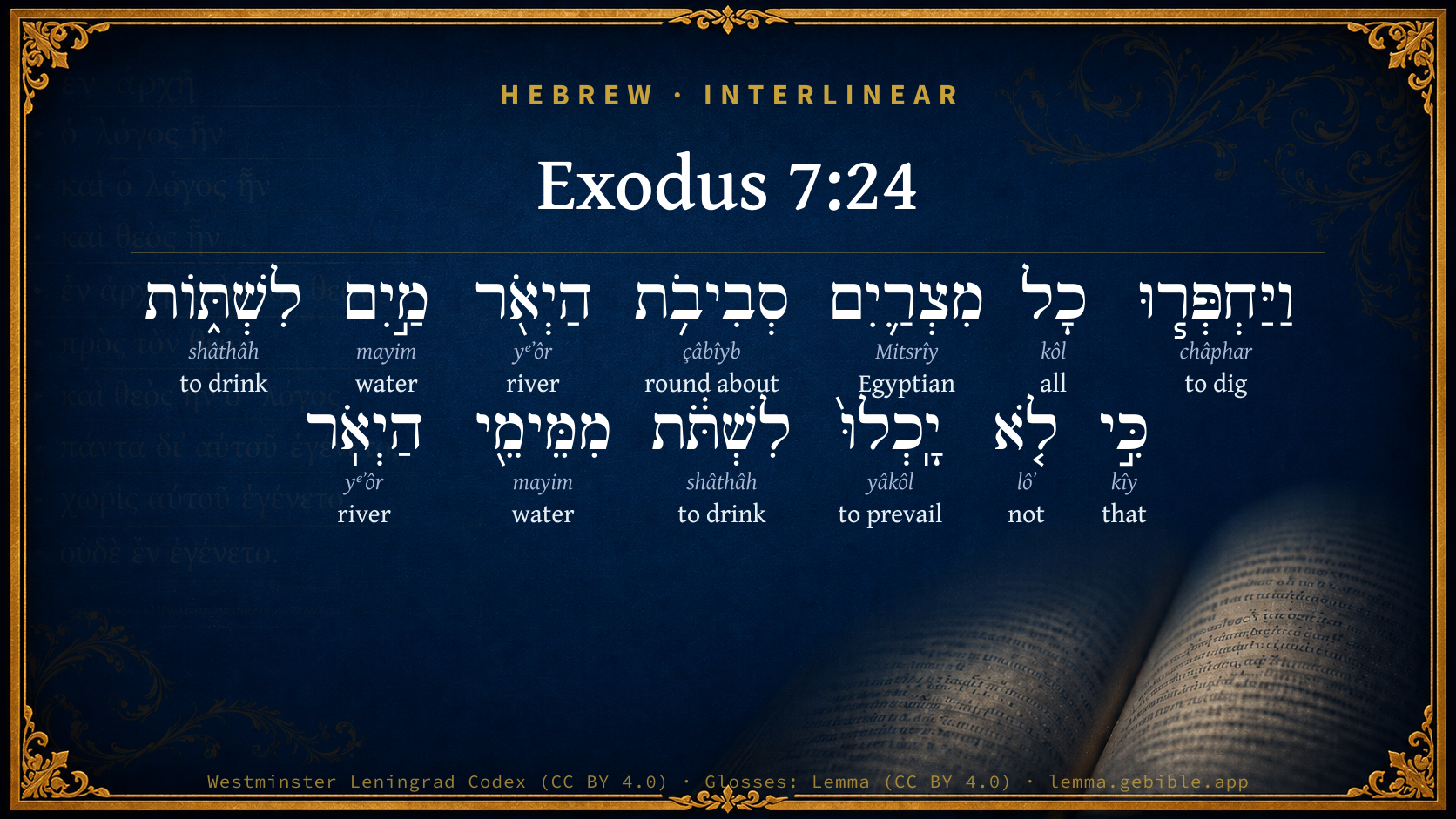
Exodus 7:24

Hebrew (Westminster Leningrad Codex) Exodus 7:24 appears in the Hebrew Old Testament. The text above is from the Westminster Leningrad Codex. Each word links to its Strong’s number, a concise gloss, and parsing drawn from the Open Scriptures Hebrew Bible morphology. Click any word for its full Brown-Driver-Briggs (BDB) entry.
Download image
Cite this verse

Exodus 7:24 (World English Bible). Public Domain. Lemma interlinear Bible study tool, https://lemma.gebible.app/v/exodus/7/24.

Show BibTeX & RIS
BibTeX
RIS
English Translation
All the Egyptians dug round about the river for water to drink; for they couldn't drink of the water of the river.
World English Bible · Public Domain
Download a study sheet

One document with this verse’s original text, its word-by-word gloss line, the meaning frame, cross-references with their text, attributed commentary, and full source and license credits — printable, and it pastes into notes with its structure intact.

This verse Autodidact and up

Study sheet (.html) Plain text (.txt)

A passage Seminary Student

Up to 50 verses in one chapter. A passage sheet keeps up to 6 commentary sources and 12 cross-references per verse, in the order this page ranks them, and says so on the sheet whenever that leaves anything out. Ask for a single verse and you get the Autodidact verse sheet above.

Everything on this page stays free to read, with no account — the sheet is a download of what is already on screen, not access to it.

Want to remove ads? Support Godless Engineer
Compare translations 3

The same verse in 3 English versions, stacked beneath the original-language interlinear above. Click any original word for its lexicon entry.

Each is an independent rendering of the whole verse — the interlinear is not word-aligned to these translations.

Highlighted words mark where these versions differ — a whole-verse word diff, not a word-by-word alignment.

  • World English Bible Public Domain
    All the Egyptians dug round about the river for water to drink; for they couldn't drink of the water of the river.
  • King James Version Public Domain
    And all the Egyptians digged round about the river for water to drink; for they could not drink of the water of the river.
  • unfoldingWord Literal Text CC BY-SA 4.0
    And all the Egyptians dug water to drink around the river, for they were not able to drink from the waters of the river.

unfoldingWord Literal Text — © unfoldingWord, licensed CC BY-SA 4.0. Word-aligned USFM3 via Door43 (git.door43.org/unfoldingWord/en_ult).

Versions to compare (up to 4)

3 of 4 selected

Show all 18 translations

Every available English version of this verse, each an independent rendering of the whole verse.

  • World English Bible Public Domain
    All the Egyptians dug round about the river for water to drink; for they couldn't drink of the water of the river.
  • Berean Standard Bible Public Domain
    So all the Egyptians dug around the Nile for water to drink, because they could not drink the water from the river.
  • Majority Standard Bible Public Domain
    So all the Egyptians dug around the Nile for water to drink, because they could not drink the water from the river.
  • King James Version Public Domain
    And all the Egyptians digged round about the river for water to drink; for they could not drink of the water of the river.
  • American Standard Version (1901) Public Domain
    And all the Egyptians digged round about the river for water to drink; for they could not drink of the water of the river.
  • Revised Version (1885) Public Domain
    And all the Egyptians digged round about the river for water to drink; for they could not drink of the water of the river.
  • Geneva Bible (1599) Public Domain
    All the Egyptians then digged rounde about the riuer for waters to drinke: for they could not drinke of the water of the riuer.
  • Douay-Rheims (1899) Public Domain
    And all the Egyptians dug round about the river for water to drink: for they could not drink of the water of the river.
  • Young's Literal Translation Public Domain
    and all the Egyptians seek water round about the river to drink, for they have not been able to drink of the waters of the River.
  • Literal Standard Version CC BY-SA 4.0
    and all the Egyptians seek water all around the River to drink, for they have not been able to drink of the waters of the River.
  • Unlocked Literal Bible CC BY-SA 4.0
    All the Egyptians dug around the river for water to drink, but they could not drink the water of the river itself.
  • unfoldingWord Literal Text CC BY-SA 4.0
    And all the Egyptians dug water to drink around the river, for they were not able to drink from the waters of the river.
  • Darby Bible Public Domain
    And all the Egyptians dug round about the river for water to drink; for they could not drink of the water of the river.
  • World Messianic Bible Public Domain
    All the Egyptians dug around the river for water to drink; for they couldn’t drink the river water.
  • Webster's Bible Public Domain
    And all the Egyptians digged round about the river for water to drink; for they could not drink of the water of the river.
  • Free Bible Version CC BY-SA 4.0
    All the Egyptians dug alongside the Nile because they couldn't drink its water.
  • Bible in Basic English Public Domain
    And all the Egyptians made holes round about the Nile to get drinking-water, for they were not able to make use of the Nile water.
  • JPS Tanakh (1917) Public Domain
    And all the Egyptians digged round about the river for water to drink; for they could not drink of the water of the river.

Literal Standard Version (2020), Covenant Press — licensed CC BY-SA 4.0. Text via the HelloAO Bible API (eBible.org). Unlocked Literal Bible (unfoldingWord) — licensed CC BY-SA 4.0. Text via the HelloAO Bible API (eBible.org). unfoldingWord Literal Text — © unfoldingWord, licensed CC BY-SA 4.0. Word-aligned USFM3 via Door43 (git.door43.org/unfoldingWord/en_ult). Free Bible Version, Dr. Jonathan Gallagher — licensed CC BY-SA 4.0. Text via the HelloAO Bible API (eBible.org).

Word by word

More ways to search: Search by grammar → Find every occurrence → Compare this word →

Practice this passage: Drill this verse → Learn its vocabulary →

וַיַּחְפְּר֧וּ
châphar
H2658
“and · to dig”
Conjunction + Verb, Qal, Sequential Imperfect, 3rd Person, Masculine, Plural
Part of Speech
Conjunction + Verb
Stem
Qal
Form
Sequential Imperfect
Person
3rd Person
Gender
Masculine
Number
Plural
Full BDB Definition

Origin: a primitive root

TWOT: 714

to dig, search for - (Qal) - to dig - to search, search out, explore
  1. כָל kôl H3605 “all of” Noun, Common, Masculine, Singular, Construct
  2. מִצְרַ֛יִם Mitsrîy H4713 “Egyptian” Noun, Proper
  3. סְבִיבֹ֥ת çâbîyb H5439 “surroundings of” Noun, Common, Both, Plural, Construct
  4. הַיְאֹ֖ר yᵉʼôr H2975 “the · river” Particle, Definite Article + Noun, Proper
  5. מַ֣יִם mayim H4325 “water(s)” Noun, Common, Masculine, Plural, Absolute
  6. לִשְׁתּ֑וֹת shâthâh H8354 “to drink” Preposition + Verb, Qal, Infinitive Construct
  7. כִּ֣י kîy H3588 “that” Conjunction
  8. לֹ֤א lôʼ H3808 “not” Particle, Negative
  9. יָֽכְלוּ֙ yâkôl H3201 “to prevail” Verb, Qal, Perfect, 3rd Person, Common, Plural
  10. לִשְׁתֹּ֔ת shâthâh H8354 “to drink” Preposition + Verb, Qal, Infinitive Construct
  11. מִמֵּימֵ֖י mayim H4325 “from · water(s) of” Preposition + Noun, Common, Masculine, Plural, Construct
  12. הַיְאֹֽר yᵉʼôr H2975 “the · river” Particle, Definite Article + Noun, Proper

About this verse

These counts appear in no published source. They are computed here, from the morphology-tagged text and Lemma’s own curated glosses. What Lemma adds →

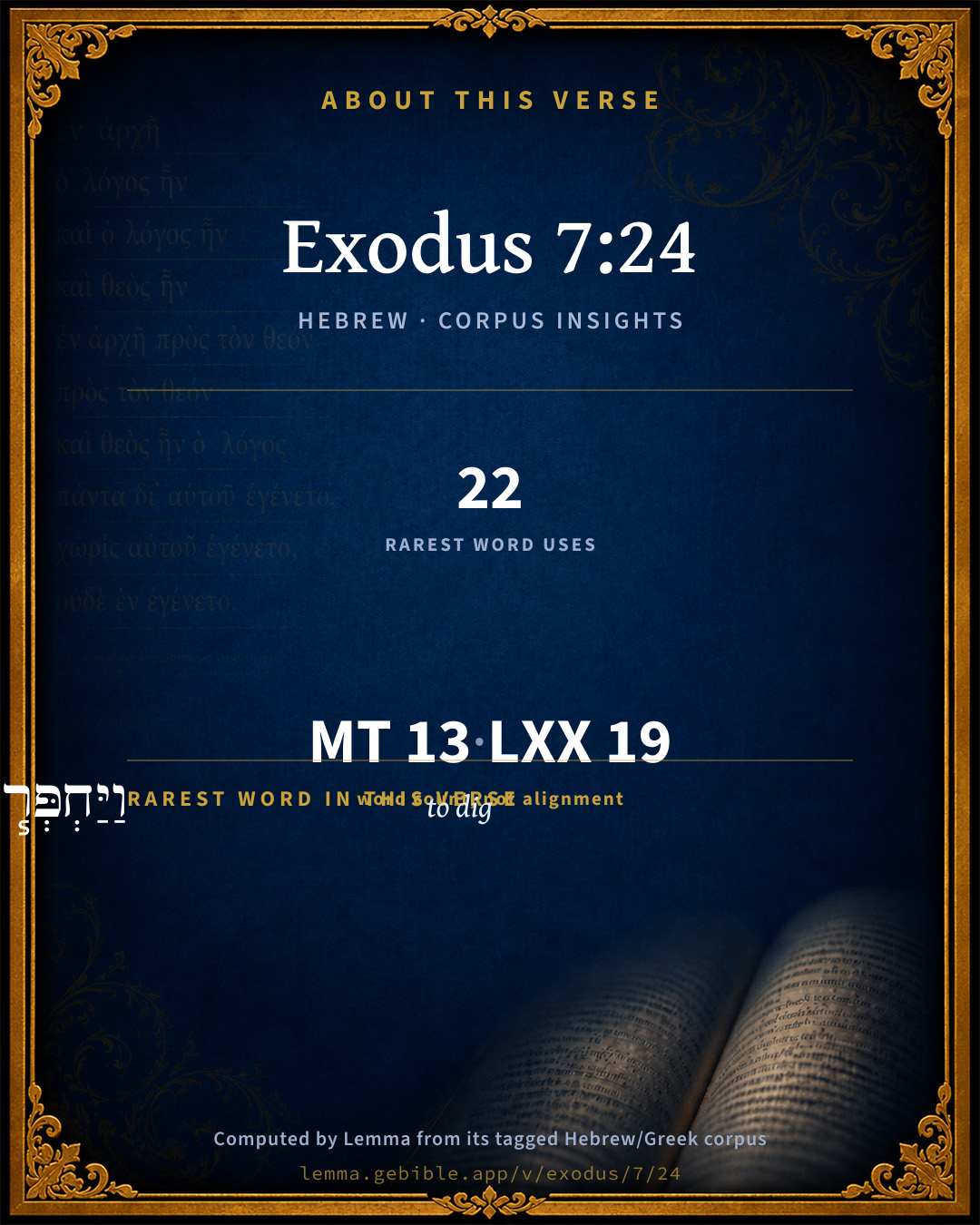
13
words
10
distinct lemmas
Pentateuch
section

Notable vocabulary

The rarest word here is וַיַּחְפְּר֧וּ to dig H2658 — appearing just 22 times in the whole Hebrew Bible.

Shared distinctive vocabulary

וַיַּחְפְּר֧וּ to dig H2658 occurs in 21 verses of the Hebrew Bible. Also found in:

Grammatical profile

  • 4 verbs
  • 7 nouns
  • 1 conjunction
  • 1 particle

Verb forms

  • וַיַּחְפְּר֧וּ Qal · Sequential Imperfect
  • לִשְׁתּ֑וֹת Qal · Infinitive Construct
  • יָֽכְלוּ֙ Qal · Perfect
  • לִשְׁתֹּ֔ת Qal · Infinitive Construct

Repetition

Words recur within this verse — often emphatic in Hebrew:

  • הַיְאֹ֖ר river H2975 ×2
  • מַ֣יִם water H4325 ×2
  • לִשְׁתּ֑וֹת to drink H8354 ×2

Hebrew & Septuagint length

In English translation the verse runs 22 words from the Hebrew and 23 from the Septuagint (LXX English) — closely comparable.

A rough comparison of the two English renderings, which tokenize alike — not a word-level alignment.

Word counts can differ between the Hebrew and the Greek without any difference in meaning — e.g. the Hebrew direct-object marker אֵת has no separate Greek word, and Greek often adds the article ὁ.

In the original languages it is 13 Hebrew tokens and 19 Greek tokens — but the two are counted differently (Hebrew bundles its prefixes and suffixes into one token; the Greek is in lemma form), so that isn’t a like-for-like length.

Hebrew and Greek witnesses Masoretic Hebrew ↔ Greek Septuagint

The same verse in the two great witnesses to the Old Testament, shown verse-for-verse.

These are two independent witnesses, not word-aligned to each other, and the Septuagint is shown in lemma (dictionary) form.

Hebrew Exodus 7:24 Masoretic · Westminster Leningrad Codex

וַיַּחְפְּר֧וּ כָל מִצְרַ֛יִם סְבִיבֹ֥ת הַיְאֹ֖ר מַ֣יִם לִשְׁתּ֑וֹת כִּ֣י לֹ֤א יָֽכְלוּ֙ לִשְׁתֹּ֔ת מִמֵּימֵ֖י הַיְאֹֽר

All the Egyptians dug round about the river for water to drink; for they couldn't drink of the water of the river.

World English Bible · Public Domain

Greek LXX Exodus 7:24 Septuagint · lemma form

ὀρύττω δέ πᾶς ὁ αἰγύπτιος κύκλος ὁ ποταμός ὥστε πίνω ὕδωρ καί οὐ δύναμαι πίνω ὕδωρ ἀπό ὁ ποταμός

And all the Egyptians dug round about the river, so as to drink water, for they could not drink water from the river.

LXX2012 (modern English Septuagint) · Public Domain

Hebrew: Westminster Leningrad Codex (CC BY 4.0). Greek: Septuagint (public domain); English from LXX2012 (modern English Septuagint) (Public Domain). How the Septuagint differs from the Hebrew →

Targum (Aramaic paraphrase)

2

The Targum is the ancient Jewish Aramaic paraphrase of the Hebrew Scriptures — an interpretive translation, not the Hebrew text itself. Onkelos (literal) and Pseudo-Jonathan (expansive) render the Torah, and Jonathan the Prophets. Coverage is partial: where no permissively-licensed English translation exists for a verse, only the Aramaic is shown. This is verse-level text, not a word-by-word alignment to the Hebrew.

  1. Targum Onkelos Torah (Genesis–Deuteronomy)
    וַחֲפָרוּ כָל מִצְרָאֵי סַחֲרָנוּת נַהֲרָא מַיָא לְמִשְׁתֵּי אֲרֵי לָא יְכִילוּ לְמִשְׁתֵּי מִמַיָא דְנַהֲרָא:

    (no public-domain English translation for this verse)

    Targum Onkelos — Aramaic: “Onkelos Genesis” (public domain); “Onkelos Exodus” (public domain); “Onkelos Leviticus” (public domain); “Onkelos Numbers” (public domain); “Onkelos Deuteronomy” (public domain). English: “Sefaria Community Translation” (CC0 1.0 (public-domain dedication)); “J.W. Etheridge. The Targums of Onkelos and Jonathan Ben Uzziel on the Pentateuch. London: Longmans, Green, 1862” (public domain). Text via Sefaria.

  2. Targum Pseudo-Jonathan Torah (Genesis–Deuteronomy)
    וַחֲפָרוּ מִצְרָאֵי חַזְרָנוֹת נַהֲרָא מוֹי לְמִשְׁתֵּי וְלָא אַשְׁכָּחוּ צְלִילִין אֲרוּם לָא יָכִילוּ לְמִשְׁתֵּי מִן מוֹי דִבְנַהֲרָא

    And the Mizraee digged about the river for water to drink, but could not find them pure; for they were not able to drink of the water from the river.

    Targum Pseudo-Jonathan — Aramaic: “Targum Jonathan on Genesis” (public domain); “Targum Jonathan on Exodus” (public domain); “Targum Jonathan on Leviticus” (public domain); “Targum Jonathan on Numbers” (public domain); “Targum Jonathan on Deuteronomy” (public domain). English: “The Targum of Jonathan ben Uzziel, trans. J. W. Etheridge, London, 1862” (public domain). Text via Sefaria.

Commentary

Notes on Exodus 7:24 from classic Christian and Jewish commentators (each source and its license shown beneath its notes). The classic Christian expositions comment on the surrounding passage and are grouped to its opening verse, so a note may address several verses; the Jewish commentaries on the Tanakh (Rashi and others) are per-verse, so they appear only where the commentator wrote on this verse.

Lemma curates 59 commentaries, every one of them public domain or Creative Commons licensed, each selected and text-cleaned for this edition rather than reprinted as found. About our sources →

Trapp's Complete Commentary

John Trapp

Exo 7:24 And all the Egyptians digged round about the river for water to drink; for they could not drink of the water of the river.

Ver. 24. Digged round about.] If by drawing the waters they might purify them. But "they looked not to the Maker thereof"; they "returned not to him that smote them." {Isa 22:11; Isa 9:13}

John Trapp, A Commentary or Exposition upon All the Books of the Old and New Testament (1647–1656) — public domain. Text from a community e-Sword module.

Joseph Benson's Commentary

Exo 7:24. The Egyptians digged round about the river for water — Josephus says, they lost their labour, and found only blood there: but if they found water, or water less bloody, it is not material to us, as it does not lessen Moses’s miracle, it not being within the compass of his commission to prevent their getting water by digging.

Joseph Benson's Commentary on the Old and New Testaments (1811–1818) — public domain. Text from a community e-Sword module.

Ellicott's Commentary for English Readers

(24) All the Egyptians digged round about the river.—Wells may be sunk in any part of the alluvium, and will always yield water, which is, however, brackish and unpalatable. This water is, no doubt, derived by percolation from the river; but the percolation is a slow process, and blood would scarcely percolate far. The water obtained was probably in the ground before the miracle took place, and was not made subject to it.

A Bible Commentary for English Readers, edited by Charles John Ellicott (1878–1897) — public domain. Text from a community e-Sword module.

John Gill's Exposition

And all the Egyptians digged round about the river,.... On each side of it, in order to get clear water; and Aben Ezra thinks the Hebrews also, who were affected with this, and the two following plagues, the frogs and lice: but it is much more reasonable to conclude that they were free from them all. This they did

for water to drink: for there was none in the river, streams, ponds and pools, or in vessels, in which they used to reserve it, and therefore could come at none but by digging; and whether they obtained any in that way is not said:

for they could not drink of the waters of the river; it being turned into blood, and stunk so exceedingly; and though they might strain it, and make it in some measure, drinkable, and might make use of the juice of herbs, and other things, to extinguish their thirst, and the better sort might have a stock of wine, yet multitudes must be greatly distressed, and many perish, as Philo (n) the Jew says they did.

(n) De Vita Mosis, l. 1. p. 617.

John Gill's Exposition of the Whole Bible (1746–1763) — public domain (CC PDM 1.0). Text via the HelloAO Bible API.

Matthew Poole's English Annotations

It is not much material to us, whether they lost their labour, and found only blood there, as Josephus affirms; or whether they succeeded and found water there, which seems more probable, because these come not within the compass of Moses’s commission, Exo 7:17,19,20, or whether they found the water something purified and less bloody, though mixed with blood. But it is observable, that though the devil could do something which might increase the plague, or imitate it, yet he could do nothing to remove it.

Matthew Poole's English Annotations on the Holy Bible (1683–1685) — public domain. Text from a community e-Sword/MySword module.

The Pulpit Commentary

Vers. 24-25. Necessity is the mother of invention. Finding the Nile water continue utterly undrinkable, the Egyptians bethought themselves of a means of obtaining water to which they never had recourse in ordinary times. This was to dig pits or wells at some distance from the river, and so obtain the moisture that lay in the ground, no doubt derived from the river originally, but already there before the change of the water into blood took place. This, it appears, remained water, and was drinkable, though probably not very agreeable, since, owing to the nitrous quality of the soil in Egypt, well-water has always a bitter and brackish taste. It sufficed, however, for drinking and culinary purposes during the "seven days" that the plague continued (ver. 25).

All the Egyptians digged. Not the Hebrews. The water stored in the houses of the Hebrews in reservoirs, cisterns, and the like, was (it would seem) not vitiated; and this would suffice for the consumption of seven days. Water to drink. Blood would not become water by percolation through earth, as Canon Cook appears to think ("Speaker"s Commentary," vol. 1. p. 278); but there might have been sufficient water in the ground before the plague began, to fill the wells dug, for seven days.

Ver. 24. God allows men to seek and obtain alleviations of his judgments.

We are not intended to sit down under the judgments of God, and fold our hands, and do nothing. Whether it be war, or pestilence, or famine, or any other Heaven-sent calamity that comes upon us for our sins and those of our nation, we must beware of sinking into apathy under the infliction, and allowing it simply to run its course. God does not desire that we should show our submission in this way. He gives us thought, and ingenuity, and inventiveness, that, in every difficulty we may devise remedies, and so lessen our own and our neighbours" sufferings. Oriental nations view each calamity that comes upon them as Kismet, "fate," and make no exertions to meet it, stem it, minimise it. Christians should act otherwise. They should so far imitate the Egyptians as to set to work actively, to do what can be done in the way of relief and alleviation. God freely allows this. He did not punish the Egyptians for digging, or frustrate their efforts by preventing the water that was in the ground from filling the wells, or by rendering it undrinkable. And so he allows cholera or plague, or even ordinary sickness, which is his judgment on an individual, to be met by care, attention, cleanliness, remedial measures, and is so far from interfering against such exertions, that he blesses them, and for the most part renders them effectual.

The Pulpit Commentary (1880–1919), ed. H.D.M. Spence-Jones & Joseph S. Exell — public domain. Text from a community e-Sword module.

Lesson kit

Teaching starters — assembled from the data on this page, not authored interpretation. Every prompt links to the verse data it draws on. Edit before teaching.

Exodus, in the Pentateuch, opens this verse with 13 words (10 distinct Hebrew lemmas). Its most distinctive word is châphar (“to dig”). A historical commentator’s framing appears above. Read the whole chapter for the surrounding context.

Discussion questions

  1. How does “to dig” (châphar) shape what this verse is saying?
  2. How does Genesis 21:30, which shares the word «to dig», read alongside this verse?
  3. What does the repetition of “river” (2× in this one verse) do in this verse?
  4. These translations render this verse differently. What is at stake in choosing one wording over another?
  5. «וַיַּחְפְּר֧וּ» is a Qal Sequential Imperfect verb. How does that grammatical form shape the action described?
  6. Compare how Trapp's Complete Commentary and Joseph Benson's Commentary read this verse. Where do they agree or differ?

Things to notice

Reading settings

Reading text

Shown beneath each verse's original-language words.

Old Testament
Old Testament edition

Read the OT as the Masoretic Hebrew (MT) or the Greek Septuagint (LXX).

English shown for the Greek Septuagint (in the Hebrew ↔ Greek comparison).

Comparing translations? Open the Compare panel on any verse page to stack up to four side by side.