
Isaiah 36:8

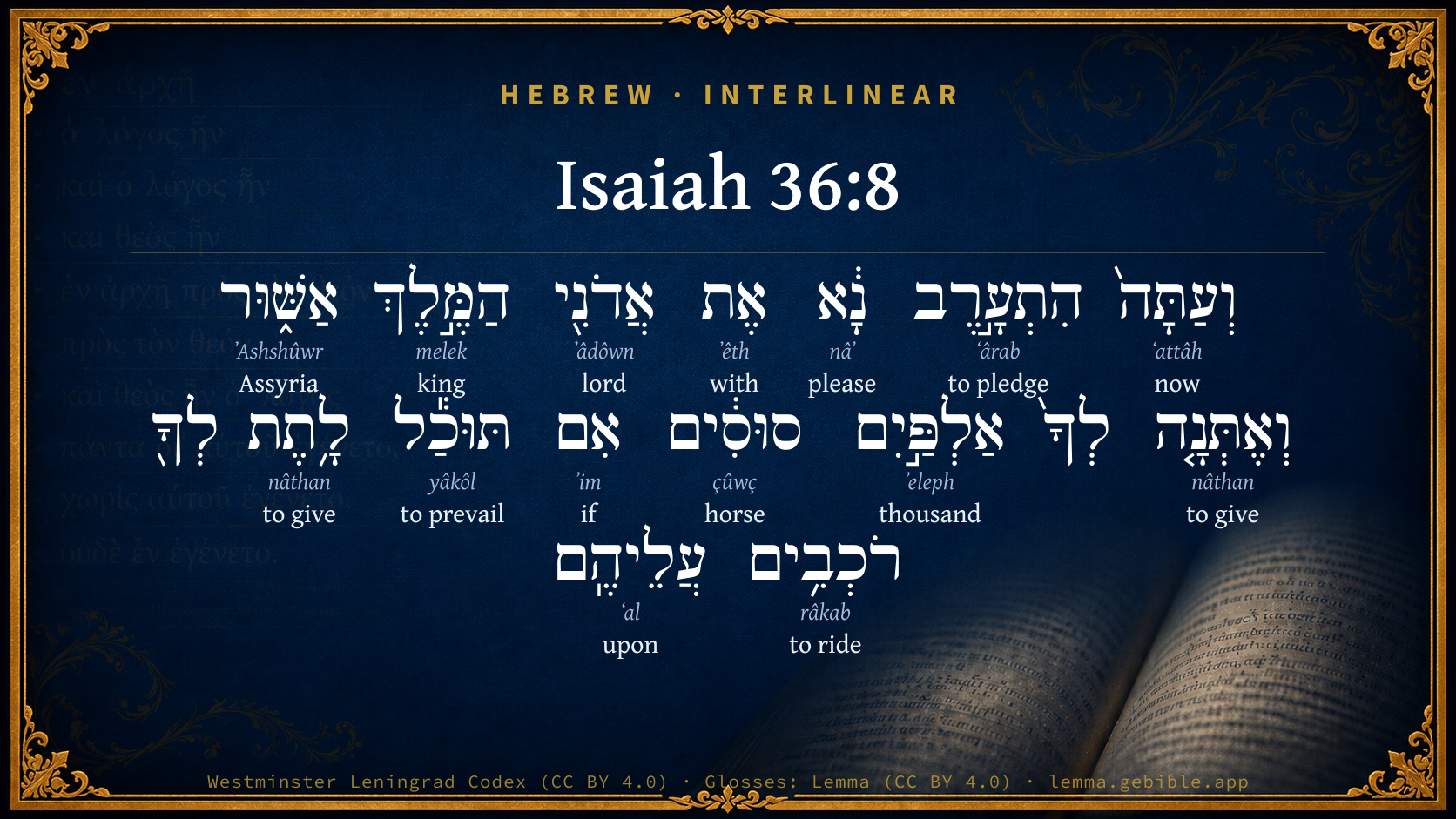
Hebrew (Westminster Leningrad Codex) Isaiah 36:8 appears in the Hebrew Old Testament. The text above is from the Westminster Leningrad Codex. Each word links to its Strong’s number, a concise gloss, and parsing drawn from the Open Scriptures Hebrew Bible morphology. Click any word for its full Brown-Driver-Briggs (BDB) entry.
Download image
Cite this verse

Isaiah 36:8 (World English Bible). Public Domain. Lemma interlinear Bible study tool, https://lemma.gebible.app/v/isaiah/36/8.

Show BibTeX & RIS
BibTeX
RIS
English Translation
Now therefore, please give pledges to my master the king of Assyria, and I will give you two thousand horses, if you are able on your part to set riders on them.
World English Bible · Public Domain
Download a study sheet

One document with this verse’s original text, its word-by-word gloss line, the meaning frame, cross-references with their text, attributed commentary, and full source and license credits — printable, and it pastes into notes with its structure intact.

This verse Autodidact and up

Study sheet (.html) Plain text (.txt)

A passage Seminary Student

Up to 50 verses in one chapter. A passage sheet keeps up to 6 commentary sources and 12 cross-references per verse, in the order this page ranks them, and says so on the sheet whenever that leaves anything out. Ask for a single verse and you get the Autodidact verse sheet above.

Everything on this page stays free to read, with no account — the sheet is a download of what is already on screen, not access to it.

Want to remove ads? Support Godless Engineer
Compare translations 3

The same verse in 3 English versions, stacked beneath the original-language interlinear above. Click any original word for its lexicon entry.

Each is an independent rendering of the whole verse — the interlinear is not word-aligned to these translations.

Highlighted words mark where these versions differ — a whole-verse word diff, not a word-by-word alignment.

  • World English Bible Public Domain
    Now therefore, please give pledges to my master the king of Assyria, and I will give you two thousand horses, if you are able on your part to set riders on them.
  • King James Version Public Domain
    Now therefore give pledges, I pray thee, to my master the king of Assyria, and I will give thee two thousand horses, if thou be able on thy part to set riders upon them.
  • unfoldingWord Literal Text CC BY-SA 4.0
    ‘And now, wager, please, with my master, the king of Assyria. And I will give to you 2, 000 horses if you are able to put riders on them for yourself.

unfoldingWord Literal Text — © unfoldingWord, licensed CC BY-SA 4.0. Word-aligned USFM3 via Door43 (git.door43.org/unfoldingWord/en_ult).

Versions to compare (up to 4)

3 of 4 selected

Show all 18 translations

Every available English version of this verse, each an independent rendering of the whole verse.

  • World English Bible Public Domain
    Now therefore, please give pledges to my master the king of Assyria, and I will give you two thousand horses, if you are able on your part to set riders on them.
  • Berean Standard Bible Public Domain
    Now, therefore, make a bargain with my master, the king of Assyria. I will give you two thousand horses—if you can put riders on them!
  • Majority Standard Bible Public Domain
    Now, therefore, make a bargain with my master, the king of Assyria. I will give you two thousand horses—if you can put riders on them!
  • King James Version Public Domain
    Now therefore give pledges, I pray thee, to my master the king of Assyria, and I will give thee two thousand horses, if thou be able on thy part to set riders upon them.
  • American Standard Version (1901) Public Domain
    Now therefore, I pray thee, give pledges to my master the king of Assyria, and I will give thee two thousand horses, if thou be able on thy part to set riders upon them.
  • Revised Version (1885) Public Domain
    Now therefore, I pray thee, give pledges to my master the king of Assyria, and I will give thee two thousand horses, if thou be able on thy part to set riders upon them.
  • Geneva Bible (1599) Public Domain
    Nowe therefore giue hostages to my lorde the King of Asshur, and I wil giue thee two thousand horses, if thou be able on thy part to set riders vpon them.
  • Douay-Rheims (1899) Public Domain
    And now deliver thyself up to my lord the king of the Assyrians, and I will give thee two thousand horses, and thou wilt not be able on thy part to find riders for them.
  • Young's Literal Translation Public Domain
    `And now, negotiate, I pray thee, with my lord the king of Asshur, and I give to thee two thousand horses, if thou art able to put for thee riders on them.
  • Literal Standard Version CC BY-SA 4.0
    And now, please negotiate with my lord the king of Asshur, and I give two thousand horses to you, if you are able to put riders on them for yourself.
  • Unlocked Literal Bible CC BY-SA 4.0
    Now therefore, I want to make you a good offer from my master the king of Assyria. I will give you two thousand horses, if you are able to find riders for them.
  • unfoldingWord Literal Text CC BY-SA 4.0
    ‘And now, wager, please, with my master, the king of Assyria. And I will give to you 2, 000 horses if you are able to put riders on them for yourself.
  • Darby Bible Public Domain
    And now engage, I pray thee, with my master the king of Assyria, and I will give thee two thousand horses, if thou be able on thy part to set riders upon them.
  • World Messianic Bible Public Domain
    Now therefore, please make a pledge to my master the king of Assyria, and I will give you two thousand horses, if you are able on your part to set riders on them.
  • Webster's Bible Public Domain
    Now therefore give pledges, I pray thee, to my master the king of Assyria, and I will give thee two thousand horses, if thou canst on thy part set riders upon them.
  • Free Bible Version CC BY-SA 4.0
    Why don't you accept a challenge from my master, the king of Assyria? He says, I'll give you two thousand horses, if you can find enough riders for them!
  • Bible in Basic English Public Domain
    And now, take a chance with my master, the king of Assyria, and I will give you two thousand horses, if you are able to put horsemen on them.
  • JPS Tanakh (1917) Public Domain
    Now therefore, I pray thee, make a wager with my master, the king of Assyria, and I will give thee two thousand horses, if thou be able on thy part to set riders upon them.

Literal Standard Version (2020), Covenant Press — licensed CC BY-SA 4.0. Text via the HelloAO Bible API (eBible.org). Unlocked Literal Bible (unfoldingWord) — licensed CC BY-SA 4.0. Text via the HelloAO Bible API (eBible.org). unfoldingWord Literal Text — © unfoldingWord, licensed CC BY-SA 4.0. Word-aligned USFM3 via Door43 (git.door43.org/unfoldingWord/en_ult). Free Bible Version, Dr. Jonathan Gallagher — licensed CC BY-SA 4.0. Text via the HelloAO Bible API (eBible.org).

Word by word

More ways to search: Search by grammar → Find every occurrence → Compare this word →

Practice this passage: Drill this verse → Learn its vocabulary →

הִתְעָ֣רֶב
ʻârab
H6148
“pledge”
Verb, Hithpael, Imperative, 2nd Person, Masculine, Singular
Part of Speech
Verb
Stem
Hithpael
Form
Imperative
Person
2nd Person
Gender
Masculine
Number
Singular
Full BDB Definition

Origin: a primitive root

TWOT: 1686

to pledge, exchange, mortgage, engage, occupy, undertake for, give pledges, be or become surety, take on pledge, give in pledge - (Qal) - to take on pledge, go surety for - to give in pledge - to exchange - to pledge - (Hithpael) - to exchange pledges - to have fellowship with, share
  1. וְעַתָּה֙ ʻattâh H6258 “and · now” Conjunction + Adverb
  2. נָ֔א nâʼ H4994 “please” Particle, Exhortation
  3. אֶת ʼêth H854 “with” Preposition
  4. אֲדֹנִ֖י ʼâdôwn H113 “lord · my” Noun, Common, Masculine, Singular, Construct + Suffix, Personal, 1st Person, Common, Singular
  5. הַמֶּ֣לֶךְ melek H4428 “the · king” Particle, Definite Article + Noun, Common, Masculine, Singular, Absolute
  6. אַשּׁ֑וּר ʼAshshûwr H804 “Assyria” Noun, Proper
  7. וְאֶתְּנָ֤ה nâthan H5414 “and · to give” Conjunction + Verb, Qal, Cohortative, 1st Person, Common, Singular
  8. אַלְפַּ֣יִם ʼeleph H505 “thousand” Adjective, Cardinal number, Both, Plural, Absolute
  9. סוּסִ֔ים çûwç H5483 “horses” Noun, Common, Masculine, Plural, Absolute
  10. אִם ʼim H518 “if” Conjunction
  11. תּוּכַ֕ל yâkôl H3201 “to prevail” Verb, Qal, Imperfect, 2nd Person, Masculine, Singular
  12. לָ֥תֶת nâthan H5414 “to give” Preposition + Verb, Qal, Infinitive Construct
  13. רֹכְבִ֥ים râkab H7392 “riding” Verb, Qal, Participle Active, Masculine, Plural, Absolute
  14. עֲלֵיהֶֽם ʻal H5921 “upon · them” Preposition + Suffix, Personal, 3rd Person, Masculine, Plural

About this verse

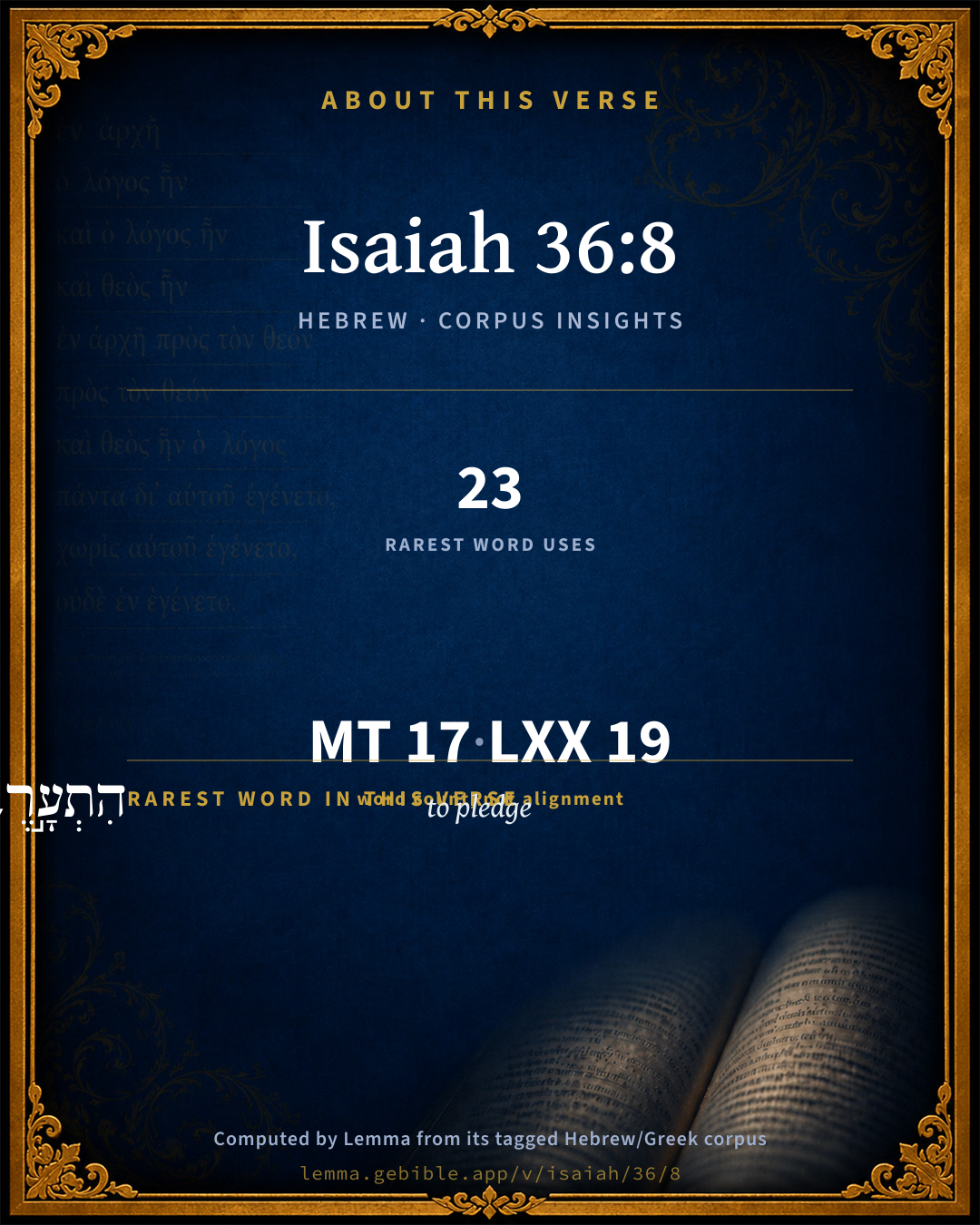
These counts appear in no published source. They are computed here, from the morphology-tagged text and Lemma’s own curated glosses. What Lemma adds →

17
words
14
distinct lemmas
Prophets
section

Notable vocabulary

The rarest word here is הִתְעָ֣רֶב to pledge H6148 — appearing just 23 times in the whole Hebrew Bible.

Shared distinctive vocabulary

הִתְעָ֣רֶב to pledge H6148 occurs in 23 verses of the Hebrew Bible. Also found in:

Grammatical profile

  • 5 verbs
  • 4 nouns
  • 1 adjective
  • 4 prepositions
  • 1 conjunction
  • 1 adverb
  • 1 particle

Verb forms

  • הִתְעָ֣רֶב Hithpael · Imperative
  • וְאֶתְּנָ֤ה Qal · Cohortative
  • תּוּכַ֕ל Qal · Imperfect
  • לָ֥תֶת Qal · Infinitive Construct
  • רֹכְבִ֥ים Qal · Participle Active

Repetition

A word recurs within this verse — often emphatic in Hebrew:

  • וְאֶתְּנָ֤ה to give H5414 ×2

Hebrew & Septuagint length

In English translation the verse runs 32 words from the Hebrew and 31 from the Septuagint (LXX English) — closely comparable.

A rough comparison of the two English renderings, which tokenize alike — not a word-level alignment.

Word counts can differ between the Hebrew and the Greek without any difference in meaning — e.g. the Hebrew direct-object marker אֵת has no separate Greek word, and Greek often adds the article ὁ.

In the original languages it is 17 Hebrew tokens and 19 Greek tokens — but the two are counted differently (Hebrew bundles its prefixes and suffixes into one token; the Greek is in lemma form), so that isn’t a like-for-like length.

Cross-references

9

Topical passages linked to Isaiah 36:8 in the Treasury of Scripture Knowledge — connected by theme and wording, ordered by reader-vote popularity; previews shown in the World English Bible.

  • 1 Samuel 17:40–43 He took his staff in his hand, and chose him five smooth stones out of the brook, and put them in the shepherd's bag which he had, even in his wallet; and his sling was in his hand: and he drew near to the Philistine.
  • 1 Kings 20:10 Ben Hadad sent to him, and said, The gods do so to me, and more also, if the dust of Samaria shall suffice for handfuls for all the people who follow me.
  • 1 Kings 20:18 He said, Whether they are come out for peace, take them alive, or whether they are come out for war, taken them alive.
  • 2 Kings 14:14 He took all the gold and silver, and all the vessels that were found in the house of Yahweh, and in the treasures of the king's house, the hostages also, and returned to Samaria.
  • 2 Kings 18:23 Now therefore, Please give pledges to my master the king of Assyria, and I will give you two thousand horses, if you are able on your part to set riders on them.
  • Nehemiah 4:2–5 He spoke before his brothers and the army of Samaria, and said, What are these feeble Jews doing? will they fortify themselves? will they sacrifice? will they make an end in a day? will they revive the stones out of the heaps of rubbish, seeing they are burned?
  • Psalms 20:7–8 Some trust in chariots, and some in horses, But we trust the name of Yahweh our God.
  • Psalms 123:3–4 Have mercy on us, Yahweh, have mercy on us, For we have endured much contempt.
  • Isaiah 10:13–14 For he has said, By the strength of my hand I have done it, and by my wisdom; for I have understanding: and I have removed the bounds of the peoples, and have robbed their treasures, and like a valiant man I have brought down those who sit [on thrones]:

Cross-references courtesy of OpenBible.info (CC BY 4.0).

Hebrew and Greek witnesses Masoretic Hebrew ↔ Greek Septuagint

The same verse in the two great witnesses to the Old Testament, shown verse-for-verse.

These are two independent witnesses, not word-aligned to each other, and the Septuagint is shown in lemma (dictionary) form.

Hebrew Isaiah 36:8 Masoretic · Westminster Leningrad Codex

וְעַתָּה֙ הִתְעָ֣רֶב נָ֔א אֶת אֲדֹנִ֖י הַמֶּ֣לֶךְ אַשּׁ֑וּר וְאֶתְּנָ֤ה לְךָ֙ אַלְפַּ֣יִם סוּסִ֔ים אִם תּוּכַ֕ל לָ֥תֶת לְךָ֖ רֹכְבִ֥ים עֲלֵיהֶֽם

Now therefore, please give pledges to my master the king of Assyria, and I will give you two thousand horses, if you are able on your part to set riders on them.

World English Bible · Public Domain

Greek LXX Isaiah 36:8 Septuagint · lemma form

νῦν μίγνυμι ὁ κύριος ἐγώ ὁ βασιλεύς ἀσσύριος καί δίδωμι σύ δισχίλιος ἵππος εἰ δύναμαι δίδωμι ἀναβάτης ἐπί αὐτός

yet now make an agreement with my lord the king of the Assyrians, and I will give you two thousand horses, if you⌃ shall be able to set riders upon them.

LXX2012 (modern English Septuagint) · Public Domain

Hebrew: Westminster Leningrad Codex (CC BY 4.0). Greek: Septuagint (public domain); English from LXX2012 (modern English Septuagint) (Public Domain). How the Septuagint differs from the Hebrew →

Targum (Aramaic paraphrase)

1

The Targum is the ancient Jewish Aramaic paraphrase of the Hebrew Scriptures — an interpretive translation, not the Hebrew text itself. Onkelos (literal) and Pseudo-Jonathan (expansive) render the Torah, and Jonathan the Prophets. Coverage is partial: where no permissively-licensed English translation exists for a verse, only the Aramaic is shown. This is verse-level text, not a word-by-word alignment to the Hebrew.

  1. Targum Jonathan Prophets (Joshua–Malachi)
    וּכְעַן אִתְעָרֵב כְעַן עִם רִבּוֹנִי מַלְכָּא דְאַתּוּר וְאֶתֵּן לָךְ תְּרֵין אַלְפִין סוּסְוָן אִם תִּכּוּל לְמַנָאָה עֲלָךְ רָכְבִין עֲלֵיהוֹן:

    And now, pledge thyself with my master the king of Assyria, and I will give thee two thousand horses, if thou be able on thy part to appoint riders upon them.

    Targum Jonathan — Aramaic: “Mikraot Gedolot” (public domain). English: “Sefaria Community Translation” (CC0 1.0 (public-domain dedication)); “London "Chaldee Paraphrase," 1871” (public domain). Text via Sefaria.

Commentary

Notes on Isaiah 36:8 from classic Christian and Jewish commentators (each source and its license shown beneath its notes). The classic Christian expositions comment on the surrounding passage and are grouped to its opening verse, so a note may address several verses; the Jewish commentaries on the Tanakh (Rashi and others) are per-verse, so they appear only where the commentator wrote on this verse.

Lemma curates 59 commentaries, every one of them public domain or Creative Commons licensed, each selected and text-cleaned for this edition rather than reprinted as found. About our sources →

Tyndale Open Study Notes

Tyndale Open Resources

36:8 At this time, cavalry mounted on horses was the newest military technology. The Assyrian chief of staff was mocking the Judeans because he knew that Judah had no trained men who knew how to ride.

Tyndale Open Study Notes — © Tyndale Open Resources, licensed CC BY-SA 4.0. Text via the HelloAO Bible API.

Jamieson, Fausset & Brown

Robert Jamieson, A. R. Fausset & David Brown

give pledges--a taunting challenge. Only give the guarantee that you can supply as many as two thousand riders, and I will give thee two thousand horses. But seeing that you have not even this small number (see on Isa 2:7), how can you stand against the hosts of Assyrian cavalry? The Jews tried to supply their weakness in this "arm" from Egypt (Isa 31:1).

Jamieson, Fausset & Brown — Commentary Critical and Explanatory on the Whole Bible (1871) — public domain (CC PDM 1.0). Text via the HelloAO Bible API.

Ellicott's Commentary for English Readers

(8) Now, therefore, give pledges.—Better, make a wager. This would seem to be a taunt interpolated by the Rabshakeh in the midst of his official message. There was something absurd in the idea of Judah coming out as strong in its cavalry. Had they two thousand men who could manage their horses if they had them?

A Bible Commentary for English Readers, edited by Charles John Ellicott (1878–1897) — public domain. Text from a community e-Sword module.

The Cambridge Bible for Schools and Colleges

gen. ed. J. J. S. Perowne

8. give pledges … to] Better (as R.V. marg.): make a wager with. The taunt must have been peculiarly galling to the war-party in Judah, who were painfully conscious of their weakness in cavalry; ch. Isa_30:16, Isa_31:1; Isa_31:3, and Isa_36:9 of this chapter.

The Cambridge Bible for Schools and Colleges (gen. ed. J. J. S. Perowne; Cambridge University Press, 1878–1918) — public domain. Text from a community e-Sword module.

John Gill's Exposition

Now therefore give pledges to my master the king of Assyria,.... Or; "hostages" (h); that thou wilt not rebel against him, but be faithful to him, and he will withdraw his army; or give security for the horses after promised: "or mingle thyself with him"; agree the matter with him, give pledges for future fidelity; or join in battle with him, come out and fight him, if able:

and I will give thee two thousand horses, if thou be able on thy part to set riders on them; thus scoffing at him, as if he had not so many soldiers to bring out against him; or so many men in his kingdom as had skill enough to ride a horse; in his bravado he signifies, that if he would come out and fight him, he would lend him so many horses, if he could put men upon them, to assist him; this he said as boasting of his master's strength and power, and in scorn and derision at Hezekiah's weakness.

(h) "da obsides", Vatablus; "paciscere cum domino meo, Gataker; "misceto, quaeso, bellum cum domino meo", Junius & Tremellius.

John Gill's Exposition of the Whole Bible (1746–1763) — public domain (CC PDM 1.0). Text via the HelloAO Bible API.

Albert Barnes' Notes on the Bible

Now, therefore, give pledges - Margin, ‘Hostages.’ The Hebrew verb (ערב ‛ârab) means properly to mix or mingle; then, to exchange commodities by barter or traffic; then, to become surety for anyone, to exchange with him, to stand in his place; then, to pledge, to pledge one’s life, or to give security of any kind. Here it is used in a spirit of taunting or derision, and is equivalent to what would be said among us, ‘I will bet you, or I will lay a wager, that if we should give you only two thousand horses, you could not find men enough to ride them, or men that had knowledge of horsemanship enough to guide them.’ There was much severity in this taunt. The Jews hoped to defend themselves. Yet here was an immense army coming up to lay siege against them. What hope had they of defense? So weak and feeble were they, that Rabshakeh said they could not furnish even two thousand horsemen to resist all the host of the Assyrians. There was also, doubtless, much truth in this taunt. It was not permitted by the law of Moses for the Jews to keep cavalry, nor for their kings to multiply horses. The reason of this may be seen in the notes at Isa 2:7. Though some of the kings, and especially Solomon, had disregarded this law of Moses, yet Hezekiah had endeavored to restore the observance of the law, and it is probable that he find no cavalry, and that the art of horsemanship was little known in Jerusalem. As the Assyrians prided themselves on their cavalry, they consequently looked with contempt on a people who were destitute of this means of defense.

Albert Barnes' Notes on the Bible (1834–1885) — public domain. Text from a community e-Sword/MySword module.

Whedon's Commentary on the Bible

Daniel D. Whedon

8. “Now try your hand,” continues Rabshakeh.

Give pledges — Hostages, securities, to the great king, for two thousand horses, if indeed you can mount such a wonderful number. A contemptuous comparison, yet of keen edge, because cavalry was not an arm the Jews could boast of. The sense of the phrase “give pledges,” is, to make an engagement with, strong and well secured.

Daniel D. Whedon (gen. ed.), Commentary on the Old and New Testaments (1874–1909) — public domain. Text from a community e-Sword module.

The Pulpit Commentary

Now therefore give pledges; i.e. "bind yourselves under s-me penalty." Rabshakeh here interrupts his message" to introduce an offer of his own. Intent on ridiculing the absurdity of Hezekiah"s resistance of Assyria, he promises to make him a present of two thousand horses, if he (Hezekiah) can find two thousand trained riders to mount them. It is quite likely that he was safe in making this promise, and that, notwithstanding the abundant use of chariots and horses by the Jews of the time for purposes of luxury, (Isa_2:7) they were destitute of a cavalry force and unaccustomed to the management of war-horses.

The Pulpit Commentary (1880–1919), ed. H.D.M. Spence-Jones & Joseph S. Exell — public domain. Text from a community e-Sword module.

J. A. Alexander on Isaiah

Joseph Addison Alexander

“And now, engage, I pray thee, with my lord, the king of Assyria, and I will give thee two thousand horses, if thou be able on thy part to set riders upon them.” A contemptuous comparison between the Jews, who were almost destitute of cavalry, and the Assyrians, who were strong in that species of force (Isa 5:28). Whether the first verb refers to fight or to negotiation, must be determined by the context.

Joseph Addison Alexander, The Prophecies of Isaiah (1846–1847; New York: Scribner, 1870–1878) — public domain. Text from a community e-Sword module.

unfoldingWord translationNotes

Door43 World Missions Community

General Information:

This continues the king of Assyria's message to Hezekiah by speaking the message to Hezekiah's men. (See: Isaiah 36:4-5)

two thousand horses

"2,000 horses" (See: Numbers)

if you are able to find riders for them

The chief commander continues to ridicule Hezekiah and his army by implying that he did not have many soldiers. (See: Irony)

translationWords

lord

king

Assyria

horse

unfoldingWord translationNotes — © Distant Shores Media and the Door43 World Missions Community, licensed CC BY-SA 4.0. Source: git.door43.org/Door43/en_tn.

Rashi

Rabbi Shlomo Yitzchaki (Rashi)

wager now on this matter, if you will be able to accomplish it. This is an expression of a wager, which is called gajjer in O.F.

Rashi on the Tanakh — English translations: “The Judaica Press complete Tanach with Rashi, translated by A. J. Rosenberg” (CC BY 4.0); “Pentateuch with Rashi's commentary by M. Rosenbaum and A.M. Silbermann, 1929-1934” (public domain); “The Metsudah Tanach series, Lakewood, N.J” (CC BY 4.0); and “The Book of Joshua, Metsudah Publications, 1997” (CC BY 4.0). Text via Sefaria.

Lesson kit

Teaching starters — assembled from the data on this page, not authored interpretation. Every prompt links to the verse data it draws on. Edit before teaching.

Isaiah, in the Prophets, opens this verse with 17 words (14 distinct Hebrew lemmas). Its most distinctive word is ʻârab (“to pledge”). A historical commentator’s framing appears above. Read the whole chapter for the surrounding context.

Discussion questions

  1. The word ʻârab carries the sense “to pledge.” How does it shape the verse?
  2. Genesis 43:9 shares the word «to pledge» with this verse. How do the two illuminate each other?
  3. “to give” occurs 2× in this one verse. What is the effect of the repetition?
  4. These translations render this verse differently. What is at stake in choosing one wording over another?
  5. The verb «הִתְעָ֣רֶב» is Hithpael Imperative. How does its form color the action?
  6. Reading how Tyndale Open Study Notes and Jamieson, Fausset & Brown read this verse, where do the two commentators agree and where do they part?

Things to notice

Reading settings

Reading text

Shown beneath each verse's original-language words.

Old Testament
Old Testament edition

Read the OT as the Masoretic Hebrew (MT) or the Greek Septuagint (LXX).

English shown for the Greek Septuagint (in the Hebrew ↔ Greek comparison).

Comparing translations? Open the Compare panel on any verse page to stack up to four side by side.