
Ezekiel 47:5

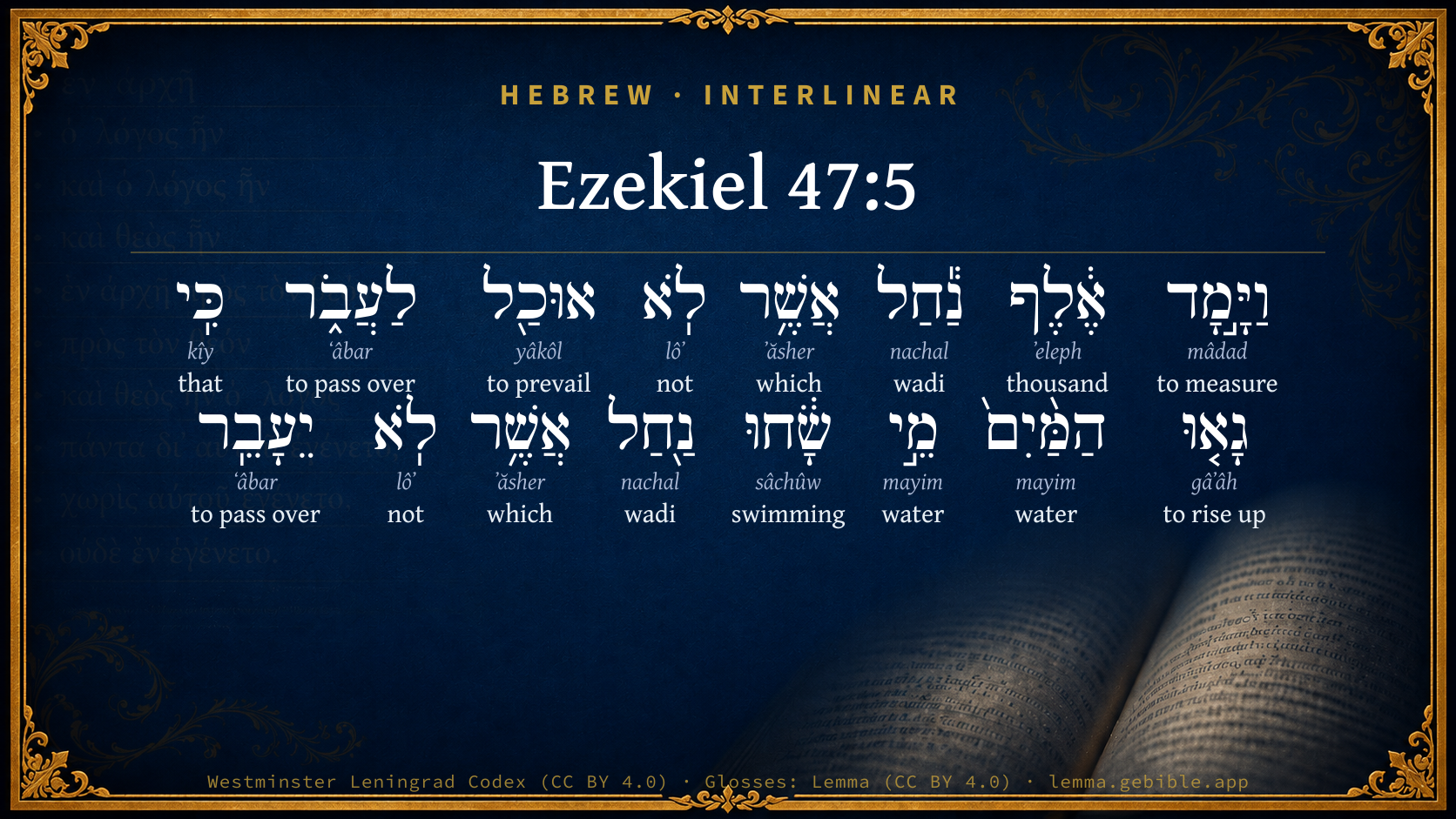
Hebrew (Westminster Leningrad Codex) Ezekiel 47:5 appears in the Hebrew Old Testament. The text above is from the Westminster Leningrad Codex. Each word links to its Strong’s number, a concise gloss, and parsing drawn from the Open Scriptures Hebrew Bible morphology. Click any word for its full Brown-Driver-Briggs (BDB) entry.
Download image
Cite this verse

Ezekiel 47:5 (World English Bible). Public Domain. Lemma interlinear Bible study tool, https://lemma.gebible.app/v/ezekiel/47/5.

Show BibTeX & RIS
BibTeX
RIS
English Translation
Afterward he measured one thousand; [and it was] a river that I could not pass through; for the waters were risen, waters to swim in, a river that could not be passed through.
World English Bible · Public Domain
Highlights
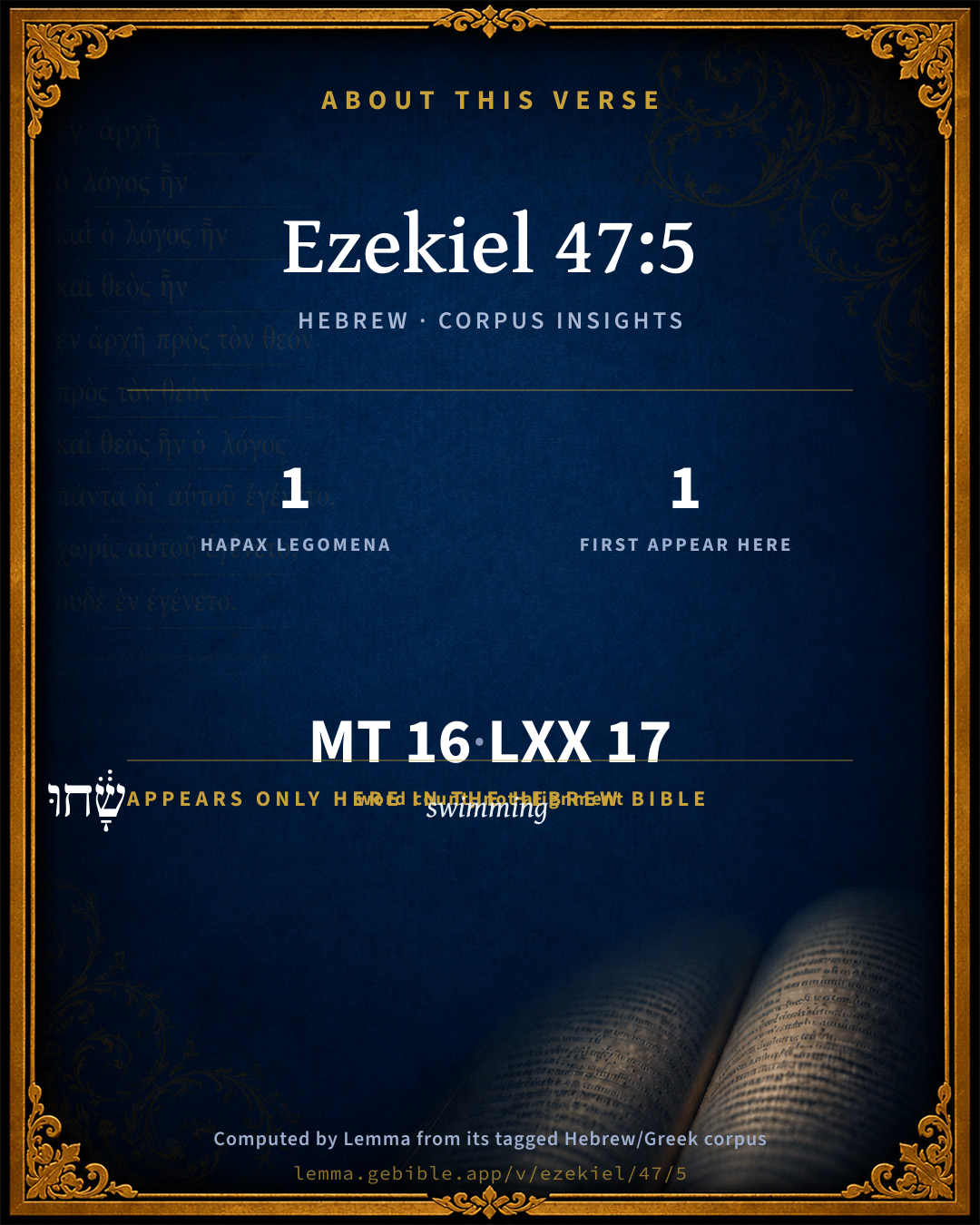
  • 1 hapax legomenon — only here in the Hebrew Bible
  • 1 first appearance in the Hebrew Bible
Full analysis ↓
Download a study sheet

One document with this verse’s original text, its word-by-word gloss line, the meaning frame, cross-references with their text, attributed commentary, and full source and license credits — printable, and it pastes into notes with its structure intact.

This verse Autodidact and up

Study sheet (.html) Plain text (.txt)

A passage Seminary Student

Up to 50 verses in one chapter. A passage sheet keeps up to 6 commentary sources and 12 cross-references per verse, in the order this page ranks them, and says so on the sheet whenever that leaves anything out. Ask for a single verse and you get the Autodidact verse sheet above.

Everything on this page stays free to read, with no account — the sheet is a download of what is already on screen, not access to it.

Want to remove ads? Support Godless Engineer
Compare translations 3

The same verse in 3 English versions, stacked beneath the original-language interlinear above. Click any original word for its lexicon entry.

Each is an independent rendering of the whole verse — the interlinear is not word-aligned to these translations.

Highlighted words mark where these versions differ — a whole-verse word diff, not a word-by-word alignment.

  • World English Bible Public Domain
    Afterward he measured one thousand; [and it was] a river that I could not pass through; for the waters were risen, waters to swim in, a river that could not be passed through.
  • King James Version Public Domain
    Afterward he measured a thousand; and it was a river that I could not pass over: for the waters were risen, waters to swim in, a river that could not be passed over.
  • unfoldingWord Literal Text CC BY-SA 4.0
    Next he measured off another thousand cubits, but it was a river that I could not cross through because the water had risen and was deep enough to swim in—it was a river that could not be crossed.

unfoldingWord Literal Text — © unfoldingWord, licensed CC BY-SA 4.0. Word-aligned USFM3 via Door43 (git.door43.org/unfoldingWord/en_ult).

Versions to compare (up to 4)

3 of 4 selected

Show all 18 translations

Every available English version of this verse, each an independent rendering of the whole verse.

  • World English Bible Public Domain
    Afterward he measured one thousand; [and it was] a river that I could not pass through; for the waters were risen, waters to swim in, a river that could not be passed through.
  • Berean Standard Bible Public Domain
    Once again he measured off a thousand cubits, but now it was a river that I could not cross, because the water had risen and was deep enough for swimming—a river that could not be crossed on foot.
  • Majority Standard Bible Public Domain
    Once again he measured off a thousand cubits, but now it was a river that I could not cross, because the water had risen and was deep enough for swimming—a river that could not be crossed on foot.
  • King James Version Public Domain
    Afterward he measured a thousand; and it was a river that I could not pass over: for the waters were risen, waters to swim in, a river that could not be passed over.
  • American Standard Version (1901) Public Domain
    Afterward he measured a thousand; `and it was' a river that I could not pass through; for the waters were risen, waters to swim in, a river that could not be passed through.
  • Revised Version (1885) Public Domain
    Afterward he measured a thousand; and it was a river that I could not pass through: for the waters were risen, waters to swim in, a river that could not be passed through.
  • Geneva Bible (1599) Public Domain
    Afterward he measured a thousand, and it was a riuer, that I could not passe ouer: for the waters were risen, and the waters did flowe, as a riuer that could not be passed ouer.
  • Douay-Rheims (1899) Public Domain
    And he measured a thousand. and he brought me through the water up to the loins. And he measured a thousand, and it was a torrent, which I could not pass over: for the waters were risen so as to make a deep torrent, which could not be passed over.
  • Young's Literal Translation Public Domain
    And he measureth a thousand -- a stream that I am not able to pass over; for risen have the waters -- waters to swim in -- a stream that is not passed over.
  • Literal Standard Version CC BY-SA 4.0
    And he measures one thousand—a stream that I am not able to pass over; for the waters have risen—waters to swim in—a stream that is not passed over.
  • Unlocked Literal Bible CC BY-SA 4.0
    Next he measured off another thousand cubits, but it was a river that I could not cross through because the water had risen and was deep enough to swim in—it was a river that could not be crossed.
  • unfoldingWord Literal Text CC BY-SA 4.0
    Next he measured off another thousand cubits, but it was a river that I could not cross through because the water had risen and was deep enough to swim in—it was a river that could not be crossed.
  • Darby Bible Public Domain
    And he measured a thousand: it was a river that I could not pass through, for the waters were risen, waters to swim in, a river that could not be passed through.
  • World Messianic Bible Public Domain
    Afterward he measured one thousand; and it was a river that I could not pass through, for the waters had risen, waters to swim in, a river that could not be walked through.
  • Webster's Bible Public Domain
    Afterward he measured a thousand; and it was a river that I could not pass over: for the waters had risen, waters to swim in, a river that could not be passed over.
  • Free Bible Version CC BY-SA 4.0
    He measured another thousand cubits, but this was a river I couldn't cross. The water had risen so high you could swim in it. It was a river that couldn't be crossed on foot.
  • Bible in Basic English Public Domain
    Again, after his measuring a thousand, it became a river which it was not possible to go through: for the waters had become deep enough for swimming, a river it was not possible to go through.
  • JPS Tanakh (1917) Public Domain
    Afterward he measured a thousand; and it was a river that I could not pass through; for the waters were risen, waters to swim in, a river that could not be passed through.

Literal Standard Version (2020), Covenant Press — licensed CC BY-SA 4.0. Text via the HelloAO Bible API (eBible.org). Unlocked Literal Bible (unfoldingWord) — licensed CC BY-SA 4.0. Text via the HelloAO Bible API (eBible.org). unfoldingWord Literal Text — © unfoldingWord, licensed CC BY-SA 4.0. Word-aligned USFM3 via Door43 (git.door43.org/unfoldingWord/en_ult). Free Bible Version, Dr. Jonathan Gallagher — licensed CC BY-SA 4.0. Text via the HelloAO Bible API (eBible.org).

Word by word

More ways to search: Search by grammar → Find every occurrence → Compare this word →

Practice this passage: Drill this verse → Learn its vocabulary →

שָׂ֔חוּ
sâchûw
H7813
“swimming”
Noun, Common, Masculine, Singular, Absolute
Part of Speech
Noun
Type
Common
Gender
Masculine
Number
Singular
State
Absolute
Full BDB Definition

Origin: from H7811

TWOT: 2247a

swimming
  1. וַיָּ֣מָד mâdad H4058 “and · to measure” Conjunction + Verb, Qal, Sequential Imperfect, 3rd Person, Masculine, Singular
  2. אֶ֔לֶף ʼeleph H505 “thousand” Adjective, Cardinal number, Both, Singular, Absolute
  3. נַ֕חַל nachal H5158 “wadi” Noun, Common, Masculine, Singular, Absolute
  4. אֲשֶׁ֥ר ʼăsher H834 “which” Particle, Relative
  5. לֹֽא lôʼ H3808 “not” Particle, Negative
  6. אוּכַ֖ל yâkôl H3201 “to prevail” Verb, Qal, Imperfect, 1st Person, Common, Singular
  7. לַעֲבֹ֑ר ʻâbar H5674 “to pass over” Preposition + Verb, Qal, Infinitive Construct
  8. כִּֽי kîy H3588 “that” Conjunction
  9. גָא֤וּ gâʼâh H1342 “to rise up” Verb, Qal, Perfect, 3rd Person, Common, Plural
  10. הַמַּ֨יִם֙ mayim H4325 “the · water(s)” Particle, Definite Article + Noun, Common, Masculine, Plural, Absolute
  11. מֵ֣י mayim H4325 “water(s) of” Noun, Common, Masculine, Plural, Construct
  12. נַ֖חַל nachal H5158 “wadi” Noun, Common, Masculine, Singular, Absolute
  13. אֲשֶׁ֥ר ʼăsher H834 “which” Particle, Relative
  14. לֹֽא lôʼ H3808 “not” Particle, Negative
  15. יֵעָבֵֽר ʻâbar H5674 “to pass over” Verb, Niphal, Imperfect, 3rd Person, Masculine, Singular

About this verse

These counts appear in no published source. They are computed here, from the morphology-tagged text and Lemma’s own curated glosses. What Lemma adds →

16
words
11
distinct lemmas
Prophets
section

Notable vocabulary

1 hapax legomenon — a word that appears only here in the entire Hebrew Bible:

  • שָׂ֔חוּ swimming H7813

First appearance in Scripture

This word makes its first canonical appearance in the Hebrew Bible here:

  • שָׂ֔חוּ swimming H7813

Shared distinctive vocabulary

גָא֤וּ to rise up H1342 occurs in 5 verses of the Hebrew Bible. Also found in:

Grammatical profile

  • 5 verbs
  • 5 nouns
  • 1 adjective
  • 1 conjunction
  • 4 particles

Verb forms

  • וַיָּ֣מָד Qal · Sequential Imperfect
  • אוּכַ֖ל Qal · Imperfect
  • לַעֲבֹ֑ר Qal · Infinitive Construct
  • גָא֤וּ Qal · Perfect
  • יֵעָבֵֽר Niphal · Imperfect

Repetition

Words recur within this verse — often emphatic in Hebrew:

  • נַ֕חַל wadi H5158 ×2
  • לַעֲבֹ֑ר to pass over H5674 ×2
  • הַמַּ֨יִם֙ water H4325 ×2
  • אֲשֶׁ֥ר which H834 ×2
  • לֹֽא not H3808 ×2

Hebrew & Septuagint length

In English translation the verse runs 33 words from the Hebrew and 25 from the Septuagint (LXX English) — closely comparable.

A rough comparison of the two English renderings, which tokenize alike — not a word-level alignment.

Word counts can differ between the Hebrew and the Greek without any difference in meaning — e.g. the Hebrew direct-object marker אֵת has no separate Greek word, and Greek often adds the article ὁ.

In the original languages it is 16 Hebrew tokens and 17 Greek tokens — but the two are counted differently (Hebrew bundles its prefixes and suffixes into one token; the Greek is in lemma form), so that isn’t a like-for-like length.

Cross-references

7

Topical passages linked to Ezekiel 47:5 in the Treasury of Scripture Knowledge — connected by theme and wording, ordered by reader-vote popularity; previews shown in the World English Bible.

  • Isaiah 11:9 They shall not hurt nor destroy in all my holy mountain; for the earth shall be full of the knowledge of Yahweh, as the waters cover the sea.
  • Habakkuk 2:14 For the earth will be filled with the knowledge of the glory of Yahweh, as the waters cover the sea.
  • Daniel 2:34–35 You saw until a stone was cut out without hands, which struck the image on its feet that were of iron and clay, and broke them in pieces.
  • Matthew 13:31–32 He set another parable before them, saying, "The Kingdom of Heaven is like a grain of mustard seed, which a man took, and sowed in his field;
  • Revelation 7:9 After these things I looked, and behold, a great multitude, which no man could number, out of every nation and of all tribes, peoples, and languages, standing before the throne and before the Lamb, dressed in white robes, with palm branches in their hands.
  • Revelation 11:15 The seventh angel sounded, and great voices in heaven followed, saying, "The kingdom of the world has become the Kingdom of our Lord, and of his Christ. He will reign forever and ever!"
  • Revelation 20:2–4 He seized the dragon, the old serpent, which is the devil and Satan, who deceives the whole inhabited earth, and bound him for a thousand years,

Cross-references courtesy of OpenBible.info (CC BY 4.0).

Hebrew and Greek witnesses Masoretic Hebrew ↔ Greek Septuagint

The same verse in the two great witnesses to the Old Testament, shown verse-for-verse.

These are two independent witnesses, not word-aligned to each other, and the Septuagint is shown in lemma (dictionary) form.

Hebrew Ezekiel 47:5 Masoretic · Westminster Leningrad Codex

וַיָּ֣מָד אֶ֔לֶף נַ֕חַל אֲשֶׁ֥ר לֹֽא אוּכַ֖ל לַעֲבֹ֑ר כִּֽי גָא֤וּ הַמַּ֨יִם֙ מֵ֣י שָׂ֔חוּ נַ֖חַל אֲשֶׁ֥ר לֹֽא יֵעָבֵֽר

Afterward he measured one thousand; [and it was] a river that I could not pass through; for the waters were risen, waters to swim in, a river that could not be passed through.

World English Bible · Public Domain

Greek LXX Ezekiel 47:5 Septuagint · lemma form

καί διαμετρέω χίλιοι καί οὐ δύναμαι διαἔρχομαι ὅτι ἐκὑβρίζω ὁ ὕδωρ ὡς ῥοῖζος χειμάρρους ὅς οὐ διαβαίνω

and again he measured a thousand; and he could not pass through: for the water rose as of a torrent which men can’t pass over.

LXX2012 (modern English Septuagint) · Public Domain

Hebrew: Westminster Leningrad Codex (CC BY 4.0). Greek: Septuagint (public domain); English from LXX2012 (modern English Septuagint) (Public Domain). How the Septuagint differs from the Hebrew →

Targum (Aramaic paraphrase)

1

The Targum is the ancient Jewish Aramaic paraphrase of the Hebrew Scriptures — an interpretive translation, not the Hebrew text itself. Onkelos (literal) and Pseudo-Jonathan (expansive) render the Torah, and Jonathan the Prophets. Coverage is partial: where no permissively-licensed English translation exists for a verse, only the Aramaic is shown. This is verse-level text, not a word-by-word alignment to the Hebrew.

  1. Targum Jonathan Prophets (Joshua–Malachi)
    וּמְשַׁח אַלְפָא נַחֲלָא דְלָא יְכֵילֵית לְמֶעְבַּר אֲרֵי תַקִיפוּ מַיָא מֵי סַחֲוָא נַחֲלָא דְלָא אֶפְשַׁר לְאִתְעֲבָּרָא:

    (no public-domain English translation for this verse)

    Targum Jonathan — Aramaic: “Mikraot Gedolot” (public domain). English: “Sefaria Community Translation” (CC0 1.0 (public-domain dedication)); “London "Chaldee Paraphrase," 1871” (public domain). Text via Sefaria.

Commentary

Notes on Ezekiel 47:5 from classic Christian and Jewish commentators (each source and its license shown beneath its notes). The classic Christian expositions comment on the surrounding passage and are grouped to its opening verse, so a note may address several verses; the Jewish commentaries on the Tanakh (Rashi and others) are per-verse, so they appear only where the commentator wrote on this verse.

Lemma curates 59 commentaries, every one of them public domain or Creative Commons licensed, each selected and text-cleaned for this edition rather than reprinted as found. About our sources →

Trapp's Complete Commentary

John Trapp

Eze 47:5 Afterward he measured a thousand; [and it was] a river that I could not pass over: for the waters were risen, waters to swim in, a river that could not be passed over.

Ver. 5. A river that could not be passed over.] Representing, as the fathomless depth of the Scriptures - which is such as that we may well do by it as the Romans did by a lake, the depth whereof they could not sound, they dedicated it to Victory - so the abundance of spiritual graces in the Church, the love of Christ which passeth all knowledge, {Eph 3:19} the over abounding goodness of God, {1Ti 1:14} the super pleonasm of it, as the apostle hath it there. Oh, saith Chrysostom, speaking of this subject, I am like a man digging in a deep spring: I stand here, and the water riseth upon me; and I stand there, and still the water riseth upon me. It is indeed a sea that hath neither bank nor bottom.

John Trapp, A Commentary or Exposition upon All the Books of the Old and New Testament (1647–1656) — public domain. Text from a community e-Sword module.

The Biblical Illustrator

Joseph S. Exell

Eze_47:5

Waters to swim in.

Waters to swim in

I. The first thought of the text concerning the Gospel is this, the idea of abundance.

1. The abundant provision for the removal of sin and for making us accepted in the Beloved. Here is blood most precious, removing every spot, and a righteousness most glorious, conferring a matchless beauty, a beauty such as Adam in his perfection never had, for his was but human righteousness, but this day the children of God wear the righteousness of the Lord Himself, and this is the name wherewith Jesus is called--The Lord our Righteousness.

2. Gods stores for our sustenance and for our protection.

(1) For our sustenance there is bread provided from heaven such as angels have never tasted. There is water leaping from the rock such as the fathers drank not in the wilderness. There is no fear that either the heavenly granary or the celestial fountain shall ever be exhausted.

(2) And as for our protection. Think how the Lords right arm is uplifted, that His power may preserve the saints; how His wisdom goeth to and fro in the earth, watching for their good; how His heart of love beats high with constant affection for them; how the whole of Godhead bows itself to protect the chosen.

3. The provision made for our training and our perfecting. In addition to affliction He has provided all the truth of God in the Bible to sanctify us; He has given us the blood of Christ to purify us; He has sent forth the blessed and eternal Spirit to refine us, and, as subordinate agencies, he has provided all our comforts, and at the same time all our trials, all our companionships with holy men, and all the beacons of unholy lives, that we may be educated for the skies.

4. What waters to swim in have we by way of consolations and strengthenings. The Comforter puts into the inspired word a singular sweetness which the most able ministers cannot arrive at, even though they should be, like Barnabas, sons of consolation.

5. Think of what God has done for us by way of making us happy and noble. He has not only pardoned us, but He has received us into His family, and He has taken us there, not to be His hired servants, as we once thought He might do, but He has made us His own sons; and what is more than that, He has made us heirs, and not secondary heirs either, but joint heirs with Christ Jesus; so that we have come right up from the place of the slave into the position of the heir of all things.

6. And then, beyond! Think of that which remaineth in Immanuels land, beyond Jordan.

II. Our text gives us the idea of space, amplitude, room. Waters to swim in. Room enough.

1. First, as to thought. Think of God as He is revealed in Holy Scripture. The Father ordaining all things, according to the council of His will; take the whole line of truth which connects itself with the Father. Then consider the Son as man and as God, the surety of the covenant, the substitute for His people, the intercessor, prophet, priest, and king, the Lord who is yet to come you have a wide range of thought there. Then consider the Holy Spirit.

2. There are waters to swim in, next, not only as regards subjects of thought but matters of faith. Oh, how sweet to have something to believe where you get right out of reasons depths!

3. Then, blessed be His name, there are waters to swim in not only for thought and faith, but also for love. Some make the doctrines of the Gospel a cold stream, like the waters of the Arctic pole, and love would be frozen if she were to venture into them; but the Scriptures are like the Gulf Stream, warm as well as deep; and love delights to plunge into them, and swim in them. In the agonies of Christ there is, to the contemplative mind, a fulness of love unspeakable, which makes the heart feel, now I can love here without stint. I can love the dear companion of my life; I can love my children; but there comes the thought, I may make them idols, and I may thus injure both them and myself. That is not waters to swim in. But if we loved the Lord ten thousand times more than we do, we should transgress no command in so doing: nay rather, the only transgression lies in falling short. Oh that we could love Him more!

4. There is room for the exercise and expansion of every faculty within the range of the Gospel. There are waters to swim in, in the Scriptures. You need not think there is no room for your imagination there. Give the coursers their reins: you shall find enough within that book to exhaust them at their highest speed. You need not think that your memory shall have nothing to remember; if you had learnt the book through and through, and knew all its texts, you would have much to remember above that, to remember its inner meaning, and its conversations with your soul, and the mysterious power it has had over your spirit, when it has touched the strings of your nature as a master harper touches his harp strings, and has brought forth music which you knew not to be sleeping there.

III. The text has the idea of trust, at least to my mind. The text speaks of waters to swim in, and swimming is a very excellent picture of faith. In the act of swimming it is needful that a man should float in the water. So far he is passive, and the water buoys him up. You must keep your head above water if you are to swim. We are told that the body is naturally buoyant, and that if a person would lie quite still upon the water he would not sink, but if he kicks and struggles he will sink himself. The first sign of faith is when a man learns to lie back upon Christ--to give himself up entirely to Him--when he ceases to be active and becomes passive, brings no good works, no efforts, no merits, to Jesus by way of recommendation, but casts his soul upon the eternal merit and the finished work of the great Substitute. That is faith in its passive form, floating faith. In the heavenly river you must float before you can swim. But the text does not speak of waters to float in, though this is essential. Many people never get beyond that floating period, and they conclude that they are safe and all is well because they fancy their heads are above water; whereas the man who is really taught of God goes on from the floating to the swimming. Now, swimming is an active exercise. The man progresses as he strikes out. He makes headway. He dives and rises: he turns to the right, he swims to the left, he pursues his course, he goes withersoever he wills, Now, the holy Word of God and the Gospel are waters to swim in. Let us learn to trust God in active exertions for the promotion of His kingdom, to trust Him in endeavours to do good. (C. H. Spurgeon.)

The progress and expansion of Gospel influences

It began at Jerusalem as a tiny rivulet. By our Saviours preaching a few disciples were converted. These were the means of the conversion of a still larger number. But at the first, the stream was very shallow, for the whole church could meet in one upper room. Even after the Pentecostal increase it was but as a brooklet. Herod thought that he could leap across it, or could dam it up, but his persecutions swelled the stream. Very shortly after, the watercourse grew broader and deeper, till it attracted the attention of the Roman Emperors, and excited their alarm. They thought that it was time to drain the rivulet, lest it should become a torrent so great as to sweep them away. Their attempts to stay its course only added to its floods. Its current became more strong and wide than before, and on it went from age to age, till at last it had become a mighty river, watering the whole earth, and greatly blessing the nations. It is destined yet to grow until it shall be like the main ocean itself, for the knowledge of the Lord shall cover the earth as the waters cover the sea. (C. H. Spurgeon.)

The Biblical Illustrator, edited by Joseph S. Exell (c. 1880s–1900s) — public domain. Text from a community e-Sword module.

Geneva Bible (1599)

Geneva Bible translators

Signifying that the graces of God should never decrease, but ever abound in his Church.

Geneva Bible (1599) marginal notes — public domain. Text via Bolls.life.

Adam Clarke's Commentary

Verse 5. See Clarke on Eze 47:3.

Adam Clarke's Commentary on the Bible (1810–1826) — public domain. Text from a community e-Sword/MySword module.

Ellicott's Commentary for English Readers

(5) A river that could not be passed over.—The whole distance measured is 4,000 cubits, or less than a mile and a half, during which the waters, without external addition, have swollen from a mere streamlet to an impassable river, in direct opposition to the ordinary fact in nature. A large part (1,500 cubits, or half of 3,000 cubits) of this distance must have been within the precincts described in Eze_42:16-20, but the prophet takes no notice of this, as the whole is ideal, and the precincts were to set forth one truth, the river another. The point thus far brought out is plainly the increase of the kingdom of God—the same truth illustrated by our Lord in the parable of the mustard seed (Mat_13:31-32), and often declared by the prophets (see Isa_11:9; Hab_2:14; Dan_2:44; Dan_7:27; &c.). All history, since the Christian era, has been occupied with the fulfilment of the prophecy.

A Bible Commentary for English Readers, edited by Charles John Ellicott (1878–1897) — public domain. Text from a community e-Sword module.

John Gill's Exposition

Afterward he measured a thousand,.... A fourth time a thousand cubits. Some think these four measurings respect the preaching of the Gospel in the four parts of the world; but rather they refer to four remarkable seasons of the ministry of it; as in the times of John the Baptist, and the disciples of Christ before his death; in the primitive churches of the three first centuries; at the time of the Reformation; and in the latter day glory, which is the fourth and last measuring:

and it was a river that I could not pass over; the prophet could not set his foot on the bottom, and wade through it, and cross over it, as he had done before:

for the waters were risen, waters to swim in; not to walk in:

a river that could not be passed over; by any man, on his feet; only by swimming, and perhaps not by that, at least not without difficulty: this may signify the large spread of the Gospel in the latter day, when the earth shall be filled with it, as the waters cover the sea; and the great light into it, and knowledge of it, that men shall then have, Isa 11:9, and yet that there are some doctrines exceeding deep, out of the reach and penetration of men, called the deep things of God, which human reason cannot attain, and where it cannot fix its foot, Co1 2:9, and which are only to be reached and embraced in the swimming arms of faith; and, though believed, cannot be accounted for, as to the modus of them, and are not to be dived into; such as the trinity of Persons in the Godhead, and the distinct manner of their subsisting in it; the generation of the Son; the procession of the Spirit; the incarnation of Christ; the union of the two natures in his person; the resurrection of the dead, &c.

John Gill's Exposition of the Whole Bible (1746–1763) — public domain (CC PDM 1.0). Text via the HelloAO Bible API.

Albert Barnes' Notes on the Bible

The rivers in Palestine were for the most part mere watercourses, dry in summer, in winter carrying the water along the wadys to the sea. The river of the vision is to have a continuous flow.

Waters to swim in - When under Constantine the Roman empire had become Christian, the Church may be contemplated as the full river, to flow on through time until the final completion of Isaiah’s prophecy Isa 11:9.

Albert Barnes' Notes on the Bible (1834–1885) — public domain. Text from a community e-Sword/MySword module.

Matthew Poole's English Annotations

This was all done in vision, and these waters thus increased were visional waters; there was no such natural course of waters in the place, nor is it imaginable, that in three miles or thereabouts, which was the most of the current, the waters should so rise; but it is emblematical, and hath a deep mysterious meaning, and includes spiritual things, and their wonderful growth from small beginnings, and these from the temple also. But I refer this still to private meditations.

Matthew Poole's English Annotations on the Holy Bible (1683–1685) — public domain. Text from a community e-Sword/MySword module.

The Pulpit Commentary

After a fourth distance of a thousand cubits, the waters had risen, or, lifted themselves up, (comp. Job_8:11, in which the verb is used of a plant growing up) and become waters to swim in literally, waters of swimming (Wjc occurs only here; the noun hp; x only in Eze_32:6) a river that could not be passed over, on account of its depth. The word ljn; was applied either to a river that constantly flowed from a fountain, as the Amen, or to a winter torrent that springs up from rain or snow upon the mountains, and disappears in summer like the Kedron, which had seldom any water in it (see Robinson"s "Bibl. Res.," 1:402). That Ezekiel"s river broadened and deepened so suddenly, and apparently without receiving into it any tributaries, clearly pointed to miraculous action.

The Pulpit Commentary (1880–1919), ed. H.D.M. Spence-Jones & Joseph S. Exell — public domain. Text from a community e-Sword module.

Rashi

Rabbi Shlomo Yitzchaki (Rashi)

for the water was so high [Heb. גָאוּ,lit. became haughty,] like גָדְלוּ, became large.

water for swimming [Heb. שָׂחוּ,] noer in O.F., to swim, water that one must swim in and not cross by foot lest it overpower him. שָׂחוּ means swimming, like (Isa. 25:11): “as the swimmer spreads out [his hands] to swim הַשׂחֶה לִשְׂחוֹת.”

Rashi on the Tanakh — English translations: “The Judaica Press complete Tanach with Rashi, translated by A. J. Rosenberg” (CC BY 4.0); “Pentateuch with Rashi's commentary by M. Rosenbaum and A.M. Silbermann, 1929-1934” (public domain); “The Metsudah Tanach series, Lakewood, N.J” (CC BY 4.0); and “The Book of Joshua, Metsudah Publications, 1997” (CC BY 4.0). Text via Sefaria.

Lesson kit

Teaching starters — assembled from the data on this page, not authored interpretation. Every prompt links to the verse data it draws on. Edit before teaching.

Ezekiel, in the Prophets, opens this verse with 16 words (11 distinct Hebrew lemmas). Its most distinctive word is sâchûw (“swimming”). A historical commentator’s framing appears above. Read the whole chapter for the surrounding context.

Discussion questions

  1. How does “swimming” (sâchûw) shape what this verse is saying?
  2. 1 word here appears nowhere else in the Hebrew Bible. Why might the author reach for such rare wording?
  3. This is the first place “swimming” appears in Scripture (first appears here). What does its debut here establish?
  4. How does Exodus 15:1, which shares the word «to rise up», read alongside this verse?
  5. What does the repetition of “wadi” (2× in this one verse) do in this verse?
  6. These translations render this verse differently. What is at stake in choosing one wording over another?
  7. «וַיָּ֣מָד» is a Qal Sequential Imperfect verb. How does that grammatical form shape the action described?
  8. Compare how Trapp's Complete Commentary and The Biblical Illustrator read this verse. Where do they agree or differ?

Things to notice

  • 1 word in this verse appears nowhere else in the Hebrew Bible.
  • 1 word makes its first canonical appearance in Scripture here.
  • This verse counts 16 Hebrew ↔ 17 Greek words.
  • These translations choose different wording for 19 words in this verse.
  • “wadi” occurs 2× in this single verse.

Reading settings

Reading text

Shown beneath each verse's original-language words.

Old Testament
Old Testament edition

Read the OT as the Masoretic Hebrew (MT) or the Greek Septuagint (LXX).

English shown for the Greek Septuagint (in the Hebrew ↔ Greek comparison).

Comparing translations? Open the Compare panel on any verse page to stack up to four side by side.