Deuteronomy 28:27

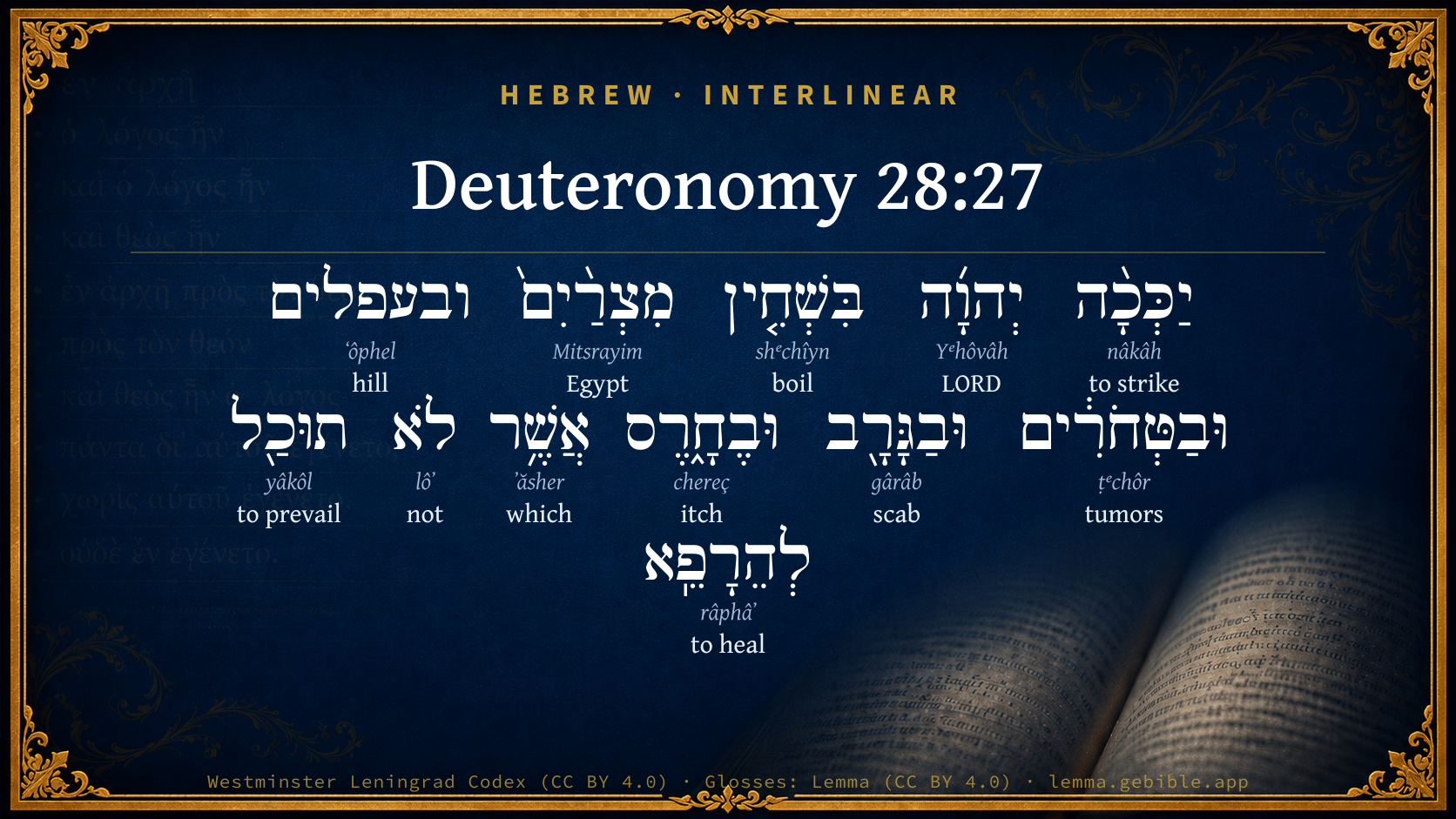
Hebrew (Westminster Leningrad Codex) Deuteronomy 28:27 appears in the Hebrew Old Testament. The text above is from the Westminster Leningrad Codex. Each word links to its Strong’s number, a concise gloss, and parsing drawn from the Open Scriptures Hebrew Bible morphology. Click any word for its full Brown-Driver-Briggs (BDB) entry.
Download image
Cite this verse

Deuteronomy 28:27 (World English Bible). Public Domain. Lemma interlinear Bible study tool, https://lemma.gebible.app/v/deuteronomy/28/27.

Show BibTeX & RIS
BibTeX
RIS
English Translation
Yahweh will strike you with the boil of Egypt, and with the tumors, and with the scurvy, and with the itch, of which you can not be healed.
World English Bible · Public Domain
Highlights
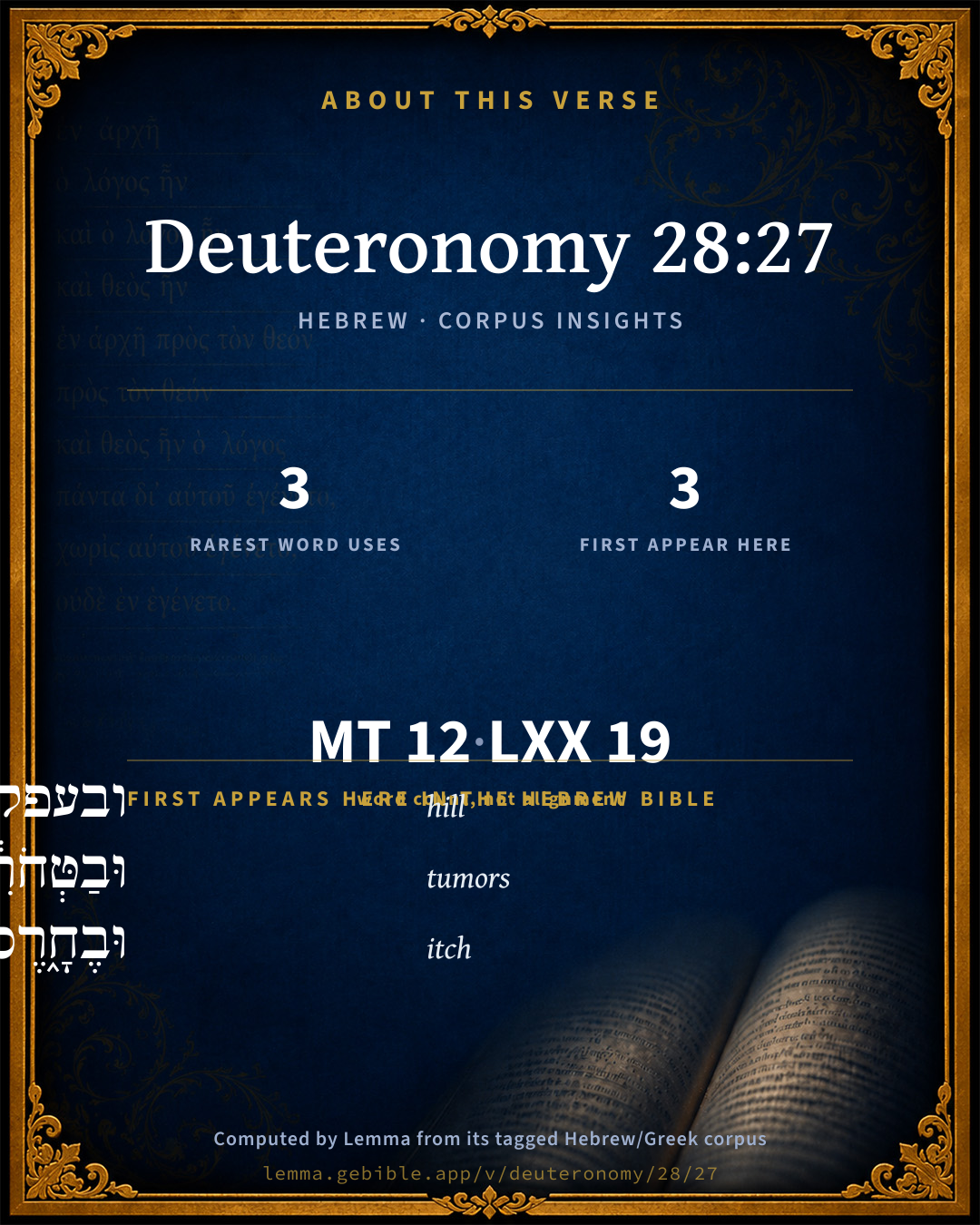
  • 3 first appearances in the Hebrew Bible
Full analysis ↓
Download a study sheet

One document with this verse’s original text, its word-by-word gloss line, the meaning frame, cross-references with their text, attributed commentary, and full source and license credits — printable, and it pastes into notes with its structure intact.

This verse Autodidact and up

Study sheet (.html) Plain text (.txt)

A passage Seminary Student

Up to 50 verses in one chapter. A passage sheet keeps up to 6 commentary sources and 12 cross-references per verse, in the order this page ranks them, and says so on the sheet whenever that leaves anything out. Ask for a single verse and you get the Autodidact verse sheet above.

Everything on this page stays free to read, with no account — the sheet is a download of what is already on screen, not access to it.

Want to remove ads? Support Godless Engineer
Compare translations 3

The same verse in 3 English versions, stacked beneath the original-language interlinear above. Click any original word for its lexicon entry.

Each is an independent rendering of the whole verse — the interlinear is not word-aligned to these translations.

Highlighted words mark where these versions differ — a whole-verse word diff, not a word-by-word alignment.

  • World English Bible Public Domain
    Yahweh will strike you with the boil of Egypt, and with the tumors, and with the scurvy, and with the itch, of which you can not be healed.
  • King James Version Public Domain
    The LORD will smite thee with the botch of Egypt, and with the emerods, and with the scab, and with the itch, whereof thou canst not be healed.
  • unfoldingWord Literal Text CC BY-SA 4.0
    Yahweh will smite with the boils of Egypt and with ulcers and with rash and with itch, from which you are not able to be healed.

unfoldingWord Literal Text — © unfoldingWord, licensed CC BY-SA 4.0. Word-aligned USFM3 via Door43 (git.door43.org/unfoldingWord/en_ult).

Versions to compare (up to 4)

3 of 4 selected

Show all 18 translations

Every available English version of this verse, each an independent rendering of the whole verse.

  • World English Bible Public Domain
    Yahweh will strike you with the boil of Egypt, and with the tumors, and with the scurvy, and with the itch, of which you can not be healed.
  • Berean Standard Bible Public Domain
    The LORD will afflict you with the boils of Egypt, with tumors and scabs and itch from which you cannot be cured.
  • Majority Standard Bible Public Domain
    The LORD will afflict you with the boils of Egypt, with tumors and scabs and itch from which you cannot be cured.
  • King James Version Public Domain
    The LORD will smite thee with the botch of Egypt, and with the emerods, and with the scab, and with the itch, whereof thou canst not be healed.
  • American Standard Version (1901) Public Domain
    Jehovah will smite thee with the boil of Egypt, and with the emerods, and with the scurvy, and with the itch, whereof thou canst not be healed.
  • Revised Version (1885) Public Domain
    The LORD shall smite thee with the boil of Egypt, and with the emerods, and with the scurvy, and with the itch, whereof thou canst not be healed.
  • Geneva Bible (1599) Public Domain
    The Lord wil smite thee with the botch of Egypt, and with the emeroids, and with the skab, and with the itche, that thou canst not be healed.
  • Douay-Rheims (1899) Public Domain
    The Lord strike thee with the ulcer of Egypt, and the part of thy body, by which the dung is cast out, with the scab and with the itch: so that thou canst not be healed.
  • Young's Literal Translation Public Domain
    `Jehovah doth smite thee with the ulcer of Egypt, and with emerods, and with scurvy, and with itch, of which thou art not able to be healed.
  • Literal Standard Version CC BY-SA 4.0
    YHWH strikes you with the ulcer of Egypt, and with lumps, and with scurvy, and with itch, of which you are not able to be healed.
  • Unlocked Literal Bible CC BY-SA 4.0
    Yahweh will attack you with the boils of Egypt and with ulcers, scurvy, and itch, from which you cannot be healed.
  • unfoldingWord Literal Text CC BY-SA 4.0
    Yahweh will smite with the boils of Egypt and with ulcers and with rash and with itch, from which you are not able to be healed.
  • Darby Bible Public Domain
    Jehovah will smite thee with the ulcers of Egypt, and with boils, and with the scab, and with the itch, whereof thou canst not be healed.
  • World Messianic Bible Public Domain
    The LORD will strike you with the boils of Egypt, with the tumors, with the scurvy, and with the itch, of which you can not be healed.
  • Webster's Bible Public Domain
    The LORD will smite thee with the botch of Egypt, and with the emerods, and with the scab, and with the itch, of which thou canst not be healed.
  • Free Bible Version CC BY-SA 4.0
    The Lord will give you boils like he did to the Egyptians, with swellings and scabs and skin rashes that can't be cured.
  • Bible in Basic English Public Domain
    The Lord will send on you the disease of Egypt, and other sorts of skin diseases which nothing will make well.
  • JPS Tanakh (1917) Public Domain
    The LORD will smite thee with the boil of Egypt, and with the emerods, and with the scab, and with the itch, whereof thou canst not be healed.

Literal Standard Version (2020), Covenant Press — licensed CC BY-SA 4.0. Text via the HelloAO Bible API (eBible.org). Unlocked Literal Bible (unfoldingWord) — licensed CC BY-SA 4.0. Text via the HelloAO Bible API (eBible.org). unfoldingWord Literal Text — © unfoldingWord, licensed CC BY-SA 4.0. Word-aligned USFM3 via Door43 (git.door43.org/unfoldingWord/en_ult). Free Bible Version, Dr. Jonathan Gallagher — licensed CC BY-SA 4.0. Text via the HelloAO Bible API (eBible.org).

Word by word

More ways to search: Search by grammar → Find every occurrence → Compare this word →

Practice this passage: Drill this verse → Learn its vocabulary →

וּבַגָּרָ֖ב
gârâb
H1618
“and · in/at the · scab”
Conjunction + Preposition, Determined + Noun, Common, Masculine, Singular, Absolute
Part of Speech
Conjunction + Preposition + Noun
Type
Common
Gender
Masculine
Number
Singular
State
Absolute
Full BDB Definition

Origin: from an unused root meaning to scratch

TWOT: 376a

itch, scab
  1. יַכְּכָ֨ה nâkâh H5221 “to strike · you” Verb, Hiphil, Imperfect, 3rd Person, Masculine, Singular + Suffix, Personal, 2nd Person, Masculine, Singular
  2. יְהוָ֜ה Yᵉhôvâh H3068 “LORD” Noun, Proper
  3. בִּשְׁחִ֤ין shᵉchîyn H7822 “in/at · boil of” Preposition + Noun, Common, Masculine, Singular, Construct
  4. מִצְרַ֨יִם֙ Mitsrayim H4714 “Egypt” Noun, Proper
  5. ובעפלים ʻôphel H6076 “and · in/at the · tumors” Conjunction + Preposition, Determined + Noun, Common, Masculine, Plural, Absolute
  6. וּבַטְּחֹרִ֔ים ṭᵉchôr H2914 “and · in/at the · tumors” Conjunction + Preposition, Determined + Noun, Common, Masculine, Plural, Absolute
  7. וּבֶחָ֑רֶס chereç H2775 “and · in/at the · itch” Conjunction + Preposition, Determined + Noun, Common, Masculine, Singular, Absolute
  8. אֲשֶׁ֥ר ʼăsher H834 “which” Particle, Relative
  9. לֹא lôʼ H3808 “not” Particle, Negative
  10. תוּכַ֖ל yâkôl H3201 “to prevail” Verb, Qal, Imperfect, 2nd Person, Masculine, Singular
  11. לְהֵרָפֵֽא râphâʼ H7495 “to heal” Preposition + Verb, Niphal, Infinitive Construct

About this verse

These counts appear in no published source. They are computed here, from the morphology-tagged text and Lemma’s own curated glosses. What Lemma adds →

12
words
12
distinct lemmas
Pentateuch
section

Notable vocabulary

The rarest word here is וּבַגָּרָ֖ב scab H1618 — appearing just 3 times in the whole Hebrew Bible.

First appearance in Scripture

These words make their first canonical appearance in the Hebrew Bible here:

  • ובעפלים hill H6076
  • וּבַטְּחֹרִ֔ים tumors H2914
  • וּבֶחָ֑רֶס itch H2775

Shared distinctive vocabulary

וּבַגָּרָ֖ב scab H1618 occurs in 3 verses of the Hebrew Bible. Also found in:

Grammatical profile

  • 3 verbs
  • 7 nouns
  • 2 particles

Verb forms

  • יַכְּכָ֨ה Hiphil · Imperfect
  • תוּכַ֖ל Qal · Imperfect
  • לְהֵרָפֵֽא Niphal · Infinitive Construct

Hebrew & Septuagint length

In English translation the verse runs 28 words from the Hebrew and 26 from the Septuagint (LXX English) — closely comparable.

A rough comparison of the two English renderings, which tokenize alike — not a word-level alignment.

Word counts can differ between the Hebrew and the Greek without any difference in meaning — e.g. the Hebrew direct-object marker אֵת has no separate Greek word, and Greek often adds the article ὁ.

In the original languages it is 12 Hebrew tokens and 19 Greek tokens — but the two are counted differently (Hebrew bundles its prefixes and suffixes into one token; the Greek is in lemma form), so that isn’t a like-for-like length.

Cross-references

12

Topical passages linked to Deuteronomy 28:27 in the Treasury of Scripture Knowledge — connected by theme and wording, ordered by reader-vote popularity; previews shown in the World English Bible.

  • 1 Samuel 5:6 But the hand of Yahweh was heavy on them of Ashdod, and he destroyed them, and struck them with tumors, even Ashdod and the borders of it.
  • Exodus 9:9 It shall become small dust over all the land of Egypt, and shall be a boil breaking forth with boils on man and on animal, throughout all the land of Egypt."
  • Exodus 15:26 and he said, "If you will diligently listen to the voice of Yahweh your God, and will do that which is right in his eyes, and will pay attention to his commandments, and keep all his statutes, I will put none of the diseases on you, which I have put on the Egyptians; for I am Yahweh who heals you."
  • Leviticus 21:20 or hunchbacked, or a dwarf, or one who has a defect in his eye, or an itching disease, or scabs, or who has damaged testicles;
  • Deuteronomy 28:35 Yahweh will strike you in the knees, and in the legs, with a sore boil, of which you can not be healed, from the sole of your foot to the crown of your head.
  • Exodus 9:11 The magicians couldn't stand before Moses because of the boils; for the boils were on the magicians, and on all the Egyptians.
  • Deuteronomy 28:60–61 He will bring on you again all the diseases of Egypt, which you were afraid of; and they shall cleave to you.
  • 1 Samuel 5:9 It was so, that after they had carried it about, the hand of Yahweh was against the city with a very great confusion: and he struck the men of the city, both small and great; and tumors broke out on them.
  • 1 Samuel 5:12 The men who didn't die were struck with the tumors; and the cry of the city went up to heaven.
  • Psalms 78:66 He struck his adversaries backward. He put them to a perpetual reproach.
  • Isaiah 3:17 Therefore the Lord brings sores on the crown of the head of the women of Zion, And Yahweh will make their scalps bald."
  • Leviticus 13:2–8 "When a man shall have a rising in his body's skin, or a scab, or a bright spot, and it becomes in the skin of his body the plague of leprosy, then he shall be brought to Aaron the priest, or to one of his sons the priests:

Cross-references courtesy of OpenBible.info (CC BY 4.0).

Hebrew and Greek witnesses Masoretic Hebrew ↔ Greek Septuagint

The same verse in the two great witnesses to the Old Testament, shown verse-for-verse.

These are two independent witnesses, not word-aligned to each other, and the Septuagint is shown in lemma (dictionary) form.

Hebrew Deuteronomy 28:27 Masoretic · Westminster Leningrad Codex

יַכְּכָ֨ה יְהוָ֜ה בִּשְׁחִ֤ין מִצְרַ֨יִם֙ ובעפלים וּבַטְּחֹרִ֔ים וּבַגָּרָ֖ב וּבֶחָ֑רֶס אֲשֶׁ֥ר לֹא תוּכַ֖ל לְהֵרָפֵֽא

Yahweh will strike you with the boil of Egypt, and with the tumors, and with the scurvy, and with the itch, of which you can not be healed.

World English Bible · Public Domain

Greek LXX Deuteronomy 28:27 Septuagint · lemma form

πατάσσω σύ κύριος ἐν ἕλκος αἰγύπτιος ἐν ὁ ἕδρα καί ψώρα ἄγριος καί κνήφη ὥστε μή δύναμαι σύ ἰάομαι

The Lord strike you with the botch of Egypt in the seat, and with a malignant scab, and itch, so that you can not be healed.

LXX2012 (modern English Septuagint) · Public Domain

On this verse, The Cambridge Bible for Schools and Colleges discusses the Septuagint’s reading. Read the note in Commentary ↓

Hebrew: Westminster Leningrad Codex (CC BY 4.0). Greek: Septuagint (public domain); English from LXX2012 (modern English Septuagint) (Public Domain). How the Septuagint differs from the Hebrew →

Targum (Aramaic paraphrase)

2

The Targum is the ancient Jewish Aramaic paraphrase of the Hebrew Scriptures — an interpretive translation, not the Hebrew text itself. Onkelos (literal) and Pseudo-Jonathan (expansive) render the Torah, and Jonathan the Prophets. Coverage is partial: where no permissively-licensed English translation exists for a verse, only the Aramaic is shown. This is verse-level text, not a word-by-word alignment to the Hebrew.

  1. Targum Onkelos Torah (Genesis–Deuteronomy)
    יִמְחִנָךְ יְיָ בְּשִׁחֲנָא דְמִצְרַיִם וּבִטְּחוֹרִין וּבְגַרְבָּא וּבַחֲרִיס יַבִּישׁ דִי לָא תִכּוּל לְאִתַּסָאָה

    (no public-domain English translation for this verse)

    Targum Onkelos — Aramaic: “Onkelos Genesis” (public domain); “Onkelos Exodus” (public domain); “Onkelos Leviticus” (public domain); “Onkelos Numbers” (public domain); “Onkelos Deuteronomy” (public domain). English: “Sefaria Community Translation” (CC0 1.0 (public-domain dedication)); “J.W. Etheridge. The Targums of Onkelos and Jonathan Ben Uzziel on the Pentateuch. London: Longmans, Green, 1862” (public domain). Text via Sefaria.

  2. Targum Pseudo-Jonathan Torah (Genesis–Deuteronomy)
    יַמְחִינְכוֹן מֵימְרָא דַיְיָ בְּשִׁיחְנֵי דִי לָקוּ בְּהוֹן מִצְרָאֵי וּבִטְחוֹרַיָא דִמְסַמְיָין חֶזְוָותָא וּבְגַרְבָּא וּבְחִכּוּכָא דְלָא תֵכְלוּן לְאִיתְּסָאָה

    And the Word of the Lord will smite you with the ulcers with which the Mizraee were smitten, and with haemorrhoids that blind the sight, and with blotches, and with erysipelas, from which you will not be able to be healed.

    Targum Pseudo-Jonathan — Aramaic: “Targum Jonathan on Genesis” (public domain); “Targum Jonathan on Exodus” (public domain); “Targum Jonathan on Leviticus” (public domain); “Targum Jonathan on Numbers” (public domain); “Targum Jonathan on Deuteronomy” (public domain). English: “The Targum of Jonathan ben Uzziel, trans. J. W. Etheridge, London, 1862” (public domain). Text via Sefaria.

Commentary

Notes on Deuteronomy 28:27 from classic Christian and Jewish commentators (each source and its license shown beneath its notes). The classic Christian expositions comment on the surrounding passage and are grouped to its opening verse, so a note may address several verses; the Jewish commentaries on the Tanakh (Rashi and others) are per-verse, so they appear only where the commentator wrote on this verse.

Lemma curates 59 commentaries, every one of them public domain or Creative Commons licensed, each selected and text-cleaned for this edition rather than reprinted as found. About our sources →

Trapp's Complete Commentary

John Trapp

Deu 28:27 The LORD will smite thee with the botch of Egypt, and with the emerods, and with the scab, and with the itch, whereof thou canst not be healed.

Ver. 27. With the botch of Egypt,] i.e., With the leprosy called Elephantiasis, when the skin grows hard as the elephant’s skin. This, saith one, was bred only about Nile, the river of Egypt.

John Trapp, A Commentary or Exposition upon All the Books of the Old and New Testament (1647–1656) — public domain. Text from a community e-Sword module.

Joseph Benson's Commentary

Deu 28:27-29. The botch of Egypt — Such boils or blains as the Egyptians were plagued with, spreading from head to foot. The emerods — Those painful swellings of the hemorrhoidal vessels, called piles. Blindness — Of mind, so that they should not know what to do. Astonishment — They should be filled with wonder and horror because of the strangeness and soreness of their calamities. Grope at noon-day — In the most clear and evident matters thou shalt grossly mistake. Thy ways — Thy counsels and enterprises shall be frustrated and turn to thy destruction. Compare Jer 25:16; Jer 25:18; Zep 1:17; Lam 4:14; Jer 4:9; Eze 4:17.

Joseph Benson's Commentary on the Old and New Testaments (1811–1818) — public domain. Text from a community e-Sword module.

Tyndale Open Study Notes

Tyndale Open Resources

28:27 the boils of Egypt: See Exod 9:8-12. • tumors: Cp. 1 Sam 5:6, 9, 12. • scurvy: Perhaps dermatitis. • The itch is also symptomatic of dermatitis.

Tyndale Open Study Notes — © Tyndale Open Resources, licensed CC BY-SA 4.0. Text via the HelloAO Bible API.

Jamieson, Fausset & Brown

Robert Jamieson, A. R. Fausset & David Brown

the botch of Egypt--a troublesome eruption, marked by red pimples, to which, at the rising of the Nile, the Egyptians are subject.

emerods--fistulæ or piles.

scab--scurvy.

itch--the disease commonly known by that name; but it is far more malignant in the East than is ever witnessed in our part of the world.

Jamieson, Fausset & Brown — Commentary Critical and Explanatory on the Whole Bible (1871) — public domain (CC PDM 1.0). Text via the HelloAO Bible API.

Adam Clarke's Commentary

Verse 27. The Lord will smite thee with the botch] שחין shechin, a violent inflammatory swelling. In Job 2:7, one of the Hexapla versions renders it ελεφας, the elephantiasis, a disease the most horrid that can possibly afflict human nature. In this disorder, the whole body is covered with a most loathsome scurf; the joints are all preternaturally enlarged, and the skin swells up and grows into folds like that of an elephant, whence the disease has its name. The skin, through its rigidity, breaks across at all the joints, and a most abominable ichor flows from all the chinks, c. See an account of it in Aretaeus, whose language is sufficient to chill the blood of a maniac, could he attend to the description given by this great master, of this most loathsome and abominable of all the natural productions of death and sin. This was called the botch of Egypt, as being peculiar to that country, and particularly in the vicinity of the Nile. Hence those words of Lucretius: -

Est Elephas morbus, qui circum flumina Nili

Nascitur, AEgypto in media nec praeterea usquam.

Lib. vi., ver. 1112.

Emerods] עפלים ophalim, from עפל aphal, to be elevated, raised up; swellings, protuberances; probably the bleeding piles.

Scab] גרב garab does not occur as a verb in the Hebrew Bible, but [Arabic] gharb, in Arabic, signifies a distemper in the corner of the eye, (Castel.,) and may amount to the Egyptian ophthalmia, which is so epidemic and distressing in that country: some suppose the scurvy to be intended.

Itch] חרס cheres, a burning itch, probably something of the erysipelatous kind, or what is commonly called St. Anthony's fire.

Whereof thou canst not be healed.] For as they were inflicted by GOD'S justice, they could not of course be cured by human art.

Adam Clarke's Commentary on the Bible (1810–1826) — public domain. Text from a community e-Sword/MySword module.

Ellicott's Commentary for English Readers

(27) The botch of Egypt.—The “boil,” with which the Egyptians were plagued (Exo_9:9, &c.) is the same word. (See also 2Ki_20:7; Job_2:7.) Rashi says of this boil, “It was very bad, being moist on the inside, and dry outside.” A learned Dalmatian Jew, with whom I have read this passage, tells me that he has seen many cases of this kind among the Hungarian and Polish Jews, and that it prevails among them, being traceable partly to their uncleanliness.

Emerods—i.e., hœmorrhoids (as in 1Sa_5:6).

The scab.—In Lev_21:20; Lev_22:22 “scurvy.” It would make both a priest and a victim unclean, and unfit for the service of Jehovah.

The itch.—Here only. “A dry ulcer like a sherd” (Rashi).

Whereof thou canst not be healed.—Not that these things are in themselves incurable, but that they should have them incurably.

A Bible Commentary for English Readers, edited by Charles John Ellicott (1878–1897) — public domain. Text from a community e-Sword module.

The Cambridge Bible for Schools and Colleges

gen. ed. J. J. S. Perowne

27. the boil of Egypt] Cp. P, Exo_9:9 with Driver’s note. One of the skin-diseases common in Egypt. Boil, Heb. sheḥîn; Eg. sḥn, ‘an abscess.’ Some think of small-pox, others of elephantiasis. But it may be the bubonic plague; see next note.

emerods] LXX ἕλκος Αἰγ. εἰς τὴν ἕδραν. Rather, as R.V. marg., tumours; Heb. ‘ophalim, swellings. Probably the buboes of the bubonic plague (so Macalister). On this see HGHL, 157 ff.

scurvy] Heb. garab (Ar. garab = mange), Lev_21:20; Lev_22:22; LXX ψώρα ἀγρία, Vulg. scabies. ‘Favus’ (Macalister).

itch] Heb. ḥeres, Lev_21:20, LXX κνήφη, Vulg. prurigo.

The Cambridge Bible for Schools and Colleges (gen. ed. J. J. S. Perowne; Cambridge University Press, 1878–1918) — public domain. Text from a community e-Sword module.

John Gill's Exposition

Thou shall betroth a wife, and another man shall lie with her,.... Espouse a woman in order to make her his wife, and before he can take her home, and consummate the marriage, through some calamity or another coming upon them, they should be set at a distance from each other, and she should fall into the hands of another man, who either should ravish her, or gain her consent to lie with her, or become his wife; which, when the marriage was so near being consummated, must be a grievous disappointment, and a great vexation:

thou shall build an house, and thou shall not dwell therein; being, before it is quite finished, or however before he is got into it, carried captive, or obliged to flee to a distant place:

thou shall plant a vineyard, and shall not gather the grapes thereof; or make it common, on the fourth year to eat the fruits of it, as Jarchi; which might not be done until sanctified and redeemed according to the law in Lev 19:23; See Gill on Deu 20:6.

John Gill's Exposition of the Whole Bible (1746–1763) — public domain (CC PDM 1.0). Text via the HelloAO Bible API.

Haydock's Catholic Bible Commentary

Egypt. See chap. vi. 15., xxviii. 60., Exodus ix. 9, and xv. 25., or with such diseases as those with which he afflicted Egypt. (Calmet) --- Out. Hebrew, "with the emerods, scab, and itch," (Haydock) 1 Kings v. 6, 12.

George Leo Haydock (1774–1849), Haydock's Catholic Family Bible and Commentary, 1859 edition — public domain. Excludes Psalms (Douay-Rheims chapter numbering differs from Protestant) and Deuterocanonical books (Catholic canon only).

Whedon's Commentary on the Bible

Daniel D. Whedon

27. The botch of Egypt — Probably the disease called elephantiasis. Comp. Exo_9:9, where the Hebrew word is translated boil. This section (27-34) announces some further disasters that will follow upon disobedience. Physical and mental calamities will come — desolation of the home and destruction of property.

Daniel D. Whedon (gen. ed.), Commentary on the Old and New Testaments (1874–1909) — public domain. Text from a community e-Sword module.

The Pulpit Commentary

Vers. 27-34. Second group. The Lord should afflict them with various loathsome diseases, vex them with humiliating and mortifying calamities, and give them over to be plundered and oppressed by their enemies.

Botch of Egypt; the form of leprosy peculiar to Egypt, (Exo_9:9, etc.) elephantiasis, AEgypti peculiare malum" (Pliny, "Nat. Hist.," 26:1-5). Emerods; tumors, probably piles. (cf. 1Sa 5) Scab; probably some kind of malignant scurvy. Itch of this there are various kinds common in Egypt and Syria.

The Pulpit Commentary (1880–1919), ed. H.D.M. Spence-Jones & Joseph S. Exell — public domain. Text from a community e-Sword module.

John Wesley's Explanatory Notes

The botch of Egypt - Such boils and blains as the Egyptians were plagued with, spreading from head to foot: The emerodes - Or piles.

John Wesley, Explanatory Notes Upon the Whole Bible (1754–1765) — public domain. Text via the GEBible commentary corpus.

unfoldingWord translationNotes

Door43 World Missions Community

General Information:

Moses speaks to the Israelites as if they were one man, so the words "you" and "your" here are singular. (See: Forms of You)

the boils of Egypt

"the same skin disease with which I cursed the Egyptians"

boils ... ulcers, scurvy, and itch

These are different types of skin diseases.

from which you cannot be healed

This can be stated in active form. AT: "from which no one will be able to heal you" (See: Active or Passive)

You will grope about at noonday like the blind grope in the darkness

"You will be like blind people who grope in darkness even at noonday." The Israelites will have a difficult life even when everyone else is enjoying life. (See: Simile)

you will be always oppressed and robbed

"stronger people will always oppress and rob you"

translationWords

Egypt

cure

darkness

oppress

save

unfoldingWord translationNotes — © Distant Shores Media and the Door43 World Missions Community, licensed CC BY-SA 4.0. Source: git.door43.org/Door43/en_tn.

Rashi

Rabbi Shlomo Yitzchaki (Rashi)

בשחין מצרים [THE LORD WILL SMITH THEE] WITH THE BOILS OF EGYPT — This was very bad, being wet inside and dry on the surface, as is stated in Treatise Bechorot 41a.

גרב is a wet boil,

חרס is a boil dry as a potsherd (חרס identical with חרש, a potsherd cf. Rashi on Leviticus 21:20).

Rashi on the Tanakh — English translations: “The Judaica Press complete Tanach with Rashi, translated by A. J. Rosenberg” (CC BY 4.0); “Pentateuch with Rashi's commentary by M. Rosenbaum and A.M. Silbermann, 1929-1934” (public domain); “The Metsudah Tanach series, Lakewood, N.J” (CC BY 4.0); and “The Book of Joshua, Metsudah Publications, 1997” (CC BY 4.0). Text via Sefaria.

Lesson kit

Teaching starters — assembled from the data on this page, not authored interpretation. Every prompt links to the verse data it draws on. Edit before teaching.

Deuteronomy, in the Pentateuch, opens this verse with 12 words (12 distinct Hebrew lemmas). Its most distinctive word is gârâb (“scab”). A historical commentator’s framing appears above. Read the whole chapter for the surrounding context.

Discussion questions

  1. How does “scab” (gârâb) shape what this verse is saying?
  2. 3 words here appear for the first time in Scripture. What is being introduced at this debut?
  3. Leviticus 21:20 shares the word «scab» with this verse. How do the two illuminate each other?
  4. These translations render this verse differently; the difference is in the English rendering, not the original. What questions does that raise?
  5. The verb «יַכְּכָ֨ה» is Hiphil Imperfect. How does its form color the action?
  6. Reading how Trapp's Complete Commentary and Joseph Benson's Commentary read this verse, where do the two commentators agree and where do they part?

Things to notice

Reading settings

Reading text

Shown beneath each verse's original-language words.

Old Testament
Old Testament edition

Read the OT as the Masoretic Hebrew (MT) or the Greek Septuagint (LXX).

English shown for the Greek Septuagint (in the Hebrew ↔ Greek comparison).

Comparing translations? Open the Compare panel on any verse page to stack up to four side by side.