
Judges 11:35

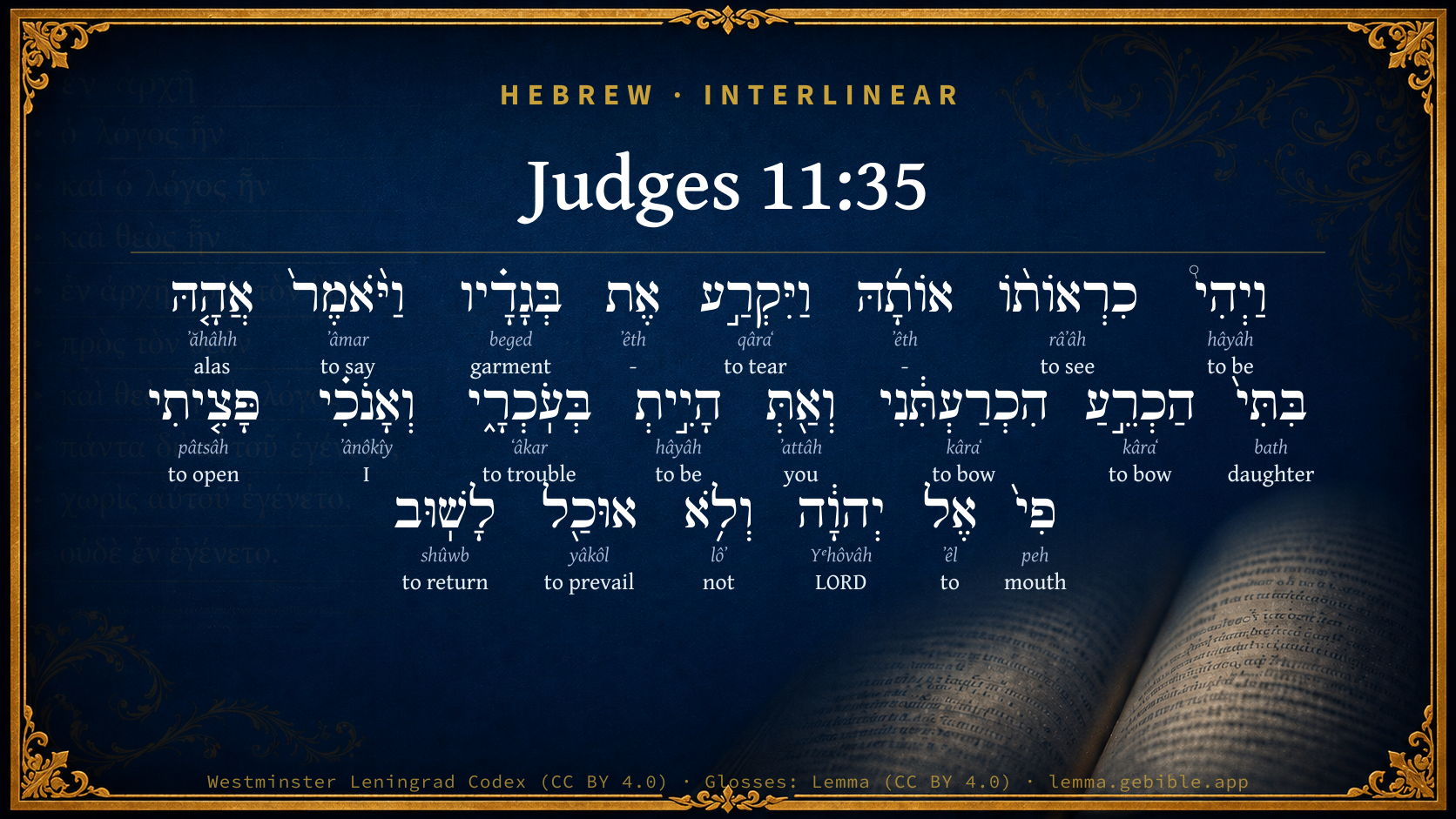
Hebrew (Westminster Leningrad Codex) Judges 11:35 appears in the Hebrew Old Testament. The text above is from the Westminster Leningrad Codex. Each word links to its Strong’s number, a concise gloss, and parsing drawn from the Open Scriptures Hebrew Bible morphology. Click any word for its full Brown-Driver-Briggs (BDB) entry.
Download image
Cite this verse

Judges 11:35 (World English Bible). Public Domain. Lemma interlinear Bible study tool, https://lemma.gebible.app/v/judges/11/35.

Show BibTeX & RIS
BibTeX
RIS
English Translation
It happened, when he saw her, that he tore his clothes, and said, Alas, my daughter! you have brought me very low, and you are one of those who trouble me; for I have opened my mouth to Yahweh, and I can't go back.
World English Bible · Public Domain
Download a study sheet

One document with this verse’s original text, its word-by-word gloss line, the meaning frame, cross-references with their text, attributed commentary, and full source and license credits — printable, and it pastes into notes with its structure intact.

This verse Autodidact and up

Study sheet (.html) Plain text (.txt)

A passage Seminary Student

Up to 50 verses in one chapter. A passage sheet keeps up to 6 commentary sources and 12 cross-references per verse, in the order this page ranks them, and says so on the sheet whenever that leaves anything out. Ask for a single verse and you get the Autodidact verse sheet above.

Everything on this page stays free to read, with no account — the sheet is a download of what is already on screen, not access to it.

Want to remove ads? Support Godless Engineer
Compare translations 3

The same verse in 3 English versions, stacked beneath the original-language interlinear above. Click any original word for its lexicon entry.

Each is an independent rendering of the whole verse — the interlinear is not word-aligned to these translations.

Highlighted words mark where these versions differ — a whole-verse word diff, not a word-by-word alignment.

  • World English Bible Public Domain
    It happened, when he saw her, that he tore his clothes, and said, Alas, my daughter! you have brought me very low, and you are one of those who trouble me; for I have opened my mouth to Yahweh, and I can't go back.
  • King James Version Public Domain
    And it came to pass, when he saw her, that he rent his clothes, and said, Alas, my daughter! thou hast brought me very low, and thou art one of them that trouble me: for I have opened my mouth unto the LORD, and I cannot go back.
  • unfoldingWord Literal Text CC BY-SA 4.0
    And it happened, as he saw her, that he tore his garments and said, “Alas, my daughter! Causing to bow, you have caused me to bow, and you are among the ones troubling me! For I have opened my mouth to Yahweh, and I am not able to turn back.”

unfoldingWord Literal Text — © unfoldingWord, licensed CC BY-SA 4.0. Word-aligned USFM3 via Door43 (git.door43.org/unfoldingWord/en_ult).

Versions to compare (up to 4)

3 of 4 selected

Show all 18 translations

Every available English version of this verse, each an independent rendering of the whole verse.

  • World English Bible Public Domain
    It happened, when he saw her, that he tore his clothes, and said, Alas, my daughter! you have brought me very low, and you are one of those who trouble me; for I have opened my mouth to Yahweh, and I can't go back.
  • Berean Standard Bible Public Domain
    As soon as Jephthah saw her, he tore his clothes and said, “No! Not my daughter! You have brought me to my knees! You have brought great misery upon me, for I have given my word to the LORD and cannot take it back.”
  • Majority Standard Bible Public Domain
    As soon as Jephthah saw her, he tore his clothes and said, “No! Not my daughter! You have brought me to my knees! You have brought great misery upon me, for I have given my word to the LORD and cannot take it back.”
  • King James Version Public Domain
    And it came to pass, when he saw her, that he rent his clothes, and said, Alas, my daughter! thou hast brought me very low, and thou art one of them that trouble me: for I have opened my mouth unto the LORD, and I cannot go back.
  • American Standard Version (1901) Public Domain
    And it came to pass, when he saw her, that he rent his clothes, and said, Alas, my daughter! thou hast brought me very low, and thou art one of them that trouble me; for I have opened my mouth unto Jehovah, and I cannot go back.
  • Revised Version (1885) Public Domain
    And it came to pass, when he saw her, that he rent his clothes, and said, Alas, my daughter! thou hast brought me very low, and thou art one of them that trouble me: for I have opened my mouth unto the LORD, and I cannot go back.
  • Geneva Bible (1599) Public Domain
    And when hee sawe her, hee rent his clothes, and saide, Alas my daughter, thou hast brought me lowe, and art of them that trouble me: for I haue opened my mouth vnto the Lord, and can not goe backe.
  • Douay-Rheims (1899) Public Domain
    And when he saw her, he rent his garments, and said: Alas! my daughter, thou hast deceived me, and thou thyself art deceived: for I have opened my mouth to the Lord, and I can do no other thing.
  • Young's Literal Translation Public Domain
    And it cometh to pass, when he seeth her, that he rendeth his garments, and saith, `Alas, my daughter, thou hast caused me greatly to bend, and thou hast been among those troubling me; and I -- I have opened my mouth unto Jehovah, and I am not able to turn back.'
  • Literal Standard Version CC BY-SA 4.0
    And it comes to pass, when he sees her, that he tears his garments and says, “Aah! My daughter, you have caused me to bend greatly, and you have been among those troubling me; and I have opened my mouth to YHWH, and I am not able to turn back.”
  • Unlocked Literal Bible CC BY-SA 4.0
    As soon as he saw her, he tore his clothes and said, “Oh! My daughter! You have crushed me with sorrow, and you have become one who causes me pain! For I have made an oath to Yahweh, and I cannot turn back on my promise.”
  • unfoldingWord Literal Text CC BY-SA 4.0
    And it happened, as he saw her, that he tore his garments and said, “Alas, my daughter! Causing to bow, you have caused me to bow, and you are among the ones troubling me! For I have opened my mouth to Yahweh, and I am not able to turn back.”
  • Darby Bible Public Domain
    And when he saw her, he rent his clothes, and said, "Alas, my daughter! you have brought me very low, and you have become the cause of great trouble to me; for I have opened my mouth to the LORD, and I cannot take back my vow."
  • World Messianic Bible Public Domain
    When he saw her, he tore his clothes, and said, “Alas, my daughter! You have brought me very low, and you are one of those who trouble me; for I have opened my mouth to the LORD, and I can’t go back.”
  • Webster's Bible Public Domain
    And it came to pass, when he saw her, that he rent his clothes, and said Alas, my daughter! thou hast brought me very low, and thou art one of them that trouble me: for I have opened my mouth to the LORD, and I cannot go back.
  • Free Bible Version CC BY-SA 4.0
    The moment he saw her, he ripped his clothes in agony and cried out, “Oh no, my daughter! You have crushed me completely! You have destroyed me, for I made a solemn promise to the Lord and I can't go back on it.”
  • Bible in Basic English Public Domain
    And when he saw her he was overcome with grief, and said, Ah! my daughter! I am crushed with sorrow, and it is you who are the chief cause of my trouble; for I have made an oath to the Lord and I may not take it back.
  • JPS Tanakh (1917) Public Domain
    And it came to pass, when he saw her, that he rent his clothes, and said: 'Alas, my daughter! thou hast brought me very low, and thou art become my troubler; for I have opened my mouth unto the LORD, and I cannot go back.'

Literal Standard Version (2020), Covenant Press — licensed CC BY-SA 4.0. Text via the HelloAO Bible API (eBible.org). Unlocked Literal Bible (unfoldingWord) — licensed CC BY-SA 4.0. Text via the HelloAO Bible API (eBible.org). unfoldingWord Literal Text — © unfoldingWord, licensed CC BY-SA 4.0. Word-aligned USFM3 via Door43 (git.door43.org/unfoldingWord/en_ult). Free Bible Version, Dr. Jonathan Gallagher — licensed CC BY-SA 4.0. Text via the HelloAO Bible API (eBible.org).

Word by word

More ways to search: Search by grammar → Find every occurrence → Compare this word →

Practice this passage: Drill this verse → Learn its vocabulary →

בְּעֹֽכְרָ֑י
ʻâkar
H5916
“in/at · troubling · me”
Preposition + Verb, Qal, Participle Active, Masculine, Plural, Construct + Suffix, Personal, 1st Person, Common, Singular
Part of Speech
Preposition + Verb
Stem
Qal
Form
Participle Active
Gender
Masculine
Number
Plural
State
Construct
Full BDB Definition

Origin: a primitive root

TWOT: 1621

to trouble, stir up, disturb, make (someone) taboo - (Qal) to disturb, trouble - (Niphal) - to be disturbed, be stirred up - disturbance, calamity (participle)
  1. וַיְהִי֩ hâyâh H1961 “and · to be” Conjunction + Verb, Qal, Sequential Imperfect, 3rd Person, Masculine, Singular
  2. כִרְאוֹת֨וֹ râʼâh H7200 “like/as · to see · him” Preposition + Verb, Qal, Infinitive Construct + Suffix, Personal, 3rd Person, Masculine, Singular
  3. אוֹתָ֜הּ ʼêth H853 “- · her” Particle, Direct Object + Suffix, Personal, 3rd Person, Feminine, Singular
  4. וַיִּקְרַ֣ע qâraʻ H7167 “and · to tear” Conjunction + Verb, Qal, Sequential Imperfect, 3rd Person, Masculine, Singular
  5. אֶת ʼêth H853 “-” Particle, Direct Object
  6. בְּגָדָ֗יו beged H899 “garments · his” Noun, Common, Masculine, Plural, Construct + Suffix, Personal, 3rd Person, Masculine, Singular
  7. וַיֹּ֨אמֶר֙ ʼâmar H559 “and · to say” Conjunction + Verb, Qal, Sequential Imperfect, 3rd Person, Masculine, Singular
  8. אֲהָ֤הּ ʼăhâhh H162 “alas” Particle, Interjection
  9. בִּתִּי֙ bath H1323 “daughter · my” Noun, Common, Feminine, Singular, Construct + Suffix, Personal, 1st Person, Common, Singular
  10. הַכְרֵ֣עַ kâraʻ H3766 “to bow” Verb, Hiphil, Infinitive Absolute
  11. הִכְרַעְתִּ֔נִי kâraʻ H3766 “to bow · me” Verb, Hiphil, Perfect, 2nd Person, Feminine, Singular + Suffix, Personal, 1st Person, Common, Singular
  12. וְאַ֖תְּ ʼattâh H859 “and · you” Conjunction + Pronoun, Personal, 2nd Person, Feminine, Singular
  13. הָיִ֣יתְ hâyâh H1961 “to be” Verb, Qal, Perfect, 2nd Person, Feminine, Singular
  14. וְאָנֹכִ֗י ʼânôkîy H595 “and · I” Conjunction + Pronoun, Personal, 1st Person, Common, Singular
  15. פָּצִ֤יתִי pâtsâh H6475 “to open” Verb, Qal, Perfect, 1st Person, Common, Singular
  16. פִי֙ peh H6310 “mouth · my” Noun, Common, Masculine, Singular, Construct + Suffix, Personal, 1st Person, Common, Singular
  17. אֶל ʼêl H413 “to” Preposition
  18. יְהוָ֔ה Yᵉhôvâh H3068 “LORD” Noun, Proper
  19. וְלֹ֥א lôʼ H3808 “and · not” Conjunction + Particle, Negative
  20. אוּכַ֖ל yâkôl H3201 “to prevail” Verb, Qal, Imperfect, 1st Person, Common, Singular
  21. לָשֽׁוּב shûwb H7725 “to return” Preposition + Verb, Qal, Infinitive Construct

About this verse

These counts appear in no published source. They are computed here, from the morphology-tagged text and Lemma’s own curated glosses. What Lemma adds →

22
words
19
distinct lemmas
Historical
section

Notable vocabulary

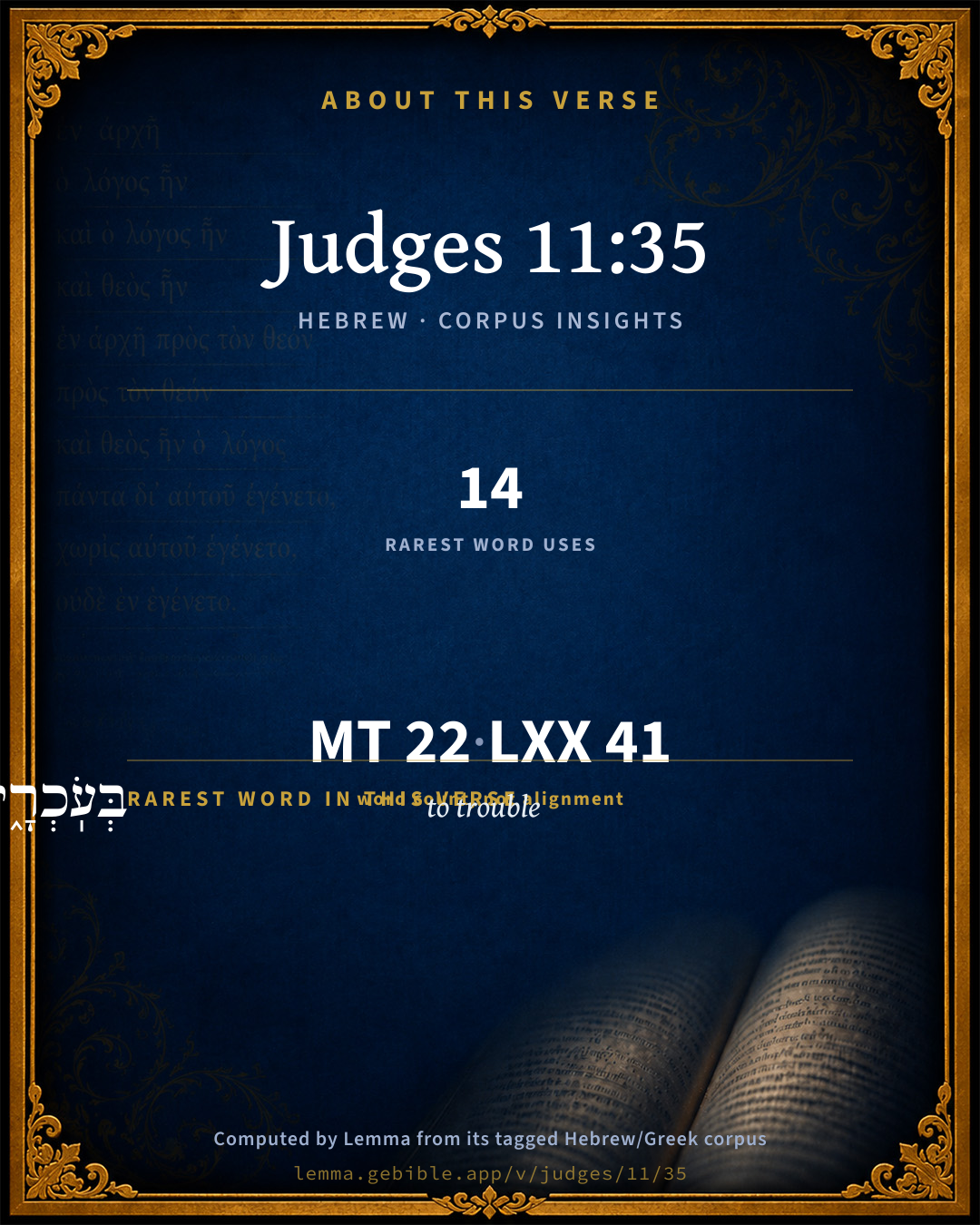
The rarest word here is בְּעֹֽכְרָ֑י to trouble H5916 — appearing just 14 times in the whole Hebrew Bible.

Shared distinctive vocabulary

בְּעֹֽכְרָ֑י to trouble H5916 occurs in 13 verses of the Hebrew Bible. Also found in:

Grammatical profile

  • 11 verbs
  • 4 nouns
  • 2 pronouns
  • 1 preposition
  • 4 particles

Verb forms

  • וַיְהִי֩ Qal · Sequential Imperfect
  • כִרְאוֹת֨וֹ Qal · Infinitive Construct
  • וַיִּקְרַ֣ע Qal · Sequential Imperfect
  • וַיֹּ֨אמֶר֙ Qal · Sequential Imperfect
  • הַכְרֵ֣עַ Hiphil · Infinitive Absolute
  • הִכְרַעְתִּ֔נִי Hiphil · Perfect
  • הָיִ֣יתְ Qal · Perfect
  • בְּעֹֽכְרָ֑י Qal · Participle Active
  • פָּצִ֤יתִי Qal · Perfect
  • אוּכַ֖ל Qal · Imperfect
  • לָשֽׁוּב Qal · Infinitive Construct

Repetition

Words recur within this verse — often emphatic in Hebrew:

  • וַיְהִי֩ to be H1961 ×2
  • הַכְרֵ֣עַ to bow H3766 ×2

Hebrew & Septuagint length

In English translation the verse runs 44 words from the Hebrew and 54 from the Septuagint (LXX English) — closely comparable.

A rough comparison of the two English renderings, which tokenize alike — not a word-level alignment.

Word counts can differ between the Hebrew and the Greek without any difference in meaning — e.g. the Hebrew direct-object marker אֵת has no separate Greek word, and Greek often adds the article ὁ.

In the original languages it is 22 Hebrew tokens and 41 Greek tokens — but the two are counted differently (Hebrew bundles its prefixes and suffixes into one token; the Greek is in lemma form), so that isn’t a like-for-like length.

Cross-references

13

Topical passages linked to Judges 11:35 in the Treasury of Scripture Knowledge — connected by theme and wording, ordered by reader-vote popularity; previews shown in the World English Bible.

  • Genesis 42:36–38 Jacob, their father, said to them, "You have bereaved me of my children! Joseph is no more, Simeon is no more, and you want to take Benjamin away. All these things are against me."
  • Matthew 14:7–9 Whereupon he promised with an oath to give her whatever she should ask.
  • Genesis 37:29–30 Reuben returned to the pit; and saw that Joseph wasn't in the pit; and he tore his clothes.
  • Genesis 37:34–35 Jacob tore his clothes, and put sackcloth on his loins, and mourned for his son many days.
  • Numbers 30:2–5 When a man vows a vow to Yahweh, or swears an oath to bind his soul with a bond, he shall not break his word; he shall do according to all that proceeds out of his mouth.
  • Judges 21:1–7 Now the men of Israel had sworn in Mizpah, saying, There shall not any of us give his daughter to Benjamin as wife.
  • 1 Samuel 14:44–45 Saul said, God do so and more also; for you shall surely die, Jonathan.
  • 2 Samuel 13:30–31 It happened, while they were in the way, that the news came to David, saying, Absalom has slain all the king's sons, and there is not one of them left.
  • 2 Samuel 18:33 The king was much moved, and went up to the chamber over the gate, and wept: and as he went, thus he said, my son Absalom, my son, my son Absalom! would I had died for you, Absalom, my son, my son!
  • Job 1:20 Then Job arose, and tore his robe, and shaved his head, and fell down on the ground, and worshiped.
  • Psalms 15:4 In whose eyes a vile man is despised, But who honors those who fear Yahweh; He who keeps an oath even when it hurts, and doesn't change;
  • Ecclesiastes 5:2–6 Don't be rash with your mouth, and don't let your heart be hasty to utter anything before God; for God is in heaven, and you on earth. Therefore let your words be few.
  • Acts 23:14 They came to the chief priests and the elders, and said, "We have bound ourselves under a great curse, to taste nothing until we have killed Paul.

Cross-references courtesy of OpenBible.info (CC BY 4.0).

Hebrew and Greek witnesses Masoretic Hebrew ↔ Greek Septuagint

The same verse in the two great witnesses to the Old Testament, shown verse-for-verse.

These are two independent witnesses, not word-aligned to each other, and the Septuagint is shown in lemma (dictionary) form.

Hebrew Judges 11:35 Masoretic · Westminster Leningrad Codex

וַיְהִי֩ כִרְאוֹת֨וֹ אוֹתָ֜הּ וַיִּקְרַ֣ע אֶת בְּגָדָ֗יו וַיֹּ֨אמֶר֙ אֲהָ֤הּ בִּתִּי֙ הַכְרֵ֣עַ הִכְרַעְתִּ֔נִי וְאַ֖תְּ הָיִ֣יתְ בְּעֹֽכְרָ֑י וְאָנֹכִ֗י פָּצִ֤יתִי פִי֙ אֶל יְהוָ֔ה וְלֹ֥א אוּכַ֖ל לָשֽׁוּב

It happened, when he saw her, that he tore his clothes, and said, Alas, my daughter! you have brought me very low, and you are one of those who trouble me; for I have opened my mouth to Yahweh, and I can't go back.

World English Bible · Public Domain

Greek LXX Judges 11:35 Septuagint · lemma form

καί γίγνομαι ὡς ὁράω αὐτός αὐτός διαῥήγνυμι ὁ ἱμάτιον αὐτός καί εἶπον ἆ ἆ θυγάτηρ ἐγώ ταραχή ταράσσω ἐγώ καί σύ εἰμί ἐν ὁ τάραχος ἐγώ καί ἐγώ εἰμί ἀναοἴγω κατά σύ ὁ στόμα ἐγώ πρός κύριος καί οὐ δύναμαι ἐπιστρέφω

And it came to pass when he saw her, that he tore his garments, and said, Ah, ah, my daughter, you have indeed troubled me, and you were the cause of my trouble; and I have opened my mouth against you to the Lord, and I shall not be able to return from it.

LXX2012 (modern English Septuagint) · Public Domain

Hebrew: Westminster Leningrad Codex (CC BY 4.0). Greek: Septuagint (public domain); English from LXX2012 (modern English Septuagint) (Public Domain). How the Septuagint differs from the Hebrew →

Targum (Aramaic paraphrase)

1

The Targum is the ancient Jewish Aramaic paraphrase of the Hebrew Scriptures — an interpretive translation, not the Hebrew text itself. Onkelos (literal) and Pseudo-Jonathan (expansive) render the Torah, and Jonathan the Prophets. Coverage is partial: where no permissively-licensed English translation exists for a verse, only the Aramaic is shown. This is verse-level text, not a word-by-word alignment to the Hebrew.

  1. Targum Jonathan Prophets (Joshua–Malachi)
    וַהֲוָה כַּד חֲזֵי יָתָהּ וּבְזַע יַת לְבוּשׁוֹהִי וַאֲמַר וַוי בְּרַתִּי אַכְרָעָא אַכְרַעְתִּינִי וְאַתְּ הֲוֵית בְּעָכְרִי וַאֲנָא פַּתְחֵית פּוּמִי בִּנְדַר קֳדָם יְיָ וְלָא אֵיכוּל לְמֵיתָב:

    (no public-domain English translation for this verse)

    Targum Jonathan — Aramaic: “Mikraot Gedolot” (public domain). English: “Sefaria Community Translation” (CC0 1.0 (public-domain dedication)); “London "Chaldee Paraphrase," 1871” (public domain). Text via Sefaria.

Commentary

Notes on Judges 11:35 from classic Christian and Jewish commentators (each source and its license shown beneath its notes). The classic Christian expositions comment on the surrounding passage and are grouped to its opening verse, so a note may address several verses; the Jewish commentaries on the Tanakh (Rashi and others) are per-verse, so they appear only where the commentator wrote on this verse.

Lemma curates 59 commentaries, every one of them public domain or Creative Commons licensed, each selected and text-cleaned for this edition rather than reprinted as found. About our sources →

Trapp's Complete Commentary

John Trapp

Jdg 11:35 And it came to pass, when he saw her, that he rent his clothes, and said, Alas, my daughter! thou hast brought me very low, and thou art one of them that trouble me: for I have opened my mouth unto the LORD, and I cannot go back.

Ver. 35. He rent his clothes, and said, Alas, my daughter!]

“ … Usque adeo nulla est sincera voluptas,

Sollicitumque aliquid laetis intervenit … ” - Ovid.

It is seldom seen that God alloweth unto any here a perfect contentment. Something men must have to complain of, that shall give an unsavoury verdure to their sweetest morsels, and make their very felicity miserable.

And I cannot go back.] But were there no priests to inquire of, what was the law in that case? Or were they also ignorant, or forgetful? Could nobody think of Lev 27:4, but Jepthah must follow his own counsel?

John Trapp, A Commentary or Exposition upon All the Books of the Old and New Testament (1647–1656) — public domain. Text from a community e-Sword module.

Geneva Bible (1599)

Geneva Bible translators

Being overcome with blind zeal, and not considering whether the vow was lawful or no.

Geneva Bible (1599) marginal notes — public domain. Text via Bolls.life.

Adam Clarke's Commentary

Verse 35. Thou hast brought me very low] He was greatly distressed to think that his daughter, who was his only child, should be, in consequence of his vow, prevented from continuing his family in Israel; for it is evident that he had not any other child, for besides her, says the text, he had neither son nor daughter, Jdg 11:34. He might, therefore, well be grieved that thus his family was to become extinct in Israel.

Adam Clarke's Commentary on the Bible (1810–1826) — public domain. Text from a community e-Sword/MySword module.

Ellicott's Commentary for English Readers

(35) He rent his clothes.—Comp. Jos_7:6. By one of the curious survivals which preserve customs for centuries after the meaning is gone out of them, every Jew on approaching to Jerusalem for the first time has to submit to the krie—i.e., to a cut made in his sleeve, as a sort of symbol of rending his clothes.

Thou hast brought me very low.—Literally, crushing, thou hast crushed me.

I have opened my mouth unto the Lord.—A vow was not deemed binding unless it had been actually expressed in words (Num_30:2-3; Num_30:7; Deu_23:23). There were two kinds of vows among the Hebrews—the simple vow, neder (Lev_27:2-27), and the “devotion,” or “ban,” cherem (Lev_27:28-29). Anything devoted to Jehovah by the cherem was irredeemable, and became “a holy of holies” (kodesh kadashim) to Him, and was to be put to death (Lev_27:29).

I cannot go back.—Num_30:2. Jephthah had not understood until now the horror of human sacrifice. He would neither wish nor dare to draw back from his cherem (Ecc_5:4-5; Mat_5:33; Jon_2:9; Pss. 72:25, Psa_26:11) merely because the anguish of it would fall so heavily upon himself. The Hebrews had the most intense feeling about the awfulness of breaking an oath or vow, and they left no room for any mental reservations (Lev_27:28-29). Saul was determined to carry out his ban even at the cost of the life of his eldest son, and even Herod Antipas felt obliged to carry out his oath to Herodias, though it involved a deep pang and a haunted conscience. It is clear that not for one moment did it occur to Jephthah to save himself from the agony of bereavement by breaking his ‘ban” (cherem) as a mere redeemable vow (neder). The Jews shared in this respect the feelings of other ancient nations. Thus the Greeks believed that the house of Athamas were under an inexpiable curse, because when the Achæans had been bidden to offer him up for a sacrifice for compassing the death of Phryxus, Kytissorus, the son of Phryxus, had intercepted the sacrifice (Herod. vii. 197, § 3; Plat. Minos, 5). It must be remembered that though his cherem had taken an unusual and unlawful (though far from unknown) form, the notion of such a vow would come far more naturally to a people which in very recent times, as well as afterwards, had devoted whole cities—men, women, children, cattle, and goods—to absolute destruction (Num_21:2-3).

A Bible Commentary for English Readers, edited by Charles John Ellicott (1878–1897) — public domain. Text from a community e-Sword module.

The Cambridge Bible for Schools and Colleges

gen. ed. J. J. S. Perowne

35. thou hast brought me very low] thou hast struck me down utterly: the same verb as in Jdg_5:27 (he bowed).

thou art one of them that trouble me] The first pron. is emphatic; ‘thou, my beloved, dost appear in the character of my worst enemy.’ For the Hebr. idiom (beth essentiae) see Psa_54:4 [Hebrews 6], Psa_118:7. Trouble is a feeble equivalent for the strong word in the original, which occurs only under circumstances which arouse unusual passion; see Gen_34:30, Jos_7:25-26, 1Sa_14:29, 1Ki_18:17-18. The Versions give a free paraphrase of the two words bowed down, trouble me (kara‘, ‘akar), but do not necessarily presuppose a different text.

I have opened my mouth] lit. opened wide, Jdg_11:36, of a solemn utterance; cf. Psa_66:13-14.

The Cambridge Bible for Schools and Colleges (gen. ed. J. J. S. Perowne; Cambridge University Press, 1878–1918) — public domain. Text from a community e-Sword module.

John Gill's Exposition

And she said unto her father, let this thing be done for me,.... She had but one favour to ask of him, which she thought might be granted, without any breach of the vow:

let me alone two months she desired such a space of time might be allowed her before the vow took place; and the rather she might be encouraged to expect that her request would be granted, since no time was fixed by the vow for the accomplishment of it, and since the time she asked was not very long, and the end to be answered not unreasonable

that I may go up and down upon the mountains; or, "ascend upon the mountains" (h); Jepthah's house in Mizpeh being higher than the mountains; or there might be, as Kimchi and Ben Melech note, a valley between that and the mountains, to which she descended in order to go up to the mountains; see Jdg 9:25 these she chose to make her abode, and take her walks in, during the time she asked, as being most fit for retirement and solitude; where she might give up herself to meditation and prayer, and conversation with her fellow virgins she would take with her, and so be wrought up to a greater degree of resignation and submission to her father's will, and to the will of God in it, as she might suppose:

and bewail my virginity, I and my fellows; the virgins her companions; this she proposed to be the subject that she and her associates would dwell upon, during this time of solitude; and the rather, as this may be thought to be the thing contained in the vow, that as she was a virgin, so she should continue; by which means she would not be the happy instrument of increasing the number of the children of Israel, nor of being the progenitor of the Messiah; upon which accounts it was reckoned in those times to be very grievous and reproachful to live and die without issue, and so matter of lamentation and weeping.

(h) "et descendam super montes", Pagninus, Montanus; "descendamque ad montes", Tigurine version.

John Gill's Exposition of the Whole Bible (1746–1763) — public domain (CC PDM 1.0). Text via the HelloAO Bible API.

Albert Barnes' Notes on the Bible

Jephthah was right in not being deterred from keeping his vow by the loss and sorrow to himself (compare the marginal references), just as Abraham was right in not withholding his son, his only son, from God, when commanded to offer him up as a burnt-offering. But Jephthah was wholly wrong in that conception of the character of God which led to his making the rash vow. And he would have done right not to slay his child, though the guilt of making and of breaking such a vow would have remained. Josephus well characterizes the sacrifice as “neither sanctioned by the Mosaic law, nor acceptable to God.”

Albert Barnes' Notes on the Bible (1834–1885) — public domain. Text from a community e-Sword/MySword module.

Haydock's Catholic Bible Commentary

Alas. These indications of grief are the effects of nature. (Salien) --- St. Ambrose considerst them as the marks of repentance; (ver. 31,) and we might hence infer that the vow was not dictated by the holy spirit, who would have endued Jepthe with fortitude, as he did Abraham, though all may not possess the virtue of that great father of believers, Genesis xxii. (Haydock) --- Deceived. We mutually expected comfort, from each other’s presence: but we must both experience the reverse. Hebrew may signify, "depressed, terrified," &c. --- Thing. Hebrew, "I cannot recede." (Haydock) --- It appears that he could not redeem what he had promised, (Calmet) as the condition had been fulfilled on the part of God. He might consider that he as no longer at liberty to use the privilege which the law allowed, when no condition had been specified, Leviticus xxvii. 4. (Haydock)

George Leo Haydock (1774–1849), Haydock's Catholic Family Bible and Commentary, 1859 edition — public domain. Excludes Psalms (Douay-Rheims chapter numbering differs from Protestant) and Deuterocanonical books (Catholic canon only).

Matthew Poole's English Annotations

Thou art one of them that trouble me: before this, I was troubled by my brethren; and since, by the Ammonites; and now most of all, though but occasionally, by thee. I have opened my mouth, i.e. I have vowed, which was done by words, Num 30:2,6.

I cannot go back, i.e. not retract my vow; I am indispensably obliged to perform it.

Matthew Poole's English Annotations on the Holy Bible (1683–1685) — public domain. Text from a community e-Sword/MySword module.

Whedon's Commentary on the Bible

Daniel D. Whedon

35. Rent his clothes — A sign of intense agony and grief. He had, probably, hoped to meet first some other less cherished member of his family.

Thou hast brought me very low — The idea here is, that of one bent down under the pressure of an almost crushing burden.

One of them that trouble me — Literally, thou art among my troublers; that is, like one whose work is to give me trouble and anguish. To sacrifice her is to end his family, since he had no other child. Jdg_11:34.

I cannot go back — They who took upon themselves a solemn oath were expected to keep their word, (Num_30:2;) but he who swore to some one’s hurt was under condemnation if he did not change, (Psa_15:4,) and the law (Leviticus 27) provided for the redemption of singular vows.

Daniel D. Whedon (gen. ed.), Commentary on the Old and New Testaments (1874–1909) — public domain. Text from a community e-Sword module.

The Pulpit Commentary

Thou hast brought me very low literally, thou hast thoroughly bowed me down, i.e. with sorrow. I cannot go back. A forcible illustration of the evil of rash vows. He who makes them is so placed that he must sin. If he breaks his vow, he has taken God"s name in vain; if he keeps it, he breaks one of God"s commandments. So it was with Saul, (1Sa_14:24, 1Sa_14:39-45) with Herod; (Mar_6:23) so it has often been since with those who have made unauthorised vows, and who in attempting to keep them have fallen into deadly sin.

The Pulpit Commentary (1880–1919), ed. H.D.M. Spence-Jones & Joseph S. Exell — public domain. Text from a community e-Sword module.

John Wesley's Explanatory Notes

Trouble me - Before this, I was troubled by my brethren; and since, by the Ammonites; and now most of all, tho' but occasionally, by thee. Opened my mouth - That is, I have vowed. Cannot go back - That is, not retract my vow; I am indispensably obliged to perform it.

John Wesley, Explanatory Notes Upon the Whole Bible (1754–1765) — public domain. Text via the GEBible commentary corpus.

Rashi

Rabbi Shlomo Yitzchaki (Rashi)

You are among those who ruined me. This is the feminine usage. ” vocalization under the ת, is generally translated as referring to the first person neuter, “I brought to the knees.” Here, however, the translation is the feminine “you brought to the knees.” Similarly, "You captured my heart, my sister bride." ” vocalization under the the ת, is translated as the feminine “you captured my heart.”

You have surely brought me to my knees All my blood is in turmoil, You have taken away my feet.

Rashi on the Tanakh — English translations: “The Judaica Press complete Tanach with Rashi, translated by A. J. Rosenberg” (CC BY 4.0); “Pentateuch with Rashi's commentary by M. Rosenbaum and A.M. Silbermann, 1929-1934” (public domain); “The Metsudah Tanach series, Lakewood, N.J” (CC BY 4.0); and “The Book of Joshua, Metsudah Publications, 1997” (CC BY 4.0). Text via Sefaria.

Lesson kit

Teaching starters — assembled from the data on this page, not authored interpretation. Every prompt links to the verse data it draws on. Edit before teaching.

Judges, in the Historical, opens this verse with 22 words (19 distinct Hebrew lemmas). Its most distinctive word is ʻâkar (“to trouble”). A historical commentator’s framing appears above. Read the whole chapter for the surrounding context.

Discussion questions

  1. How does “to trouble” (ʻâkar) shape what this verse is saying?
  2. Genesis 34:30 shares the word «to trouble» with this verse. How do the two illuminate each other?
  3. “to be” occurs 2× in this one verse. What is the effect of the repetition?
  4. The translations on this page render this verse differently — a whole-verse word diff, not a word-by-word alignment. What might account for the different wordings?
  5. The verb «וַיְהִי֩» is Qal Sequential Imperfect. How does its form color the action?
  6. Reading how Trapp's Complete Commentary and Geneva Bible (1599) read this verse, where do the two commentators agree and where do they part?

Things to notice

Reading settings

Reading text

Shown beneath each verse's original-language words.

Old Testament
Old Testament edition

Read the OT as the Masoretic Hebrew (MT) or the Greek Septuagint (LXX).

English shown for the Greek Septuagint (in the Hebrew ↔ Greek comparison).

Comparing translations? Open the Compare panel on any verse page to stack up to four side by side.