
Isaiah 47:12

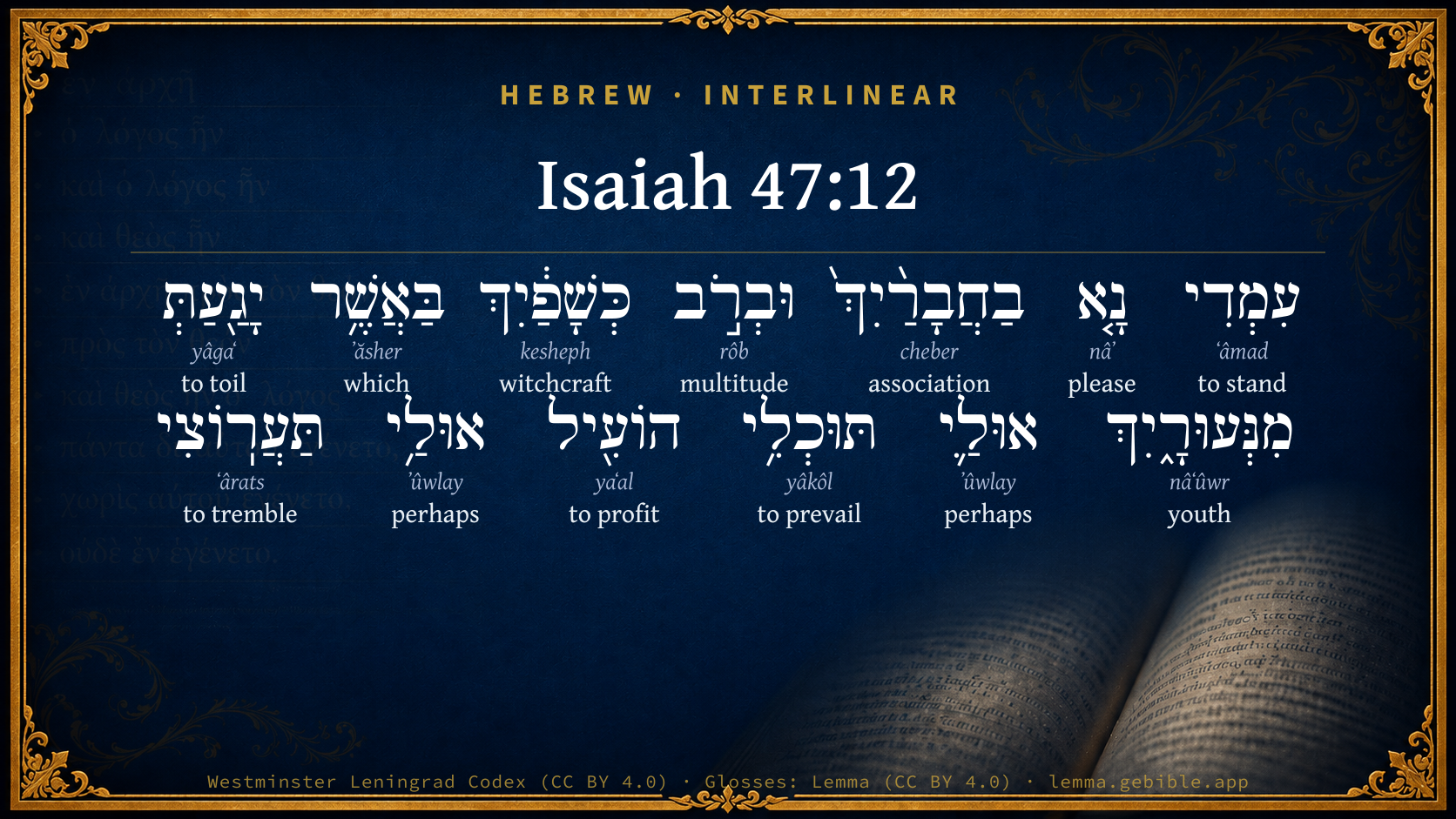
Hebrew (Westminster Leningrad Codex) Isaiah 47:12 appears in the Hebrew Old Testament. The text above is from the Westminster Leningrad Codex. Each word links to its Strong’s number, a concise gloss, and parsing drawn from the Open Scriptures Hebrew Bible morphology. Click any word for its full Brown-Driver-Briggs (BDB) entry.
Download image
Cite this verse

Isaiah 47:12 (World English Bible). Public Domain. Lemma interlinear Bible study tool, https://lemma.gebible.app/v/isaiah/47/12.

Show BibTeX & RIS
BibTeX
RIS
English Translation
Stand now with your enchantments, and with the multitude of your sorceries, in which you have labored from your youth; if so be you shall be able to profit, if so be you may prevail.
World English Bible · Public Domain
Download a study sheet

One document with this verse’s original text, its word-by-word gloss line, the meaning frame, cross-references with their text, attributed commentary, and full source and license credits — printable, and it pastes into notes with its structure intact.

This verse Autodidact and up

Study sheet (.html) Plain text (.txt)

A passage Seminary Student

Up to 50 verses in one chapter. A passage sheet keeps up to 6 commentary sources and 12 cross-references per verse, in the order this page ranks them, and says so on the sheet whenever that leaves anything out. Ask for a single verse and you get the Autodidact verse sheet above.

Everything on this page stays free to read, with no account — the sheet is a download of what is already on screen, not access to it.

Want to remove ads? Support Godless Engineer
Compare translations 3

The same verse in 3 English versions, stacked beneath the original-language interlinear above. Click any original word for its lexicon entry.

Each is an independent rendering of the whole verse — the interlinear is not word-aligned to these translations.

Highlighted words mark where these versions differ — a whole-verse word diff, not a word-by-word alignment.

  • World English Bible Public Domain
    Stand now with your enchantments, and with the multitude of your sorceries, in which you have labored from your youth; if so be you shall be able to profit, if so be you may prevail.
  • King James Version Public Domain
    Stand now with thine enchantments, and with the multitude of thy sorceries, wherein thou hast laboured from thy youth; if so be thou shalt be able to profit, if so be thou mayest prevail.
  • unfoldingWord Literal Text CC BY-SA 4.0
    Stand, please, with your spells and with the abundance of your sorceries, in which you have labored from your youth; perhaps you will be able to benefit, perhaps you will terrify.

unfoldingWord Literal Text — © unfoldingWord, licensed CC BY-SA 4.0. Word-aligned USFM3 via Door43 (git.door43.org/unfoldingWord/en_ult).

Versions to compare (up to 4)

3 of 4 selected

Show all 18 translations

Every available English version of this verse, each an independent rendering of the whole verse.

  • World English Bible Public Domain
    Stand now with your enchantments, and with the multitude of your sorceries, in which you have labored from your youth; if so be you shall be able to profit, if so be you may prevail.
  • Berean Standard Bible Public Domain
    So take your stand with your spells and with your many sorceries, with which you have wearied yourself from your youth. Perhaps you will succeed; perhaps you will inspire terror!
  • Majority Standard Bible Public Domain
    So take your stand with your spells and with your many sorceries, with which you have wearied yourself from your youth. Perhaps you will succeed; perhaps you will inspire terror!
  • King James Version Public Domain
    Stand now with thine enchantments, and with the multitude of thy sorceries, wherein thou hast laboured from thy youth; if so be thou shalt be able to profit, if so be thou mayest prevail.
  • American Standard Version (1901) Public Domain
    Stand now with thine enchantments, and with the multitude of thy sorceries, wherein thou hast labored from thy youth; if so be thou shalt be able to profit, if so be thou mayest prevail.
  • Revised Version (1885) Public Domain
    Stand now with thine enchantments, and with the multitude of thy sorceries, wherein thou hast laboured from thy youth; if so be thou shalt be able to profit, if so be thou mayest prevail.
  • Geneva Bible (1599) Public Domain
    Stand now among thine inchanters, and in the multitude of thy southsaiers (with whome thou hast wearied thy selfe from thy youth) if so be thou maist haue profit, or if so be thou maist haue strength.
  • Douay-Rheims (1899) Public Domain
    Stand now with thy enchanters, and with the multitude of thy sorceries, in which thou hast laboured from thy youth, if so be it may profit thee any thing, or if thou mayst become stronger.
  • Young's Literal Translation Public Domain
    Stand, I pray thee, in thy charms, And in the multitude of thy sorceries, In which thou hast laboured from thy youth, It may be thou art able to profit, It may be thou dost terrify!
  • Literal Standard Version CC BY-SA 4.0
    Now stand in your charms, || And in the multitude of your sorceries, || In which you have labored from your youth, || It may be you are able to profit, || It may be you terrify!
  • Unlocked Literal Bible CC BY-SA 4.0
    Persist in casting your spells and your many sorceries which you have faithfully recited since your childhood; perhaps you will be successful, perhaps you will scare away disaster.
  • unfoldingWord Literal Text CC BY-SA 4.0
    Stand, please, with your spells and with the abundance of your sorceries, in which you have labored from your youth; perhaps you will be able to benefit, perhaps you will terrify.
  • Darby Bible Public Domain
    Stand now with thine enchantments and with the multitude of thy sorceries, wherein thou hast laboured from thy youth; if so be thou shalt be able to turn them to profit, if so be thou mayest cause terror.
  • World Messianic Bible Public Domain
    “Stand now with your enchantments and with the multitude of your sorceries, in which you have labored from your youth, as if you might profit, as if you might prevail.
  • Webster's Bible Public Domain
    Stand now with thy enchantments, and with the multitude of thy sorceries, in which thou hast labored from thy youth; if thou shalt be able to profit, if thou mayest prevail.
  • Free Bible Version CC BY-SA 4.0
    So keep going with your magic spells and all your witchcraft, which you have worked at since you were young. Maybe you'll be successful, maybe you'll terrify people!
  • Bible in Basic English Public Domain
    Go on now with your secret arts, and all your wonder-working, to which you have given yourself up from your earliest days; it may be that they will be of profit to you, or by them you may put fear into your attackers.
  • JPS Tanakh (1917) Public Domain
    Stand now with thine enchantments, and with the multitude of thy sorceries, wherein thou hast laboured from thy youth; if so be thou shalt be able to profit, if so be thou mayest prevail.

Literal Standard Version (2020), Covenant Press — licensed CC BY-SA 4.0. Text via the HelloAO Bible API (eBible.org). Unlocked Literal Bible (unfoldingWord) — licensed CC BY-SA 4.0. Text via the HelloAO Bible API (eBible.org). unfoldingWord Literal Text — © unfoldingWord, licensed CC BY-SA 4.0. Word-aligned USFM3 via Door43 (git.door43.org/unfoldingWord/en_ult). Free Bible Version, Dr. Jonathan Gallagher — licensed CC BY-SA 4.0. Text via the HelloAO Bible API (eBible.org).

Word by word

More ways to search: Search by grammar → Find every occurrence → Compare this word →

Practice this passage: Drill this verse → Learn its vocabulary →

כְּשָׁפַ֔יִךְ
kesheph
H3785
“witchcrafts · your”
Noun, Common, Masculine, Plural, Construct + Suffix, Personal, 2nd Person, Feminine, Singular
Part of Speech
Noun
Type
Common
Gender
Masculine
Number
Plural
State
Construct
Full BDB Definition

Origin: from H3784

TWOT: 1051a

sorcery, witchcraft
  1. עִמְדִי ʻâmad H5975 “stand” Verb, Qal, Imperative, 2nd Person, Feminine, Singular
  2. נָ֤א nâʼ H4994 “please” Particle, Exhortation
  3. בַחֲבָרַ֨יִךְ֙ cheber H2267 “in/at · associations · your” Preposition + Noun, Common, Masculine, Plural, Construct + Suffix, Personal, 2nd Person, Feminine, Singular
  4. וּבְרֹ֣ב rôb H7230 “and · in/at · multitude of” Conjunction + Preposition + Noun, Common, Both, Singular, Construct
  5. בַּאֲשֶׁ֥ר ʼăsher H834 “in/at · which” Preposition + Particle, Relative
  6. יָגַ֖עַתְּ yâgaʻ H3021 “to toil” Verb, Qal, Perfect, 2nd Person, Feminine, Singular
  7. מִנְּעוּרָ֑יִךְ nâʻûwr H5271 “from · youth · your” Preposition + Noun, Common, Both, Plural, Construct + Suffix, Personal, 2nd Person, Feminine, Singular
  8. אוּלַ֛י ʼûwlay H194 “perhaps” Adverb
  9. תּוּכְלִ֥י yâkôl H3201 “to prevail” Verb, Qal, Imperfect, 2nd Person, Feminine, Singular
  10. הוֹעִ֖יל yaʻal H3276 “to profit” Verb, Hiphil, Infinitive Construct
  11. אוּלַ֥י ʼûwlay H194 “perhaps” Adverb
  12. תַּעֲרֽוֹצִי ʻârats H6206 “to tremble” Verb, Qal, Imperfect, 2nd Person, Feminine, Singular

About this verse

These counts appear in no published source. They are computed here, from the morphology-tagged text and Lemma’s own curated glosses. What Lemma adds →

13
words
12
distinct lemmas
Prophets
section

Notable vocabulary

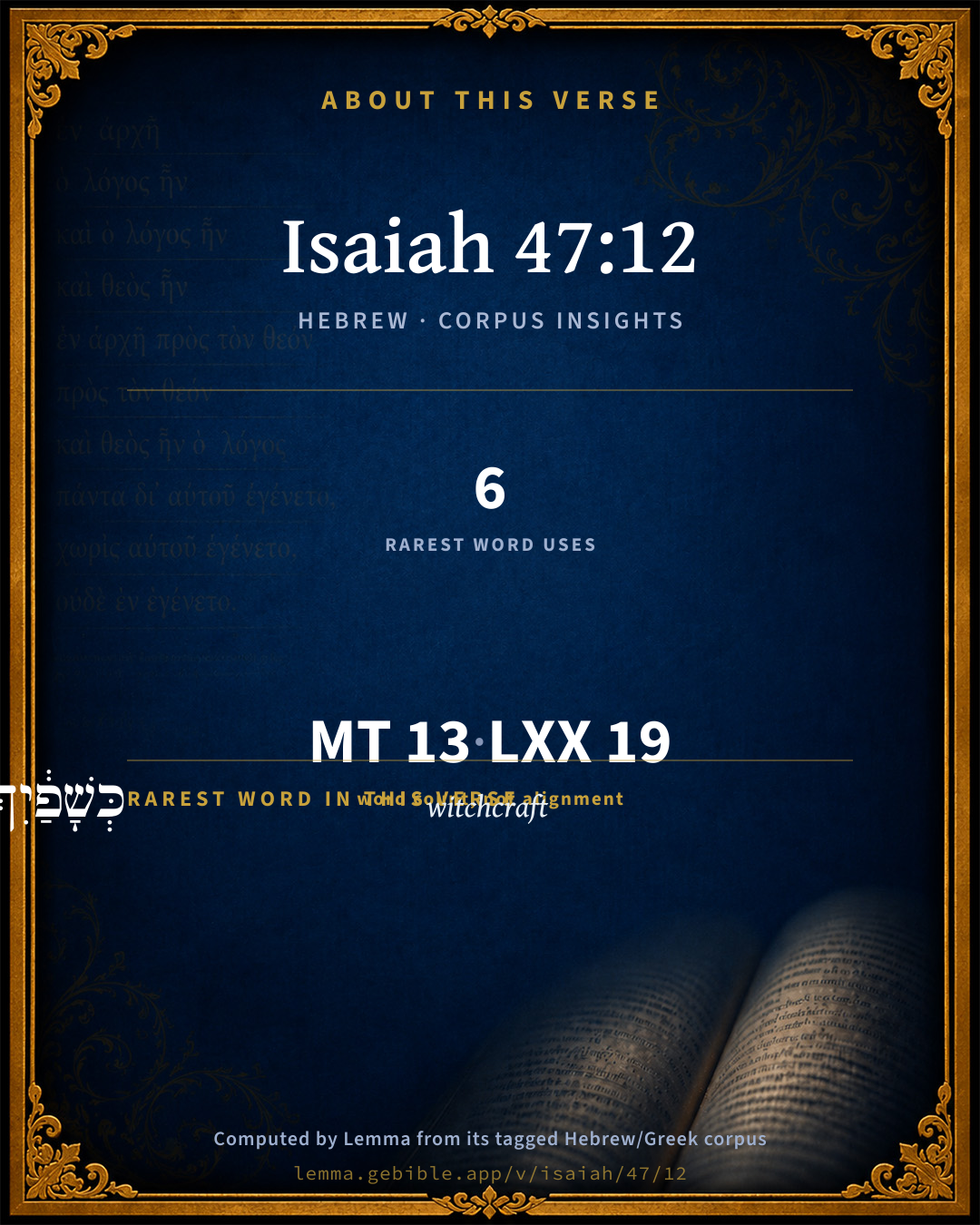
The rarest word here is כְּשָׁפַ֔יִךְ witchcraft H3785 — appearing just 6 times in the whole Hebrew Bible.

Shared distinctive vocabulary

כְּשָׁפַ֔יִךְ witchcraft H3785 occurs in 5 verses of the Hebrew Bible. Also found in:

Grammatical profile

  • 5 verbs
  • 4 nouns
  • 2 adverbs
  • 2 particles

Verb forms

  • עִמְדִי Qal · Imperative
  • יָגַ֖עַתְּ Qal · Perfect
  • תּוּכְלִ֥י Qal · Imperfect
  • הוֹעִ֖יל Hiphil · Infinitive Construct
  • תַּעֲרֽוֹצִי Qal · Imperfect

Repetition

A word recurs within this verse — often emphatic in Hebrew:

  • אוּלַ֛י perhaps H194 ×2

Hebrew & Septuagint length

In English translation the verse runs 35 words from the Hebrew and 24 from the Septuagint (LXX English) — the Septuagint runs noticeably shorter here. See the side-by-side →

A rough comparison of the two English renderings, which tokenize alike — not a word-level alignment.

Word counts can differ between the Hebrew and the Greek without any difference in meaning — e.g. the Hebrew direct-object marker אֵת has no separate Greek word, and Greek often adds the article ὁ.

In the original languages it is 13 Hebrew tokens and 19 Greek tokens — but the two are counted differently (Hebrew bundles its prefixes and suffixes into one token; the Greek is in lemma form), so that isn’t a like-for-like length.

Cross-references

14

Topical passages linked to Isaiah 47:12 in the Treasury of Scripture Knowledge — connected by theme and wording, ordered by reader-vote popularity; previews shown in the World English Bible.

  • Acts 13:8–12 But Elymas the sorcerer (for so is his name by interpretation) withstood them, seeking to turn aside the proconsul from the faith.
  • Isaiah 47:9–10 but these two things shall come to you in a moment in one day, the loss of children, and widowhood; in their full measure shall they come on you, in the multitude of your sorceries, and the great abundance of your enchantments.
  • Jeremiah 2:28 But where are your gods that you have made you? let them arise, if they can save you in the time of your trouble: for according to the number of your cities are your gods, Judah.
  • Nahum 3:4 because of the multitude of the prostitution of the alluring prostitute, the mistress of witchcraft, who sells nations through her prostitution, and families through her witchcraft.
  • Exodus 7:11 Then Pharaoh also called for the wise men and the sorcerers. They also, the magicians of Egypt, did in like manner with their enchantments.
  • Exodus 8:7 The magicians did in like manner with their enchantments, and brought up frogs on the land of Egypt.
  • Exodus 8:18–19 The magicians tried with their enchantments to bring forth lice, but they couldn't. There were lice on man, and on animal.
  • Exodus 9:11 The magicians couldn't stand before Moses because of the boils; for the boils were on the magicians, and on all the Egyptians.
  • Isaiah 8:19 When they shall tell you, "Consult with those who have familiar spirits and with the wizards, who chirp and who mutter:" shouldn't a people consult with their God? on behalf of the living [should they consult] with the dead?
  • Isaiah 19:3 The spirit of Egypt shall fail in the midst of it; and I will destroy the counsel of it: and they shall seek to the idols, and to the charmers, and to those who have familiar spirits, and to the wizards.
  • Isaiah 44:25 who frustrates the signs of the liars, and makes diviners mad; who turns wise men backward, and makes their knowledge foolish;
  • Daniel 5:7–9 The king cried aloud to bring in the enchanters, the Chaldeans, and the soothsayers. The king spoke and said to the wise men of Babylon, Whoever shall read this writing, and show me the interpretation of it, shall be clothed with purple, and have a chain of gold about his neck, and shall be the third ruler in the kingdom.
  • Revelation 17:4–6 The woman was dressed in purple and scarlet, and decked with gold and precious stones and pearls, having in her hand a golden cup full of abominations and the impurities of the sexual immorality of the earth.
  • 2 Thessalonians 2:9–12 even he whose coming is according to the working of Satan with all power and signs and lying wonders,

Cross-references courtesy of OpenBible.info (CC BY 4.0).

Hebrew and Greek witnesses Masoretic Hebrew ↔ Greek Septuagint

The same verse in the two great witnesses to the Old Testament, shown verse-for-verse.

Here the Septuagint runs noticeably shorter than the Hebrew — LXX2012 (modern English Septuagint) 24 words vs World English Bible 35. A rough length comparison of the two English translations, not a word-level alignment — read both below.

These are two independent witnesses, not word-aligned to each other, and the Septuagint is shown in lemma (dictionary) form.

Hebrew Isaiah 47:12 Masoretic · Westminster Leningrad Codex

עִמְדִי נָ֤א בַחֲבָרַ֨יִךְ֙ וּבְרֹ֣ב כְּשָׁפַ֔יִךְ בַּאֲשֶׁ֥ר יָגַ֖עַתְּ מִנְּעוּרָ֑יִךְ אוּלַ֛י תּוּכְלִ֥י הוֹעִ֖יל אוּלַ֥י תַּעֲרֽוֹצִי

Stand now with your enchantments, and with the multitude of your sorceries, in which you have labored from your youth; if so be you shall be able to profit, if so be you may prevail.

World English Bible · Public Domain

Greek LXX Isaiah 47:12 Septuagint · lemma form

ἵστημι νῦν ἐν ὁ ἐπαοιδή σύ καί ὁ πολύς φαρμακία σύ ὅς μανθάνω ἐκ νεότης σύ εἰ δύναμαι ὠφελέω

Stand now with your enchantments, and with the abundance of your sorcery, which you have learned from your youth; if you can be profited.

LXX2012 (modern English Septuagint) · Public Domain

Hebrew: Westminster Leningrad Codex (CC BY 4.0). Greek: Septuagint (public domain); English from LXX2012 (modern English Septuagint) (Public Domain). How the Septuagint differs from the Hebrew →

Targum (Aramaic paraphrase)

1

The Targum is the ancient Jewish Aramaic paraphrase of the Hebrew Scriptures — an interpretive translation, not the Hebrew text itself. Onkelos (literal) and Pseudo-Jonathan (expansive) render the Torah, and Jonathan the Prophets. Coverage is partial: where no permissively-licensed English translation exists for a verse, only the Aramaic is shown. This is verse-level text, not a word-by-word alignment to the Hebrew.

  1. Targum Jonathan Prophets (Joshua–Malachi)
    קוּמִי כְעַן בְּקִסוּמִיךְ וּבְסַגְיוּת חָרָשִׁיךְ דַהֲוֵית מִתְעַסְקָא בְּהוֹן מִיַנְקוּתִיךְ מָאִים תִּכְלִין לַהֲנָאָה מָאִים תִּכְלִין לְמִתְקַף:

    Persist now in thine enchantments; and in the multitude of thy sorceries, in which thou wast occupied from thy youth; if so be thou shalt be able to prevail.

    Targum Jonathan — Aramaic: “Mikraot Gedolot” (public domain). English: “Sefaria Community Translation” (CC0 1.0 (public-domain dedication)); “London "Chaldee Paraphrase," 1871” (public domain). Text via Sefaria.

Commentary

Notes on Isaiah 47:12 from classic Christian and Jewish commentators (each source and its license shown beneath its notes). The classic Christian expositions comment on the surrounding passage and are grouped to its opening verse, so a note may address several verses; the Jewish commentaries on the Tanakh (Rashi and others) are per-verse, so they appear only where the commentator wrote on this verse.

Lemma curates 59 commentaries, every one of them public domain or Creative Commons licensed, each selected and text-cleaned for this edition rather than reprinted as found. About our sources →

Trapp's Complete Commentary

John Trapp

Isa 47:12 Stand now with thine enchantments, and with the multitude of thy sorceries, wherein thou hast laboured from thy youth; if so be thou shalt be able to profit, if so be thou mayest prevail.

Ver. 12. Stand now with thine enchantments.] {a} Try thine utmost skill, and let us see what thou canst do for thyself. This is spoken in way of derision.

Wherein thou hast laboured from thy youth.] But found them to be no better than toilsome toys, quae nec ignoranti nocent, nec scientem iuvant, Against judiciary astrology, see Aug. De Civ. Dei, lib. v. cap. 1-5.

{a} Hinc divinatores per antonomasiam Chaldaei appellati.

John Trapp, A Commentary or Exposition upon All the Books of the Old and New Testament (1647–1656) — public domain. Text from a community e-Sword module.

Joseph Benson's Commentary

Isa 47:12-15. Stand now with thine enchantments — Persist in these practices. Wherein thou hast laboured from thy youth — From the beginning of thy kingdom. For the Chaldeans in all ages were famous, or rather infamous, for the study and practice of these arts. Thou art wearied in thy counsels — Thou hast spent thy time and strength in going from one to another, in trying all manner of experiments, and all to no purpose. Let now the astrologers, &c., stand up — To succour thee, or to inquire for thee. Behold, they shall be as stubble — They shall have no more power to withstand the calamities coming upon them than stubble has to resist the violence of the fire. They shall not deliver themselves from the flame — And much less thee. There shall not be a coal to warm at, &c. — They shall be totally consumed, and all the comfort which thou didst expect from them shall utterly vanish. Thus shall they be unto thee — Such comfortless and helpless creatures, namely, thy sorcerers, astrologers, &c.; with whom thou hast laboured — Upon whom thou hast spent thy time, pains, and money; even thy merchants — Or negotiators, as Bishop Lowth translates סחרין, with whom thou hast had so much intercourse, and so many dealings. They shall wander every one to his quarter — Or, as some interpret the meaning, “They shall wander by whatsoever ways they can to the extreme boundaries of thy empire, to save themselves from the general calamity.” None shall save thee — From thy impending ruin, but all shall leave thee to perish without help, and without hope. Observe, reader, they, and only they, are safe and happy, who, by faith and prayer, deal with one that will always be a present help in time of trouble to those that flee to him for refuge, and trust in him.

Joseph Benson's Commentary on the Old and New Testaments (1811–1818) — public domain. Text from a community e-Sword module.

Tyndale Open Study Notes

Tyndale Open Resources

47:12-15 In the face of calamity, Babylon would turn to occult practices for help, but it would not find help.

Tyndale Open Study Notes — © Tyndale Open Resources, licensed CC BY-SA 4.0. Text via the HelloAO Bible API.

Geneva Bible (1599)

Geneva Bible translators

He derideth their vain confidence, that put their trust in anything but in God, condemning also such vain sciences, which serve to no use, but to delude the people, and to bring them from depending only on God.

Geneva Bible (1599) marginal notes — public domain. Text via Bolls.life.

Jamieson, Fausset & Brown

Robert Jamieson, A. R. Fausset & David Brown

Stand--forth: a scornful challenge to Babylon's magicians to show whether they can defend their city.

laboured--The devil's service is a laborious yet fruitless one (Isa 55:2).

Jamieson, Fausset & Brown — Commentary Critical and Explanatory on the Whole Bible (1871) — public domain (CC PDM 1.0). Text via the HelloAO Bible API.

Ellicott's Commentary for English Readers

(12) If so be thou shalt be able . . .—The words come with a subtle tone of irony. Persevere in thy enchantments . . . perchance thou wilt be able to profit, perchance thou wilt strike terror.

A Bible Commentary for English Readers, edited by Charles John Ellicott (1878–1897) — public domain. Text from a community e-Sword module.

The Cambridge Bible for Schools and Colleges

gen. ed. J. J. S. Perowne

12. Stand now with &c.] Either Stand by thy spells, persist in them, stake everything upon them, as Lev_13:5; Jer_48:11, Eze_13:5 (these parallels, however, are not quite convincing); or (as in Isa_47:13) Stand forth with thy spells.

wherein thou hast laboured from thy youth] Or: with which thou hast wearied thyself, &c.; see on ch. Isa_43:22. Duhm omits these words entirely, for the sake of the rhythm, but they excite no suspicion on any other ground.

if so be &c.] perchance thou wilt be able to profit!—

perchance thou wilt inspire terror! (Cf. R.V.)

keen and bitter irony.

The Cambridge Bible for Schools and Colleges (gen. ed. J. J. S. Perowne; Cambridge University Press, 1878–1918) — public domain. Text from a community e-Sword module.

John Gill's Exposition

Stand now with thine enchantments, and with the multitude of thy sorceries,.... An ironic expression, deriding those evil arts, bidding defiance to them, calling upon the masters of them to do their utmost by them:

wherein thou hast laboured from thy youth; from the infancy of their state; as soon as their monarchy was founded, or they became a people, they were given to these practices, and were famous for them; and in which, no doubt, many among them were brought up from their youth; and to gain the knowledge of which they were at great labour and expense; and yet it was all in vain, and to no purpose:

if so be thou shall be able to profit, if so be thou mayest prevail; if skill in these things can be of any advantage to keep off the impending calamity, and fortify against the powerful enemy that will quickly surprise thee; try if by thine art thou canst foresee the danger, and prevent it.

John Gill's Exposition of the Whole Bible (1746–1763) — public domain (CC PDM 1.0). Text via the HelloAO Bible API.

Albert Barnes' Notes on the Bible

Stand now with thy enchantments - (See the notes at Isa 47:9). This is evidently sarcastic and ironical. It is a call on those who practiced the arts of magic to stand forth, and to show whether they were able to defend the city, and to save the nation.

Wherein thou hast labored - Or in practicing which thou hast been diligently employed.

From thy youth - From the very commencement of thy national existence. Babylon was always distinguished for these arts. Now was a time when their value was to be put to the test, and when it was to be seen whether they were able to save the nation.

If so be - Or perhaps or possibly, they may be able to profit thee - the language of irony. Perhaps by the aid of these arts you may be able to repel your foes.

Albert Barnes' Notes on the Bible (1834–1885) — public domain. Text from a community e-Sword/MySword module.

Haydock's Catholic Bible Commentary

CHAPTER XLVII.

George Leo Haydock (1774–1849), Haydock's Catholic Family Bible and Commentary, 1859 edition — public domain. Excludes Psalms (Douay-Rheims chapter numbering differs from Protestant) and Deuterocanonical books (Catholic canon only).

Matthew Poole's English Annotations

Stand: this word notes either,

1. Continuance. Persist or go on in these practices. Or,

2. Their gesture. For those that inquired of their gods by any of these superstitious practices used to stand; this being a posture, both of reverence, and waiting for an answer. But this is not a command or concession, but a sacred irony or scoff at the folly of these men, who having so oft been disappointed by these impostures, yet were as forward to use them and trust to them as if they had never deceived them.

From thy youth; from the beginning of thy commonwealth or kingdom. For the Chaldeans in all ages were famous, or rather infamous, for the study and practice of these arts.

Matthew Poole's English Annotations on the Holy Bible (1683–1685) — public domain. Text from a community e-Sword/MySword module.

Whedon's Commentary on the Bible

Daniel D. Whedon

12. Wherein thou hast laboured — Namely, in astrology, magic, or sorceries, through which Babylon might attempt to thwart the divine decree.

Daniel D. Whedon (gen. ed.), Commentary on the Old and New Testaments (1874–1909) — public domain. Text from a community e-Sword module.

The Pulpit Commentary

Stand now. The fourth and concluding strophe now begins; it opens, like the third, with a single imperative. It has, as Mr. Cheyne observes, "a strongly ironical tinge, reminding us of Elijah"s language to the priests of Baal in 1Ki_18:27." The irony is, however, confined to the first half (vers. 12, 13); giving place in vers. 14 and 15 to a scathing sentence of judgment and ruin. Enchantments... sorceries; rather, spells, enchantments (see the comment on ver. 9). If so be, etc.; rather, perchance thou wilt be able to profit; perchance thou wilt cause terror. The prophet gives a pretended encouragement to Israel"s adversaries. "If Babylon uses all the resources of her magical art, perhaps she may succeed who knows? Perhaps she may strike terror into the hearts of her assailants."

The Pulpit Commentary (1880–1919), ed. H.D.M. Spence-Jones & Joseph S. Exell — public domain. Text from a community e-Sword module.

The Preacher's Complete Homiletical Commentary

Joseph S. Exell (gen. ed.)

A CALL TO THE UNRIGHTEOUS

(Fourth Sunday in Advent.)

Isa_46:12-13. Hearken unto Me, ye stout-hearted, &c.

Referred at first to local and national circumstances, but addressed to the men of every generation—to ourselves in our own circumstances, rendered more obvious and striking by the near approach of the joyful season of Christmas.

I. God’s dealings with mankind have been all of a character which may be called unexpected. No reason can be given why men should be redeemed, rather than fallen angels, save that it so pleased Him who “worketh all things,” &c. Suppose that God had left the world to itself for many ages; suppose Him breaking the silence of centuries, of what nature would the world expect the summons to be if roused in the midst of its profligacy by the call, “Hearken,” &c.? Would it not be a message of wrath, &c.? It never could have been expected, that after such a summons would follow such words as are found in the text.

II. Having summoned the stout-hearted to hearken, the words that follow are specially adapted to their case—contain the motives which are most likely to bring them to contrition and repentance. The nearness of salvation is made an argument with the ungodly why they should turn from evil courses, just as preached by the Baptist—“Repent ye, for,” &c. The argument may not seem at first to be one of extraordinary force, but there is an energy and a persuasiveness in the approach of a Redeemer which may vainly be looked for in the approach of any other persons, or any other event. Apply this argument.

God goes on to speak with more distinctness of His purposes of mercy: “And I will place,” &c. Refers originally to what Christ would accomplish at His first appearing in Judea, and also what He would effect at His second advent. But if we confine our thoughts to what has been already effected, we have sufficient material from which to prove the accomplishment of the text. “Righteousness” is the salvation which God promises to be at hand. This is the most faithful description of the deliverance provided through the mediation of Christ, for that deliverance to righteousness which God provided for His own honour whilst providing for our rescue (Rom_9:30, &c.) And not only is salvation the righteousness of all, because it provides that God shall be just while the justifier; it is emphatically “God’s righteousness,” inasmuch as it communicates a righteousness to man which by his own strivings he could not have attained. It does this in two ways—by imputing Christ’s righteousness, and by working righteousness in us by the operation of the Holy Spirit.

And this salvation God placed in Zion, for it was only by the going up of the Mediator as a victim to the altar that the curse of the law was exhausted and the honour of the Divine attributes secured. Ages have no power to weaken or remove it. Still is virtue going out from Zion mighty as when the first Atonement was made. But we look for a yet nobler and ampler accomplishment of the prophecy (Isa_25:6-8; Isa_63:1).

“For Israel my glory.” Wonderful words! That fallen man should be His glory is an inexplicable mystery apart from Redemption. A redeemed creature is emphatically the glory of God.—H. Melvill, B.A.: Sermons, 1853, pp. 562–568.

I. A CALL OF GOD TO THE LISTLESS AND IMPENITENT. “Hearken unto Me ye stout-hearted, that are far from righteousness.”

1. This call may be said to apply to three classes—

(1.) To the spiritually deaf;

(2.) To the spiritually obdurate;

(3.) To the spiritually destitute—“Far from righteousness.”

2. This call is entitled to our immediate and most earnest attention.

(1.) Because it concerns our eternal destiny;

(2.) Because it is God’s call.

II. CONNECTED WITH THIS CALL IS THE GRACIOUS PROVISION AND ACCESSIBILITY OF SALVATION. “I bring near my righteousness; it shall not be far off, and my salvation shall not tarry.” Of this salvation, thus provided and so easily available, we reremark that—

1. It is Divine in its origin and nature. “I bring;” “my salvation.”

2. It is prompt in its announcement and delivery. The text signifies anything but delay, anything but cold and indifferent pauses. God makes haste to be gracious. He observes due time. and sent His Son in the fulness of time, He is slow to anger, but plenteous in mercy. As the prodigal’s father ran to meet him, so does God to save man.

3. It is mercifully adapted to the sinner’s condition.

(1.) He deserves threatening, but obtained instead mercy’s rich promise. God might justly have followed the call by threatening; but rather than this, there is a beautiful transition from the severe to the tender, from the prelude of thunder to the sweet and gentle music of love. It is a beautiful gradation from law to grace.

(2.) He deserves the loss of redemptive privileges, but is offered a near salvation.

(3.) He deserves present punishment, but is offered a timely pardon.

III. GOD CONSTITUTES HIS CHURCH THE TREASURY OF THIS ACCESSIBLE SALVATION. “I will place salvation in Zion, for Israel my glory.” Here we see—

1. That the church is the world’s house of mercy.

2. That the church is entrusted with the most solemn responsibilities.

3. That the church is God’s glory and object of honour. “For Israel my glory.”—Thomas Colclough in the “Lau Preacher,” vol. iii. p. 123.

I. THE DEPLORABLE CONDITION OF UNCONVERTED SINNERS.

1. “Stout-hearted”—stubborn, obdurate, hard. In Eze_11:19 we have a striking and instructive figure describing the condition of unconverted sinners: “The stony heart”—as hard, as cold, as barren, and as dead as a stone!

2. “Far from righteousness”—rightness in heart, in habit, and in life. Morally wrong. Alienated from God. All are naturally wrong (Rom_3:10). Yet some talk of moral excellence in fallen creatures, &c. The Bible acknowledges no real excellence but what arises from a work of grace upon the soul. Sin has defaced the moral excellences of man (Jer_17:9; Gen_6:5; Rom_8:7). “That which is born of the flesh is flesh”—fallen, corrupt, subject to the law of the Fall. “Ye must be born again.”

II. THE WONDERFUL MERCY OF GOD. Has provided a method of deliverance from this deplorable condition. “I bring near my righteousness,” &c. This deliverance God brings near (Rom_10:6-9). Your wrongness may be brought to a final end. The gospel is the grand provision for the restoration of righteousness in fallen and sinful men (2Co_5:21, &c.) Though by nature “far off,” you may be brought “nigh by the blood of Christ.”

III. THE IMPERATIVE DUTY TO WHICH SINNERS ARE SUMMONED. “Hearken unto Me.” When God speaks, it behoves us to listen (Heb_2:2-3). Hearken to His voice—immediately, earnestly, practically, constantly. “Hear, and your soul shall live.”—Alfred Tucker.

The Preacher's Complete Homiletical Commentary (gen. ed. Joseph S. Exell; Funk & Wagnalls, c. 1892) — public domain (pre-1929). A full-Bible homiletical/sermon-outline anthology covering 65 of 66 books (2 John is absent from the source module). Text from a community e-Sword module.

John Wesley's Explanatory Notes

Stand - Persist in these practices. laboured - From the beginning of thy kingdom. For the Chaldeans in all ages were famous for the practice of these arts.

John Wesley, Explanatory Notes Upon the Whole Bible (1754–1765) — public domain. Text via the GEBible commentary corpus.

Keil & Delitzsch

C. F. Keil & F. Delitzsch

Then follows the concluding strophe, which, like the first, announces to the imperial city in a triumphantly sarcastic tone its inevitable fate; whereas the intermediate strophes refer rather to the sins by which this fate has been brought upon it. "Come near, then, with thine enchantments, and with the multitude of thy witchcrafts, wherein thou hast laboured from thy youth: perhaps thou canst profit, perhaps thou wilt inspire terror. Thou art wearied through the multitude of thy consultations; let the dissectors of the heavens come near, then, and save thee, the star-gazers, they who with every new moon bring things to light that will come upon thee. Behold, they have become like stubble: fire has consumed them: there is not a red-hot coal to warm themselves, a hearth-fire to sit before. So is it with thy people, for whom thou hast laboured: thy partners in trade from thy youth, they wander away every one in his own direction; no one who brings salvation to thee." Hitzig and others adopt the simple rendering, "Persevere, then, with thine enchantments." It is indeed true, that in Lev 13:5 בּ עמד signifies "to remain standing by anything," i.e., to persevere with it, just as in Eze 13:5 it signifies to keep one's standing in anything; in Kg2 23:3, to enter upon anything; and in Ecc 8:3, to engage in anything; but there is no reason for taking it here in any other sense than in Isa 47:13. Babylon is to draw near with all the processes of the black art, wherein בּאשׁר, according to our western mode of expression, equivalent to בּהם אשׁר, Ges. 123, 2*) it had been addicted to abundance of routine from its youth upwards (יגעאתּ with an auxiliary pathach for יגעתּ); possibly it may be of some use, possibly it will terrify, i.e., make itself so terrible to the approaching calamity, as to cause it to keep off. The prophet now sees in spirit how Babylon draws near, and how it also harasses itself to no purpose; he therefore follows up the עמדי־נא, addressed in pleno to Babylon, with a second challenge commencing with יעמדוּ־נא. Their astrologers are to draw near, and try that power over the future to which they lay claim, by bringing it to bear at once upon the approaching destruction for the benefit of Babylon. עצתיך is a singular form connected with a feminine plural suffix, such as we find in Psa 9:15; Eze 35:11; Ezr 9:15, connected with a masculine plural suffix. Assuming the correctness of the vowel-pointing, the singular appears in such cases as these to have a collective meaning, like the Arabic pl. fractus; for there is no ground to suppose that the Aramaean plural form ‛ētsâth is used here in the place of the Hebrew. Instead of שׁמים הברו (which would be equivalent to הברו אשׁרא, the keri reads שׁמים הברי, cutters up of the heavens, i.e., planners or dissectors of them, from hâb, dissecare, resecare (compare the rabbinical habhârâh, a syllable, i.e., segmentum vocabuli, and possibly also the talmudic 'ēbhârı̄m, limbs of a body). The correction proposed by Knobel, viz., chōbherē, from châbhār, to know, or be versed in, is unnecessary. Châzâh b' signifies here, as it generally does, to look with pleasure or with interest at anything; hence Luther has rendered it correctly, die Sternkucker (Eng. ver. star-gazers). They are described still further as those who make known with every new moon (lechŏdâshı̄m, like labbeqârı̄m, every morning, Isa 33:2, etc.), things which, etc. מאשׁר is used in a partitive sense: out of the great mass of events they select the most important, and prepare a calendar or almanack (ἀλμενιχιακά in Plutarch) for the state every month. But these very wise men cannot save themselves, to say nothing of others, out of the power of that flame, which is no comforting coal-fire to warm one's self by, no hearth-fire (Isa 44:16) to sit in front of, but a devouring, eternal, i.e., peremptory flame (Isa 33:14). The rendering adopted by Grotius, Vitringa, Lowth, Gesenius, and others, "non supererit pruna ad calendum," is a false one, if only because it is not in harmony with the figure. "Thus shall they be unto thee," he continues in Isa 47:15, i.e., such things shall be endured to thy disgrace by those about whom thou hast wearied thyself (אשׁר = בּהם אשׁר). The learned orders of the Chaldeans had their own quarter, and enjoyed all the distinction and privileges of a priestly caste. What follows cannot possibly be understood as relating to these masters of astrology and witchcraft, as Ewald supposes; for, according to the expression שׁחרהּ in Isa 47:11, they would be called שׁחריך. Moreover, if they became a prey of the flames, and therefore were unable to flee, we should have to assume that they were burned while taking flight (Umbreit). סחריך are those who carried on commercial intercourse with the great "trading city" (Eze 17:4), as Berossos says, "In Babylon there was a great multitude of men of other nations who had settled in Chaldea, and they lived in disorder, like the wild beasts;" compare Aeschylus, Pers. 52-3, Βαβυλὼν δ ̓ ἡ πολύχρυσος πάμμικτον ὄχλον πέμπει. All of these are scattered in the wildest flight, אל־עברו אישׁ, every one on his own side, viz., in the direction of his own home, and do not trouble themselves about Babylon.

Keil & Delitzsch — Biblical Commentary on the Old Testament (1861–1891) — public domain (CC PDM 1.0). Text via the HelloAO Bible API. (Old Testament only.)

J. A. Alexander on Isaiah

Joseph Addison Alexander

“Stand now!” The word here rendered ‘now’ is not a particle of time but of entreaty, very often corresponding to ‘I pray’, or ‘if you please’. In this case it indicates a kind of concession to the people, if they still choose to try the virtue of their superstitious arts which He had already denounced as worthless. “Stand now in thy spells (or charels).” Some suppose an allusion to the customary standing posture of astrologers, conjurers, etc. Others understand the verb to mean ‘stand fast, be firm and courageous.’ But the modern writers generally understand it to mean ‘persist or persevere’, which of course requires the preposition to be taken in its usual proper sense of ‘in’. “Persist now in thy spells and in the abundance of thy charms,” the same nouns that are joined above in v. 9. “In which thou hast labored.” ‘From thy youth’ may either mean ‘of old’, or more specifically, ‘since the earliest period of thy national existence’. The antiquity of occult arts, and above all of astrology, in Babylon, is attested by various profane writers. Diodorus Siculus indeed derives them from Egypt, and describes the Chaldees or astrologers of Babylon as Egyptian colonists. But as this last is certainly erroneous (see above on v. 1), the other assertion can have no authority. The Babylonians are reported by the same and other writers to have carried back their own antiquity, as proved by recorded scientific observations, to an extravagant and foolish length, to which some think there is allusion here in the expression ‘from thy youth’. “Perhaps thou wilt be able to succeed, or help thyself,” the verb commonly translated ‘profit’. (See above, Isa 44:10) This faint suggestion of a possibility is more expressive than a positive denial.

Joseph Addison Alexander, The Prophecies of Isaiah (1846–1847; New York: Scribner, 1870–1878) — public domain. Text from a community e-Sword module.

unfoldingWord translationNotes

Door43 World Missions Community

Connecting Statement:

Yahweh continues to speak to Babylon about her downfall as if she were a queen who is humiliated. (See: Metaphor and Personification)

Persist in casting your spells ... perhaps you will scare away disaster

Yahweh mocks Babylon by telling her to continue to practice her sorcery to keep bad things away, but he knows that it will not help her. (See: Irony)

translationWords

sorcerer

faithful

save

heaven

declare

new moon

unfoldingWord translationNotes — © Distant Shores Media and the Door43 World Missions Community, licensed CC BY-SA 4.0. Source: git.door43.org/Door43/en_tn.

Rashi

Rabbi Shlomo Yitzchaki (Rashi)

Stand now Strengthen yourself now.

perhaps you will gain strength Heb. תַּעֲרוֹצִי. Jonathan renders: Perhaps you will be able to become strong.

Rashi on the Tanakh — English translations: “The Judaica Press complete Tanach with Rashi, translated by A. J. Rosenberg” (CC BY 4.0); “Pentateuch with Rashi's commentary by M. Rosenbaum and A.M. Silbermann, 1929-1934” (public domain); “The Metsudah Tanach series, Lakewood, N.J” (CC BY 4.0); and “The Book of Joshua, Metsudah Publications, 1997” (CC BY 4.0). Text via Sefaria.

Ibn Ezra

Rabbi Abraham ibn Ezra

נא Now.

בחבריך With thine enchantments. It is a plural noun, of the same root as וחבר חבר or a charmer (Deut. 18:11).

הועיל To profit. It is Infinitive.

תערוצי Thou mayest prevail. Comp. עריץ strong (29:20)

Ibn Ezra on the Tanakh — English translations: “Sefaria Community Translation” (CC0 1.0 (public-domain dedication)); “Yalkut, Sifsei Chachomim Chumash, Metsudah Publications, 2009” (CC BY 4.0); and “Commentary of Ibn Ezra on Isaiah - trans. by M. Friedlander, 1873” (public domain). Text via Sefaria.

Lesson kit

Teaching starters — assembled from the data on this page, not authored interpretation. Every prompt links to the verse data it draws on. Edit before teaching.

Isaiah, in the Prophets, opens this verse with 13 words (12 distinct Hebrew lemmas). Its most distinctive word is kesheph (“witchcraft”). The Greek Septuagint runs shorter here. A historical commentator’s framing appears above. Read the whole chapter for the surrounding context.

Discussion questions

  1. What does “witchcraft” (kesheph) contribute to the verse as a whole?
  2. How does 2 Kings 9:22, which shares the word «witchcraft», read alongside this verse?
  3. What does the repetition of “perhaps” (2× in this one verse) do in this verse?
  4. The Septuagint runs shorter here than the Hebrew. What might account for the difference?
  5. The translations on this page render this verse differently — a whole-verse word diff, not a word-by-word alignment. What might account for the different wordings?
  6. «עִמְדִי» is a Qal Imperative verb. How does that grammatical form shape the action described?
  7. Compare how Trapp's Complete Commentary and Joseph Benson's Commentary read this verse. Where do they agree or differ?

Things to notice

Reading settings

Reading text

Shown beneath each verse's original-language words.

Old Testament
Old Testament edition

Read the OT as the Masoretic Hebrew (MT) or the Greek Septuagint (LXX).

English shown for the Greek Septuagint (in the Hebrew ↔ Greek comparison).

Comparing translations? Open the Compare panel on any verse page to stack up to four side by side.