
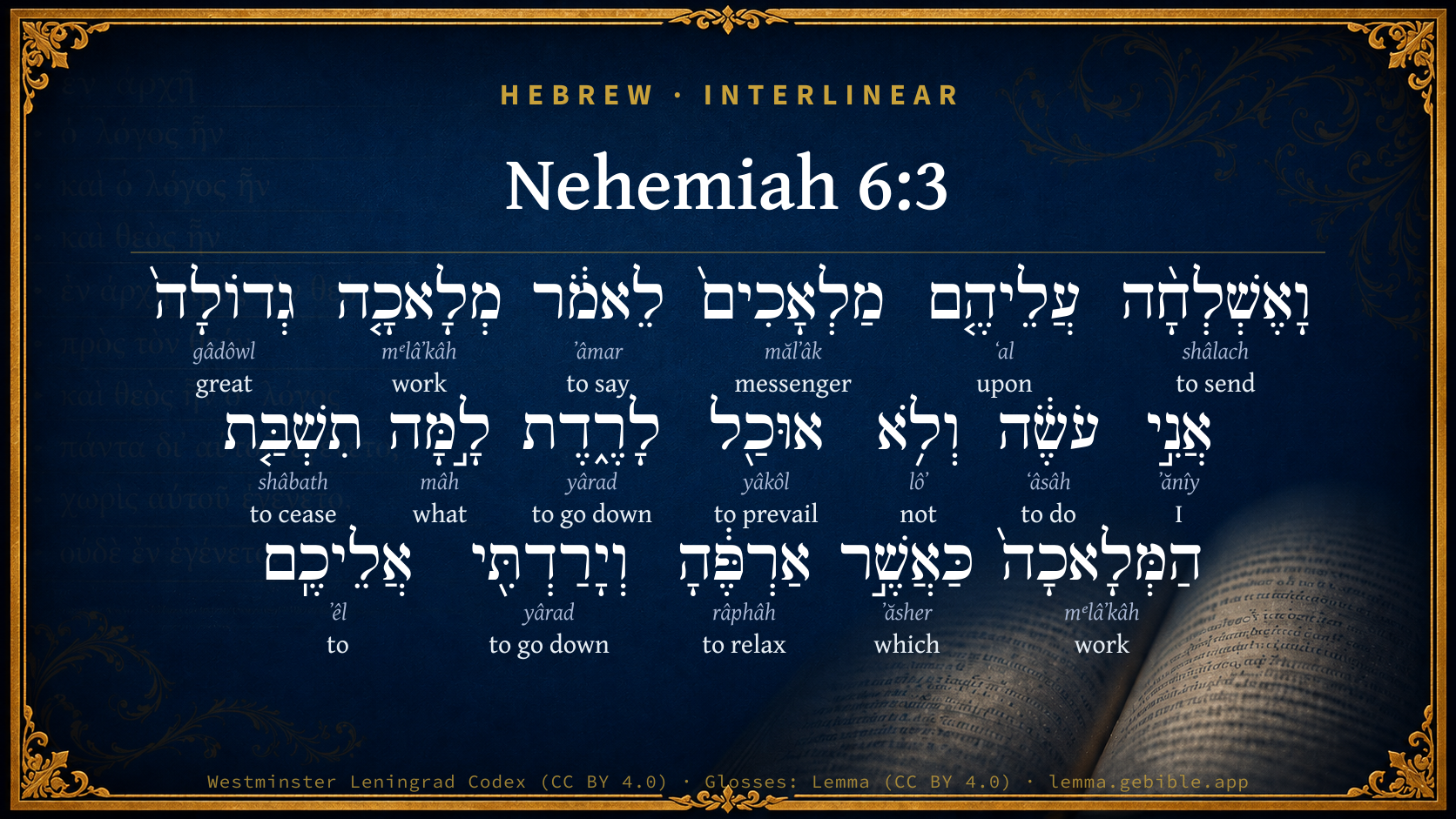
Nehemiah 6:3

Hebrew (Westminster Leningrad Codex) Nehemiah 6:3 appears in the Hebrew Old Testament. The text above is from the Westminster Leningrad Codex. Each word links to its Strong’s number, a concise gloss, and parsing drawn from the Open Scriptures Hebrew Bible morphology. Click any word for its full Brown-Driver-Briggs (BDB) entry.
Download image
Cite this verse

Nehemiah 6:3 (World English Bible). Public Domain. Lemma interlinear Bible study tool, https://lemma.gebible.app/v/nehemiah/6/3.

Show BibTeX & RIS
BibTeX
RIS
English Translation
I sent messengers to them, saying, I am doing a great work, so that I can't come down: why should the work cease, while I leave it, and come down to you?
World English Bible · Public Domain
Download a study sheet

One document with this verse’s original text, its word-by-word gloss line, the meaning frame, cross-references with their text, attributed commentary, and full source and license credits — printable, and it pastes into notes with its structure intact.

This verse Autodidact and up

Study sheet (.html) Plain text (.txt)

A passage Seminary Student

Up to 50 verses in one chapter. A passage sheet keeps up to 6 commentary sources and 12 cross-references per verse, in the order this page ranks them, and says so on the sheet whenever that leaves anything out. Ask for a single verse and you get the Autodidact verse sheet above.

Everything on this page stays free to read, with no account — the sheet is a download of what is already on screen, not access to it.

Want to remove ads? Support Godless Engineer
Compare translations 3

The same verse in 3 English versions, stacked beneath the original-language interlinear above. Click any original word for its lexicon entry.

Each is an independent rendering of the whole verse — the interlinear is not word-aligned to these translations.

Highlighted words mark where these versions differ — a whole-verse word diff, not a word-by-word alignment.

  • World English Bible Public Domain
    I sent messengers to them, saying, I am doing a great work, so that I can't come down: why should the work cease, while I leave it, and come down to you?
  • King James Version Public Domain
    And I sent messengers unto them, saying, I am doing a great work, so that I cannot come down: why should the work cease, whilst I leave it, and come down to you?
  • unfoldingWord Literal Text CC BY-SA 4.0
    And I sent messengers to them, saying, “I am doing a great work, and I am not able to go down. Why should the work stop while I abandon it and go down to you?”

unfoldingWord Literal Text — © unfoldingWord, licensed CC BY-SA 4.0. Word-aligned USFM3 via Door43 (git.door43.org/unfoldingWord/en_ult).

Versions to compare (up to 4)

3 of 4 selected

Show all 18 translations

Every available English version of this verse, each an independent rendering of the whole verse.

  • World English Bible Public Domain
    I sent messengers to them, saying, I am doing a great work, so that I can't come down: why should the work cease, while I leave it, and come down to you?
  • Berean Standard Bible Public Domain
    So I sent messengers to them, saying, “I am doing a great work and cannot come down. Why should the work stop while I leave it to go down to you?”
  • Majority Standard Bible Public Domain
    So I sent messengers to them, saying, “I am doing a great work and cannot come down. Why should the work stop while I leave it to go down to you?”
  • King James Version Public Domain
    And I sent messengers unto them, saying, I am doing a great work, so that I cannot come down: why should the work cease, whilst I leave it, and come down to you?
  • American Standard Version (1901) Public Domain
    And I sent messengers unto them, saying, I am doing a great work, so that I cannot come down: why should the work cease, whilst I leave it, and come down to you?
  • Revised Version (1885) Public Domain
    And I sent messengers unto them, saying, I am doing a great work, so that I cannot come down: Why should the work cease, whilst I leave it, and come down to you?
  • Geneva Bible (1599) Public Domain
    Therefore I sent messengers vnto them, saying, I haue a great worke to doe, and I can not come downe: why should the worke cease, whiles I leaue it, and come downe to you?
  • Douay-Rheims (1899) Public Domain
    And I sent messengers to them, saying: I am doing a great work, and I cannot come down, lest it be neglected whilst I come, and go down to you.
  • Young's Literal Translation Public Domain
    And I send unto them messengers, saying, `A great work I am doing, and I am not able to come down; why doth the work cease when I let it alone, and have come down unto you?'
  • Literal Standard Version CC BY-SA 4.0
    And I send to them messengers, saying, “A great work I am doing, and I am not able to come down; why does the work cease when I let it alone, and have come down to you?”
  • Unlocked Literal Bible CC BY-SA 4.0
    I sent messengers to them, saying, “I am doing a great work, and I cannot come down. Why should the work stop while I leave it and come down to you?”
  • unfoldingWord Literal Text CC BY-SA 4.0
    And I sent messengers to them, saying, “I am doing a great work, and I am not able to go down. Why should the work stop while I abandon it and go down to you?”
  • Darby Bible Public Domain
    And I sent messengers to them, saying, I am doing a great work, and I cannot come down. Why should the work cease, whilst I leave it and come down to you?
  • World Messianic Bible Public Domain
    I sent messengers to them, saying, “I am doing a great work, so that I can’t come down. Why should the work cease while I leave it and come down to you?”
  • Webster's Bible Public Domain
    And I sent messengers to them, saying, I am doing a great work, so that I cannot come down: why should the work cease, whilst I leave it, and come down to you?
  • Free Bible Version CC BY-SA 4.0
    So I sent messengers to tell them, “I'm busy with important work and I can't come down. Why should I stop what I'm doing and leave it to come and see you?”
  • Bible in Basic English Public Domain
    And I sent men to them saying, I am doing a great work, so that it is not possible for me to come down: is the work to be stopped while I go away from it and come down to you?
  • JPS Tanakh (1917) Public Domain
    And I sent messengers unto them, saying: 'I am doing a great work, so that I cannot come down; why should the work cease, whilst I leave it, and come down to you?'

Literal Standard Version (2020), Covenant Press — licensed CC BY-SA 4.0. Text via the HelloAO Bible API (eBible.org). Unlocked Literal Bible (unfoldingWord) — licensed CC BY-SA 4.0. Text via the HelloAO Bible API (eBible.org). unfoldingWord Literal Text — © unfoldingWord, licensed CC BY-SA 4.0. Word-aligned USFM3 via Door43 (git.door43.org/unfoldingWord/en_ult). Free Bible Version, Dr. Jonathan Gallagher — licensed CC BY-SA 4.0. Text via the HelloAO Bible API (eBible.org).

Word by word

More ways to search: Search by grammar → Find every occurrence → Compare this word →

Practice this passage: Drill this verse → Learn its vocabulary →

אַרְפֶּ֔הָ
râphâh
H7503
“to relax · her”
Verb, Hiphil, Imperfect, 1st Person, Common, Singular + Suffix, Personal, 3rd Person, Feminine, Singular
Part of Speech
Verb
Stem
Hiphil
Form
Imperfect
Person
1st Person
Gender
Common
Number
Singular
Full BDB Definition

Origin: a primitive root

TWOT: 2198

to sink, relax, sink down, let drop, be disheartened - (Qal) - to sink down - to sink, drop - to sink, relax, abate - to relax, withdraw - (Niphal) idle (participle) - (Piel) to let drop - (Hiphil) - to let drop, abandon, relax, refrain, forsake - to let go - to refrain, let alone - to be quiet - (Hithpael) to show oneself slack
  1. וָאֶשְׁלְחָ֨ה shâlach H7971 “and · to send” Conjunction + Verb, Qal, Sequential Imperfect, 1st Person, Common, Singular + Suffix, h
  2. עֲלֵיהֶ֤ם ʻal H5921 “upon · them” Preposition + Suffix, Personal, 3rd Person, Masculine, Plural
  3. מַלְאָכִים֙ mălʼâk H4397 “messengers” Noun, Common, Masculine, Plural, Absolute
  4. לֵאמֹ֔ר ʼâmar H559 “to say” Preposition + Verb, Qal, Infinitive Construct
  5. מְלָאכָ֤ה mᵉlâʼkâh H4399 “work” Noun, Common, Feminine, Singular, Absolute
  6. גְדוֹלָה֙ gâdôwl H1419 “great” Adjective, Adjective, Feminine, Singular, Absolute
  7. אֲנִ֣י ʼănîy H589 “I” Pronoun, Personal, 1st Person, Common, Singular
  8. עֹשֶׂ֔ה ʻâsâh H6213 “doing” Verb, Qal, Participle Active, Masculine, Singular, Absolute
  9. וְלֹ֥א lôʼ H3808 “and · not” Conjunction + Particle, Negative
  10. אוּכַ֖ל yâkôl H3201 “to prevail” Verb, Qal, Imperfect, 1st Person, Common, Singular
  11. לָרֶ֑דֶת yârad H3381 “to go down” Preposition + Verb, Qal, Infinitive Construct
  12. לָ֣מָּה mâh H4100 “to/for · what” Preposition + Particle, Interrogative
  13. תִשְׁבַּ֤ת shâbath H7673 “to cease” Verb, Qal, Imperfect, 3rd Person, Feminine, Singular
  14. הַמְּלָאכָה֙ mᵉlâʼkâh H4399 “the · work” Particle, Definite Article + Noun, Common, Feminine, Singular, Absolute
  15. כַּאֲשֶׁ֣ר ʼăsher H834 “like/as · which” Preposition + Particle, Relative
  16. וְיָרַדְתִּ֖י yârad H3381 “and · to go down” Conjunction + Verb, Qal, Sequential Perfect, 1st Person, Common, Singular
  17. אֲלֵיכֶֽם ʼêl H413 “to · you” Preposition + Suffix, Personal, 2nd Person, Masculine, Plural

About this verse

These counts appear in no published source. They are computed here, from the morphology-tagged text and Lemma’s own curated glosses. What Lemma adds →

18
words
16
distinct lemmas
Historical
section

Shared distinctive vocabulary

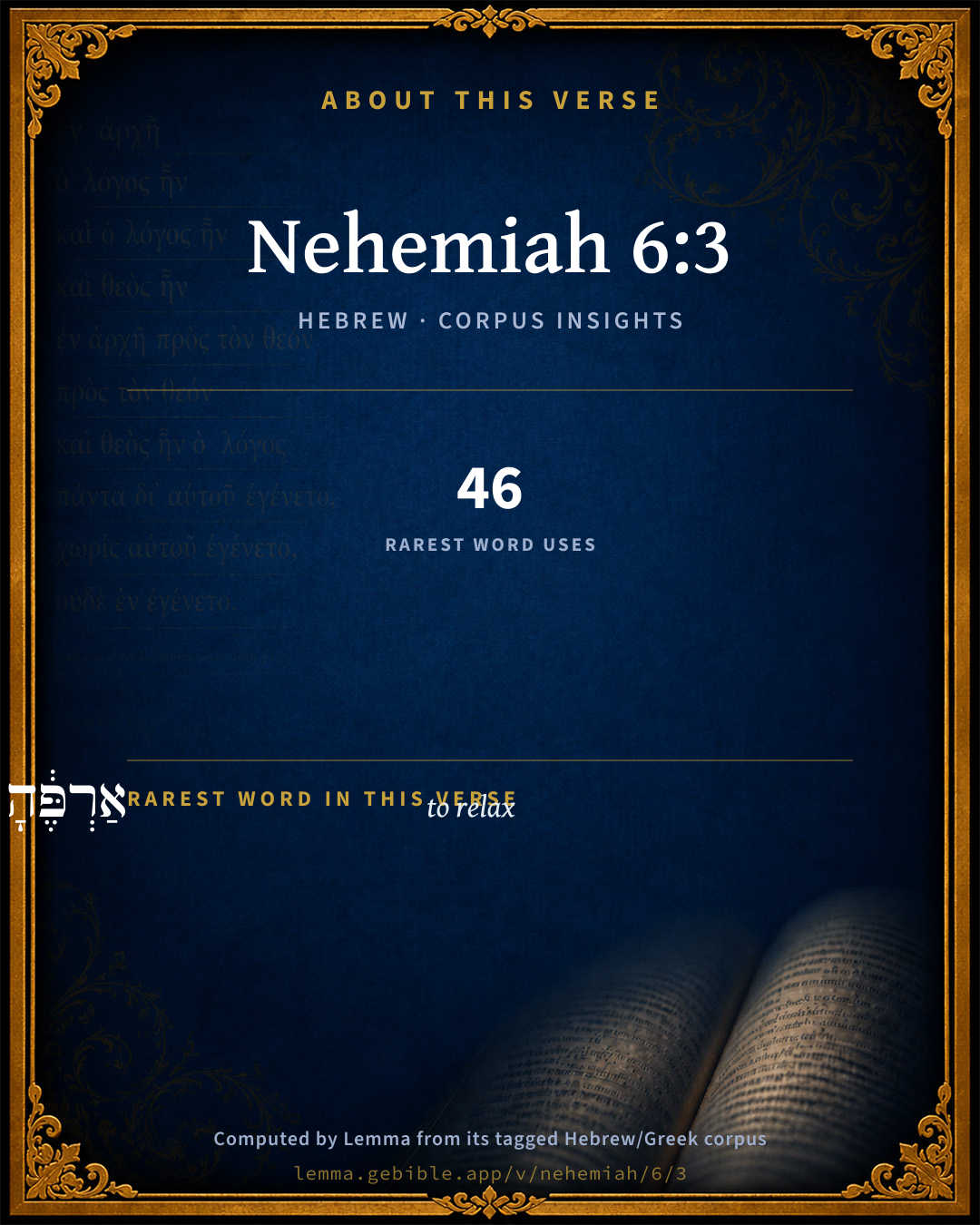
אַרְפֶּ֔הָ to relax H7503 occurs in 45 verses of the Hebrew Bible. Also found in:

Grammatical profile

  • 8 verbs
  • 3 nouns
  • 1 adjective
  • 1 pronoun
  • 2 prepositions
  • 3 particles

Verb forms

  • וָאֶשְׁלְחָ֨ה Qal · Sequential Imperfect
  • לֵאמֹ֔ר Qal · Infinitive Construct
  • עֹשֶׂ֔ה Qal · Participle Active
  • אוּכַ֖ל Qal · Imperfect
  • לָרֶ֑דֶת Qal · Infinitive Construct
  • תִשְׁבַּ֤ת Qal · Imperfect
  • אַרְפֶּ֔הָ Hiphil · Imperfect
  • וְיָרַדְתִּ֖י Qal · Sequential Perfect

Repetition

Words recur within this verse — often emphatic in Hebrew:

  • מְלָאכָ֤ה work H4399 ×2
  • לָרֶ֑דֶת to go down H3381 ×2

Cross-references

6

Topical passages linked to Nehemiah 6:3 in the Treasury of Scripture Knowledge — connected by theme and wording, ordered by reader-vote popularity; previews shown in the World English Bible.

  • Matthew 10:16 "Behold, I send you out as sheep in the midst of wolves. Therefore be wise as serpents, and harmless as doves.
  • John 9:4 I must work the works of him who sent me, while it is day. The night is coming, when no one can work.
  • 1 Timothy 4:15–16 Be diligent in these things. Give yourself wholly to them, that your progress may be revealed to all.
  • Proverbs 14:15 A simple man believes everything, But the prudent man carefully considers his ways.
  • Luke 14:30 saying, 'This man began to build, and wasn't able to finish.'
  • Ecclesiastes 9:10 Whatever your hand finds to do, do it with your might; for there is no work, nor device, nor knowledge, nor wisdom, in Sheol, where you are going.

Cross-references courtesy of OpenBible.info (CC BY 4.0).

Hebrew and Greek witnesses Masoretic Hebrew ↔ Greek Septuagint

The same verse in the two great witnesses to the Old Testament, shown verse-for-verse.

These are two independent witnesses, not word-aligned to each other, and the Septuagint is shown in lemma (dictionary) form.

Hebrew Nehemiah 6:3 Masoretic · Westminster Leningrad Codex

וָאֶשְׁלְחָ֨ה עֲלֵיהֶ֤ם מַלְאָכִים֙ לֵאמֹ֔ר מְלָאכָ֤ה גְדוֹלָה֙ אֲנִ֣י עֹשֶׂ֔ה וְלֹ֥א אוּכַ֖ל לָרֶ֑דֶת לָ֣מָּה תִשְׁבַּ֤ת הַמְּלָאכָה֙ כַּאֲשֶׁ֣ר אַרְפֶּ֔הָ וְיָרַדְתִּ֖י אֲלֵיכֶֽם

I sent messengers to them, saying, I am doing a great work, so that I can't come down: why should the work cease, while I leave it, and come down to you?

World English Bible · Public Domain

Greek LXX Structure differs

The Septuagint has no separate book of Nehemiah. Its Greek text is the second half of Esdras B (2 Esdras), chapters 11–23; Ezra is the first half (1–10).

A verse-for-verse comparison isn’t shown here because the chapters and verses don’t line up. Switch to the LXX edition with the MT / LXX toggle above to read the Greek directly.

On this verse, The Cambridge Bible for Schools and Colleges discusses the Septuagint’s reading. Read the note in Commentary ↓

Hebrew: Westminster Leningrad Codex (CC BY 4.0). Greek: Septuagint (public domain); English from a public-domain English Septuagint. How the Septuagint differs from the Hebrew →

Commentary

Notes on Nehemiah 6:3 from classic Christian and Jewish commentators (each source and its license shown beneath its notes). The classic Christian expositions comment on the surrounding passage and are grouped to its opening verse, so a note may address several verses; the Jewish commentaries on the Tanakh (Rashi and others) are per-verse, so they appear only where the commentator wrote on this verse.

Lemma curates 59 commentaries, every one of them public domain or Creative Commons licensed, each selected and text-cleaned for this edition rather than reprinted as found. About our sources →

Trapp's Complete Commentary

John Trapp

Neh 6:3 And I sent messengers unto them, saying, I [am] doing a great work, so that I cannot come down: why should the work cease, whilst I leave it, and come down to you?

Ver. 3. And I sent messengers unto them] He went not, but sent. This was to be wise as a serpent, Mat 10:16. God calleth us not to a weak simplicity, but alloweth us as much of the serpent as of the dove, and telleth us that a serpent’s eye in a dove’s head is a singular accomplishment. Beware of men, Neh 6:18, brutish persons, skilful to destroy, Eze 21:31. Bless yourselves from Machiavellians (those matchless villanies), and pray, with David, to be delivered from lying lips and from a deceitful tongue, Psa 120:2. The Cardinal of Lorraine (the chief engineer of the French Massacre) sent to Christopher, Duke of Wirtsberg, a prudent and a valiant prince, that he and his brethren, the Guises, would embrace the Protestant religion, and desired to be enrolled in the number of the Protestant princes; but they knew him too well to trust him.

I am doiny a great work, so that I cannot come down] I cannot intend it, as having my hands more full of employment than that I can give heed to your compliments. There is a curse to him that doth the work of the Lord negligently or deceitfully. And lata negligentia dolus est, saith the Civilian, Remissness is a kind of perfidiousness.

Why should the work cease?] As it would, or at least go but slowly on, in his absence; he was εργοδιωκτης, the driver on of tbe business; as was likewise Boaz, who, therefore, followed it so closely himself, Rth 2:4; his eyes were upon the servants, reapers, gleaners; he lodged in the midst of his husbandry. Let the tempter ever find us busy, and he will depart discouraged, as Cupid is said to do from the muses, whom he could never take idle. Standing water soon stinks, empty stomachs draw the humour that is next it; so doth the idle heart evil motions. An industrious Nehemiah is not at leisure to parley with Sanballat; lest if he let any water go beside the mill, he should be a great loser by it. His employment is as a guard or good angel, to keep him both right and safe.

John Trapp, A Commentary or Exposition upon All the Books of the Old and New Testament (1647–1656) — public domain. Text from a community e-Sword module.

The Biblical Illustrator

Joseph S. Exell

Neh_6:3

A great work.

A great work

A story is told of an old man who rived long ago. A friend asked him the cause of his complaints, since in the evening he so often complained of great weariness and pain. Alas, answered he, I have every day so much to do: I have two falcons to tame, two hares to keep from running away, two hawks to manage, a serpent to confine, a lion to chain, and a sick man to tend and wait upon. Why, this is only folly, said the friend; no man has all these things to do at once. Yes indeed, he answered, it is with me as I have said. The two falcons are my two eyes, which I must diligently guard, lest something should please them which may be hurtful to my salvation; the two hares are my feet, which I must hold back lest they should run after evil objects, and walk in the ways of sin; the two hawks are my two hands, which I must train and keep to work, in order that I may be able to provide for myself and for my brethren who are in need; the serpent is my tongue, which I must always keep in with a bridle, lest it should speak anything unseemly; the lion is my heart, with which I have to maintain a continual fight in order that vanity and pride may not fill it, but that the grace of God may dwell and work there; the sick man is my body, which is ever needing my watchfulness and care. All this daily wears out my strength. The friend listened with wonder, and then said, Dear brother, if all men laboured and struggled after this manner, the times would be better, and more according to the will of God. (J. M. Randall.)

Determination of purpose

The ancient Greeks had an aphorism which is worthy of remembrance: He is formidable who does one thing. A man must have a fixed design, or he will not have a steady course. As the instrument tuned to no key-note, so is the man whose spirit is strung to no commanding aim. In vain does the vessel launch forth from the harbour if she have no haven for which to steer and no helm by which to shape her voyage. Take a just view of your life, and all is but dung and dross in comparison with your final acceptance with God. This is the object, the one object which you must enterprise, prosecute, and secure. What a work is before us! (Hugh Stowell, M. A.)

A great work in the face of strong antagonism

The Christian has a great work to do for himself, working out under gospel influences his own salvation with fear and trembling. It is great in regard of others. We are not merely children of God going home to glory; but we are fellow-workers with God--keepers of beacons to imperilled mariners in a dark night of storms--oarsmen of a lifeboat out on the wild ocean saving drowning souls from destruction. Yea, we have a great work in regard of our glorious God and Saviour. We may not understand it, yet we are assured by God Himself of the truth that more than in all His works of creation and providence is there manifestation made of His manifold wisdom in this work of salvation. Every soul saved on earth by our human instrumentality is a radiant diadem in the many crowns of Jesus. Moreover, like Nehemiah, we are doing this great work in the face of strong antagonisms, and against the insidious opposition of enemies striving to hinder us. Alas! how many are the Sanballats and Tobiahs of the world! I am not railing at the world itself, for it is a good world for Christian work--a world whereof we are to make the most; and the pleasures and honours and riches of it, when accepted as gifts of God and used for His glory, are among our mighty means of grace, whereby our own souls may be edified and Christs kingdom enlarged. I am thinking now of the world as used by Satan to hinder Christian work--those scornful words or seductive arts of temptation, and, I repeat, they are many. Pleasure comes to the scene of Christian labour with all-bewitching beauty and bewildering blandishments, and she pleads for sensual indulgence, and would draw the worker for Christ forth and down to the fair plains of Ono. Avarice comes with jewels of great price, and keys offering coffers of untold wealth in the stronghold of Mammon. Ambition comes, in the pomp and glory of an archangel, fallen from heaven, and points to a perspective of surpassing splendour, with shining palms and triumphal processions, outflashing diadems and uprising throne. With these and many other specious beguilements come the great adversaries of the soul and the Church. They plead with the Christian worker as he builds the walls of Zion, crying eloquently and earnestly, Oh, come down and meet us in some plain of Ono! And to all this our reply should be just that of Nehemiah, I am doing a great work, and I cannot come down. Oh, fellow-worker with God in this glorious salvation, take to your heart as the inspiration of your lives this strong argument; rise to a comprehension of the magnificent part you are acting in the face of the universe; of the vastness of the issues you are working out for God! Say to the assaulting tempter, Let me alone. I am working--working. I am working out my own destiny. I am striving for a guerdon in the skies grander than the Conquerors. I am working for others--for the beloved of my own house-hold--my child, my parent, my brother, my friend. Oh, do not hinder me! I am working for a world--a world for which the Son of God bled in the garden--died on the Cross! See! see! that world rolls like a shattered wreck on the stormy seas of time, and I am keeping the beacon aflame! Oh, hinder me not! Nay, more, I am working for Jehovah--that God who, when I was lost, sent His own Son to save me. (T. L. Cuyler.)

Nehemiah, the model man of business

In studying Nehemiah as a man of business we notice--

I. He was a model of earnstness.

II. He was a model of unselfishness.

III. He was a model of faithfulness.

IV. He was a model of prayer. (R. Newton, D. D.)

A good man in a great work

This narrative illustrates--

I. The characteristics of a great work. It has--

1. A high purpose. It was--

2. Beset with difficulties. A true work will have generally to surmount--

(1) Mens scorn.

(2) External hindrances.

II. The temptations that beset a great work.

1. Temptations from armed enemies.

2. Temptations from professed friends.

III. The spirit of a true worker. There will be--

1. Prayer for the work.

2. Earnest prosecution of it.

3. Resistance of all temptations to leave it. (Urijah R. Thomas.)

The great work

We learn from these words--

I. That Nehemiah was doing a great work.

II. That there were those who endeavoured to hinder him.

III. That the magnitude of the work required that he should not cease or allow himself to be hindered from prosecuting it.

IV. We may learn from the context that Nehemiah succeeded in accomplishing the work by prayer and painstaking diligence. (James Shore, M. A.)

The great work

I. That the work of religion in general is a great work. This will appear when we contemplate it as being--

1. Gods work. It originated with God; its foundations were laid in heaven; it emanated from the throne of the Eternal; it is the product of infinite wisdom, love, and truth. It bears on its countenance the image of its immaculate Author, and it is every way worthy of its great Original. Unmistakable traces and manifestations of its Divinity are seen in the loftiness of its character, in the purity of its principles, and in the efficiency and permanency of its influences. Nothing is worth the name of greatness compared with the system God has devised to heal the sorrows and cleanse the pollutions of the soul. And is there not a glory and majesty about it immeasurably great? God appears great in the works of creation. If, then, God is so great throughout the wide range of creation, how great must He be in restoring man to His favour, in giving life, vigour, and beauty to souls once dead in trespasses and sins! That religion is a great work is evident--

2. From the importance attached to it in the Bible. The Bible, Gods holy book, is pregnant with it, its glory and beauty being reflected from every page. This book was written expressly to pourtray religion, its doctrines, principles, and duties. Let the question be settled in our minds--religion is the principal thing; it is emphatically the worlds great bless ing; so the sacred penmen estimate it. They speak of it as Gods salvation; as the great salvation; as the pearl of great price; as the one thing needful; as the good part; the more excellent way; the bread of life; and life eternal. That religion is a great work is evident from--

3. The qualifications necessary to engage in it. A high state of intellect is not essential to it. The most gigantic intellect is no qualification for Gods service, if not renewed and sanctified by the Holy Ghost. The qualifications necessary to engage in this work must have their seat in the heart rather than in the head. Right moral emotions cannot be dispensed with.

4. That religion is a great work appears from its blessed results on human character and conduct. The history of the past in relation to Gods work unfolds a series of wonderful achievements and glorious results. Its wide spread influence amongst the various nations and tribes of men has told a marvellous tale.

II. The good man is engaged in this work. This expression denotes--

1. Decision of character. In a world like ours fixedness of purpose is invaluable, whether it relate to the active duties of every-day life or to the more lofty and ennobling duties of religion. It is essential to success. The man whose movements are changeable, and who is never steady to one point or purpose, brings nothing to a good issue. What a paralysing influence indecision has upon the soul in relation to religion. Men dream and talk about their future course of action, and yet they are never found at the starting-point. They are decided for the future, but not for the present. The diligent man says, I am doing a great work; I am in it; it form part and parcel of my very being. The Scriptures furnish us with specimens of the decision we plead for. We see it in Joshua, when he says, As for me and my house, we will serve the Lord. So, too, David said, O God, my heart is fixed; I have chosen the way of truth.

2. Labour. I am doing a great work. Religion is essentially active; it has no sympathy with sloth and inactivity.

III. The spirit of perseverance is required in this work. The good man engaged in this work cannot come down, because--

1. The work requires close and constant application. To acquire anything like an approach to perfection or completeness in religion is no easy task. The world, with its blandishments, its false maxims, and glittering snares, says, Come down. The flesh, naturally in favour of indulgence and ease, and opposed to self-denial, joins in the cry, and says, Come down. Satan, whose malice breaks out more bitterly as he sees the wall rising higher, repeats the order, Come down. Thus every new stone added to the building is the subject of dispute. The builder cannot leave his work, because--

2. Shame and misery would be the result. A more pitiful sight than that of a good man cast down from his excellency is certainly not to be found. My reason, my judgment, my conscience, all concur with the inspired admonition, Stand fast, therefore, in the liberty wherewith Christ has made you free, and be not entangled again with the yoke of bondage.

IV. Why should the work cease, whilst i leave it, and come down to you? We must not suppose that Gods work would entirely cease, even though a thousand such men as Nehemiah were to desert it.

1. All the infidelity and wickedness of men cannot stop this work. Observe, finally, that--

2. Were it possible that His work should cease, it would be the greatest calamity the world ever knew. (A. Twiss.)

The pre-eminence of Gods work

I. Gods work is still a great work. It resolves itself into two parts--

1. Work in relation to ones self--faith in the Redeemer, progressive holiness and final glory.

2. Work in relation to others.

II. Gods work must be done first. To Sanballats complimentary note Nehemiah replied by his conduct, Gods work first, compliments next.

III. Gods work preserves from mischief and misery.

IV. Gods work should be loved for its own sake.

V. Gods work should be begun, continued, and ended with prayer. (Homilist.)

Safety in Christian work

Christian work is--

1. A safeguard against vice. All honest work, indeed, is an antidote to vice, but Christian work is especially so.

1. It fills up those leisure hours that so often prove fatal to the unguarded soul.

2. By its very nature it supplies positive motives against temptation.

(1) It strengthens all ones Christian principles.

(2) It keeps one constantly under the play of Christian influences.

(3) It prevents the spiritual life from dying of disuse.

II. A safegaurd against spiritual declension. Our spiritual life depends in the first instance on the work of Christ for us; but its continuance is dependent on activity--on the work we do for Christ.

1. Physical growth is dependent on activity.

2. So, too, with intellectual life.

3. So in a still higher degree it is in spiritual life.

Selfishness is the greatest spiritual poverty. Life loses in the proportion in which it withholds itself, and gains by all it gives. According to the width of my sympathies and the self-forgetting ardour of my zeal is the true power and opulence of my being. If it be lawful or possible to enlist the higher selfishness in the service of unselfishness, as you value your religious life, as you would protect it on the one hand against innate tendencies to declension, and on the other against the sapping and undermining influences of the outer world, give your sympathies, your energies, your substance to the cause of God and man. It is not enough for your religious safety that you abstain from evil--you must engage in positive good.

III. A safeguard against scepticism. Not that scepticism cannot be met in the field of argument. But argument is not, in every case, the best way to meet the native scepticism of the heart. Christian truth is of such a nature that to understand it fully you must live it. If any man will do Gods will he shall know of the doctrine. There was a minister who at an early period of his life was in doubt about the truth of Christianity. He had almost lost his faith, when hearing this text he resolved to make trial of it. He went and gathered a number of boys together from the streets and taught them as best he could; from that he went to something else as opportunity offered, with the result that he found the text to be true; that in doing Gods will, especially in doing good to others, his doubts had all fled and never troubled him more. He found, as Carlyle says, that doubt of whatever kind can be ended by action alone. As a rule it is not from the great class of Christian workers that scepticism draws its recruits, but from those who stand aloof from all Christian activities, and in many cases look down on them with contempt.

IV. A safeguard against despondency. It is an old saying and true that while the water flows and the mill-stones revolve unless the grain be thrown between them to be ground, the stones will grind each other. So the heart and mind which are inactive, which have no subjects of interest, to engross them, turn their force inward and prey upon themselves. The water that is stagnant soon loses its freshness of colour and of flavour, and engenders the worthless weed, the green scum, the foul mud and noxious exhalations; so the man or woman who leads a useless, purposeless, inactive life not only degenerates in inward character, but loses the freshness and brightness of life, becomes restless, discontented, and a prey to melancholy. To a woman of the desponding type who was wont to bewail her spiritual poverty in the language of the prophet, My leanness i my leanness I a shrewd and faithful friend, well-known for her good works, administered the needed and merited reproof, Nay, but it would better become you to say, My laziness! my laziness! (Robert Whyte, D. D.)

Hindrances to revivals

I. A revival of religion is a great work.

II. Several things may put a stop to a revival. A revival will cease--

1. Whenever the Church believes it is going to cease.

2. When Christians consent that it should cease.

3. Whenever Christians suppose the work will go on without their aid.

4. When Christians begin to proselytise.

5. When the Church in any way grieves the Holy Spirit.

6. When Christians lose the spirit of brotherly love.

7. When Christians are frequently reconverted.

III. Things which ought to be done to continue a revival.

1. Ministerial humiliation.

2. Churches which have opposed revivals must repent.

3. Those who promote the work of revivals must repent their mistakes. (G. Finney.)

The Biblical Illustrator, edited by Joseph S. Exell (c. 1880s–1900s) — public domain. Text from a community e-Sword module.

Joseph Benson's Commentary

Neh 6:3. I am doing a great work — He acquainted them that he thought the business which they might have with him could not be of such importance as that which he had in hand; and therefore he would not put a stop to it to come and confer with them. Thus he tells them one, but not the only, nor the principal reason of his refusal; for he properly judged that it would answer no good end to intimate to them his suspicions of their design to compass his death.

Joseph Benson's Commentary on the Old and New Testaments (1811–1818) — public domain. Text from a community e-Sword module.

Geneva Bible (1599)

Geneva Bible translators

Meaning, that if he should obey their request, the work which God had appointed, should cease: showing hereby that we should not commit ourselves to the hands of the wicked.

Geneva Bible (1599) marginal notes — public domain. Text via Bolls.life.

Adam Clarke's Commentary

Verse 3. I am doing a great work] Though he knew their design, he does not think it prudent to mention it. Had he done so, they would probably have gone to extremities, finding that they were discovered; and perhaps in a formidable body attacked Jerusalem, when ill provided to sustain such a shock. They wished to effect their purpose rather by treachery than by open violence. I know not any language which a man who is employed on important labours can use more suitably, as an answer to the thousand invitations and provocations he may have to remit his work, enter into useless or trivial conferences, or notice weak, wicked, and malicious attacks on his work and his motives: "I am doing a great work, so I cannot stoop to your nonsense, or notice your malevolence. Why should the work cease, while I leave it, and come down to such as you?"

Adam Clarke's Commentary on the Bible (1810–1826) — public domain. Text from a community e-Sword/MySword module.

The Cambridge Bible for Schools and Colleges

gen. ed. J. J. S. Perowne

3. cease] ‘The great work’ of rebuilding the walls was one for which Nehemiah was responsible; and it was no doubt literally true that if he quitted the city there would at once be a cessation in the prosecution of the work. The LXX. misunderstood the last clause, ὡς ἂν τελειώσω αὐτὸ καταβήσομαι πρὸς ὑμᾶς.

The Cambridge Bible for Schools and Colleges (gen. ed. J. J. S. Perowne; Cambridge University Press, 1878–1918) — public domain. Text from a community e-Sword module.

John Gill's Exposition

And I sent messengers unto them,.... He did not show any open contempt of them, nor did he even return answer by the messenger that came from them, but sent some of his own people to them:

saying, I am doing a great work; was about an affair of great importance, very busy, and not at leisure to give them a meeting:

so that I cannot come down; Jerusalem being built on an eminence, and the place proposed to meet at in a plain, going thither is expressed by coming down:

why should the work cease, while I leave it, and come down to you? signifying that it would cease if he left it; and it being of greater consequence than anything they could have to converse about, he argues it would be wrong to relinquish it on such an account; this was the reason he thought fit to give, but was not the only, nor the principal reason, which is suggested in the preceding verse.

John Gill's Exposition of the Whole Bible (1746–1763) — public domain (CC PDM 1.0). Text via the HelloAO Bible API.

Haydock's Catholic Bible Commentary

You. This was one, (Haydock) though not the principal reason which hindered him. It is often adviseable not to seem to suspect any evil.

George Leo Haydock (1774–1849), Haydock's Catholic Family Bible and Commentary, 1859 edition — public domain. Excludes Psalms (Douay-Rheims chapter numbering differs from Protestant) and Deuterocanonical books (Catholic canon only).

Matthew Poole's English Annotations

I am doing a great work: he tells them one, but not the only, nor the principal, reason of his refusal, because his coming might cause the work to cease, not only by the neglect of it during his absence, but by his death, which they by this means might compass, though he thought it not fit to express so much to them.

Matthew Poole's English Annotations on the Holy Bible (1683–1685) — public domain. Text from a community e-Sword/MySword module.

Whedon's Commentary on the Bible

Daniel D. Whedon

3. Why should the work cease — Though Nehemiah saw through their foul designs he was too wise to utter his suspicions, and maintained a noble dignity of reserve. His answer to them also contains a most consummate hint of their low plotting. “I know not any language,” says Dr. A. Clarke, “which a man who is employed on important labours can use more suitably as an answer to the thousand invitations and provocations he may have to remit his work, enter into useless or trivial conferences, or notice weak, wicked, and malicious attacks on his work and his motives: ‘I am doing a great work, so I cannot stoop to your nonsense or notice your malevolence. Why should the work cease while I leave it, and come down to such as you?’”

Daniel D. Whedon (gen. ed.), Commentary on the Old and New Testaments (1874–1909) — public domain. Text from a community e-Sword module.

unfoldingWord translationNotes

Door43 World Missions Community

I am doing a great work

Nehemiah supervised the rebuilding of the wall. He did not build it by himself. AT: "We are doing a great work" (See: Synecdoche)

Why should the work stop while I leave it and come down to you?

This rhetorical question is used to challenge Sanballat's request. This can be written as a statement. AT: "I cannot let the work stop and come down to you" (See: Rhetorical Question)

down to you

The word "down" is used here because the plain of Ono where they were requesting Nehemiah to come is at a lower elevation than Jerusalem.

translationWords

send

messenger

works

unfoldingWord translationNotes — © Distant Shores Media and the Door43 World Missions Community, licensed CC BY-SA 4.0. Source: git.door43.org/Door43/en_tn.

Rashi

Rabbi Shlomo Yitzchaki (Rashi)

“I am doing great work of the buildings (of the city); other editions read: [of the buildings] of dust.

Why should...stop Why should the work be curtailed?

when I leave it Heb. אַרְפֶּהָ, lit. [slacken] my hand from the building.

and come down to you to speak with and to meet with you.

Rashi on the Tanakh — English translations: “The Judaica Press complete Tanach with Rashi, translated by A. J. Rosenberg” (CC BY 4.0); “Pentateuch with Rashi's commentary by M. Rosenbaum and A.M. Silbermann, 1929-1934” (public domain); “The Metsudah Tanach series, Lakewood, N.J” (CC BY 4.0); and “The Book of Joshua, Metsudah Publications, 1997” (CC BY 4.0). Text via Sefaria.

Lesson kit

Teaching starters — assembled from the data on this page, not authored interpretation. Every prompt links to the verse data it draws on. Edit before teaching.

Nehemiah, in the Historical, opens this verse with 18 words (16 distinct Hebrew lemmas). Its most distinctive word is râphâh (“to relax”). A historical commentator’s framing appears above. Read the whole chapter for the surrounding context.

Discussion questions

  1. What does “to relax” (râphâh) contribute to the verse as a whole?
  2. Exodus 4:26 shares the word «to relax» with this verse. How do the two illuminate each other?
  3. “work” occurs 2× in this one verse. What is the effect of the repetition?
  4. The translations on this page render this verse differently — a whole-verse word diff, not a word-by-word alignment. What might account for the different wordings?
  5. The verb «וָאֶשְׁלְחָ֨ה» is Qal Sequential Imperfect. How does its form color the action?
  6. Reading how Trapp's Complete Commentary and The Biblical Illustrator read this verse, where do the two commentators agree and where do they part?

Things to notice

Reading settings

Reading text

Shown beneath each verse's original-language words.

Old Testament
Old Testament edition

Read the OT as the Masoretic Hebrew (MT) or the Greek Septuagint (LXX).

English shown for the Greek Septuagint (in the Hebrew ↔ Greek comparison).

Comparing translations? Open the Compare panel on any verse page to stack up to four side by side.