
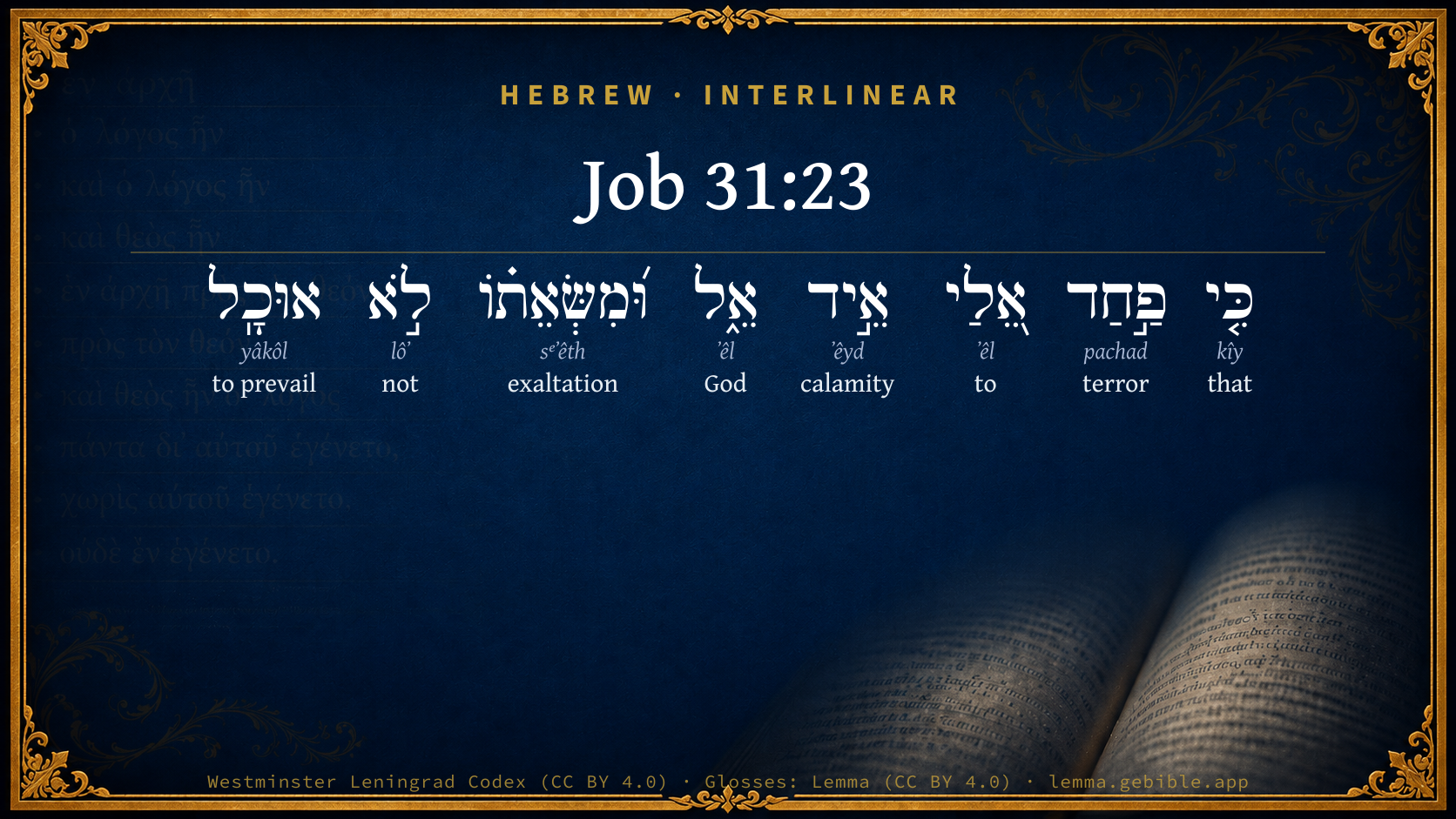
Job 31:23

Hebrew (Westminster Leningrad Codex) Job 31:23 appears in the Hebrew Old Testament. The text above is from the Westminster Leningrad Codex. Each word links to its Strong’s number, a concise gloss, and parsing drawn from the Open Scriptures Hebrew Bible morphology. Click any word for its full Brown-Driver-Briggs (BDB) entry.
Download image
Cite this verse

Job 31:23 (World English Bible). Public Domain. Lemma interlinear Bible study tool, https://lemma.gebible.app/v/job/31/23.

Show BibTeX & RIS
BibTeX
RIS
English Translation
For calamity from God is a terror to me, By reason of his majesty I can do nothing.
World English Bible · Public Domain
Download a study sheet

One document with this verse’s original text, its word-by-word gloss line, the meaning frame, cross-references with their text, attributed commentary, and full source and license credits — printable, and it pastes into notes with its structure intact.

This verse Autodidact and up

Study sheet (.html) Plain text (.txt)

A passage Seminary Student

Up to 50 verses in one chapter. A passage sheet keeps up to 6 commentary sources and 12 cross-references per verse, in the order this page ranks them, and says so on the sheet whenever that leaves anything out. Ask for a single verse and you get the Autodidact verse sheet above.

Everything on this page stays free to read, with no account — the sheet is a download of what is already on screen, not access to it.

Want to remove ads? Support Godless Engineer
Compare translations 3

The same verse in 3 English versions, stacked beneath the original-language interlinear above. Click any original word for its lexicon entry.

Each is an independent rendering of the whole verse — the interlinear is not word-aligned to these translations.

Highlighted words mark where these versions differ — a whole-verse word diff, not a word-by-word alignment.

  • World English Bible Public Domain
    For calamity from God is a terror to me, By reason of his majesty I can do nothing.
  • King James Version Public Domain
    For destruction from God was a terror to me, and by reason of his highness I could not endure.
  • unfoldingWord Literal Text CC BY-SA 4.0
    For the destruction of God a dread to me, and from his majesty, I was not able.

unfoldingWord Literal Text — © unfoldingWord, licensed CC BY-SA 4.0. Word-aligned USFM3 via Door43 (git.door43.org/unfoldingWord/en_ult).

Versions to compare (up to 4)

3 of 4 selected

Show all 18 translations

Every available English version of this verse, each an independent rendering of the whole verse.

  • World English Bible Public Domain
    For calamity from God is a terror to me, By reason of his majesty I can do nothing.
  • Berean Standard Bible Public Domain
    For calamity from God terrifies me, and His splendor I cannot overpower.
  • Majority Standard Bible Public Domain
    For calamity from God terrifies me, and His splendor I cannot overpower.
  • King James Version Public Domain
    For destruction from God was a terror to me, and by reason of his highness I could not endure.
  • American Standard Version (1901) Public Domain
    For calamity from God is a terror to me, And by reason of his majesty I can do nothing.
  • Revised Version (1885) Public Domain
    For calamity from God was a terror to me, and by reason of his excellency I could do nothing.
  • Geneva Bible (1599) Public Domain
    For Gods punishment was fearefull vnto me, and I could not be deliuered from his highnes.
  • Douay-Rheims (1899) Public Domain
    For I have always feared God as waves swelling over me, and his weight I was not able to bear.
  • Young's Literal Translation Public Domain
    For a dread unto me `is' calamity `from' God, And because of His excellency I am not able.
  • Literal Standard Version CC BY-SA 4.0
    For calamity [from] God [is] a dread to me, || And because of His excellence I am not able.
  • Unlocked Literal Bible CC BY-SA 4.0
    For I dreaded destruction from God; because of his majesty, I was not able to do those things.
  • unfoldingWord Literal Text CC BY-SA 4.0
    For the destruction of God a dread to me, and from his majesty, I was not able.
  • Darby Bible Public Domain
    For calamity from ùGod was a terror to me, and by reason of his excellency I was powerless.
  • World Messianic Bible Public Domain
    For calamity from God is a terror to me. Because of his majesty, I can do nothing.
  • Webster's Bible Public Domain
    For destruction from God was a terror to me, and by reason of his highness I could not endure.
  • Free Bible Version CC BY-SA 4.0
    Since I'm terrified of what punishment God may have in store for me, and because of his majesty, I could never do this.
  • Bible in Basic English Public Domain
    For the fear of God kept me back, and because of his power I might not do such things.
  • JPS Tanakh (1917) Public Domain
    For calamity from God was a terror to me, and by reason of His majesty I could do nothing.

Literal Standard Version (2020), Covenant Press — licensed CC BY-SA 4.0. Text via the HelloAO Bible API (eBible.org). Unlocked Literal Bible (unfoldingWord) — licensed CC BY-SA 4.0. Text via the HelloAO Bible API (eBible.org). unfoldingWord Literal Text — © unfoldingWord, licensed CC BY-SA 4.0. Word-aligned USFM3 via Door43 (git.door43.org/unfoldingWord/en_ult). Free Bible Version, Dr. Jonathan Gallagher — licensed CC BY-SA 4.0. Text via the HelloAO Bible API (eBible.org).

Word by word

More ways to search: Search by grammar → Find every occurrence → Compare this word →

Practice this passage: Drill this verse → Learn its vocabulary →

וּ֝מִשְּׂאֵת֗וֹ
sᵉʼêth
H7613
“and · from · exaltation · his”
Conjunction + Preposition + Noun, Common, Feminine, Singular, Construct + Suffix, Personal, 3rd Person, Masculine, Singular
Part of Speech
Conjunction + Preposition + Noun
Type
Common
Gender
Feminine
Number
Singular
State
Construct
Full BDB Definition

Origin: from H5375

TWOT: 1421j

elevation, exaltation, dignity, swelling, uprising - dignity, exaltation, loftiness - swelling - uprising
  1. כִּ֤י kîy H3588 “that” Conjunction
  2. פַ֣חַד pachad H6343 “terror” Noun, Common, Masculine, Singular, Absolute
  3. אֵ֭לַי ʼêl H413 “to · me” Preposition + Suffix, Personal, 1st Person, Common, Singular
  4. אֵ֣יד ʼêyd H343 “calamity of” Noun, Common, Masculine, Singular, Construct
  5. אֵ֑ל ʼêl H410 “God” Noun, Common, Masculine, Singular, Absolute
  6. לֹ֣א lôʼ H3808 “not” Particle, Negative
  7. אוּכָֽל yâkôl H3201 “to prevail” Verb, Qal, Imperfect, 1st Person, Common, Singular

About this verse

These counts appear in no published source. They are computed here, from the morphology-tagged text and Lemma’s own curated glosses. What Lemma adds →

8
words
8
distinct lemmas
Wisdom
section

Notable vocabulary

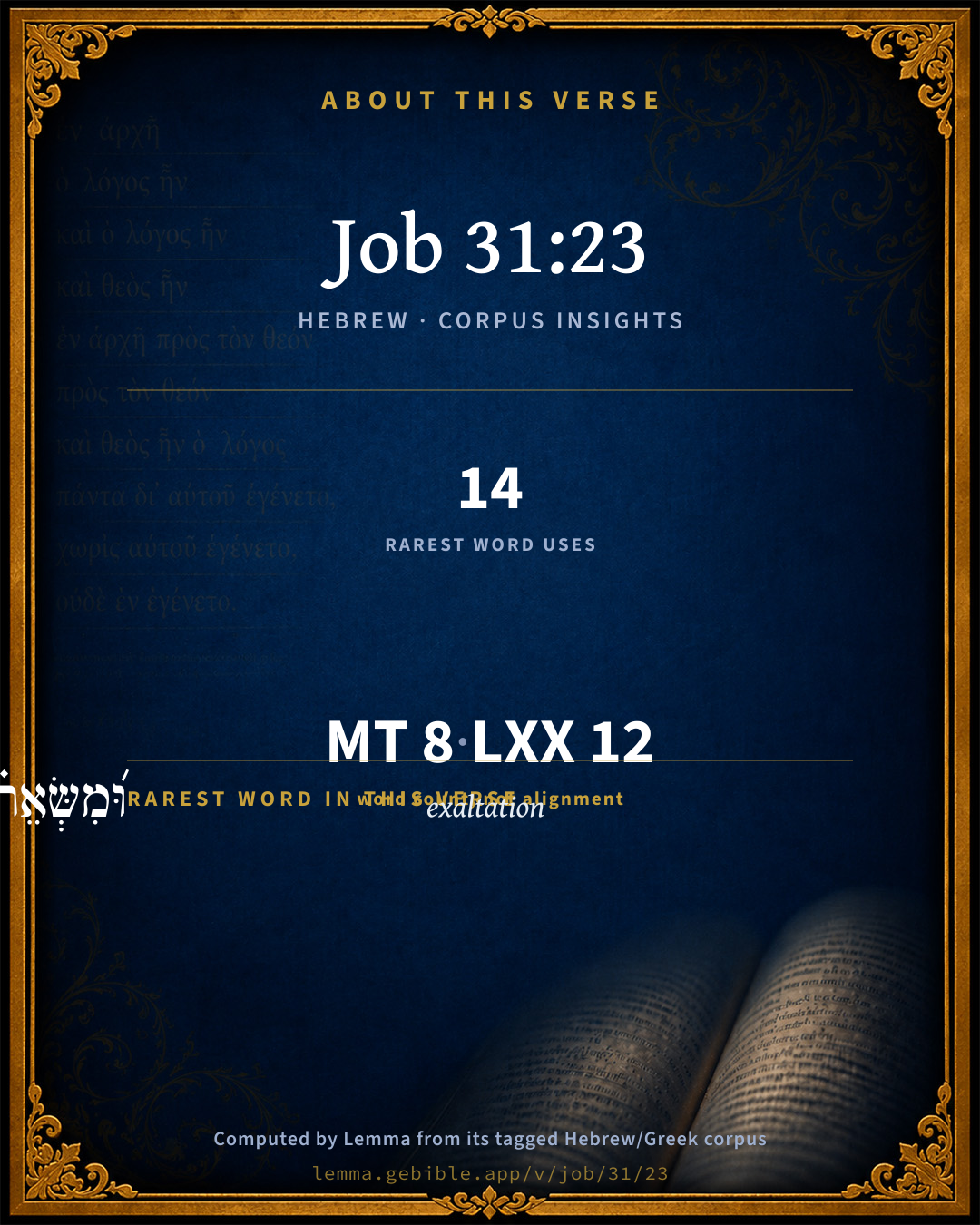
The rarest word here is וּ֝מִשְּׂאֵת֗וֹ exaltation H7613 — appearing just 14 times in the whole Hebrew Bible.

Shared distinctive vocabulary

וּ֝מִשְּׂאֵת֗וֹ exaltation H7613 occurs in 13 verses of the Hebrew Bible. Also found in:

Grammatical profile

  • 1 verb
  • 4 nouns
  • 1 preposition
  • 1 conjunction
  • 1 particle

Verb forms

  • אוּכָֽל Qal · Imperfect

Hebrew & Septuagint length

In English translation the verse runs 18 words from the Hebrew and 18 from the Septuagint (LXX English) — the same length.

A rough comparison of the two English renderings, which tokenize alike — not a word-level alignment.

Word counts can differ between the Hebrew and the Greek without any difference in meaning — e.g. the Hebrew direct-object marker אֵת has no separate Greek word, and Greek often adds the article ὁ.

In the original languages it is 8 Hebrew tokens and 12 Greek tokens — but the two are counted differently (Hebrew bundles its prefixes and suffixes into one token; the Greek is in lemma form), so that isn’t a like-for-like length.

Cross-references

11

Topical passages linked to Job 31:23 in the Treasury of Scripture Knowledge — connected by theme and wording, ordered by reader-vote popularity; previews shown in the World English Bible.

  • Job 13:11 Shall not his majesty make you afraid, And his dread fall on you?
  • Psalms 119:120 My flesh trembles for fear of you. I am afraid of your judgments.
  • 2 Corinthians 5:11 Knowing therefore the fear of the Lord, we persuade men, but we are revealed to God; and I hope that we are revealed also in your consciences.
  • Psalms 76:7 You, even you, are to be feared. Who can stand in your sight when you are angry?
  • Isaiah 13:6 Wail; for the day of Yahweh is at hand; as destruction from the Almighty shall it come.
  • Genesis 39:9 He isn't greater in this house than I, neither has he kept back anything from me but you, because you are his wife. How then can I do this great wickedness, and sin against God?"
  • Job 20:23 When he is about to fill his belly, God will cast the fierceness of his wrath on him. It will rain on him while he is eating.
  • Job 21:20 Let his own eyes see his destruction. Let him drink of the wrath of the Almighty.
  • Job 40:9 Or have you an arm like God? Can you thunder with a voice like him?
  • Job 42:5–6 I had heard of you by the hearing of the ear, But now my eye sees you.
  • Joel 1:15 Alas for the day! For the day of Yahweh is at hand, And it will come as destruction from the Almighty.

Cross-references courtesy of OpenBible.info (CC BY 4.0).

Hebrew and Greek witnesses Masoretic Hebrew ↔ Greek Septuagint

The same verse in the two great witnesses to the Old Testament, shown verse-for-verse.

These are two independent witnesses, not word-aligned to each other, and the Septuagint is shown in lemma (dictionary) form.

Hebrew Job 31:23 Masoretic · Westminster Leningrad Codex

כִּ֤י פַ֣חַד אֵ֭לַי אֵ֣יד אֵ֑ל וּ֝מִשְּׂאֵת֗וֹ לֹ֣א אוּכָֽל

For calamity from God is a terror to me, By reason of his majesty I can do nothing.

World English Bible · Public Domain

Greek LXX Job 31:23 Septuagint · lemma form

φόβος γάρ κύριος συνἔχω ἐγώ καί ἀπό ὁ λῆμμα αὐτός οὐ ὑποφέρω

For the fear of the Lord constrained me, and I can’t bear up by reason of his burden.

LXX2012 (modern English Septuagint) · Public Domain

Hebrew: Westminster Leningrad Codex (CC BY 4.0). Greek: Septuagint (public domain); English from LXX2012 (modern English Septuagint) (Public Domain). How the Septuagint differs from the Hebrew →

Commentary

Notes on Job 31:23 from classic Christian and Jewish commentators (each source and its license shown beneath its notes). The classic Christian expositions comment on the surrounding passage and are grouped to its opening verse, so a note may address several verses; the Jewish commentaries on the Tanakh (Rashi and others) are per-verse, so they appear only where the commentator wrote on this verse.

Lemma curates 59 commentaries, every one of them public domain or Creative Commons licensed, each selected and text-cleaned for this edition rather than reprinted as found. About our sources →

Trapp's Complete Commentary

John Trapp

Job 31:23 For destruction [from] God [was] a terror to me, and by reason of his highness I could not endure.

Ver. 23. For destruction from God was a terror to me] Such an eminent and exemplary calamity or misery, as is mentioned in the former verse, frightened me from wrong dealing. I foresaw the evil event of such practices, and therefore dared not venture. We may not fear the punishment only, and not the offence (for that is a servile fear, and hath torment); neither may we fear the punishment more than the offence. But to fear the punishment with the offence, the offence being feared in the first place, and most, this is incident to saints, and commanded, Mat 10:28.

And by reason of his highness (or excellency) I could not endure] Non praevaluissem, saith Tremellius. The Hebrew is, I could not; sc. Prevail or subsist. If there be no standing before a lion, or bearing up sail before a tempest; why should any one think to contest with omnipotence, to strive with his Maker, whom nothing can disarm or pacify, but a humble yielding to his justice in hope of mercy, with a resolution to fear before him continually, as the Scripture phraseth it?

John Trapp, A Commentary or Exposition upon All the Books of the Old and New Testament (1647–1656) — public domain. Text from a community e-Sword module.

Joseph Benson's Commentary

Job 31:23. For destruction, &c. — I stood in awe of God, and his justice and wrath, and therefore made it my care and business to shun sin, and to please him. And by reason of his highness — His excellence or majesty, which is most glorious and terrible; I could not endure — I knew myself unable, either to oppose his power, or to bear his wrath, and therefore I did not dare to provoke him by any impiety or injustice. Even good men have need to restrain themselves from sin, with the fear of destruction from God. Even when salvation from God is a comfort to us, yet destruction from God should be a terror to us. Adam, in innocence, was awed by a threatening.

Joseph Benson's Commentary on the Old and New Testaments (1811–1818) — public domain. Text from a community e-Sword module.

Geneva Bible (1599)

Geneva Bible translators

I refrained not from sinning for fear of men, but because I feared God.

Geneva Bible (1599) marginal notes — public domain. Text via Bolls.life.

Jamieson, Fausset & Brown

Robert Jamieson, A. R. Fausset & David Brown

For--that is, the reason why Job guarded against such sins. Fear of God, though he could escape man's judgment (Gen 39:9). UMBREIT more spiritedly translates, Yea, destruction and terror from God might have befallen me (had I done so): mere fear not being the motive.

highness--majestic might.

endure--I could have availed nothing against it.

Jamieson, Fausset & Brown — Commentary Critical and Explanatory on the Whole Bible (1871) — public domain (CC PDM 1.0). Text via the HelloAO Bible API.

Adam Clarke's Commentary

Verse 23. Destruction from God was a terror] I have ever been preserved from outward sin, through the fear of God's judgments; I knew his eye was constantly upon me, and I could

"Never in my Judge's eye my Judge's anger dare."

Adam Clarke's Commentary on the Bible (1810–1826) — public domain. Text from a community e-Sword/MySword module.

Ellicott's Commentary for English Readers

(23) I could not endure.—Rather, I was unable to act thus.

A Bible Commentary for English Readers, edited by Charles John Ellicott (1878–1897) — public domain. Text from a community e-Sword module.

The Cambridge Bible for Schools and Colleges

gen. ed. J. J. S. Perowne

23. highness I could not endure] Or, majesty I was powerless, lit. I was unable. The verse closes the whole passage Job_31:16-22, expressing the feeling by which Job’s conduct was regulated; his awe before the majesty of God and fear of His judicial anger restrained him, so that he was “powerless” to commit any of the wrongs to which he has just made reference.

The Cambridge Bible for Schools and Colleges (gen. ed. J. J. S. Perowne; Cambridge University Press, 1878–1918) — public domain. Text from a community e-Sword module.

John Gill's Exposition

If I rejoiced because my wealth was great,.... As it was, see Job 1:2; yet he did not set his heart upon it, please himself with it, indulge to a carnal joy on account of it, nor suffer it to engross his affections, or alienate them from God his chief joy; not but that a man may lawfully rejoice in the goodness of God unto him, in increasing his wealth, and praise him for it, who has placed him in such easy circumstances, and so comfortably provided for him and his family, and put him into a capacity to do good to others; and he may rejoice in what God has given him, and cheerfully partake of it, Ch1 29:13;

and because my hand had gotten much; though he had much wealth, he did not ascribe it to his own industry, and applaud his own wisdom and diligence, as men are apt to do, for all comes of God, and is owing to his blessing; he did not please himself when become rich, as if his own hand had found him much substance, as Ephraim did, Hos 12:8.

John Gill's Exposition of the Whole Bible (1746–1763) — public domain (CC PDM 1.0). Text via the HelloAO Bible API.

Albert Barnes' Notes on the Bible

For destruction from God was a terror to me - The destruction which God would bring upon one who was guilty of the crime here specified, awed and restrained me. He was deterred from this crime of oppressing the fatherless by the fear of God. He could have escaped the judgment of people. He had power and influence enough not to dread the penalty of human law. He could have done it in such a way as not to have been arraigned before any earthly tribunal, but he remembered that the eye of God was upon him, and that he was the avenger of the fatherless and the widow.

And by reason of his highness - On account of his majesty, exaltation, glory.

I could not endure - אוכל לא lo''ûkôl - I could not; that is, I could not do it. I was so much awed by his majesty; I had such a veneration for him, that I could not be guilty of such an offence.

Albert Barnes' Notes on the Bible (1834–1885) — public domain. Text from a community e-Sword/MySword module.

Haydock's Catholic Bible Commentary

Bear. I knew that he would resent the injury, though I might, for a time, oppress the weak.

George Leo Haydock (1774–1849), Haydock's Catholic Family Bible and Commentary, 1859 edition — public domain. Excludes Psalms (Douay-Rheims chapter numbering differs from Protestant) and Deuterocanonical books (Catholic canon only).

Matthew Poole's English Annotations

I was so far from denying or questioning God’s providence, wherewith you seem to charge me, that I always reverenced it; and when by reason of my great wealth, and power, and interest I had little reason to fear man, I stood in awe of God and of his judgments, and made it my care and business to please God. His highness, or excellency, or majesty, which is most glorious and terrible.

I could not endure; I found myself utterly unable either to oppose his power, or to bear his wrath, and therefore I durst not provoke him by any impiety or injustice.

Matthew Poole's English Annotations on the Holy Bible (1683–1685) — public domain. Text from a community e-Sword/MySword module.

Whedon's Commentary on the Bible

Daniel D. Whedon

23. Destruction… a terror — It was not unworthy of Job to confess that the fear of God — even of destruction “from the presence of the Lord” (2Th_1:9) — was the mainspring of his moral life. Religious life may have its roots in the wintry soil of fear, but it matures and ripens under the summer sun of divine love.

Daniel D. Whedon (gen. ed.), Commentary on the Old and New Testaments (1874–1909) — public domain. Text from a community e-Sword module.

The Pulpit Commentary

For destruction from God was a terror to me. I could not, i.e., have acted in the way charged against me by Eliphaz, since I was always God-fearing, and should have been deterred, if by nothing else, at any rate by dread of the Divine vengeance. And by reason of his highness I could not endure. God"s majesty and excellency are such that I could not have had the face to resist them. If! had begun such a course of life as Eliphaz laid to my charge, (Job_22:5-9) I could not have persisted in it.

The Pulpit Commentary (1880–1919), ed. H.D.M. Spence-Jones & Joseph S. Exell — public domain. Text from a community e-Sword module.

John Wesley's Explanatory Notes

For - I stood in awe of God and of his judgments. I could not - I knew myself unable either to oppose his power, or to bear his wrath. Even good men have need to restrain themselves from sin, with the fear of Destruction from God. Even when salvation from God is a comfort to us, yet destruction from God should be a terror to us. Adam in innocency was awed by a threatning.

John Wesley, Explanatory Notes Upon the Whole Bible (1754–1765) — public domain. Text via the GEBible commentary corpus.

Rashi

Rabbi Shlomo Yitzchaki (Rashi)

fear to me His misfortune, which He brought upon the wicked, was fear in my eyes; therefore, I refrained from doing it.

Rashi on the Tanakh — English translations: “The Judaica Press complete Tanach with Rashi, translated by A. J. Rosenberg” (CC BY 4.0); “Pentateuch with Rashi's commentary by M. Rosenbaum and A.M. Silbermann, 1929-1934” (public domain); “The Metsudah Tanach series, Lakewood, N.J” (CC BY 4.0); and “The Book of Joshua, Metsudah Publications, 1997” (CC BY 4.0). Text via Sefaria.

Lesson kit

Teaching starters — assembled from the data on this page, not authored interpretation. Every prompt links to the verse data it draws on. Edit before teaching.

Job, in the Wisdom, opens this verse with 8 words (8 distinct Hebrew lemmas). Its most distinctive word is sᵉʼêth (“exaltation”). A historical commentator’s framing appears above. Read the whole chapter for the surrounding context.

Discussion questions

  1. The word sᵉʼêth carries the sense “exaltation.” How does it shape the verse?
  2. Genesis 4:7 shares the word «exaltation» with this verse. How do the two illuminate each other?
  3. These translations render this verse differently. What is at stake in choosing one wording over another?
  4. The verb «אוּכָֽל» is Qal Imperfect. How does its form color the action?
  5. Reading how Trapp's Complete Commentary and Joseph Benson's Commentary read this verse, where do the two commentators agree and where do they part?

Things to notice

Reading settings

Reading text

Shown beneath each verse's original-language words.

Old Testament
Old Testament edition

Read the OT as the Masoretic Hebrew (MT) or the Greek Septuagint (LXX).

English shown for the Greek Septuagint (in the Hebrew ↔ Greek comparison).

Comparing translations? Open the Compare panel on any verse page to stack up to four side by side.