
Isaiah 29:11

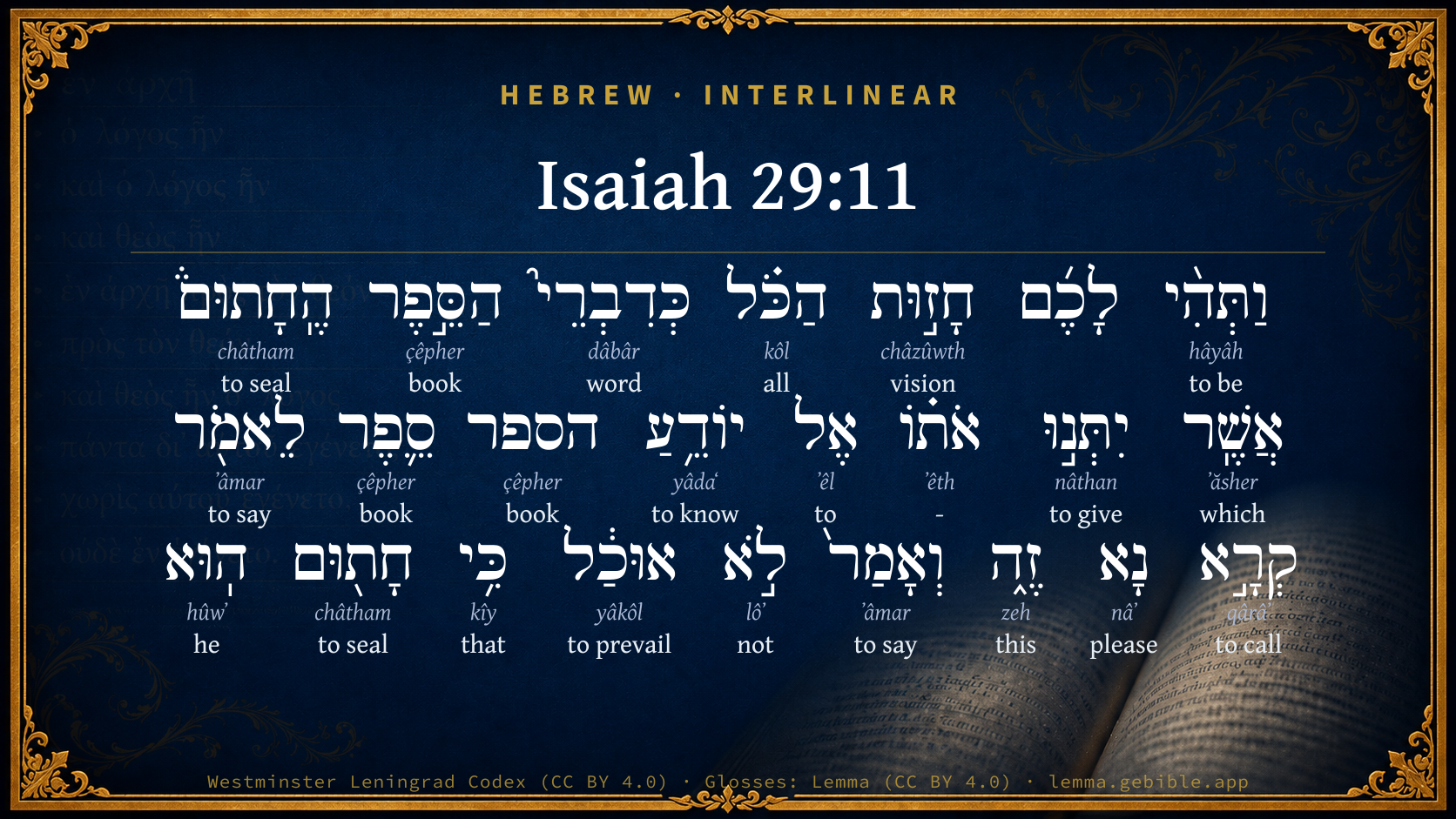
Hebrew (Westminster Leningrad Codex) Isaiah 29:11 appears in the Hebrew Old Testament. The text above is from the Westminster Leningrad Codex. Each word links to its Strong’s number, a concise gloss, and parsing drawn from the Open Scriptures Hebrew Bible morphology. Click any word for its full Brown-Driver-Briggs (BDB) entry.
Download image
Cite this verse

Isaiah 29:11 (World English Bible). Public Domain. Lemma interlinear Bible study tool, https://lemma.gebible.app/v/isaiah/29/11.

Show BibTeX & RIS
BibTeX
RIS
English Translation
All vision is become to you as the words of a book that is sealed, which men deliver to one who is learned, saying, Read this, I pray you; and he says, I can't, for it is sealed:
World English Bible · Public Domain
Download a study sheet

One document with this verse’s original text, its word-by-word gloss line, the meaning frame, cross-references with their text, attributed commentary, and full source and license credits — printable, and it pastes into notes with its structure intact.

This verse Autodidact and up

Study sheet (.html) Plain text (.txt)

A passage Seminary Student

Up to 50 verses in one chapter. A passage sheet keeps up to 6 commentary sources and 12 cross-references per verse, in the order this page ranks them, and says so on the sheet whenever that leaves anything out. Ask for a single verse and you get the Autodidact verse sheet above.

Everything on this page stays free to read, with no account — the sheet is a download of what is already on screen, not access to it.

Want to remove ads? Support Godless Engineer
Compare translations 3

The same verse in 3 English versions, stacked beneath the original-language interlinear above. Click any original word for its lexicon entry.

Each is an independent rendering of the whole verse — the interlinear is not word-aligned to these translations.

Highlighted words mark where these versions differ — a whole-verse word diff, not a word-by-word alignment.

  • World English Bible Public Domain
    All vision is become to you as the words of a book that is sealed, which men deliver to one who is learned, saying, Read this, I pray you; and he says, I can't, for it is sealed:
  • King James Version Public Domain
    And the vision of all is become unto you as the words of a book that is sealed, which men deliver to one that is learned, saying, Read this, I pray thee: and he saith, I cannot; for it is sealed:
  • unfoldingWord Literal Text CC BY-SA 4.0
    And the vision of all has become to you like the words of a sealed scroll, which, they give it to one knowing writing, saying, “Read this, please,” and he says, “I am not able, for it sealed.”

unfoldingWord Literal Text — © unfoldingWord, licensed CC BY-SA 4.0. Word-aligned USFM3 via Door43 (git.door43.org/unfoldingWord/en_ult).

Versions to compare (up to 4)

3 of 4 selected

Show all 18 translations

Every available English version of this verse, each an independent rendering of the whole verse.

  • World English Bible Public Domain
    All vision is become to you as the words of a book that is sealed, which men deliver to one who is learned, saying, Read this, I pray you; and he says, I can't, for it is sealed:
  • Berean Standard Bible Public Domain
    And the entire vision will be to you like the words sealed in a scroll. If it is handed to someone to read, he will say, “I cannot, because it is sealed.”
  • Majority Standard Bible Public Domain
    And the entire vision will be to you like the words sealed in a scroll. If it is handed to someone to read, he will say, “I cannot, because it is sealed.”
  • King James Version Public Domain
    And the vision of all is become unto you as the words of a book that is sealed, which men deliver to one that is learned, saying, Read this, I pray thee: and he saith, I cannot; for it is sealed:
  • American Standard Version (1901) Public Domain
    And all vision is become unto you as the words of a book that is sealed, which men deliver to one that is learned, saying, Read this, I pray thee; and he saith, I cannot, for it is sealed:
  • Revised Version (1885) Public Domain
    And all vision is become unto you as the words of a book that is sealed, which men deliver to one that is learned, saying, Read this, I pray thee: and he saith, I cannot, for it is sealed:
  • Geneva Bible (1599) Public Domain
    And the vision of them all is become vnto you, as the wordes of a booke that is sealed vp, which they deliuer to one that can reade, saying, Reade this, I pray thee. Then shall he say, I can not: for it is sealed.
  • Douay-Rheims (1899) Public Domain
    And the vision of all shall be unto you as the words of a book that is sealed, which when they shall deliver to one that is learned, they shall say: Read this: and he shall answer: I cannot, for it is sealed.
  • Young's Literal Translation Public Domain
    And the vision of the whole is to you, As words of the sealed book, That they give unto one knowing books, Saying, `Read this, we pray thee,' And he hath said, `I am not able, for it `is' sealed;'
  • Literal Standard Version CC BY-SA 4.0
    And the vision of the whole is to you, || As words of the sealed scroll, || That they give to one knowing scrolls, || Saying, “Please read this,” || And he has said, “I am not able, for it [is] sealed”;
  • Unlocked Literal Bible CC BY-SA 4.0
    All revelation has become to you as the words of a book that is sealed, which men might give to one who is learned, saying, “Read this.” He also says, “I cannot, for it is sealed.”
  • unfoldingWord Literal Text CC BY-SA 4.0
    And the vision of all has become to you like the words of a sealed scroll, which, they give it to one knowing writing, saying, “Read this, please,” and he says, “I am not able, for it sealed.”
  • Darby Bible Public Domain
    And the whole vision is become unto you as the words of a book that is sealed, which they give to one that can read, saying, Read this, I pray thee; and he saith, I cannot, for it is sealed.
  • World Messianic Bible Public Domain
    All vision has become to you like the words of a book that is sealed, which men deliver to one who is educated, saying, “Read this, please;” and he says, “I can’t, for it is sealed;”
  • Webster's Bible Public Domain
    And the vision of all is become to you as the words of a book that is sealed, which men deliver to one that is learned, saying, Read this, I pray thee: and he saith, I cannot; for it is sealed:
  • Free Bible Version CC BY-SA 4.0
    This entire vision is like words in a scroll that is sealed shut. If you give it to someone who knows how to read and say, “Please read it,” they'll say, “I can't read it because it's sealed shut.”
  • Bible in Basic English Public Domain
    And the vision of all this has become to you like the words of a book which is shut, which men give to one who has knowledge of writing, saying, Make clear to us what is in the book: and he says, I am not able to, for the book is shut:
  • JPS Tanakh (1917) Public Domain
    And the vision of all this is become unto you as the words of a writing that is sealed, which men deliver to one that is learned, saying: 'Read this, I pray thee'; and he saith: 'I cannot, for it is sealed';

Literal Standard Version (2020), Covenant Press — licensed CC BY-SA 4.0. Text via the HelloAO Bible API (eBible.org). Unlocked Literal Bible (unfoldingWord) — licensed CC BY-SA 4.0. Text via the HelloAO Bible API (eBible.org). unfoldingWord Literal Text — © unfoldingWord, licensed CC BY-SA 4.0. Word-aligned USFM3 via Door43 (git.door43.org/unfoldingWord/en_ult). Free Bible Version, Dr. Jonathan Gallagher — licensed CC BY-SA 4.0. Text via the HelloAO Bible API (eBible.org).

Word by word

More ways to search: Search by grammar → Find every occurrence → Compare this word →

Practice this passage: Drill this verse → Learn its vocabulary →

חָז֣וּת
châzûwth
H2380
“vision of”
Noun, Common, Feminine, Singular, Construct
Part of Speech
Noun
Type
Common
Gender
Feminine
Number
Singular
State
Construct
Full BDB Definition

Origin: from H2372

TWOT: 633d

vision, conspicuousness - vision, oracle of a prophet - agreement - conspicuousness in appearance
  1. וַתְּהִ֨י hâyâh H1961 “and · to be” Conjunction + Verb, Qal, Sequential Imperfect, 3rd Person, Feminine, Singular
  2. הַכֹּ֗ל kôl H3605 “the · all” Particle, Definite Article + Noun, Common, Masculine, Singular, Absolute
  3. כְּדִבְרֵי֮ dâbâr H1697 “like/as · words of” Preposition + Noun, Common, Masculine, Plural, Construct
  4. הַסֵּ֣פֶר çêpher H5612 “the · book” Particle, Definite Article + Noun, Common, Masculine, Singular, Absolute
  5. הֶֽחָתוּם֒ châtham H2856 “the · sealed” Particle, Definite Article + Verb, Qal, Participle Passive, Masculine, Singular, Absolute
  6. אֲשֶֽׁר ʼăsher H834 “which” Particle, Relative
  7. יִתְּנ֣וּ nâthan H5414 “to give” Verb, Qal, Imperfect, 3rd Person, Masculine, Plural
  8. אֹת֗וֹ ʼêth H853 “- · him” Particle, Direct Object + Suffix, Personal, 3rd Person, Masculine, Singular
  9. אֶל ʼêl H413 “to” Preposition
  10. יוֹדֵ֥עַ yâdaʻ H3045 “knowing” Verb, Qal, Participle Active, Masculine, Singular, Construct
  11. הספר çêpher H5612 “the · book” Particle, Definite Article + Noun, Common, Masculine, Singular, Absolute
  12. סֵ֛פֶר çêpher H5612 “book” Noun, Common, Masculine, Singular, Absolute
  13. לֵאמֹ֖ר ʼâmar H559 “to say” Preposition + Verb, Qal, Infinitive Construct
  14. קְרָ֣א qârâʼ H7121 “call” Verb, Qal, Imperative, 2nd Person, Masculine, Singular
  15. נָא nâʼ H4994 “please” Particle, Exhortation
  16. זֶ֑ה zeh H2088 “this” Pronoun, Demonstrative, Masculine, Singular
  17. וְאָמַר֙ ʼâmar H559 “and · to say” Conjunction + Verb, Qal, Sequential Perfect, 3rd Person, Masculine, Singular
  18. לֹ֣א lôʼ H3808 “not” Particle, Negative
  19. אוּכַ֔ל yâkôl H3201 “to prevail” Verb, Qal, Imperfect, 1st Person, Common, Singular
  20. כִּ֥י kîy H3588 “that” Conjunction
  21. חָת֖וּם châtham H2856 “sealed” Verb, Qal, Participle Passive, Masculine, Singular, Absolute
  22. הֽוּא hûwʼ H1931 “he” Pronoun, Personal, 3rd Person, Masculine, Singular

About this verse

These counts appear in no published source. They are computed here, from the morphology-tagged text and Lemma’s own curated glosses. What Lemma adds →

24
words
19
distinct lemmas
Prophets
section

Notable vocabulary

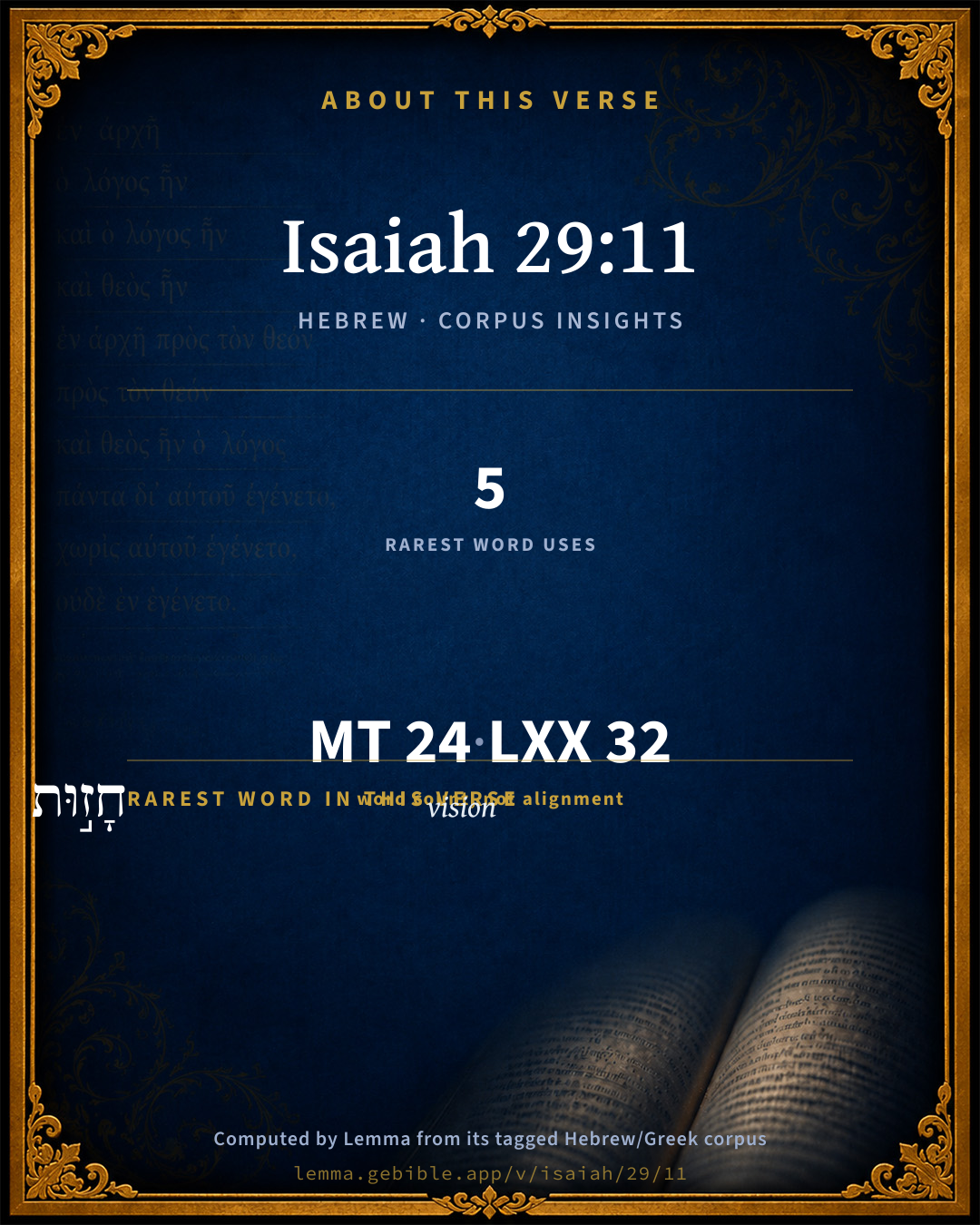
The rarest word here is חָז֣וּת vision H2380 — appearing just 5 times in the whole Hebrew Bible.

Shared distinctive vocabulary

חָז֣וּת vision H2380 occurs in 5 verses of the Hebrew Bible. Also found in:

Grammatical profile

  • 9 verbs
  • 6 nouns
  • 2 pronouns
  • 2 prepositions
  • 1 conjunction
  • 4 particles

Verb forms

  • וַתְּהִ֨י Qal · Sequential Imperfect
  • הֶֽחָתוּם֒ Qal · Participle Passive
  • יִתְּנ֣וּ Qal · Imperfect
  • יוֹדֵ֥עַ Qal · Participle Active
  • לֵאמֹ֖ר Qal · Infinitive Construct
  • קְרָ֣א Qal · Imperative
  • וְאָמַר֙ Qal · Sequential Perfect
  • אוּכַ֔ל Qal · Imperfect
  • חָת֖וּם Qal · Participle Passive

Repetition

Words recur within this verse — often emphatic in Hebrew:

  • הַסֵּ֣פֶר book H5612 ×3
  • הֶֽחָתוּם֒ to seal H2856 ×2
  • לֵאמֹ֖ר to say H559 ×2

Hebrew & Septuagint length

In English translation the verse runs 38 words from the Hebrew and 39 from the Septuagint (LXX English) — closely comparable.

A rough comparison of the two English renderings, which tokenize alike — not a word-level alignment.

Word counts can differ between the Hebrew and the Greek without any difference in meaning — e.g. the Hebrew direct-object marker אֵת has no separate Greek word, and Greek often adds the article ὁ.

In the original languages it is 24 Hebrew tokens and 32 Greek tokens — but the two are counted differently (Hebrew bundles its prefixes and suffixes into one token; the Greek is in lemma form), so that isn’t a like-for-like length.

Cross-references

8

Topical passages linked to Isaiah 29:11 in the Treasury of Scripture Knowledge — connected by theme and wording, ordered by reader-vote popularity; previews shown in the World English Bible.

  • Matthew 13:11 He answered them, "To you it is given to know the mysteries of the Kingdom of Heaven, but it is not given to them.
  • Isaiah 8:16 Bind up the testimony, seal the law among my disciples.
  • Daniel 12:4 But you, Daniel, shut up the words, and seal the book, even to the time of the end: many shall run back and forth, and knowledge shall be increased."
  • Daniel 12:9 He said, Go your way, Daniel; for the words are shut up and sealed until the time of the end.
  • Matthew 11:25 At that time, Jesus answered, "I thank you, Father, Lord of heaven and earth, that you hid these things from the wise and understanding, and revealed them to infants.
  • Matthew 16:17 Jesus answered him, "Blessed are you, Simon Bar Jonah, for flesh and blood has not revealed this to you, but my Father who is in heaven.
  • Revelation 5:1–9 I saw, in the right hand of him who sat on the throne, a book written inside and outside, sealed shut with seven seals.
  • Revelation 6:1 I saw that the Lamb opened one of the seven seals, and I heard one of the four living creatures saying, as with a voice of thunder, "Come and see!"

Cross-references courtesy of OpenBible.info (CC BY 4.0).

Hebrew and Greek witnesses Masoretic Hebrew ↔ Greek Septuagint

The same verse in the two great witnesses to the Old Testament, shown verse-for-verse.

These are two independent witnesses, not word-aligned to each other, and the Septuagint is shown in lemma (dictionary) form.

Hebrew Isaiah 29:11 Masoretic · Westminster Leningrad Codex

וַתְּהִ֨י לָכֶ֜ם חָז֣וּת הַכֹּ֗ל כְּדִבְרֵי֮ הַסֵּ֣פֶר הֶֽחָתוּם֒ אֲשֶֽׁר יִתְּנ֣וּ אֹת֗וֹ אֶל יוֹדֵ֥עַ הספר סֵ֛פֶר לֵאמֹ֖ר קְרָ֣א נָא זֶ֑ה וְאָמַר֙ לֹ֣א אוּכַ֔ל כִּ֥י חָת֖וּם הֽוּא

All vision is become to you as the words of a book that is sealed, which men deliver to one who is learned, saying, Read this, I pray you; and he says, I can't, for it is sealed:

World English Bible · Public Domain

Greek LXX Isaiah 29:11 Septuagint · lemma form

καί εἰμί σύ πᾶς ὁ ῥῆμα οὗτος ὡς ὁ λόγος ὁ βιβλίον ὁ σφραγίζω οὗτος ὅς ἐάν δίδωμι αὐτός ἄνθρωπος ἐπίσταμαι γράμμα λέγω ἀναγιγνώσκω οὗτος καί εἶπον οὐ δύναμαι ἀναγιγνώσκω σφραγίζω γάρ

And all these things shall be to you as the words of this sealed book, which if they shall give to a learned man, saying, Read this, he shall then say, I can’t read it, for it is sealed.

LXX2012 (modern English Septuagint) · Public Domain

On this verse, Adam Clarke's Commentary discusses the Septuagint’s reading. Read the note in Commentary ↓

Hebrew: Westminster Leningrad Codex (CC BY 4.0). Greek: Septuagint (public domain); English from LXX2012 (modern English Septuagint) (Public Domain). How the Septuagint differs from the Hebrew →

Targum (Aramaic paraphrase)

1

The Targum is the ancient Jewish Aramaic paraphrase of the Hebrew Scriptures — an interpretive translation, not the Hebrew text itself. Onkelos (literal) and Pseudo-Jonathan (expansive) render the Torah, and Jonathan the Prophets. Coverage is partial: where no permissively-licensed English translation exists for a verse, only the Aramaic is shown. This is verse-level text, not a word-by-word alignment to the Hebrew.

  1. Targum Jonathan Prophets (Joshua–Malachi)
    וַהֲוַת לְכוֹן נְבוּאַת כּוֹלָא כְּפִתְגָמֵי סִפְרָא דַחֲתִים דְאִם יִתְּנוּן יָתֵהּ לִדְיָדַע סִפְרָא לְמֵימַר קְרֵי כְעַן דֵין וְיֵימַר לֵית אֲנָא יָכִיל אֲרֵי חֲתִים הוּא:

    And all the prophecy shall be unto you as the words of a sealed book, which if one gives to a man that is learned, saying, “Read this now;” then he shall answer, “I am not able, because it is sealed.”

    Targum Jonathan — Aramaic: “Mikraot Gedolot” (public domain). English: “Sefaria Community Translation” (CC0 1.0 (public-domain dedication)); “London "Chaldee Paraphrase," 1871” (public domain). Text via Sefaria.

Commentary

Notes on Isaiah 29:11 from classic Christian and Jewish commentators (each source and its license shown beneath its notes). The classic Christian expositions comment on the surrounding passage and are grouped to its opening verse, so a note may address several verses; the Jewish commentaries on the Tanakh (Rashi and others) are per-verse, so they appear only where the commentator wrote on this verse.

Lemma curates 59 commentaries, every one of them public domain or Creative Commons licensed, each selected and text-cleaned for this edition rather than reprinted as found. About our sources →

Trapp's Complete Commentary

John Trapp

Isa 29:11 And the vision of all is become unto you as the words of a book that is sealed, which [men] deliver to one that is learned, saying, Read this, I pray thee: and he saith, I cannot; for it [is] sealed:

Ver. 11. And the vision of all is become unto you, &c.] The Scriptures were so to the scribes and elders of the people, who although, when Herod asked them of the Messiah, they could give such descriptions of him as agreed to none but the babe of Bethlehem, {Mat 2:5-6} yet would they by no means be drawn to believe in his name. And the like woeful obstinace is found in the Rabbis and other Jews to this day. The like spiritual judgment hath befallen the Papists also, both the learned and unlearned; and yet one of them sticks not to tell us to our heads, that our damnation is so plainly and plentifully set down in our own English Bibles, that no man needeth to doubt of it who hath but a book, and can read English. Thus, who so bold as blind Bayard? who so blind as those that will not see?

John Trapp, A Commentary or Exposition upon All the Books of the Old and New Testament (1647–1656) — public domain. Text from a community e-Sword module.

The Biblical Illustrator

Joseph S. Exell

Isa_29:11-12

The vision of all is become unto you as the words of a book that is sealed

The universality of spiritual blindness

What is affirmed in these verses holds so strikingly true of Gods general revelation to the world, that we deem the lesson contained in them to be not of partial, but permanent application.

I. There is A COMPLAINT uttered in these verses

(1) by the learned,

(2) by the unlearned.

1. If a book be closed down by a material seal, then, till that seal be broken, there lies a material obstacle even in the way of him who is able to read the contents of it. Is there any hindrance in virtue of which the critics, and the grammarians, and the accomplished theologians of our age, are unable to reach the real and effective understanding of the words of this prophecy? Yes, and it is wonderful to tell, how little the mere erudition of Scripture helps the real discernment of Scripture. The learned just labour as helplessly under a want of an impression of the reality of this whole matter, as the unlearned; and if this be true of many a priest and theologian, with whom Christianity is a science, and the study of the Bible the business of their profession, what can we expect of those among the learned, who, in the pursuits of a secular philosophy, never enter into contact with the Bible, either in its doctrine or in its language, except when it is obtruded on them? To make the wisdom of the New Testament his wisdom, and its spirit his spirit, and its language his best-loved and best-understood language, there must be a higher influence upon the mind, than what lies in human art, or in human explanation. And till this is brought to pass, the doctrines of the atonement and of regeneration, and of fellowship with the Father and the Son, and of a believers progressive holiness, under the moral and spiritual power of the truth as it is in Jesus, will, as to his own personal experience of its meaning, remain so many empty sounds, or so many deep and hidden mysteries: and just as effectually, as if the book were held together by an iron clasp, which he has not strength to unclose, may he say of the same book lying open and legible before him, that he cannot read it, because it is sealed.

2. As for the complaint of the unlearned, it happily, in the literal sense of it, is not applicable to the great majority of our immediate countrymen, even in the very humblest walks of society. They can read the book. There may remain a seal upon its meaning to him, who, in the ordinary sense of the term, is learned, while the seal may be removed, and the meaning lie open as the light of day to him, who in the same sense is unlearned. In pressing home the truths and overtures of Christianity on the poor, we often meet with the very answer of the text, I am not learned. They think that there is an ignorance which necessity attaches to their condition, and that this should alleviate the burden of their condemnation, in that they know not God. Now we refuse this apology altogether. The Word of the Lord is in your hands, and you can at least read it. The Gospel is preached unto you as well as unto others--and you can, at least, attend to it.

II. Let us now proceed to EXPLAIN A CIRCUMSTANCE which stands associated in our text with the incapacity both of learned and unlearned to discover the meaning of Gods communications--that is the spirit of deep sleep which had closed the eyes of the people, and buried in darkness and insensibility the prophets, the rulers, and the seers, as well as the humblest and most ignorant of the land. The connection between the one circumstance and the other is quite palpable. If a peasant and a philosopher were both literally asleep before me--and that so profoundly, as that no voice of mine could awaken them--then they are just in the same circumstances, with regard to any demonstration which I addressed to their understandings. Neither would it at all help the conveyance of my meaning to their mind, that while dead to all perception of the argument which issued from my lips, or even of the sound which is its vehicle, the minds of both of them were most busily alive and active amongst the imagery of a dream--the one dreaming too, perhaps, in the style of some high intellectual pursuit, and the other dreaming in the style of some common and illiterate occupation. Such, it is possible to conceive, may be the profoundness of this lethargy, as to be unmoved by the most loud and terrifying intimations. That the vast majority of the world are, in truth, asleep to all those realities which constitute the great materials of religion, may be abundantly proved by experience. Now, the question comes to be, how is this sleep dissipated? Not, we affirm, and all experience will go with us, by the power of natural argument--not by the demonstrations of human learning, for these are just as powerless with him who understands them, as with him who makes his want of learning the pretence for putting them away. There must be a something equivalent to the communication of a new sense, ere a reality comes to be seen in those eternal things. It is true, that along the course of our ordinary existence, we are awake to the concerns of our ordinary existence. But this is not a wakefulness which goes to disturb the profoundness of our insensibility as to the concerns of a higher existence. We are in one sense awake; but in another most entirely, and, to all human appearance, most hopelessly and irrecoverably asleep. We are just in the same condition with a man who is dreaming, and so moves for the time in a pictured world of his own. And the transition is not greater from the sleeping fancies of the night to the waking certainties of our daily business, than is the transition from the daydreams of a passing world to those substantial considerations which wield s presiding authority over the conduct of him who walketh not by the sight of that which is around him, but by the faith of the unseen things that are above him, and before him. (T. Chalmers, D. D.)

The voices of life

Here, we find the picture of the two great classes of excuses men make today, when duties are urged upon them.

I. The first great answer of human nature to the call of duty--the first and readiest excuse which the easy-going, self-indulgent life has to offer--is this first excuse of the men of Jerusalem to the unpleasant vision of the future. It is as a book which is sealed, and he who is able to read it does not read it, simply because it is closed, or sealed. Here we have a definite excuse given, which looks plausible enough, but which only means, after all, the lack of will power, which so frequently lodges behind some prominent excuse. POWERLESSNESS OF WILL! Who does not make this excuse in life?

II. The other great excuse which is so freely given is the LACK OF OPPORTUNITY. He who has the will has not the one requisite, the one condition of success, the longed for opportunity. The poor man with his tastes envies the rich their command over the forces of life. The struggling student by his midnight lamp, with his book borrowed from the library, sighs as he sees the elegantly bound but unopened volumes of those who have abundant opportunities but no appreciation of their hidden treasures, or will to read them. The invalid upon the bed of pain, whose life is a dream of impossible realities, cherishing noble yearnings for the strife, sees life passing by, padlocked and bound, with every aspiration chained and fettered by the hopeless impossibility of ever achieving anything. Practical lessons--

1. This very incompleteness of our nature shows us the souls rightful demand for another life without these limiting human conditions.

2. Right in the midst of these voices of life, these excuses for our failure, from whatever source these excuses come, the religion of Jesus Christ appears as a new creation of power.

3. Just when we feel that our motive power is failing us, or that we are helpless in our surroundings, and are lacking an opportunity for the exercise of our suppressed faculties, the Spirit of God, who is the Comforter of the sanctified heart of man and the Inspirer of his better nature, appears with His Divine mission, and opens the way out of dead levels and land-locked vistas, into new and unforeseen stretches of existence. What a power there is in this thought of the souls higher deliverance by the interposing hand of the Spirit of God, lifting us out of our poor everyday life! (W. W. Newton.)

Bible neglect reproved

The general division of the learned and the unlearned is introduced as offering an excuse for the not understanding the revelation of God. There is diversity, indeed, in the excuse itself, but there is thorough agreement upon the point, that, from some reason or another, the Bible is unintelligible; the one class taking refuge in the alleged obscurity of Scripture, and the other in their own defective education. None are represented as actually throwing scorn upon the book, but all render it a kind of involuntary homage. And we believe that no truer description could be given of the great body of men, considered relative to the light in which they view Scripture. If there were anything like a general suspicion that the Bible is not what it professes itself--a revelation from God, there would be nothing to surprise us in the general neglect with which it is treated; we should quite expect that if there were doubt as to the origin there would, for the most part, be indifference as to the contents; but with the great body of men its origin is no more brought into question than is the duty of preparing for eternity. And here we have a manifest inconsistency, to be accounted for only on the supposition that men have provided themselves with some specious apology.

I. We shall consider, therefore, THE CASE AND APOLOGY OF THE LEARNED. There is something of truth in the representation that the Bible is a sealed book. We always regard it as a standing proof of the divinity of the volume, that it is not to be unfolded by the processes which we apply to a mere human composition, and that every attempt to enter deeply into its meaning, without the assistance of its Author, issues in nothing but conjecture and confusion. But in all these excuses, however specious, and however, in a certain sense, grounded on a truth, there is nothing to warrant that refusal to examine Holy Writ which they are invented to justify. We know of no conclusion which can be fairly drawn from the confessed mysteriousness of Scripture, and the consequent need of a superhuman interpreter, but that the volume should never be approached in our own wisdom, and never without prayer for the teaching of Gods Spirit. If it would be our duty to study the volume were it not sealed, it must be equally our duty to study it when, though sealed, the way is prescribed in which it may be opened. We have only to bring this consideration into the account, and there is an end of all arguing from the obscurity of the study of Scripture.

II. THE CASE AND APOLOGY OF THE UNLEARNED MAN. Here, again, the excuse is based on a truth, but nevertheless, it in no degree justifies neglect. It is of vast importance that the poor be set right in this matter, and that they be taught that there is no necessary connection, as they seem to suppose, between scholarship and salvation. It is easier for the educated man to become, what is called a skilful divine, but it is not one jot easier for him to discover and follow the narrow path of life. Indeed, if there be advantage at all, it is on the side of the unlearned. If the understanding the Bible, so as to become morally advantaged by its statements, depend on the influences of the Holy Ghost, it is clear that the learned may read much and gain no spiritual benefit, and the unlearned read little and yet be mightily profited. (H. Melvill, B. D.)

Learned and unlearned

The passage is interesting as illustrating the diffusion of literary education in Isaiahs time (Jer_5:4-5).(Prof. J. Skinner, D. D.)

Gradual revelation

Sir Joshua Reynolds says that when he first visited Italy to make the acquaintance of the celebrated masterpieces of art he was much cast down. The renowned masters maintained towards him quiet and dignified silence; they refused to confide to him their thoughts. He gazed steadfastly at the wondrous pictures whose fame had filled the world, and could not behold their glory. Persevering, however, in his studies, the pictures gradually began, one after another, to raise their veils and permit him to have an occasional peep at their rare beauty; they softly whispered to him a few of their secrets; and as he continued unwavering in his devotion, they at last flung away their reserve, showed themselves with an open face, and revealed to him the wealth of beautiful ideas that was lodged in them. (J. C. Jones.)

The Holy Spirit the Illuminator

I remember to have heard from one who was a spectator at the time, of his having once seen a little child playing upon a headland over the sea, who took a telescope from the hand of one near him, and handed it to a blind old sailor who was sitting on the cliff, and the child asked the blind man to sweep the far horizon and tell him with the glass what ships were them. The old man, however, could only turn bitterly towards the child with those sightless eyes of his; and, it seems to me, that you might as well give a telescope to a sightless man as to give the Bible to a man whom you do not suppose to possess the guidance of the Spirit. (Bp. W. Alexander.)

The Biblical Illustrator, edited by Joseph S. Exell (c. 1880s–1900s) — public domain. Text from a community e-Sword module.

Joseph Benson's Commentary

Isa 29:11-12. And the vision of all — Of all your prophets, or every vision; is unto you as the words of a book that is sealed — Which no man can read while it is sealed up, as books then sometimes were, being in the form of rolls. Which men deliver to one that is learned — That understands the language in which the book is written; saying, Read this — he saith, I cannot; for it is sealed — Mere human learning, without supernatural illumination, will not enable any man rightly to understand the word of God, and things divine: see 1Co 2:11; 1Co 2:14. The book is delivered — Unsealed and opened; to him that is unlearned — and he saith, I cannot read it; for I am unlearned. Thus, neither the learned nor the unlearned among the Jews were any better for the messages which God sent them by his servants the prophets, nor desired to be better.

Joseph Benson's Commentary on the Old and New Testaments (1811–1818) — public domain. Text from a community e-Sword module.

Geneva Bible (1599)

Geneva Bible translators

Meaning, that it is all alike, either to read, or not to read, except God open the heart to understand.

Geneva Bible (1599) marginal notes — public domain. Text via Bolls.life.

Jamieson, Fausset & Brown

Robert Jamieson, A. R. Fausset & David Brown

of all--rather, "the whole vision." "Vision" is the same here as "revelation," or "law"; in Isa 28:15, the same Hebrew word is translated, "covenant" [MAURER].

sealed-- (Isa 8:16), God seals up the truth so that even the learned, because they lack believing docility, cannot discern it (Mat 13:10-17; Mat 11:25). Prophecy remained comparatively a sealed volume (Dan 12:4, Dan 12:9), until Jesus, who "alone is worthy," "opened the seals" (Rev 5:1-5, Rev 5:9; Rev 6:1).

Jamieson, Fausset & Brown — Commentary Critical and Explanatory on the Whole Bible (1871) — public domain (CC PDM 1.0). Text via the HelloAO Bible API.

Adam Clarke's Commentary

Verse 11. I cannot; for it is sealed - "I cannot read it; for it is sealed up."] An ancient MS. and the Septuagint have preserved a word here, lost out of the text; לקרות likroth, (for לקראות,) αναγνωναι, read it.

Adam Clarke's Commentary on the Bible (1810–1826) — public domain. Text from a community e-Sword/MySword module.

Ellicott's Commentary for English Readers

(11) The vision of all . . .—Better, the whole vision, i.e., the entire substance of Isaiah’s teaching. The words perhaps imply that this had been committed to writing, but that to the unbelievers they were as “the roll of a sealed book.” The same imagery meets us in Rev_5:2. The wise of this world treated its dark sayings as seals, which forbade their making any attempt to study it. The poorer unlearned class could plead a more genuine and less guilty ignorance, but the effect was the same with both.

A Bible Commentary for English Readers, edited by Charles John Ellicott (1878–1897) — public domain. Text from a community e-Sword module.

The Cambridge Bible for Schools and Colleges

gen. ed. J. J. S. Perowne

11. the vision of all] i.e. the revelation of all this (cf. Psa_49:17, “all that”).

learned] is literally “knowing letters.”

11, 12. A distinction is drawn between the ignorance of the educated and that of the uneducated classes. The man of culture is like one who will not break the seal of a sealed book that he may read it; the man in the street cannot read it even if unsealed. The passage is interesting as illustrating the diffusion of literary education in Isaiah’s time (cf. Jer_5:4-5).

The Cambridge Bible for Schools and Colleges (gen. ed. J. J. S. Perowne; Cambridge University Press, 1878–1918) — public domain. Text from a community e-Sword module.

John Gill's Exposition

And the vision of all is become unto you as the words of a book that is sealed,.... The prophecies of all the prophets contained in the Scriptures; or all the prophecies in the book of Isaiah, concerning the Messiah, were no more seen, known, and understood, both by the priests and the people, than if they had been in a book, written, rolled up, and sealed. And this was owing, not to the obscurity of these writings, or because they were really sealed up, but to the blindness and stupidity of the people, whose eyes were closed, and their heads covered; and the prophecies of the Scriptures were only so to them, "unto you", not unto others; not to the apostles of Christ, whose understandings were opened by him, to understand the things written concerning him, in the law, in the prophets, and in the psalms; but the Jewish rulers, civil and ecclesiastical, as well as the common people, understood them not, though they were the means of fulfilling many of them; and they were as ignorant of the prophecies concerning their own ruin and destruction, for their rejection of Christ; see Luk 24:27,

which men deliver to one that is learned; or, "that knows the book" (u); or "letters", as the Septuagint; see Joh 7:15 such were the Scribes, called or "letter men", men that could read well, and understood language:

saying, Read this, I pray thee; or read this now, as the Targum, and interpret it, and tell the meaning of it:

and he saith, I cannot, for it is sealed; which Kimchi says was an excuse invented, because he had no mind to read it, or otherwise he could have said, open, and I will read it; or he might have broke off the seal; but knowing there were difficult things, and things hard to be understood, in it, did not care to look into it, and read it, and attempt to explain it to others.

(u) "scienti librum", Montanus; , Sept.; "scienti literas", V. L. Junius & Tremellius, Piscator, Cocceius.

John Gill's Exposition of the Whole Bible (1746–1763) — public domain (CC PDM 1.0). Text via the HelloAO Bible API.

Albert Barnes' Notes on the Bible

And the vision of all - The vision of all the prophets; that is, all the revelations which God has made to you (see the note at Isa 1:1). The prophet refers not only to his own communications, but to those of his contemporaries, and of all who had gone before him. The sense is, that although they had the communications which God had made to them, yet they did not understand them. They were as ignorant of their true nature as a man who can read is of the contents of a letter that is sealed up, or as a man who cannot read is of the contents of a book that is handed to him.

As the words of a book - Margin, ‘Letter.’ The word ספר sêpher may mean either. It properly means anything which is “written” (Deu 24:1, Deu 24:3; Jer 32:11; Dan 1:4), but is commonly applied to a book Exo 17:14; Jos 1:8; Jos 8:34; Psa 40:8.

That is sealed - (see the note at Isa 8:16).

Albert Barnes' Notes on the Bible (1834–1885) — public domain. Text from a community e-Sword/MySword module.

The Pulpit Commentary

The vision of all; i.e. "the entire vision all that Isaiah has put before them in vers. 1-8. As the words of a book that is sealed; rather, the words of a letter (marginal rendering) or writing. Written documents were often sealed up to secure secrecy, the sealing being done in various ways. When the writing was on a clay tablet, it was often enclosed in a clay envelope, so that the document could not be read till the outer clay covering was broken. Rolls of papyrus or parchment were secured differently. One that is learned; i.e. "one that can read writing," which the ordinary Jew could not do, any more than the ordinary European in the Middle Ages. Neither the learned nor the unlearned Jews would be able to understand Isaiah"s prophecy, so as to realize and accept its literal truth. They were devoid of spiritual discernment. Even the rulers were but "blind loaders of the blind.

God"s Word a sealed Book.

Reference is to the prophecies of Isaiah, which were evidently circulated in writing among the people; but, by reason of prevailing hypocrisy, pride, and obstinacy, they were not understood they were like a sealed book (compare the figure in Rev_5:2). The connection of the text may be stated thus: "The hearers stare in astonishment at a prophecy seemingly so out of relation to facts. The prophet warns them that, if they willfully deaden their spiritual faculties, there will be no emerging afterwards from this state of blindness and stupefaction. Jehovah will judicially fix them in it. The ruling class is mainly addressed. They are spiritually asleep, with eyes closed and heads wrapped up (in Oriental fashion).

I GOD"S WORD IS NOT A SEALED BOOK BY DIVINE DESIGN. A curious notion has gained acceptance that the Bible could not be the Word of God if it did not contain mysteries quite beyond the possibility of man"s apprehension. On the other hand, it has been well urged that God can have no need thus to "show off" his superiority; and that revelation must mean light," "unfolding;" it can never be intended to mean "bewildering." Of this we may be sure there is nothing in the Bible scaled from man. Whatever is there is for our understanding, for our instruction. Isaiah"s prophecies, given by God"s inspiration, are plain enough; he may read them who runs.

II GOD"S WORD BECOMES A SEALED BOOK THROUGH HUMAN PERVERSITY. This may be shown:

1. In the blinding influence of prejudice. We cannot find in the Word what we do not want to find. This may be applied to national prejudice, sectarian prejudice, and personal prejudice.

2. In the closing of men"s minds to the incomings and gracious illuminations and inspirations of God"s Spirit. He who gives the Word gives the keys to its meanings and applications, through the guiding Spirit. It is a sealed Book if we have not the key.

3. In the judicial scaling which comes as a judgment on the perversity. This is the precise case associated with the text. These willful rulers were determined to treat Isaiah"s prophecies as a sealed book: then to them it shall be a sealed book; and when they want to understand it, they shall "weary themselves to find the door." Apply to our own relations with God"s Word. The openness and suggestiveness of it is a test of our spiritual state. We must never think that God has closed it; the fact can only be that we have closed ourselves to it. R.T.

The Pulpit Commentary (1880–1919), ed. H.D.M. Spence-Jones & Joseph S. Exell — public domain. Text from a community e-Sword module.

J. A. Alexander on Isaiah

Joseph Addison Alexander

“And the vision of all (or of the whole) is (or has become) to you like the words of the sealed writing, which they give to one knowing writing, saying Pray read this, and he says, I cannot, for it is sealed.” The vision of all may either mean of all the prophets, or collectively all vision, or the vision of all things, (i.e., prophecy on all subjects). The English word ‘book’ does not exactly represent the Hebrew word, which originally signifies writing in general or anything written, and is here used as we might use document or the still more general term paper. In the phrase one knowing writing, the last word seems to mean writing in general, and the whole phrase one who understands it or knows how to read it. The application of the simile becomes clear in the next verse.

Joseph Addison Alexander, The Prophecies of Isaiah (1846–1847; New York: Scribner, 1870–1878) — public domain. Text from a community e-Sword module.

unfoldingWord translationNotes

Door43 World Missions Community

All revelation has become to you as the words of a book that is sealed

The other prophets in Jerusalem are unable to hear or understand God's message. AT: "All that Yahweh has revealed is to you like a sealed book" (See: Simile)

is sealed, which men might give to one who is learned

This can be stated as a new sentence. AT: "is sealed. A person may take the sealed book to someone who can read"

If the book is given to one who cannot read

This can be stated in active form. AT: "If a person takes the book to someone who cannot read" (See: Active or Passive)

translationWords

reveal

word

seal

unfoldingWord translationNotes — © Distant Shores Media and the Door43 World Missions Community, licensed CC BY-SA 4.0. Source: git.door43.org/Door43/en_tn.

Rashi

Rabbi Shlomo Yitzchaki (Rashi)

the vision of everything All that you used to see in the constellations shall be concealed from you like the words of a letter sealed with wax, which, if they give to read one able to read a letter, he will say, “I cannot, for I see not what is inside, for it is sealed.”

Rashi on the Tanakh — English translations: “The Judaica Press complete Tanach with Rashi, translated by A. J. Rosenberg” (CC BY 4.0); “Pentateuch with Rashi's commentary by M. Rosenbaum and A.M. Silbermann, 1929-1934” (public domain); “The Metsudah Tanach series, Lakewood, N.J” (CC BY 4.0); and “The Book of Joshua, Metsudah Publications, 1997” (CC BY 4.0). Text via Sefaria.

Ibn Ezra

Rabbi Abraham ibn Ezra

The vision of all. Every prophecy.

For it is sealed. They cannot understand it; the same meaning is contained in the words, seal the law (8:16), as I explained.

Ibn Ezra on the Tanakh — English translations: “Sefaria Community Translation” (CC0 1.0 (public-domain dedication)); “Yalkut, Sifsei Chachomim Chumash, Metsudah Publications, 2009” (CC BY 4.0); and “Commentary of Ibn Ezra on Isaiah - trans. by M. Friedlander, 1873” (public domain). Text via Sefaria.

Lesson kit

Teaching starters — assembled from the data on this page, not authored interpretation. Every prompt links to the verse data it draws on. Edit before teaching.

Isaiah, in the Prophets, opens this verse with 24 words (19 distinct Hebrew lemmas). Its most distinctive word is châzûwth (“vision”). A historical commentator’s framing appears above. Read the whole chapter for the surrounding context.

Discussion questions

  1. How does “vision” (châzûwth) shape what this verse is saying?
  2. Isaiah 21:2 shares the word «vision» with this verse. How do the two illuminate each other?
  3. “book” occurs 3× in this one verse. What is the effect of the repetition?
  4. These translations render this verse differently; the difference is in the English rendering, not the original. What questions does that raise?
  5. The verb «וַתְּהִ֨י» is Qal Sequential Imperfect. How does its form color the action?
  6. Reading how Trapp's Complete Commentary and The Biblical Illustrator read this verse, where do the two commentators agree and where do they part?

Things to notice

Reading settings

Reading text

Shown beneath each verse's original-language words.

Old Testament
Old Testament edition

Read the OT as the Masoretic Hebrew (MT) or the Greek Septuagint (LXX).

English shown for the Greek Septuagint (in the Hebrew ↔ Greek comparison).

Comparing translations? Open the Compare panel on any verse page to stack up to four side by side.