
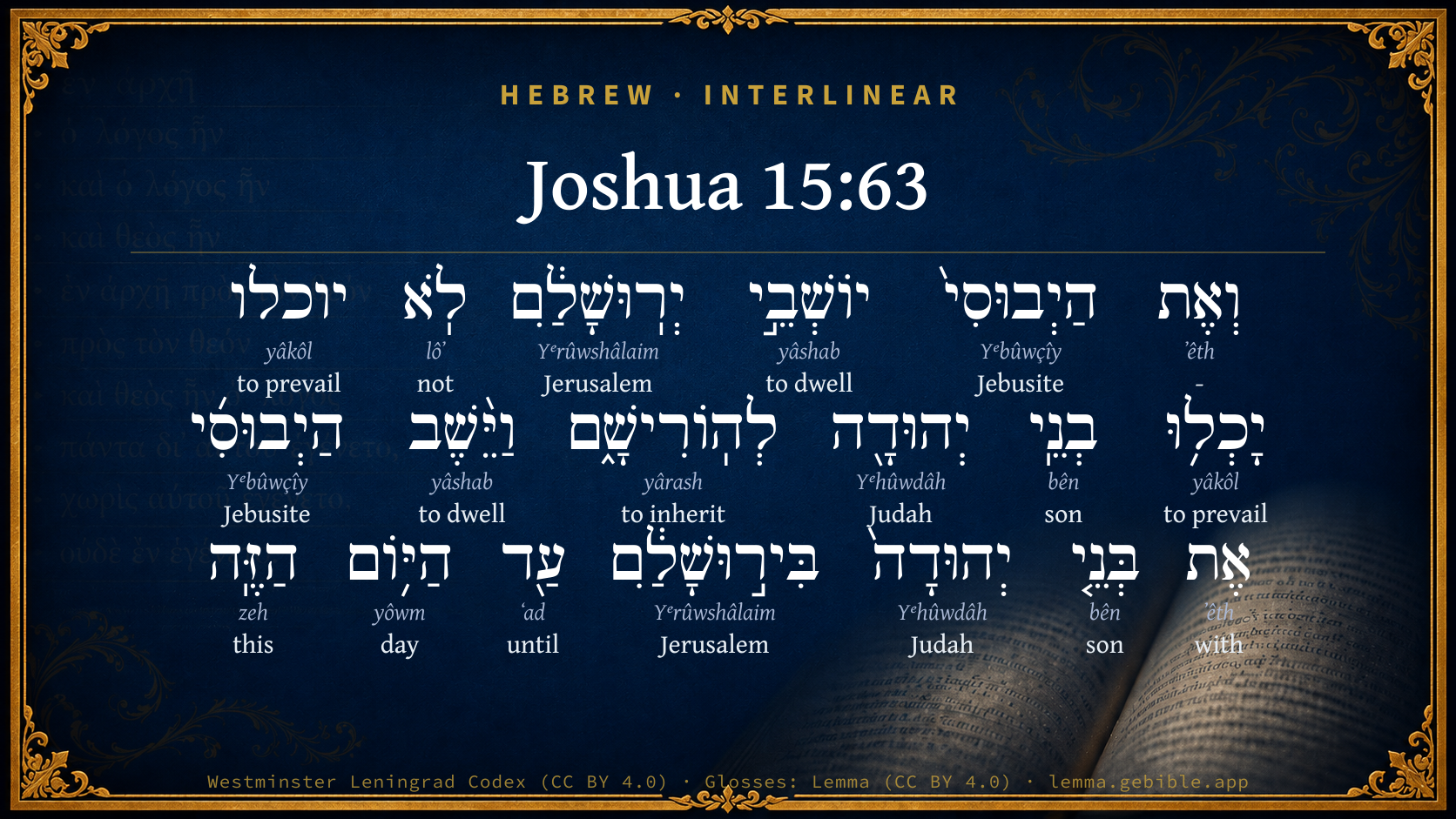
Joshua 15:63

Hebrew (Westminster Leningrad Codex) Joshua 15:63 appears in the Hebrew Old Testament. The text above is from the Westminster Leningrad Codex. Each word links to its Strong’s number, a concise gloss, and parsing drawn from the Open Scriptures Hebrew Bible morphology. Click any word for its full Brown-Driver-Briggs (BDB) entry.
Download image
Cite this verse

Joshua 15:63 (World English Bible). Public Domain. Lemma interlinear Bible study tool, https://lemma.gebible.app/v/joshua/15/63.

Show BibTeX & RIS
BibTeX
RIS
English Translation
As for the Jebusites, the inhabitants of Jerusalem, the children of Judah couldn't drive them out: but the Jebusites dwell with the children of Judah at Jerusalem to this day.
World English Bible · Public Domain
Download a study sheet

One document with this verse’s original text, its word-by-word gloss line, the meaning frame, cross-references with their text, attributed commentary, and full source and license credits — printable, and it pastes into notes with its structure intact.

This verse Autodidact and up

Study sheet (.html) Plain text (.txt)

A passage Seminary Student

Up to 50 verses in one chapter. A passage sheet keeps up to 6 commentary sources and 12 cross-references per verse, in the order this page ranks them, and says so on the sheet whenever that leaves anything out. Ask for a single verse and you get the Autodidact verse sheet above.

Everything on this page stays free to read, with no account — the sheet is a download of what is already on screen, not access to it.

Want to remove ads? Support Godless Engineer
Compare translations 3

The same verse in 3 English versions, stacked beneath the original-language interlinear above. Click any original word for its lexicon entry.

Each is an independent rendering of the whole verse — the interlinear is not word-aligned to these translations.

Highlighted words mark where these versions differ — a whole-verse word diff, not a word-by-word alignment.

  • World English Bible Public Domain
    As for the Jebusites, the inhabitants of Jerusalem, the children of Judah couldn't drive them out: but the Jebusites dwell with the children of Judah at Jerusalem to this day.
  • King James Version Public Domain
    As for the Jebusites the inhabitants of Jerusalem, the children of Judah could not drive them out; but the Jebusites dwell with the children of Judah at Jerusalem unto this day.
  • unfoldingWord Literal Text CC BY-SA 4.0
    But the Jebusite, the dwellers of Jerusalem, the sons of Judah were not able to dispossess them, so the Jebusite has dwelled with the sons of Judah in Jerusalem to this day.

unfoldingWord Literal Text — © unfoldingWord, licensed CC BY-SA 4.0. Word-aligned USFM3 via Door43 (git.door43.org/unfoldingWord/en_ult).

Versions to compare (up to 4)

3 of 4 selected

Show all 18 translations

Every available English version of this verse, each an independent rendering of the whole verse.

  • World English Bible Public Domain
    As for the Jebusites, the inhabitants of Jerusalem, the children of Judah couldn't drive them out: but the Jebusites dwell with the children of Judah at Jerusalem to this day.
  • Berean Standard Bible Public Domain
    But the descendants of Judah could not drive out the Jebusites living in Jerusalem. So to this day the Jebusites live there among the descendants of Judah.
  • Majority Standard Bible Public Domain
    But the descendants of Judah could not drive out the Jebusites living in Jerusalem. So to this day the Jebusites live there among the descendants of Judah.
  • King James Version Public Domain
    As for the Jebusites the inhabitants of Jerusalem, the children of Judah could not drive them out; but the Jebusites dwell with the children of Judah at Jerusalem unto this day.
  • American Standard Version (1901) Public Domain
    And as for the Jebusites, the inhabitants of Jerusalem, the children of Judah could not drive them out: but the Jebusites dwell with the children of Judah at Jerusalem unto this day.
  • Revised Version (1885) Public Domain
    And as for the Jebusites, the inhabitants of Jerusalem, the children of Judah could not drive them out: but the Jebusites dwelt with the children of Judah at Jerusalem, unto this day.
  • Geneva Bible (1599) Public Domain
    Neuerthelesse, the Iebusites that were the inhabitants of Ierusalem, could not the children of Iudah cast out, but the Iebusites dwell with the children of Iudah at Ierusalem vnto this day.
  • Douay-Rheims (1899) Public Domain
    But the children of Juda could not destroy the Jebusite that dwelt in Jerusalem: and the Jebusite dwelt with the children of Juda in Jerusalem until this present day.
  • Young's Literal Translation Public Domain
    As to the Jebusites, inhabitants of Jerusalem, the sons of Judah have not been able to dispossess them, and the Jebusite dwelleth with the sons of Judah in Jerusalem unto this day.
  • Literal Standard Version CC BY-SA 4.0
    As for the Jebusites, inhabitants of Jerusalem, the sons of Judah have not been able to dispossess them, and the Jebusite dwells with the sons of Judah in Jerusalem to this day.
  • Unlocked Literal Bible CC BY-SA 4.0
    But as for the Jebusites, the inhabitants of Jerusalem, the tribe of Judah could not drive them out, so the Jebusites live there with the tribe of Judah to this day.
  • unfoldingWord Literal Text CC BY-SA 4.0
    But the Jebusite, the dwellers of Jerusalem, the sons of Judah were not able to dispossess them, so the Jebusite has dwelled with the sons of Judah in Jerusalem to this day.
  • Darby Bible Public Domain
    But as for the Jebusites, the inhabitants of Jerusalem, the children of Judah could not dispossess them; and the Jebusites dwell with the children of Judah at Jerusalem to this day.
  • World Messianic Bible Public Domain
    As for the Jebusites, the inhabitants of Jerusalem, the children of Judah couldn’t drive them out; but the Jebusites live with the children of Judah at Jerusalem to this day.
  • Webster's Bible Public Domain
    As for the Jebusites, the inhabitants of Jerusalem, the children of Judah could not expel them: but the Jebusites dwell with the children of Judah at Jerusalem to this day.
  • Free Bible Version CC BY-SA 4.0
    However, the tribe of Judah could not drive out the Jebusites, the inhabitants of Jerusalem, so the Jebusites live among the tribe of Judah in Jerusalem to this very day.
  • Bible in Basic English Public Domain
    And as for the Jebusites living in Jerusalem, the children of Judah were unable to make them go out; but the Jebusites are living with the children of Judah at Jerusalem, to this day.
  • JPS Tanakh (1917) Public Domain
    And as for the Jebusites, the inhabitants of Jerusalem, the children of Judah could not drive them out; but the Jebusites dwelt with the children of Judah at Jerusalem, unto this day.

Literal Standard Version (2020), Covenant Press — licensed CC BY-SA 4.0. Text via the HelloAO Bible API (eBible.org). Unlocked Literal Bible (unfoldingWord) — licensed CC BY-SA 4.0. Text via the HelloAO Bible API (eBible.org). unfoldingWord Literal Text — © unfoldingWord, licensed CC BY-SA 4.0. Word-aligned USFM3 via Door43 (git.door43.org/unfoldingWord/en_ult). Free Bible Version, Dr. Jonathan Gallagher — licensed CC BY-SA 4.0. Text via the HelloAO Bible API (eBible.org).

Word by word

More ways to search: Search by grammar → Find every occurrence → Compare this word →

Practice this passage: Drill this verse → Learn its vocabulary →

הַיְבוּסִי֙
Yᵉbûwçîy
H2983
“the · Jebusite”
Particle, Definite Article + Noun, Gentilic, Masculine, Singular, Absolute
Part of Speech
Particle + Noun
Type
Gentilic
Gender
Masculine
Number
Singular
State
Absolute
Full BDB Definition

Origin: from H2982

TWOT: None

Jebusite = "descendants of Jebus" - descendants of the 3rd son of Canaan who lived in or around the site of Jebus, the early name for Jerusalem
  1. וְאֶת ʼêth H853 “and · -” Conjunction + Particle, Direct Object
  2. יוֹשְׁבֵ֣י yâshab H3427 “dwelling” Verb, Qal, Participle Active, Masculine, Plural, Construct
  3. יְרֽוּשָׁלִַ֔ם Yᵉrûwshâlaim H3389 “Jerusalem” Noun, Proper
  4. לֹֽא lôʼ H3808 “not” Particle, Negative
  5. יוכלו yâkôl H3201 “to prevail” Verb, Qal, Imperfect, 3rd Person, Masculine, Plural
  6. יָכְל֥וּ yâkôl H3201 “to prevail” Verb, Qal, Perfect, 3rd Person, Common, Plural
  7. בְנֵֽי bên H1121 “sons of” Noun, Common, Masculine, Plural, Construct
  8. יְהוּדָ֖ה Yᵉhûwdâh H3063 “Judah” Noun, Proper
  9. לְהֽוֹרִישָׁ֑ם yârash H3423 “to inherit · them” Preposition + Verb, Hiphil, Infinitive Construct + Suffix, Personal, 3rd Person, Masculine, Plural
  10. וַיֵּ֨שֶׁב yâshab H3427 “and · to dwell” Conjunction + Verb, Qal, Sequential Imperfect, 3rd Person, Masculine, Singular
  11. הַיְבוּסִ֜י Yᵉbûwçîy H2983 “the · Jebusite” Particle, Definite Article + Noun, Gentilic, Masculine, Singular, Absolute
  12. אֶת ʼêth H854 “with” Preposition
  13. בְּנֵ֤י bên H1121 “sons of” Noun, Common, Masculine, Plural, Construct
  14. יְהוּדָה֙ Yᵉhûwdâh H3063 “Judah” Noun, Proper
  15. בִּיר֣וּשָׁלִַ֔ם Yᵉrûwshâlaim H3389 “in/at · Jerusalem” Preposition + Noun, Proper
  16. עַ֖ד ʻad H5704 “until” Preposition
  17. הַיּ֥וֹם yôwm H3117 “the · day” Particle, Definite Article + Noun, Common, Masculine, Singular, Absolute
  18. הַזֶּֽה zeh H2088 “the · this” Particle, Definite Article + Pronoun, Demonstrative, Masculine, Singular

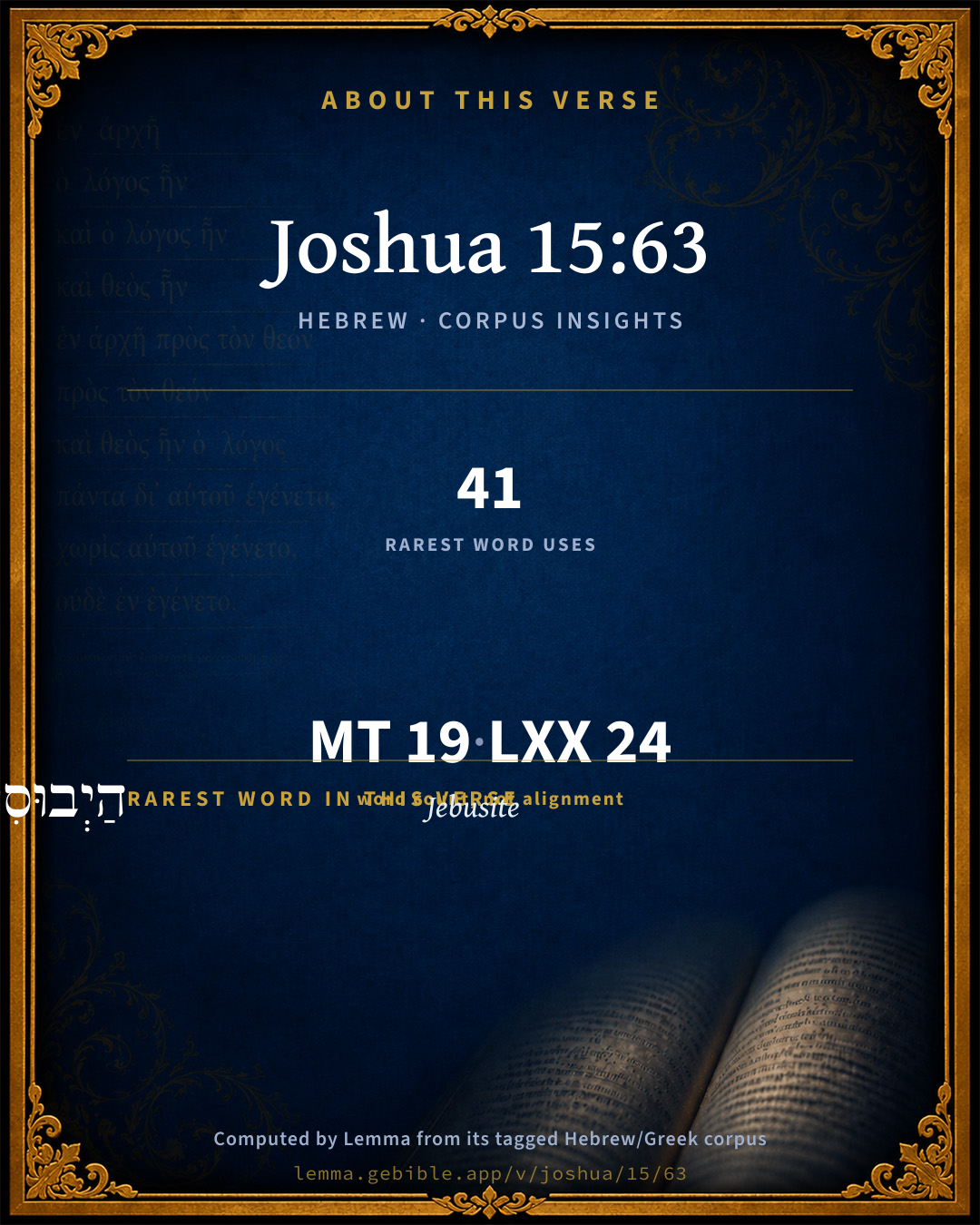
About this verse

These counts appear in no published source. They are computed here, from the morphology-tagged text and Lemma’s own curated glosses. What Lemma adds →

19
words
13
distinct lemmas
Historical
section

Shared distinctive vocabulary

הַיְבוּסִי֙ Jebusite H2983 occurs in 39 verses of the Hebrew Bible. Also found in:

Grammatical profile

  • 5 verbs
  • 9 nouns
  • 1 pronoun
  • 2 prepositions
  • 2 particles

Verb forms

  • יוֹשְׁבֵ֣י Qal · Participle Active
  • יוכלו Qal · Imperfect
  • יָכְל֥וּ Qal · Perfect
  • לְהֽוֹרִישָׁ֑ם Hiphil · Infinitive Construct
  • וַיֵּ֨שֶׁב Qal · Sequential Imperfect

Repetition

Words recur within this verse — often emphatic in Hebrew:

  • הַיְבוּסִי֙ Jebusite H2983 ×2
  • יוֹשְׁבֵ֣י to dwell H3427 ×2
  • יְרֽוּשָׁלִַ֔ם Jerusalem H3389 ×2
  • יוכלו to prevail H3201 ×2
  • בְנֵֽי son H1121 ×2
  • יְהוּדָ֖ה Judah H3063 ×2

Hebrew & Septuagint length

In English translation the verse runs 30 words from the Hebrew and 24 from the Septuagint (LXX English) — closely comparable.

A rough comparison of the two English renderings, which tokenize alike — not a word-level alignment.

Word counts can differ between the Hebrew and the Greek without any difference in meaning — e.g. the Hebrew direct-object marker אֵת has no separate Greek word, and Greek often adds the article ὁ.

In the original languages it is 19 Hebrew tokens and 24 Greek tokens — but the two are counted differently (Hebrew bundles its prefixes and suffixes into one token; the Greek is in lemma form), so that isn’t a like-for-like length.

Cross-references

4

Topical passages linked to Joshua 15:63 in the Treasury of Scripture Knowledge — connected by theme and wording, ordered by reader-vote popularity; previews shown in the World English Bible.

  • Judges 1:21 The children of Benjamin did not drive out the Jebusites who inhabited Jerusalem; but the Jebusites dwell with the children of Benjamin in Jerusalem to this day.
  • Judges 1:8 The children of Judah fought against Jerusalem, and took it, and struck it with the edge of the sword, and set the city on fire.
  • 2 Samuel 5:6–9 The king and his men went to Jerusalem against the Jebusites, the inhabitants of the land, who spoke to David, saying, Except you take away the blind and the lame, you shall not come in here; thinking, David can't come in here.
  • 1 Chronicles 11:4–8 David and all Israel went to Jerusalem (the same is Jebus); and the Jebusites, the inhabitants of the land, were there.

Cross-references courtesy of OpenBible.info (CC BY 4.0).

Hebrew and Greek witnesses Masoretic Hebrew ↔ Greek Septuagint

The same verse in the two great witnesses to the Old Testament, shown verse-for-verse.

These are two independent witnesses, not word-aligned to each other, and the Septuagint is shown in lemma (dictionary) form.

Hebrew Joshua 15:63 Masoretic · Westminster Leningrad Codex

וְאֶת הַיְבוּסִי֙ יוֹשְׁבֵ֣י יְרֽוּשָׁלִַ֔ם לֹֽא יוכלו יָכְל֥וּ בְנֵֽי יְהוּדָ֖ה לְהֽוֹרִישָׁ֑ם וַיֵּ֨שֶׁב הַיְבוּסִ֜י אֶת בְּנֵ֤י יְהוּדָה֙ בִּיר֣וּשָׁלִַ֔ם עַ֖ד הַיּ֥וֹם הַזֶּֽה

As for the Jebusites, the inhabitants of Jerusalem, the children of Judah couldn't drive them out: but the Jebusites dwell with the children of Judah at Jerusalem to this day.

World English Bible · Public Domain

Greek LXX Joshua 15:63 Septuagint · lemma form

καί ὁ ιεβουσαῖος καταοἰκέω ἐν ἰερουσαλήμ καί οὐ δύναμαι ὁ υἱός ιουδα ἀποὀλλύω αὐτός καί καταοἰκέω ὁ ιεβουσαῖος ἐν ἰερουσαλήμ ἕως ὁ ἡμέρα ἐκεῖνος

And the Jebusite lived in Jerusalem, and the children of Juda could not destroy them; and the Jebusites lived in Jerusalem to this day.

LXX2012 (modern English Septuagint) · Public Domain

Hebrew: Westminster Leningrad Codex (CC BY 4.0). Greek: Septuagint (public domain); English from LXX2012 (modern English Septuagint) (Public Domain). How the Septuagint differs from the Hebrew →

Targum (Aramaic paraphrase)

1

The Targum is the ancient Jewish Aramaic paraphrase of the Hebrew Scriptures — an interpretive translation, not the Hebrew text itself. Onkelos (literal) and Pseudo-Jonathan (expansive) render the Torah, and Jonathan the Prophets. Coverage is partial: where no permissively-licensed English translation exists for a verse, only the Aramaic is shown. This is verse-level text, not a word-by-word alignment to the Hebrew.

  1. Targum Jonathan Prophets (Joshua–Malachi)
    וְיַת יְבוּסָאֵי יַתְבֵי יְרוּשְׁלֵם לָא יְכִילוּ בְּנֵי יְהוּדָה לְתָרָכוּתְהוֹן וִיתִיבוּ יְבוּסָאֵי עִם בְּנֵי יְהוּדָה בִּירוּשְׁלֵם עַד יוֹמָא הַדִין:

    (no public-domain English translation for this verse)

    Targum Jonathan — Aramaic: “Mikraot Gedolot” (public domain). English: “Sefaria Community Translation” (CC0 1.0 (public-domain dedication)); “London "Chaldee Paraphrase," 1871” (public domain). Text via Sefaria.

Commentary

Notes on Joshua 15:63 from classic Christian and Jewish commentators (each source and its license shown beneath its notes). The classic Christian expositions comment on the surrounding passage and are grouped to its opening verse, so a note may address several verses; the Jewish commentaries on the Tanakh (Rashi and others) are per-verse, so they appear only where the commentator wrote on this verse.

Lemma curates 59 commentaries, every one of them public domain or Creative Commons licensed, each selected and text-cleaned for this edition rather than reprinted as found. About our sources →

Joseph Benson's Commentary

Jos 15:63. The Jebusites, the inhabitants of Jerusalem — Jerusalem was in part taken by Joshua before this; but the upper and stronger part of it, called Zion, was still held by the Jebusites, even till David’s time. And, it is probable, they descended from thence to the lower town, called Jerusalem, and took it; so that the Israelites were obliged to win it a second, yea, and a third time also. For afterward it was possessed by the Jebusites, Jdg 19:11; 2Sa 5:6. 7. The children of Judah could not, &c. — A part of Jerusalem was in the tribe of Judah, namely, the tower of Zion, mount Moriah, with some of the south parts adjacent; the rest of it was in the tribe of Benjamin, namely, the greatest part of the city itself. So that it was inhabited promiscuously by them both. They could not drive them out because of their unbelief; as Christ could do no mighty work because of the people’s unbelief, Mar 6:5-6; and because of their sloth, cowardice, and wickedness, whereby they forfeited God’s help. The Jebusites dwell at Jerusalem unto this day — When this book was written, whether in Joshua’s life, which continued many years after the taking of Jerusalem, or after his death, when this clause was added, as others were elsewhere in this book, by some other man of God, which must have been done before David’s time, because then the Jebusites were quite expelled and their fort taken.

Joseph Benson's Commentary on the Old and New Testaments (1811–1818) — public domain. Text from a community e-Sword module.

Tyndale Open Study Notes

Tyndale Open Resources

15:63 Even though Jerusalem was assigned to the tribe of Benjamin (18:28), it was not conquered in Joshua’s day. • to this day: The Jebusites’ continued presence later caused Judah trouble (Judg 1:21).

Tyndale Open Study Notes — © Tyndale Open Resources, licensed CC BY-SA 4.0. Text via the HelloAO Bible API.

Geneva Bible (1599)

Geneva Bible translators

That is, utterly, though they slew the most part, and burnt their city, Judg. 1:8.

Geneva Bible (1599) marginal notes — public domain. Text via Bolls.life.

Adam Clarke's Commentary

Verse 63. The Jebusites dwell - at Jerusalem unto this day.] The whole history of Jerusalem, previously to the time of David, is encumbered with many difficulties. Sometimes it is attributed to Judah, sometimes to Benjamin, and it is probable that, being on the frontiers of both those tribes, each possessed a part of it. If the Jebusites were ever driven out before the time of David, it is certain they recovered it again, or at least a part of it - what is called the citadel or strong hold of Zion, (see 2Sa 5:7), which he took from them; after which the city fell wholly into the hands of the Israelites. This verse is an additional proof that the book of Joshua was not written after the times of the Jewish kings, as some have endeavoured to prove; for when this verse was written, the Jebusites dwelt with the children of Judah, which they did not after the days of David; therefore the book was written before there were any kings in Judea.

IT is very likely, not only that many cities have by the lapse of time changed their names or been totally destroyed, (see the note on Jos 15:1,) but that the names of those in the preceding catalogue have been changed also, several of them repeated that should have been mentioned but once, and not a few confounded with the terms by which they are described. But we must not suppose that every repetition of the name is through the carelessness of copyists; for there are often two places which bear the same name, which is frequently the case in England. But besides this, villages are mentioned as being apparently in the tribe of Judah, which afterwards appear to have been in an other tribe. The reason appears to be this: many towns are mentioned which were frontier towns, and when the limits of a tribe are pointed out, such places must necessarily be mentioned, though allotted to a different tribe. This consideration will serve to remove several difficulties which occur in the reading of this and the following chapters.

Adam Clarke's Commentary on the Bible (1810–1826) — public domain. Text from a community e-Sword/MySword module.

John Calvin's Commentaries

63. As for the Jebusites, etc This furnishes no excuse for the people, nor is it set down with that view; for had they exerted themselves to the full measure of their strength, and failed of success, the dishonor would have fallen on God himself, who had promised that he would continue with them as their leader until he should give them full and free possession of the land, and that he would send hornets to drive out the inhabitants. Therefore, it was owing entirely to their own sluggishness that they did not make themselves masters of the city of Jerusalem. This they were not able to do; but their own torpor, their neglect of the divine command from a love of ease, were the real obstacles.

This passage is deserving of notice: we ought to learn from it to make vigorous trial of our strength in attempting to accomplish the commands of God, and not to omit any opportunity, lest while we are idly resting the door may be shut. A moderate delay might have been free from blame; but a long period of effeminate ease in a manner rejected the blessing which God was ready to bestow.

John Calvin's Commentaries (1540-1563) — public domain. Text from the Calvin Translation Society English edition (1840s-50s) via the Christian Classics Ethereal Library (ccel.org). Calvin's coverage is partial (roughly two-thirds of the Bible); uncommented books and verses are honest gaps, never fabricated. The 19th-century editor's footnotes and remarks are omitted so the notes are faithfully Calvin's own voice.

Ellicott's Commentary for English Readers

(63) Could not drive them out.—It is observable that the failure of the three great tribes of Judah and Joseph (Ephraim and Manasseh) to clear the inheritance assigned to them is specially noticed in the Book of Joshua—viz., Judah in this place, and Ephraim and Manasseh in Jos_16:10; Jos_17:11-12. A list of the failures of all the tribes is given in Judges 1.

A Bible Commentary for English Readers, edited by Charles John Ellicott (1878–1897) — public domain. Text from a community e-Sword module.

The Cambridge Bible for Schools and Colleges

gen. ed. J. J. S. Perowne

63. As for] The Author closes the catalogue of the cities of Judah with an announcement that the children of this royal tribe failed to drive out the Jebusites from Jerusalem.

the Jebusites] The Jebusites are noticed above, ch. Jos_10:1, and ch. Jos_11:3. They were a strong mountain-tribe, and as long as the “Upper City” remained in their hands they practically had possession of the whole. The children of Judah, as also the children of Benjamin, took and burnt the “Lower City,” but relinquished the attempt to capture the “Upper City.” (See Jdg_1:8; Jdg_1:21.)

unto this day] It is plain from this that the Book of Joshua was written before the reign of David (1Ch_11:3-9).

The Cambridge Bible for Schools and Colleges (gen. ed. J. J. S. Perowne; Cambridge University Press, 1878–1918) — public domain. Text from a community e-Sword module.

Haydock's Catholic Bible Commentary

Jerusalem. The Benjamites claimed the northern part of this city; (Haydock) and they did not drive out the Jebusites, but lived with them, Judges i. 21. The tribe of Juda had burnt a part of the city, Judges i. 8. But it seems the Jebusites kept their hold, (Calmet) at least in the citadel, (Haydock) and frequently in the lower town, till they were entirely banished by David, 2 Kings v. 7. See Judges xix. 11. In latter times, the Jews considered this place as the common city of all the nation, to which none of the tribes had an exclusive right; and hence, in the last siege, there was no head, and all the Jews were admitted without examination. (Josephus, Jewish Wars iv. 5, &c.) (Calmet) --- Day, and even till the reign of David. The author of this observation must have lived before that period. Josue might have made this and may other similar remarks, when he finished this work, towards the end of his life. (Haydock)

George Leo Haydock (1774–1849), Haydock's Catholic Family Bible and Commentary, 1859 edition — public domain. Excludes Psalms (Douay-Rheims chapter numbering differs from Protestant) and Deuterocanonical books (Catholic canon only).

Matthew Poole's English Annotations

For though Jerusalem was in part taken by Joshua before this, yet the upper and stronger part of it, called Zion, was still kept by the Jebusites, even until David’s time; and it seems from thence they descended to the lower town called Jerusalem, and took it; so that the Israelites were forced to win it a second time; yea, and a third time also, for afterwards it was possessed by the Jebusites, Jdg 19:11; 2Sa 5:6,7.

Could not drive them out; namely, because of their unbelief, as Christ could do no mighty work—because of the people’s unbelief, Mar 6:5,6; Mt 13:58, and because of their sloth, and cowardice, and wickedness, whereby they forfeited God’s help, and then they must needs be impotent; but this inability was wilful, and brought upon them by themselves.

Jebusites dwell with the children of Judah at Jerusalem: the same things which are here said of the children of Judah, are said of the Benjamites, Jdg 1:21. Hence ariseth a question, To which of the tribes Jerusalem belonged? whether to Benjamin, as is gathered from Gen 49:27; Deu 33:12; Jer 6:1, or to Judah, as is implied here, and Psa 78:68,69. Some think, that being in the borders of both, it was common to both, and promiscuously inhabited by both; and it is certain that after the captivity it was possessed by both, Neh 11:4. But for the present, though it did belong to Benjamin, yet the children of Judah being possibly very active in the first taking of it by Joshua, as they certainly were after his death, Jdg 1:8, they might thereby get some right share with the Benjamites in the possession of it. It seems most probable that part of it, and indeed the greatest part and main body of it, stood in the tribe of Benjamin; and hence this is mentioned in the list of their cities, and not in Judah’s list: and part of it stood in Judah’s share, even Mount Moriah, on which the temple was built; and Mount Sion, when it was taken from the Jebusites.

Unto this day; when this book was written, whether in Joshua’s life and old age, which continued many years after the taking of Jerusalem; or after his death, when this clause was added here and elsewhere in this book by some other man of God, which must needs be done before David’s time, when the Jebusites were quite expelled, and their fort taken.

Matthew Poole's English Annotations on the Holy Bible (1683–1685) — public domain. Text from a community e-Sword/MySword module.

The Pulpit Commentary

As for the Jebusites. This passage, compared with Jud_1:8, 21, and 2Sa_5:6, implies that the people of Judah took and set on fire the lower city, but were compelled to leave the stronghold of Zion in the hands of the Jebusites. (see note on Jos_10:1) Origen and Theodoret see in the Jebusites the type of the nominal members of Christ"s Church, who are not His disciples indeed. The former refers to Mat_13:25. Unto this day. A clear proof that this book was written before David became king.

Invisible Jebusites.

The failure of the men of Judah to conquer the Jebusites is illustrative of the failures men too commonly encounter in the attempt to accomplish the aims of life.

I NO MAN PERFECTLY SUCCEEDS IN THE TASK OF HIS LIFE. If a man is satisfied that he has accomplished all his aims, this is a proof that those aims were low. We are bound to aim at the highest though we never reach it. The most successful life is still a broken life. Like the rainbow with half the arch melted away, like the waterfall blown into mist before it reaches the ground, like the bird"s song cut short by the storm, life"s work ends ragged and unfinished. When failure arises from the magnitude of the task, we are free from blame if we have laboured our best at it. But it is usually aggravated by our indolence, cowardice, and culpable weakness. Only Christ has perfectly succeeded. (Joh_17:4) We need a higher view of the requirements of duty, a deeper conviction of our own past failure, more trust in God"s power to help us, more consecration of soul and earnest, self-sacrificing effort.

II NO CHRISTIAN WHILE IN THIS WORLD PERFECTLY SUCCEEDS IN EXPELLING HIS SINS. The Christian life is a warfare with sin. Though God pardons sin immediately on our repentance and faith in Christ, and gives us grace with which to conquer it, He requires us to fight against it. The war is not decided by one battle. It is a life-long conflict. He who claims to have completely conquered is deceiving himself. (1Jn_1:8) This is a fact, but one to cause shame, for it is not a physical necessity. We ought to conquer all sin, and in Christ we have the means for this perfect victory.

III THE CONQUEST OF THE WORLD FOR CHRIST IS SLOW. The Jebusites were not completely subdued till the days of David. (2Sa_5:6, 2Sa_5:7) Christian mission work proceeds slowly. Strongholds of sin, of heathenism, of unbelief, of worldliness still seem invincible.

(1) This fact should not shake our faith in the truth of Christ, for it was predicted while ultimate triumph was promised. (Mat_13:31, Mat_13:32)

(2) It should convince us of our own want of faithfulness. Christ has entrusted the extension of His gospel to His Church. It is to the shame of the Church that she is so remiss in carrying out her great mission.

IV NO EARTHLY INHERITANCE IS WITHOUT ITS DISADVANTAGES. Canaan was not paradise. The land flowing with milk and honey also brought forth thorns and briars. Jerusalem, the future capital of the land, was the last place to be subdued. So we find something amiss in the very core of life. This is owing

(1) partly to our failure to make the best use of this world, and

(2) partly to the fact that God has given us natures too great for any earthly satisfaction. Therefore we must expect disappointment here. The perfect inheritance is reserved for the next world. W.F.A.

HOMILIES BY J. WAITE Ver. 63. Failure.

We have here the first hint of the incompleteness of Israel"s conquest of the land. The effects of this failure fully to carry out the Divine command in the extermination of the heathen were very manifest afterwards in the moral and social life of the people. "Their whole subsequent history, down to the captivity, was coloured by the wars, by the customs, by the contagion of Phoenician and Canaanite rites, to which, for good or evil, they were henceforth exposed" (Stanley). "They could not take Jerusalem." The reason lay in themselves. The fault was their own They had not enough faith, and of the courage that springs from faith. If they had had more of the spirit of their great leader in them they would not thus have quailed before their foes, or left the work half finished. The historic fact finds its analogue in the moral and spiritual life of men.

It suggests

I THE FEEBLENESS THAT IS THE RESULT OF FAITHLESSNESS. Want of power is in various ways coupled in Scripture with want of faith. There were times when Christ could not do mighty works among the people "because of their unbelief". (Mat_13:58 Mar_6:5) The disciples could not cure the lunatic child "because of their unbelief". (Mat_17:20) Peter could no longer walk on the water when he began to doubt. (Mat_14:31) As the Jews "could not enter in" to the land of promise "because of their unbelief," so may we fail to secure our inheritance in God"s everlasting rest. (Heb_3:19 Heb_4:1-14) These examples suggest that faithlessness is weakness, inasmuch as

(1) it severs the soul from the Divine fountain of strength;

(2) it obscures the soul"s vision of those spiritual realities which are the inspiration of all high and holy endeavour;

(3) it robs the soul of all firm standing in the hope of the eternal future. That must be a source of fatal weakness to a man which thus disconnects him from the higher interests of his being and leaves him at the mercy of things "seen and temporal." "All things are possible to him that believeth." To him that believeth not, nothing, great or good, is possible in this world.

II THE ILL EFFECTS OF SUCH MORAL FEEBLENESS. The results of Israel"s failure to exterminate the Canaanites are typical of conditions only too common in the moral life of men. The delay it involved in the settlement of the State politically, ecclesiastically; the perpetual unrest; the national disgrace; the corruption of the national life by the contagion of idolatry; the reproach cast on the name of Jehovah among the nations all these have their resemblance in the penalties of moral failure.

1. Personal dishonour. When a man has not the courage to face and combat the evils of his own heart and life, or that confront him in the world without, he generally falls into the shame of some kind of base compromise. He deals sophistically with his own conscience, suppresses the nobler impulses of his nature, belies the essential principles of his religious faith, disowns the bond of his allegiance to Christ. No greater dishonour possible to a man than this.

2. Spiritual degeneracy. As an enfeebled body is liable to the infection of disease, so moral laxity leaves men a prey to the destroyer. Corrupting influences readily take effect upon them. The gates are open, the sentinel is asleep, no wonder the foe enters and takes possession of the citadel. "From him that hath not shall be taken away," etc. (Mat_13:12)

3. Exaggeration of opposing difficulties. The sense of moral weakness and falseness conjures up obstacles in the path of duty or endeavour that do not really exist. High moral excellence seems impossible to him who is content to grovel. The faithless heart always "sees a lion in the way.

"The wise and active conquer difficulties By daring to attempt them. Sloth and folly Shiver and shrink at sight of toil and danger, And make the impossibilities they fear.

4. Defective witness for God. Every such case of spiritual failure is a hindrance to the progress of the kingdom of heaven among men, thwarts so far the Divine purpose m the triumph of truth and righteousness. The hostile forces of the world laugh at a half-hearted service of Christ. The strongholds of iniquity can never fall before a church enfeebled by the spirit of unbelief. W.

The Pulpit Commentary (1880–1919), ed. H.D.M. Spence-Jones & Joseph S. Exell — public domain. Text from a community e-Sword module.

John Wesley's Explanatory Notes

Inhabitants of Jerusalem - For though Jerusalem was in part taken by Joshua before this; yet the upper and stronger part of it, called Zion, was still kept by the Jebusites, even until David's time; and it seems from thence they descended to the lower town called Jerusalem, and took it so that the Israelites were forced to win it a second time; yea, and a third time also: for afterwards it was possessed by the Jebusites, Judg. xix, 11; 2 Sam. v, 6, 7. Could not drive them out - Namely, because of their unbelief, as Christ could do no mighty work, because of the peoples unbelief, Mark vi, 5, 6 Matt. xiii, 58, and because of their sloth, and cowardice, and wickedness, whereby they forfeited God's help. The children of Judah - The same things which are here said of the children of Judah, are said of the Benjamites, Judg. i, 21. Hence ariseth a question, To which of the tribes Jerusalem belonged? It seems probable, that part of it, and indeed the greatest part, stood in the tribe of Benjamin; and hence this is mentioned in the list of their cities, and not in Judah's list; and part of it stood in Judah's share, even mount Moriah, on which the temple was built; and Mount Zion, when it was taken from the Jebusites. To this day - When this book was written, whether in Joshua's life, which continued many years after the taking of Jerusalem; or after his death, when this clause was added by some other man of God. But this must be done before David's time, when the Jebusites were quite expelled, and their fort taken.

John Wesley, Explanatory Notes Upon the Whole Bible (1754–1765) — public domain. Text via the GEBible commentary corpus.

unfoldingWord translationNotes

Door43 World Missions Community

to this day

This refers to the period of time in which the author wrote this book.

translationWords

Jebus

Jerusalem

tribe

Judah

cast out

unfoldingWord translationNotes — © Distant Shores Media and the Door43 World Missions Community, licensed CC BY-SA 4.0. Source: git.door43.org/Door43/en_tn.

Rashi

Rabbi Shlomo Yitzchaki (Rashi)

The descendants of Yehudah were unable to expel them. We learned in Sifri: “Rabbi Yehoshua be Korcho says, ‘They were really able [to expel them] but they were not permitted to do so because of the oath that Avrohom had sworn to Avimelech. These Yevusim Were not part of the Yevusi nation, but the Tower of David which was in Yerushalayim was named Yevus, and those who lived in that vicinity were of the Philishtim. Thus when the descendants of Yehudah conquered Yerushalayim, they did not expel the inhabitants of that vicinity.

Rashi on the Tanakh — English translations: “The Judaica Press complete Tanach with Rashi, translated by A. J. Rosenberg” (CC BY 4.0); “Pentateuch with Rashi's commentary by M. Rosenbaum and A.M. Silbermann, 1929-1934” (public domain); “The Metsudah Tanach series, Lakewood, N.J” (CC BY 4.0); and “The Book of Joshua, Metsudah Publications, 1997” (CC BY 4.0). Text via Sefaria.

Lesson kit

Teaching starters — assembled from the data on this page, not authored interpretation. Every prompt links to the verse data it draws on. Edit before teaching.

Joshua, in the Historical, opens this verse with 19 words (13 distinct Hebrew lemmas). Its most distinctive word is Yᵉbûwçîy (“Jebusite”). A historical commentator’s framing appears above. Read the whole chapter for the surrounding context.

Discussion questions

  1. What does “Jebusite” (Yᵉbûwçîy) contribute to the verse as a whole?
  2. How does Genesis 10:16, which shares the word «Jebusite», read alongside this verse?
  3. What does the repetition of “Jebusite” (2× in this one verse) do in this verse?
  4. These translations render this verse differently. What is at stake in choosing one wording over another?
  5. «יוֹשְׁבֵ֣י» is a Qal Participle Active verb. How does that grammatical form shape the action described?
  6. Compare how Joseph Benson's Commentary and Tyndale Open Study Notes read this verse. Where do they agree or differ?

Things to notice

Reading settings

Reading text

Shown beneath each verse's original-language words.

Old Testament
Old Testament edition

Read the OT as the Masoretic Hebrew (MT) or the Greek Septuagint (LXX).

English shown for the Greek Septuagint (in the Hebrew ↔ Greek comparison).

Comparing translations? Open the Compare panel on any verse page to stack up to four side by side.