
Joshua 9:19

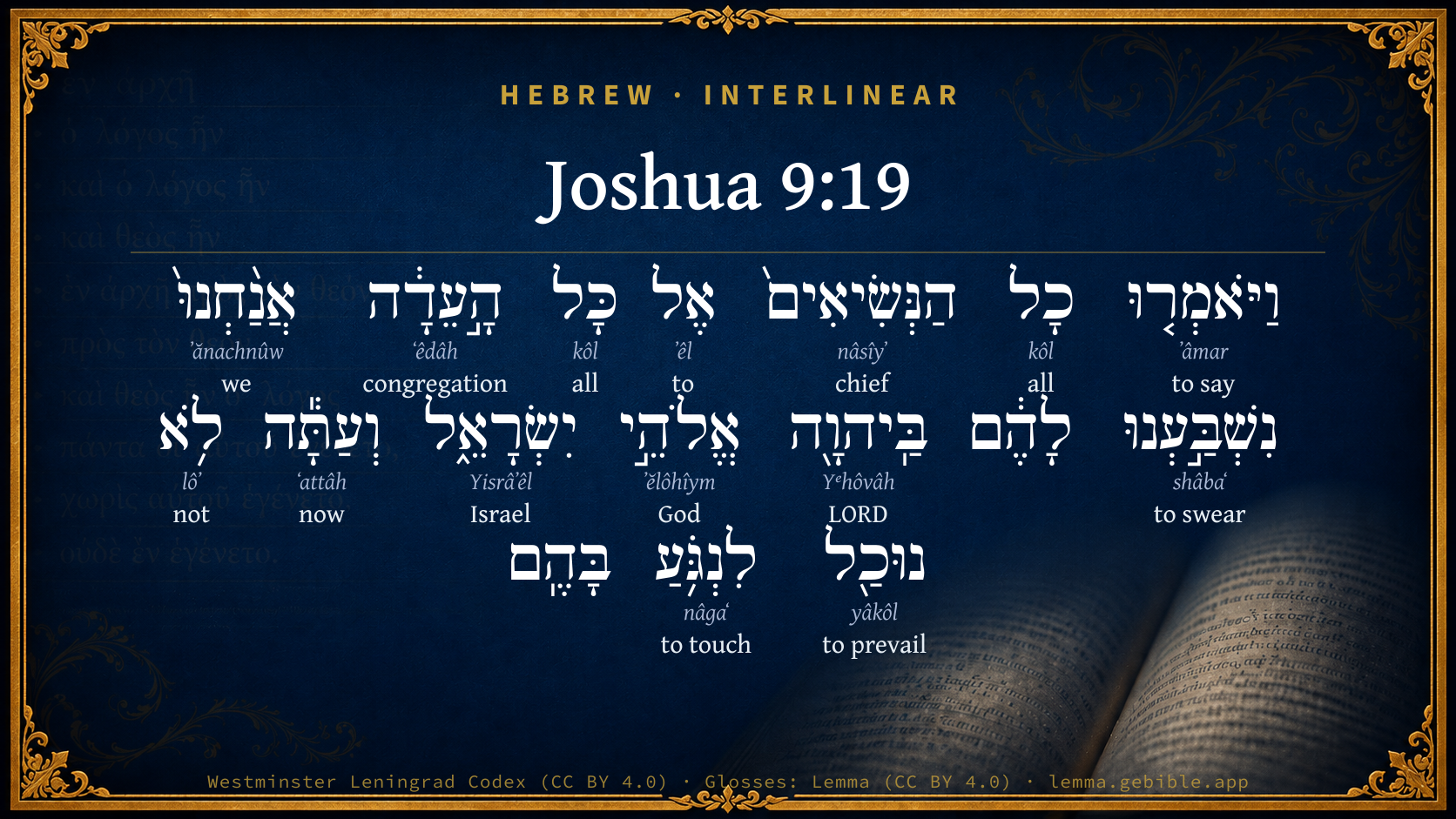
Hebrew (Westminster Leningrad Codex) Joshua 9:19 appears in the Hebrew Old Testament. The text above is from the Westminster Leningrad Codex. Each word links to its Strong’s number, a concise gloss, and parsing drawn from the Open Scriptures Hebrew Bible morphology. Click any word for its full Brown-Driver-Briggs (BDB) entry.
Download image
Cite this verse

Joshua 9:19 (World English Bible). Public Domain. Lemma interlinear Bible study tool, https://lemma.gebible.app/v/joshua/9/19.

Show BibTeX & RIS
BibTeX
RIS
English Translation
But all the princes said to all the congregation, We have sworn to them by Yahweh, the God of Israel: now therefore we may not touch them.
World English Bible · Public Domain
Download a study sheet

One document with this verse’s original text, its word-by-word gloss line, the meaning frame, cross-references with their text, attributed commentary, and full source and license credits — printable, and it pastes into notes with its structure intact.

This verse Autodidact and up

Study sheet (.html) Plain text (.txt)

A passage Seminary Student

Up to 50 verses in one chapter. A passage sheet keeps up to 6 commentary sources and 12 cross-references per verse, in the order this page ranks them, and says so on the sheet whenever that leaves anything out. Ask for a single verse and you get the Autodidact verse sheet above.

Everything on this page stays free to read, with no account — the sheet is a download of what is already on screen, not access to it.

Want to remove ads? Support Godless Engineer
Compare translations 3

The same verse in 3 English versions, stacked beneath the original-language interlinear above. Click any original word for its lexicon entry.

Each is an independent rendering of the whole verse — the interlinear is not word-aligned to these translations.

Highlighted words mark where these versions differ — a whole-verse word diff, not a word-by-word alignment.

  • World English Bible Public Domain
    But all the princes said to all the congregation, We have sworn to them by Yahweh, the God of Israel: now therefore we may not touch them.
  • King James Version Public Domain
    But all the princes said unto all the congregation, We have sworn unto them by the LORD God of Israel: now therefore we may not touch them.
  • unfoldingWord Literal Text CC BY-SA 4.0
    But all of the leaders said to all of the congregation, “We, we have sworn to them by Yahweh the God of Israel, so now we are not able to touch them.

unfoldingWord Literal Text — © unfoldingWord, licensed CC BY-SA 4.0. Word-aligned USFM3 via Door43 (git.door43.org/unfoldingWord/en_ult).

Versions to compare (up to 4)

3 of 4 selected

Show all 18 translations

Every available English version of this verse, each an independent rendering of the whole verse.

  • World English Bible Public Domain
    But all the princes said to all the congregation, We have sworn to them by Yahweh, the God of Israel: now therefore we may not touch them.
  • Berean Standard Bible Public Domain
    All the leaders answered, “We have sworn an oath to them by the LORD, the God of Israel, and now we cannot touch them.
  • Majority Standard Bible Public Domain
    All the leaders answered, “We have sworn an oath to them by the LORD, the God of Israel, and now we cannot touch them.
  • King James Version Public Domain
    But all the princes said unto all the congregation, We have sworn unto them by the LORD God of Israel: now therefore we may not touch them.
  • American Standard Version (1901) Public Domain
    But all the princes said unto all the congregation, We have sworn unto them by Jehovah, the God of Israel: now therefore we may not touch them.
  • Revised Version (1885) Public Domain
    But all the princes said unto all the congregation, We have sworn unto them by the LORD, the God of Israel: now therefore we may not touch them.
  • Geneva Bible (1599) Public Domain
    Then all the Princes said vnto all the Congregation, We haue sworne vnto them by the Lord God of Israel: nowe therefore we may not touch them.
  • Douay-Rheims (1899) Public Domain
    And they answered them: We have sworn to them in the name of the Lord the God of Israel, and therefore we may not touch them.
  • Young's Literal Translation Public Domain
    And all the princes say unto all the company, `We -- we have sworn to them by Jehovah, God of Israel; and now, we are not able to come against them;
  • Literal Standard Version CC BY-SA 4.0
    And all the princes say to all the congregation, “We have sworn to them by YHWH, God of Israel; and now, we are not able to come against them;
  • Unlocked Literal Bible CC BY-SA 4.0
    But all the leaders said to all the people, “We have taken an oath concerning them by Yahweh, the God of Israel, and now we cannot harm them.
  • unfoldingWord Literal Text CC BY-SA 4.0
    But all of the leaders said to all of the congregation, “We, we have sworn to them by Yahweh the God of Israel, so now we are not able to touch them.
  • Darby Bible Public Domain
    And all the princes said to all the assembly, We have sworn unto them by Jehovah the God of Israel, and now we may not touch them.
  • World Messianic Bible Public Domain
    But all the princes said to all the congregation, “We have sworn to them by the LORD, the God of Israel. Now therefore we may not touch them.
  • Webster's Bible Public Domain
    But all the princes said to all the congregation, We have sworn to them by the LORD God of Israel: now therefore we may not touch them.
  • Free Bible Version CC BY-SA 4.0
    But the leaders replied to the people, “We swore to them by the Lord, the God of Israel, so we cannot lay a hand on them now.
  • Bible in Basic English Public Domain
    But all the chiefs said to the people, We have taken an oath to them by the Lord, the God of Israel, and so we may not put our hands on them.
  • JPS Tanakh (1917) Public Domain
    But all the princes said unto all the congregation: 'We have sworn unto them by the LORD, the God of Israel; now therefore we may not touch them.

Literal Standard Version (2020), Covenant Press — licensed CC BY-SA 4.0. Text via the HelloAO Bible API (eBible.org). Unlocked Literal Bible (unfoldingWord) — licensed CC BY-SA 4.0. Text via the HelloAO Bible API (eBible.org). unfoldingWord Literal Text — © unfoldingWord, licensed CC BY-SA 4.0. Word-aligned USFM3 via Door43 (git.door43.org/unfoldingWord/en_ult). Free Bible Version, Dr. Jonathan Gallagher — licensed CC BY-SA 4.0. Text via the HelloAO Bible API (eBible.org).

Word by word

More ways to search: Search by grammar → Find every occurrence → Compare this word →

Practice this passage: Drill this verse → Learn its vocabulary →

אֲנַ֨חְנוּ֙
ʼănachnûw
H587
“we”
Pronoun, Personal, 1st Person, Common, Plural
Part of Speech
Pronoun
Type
Personal
Person
1st Person
Gender
Common
Number
Plural
Full BDB Definition

Origin: apparently from H595

TWOT: 128

we (first person plural - usually used for emphasis)
  1. וַיֹּאמְר֤וּ ʼâmar H559 “and · to say” Conjunction + Verb, Qal, Sequential Imperfect, 3rd Person, Masculine, Plural
  2. כָל kôl H3605 “all of” Noun, Common, Masculine, Singular, Construct
  3. הַנְּשִׂיאִים֙ nâsîyʼ H5387 “the · chiefs” Particle, Definite Article + Noun, Common, Masculine, Plural, Absolute
  4. אֶל ʼêl H413 “to” Preposition
  5. כָּל kôl H3605 “all of” Noun, Common, Masculine, Singular, Construct
  6. הָ֣עֵדָ֔ה ʻêdâh H5712 “the · congregation” Particle, Definite Article + Noun, Common, Feminine, Singular, Absolute
  7. נִשְׁבַּ֣עְנוּ shâbaʻ H7650 “to swear” Verb, Niphal, Perfect, 1st Person, Common, Plural
  8. בַּֽיהוָ֖ה Yᵉhôvâh H3068 “in/at · LORD” Preposition + Noun, Proper
  9. אֱלֹהֵ֣י ʼĕlôhîym H430 “God(s) of” Noun, Common, Masculine, Plural, Construct
  10. יִשְׂרָאֵ֑ל Yisrâʼêl H3478 “Israel” Noun, Proper
  11. וְעַתָּ֕ה ʻattâh H6258 “and · now” Conjunction + Adverb
  12. לֹ֥א lôʼ H3808 “not” Particle, Negative
  13. נוּכַ֖ל yâkôl H3201 “to prevail” Verb, Qal, Imperfect, 1st Person, Common, Plural
  14. לִנְגֹּ֥עַ nâgaʻ H5060 “to touch” Preposition + Verb, Qal, Infinitive Construct

About this verse

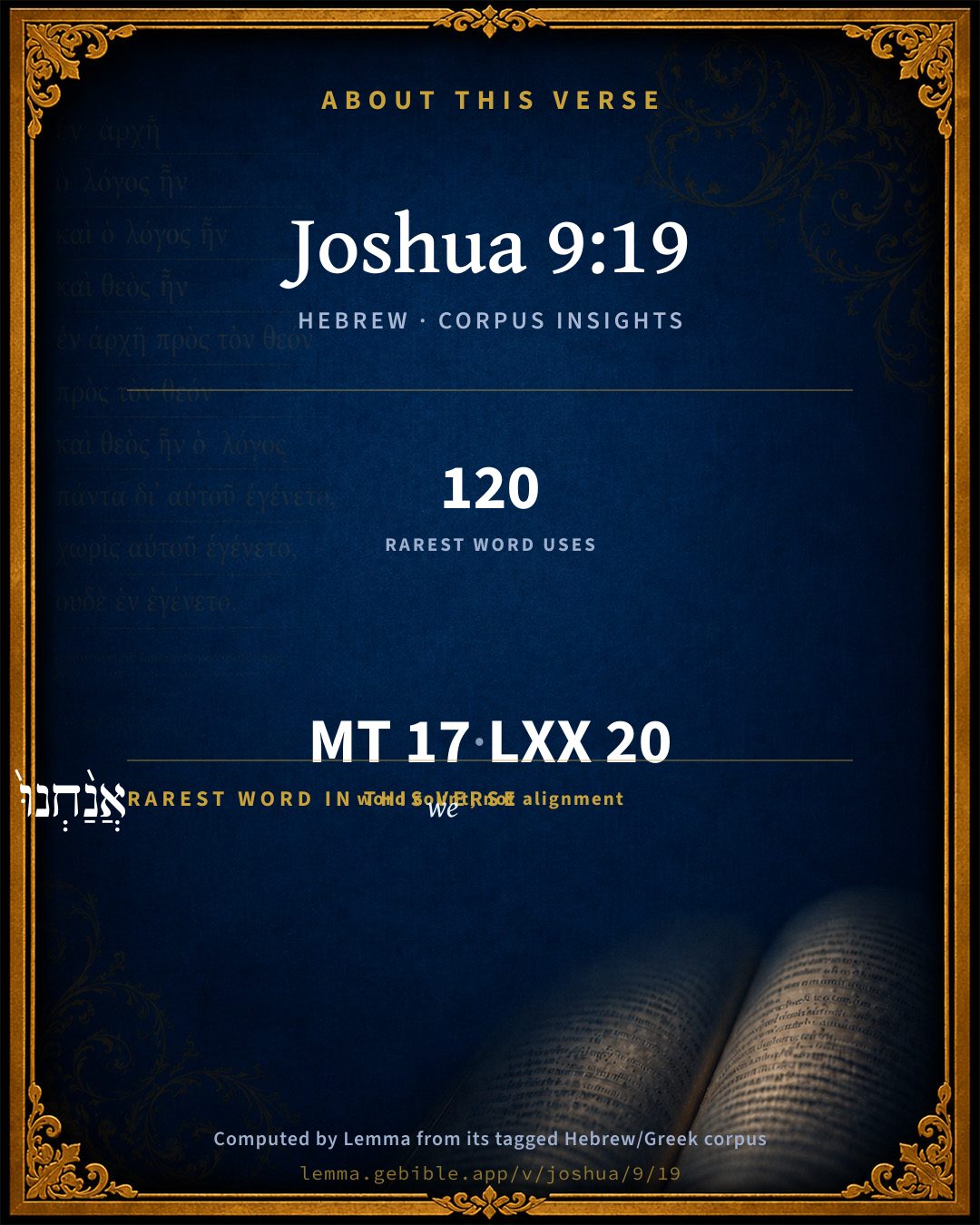
These counts appear in no published source. They are computed here, from the morphology-tagged text and Lemma’s own curated glosses. What Lemma adds →

17
words
14
distinct lemmas
Historical
section

Grammatical profile

  • 4 verbs
  • 7 nouns
  • 1 pronoun
  • 3 prepositions
  • 1 adverb
  • 1 particle

Verb forms

  • וַיֹּאמְר֤וּ Qal · Sequential Imperfect
  • נִשְׁבַּ֣עְנוּ Niphal · Perfect
  • נוּכַ֖ל Qal · Imperfect
  • לִנְגֹּ֥עַ Qal · Infinitive Construct

Repetition

A word recurs within this verse — often emphatic in Hebrew:

Hebrew & Septuagint length

In English translation the verse runs 27 words from the Hebrew and 29 from the Septuagint (LXX English) — closely comparable.

A rough comparison of the two English renderings, which tokenize alike — not a word-level alignment.

Word counts can differ between the Hebrew and the Greek without any difference in meaning — e.g. the Hebrew direct-object marker אֵת has no separate Greek word, and Greek often adds the article ὁ.

In the original languages it is 17 Hebrew tokens and 20 Greek tokens — but the two are counted differently (Hebrew bundles its prefixes and suffixes into one token; the Greek is in lemma form), so that isn’t a like-for-like length.

Cross-references

4

Topical passages linked to Joshua 9:19 in the Treasury of Scripture Knowledge — connected by theme and wording, ordered by reader-vote popularity; previews shown in the World English Bible.

  • Ecclesiastes 8:2 I say, "Keep the king's command!" because of the oath to God.
  • Joshua 9:20 This we will do to them, and let them live; lest wrath be on us, because of the oath which we swore to them.
  • Ecclesiastes 9:2 All things come alike to all. There is one event to the righteous and to the wicked; to the good, to the clean, to the unclean, to him who sacrifices, and to him who doesn't sacrifice. As is the good, so is the sinner; he who takes an oath, as he who fears an oath.
  • Jeremiah 4:2 and you shall swear, As Yahweh lives, in truth, in justice, and in righteousness; and the nations shall bless themselves in him, and in him shall they glory.

Cross-references courtesy of OpenBible.info (CC BY 4.0).

Hebrew and Greek witnesses Masoretic Hebrew ↔ Greek Septuagint

The same verse in the two great witnesses to the Old Testament, shown verse-for-verse.

These are two independent witnesses, not word-aligned to each other, and the Septuagint is shown in lemma (dictionary) form.

Hebrew Joshua 9:19 Masoretic · Westminster Leningrad Codex

וַיֹּאמְר֤וּ כָל הַנְּשִׂיאִים֙ אֶל כָּל הָ֣עֵדָ֔ה אֲנַ֨חְנוּ֙ נִשְׁבַּ֣עְנוּ לָהֶ֔ם בַּֽיהוָ֖ה אֱלֹהֵ֣י יִשְׂרָאֵ֑ל וְעַתָּ֕ה לֹ֥א נוּכַ֖ל לִנְגֹּ֥עַ בָּהֶֽם

But all the princes said to all the congregation, We have sworn to them by Yahweh, the God of Israel: now therefore we may not touch them.

World English Bible · Public Domain

Greek LXX Joshua 9:19 Septuagint · lemma form

καί εἶπον ὁ ἄρχων πᾶς ὁ συναγωγή ἐγώ ὄμνυμι αὐτός κύριος ὁ θεός ἰσραήλ καί νῦν οὐ δύναμαι ἅπτομαι αὐτός

And the princes said to all the congregation: We have sworn to them by the Lord God of Israel, and now we shall not be able to touch them.

LXX2012 (modern English Septuagint) · Public Domain

Hebrew: Westminster Leningrad Codex (CC BY 4.0). Greek: Septuagint (public domain); English from LXX2012 (modern English Septuagint) (Public Domain). How the Septuagint differs from the Hebrew →

Targum (Aramaic paraphrase)

1

The Targum is the ancient Jewish Aramaic paraphrase of the Hebrew Scriptures — an interpretive translation, not the Hebrew text itself. Onkelos (literal) and Pseudo-Jonathan (expansive) render the Torah, and Jonathan the Prophets. Coverage is partial: where no permissively-licensed English translation exists for a verse, only the Aramaic is shown. This is verse-level text, not a word-by-word alignment to the Hebrew.

  1. Targum Jonathan Prophets (Joshua–Malachi)
    וַאֲמַרוּ כָּל רַבְרְבַיָא לְכָל כְּנִשְׁתָּא אֲנַחְנָא קַיֵימְנָא לְהוֹן בְּמֵימְרָא דַייָ אֱלָהָא דְיִשְׂרָאֵל וּכְעַן לָא נִכּוּל לְאַנְזָקָא בְּהוֹן:

    (no public-domain English translation for this verse)

    Targum Jonathan — Aramaic: “Mikraot Gedolot” (public domain). English: “Sefaria Community Translation” (CC0 1.0 (public-domain dedication)); “London "Chaldee Paraphrase," 1871” (public domain). Text via Sefaria.

Commentary

Notes on Joshua 9:19 from classic Christian and Jewish commentators (each source and its license shown beneath its notes). The classic Christian expositions comment on the surrounding passage and are grouped to its opening verse, so a note may address several verses; the Jewish commentaries on the Tanakh (Rashi and others) are per-verse, so they appear only where the commentator wrote on this verse.

Lemma curates 59 commentaries, every one of them public domain or Creative Commons licensed, each selected and text-cleaned for this edition rather than reprinted as found. About our sources →

Trapp's Complete Commentary

John Trapp

Jos 9:19 But all the princes said unto all the congregation, We have sworn unto them by the LORD God of Israel: now therefore we may not touch them.

Ver. 19. Now therefore we may not touch them.] Unless we will run upon the pikes of God’s displeasure, as Saul did four hundred years after this. {2Sa 21:1-2}

John Trapp, A Commentary or Exposition upon All the Books of the Old and New Testament (1647–1656) — public domain. Text from a community e-Sword module.

Adam Clarke's Commentary

Verse 19. We have sworn unto them] Although the Israelites were deceived in this business, and the covenant was made on a certain supposition which was afterwards proved to have had no foundation in truth, and consequently the whole engagement on the part of the deceived was hereby vitiated and rendered null and void; yet, because the elders had eaten with them, offered a covenant sacrifice, and sworn by Jehovah, they did not consider themselves at liberty to break the terms of the agreement, as far as the lives of the Gibeonites were concerned. That their conduct in this respect was highly pleasing to God is evident from this, that Joshua is nowhere reprehended for making this covenant, and sparing the Gibeonites; and that Saul, who four hundred years after this thought himself and the Israelites loosed from this obligation, and in consequence oppressed and destroyed the Gibeonites, was punished for the breach of this treaty, being considered as the violator of a most solemn oath and covenant engagement. See 2Sa 21:2-9, and Eze 17:18-19.

All these circumstances laid together, prove that the command to destroy the Canaanites was not so absolute as is generally supposed: and should be understood as rather referring to the destruction of the political existence of the Canaanitish nations, than to the destruction of their lives. See the notes on De 20:10; De 20:17.

Adam Clarke's Commentary on the Bible (1810–1826) — public domain. Text from a community e-Sword/MySword module.

Ellicott's Commentary for English Readers

(19) We have sworn unto them . . . therefore we may not touch them.—Although the covenant was obtained from the Israelites by false pretences, yet, being made in the name of Jehovah, it could not be broken; it was His covenant. “He that sweareth to his own hurt, and changeth not,” is commended in Psa_15:4. We should notice that the law of Jehovah had raised the tone of morality in this particular. There are many Christians who would not hesitate to repudiate an agreement concluded under false pretences.

A Bible Commentary for English Readers, edited by Charles John Ellicott (1878–1897) — public domain. Text from a community e-Sword module.

John Gill's Exposition

But all the princes said to all the congregation,.... That is, all the princes that went to Gibeon addressed all the Israelites that were there:

we have sworn unto them by the Lord God of Israel; by the Word of the Lord God, as the Targum; an oath is a solemn sacred thing, and not to be broken, and a good man will make conscience of it, and keep it, though he has sworn to his own hurt: and

now therefore we may not touch them; neither take away their lives nor their substance.

John Gill's Exposition of the Whole Bible (1746–1763) — public domain (CC PDM 1.0). Text via the HelloAO Bible API.

Matthew Poole's English Annotations

They plead not the lawfulness or the prudence of the action, but only the obligation of an oath; of which, though it was procured by fraud, they perceived the people sufficiently sensible.

We may not touch them, i.e. not hurt them, as that word is oft used, as Gen 26:11; Psa 105:15; Psa 144:5; or not smite them, as is said, Jos 9:18.

Matthew Poole's English Annotations on the Holy Bible (1683–1685) — public domain. Text from a community e-Sword/MySword module.

Whedon's Commentary on the Bible

Daniel D. Whedon

19. Now therefore we may not touch them — So strong was their respect for their oath that they would hold as valid a contract made on fraudulent representations. According to natural justice and the laws of our modern civilization, they would have been justified in treating their oath as null and void. Most expositors are of this opinion; and Calvin goes so far as to charge the princes with a new violation of the will of God, because they now “obstinately maintain, upon the pretext of their oath, the promise which they had foolishly made.”

Daniel D. Whedon (gen. ed.), Commentary on the Old and New Testaments (1874–1909) — public domain. Text from a community e-Sword module.

Lesson kit

Teaching starters — assembled from the data on this page, not authored interpretation. Every prompt links to the verse data it draws on. Edit before teaching.

Joshua, in the Historical, opens this verse with 17 words (14 distinct Hebrew lemmas). Its most distinctive word is ʼănachnûw (“we”). A historical commentator’s framing appears above. Read the whole chapter for the surrounding context.

Discussion questions

  1. How does “we” (ʼănachnûw) shape what this verse is saying?
  2. How does Ecclesiastes 8:2, which shares this passage’s theme, read alongside this verse?
  3. What does the repetition of “all” (2× in this one verse) do in this verse?
  4. The translations on this page render this verse differently — a whole-verse word diff, not a word-by-word alignment. What might account for the different wordings?
  5. «וַיֹּאמְר֤וּ» is a Qal Sequential Imperfect verb. How does that grammatical form shape the action described?
  6. Compare how Trapp's Complete Commentary and Adam Clarke's Commentary read this verse. Where do they agree or differ?

Things to notice

Reading settings

Reading text

Shown beneath each verse's original-language words.

Old Testament
Old Testament edition

Read the OT as the Masoretic Hebrew (MT) or the Greek Septuagint (LXX).

English shown for the Greek Septuagint (in the Hebrew ↔ Greek comparison).

Comparing translations? Open the Compare panel on any verse page to stack up to four side by side.