
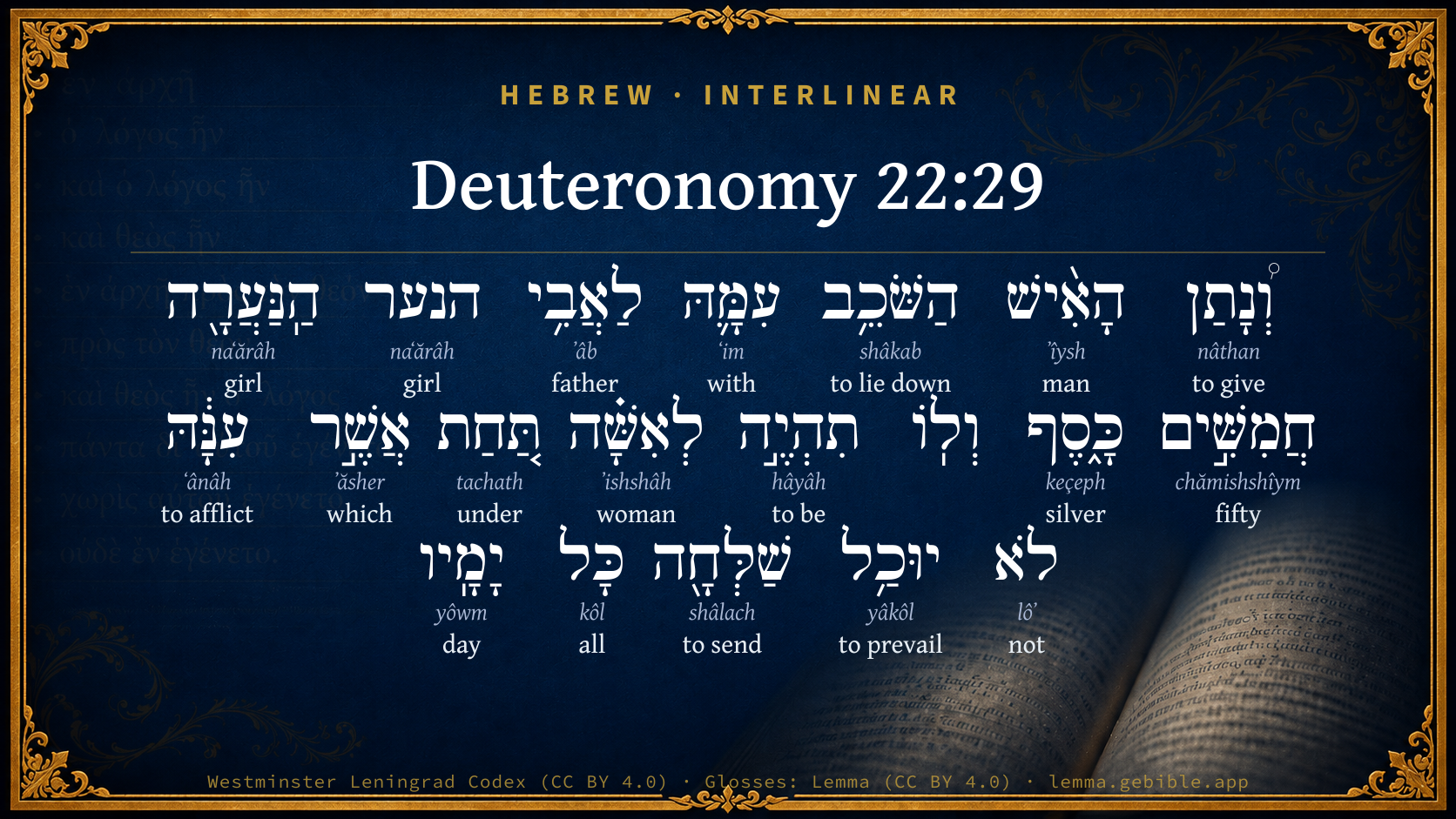
Deuteronomy 22:29

Hebrew (Westminster Leningrad Codex) Deuteronomy 22:29 appears in the Hebrew Old Testament. The text above is from the Westminster Leningrad Codex. Each word links to its Strong’s number, a concise gloss, and parsing drawn from the Open Scriptures Hebrew Bible morphology. Click any word for its full Brown-Driver-Briggs (BDB) entry.
Download image
Cite this verse

Deuteronomy 22:29 (World English Bible). Public Domain. Lemma interlinear Bible study tool, https://lemma.gebible.app/v/deuteronomy/22/29.

Show BibTeX & RIS
BibTeX
RIS
English Translation
then the man who lay with her shall give to the lady's father fifty [shekels] of silver, and she shall be his wife, because he has humbled her; he may not put her away all his days.
World English Bible · Public Domain
Download a study sheet

One document with this verse’s original text, its word-by-word gloss line, the meaning frame, cross-references with their text, attributed commentary, and full source and license credits — printable, and it pastes into notes with its structure intact.

This verse Autodidact and up

Study sheet (.html) Plain text (.txt)

A passage Seminary Student

Up to 50 verses in one chapter. A passage sheet keeps up to 6 commentary sources and 12 cross-references per verse, in the order this page ranks them, and says so on the sheet whenever that leaves anything out. Ask for a single verse and you get the Autodidact verse sheet above.

Everything on this page stays free to read, with no account — the sheet is a download of what is already on screen, not access to it.

Want to remove ads? Support Godless Engineer
Compare translations 3

The same verse in 3 English versions, stacked beneath the original-language interlinear above. Click any original word for its lexicon entry.

Each is an independent rendering of the whole verse — the interlinear is not word-aligned to these translations.

Highlighted words mark where these versions differ — a whole-verse word diff, not a word-by-word alignment.

  • World English Bible Public Domain
    then the man who lay with her shall give to the lady's father fifty [shekels] of silver, and she shall be his wife, because he has humbled her; he may not put her away all his days.
  • King James Version Public Domain
    Then the man that lay with her shall give unto the damsel's father fifty shekels of silver, and she shall be his wife; because he hath humbled her, he may not put her away all his days.
  • unfoldingWord Literal Text CC BY-SA 4.0
    then the man who lay with her shall give 50 silvers to the father of the girl, and she shall be his wife, because he has violated her. He may not send her away all his days.

unfoldingWord Literal Text — © unfoldingWord, licensed CC BY-SA 4.0. Word-aligned USFM3 via Door43 (git.door43.org/unfoldingWord/en_ult).

Versions to compare (up to 4)

3 of 4 selected

Show all 18 translations

Every available English version of this verse, each an independent rendering of the whole verse.

  • World English Bible Public Domain
    then the man who lay with her shall give to the lady's father fifty [shekels] of silver, and she shall be his wife, because he has humbled her; he may not put her away all his days.
  • Berean Standard Bible Public Domain
    then the man who lay with her must pay the young woman’s father fifty shekels of silver, and she must become his wife because he has violated her. He must not divorce her as long as he lives.
  • Majority Standard Bible Public Domain
    then the man who lay with her must pay the young woman’s father fifty shekels of silver, and she must become his wife because he has violated her. He must not divorce her as long as he lives.
  • King James Version Public Domain
    Then the man that lay with her shall give unto the damsel's father fifty shekels of silver, and she shall be his wife; because he hath humbled her, he may not put her away all his days.
  • American Standard Version (1901) Public Domain
    then the man that lay with her shall give unto the damsel's father fifty `shekels' of silver, and she shall be his wife, because he hath humbled her; he may not put her away all his days.
  • Revised Version (1885) Public Domain
    then the man that lay with her shall give unto the damsel’s father fifty shekels of silver, and she shall be his wife, because he hath humbled her; he may not put her away all his days.
  • Geneva Bible (1599) Public Domain
    Then the man that lay with her, shall giue vnto the maydes father fiftie shekels of siluer: and she shalbe his wife, because he hath humbled her: he can not put her away all his life.
  • Douay-Rheims (1899) Public Domain
    He that lay with her shall give to the father of the maid fifty sides of silver, and shall have her to wife, because he hath humbled her: he may not put her away all the days of his life.
  • Young's Literal Translation Public Domain
    then hath the man who is lying with her given to the father of the damsel fifty silverlings, and to him she is for a wife; because that he hath humbled her, he is not able to send her away all his days.
  • Literal Standard Version CC BY-SA 4.0
    then the man who is lying with her has given fifty pieces of silver to the father of the girl, and she is to him for a wife; because that he has humbled her, he is not able to send her away [for] all his days.
  • Unlocked Literal Bible CC BY-SA 4.0
    then the man who slept with her must give fifty shekels of silver to the girl's father, and she must become his wife, because he has humiliated her. He may not send her away during all his days.
  • unfoldingWord Literal Text CC BY-SA 4.0
    then the man who lay with her shall give 50 silvers to the father of the girl, and she shall be his wife, because he has violated her. He may not send her away all his days.
  • Darby Bible Public Domain
    then the man that lay with her shall give unto the damsel's father fifty [shekels] of silver, and she shall be his wife, because he hath humbled her; he may not put her away all his days.
  • World Messianic Bible Public Domain
    then the man who lay with her shall give to the lady’s father fifty shekels of silver. She shall be his wife, because he has humbled her. He may not put her away all his days.
  • Webster's Bible Public Domain
    Then the man that lay with her shall give to the damsel's father fifty shekels of silver, and she shall be his wife; because he hath humbled her, he may not put her away all his days.
  • Free Bible Version CC BY-SA 4.0
    the man must pay the woman's father fifty shekels of silver, and he must marry her because he has brought shame on her. He is not allowed to divorce her as long as he lives.
  • Bible in Basic English Public Domain
    Then the man will have to give the virgin's father fifty shekels of silver and make her his wife, because he has put shame on her; he may never put her away all his life.
  • JPS Tanakh (1917) Public Domain
    then the man that lay with her shall give unto the damsel's father fifty shekels of silver, and she shall be his wife, because he hath humbled her; he may not put her away all his days.

Literal Standard Version (2020), Covenant Press — licensed CC BY-SA 4.0. Text via the HelloAO Bible API (eBible.org). Unlocked Literal Bible (unfoldingWord) — licensed CC BY-SA 4.0. Text via the HelloAO Bible API (eBible.org). unfoldingWord Literal Text — © unfoldingWord, licensed CC BY-SA 4.0. Word-aligned USFM3 via Door43 (git.door43.org/unfoldingWord/en_ult). Free Bible Version, Dr. Jonathan Gallagher — licensed CC BY-SA 4.0. Text via the HelloAO Bible API (eBible.org).

Word by word

More ways to search: Search by grammar → Find every occurrence → Compare this word →

Practice this passage: Drill this verse → Learn its vocabulary →

הנער
naʻărâh
H5291
“the · girl”
Particle, Definite Article + Noun, Common, Feminine, Singular, Absolute
Part of Speech
Particle + Noun
Type
Common
Gender
Feminine
Number
Singular
State
Absolute
Full BDB Definition

Origin: from H5288

TWOT: 1389c

girl, damsel, female servant - girl, damsel, little girl - of young woman, marriageable young woman, concubine, prostitute - maid, female attendant, female servant
  1. וְ֠נָתַן nâthan H5414 “and · to give” Conjunction + Verb, Qal, Sequential Perfect, 3rd Person, Masculine, Singular
  2. הָאִ֨ישׁ ʼîysh H376 “the · man” Particle, Definite Article + Noun, Common, Masculine, Singular, Absolute
  3. הַשֹּׁכֵ֥ב shâkab H7901 “the · lying down” Particle, Definite Article + Verb, Qal, Participle Active, Masculine, Singular, Absolute
  4. עִמָּ֛הּ ʻim H5973 “with · her” Preposition + Suffix, Personal, 3rd Person, Feminine, Singular
  5. לַאֲבִ֥י ʼâb H1 “to/for · father of” Preposition + Noun, Common, Masculine, Singular, Construct
  6. הַֽנַּעֲרָ֖ה naʻărâh H5291 “the · girl” Particle, Definite Article + Noun, Common, Feminine, Singular, Absolute
  7. חֲמִשִּׁ֣ים chămishshîym H2572 “fifty” Adjective, Cardinal number, Both, Plural, Absolute
  8. כָּ֑סֶף keçeph H3701 “silver” Noun, Common, Masculine, Singular, Absolute
  9. תִהְיֶ֣ה hâyâh H1961 “to be” Verb, Qal, Imperfect, 3rd Person, Feminine, Singular
  10. לְאִשָּׁ֗ה ʼishshâh H802 “to/for · woman” Preposition + Noun, Common, Feminine, Singular, Absolute
  11. תַּ֚חַת tachath H8478 “under” Preposition
  12. אֲשֶׁ֣ר ʼăsher H834 “which” Particle, Relative
  13. עִנָּ֔הּ ʻânâh H6031 “to afflict · her” Verb, Piel, Perfect, 3rd Person, Masculine, Singular + Suffix, Personal, 3rd Person, Feminine, Singular
  14. לֹא lôʼ H3808 “not” Particle, Negative
  15. יוּכַ֥ל yâkôl H3201 “to prevail” Verb, Qal, Imperfect, 3rd Person, Masculine, Singular
  16. שַׁלְּחָ֖ה shâlach H7971 “to send · her” Verb, Piel, Infinitive Construct + Suffix, Personal, 3rd Person, Feminine, Singular
  17. כָּל kôl H3605 “all of” Noun, Common, Masculine, Singular, Construct
  18. יָמָֽיו yôwm H3117 “days · his” Noun, Common, Masculine, Plural, Construct + Suffix, Personal, 3rd Person, Masculine, Singular

About this verse

These counts appear in no published source. They are computed here, from the morphology-tagged text and Lemma’s own curated glosses. What Lemma adds →

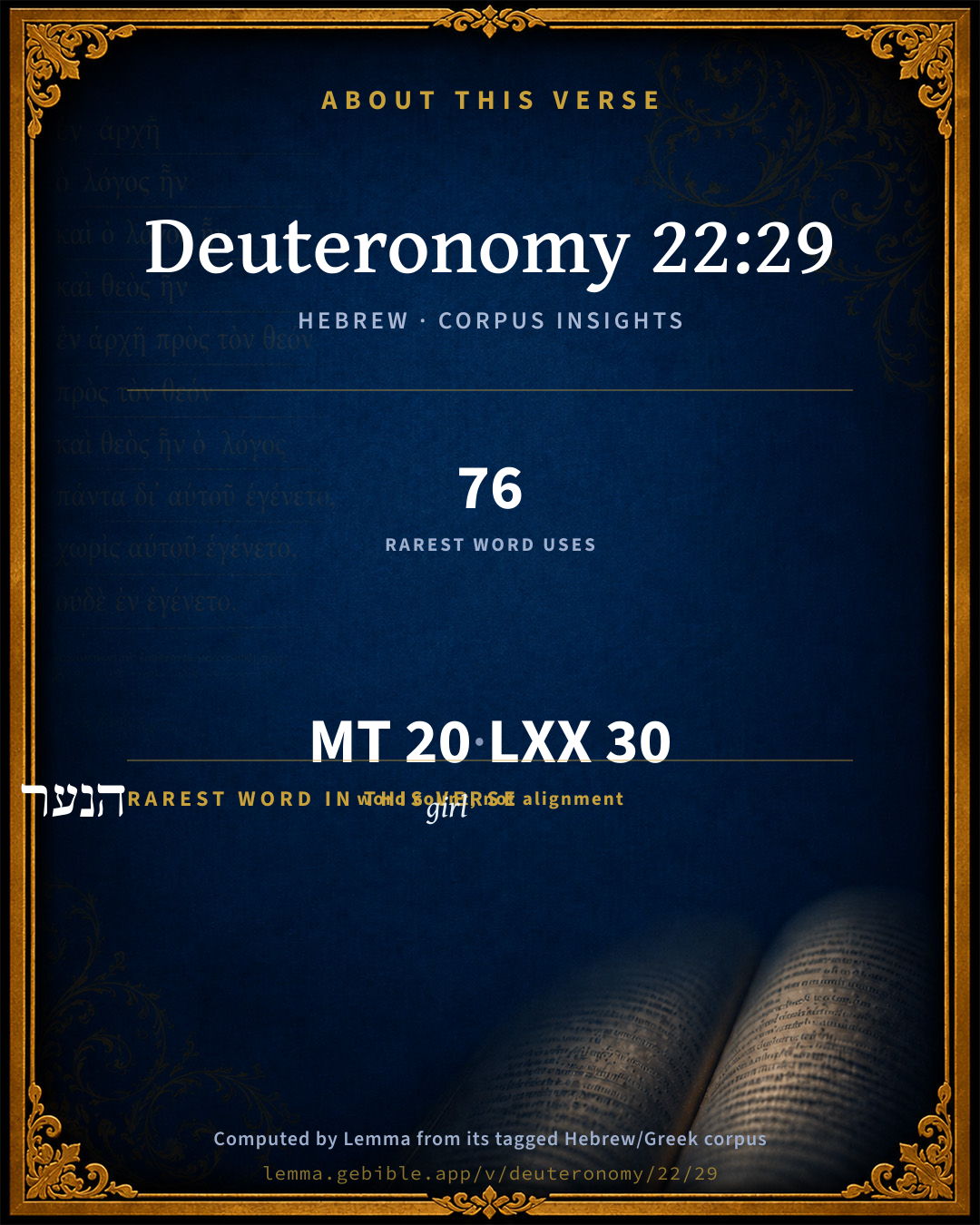
20
words
18
distinct lemmas
Pentateuch
section

Grammatical profile

  • 6 verbs
  • 8 nouns
  • 1 adjective
  • 3 prepositions
  • 2 particles

Verb forms

  • וְ֠נָתַן Qal · Sequential Perfect
  • הַשֹּׁכֵ֥ב Qal · Participle Active
  • תִהְיֶ֣ה Qal · Imperfect
  • עִנָּ֔הּ Piel · Perfect
  • יוּכַ֥ל Qal · Imperfect
  • שַׁלְּחָ֖ה Piel · Infinitive Construct

Repetition

A word recurs within this verse — often emphatic in Hebrew:

  • הנער girl H5291 ×2

Hebrew & Septuagint length

In English translation the verse runs 37 words from the Hebrew and 37 from the Septuagint (LXX English) — the same length.

A rough comparison of the two English renderings, which tokenize alike — not a word-level alignment.

Word counts can differ between the Hebrew and the Greek without any difference in meaning — e.g. the Hebrew direct-object marker אֵת has no separate Greek word, and Greek often adds the article ὁ.

In the original languages it is 20 Hebrew tokens and 30 Greek tokens — but the two are counted differently (Hebrew bundles its prefixes and suffixes into one token; the Greek is in lemma form), so that isn’t a like-for-like length.

Cross-references

3

Topical passages linked to Deuteronomy 22:29 in the Treasury of Scripture Knowledge — connected by theme and wording, ordered by reader-vote popularity; previews shown in the World English Bible.

  • Deuteronomy 22:19 and they shall fine him one hundred [shekels] of silver, and give them to the father of the young lady, because he has brought up an evil name on a virgin of Israel: and she shall be his wife; he may not put her away all his days.
  • Deuteronomy 21:14 It shall be, if you have no delight in her, then you shall let her go where she will; but you shall not sell her at all for money, you shall not deal with her as a slave, because you have humbled her.
  • Deuteronomy 22:24 then you shall bring them both out to the gate of that city, and you shall stone them to death with stones; the lady, because she didn't cry, being in the city; and the man, because he has humbled his neighbor's wife: so you shall put away the evil from the midst of you.

Cross-references courtesy of OpenBible.info (CC BY 4.0).

Hebrew and Greek witnesses Masoretic Hebrew ↔ Greek Septuagint

The same verse in the two great witnesses to the Old Testament, shown verse-for-verse.

These are two independent witnesses, not word-aligned to each other, and the Septuagint is shown in lemma (dictionary) form.

Hebrew Deuteronomy 22:29 Masoretic · Westminster Leningrad Codex

וְ֠נָתַן הָאִ֨ישׁ הַשֹּׁכֵ֥ב עִמָּ֛הּ לַאֲבִ֥י הנער הַֽנַּעֲרָ֖ה חֲמִשִּׁ֣ים כָּ֑סֶף וְלֽוֹ תִהְיֶ֣ה לְאִשָּׁ֗ה תַּ֚חַת אֲשֶׁ֣ר עִנָּ֔הּ לֹא יוּכַ֥ל שַׁלְּחָ֖ה כָּל יָמָֽיו

then the man who lay with her shall give to the lady's father fifty [shekels] of silver, and she shall be his wife, because he has humbled her; he may not put her away all his days.

World English Bible · Public Domain

Greek LXX Deuteronomy 22:29 Septuagint · lemma form

δίδωμι ὁ ἄνθρωπος ὁ κοιμάω μετά αὐτός ὁ πατήρ ὁ νεᾶνις πεντήκοντα δίδραγμον ἀργύριον καί αὐτός εἰμί γυνή ἀντί ὅς ταπεινόω αὐτός οὐ δύναμαι ἐκ ἀποστέλλω αὐτός ὁ ἅπας χρόνος

the man who lay with her shall give to the father of the damsel fifty silver didrachmas, and she shall be his wife, because he has humbled her; he shall never be able to put her away.

LXX2012 (modern English Septuagint) · Public Domain

Hebrew: Westminster Leningrad Codex (CC BY 4.0). Greek: Septuagint (public domain); English from LXX2012 (modern English Septuagint) (Public Domain). How the Septuagint differs from the Hebrew →

Targum (Aramaic paraphrase)

2

The Targum is the ancient Jewish Aramaic paraphrase of the Hebrew Scriptures — an interpretive translation, not the Hebrew text itself. Onkelos (literal) and Pseudo-Jonathan (expansive) render the Torah, and Jonathan the Prophets. Coverage is partial: where no permissively-licensed English translation exists for a verse, only the Aramaic is shown. This is verse-level text, not a word-by-word alignment to the Hebrew.

  1. Targum Onkelos Torah (Genesis–Deuteronomy)
    וְיִתֵּן גַבְרָא דְיִשְׁכֻּב עִמַהּ לַאֲבוּהָא דְעוּלֶמְתָּא חַמְשִׁין סִלְעִין דִכְסַף וְלֵהּ תְּהֵי לְאִנְתּוּ חֳלַף דִי עַנְיַהּ לֵית לֵהּ רְשׁוּ לְמִפְטְרַהּ כָּל יוֹמוֹהִי

    (no public-domain English translation for this verse)

    Targum Onkelos — Aramaic: “Onkelos Genesis” (public domain); “Onkelos Exodus” (public domain); “Onkelos Leviticus” (public domain); “Onkelos Numbers” (public domain); “Onkelos Deuteronomy” (public domain). English: “Sefaria Community Translation” (CC0 1.0 (public-domain dedication)); “J.W. Etheridge. The Targums of Onkelos and Jonathan Ben Uzziel on the Pentateuch. London: Longmans, Green, 1862” (public domain). Text via Sefaria.

  2. Targum Pseudo-Jonathan Torah (Genesis–Deuteronomy)
    וְיִתֵּן גַּבְרָא דְשַׁמֵּשׁ עִמָּהּ לְאָבוּהָא דְעוּלֵּימְתָּא דְמֵי בַּהֲתָהּ חַמְשִׁין סַלְעִין דִּכְסַף וְלֵיהּ תְּהֵי לְאִינְתּוּ חוֹלַף דְּעַנְיָיהּ לֵית לֵיהּ רְשׁוּ לְמִפְטְרָהּ בְּגִיטָא כָּל יוֹמוֹי

    then the man who lay with her shall give to her father, as a fine for her dishonour, fifty shekels of silver, and she shall be his wife, because he humbled her, nor shall he have power to put her away by divorcement all his days.

    Targum Pseudo-Jonathan — Aramaic: “Targum Jonathan on Genesis” (public domain); “Targum Jonathan on Exodus” (public domain); “Targum Jonathan on Leviticus” (public domain); “Targum Jonathan on Numbers” (public domain); “Targum Jonathan on Deuteronomy” (public domain). English: “The Targum of Jonathan ben Uzziel, trans. J. W. Etheridge, London, 1862” (public domain). Text via Sefaria.

Commentary

Notes on Deuteronomy 22:29 from classic Christian and Jewish commentators (each source and its license shown beneath its notes). The classic Christian expositions comment on the surrounding passage and are grouped to its opening verse, so a note may address several verses; the Jewish commentaries on the Tanakh (Rashi and others) are per-verse, so they appear only where the commentator wrote on this verse.

Lemma curates 59 commentaries, every one of them public domain or Creative Commons licensed, each selected and text-cleaned for this edition rather than reprinted as found. About our sources →

Trapp's Complete Commentary

John Trapp

Deu 22:29 Then the man that lay with her shall give unto the damsel’s father fifty [shekels] of silver, and she shall be his wife; because he hath humbled her, he may not put her away all his days.

Ver. 29. She shall be his wife.] Howbeit he must be humbled before the Lord, for entering into his ordinance through the devil’s portal.

John Trapp, A Commentary or Exposition upon All the Books of the Old and New Testament (1647–1656) — public domain. Text from a community e-Sword module.

Joseph Benson's Commentary

Deu 22:29. Shall give unto the damsel’s father fifty shekels — Besides the dowry, as Philo, the learned Jew, notes, which is here omitted, because that was customary, it being sufficient here to mention what was peculiar to this case. She shall be his wife — He was not at liberty to refuse her, if her father consented to his marrying her, and he was deprived of the privilege of ever divorcing her.

Joseph Benson's Commentary on the Old and New Testaments (1811–1818) — public domain. Text from a community e-Sword module.

Tyndale Open Study Notes

Tyndale Open Resources

22:29 fifty pieces of silver: The father could still expect a dowry for his unmarried daughter (see Gen 34:12; Exod 22:16). • he must marry: The assumption is that the girl and her father were willing to undertake the arrangement (see Exod 22:17).

Tyndale Open Study Notes — © Tyndale Open Resources, licensed CC BY-SA 4.0. Text via the HelloAO Bible API.

The Cambridge Bible for Schools and Colleges

gen. ed. J. J. S. Perowne

29. humbled] See Deu_22:24. He may not, etc., as in Deu_22:19.

The Cambridge Bible for Schools and Colleges (gen. ed. J. J. S. Perowne; Cambridge University Press, 1878–1918) — public domain. Text from a community e-Sword module.

John Gill's Exposition

A man shall not take his father's wife,.... Not marry her, whether his own mother, or a stepmother; or even, as Aben Ezra thinks, anyone that was deflowered by his father. Jarchi interprets it of his father's brother's wife, which he was obliged to marry by virtue of the law in Deu 25:5.

nor discover his father's skirt; or lie with her his father had thrown his skirt over, or married; and which being the first, is mentioned here as a sample to all the rest forbidden Lev 18:7 or, as Bishop Patrick expresses it, is a "short memorandum", to make them careful to observe all the other laws respecting incestuous marriages and copulations there delivered.

Next: Deuteronomy Chapter 23

John Gill's Exposition of the Whole Bible (1746–1763) — public domain (CC PDM 1.0). Text via the HelloAO Bible API.

Haydock's Catholic Bible Commentary

Life. A law nearly similar occurs, Exodus xxii. 16, (Haydock) only there Moses speaks of seduction. (Menochius) --- If the father or the woman refused their consent to the marriage, the person had only to pay 50 sicles; which the woman received, if her father was not alive. But if they consented, the person who had been condemned by the judge, was bound to marry the woman, how deformed soever. (Selden, Uxor. i. 16.) (Calmet)

George Leo Haydock (1774–1849), Haydock's Catholic Family Bible and Commentary, 1859 edition — public domain. Excludes Psalms (Douay-Rheims chapter numbering differs from Protestant) and Deuterocanonical books (Catholic canon only).

Matthew Poole's English Annotations

Fifty shekels of silver, besides the dowry, as Philo the learned Jew notes, which is here omitted, because that was common and customary, and because it might easily be gathered out of Exo 22:16, it being sufficient here to mention what was peculiar to this case.

She shall be his wife, to wit, if her father consent to it, which is to be supposed out of Exo 22:16, it being not likely that the father should lose his paternal right of disposing his child when she was in some sort forced, rather than when she was enticed.

He may not put her away all his days, which others were suffered to do, Deu 24:1, and he who enticed the maid (Exo 22:16) was not prohibited to do.

Matthew Poole's English Annotations on the Holy Bible (1683–1685) — public domain. Text from a community e-Sword/MySword module.

John Wesley's Explanatory Notes

Fifty shekels - Besides the dowry, as Philo, the learned Jew notes, which is here omitted, because that was customary, it being sufficient here to mention what was peculiar to this case. His wife - If her father consented to it.

John Wesley, Explanatory Notes Upon the Whole Bible (1754–1765) — public domain. Text via the GEBible commentary corpus.

Lesson kit

Teaching starters — assembled from the data on this page, not authored interpretation. Every prompt links to the verse data it draws on. Edit before teaching.

Deuteronomy, in the Pentateuch, opens this verse with 20 words (18 distinct Hebrew lemmas). Its most distinctive word is naʻărâh (“girl”). A historical commentator’s framing appears above. Read the whole chapter for the surrounding context.

Discussion questions

  1. How does “girl” (naʻărâh) shape what this verse is saying?
  2. Deuteronomy 22:19 shares this passage’s theme. How do the two illuminate each other?
  3. “girl” occurs 2× in this one verse. What is the effect of the repetition?
  4. These translations render this verse differently; the difference is in the English rendering, not the original. What questions does that raise?
  5. The verb «וְ֠נָתַן» is Qal Sequential Perfect. How does its form color the action?
  6. Reading how Trapp's Complete Commentary and Joseph Benson's Commentary read this verse, where do the two commentators agree and where do they part?

Things to notice

Reading settings

Reading text

Shown beneath each verse's original-language words.

Old Testament
Old Testament edition

Read the OT as the Masoretic Hebrew (MT) or the Greek Septuagint (LXX).

English shown for the Greek Septuagint (in the Hebrew ↔ Greek comparison).

Comparing translations? Open the Compare panel on any verse page to stack up to four side by side.