Isaiah 46:2

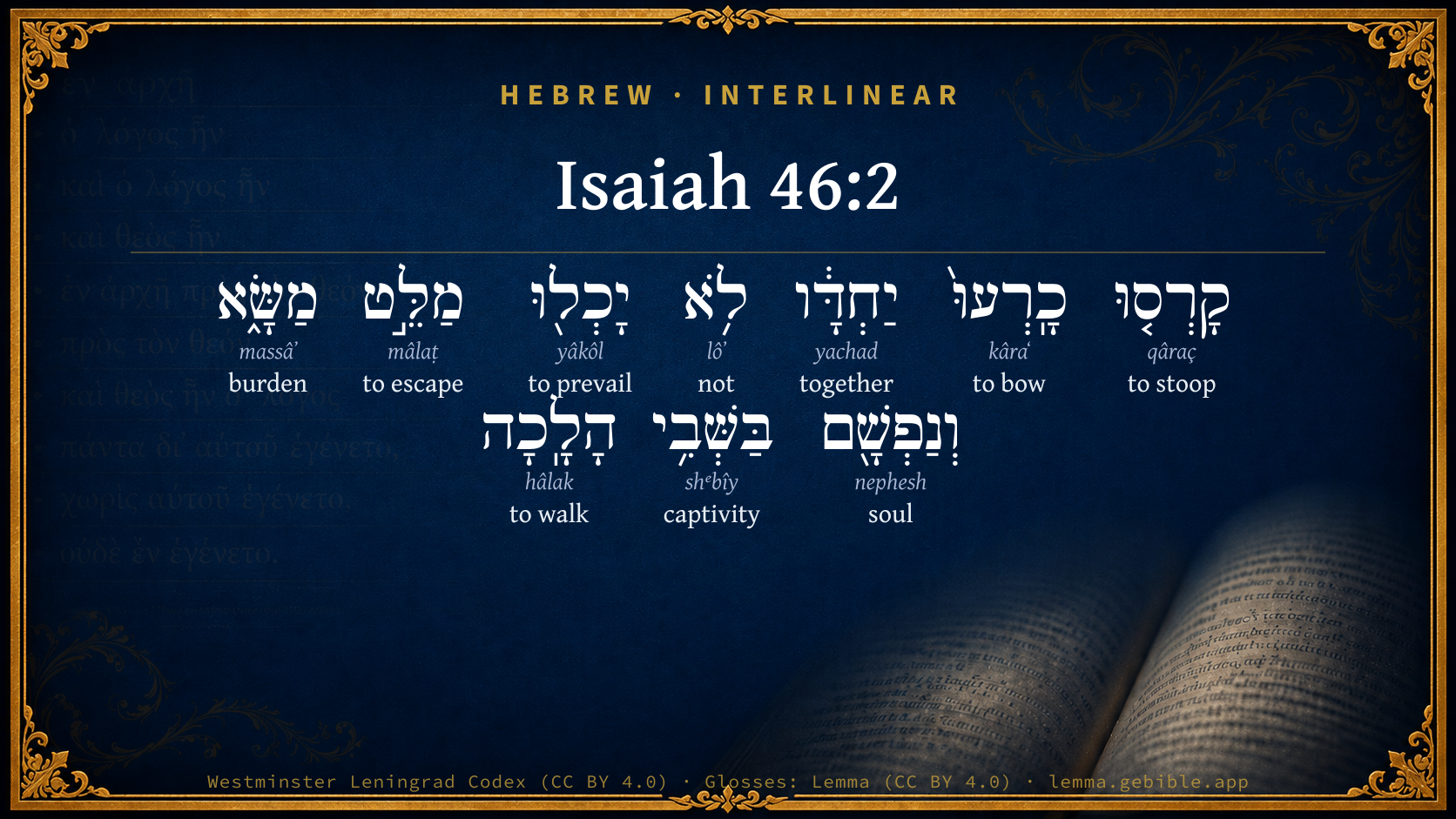
Hebrew (Westminster Leningrad Codex) Isaiah 46:2 appears in the Hebrew Old Testament. The text above is from the Westminster Leningrad Codex. Each word links to its Strong’s number, a concise gloss, and parsing drawn from the Open Scriptures Hebrew Bible morphology. Click any word for its full Brown-Driver-Briggs (BDB) entry.
Download image
Cite this verse

Isaiah 46:2 (World English Bible). Public Domain. Lemma interlinear Bible study tool, https://lemma.gebible.app/v/isaiah/46/2.

Show BibTeX & RIS
BibTeX
RIS
English Translation
They stoop, they bow down together; they could not deliver the burden, but themselves are gone into captivity.
World English Bible · Public Domain
Download a study sheet

One document with this verse’s original text, its word-by-word gloss line, the meaning frame, cross-references with their text, attributed commentary, and full source and license credits — printable, and it pastes into notes with its structure intact.

This verse Autodidact and up

Study sheet (.html) Plain text (.txt)

A passage Seminary Student

Up to 50 verses in one chapter. A passage sheet keeps up to 6 commentary sources and 12 cross-references per verse, in the order this page ranks them, and says so on the sheet whenever that leaves anything out. Ask for a single verse and you get the Autodidact verse sheet above.

Everything on this page stays free to read, with no account — the sheet is a download of what is already on screen, not access to it.

Want to remove ads? Support Godless Engineer
Compare translations 3

The same verse in 3 English versions, stacked beneath the original-language interlinear above. Click any original word for its lexicon entry.

Each is an independent rendering of the whole verse — the interlinear is not word-aligned to these translations.

Highlighted words mark where these versions differ — a whole-verse word diff, not a word-by-word alignment.

  • World English Bible Public Domain
    They stoop, they bow down together; they could not deliver the burden, but themselves are gone into captivity.
  • King James Version Public Domain
    They stoop, they bow down together; they could not deliver the burden, but themselves are gone into captivity.
  • unfoldingWord Literal Text CC BY-SA 4.0
    They stooped, they bowed down together; they were not able to rescue the burden, and their soul has gone into captivity. q1

unfoldingWord Literal Text — © unfoldingWord, licensed CC BY-SA 4.0. Word-aligned USFM3 via Door43 (git.door43.org/unfoldingWord/en_ult).

Versions to compare (up to 4)

3 of 4 selected

Show all 18 translations

Every available English version of this verse, each an independent rendering of the whole verse.

  • World English Bible Public Domain
    They stoop, they bow down together; they could not deliver the burden, but themselves are gone into captivity.
  • Berean Standard Bible Public Domain
    The gods cower; they crouch together, unable to relieve the burden; but they themselves go into captivity.
  • Majority Standard Bible Public Domain
    The gods cower; they crouch together, unable to relieve the burden; but they themselves go into captivity.
  • King James Version Public Domain
    They stoop, they bow down together; they could not deliver the burden, but themselves are gone into captivity.
  • American Standard Version (1901) Public Domain
    They stoop, they bow down together; they could not deliver the burden, but themselves are gone into captivity.
  • Revised Version (1885) Public Domain
    They stoop, they bow down together; they could not deliver the burden, but themselves are gone into captivity.
  • Geneva Bible (1599) Public Domain
    They are bowed downe, and fallen together: for they coulde not rid them of the burden, and their soule is gone into captiuitie.
  • Douay-Rheims (1899) Public Domain
    They are consumed, and are broken together: they could not save him that carried them, and they themselves shall go into captivity.
  • Young's Literal Translation Public Domain
    They have stooped, they have bowed together, They have not been able to deliver the burden, And themselves into captivity have gone.
  • Literal Standard Version CC BY-SA 4.0
    They have stooped, they have bowed together, || They have not been able to deliver the burden, || And have gone into captivity themselves.
  • Unlocked Literal Bible CC BY-SA 4.0
    Together they bend low, kneel down; they cannot rescue the images, and they themselves have gone off into captivity.
  • unfoldingWord Literal Text CC BY-SA 4.0
    They stooped, they bowed down together; they were not able to rescue the burden, and their soul has gone into captivity. q1
  • Darby Bible Public Domain
    They bend, they are bowed down together; they could not deliver the burden, and themselves are gone into captivity.
  • World Messianic Bible Public Domain
    They stoop and they bow down together. They could not deliver the burden, but they have gone into captivity.
  • Webster's Bible Public Domain
    They stoop, they bow down together; they could not deliver the burden, but themselves have gone into captivity.
  • Free Bible Version CC BY-SA 4.0
    They bend low and bow down together—they can't help rescue their idols, and they themselves go off into captivity.
  • Bible in Basic English Public Domain
    They are bent down, they are falling together: they were not able to keep their images safe, but they themselves have been taken prisoner.
  • JPS Tanakh (1917) Public Domain
    They stoop, they bow down together, they could not deliver the burden; and themselves are gone into captivity.

Literal Standard Version (2020), Covenant Press — licensed CC BY-SA 4.0. Text via the HelloAO Bible API (eBible.org). Unlocked Literal Bible (unfoldingWord) — licensed CC BY-SA 4.0. Text via the HelloAO Bible API (eBible.org). unfoldingWord Literal Text — © unfoldingWord, licensed CC BY-SA 4.0. Word-aligned USFM3 via Door43 (git.door43.org/unfoldingWord/en_ult). Free Bible Version, Dr. Jonathan Gallagher — licensed CC BY-SA 4.0. Text via the HelloAO Bible API (eBible.org).

Word by word

More ways to search: Search by grammar → Find every occurrence → Compare this word →

Practice this passage: Drill this verse → Learn its vocabulary →

About this verse

These counts appear in no published source. They are computed here, from the morphology-tagged text and Lemma’s own curated glosses. What Lemma adds →

10
words
10
distinct lemmas
Prophets
section

Notable vocabulary

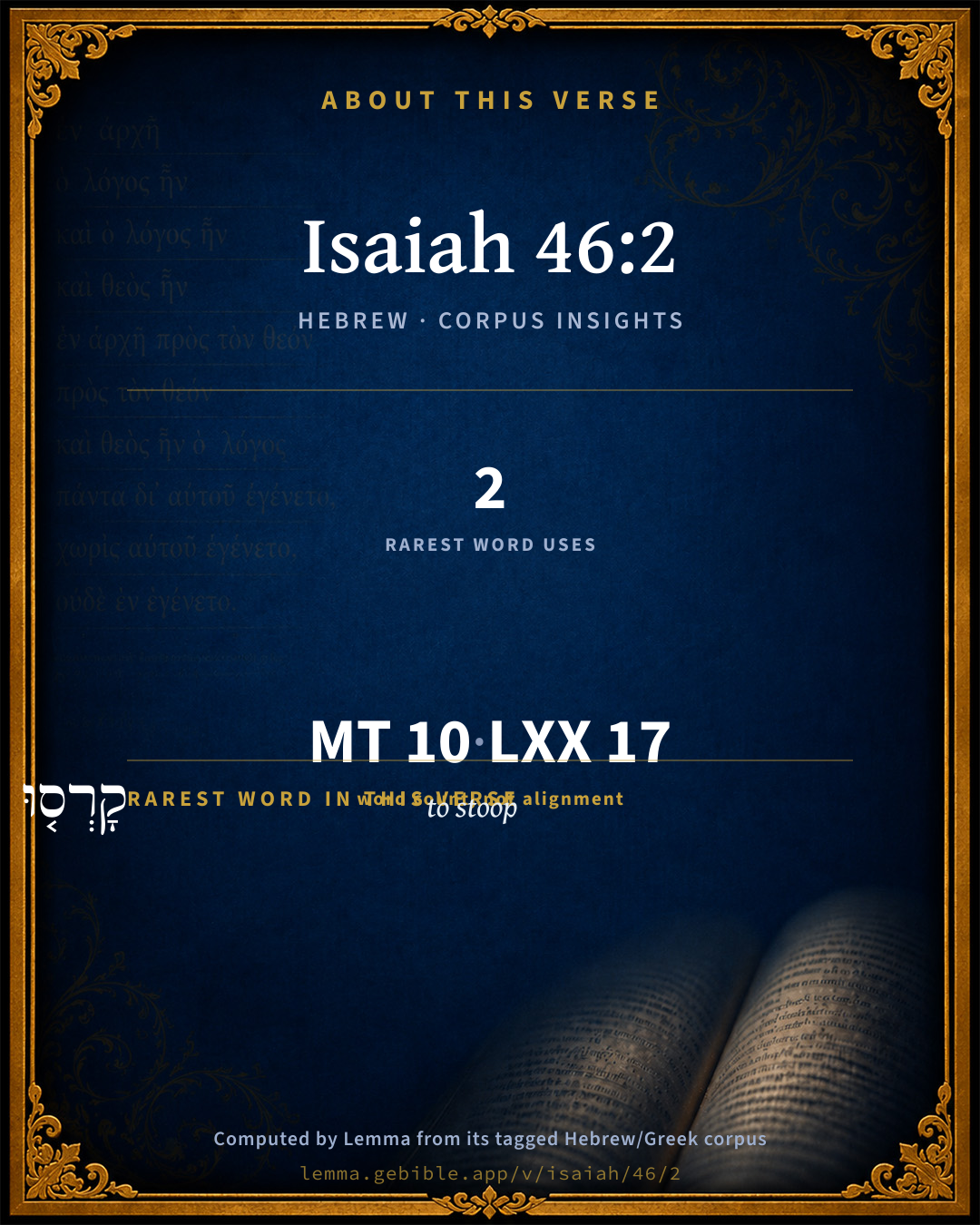
The rarest word here is קָרְס֤וּ to stoop H7164 — appearing just 2 times in the whole Hebrew Bible.

Shared distinctive vocabulary

קָרְס֤וּ to stoop H7164 occurs in 2 verses of the Hebrew Bible. Also found in:

Grammatical profile

  • 5 verbs
  • 3 nouns
  • 1 adverb
  • 1 particle

Verb forms

  • קָרְס֤וּ Qal · Perfect
  • כָֽרְעוּ֙ Qal · Perfect
  • יָכְל֖וּ Qal · Perfect
  • מַלֵּ֣ט Piel · Infinitive Construct
  • הָלָֽכָה Qal · Perfect

Hebrew & Septuagint length

In English translation the verse runs 18 words from the Hebrew and 17 from the Septuagint (LXX English) — closely comparable.

A rough comparison of the two English renderings, which tokenize alike — not a word-level alignment.

Word counts can differ between the Hebrew and the Greek without any difference in meaning — e.g. the Hebrew direct-object marker אֵת has no separate Greek word, and Greek often adds the article ὁ.

In the original languages it is 10 Hebrew tokens and 17 Greek tokens — but the two are counted differently (Hebrew bundles its prefixes and suffixes into one token; the Greek is in lemma form), so that isn’t a like-for-like length.

Cross-references

11

Topical passages linked to Isaiah 46:2 in the Treasury of Scripture Knowledge — connected by theme and wording, ordered by reader-vote popularity; previews shown in the World English Bible.

  • Jeremiah 48:7 For, because you have trusted in your works and in your treasures, you also shall be taken: and Chemosh shall go forth into captivity, his priests and his princes together.
  • Judges 18:17–18 The five men who went to spy out the land went up, and came in there, and took the engraved image, and the ephod, and the teraphim, and the molten image: and the priest stood by the entrance of the gate with the six hundred men girt with weapons of war.
  • Judges 18:24 He said, you have taken away my gods which I made, and the priest, and are gone away, and what have I more? and how then say you to me, What ails you?
  • 2 Samuel 5:21 They left their images there; and David and his men took them away.
  • Jeremiah 43:12–13 I will kindle a fire in the houses of the gods of Egypt; and he shall burn them, and carry them away captive: and he shall array himself with the land of Egypt, as a shepherd puts on his garment; and he shall go forth from there in peace.
  • Isaiah 36:18–19 Beware lest Hezekiah persuade you, saying, Yahweh will deliver us. Has any of the gods of the nations delivered his land out of the hand of the king of Assyria?
  • Isaiah 37:12 Have the gods of the nations delivered them, which my fathers have destroyed, Gozan, and Haran, and Rezeph, and the children of Eden who were in Telassar?
  • Isaiah 37:19 and have cast their gods into the fire: for they were no gods, but the work of men's hands, wood and stone; therefore they have destroyed them.
  • Isaiah 44:17 The residue of it he makes a god, even his engraved image; he falls down to it and worships, and prays to it, and says, Deliver me; for you are my god.
  • Isaiah 45:20 Assemble yourselves and come; draw near together, you who have escaped from the nations: they have no knowledge who carry the wood of their engraved image, and pray to a god that can't save.
  • Hosea 10:5–6 The inhabitants of Samaria will be in terror for the calves of Beth Aven; For its people will mourn over it, Along with its priests who rejoiced over it, For its glory, because it has departed from it.

Cross-references courtesy of OpenBible.info (CC BY 4.0).

Hebrew and Greek witnesses Masoretic Hebrew ↔ Greek Septuagint

The same verse in the two great witnesses to the Old Testament, shown verse-for-verse.

These are two independent witnesses, not word-aligned to each other, and the Septuagint is shown in lemma (dictionary) form.

Hebrew Isaiah 46:2 Masoretic · Westminster Leningrad Codex

קָרְס֤וּ כָֽרְעוּ֙ יַחְדָּ֔ו לֹ֥א יָכְל֖וּ מַלֵּ֣ט מַשָּׂ֑א וְנַפְשָׁ֖ם בַּשְּׁבִ֥י הָלָֽכָה

They stoop, they bow down together; they could not deliver the burden, but themselves are gone into captivity.

World English Bible · Public Domain

Greek LXX Isaiah 46:2 Septuagint · lemma form

καί πεινάω καί ἐκλύω οὐ ἰσχύω ἅμα ὅς οὐ δύναμαι σώζω ἀπό πόλεμος αὐτός δέ αἰχμάλωτος ἄγω

who will not be able to save themselves from war, but they themselves are led away captive.

LXX2012 (modern English Septuagint) · Public Domain

On this verse, Albert Barnes' Notes on the Bible discusses the Septuagint’s reading. Read the note in Commentary ↓

Hebrew: Westminster Leningrad Codex (CC BY 4.0). Greek: Septuagint (public domain); English from LXX2012 (modern English Septuagint) (Public Domain). How the Septuagint differs from the Hebrew →

Targum (Aramaic paraphrase)

1

The Targum is the ancient Jewish Aramaic paraphrase of the Hebrew Scriptures — an interpretive translation, not the Hebrew text itself. Onkelos (literal) and Pseudo-Jonathan (expansive) render the Torah, and Jonathan the Prophets. Coverage is partial: where no permissively-licensed English translation exists for a verse, only the Aramaic is shown. This is verse-level text, not a word-by-word alignment to the Hebrew.

  1. Targum Jonathan Prophets (Joshua–Malachi)
    אִתְקְצִיצוּ וְאִתְקְטִפוּ כַּחֲדָא וְלָא יָכִילוּ לְשֵׁיזָבָא נַטְלֵיהוֹן וּפִלְחֵיהוֹן בְּשִׁבְיָא אֲזָלוּ:

    They are cut off, yea, they are altogether cut to pieces, and they were not able to deliver them that carried them; and their worshippers are gone into captivity.

    Targum Jonathan — Aramaic: “Mikraot Gedolot” (public domain). English: “Sefaria Community Translation” (CC0 1.0 (public-domain dedication)); “London "Chaldee Paraphrase," 1871” (public domain). Text via Sefaria.

Commentary

Notes on Isaiah 46:2 from classic Christian and Jewish commentators (each source and its license shown beneath its notes). The classic Christian expositions comment on the surrounding passage and are grouped to its opening verse, so a note may address several verses; the Jewish commentaries on the Tanakh (Rashi and others) are per-verse, so they appear only where the commentator wrote on this verse.

Lemma curates 59 commentaries, every one of them public domain or Creative Commons licensed, each selected and text-cleaned for this edition rather than reprinted as found. About our sources →

Trapp's Complete Commentary

John Trapp

Isa 46:2 They stoop, they bow down together; they could not deliver the burden, but themselves are gone into captivity.

Ver. 2. They stoop.] The Babylonians, together with their idols; ridiculous gods, that could be thus plundered, carried captives, borne on the backs of asses.

But themselves are gone into captivity.] Heb., And their soul went into captivity; that is, their idols, that were dear unto them as their very souls.

John Trapp, A Commentary or Exposition upon All the Books of the Old and New Testament (1647–1656) — public domain. Text from a community e-Sword module.

Geneva Bible (1599)

Geneva Bible translators

He derideth the idols, which had neither soul nor sense.

The beasts that carried the idols, fell down under their burden.

Geneva Bible (1599) marginal notes — public domain. Text via Bolls.life.

Jamieson, Fausset & Brown

Robert Jamieson, A. R. Fausset & David Brown

deliver--from the enemies' hands.

burden--their images laid on the beasts (Isa 46:1).

themselves--the gods, here also distinguished from their images.

Jamieson, Fausset & Brown — Commentary Critical and Explanatory on the Whole Bible (1871) — public domain (CC PDM 1.0). Text via the HelloAO Bible API.

Adam Clarke's Commentary

Verse 2. They could not deliver the burden - "They could not deliver their own charge"] That is, their worshippers, who ought to have been borne by them. See the two next verses. The Chaldee and Syriac Versions render it in effect to the same purpose, those that bear them, meaning their worshippers; but how they can render massa in an active sense, I do not understand.

For לא lo, not, ולא velo, and they could not, is the reading of twenty-four of Kennicott's, sixteen of De Rossi's, and two of my own MSS. The added vau gives more elegance to the passage.

But themselves - "Even they themselves"] For ונפשם venaphsham, an ancient MS. has כי נפשם ki naphsham, with more force.

Adam Clarke's Commentary on the Bible (1810–1826) — public domain. Text from a community e-Sword/MySword module.

Ellicott's Commentary for English Readers

(2) They could not deliver the burden.—The deities are, for the moment, distinguished from their images. They are powerless to rescue them. So far as they have a soul or being at all, that very being is carried away captive.

A Bible Commentary for English Readers, edited by Charles John Ellicott (1878–1897) — public domain. Text from a community e-Sword module.

The Cambridge Bible for Schools and Colleges

gen. ed. J. J. S. Perowne

2. they could not deliver] i.e. cause to escape.

themselves are gone into captivity] The distinction allowed between the gods and their images is an ironical concession to heathen modes of thought. The fact that the gods are unable to save their own images means that they have vanished. The recently discovered inscriptions have shewn, however, that the idols of Babylon had nothing to fear from Cyrus.

The Cambridge Bible for Schools and Colleges (gen. ed. J. J. S. Perowne; Cambridge University Press, 1878–1918) — public domain. Text from a community e-Sword module.

John Gill's Exposition

They stoop, they bow together,.... Either the beasts under their burdens, or other idols besides those mentioned; or rather the Babylonians themselves, who were obliged to submit to the conquerors:

they could not deliver the burdens; the idols could not save themselves from being laid as burdens upon the beasts, any more than they could save their worshippers: so the Targum understands this and the preceding clause of them;

"they are cut off, and cut to pieces together, they could not deliver those that carried them;''

or else the Babylonians are designed, who could not save their gods from being used in this shameful manner:

but themselves are gone into captivity, or "their souls" (m); what were as dear to them as their own souls, their idols; to whom also souls may be ascribed by way of derision, being inanimate as well as irrational; and it is not unusual for idols to be said to be carried captive; hence those words of Tertullian, "manent et simulachra caplira": or rather the Babylonians, who went into captivity themselves, and so could not save their idols: thus they who had led captive the Jews are led captive themselves; and thus it will be with mystical Babylon, Rev 13:10.

(m) "et animae eorum", V. L. Munster, Pagninus, Montanus, Cocceius.

John Gill's Exposition of the Whole Bible (1746–1763) — public domain (CC PDM 1.0). Text via the HelloAO Bible API.

Albert Barnes' Notes on the Bible

They stoop - Bel, and Nebo, and all the Babylonian gods (see Isa 46:1).

They could not deliver the burden - The word ‘burden’ here, probably means the load of metal, wood, and stone, of which the idols were composed. The gods whom the Babylonians worshipped had not even power to protect the images which were made to represent them, and which had now become a heavy burden to the animals and wains which were carrying them away. They could not rescue them from the hands of the conqueror; and how unable were they, therefore, to defend those who put their trust in them. The Vulgate renders this, ‘They could not deliver him that bare them.’ The Septuagint, ‘You are carrying them like a burden bound on the weary, faint, and hungry; who are all without strength, and unable to escape from battle; and as for them, they are carried away captives!’

But themselves - Margin, as Hebrew, ‘Their soul.’ The sense is, that the gods thus worshipped, so far from being able to defend those who worshipped them, had themselves become captive, and were borne to a distant land.

Albert Barnes' Notes on the Bible (1834–1885) — public domain. Text from a community e-Sword/MySword module.

Haydock's Catholic Bible Commentary

They. Literally, "their soul." (Haydock) --- The pagans must have supposed they had one. (Calmet) --- Captivity. "There are as many triumphs over the gods as over men." (Tertullian) --- The former shared the fate of their adorers. Their statues were plundered.

George Leo Haydock (1774–1849), Haydock's Catholic Family Bible and Commentary, 1859 edition — public domain. Excludes Psalms (Douay-Rheims chapter numbering differs from Protestant) and Deuterocanonical books (Catholic canon only).

Matthew Poole's English Annotations

They; either,

1. The idols, of whom these words are used, Isa 46:1. Or,

2. The Babylonians, who are sufficiently implied in that expression, their idols, Isa 46:1.

They bow down together; either,

1. One as well as another; or,

2. The Babylonians and their idols together, neither could help the other.

They could not deliver the burden; either,

1. The idols could not deliver themselves, who were now a burden to the beasts, and carried away by them; or,

2. The Babylonians could not deliver their idols, which he now had called burdens. And this sense seems most probable from the following clause, which clearly speaks of the same persons or things; but themselves, &c., Heb. their souls; for although the soul is here put for the person, as it commonly is, yet that title is never given to any idol or lifeless thing, but only to such creatures as have or had souls within their bodies. So the meaning of this and the foregoing verse is this, that neither the Babylonians nor their idols could either save themselves or one another, but both are bowed down and gone into captivity together.

Matthew Poole's English Annotations on the Holy Bible (1683–1685) — public domain. Text from a community e-Sword/MySword module.

The Pulpit Commentary

They stoop, they bow down together; i.e. all the Babylonian gods would suffer equally not one would be able to protect himself. They could not deliver the burden. A distinction is here made between the god and the idol, which have hitherto been identified. The god was, in each case, unable to deliver, or save from capture, the heavy "burden" of gold, or silver, or bronze (i.e. his own image) which was carried off on the back of the "weary beast." On the contrary, the gods themselves the "souls" of the images, immanent in them were carried off with the images into captivity.

The Pulpit Commentary (1880–1919), ed. H.D.M. Spence-Jones & Joseph S. Exell — public domain. Text from a community e-Sword module.

John Wesley's Explanatory Notes

They - The Babylonians. Together - The Babylonians and their idols together, neither could help the other. Deliver - The Babylonians could not deliver their idols.

John Wesley, Explanatory Notes Upon the Whole Bible (1754–1765) — public domain. Text via the GEBible commentary corpus.

J. A. Alexander on Isaiah

Joseph Addison Alexander

“They stoop, they bow together; they cannot save the load; themselves are gone into captivity.” The first clause may mean that they are now both fallen; or together may have reference to the other gods of Babylon, so as to mean that not only Bel and Nebo but all the rest are fallen. The last member of the first clause has been variously explained. The most satisfactory interpretation is the one which gives the word ‘load’ the same sense as in v. 1, and applies it to the images with which the beasts were charged or laden. These are then to be considered as distinguished by the writer from the gods which they represented. Bel and Nebo are unable to rescue their own images. This agrees well with the remainder of the sentence, ‘themselves are gone (or literally their self is gone) into captivity.’ This is the only way in which the reflexive pronoun could be made emphatic here without an awkward circumlocution. The antithesis is really between the material images of Bel and Nebo and themselves, so far as they had any real existence. The whole god, soul and body, all that there was of him, was gone into captivity. The idea of the conquest and captivity of tutelary gods was common in the ancient east, and is alluded to, besides this place, in Jer 48:7; Jer 49:3; Jos 10:5-6; Dan 11:8, to which may be added 1Sa 5:1. Whether the Prophet here refers to an actual event or an ideal one, and how the former supposition may be reconciled with the statement of Herodotus and Diodorus, that the great image of Bel at Babylon was not destroyed until the time of Xerxes, are questions growing out of the erroneous supposition that the passage has exclusive reference to the conquest by Cyrus; whereas it may include the whole series of events which resulted in the final downfall of the Babylonian idol worship.

Joseph Addison Alexander, The Prophecies of Isaiah (1846–1847; New York: Scribner, 1870–1878) — public domain. Text from a community e-Sword module.

Rashi

Rabbi Shlomo Yitzchaki (Rashi)

they could not deliver the burden to discharge the feces in their bowels as others discharge, in the normal manner.

deliver Heb. מַלֵּט, an expression of discharging from an embedded place. Comp. (supra 34:15) “There, the owl has made its nest, and she has laid eggs (וַתְּמַלֵט),” he has discharged her egg. Comp. also (infra 66:7) “And she has been delivered (וְהִמְלִיטָה) of a male child.” Jonathan, however, did not render these verses in this manner.

Rashi on the Tanakh — English translations: “The Judaica Press complete Tanach with Rashi, translated by A. J. Rosenberg” (CC BY 4.0); “Pentateuch with Rashi's commentary by M. Rosenbaum and A.M. Silbermann, 1929-1934” (public domain); “The Metsudah Tanach series, Lakewood, N.J” (CC BY 4.0); and “The Book of Joshua, Metsudah Publications, 1997” (CC BY 4.0). Text via Sefaria.

Ibn Ezra

Rabbi Abraham ibn Ezra

They bow down. The beasts that carry the idols, bow down.

The burden. Their idols. נפשם Their souls, that is, the persons carried by the beasts, are gone into captivity. They were also carried away as captives. Others explain the verse thus: They, that is, all the idols that are left in Babylon, and are not yet mentioned, stoop and bow down, and cannot deliver the burden, for they must go themselves into captivity.

Ibn Ezra on the Tanakh — English translations: “Sefaria Community Translation” (CC0 1.0 (public-domain dedication)); “Yalkut, Sifsei Chachomim Chumash, Metsudah Publications, 2009” (CC BY 4.0); and “Commentary of Ibn Ezra on Isaiah - trans. by M. Friedlander, 1873” (public domain). Text via Sefaria.

Lesson kit

Teaching starters — assembled from the data on this page, not authored interpretation. Every prompt links to the verse data it draws on. Edit before teaching.

Isaiah, in the Prophets, opens this verse with 10 words (10 distinct Hebrew lemmas). Its most distinctive word is qâraç (“to stoop”). A historical commentator’s framing appears above. Read the whole chapter for the surrounding context.

Discussion questions

  1. What does “to stoop” (qâraç) contribute to the verse as a whole?
  2. How does Isaiah 46:1, which shares the word «to stoop», read alongside this verse?
  3. These translations render this verse differently. What is at stake in choosing one wording over another?
  4. «קָרְס֤וּ» is a Qal Perfect verb. How does that grammatical form shape the action described?
  5. Compare how Trapp's Complete Commentary and Geneva Bible (1599) read this verse. Where do they agree or differ?

Things to notice

Reading settings

Reading text

Shown beneath each verse's original-language words.

Old Testament
Old Testament edition

Read the OT as the Masoretic Hebrew (MT) or the Greek Septuagint (LXX).

English shown for the Greek Septuagint (in the Hebrew ↔ Greek comparison).

Comparing translations? Open the Compare panel on any verse page to stack up to four side by side.