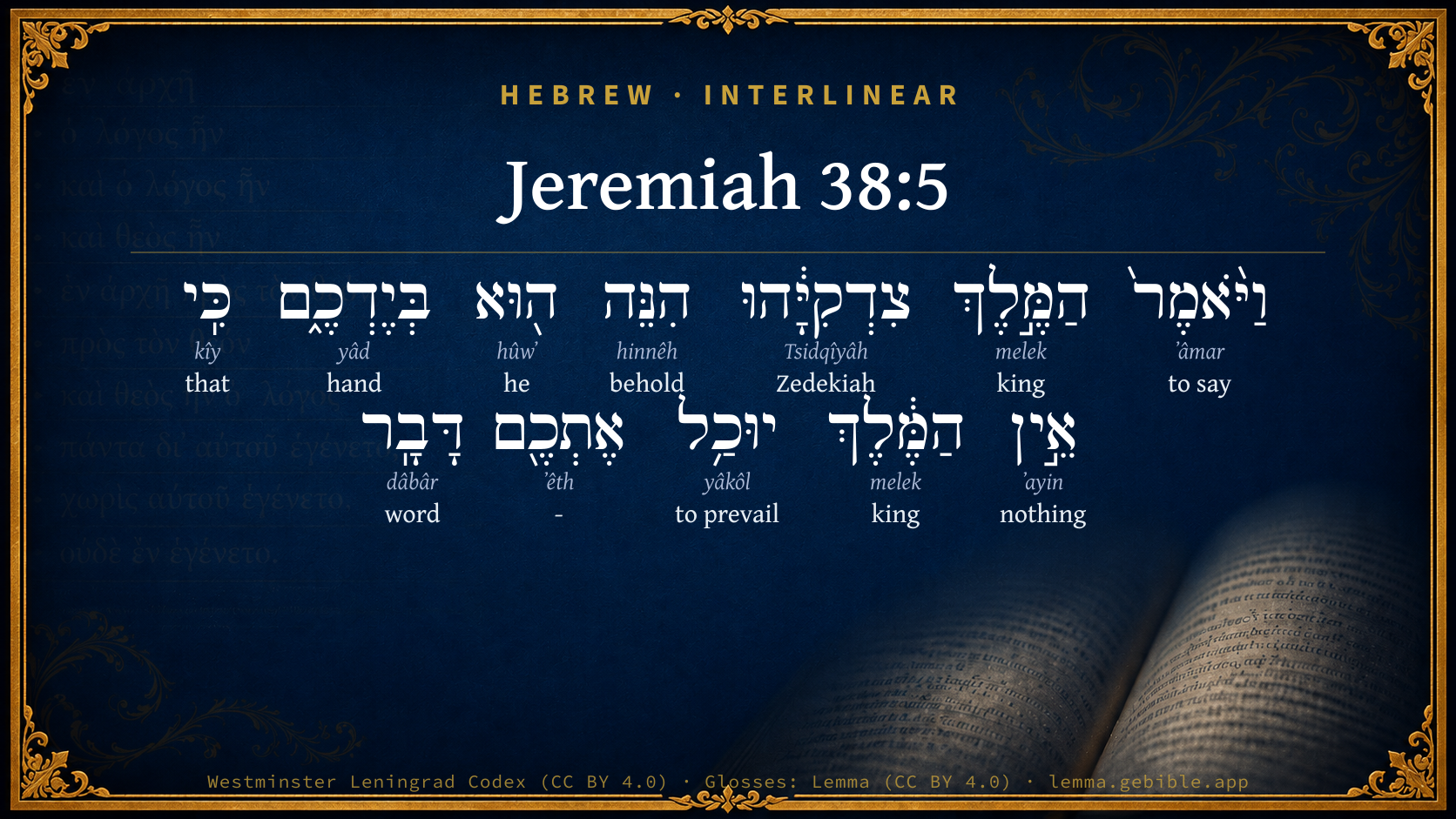
Jeremiah 38:5

Hebrew (Westminster Leningrad Codex) Jeremiah 38:5 appears in the Hebrew Old Testament. The text above is from the Westminster Leningrad Codex. Each word links to its Strong’s number, a concise gloss, and parsing drawn from the Open Scriptures Hebrew Bible morphology. Click any word for its full Brown-Driver-Briggs (BDB) entry.
Download image
Cite this verse

Jeremiah 38:5 (World English Bible). Public Domain. Lemma interlinear Bible study tool, https://lemma.gebible.app/v/jeremiah/38/5.

Show BibTeX & RIS
BibTeX
RIS
English Translation
Zedekiah the king said, Behold, he is in your hand; for the king is not he who can do anything against you.
World English Bible · Public Domain
Download a study sheet

One document with this verse’s original text, its word-by-word gloss line, the meaning frame, cross-references with their text, attributed commentary, and full source and license credits — printable, and it pastes into notes with its structure intact.

This verse Autodidact and up

Study sheet (.html) Plain text (.txt)

A passage Seminary Student

Up to 50 verses in one chapter. A passage sheet keeps up to 6 commentary sources and 12 cross-references per verse, in the order this page ranks them, and says so on the sheet whenever that leaves anything out. Ask for a single verse and you get the Autodidact verse sheet above.

Everything on this page stays free to read, with no account — the sheet is a download of what is already on screen, not access to it.

Want to remove ads? Support Godless Engineer
Compare translations 3

The same verse in 3 English versions, stacked beneath the original-language interlinear above. Click any original word for its lexicon entry.

Each is an independent rendering of the whole verse — the interlinear is not word-aligned to these translations.

Highlighted words mark where these versions differ — a whole-verse word diff, not a word-by-word alignment.

  • World English Bible Public Domain
    Zedekiah the king said, Behold, he is in your hand; for the king is not he who can do anything against you.
  • King James Version Public Domain
    Then Zedekiah the king said, Behold, he is in your hand: for the king is not he that can do any thing against you.
  • unfoldingWord Literal Text CC BY-SA 4.0
    So King Zedekiah said, “Look, he is in your hand since there is no king able to resist you.”

unfoldingWord Literal Text — © unfoldingWord, licensed CC BY-SA 4.0. Word-aligned USFM3 via Door43 (git.door43.org/unfoldingWord/en_ult).

Versions to compare (up to 4)

3 of 4 selected

Show all 18 translations

Every available English version of this verse, each an independent rendering of the whole verse.

  • World English Bible Public Domain
    Zedekiah the king said, Behold, he is in your hand; for the king is not he who can do anything against you.
  • Berean Standard Bible Public Domain
    “Here he is,” replied King Zedekiah. “He is in your hands, since the king can do nothing to stop you.”
  • Majority Standard Bible Public Domain
    “Here he is,” replied King Zedekiah. “He is in your hands, since the king can do nothing to stop you.”
  • King James Version Public Domain
    Then Zedekiah the king said, Behold, he is in your hand: for the king is not he that can do any thing against you.
  • American Standard Version (1901) Public Domain
    And Zedekiah the king said, Behold, he is in your hand; for the king is not he that can do anything against you.
  • Revised Version (1885) Public Domain
    And Zedekiah the king said, Behold, he is in your hand: for the king is not he that can do any thing against you.
  • Geneva Bible (1599) Public Domain
    Then Zedekiah the King sayd, Behold, he is in your hands, for ye King can denie you nothing.
  • Douay-Rheims (1899) Public Domain
    And king Sedecias said: Behold he is in your hands: for it is not lawful for the king to deny you any thing.
  • Young's Literal Translation Public Domain
    And the king Zedekiah saith, `Lo, he `is' in your hand: for the king is not able for you `in' anything.'
  • Literal Standard Version CC BY-SA 4.0
    And King Zedekiah says, “Behold, he [is] in your hand: for the king is not able [to do] anything against you.”
  • Unlocked Literal Bible CC BY-SA 4.0
    So King Zedekiah said, “Look, he is in your hand since there is no king able to resist you.”
  • unfoldingWord Literal Text CC BY-SA 4.0
    So King Zedekiah said, “Look, he is in your hand since there is no king able to resist you.”
  • Darby Bible Public Domain
    And king Zedekiah said, Behold, he is in your hand; for the king is not he that can do a thing against you.
  • World Messianic Bible Public Domain
    Zedekiah the king said, “Behold, he is in your hand; for the king can’t do anything to oppose you.”
  • Webster's Bible Public Domain
    Then Zedekiah the king said, Behold, he is in your hand: for the king is not he that can do any thing against you.
  • Free Bible Version CC BY-SA 4.0
    “Well, you can do whatever you want to him,” King Zedekiah replied. “I can't stop you.”
  • Bible in Basic English Public Domain
    Then Zedekiah the king said, See, he is in your hands: for the king was not able to do anything against them.
  • JPS Tanakh (1917) Public Domain
    Then Zedekiah the king said: 'Behold, he is in your hand; for the king is not he that can do any thing against you.'

Literal Standard Version (2020), Covenant Press — licensed CC BY-SA 4.0. Text via the HelloAO Bible API (eBible.org). Unlocked Literal Bible (unfoldingWord) — licensed CC BY-SA 4.0. Text via the HelloAO Bible API (eBible.org). unfoldingWord Literal Text — © unfoldingWord, licensed CC BY-SA 4.0. Word-aligned USFM3 via Door43 (git.door43.org/unfoldingWord/en_ult). Free Bible Version, Dr. Jonathan Gallagher — licensed CC BY-SA 4.0. Text via the HelloAO Bible API (eBible.org).

Word by word

More ways to search: Search by grammar → Find every occurrence → Compare this word →

Practice this passage: Drill this verse → Learn its vocabulary →

צִדְקִיָּ֔הוּ
Tsidqîyâh
H6667
“Zedekiah”
Noun, Proper
Part of Speech
Noun
Type
Proper
Full BDB Definition

Origin: from H6664 and H3050

TWOT: None

Zedekiah = "Jehovah is righteous" - the last king of Judah renamed from 'Mattaniah' by Nebuchadnezzar; son of Josiah by wife Hamutal; placed on the throne by Nebuchadnezzar when he carried his nephew Jehoiakim in captivity - false prophet at the court of king Ahab of the northern kingdom of Israel - son of Maaseiah, a false prophet in Babylon - son of Hananiah, one of the princes of Judah in the time of Jeremiah - a priest who sealed the covenant with Nehemiah - son of king Jehoiakim of Judah
  1. וַיֹּ֨אמֶר֙ ʼâmar H559 “and · to say” Conjunction + Verb, Qal, Sequential Imperfect, 3rd Person, Masculine, Singular
  2. הַמֶּ֣לֶךְ melek H4428 “the · king” Particle, Definite Article + Noun, Common, Masculine, Singular, Absolute
  3. הִנֵּה hinnêh H2009 “behold” Particle, Demonstrative
  4. ה֖וּא hûwʼ H1931 “he” Pronoun, Personal, 3rd Person, Masculine, Singular
  5. בְּיֶדְכֶ֑ם yâd H3027 “in/at · hand · your” Preposition + Noun, Common, Both, Singular, Construct + Suffix, Personal, 2nd Person, Masculine, Plural
  6. כִּֽי kîy H3588 “that” Conjunction
  7. אֵ֣ין ʼayin H369 “nothing” Particle, Negative
  8. הַמֶּ֔לֶךְ melek H4428 “the · king” Particle, Definite Article + Noun, Common, Masculine, Singular, Absolute
  9. יוּכַ֥ל yâkôl H3201 “to prevail” Verb, Qal, Imperfect, 3rd Person, Masculine, Singular
  10. אֶתְכֶ֖ם ʼêth H853 “- · you” Particle, Direct Object + Suffix, Personal, 2nd Person, Masculine, Plural
  11. דָּבָֽר dâbâr H1697 “word” Noun, Common, Masculine, Singular, Absolute

About this verse

These counts appear in no published source. They are computed here, from the morphology-tagged text and Lemma’s own curated glosses. What Lemma adds →

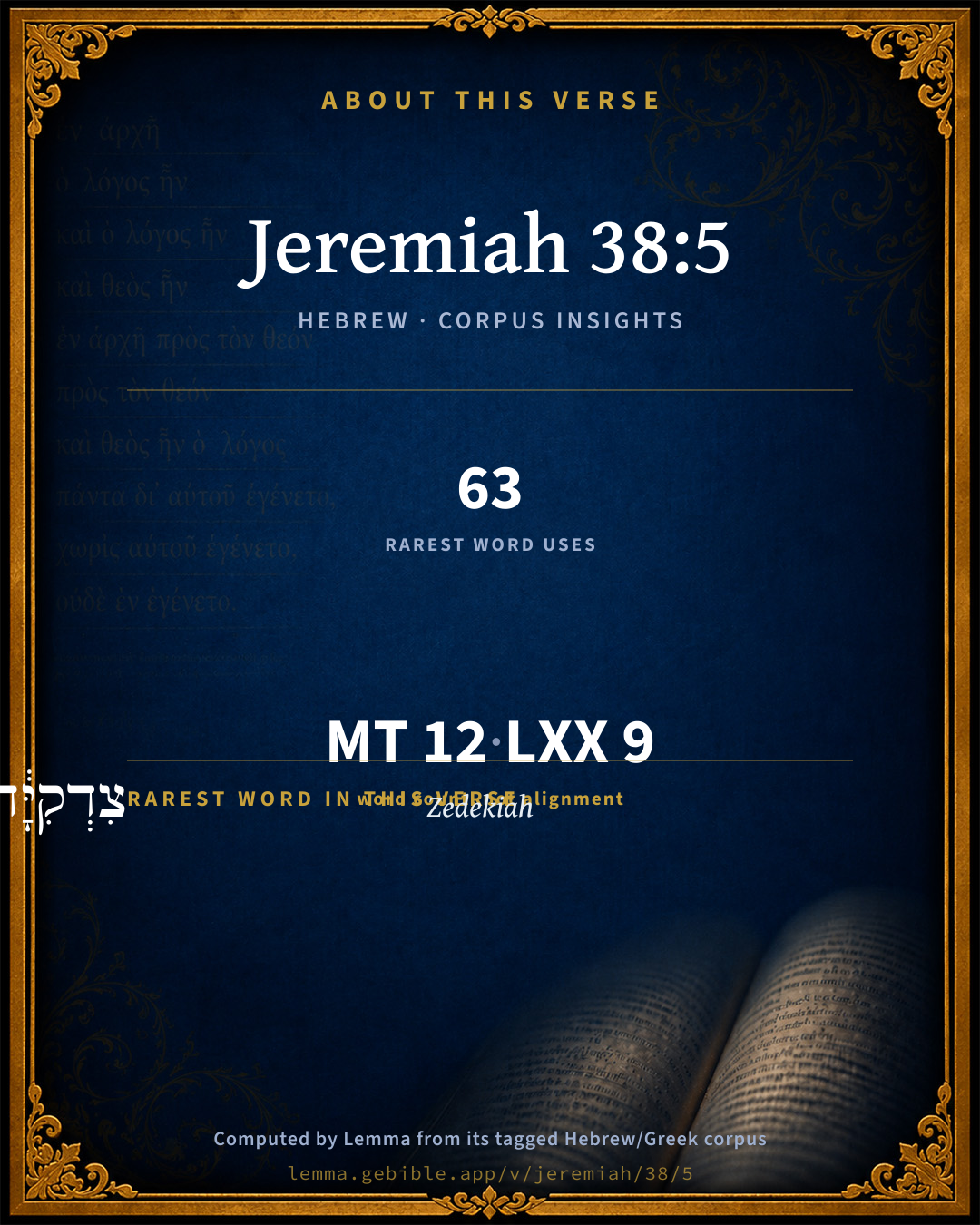
12
words
11
distinct lemmas
Prophets
section

Grammatical profile

  • 2 verbs
  • 5 nouns
  • 1 pronoun
  • 1 conjunction
  • 3 particles

Verb forms

  • וַיֹּ֨אמֶר֙ Qal · Sequential Imperfect
  • יוּכַ֥ל Qal · Imperfect

Repetition

A word recurs within this verse — often emphatic in Hebrew:

  • הַמֶּ֣לֶךְ king H4428 ×2

Hebrew & Septuagint length

In the original languages it is 12 Hebrew tokens and 9 Greek tokens — but the two are counted differently (Hebrew bundles its prefixes and suffixes into one token; the Greek is in lemma form), so that isn’t a like-for-like length.

Cross-references

6

Topical passages linked to Jeremiah 38:5 in the Treasury of Scripture Knowledge — connected by theme and wording, ordered by reader-vote popularity; previews shown in the World English Bible.

  • John 19:12–16 At this, Pilate was seeking to release him, but the Jews cried out, saying, "If you release this man, you aren't Caesar's friend! Everyone who makes himself a king speaks against Caesar!"
  • 2 Samuel 3:39 I am this day weak, though anointed king; and these men the sons of Zeruiah are too hard for me. May Yahweh reward the evil-doer according to his wickedness."
  • 1 Samuel 15:24 Saul said to Samuel, I have sinned; for I have transgressed the commandment of Yahweh, and your words, because I feared the people, and obeyed their voice.
  • 1 Samuel 29:9 Achish answered David, I know that you are good in my sight, as an angel of God: notwithstanding the princes of the Philistines have said, He shall not go up with us to the battle.
  • 2 Samuel 19:22 David said, What have I to do with you, you sons of Zeruiah, that you should this day be adversaries to me? shall there any man be put to death this day in Israel? for don't I know that I am this day king over Israel?
  • Proverbs 29:25 The fear of man proves to be a snare, But whoever puts his trust in Yahweh is kept safe.

Cross-references courtesy of OpenBible.info (CC BY 4.0).

Hebrew and Greek witnesses Masoretic Hebrew ↔ Greek Septuagint

The same verse in the two great witnesses to the Old Testament, shown verse-for-verse.

These are two independent witnesses, not word-aligned to each other, and the Septuagint is shown in lemma (dictionary) form.

Hebrew Jeremiah 38:5 Masoretic · Westminster Leningrad Codex

וַיֹּ֨אמֶר֙ הַמֶּ֣לֶךְ צִדְקִיָּ֔הוּ הִנֵּה ה֖וּא בְּיֶדְכֶ֑ם כִּֽי אֵ֣ין הַמֶּ֔לֶךְ יוּכַ֥ל אֶתְכֶ֖ם דָּבָֽר

Zedekiah the king said, Behold, he is in your hand; for the king is not he who can do anything against you.

World English Bible · Public Domain

Greek LXX Structure differs

In the Septuagint, Jeremiah is about an eighth shorter than the Hebrew and arranges its material differently — the Oracles Against the Nations (Hebrew chapters 46–51) appear in the middle of the Greek book, after 25:13. Because the chapter and verse boundaries do not line up, a verse-for-verse comparison with the Hebrew is not shown.

A verse-for-verse comparison isn’t shown here because the chapters and verses don’t line up. Switch to the LXX edition with the MT / LXX toggle above to read the Greek directly.

On this verse, The Cambridge Bible for Schools and Colleges discusses the Septuagint’s reading. Read the note in Commentary ↓

Hebrew: Westminster Leningrad Codex (CC BY 4.0). Greek: Septuagint (public domain); English from a public-domain English Septuagint. How the Septuagint differs from the Hebrew →

Targum (Aramaic paraphrase)

1

The Targum is the ancient Jewish Aramaic paraphrase of the Hebrew Scriptures — an interpretive translation, not the Hebrew text itself. Onkelos (literal) and Pseudo-Jonathan (expansive) render the Torah, and Jonathan the Prophets. Coverage is partial: where no permissively-licensed English translation exists for a verse, only the Aramaic is shown. This is verse-level text, not a word-by-word alignment to the Hebrew.

  1. Targum Jonathan Prophets (Joshua–Malachi)
    וַאֲמַר מַלְכָּא צִדְקִיָה הָא הוּא מְסִיר בְּיֶדְכוֹן אֲרֵי לֵית מַלְכָּא יָכִיל לַאֲתָבָא יַתְכוֹן פִּתְגָם:

    (no public-domain English translation for this verse)

    Targum Jonathan — Aramaic: “Mikraot Gedolot” (public domain). English: “Sefaria Community Translation” (CC0 1.0 (public-domain dedication)); “London "Chaldee Paraphrase," 1871” (public domain). Text via Sefaria.

Commentary

Notes on Jeremiah 38:5 from classic Christian and Jewish commentators (each source and its license shown beneath its notes). The classic Christian expositions comment on the surrounding passage and are grouped to its opening verse, so a note may address several verses; the Jewish commentaries on the Tanakh (Rashi and others) are per-verse, so they appear only where the commentator wrote on this verse.

Lemma curates 59 commentaries, every one of them public domain or Creative Commons licensed, each selected and text-cleaned for this edition rather than reprinted as found. About our sources →

Trapp's Complete Commentary

John Trapp

Jer 38:5 Then Zedekiah the king said, Behold, he [is] in your hand: for the king [is] not [he that] can do [any] thing against you.

Ver. 5. Then Zedekiah the king said, Behold, he is in your hand.] O nihil regem, qui ne verbulo quidem cruentis viris obluctatur! O king of clouts, saith one, who, knowing the prophet’s innocence and these princes’ blood thirstiness, durst not say a word for him or against them! This inconsistancy of his, and impotence of spirit, proceeded merely from diffidence and distrust in God.

John Trapp, A Commentary or Exposition upon All the Books of the Old and New Testament (1647–1656) — public domain. Text from a community e-Sword module.

The Biblical Illustrator

Joseph S. Exell

Jer_38:5

For the king is not he that can do anything against you.

Zedekiah weakened and ruined through fear of man

Zedekiah was one of those unfortunate characters, frequent in history, like our own Charles I. and Louis XVI. of France, who find themselves at the head of affairs during a great crisis, without having the strength of character to enable them to do what they know to be right, and whose infirmity becomes moral guilt. The princes of his court had him completely under their influence (Jer_38:5). The king is not he that can do anything against you. This view of his character is the key to Jer_38:17. The king had some sympathy with the imprisoned prophet. He had also a desire to hear the Word of the Lord; but he was afraid of the princes. He did not dare openly to show his sympathy, openly to declare his reverence for the Divine message; so he had a secret interview with him. Jeremiahs address to the king may be divided into three parts--

(1) A prophecy,

(2) A personal defence,

(3) A request.

He declared that the King of Babylon should be victorious; he also declared his own innocence of any design against king or people, and compared his own conduct with that of the prophets who, to please the people, had spoken smooth things unto them; and he asked for some alleviation of his treatment.

The Biblical Illustrator, edited by Joseph S. Exell (c. 1880s–1900s) — public domain. Text from a community e-Sword module.

Tyndale Open Study Notes

Tyndale Open Resources

38:5 When the officials angrily confronted King Zedekiah and made their demands, he was weak and cowardly.

Tyndale Open Study Notes — © Tyndale Open Resources, licensed CC BY-SA 4.0. Text via the HelloAO Bible API.

Geneva Bible (1599)

Geneva Bible translators

Wherein he grievously offended in that that not only he would not hear the truth spoken by the Prophet, but also gave him to the lusts of the wicked to be cruelly entreated.

Geneva Bible (1599) marginal notes — public domain. Text via Bolls.life.

Jamieson, Fausset & Brown

Robert Jamieson, A. R. Fausset & David Brown

the king is not he--Zedekiah was a weak prince, and now in his straits afraid to oppose his princes. He hides his dislike of their overweening power, which prevented him shielding Jeremiah as he would have wished, under complimentary speeches. "It is not right that the king should deny aught to such faithful and wise statesmen"; the king is not such a one as to deny you your wishes [JEROME].

Jamieson, Fausset & Brown — Commentary Critical and Explanatory on the Whole Bible (1871) — public domain (CC PDM 1.0). Text via the HelloAO Bible API.

Adam Clarke's Commentary

Verse 5. He is in your hand] Ye have power to do as you please; I must act by your counsel. Poor weak prince! you respect the prophet, you fear the cabal, and you sacrifice an innocent man to your own weakness and their malice!

Adam Clarke's Commentary on the Bible (1810–1826) — public domain. Text from a community e-Sword/MySword module.

John Calvin's Commentaries

Zedekiah doubtless knew that wrong was done to the holy Prophet; for though he wished him to remain as he was, yet he knew that the Prophet had not threatened the people from ill-will or a hostile mind; and he was thus conscious that he had to do with God rather than with a mortal man. However this may have been, he knew that Jeremiah was not an enemy to the public safety according to the charge brought by the princes. He might then have wished to deliver the Prophet from their hands, but he submitted to their fury; for he was divested of all regal power, and was become, as it were, a slave to his own counselors, on whom depended the government of the kingdom.

They wrongly explain this verse, who think that the king spoke honorably of his counselors, as though he had said, that such was their prudence and dignity, that nothing could be denied them. They pervert the meaning of the Prophet; for the king, on the contrary, acknowledges here, that he was reduced to such a condition, as though he were a private individual, he, in short, confessed that he was the servant of servants; “Now I see,” he says, “that I am no king, but that ye so rule, that, willing or unwilling, I am forced to yield to you, even in the best cause.” There is then no doubt but that it was the bitter complaint of the king when he said, The king can do nothing against you.

But Zedekiah deserved this degradation: for he ought to have been from the beginning more teachable, and to submit to God. But in the first place, as we have seen, he had despised prophetic doctrine, and hearkened not to the voice of God; and in the second place, he revolted perfidiously from the Chaldean king, and became thus guilty of ingratitude, for when his nephew was dethroned, that is, Jeconiah or Coniah, he obtained the regal power through the favor of the king of Babylon. He had therefore been ungrateful in denying tribute to him. But his impiety was the main cause of all evils. As then he had been such a rebel against God, he deserved that the princes should prove rebels to him. He then degraded himself, and deprived himself of royal authority, when he refused submission to the word of God, and also when he denied tribute to the king of Babylon. It was no wonder, then, that God made him subject to the princes and counselors, who were yet his servants.

As to these couriers, their arrogance was inexcusable in daring to condemn Jeremiah; for this was to take away from the king his own right; Die let this man, for he is worthy of death. Why was it that they were not content with accusing him, without assuming also to be his sole judges? As, then, they treated the king so disrespectfully, there is no doubt but they were despisers of God, when they deemed as nothing the royal dignity. But as to the king, he reaped, as I have said, the fruit of his own impiety, for he had not given to God his due honor in embracing the truth taught by the Prophet. It was therefore necessary, that he should be unworthily and contumeliously treated, so that he dared not to say even one word in behalf of a just and good cause. This was the reason why he said, He is in your hands, for the king can do nothing against you

John Calvin's Commentaries (1540-1563) — public domain. Text from the Calvin Translation Society English edition (1840s-50s) via the Christian Classics Ethereal Library (ccel.org). Calvin's coverage is partial (roughly two-thirds of the Bible); uncommented books and verses are honest gaps, never fabricated. The 19th-century editor's footnotes and remarks are omitted so the notes are faithfully Calvin's own voice.

The Cambridge Bible for Schools and Colleges

gen. ed. J. J. S. Perowne

5. the king is not he, etc.] The LXX, perhaps rightly, make this clause a comment of the narrator (“For the king was not able … against them”).

The Cambridge Bible for Schools and Colleges (gen. ed. J. J. S. Perowne; Cambridge University Press, 1878–1918) — public domain. Text from a community e-Sword module.

John Gill's Exposition

Then Zedekiah the king said, behold, he is in your hand,.... In your power, to do with him as you please. This is either a grant of the king, allowing them to do as they thought fit; or a declaration of their power, supposing them to be the princes of the sanhedrim, as Grotius thinks, to judge of a false prophet, and condemn him; but that they were such does not appear; nor does their charge of the prophet, or their procedure against him, confirm it. The former sense seems best:

for the king is not he that can do any thing against you; which is said either in a flattering way, that such was their interest in him, and so great his regard for them, that he could not deny them any thing. So it is in the old translations, "for the king may deny you nothing"; and, "the king can deny you nothing": or else in a complaining way, suggesting that, he was a king, and no king; that he had no power to oppose them; they would do as they pleased; and therefore it signified nothing applying to him; he should not say any thing against it; he would have no concern in it; they might do as they pleased, since he knew they would.

John Gill's Exposition of the Whole Bible (1746–1763) — public domain (CC PDM 1.0). Text via the HelloAO Bible API.

Albert Barnes' Notes on the Bible

All real power was in their hands, and as they affirmed that Jeremiah’s death was a matter of necessity, the king did not dare refuse it to them.

Albert Barnes' Notes on the Bible (1834–1885) — public domain. Text from a community e-Sword/MySword module.

Haydock's Catholic Bible Commentary

Lawful. This is a compliment, or Sedecias complains indirectly that they had only left him the name of king. He grieved at the treatment of the prophet. (Calmet)

George Leo Haydock (1774–1849), Haydock's Catholic Family Bible and Commentary, 1859 edition — public domain. Excludes Psalms (Douay-Rheims chapter numbering differs from Protestant) and Deuterocanonical books (Catholic canon only).

Matthew Poole's English Annotations

He is in your hand; that is, in your power, either by the established law against false prophets, or else I yield up my power to you, I surrender him into your hands. But neither of these seemeth very probable, for here is no mention of the sitting of the sanhedrim to judge him as a false prophet, nor of any judicial proceedings of that nature: and it should seem by Zedekiah’s relieving of him soon after from the dungeon, into which they threw him, that he had not surrendered Jeremiah so into their hands, but he to himself a superintendency upon them to correct their too severe dealings with him. The meaning seems rather to be, If you will do any such thing, I shall not oppose you, but I will not be the author of it.

For the king is not he that can do any thing against you; I see I am as it were no king, I can do nothing against you, you will do what you please. I incline to this sense from the consideration of the favour showed him by Zedekiah, both before and after this.

Matthew Poole's English Annotations on the Holy Bible (1683–1685) — public domain. Text from a community e-Sword/MySword module.

Whedon's Commentary on the Bible

Daniel D. Whedon

5. For the king, etc. — The exact construction of the original is doubtful and disputed. But following the Masoretic text, we must translate, The king cannot as to you a word, (or matter;) that is, the king cannot over-bear you in any matter. It is a confession of imbecility, indeed, but also suggests a real dislike of Jeremiah.

Daniel D. Whedon (gen. ed.), Commentary on the Old and New Testaments (1874–1909) — public domain. Text from a community e-Sword module.

The Pulpit Commentary

He is in your hand. The growing power of the "princes" (see Jer_22:4) seems to have confined the king to a merely secondary role.

"Put not your trust in princes.

What a proof does this incident give of the wisdom of this counsel! Note

I ALL ARE TEMPTED TO PUT TRUST IN MEN. To very many man is the highest being they know or believe in. Then, our fellow men are near at hand; we can understand them and they us; are of like nature they can be touched with the feeling of our infirmities; and they in whom we trust appear to us to possess that which we need but have not.

II STILL MORE ARE WE PRONE TO PUT OUR TRUST IN PRINCES. We do this because:

1. Of the law of honour which is supposed to bind them. The word of a king, where that is there is power.

2. They have such vast capacity of help. Unlimited resources seem at their command.

3. They are independent of and superior to the influences which govern inferior men.

4. And very often they have rendered great help to men in need thereof.

III But there are many instances which show that THIS TRUST SHOULD BE VERY LIMITED. Here is a case in point. How miserable this king"s conduct! Now, wherefore did Zedekiah, and do such as he, disappoint men"s expectations (cf. Shakespeare, "Henry VIII," Wolsey"s dying speech)? It is because they are governed, not by principle, but by expediency. A tree standing on the summit of a lofty hill needs to be more firmly rooted than trees in the sheltered valley, for it is exposed to every wind that blows. But if it be not so rooted, it will soon fall. So with exalted personages; they are exposed to influences on all sides; all parties seek to gain them over to their views and to enlist them in their favour. Hence if a prince have not firm principles to guide him, he will sway from side to side and finally fall. So it was with this King Zedekiah. He was influenced now by one party and now by another. (cf. homily on The woe of weakness, Jer_34:2) "Like a wave of the sea driven of the wind and tossed." And all this is true in measure and degree of all who fill high stations, and in whom men are apt to put great trust. But,

IV UNLIMITED TRUST SHOULD BE IN GOD ALONE. The prophet of God was doubtless less surprised than grieved, but he had long learned to commit his way unto the Lord. Let us do likewise, and then we may rest assured that, let men above us favour or frown upon us, that which is best for us and for all will assuredly be done. "Ill that thou blessest turns to good, And unblest good is ill, And all is right that seems most wrong, If it be thy sweet will. C.

The Pulpit Commentary (1880–1919), ed. H.D.M. Spence-Jones & Joseph S. Exell — public domain. Text from a community e-Sword module.

John Wesley's Explanatory Notes

For the king - I see I am as it were no king. I can do nothing against you, you will do what you please.

John Wesley, Explanatory Notes Upon the Whole Bible (1754–1765) — public domain. Text via the GEBible commentary corpus.

Rashi

Rabbi Shlomo Yitzchaki (Rashi)

cannot Heb. יוּכַל, like יָכוֹל, since he is weakening the hands of, etc.

Rashi on the Tanakh — English translations: “The Judaica Press complete Tanach with Rashi, translated by A. J. Rosenberg” (CC BY 4.0); “Pentateuch with Rashi's commentary by M. Rosenbaum and A.M. Silbermann, 1929-1934” (public domain); “The Metsudah Tanach series, Lakewood, N.J” (CC BY 4.0); and “The Book of Joshua, Metsudah Publications, 1997” (CC BY 4.0). Text via Sefaria.

Lesson kit

Teaching starters — assembled from the data on this page, not authored interpretation. Every prompt links to the verse data it draws on. Edit before teaching.

Jeremiah, in the Prophets, opens this verse with 12 words (11 distinct Hebrew lemmas). Its most distinctive word is Tsidqîyâh (“Zedekiah”). A historical commentator’s framing appears above. Read the whole chapter for the surrounding context.

Discussion questions

  1. What does “Zedekiah” (Tsidqîyâh) contribute to the verse as a whole?
  2. How does John 19:12–16, which shares this passage’s theme, read alongside this verse?
  3. What does the repetition of “king” (2× in this one verse) do in this verse?
  4. These translations render this verse differently. What is at stake in choosing one wording over another?
  5. «וַיֹּ֨אמֶר֙» is a Qal Sequential Imperfect verb. How does that grammatical form shape the action described?
  6. Compare how Trapp's Complete Commentary and The Biblical Illustrator read this verse. Where do they agree or differ?

Things to notice

Reading settings

Reading text

Shown beneath each verse's original-language words.

Old Testament
Old Testament edition

Read the OT as the Masoretic Hebrew (MT) or the Greek Septuagint (LXX).

English shown for the Greek Septuagint (in the Hebrew ↔ Greek comparison).

Comparing translations? Open the Compare panel on any verse page to stack up to four side by side.