Jeremiah 1:19

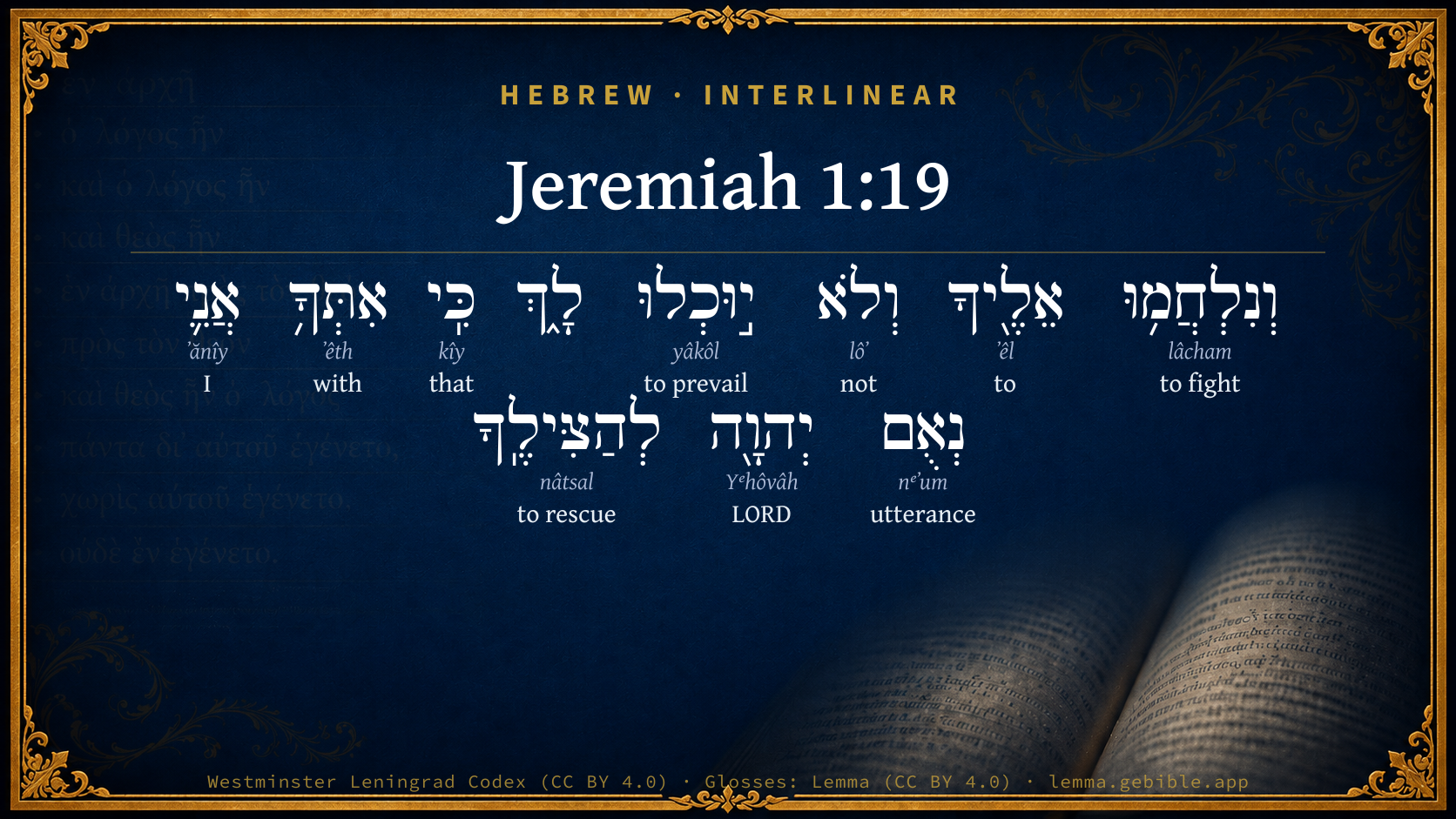
Hebrew (Westminster Leningrad Codex) Jeremiah 1:19 appears in the Hebrew Old Testament. The text above is from the Westminster Leningrad Codex. Each word links to its Strong’s number, a concise gloss, and parsing drawn from the Open Scriptures Hebrew Bible morphology. Click any word for its full Brown-Driver-Briggs (BDB) entry.
Download image
Cite this verse

Jeremiah 1:19 (World English Bible). Public Domain. Lemma interlinear Bible study tool, https://lemma.gebible.app/v/jeremiah/1/19.

Show BibTeX & RIS
BibTeX
RIS
English Translation
They shall fight against you; but they shall not prevail against you: for I am with you, says Yahweh, to deliver you.
World English Bible · Public Domain
Download a study sheet

One document with this verse’s original text, its word-by-word gloss line, the meaning frame, cross-references with their text, attributed commentary, and full source and license credits — printable, and it pastes into notes with its structure intact.

This verse Autodidact and up

Study sheet (.html) Plain text (.txt)

A passage Seminary Student

Up to 50 verses in one chapter. A passage sheet keeps up to 6 commentary sources and 12 cross-references per verse, in the order this page ranks them, and says so on the sheet whenever that leaves anything out. Ask for a single verse and you get the Autodidact verse sheet above.

Everything on this page stays free to read, with no account — the sheet is a download of what is already on screen, not access to it.

Want to remove ads? Support Godless Engineer
Compare translations 3

The same verse in 3 English versions, stacked beneath the original-language interlinear above. Click any original word for its lexicon entry.

Each is an independent rendering of the whole verse — the interlinear is not word-aligned to these translations.

Highlighted words mark where these versions differ — a whole-verse word diff, not a word-by-word alignment.

  • World English Bible Public Domain
    They shall fight against you; but they shall not prevail against you: for I am with you, says Yahweh, to deliver you.
  • King James Version Public Domain
    And they shall fight against thee; but they shall not prevail against thee; for I am with thee, saith the LORD, to deliver thee.
  • unfoldingWord Literal Text CC BY-SA 4.0
    And they will fight against you, but they will not prevail against you, for I with you to rescue you—the declaration of Yahweh.”

unfoldingWord Literal Text — © unfoldingWord, licensed CC BY-SA 4.0. Word-aligned USFM3 via Door43 (git.door43.org/unfoldingWord/en_ult).

Versions to compare (up to 4)

3 of 4 selected

Show all 18 translations

Every available English version of this verse, each an independent rendering of the whole verse.

  • World English Bible Public Domain
    They shall fight against you; but they shall not prevail against you: for I am with you, says Yahweh, to deliver you.
  • Berean Standard Bible Public Domain
    They will fight against you but will never overcome you, since I am with you to deliver you,” declares the LORD.
  • Majority Standard Bible Public Domain
    They will fight against you but will never overcome you, since I am with you to deliver you,” declares the LORD.
  • King James Version Public Domain
    And they shall fight against thee; but they shall not prevail against thee; for I am with thee, saith the LORD, to deliver thee.
  • American Standard Version (1901) Public Domain
    And they shall fight against thee; but they shall not prevail against thee: for I am with thee, saith Jehovah, to deliver thee.
  • Revised Version (1885) Public Domain
    And they shall fight against thee; but they shall not prevail against thee: for I am with thee, saith the LORD, to deliver thee.
  • Geneva Bible (1599) Public Domain
    For they shall fight against thee, but they shall not preuaile against thee: for I am with thee to deliuer thee, sayth the Lord.
  • Douay-Rheims (1899) Public Domain
    And they shall fight against thee, and shall not prevail: for I am with thee, saith the Lord, to deliver thee.
  • Young's Literal Translation Public Domain
    and they have fought against thee, and they prevail not against thee; for with thee `am' I, -- an affirmation of Jehovah -- to deliver thee.
  • Literal Standard Version CC BY-SA 4.0
    and they have fought against you, and they do not prevail against you; for I [am] with you,” a declaration of YHWH, “to deliver you.”
  • Unlocked Literal Bible CC BY-SA 4.0
    They will fight against you, but they will not defeat you, for I will be with you to rescue you—this is Yahweh's declaration.”
  • unfoldingWord Literal Text CC BY-SA 4.0
    And they will fight against you, but they will not prevail against you, for I with you to rescue you—the declaration of Yahweh.”
  • Darby Bible Public Domain
    And they shall fight against thee, but they shall not prevail against thee: for I am with thee, saith Jehovah, to deliver thee.
  • World Messianic Bible Public Domain
    They will fight against you, but they will not prevail against you; for I am with you”, says the LORD, “to rescue you.”
  • Webster's Bible Public Domain
    And they shall fight against thee; but they shall not prevail against thee; for I am with thee, saith the LORD, to deliver thee.
  • Free Bible Version CC BY-SA 4.0
    They will fight against you but they won't defeat you, because I'll be there to rescue you,” declares the Lord.
  • Bible in Basic English Public Domain
    They will be fighting against you, but they will not overcome you: for I am with you, says the Lord, to give you salvation.
  • JPS Tanakh (1917) Public Domain
    And they shall fight against thee; but they shall not prevail against thee; For I am with thee, saith the LORD, to deliver thee.'

Literal Standard Version (2020), Covenant Press — licensed CC BY-SA 4.0. Text via the HelloAO Bible API (eBible.org). Unlocked Literal Bible (unfoldingWord) — licensed CC BY-SA 4.0. Text via the HelloAO Bible API (eBible.org). unfoldingWord Literal Text — © unfoldingWord, licensed CC BY-SA 4.0. Word-aligned USFM3 via Door43 (git.door43.org/unfoldingWord/en_ult). Free Bible Version, Dr. Jonathan Gallagher — licensed CC BY-SA 4.0. Text via the HelloAO Bible API (eBible.org).

Word by word

More ways to search: Search by grammar → Find every occurrence → Compare this word →

Practice this passage: Drill this verse → Learn its vocabulary →

וְנִלְחֲמ֥וּ
lâcham
H3898
“and · to fight”
Conjunction + Verb, Niphal, Sequential Perfect, 3rd Person, Common, Plural
Part of Speech
Conjunction + Verb
Stem
Niphal
Form
Sequential Perfect
Person
3rd Person
Gender
Common
Number
Plural
Full BDB Definition

Origin: a primitive root

TWOT: 1104 , 1105

to fight, do battle, make war - (Qal) to fight, do battle - (Niphal) to engage in battle, wage war - (Qal) to eat, use as food
  1. אֵלֶ֖יךָ ʼêl H413 “to · you” Preposition + Suffix, Personal, 2nd Person, Masculine, Singular
  2. וְלֹא lôʼ H3808 “and · not” Conjunction + Particle, Negative
  3. י֣וּכְלוּ yâkôl H3201 “to prevail” Verb, Qal, Imperfect, 3rd Person, Masculine, Plural
  4. כִּֽי kîy H3588 “that” Conjunction
  5. אִתְּךָ֥ ʼêth H854 “with · you” Preposition + Suffix, Personal, 2nd Person, Masculine, Singular
  6. אֲנִ֛י ʼănîy H589 “I” Pronoun, Personal, 1st Person, Common, Singular
  7. נְאֻם nᵉʼum H5002 “utterance of” Noun, Common, Masculine, Singular, Construct
  8. יְהוָ֖ה Yᵉhôvâh H3068 “LORD” Noun, Proper
  9. לְהַצִּילֶֽךָ nâtsal H5337 “to rescue · you” Preposition + Verb, Hiphil, Infinitive Construct + Suffix, Personal, 2nd Person, Masculine, Singular

About this verse

These counts appear in no published source. They are computed here, from the morphology-tagged text and Lemma’s own curated glosses. What Lemma adds →

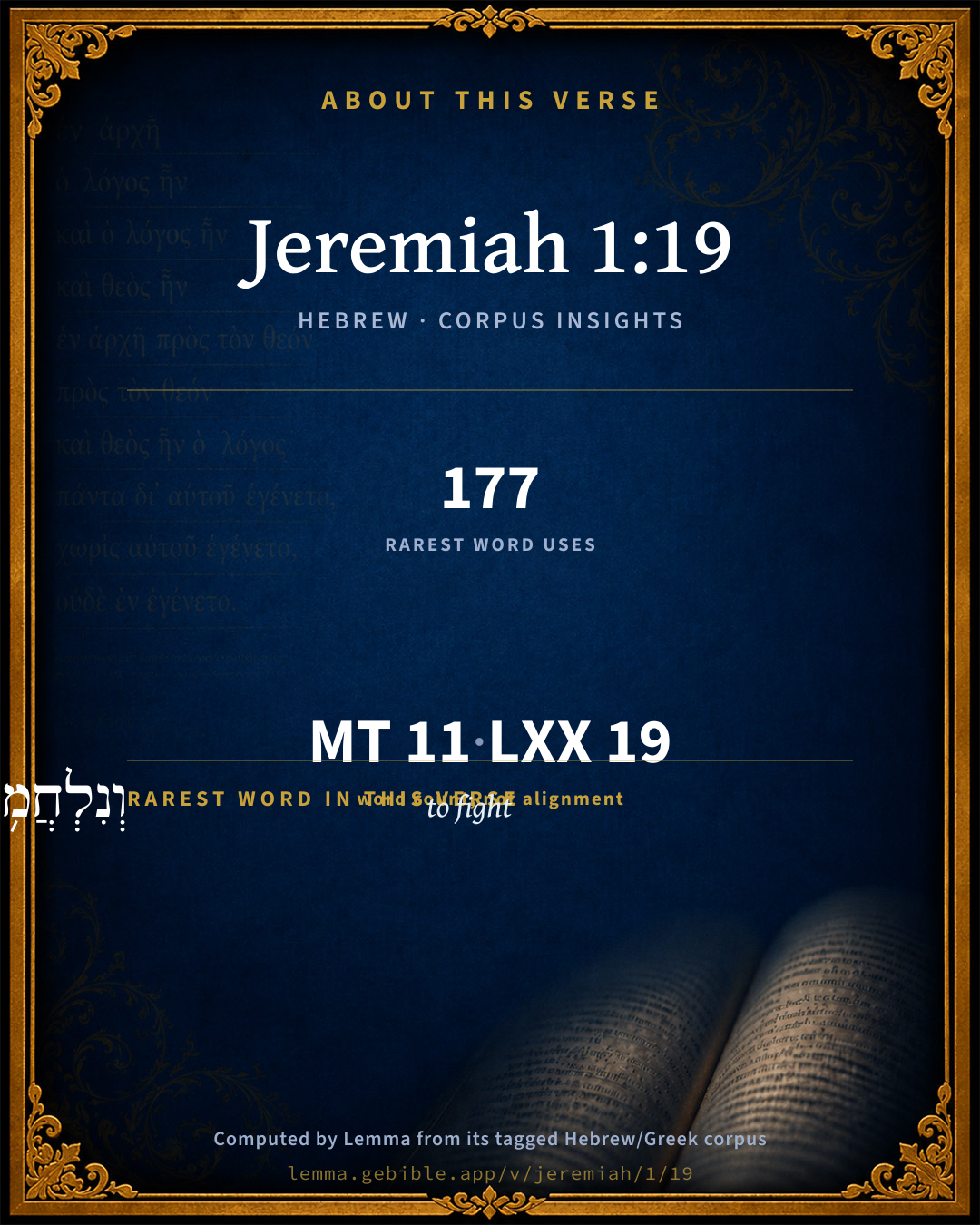
11
words
10
distinct lemmas
Prophets
section

Grammatical profile

  • 3 verbs
  • 2 nouns
  • 1 pronoun
  • 3 prepositions
  • 1 conjunction
  • 1 particle

Verb forms

  • וְנִלְחֲמ֥וּ Niphal · Sequential Perfect
  • י֣וּכְלוּ Qal · Imperfect
  • לְהַצִּילֶֽךָ Hiphil · Infinitive Construct

Hebrew & Septuagint length

In the original languages it is 11 Hebrew tokens and 19 Greek tokens — but the two are counted differently (Hebrew bundles its prefixes and suffixes into one token; the Greek is in lemma form), so that isn’t a like-for-like length.

Cross-references

11

Topical passages linked to Jeremiah 1:19 in the Treasury of Scripture Knowledge — connected by theme and wording, ordered by reader-vote popularity; previews shown in the World English Bible.

  • Joshua 1:9 Haven't I commanded you? Be strong and of good courage; don't be afraid, neither be dismayed: for Yahweh your God is with you wherever you go.
  • Jeremiah 1:8 Don't be afraid because of them; for I am with you to deliver you, says Yahweh.
  • Jeremiah 20:11 But Yahweh is with me as an awesome mighty one: therefore my persecutors shall stumble, and they shall not prevail; they shall be utterly disappointed, because they have not dealt wisely, even with an everlasting dishonor which shall never be forgotten.
  • Psalms 129:2 Many times they have afflicted me from my youth up, Yet they have not prevailed against me.
  • Jeremiah 29:25–32 Thus speaks Yahweh of Hosts, the God of Israel, saying, Because you have sent letters in your own name to all the people who are at Jerusalem, and to Zephaniah the son of Maaseiah, the priest, and to all the priests, saying,
  • Jeremiah 11:19 But I was like a gentle lamb that is led to the slaughter; and I didn't know that they had devised devices against me, [saying], Let us destroy the tree with the fruit of it, and let us cut him off from the land of the living, that his name may be no more remembered.
  • Jeremiah 15:10–21 Woe is me, my mother, that you have borne me a man of strife and a man of contention to the whole earth! I have not lent, neither have men lent to me; [yet] everyone of them does curse me.
  • Jeremiah 26:11–24 Then spoke the priests and the prophets to the princes and to all the people, saying, This man is worthy of death; for he has prophesied against this city, as you have heard with your ears.
  • Jeremiah 37:11–21 It happened that, when the army of the Chaldeans was broken up from Jerusalem for fear of Pharaoh's army,
  • Jeremiah 20:1–6 Now Pashhur, the son of Immer the priest, who was chief officer in the house of Yahweh, heard Jeremiah prophesying these things.
  • Jeremiah 38:6–13 Then took they Jeremiah, and cast him into the dungeon of Malchijah the king's son, that was in the court of the guard: and they let down Jeremiah with cords. In the dungeon there was no water, but mire; and Jeremiah sank in the mire.

Cross-references courtesy of OpenBible.info (CC BY 4.0).

Hebrew and Greek witnesses Masoretic Hebrew ↔ Greek Septuagint

The same verse in the two great witnesses to the Old Testament, shown verse-for-verse.

These are two independent witnesses, not word-aligned to each other, and the Septuagint is shown in lemma (dictionary) form.

Hebrew Jeremiah 1:19 Masoretic · Westminster Leningrad Codex

וְנִלְחֲמ֥וּ אֵלֶ֖יךָ וְלֹא י֣וּכְלוּ לָ֑ךְ כִּֽי אִתְּךָ֥ אֲנִ֛י נְאֻם יְהוָ֖ה לְהַצִּילֶֽךָ

They shall fight against you; but they shall not prevail against you: for I am with you, says Yahweh, to deliver you.

World English Bible · Public Domain

Greek LXX Structure differs

In the Septuagint, Jeremiah is about an eighth shorter than the Hebrew and arranges its material differently — the Oracles Against the Nations (Hebrew chapters 46–51) appear in the middle of the Greek book, after 25:13. Because the chapter and verse boundaries do not line up, a verse-for-verse comparison with the Hebrew is not shown.

A verse-for-verse comparison isn’t shown here because the chapters and verses don’t line up. Switch to the LXX edition with the MT / LXX toggle above to read the Greek directly.

Hebrew: Westminster Leningrad Codex (CC BY 4.0). Greek: Septuagint (public domain); English from a public-domain English Septuagint. How the Septuagint differs from the Hebrew →

Targum (Aramaic paraphrase)

1

The Targum is the ancient Jewish Aramaic paraphrase of the Hebrew Scriptures — an interpretive translation, not the Hebrew text itself. Onkelos (literal) and Pseudo-Jonathan (expansive) render the Torah, and Jonathan the Prophets. Coverage is partial: where no permissively-licensed English translation exists for a verse, only the Aramaic is shown. This is verse-level text, not a word-by-word alignment to the Hebrew.

  1. Targum Jonathan Prophets (Joshua–Malachi)
    וִיהוֹן דְיָנִין וּמְגִיחִין לְקִבְלָךְ לְמִסְתַּר יַת פִּתְגָמֵי נְבוּאֲתָךְ וְלָא יָכְלִין לָךְ אֲרֵי בְסַעְדָךְ מֵימְרִי אֲמַר יְיָ לְשֵׁיזָבוּתָךְ:

    (no public-domain English translation for this verse)

    Targum Jonathan — Aramaic: “Mikraot Gedolot” (public domain). English: “Sefaria Community Translation” (CC0 1.0 (public-domain dedication)); “London "Chaldee Paraphrase," 1871” (public domain). Text via Sefaria.

Commentary

Notes on Jeremiah 1:19 from classic Christian and Jewish commentators (each source and its license shown beneath its notes). The classic Christian expositions comment on the surrounding passage and are grouped to its opening verse, so a note may address several verses; the Jewish commentaries on the Tanakh (Rashi and others) are per-verse, so they appear only where the commentator wrote on this verse.

Lemma curates 59 commentaries, every one of them public domain or Creative Commons licensed, each selected and text-cleaned for this edition rather than reprinted as found. About our sources →

Trapp's Complete Commentary

John Trapp

Jer 1:19 And they shall fight against thee; but they shall not prevail against thee; for I [am] with thee, saith the LORD, to deliver thee.

Ver. 19. They shall not prevail against me.] They shall not take thy crown from thee, no, nor thy precious life; for thou shalt survive them. So Luther died in his bed, defying the malice of Rome and of hell.

For I am with thee.] And what can all the wicked do against one minister armed with God’s presence and power?

John Trapp, A Commentary or Exposition upon All the Books of the Old and New Testament (1647–1656) — public domain. Text from a community e-Sword module.

The Biblical Illustrator

Joseph S. Exell

Jer_1:19

And they shall fight against thee.

Opposition

I. The vehemence of our foes.

1. Formerly this virulence was manifested in revolting cruelties; lit fires of martyrdom; crowded prisons with sufferers for conscience sake; drove thousands into exile; even disturbed ashes of pious dead to emphasise the execrations of the living.

2. Now opposition resorts to more secret, though not less deadly means. Seeks to prison confidence and joys; impede progress, disturb peace, destroy spirituality.

II. The certainty of our security. Saints may be weary, maimed, fearful, but cannot be ultimately defeated. False professors will fall a prey: indeed they tempt the tempter; but true men are sure of victory.

III. The source of our confidence.

1. The abiding presence of the Lord.

2. The constant manifestation of the power of the Lord. (R. A. Griffin.)

Persistence in spite of opposition

As the springs do not cease from giving forth their waters, or the rivers their streams, albeit no man come to take up any, or to sail upon them: so must not the minister cease from preaching, admonition, and reproving, albeit in manner, no man make profit of his doctrine and admonition. (J. Spencer.)

.

The Biblical Illustrator, edited by Joseph S. Exell (c. 1880s–1900s) — public domain. Text from a community e-Sword module.

Tyndale Open Study Notes

Tyndale Open Resources

1:19 I, the Lord, have spoken: This statement has the force of a royal decree (see study note on 2:2).

Tyndale Open Study Notes — © Tyndale Open Resources, licensed CC BY-SA 4.0. Text via the HelloAO Bible API.

Adam Clarke's Commentary

Verse 19. They shall not prevail against thee] Because I am determined to defend and support thee against all thy enemies. One of the ancients has said, Θεου θελοντος, και επι ῥιπος πλεῃ Σωζῃ· Thestius, apud Theophil. ad Autolyc. lib. ii. "God protecting thee, though thou wert at sea upon a twig, thou shouldst be safe."

Adam Clarke's Commentary on the Bible (1810–1826) — public domain. Text from a community e-Sword/MySword module.

John Calvin's Commentaries

God in this verse briefly reminds his servant, that though he would be supplied with invincible power, yet he would have great trials, so that his office would not be, according to a common saying, a mere play. He then shews for what purpose he would be made like a fortified city, an iron pillar, and a brazen wall, even that he might manfully fight, and not for the purpose of keeping away all dangers, and all fightings, and everything hard and grievous to the flesh. We, in short, see that the promise was given for this end, — that Jeremiah, relying on God’s aid, might not hesitate to set himself against all the Jews, and that whatever might be their fury, he might still be courageous.

Now a profitable doctrine may be hence gathered, even this — that whenever God promises his servants victory over their enemies, they ought not to make this the occasion of fostering their torpidity or idleness, but, on the contrary, of gathering courage, so that they may proceed boldly and unweariedly in the course of their vocation. In short, God promises to be their deliverer, but at the same time exhorts them to resist all the assaults of their enemies.

Hence he says, They shall fight with thee, but they shall not prevail, for I am with thee to deliver thee From these words we see that Jeremiah was fully armed, that he might not fear on seeing dangers surrounding him; for God does not here declare that he would be like a wall to him to prevent him from being assaulted, but he says that he would deliver him; as though he had said, “Prepare thyself to suffer; for except I were thy deliverer, it would be all over with thee, and thou mightest perish a hundred times; but there is no reason for thee to fear any dangers amidst thousand deaths, since I am present with thee as thy deliverer.” Now follows —

John Calvin's Commentaries (1540-1563) — public domain. Text from the Calvin Translation Society English edition (1840s-50s) via the Christian Classics Ethereal Library (ccel.org). Calvin's coverage is partial (roughly two-thirds of the Bible); uncommented books and verses are honest gaps, never fabricated. The 19th-century editor's footnotes and remarks are omitted so the notes are faithfully Calvin's own voice.

Ellicott's Commentary for English Readers

(19) I am with thee.—That thought was in itself enough. The presence, and therefore the protection, of the All-wise and the Almighty was the one condition of safety. Even in its lower sense, “Immanuel,” God with us (Isa_7:14), was the watchword of every true combatant in God’s great army.

A Bible Commentary for English Readers, edited by Charles John Ellicott (1878–1897) — public domain. Text from a community e-Sword module.

The Cambridge Bible for Schools and Colleges

gen. ed. J. J. S. Perowne

19. they shall not prevail against thee] When we compare portions of the subsequent history of Jeremiah, we find that in point of fact the prophet was from time to time at the mercy of his foes. The sense therefore here is shall not finally prevail. Before the prophet’s death his cause should be vindicated, his predictions verified, and good seed sown. Cp. the nature of the fulfilment of our Saviour’s prayer in Luk_22:32.

The Cambridge Bible for Schools and Colleges (gen. ed. J. J. S. Perowne; Cambridge University Press, 1878–1918) — public domain. Text from a community e-Sword module.

John Gill's Exposition

And they shall fight against thee,.... The Targum adds,

"that they may hide the words of thy prophecy;''

hinder him from prophesying, stop his mouth, and even take away his life:

but they shall not prevail against thee; as to do either:

for I am with thee, saith the Lord, to deliver thee; as he did; he hid him when they sought for him, and delivered him out of the dungeon and bonds into which he was cast by them; See Gill on Jer 1:8.

Next: Jeremiah Chapter 2

John Gill's Exposition of the Whole Bible (1746–1763) — public domain (CC PDM 1.0). Text via the HelloAO Bible API.

Haydock's Catholic Bible Commentary

Prevail. God does not promise peace, but victory. (Worthington)

George Leo Haydock (1774–1849), Haydock's Catholic Family Bible and Commentary, 1859 edition — public domain. Excludes Psalms (Douay-Rheims chapter numbering differs from Protestant) and Deuterocanonical books (Catholic canon only).

Matthew Poole's English Annotations

They shall fight against thee; make united attempts upon thee. See Jdg 20:11.

They shall not prevail; they shall not be able, by all their devices, to shorten thy days, Jer 15:20; 20:10,11.

For I am with thee: here is the reason given of his safety, God will be his guard. See Jer 1:8; 2Ti 4:17,18.

Matthew Poole's English Annotations on the Holy Bible (1683–1685) — public domain. Text from a community e-Sword/MySword module.

Rashi

Rabbi Shlomo Yitzchaki (Rashi)

And they shall fight against you They shall quarrel and fight against you to refute the words of your prophecy.

Rashi on the Tanakh — English translations: “The Judaica Press complete Tanach with Rashi, translated by A. J. Rosenberg” (CC BY 4.0); “Pentateuch with Rashi's commentary by M. Rosenbaum and A.M. Silbermann, 1929-1934” (public domain); “The Metsudah Tanach series, Lakewood, N.J” (CC BY 4.0); and “The Book of Joshua, Metsudah Publications, 1997” (CC BY 4.0). Text via Sefaria.

Lesson kit

Teaching starters — assembled from the data on this page, not authored interpretation. Every prompt links to the verse data it draws on. Edit before teaching.

Jeremiah, in the Prophets, opens this verse with 11 words (10 distinct Hebrew lemmas). Its most distinctive word is lâcham (“to fight”). A historical commentator’s framing appears above. Read the whole chapter for the surrounding context.

Discussion questions

  1. How does “to fight” (lâcham) shape what this verse is saying?
  2. Joshua 1:9 shares this passage’s theme. How do the two illuminate each other?
  3. The translations on this page render this verse differently — a whole-verse word diff, not a word-by-word alignment. What might account for the different wordings?
  4. The verb «וְנִלְחֲמ֥וּ» is Niphal Sequential Perfect. How does its form color the action?
  5. Reading how Trapp's Complete Commentary and The Biblical Illustrator read this verse, where do the two commentators agree and where do they part?

Things to notice

Reading settings

Reading text

Shown beneath each verse's original-language words.

Old Testament
Old Testament edition

Read the OT as the Masoretic Hebrew (MT) or the Greek Septuagint (LXX).

English shown for the Greek Septuagint (in the Hebrew ↔ Greek comparison).

Comparing translations? Open the Compare panel on any verse page to stack up to four side by side.