
Habakkuk 1:13

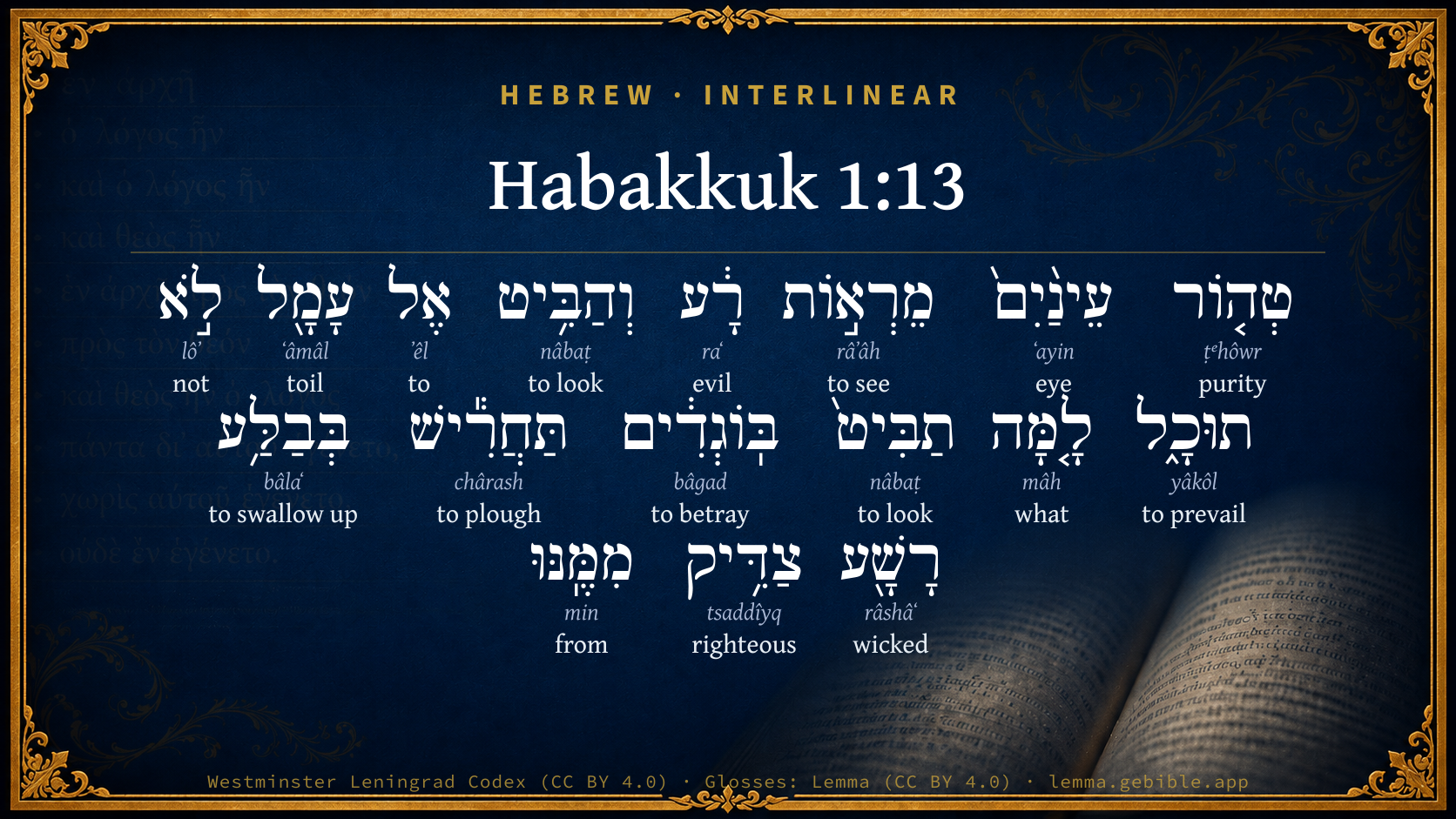
Hebrew (Westminster Leningrad Codex) Habakkuk 1:13 appears in the Hebrew Old Testament. The text above is from the Westminster Leningrad Codex. Each word links to its Strong’s number, a concise gloss, and parsing drawn from the Open Scriptures Hebrew Bible morphology. Click any word for its full Brown-Driver-Briggs (BDB) entry.
Download image
Cite this verse

Habakkuk 1:13 (World English Bible). Public Domain. Lemma interlinear Bible study tool, https://lemma.gebible.app/v/habakkuk/1/13.

Show BibTeX & RIS
BibTeX
RIS
English Translation
You who have purer eyes than to see evil, and who cannot look on perversity, why do you tolerate those who deal treacherously, and keep silent when the wicked swallows up the man who is more righteous than he,
World English Bible · Public Domain
Highlights
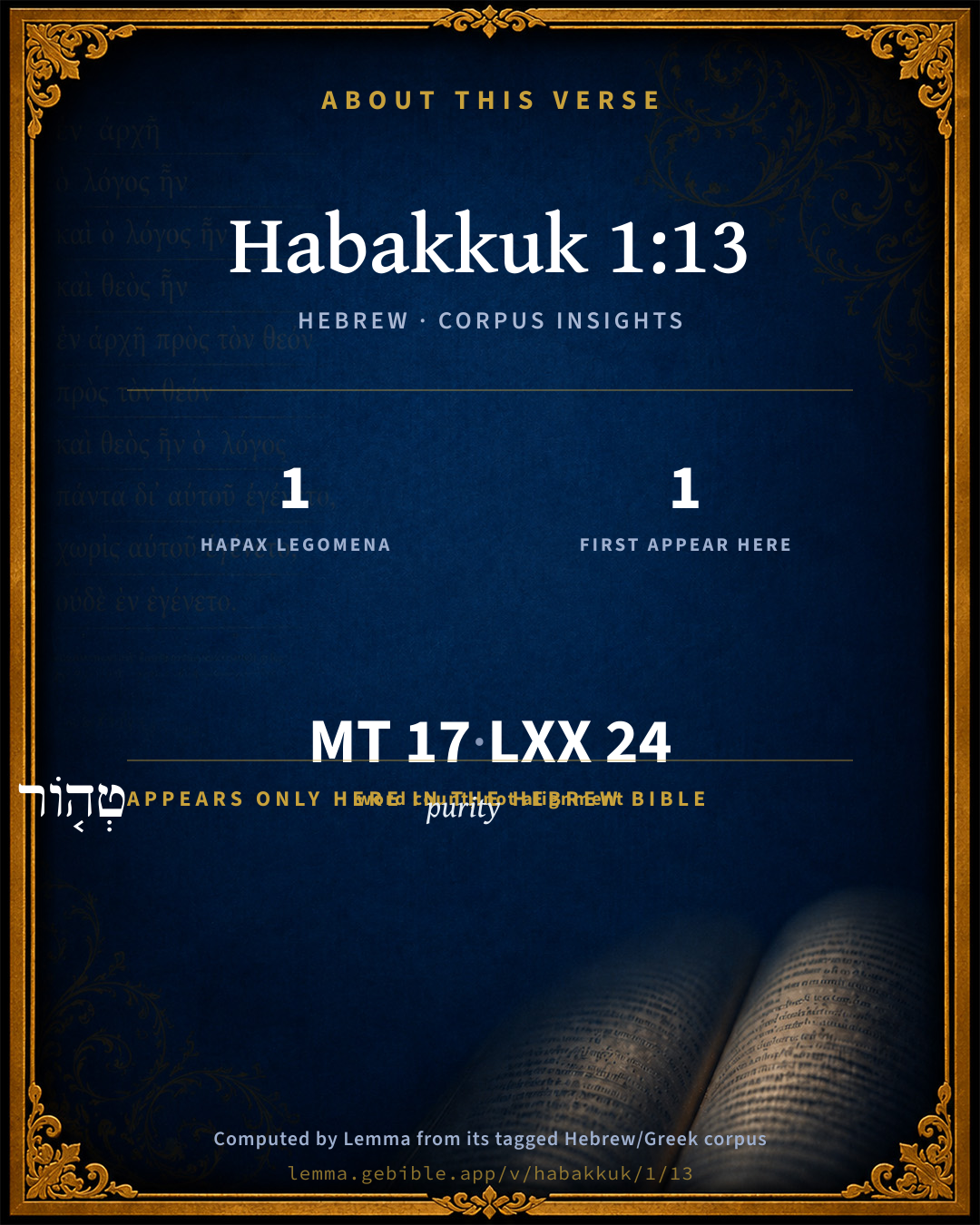
  • 1 hapax legomenon — only here in the Hebrew Bible
  • 1 first appearance in the Hebrew Bible
Full analysis ↓
Download a study sheet

One document with this verse’s original text, its word-by-word gloss line, the meaning frame, cross-references with their text, attributed commentary, and full source and license credits — printable, and it pastes into notes with its structure intact.

This verse Autodidact and up

Study sheet (.html) Plain text (.txt)

A passage Seminary Student

Up to 50 verses in one chapter. A passage sheet keeps up to 6 commentary sources and 12 cross-references per verse, in the order this page ranks them, and says so on the sheet whenever that leaves anything out. Ask for a single verse and you get the Autodidact verse sheet above.

Everything on this page stays free to read, with no account — the sheet is a download of what is already on screen, not access to it.

Want to remove ads? Support Godless Engineer
Compare translations 3

The same verse in 3 English versions, stacked beneath the original-language interlinear above. Click any original word for its lexicon entry.

Each is an independent rendering of the whole verse — the interlinear is not word-aligned to these translations.

Highlighted words mark where these versions differ — a whole-verse word diff, not a word-by-word alignment.

  • World English Bible Public Domain
    You who have purer eyes than to see evil, and who cannot look on perversity, why do you tolerate those who deal treacherously, and keep silent when the wicked swallows up the man who is more righteous than he,
  • King James Version Public Domain
    Thou art of purer eyes than to behold evil, and canst not look on iniquity: wherefore lookest thou upon them that deal treacherously, and holdest thy tongue when the wicked devoureth the man that is more righteous than he?
  • unfoldingWord Literal Text CC BY-SA 4.0
    Your eyes are pure from seeing evil, and you are not able to look at trouble. Why do you look at treacherous ones, keep silent when the wicked devours more righteous than him?

unfoldingWord Literal Text — © unfoldingWord, licensed CC BY-SA 4.0. Word-aligned USFM3 via Door43 (git.door43.org/unfoldingWord/en_ult).

Versions to compare (up to 4)

3 of 4 selected

Show all 18 translations

Every available English version of this verse, each an independent rendering of the whole verse.

  • World English Bible Public Domain
    You who have purer eyes than to see evil, and who cannot look on perversity, why do you tolerate those who deal treacherously, and keep silent when the wicked swallows up the man who is more righteous than he,
  • Berean Standard Bible Public Domain
    Your eyes are too pure to look upon evil, and You cannot tolerate wrongdoing. So why do You tolerate the faithless? Why are You silent while the wicked swallow up those more righteous than themselves?
  • Majority Standard Bible Public Domain
    Your eyes are too pure to look upon evil, and You cannot tolerate wrongdoing. So why do You tolerate the faithless? Why are You silent while the wicked swallow up those more righteous than themselves?
  • King James Version Public Domain
    Thou art of purer eyes than to behold evil, and canst not look on iniquity: wherefore lookest thou upon them that deal treacherously, and holdest thy tongue when the wicked devoureth the man that is more righteous than he?
  • American Standard Version (1901) Public Domain
    Thou that art of purer eyes than to behold evil, and that canst not look on perverseness, wherefore lookest thou upon them that deal treacherously, and holdest thy peace when the wicked swalloweth up the man that is more righteous than he;
  • Revised Version (1885) Public Domain
    Thou that art of purer eyes than to behold evil, and that canst not look on perverseness, wherefore lookest thou upon them that deal treacherously, and holdest thy peace when the wicked swalloweth up the man that is more righteous than he;
  • Geneva Bible (1599) Public Domain
    Thou art of pure eyes, and canst not see euill: thou canst not behold wickednesse: wherefore doest thou looke vpon the transgressors, and holdest thy tongue when the wicked deuoureth the man, that is more righteous then he?
  • Douay-Rheims (1899) Public Domain
    Thy eyes are too pure to behold evil, and thou canst not look on iniquity. Why lookest thou upon them that do unjust things, and holdest thy peace when the wicked devoureth the man that is more just than himself?
  • Young's Literal Translation Public Domain
    Purer of eyes than to behold evil, To look on perverseness Thou art not able, Why dost Thou behold the treacherous? Thou keepest silent when the wicked Doth swallow the more righteous than he,
  • Literal Standard Version CC BY-SA 4.0
    Purer of eyes than to behold evil, || You are not able to look on perverseness, || Why do You behold the treacherous? You keep silent when the wicked || Swallow the more righteous than he,
  • Unlocked Literal Bible CC BY-SA 4.0
    Your eyes are too pure to gaze upon evil, and you are not able to look on wrongdoing with favor; why then have you looked favorably on those who betray? Why are you silent while the wicked swallow up those more righteous than they are?
  • unfoldingWord Literal Text CC BY-SA 4.0
    Your eyes are pure from seeing evil, and you are not able to look at trouble. Why do you look at treacherous ones, keep silent when the wicked devours more righteous than him?
  • Darby Bible Public Domain
    [Thou art] of purer eyes than to behold evil, and canst not look on mischief: wherefore lookest thou upon them that deal treacherously, [and] keepest silence when the wicked swalloweth up a [man] more righteous than he?
  • World Messianic Bible Public Domain
    You who have purer eyes than to see evil, and who cannot look on perversity, why do you tolerate those who deal treacherously and keep silent when the wicked swallows up the man who is more righteous than he,
  • Webster's Bible Public Domain
    Thou art of purer eyes than to behold evil, and canst not look on iniquity: why lookest thou on them that deal treacherously, and keepest silence when the wicked devoureth the man that is more righteous than he?
  • Free Bible Version CC BY-SA 4.0
    Your eyes are too pure to look upon evil; you cannot stand the sight of wrong. So why do you put up with untrustworthy people? Why are you silent when the wicked destroy those who do less evil than they do?
  • Bible in Basic English Public Domain
    Before your holy eyes sin may not be seen, and you are unable to put up with wrong; why, then, are your eyes on the false? why do you say nothing when the evil-doer puts an end to one who is more upright than himself?
  • JPS Tanakh (1917) Public Domain
    Thou that art of eyes too pure to behold evil, and that canst not look on mischief, wherefore lookest Thou, when they deal treacherously, and holdest Thy peace, when the wicked swalloweth up the man that is more righteous than he;

Literal Standard Version (2020), Covenant Press — licensed CC BY-SA 4.0. Text via the HelloAO Bible API (eBible.org). Unlocked Literal Bible (unfoldingWord) — licensed CC BY-SA 4.0. Text via the HelloAO Bible API (eBible.org). unfoldingWord Literal Text — © unfoldingWord, licensed CC BY-SA 4.0. Word-aligned USFM3 via Door43 (git.door43.org/unfoldingWord/en_ult). Free Bible Version, Dr. Jonathan Gallagher — licensed CC BY-SA 4.0. Text via the HelloAO Bible API (eBible.org).

Word by word

More ways to search: Search by grammar → Find every occurrence → Compare this word →

Practice this passage: Drill this verse → Learn its vocabulary →

טְה֤וֹר
ṭᵉhôwr
H2890
“purity of”
Adjective, Adjective, Masculine, Singular, Construct
Part of Speech
Adjective
Type
Adjective
Gender
Masculine
Number
Singular
State
Construct
Full BDB Definition

Origin: from H2891

TWOT: 792b

pureness, cleanness, clean, pure - clean (ceremonially - of animals) - pure (physically) - pure, clean (morally, ethically)
  1. עֵינַ֨יִם֙ ʻayin H5869 “eyes” Noun, Common, Both, Dual, Absolute
  2. מֵרְא֣וֹת râʼâh H7200 “from · to see” Preposition + Verb, Qal, Infinitive Construct
  3. רָ֔ע raʻ H7451 “evil” Adjective, Adjective, Masculine, Singular, Absolute
  4. וְהַבִּ֥יט nâbaṭ H5027 “and · to look” Conjunction + Verb, Hiphil, Infinitive Construct
  5. אֶל ʼêl H413 “to” Preposition
  6. עָמָ֖ל ʻâmâl H5999 “toil” Noun, Common, Both, Singular, Absolute
  7. לֹ֣א lôʼ H3808 “not” Particle, Negative
  8. תוּכָ֑ל yâkôl H3201 “to prevail” Verb, Qal, Imperfect, 2nd Person, Masculine, Singular
  9. לָ֤מָּה mâh H4100 “to/for · what” Preposition + Particle, Interrogative
  10. תַבִּיט֙ nâbaṭ H5027 “to look” Verb, Hiphil, Imperfect, 2nd Person, Masculine, Singular
  11. בּֽוֹגְדִ֔ים bâgad H898 “betraying” Verb, Qal, Participle Active, Masculine, Plural, Absolute
  12. תַּחֲרִ֕ישׁ chârash H2790 “to plough” Verb, Hiphil, Imperfect, 2nd Person, Masculine, Singular
  13. בְּבַלַּ֥ע bâlaʻ H1104 “in/at · to swallow up” Preposition + Verb, Piel, Infinitive Construct
  14. רָשָׁ֖ע râshâʻ H7563 “wicked” Adjective, Adjective, Masculine, Singular, Absolute
  15. צַדִּ֥יק tsaddîyq H6662 “righteous” Adjective, Adjective, Masculine, Singular, Absolute
  16. מִמֶּֽנּוּ min H4480 “from · him” Preposition + Suffix, Personal, 3rd Person, Masculine, Singular

About this verse

These counts appear in no published source. They are computed here, from the morphology-tagged text and Lemma’s own curated glosses. What Lemma adds →

17
words
16
distinct lemmas
Prophets
section

Notable vocabulary

1 hapax legomenon — a word that appears only here in the entire Hebrew Bible:

  • טְה֤וֹר purity H2890

First appearance in Scripture

This word makes its first canonical appearance in the Hebrew Bible here:

  • טְה֤וֹר purity H2890

Shared distinctive vocabulary

בּֽוֹגְדִ֔ים to betray H898 occurs in 39 verses of the Hebrew Bible. Also found in:

Grammatical profile

  • 7 verbs
  • 2 nouns
  • 4 adjectives
  • 2 prepositions
  • 2 particles

Verb forms

  • מֵרְא֣וֹת Qal · Infinitive Construct
  • וְהַבִּ֥יט Hiphil · Infinitive Construct
  • תוּכָ֑ל Qal · Imperfect
  • תַבִּיט֙ Hiphil · Imperfect
  • בּֽוֹגְדִ֔ים Qal · Participle Active
  • תַּחֲרִ֕ישׁ Hiphil · Imperfect
  • בְּבַלַּ֥ע Piel · Infinitive Construct

Repetition

A word recurs within this verse — often emphatic in Hebrew:

  • וְהַבִּ֥יט to look H5027 ×2

Hebrew & Septuagint length

In English translation the verse runs 39 words from the Hebrew and 32 from the Septuagint (LXX English) — closely comparable.

A rough comparison of the two English renderings, which tokenize alike — not a word-level alignment.

Word counts can differ between the Hebrew and the Greek without any difference in meaning — e.g. the Hebrew direct-object marker אֵת has no separate Greek word, and Greek often adds the article ὁ.

In the original languages it is 17 Hebrew tokens and 24 Greek tokens — but the two are counted differently (Hebrew bundles its prefixes and suffixes into one token; the Greek is in lemma form), so that isn’t a like-for-like length.

Cross-references

26

Topical passages linked to Habakkuk 1:13 in the Treasury of Scripture Knowledge — connected by theme and wording, ordered by reader-vote popularity; previews shown in the World English Bible.

  • Psalms 5:4–5 For you are not a God who has pleasure in wickedness. Evil can't live with you.
  • Psalms 34:15–16 Yahweh's eyes are toward the righteous. His ears listen to their cry.
  • Jeremiah 12:1–2 Righteous are you, Yahweh, when I contend with you; yet would I reason the cause with you: why does the way of the wicked prosper? why are all they at ease who deal very treacherously?
  • Habakkuk 1:3–4 Why do you show me iniquity, and look at perversity? For destruction and violence are before me. There is strife, and contention rises up.
  • Proverbs 31:8–9 Open your mouth for the mute, In the cause of all who are left desolate.
  • 2 Samuel 4:11 How much more, when wicked men have slain a righteous person in his own house on his bed, shall I not now require his blood of your hand, and take you away from the earth?
  • Psalms 10:15 Break the arm of the wicked. As for the evil man, seek out his wickedness until you find none.
  • Psalms 50:3 Our God comes, and does not keep silent. A fire devours before him. It is very tempestuous around him.
  • 1 Peter 1:15–16 but just as he who called you is holy, you yourselves also be holy in all of your behavior;
  • 1 Kings 2:32 Yahweh will return his blood on his own head, because he fell on two men more righteous and better than he, and killed them with the sword, and my father David didn't know it, [to wit], Abner the son of Ner, captain of the host of Israel, and Amasa the son of Jether, captain of the host of Judah.
  • Esther 4:14 For if you altogether hold your peace at this time, then will relief and deliverance arise to the Jews from another place, but you and your father's house will perish: and who knows whether you haven't come to the kingdom for such a time as this?
  • Job 15:15 Behold, he puts no trust in his holy ones; Yes, the heavens are not clean in his sight:
  • Psalms 10:1–2 Why do you stand far off, Yahweh? Why do you hide yourself in times of trouble?
  • Psalms 11:4–7 Yahweh is in his holy temple. Yahweh is on his throne in heaven. His eyes observe. His eyes examine the children of men.
  • Psalms 35:22 You have seen it, Yahweh. Don't keep silent. Lord, don't be far from me.
  • Psalms 37:12–15 The wicked plots against the just, And gnashes at him with his teeth.
  • Psalms 37:32–33 The wicked watches the righteous, And seeks to kill him.
  • Psalms 50:21 You have done these things, and I kept silent. You thought that the "I AM" was just like you. I will rebuke you, and accuse you in front of your eyes.
  • Psalms 56:1–2 Be merciful to me, God, for man wants to swallow me up. All day long, he attacks and oppresses me.
  • Psalms 73:3 For I was envious of the arrogant, When I saw the prosperity of the wicked.
  • Psalms 83:1 God, don't keep silent. Don't keep silent, And don't be still, God.
  • Isaiah 21:2 A grievous vision is declared to me; the treacherous man deals treacherously, and the destroyer destroys. Go up, Elam; besiege, Media; all the sighing of it have I made to cease.
  • Isaiah 33:1 Woe to you who destroy, and you weren't destroyed; and deal treacherously, and they didn't deal treacherously with you! When you have ceased to destroy, you shall be destroyed; and when you have made an end of dealing treacherously, they shall deal treacherously with you.
  • Isaiah 64:12 Will you refrain yourself for these things, Yahweh? will you hold your peace, and afflict us very sore?
  • Acts 2:23 him, being delivered up by the determined counsel and foreknowledge of God, you have taken by the hand of lawless men, crucified and killed;
  • Acts 3:13–15 The God of Abraham, Isaac, and Jacob, the God of our fathers, has glorified his Servant Jesus, whom you delivered up, and denied in the presence of Pilate, when he had determined to release him.

Cross-references courtesy of OpenBible.info (CC BY 4.0).

Hebrew and Greek witnesses Masoretic Hebrew ↔ Greek Septuagint

The same verse in the two great witnesses to the Old Testament, shown verse-for-verse.

These are two independent witnesses, not word-aligned to each other, and the Septuagint is shown in lemma (dictionary) form.

Hebrew Habakkuk 1:13 Masoretic · Westminster Leningrad Codex

טְה֤וֹר עֵינַ֨יִם֙ מֵרְא֣וֹת רָ֔ע וְהַבִּ֥יט אֶל עָמָ֖ל לֹ֣א תוּכָ֑ל לָ֤מָּה תַבִּיט֙ בּֽוֹגְדִ֔ים תַּחֲרִ֕ישׁ בְּבַלַּ֥ע רָשָׁ֖ע צַדִּ֥יק מִמֶּֽנּוּ

You who have purer eyes than to see evil, and who cannot look on perversity, why do you tolerate those who deal treacherously, and keep silent when the wicked swallows up the man who is more righteous than he,

World English Bible · Public Domain

Greek LXX Habakkuk 1:13 Septuagint · lemma form

καθαρός ὀφθαλμός ὁ μή ὁράω πονηρός καί ἐπιβλέπω ἐπί πόνος οὐ δύναμαι ἵνα τίς ἐπιβλέπω ἐπί καταφρονέω παρασιωπάω ἐν ὁ καταπίνω ἀσεβής ὁ δίκαιος

His eye is too pure to behold evil doings, and to look upon grievous afflictions: therefore do you look upon despisers? will you be silent when the ungodly swallows up the just?

LXX2012 (modern English Septuagint) · Public Domain

On this verse, The Pulpit Commentary discusses the Septuagint’s reading. Read the note in Commentary ↓

Hebrew: Westminster Leningrad Codex (CC BY 4.0). Greek: Septuagint (public domain); English from LXX2012 (modern English Septuagint) (Public Domain). How the Septuagint differs from the Hebrew →

Targum (Aramaic paraphrase)

1

The Targum is the ancient Jewish Aramaic paraphrase of the Hebrew Scriptures — an interpretive translation, not the Hebrew text itself. Onkelos (literal) and Pseudo-Jonathan (expansive) render the Torah, and Jonathan the Prophets. Coverage is partial: where no permissively-licensed English translation exists for a verse, only the Aramaic is shown. This is verse-level text, not a word-by-word alignment to the Hebrew.

  1. Targum Jonathan Prophets (Joshua–Malachi)
    בְּרִיר מֵימְרָךְ מִלְמֶחֱזֵי בְּעוֹבָדֵי בִּישׁ וּמִלְאִסְתַּכָּלָא בְּעָבְדֵי לֵיאוּת שְׁקַר הֲלָא גְלֵי קֳדָמָךְ וּלְמָא אַתְּ מִסְתַּכֵּל בְּאָנְסִין וְאַתְּ יָהֵיב אַרְכָּא לְרַשִׁיעַיָא וּמְסַלְעֲמִין לִדְטָבִין מִנְהוֹן:

    (no public-domain English translation for this verse)

    Targum Jonathan — Aramaic: “Mikraot Gedolot” (public domain). English: “Sefaria Community Translation” (CC0 1.0 (public-domain dedication)); “London "Chaldee Paraphrase," 1871” (public domain). Text via Sefaria.

Commentary

Notes on Habakkuk 1:13 from classic Christian and Jewish commentators (each source and its license shown beneath its notes). The classic Christian expositions comment on the surrounding passage and are grouped to its opening verse, so a note may address several verses; the Jewish commentaries on the Tanakh (Rashi and others) are per-verse, so they appear only where the commentator wrote on this verse.

Lemma curates 59 commentaries, every one of them public domain or Creative Commons licensed, each selected and text-cleaned for this edition rather than reprinted as found. About our sources →

Trapp's Complete Commentary

John Trapp

Hab 1:13 [Thou art] of purer eyes than to behold evil, and canst not look on iniquity: wherefore lookest thou upon them that deal treacherously, [and] holdest thy tongue when the wicked devoureth [the man that is] more righteous than he?

Ver. 13. Thou art of purer eyes than to behold evil] sc. With patience, and without punishing it. This I am right sure of; and therefore cannot but conclude that thou wilt take an order with our oppressors, thou wilt one day pay them home, for the new and the old, though for a time they ruffle and revel in our ruins. God, as he is ολοφθαλμος, All-eye, neither can we be at any time from under his view; so εχει θεος εκδικον ομμα, he hath a holy eye that cannot behold evil and bear with it. Hence that of Joshua to the people, Jos 24:19, "Ye cannot serve the Lord," sc. unless ye first throw all your lusts out of service: "for he is a holy God; he is a jealous God; he will not forgive your trangressions nor your sins." Now, therefore, if Cave, spectat Cato, was such a forcible watchword among the Romans, and a retentive from evil; Take heed, Cato sees you, and will punish you; how much more should this prevail with Christians, Cave, videt Dominus, Take heed, the Lord beholdeth!

“ Ne pecces, Deus ipse videt, bonus Angelus astat. ”

Surely, as they were wont to say at Rome concerning cowards, that they had nothing Roman in them; so may it be said of such as stand not in awe of God’s pure eyes and dreadful presence, that they have nothing Christian in them, whatever they pretend; since it is every godly man’s care and comfort to be in the fear of the Lord all the day, to walk evermore in the sense of his presence and light of his countenance.

And canst not look on iniquity] Heb. And to look on iniquity thou canst not do it. Lo, this is one of those things that God cannot do; as he cannot lie, he cannot die, he cannot deny himself; so here, he cannot look on iniquity, sc. with approbation or delight. He cannot but hate it; and (as the next thing to hatred is revenge) he cannot but punish it, such is the holiness of his nature, Psa 5:4-6. He hateth sin naturally, as we hate poison for itself; and therefore let it be in a toad or in a prince’s cabin, we hate it still. Nevertheless, it must be remembered for our comfort, that, like as we hate poison in a toad, but pity it in a man, because in the one it is their nature, in the other their disease; so sin maketh wicked men the object of God’s hatred, but the saints of his pity; and accordingly, he chastiseth the one, but plagueth the other.

Wherefore lookest thou upon them that deal treacherously] And yet, such is thy tolerance, seemest to take no notice of their trespasses and treacheries; which I am sure thou hatest with a perfect hatred. Here then the prophet, disceptat potius secum, quam cum ipso Deo, saith Calvin, contesteth rather with himself than with God about the ordering of things here below. He doth not question the Divine providence, because good men suffer, bad men prosper, as Aristotle did. He doth not say with Pompey, when discomfited by Caesar, that there was a mist, at least, over the eye of providence; so blaming the sun because of the soreness of his own blear eyes. He doth not impatiently cry out with Brutus, defeated, ω τλημων αρετη, O wretched virtue, or, O hard fortune. But he modestly expostulated with the Lord about his proceedings, having before justified him; and now dareth not reprehend what he cannot yet so fully comprehend; but, putting his mouth in the dust, concludeth with David, after some conflict with his own doubtings, "I know, O Lord, that thy judgments are right, and that thou in faithfulness" ( non ad exitium, sed ad exercitium, not for destruction but for disciple, and that thou mightest be true to my soul) "hast afflicted me," Psa 119:75.

And holdest thy tongue] And so, by silence, seemest to consent (as the civilian’s rule is qui tacet, consentire videtur), but thou seemest so only, Psa 50:21 Or, art thou deaf? Not so neither, Psa 50:3.

When the wicked devoureth the man that is more righteous than he] i.e. The Chaldees destroy the Jews, which were some of them better than they; and the rest were therefore the worse, because they ought to have been better. The truth is, none are so bad as they that either have been good and are not; or that might have been better, but would not.

John Trapp, A Commentary or Exposition upon All the Books of the Old and New Testament (1647–1656) — public domain. Text from a community e-Sword module.

The Biblical Illustrator

Joseph S. Exell

Hab_1:13

Thou art of purer eyes than to behold evil, and canst not look upon iniquity.

The holiness of God

There is in our Maker a purity of nature, and an essential sort of holiness which render Him incapable of enduring sin in any person, or under any circumstances. I believe this is the very foundation of all religious feeling whatever. The true fear of God is the fear of His holiness.

1. This is no contradiction to the character in which God is exhibited to us in the Gospel, as a God of love. But we must notice the limits under which the love of God must be taken in application to ourselves. Only in the Gospel is it revealed.

2. God has always shown a sort of instinctive abhorrence of sin, which no worth of the individual sinner could induce Him to overcome. This holiness of God is opposed to sin in every form and degree. There is nothing in man which can reconcile the nature of God to sin. Is sin regarded by us, as we must know and believe it is regarded by God? (H. Raikes, A. M.)

The holiness of God

I. His holiness is universally manifest.

1. It is manifest to man.

(1) In law. The principles of His moral law are holy, just, and good.

(2) In providence. Justice is but holiness in action, and through all ages God has expressed His abhorrence of sin in the judgments He has inflicted.

(3) In Christ. He sent His Son into the world. What for? To put away sin. To cleanse humanity by His self-sacrificing life.

(4) In conscience. The moral constitution of man, which recoils from the wrong and sympathises with the right, manifests Gods holiness. There is no room for man, then, to doubt Gods holiness.

2. It is manifest to angels. They live in its light. They are adorned with its beauties, they are inspired with its glories, and their anthem is, Holy, holy, holy is the Lord God Almighty.

3. It is manifest to the lost. They are bound to exclaim, Just and right are Thy ways, Thou King of saints.

II. His holiness is eternally original. The holiness of all holy intelligences is derived from Him.

III. His holiness is gloriously effulgent. He is glorious in holiness. He is light, in Him there is no darkness at all.

IV. His holiness is absolutely standard. It is that to which the holiness of all other beings must come, and by which it must be tested. The law is, we are to be holy as He is holy. But how can fallen man be raised to this standard of holiness? Here is the answer, and the only satisfactory answer: For the grace of God that bringeth salvation hath appeared to all men, etc. (Homilist.)

Wherefore lookest Thou upon them that deal treacherously?--

Things that suggest mistrust of God

St. Hieroms opinion is that the name Habakkuk is derived from a word that signifies embracing, and may imply the embraces of a wrestler, who clasps his arms about the person he contends with. In this chapter we have the prophet contending with no less an antagonist than the great God, and upon no lower subject than His holiness, justice, and goodness. Is it not a very bold and daring thing for a creature thus to arraign the justice of His Creator? The father fore-mentioned explains that the prophet in his own person represents the frailty and impatience of man. We understand Habakkuk to be really saying, True it is, O Lord, we are a very wicked and sinful people; but yet not so bad as the tyrannous Nebuchadnezzar, and his idolatrous Chaldeans. How then can it be consistent with Thy justice and hatred to sin, to permit the greater sinners to prosper in their oppression of the less, of those that are better than themselves? Why dost Thou favour them in their treacherous enterprises? The words of the text contain an expostulation with God, concerning that seemingly strange dispensation of His providence in suffering the wicked to prosper and thrive, and that by the afflictions and oppressions of the righteous.

I. The ground and occasion of this expostulation of the text. Good men cannot oppress, or take indirect methods to thrive; they have a God above, and a conscience within, which overawe them, and will not suffer them to do it. Nor can they be supposed to use such means as may effectually secure them from the violences and oppressions of others; for the good man, charitably measuring others by himself, does not stand upon a constant guard, nor use preventive methods to keep off those injuries that he is not apprehensive of. But a bad man has none of those restraints of God, or conscience, or charity, to hinder him from falling upon the prey that lies exposed to him. It is not then to be wondered at that those who deal treacherously prosper, or that the wicked devoureth the man that is more righteous than he.

II. Inquire into the objections that are made against Gods permission hereof. How comes it to pass that God does not interpose, that He does not hinder the evil and defend the good? This has been a stumbling-block in all ages. It was to holy Job; to Jeremiah; and to Asaph. It is a great argument of the atheists to banish the belief of a God and His providence out of the world. They say, If God would hinder them but cannot, then is He not omnipotent; if He can, but will not, then is He not just and good; so that either His power, or His justice and goodness, must be given up; or else those attributes must be salved by the imperfection of His knowledge. But the true notion of God is a Being infinite in all perfections, and therefore he that is defective in knowledge can no more be God than he that is not infinite in power, justice, or goodness. And so they would dispute God out of being.

III. Vindicate the Divine providence by showing the weakness of these objections. It may be very consistent with the justice and goodness of God to permit these things. The objection is built upon the contrary supposition.

1. It is not inconsistent with Gods justice and goodness to suffer good men to be afflicted in this world, because--

(1) Afflictions are not always punishments, but means whereby God does a great deal of good and benefit to them that are exercised with them. He weans them from the world, reduces them (leads them back) when they are going astray, tries and proves their faith, patience, submission, resignation, etc.

2. Supposing afflictions to be punishments, the best men will find failings and sins enough in themselves to make the punishment reasonable. They may well think God good and merciful in thus chastising them.

3. He has appointed a day wherein He will abundantly recompense all the troubles and sorrows and sufferings of pious men with joys unspeakable.

4. It is not inconsistent with Gods justice and goodness to suffer bad men to be prosperous here.

(1) Prosperity is not always a blessing. If the impunity of the wicked be their hardening and judgment, it is certainly not unjust with God to suffer it.

(2) There is hardly any man so bad but has something of good in him, by which he is useful and serviceable to the world. For God to reward the natural or moral goodness of otherwise bad men, with outward temporal blessings, is agreeable to His rule of rewarding every one according to his works.

(3) It cannot argue want of justice or goodness in God to try all means to reduce wholly wicked men and make them better.

(4) There is a day of retribution coming.

5. It is not inconsistent with Gods justice and goodness to suffer bad men to be the instruments whereby good men are afflicted. If a thing has to be done, and is right to do, it cannot matter whether the agent employed is good or bad, so long as he is efficient for the work. And can the good be employed in many of these judgments, or calamities, or wrongs? If God may work by such things, He must use the sort of people who can do them. Inferences--

1. This subject gives us an irrefragable assurance of a future judgment and state.

2. Learn not to love the world, nor the things of the world.

3. The facts dwelt on should excite and inflame our desires and longings after the other world, where the wicked shall be made miserable, and the good man happy.

4. Learn not to think hardly of God, nor to envy wicked men when He permits them to persecute His Church, and to triumph in the miseries and ruin of His best servants. (W. Talbot, D. D.)

Wait, and you will see

Linnell, the artist, had a commission to paint a picture, for which he was to receive £1000. Not wishing any one to inspect it until perfected, he veiled it when not working at it, and wrote over it in Latin, Wait, and you will see. The final issue of much of Gods work is now hidden from us, but assured that, even in times of affliction, God is acting wisely, we must wait until He is pleased to let us see the finished glory of His work. (Gates of Imagery.)

The Biblical Illustrator, edited by Joseph S. Exell (c. 1880s–1900s) — public domain. Text from a community e-Sword module.

Joseph Benson's Commentary

Hab 1:13-17. Thou art of purer eyes than to behold evil — Thou art of too just and pure a nature to approve of wickedness: it must ever be an abomination to thee. Thou canst not look upon iniquity — Except with infinite abhorrence. Wherefore lookest thou upon them — Seemest to connive at, or dost not show any particular dislike at the violence of those idolatrous Chaldeans? And makest men as the fishes of the sea, &c. — By delivering them to Nebuchadnezzar, who takes them in his net, as a fisherman takes fishes; which creatures suffer themselves to be taken without resistance, because they have no power to defend themselves. As the creeping things that have no ruler, &c. — No chief to conduct or guard them. The Hebrews give the common name of reptiles to all fishes. They take up all of them with the angle — The prophet, having in the preceding verse compared men to fishes, continues here, by way of metaphor, to describe the advantages which the Chaldeans gained over other nations, by the several ways used by fishermen in taking fishes, as by catching them with the angle, enclosing them in nets, and gathering them in drags. Therefore they rejoice and are glad — On account of the prey they take; that is, the Chaldeans rejoice in taking a great number of captives, and gathering rich spoils, as fishermen rejoice when they catch a great number of fishes. Therefore they sacrifice unto their net, &c. — They impute all their victories to their own strength and skill, or to idols of their own making, and render no acknowledgments to God for their success. Because by them their portion is fat, &c. — Because by means of their victories they get abundance of rich spoil. Shall they therefore empty their net — Carry away the riches and spoils of their conquests, (see 2Ki 24:13,) in order to undertake more; just as fishermen empty their nets to fill them again. But the words may be properly rendered, Shall he therefore spread his net? in which sense the Vulgate, as also the Greek and Chaldee, here interpret the Hebrew verb ירוק, a word often used of drawing or unsheathing a sword or spear. And not spare continually to slay the nations — Wilt thou suffer them to go on to make havoc continually of all other nations? Shall they never be stopped in their career?

Joseph Benson's Commentary on the Old and New Testaments (1811–1818) — public domain. Text from a community e-Sword module.

Keil & Delitzsch

C. F. Keil & F. Delitzsch

The believing confidence expressed in this verse does not appear to be borne out by what is actually done by God. The prophet proceeds to lay this enigma before God in Hab 1:13-17, and to pray for his people to be spared during the period of the Chaldaean affliction. Hab 1:13. "Art Thou too pure of eye to behold evil, and canst Thou not look upon distress? Wherefore lookest Thou upon the treacherous? and art silent when the wicked devours one more righteous than he? Hab 1:14. And Thou hast made men like fishes of the sea, like reptiles that have no ruler. Hab 1:15. All of them hath he lifted up with the hook; he draws them into his net, and gathers them in his fishing net; he rejoices thereat, and is glad. Hab 1:16. Therefore he sacrifices to his net, and burns incense to his landing net; for through them is his portion rich, and his food fat. Hab 1:17. Shall he therefore empty his net, and always strangle nations without sparing?" In Hab 1:13, טהור עינים, with the two clauses dependent upon it, stands as a vocative, and טהור followed by מן as a comparative: purer of eyes than to be able to see. This epithet is applied to God as the pure One, whose eyes cannot bear what is morally unclean, i.e., cannot look upon evil. The purity of God is not measured here by His seeing evil, but is described as exalted above it, and not coming at all into comparison with it. On the relation in which these words stand to Num 23:21, see the remarks on Hab 1:3. In the second clause the infinitive construction passes over into the finite verb, as is frequently the case; so that אשׁר must be supplied in thought: who canst not look upon, i.e., canst not tolerate, the distress which the wicked man prepares for others. Wherefore then lookest Thou upon treacherous ones, namely, the Chaldaeans? They are called בּוגדים, from their faithlessly deceptive and unscrupulously rapacious conduct, as in Isa 21:2; Isa 24:16. That the seeing is a quiet observance, without interposing to punish, is evident from the parallel תּחרישׁ: Thou art silent at the swallowing of the צדיק ממּנּוּ. The more righteous than he (the ungodly one) is not the nation of Israel as such, which, if not perfectly righteous, was relatively more righteous than the Chaldaeans. This rabbinical view is proved to be erroneous, by the fact that in Hab 1:2 and Hab 1:3 the prophet describes the moral depravity of Israel in the same words as those which he here applies to the conduct of the Chaldaeans. The persons intended are rather the godly portion of Israel, who have to share in the expiation of the sins of the ungodly, and suffer when they are punished (Delitzsch). This fact, that the righteous is swallowed along with the unrighteous, appears irreconcilable with the holiness of God, and suggests the inquiry, how God can possibly let this be done.

This strange fact is depicted still further in Hab 1:14-16 in figures taken from the life of a fisherman. The men are like fishes, whom the Chaldaean collects together in his net, and then pays divine honour to his net, by which he has been so enriched. ותּעשׂה is not dependent upon למּה, but continues the address in a simple picture, in which the imperfect with Vav convers. represents the act as the natural consequence of the silence of God: "and so Thou makest the men like fishes," etc. The point of comparison lies in the relative clause לא־משׁל בּו, "which has no ruler," which is indeed formally attached to כּרמשׂ alone, but in actual fact belongs to דּגי היּם also. "No ruler," to take the defenceless under his protection, and shelter and defend them against enemies. Then will Judah be taken prisoner and swallowed up by the Chaldaeans. God has given it helplessly up to the power of its foes, and has obviously ceased to be its king. Compare the similar lamentation in Isa 63:19 : "are even like those over whom Thou hast never ruled." רמשׂ, the creeping thing, the smaller animals which exist in great multitudes, and move with great swiftness, refers here to the smaller water animals, to which the word remes is also applied in Psa 104:25, and the verb râmas in Gen 1:21 and Lev 11:46. כּלּה, pointing back to the collective 'âdâm, is the object, and is written first for the sake of emphasis. The form העלה, instead of העלה, is analogous to the hophal העלה in Nah 2:8 and Jdg 6:28, and also to העברתּ in Jos 7:7 : to take up out of the water (see Ges. 63, Anm. 4). יגרהוּ from גרר, to pull, to draw together. Chakkâh is the hook, cherem the net generally, mikhmereth the large fishing-net (σαγήνη), the lower part of which, when sunk, touches the bottom, whilst the upper part floats on the top of the water. These figures are not to be interpreted with such specialty as that the net and fishing net answer to the sword and bow; but the hook, the net, and the fishing net, as the things used for catching fish, refer to all the means which the Chaldaeans employ in order to subdue and destroy the nations. Luther interprets it correctly. "These hooks, nets, and fishing nets," he says, "are nothing more than his great and powerful armies, by which he gained dominion over all lands and people, and brought home to Babylon the goods, jewels, silver, and gold, interest and rent of all the world." He rejoices over the success of his enterprises, over this capture of men, and sacrifices and burns incense to his net, i.e., he attributes to the means which he has employed the honour due to God. There is no allusion in these words to the custom of the Scythians and Sauromatians, who are said by Herodotus (iv. 59, 60) to have offered sacrifices every year to a sabre, which was set up as a symbol of Mars. What the Chaldaean made into his god, is expressed in Hab 1:11, namely, his own power. "He who boasts of a thing, and is glad and joyous on account of it, but does not thank the true God, makes himself into an idol, gives himself the glory, and does not rejoice in God, but in his own strength and work" (Luther). The Chaldaean sacrifices to his net, for thereby (בּהמּה, by net and yarn) his portion (chelqō) is fat, i.e., the portion of this booty which falls to him, and fat is his food ( בּראה is a neuter substantive). The meaning is, that he thereby attains to wealth and prosperity. In Hab 1:17 there is appended to this the question embracing the thought: Shall he therefore, because he rejoices over his rich booty, or offers sacrifice to his net, empty his net, sc. to throw it in afresh, and proceed continually to destroy nations in so unsparing a manner? In the last clause the figure passes over into a literal address. The place of the imperfect is now taken by a periphrastic construction with the infinitive: Shall he constantly be about to slay? On this construction, see Ges. 132, 3, Anm. 1, and Ewald, 237, c. לא יחמול is a subordinate clause appended in an adverbial sense: unsparingly, without sparing.

Keil & Delitzsch — Biblical Commentary on the Old Testament (1861–1891) — public domain (CC PDM 1.0). Text via the HelloAO Bible API. (Old Testament only.)

Jamieson, Fausset & Brown

Robert Jamieson, A. R. Fausset & David Brown

purer . . . than to behold evil--without being displeased at it.

canst not look on iniquity--unjust injuries done to Thy people. The prophet checks himself from being carried too far in his expostulatory complaint, by putting before himself honorable sentiments of God.

them that deal treacherously--the Chaldeans, once allies of the Jews, but now their violent oppressors. Compare "treacherous dealers," (Isa 21:2; Isa 24:16). Instead of speaking evil against God, he goes to God Himself for the remedy for his perplexity (Psa 73:11-17).

devoureth the man that is more righteous--The Chaldean oppresses the Jew, who with all his faults, is better than his oppressor (compare Eze 16:51-52).

Jamieson, Fausset & Brown — Commentary Critical and Explanatory on the Whole Bible (1871) — public domain (CC PDM 1.0). Text via the HelloAO Bible API.

Adam Clarke's Commentary

Verse 13. Thou art of purer eyes] Seeing thou art so pure, and canst not look on iniquity-it is so abominable-how canst thou bear with them who "deal treacherously, and hold thy tongue when the wicked devour the righteous?" All such questions are easily solved by a consideration of God's ineffable mercy, which leads him to suffer long and be kind. He has no pleasure in the death of a sinner.

Adam Clarke's Commentary on the Bible (1810–1826) — public domain. Text from a community e-Sword/MySword module.

John Calvin's Commentaries

The Prophet here expostulates with God, not as at the beginning of the chapter; for he does not here, with a holy and calm mind, undertake the defense of God’s glory, but complains of injuries, as men do when oppressed, who go to the judge and implore his protection. This complaint, then, is to be distinguished from the former one; for at the beginning of the chapter the Prophet did not plead his own cause or that of the people; but zeal for God’s glory roused him, so that he in a manner asked God to take vengeance on so great an obstinacy in wickedness; but he now comes down and expresses the feelings of men; for he speaks of the thoughts and sorrows of those who had suffered injuries under the tyranny of their enemies.

And he says, O God, thou art pure in eyes, thou lookest not on evil. Some render the verb טהור, theur in the imperative mood, clear the eyes; but they are mistaken; for the verse contains two parts, the one contrary to the other. The Prophet reasons from the nature of God, and then he states what is of an opposite character. Thou, God, he says, art pure in eyes; hence thou canst not look on evil; it is not consistent with thy nature to pass by the vices of men, for every iniquity is hateful to thee. Thus the Prophet sets before himself the nature of God. Then he adds, that experience is opposed to this; for the wicked, he says, exult; and while they miserably oppress the innocent, no one affords any help. How is this, except that God sleeps in heaven, and neglects the affairs of men? We now then understand the Prophet’s meaning in this verse.

By saying that God is pure in eyes, he assumes what ought to be deemed certain and indubitable by all men of piety. But as God’s justice does not always appear, the Prophet has a struggle; and he shows that he in a manner vacillated, for he did not see in the state of things before him what yet his piety dictated to him, that is, that God was just and upright. It is indeed true, that the second part of the verse borders on blasphemy: for though the Prophet ever thought honourably and reverently of God, yet he murmurs here, and indirectly charges God with too much tardiness, as he connived at things, while he saw the just shamefully oppressed by the wicked. But we must notice the order which the Prophet keeps. For by saying that God is pure in eyes, he no doubt restrains himself. As there was danger lest this temptation should carry him too far, he meets it in time, and includes himself, in a manner, within this boundary—that we ought to retain a full conviction of God’s justice. The same order is observed by Jeremiah when he says, ‘I know, Lord, that thou art just, but how is it that the ungodly do thus pervert all equity? and thou either takest no notice, or dost not apply any remedy. I would therefore freely contend with thee.’ The Prophet does not immediately break out into such an expression as this, “O Lord, I will contend with thee in judgement:” but before he mentions his complaint, knowing that his feelings were strongly excited, he makes a kind of preface, and in a manner restrains himself, that he might check that extreme ardor which might have otherwise carried him beyond due bounds; “Thou art just, O Lord,” he says. In a similar manner does our prophet speak here, Thou art pure in eyes, so as not to behold evil; and thou canst not look on trouble

Since, he says, thou canst not look on trouble, we find that he confirms himself in that truth—that the justice of God cannot be separated from his very nature: and by saying, לא תוכל, la tucal, “thou canst not,” it is the same as though he had said, “Thou, O Lord, art just, because thou art God; and God, because thou art just.” For these two things cannot be separated, as both the eternity, and the very being of God, cannot stand without his justice. We hence see how strenuously the Prophet struggled against his own impetuosity, so that he might not too much indulge himself in the complaint, which immediately follows.

For he then asks, according to the common judgement of the flesh, Why dost thou look on, when the ungodly devours one more just than himself? The Prophet here does not divest God of his power, but speaks in doubt, and contends not so much with God as with himself. A profane man would have said, “There is no God, there is no providence,” or, “He cares not for the world, he takes his pleasure in heaven.” But the Prophet says, “Thou seest, Lord.” Hence he ascribes to God what peculiarly belongs to him—that he does not neglect the world which he has created. At the same time he here inclines two ways, and alternates; Why does thou look on, when the ungodly devours one more just than himself? He says not that the world revolves by chance, nor that God takes his delight and ease in heaven, as the Epicureans hold; but he confesses that the world is seen by God, and that he exercises care over the affairs of men: notwithstanding, as he could not see his way clear in a state of things so confused, he argues the point rather with himself than with God. We now see the import of this sentence. The Prophet, however, proceeds—

John Calvin's Commentaries (1540-1563) — public domain. Text from the Calvin Translation Society English edition (1840s-50s) via the Christian Classics Ethereal Library (ccel.org). Calvin's coverage is partial (roughly two-thirds of the Bible); uncommented books and verses are honest gaps, never fabricated. The 19th-century editor's footnotes and remarks are omitted so the notes are faithfully Calvin's own voice.

Ellicott's Commentary for English Readers

(13) The prophet’s confidence is tempered, however, with anxious fear. Why does not God show plainly that He authorises this visitation? The triumph of this godless invader appears to impugn God’s majesty.

A Bible Commentary for English Readers, edited by Charles John Ellicott (1878–1897) — public domain. Text from a community e-Sword module.

The Cambridge Bible for Schools and Colleges

gen. ed. J. J. S. Perowne

13. thou art of purer eyes] lit. O thou of pure eyes so as not (to be able) to see evil, and who canst not look upon wrongdoing. Psa_5:4-5 “evil cannot dwell with thee.”

treacherously] Or, ruthlessly, tyrannically.

holdest thy tongue … devoureth] holdest thy peace … swalloweth up. Isa_42:14, “I have long time holden my peace, I have been still and refrained myself; now &c.” Psa_50:21.

more righteous than he] The “wicked” is the Chaldean conqueror; the “righteous” is generalized to include the other nations, victims of the Chaldean barbarities, though Israel may be specially in the prophet’s mind. But in Hab_1:12-17 the prophet speaks out of the heart of mankind (cf. Nahum, Introd. § 4). The anomaly is that the righteous God, whose nature cannot endure wrong, looks on and is silent over this wrong which is as large as the human race.

The Cambridge Bible for Schools and Colleges (gen. ed. J. J. S. Perowne; Cambridge University Press, 1878–1918) — public domain. Text from a community e-Sword module.

John Gill's Exposition

Thou art of purer eyes than to behold evil, and canst not look upon iniquity,.... The Lord with his eyes of omniscience beholds all things good and evil, and all men good and bad, with all their actions; but then he does not look upon the sins of men with pleasure and approbation; since they are contrary to his nature, repugnant to his will, and breaches of his righteous law: and though sin in general may be included here, yet there seems to be a particular respect had to the "evil" or injury done by the Chaldeans to the Jews, in invading their land, spoiling their substance, and slaying their persons; and to the "iniquity", labour, or grievance, by which may be meant the oppression and violence the same people exercised upon the inhabitants of Judea; which, though permitted by the Lord, could not be well pleasing in his sight. The Targum interprets it of persons, workers of evil, and workers of the labour of falsehood; see Psa 5:4,

wherefore lookest thou upon them that deal treacherously; the Chaldeans, who dealt treacherously with God, by worshipping idols; and with the Jews, pretending to be their good friends and allies, when they meditated their ruin and destruction; and yet the Lord in his providence seemed to look favourably on these perfidious persons, since they succeeded in all their enterprises: this was stumbling to the prophet, and all good men; and they knew not how, or at least found great difficulty, to reconcile this to the purity and holiness of God, and to his justice and faithfulness; see Jer 12:1,

and holdest thy tongue when the wicked devoureth the man that is more righteous than he? the comparison does not lie so much personally between Nebuchadnezzar and Zedekiah the last king of the Jews, whose eyes the king of Babylon put out, and whom he used in a cruel manner; who was, no doubt, comparatively speaking, a more righteous person than the Chaldean monarch was; being not the worst of the kings of Judea, and whose name has the signification of righteousness in it: but rather between the Chaldeans and the Jews; who, though there were many wicked persons among them, yet there were some truly righteous, who fell in the common calamity; and, as to the bulk of them, were a more righteous people, at the worst, than their enemies were, who devoured them, destroyed many with the sword, plundered them of their substance, and carried them captive; and the Lord was silent all this while, said nothing in his providence against them, put no stop to their proceedings; and by his silence seemed to approve of, at least to connive at, what they did; and this the prophet in the name of good men reasons with the Lord about.

John Gill's Exposition of the Whole Bible (1746–1763) — public domain (CC PDM 1.0). Text via the HelloAO Bible API.

Albert Barnes' Notes on the Bible

Thou art of purer eyes than to behold evil - The prophet repeats his complaint (as troubling thoughts are accustomed to come back, after they have been repelled,), in order to answer it more strongly. All sin is hateful in God’s sight, and in His Holy Wisdom He cannot endure to “look toward iniquity.” As man turns away from sickening sights, so God’s abhorrence of wrong is pictured by His not being able to “look toward it.” If He looked toward them, they must perish Psa 104:32. Light cannot co-exist with darkness, fire with water, heat with cold, deformity with beauty, foulness with sweetness, nor is sin compatible with the Presence of God, except as its Judge and punisher. Thou canst not look. There is an entire contradiction between God and unholiness. And yet,

Wherefore lookest thou upon - viewest, as in Thy full sight make the contrast stronger. God cannot endure “to look toward” (אל) iniquity, and yet He does not only this, but beholdeth it, contemplateth it, and still is silent), yea, as it would seem, with favor , bestowing upon them the goods of this life, honor, glory, children, riches, as the Psalmist saith Psa 73:12; “Behold these are the ungodly, who prosper in the world, they increase in riches?” Why lookest thou upon “them that deal treacherously, holdest Thy tongue,” puttest restraint , as it were, upon Thyself and Thine own attribute of Justice, “when the wicked devoureth the man that is more righteous than he?” Psa 143:2 “in God’s sight no man living can be justified;” and, in one sense, Sodom and Gomorrah were less unrighteous than Jerusalem, and Mat 10:15; Mat 11:24; Mar 6:11; Luk 10:12 “it shall be more tolerable for them in the day of Judgment,” because they sinned against less light; yet the actual sins of the Chaldee were greater than those of Jerusalem, and Satan’s evil is greater than that of these who are his prey.

To say that Judah was more righteous than the Chaldaean does not imply any righteousness of the Chaldaean, as the saying that (Jer 31:11, Del.) “God ransomed Jacob from the hand of one stronger than he,” does not imply any strength remaining to Israel. Then, also, in all the general judgments of God, the righteous too suffer in this world, whence Abraham intercedes for Sodom, if there were but ten righteous in it; lest Gen 18:23 “the righteous be destroyed with the wicked.” Hence, God also spared Nineveh in part as having Jon 4:11 “more than sixscore thousand persons that cannot discern between their right hand and their left hand,” i. e., good from evil. No times were more full of sin than those before the destruction of Jerusalem, yet the fury of the Assassins fell upon the innocent. And so the words, like the voice of the souls under the Altar Rev 6:10, become the cry of the Church at all times against the oppressing world, and of the blood of the martyrs from Abel to the end, “Lord, how long?” And in that the word “righteous” signifies both “one righteous man,” and the whole class or generation of the righteous, it speaks both of Christ the Head and of all His members in whom (as by Saul) He was persecuted. The wicked also includes all persecutors, both those who executed the Lord Christ, and those who brought His servants before judgment-seats, and who blasphemed His Name Jam 2:6-7, and caused many to blaspheme, and killed those whom they could not compel. And God, all the while, seemeth to look away and not to regard.

Albert Barnes' Notes on the Bible (1834–1885) — public domain. Text from a community e-Sword/MySword module.

Haydock's Catholic Bible Commentary

Look, with approbation (Calmet) or connivance.

George Leo Haydock (1774–1849), Haydock's Catholic Family Bible and Commentary, 1859 edition — public domain. Excludes Psalms (Douay-Rheims chapter numbering differs from Protestant) and Deuterocanonical books (Catholic canon only).

Matthew Poole's English Annotations

Thou, O Lord, who hast raised and increased the Chaldean kingdom.

Art of purer; of infinite purity and holiness.

Eyes, ascribed unto God to express his knowledge; so his eves run to and fro, and his eye is upon the righteous.

Than to behold: his omniscience doth behold all things, and so David expresseth it,

Thou beholdest mischief and spite, to requite it, Psa 10:14; but he doth not, will not, cannot, see with delight, with approbation, evil, of sin and violence.

And canst not look on iniquity; the same thing repeated to confirm us. All this the prophet doth lay down as most undoubtedly true, and on which he stays himself (though he be amazed with the darkness of providences); and by this he will repress all undue murmurings, when he debates with God about his providences: most just and holy; but why thus or thus?

Wherefore lookest; seest all the violence done, and bearest with them that do it; why doth not thy hand remove and avenge what thine eye is offended at, and thy heart abhorreth?

Them that deal treacherously; the Chaldeans, who were a perfidious nation, and ruined many by their treacheries; fraud and force were both alike to them. And it is likely they dealt very falsely with the Jews.

Holdest thy tongue; seemest unconcerned in such a degree as to be silent and say nothing.

When, or whilst; it might seem a fit season to speak, when the violent are about their violence, when the prey is between the teeth and not swallowed.

The wicked; the Chaldean, an oppressor, bloody and treacherous against men, an atheist or idolater against God.

Devoureth; swalloweth down whole, as the word imports, Num 16:30; Psa 124:3. The man; the Jew, or almost every one of us, as the phrase imports.

More righteous than he: though the Jews were a very corrupt nation, yet, compared with the Chaldeans, they were the better, and of the two the Jew was the less evil. Now this riddle he desired might be unfolded, Why is the juster oppressed by the unjuster?

Matthew Poole's English Annotations on the Holy Bible (1683–1685) — public domain. Text from a community e-Sword/MySword module.

The Pulpit Commentary

Thou art of purer eyes than to behold evil. (comp. Hab_1:3) God cannot look with complacency on evil. (Psa_5:5, Psa_5:6) Iniquity; Septuagint, ponouv ojdunhv, "labours of pain." Injustice and the distress occasioned by it. God"s holiness cannot endure the sight of wickedness, nor his mercy the sight of man"s misery. And yet he permits these evil men to afflict the holy seed. This is the prophet"s perplexity, which he lays before the Lord. Them that deal treacherously. The Chaldeans, so called from their faithless and rapacious conduct. (Isa_21:2; Isa_24:16) More righteous. The Israelites, wicked as they were, were more righteous than the Chaldeans. (comp. Eze_16:51, etc.) Delitzsch and Keil think that the persons intended are the godly portion of Israel, who will suffer with the guilty.

Vers. 13-15, 17; ch. Rom_11:33) "Thy way is in the sea;" i.e. "far down in secret channels of the deep is his roadway;" "Thy footsteps are not known;" i.e. "none can follow thy tracks". (Psa_77:19) One man enjoys the endowment of reason; another is left a helpless lunatic. One has all things and abounds; another is well nigh destitute of the common necessaries of life. One has "no changes;" another is being continually subjected to adverse influences. We see the mother dying just after she has given birth to her child; we behold the young and the beautiful passing "out of sunshiny life into silent death;" we behold the earnest toiler stricken down in the very prime of life, whilst useless and injurious lives are preserved and "burn to the socket." The sceptic asks us to reconcile all this with the thought of God"s wise and loving rulership, and, failing this, to join him in his indifference and practical atheism; but to do so would be to go contrary to the deepest convictions of our hearts, and to the clearest testimony of our consciences. We will rather seek to cherish a faith which will pierce the mists, and enable us, despite such anomalies, to recognize the goodness and the love of God.

II THE TRUE ATTITUDE IN RELATION TO THESE DARK PROBLEMS.

1. The attitude of prayer. The seer took all his fears and forebodings, his difficulties and discouragements, his doubts and perplexities, to God in prayer (vers. 13-15, 17). As we pray light often is cast upon the hidden path.

2. The attitude of expectancy. "I will stand upon my watch," etc. (ch. 2:1). We are to "wait patiently for the Lord," and there is ever to enter into this waiting the element of watchfulness. We are to look for further light, even here, upon the works and ways of our God, and we shall assuredly miss this unless we cherish the spirit of holy expectation. "Many a proffered succour from heaven goes past us because we are not standing on our watch tower to catch the far off indications of its approach, and to fling open the gates of our hearts for its entrance" (Maclaren).

3. The attitude of trust. "The just shall live by his faith". It (Jer_2:4) is not in the process, but in the issue, that the wisdom and rightness of the Divine operations will be fully manifested, and for the issue we must trustfully wait. Tennyson sings

Who can so forecast the years, And find in loss a gain to match? Or reach a hand through time to catch The far off interest of tears?

In God"s economy there is a gain to match every loss. Tears do bear interest; only we cannot "forecast the years," and see the gain; we cannot reach forth and seize in advance "the interest of tears." But however far off, it is there. We shall know more and more, even in the present life, as God"s purposes concerning us develop, that all things are working together for our good, (Rom_8:28) whilst at length standing upon the heights of eternity, and gazing back upon the past and seeing in the perfect light, the perfect wisdom, and the perfect love, we shall cry with adoring gratitude, "He hath done all things well! S.D.H.

The Pulpit Commentary (1880–1919), ed. H.D.M. Spence-Jones & Joseph S. Exell — public domain. Text from a community e-Sword module.

unfoldingWord translationNotes

Door43 World Missions Community

General Information:

Habakkuk continues speaking to Yahweh about the Chaldeans.

Your eyes are too pure

Here the word "eyes" represents Yahweh who sees. AT: "You are too pure" (See: Synecdoche)

those who betray

This refers to the Chaldeans. The word "betray" refers to people who have been disloyal or have broken agreements that they have made.

Why are you silent while the wicked swallow up those more righteous than they are?

Habakkuk speaks of wicked people destroying others as if the wicked were swallowing them. AT: "Why are you silent while the wicked destroy those more righteous than they are?" (See: Metaphor)

those more righteous than they are

This refers to the Israelites, about whom Habakkuk had been complaining. The reader should understand that these are wicked people, but they are "more righteous than" or not as wicked as the Chaldeans. (See: Irony)

You make men like fish in the sea

Habakkuk compares the way in which the Chaldeans will kill people without remorse with the way in which people will kill fish without remorse. AT: "You cause men to become no more important than fish" (See: Simile)

like creeping things without a ruler over them

The words "creeping things" refer to insects and other bugs that crawl about. Just as insects have no ruler to organize and defend them, the people are defenseless before the Chaldean army. The verb may be supplied from the previous phrase. AT: "you make men as defenseless as insects that have no ruler" (See: Ellipsis and Simile)

translationWords

pure

evil

wrong

favor

betray

righteous

rule

unfoldingWord translationNotes — © Distant Shores Media and the Door43 World Missions Community, licensed CC BY-SA 4.0. Source: git.door43.org/Door43/en_tn.

Rashi

Rabbi Shlomo Yitzchaki (Rashi)

[You are] of eyes too pure to behold evil?

gaze like וּלְהַבִּיט, and to gaze upon iniquity.

one more righteous than he that he will blind the eyes of Zedekiah (II Kings 25:7).

Rashi on the Tanakh — English translations: “The Judaica Press complete Tanach with Rashi, translated by A. J. Rosenberg” (CC BY 4.0); “Pentateuch with Rashi's commentary by M. Rosenbaum and A.M. Silbermann, 1929-1934” (public domain); “The Metsudah Tanach series, Lakewood, N.J” (CC BY 4.0); and “The Book of Joshua, Metsudah Publications, 1997” (CC BY 4.0). Text via Sefaria.

Lesson kit

Teaching starters — assembled from the data on this page, not authored interpretation. Every prompt links to the verse data it draws on. Edit before teaching.

Habakkuk, in the Prophets, opens this verse with 17 words (16 distinct Hebrew lemmas). Its most distinctive word is ṭᵉhôwr (“purity”). A historical commentator’s framing appears above. Read the whole chapter for the surrounding context.

Discussion questions

  1. The word ṭᵉhôwr carries the sense “purity.” How does it shape the verse?
  2. 1 word here appears nowhere else in the Hebrew Bible. Why might the author reach for such rare wording?
  3. This is the first place “purity” appears in Scripture (first appears here). What does its debut here establish?
  4. How does Exodus 21:8, which shares the word «to betray», read alongside this verse?
  5. What does the repetition of “to look” (2× in this one verse) do in this verse?
  6. These translations render this verse differently; the difference is in the English rendering, not the original. What questions does that raise?
  7. «מֵרְא֣וֹת» is a Qal Infinitive Construct verb. How does that grammatical form shape the action described?
  8. Compare how Trapp's Complete Commentary and The Biblical Illustrator read this verse. Where do they agree or differ?

Things to notice

  • 1 word in this verse appears nowhere else in the Hebrew Bible.
  • 1 word makes its first canonical appearance in Scripture here.
  • This verse counts 17 Hebrew ↔ 24 Greek words.
  • These translations choose different wording for 34 words in this verse.
  • “to look” occurs 2× in this single verse.

Reading settings

Reading text

Shown beneath each verse's original-language words.

Old Testament
Old Testament edition

Read the OT as the Masoretic Hebrew (MT) or the Greek Septuagint (LXX).

English shown for the Greek Septuagint (in the Hebrew ↔ Greek comparison).

Comparing translations? Open the Compare panel on any verse page to stack up to four side by side.