
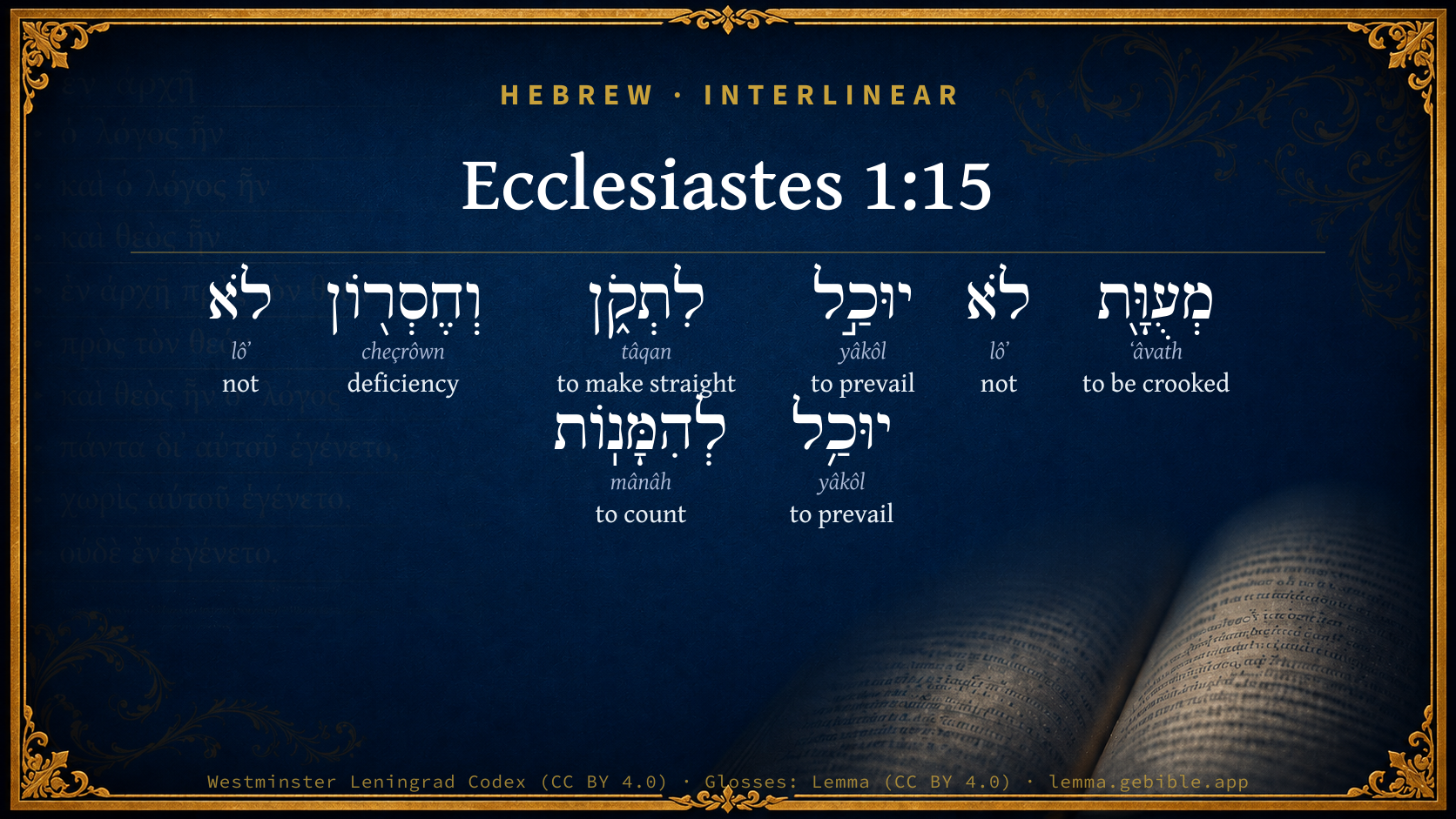
Ecclesiastes 1:15

Hebrew (Westminster Leningrad Codex) Ecclesiastes 1:15 appears in the Hebrew Old Testament. The text above is from the Westminster Leningrad Codex. Each word links to its Strong’s number, a concise gloss, and parsing drawn from the Open Scriptures Hebrew Bible morphology. Click any word for its full Brown-Driver-Briggs (BDB) entry.
Download image
Cite this verse

Ecclesiastes 1:15 (World English Bible). Public Domain. Lemma interlinear Bible study tool, https://lemma.gebible.app/v/ecclesiastes/1/15.

Show BibTeX & RIS
BibTeX
RIS
English Translation
That which is crooked can't be made straight; and that which is lacking can't be counted.
World English Bible · Public Domain
Highlights
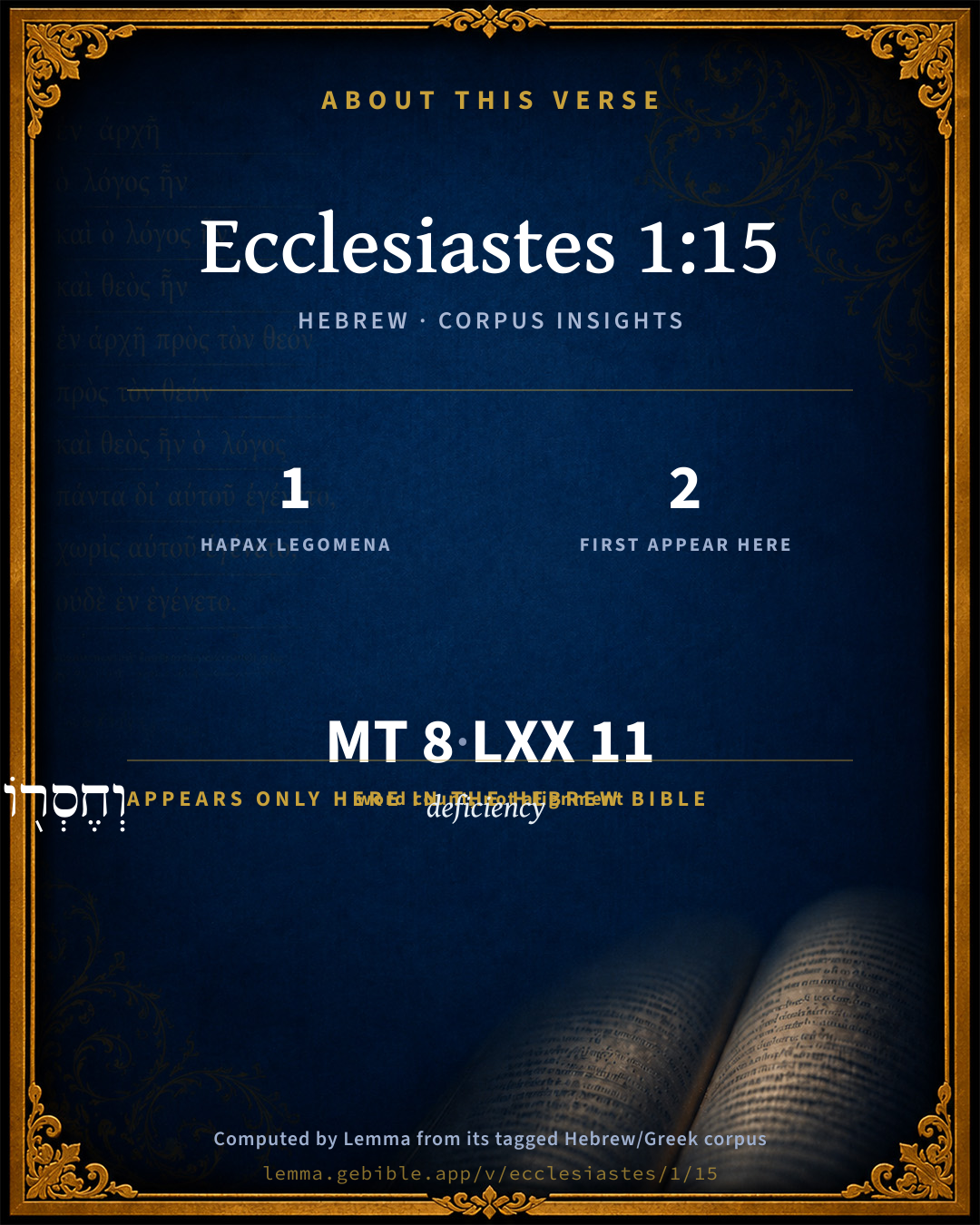
  • 1 hapax legomenon — only here in the Hebrew Bible
  • 2 first appearances in the Hebrew Bible
Full analysis ↓
Download a study sheet

One document with this verse’s original text, its word-by-word gloss line, the meaning frame, cross-references with their text, attributed commentary, and full source and license credits — printable, and it pastes into notes with its structure intact.

This verse Autodidact and up

Study sheet (.html) Plain text (.txt)

A passage Seminary Student

Up to 50 verses in one chapter. A passage sheet keeps up to 6 commentary sources and 12 cross-references per verse, in the order this page ranks them, and says so on the sheet whenever that leaves anything out. Ask for a single verse and you get the Autodidact verse sheet above.

Everything on this page stays free to read, with no account — the sheet is a download of what is already on screen, not access to it.

Want to remove ads? Support Godless Engineer
Compare translations 3

The same verse in 3 English versions, stacked beneath the original-language interlinear above. Click any original word for its lexicon entry.

Each is an independent rendering of the whole verse — the interlinear is not word-aligned to these translations.

Highlighted words mark where these versions differ — a whole-verse word diff, not a word-by-word alignment.

  • World English Bible Public Domain
    That which is crooked can't be made straight; and that which is lacking can't be counted.
  • King James Version Public Domain
    That which is crooked cannot be made straight: and that which is wanting cannot be numbered.
  • unfoldingWord Literal Text CC BY-SA 4.0
    A bent —one is not able to straighten, and lack is not able to be counted. ts\*

unfoldingWord Literal Text — © unfoldingWord, licensed CC BY-SA 4.0. Word-aligned USFM3 via Door43 (git.door43.org/unfoldingWord/en_ult).

Versions to compare (up to 4)

3 of 4 selected

Show all 18 translations

Every available English version of this verse, each an independent rendering of the whole verse.

  • World English Bible Public Domain
    That which is crooked can't be made straight; and that which is lacking can't be counted.
  • Berean Standard Bible Public Domain
    What is crooked cannot be straightened, and what is lacking cannot be counted.
  • Majority Standard Bible Public Domain
    What is crooked cannot be straightened, and what is lacking cannot be counted.
  • King James Version Public Domain
    That which is crooked cannot be made straight: and that which is wanting cannot be numbered.
  • American Standard Version (1901) Public Domain
    That which is crooked cannot be made straight; and that which is wanting cannot be numbered.
  • Revised Version (1885) Public Domain
    That which is crooked cannot be made straight: and that which is wanting cannot be numbered.
  • Geneva Bible (1599) Public Domain
    That which is crooked, can none make straight: and that which faileth, cannot be nombred.
  • Douay-Rheims (1899) Public Domain
    The perverse are hard to be corrected, and the number of fools is infinite.
  • Young's Literal Translation Public Domain
    A crooked thing `one' is not able to make straight, and a lacking thing is not able to be numbered.
  • Literal Standard Version CC BY-SA 4.0
    A crooked thing [one] is not able to make straight, and a lacking thing is not able to be numbered.
  • Unlocked Literal Bible CC BY-SA 4.0
    The twisted cannot be straightened! The missing cannot be counted!
  • unfoldingWord Literal Text CC BY-SA 4.0
    A bent —one is not able to straighten, and lack is not able to be counted. ts\*
  • Darby Bible Public Domain
    That which is crooked cannot be made straight; and that which is wanting cannot be numbered.
  • World Messianic Bible Public Domain
    That which is crooked can’t be made straight; and that which is lacking can’t be counted.
  • Webster's Bible Public Domain
    That which is crooked cannot be made straight: and that which is wanting cannot be numbered.
  • Free Bible Version CC BY-SA 4.0
    You can't straighten what is twisted, and you can't count what isn't there.
  • Bible in Basic English Public Domain
    That which is bent may not be made straight, and that which is not there may not be numbered.
  • JPS Tanakh (1917) Public Domain
    That which is crooked cannot be made straight; and that which is wanting cannot be numbered.

Literal Standard Version (2020), Covenant Press — licensed CC BY-SA 4.0. Text via the HelloAO Bible API (eBible.org). Unlocked Literal Bible (unfoldingWord) — licensed CC BY-SA 4.0. Text via the HelloAO Bible API (eBible.org). unfoldingWord Literal Text — © unfoldingWord, licensed CC BY-SA 4.0. Word-aligned USFM3 via Door43 (git.door43.org/unfoldingWord/en_ult). Free Bible Version, Dr. Jonathan Gallagher — licensed CC BY-SA 4.0. Text via the HelloAO Bible API (eBible.org).

Word by word

More ways to search: Search by grammar → Find every occurrence → Compare this word →

Practice this passage: Drill this verse → Learn its vocabulary →

About this verse

These counts appear in no published source. They are computed here, from the morphology-tagged text and Lemma’s own curated glosses. What Lemma adds →

8
words
6
distinct lemmas
Wisdom
section

Notable vocabulary

1 hapax legomenon — a word that appears only here in the entire Hebrew Bible:

  • וְחֶסְר֖וֹן deficiency H2642

First appearance in Scripture

These words make their first canonical appearance in the Hebrew Bible here:

  • לִתְקֹ֑ן to make straight H8626
  • וְחֶסְר֖וֹן deficiency H2642

Shared distinctive vocabulary

לִתְקֹ֑ן to make straight H8626 occurs in 3 verses of the Hebrew Bible. Also found in:

Grammatical profile

  • 5 verbs
  • 1 noun
  • 2 particles

Verb forms

  • מְעֻוָּ֖ת Pual · Participle Passive
  • יוּכַ֣ל Qal · Imperfect
  • לִתְקֹ֑ן Qal · Infinitive Construct
  • יוּכַ֥ל Qal · Imperfect
  • לְהִמָּנֽוֹת Niphal · Infinitive Construct

Repetition

Words recur within this verse — often emphatic in Hebrew:

  • יוּכַ֣ל to prevail H3201 ×2
  • לֹא not H3808 ×2

Hebrew & Septuagint length

In English translation the verse runs 16 words from the Hebrew and 13 from the Septuagint (LXX English) — closely comparable.

A rough comparison of the two English renderings, which tokenize alike — not a word-level alignment.

Word counts can differ between the Hebrew and the Greek without any difference in meaning — e.g. the Hebrew direct-object marker אֵת has no separate Greek word, and Greek often adds the article ὁ.

In the original languages it is 8 Hebrew tokens and 11 Greek tokens — but the two are counted differently (Hebrew bundles its prefixes and suffixes into one token; the Greek is in lemma form), so that isn’t a like-for-like length.

Cross-references

8

Topical passages linked to Ecclesiastes 1:15 in the Treasury of Scripture Knowledge — connected by theme and wording, ordered by reader-vote popularity; previews shown in the World English Bible.

  • Ecclesiastes 7:12–13 For wisdom is a defense, even as money is a defense; but the excellency of knowledge is that wisdom preserves the life of him who has it.
  • Matthew 6:27 "Which of you, by being anxious, can add one cubit to the measure of his life?
  • Ecclesiastes 3:14 I know that whatever God does, it shall be forever. Nothing can be added to it, nor anything taken from it; and God has done it, that men should fear before him.
  • Isaiah 40:4 Every valley shall be exalted, and every mountain and hill shall be made low; and the uneven shall be made level, and the rough places a plain:
  • Job 11:6 That he would show you the secrets of wisdom! For true wisdom has two sides. Know therefore that God exacts of you less than your iniquity deserves.
  • Job 34:29 When he gives quietness, who then can condemn? When he hides his face, who then can see him? Alike whether to a nation, or to a man:
  • Lamentations 3:37 Who is he who says, and it comes to pass, when the Lord doesn't command it?
  • Daniel 4:35 All the inhabitants of the earth are reputed as nothing; and he does according to his will in the army of heaven, and among the inhabitants of the earth; and none can stay his hand, or tell him, What do you?

Cross-references courtesy of OpenBible.info (CC BY 4.0).

Hebrew and Greek witnesses Masoretic Hebrew ↔ Greek Septuagint

The same verse in the two great witnesses to the Old Testament, shown verse-for-verse.

These are two independent witnesses, not word-aligned to each other, and the Septuagint is shown in lemma (dictionary) form.

Hebrew Ecclesiastes 1:15 Masoretic · Westminster Leningrad Codex

מְעֻוָּ֖ת לֹא יוּכַ֣ל לִתְקֹ֑ן וְחֶסְר֖וֹן לֹא יוּכַ֥ל לְהִמָּנֽוֹת

That which is crooked can't be made straight; and that which is lacking can't be counted.

World English Bible · Public Domain

Greek LXX Ecclesiastes 1:15 Septuagint · lemma form

διαστρέφω οὐ δύναμαι ὁ ἐπικοσμέω καί ὑστέρημα οὐ δύναμαι ὁ ἀριθμέω

That which is crooked can’t be made straight: and deficiency can’t be numbered.

LXX2012 (modern English Septuagint) · Public Domain

On this verse, Keil & Delitzsch discusses the Septuagint’s reading. Read the note in Commentary ↓

Hebrew: Westminster Leningrad Codex (CC BY 4.0). Greek: Septuagint (public domain); English from LXX2012 (modern English Septuagint) (Public Domain). How the Septuagint differs from the Hebrew →

Commentary

Notes on Ecclesiastes 1:15 from classic Christian and Jewish commentators (each source and its license shown beneath its notes). The classic Christian expositions comment on the surrounding passage and are grouped to its opening verse, so a note may address several verses; the Jewish commentaries on the Tanakh (Rashi and others) are per-verse, so they appear only where the commentator wrote on this verse.

Lemma curates 59 commentaries, every one of them public domain or Creative Commons licensed, each selected and text-cleaned for this edition rather than reprinted as found. About our sources →

Trapp's Complete Commentary

John Trapp

Ecc 1:15 [That which is] crooked cannot be made straight: and that which is wanting cannot be numbered.

Ver. 15. That which is crooked cannot be made straight.] Most men are so wedded and wedged to their wicked ways, that they cannot be rectified but by an extraordinary touch from the hand of Heaven. Hesiod, speaking of God, saith that he can easily set crooked things straight, and only he. {a} Holy Melanchthon, being himself newly converted, thought it impossible for his hearers to withstand the evidence of the gospel; but after he had been a preacher a while, he complained, that ‘old Adam was too hard for young Melanchthon’; and yet, besides the singular skill and learning that God had given him - for the which he merited to be called the phoenix of Germany - Ad eum modum in hoc vitae theatro versatum Philippum Melanchthonem apparet, saith a friend and scholar of his - i.e., It well appeareth that Melanchthon was, Solomon-like, on this wise busied upon the theatre of his life, that, seeing and observing all he could, he made profit of everything, and stored his heart, as the bee doth her hive, out of all sorts of flowers, for the common benefit. Howbeit, he met with much crossness and crookedness that wrung mahy tears from him, as it did likewise from St Paul, {Php 3:18} not in open enemies only, as Eccius and other Papists, but in professed friends, as Flaccius, Osiander, &c., who not only vexed him grievously while alive, but also fell foul upon him when he was dead, {b} as Zanchins complaineth. {c} Of all fowl, we most hate and detest the crows, and of all beasts the jackals, a kind of foxes in Barbary; because the one digs up the graves and devours the flesh, the other picks out the eyes of the dead. But to return to the text: sinful men grow aged and crooked with good opinions of themselves, and can seldom or never be set straight again. The Pharisee sets up his counter for a thousand pound, - "I am not as other men," saith he, "nor as this publican"; he stands upon his comparisons, nay, upon his disparisons, and although he turn aside unto his crooked ways, as Samson did to his Delilah, yet he thinks much to be "led forth with the workers of iniquity," but cries, "peace shall be upon Israel." {Psa 125:5} How many are there that, having "laden themselves with thick clay," {Hab 2:6} are bowed together, as he in the gospel was, {Luk 13:11} and can in nowise lift up themselves! They neither can nor will ( O curvae in terras animae, &c.), but are frample and foolish.

The Greek word for crooked, {d} comes of a Hebrew word that signifies a fool, {e} and every fool is conceited; he will not part with his bauble for the Tower of London. Try to straighten these crooked pieces, and they will sooner break than bend, venture all, than mend anything. Plato went thrice to Sicily to convert Dionysius, and could not do it. A wiser than Plato complains of a "perverse and crooked generation." {Deu 32:5 Act 2:40 Php 2:15} It is the work of God’s Spirit only, by his corrective and directive power, to set all to rights. {Luk 3:5} Philosophy can abscondere vitia, non abscindere, - chain up corrupt nature, but not change it.

And that which is wanting cannot be numbered.] Et stultorum infinitus est numerus, so the Vulgate renders it; ‘there is a numberless number of fools,’ such as are wanting with a witness; witless, sapless fellows, such as have principium laesum, their brains cracked by the first fall, and are not cured of their spiritual frenzy by being reunited to the second Adam. Of such fools there are not a few; all places are full of them, and so is hell too; the earth is burdened, the air darkened, with the number of them, as the land of Egypt was with the flies that there swarmed. Bias the philosopher could say, that the ‘most were the worst’; {f} and Cicero, that there was a great nation of bad people, but a few good. {g} Rari quippe boni, saith Juvenal, There is a great paucity of good people. And those few that are, find not a few wants and weaknesses in themselves, quae tamen non nocent, si non placent, these hurt us not, if they please us not; for God considers whereof we are made, and will cast out condemnation for ever, as one renders that place, Mat 12:10 : Triste mortalitatis privilegium est, licere aliquando peccare. {h} Our lives are fuller of sins than the firmament is of stars, or the furnace of sparks. Nimis augusta res est nuspiam errare. {i} David saw such volumes of infirmities, and so many errata in all that he did, that he cries out, "Who can understand his errors? Oh, cleanse thou me from secret sins." {Psa 19:12}

{a} Pειος δετ ιθυνει σκολιον. - Hes.

{b} Melch. Adam in Vita Mel.

{c} Melanchthon. mortuus tantum, non ut blasphemus in Deum cruci affigitur. - Zanch. Miscel., Ep. Ded.

{d} Sκολιος

{e} פכל

{f} Oι πλειστοι κακοι εισι

{g} Deteriorum magna est natio, boni singulares. - Cic. ad Attic.

{h} Lud. de Dieu. Euphor.

{i} Amama.

John Trapp, A Commentary or Exposition upon All the Books of the Old and New Testament (1647–1656) — public domain. Text from a community e-Sword module.

The Biblical Illustrator

Joseph S. Exell

Ecc_1:15

That which is crooked cannot be made straight.

Making the crooked straight

(with Isa_40:4):--Both these men gaze upon the affairs of human kind, and are afflicted with the sense of crookedness. It does not require much insight to perceive that much in human nature is marred and crooked, and life is gnarled and twisted. The world is a place of grand plans and poor executions, a realm of broken columns, snapped friendships, strained relationships. It abounds in crooked things. Both men pronounced the things crooked, but one said it in a despondency, the other said it in hope. One mans heart shrinks up in despair, the other mans expands in the strength of a great assurance. The two types belong to every age. They rub shoulders in common life. We meet them everywhere, the prophets of melancholy and the cheery bearers of glad tidings of great joy. There are always those who behold the crooked and see no prospect of rectification; and there are always those who see the crooked and also behold its ultimate correction. How do these contradictory conclusions arise? How can we explain the despondent judgment which anticipates no day of renewal? We are always very much inclined to seek our explanation in our natural temperaments. How frequently we hear this word in common life, I am naturally of a despondent turn of mind. There is certainly some truth in these explanations, hut when we seek for an excuse in our temperament, we are attended by grave and serious perils. It is possible to regulate our powers, by observing the law of balance. If a mans constitution has some ingredient in excess, he can restrain and control it by developing another ingredient. It is by the balance and antagonisms of our faculties that we shape our characters. Let us cultivate the opposite to our excesses. Or, let us exercise ourselves in some grace which will act as guardian upon our natural bias. I have said that both men saw the crooked things. Is that quite true? To a certain degree it is true, but the half remains unsaid. To see anything clearly in all its vivid relationships we must believe strongly. The Word of God proclaims that believing is seeing. Said I not unto thee, that, if thou wouldst believe, thou shouldst see?. . . Your father Abraham rejoiced to see My day. He saw it through the lens of faith. If we would have clear sight, we must have firm belief. If we desire to see things clearly in their far-reaching relationships, we must come to them with a confident faith. Koheleth had no faith, and therefore his sight was only partial. He beheld the crookedness; he did not see its infinite relationships. Isaiah believed in God, and with his faith-washed eyes he looked at the crookednesses of men with the vision of an optimist. (J. H. Jowett, M. A.)

The crooked things straightened

It is easy enough to straighten some crooked things. Here, for instance, is a piece of paper. I can take it in my hand, and squeeze and crumple it all up till there is not one straight piece in it as big as your little-finger nail. And then I can spread it out on the table, and smooth it down, and make it just as straight again as ever it was. And just so, if I take a tender willow twig, I can wind it round my finger like a thread; then I can unwind it again, and it will come out as straight as ever. But let that willow twig remain crooked while it is growing for five or ten years, and then you may write on it the words of our text; for that which is crooked cannot be made straight.

I. We are all born with crooked hearts.

II. Like the tree or the clay, our hearts are having something done to them which will make it much harder to straighten what is crooked in them. With the tree, it is its growth that will make its crookedness hard to straighten. With the clay, it is the baking or burning of it. With ourselves, it is the exercising or practising of what is sinful in our hearts that will make it hard to straighten them. This world is Gods school. All the time spent in it is time spent at school. We are getting educated here for eternity. And when we form a wrong habit of thinking, or feeling, or acting, we are hardening a crooked point and fastening it upon our characters. And when we go out of the school of life,--that is, when we come to die and go into eternity,--then it will be true that that which is crooked cannot he made straight. And so it is with the gardener and his trees. While they are young and tender it is very easy to straighten them when they get crooked. But let them only grow crooked, and then what can he do with them?

III. The importance of keeping straight while we are getting educated. Did you ever know a person who had charge of a nursery of young trees? If you did, you might learn some very useful lessons from his example. The great object with him is to keep his trees in proper shape while they are growing. He walks about among them very often, and watches them closely. If he sees one getting crooked, he tries to straighten it. If merely bending it with his hands will not keep it straight, then he puts a stake in the ground, and ties the young tree to it, so as to keep it in a right position all the time it is growing. And if the gardener thinks it worth his while to take so much care and pains with the education of a mere tree, which, after all, will only last a few years, how much more careful should we be in educating our souls, which are to live for ever and ever! Did you ever go to a photographers to have your likeness taken? If you did, you remember how very careful he was to have you seated properly before he began to take it. Then, when everything was arranged just to suit him, he said, There now; keep just so for a little while, and well get a nice picture. Suppose, now, you had shut one eye just at that moment, and kept it shut for two or three minutes: what then? Why, you would have had the likeness of a one-eyed boy or girl. Or suppose you had twisted your face, or screwed up your mouth: why, you would have had a picture of yourself with a screwed-up mouth or a twisted face. Nothing in the world could prevent it. New, this world is Gods photograph office; and we are all staying here to have our likeness taken. While we are young the likeness is being taken of what we are to be as men and women. And all the time we are living here the likeness is being taken of what we shall be hereafter for ever.

IV. How can we get straight and keep straight till our likeness is finished? This is the most important question. Remember we are not straight, to begin with. Recollect that we are all born with crooked or sinful hearts. They must be made straight before they can be kept straight. How, then, can a crooked, sinful heart be made straight or good? We must take it to Jesus, and pray for Him to take away all that is wicked in it. Jesus is able to do this. But no one else besides Him can do it for us. But when our hearts are made straight, how are we to keep them straight? Two things are necessary for this:--we must get Jesus to help us, and we must help ourselves. We must get Jesus to help us. Without His help we can do nothing at all in this matter. But how will God help us here? By giving us His grace and His Holy Spirit. These are just the kind of help to us, in trying to keep our hearts straight, that the sun and rain are to the farmer in making his crops grow. But how are we to get this help from God? By earnest prayer. (R. Newton, D. D.)

The Biblical Illustrator, edited by Joseph S. Exell (c. 1880s–1900s) — public domain. Text from a community e-Sword module.

Keil & Delitzsch

C. F. Keil & F. Delitzsch

"Is there anything whereof it may be said: See, this is new? - it was long ago through the ages (aeons) which have been before us." The Semit. substantive verb ישׁ (Assyr. isu) has here the force of a hypothetical antecedent: supposing that there is a thing of which one might say, etc. The זה, with Makkeph, belongs as subject, as at Ecc 7:27, Ecc 7:29 as object, to that which follows. כּבר (vid., List, p. 193) properly denotes length or greatness of time (as כּברה, length of way). The ל of לע is that of measure: this "long ago" measured (Hitz.) after infinitely long periods of time. מלּ, ante nos, follows the usage of מלּף, Isa 41:26, and lpaa', Jdg 1:10, etc.; the past time is spoken of as that which was before, for it is thought of as the beginning of the succession of time (vid., Orelli, Synon. der Zeit u. Ewigkeit, p. 14f.). The singular היה may also be viewed as pred. of a plur. inhumanus in order; but in connection, Ecc 2:7, Ecc 2:9 (Gesen. 147, An. 2), it is more probable that it is taken as a neut. verb. That which newly appears has already been, but had been forgotten; for generations come and generations go, and the one forgets the other.

Ecclesiastes 1:11

ecc 1:11

"There is no remembrance of ancestors; and also of the later ones who shall come into existence, there will be no remembrance for them with those who shall come into existence after them." With זכּרון (with Kametz) there is also זכרון, the more common form by our author, in accordance with the usage of his age; Gesen., Elst., and others regard it here and at Ecc 2:16 as constr., and thus לרא as virtually object-gen. (Jerome, non est priorum memoria); but such refinements of the old syntaxis ornata are not to be expected in our author: he changes (according to the traditional punctuation) here the initial sound, as at Ecc 1:17 the final sound, to oth and uth. אין ל is the contrast of היה ל: to attribute to one, to become partaker of. The use of the expression, "for them," gives emphasis to the statement. "With those who shall come after," points from the generation that is future to a remoter future, cf. Gen 33:2. The Kametz of the prep. is that of the recompens. art.; cf. Num 2:31, where it denotes "the last" among the four hosts; for there הא is meant of the last in order, as here it is meant of the remotely future time.

Ecclesiastes 1:12

ecc 1:12

"I, Koheleth, have been king over Israel in Jerusalem." That of the two possible interpretations of הייתי, "I have become" and "I have been," not the former (Grtz), but the latter, is to be here adopted, has been already shown. We translate better by "I have been" - for the verb here used is a pure perfect - than by "I was" (Ew., Elst., Hengst., Zck.), with which Bullock (Speaker's Comm., vol. IV, 1873) compares the expression Quand j'tois roi ! which was often used by Louis XIV towards the end of his life. But here the expression is not a cry of complaint, like the "fuimus Troes," but a simple historical statement, by which the Preacher of the vanity of all earthly things here introduces himself, - it is Solomon, resuscitated by the author of the book, who here looks back on his life as king. "Israel" is the whole of Israel, and points to a period before the division of the kingdom; a king over Judah alone would not so describe himself. Instead of "king על (over) Israel," the old form of the language uses frequently simply "king of Israel," although also the former expression is sometimes found; cf. Sa1 15:26; Sa2 19:23; Kg1 11:37. He has been king, - king over a great, peaceful, united people; king in Jerusalem, the celebrated, populous, highly-cultivated city, - and thus placed on an elevation having the widest survey, and having at his disposal whatever can make a man happy; endowed, in particular, with all the means of gaining knowledge, which accorded with the disposition of his heart searching after wisdom (cf. Kg1 3:9-11; Kg1 5:9).

But in his search after worldly knowledge he found no satisfaction.

Ecclesiastes 1:13

ecc 1:13

"And I gave my heart to seek and to hold survey with wisdom over all that is done under the sun: a sore trouble it is which God has given to the children of men to be exercised therewith." The synonyms דּרשׁ(to seek) and תּוּר (to hold survey over) do not represent a lower and a higher degree of search (Zck.), but two kinds of searching: one penetrating in depth, the other going out in extent; for the former of these verbs (from the root-idea of grinding, testing) signifies to investigate an object which one already has in hand, to penetrate into it, to search into it thoroughly; and the latter verb (from the root-idea of moving round about)

(Note: Vid., the investigation of these roots (Assyr. utîr, he brought back) in Eth's Schlafgemach der Phantasie, pp. 86-89.)

signifies to hold a survey, - look round in order to bring that which is unknown, or not comprehensively known, within the sphere of knowledge, and thus has the meaning of bǎkkēsh, one going the rounds. It is the usual word for the exploring of a country, i.e., the acquiring personal knowledge of its as yet unknown condition; the passing over to an intellectual search is peculiar to the Book of Koheleth, as it has the phrase ל לב נתן, animum advertere, or applicare ad aliquid, in common only with Dan 10:12. The beth of bahhochemah is that of the instrument; wisdom must be the means (organon) of knowledge in this searching and inquiry. With על is introduced the sphere into which it extends. Grotius paraphrases: Historiam animalium et satorum diligentissime inquisivi. But נעשׂה does not refer to the world of nature, but to the world of men; only within this can anything be said of actions, only this has a proper history. But that which offers itself for research and observation there, brings neither joy nor contentment. Hitzig refers הוּא to human activity; but it relates to the research which has this activity as its object, and is here, on that account, called "a sore trouble," because the attainment and result gained by the laborious effort are of so unsatisfactory a nature. Regarding ענין, which here goes back to ענה ב, to fatigue oneself, to trouble oneself with anything, and then to be engaged with it. The words ענין רע would mean trouble of an evil nature (vid., at Psa 78:49; Pro 6:24); but better attested is the reading ענין רע "a sore trouble." הוּא is the subj., as at Ecc 2:1 and elsewhere; the author uses it also in expressions where it is pred. And as frequently as he uses asher and שׁ, so also, when form and matter commend it, he uses the scheme of the attributive clause (elliptical relative clause), as here (cf. Ecc 3:16), where certainly, in conformity with the old style, נתנו was to be used.

Ecclesiastes 1:14

ecc 1:14

He adduces proof of the wearisomeness of this work of research: "I saw all the works that are done under the sun; and, behold, all is vanity and striving after the wind." The point of the sentence lies in והנּה = וארא וה, so that thus rathi is the expression of the parallel fact (circumst. perfect). The result of his seeing, and that, as he has said Ecc 1:13, of a by no means superficial and limited seeing, was a discovery of the fleeting, unsubstantial, fruitless nature of all human actions and endeavours. They had, as hevel expresses, not reality in them; and also, as denoted by reuth ruahh (the lxx render well by προαίρεσις πνεύματος), they had no actual consequences, no real issue. Hos 12:1 also says: "Ephraim feedeth on wind," i.e., follows after, as the result of effort obtains, the wind, roěh ruahh; but only in the Book of Koheleth is this sentence transformed into an abstract terminus technicus (vid., under Reth).

Ecclesiastes 1:15

ecc 1:15

The judgment contained in the words, "vanity and a striving after the wind," is confirmed: "That which is crooked cannot become straight; and a deficit cannot be numerable," i.e., cannot be taken into account (thus Theod., after the Syro-Hex.), as if as much were present as is actually wanting; for, according to the proverb, "Where there is nothing, nothing further is to be counted." Hitzig thinks, by that which is crooked and wanting, according to Ecc 7:13, of the divine order of the world: that which is unjust in it, man cannot alter; its wants he cannot complete. But the preceding statement refers only to labour under the sun, and to philosophical research and observation directed thereto. This places before the eyes of the observer irregularities and wants, brings such irregularities and wants to his consciousness, - which are certainly partly brought about and destined by God, but for the most part are due to the transgressions of man himself, - and what avails the observer the discovery and investigation? - he has only lamentation over it, for with all his wisdom he can bring no help. Instead of לתקן (vid., under תקן), לתקן was to be expected. However, the old language also formed intransitive infinitives with transitive modification of the final vowels, e.g., יבשׁ, etc. (cf. ישׁון, Ecc 5:11).

Having now gained such a result in his investigation and research by means of wisdom, he reaches the conclusion that wisdom itself is nothing.

Ecclesiastes 1:16

ecc 1:16

"I have communed with mine own heart, saying: Lo, I have gained great and always greater wisdom above all who were before me over Jerusalem; and my heart hath seen wisdom and knowledge in fulness. And I gave my heart to know what was in wisdom and knowledge, madness and folly - I have perceived that this also is a grasping after the wind." The evidence in which he bears witness to himself that striving after wisdom and knowledge brings with it no true satisfaction, reaches down to the close of Ecc 1:17; ידעתּי is the conclusion which is aimed at. The manner of expression is certainly so far involved, as he speaks of his heart to his heart what it had experienced, and to what he had purposely directed it. The אני leads us to think that a king speaks, for whom it is appropriate to write a capital I, or to multiply it into we; vid., regarding this "I," more pleonastic than emphatic, subordinated to its verb.

It is a question whether עם־לבּי, after the phrase (את) עם דּבּר, is meant of speaking with any one, colloqui, or of the place of speaking, as in "thou shalt consider in thine heart," Deu 8:5, it is used of the place of consciousness; cf. Job 15:9, (עמּדי) עמּי היה = σύνοιδα ἐμαυτῷ, and what is said in my Psychol. p. 134, regarding συνείδησις, consciousness, and συμμαρτυρεῖν. בּלבּי, interchanging with עם־לבּי, Ecc 2:1, Ecc 2:15, commends the latter meaning: in my heart (lxx, Targ., Jerome, Luther); but the cogn. expressions, medabběrěth ǎl-libbah, Sa1 1:13, and ledabbēr ěl-libbi, Gen 24:45, suggest as more natural the former rendering, viz., as of a dialogue, which is expressed by the Gr. Venet. (more distinctly than by Aquila, Symm., and Syr.): διείλεγμαι ἐγὼ ξὺν τῇ καρδίᾳ μου. Also לאמר, occurring only here in the Book of Koheleth, brings it near that the following oratio directa is directed to the heart, as it also directly assumes the form of an address, Ecc 2:1, after בלבי. The expression, הג הך, "to make one's wisdom great," i.e., "to gain great wisdom," is without a parallel; for the words, הג תו, Isa 28:29, quoted by Hitzig, signify to show and attest truly useful (beneficial) knowledge in a noble way. The annexed והו refers to the continued increase made to the great treasure already possessed (cf. Ecc 2:9 and Kg1 10:7). The al connected therewith signifies, "above" (Gen 49:26) all those who were over Jerusalem before me. This is like the sarrâni âlik maḥrija, "the kings who were my predecessors," which was frequently used by the Assyrian kings. The Targumist seeks to accommodate the words to the actual Solomon by thus distorting them: "above all the wise men who have been in Jerusalem before me," as if the word in the text were בירושלם,

(Note: In F. the following note is added: "Several Codd. have, erroneously, birushalam instead of al-jerushalam." Kennicott counts about 60 such Codd. It stands thus also in J; and at first it thus stood in H, but was afterwards corrected to al-yerushalam. Cf. Elias Levita's Masoreth hamasoreth, II 8, at the end.)

as it is indeed found in several Codd., and according to which also the lxx, Syr., Jerome, and the Venet. translate. Rather than think of the wise (הכּימיּא), we are led to think of all those who from of old stood at the head of the Israelitish community. But there must have been well-known great men with whom Solomon measures himself, and these could not be such dissimilarly great men as the Canaanitish kings to the time of Melchizedek; and since the Jebusites, even under Saul, were in possession of Zion, and Jerusalem was for the first time completely subdued by David (Sa2 5:7, cf. Jos 15:63), it is evident that only one predecessor of Solomon in the office of ruler over Jerusalem can be spoken of, and that here an anachronism lies before us, occasioned by the circumstance that the Salomo revivivus, who has behind him the long list of kings whom in truth he had before him, here speaks.

Regarding היה אשׁר, qu'il y uet, for היו אשׁר, qui furent, vid., at Ecc 1:10. The seeing here ascribed to the heart (here = νοῦς, Psychol. p. 249) is meant of intellectual observation and apprehension; for "all perception, whether it be mediated by the organs of sense or not (as prophetic observing and contemplating), comprehends all, from mental discernment down to suffering, which veils itself in unconsciousness, and the Scripture designates it as a seeing" (Psychol. 234); the Book of Koheleth also uses the word ראה of every kind of human experience, bodily or mental, Ecc 2:24; Ecc 5:17; Ecc 6:6; Ecc 9:9. It is commonly translated: "My heart saw much wisdom and knowledge" (thus e.g., Ewald); but that is contrary to the gram. structure of the sentence (Ew. 287c). The adject. harbēh

(Note: Regarding the form הרבה, which occurs once (Jer 42:2), vid., Ew. 240c.)

is always, and by Koheleth also, Ecc 2:7; Ecc 5:6, Ecc 5:16; Ecc 6:11; Ecc 9:18; Ecc 11:8; Ecc 12:9, Ecc 12:12, placed after its subst.; thus it is here adv., as at Ecc 5:19; Ecc 7:16. Rightly the Venet.: ἡ καρδία μου τεθέαται κατὰ πολὺ σοφίαν καί γνῶσιν Chokma signifies, properly, solidity, compactness; and then, like πυκνότης, mental ability, secular wisdom; and, generally, solid knowledge of the true and the right. Dǎǎth is connected with chokma here and at Isa 33:6, as at Rom 11:33, γνῶσις is with σοφία. Baumggarten-Crusius there remarks that σοφία refers to the general ordering of things, γνῶσις to the determination of individual things; and Harless, that σοφία is knowledge which proposes the right aim, and γνῶσις that which finds the right means thereto. In general, we may say that chokma is the fact of a powerful knowledge of the true and the right, and the property which arises out of this intellectual possession; but dǎǎth is knowledge penetrating into the depth of the essence of things, by which wisdom is acquired and in which wisdom establishes itself.

Ecc 1:17

By the consecutive modus ואתּנה (aor. with ah, like Gen 32:6; Gen 41:11, and particularly in more modern writings; vid., p. 198, regarding the rare occurrence of the aorist form in the Book of Koheleth) he bears evidence to himself as to the end which, thus equipped with wisdom and knowledge, he gave his heart to attain unto (cf. 13a), i.e., toward which he directed the concentration of his intellectual strength. He wished to be clear regarding the real worth of wisdom and knowledge in their contrasts; he wished to become conscious of this, and to have joy in knowing what he had in wisdom and knowledge as distinguished from madness and folly. After the statement of the object lādǎǎth, stands vedaath, briefly for ולדעת. Ginsburg wishes to get rid of the words holēloth vesikluth, or at least would read in their stead תּבוּנית ושׂכלוּת (rendering them "intelligence and prudence"); Grtz, after the lxx παραβολὰς καὶ ἐπιστήμην, reads משׁלות ושׂכלות. But the text can remain as it is: the object of Koheleth is, on the one hand, to become acquainted with wisdom and knowledge; and, on the other, with their contraries, and to hold these opposite to each other in their operations and consequences. The lxx, Targ., Venet., and Luther err when they render sikluth here by ἐπιστήμη, etc. As sikluth, insight, intelligence, is in the Aram. written with the letter samek (instead of sin), so here, according to the Masora סכלות, madness is for once written with ס, being everywhere else in the book written with שׂ; the word is an ἐναντιόφωνον,

(Note: Vid., Th. M. Redslob's Die Arab. Wrter, u.s.w. (1873).)

and has, whether written in the one way or in the other, a verb, sakal (שׂכל, סכל), which signifies "to twist together," as its root, and is referred partly to a complication and partly to a confusion of ideas. הללות, from הלל, in the sense of "to cry out," "to rage," always in this book terminates in th, and only at Ecc 10:13 in th; the termination th is that of the abstr. sing.; but th, as we think we have shown at Pro 1:20, is that of a fem. plur., meant intensively, like bogdoth, Zep 2:4; binoth, chokmoth, cf. bogdim, Pro 23:28; hhovlim, Zac 11:7, Zac 11:14; toqim, Pro 11:15 (Bttch. 700g E). Twice vesikluth presents what, speaking to his own heart, he bears testimony to before himself. By yādǎ'ti, which is connected with dibbarti (Ecc 1:16) in the same rank, he shows the facit. זה refers to the striving to become conscious of the superiority of secular wisdom and science to the love of pleasure and to ignorance. He perceived that this striving also was a grasping after the wind; with רעוּת, 14b, is here interchanged רעיון. He proves to himself that nothing showed itself to be real, i.e., firm and enduring, unimpeachable and imperishable. And why not?

Ecc 1:18

"For in much wisdom is much grief; and he that increaseth knowledge increaseth sorrow." The German proverb: "Much wisdom causeth headache," is compared, Ecc 12:12, but not here, where כּעס and מכאוב express not merely bodily suffering, but also mental grief. Spinoza hits one side of the matter in his Ethics, IV 17, where he remarks: "Veram boni et mali cognitionem saepe non satis valere ad cupiditates coercendas, quo facto homo imbecillitatem suam animadvertens cogitur exclamare: Video meliora proboque, deteriora sequor." In every reference, not merely in that which is moral, there is connected with knowledge the shadow of a sorrowful consciousness, in spite of every effort to drive it away. The wise man gains an insight into the thousand-fold woes of the natural world, and of the world of human beings, and this reflects itself in him without his being able to change it; hence the more numerous the observed forms of evil, suffering, and discord, so much greater the sadness (כּעס, R. כס, cogn. הס, perstringere) and the heart-sorrow (מכאוב, crve-cour) which the inutility of knowledge occasions. The form of 18a is like Ecc 5:6, and that of 18b like e.g., Pro 18:22. We change the clause veyosiph daath into an antecedent, but in reality the two clauses stand together as the two members of a comparison: if one increaseth knowledge, he increaseth (at the same time) sorrow. "יוסיף, Isa 29:14; Isa 38:5; Ecc 2:18," says Ewald, 169a, "stands alone as a part. act., from the stem reverting from Hiph. to Kal with י instead of ." But this is not unparalleled; in הן יוסיף the verb יוסף is fin., in the same manner as יסּד, Isa 28:16; תּומיך, Psa 16:5, is Hiph., in the sense of amplificas, from ימך; יפיח, Pro 6:19 (vid., l.c.), is an attribut. clause, qui efflat, used as an adj.; and, at least, we need to suppose in the passage before us the confusion that the ē of kātēl (from kātil, originally kātal), which is only long, has somehow passed over into î. Bttcher's remark to the contrary, "An impersonal fiens thus repeated is elsewhere altogether without a parallel," is set aside by the proverb formed exactly thus: "He that breathes the love of truth says what is right," Pro 12:17.

Next: Ecclesiastes Chapter 2

Keil & Delitzsch — Biblical Commentary on the Old Testament (1861–1891) — public domain (CC PDM 1.0). Text via the HelloAO Bible API. (Old Testament only.)

Geneva Bible (1599)

Geneva Bible translators

Man is not able by all his diligence to cause things to go otherwise than they do: neither can he number the faults that are committed, much less remedy them.

Geneva Bible (1599) marginal notes — public domain. Text via Bolls.life.

Jamieson, Fausset & Brown

Robert Jamieson, A. R. Fausset & David Brown

Investigation (Ecc 1:13) into human ways is vain labor, for they are hopelessly "crooked" and "cannot be made straight" by it (Ecc 7:13). God, the chief good, alone can do this (Isa 40:4; Isa 45:2).

wanting-- (Dan 5:27).

numbered--so as to make a complete number; so equivalent to "supplied" [MAURER]. Or, rather, man's state is utterly wanting; and that which is wholly defective cannot be numbered or calculated. The investigator thinks he can draw up, in accurate numbers, statistics of man's wants; but these, including the defects in the investigator's labor, are not partial, but total.

Jamieson, Fausset & Brown — Commentary Critical and Explanatory on the Whole Bible (1871) — public domain (CC PDM 1.0). Text via the HelloAO Bible API.

Adam Clarke's Commentary

Verse 15. That which is crooked cannot be made straight] There are many apparent irregularities and anomalies in nature for which we cannot account; and there are many defects that cannot be supplied. This is the impression from a general view of nature; but the more we study and investigate its operations, the more we shall be convinced that all is a consecutive and well-ordered whole; and that in the chain of nature not one link is broken, deficient, or lost.

Adam Clarke's Commentary on the Bible (1810–1826) — public domain. Text from a community e-Sword/MySword module.

Ellicott's Commentary for English Readers

(15) Made straight.—The verb occurs only in this book (Ecc_7:13; Ecc_12:9, “set in order”) and in Rabbinical Hebrew. So likewise “that which is wanting” is peculiar to this passage, and to later Hebrew.

A Bible Commentary for English Readers, edited by Charles John Ellicott (1878–1897) — public domain. Text from a community e-Sword module.

The Cambridge Bible for Schools and Colleges

gen. ed. J. J. S. Perowne

15. That which is crooked] The words are apparently a proverbial saying quoted as already current. The complaint is that the search after wisdom brings the seeker face to face with anomalies and defects, which yet he cannot rectify. The Hebrew words are not the same, but we may, perhaps, trace an allusive reference to the promise of Isa_40:4 that “the crooked shall be made straight,” and the Debater in his present mood looks on this also as a delusive dream. There is nothing left but to take things as they are and “accept the inevitable.” Comp. chap. Ecc_7:13, as expressing the same thought.

that which is wanting] The second clause presents the negative aspect of the world’s defects as “crooked” did the positive. Everywhere, if there is nothing absolutely evil, there is an “incompleteness” which we cannot remedy, any more than our skill in arithmetic can make up for a deficit which stares us in the face when we look into an account, and the seeker had not as yet attained to the faith which sees beyond that incompleteness the ultimate completeness of the Divine order.

The Cambridge Bible for Schools and Colleges (gen. ed. J. J. S. Perowne; Cambridge University Press, 1878–1918) — public domain. Text from a community e-Sword module.

John Gill's Exposition

That which is crooked cannot be made straight,.... By all the art and cunning, wisdom and knowledge of man, that he can attain unto; whatever he, in the vanity of his mind, may find fault with in the works of God, either of nature of providence, and which he may call crooked, it is not in his power to make them straight, or to mend them; see Ecc 7:13. There is something which, through sin, is crooked, in the hearts, in the nature, in the principles, ways and works, of men; which can never be made straight, corrected or amended, by all the natural wisdom and knowledge of men, which shows the insufficiency of it: the wisest philosophers among men, with all their parade of wit and learning, could never effect anything of this kind; this only is done by the Spirit and grace of God; see Isa 42:16;

and that which is wanting cannot be numbered; the deficiencies in human science are so many, that they cannot be reckoned up; and the defects in human nature can never be supplied or made up by natural knowledge and wisdom; and which are so numerous, as that they cannot be understood and counted. The Targum is,

"a man whose ways are perverse in this world, and dies in them, and does not return by repentance, he has no power of correcting himself after his death; and a man that fails from the law and the precepts in his life, after his death hath no power to be numbered with the righteous in paradise:''

to the same sense Jarchi's note and the Midrash.

John Gill's Exposition of the Whole Bible (1746–1763) — public domain (CC PDM 1.0). Text via the HelloAO Bible API.

Albert Barnes' Notes on the Bible

He saw clearly both the disorder and incompleteness of human actions (compare the marginal reference), and also man’s impotence to rectify them.

Albert Barnes' Notes on the Bible (1834–1885) — public domain. Text from a community e-Sword/MySword module.

Haydock's Catholic Bible Commentary

Perverse. Habitual and obstinate sinners. (Calmet) --- Fools, who follow the broad road. (Haydock) --- Hebrew and Septuagint, "the defect cannot be numbered." We know not to what a height the soul of man might have risen, if he had continued faithful.

George Leo Haydock (1774–1849), Haydock's Catholic Family Bible and Commentary, 1859 edition — public domain. Excludes Psalms (Douay-Rheims chapter numbering differs from Protestant) and Deuterocanonical books (Catholic canon only).

Matthew Poole's English Annotations

That which is crooked cannot be made straight; all our knowledge serves only to discover our diseases and miseries, but is oft itself utterly insufficient to heal or remove them; it cannot rectify those confusions and disorders which are either in our own hearts and lives, or in the men and things of the world.

That which is wanting, to wit, in our knowledge, and in order to man’s complete satisfaction and felicity, cannot be numbered; we know little of what we should or might know, or did know in the state of innocency, or shall know in the future life.

Matthew Poole's English Annotations on the Holy Bible (1683–1685) — public domain. Text from a community e-Sword/MySword module.

Whedon's Commentary on the Bible

Daniel D. Whedon

15. That which is crooked — This refers to the discouraged state of the writer’s mind. It should be translated, That which is bowed cannot be set up. The effort at a philosophical view was vain, for it yielded no relief to his depression previously stated.

That which is wanting — Most versions refer this to persons. “He who is gone, cannot be numbered,” and it is as a reason for what is just stated. The appalling and irremediable nature of death is the one thing that spoils all the comfort which philosophy might yield.

Daniel D. Whedon (gen. ed.), Commentary on the Old and New Testaments (1874–1909) — public domain. Text from a community e-Sword module.

The Pulpit Commentary

That which is crooked cannot be made straight. This is intended as a confirmation of ver. 14. By the utmost exercise of his powers and faculties man cannot change the course of events; he is constantly met by anomalies which he can neither explain nor rectify. (comp. Ecc_7:13) The above is probably a proverbial saying. Knobel quotes Suidas: Xulon ajgkulon oujdepot ojrqon. The Vulgate takes the whole maxim as applying only to morals: "Perverse men are hardly corrected, and the number of tools is infinite." So too the Syriac and Targum. The Septuagint rightly as the Authorized Version. The writer is not referring merely to man"s sins and delinquencies, but to the perplexities in which he finds himself involved, and extrication from which is impracticable. That which is wanting cannot be numbered. The word wOdsj, "loss, defect," is apax legomenon in the Old Testament. We cannot reckon where there is nothing to count; no skill in arithmetic will avail to make up for a substantial deficit. So nothing man can do is able to remedy the anomalies by which he is surrounded, or to supply the defects which are pressed upon his notice.

Concerning crooked things and things wanting.

I IRREGULARITIES AND DEFECTS EXIST IN THE WORLD"S PROGRAM. This the teaching of the two proverbs, that crooked things cannot be straightened, i.e. by man, or wanting things numbered. To the seeker after wisdom, who surveys all the works that are done under the sun, and gives his heart to search into and to seek out by wisdom with regard to these what is their end and issue, there appear in the physical, mental, and moral worlds anomalies, irregularities, excrescences, deviations from the straight line of natural order, as well as defects, wants, imperfections, gaps, cleavages, interruptions, failures to reach completeness, which arrest attention and excite astonishment.

1. Of irregularities or crooked things, such phenomena as these may be cited:

(1) In the physical world, storms, tempests, accidents, diseases, sudden and unexpected calamities.

(2) In the mental world, perverted judgments, erroneous beliefs, false conclusions.

(3) In the moral world, wicked principles and depraved actions, sins of every kind, transgressions of human and Divine law.

2. Of things wanting or defects, may be reckoned these:

(1) In the material realm, scenes where some element is wanting to complete their beauty or utility, as e.g. a Sahara without a green leaf to refresh the eye, or a well at which to quench the thirst; or forms of life that never attain to maturity, as e.g. buds that drop before ripening into flowers or fruit.

(2) In the intellectual sphere, ignorance, limited knowledge, defective education, one-sided apprehension of truth, narrow and imperfect views.

(3) In the moral domain, actions that, without being wholly wrong, yet fall short of being fully right, as e.g. where one tells a half-truth, or does less in particular circumstances than duty demands of him.

II SUCH IRREGULARITIES AND DEFECTS ARE BEYOND THE POWER OF MAN TO REMOVE OR REMEDY. This, at least, is the doctrine of the above two proverbial sayings.

1. The doctrine, however, is not absolutely and universally true. In the physical, mental, and moral worlds, man can do something to straighten what is crooked and supply what is lacking. For instance, by skill and foresight he can guard himself to some extent against the virulence of disease, the violence of storms and tempests, the destructiveness of unexpected calamities; by education he can protect himself and others against the perils arising from defective knowledge and erroneous judgments; by personal cultivation of virtue he can at least diminish the quantity of its opposite, vice, in the world. If he cannot straighten out all the crooks, he can even some; if he cannot remedy every defect, he can remove a few.

2. Yet the doctrine is true in the sense intended by the Preacher. This is, that after man has done his utmost there will remain anomalies that baffle him to explain, a sense of incompleteness which nothing he can attempt will remove. Let him prosecute his investigations ever so widely and vigorously, there always will be "more things in heaven and earth than are dreamt of in his philosophy enigmas he cannot solve, antinomies he cannot reconcile, defects he cannot fill up.

III THE EXISTENCE OF SUCH IRREGULARITIES AND DEFECTS SUGGESTS SOME IMPORTANT LESSONS. AS:

1. That the present system of things is not final. Nothing that is imperfect can be final. The crooked things that want straightening and the lacking things that need supplying contain a dim prophecy of a future and better order, in which the crooked things will be straightened and the defective things supplied.

2. That mans power of apprehending things is incomplete. From this probably arises not a little of that sense of disorder and incompleteness in the outer world of which he complains.

3. That things impossible to man may be possible to God. Though man"s faculties are limited, it does not follow that God"s power is. The crooked things that man cannot straighten, God can straighten if it seem good to his wisdom.

4. That mans duty meanwhile is to submit and wait. Instead of fretting at what he cannot rectify, he should aim at extracting from it that moral discipline which, doubtless, it is intended to impart; and instead of rushing to hasty conclusions from what he only imperfectly apprehends, he ought in a spirit of hopefulness to wait for further light.

The Pulpit Commentary (1880–1919), ed. H.D.M. Spence-Jones & Joseph S. Exell — public domain. Text from a community e-Sword module.

John Wesley's Explanatory Notes

Crooked - All our knowledge serves only to discover our miseries, but is utterly insufficient to remove them; it cannot rectify those disorders which are either in our own hearts and lives, or in the men and things of the world. Wanting - In our knowledge. Or, counted out to us from the treasures of human learning. But what is wanting, will still be so. And that which is wanting in our own knowledge, is so much that it cannot be numbered. The more we know, the more we see of our own ignorance.

John Wesley, Explanatory Notes Upon the Whole Bible (1754–1765) — public domain. Text via the GEBible commentary corpus.

Rashi

Rabbi Shlomo Yitzchaki (Rashi)

What is crooked during his lifetime, will not be able to be straightened after he dies. Whoever toiled on the eve of the Sabbath will eat on the Sabbath, and our Sages explained this as referring to one who was intimate with a woman forbidden to him and begot a mamzer, or to a Torah scholar who parted with the Torah, who was originally straight and became crooked.

and what is missing will not be able to be counted One who excluded himself from the number of the righteous will not be able to be counted with them in their reception of reward.

Rashi on the Tanakh — English translations: “The Judaica Press complete Tanach with Rashi, translated by A. J. Rosenberg” (CC BY 4.0); “Pentateuch with Rashi's commentary by M. Rosenbaum and A.M. Silbermann, 1929-1934” (public domain); “The Metsudah Tanach series, Lakewood, N.J” (CC BY 4.0); and “The Book of Joshua, Metsudah Publications, 1997” (CC BY 4.0). Text via Sefaria.

Lesson kit

Teaching starters — assembled from the data on this page, not authored interpretation. Every prompt links to the verse data it draws on. Edit before teaching.

Ecclesiastes, in the Wisdom, opens this verse with 8 words (6 distinct Hebrew lemmas). Its most distinctive word is cheçrôwn (“deficiency”). A historical commentator’s framing appears above. Read the whole chapter for the surrounding context.

Discussion questions

  1. What does “deficiency” (cheçrôwn) contribute to the verse as a whole?
  2. 1 word here appears nowhere else in the Hebrew Bible. Why might the author reach for such rare wording?
  3. 2 words make their first appearance in Scripture here. What does this debut establish?
  4. How does Ecclesiastes 7:13, which shares the word «to make straight», read alongside this verse?
  5. What does the repetition of “to prevail” (2× in this one verse) do in this verse?
  6. These translations render this verse differently; the difference is in the English rendering, not the original. What questions does that raise?
  7. «מְעֻוָּ֖ת» is a Pual Participle Passive verb. How does that grammatical form shape the action described?
  8. Compare how Trapp's Complete Commentary and The Biblical Illustrator read this verse. Where do they agree or differ?

Things to notice

  • 1 word in this verse appears nowhere else in the Hebrew Bible.
  • 2 words make their first canonical appearance in Scripture here.
  • This verse counts 8 Hebrew ↔ 11 Greek words.
  • These translations choose different wording for 16 words in this verse.
  • “to prevail” occurs 2× in this single verse.

Reading settings

Reading text

Shown beneath each verse's original-language words.

Old Testament
Old Testament edition

Read the OT as the Masoretic Hebrew (MT) or the Greek Septuagint (LXX).

English shown for the Greek Septuagint (in the Hebrew ↔ Greek comparison).

Comparing translations? Open the Compare panel on any verse page to stack up to four side by side.