
Numbers 24:13

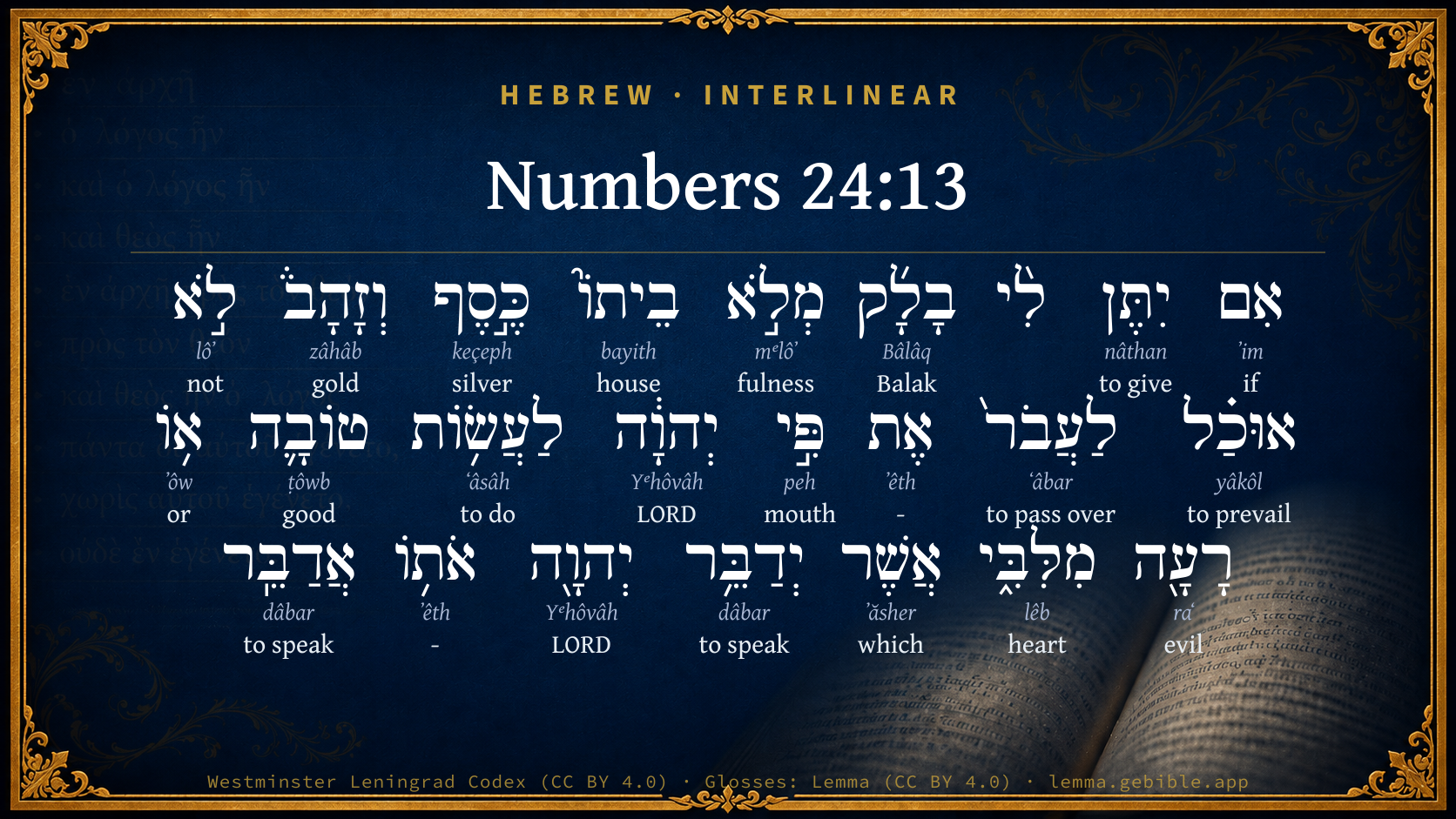
Hebrew (Westminster Leningrad Codex) Numbers 24:13 appears in the Hebrew Old Testament. The text above is from the Westminster Leningrad Codex. Each word links to its Strong’s number, a concise gloss, and parsing drawn from the Open Scriptures Hebrew Bible morphology. Click any word for its full Brown-Driver-Briggs (BDB) entry.
Download image
Cite this verse

Numbers 24:13 (World English Bible). Public Domain. Lemma interlinear Bible study tool, https://lemma.gebible.app/v/numbers/24/13.

Show BibTeX & RIS
BibTeX
RIS
English Translation
If Balak would give me his house full of silver and gold, I can't go beyond the word of Yahweh, to do either good or bad of my own mind; what Yahweh speaks, that will I speak?
World English Bible · Public Domain
Download a study sheet

One document with this verse’s original text, its word-by-word gloss line, the meaning frame, cross-references with their text, attributed commentary, and full source and license credits — printable, and it pastes into notes with its structure intact.

This verse Autodidact and up

Study sheet (.html) Plain text (.txt)

A passage Seminary Student

Up to 50 verses in one chapter. A passage sheet keeps up to 6 commentary sources and 12 cross-references per verse, in the order this page ranks them, and says so on the sheet whenever that leaves anything out. Ask for a single verse and you get the Autodidact verse sheet above.

Everything on this page stays free to read, with no account — the sheet is a download of what is already on screen, not access to it.

Want to remove ads? Support Godless Engineer
Compare translations 3

The same verse in 3 English versions, stacked beneath the original-language interlinear above. Click any original word for its lexicon entry.

Each is an independent rendering of the whole verse — the interlinear is not word-aligned to these translations.

Highlighted words mark where these versions differ — a whole-verse word diff, not a word-by-word alignment.

  • World English Bible Public Domain
    If Balak would give me his house full of silver and gold, I can't go beyond the word of Yahweh, to do either good or bad of my own mind; what Yahweh speaks, that will I speak?
  • King James Version Public Domain
    If Balak would give me his house full of silver and gold, I cannot go beyond the commandment of the LORD, to do either good or bad of mine own mind; but what the LORD saith, that will I speak?
  • unfoldingWord Literal Text CC BY-SA 4.0
    ‘If Balak gives to me his house full of silver and gold, I will not be able to go beyond the mouth of Yahweh to do good or evil from my heart; what Yahweh speaks, it I must speak?’

unfoldingWord Literal Text — © unfoldingWord, licensed CC BY-SA 4.0. Word-aligned USFM3 via Door43 (git.door43.org/unfoldingWord/en_ult).

Versions to compare (up to 4)

3 of 4 selected

Show all 18 translations

Every available English version of this verse, each an independent rendering of the whole verse.

  • World English Bible Public Domain
    If Balak would give me his house full of silver and gold, I can't go beyond the word of Yahweh, to do either good or bad of my own mind; what Yahweh speaks, that will I speak?
  • Berean Standard Bible Public Domain
    that even if Balak were to give me his house full of silver and gold, I could not do anything of my own accord, good or bad, to go beyond the command of the LORD? I will speak whatever the LORD says.
  • Majority Standard Bible Public Domain
    that even if Balak were to give me his house full of silver and gold, I could not do anything of my own accord, good or bad, to go beyond the command of the LORD? I must speak whatever the LORD says.
  • King James Version Public Domain
    If Balak would give me his house full of silver and gold, I cannot go beyond the commandment of the LORD, to do either good or bad of mine own mind; but what the LORD saith, that will I speak?
  • American Standard Version (1901) Public Domain
    If Balak would give me his house full of silver and gold, I cannot go beyond the word of Jehovah, to do either good or bad of mine own mind; what Jehovah speaketh, that will I speak?
  • Revised Version (1885) Public Domain
    If Balak would give me his house full of silver and gold, I cannot go beyond the word of the LORD, to do either good or bad of mine own mind; what the LORD speaketh, that will I speak?
  • Geneva Bible (1599) Public Domain
    If Balak would giue me his house ful of siluer and gold, I can not passe the commandement of the Lord, to doe either good or bad of mine owne minde? what the Lord shall commaund, the same will I speake.
  • Douay-Rheims (1899) Public Domain
    If Balac would give me his house full of silver and gold, I cannot go beyond the word of the Lord my God, to utter any thing of my own head either good or evil: but whatsoever the Lord shall say, that I will speak?
  • Young's Literal Translation Public Domain
    If Balak doth give to me the fulness of his house of silver and gold, I am not able to pass over the command of Jehovah, to do good or evil of mine own heart -- that which Jehovah speaketh -- it I speak?
  • Literal Standard Version CC BY-SA 4.0
    If Balak gives to me the fullness of his house of silver and gold, I am not able to pass over the command of YHWH, to do good or evil of my own heart; that which YHWH speaks—it I speak?
  • Unlocked Literal Bible CC BY-SA 4.0
    'Even if Balak gave me his palace full of silver and gold, I could not go beyond Yahweh's word and anything bad or good, or anything at all that I might want to do. I can say only what Yahweh tells me to say.' Did I not say this to them?
  • unfoldingWord Literal Text CC BY-SA 4.0
    ‘If Balak gives to me his house full of silver and gold, I will not be able to go beyond the mouth of Yahweh to do good or evil from my heart; what Yahweh speaks, it I must speak?’
  • Darby Bible Public Domain
    If Balak gave me his house full of silver and gold, I could not go beyond the commandment of Jehovah to do good or bad out of my heart: what Jehovah shall say, that will I speak?
  • World Messianic Bible Public Domain
    ‘If Balak would give me his house full of silver and gold, I can’t go beyond the LORD’s word, to do either good or bad from my own mind. I will say what the LORD says’?
  • Webster's Bible Public Domain
    If Balak would give me his house full of silver and gold, I could not go beyond the commandment of the LORD, to do either good or bad of my own mind; but what the LORD saith, that will I speak?
  • Free Bible Version CC BY-SA 4.0
    that even if you gave me your whole palace full of silver and gold, I couldn't do anything I wanted or disobey the command of the Lord my God in any way? I can only say what the Lord tells me.
  • Bible in Basic English Public Domain
    Even if Balak gave me his house full of silver and gold, it would not be possible for me to go outside the orders of the Lord, doing good or evil at the impulse of my mind; whatever the Lord says I will say?
  • JPS Tanakh (1917) Public Domain
    If Balak would give me his house full of silver and gold, I cannot go beyond the word of the LORD, to do either good or bad of mine own mind; what the LORD speaketh, that will I speak?

Literal Standard Version (2020), Covenant Press — licensed CC BY-SA 4.0. Text via the HelloAO Bible API (eBible.org). Unlocked Literal Bible (unfoldingWord) — licensed CC BY-SA 4.0. Text via the HelloAO Bible API (eBible.org). unfoldingWord Literal Text — © unfoldingWord, licensed CC BY-SA 4.0. Word-aligned USFM3 via Door43 (git.door43.org/unfoldingWord/en_ult). Free Bible Version, Dr. Jonathan Gallagher — licensed CC BY-SA 4.0. Text via the HelloAO Bible API (eBible.org).

Word by word

More ways to search: Search by grammar → Find every occurrence → Compare this word →

Practice this passage: Drill this verse → Learn its vocabulary →

מְלֹ֣א
mᵉlôʼ
H4393
“fulness of”
Noun, Common, Masculine, Singular, Construct
Part of Speech
Noun
Type
Common
Gender
Masculine
Number
Singular
State
Construct
Full BDB Definition

Origin: from H4390

TWOT: 1195b

fulness, that which fills - fulness, handful - mass, multitude - fulness, that which fills, entire contents - full length, full line
  1. אִם ʼim H518 “if” Conjunction
  2. יִתֶּן nâthan H5414 “to give” Verb, Qal, Imperfect, 3rd Person, Masculine, Singular
  3. בָלָ֜ק Bâlâq H1111 “Balak” Noun, Proper
  4. בֵיתוֹ֮ bayith H1004 “house · his” Noun, Common, Masculine, Singular, Construct + Suffix, Personal, 3rd Person, Masculine, Singular
  5. כֶּ֣סֶף keçeph H3701 “silver” Noun, Common, Masculine, Singular, Absolute
  6. וְזָהָב֒ zâhâb H2091 “and · gold” Conjunction + Noun, Common, Masculine, Singular, Absolute
  7. לֹ֣א lôʼ H3808 “not” Particle, Negative
  8. אוּכַ֗ל yâkôl H3201 “to prevail” Verb, Qal, Imperfect, 1st Person, Common, Singular
  9. לַעֲבֹר֙ ʻâbar H5674 “to pass over” Preposition + Verb, Qal, Infinitive Construct
  10. אֶת ʼêth H853 “-” Particle, Direct Object
  11. פִּ֣י peh H6310 “mouth of” Noun, Common, Masculine, Singular, Construct
  12. יְהוָ֔ה Yᵉhôvâh H3068 “LORD” Noun, Proper
  13. לַעֲשׂ֥וֹת ʻâsâh H6213 “to do” Preposition + Verb, Qal, Infinitive Construct
  14. טוֹבָ֛ה ṭôwb H2896 “good” Adjective, Adjective, Feminine, Singular, Absolute
  15. א֥וֹ ʼôw H176 “or” Conjunction
  16. רָעָ֖ה raʻ H7451 “evil” Noun, Common, Feminine, Singular, Absolute
  17. מִלִּבִּ֑י lêb H3820 “from · heart · my” Preposition + Noun, Common, Masculine, Singular, Construct + Suffix, Personal, 1st Person, Common, Singular
  18. אֲשֶׁר ʼăsher H834 “which” Particle, Relative
  19. יְדַבֵּ֥ר dâbar H1696 “to speak” Verb, Piel, Imperfect, 3rd Person, Masculine, Singular
  20. יְהוָ֖ה Yᵉhôvâh H3068 “LORD” Noun, Proper
  21. אֹת֥וֹ ʼêth H853 “- · him” Particle, Direct Object + Suffix, Personal, 3rd Person, Masculine, Singular
  22. אֲדַבֵּֽר dâbar H1696 “to speak” Verb, Piel, Imperfect, 1st Person, Common, Singular

About this verse

These counts appear in no published source. They are computed here, from the morphology-tagged text and Lemma’s own curated glosses. What Lemma adds →

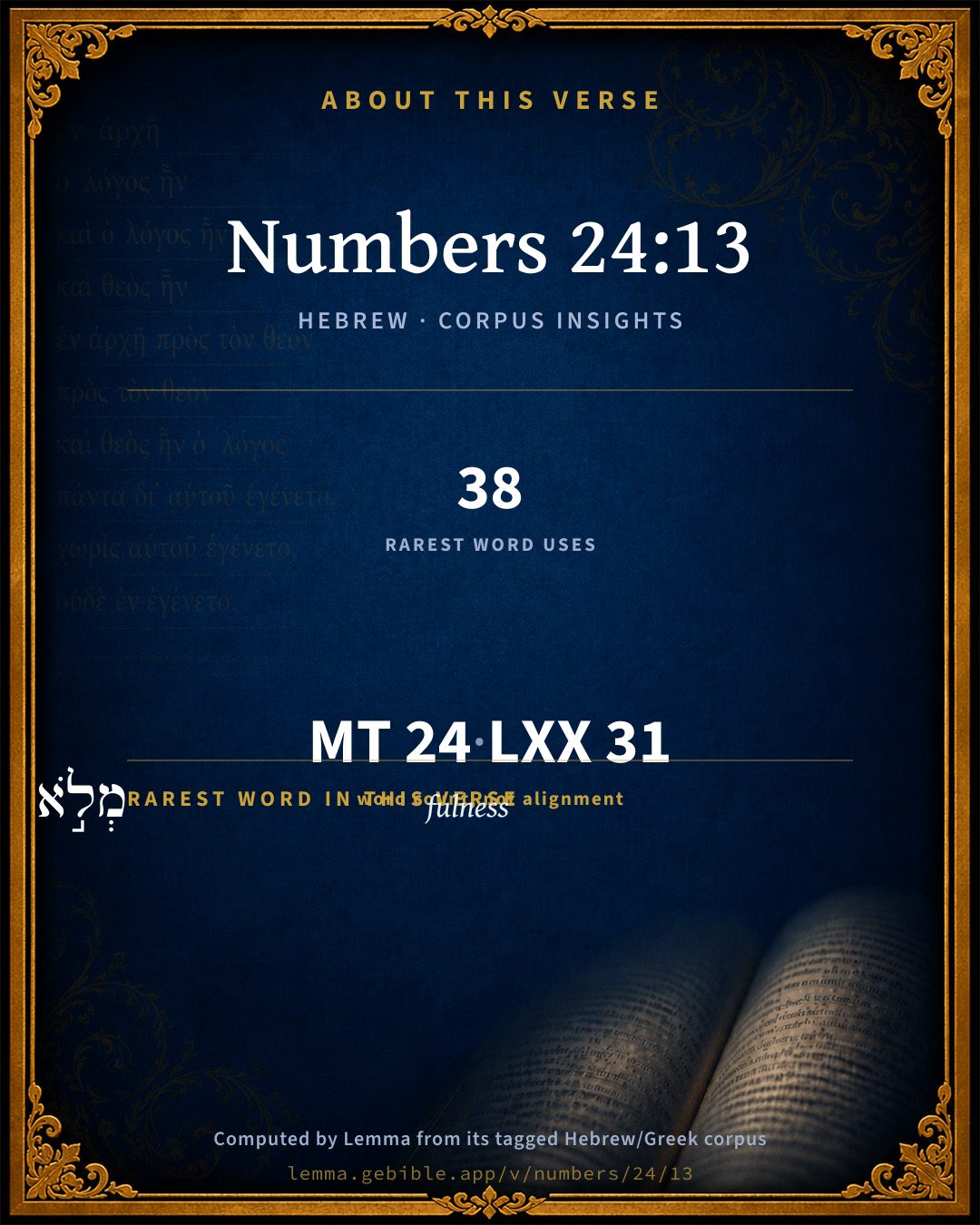
24
words
20
distinct lemmas
Pentateuch
section

Shared distinctive vocabulary

מְלֹ֣א fulness H4393 occurs in 36 verses of the Hebrew Bible. Also found in:

Grammatical profile

  • 6 verbs
  • 10 nouns
  • 1 adjective
  • 1 preposition
  • 2 conjunctions
  • 4 particles

Verb forms

  • יִתֶּן Qal · Imperfect
  • אוּכַ֗ל Qal · Imperfect
  • לַעֲבֹר֙ Qal · Infinitive Construct
  • לַעֲשׂ֥וֹת Qal · Infinitive Construct
  • יְדַבֵּ֥ר Piel · Imperfect
  • אֲדַבֵּֽר Piel · Imperfect

Repetition

Words recur within this verse — often emphatic in Hebrew:

  • יְהוָ֔ה LORD H3068 ×2
  • יְדַבֵּ֥ר to speak H1696 ×2

Hebrew & Septuagint length

In English translation the verse runs 37 words from the Hebrew and 41 from the Septuagint (LXX English) — closely comparable.

A rough comparison of the two English renderings, which tokenize alike — not a word-level alignment.

Word counts can differ between the Hebrew and the Greek without any difference in meaning — e.g. the Hebrew direct-object marker אֵת has no separate Greek word, and Greek often adds the article ὁ.

In the original languages it is 24 Hebrew tokens and 31 Greek tokens — but the two are counted differently (Hebrew bundles its prefixes and suffixes into one token; the Greek is in lemma form), so that isn’t a like-for-like length.

Cross-references

3

Topical passages linked to Numbers 24:13 in the Treasury of Scripture Knowledge — connected by theme and wording, ordered by reader-vote popularity; previews shown in the World English Bible.

  • Numbers 16:28 Moses said, Hereby you shall know that Yahweh has sent me to do all these works; for [I have] not [done them] of my own mind.
  • Numbers 22:18 Balaam answered the servants of Balak, If Balak would give me his house full of silver and gold, I can't go beyond the word of Yahweh my God, to do less or more.
  • Numbers 22:20 God came to Balaam at night, and said to him, If the men are come to call you, rise up, go with them; but only the word which I speak to you, that shall you do.

Cross-references courtesy of OpenBible.info (CC BY 4.0).

Hebrew and Greek witnesses Masoretic Hebrew ↔ Greek Septuagint

The same verse in the two great witnesses to the Old Testament, shown verse-for-verse.

These are two independent witnesses, not word-aligned to each other, and the Septuagint is shown in lemma (dictionary) form.

Hebrew Numbers 24:13 Masoretic · Westminster Leningrad Codex

אִם יִתֶּן לִ֨י בָלָ֜ק מְלֹ֣א בֵיתוֹ֮ כֶּ֣סֶף וְזָהָב֒ לֹ֣א אוּכַ֗ל לַעֲבֹר֙ אֶת פִּ֣י יְהוָ֔ה לַעֲשׂ֥וֹת טוֹבָ֛ה א֥וֹ רָעָ֖ה מִלִּבִּ֑י אֲשֶׁר יְדַבֵּ֥ר יְהוָ֖ה אֹת֥וֹ אֲדַבֵּֽר

If Balak would give me his house full of silver and gold, I can't go beyond the word of Yahweh, to do either good or bad of my own mind; what Yahweh speaks, that will I speak?

World English Bible · Public Domain

Greek LXX Numbers 24:13 Septuagint · lemma form

ἐάν ἐγώ δίδωμι βαλακ πλήρης ὁ οἶκος αὐτός ἀργύριον καί χρυσίον οὐ δύναμαι παραβαίνω ὁ ῥῆμα κύριος ποιέω αὐτός πονηρός ἤ καλός παρά ἐμαυτοῦ ὅσος ἐάν εἶπον ὁ θεός οὗτος εἶπον

If Balac should give me his house full of silver and gold, I shall not be able to transgress the word of the Lord to make it good or bad by myself; whatever things God shall say, them will I speak.

LXX2012 (modern English Septuagint) · Public Domain

Hebrew: Westminster Leningrad Codex (CC BY 4.0). Greek: Septuagint (public domain); English from LXX2012 (modern English Septuagint) (Public Domain). How the Septuagint differs from the Hebrew →

Targum (Aramaic paraphrase)

2

The Targum is the ancient Jewish Aramaic paraphrase of the Hebrew Scriptures — an interpretive translation, not the Hebrew text itself. Onkelos (literal) and Pseudo-Jonathan (expansive) render the Torah, and Jonathan the Prophets. Coverage is partial: where no permissively-licensed English translation exists for a verse, only the Aramaic is shown. This is verse-level text, not a word-by-word alignment to the Hebrew.

  1. Targum Onkelos Torah (Genesis–Deuteronomy)
    אִם יִתֶּן לִי בָלָק מְלֵי בֵיתֵיהּ כְּסַף וּדְהַב לֵית לִי רְשׁוּ לְמֶעֱבַּר עַל גְזֵירַת מֵימְרָא דַיְיָ לְמֶעֱבַּד טַבְתָּא אוֹ בִּישְׁתָּא מֵרְעוּתִי דִי יְמַלֵל יְיָ יָתֵיהּ אֲמַלֵיל

    (no public-domain English translation for this verse)

    Targum Onkelos — Aramaic: “Onkelos Genesis” (public domain); “Onkelos Exodus” (public domain); “Onkelos Leviticus” (public domain); “Onkelos Numbers” (public domain); “Onkelos Deuteronomy” (public domain). English: “Sefaria Community Translation” (CC0 1.0 (public-domain dedication)); “J.W. Etheridge. The Targums of Onkelos and Jonathan Ben Uzziel on the Pentateuch. London: Longmans, Green, 1862” (public domain). Text via Sefaria.

  2. Targum Pseudo-Jonathan Torah (Genesis–Deuteronomy)
    אִם יִתֵּן לִי בָלָק מִן יְקָרָא מְלא קוּרְטוֹר דִילֵיהּ כְּסַף וּדְהַב לֵית לִי רְשׁוּ לְמֶעֱבַר עַל גְזֵירֵת מֵימַר דַיְיָ לְמֶעֱבַד טַבְתָא אוֹ בִישְׁתָא מִן רְעוּתִי מַה דִי מַלֵיל יְיָ יָתֵיהּ אֲמַלֵיל

    If Balak would give me the fulness of his treasures of silver and gold, I have no power to transgress the decree of the Word of the Lord to do good or evil of my own will: what the Lord saith shall I not speak.

    Targum Pseudo-Jonathan — Aramaic: “Targum Jonathan on Genesis” (public domain); “Targum Jonathan on Exodus” (public domain); “Targum Jonathan on Leviticus” (public domain); “Targum Jonathan on Numbers” (public domain); “Targum Jonathan on Deuteronomy” (public domain). English: “The Targum of Jonathan ben Uzziel, trans. J. W. Etheridge, London, 1862” (public domain). Text via Sefaria.

Commentary

Notes on Numbers 24:13 from classic Christian and Jewish commentators (each source and its license shown beneath its notes). The classic Christian expositions comment on the surrounding passage and are grouped to its opening verse, so a note may address several verses; the Jewish commentaries on the Tanakh (Rashi and others) are per-verse, so they appear only where the commentator wrote on this verse.

Lemma curates 59 commentaries, every one of them public domain or Creative Commons licensed, each selected and text-cleaned for this edition rather than reprinted as found. About our sources →

Trapp's Complete Commentary

John Trapp

Num 24:13 If Balak would give me his house full of silver and gold, I cannot go beyond the commandment of the LORD, to do [either] good or bad of mine own mind; [but] what the LORD saith, that will I speak?

Ver. 13. I cannot go beyond.] Here was coloured covetousness, or "a cloak of covetousness." {1Th 2:5} {See Trapp on "1Th 2:5"} God lets out the tedder to wicked men for a time, and then calls them back with shame enough to their task; lets them have the ball on the foot till they come almost to the goal, and then defeats them of their great hopes; as he did this sinful couple. Balak had not his will, nor Balaam his wages; God fooled them both, pulling the morsel out of their mouths, that they had well-nigh devoured.

John Trapp, A Commentary or Exposition upon All the Books of the Old and New Testament (1647–1656) — public domain. Text from a community e-Sword module.

Ellicott's Commentary for English Readers

(13) I cannot go beyond the commandment of the Lord.—Hebrew, the mouth of the Lord: the same expression which is used in Num_22:18, where the Authorised Version has “the word of the Lord.”

A Bible Commentary for English Readers, edited by Charles John Ellicott (1878–1897) — public domain. Text from a community e-Sword module.

John Gill's Exposition

If Balak would give me his house full of silver and gold,.... Which are the very words he said to the princes of Moab, Num 22:18,

I cannot go beyond the commandment of the Lord, to do either good or bad; for though here it is the "commandment", and there the "word" of the Lord, yet it is the same word in both places in the original text: indeed, here he omits the relation to the Lord he there claims, saying "my God"; and instead of "little or great", here it is "good or bad", but the sense is the same: and he adds, for explanation sake:

of mine own mind: or out of my heart, which was disposed well enough to serve Balak, but was laid under a restraint by the Lord:

but what the Lord said, that will I speak; and he had not only said this to the messengers, but to the king himself, and therefore he thought, that as he had openly and honestly told him this at first, he had no reason to be so angry with him; see Num 22:38.

John Gill's Exposition of the Whole Bible (1746–1763) — public domain (CC PDM 1.0). Text via the HelloAO Bible API.

Rashi

Rabbi Shlomo Yitzchaki (Rashi)

לעבר את פי ה׳ [I AM UNABLE] TO GO BEYOND THE WORD OF THE LORD — Here it does not say “[the Lord] my God”, as it is said at first (Numbers 22:18), because he had now become conscious that he was regarded by the Holy One, blessed be He, as something vile and banished from His presence.

Rashi on the Tanakh — English translations: “The Judaica Press complete Tanach with Rashi, translated by A. J. Rosenberg” (CC BY 4.0); “Pentateuch with Rashi's commentary by M. Rosenbaum and A.M. Silbermann, 1929-1934” (public domain); “The Metsudah Tanach series, Lakewood, N.J” (CC BY 4.0); and “The Book of Joshua, Metsudah Publications, 1997” (CC BY 4.0). Text via Sefaria.

Lesson kit

Teaching starters — assembled from the data on this page, not authored interpretation. Every prompt links to the verse data it draws on. Edit before teaching.

Numbers, in the Pentateuch, opens this verse with 24 words (20 distinct Hebrew lemmas). Its most distinctive word is mᵉlôʼ (“fulness”). A historical commentator’s framing appears above. Read the whole chapter for the surrounding context.

Discussion questions

  1. The word mᵉlôʼ carries the sense “fulness.” How does it shape the verse?
  2. Genesis 48:19 shares the word «fulness» with this verse. How do the two illuminate each other?
  3. “LORD” occurs 2× in this one verse. What is the effect of the repetition?
  4. These translations render this verse differently; the difference is in the English rendering, not the original. What questions does that raise?
  5. The verb «יִתֶּן» is Qal Imperfect. How does its form color the action?
  6. Reading how Trapp's Complete Commentary and Ellicott's Commentary for English Readers read this verse, where do the two commentators agree and where do they part?

Things to notice

Reading settings

Reading text

Shown beneath each verse's original-language words.

Old Testament
Old Testament edition

Read the OT as the Masoretic Hebrew (MT) or the Greek Septuagint (LXX).

English shown for the Greek Septuagint (in the Hebrew ↔ Greek comparison).

Comparing translations? Open the Compare panel on any verse page to stack up to four side by side.