
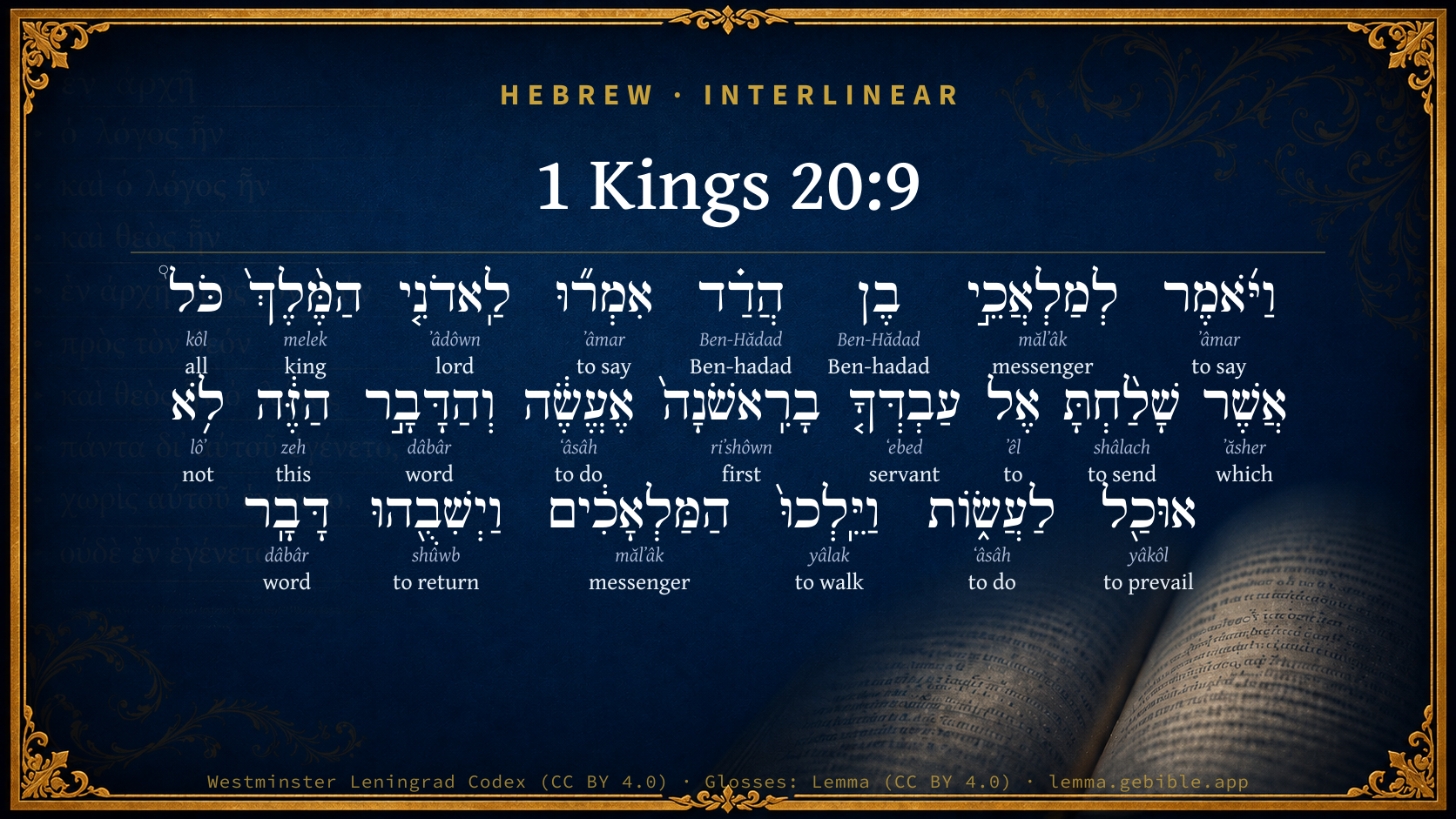
1 Kings 20:9

Hebrew (Westminster Leningrad Codex) 1 Kings 20:9 appears in the Hebrew Old Testament. The text above is from the Westminster Leningrad Codex. Each word links to its Strong’s number, a concise gloss, and parsing drawn from the Open Scriptures Hebrew Bible morphology. Click any word for its full Brown-Driver-Briggs (BDB) entry.
Download image
Cite this verse

1 Kings 20:9 (World English Bible). Public Domain. Lemma interlinear Bible study tool, https://lemma.gebible.app/v/1-kings/20/9.

Show BibTeX & RIS
BibTeX
RIS
English Translation
Therefore he said to the messengers of Ben Hadad, Tell my lord the king, All that you did send for to your servant at the first I will do; but this thing I may not do. The messengers departed, and brought him word again.
World English Bible · Public Domain
Download a study sheet

One document with this verse’s original text, its word-by-word gloss line, the meaning frame, cross-references with their text, attributed commentary, and full source and license credits — printable, and it pastes into notes with its structure intact.

This verse Autodidact and up

Study sheet (.html) Plain text (.txt)

A passage Seminary Student

Up to 50 verses in one chapter. A passage sheet keeps up to 6 commentary sources and 12 cross-references per verse, in the order this page ranks them, and says so on the sheet whenever that leaves anything out. Ask for a single verse and you get the Autodidact verse sheet above.

Everything on this page stays free to read, with no account — the sheet is a download of what is already on screen, not access to it.

Want to remove ads? Support Godless Engineer
Compare translations 3

The same verse in 3 English versions, stacked beneath the original-language interlinear above. Click any original word for its lexicon entry.

Each is an independent rendering of the whole verse — the interlinear is not word-aligned to these translations.

Highlighted words mark where these versions differ — a whole-verse word diff, not a word-by-word alignment.

  • World English Bible Public Domain
    Therefore he said to the messengers of Ben Hadad, Tell my lord the king, All that you did send for to your servant at the first I will do; but this thing I may not do. The messengers departed, and brought him word again.
  • King James Version Public Domain
    Wherefore he said unto the messengers of Benhadad, Tell my lord the king, All that thou didst send for to thy servant at the first I will do: but this thing I may not do. And the messengers departed, and brought him word again.
  • unfoldingWord Literal Text CC BY-SA 4.0
    And he said to the messengers of Ben Hadad, “Say to my lord the king, ‘All that you sent to your servant at first, I will do, but this thing I am not able to do.’” And the messengers went and returned him word.

unfoldingWord Literal Text — © unfoldingWord, licensed CC BY-SA 4.0. Word-aligned USFM3 via Door43 (git.door43.org/unfoldingWord/en_ult).

Versions to compare (up to 4)

3 of 4 selected

Show all 18 translations

Every available English version of this verse, each an independent rendering of the whole verse.

  • World English Bible Public Domain
    Therefore he said to the messengers of Ben Hadad, Tell my lord the king, All that you did send for to your servant at the first I will do; but this thing I may not do. The messengers departed, and brought him word again.
  • Berean Standard Bible Public Domain
    So Ahab answered the messengers of Ben-hadad, “Tell my lord the king, ‘All that you demanded of your servant the first time I will do, but this thing I cannot do.’” So the messengers departed and relayed the message to Ben-hadad.
  • Majority Standard Bible Public Domain
    So Ahab answered the messengers of Ben-hadad, “Tell my lord the king, ‘All that you demanded of your servant the first time I will do, but this thing I cannot do.’” So the messengers departed and relayed the message to Ben-hadad.
  • King James Version Public Domain
    Wherefore he said unto the messengers of Benhadad, Tell my lord the king, All that thou didst send for to thy servant at the first I will do: but this thing I may not do. And the messengers departed, and brought him word again.
  • American Standard Version (1901) Public Domain
    Wherefore he said unto the messengers of Ben-hadad, Tell my lord the king, All that thou didst send for to thy servant at the first I will do; but this thing I may not do. And the messengers departed, and brought him word again.
  • Revised Version (1885) Public Domain
    Wherefore he said unto the messengers of Ben-hadad, Tell my lord the king, All that thou didst send for to thy servant at the first I will do: but this thing I may not do. And the messengers departed, and brought him word again.
  • Geneva Bible (1599) Public Domain
    Wherefore hee sayde vnto the messengers of Ben-hadad, Tell my lorde the King, All that thou didddest sende for to thy seruant at the first time, that I will doe, but this thing I may not do. And the messengers departed, and brought him an answere.
  • Douay-Rheims (1899) Public Domain
    Wherefore he answered the messengers of Benadad: Tell my lord the king: All that thou didst send for to me thy servant at first, I will do: but this thing I cannot do.
  • Young's Literal Translation Public Domain
    And he saith to the messengers of Ben-Hadad, `Say to my lord the king, All that thou didst send for unto thy servant at the first I do, and this thing I am not able to do;' and the messengers go and take him back word.
  • Literal Standard Version CC BY-SA 4.0
    And he says to the messengers of Ben-Hadad, “Say to my lord the king, All that you sent to your servant for at the first I do, and this thing I am not able to do”; and the messengers go and take him back word.
  • Unlocked Literal Bible CC BY-SA 4.0
    So Ahab said to the messengers of Ben Hadad, “Tell my master the king, 'I agree to everything that you sent your servant to do the first time, but I cannot accept this second demand.'” So the messengers left and took this response to Ben Hadad.
  • unfoldingWord Literal Text CC BY-SA 4.0
    And he said to the messengers of Ben Hadad, “Say to my lord the king, ‘All that you sent to your servant at first, I will do, but this thing I am not able to do.’” And the messengers went and returned him word.
  • Darby Bible Public Domain
    And he said to the messengers of Ben-Hadad, Tell my lord the king, All that thou didst send for to thy servant at the first I will do; but this thing I cannot do. And the messengers departed, and brought him word again.
  • World Messianic Bible Public Domain
    Therefore he said to the messengers of Ben Hadad, “Tell my lord the king, ‘All that you sent for to your servant at the first I will do, but this thing I cannot do.’” The messengers departed and brought him back the message.
  • Webster's Bible Public Domain
    Wherefore he said to the messengers of Ben-hadad, Tell my lord the king, All that thou didst send for to thy servant at the first, I will do: but this thing I may not do. And the messengers departed, and brought him word again.
  • Free Bible Version CC BY-SA 4.0
    So the king told Ben-hadad's messengers, “Tell my lord the king: Everything you demanded at first your servant will do, but I cannot agree to this latest demand.” The messengers took the reply back to him.
  • Bible in Basic English Public Domain
    So he said to the representatives of Ben-hadad, Say to my lord the king, All the orders you sent the first time I will do; but this thing I may not do. And the representatives went back with this answer.
  • JPS Tanakh (1917) Public Domain
    Wherefore he said unto the messengers of Ben-hadad: 'Tell my lord the king: All that thou didst send for to thy servant at the first I will do; but this thing I may not do.' And the messengers departed, and brought him back word.

Literal Standard Version (2020), Covenant Press — licensed CC BY-SA 4.0. Text via the HelloAO Bible API (eBible.org). Unlocked Literal Bible (unfoldingWord) — licensed CC BY-SA 4.0. Text via the HelloAO Bible API (eBible.org). unfoldingWord Literal Text — © unfoldingWord, licensed CC BY-SA 4.0. Word-aligned USFM3 via Door43 (git.door43.org/unfoldingWord/en_ult). Free Bible Version, Dr. Jonathan Gallagher — licensed CC BY-SA 4.0. Text via the HelloAO Bible API (eBible.org).

Word by word

More ways to search: Search by grammar → Find every occurrence → Compare this word →

Practice this passage: Drill this verse → Learn its vocabulary →

בֶן
Ben-Hădad
H1130
“Ben-hadad”
Noun, Proper
Part of Speech
Noun
Type
Proper
Full BDB Definition

Origin: from H1121 and H1908

TWOT: None

Ben-hadad = "son of [the false god] Hadad" - the king of Syria, contemporary with Asa of Judah - the son of Hazael, also king of Syria
  1. וַיֹּ֜אמֶר ʼâmar H559 “and · to say” Conjunction + Verb, Qal, Sequential Imperfect, 3rd Person, Masculine, Singular
  2. לְמַלְאֲכֵ֣י mălʼâk H4397 “to/for · messengers of” Preposition + Noun, Common, Masculine, Plural, Construct
  3. הֲדַ֗ד Ben-Hădad H1130 “Ben-hadad” Noun, Proper
  4. אִמְר֞וּ ʼâmar H559 “say” Verb, Qal, Imperative, 2nd Person, Masculine, Plural
  5. לַֽאדֹנִ֤י ʼâdôwn H113 “to/for · lord · my” Preposition + Noun, Common, Masculine, Singular, Construct + Suffix, Personal, 1st Person, Common, Singular
  6. הַמֶּ֨לֶךְ֙ melek H4428 “the · king” Particle, Definite Article + Noun, Common, Masculine, Singular, Absolute
  7. כֹּל֩ kôl H3605 “all” Noun, Common, Masculine, Singular, Absolute
  8. אֲשֶׁר ʼăsher H834 “which” Particle, Relative
  9. שָׁלַ֨חְתָּ shâlach H7971 “to send” Verb, Qal, Perfect, 2nd Person, Masculine, Singular
  10. אֶל ʼêl H413 “to” Preposition
  11. עַבְדְּךָ֤ ʻebed H5650 “servant · your” Noun, Common, Masculine, Singular, Construct + Suffix, Personal, 2nd Person, Masculine, Singular
  12. בָרִֽאשֹׁנָה֙ riʼshôwn H7223 “in/at the · first” Preposition, Determined + Adjective, Adjective, Feminine, Singular, Absolute
  13. אֶעֱשֶׂ֔ה ʻâsâh H6213 “to do” Verb, Qal, Imperfect, 1st Person, Common, Singular
  14. וְהַדָּבָ֣ר dâbâr H1697 “and · the · word” Conjunction + Particle, Definite Article + Noun, Common, Masculine, Singular, Absolute
  15. הַזֶּ֔ה zeh H2088 “the · this” Particle, Definite Article + Pronoun, Demonstrative, Masculine, Singular
  16. לֹ֥א lôʼ H3808 “not” Particle, Negative
  17. אוּכַ֖ל yâkôl H3201 “to prevail” Verb, Qal, Imperfect, 1st Person, Common, Singular
  18. לַעֲשׂ֑וֹת ʻâsâh H6213 “to do” Preposition + Verb, Qal, Infinitive Construct
  19. וַיֵּֽלְכוּ֙ yâlak H3212 “and · to walk” Conjunction + Verb, Qal, Sequential Imperfect, 3rd Person, Masculine, Plural
  20. הַמַּלְאָכִ֔ים mălʼâk H4397 “the · messengers” Particle, Definite Article + Noun, Common, Masculine, Plural, Absolute
  21. וַיְשִׁבֻ֖הוּ shûwb H7725 “and · to return · him” Conjunction + Verb, Hiphil, Sequential Imperfect, 3rd Person, Masculine, Plural + Suffix, Personal, 3rd Person, Masculine, Singular
  22. דָּבָֽר dâbâr H1697 “word” Noun, Common, Masculine, Singular, Absolute

About this verse

These counts appear in no published source. They are computed here, from the morphology-tagged text and Lemma’s own curated glosses. What Lemma adds →

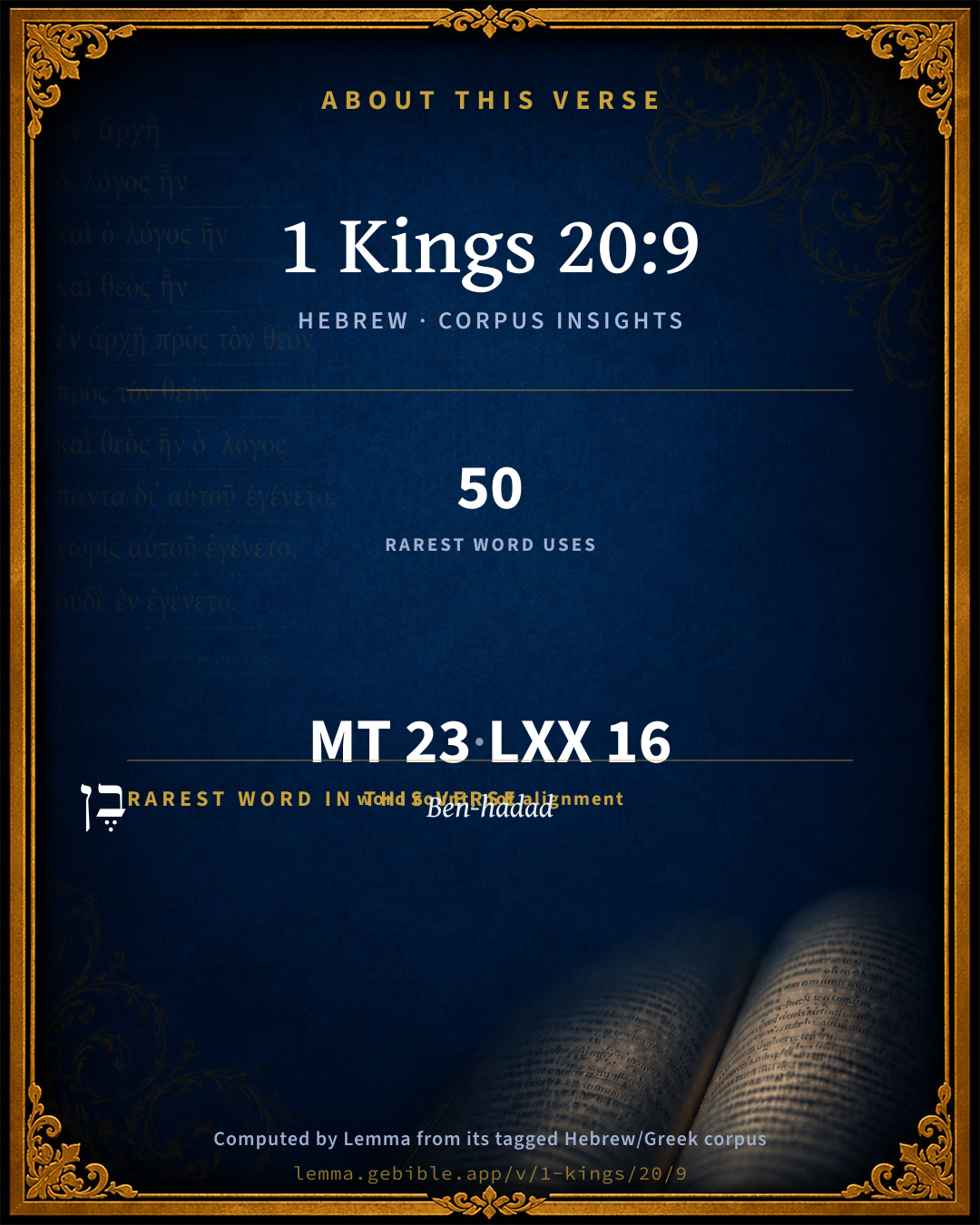
23
words
18
distinct lemmas
Historical
section

Shared distinctive vocabulary

בֶן Ben-hadad H1130 occurs in 24 verses of the Hebrew Bible. Also found in:

Grammatical profile

  • 8 verbs
  • 10 nouns
  • 1 adjective
  • 1 pronoun
  • 1 preposition
  • 2 particles

Verb forms

  • וַיֹּ֜אמֶר Qal · Sequential Imperfect
  • אִמְר֞וּ Qal · Imperative
  • שָׁלַ֨חְתָּ Qal · Perfect
  • אֶעֱשֶׂ֔ה Qal · Imperfect
  • אוּכַ֖ל Qal · Imperfect
  • לַעֲשׂ֑וֹת Qal · Infinitive Construct
  • וַיֵּֽלְכוּ֙ Qal · Sequential Imperfect
  • וַיְשִׁבֻ֖הוּ Hiphil · Sequential Imperfect

Repetition

Words recur within this verse — often emphatic in Hebrew:

  • וַיֹּ֜אמֶר to say H559 ×2
  • לְמַלְאֲכֵ֣י messenger H4397 ×2
  • בֶן Ben-hadad H1130 ×2
  • אֶעֱשֶׂ֔ה to do H6213 ×2
  • וְהַדָּבָ֣ר word H1697 ×2

Hebrew & Septuagint length

In English translation the verse runs 44 words from the Hebrew and 21 from the Septuagint (LXX English) — the Septuagint runs noticeably shorter here. See the side-by-side →

A rough comparison of the two English renderings, which tokenize alike — not a word-level alignment.

Word counts can differ between the Hebrew and the Greek without any difference in meaning — e.g. the Hebrew direct-object marker אֵת has no separate Greek word, and Greek often adds the article ὁ.

In the original languages it is 23 Hebrew tokens and 16 Greek tokens — but the two are counted differently (Hebrew bundles its prefixes and suffixes into one token; the Greek is in lemma form), so that isn’t a like-for-like length.

Hebrew and Greek witnesses Masoretic Hebrew ↔ Greek Septuagint

The same verse in the two great witnesses to the Old Testament, shown verse-for-verse.

Here the Septuagint runs noticeably shorter than the Hebrew — LXX2012 (modern English Septuagint) 21 words vs World English Bible 44. A rough length comparison of the two English translations, not a word-level alignment — read both below.

These are two independent witnesses, not word-aligned to each other, and the Septuagint is shown in lemma (dictionary) form.

Hebrew 1 Kings 20:9 Masoretic · Westminster Leningrad Codex

וַיֹּ֜אמֶר לְמַלְאֲכֵ֣י בֶן הֲדַ֗ד אִמְר֞וּ לַֽאדֹנִ֤י הַמֶּ֨לֶךְ֙ כֹּל֩ אֲשֶׁר שָׁלַ֨חְתָּ אֶל עַבְדְּךָ֤ בָרִֽאשֹׁנָה֙ אֶעֱשֶׂ֔ה וְהַדָּבָ֣ר הַזֶּ֔ה לֹ֥א אוּכַ֖ל לַעֲשׂ֑וֹת וַיֵּֽלְכוּ֙ הַמַּלְאָכִ֔ים וַיְשִׁבֻ֖הוּ דָּבָֽר

Therefore he said to the messengers of Ben Hadad, Tell my lord the king, All that you did send for to your servant at the first I will do; but this thing I may not do. The messengers departed, and brought him word again.

World English Bible · Public Domain

Greek LXX 1 Kings 20:9 Septuagint · lemma form

καί γράφω ἐν ὁ βιβλίον λέγω νηστεύω νηστεία καί καταἵζω ὁ ναβουθαι ἐν ἀρχή ὁ λαός

And it was written in the letters, saying, Keep a fast, and set Naboth in a chief place among the people.

LXX2012 (modern English Septuagint) · Public Domain

On this verse, The Cambridge Bible for Schools and Colleges discusses the Septuagint’s reading. Read the note in Commentary ↓

Hebrew: Westminster Leningrad Codex (CC BY 4.0). Greek: Septuagint (public domain); English from LXX2012 (modern English Septuagint) (Public Domain). How the Septuagint differs from the Hebrew →

Targum (Aramaic paraphrase)

1

The Targum is the ancient Jewish Aramaic paraphrase of the Hebrew Scriptures — an interpretive translation, not the Hebrew text itself. Onkelos (literal) and Pseudo-Jonathan (expansive) render the Torah, and Jonathan the Prophets. Coverage is partial: where no permissively-licensed English translation exists for a verse, only the Aramaic is shown. This is verse-level text, not a word-by-word alignment to the Hebrew.

  1. Targum Jonathan Prophets (Joshua–Malachi)
    וַאֲמַר לְאִזְגַדֵי בַּר הֲדַד אֱמַרוּ לְרִבּוֹנִי מַלְכָּא כָּל דִי שְׁלַחְתָּא לְעַבְדָךְ בְּקַדְמֵיתָא אַעְבֵּיד וּפִתְגָמָא הָדֵין לָא אִיכּוּל לְמֶעְבַּד וַאֲזָלוּ אִזְגַדַיָא וַאֲתִיבוֹהִי פִתְגָמָא:

    (no public-domain English translation for this verse)

    Targum Jonathan — Aramaic: “Mikraot Gedolot” (public domain). English: “Sefaria Community Translation” (CC0 1.0 (public-domain dedication)); “London "Chaldee Paraphrase," 1871” (public domain). Text via Sefaria.

Commentary

Notes on 1 Kings 20:9 from classic Christian and Jewish commentators (each source and its license shown beneath its notes). The classic Christian expositions comment on the surrounding passage and are grouped to its opening verse, so a note may address several verses; the Jewish commentaries on the Tanakh (Rashi and others) are per-verse, so they appear only where the commentator wrote on this verse.

Lemma curates 59 commentaries, every one of them public domain or Creative Commons licensed, each selected and text-cleaned for this edition rather than reprinted as found. About our sources →

Trapp's Complete Commentary

John Trapp

1Ki 20:9 Wherefore he said unto the messengers of Benhadad, Tell my lord the king, All that thou didst send for to thy servant at the first I will do: but this thing I may not do. And the messengers departed, and brought him word again.

Ver. 9. But this thing I may not do.] He saith not, This thing I will not do, which plainly discovereth his dastardliness and pusillanimity. {cowardliness} He had not "the spirit of power," because not "of a sound mind." {2Ti 1:7}

John Trapp, A Commentary or Exposition upon All the Books of the Old and New Testament (1647–1656) — public domain. Text from a community e-Sword module.

Joseph Benson's Commentary

1Ki 20:9-11. This thing I may not do — If I would do it, I cannot; because my people will not suffer it. If the dust of Samaria shall suffice for handfuls, &c. — If I do not assault thy city with so potent and numerous an army, as shall turn it all into a heap of dust, and shall be sufficient to carry it all away, though every soldier take but one handful of it. See the like boast, 2Sa 17:13. The king of Israel said, Let not him that girdeth, &c. — Do not triumph before the victory, for the events of war are uncertain.

Joseph Benson's Commentary on the Old and New Testaments (1811–1818) — public domain. Text from a community e-Sword module.

The Cambridge Bible for Schools and Colleges

gen. ed. J. J. S. Perowne

9. Tell my lord the king] The LXX. says ‘your lord’. The Hebrew accords better with the generally submissive conduct of Ahab throughout the whole narrative. The picture of the power of the Israelitish king is not very magnificent. Even in this final answer he speaks of himself as Ben-hadad’s ‘servant’.

The Cambridge Bible for Schools and Colleges (gen. ed. J. J. S. Perowne; Cambridge University Press, 1878–1918) — public domain. Text from a community e-Sword module.

John Gill's Exposition

Wherefore he sent unto the messengers of Benhadad,.... Upon the advice the elders had given him, and encouraged thereby, though in a poor sneaking manner after all:

tell my lord the king, all that thou didst send for to thy servant at the first I will do; owning him as his lord, and himself as his servant, and promising to grant his first demand, though so insolent, in the sense he understood him, of paying tribute to him for it:

but this thing I may not do; to have not only all put into his hands, but his and his servant's houses to be searched and pillaged, because the elders of his people would not agree; and yet he seems to speak as if he himself would have submitted to it, but was restrained by his council:

and the messengers departed, and brought him word again; reported to Benhadad the answer they received from Ahab.

John Gill's Exposition of the Whole Bible (1746–1763) — public domain (CC PDM 1.0). Text via the HelloAO Bible API.

Matthew Poole's English Annotations

This thing I may not do; if I would do it, I cannot, because my people will not suffer it.

Matthew Poole's English Annotations on the Holy Bible (1683–1685) — public domain. Text from a community e-Sword/MySword module.

The Pulpit Commentary

Wherefore Heb. and he said unto the mcaeengers of Benhadad, Tell my lord the king He still employs the same obsequious language as in ver. 4, All that thou didst send for to thy servant at the first I will do: but this thing I may Heb. can not do At first sight it appears as if Ahab objected to the search (ver. 6), i.e., plunder, of his house and capital much more than to the surrender of his wives to shame and of his children to slavery. But we must remember that a man is ready to promise almost anything in his extremity, and that we do not know what construction he put, or would have claimed to put, upon Ben-hadad"s first demand, had that monarch consented to revert to these conditions, or by what means he hoped to evade it. And the messengers departed, and brought him Ben-hadad, not Ahab, as Rawlinson imagines word again. Not the "word related in the next verse" (Rawlinson), but the message just recorded.

This thing I may not do." "Better die than live in disgrace," says the Greek proverb. The king of Samaria was in a similar strait to those four logical lepers who, a few years later, in another siege, lay at the gate of the city. (2Ki_7:4) He could but die in any case, and he might perchance live if he stood on his defence. Even a worm will turn when trod upon. We should think scorn of Ahab, had he not made a stand for his life and wife and children.

The Pulpit Commentary (1880–1919), ed. H.D.M. Spence-Jones & Joseph S. Exell — public domain. Text from a community e-Sword module.

unfoldingWord translationNotes

Door43 World Missions Community

May the gods do so to me and more also

This is an oath with great emphasis. See how you translated this in 1 Kings 19:2.

if even the ashes of Samaria will be enough for all the people who follow me to have a handful each

Ben Hadad is threatening that his army will totally destroy everything in Samaria. (See: Metaphor)

translationWords

Ahab

messenger

king

false god

ash

Samaria

unfoldingWord translationNotes — © Distant Shores Media and the Door43 World Missions Community, licensed CC BY-SA 4.0. Source: git.door43.org/Door43/en_tn.

Lesson kit

Teaching starters — assembled from the data on this page, not authored interpretation. Every prompt links to the verse data it draws on. Edit before teaching.

1 Kings, in the Historical, opens this verse with 23 words (18 distinct Hebrew lemmas). Its most distinctive word is Ben-Hădad (“Ben-hadad”). The Greek Septuagint runs shorter here. A historical commentator’s framing appears above. Read the whole chapter for the surrounding context.

Discussion questions

  1. The word Ben-Hădad carries the sense “Ben-hadad.” How does it shape the verse?
  2. 1 Kings 15:18 shares the word «Ben-hadad» with this verse. How do the two illuminate each other?
  3. “to say” occurs 2× in this one verse. What is the effect of the repetition?
  4. Compared with the Hebrew, the Septuagint runs shorter here. What questions does that raise?
  5. These translations render this verse differently; the difference is in the English rendering, not the original. What questions does that raise?
  6. The verb «וַיֹּ֜אמֶר» is Qal Sequential Imperfect. How does its form color the action?
  7. Reading how Trapp's Complete Commentary and Joseph Benson's Commentary read this verse, where do the two commentators agree and where do they part?

Things to notice

Reading settings

Reading text

Shown beneath each verse's original-language words.

Old Testament
Old Testament edition

Read the OT as the Masoretic Hebrew (MT) or the Greek Septuagint (LXX).

English shown for the Greek Septuagint (in the Hebrew ↔ Greek comparison).

Comparing translations? Open the Compare panel on any verse page to stack up to four side by side.