

Job 4:2

Hebrew (Westminster Leningrad Codex) Job 4:2 appears in the Hebrew Old Testament. The text above is from the Westminster Leningrad Codex. Each word links to its Strong’s number, a concise gloss, and parsing drawn from the Open Scriptures Hebrew Bible morphology. Click any word for its full Brown-Driver-Briggs (BDB) entry.
Download image
Cite this verse

Job 4:2 (World English Bible). Public Domain. Lemma interlinear Bible study tool, https://lemma.gebible.app/v/job/4/2.

Show BibTeX & RIS
BibTeX
RIS
English Translation
"If someone ventures to talk with you, will you be grieved? But who can withhold himself from speaking?
World English Bible · Public Domain
Download a study sheet

One document with this verse’s original text, its word-by-word gloss line, the meaning frame, cross-references with their text, attributed commentary, and full source and license credits — printable, and it pastes into notes with its structure intact.

This verse Autodidact and up

Study sheet (.html) Plain text (.txt)

A passage Seminary Student

Up to 50 verses in one chapter. A passage sheet keeps up to 6 commentary sources and 12 cross-references per verse, in the order this page ranks them, and says so on the sheet whenever that leaves anything out. Ask for a single verse and you get the Autodidact verse sheet above.

Everything on this page stays free to read, with no account — the sheet is a download of what is already on screen, not access to it.

Want to remove ads? Support Godless Engineer
Compare translations 3

The same verse in 3 English versions, stacked beneath the original-language interlinear above. Click any original word for its lexicon entry.

Each is an independent rendering of the whole verse — the interlinear is not word-aligned to these translations.

Highlighted words mark where these versions differ — a whole-verse word diff, not a word-by-word alignment.

  • World English Bible Public Domain
    "If someone ventures to talk with you, will you be grieved? But who can withhold himself from speaking?
  • King James Version Public Domain
    If we assay to commune with thee, wilt thou be grieved? but who can withhold himself from speaking?
  • unfoldingWord Literal Text CC BY-SA 4.0
    “If a word is tried with you, will you tire? But to refrain from a word, who is able?

unfoldingWord Literal Text — © unfoldingWord, licensed CC BY-SA 4.0. Word-aligned USFM3 via Door43 (git.door43.org/unfoldingWord/en_ult).

Versions to compare (up to 4)

3 of 4 selected

Show all 18 translations

Every available English version of this verse, each an independent rendering of the whole verse.

  • World English Bible Public Domain
    "If someone ventures to talk with you, will you be grieved? But who can withhold himself from speaking?
  • Berean Standard Bible Public Domain
    “If one ventures a word with you, will you be wearied? Yet who can keep from speaking?
  • Majority Standard Bible Public Domain
    “If one ventures a word with you, will you be wearied? Yet who can keep from speaking?
  • King James Version Public Domain
    If we assay to commune with thee, wilt thou be grieved? but who can withhold himself from speaking?
  • American Standard Version (1901) Public Domain
    If one assay to commune with thee, wilt thou be grieved? But who can withhold himself from speaking?
  • Revised Version (1885) Public Domain
    If one assay to commune with thee, wilt thou be grieved? but who can withhold himself from speaking?
  • Geneva Bible (1599) Public Domain
    If we assay to commune with thee, wilt thou be grieued? but who can withholde himselfe from speaking?
  • Douay-Rheims (1899) Public Domain
    If we begin to speak to thee, perhaps thou wilt take it ill, but who can withhold the words he hath conceived?
  • Young's Literal Translation Public Domain
    Hath one tried a word with thee? -- Thou art weary! And to keep in words who is able?
  • Literal Standard Version CC BY-SA 4.0
    “Has one tried a word with you? You are weary! And who is able to keep in words?
  • Unlocked Literal Bible CC BY-SA 4.0
    If anyone tries to speak with you, will you be impatient? But who can stop himself from speaking?
  • unfoldingWord Literal Text CC BY-SA 4.0
    “If a word is tried with you, will you tire? But to refrain from a word, who is able?
  • Darby Bible Public Domain
    If a word were essayed to thee, wouldest thou be grieved? But who can refrain from speaking?
  • World Messianic Bible Public Domain
    “If someone ventures to talk with you, will you be grieved? But who can withhold himself from speaking?
  • Webster's Bible Public Domain
    If we essay to commune with thee, wilt thou be grieved? but who can refrain from speaking?
  • Free Bible Version CC BY-SA 4.0
    “Could I say a word? I don't want to upset you but who could keep quiet and not respond?
  • Bible in Basic English Public Domain
    If one says a word, will it be a weariness to you? but who is able to keep from saying what is in his mind?
  • JPS Tanakh (1917) Public Domain
    If one venture a word unto thee, wilt thou be weary? But who can withhold himself from speaking?

Literal Standard Version (2020), Covenant Press — licensed CC BY-SA 4.0. Text via the HelloAO Bible API (eBible.org). Unlocked Literal Bible (unfoldingWord) — licensed CC BY-SA 4.0. Text via the HelloAO Bible API (eBible.org). unfoldingWord Literal Text — © unfoldingWord, licensed CC BY-SA 4.0. Word-aligned USFM3 via Door43 (git.door43.org/unfoldingWord/en_ult). Free Bible Version, Dr. Jonathan Gallagher — licensed CC BY-SA 4.0. Text via the HelloAO Bible API (eBible.org).

Word by word

More ways to search: Search by grammar → Find every occurrence → Compare this word →

Practice this passage: Drill this verse → Learn its vocabulary →

About this verse

These counts appear in no published source. They are computed here, from the morphology-tagged text and Lemma’s own curated glosses. What Lemma adds →

8
words
8
distinct lemmas
Wisdom
section

Notable vocabulary

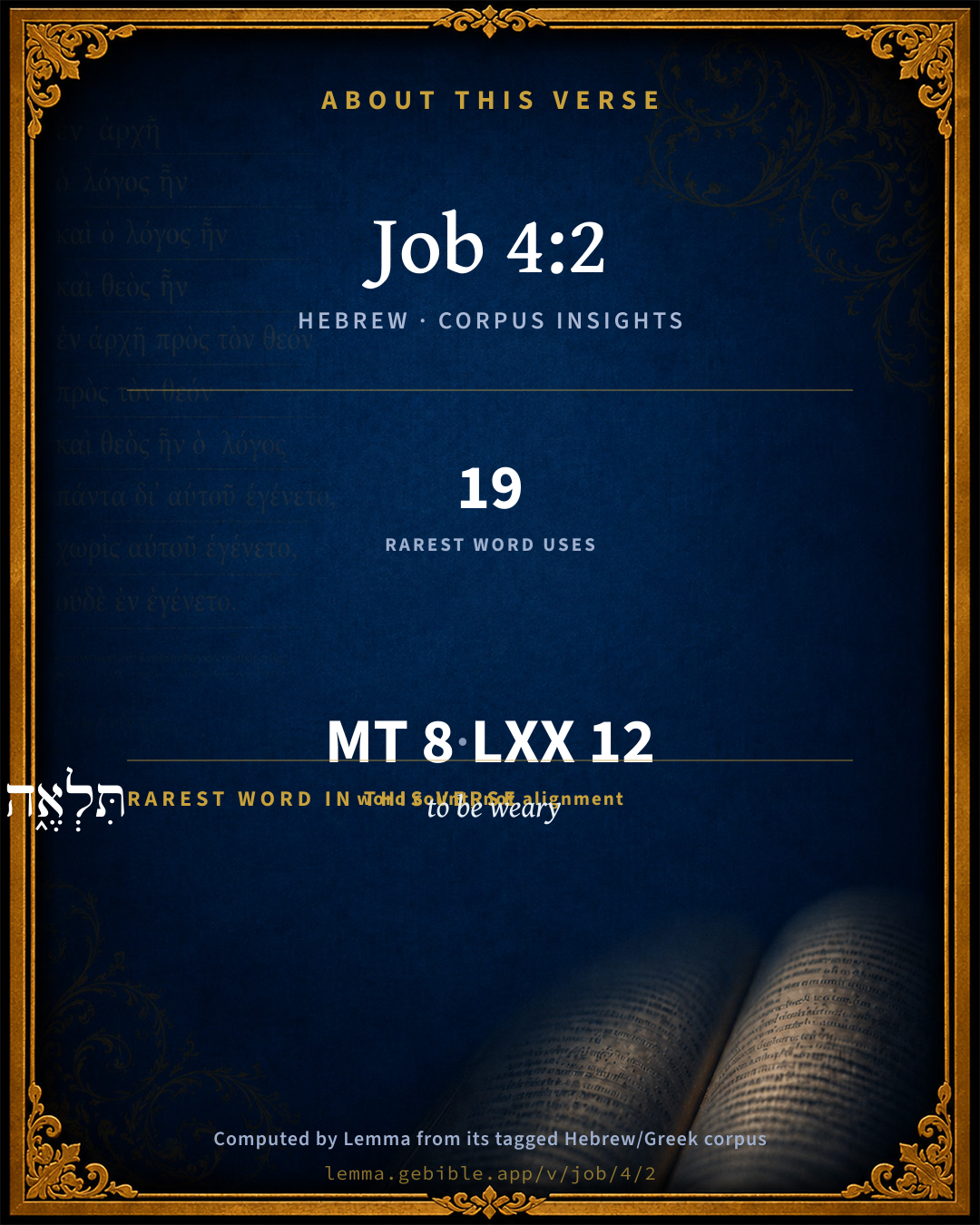
The rarest word here is תִּלְאֶ֑ה to be weary H3811 — appearing just 19 times in the whole Hebrew Bible.

Shared distinctive vocabulary

תִּלְאֶ֑ה to be weary H3811 occurs in 18 verses of the Hebrew Bible. Also found in:

Grammatical profile

  • 4 verbs
  • 2 nouns
  • 1 preposition
  • 1 particle

Verb forms

  • הֲנִסָּ֬ה Niphal · Perfect
  • תִּלְאֶ֑ה Qal · Imperfect
  • וַעְצֹ֥ר Qal · Infinitive Construct
  • יוּכָֽל Qal · Imperfect

Hebrew & Septuagint length

In English translation the verse runs 18 words from the Hebrew and 17 from the Septuagint (LXX English) — closely comparable.

A rough comparison of the two English renderings, which tokenize alike — not a word-level alignment.

Word counts can differ between the Hebrew and the Greek without any difference in meaning — e.g. the Hebrew direct-object marker אֵת has no separate Greek word, and Greek often adds the article ὁ.

In the original languages it is 8 Hebrew tokens and 12 Greek tokens — but the two are counted differently (Hebrew bundles its prefixes and suffixes into one token; the Greek is in lemma form), so that isn’t a like-for-like length.

Cross-references

6

Topical passages linked to Job 4:2 in the Treasury of Scripture Knowledge — connected by theme and wording, ordered by reader-vote popularity; previews shown in the World English Bible.

  • Job 32:18–20 For I am full of words. The spirit within me constrains me.
  • Acts 4:20 for we can't help telling the things which we saw and heard."
  • Jeremiah 6:11 Therefore I am full of the wrath of Yahweh; I am weary with holding in: pour it out on the children in the street, and on the assembly of young men together; for even the husband with the wife shall be taken, the aged with him who is full of days.
  • Jeremiah 20:9 If I say, I will not make mention of him, nor speak any more in his name, then there is in my heart as it were a burning fire shut up in my bones, and I am weary with forbearing, and I can't [contain].
  • 2 Corinthians 2:4–6 For out of much affliction and anguish of heart I wrote to you with many tears, not that you should be made sorry, but that you might know the love that I have so abundantly for you.
  • 2 Corinthians 7:8–10 For though I made you sorry with my letter, I do not regret it, though I did regret it. For I see that my letter made you sorry, though just for a while.

Cross-references courtesy of OpenBible.info (CC BY 4.0).

Hebrew and Greek witnesses Masoretic Hebrew ↔ Greek Septuagint

The same verse in the two great witnesses to the Old Testament, shown verse-for-verse.

These are two independent witnesses, not word-aligned to each other, and the Septuagint is shown in lemma (dictionary) form.

Hebrew Job 4:2 Masoretic · Westminster Leningrad Codex

הֲנִסָּ֬ה דָבָ֣ר אֵלֶ֣יךָ תִּלְאֶ֑ה וַעְצֹ֥ר בְּ֝מִלִּ֗ין מִ֣י יוּכָֽל

"If someone ventures to talk with you, will you be grieved? But who can withhold himself from speaking?

World English Bible · Public Domain

Greek LXX Job 4:2 Septuagint · lemma form

μή πολλάκις σύ λαλέω ἐν κόπος ἰσχύς δέ ῥῆμα σύ τίς ὑποφέρω

Have you been often spoken to in distress? but who shall endure the force of your words?

LXX2012 (modern English Septuagint) · Public Domain

On this verse, Haydock's Catholic Bible Commentary discusses the Septuagint’s reading. Read the note in Commentary ↓

Hebrew: Westminster Leningrad Codex (CC BY 4.0). Greek: Septuagint (public domain); English from LXX2012 (modern English Septuagint) (Public Domain). How the Septuagint differs from the Hebrew →

Commentary

Notes on Job 4:2 from classic Christian and Jewish commentators (each source and its license shown beneath its notes). The classic Christian expositions comment on the surrounding passage and are grouped to its opening verse, so a note may address several verses; the Jewish commentaries on the Tanakh (Rashi and others) are per-verse, so they appear only where the commentator wrote on this verse.

Lemma curates 59 commentaries, every one of them public domain or Creative Commons licensed, each selected and text-cleaned for this edition rather than reprinted as found. About our sources →

Trapp's Complete Commentary

John Trapp

Job 4:2 [If] we assay to commune with thee, wilt thou be grieved? but who can withhold himself from speaking?

Ver. 2. If we assay to commune with thee] Or may we assay to commune with thee? Art thou in case to be counselled? and will not an essay to this purpose further trouble thy patience and distemper thee? The ear which tasteth words (as the mouth doth meat), if filled with choler, can relish no comfort; and the easiest medicines, or mildest waters, are troublesome to sore eyes (Basil. Orat. 12). Honey causeth pain to exulcerate parts, though in itself it be sweet and medicinal; children, though at other times they like it and lick it in, yet they will not endure to have it come near their lips when they have the cankers (Alex. Aphrod. problem.). Some patients are mad against their medicines; and some hearers rage at a reproof. Eliphaz knew not but that Job might do as much, and that having newly been in a fearful fit of passion, he might fall into another, as Jonah did; the orifice of his corruption being not yet closed up by repentance; hence this preamble by way of friendly insinuation. The like art useth Paul with Philemon, and with the Corinthians often.

But who can withhold himself from speaking?] Who that hath any piety toward God, or pity to his offending friend? We use to say, He that receiveth a courtesy selleth his liberty; but true love will not be tongue tied. Our Saviour’s mouth was not stopped with all the good cheer that Simon the leper made him, Luk 7:36-50, neither entertained he the Pharisees with fewer menaces than they did him, eftsoons, with messes of meat. Job had been doubtless very friendly to his friends, who yet spare him not; and had they done it aright with the meekness of wisdom they had showed themselves friends indeed there being not a better office or evidence of love than this, Lev 19:17. Friends, as bees, are killed with the honey of flattery, but quickened with the vinegar of reproof, so it be well managed. The eagle, though she loveth her young ones dearly, yet she pricketh and beateth them out of the nest when they are ready for flight.

John Trapp, A Commentary or Exposition upon All the Books of the Old and New Testament (1647–1656) — public domain. Text from a community e-Sword module.

Joseph Benson's Commentary

Job 4:2. If we assay to commune with thee, &c. — This is nearly the sense, but not exactly the construction of the Hebrew, הנסה דבר אליךְ, hanissah dabar eeleka, is rather, Annon aggrediemur sermonem adversus te. Shall we not attempt a discourse against thee? Shall we suffer thee to go on with thy complaints? Shall we hear thee with patience, and be altogether silent, without so much as attempting a reply? Wilt thou be grieved? — Or, Thou wilt be grieved; תלאה, Tileh, moleste feres, thou wilt take it ill. Our words will undoubtedly vex, and not comfort thee, as we desired and intended to do. For truth is surely to be regarded more than friendship, and we cannot, in consistency therewith, speak words of consolation, but we must use those of sharp reproof. This makes me desire to be silent, were it possible. But who can withhold? &c. — The Hebrew

ועצר במלין, vagnetser bemillin, &c., is literally, But to refrain from words, who can? Who, when he hears such unreasonable and ungodly words, coming from such a person as thou art, words whereby thou dost accuse thy Maker, reproach his providence, and contemn his blessings, can forbear speaking? No man, who hath any respect to God, or love to thee, can refrain from reproving thee. I will, therefore, suggest to thee some of those observations, which were the thoughts of wise and prudent men of old time; and from which, if well applied, thou mayest receive singular profit. The verse is intended as an apology for what he was about to say.

Joseph Benson's Commentary on the Old and New Testaments (1811–1818) — public domain. Text from a community e-Sword module.

Whedon's Commentary on the Bible

Daniel D. Whedon

First double strophe — Proposition — MISERY IMPLIES GUILT, Job_4:2-11. First strophe — Reproof of Job for the failure of his faith, Job_4:2-6.

2. If we assay — Literally, Should we attempt a word with thee, wilt thou take it ill? The address of Telemachus to Antinous in the Odyssey opens in a similar manner, almost word for word. Who can withhold himself, etc. — Better, “Yet to restrain words, who is able?” A delicate and courteous beginning.

Daniel D. Whedon (gen. ed.), Commentary on the Old and New Testaments (1874–1909) — public domain. Text from a community e-Sword module.

Geneva Bible (1599)

Geneva Bible translators

Seeing this thine impatience.

Geneva Bible (1599) marginal notes — public domain. Text via Bolls.life.

Jamieson, Fausset & Brown

Robert Jamieson, A. R. Fausset & David Brown

If we assay to commune--Rather, two questions, "May we attempt a word with thee? Wilt thou be grieved at it?" Even pious friends often count that only a touch which we feel as a wound.

Jamieson, Fausset & Brown — Commentary Critical and Explanatory on the Whole Bible (1871) — public domain (CC PDM 1.0). Text via the HelloAO Bible API.

Adam Clarke's Commentary

Verse 2. If we assay to commune with thee] As if he had said, Should I and my friends endeavour to reason with thee ever so mildly, because we shall have many things to say by way of reprehension, thou wilt be grieved and faint; and this we may reasonably infer from the manner in which thou bearest thy present afflictions. Yet as thou hast uttered words which are injurious to thy Maker, who can forbear speaking? It is our duty to rise up on the part of God, though thereby we shall grieve him who is our friend. This was a plausible beginning, and certainly was far from being insincere.

Adam Clarke's Commentary on the Bible (1810–1826) — public domain. Text from a community e-Sword/MySword module.

Ellicott's Commentary for English Readers

IV.

(2) If we assay.—Rather, perhaps, Has one ever assayed? or, Has a word ever been tried? It appears from Job_29:9-10, that Job was held in great honour and reverence by all, and Eliphaz regarded him with awe such as would have constrained him to be silent, but he is so convinced that Job is wrong and deserves reproof, that he cannot refrain from speaking. He strikes a note, however, which the friends all sound, namely, that it is the wicked who suffer, and that all who suffer must be wicked. This, in a variety of forms, is the sum and substance of what they have to say.

A Bible Commentary for English Readers, edited by Charles John Ellicott (1878–1897) — public domain. Text from a community e-Sword module.

The Cambridge Bible for Schools and Colleges

gen. ed. J. J. S. Perowne

2. If we assay to commune] lit. if one should assay a word with thee. be grieved] This word is rendered thou faintest, Job_4:5. It means to be weary; this may be equivalent either to be impatient, Isa_1:14, or to be exhausted. It is difficult to decide here. We may render, leaving the ambiguity, will it be too much for thee? Eliphaz speaks unwillingly, and would spare Job, but he is compelled by the frame of mind in which he sees his friend.

The Cambridge Bible for Schools and Colleges (gen. ed. J. J. S. Perowne; Cambridge University Press, 1878–1918) — public domain. Text from a community e-Sword module.

John Gill's Exposition

Behold, thou hast instructed many,.... This is introduced with a "behold", either as a note of admiration, that such a man, who had instructed others, should act the part he now does; or as a note of attention to Job himself, and all others that should hear and read this, to observe it, and well consider it, and make the proper use of it; or as a note of asseveration, affirming it to be true and certain, notorious and unquestionable, as no doubt it was: Job was the instructor, a great man, and yet condescended to teach and instruct men in the best things, as did also Abraham, David, Solomon, and others; and a good man, and so fit to teach good things, as every good man is, and who, according to his ability, the gift and measure of grace received should instruct others; and a man of great gift he was, both in things natural, civil, and religious; one that could speak well, and to the purpose, and so was apt and able to teach; and such should not disuse and hide their talents: the persons he instructed were not only his own family, his children and servants, as Abraham before him did; but others who attended him, and waited for his counsel and advice, his words and doctrine, as for the rain, and latter rain, and which dropped and distilled as such, see Job 29:15; and these were "many"; his many ignorant neighbours about him, or many professors of religion, as there might be, and it seems there were in this idolatrous country; and many afflicted ones among these, which is usually the case: Job had many scholars in his school, of different sorts, that attended on him; and these he instructed in the knowledge of the true God, his nature, perfections, and works; and of the living Redeemer, his person, office, grace, and righteousness; and of themselves, the impurity of their nature through original sin, he was acquainted with; their impotency and inability to purge themselves, to atone for sin, and to justify and make themselves acceptable to God; as well as he instructed them in the worship of God, and the manner of it, their duty to him and to one another, and to all their fellow creatures: some render it, "thou hast corrected", or "reproved many" (l); he had taught the afflicted to be patient under their afflictions, and had reproved them for their impatience; and the design of Eliphaz is to upbraid him with it, as in Rom 2:21; thou that didst correct others for their unbecoming behaviour under afflictions, art thyself guilty of the same: "turpe est doctori, cure culpa redarguit ipsum":

and thou hast strengthened the weak hands; either such as hung down through want of food, by giving it to them, both corporeal and spiritual, which strengthens men's hearts, and so their hands; or through sluggishness, by exhorting and stirring them up to be active and diligent; or through fear of enemies, especially spiritual ones, as sin, Satan, and the world; by reason of whose numbers and strength good men are apt to be dispirited, and ready to castaway their spiritual armour, particularly the shield of faith and confidence in God, as faint hearted soldiers in war, to which the allusion is: and these were strengthened by telling them that all their enemies were conquered, and they were more than conquerors over them; that the victory was certain, and their warfare accomplished, or would quickly be: or else, whose hands were weak through a sense of sin and danger, and being in expectation of the wrath, and vengeance of God; and who were strengthened by observing to them that there was a Saviour appointed and expected, a living Redeemer, who would stand upon the earth in the latter day, and save them from their sins, and from wrath to come; see Isa 35:3; or rather, such whose hearts and hands were, weak through sore and heavy afflictions, whom Job strengthened by showing them that their afflictions were of God; not by chance, but by appointment, and according to the sovereign will of God; that they were for their good, either temporal, spiritual, or eternal; and that they would not continue always, but have an end; and therefore should be patiently bore, see Co1 12:11.

(l) "corripuisti", Mercerus, Michaelis; "castigasti", Codurcus, Drusius, Schmidt, Schultens.

John Gill's Exposition of the Whole Bible (1746–1763) — public domain (CC PDM 1.0). Text via the HelloAO Bible API.

Albert Barnes' Notes on the Bible

If we assay to commune with thee - Margin, A word. Hebrew - הנסה דבר dâbâr hanı̂câh. “May we attempt a word with thee?” This is a gentle and polite apology at the beginning of his speech - an inquiry whether he would take it as unkind if one should adventure on a remark in the way of argument. Jahn, in characterizing the part which Job’s three friends respectively take in the controversy, says: “Eliphaz is superior to the others in discernment and delicacy. He begins by addressing Job mildly; and it is not until irritated by opposition that he reckons him among the wicked.”

Wilt thou be grieved? - That is, Wilt thou take it ill? Will it be offensive to you, or weary you, or tire your patience? The word used here (לאה lâ'âh) means to labor, to strive, to weary, to exhaust; and hence, to be weary, to try one’s patience, to take anything ill. Here it is the language of courtesy, and is designed to introduce the subsequent remarks in the kindest manner. Eliphaz knew that he was about to make observations which might implicate Job, and he introduced them in as kind a manner as possible. There is nothing abrupt or harsh in his beginning. All is courteous in the highest degree, and is a model for debaters.

But who can withhold himself from speaking? - Margin, “Refrain from words.” That is, “the subject is so important, the sentiments advanced by Job are so extraordinary, and the principles involved are so momentous, that it is impossible to refrain.” There is much delicacy in this. He did not begin to speak merely to make a speech. He professes that be would not have spoken, if he had not been pressed by the importance of the subject, and had not been full of matter. To a great extent, this is a good rule to adopt: not to make a speech unless there are sentiments which weigh upon the mind, and convictions of duty which cannot be repressed.

Albert Barnes' Notes on the Bible (1834–1885) — public domain. Text from a community e-Sword/MySword module.

Haydock's Catholic Bible Commentary

Conceived? and to which the speech of Job had given occasion. (Menochius) --- Septuagint, "Who shall bear the force of thy words? For if thou," &c. (Haydock)

George Leo Haydock (1774–1849), Haydock's Catholic Family Bible and Commentary, 1859 edition — public domain. Excludes Psalms (Douay-Rheims chapter numbering differs from Protestant) and Deuterocanonical books (Catholic canon only).

Matthew Poole's English Annotations

Wilt thou be grieved? or, (without a note of interrogation,) thou wilt be grieved. Our words will undoubtedly vex thee, and not comfort thee, as we intended and desired to do. We must not use words of comfort, but of sharp reproof, which will be irksome to thee; and this makes me desire to be silent, if it were possible.

Who can withhold himself from speaking, when he hears such unreasonable and ungodly words coming from such a person as thou art, whereby thou dost accuse thy Maker, and reproach his providence, and contemn his blessings? No man who hath any respect to God, or love to thee, can forbear reproving thee.

Matthew Poole's English Annotations on the Holy Bible (1683–1685) — public domain. Text from a community e-Sword/MySword module.

The Pulpit Commentary

If we assay to commune with thee, wilt thou be grieved? rather, If one assay a word against theewilt thou be angry? Eliphaz feels that what he is about to say will be unwelcome, and, as it were, apologizes beforehand. Surely Job will not be angry if a friend just ventures a word. But who can withhold himself from speaking? Let Job be angry or not, Eliphaz must speak. It is impossible to hear such words as Job has uttered, and yet keep silence. God"s wisdom and justice have been impugned, and must be vindicated.

Irrepressible speech.

Eliphaz says," Who can withhold himself from speaking?" He utters his own sentiment, but it is a very common one far more common than the honest admission of it with which Eliphaz justifies his address to Job.

I IRREPRESSIBLE SPEECH SPRINGS FROM VARIOUS INFLUENCES, Sometimes it is difficult to find words. What, then, are the things that break open the fountains of speech?

1. Natural temperament. Some are naturally loquacious, others as naturally taciturn. No man is responsible for his original constitution; his responsibility begins with his use of it.

2. Wealth of ideas. It is not only verbal fluency that runs into a volume of speech. One who thinks much will have the materials for talking much. Coleridge meditated deeply; Macaulay read enormously, and remembered all he read; and both were great talkers.

3. Depth of feeling. Passion elves eloquence to the least gifted person. Sympathy will seek for words. So the long contemplation of Job"s sufferings urged Eliphaz to speak.

4. Provocation. Eliphaz was shocked at Job"s cursing the day of his birth. Unable to enter into the tragic depths of the sufferer"s grief, he could easily perceive the highly improper tone of the language used. Controversy rouses the least beautiful, but often the most vigorous, kind of eloquence.

5. Vanity. To many people there is a strange charm in the sound of their own voices.

II IRREPRESSIBLE SPEECH MAY BE A SOURCE OF GREAT EVIL, The talker rarely seems to consider how keen a weapon he is wielding. He does not appear to remember that his words are like arrows, and that the bow drawn at a venture may inflict a mortal wound; that they are as seeds which may spring up and bear hitter fruit long after the sower has forgotten when and where he threw them broadcast over the earth. Certain points in particular need to be noticed.

1. Irrepressible speech lacks due reflection. It is hasty and ill-judged. Thus it may say far more than the speaker intended, and it may even convey a very false impression. Spoken without due thought, the hurried word may make a suggestion which mature consideration would utterly repudiate. Words lead to deeds, and thus irrepressible speech becomes an unalterable act. "Volatility of words," says Lavater, "is carelessness in actions; words are the wings of actions.

2. Irrepressible speech is likely to be inconsiderate of the feelings of others. Surely Job"s three comforters could not have known what cruel barbs their words were, or they would scarcely have tormented the sufferer as they did. It is so easy to wound with the tongue, that if we talk hastily and without thought, it is most likely that we shall do so even without intending it.

3. Irrepressible speech is a slight on the mission of silence. Those seven days of silence served as a healing ministry, or at least they were days of unadulterated sympathy on the part of the three friends. Why, then, should the good men change their tactics? Evidently they had not enough faith in silence.

4. Irrepressible speech needs the preservation of Divine grace. Great talkers should especially look for help from above, that their speech may be "seasoned with salt." He who spake as never man spake is a model of wise, laconic utterance. To be safe in the use of the tongue we need to be much in company with Christ, often in converse with Heaven. W.F.A.

The Pulpit Commentary (1880–1919), ed. H.D.M. Spence-Jones & Joseph S. Exell — public domain. Text from a community e-Sword module.

John Wesley's Explanatory Notes

If we, &c. - He speaks with great modesty. He will not undertake the cause alone, but joins his friends with him. He will not promise much, but only assay, or try if he could propose any thing pertinent to Job's case. Withhold - When he hears such words from such a person as thou art.

John Wesley, Explanatory Notes Upon the Whole Bible (1754–1765) — public domain. Text via the GEBible commentary corpus.

Keil & Delitzsch

C. F. Keil & F. Delitzsch

2 If one attempts a word with thee, will it grieve thee?

And still to restrain himself from words, who is able?

3 Behold, thou hast instructed many,

And the weak hands thou hast strengthened.

4 The stumbling turned to thy words,

And the sinking knees thou hast strengthened.

5 But now it cometh to thee, thou art grieved;

Now it toucheth thee, thou despondest.

The question with which Eliphaz beings, is certainly one of those in which the tone of interrogation falls on the second of the paratactically connected sentences: Wilt thou, if we speak to thee, feel it unbearable? Similar examples are Job 4:21; Num 16:22; Jer 8:4; and with interrogative Wherefore? Isa 5:4; Isa 50:2 : comp. the similar paratactic union of sentences, Job 2:10; Job 3:11. The question arises here, whether נסּה is an Aramaic form of writing for נשּׂא (as the Masora in distinction from Deu 4:34 takes it), and also either future, Wilt thou, if we raise, i.e., utter, etc.; or passive, as Ewald formerly,

(Note: In the second edition, comp. Jahrb. ix. 37, he explains it otherwise: "If we attempt a word with thee, will it be grievous to thee quod aegre feras?" But that, however, must be נסּה; the form נסּה can only be third pers. Piel: If any one attempts, etc., which, according to Ewald's construction, gives no suitable rendering.)

If a word is raised, i.e., uttered, דּבר נשׂא, like משׁל נשׂא, Job 27:1; or whether it is third pers. Piel, with the signification, attempt, tentare, Ecc 7:23. The last is to be preferred, because more admissible and also more expressive. נסּה followed by the fut. is a hypothetic praet., Supposing that, etc., wilt thou, etc., as e.g., Job 23:10. מלּין is the Aramaic plur. of מלּה, which is more frequent in the book of Job than the Hebrew plur. מלּים. The futt., Job 4:3., because following the perf., are like imperfects in the western languages: the expression is like Isa 35:3. In עתּה כּי, Job 4:5, כּי has a temporal signification, Now when, Ges. 155, 1, e, (b).

Keil & Delitzsch — Biblical Commentary on the Old Testament (1861–1891) — public domain (CC PDM 1.0). Text via the HelloAO Bible API. (Old Testament only.)

Rashi

Rabbi Shlomo Yitzchaki (Rashi)

Because He tested This is an expression of wonder. Because He tested you with one thing, should you weary? With one rest that the Holy One, blessed be He, tested you, you have become weary. From now on, who will be able to withhold his words from answering you?

Rashi on the Tanakh — English translations: “The Judaica Press complete Tanach with Rashi, translated by A. J. Rosenberg” (CC BY 4.0); “Pentateuch with Rashi's commentary by M. Rosenbaum and A.M. Silbermann, 1929-1934” (public domain); “The Metsudah Tanach series, Lakewood, N.J” (CC BY 4.0); and “The Book of Joshua, Metsudah Publications, 1997” (CC BY 4.0). Text via Sefaria.

Lesson kit

Teaching starters — assembled from the data on this page, not authored interpretation. Every prompt links to the verse data it draws on. Edit before teaching.

Job, in the Wisdom, opens this verse with 8 words (8 distinct Hebrew lemmas). Its most distinctive word is lâʼâh (“to be weary”). A historical commentator’s framing appears above. Read the whole chapter for the surrounding context.

Discussion questions

  1. What does “to be weary” (lâʼâh) contribute to the verse as a whole?
  2. How does Genesis 19:11, which shares the word «to be weary», read alongside this verse?
  3. These translations render this verse differently. What is at stake in choosing one wording over another?
  4. «הֲנִסָּ֬ה» is a Niphal Perfect verb. How does that grammatical form shape the action described?
  5. Compare how Trapp's Complete Commentary and Joseph Benson's Commentary read this verse. Where do they agree or differ?

Things to notice

Reading settings

Reading text

Shown beneath each verse's original-language words.

Old Testament
Old Testament edition

Read the OT as the Masoretic Hebrew (MT) or the Greek Septuagint (LXX).

English shown for the Greek Septuagint (in the Hebrew ↔ Greek comparison).

Comparing translations? Open the Compare panel on any verse page to stack up to four side by side.