
Jeremiah 6:10

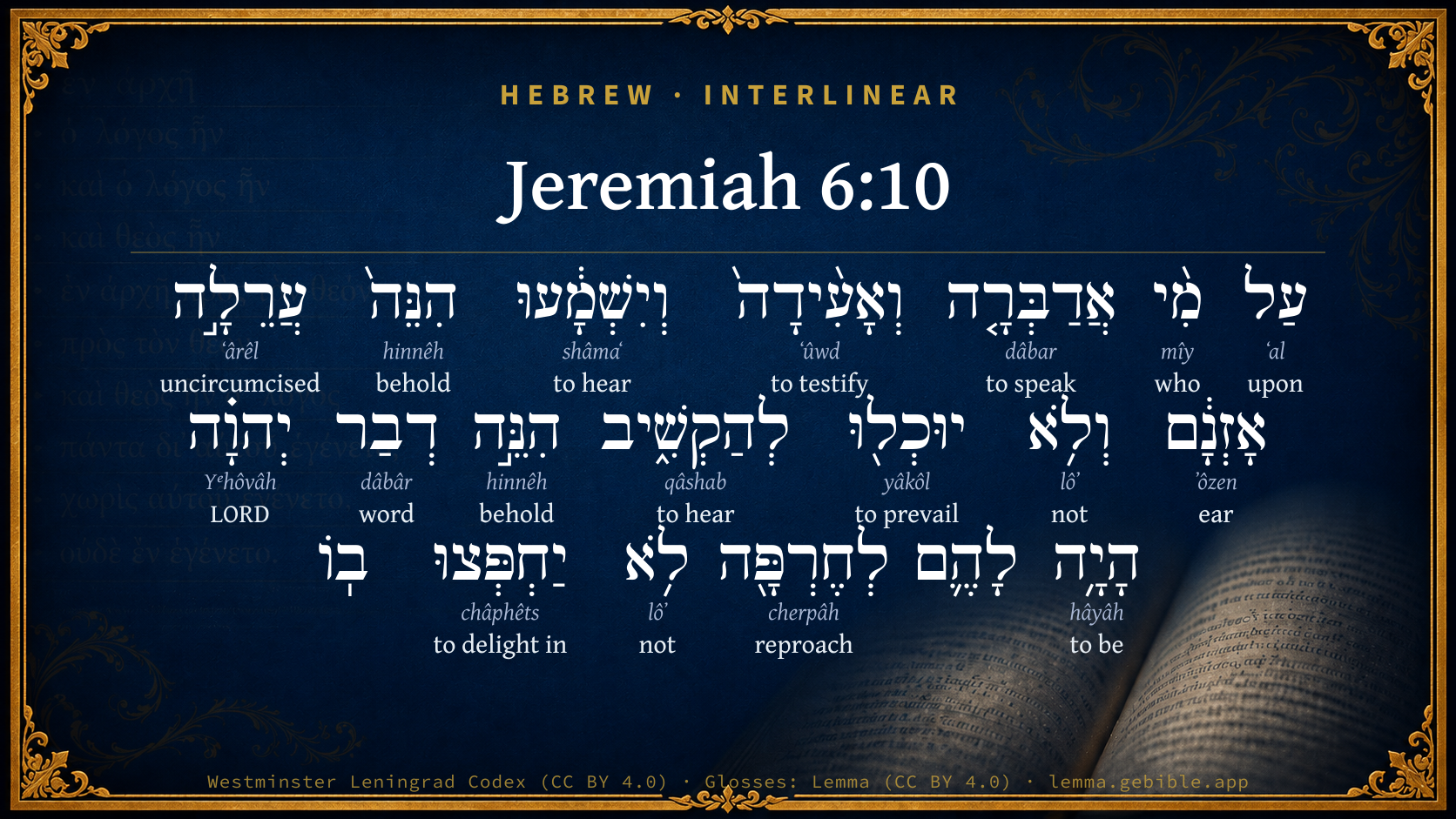
Hebrew (Westminster Leningrad Codex) Jeremiah 6:10 appears in the Hebrew Old Testament. The text above is from the Westminster Leningrad Codex. Each word links to its Strong’s number, a concise gloss, and parsing drawn from the Open Scriptures Hebrew Bible morphology. Click any word for its full Brown-Driver-Briggs (BDB) entry.
Download image
Cite this verse

Jeremiah 6:10 (World English Bible). Public Domain. Lemma interlinear Bible study tool, https://lemma.gebible.app/v/jeremiah/6/10.

Show BibTeX & RIS
BibTeX
RIS
English Translation
To whom shall I speak and testify, that they may hear? behold, their ear is uncircumcised, and they can't listen: behold, the word of Yahweh is become to them a reproach; they have no delight in it.
World English Bible · Public Domain
Download a study sheet

One document with this verse’s original text, its word-by-word gloss line, the meaning frame, cross-references with their text, attributed commentary, and full source and license credits — printable, and it pastes into notes with its structure intact.

This verse Autodidact and up

Study sheet (.html) Plain text (.txt)

A passage Seminary Student

Up to 50 verses in one chapter. A passage sheet keeps up to 6 commentary sources and 12 cross-references per verse, in the order this page ranks them, and says so on the sheet whenever that leaves anything out. Ask for a single verse and you get the Autodidact verse sheet above.

Everything on this page stays free to read, with no account — the sheet is a download of what is already on screen, not access to it.

Want to remove ads? Support Godless Engineer
Compare translations 3

The same verse in 3 English versions, stacked beneath the original-language interlinear above. Click any original word for its lexicon entry.

Each is an independent rendering of the whole verse — the interlinear is not word-aligned to these translations.

Highlighted words mark where these versions differ — a whole-verse word diff, not a word-by-word alignment.

  • World English Bible Public Domain
    To whom shall I speak and testify, that they may hear? behold, their ear is uncircumcised, and they can't listen: behold, the word of Yahweh is become to them a reproach; they have no delight in it.
  • King James Version Public Domain
    To whom shall I speak, and give warning, that they may hear? behold, their ear is uncircumcised, and they cannot hearken: behold, the word of the LORD is unto them a reproach; they have no delight in it.
  • unfoldingWord Literal Text CC BY-SA 4.0
    To whom shall I speak and give warning that they may listen? Behold! Their ear uncircumcised, and they are not able to pay attention! Behold! The word of Yahweh has come to them for disgrace, but they would not delight in it.” ts\*

unfoldingWord Literal Text — © unfoldingWord, licensed CC BY-SA 4.0. Word-aligned USFM3 via Door43 (git.door43.org/unfoldingWord/en_ult).

Versions to compare (up to 4)

3 of 4 selected

Show all 18 translations

Every available English version of this verse, each an independent rendering of the whole verse.

  • World English Bible Public Domain
    To whom shall I speak and testify, that they may hear? behold, their ear is uncircumcised, and they can't listen: behold, the word of Yahweh is become to them a reproach; they have no delight in it.
  • Berean Standard Bible Public Domain
    To whom can I give this warning? Who will listen to me? Look, their ears are closed, so they cannot hear. See, the word of the LORD has become offensive to them; they find no pleasure in it.
  • Majority Standard Bible Public Domain
    To whom can I give this warning? Who will listen to me? Look, their ears are closed, so they cannot hear. See, the word of the LORD has become offensive to them; they find no pleasure in it.
  • King James Version Public Domain
    To whom shall I speak, and give warning, that they may hear? behold, their ear is uncircumcised, and they cannot hearken: behold, the word of the LORD is unto them a reproach; they have no delight in it.
  • American Standard Version (1901) Public Domain
    To whom shall I speak and testify, that they may hear? behold, their ear is uncircumcised, and they cannot hearken: behold, the word of Jehovah is become unto them a reproach; they have no delight in it.
  • Revised Version (1885) Public Domain
    To whom shall I speak and testify, that they may hear? behold, their ear is uncircumcised, and they cannot hearken: behold, the word of the LORD is become unto them a reproach; they have no delight in it.
  • Geneva Bible (1599) Public Domain
    Vnto whome shall I speake, and admonish that they may heare? beholde, their eares are vncircumcised, and they cannot hearken: beholde, the worde of the Lord is vnto them as a reproche: they haue no delite in it.
  • Douay-Rheims (1899) Public Domain
    To whom shall I speak? and to whom shall I testify, that he may hear? behold, their ears are uncircumcised, and they cannot hear: behold the word of the Lord is become unto them a reproach: and and they will not receive it.
  • Young's Literal Translation Public Domain
    To whom do I speak, and testify, and they hear? Lo, their ear `is' uncircumcised, And they are not able to attend. Lo, a word of Jehovah hath been to them for a reproach, They delight not in it.
  • Literal Standard Version CC BY-SA 4.0
    To whom do I speak, and testify, and they hear? Behold, their ear [is] uncircumcised, || And they are not able to attend. Behold, a word of YHWH has been to them for a reproach, || They do not delight in it.
  • Unlocked Literal Bible CC BY-SA 4.0
    To whom should I declare and warn so they will listen? Look! Their ears are uncircumcised; they are not able to pay attention! Look! The word of Yahweh has come to them to correct them, but they do not want it.”
  • unfoldingWord Literal Text CC BY-SA 4.0
    To whom shall I speak and give warning that they may listen? Behold! Their ear uncircumcised, and they are not able to pay attention! Behold! The word of Yahweh has come to them for disgrace, but they would not delight in it.” ts\*
  • Darby Bible Public Domain
    To whom shall I speak and testify, that they may hear? Behold, their ear is uncircumcised, and they cannot hearken: behold, the word of Jehovah is unto them a reproach; they have no delight in it.
  • World Messianic Bible Public Domain
    To whom should I speak and testify, that they may hear? Behold, their ear is uncircumcised, and they can’t listen. Behold, the LORD’s word has become a reproach to them. They have no delight in it.
  • Webster's Bible Public Domain
    To whom shall I speak, and give warning, that they may hear? Behold, their ear is uncircumcised, and they cannot hearken: behold, the word of the LORD is to them a reproach; they have no delight in it.
  • Free Bible Version CC BY-SA 4.0
    Who can I give this warning to? Who's going to listen to me? Can't you see that they refuse to listen? They can't hear what I'm saying. See how offensive the Lord's message is to them. They don't like it at all.
  • Bible in Basic English Public Domain
    To whom am I to give word, witnessing so that they may take note? see, their ears are stopped, and they are not able to give attention: see, the word of the Lord has been a cause of shame to them, they have no delight in it.
  • JPS Tanakh (1917) Public Domain
    To whom shall I speak and give warning, that they may hear? Behold, their ear is dull, and they cannot attend; behold, the word of the LORD is become unto them a reproach, they have no delight in it.

Literal Standard Version (2020), Covenant Press — licensed CC BY-SA 4.0. Text via the HelloAO Bible API (eBible.org). Unlocked Literal Bible (unfoldingWord) — licensed CC BY-SA 4.0. Text via the HelloAO Bible API (eBible.org). unfoldingWord Literal Text — © unfoldingWord, licensed CC BY-SA 4.0. Word-aligned USFM3 via Door43 (git.door43.org/unfoldingWord/en_ult). Free Bible Version, Dr. Jonathan Gallagher — licensed CC BY-SA 4.0. Text via the HelloAO Bible API (eBible.org).

Word by word

More ways to search: Search by grammar → Find every occurrence → Compare this word →

Practice this passage: Drill this verse → Learn its vocabulary →

עֲרֵלָ֣ה
ʻârêl
H6189
“uncircumcised”
Adjective, Adjective, Feminine, Singular, Absolute
Part of Speech
Adjective
Type
Adjective
Gender
Feminine
Number
Singular
State
Absolute
Full BDB Definition

Origin: from H6188

TWOT: 1695b

uncircumcised, having foreskin
  1. עַל ʻal H5921 “upon” Preposition
  2. מִ֨י mîy H4310 “who” Particle, Interrogative
  3. אֲדַבְּרָ֤ה dâbar H1696 “to speak” Verb, Piel, Cohortative, 1st Person, Common, Singular
  4. וְאָעִ֨ידָה֙ ʻûwd H5749 “and · to testify” Conjunction + Verb, Hiphil, Cohortative, 1st Person, Common, Singular
  5. וְיִשְׁמָ֔עוּ shâmaʻ H8085 “and · to hear” Conjunction + Verb, Qal, Imperfect, 3rd Person, Masculine, Plural
  6. הִנֵּה֙ hinnêh H2009 “behold” Particle, Demonstrative
  7. אָזְנָ֔ם ʼôzen H241 “ear · their” Noun, Common, Feminine, Singular, Construct + Suffix, Personal, 3rd Person, Masculine, Plural
  8. וְלֹ֥א lôʼ H3808 “and · not” Conjunction + Particle, Negative
  9. יוּכְל֖וּ yâkôl H3201 “to prevail” Verb, Qal, Imperfect, 3rd Person, Masculine, Plural
  10. לְהַקְשִׁ֑יב qâshab H7181 “to hear” Preposition + Verb, Hiphil, Infinitive Construct
  11. הִנֵּ֣ה hinnêh H2009 “behold” Particle, Demonstrative
  12. דְבַר dâbâr H1697 “word of” Noun, Common, Masculine, Singular, Construct
  13. יְהוָ֗ה Yᵉhôvâh H3068 “LORD” Noun, Proper
  14. הָיָ֥ה hâyâh H1961 “to be” Verb, Qal, Perfect, 3rd Person, Masculine, Singular
  15. לְחֶרְפָּ֖ה cherpâh H2781 “to/for · reproach” Preposition + Noun, Common, Feminine, Singular, Absolute
  16. לֹ֥א lôʼ H3808 “not” Particle, Negative
  17. יַחְפְּצוּ châphêts H2654 “to delight in” Verb, Qal, Imperfect, 3rd Person, Masculine, Plural

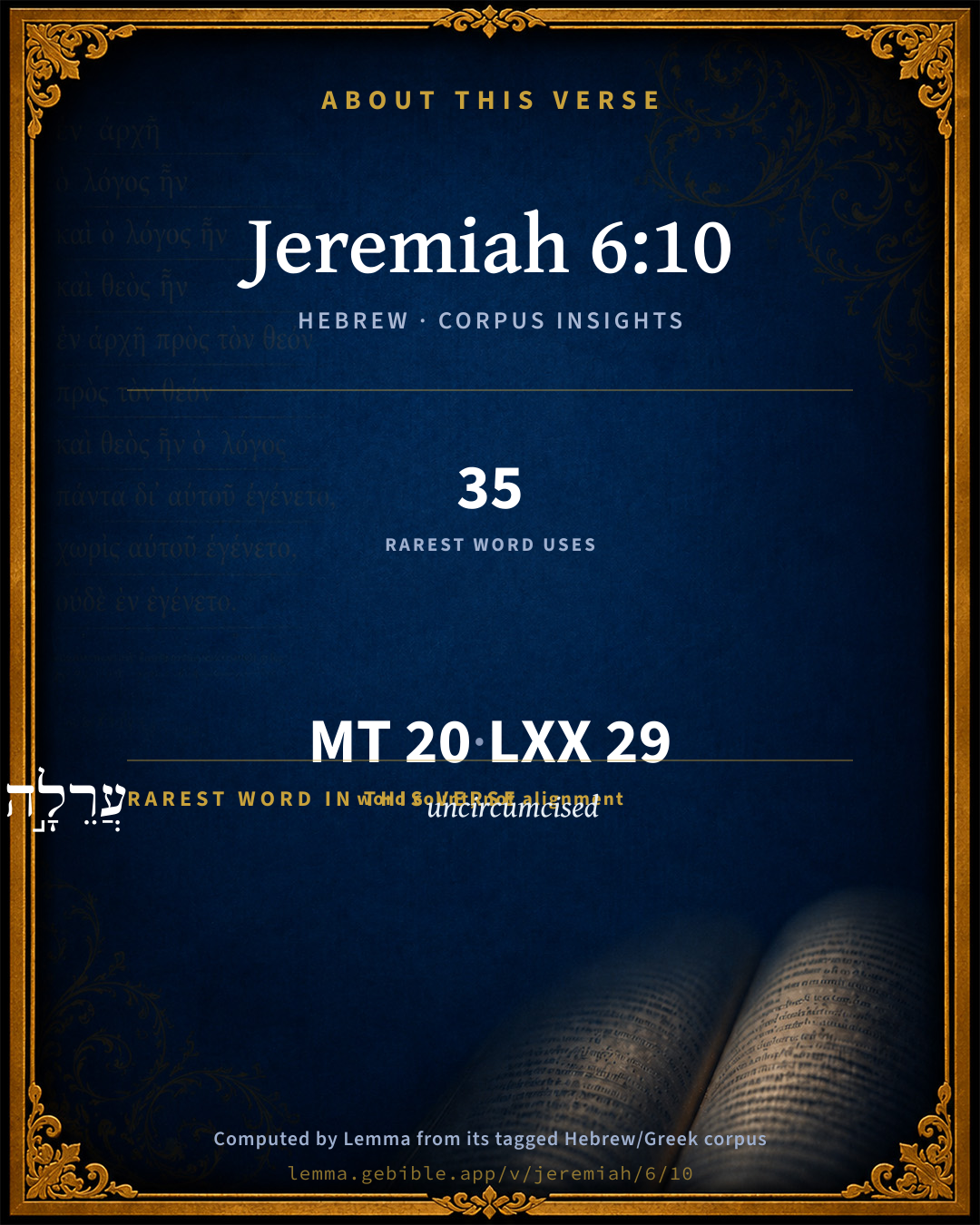
About this verse

These counts appear in no published source. They are computed here, from the morphology-tagged text and Lemma’s own curated glosses. What Lemma adds →

20
words
16
distinct lemmas
Prophets
section

Shared distinctive vocabulary

עֲרֵלָ֣ה uncircumcised H6189 occurs in 32 verses of the Hebrew Bible. Also found in:

Grammatical profile

  • 7 verbs
  • 4 nouns
  • 1 adjective
  • 3 prepositions
  • 5 particles

Verb forms

  • אֲדַבְּרָ֤ה Piel · Cohortative
  • וְאָעִ֨ידָה֙ Hiphil · Cohortative
  • וְיִשְׁמָ֔עוּ Qal · Imperfect
  • יוּכְל֖וּ Qal · Imperfect
  • לְהַקְשִׁ֑יב Hiphil · Infinitive Construct
  • הָיָ֥ה Qal · Perfect
  • יַחְפְּצוּ Qal · Imperfect

Repetition

Words recur within this verse — often emphatic in Hebrew:

  • הִנֵּה֙ behold H2009 ×2
  • וְלֹ֥א not H3808 ×2

Hebrew & Septuagint length

In the original languages it is 20 Hebrew tokens and 29 Greek tokens — but the two are counted differently (Hebrew bundles its prefixes and suffixes into one token; the Greek is in lemma form), so that isn’t a like-for-like length.

Cross-references

34

Topical passages linked to Jeremiah 6:10 in the Treasury of Scripture Knowledge — connected by theme and wording, ordered by reader-vote popularity; previews shown in the World English Bible.

  • Acts 7:51 "You stiff-necked and uncircumcised in heart and ears, you always resist the Holy Spirit! As your fathers did, so you do.
  • Jeremiah 7:26 yet they didn't listen to me, nor inclined their ear, but made their neck stiff: they did worse than their fathers.
  • John 7:7 The world can't hate you, but it hates me, because I testify about it, that its works are evil.
  • Hebrews 11:7 By faith, Noah, being warned about things not yet seen, moved with godly fear, prepared an ark for the saving of his house, through which he condemned the world, and became heir of the righteousness which is according to faith.
  • Exodus 6:12 Moses spoke before Yahweh, saying, "Behold, the children of Israel haven't listened to me. How then shall Pharaoh listen to me, who am of uncircumcised lips?"
  • Isaiah 53:1 Who has believed our message? and to whom has the arm of Yahweh been revealed?
  • Deuteronomy 29:4 but Yahweh has not given you a heart to know, and eyes to see, and ears to hear, to this day.
  • 2 Chronicles 36:15–16 Yahweh, the God of their fathers, sent to them by his messengers, rising up early and sending, because he had compassion on his people, and on his dwelling-place:
  • Psalms 1:2 But his delight is in Yahweh's law; On his law he meditates day and night.
  • Psalms 40:8 I delight to do your will, my God. Yes, your law is within my heart."
  • Psalms 119:16 I will delight myself in your statutes. I will not forget your word.
  • Psalms 119:24 Indeed your statutes are my delight, And my counselors.
  • Psalms 119:35 Direct me in the path of your commandments, For I delight in them.
  • Psalms 119:70 Their heart is as callous as the fat, But I delight in your law.
  • Psalms 119:77 Let your tender mercies come to me, that I may live; For your law is my delight.
  • Psalms 119:174 I have longed for your salvation, Yahweh. Your law is my delight.
  • Isaiah 6:9–10 He said, "Go, and tell this people, 'You hear indeed, But don't understand; And you see indeed, But don't perceive.'
  • Isaiah 28:9–13 Whom will he teach knowledge? and whom will he make to understand the message? those who are weaned from the milk, and drawn from the breasts?
  • Isaiah 42:23–25 Who is there among you who will give ear to this? who will listen and hear for the time to come?
  • Jeremiah 4:4 Circumcise yourselves to Yahweh, and take away the foreskins of your heart, you men of Judah and inhabitants of Jerusalem; lest my wrath go forth like fire, and burn so that none can quench it, because of the evil of your doings.
  • Jeremiah 5:4–5 Then I said, Surely these are poor; they are foolish; for they don't know the way of Yahweh, nor the law of their God:
  • Jeremiah 20:8–9 For as often as I speak, I cry out; I cry, Violence and destruction! because the word of Yahweh is made a reproach to me, and a derision, all the day.
  • Ezekiel 3:18–21 When I tell the wicked, You shall surely die; and you give him no warning, nor speak to warn the wicked from his wicked way, to save his life; the same wicked man shall die in his iniquity; but his blood will I require at your hand.
  • Ezekiel 33:3 if, when he sees the sword come on the land, he blow the trumpet, and warn the people;
  • Ezekiel 33:9 Nevertheless, if you warn the wicked of his way to turn from it, and he doesn't turn from his way; he shall die in his iniquity, but you have delivered your soul.
  • Amos 7:10 Then Amaziah the priest of Beth El sent to Jeroboam king of Israel, saying, "Amos has conspired against you in the midst of the house of Israel. The land is not able to bear all his words.
  • Matthew 3:7 But when he saw many of the Pharisees and Sadducees coming for his baptism, he said to them, "You offspring of vipers, who warned you to flee from the wrath to come?
  • Luke 11:45 One of the lawyers answered him, "Teacher, in saying this you insult us also."
  • Luke 20:19 The chief priests and the scribes sought to lay hands on Him that very hour, but they feared the people--for they knew He had spoken this parable against them.
  • John 9:40 Those of the Pharisees who were with him heard these things, and said to him, "Are we also blind?"
  • Acts 7:60 He kneeled down, and cried with a loud voice, "Lord, don't hold this sin against them!" When he had said this, he fell asleep.
  • Romans 7:22 For I delight in God's law after the inward man,
  • Colossians 1:28 whom we proclaim, admonishing every man and teaching every man in all wisdom, that we may present every man perfect in Christ Jesus;
  • 2 Timothy 4:3 For the time will come when they will not listen to the sound doctrine, but, having itching ears, will heap up for themselves teachers after their own lusts;

Cross-references courtesy of OpenBible.info (CC BY 4.0).

Hebrew and Greek witnesses Masoretic Hebrew ↔ Greek Septuagint

The same verse in the two great witnesses to the Old Testament, shown verse-for-verse.

These are two independent witnesses, not word-aligned to each other, and the Septuagint is shown in lemma (dictionary) form.

Hebrew Jeremiah 6:10 Masoretic · Westminster Leningrad Codex

עַל מִ֨י אֲדַבְּרָ֤ה וְאָעִ֨ידָה֙ וְיִשְׁמָ֔עוּ הִנֵּה֙ עֲרֵלָ֣ה אָזְנָ֔ם וְלֹ֥א יוּכְל֖וּ לְהַקְשִׁ֑יב הִנֵּ֣ה דְבַר יְהוָ֗ה הָיָ֥ה לָהֶ֛ם לְחֶרְפָּ֖ה לֹ֥א יַחְפְּצוּ בֽוֹ

To whom shall I speak and testify, that they may hear? behold, their ear is uncircumcised, and they can't listen: behold, the word of Yahweh is become to them a reproach; they have no delight in it.

World English Bible · Public Domain

Greek LXX Structure differs

In the Septuagint, Jeremiah is about an eighth shorter than the Hebrew and arranges its material differently — the Oracles Against the Nations (Hebrew chapters 46–51) appear in the middle of the Greek book, after 25:13. Because the chapter and verse boundaries do not line up, a verse-for-verse comparison with the Hebrew is not shown.

A verse-for-verse comparison isn’t shown here because the chapters and verses don’t line up. Switch to the LXX edition with the MT / LXX toggle above to read the Greek directly.

Hebrew: Westminster Leningrad Codex (CC BY 4.0). Greek: Septuagint (public domain); English from a public-domain English Septuagint. How the Septuagint differs from the Hebrew →

Targum (Aramaic paraphrase)

1

The Targum is the ancient Jewish Aramaic paraphrase of the Hebrew Scriptures — an interpretive translation, not the Hebrew text itself. Onkelos (literal) and Pseudo-Jonathan (expansive) render the Torah, and Jonathan the Prophets. Coverage is partial: where no permissively-licensed English translation exists for a verse, only the Aramaic is shown. This is verse-level text, not a word-by-word alignment to the Hebrew.

  1. Targum Jonathan Prophets (Joshua–Malachi)
    עַל מַה אֲמַלֵיל וְאַסְהֵיד וִיקַבְּלוּן אוּלְפַן הָא אִטַפִּשַׁת אוּדְנְהוֹן וְלָא יָכְלִין לְמֵיצָת הָא פִּתְגָמָא דַייָ הֲוָה לְהוֹן לְחִיסוּדִין מִדְלָא צָבָן בֵּיהּ:

    (no public-domain English translation for this verse)

    Targum Jonathan — Aramaic: “Mikraot Gedolot” (public domain). English: “Sefaria Community Translation” (CC0 1.0 (public-domain dedication)); “London "Chaldee Paraphrase," 1871” (public domain). Text via Sefaria.

Commentary

Notes on Jeremiah 6:10 from classic Christian and Jewish commentators (each source and its license shown beneath its notes). The classic Christian expositions comment on the surrounding passage and are grouped to its opening verse, so a note may address several verses; the Jewish commentaries on the Tanakh (Rashi and others) are per-verse, so they appear only where the commentator wrote on this verse.

Lemma curates 59 commentaries, every one of them public domain or Creative Commons licensed, each selected and text-cleaned for this edition rather than reprinted as found. About our sources →

Trapp's Complete Commentary

John Trapp

Jer 6:10 To whom shall I speak, and give warning, that they may hear? behold, their ear [is] uncircumcised, and they cannot hearken: behold, the word of the LORD is unto them a reproach; they have no delight in it.

Ver. 10. To whom shall I speak and give warning?] Heb., Protest - q.d., I know not where to meet with one teachable hearer in all Jerusalem.

Behold, their ear is uncircumcised.] Obstructed and stopped with the "superfluity of naughtiness," worse than any ear wax, or thick film overgrowing the organ of hearing. Tanquam monstra marina, surda aure Dei verba praetereunt.

The word of the Lord is unto them a reproach.] They take reproofs for reproaches. {as Luk 11:45}

John Trapp, A Commentary or Exposition upon All the Books of the Old and New Testament (1647–1656) — public domain. Text from a community e-Sword module.

The Biblical Illustrator

Joseph S. Exell

Jer_6:10

They have no delight in it.

The impediments to the right celebration of religious ordinances

You will readily admit, that the feeling of delight accompanying the performance of anything is, for the most part, a sign and measure of its profitable accomplishment; that that is usually well done which is done cheerfully and with the heart; and that nothing, on the contrary, is more commonly deteriorated in the performance of it, than what is entered on with the apprehension of its being a piece of drudgery, and gone through as a mere task. How true does this remark hold in the department of religion! If we approach the exercises of religion, whether reading or hearing the Word, or the sacraments, or prayer, as formalists come to them--if we take no lively interest in them--if we are actuated merely by the force of custom, the power of example and other motives of expediency, how can they ever profit us? Are we not changing the sources of heavens blessings into empty and broken cisterns?

I. In attending to the circumstances that operate to take away from us delight in Christian ordinances, we observe, that an unfavourable change in the frame of mind, as persons are engaged In religious exorcises, often occurs, at least at times occurs, unavoidably, however our desires and endeavours may be set against it. At one time we will be attending with deep earnestness, at another time listening with cold indifference. There is now a great acuteness in receiving instruction, at another time almost a deadness that blunts the edge of the best directed observations. Now, all such changes as these are still, in so far as they are traceable to constitutional temperament, to be ranked among the class of what the Bible calls our infirmities, and when they are met by meditation on the Word of God, and by prayer, in order that we may be cured, they are not charged as criminalities against us. At the same time, take good heed lest you ascribe to those things over which you think you have no control, what all the while springs from sinful negligence.

II. First, the state of mind I have described, shows that there has not been with us due consideration before we have come to the public ordinances of religion. We do not consider that the services of the sanctuary relate to God in our adoring, or praising, or supplicating Him whom the universe celebrates as its Maker, whom angels, principalities and powers reverently worship--we do not consider that the services of the sanctuary are the appointed means through which the soul is called to discourse with its own original, with Him who is the source of bliss. We do not consider that the services of the sanctuary present the sublimest objects for the exercise of the understanding, the most splendid for attracting the imagination, the most engaging for affecting the heart. Accordingly we do not in our petitions implore that fixedness of heart which is required in the true and spiritual worshipper; we do not enter the sanctuary cherishing the serious thought that we come hither to seek the blessings which the mercy of the Saviour gives to every one who feels his need of them, and asks them. On the contrary, we come to the sanctuary altogether unconcerned; we sit down without offering in our minds one preparatory petition; we possess a frame of mind that is akin to levity; we are chargeable at least with indifference, which can only be excusable in our waiting on an empty ceremonial. Even allowing that the individual still possesses some desire to receive the benefits of religious ordinances in the sanctuary, they are rendered quite impracticable to him, except where the devotional exercises of every day are preparatory to those of the Sabbath. The want of serious consideration before we come to engage in religious ordinances, leads directly to want of due reflection when engaged in the performance of them; for such trains of thought as we have been cherishing, are not easily broken down, and, in fact, we cannot authoritatively dismiss them--they have fastened themselves by innumerable links to the mind, and though many of these links may from time to time be detached by us, still numbers are left which are quite sufficient to rivet the objects of our affectionate concern to our memories and our hearts. Such objects, through long usage, become great favourites with the mind, and hence, it not only attends to them in the season of disengagement from other things, but strives to get back to them, even when occupied in the ordinances of religion. Then when we think how base and degraded our natural dispositions are, surely it is a most unreasonable expectation that we are prepared for the spiritual exercises of the Sabbath, if we have had no preparatory devotional exercises for such a day.

III. Most serious and grievous is the evil of which I am now speaking. Whatever degree of it adheres to us its tendency is to destroy utterly the capacity of religious feeling, and to increase that searedness of conscience which is the forerunner of open profligacy. Let us then be roused to consideration. Let us come to religious ordinances with serious thoughts on their nature, their reasonableness, their awful sanctions, and their inestimable utility; and, having especially in view the example of the serious worshipper who prays for the spirit of prayer, and who is a suppliant in private for the grace of supplication which is to be employed by him in public, let us endeavour when we join in religious ordinances to preserve seriousness of mind. Let us for this purpose devoutly consider the object we have in view, whether engaged in the Word, in sacrament, or in prayer. Let us not give a single moments encouragement to thoughts upon other subjects. Let us withstand the inroads of such thoughts--let us cast them out as of Satan, when they enter, and let us try to prevent them entering at all. Let there be prayer, consideration and serious concern; and thus entering into the great truths, into the sweetness of religion, there will be no longer felt the weariness with which we set out. The satisfaction and delight, so conducive to our improvement, will then take the place of the fatigue and irksomeness of the mere bodily worshipper. The Sabbath will be the most acceptable of all refreshments, the Psalms of the sanctuary will be the sentiments of gratitude and joy, the prayers offered will be as the flame which first ascended in holy ardour to its origin, and the Word will be the principal vehicle of calling into action every good resolution. Religion will then become that very privilege it is intended to be; the elements, set upon the table, will appear as the memorials of all that is dear and precious to our souls; the sentiments of holy love will be awakened in commemorating the blessed Friend who gave His soul for us sinners; and thus the sanctuary and its services will become the pledge to us of the noblest benefits, the scene of the most glorious hopes, and an incitement to devoted obedience. (W. Muir, D. D.)

The Gospel unappreciated

Alphonse Kerr heard a gardener ask his masters permission to sleep for the future in the stable. For, said he, there is no possibility of sleeping in the chamber behind the greenhouse, sir; there are nightingales there which do nothing but guggle and keep up a noise all the night. The sweetest sounds are but an annoyance to those who have no musical ear; doubtless the music of heaven would have no charm to carnal minds, certainly the joyful sound of the Gospel is unappreciated so long as mens ears remain uncircumcised.

The Biblical Illustrator, edited by Joseph S. Exell (c. 1880s–1900s) — public domain. Text from a community e-Sword module.

Joseph Benson's Commentary

Jer 6:10. To whom shall I speak and give warning? — I cannot find out any that will so much as give me a patient hearing, much less will any take warning. I cannot speak with any hope of success. Behold, their ear is uncircumcised — A figurative expression, not unfrequent with the prophets, signifying the rejecting of instruction; as an uncircumcised heart signifies an obstinate and rebellious will. As if he had said, Their mind is unbelieving and carnal, and therefore not disposed to hearken to the voice of God. Nay, they are not only deaf to it, but prejudiced against it; and they cannot hearken — Namely, because they are resolved they will not. Behold, the word of the Lord is unto them a reproach — Both the reproofs and the threatenings of it are so; they consider themselves as wronged and affronted by both, and resent plain dealing as they would the most causeless slander and calumny. They have no delight in it — More is implied than expressed; they have an antipathy to it, their hearts rise against it; it exasperates them, and inflames their passions; and they are ready to fly in the face of their reprovers.

Joseph Benson's Commentary on the Old and New Testaments (1811–1818) — public domain. Text from a community e-Sword module.

Tyndale Open Study Notes

Tyndale Open Resources

6:10-15 In a series of rhetorical questions, Jeremiah, the messenger-prosecutor, revealed his love for the people; he then expressed his disbelief when the people responded with scorn. After presenting evidence of sins committed by the people from the lowest level of society to the highest, the prophet transmitted a divine decree. The future tense of his indictment suggests that the message was given before the invasion.

6:10 The people could literally hear, because their retorts were filled with scorn, but they did not take the Lord’s message seriously (cp. Acts 7:51).

Tyndale Open Study Notes — © Tyndale Open Resources, licensed CC BY-SA 4.0. Text via the HelloAO Bible API.

Geneva Bible (1599)

Geneva Bible translators

They delight to hear vain things, and to shut up their ears to true doctrine.

Geneva Bible (1599) marginal notes — public domain. Text via Bolls.life.

Jamieson, Fausset & Brown

Robert Jamieson, A. R. Fausset & David Brown

ear is uncircumcised--closed against the precepts of God by the foreskin of carnality (Lev 26:41; Eze 44:7; Act 7:51).

word . . . reproach-- (Jer 20:8).

Jamieson, Fausset & Brown — Commentary Critical and Explanatory on the Whole Bible (1871) — public domain (CC PDM 1.0). Text via the HelloAO Bible API.

Adam Clarke's Commentary

Verse 10. The word of the Lord is unto them a reproach] It is an object of derision; they despise it.

Adam Clarke's Commentary on the Bible (1810–1826) — public domain. Text from a community e-Sword/MySword module.

John Calvin's Commentaries

The Prophet here shews there was no reason for him to labor any longer in trying to reform the people, for he spoke to the deaf. He had said before, according to our lecture yesterday, that God was still ready to be reconciled to the Jews, if they repented; but now, referring to himself, he says that his words were wholly lost. Hence he asks a question as respecting a thing strange or unexpected. To whom, he says, shall I speak? and to whom shall I protest? He had indeed, as we found yesterday, exhorted the people to repent: but there is nothing inconsistent in all this; for he wished, as far as he could, to secure, the safety of the people. Even God had commanded this; and it was his will, as it was yesterday stated, that a testimony should be borne, that it was not his fault, according to what had been taught, that he was not reconciled to the people.

We now then see that the whole passage harmonizes; for Jeremiah performed his office in trying to find out whether the people were healable; but when he saw that such were their obstinacy that it allowed of no remedy, he exclaims as one astonished, To whom shall I speak? and to whom shall I protest? The meaning is, that the people were so given up to impiety, that the prophets spent their labor in vain while endeavoring to reform them. And the first clause he confirms by another, To whom shall I protest? He intimates that they had despised not only what had been plainly taught them, but also protestations, which possess much greater power. He means that their wickedness could be cured by no remedies, that they had not only rejected plain truth and serious warnings, but had also perversely resisted solemn protestations.

That they may hear, he says. He intimates, that though he had faithfully performed his office, yet his labor was without any fruit, for all the Jews were deaf. Hence he adds, Behold, uncircumcised is their ear This metaphor is common in the prophets. The uncircumcised ear is that which rejects all true doctrine. An uncircumcised heart is that which is perverse and rebellious. But we ought to understand the reason of this: as circumcision was an evidence of obedience, so the Scripture calls those uncircumcised who are unteachable, who cast away every fear of God and all sense of religion, and follow their own lusts and desires. But to be thus called was greatly disliked by the Jews; for circumcision gave them no common ground of confidence, since it was the symbol and pledge of adoption, and since they knew that they were thereby separated from other nations so as to be called God’s holy people. But the Prophet divested them of this vain conceit by calling them uncircumcised in heart and ears, for they had dealt perfidiously with God when they promised to be obedient to his will.

The external sign was of itself nothing, when the end was disregarded. It was God’s will to consecrate his ancient people to himself by circumcision: but when they became satisfied with the visible sign only, there was no longer the reality, and God’s covenant was profaned. It is the same at this day with respect to baptism; they who wish to be deemed Christians, boast of it, while at the same time they shew no fear of God, and while their whole life obliterates the true character of baptism. It is hence evident, that they are sacrilegious, for they pollute what is holy. And for this reason Paul calls the letter [the outward rite] of circumcision, a sign without the reality. (Romans 2:27.) So at this day baptism may be called the letter in all the profane, who have no regard to its design: for God receives us into his Church on the condition that we are the members of Christ, and that being ruled by his Spirit we renounce the lusts of our flesh. But when we seek under the cloak of baptism to associate God with the Devil, it is a most detestable sacrilege. Such was the stupid presumption of the Jews. This was the reason why the prophets so often charged them with being uncircumcised in hearts and ears: “Ye are God’s holy people; give a proof of this: ye indeed boast that you have been circumcised; surely, the cutting off of a small pellicle does not satisfy God; shew that your hearts and ears have been circumcised: but uncircumcision remains in your hearts, and it remains in your ears; ye are then heathens.”

We now then see the meaning of the Prophet, and also the reason why Scripture speaks so much of the uncircumcision of the hearts and ears, and it was this, — to prove the Jews guilty of profaning that sign, which ought to have been a pledge of their adoption, and to have served as a profession of a new life.

It was not to lessen their guilt that Jeremiah said, They could not attend or give ear. If any one objects and asks, “Ought it to be deemed a crime that they could not attend?” The Prophet, as I have said, did not extenuate their guilt, but on the contrary shewed that they were so sunk in their vices, that they were not masters of themselves; as the case is with a drunkard, who is not in his right mind; but as he has contracted this vice of intemperance, his going astray or his ignorance is in no way excusable. So also the Prophet says, that the Jews could not attend to the word of the Lord, because they had surrendered themselves up to the Devil, so that they were become his slaves; as Paul says of those who were without the grace of God, that they were sold under sin, (Romans 7:14;) and the Scripture says elsewhere the same.

In short, Jeremiah here teaches us, that such was the habit of sinning contracted by the Jews, that they were no longer free to do what was right; for the Devil led them here and there at his pleasure, as though they were bound in his chains. And thus he sets forth their depravity as hopeless. Even Aristotle, though he is of no authority as to the power of the will, for he holds free-will, (he knew nothing of original sin and of the corruption of nature,) yet allows that those who are otherwise wholly free cannot do what is right, when they become so hardened in their vices, that intemperance, ἀκράτεια, rules in them: for intemperance is a tyrant, which so subdues all the feelings and senses of men, that all liberty is destroyed. We now then see what the Prophet had in view: he meant not that the Jews sinned, because they had not the power to resist; but because they had so plunged themselves into the abyss of wickedness, that they had sold themselves as it were to the Devil, who held them fast bound, and furiously drove them along as he pleased.

And this we learn more fully from what follows; for he says, Behold, the word of Jehovah has been to them a reproach; and it has not pleased them, or they have not delighted in it; for חפףmeans to take delight in a thing. The Prophet now more clearly shews, that the fault was in the Jews themselves, because they had despised God. Whence then was the impotence of which he had spoken? Even from their licentiousness, because they deemed God and his prophets as nothing. Since, then, their minds were thus hardened so as impiously to despise the truth, it followed that they could not hear and attend, inasmuch as they were deprived of all right knowledge. Whence was this? Even because they had closed their eyes and deafened their ears, and given themselves up altogether to the Devil, so that he led them into every kind of madness. In short, he shews at the end of the verse what was the beginning of all their evils, even because the word of God did not please them, that is, because they had cast aside every care for true religion, because they were not pleased when the prophets came and offered to them the favor of God. As then the truth had become unsavory to them, so that they rejected it, when it ought to have been especially delightful to them, so it happened that they became wholly stupid and void of all judgment and reason; and hence also came the uncircumcision of the ears of which mention has been made. It follows —

John Calvin's Commentaries (1540-1563) — public domain. Text from the Calvin Translation Society English edition (1840s-50s) via the Christian Classics Ethereal Library (ccel.org). Calvin's coverage is partial (roughly two-thirds of the Bible); uncommented books and verses are honest gaps, never fabricated. The 19th-century editor's footnotes and remarks are omitted so the notes are faithfully Calvin's own voice.

Ellicott's Commentary for English Readers

(10) To whom shall I speak . . .?—The prophet, who now speaks in his own name, has heard the message from the Lord of Hosts; but what avails it? who will listen? As elsewhere the lips (Exo_6:30) and the heart (Lev_26:41; Eze_44:7), so here the ear of Israel was uncircumcised, as though it had never been brought into covenant with Jehovah or consecrated to His service.

A reproach.—i.e., the object of their scorn.

A Bible Commentary for English Readers, edited by Charles John Ellicott (1878–1897) — public domain. Text from a community e-Sword module.

The Cambridge Bible for Schools and Colleges

gen. ed. J. J. S. Perowne

10. their ear is uncircumcised] dedicated not to God’s service, but to profane uses only. Cp. Act_7:51; so of the lips, Exo_6:12; Exo_6:30.

The Cambridge Bible for Schools and Colleges (gen. ed. J. J. S. Perowne; Cambridge University Press, 1878–1918) — public domain. Text from a community e-Sword module.

John Gill's Exposition

To whom shall I speak, and give warning, that they may hear?.... These are the words of the prophet, despairing of any success by his ministry; suggesting that the people were so universally depraved, that there were none that would hear him; that speaking to them was only beating the air, and that all expostulations, warnings, remonstrances, and testimonies, would signify nothing:

behold, their ear is uncircumcised, and they cannot hearken; their ears were stopped with the filth of sin naturally, and they wilfully stopped their ears like the adder; and so being unsanctified, they neither could hear nor desired to hear the word of the Lord, as to understand it; see Act 7:51,

behold, the word of the Lord is unto them a reproach; they reproached it, and blasphemed it, as a novel and false doctrine, and thought it a dishonour to them to receive and profess it; and just so the Jews vilified the Gospel, in the times of Christ and his apostles; and as many do now, who treat it with contempt, as unworthy of God, as contrary to reason, as opening a door to licentiousness, and think it a scandal to preach or profess it:

they have no delight in it; they see no beauty nor glory in it; they taste nothing of the sweetness of it; its doctrines are insipid things to them, they having never felt the power of it in their hearts; whereas such who are the true circumcision, who are circumcised in heart and ears, who are born again, these desire the sincere milk of the word; it is to them more than their necessary food; and, with this Prophet Jeremiah, they find it, and eat it, and it is the joy and rejoicing of their hearts, Jer 15:16.

John Gill's Exposition of the Whole Bible (1746–1763) — public domain (CC PDM 1.0). Text via the HelloAO Bible API.

Albert Barnes' Notes on the Bible

Give warning - Rather testify.

Reproach - They make the Word of God the object of their ridicule.

Albert Barnes' Notes on the Bible (1834–1885) — public domain. Text from a community e-Sword/MySword module.

Haydock's Catholic Bible Commentary

Uncircumcised. Impure and deaf. (Calmet) --- Non vocat impossibilitas supplicio quæ de contemptu et infidelitate descendit. (St. Jerome)

George Leo Haydock (1774–1849), Haydock's Catholic Family Bible and Commentary, 1859 edition — public domain. Excludes Psalms (Douay-Rheims chapter numbering differs from Protestant) and Deuterocanonical books (Catholic canon only).

Matthew Poole's English Annotations

Give warning, Heb. make protestation; noting with what earnestness the prophet would bespeak them in his warning of them: see Jer 11:7. The prophet taking notice of their obstinacy, speaks as one astonished, and highly makes complaint, being greatly grieved that he can find none that will take warning; the like Jer 7:23,24; he labours to persuade, but all is in vain; they turn a deaf ear to him, as the next expression intimates.

Their ear is uncircumcised; a figurative kind of speech frequent with the prophets: an uncircumcised ear signifying the rejecting of instruction; an uncircumcised heart, an obstinate and rebellious will: hence circumcision was for a testimony of obedience; and therefore the prophet doth tacitly insinuate their falseness to God, to whom they had promised to be obedient, 2Ki 11:17; 23:3. And the Scripture calls those that are void of the fear of God, and carried out to all manner of lusts, uncircumcised, Eze 44:7,9; for uncircumcision was abominable among the Jews; so that it notes both their sin and their shame, their ear being stopped, unfit for hearing, as if it were with a foreskin or film over it, Act 7:51.

They cannot hearken: the prophet doth not here lessen their crimes by their inability and want of power, but rather aggravates it, inasmuch as they had brought themselves under that incapacity by their obstinacy and willfulness; as a drunken man that hath deprived himself of his reason by excess, renders the want of his understanding the more inexcusable.

A reproach; either they reproach it in the messenger’s mouth, Luk 11:45, or rather they laugh at it and scorn it, they cannot bear counsel, they look upon reproving them to be reproaching them; they take no delight in hearing such things: a further reason of their impotency and obstinacy; all their admonitions and instructions seemed insipid, and therefore were they so stupid, according to the next words, Pro 15:12. See Jer 5:31; 2Ti 4:3.

Matthew Poole's English Annotations on the Holy Bible (1683–1685) — public domain. Text from a community e-Sword/MySword module.

The Pulpit Commentary

Their ear is uncircumcised; covered as it were with a foreskin, which prevents the prophetic message from finding admittance. Elsewhere it is the heart, (Lev_26:41 Eze_44:7) or the lips (Exo_6:12) which are said to be circumcised;" a passage in Stephen"s speech applies the epithet both to the heart and to the ears. (Act_7:51)

Vers. 10, 11. The indifference of men and the burden of truth.

We have here revealed to us a conflict in the mind of the prophet. At first it seems vain for him to speak, for none heed his warnings (ver. 10); but then he feels the awful burden of his message compelling utterance. While he looks at his audience he loses heart and sees little good in attempting to influence them; but when he looks within at his trust he finds that this has claims and powers before which he must bow obediently. Thus the teacher of high truth is often discouraged when he considers the unfitness of men to receive it, until he realizes more fully the majesty of the truth itself which possesses him and is not simply a treasure to be regarded as his property, but a Lord demanding his faithful service.

I THE INDIFFERENCE OF MEN. Here was the source of Jeremiah"s discouragement, and we can sympathize with him. What is the use of uttering truths that men are not fit to receive only to waste our powers, create misunderstandings, and provoke opposition?

1. The reception of truth depends on the condition of the receiving mind. Language requires ears as well as tongues. Outward ears are useless without the inward ears of an understanding mind. An ass has no lack of ears, but what are a prophet"s words to him? There are people to whom the solemn utterance of the most awful truths is but so much noise. Therefore

(1) it behooves men to beware of mocking at the supposed folly of any teaching till they have ascertained whether the fault lies with the teacher or with the taught. And

(2) it is not enough to utter truth; we should seek for men the right preparation for receiving it the plowing of the hard soil in readiness for the sowing of the seed.

2. When the mind is in a wrong condition for the reception of truth this may meet with ridicule and dislike. Truth may meet with ridicule. The word of Jehovah was "a mockery to the Jews." Ridicule may be both a result of misunderstanding the truth and a cause of further mistakes. Truth may also meet with dislike. The Jews had "no delight" in the Divine Word. This was a proof of their not understanding it; for to know it is to love it. (Psa_119:16) It was also a cause of their not rightly receiving it; for dislike to truth Minds the eye to the nature of it.

II THE BURDEN OF TRUTH. In spite of all these grounds for discouragement, Jeremiah feels that he must utter his message when once he considers its origin and character.

1. Truth is a trust from God. It is "the fury of the Lord " that possesses the prophet, not the mere passion of his own thoughts. He who holds a Divine truth is a steward of an oracle of God. Woe to him if he consult his own convenience and rely only on his own judgment when, as a steward, he is called to be faithful to his Master"s will. His duty is to speak; the consequences may be left to God.

2. Truth is an inspiration from God. Jeremiah is full of the fury of Jehovah." The Spirit of God has possessed him; he is brought into sympathy with the thought and feeling of God: he must needs utter this. If men feel the inspiration of truth they will be carried away by it and poor considerations of worldly expediency will be swept on one side by the flood of a Divine passion.

3. Truth is a burden on the soul which cries for utterance. Jeremiah exclaims, "I am weary with holding in! Woe is me!" cries St. Paul, as he thinks of the suggestion to restrain his preaching the gospel. Under great passions men do not speak measured words, chosen in strict consideration for their hearers; they speak to give vent to their own souls. The grandest utterances of humanity, in prophecy and in poetry, are free from all calculations as to the reception of them by an audience. They are unrestrainable expressions of the soul; like the songs of birds flowing from the very fullness of the heart.

4. Truth is for the good of mankind. Jeremiah must speak, for what he utters concerns others than himself. No one has a right to the monopoly of any great truth. It is common property, and he who hides it steals it. If his excuse is that men cannot understand it, let him remember

(1) that he is not an infallible judge of the capacities of other men; and

(2) that his duty is to bear his testimony, whether men will hear or no, and to leave all further responsibility with them.

The uncircumcised ear.

I WHAT IS THIS? Not a physical defect, although the figure employed seems to tell of some fleshly growth which has formed over the cavity of the ear, and so destroyed the power of hearing. Nor a mental defect. They were acute enough; they readily understood the prophet"s meaning when he spoke to them. Their minds were at that very time busy about all sorts of plots and schemes, which they hoped to carry out. Nor was it a moral defect. They knew the right, the true, the good. Conscience was still at work and goading them with her reproaches. Hence they devise means (ver. 14) to lull and quiet it. And they had the power of choice, and deliberately chose ways of their own rather than those of God. True, it is said in the text, "And they cannot hearken." But that tells only of what is the perpetual result of refusing continuously to hear God"s Word. Let a man tie his arm to his side for six months, and see what power of using it he has left after that. It will have become atrophied. And so in like manner do the functions of the soul, the limbs of our spiritual nature. The "will not" in regard to their use darkens down into the dreadful "cannot" of the judgment of God. There is no more awful fact for the faithless servant of God, nor more blessed one for the faithful, than this law of habit. The utterance of it concerning the wicked is, as here, "They cannot hearken;" but concerning the good, "My heart is fixed, O God, my heart is fixed: I will sing and give praise." But it is a spiritual defect. It is the result of "the alienated will," that which the Bible calls "the unrenewed heart," "the carnal mind," "the unregenerate nation." All such expressions tell of the will of man turned away from God, and having no higher motive than to please and gratify self. That is the radical defect of us all, and it is that which the prophet here terms "the uncircumcised ear." It by no means always involves the outrageous wickedness which is told of in their prophecies; it can exist and yet never "commit abomination," as did these to whom Jeremiah spoke. It is found in company with much outward religiousness, much moral propriety, much amiability of character; but wherever it is, Christ"s word concerning all such is, "Ye must be born again." It is in its nature fierce, savage, unsubdued still. It often seems to be tamed, and moves about soft-footed and gently as if it never could do harm; but let some lure be held out to it, some provocation be given, and then its ferocity and all its hideous evil will reveal itself at once. Accustomed as we are to see this evil nature held in check by the usages of society, the habits of civilized life and a refined selfishness, we are often blind to its true character, and "marvel" much at our Savior"s reiterated word, "Ye must be born again.

II ITS EFFECTS.

1. Disregard of and dislike to the Word of God. "To whom shall I speak?" said the prophet. He could get no one to listen to him. And this is the too frequent experience of our own day. How deserted the churches are, and where they are better attended, what kind of listening is it that prevails? Granted the intolerable dullness of many preachers, but the evil is not probed when this is said. The true cause is "the uncircumcised ear" that Jeremiah tells of. But not only have men "no delight in" the Word of God, they count it "a reproach." They come to be ashamed of its being thought that they should regard it with interest or have any real care for it. The tone adopted regarding those who do delight in God"s Word is one of scorn and contempt.

2. Men go on unchecked in sin (cf. vers. 13, 15, and passim). Surely it is a question not merely for the Church, but for thoughtful men of the world, whether it be well for any community or people to be throwing aside all the restraints of God"s Word, as so many are doing. The history of Israel of old is a beacon-light, warning the people of our day of what comes from despising the Word of the Lord.

3. God"s judgments come upon such people (ver. 12).

4. Men become shameless and hardened (ver. 15).

5. The heart of God"s faithful servants is sorely troubled (cf. ver. 10). Here the prophet mourns over their "uncircumcised ears.

III ABETTORS AND MINISTERS TO THIS EVIL.

1. Unfaithful priests and prophets (ver. 13).

2. The hardening effects of the people"s own sin.

IV THE REMEDY. Yet more impassioned and earnest ministry of the Word. There must be no giving up of work or abandoning it in despair. But as ver. 11 more intense devotedness in the endeavor, futile as it may appear, to save men from death.

The fiery disciplines of God. He is "a consuming fire;" and the fire of his love will burn fiercely on until the evil on which it fastens is burnt out of the soul, the Church, the nation, he loves. Oh, the awfulness of the love of God! If God were not love, there might be a possibility of a soul being allowed to perish in its sins and to go its own way to death unchecked; but as the fondest mother will subject her child to terrible suffering for the saving of its life, so, too, will God.

CONCLUSION. What a summons comes to us from these truths:

(1) to seek the renewing grace of the Spirit of God;

(2) to take heed how we hear! C.

The Pulpit Commentary (1880–1919), ed. H.D.M. Spence-Jones & Joseph S. Exell — public domain. Text from a community e-Sword module.

John Wesley's Explanatory Notes

Their ear - An uncircumcised ear, signifies the rejecting of instruction; an uncircumcised heart, an obstinate and rebellious will. They cannot - They had brought themselves under that incapacity by their obstinacy and wilfulness. A reproach - They laugh at it, and scorn it.

John Wesley, Explanatory Notes Upon the Whole Bible (1754–1765) — public domain. Text via the GEBible commentary corpus.

Rashi

Rabbi Shlomo Yitzchaki (Rashi)

and warn Heb. ואעידה, an expression of warning.

clogged Heb. ערלה, clogged, and so is every expression of ערלה.

a disgrace They deride it.

Rashi on the Tanakh — English translations: “The Judaica Press complete Tanach with Rashi, translated by A. J. Rosenberg” (CC BY 4.0); “Pentateuch with Rashi's commentary by M. Rosenbaum and A.M. Silbermann, 1929-1934” (public domain); “The Metsudah Tanach series, Lakewood, N.J” (CC BY 4.0); and “The Book of Joshua, Metsudah Publications, 1997” (CC BY 4.0). Text via Sefaria.

Lesson kit

Teaching starters — assembled from the data on this page, not authored interpretation. Every prompt links to the verse data it draws on. Edit before teaching.

Jeremiah, in the Prophets, opens this verse with 20 words (16 distinct Hebrew lemmas). Its most distinctive word is ʻârêl (“uncircumcised”). A historical commentator’s framing appears above. Read the whole chapter for the surrounding context.

Discussion questions

  1. How does “uncircumcised” (ʻârêl) shape what this verse is saying?
  2. Genesis 17:14 shares the word «uncircumcised» with this verse. How do the two illuminate each other?
  3. “behold” occurs 2× in this one verse. What is the effect of the repetition?
  4. These translations render this verse differently; the difference is in the English rendering, not the original. What questions does that raise?
  5. The verb «אֲדַבְּרָ֤ה» is Piel Cohortative. How does its form color the action?
  6. Reading how Trapp's Complete Commentary and The Biblical Illustrator read this verse, where do the two commentators agree and where do they part?

Things to notice

Reading settings

Reading text

Shown beneath each verse's original-language words.

Old Testament
Old Testament edition

Read the OT as the Masoretic Hebrew (MT) or the Greek Septuagint (LXX).

English shown for the Greek Septuagint (in the Hebrew ↔ Greek comparison).

Comparing translations? Open the Compare panel on any verse page to stack up to four side by side.