
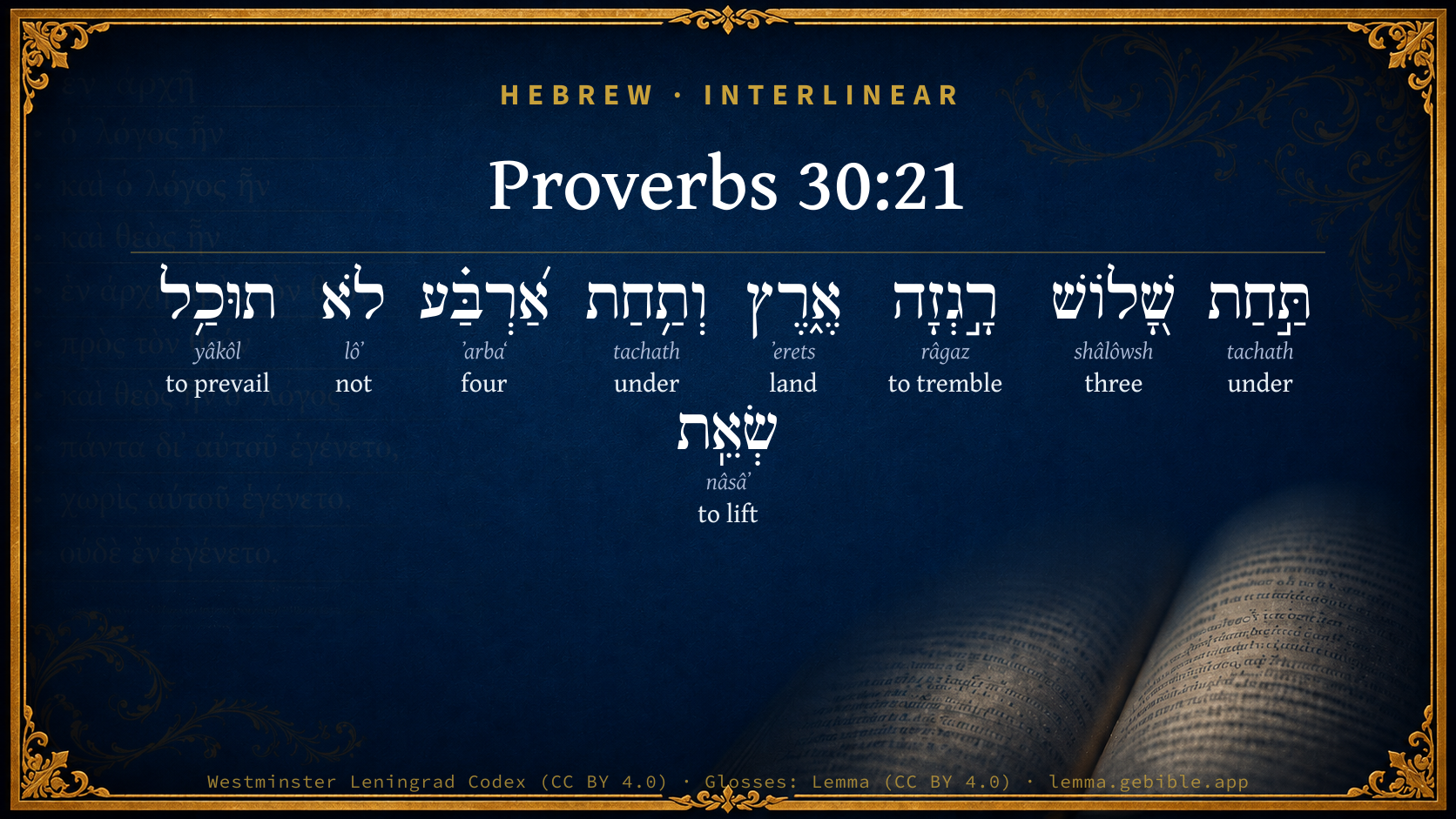
Proverbs 30:21

Hebrew (Westminster Leningrad Codex) Proverbs 30:21 appears in the Hebrew Old Testament. The text above is from the Westminster Leningrad Codex. Each word links to its Strong’s number, a concise gloss, and parsing drawn from the Open Scriptures Hebrew Bible morphology. Click any word for its full Brown-Driver-Briggs (BDB) entry.
Download image
Cite this verse

Proverbs 30:21 (World English Bible). Public Domain. Lemma interlinear Bible study tool, https://lemma.gebible.app/v/proverbs/30/21.

Show BibTeX & RIS
BibTeX
RIS
English Translation
"For three things the earth tremble, And under four, it can't bear up:
World English Bible · Public Domain
Download a study sheet

One document with this verse’s original text, its word-by-word gloss line, the meaning frame, cross-references with their text, attributed commentary, and full source and license credits — printable, and it pastes into notes with its structure intact.

This verse Autodidact and up

Study sheet (.html) Plain text (.txt)

A passage Seminary Student

Up to 50 verses in one chapter. A passage sheet keeps up to 6 commentary sources and 12 cross-references per verse, in the order this page ranks them, and says so on the sheet whenever that leaves anything out. Ask for a single verse and you get the Autodidact verse sheet above.

Everything on this page stays free to read, with no account — the sheet is a download of what is already on screen, not access to it.

Want to remove ads? Support Godless Engineer
Compare translations 3

The same verse in 3 English versions, stacked beneath the original-language interlinear above. Click any original word for its lexicon entry.

Each is an independent rendering of the whole verse — the interlinear is not word-aligned to these translations.

Highlighted words mark where these versions differ — a whole-verse word diff, not a word-by-word alignment.

  • World English Bible Public Domain
    "For three things the earth tremble, And under four, it can't bear up:
  • King James Version Public Domain
    For three things the earth is disquieted, and for four which it cannot bear:
  • unfoldingWord Literal Text CC BY-SA 4.0
    Under three things the earth quakes, and under four it is not able to hold up:

unfoldingWord Literal Text — © unfoldingWord, licensed CC BY-SA 4.0. Word-aligned USFM3 via Door43 (git.door43.org/unfoldingWord/en_ult).

Versions to compare (up to 4)

3 of 4 selected

Show all 18 translations

Every available English version of this verse, each an independent rendering of the whole verse.

  • World English Bible Public Domain
    "For three things the earth tremble, And under four, it can't bear up:
  • Berean Standard Bible Public Domain
    Under three things the earth trembles, under four it cannot bear up:
  • Majority Standard Bible Public Domain
    Under three things the earth trembles, under four it cannot bear up:
  • King James Version Public Domain
    For three things the earth is disquieted, and for four which it cannot bear:
  • American Standard Version (1901) Public Domain
    For three things the earth doth tremble, And for four, `which' it cannot bear:
  • Revised Version (1885) Public Domain
    For three things the earth doth tremble, and for four, which it cannot bear:
  • Geneva Bible (1599) Public Domain
    For three things the earth is moued: yea, for foure it cannot susteine it selfe:
  • Douay-Rheims (1899) Public Domain
    By three things the earth is disturbed, and the fourth it cannot bear:
  • Young's Literal Translation Public Domain
    For three things hath earth been troubled, And for four -- it is not able to bear:
  • Literal Standard Version CC BY-SA 4.0
    For three things has earth been troubled, || And for four—it is not able to bear:
  • Unlocked Literal Bible CC BY-SA 4.0
    Under three things the earth trembles, and under four it cannot bear up:
  • unfoldingWord Literal Text CC BY-SA 4.0
    Under three things the earth quakes, and under four it is not able to hold up:
  • Darby Bible Public Domain
    Under three [things] the earth is disquieted, and under four it cannot bear up:
  • World Messianic Bible Public Domain
    “For three things the earth trembles, and under four, it can’t bear up:
  • Webster's Bible Public Domain
    For three things the earth is disquieted, and for four which it cannot bear:
  • Free Bible Version CC BY-SA 4.0
    Three things make the earth tremble, there are four things it can't support:
  • Bible in Basic English Public Domain
    For three things the earth is moved, and there are four which it will not put up with:
  • JPS Tanakh (1917) Public Domain
    For three things the earth doth quake, and for four it cannot endure:

Literal Standard Version (2020), Covenant Press — licensed CC BY-SA 4.0. Text via the HelloAO Bible API (eBible.org). Unlocked Literal Bible (unfoldingWord) — licensed CC BY-SA 4.0. Text via the HelloAO Bible API (eBible.org). unfoldingWord Literal Text — © unfoldingWord, licensed CC BY-SA 4.0. Word-aligned USFM3 via Door43 (git.door43.org/unfoldingWord/en_ult). Free Bible Version, Dr. Jonathan Gallagher — licensed CC BY-SA 4.0. Text via the HelloAO Bible API (eBible.org).

Word by word

More ways to search: Search by grammar → Find every occurrence → Compare this word →

Practice this passage: Drill this verse → Learn its vocabulary →

About this verse

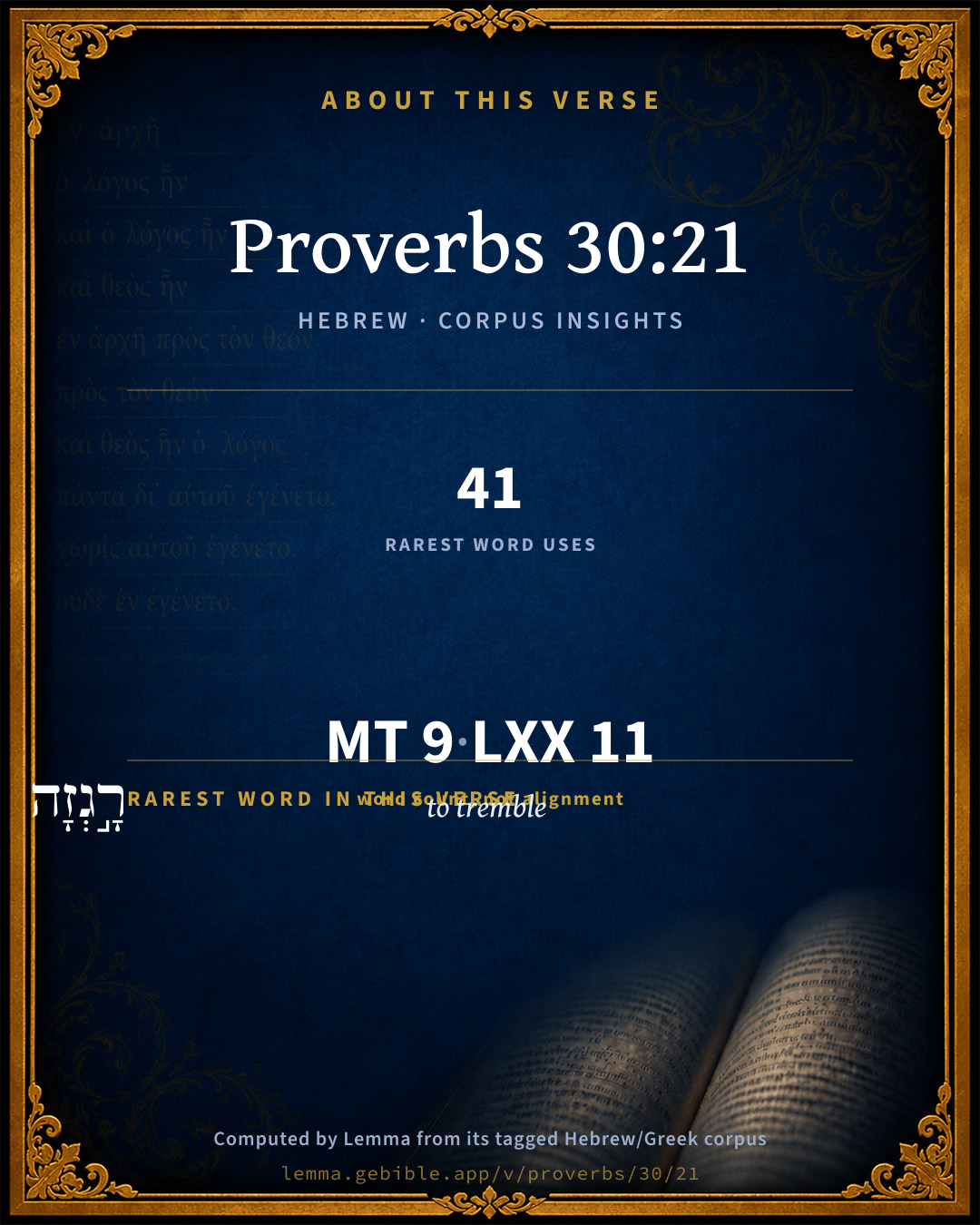
These counts appear in no published source. They are computed here, from the morphology-tagged text and Lemma’s own curated glosses. What Lemma adds →

9
words
8
distinct lemmas
Wisdom
section

Shared distinctive vocabulary

רָ֣גְזָה to tremble H7264 occurs in 40 verses of the Hebrew Bible. Also found in:

Grammatical profile

  • 3 verbs
  • 1 noun
  • 2 adjectives
  • 2 prepositions
  • 1 particle

Verb forms

  • רָ֣גְזָה Qal · Perfect
  • תוּכַ֥ל Qal · Imperfect
  • שְׂאֵֽת Qal · Infinitive Construct

Repetition

A word recurs within this verse — often emphatic in Hebrew:

  • תַּ֣חַת under H8478 ×2

Hebrew & Septuagint length

In English translation the verse runs 13 words from the Hebrew and 13 from the Septuagint (LXX English) — the same length.

A rough comparison of the two English renderings, which tokenize alike — not a word-level alignment.

Word counts can differ between the Hebrew and the Greek without any difference in meaning — e.g. the Hebrew direct-object marker אֵת has no separate Greek word, and Greek often adds the article ὁ.

In the original languages it is 9 Hebrew tokens and 11 Greek tokens — but the two are counted differently (Hebrew bundles its prefixes and suffixes into one token; the Greek is in lemma form), so that isn’t a like-for-like length.

Hebrew and Greek witnesses Masoretic Hebrew ↔ Greek Septuagint

The same verse in the two great witnesses to the Old Testament, shown verse-for-verse.

These are two independent witnesses, not word-aligned to each other, and the Septuagint is shown in lemma (dictionary) form.

Hebrew Proverbs 30:21 Masoretic · Westminster Leningrad Codex

תַּ֣חַת שָׁ֭לוֹשׁ רָ֣גְזָה אֶ֑רֶץ וְתַ֥חַת אַ֝רְבַּ֗ע לֹא תוּכַ֥ל שְׂאֵֽת

"For three things the earth tremble, And under four, it can't bear up:

World English Bible · Public Domain

Greek LXX Proverbs 30:21 Septuagint · lemma form

διά τρεῖς σείω ὁ γῆ ὁ δέ τέταρτος οὐ δύναμαι φέρω

By three things the earth is troubled, and the fourth it can’t bear:

LXX2012 (modern English Septuagint) · Public Domain

On this verse, Keil & Delitzsch discusses the Septuagint’s reading. Read the note in Commentary ↓

Hebrew: Westminster Leningrad Codex (CC BY 4.0). Greek: Septuagint (public domain); English from LXX2012 (modern English Septuagint) (Public Domain). How the Septuagint differs from the Hebrew →

Commentary

Notes on Proverbs 30:21 from classic Christian and Jewish commentators (each source and its license shown beneath its notes). The classic Christian expositions comment on the surrounding passage and are grouped to its opening verse, so a note may address several verses; the Jewish commentaries on the Tanakh (Rashi and others) are per-verse, so they appear only where the commentator wrote on this verse.

Lemma curates 59 commentaries, every one of them public domain or Creative Commons licensed, each selected and text-cleaned for this edition rather than reprinted as found. About our sources →

Trapp's Complete Commentary

John Trapp

Pro 30:21 For three [things] the earth is disquieted, and for four [which] it cannot bear:

Ver. 21. For three things the earth is disquieted.] Such trouble towns are odious creatures; the places where they live, long for a vomit to spew them out. As they live wickedly, so they die wishedly; there is a good world’s riddance of them, as there was of Nabal, and of those in Job 27:23; Job 27:15, who were buried before half dead, being hissed and kicked off the stage of the world, as Phocas was by Heraclius.

And for four which it cannot bear.] The very axle of the world is even ready to crack under them, the earth to open and swallow them up.

John Trapp, A Commentary or Exposition upon All the Books of the Old and New Testament (1647–1656) — public domain. Text from a community e-Sword module.

Joseph Benson's Commentary

Pro 30:21-23. For three things the earth — That is, the inhabitants of the earth; is disquieted — By their insolence and impudence they cause great disturbances in the places where they live; for four it cannot rest — They are intolerable in human societies. For a servant when he reigneth — When he is advanced to great power and dignity; for such a one is ignorant and unfit for his place, and therefore commits many errors; he is poor, and therefore insatiable; he is proud and imperious, and usually injurious and cruel; and a fool — A conceited fool, or an obstinately wicked man; when he is filled with meat — When he is over fed, his meat and drink heating his blood, and stirring him up to many insolences: or, when he abounds in wealth, which, in that case, is like a sword in a madman’s hand, being an instrument and occasion of many acts of wickedness and mischief. For an odious woman — Proud and perverse, and full of other offensive qualities; when she is married — For then she displays all those ill humours which before she concealed. And a handmaid that is heir — Which great and sudden change transports her beside herself, and makes her insufferably proud and scornful.

Joseph Benson's Commentary on the Old and New Testaments (1811–1818) — public domain. Text from a community e-Sword module.

The Preacher's Complete Homiletical Commentary

Joseph S. Exell (gen. ed.)

CRITICAL NOTES.—

Pro_30:23. Odious, or unloved.

MAIN HOMILETICS OF THE PARAGRAPH.—Pro_30:21-23

BURDENS GRIEVOUS TO BE BORNE

I. It is sometimes dangerous to the peace of a community to raise a person from a low to a high position. To place a man who has never before crossed a horse, upon a high-spirited charger, is to create a source of danger both to himself and others. There is a strong probability that the unskilful rider will be thrown from his unaccustomed elevation, and so injure himself. And it is also probable that he will be the means of mischief to other travellers upon the road, whom he will overthrow in his unskilful efforts to keep his seat. It is generally as dangerous an experiment to lift a man at once from the position of a servant to that of a ruler. Although faithfulness “over a few things” is, according to the highest authority, the best qualification for rulership “over many things” (Mat_25:21), it is not always hands used only to service are fit to hold the reins of government, either in a small or a large society. On this subject see also on chap. Pro_19:10, page 569.

II. Some human creatures cannot safely be trusted with even a sufficiency of this world’s goods. They are not only unfit to rule others, but so unfit to rule themselves that they cannot be “filled with meat” without becoming a centre of disturbance. Even enough of the necessaries of life suffices to make them injurious to themselves and insolent to their betters. This is especially true of men who are slaves to their bodily appetites. There are men in the world who, although peaceable and even useful citizens when they are kept in a state of comparative want and hardship, indulge in excess and immorality as soon as the restraint is removed. They will sometimes know this to be true, and yet they are so wanting in moral courage and strength as not to struggle after a higher condition of being. Such men are fools indeed.

III. The change of disposition which change of circumstance sometimes seems to work may be the result of deliberate purpose. When a servant becomes a ruler he may be the occasion of trouble simply from intellectual inability, and the fool who cannot safely be filled with meat may be only morally weak; but the woman here represented as developing into a curse after marriage suggests a person who has deliberately hidden her real character for a time in order to gain a position in which she can have more opportunities of indulging her evil propensities. This is a step farther in wickedness, and this domestic burden is often the most grievous of all burdens. On this subject see on chap. Pro_21:9; Pro_21:19, page 613.

OUTLINES AND SUGGESTIVE COMMENTS

Judge, then, how horrible it is that men should set the devil, or his two angels the world and the flesh, in the throne, whiles they place God in the footstool; or that in this commonwealth of man, reason, which is the queen or princess over the better powers and graces of the soul, should stoop to so base a slave as sensual lust.—T. Adams.

And now, just notice the comprehensiveness, in regard to the happiness of human life, of the four things thus enumerated. They begin, observe, at the throne, and come down to the domestic servant. They embrace four great sources of the social unhappiness of mankind. These are—incompetent rule, prosperous and, besotted folly, conjugal alienation and strife with its domestic miseries, and the unnatural inversion of social order.—Wardlaw.

The Preacher's Complete Homiletical Commentary (gen. ed. Joseph S. Exell; Funk & Wagnalls, c. 1892) — public domain (pre-1929). A full-Bible homiletical/sermon-outline anthology covering 65 of 66 books (2 John is absent from the source module). Text from a community e-Sword module.

Tyndale Open Study Notes

Tyndale Open Resources

30:21-23 This proverb lists four things that make the earth tremble because they overturn the order of things. • who prospers (literally who is full of bread): In the ancient Near East as in much of the non-industrialized world today, having adequate food (bread) was a sign of prosperity.

Tyndale Open Study Notes — © Tyndale Open Resources, licensed CC BY-SA 4.0. Text via the HelloAO Bible API.

Jamieson, Fausset & Brown

Robert Jamieson, A. R. Fausset & David Brown

Pride and cruelty, the undue exaltation of those unfit to hold power, produce those vices which disquiet society (compare Pro 19:10; Pro 28:3).

Jamieson, Fausset & Brown — Commentary Critical and Explanatory on the Whole Bible (1871) — public domain (CC PDM 1.0). Text via the HelloAO Bible API.

Adam Clarke's Commentary

Verse 21. For three things the earth is disquieted, and for four which it cannot bear] This is another enigma. Four things insupportable to men. 1. A slave, when he becomes ruler. 2. An overfed fool. 3. An ill-tempered woman, when mistress of a family. And, 4. A servant maid, when the rule of the house is committed to her.

1. A slave, when he comes to bear rule, is an unprincipled tyrant. It has been often observed both in America and in the West Indies, when it was judged necessary to arm some of the most confidential slaves, that no regiments were used so cruelly in the drill, c., as those black regiments that had black officers.

2. The overfed fool. The intellectually weak man, who has every thing at his command, has generally manners which none can bear and, if a favourite with his master, he is insupportable to all others.

3. An ill-tempered woman, when she gets embarrassed with domestic cares, is beyond bearing.

4. A servant maid, when, either through the death of the mistress, or the sin of the husband, she is in fact exalted to be head over the family, is so insolent and impudent, as to be hateful to every one, and execrated by all.

Adam Clarke's Commentary on the Bible (1810–1826) — public domain. Text from a community e-Sword/MySword module.

The Cambridge Bible for Schools and Colleges

gen. ed. J. J. S. Perowne

21. For] “or Under,” R.V. marg.

21–23. Four things that are intolerable.

Two of them are drawn from each sex, and in each case they are unbearable because they are out of place, in a false position.

The Cambridge Bible for Schools and Colleges (gen. ed. J. J. S. Perowne; Cambridge University Press, 1878–1918) — public domain. Text from a community e-Sword module.

John Gill's Exposition

For three things the earth is disquieted,.... The inhabitants of it are made very uneasy;

and for four which it cannot bear; they are a load and burden upon it, and are intolerable to those that dwell on it, and make them very uncomfortable.

John Gill's Exposition of the Whole Bible (1746–1763) — public domain (CC PDM 1.0). Text via the HelloAO Bible API.

Albert Barnes' Notes on the Bible

For four which it cannot bear - Better: four it cannot bear. Here the common element is that of being intolerable, and the four examples are divided equally between the two sexes. Each has its examples of power and prosperity misused because they fall to the lot of those who have no training for them, and are therefore in the wrong place.

Albert Barnes' Notes on the Bible (1834–1885) — public domain. Text from a community e-Sword/MySword module.

Matthew Poole's English Annotations

The earth is disquieted; either,

1. The earth itself trembleth and is moved; so it is an hyperbole. Or rather,

2. The inhabitants of the earth. They do by their insolence and impudence cause great and dreadful disturbances in the places where they live.

Which it cannot bear; which are intolerable in human societies.

Matthew Poole's English Annotations on the Holy Bible (1683–1685) — public domain. Text from a community e-Sword/MySword module.

Whedon's Commentary on the Bible

Daniel D. Whedon

21-23. Three… four — Hence follows another enigma, the four intolerable things.

The earth is disquieted — The land is disturbed, thrown into commotion.

A servant when he reigneth — When he becomes a ruler. Under Eastern governments slaves are sometimes promoted to office and become rulers. They are frequently the most imperious of tyrants. The same thing was, in the days of slavery, observed in this country when slaves were made overseers of their fellows, and in the West Indies, as Dr. Clarke remarks, where they were made drill masters of black regiments. This grows out of their previous condition and education, or, rather, their lack of education. (Comp. Pro_29:19.)

A fool — נבל, (nabhal,) an ungodly dolt; the word implies wickedness and stupidity. (Compare Pro_19:10.)

An odious woman — A hateful and hated woman.

When she is married — Literally, when she is lorded, or husbanded; that is, when she gets married. (Comp. Pro_29:17-18; Pro_31:1.)

Heir to her mistress — Literally, inherits her mistress; that is, inherits her place — disinherits her in the affections and honour of her husband. Comp. Pro_16:21.

Daniel D. Whedon (gen. ed.), Commentary on the Old and New Testaments (1874–1909) — public domain. Text from a community e-Sword module.

The Pulpit Commentary

Vers. 21-23. Then follows a proverb concerning four things which are intolerable, examples of incongruous associations or positions two in the case of men, two in the case of women.

For three things the earth is disquieted; better, under three things the earth doth tremble, as if oppressed by an overwhelming borden. The form of expression does not allow us to think of an earthquake. "The earth" is equivalent to "the inhabitants thereof." And for four which it cannot bear; or, under four it cannot stand. (comp. Amo_7:10) These four evils destroy the comfort of social life, uproot the bonds of society, and endanger the safety of a nation.

Vers. 21-23. Intolerable things.

I THE EXAMPLES.

1. The slave in authority. (Ver. 22) The inversion of objects is intolerable to the trained eye; things standing upside down, etc. So in social relations and in political Government belongs to the wise and the strong; the feeble in mind and the narrow in heart are emphatically the wrong men in the wrong place, in seats of power.

2. The self-satisfied fool. His fatuous smile is a satire upon himself and upon the condition of things which permits him to bask in so fantastic a paradise. Those are sights to make the "angels weep.

3. The ill-tempered wife. (Ver. 23) She, again, is emphatically "out of place." For home, in any sweet sense, is the place which woman"s presence makes a delight.

4. The ambitious maidservant. The effort to supplant, to grasp a place beyond one"s rights and deserts, hurts our intuitive perceptions of what is right. An Oriental proverb says, "Sit in your place, and none shall make you rise," on which we have a pointed commentary from Christ in Luk_14:11, "He that humbleth himself shall be exalted.

II THE GENERAL LESSONS. Order and rank are Divine institutions. To overturn this is no work of the true reformer or friend of the social weal. Rule rests ultimately upon ability to rule; government, upon power; authority, upon wisdom. When these relations are actually reversed, society is disturbed, matters are unhappy. When they only seem to be reversed, there will be distress and discomfort in right minds, until the just order and the nominal state of things shall be restored. J.

The Pulpit Commentary (1880–1919), ed. H.D.M. Spence-Jones & Joseph S. Exell — public domain. Text from a community e-Sword module.

John Wesley's Explanatory Notes

Four - Which are intolerable in human societies.

John Wesley, Explanatory Notes Upon the Whole Bible (1754–1765) — public domain. Text via the GEBible commentary corpus.

Keil & Delitzsch

C. F. Keil & F. Delitzsch

It is now not at all necessary to rack one's brains over the grounds or the reasons of the arrangement of the following proverb (vid., Hitzig). There are, up to this point, two numerical proverbs which begin with שׁתּים, Pro 30:7, and שׁתּי, Pro 30:15; after the cipher 2 there then, Pro 30:18, followed the cipher 3, which is now here continued:

21 Under three things doth the earth tremble,

And under four can it not stand:

22 Under a servant when he becomes king,

And a profligate when he has bread enough;

23 Under an unloved woman when she is married,

And a maid-servant when she becomes heiress to her mistress.

We cannot say here that the 4 falls into 3 + 1; but the four consists of four ones standing beside one another. ארץ is here without pausal change, although the Athnach here, as at Pro 30:24, where the modification of sound occurs, divides the verse into two; מארץ, 14b (cf. Psa 35:2), remains, on the other hand, correctly unchanged. The "earth" stands here, as frequently, instead of the inhabitants of the earth. It trembles when one of the four persons named above comes and gains free space for acting; it feels itself oppressed as by an insufferable burden (an expression similar to Amo 7:10); - the arrangement of society is shattered; an oppressive closeness of the air, as it were, settles over all minds. The first case is already designated, Pro 19:10, as improper: under a slave, when he comes to reign (quum rex fit); for suppose that such an one has reached the place of government, not by the murder of the king and by the robbery of the crown, but, as is possible in an elective monarchy, by means of the dominant party of the people, he will, as a rule, seek to indemnify himself in his present highness for his former lowliness, and in the measure of his rule show himself unable to rise above his servile habits, and to pass out of the limited circle of his earlier state. The second case is this: a נבל, one whose mind is perverted and whose conduct is profligate - in short, a low man (vid., Pro 17:17) - ישׂבּע־לחם (cf. Metheg-Setzung, 28), i.e., has enough to eat (cf. to the expression Pro 28:19; Jer 44:17); for this undeserved living without care and without want makes him only so much the more arrogant, and troublesome, and dangerous. The שׂנוּאה, in the second case, is not thought of as a spouse, and that, as in supposed polygamy, Gen 29:31; Deu 21:15-17, as fallen into disfavour, but who again comes to favour and honour (Dathe, Rosenmller); for she can be שׂנואה without her own fault, and as such she is yet no גּרוּשׁה; and it is not to be perceived why the re-assumption of such an one should shatter social order. Rightly Hitzig, and, after his example, Zckler: an unmarried lady, an old spinster, is meant, whom no one desired because she had nothing attractive, and was only repulsive (cf. Grimm, under Sir. 7:26b). If such an one, as כּי תבעל says, at length, however, finds her husband and enters into the married relation, then she carries her head so much the higher; for she gives vent to ill-humour, strengthened by long restraint, against her subordinates; then she richly requites her earlier and happily married companions for their depreciation of her, among whom she had to suffer, as able to find no one who would love her. In the last case it is asked whether כּי־תירשׁ is meant of inheriting as an heiress (Aquila, Symmachus, Theodotion, the Targ., Jerome, the Venet., and Luther), or supplanting (Euchel, Gesenius, Hitzig), i.e., an entering into the inheritance of the dead, or an entering into the place of a living mistress. Since ירשׁ, with the accus. of the person, Gen 15:3-4, signifies to be the heir of one, and only with the accus. of peoples and lands signifies, "to take into possession (to seize) by supplanting," the former is to be preferred; the lxx (Syr.), ὅταν ἐκβάλῃ, appear to have read כּי־תגרשׁ. This גּרשׁ would certainly be, after Gen 21:10, a piece of the world turned upside down; but also the entering, as heiress, into the inheritance, makes the maid-servant the reverse of that which she was before, and brings with it the danger that the heiress, notwithstanding her want of culture and dignity, demean herself also as heiress of the rank. Although the old Israelitish law knew only intestate succession to an inheritance, yet there also the case might arise, that where there were no natural or legal heirs, the bequest of a wife of rank passed over to her servants and nurses.

Keil & Delitzsch — Biblical Commentary on the Old Testament (1861–1891) — public domain (CC PDM 1.0). Text via the HelloAO Bible API. (Old Testament only.)

Bridges on Proverbs

Charles Bridges

Next to things which were unsearchable, Agur now mentions some things that were intolerable — things, for which the earth is disquieted, bringing confusion wherever they are found. Who does not naturally condemn things out of place, as unsuitable and unseemly? Order is the law of the works of God in the world, no less than in the Church;†1 and any breach of order is to be deprecated. Four such evils are here mentioned — two connected with men, two with women; the one class in the community, the other in the family.

The first evil mentioned is — a servant, when he reigneth. This is a serious evil in the family, whether it arises from the mismanagement of the master,†2 or from his own intrigue. (Pro 30:23 .) He is obviously out of place; and ruling, where he ought to serve, he must bring disorder. (Gen 16:4 .) The evil is far greater in a kingdom. Men of low birth may indeed rise honorably by their own merit to a high station. God may call them, as he did Joseph (Gen 41:41 ), to reign. The evil is the advancement to power of ignorant, unprincipled minions.†3 Men of mean spirit cannot bear to be raised. Intoxicated by sudden elevation, these upstarts shew themselves not only fools, but tyrants;†4 swelling with all the insolence of their unseemly honor. Such was the enmity of Tobiah the Ammonite†5 and the misrule of Haman.†6 What national evil resulted from the elevation of Jeroboam!†7 What anarchy from the successful usurpation of Zimri!†8 Well therefore might the reign of servants be deplored, as a component part of the calamity of disconsolate Zion! (Lam 5:8 .) In the ordinary course it can only be viewed as a chastening dispensation. (Isa 3:4-5 .) Let us acknowledge with thankfulness our deliverance from it.

Then look at the fool (not an idiot, but a willful sinner) when he is filled with meat. Can we wonder that he should be a trouble and a curse; giving the reins to his appetite, and becoming yet more devoid of understanding than before? The history of Nabal, sunk into brutishness by his own sensual lust (1Sa 25:36 ); Elah murdered by his servant, whilst "drinking himself drunk in his steward’s house;"†9 Belshazzar giving himself over to the lust of ungodliness†10 — all these were evils, for which the earth was disquieted, and which it could not bear. Filled with meat — "with surfeiting and drunkenness" they dig as it were their own graves with their teeth, and are set forth as an example in the just punishment of their wicked folly.

Look again into the inner room of the family. What is the origin of discord and palpable misery? An odious woman is in rule. She quarrels with all around her. Her ungoverned tongue and temper are an unceasing source of agitation. Had she known herself, much better for her never to have entered into the marriage bond, than to become the inseparable tormentor of her husband and family.†11 Woman is to man either his greatest curse or blessing. If love be not the earnest of the sacred union, truly will it be a bond of misery, from which only the special mercy of God can deliver. Let the worldly portion of the wife be the last consideration. Take heed, lest worldly glitter open a door for remediless misery.

The odious woman, when she is married, if she be in authority, becomes a national evil. Jezebel was a scourge to Israel, the spring of all Ahab’s wickedness, that brought the heavy judgment of God upon the land.†12 The earth was disquieted for her, and at the last cast her out. (2Ki 9:30-37 .) Herodias brought upon her husband and his nation the guilt of the blood of the murdered prophet "crying from the ground." (Mat 14:8 .) If marriage be the ordinance of lust, not of godliness, what wonder if an odious woman should be the result, a canker to every domestic comfort?

The last evil noticed is a frequent source of family trouble — an handmaid, that is heir to her mistress. Want of discipline, simplicity, or integrity, leads to waywardness and self-indulgence; and the house, instead of being under wholesome rule, becomes a prey to envy and strife. The ill-regulated connection between Abraham and Hagar, when the servant became heir to her mistress — occupying her mistress’s place with her husband — became the source of most baneful contention. (Gen 16:4 .) Our own history presents sad illustration of this intolerable evil. Anne Boleyn and Jane Seymour were handmaids, and unhappily heirs, to their respective mistresses while living, in the affections of the sovereign. The royal example of selfishness and lust was a national grievance, in which the handmaids were not wholly guiltless.

And thus in modern society, an handmaid, treated with that familiarity, which breaks down the Divine barriers between the several ranks, has sometimes become heir to her mistress; either succeeding to her property — perhaps to the exclusion of more rightful claimants (Pro 29:21 ); or rising into her place by an ill-assorted union, like those above-mentioned, usually productive of much family dissension. Or again, in the higher ranks, she is the heir to her mistress’s dresses. This encourages in her the love of dress and vanity, habits unsuitable to her situation in life; and too often hurtful to her solid respectability and eternal interests.

How needful is it to preserve consistency in every part of our profession! Oh! let us look carefully to it, that no want of wisdom, godly contentment, or self-denial, brings reproach upon that worthy name by which we are called; that there be no spots, to mar that adorning beauty, which might attract those around us to the ways of God.

Footnotes:

†1 Ecc 3:11. 1Co 14:40 .

†2 Pro 29:21.

†3 Pro 19:10. Ecc 10:5-7 .

†4 Proverbs XX? iii. 3. This danger is accurately drawn by one of the Classic moralists: -

Asperius nihil est humili; cum surgit in altum,

Cuncta ferit, dum cuncta timet; desævit in omnes,

Ut se posse putet; nec bellua tetrior ulla est,

Quam servi rabies, in libera terga furentis.

Claudian. Lib. i. in Eutrop.

†5 Neh 2:10.

†6 Est 3:1.

†7 1Ki 11:26-28 ; 1Ki 12:30 .

†8 1Ki 16:9-20 . Compare 2Ki 8:12 .

†9 1Ki 16:9-10 . Hos 7:5 .

†10 Dan 5:1-4, Dan 5:30 . 1Sa 30:16 . 1Ki 20:16 .

†11 Pro 21:9, Pro 21:19 ; Pro 27:15 .

†12 1Ki 16:31 ; 1Ki 21:25 .

Charles Bridges, An Exposition of the Book of Proverbs (1846) — public domain. Text from a community e-Sword module.

unfoldingWord translationNotes

Door43 World Missions Community

Under three things the earth trembles, and under four it cannot bear up

The use of the numbers "three" and "four" here is likely a poetic device. "There are some things that make the earth tremble, that it cannot endure. Four of these are:"

a fool when he is filled with food

This can be translated in active form. AT: "a fool who has had enough to eat" (See: Active or Passive)

a hated woman when she marries

That is, people rightly hated her before she married; once she marries, she will be worse than she was before she married. This can be translated in active form. AT: "a woman whom good people have hated when she marries" or "an outcast woman when she marries" (See: Active or Passive)

takes the place of her mistress

rules the household

translationWords

earth

servant

king

fool

unfoldingWord translationNotes — © Distant Shores Media and the Door43 World Missions Community, licensed CC BY-SA 4.0. Source: git.door43.org/Door43/en_tn.

Lesson kit

Teaching starters — assembled from the data on this page, not authored interpretation. Every prompt links to the verse data it draws on. Edit before teaching.

Proverbs, in the Wisdom, opens this verse with 9 words (8 distinct Hebrew lemmas). Its most distinctive word is râgaz (“to tremble”). A historical commentator’s framing appears above. Read the whole chapter for the surrounding context.

Discussion questions

  1. What does “to tremble” (râgaz) contribute to the verse as a whole?
  2. How does Genesis 45:24, which shares the word «to tremble», read alongside this verse?
  3. What does the repetition of “under” (2× in this one verse) do in this verse?
  4. The translations on this page render this verse differently — a whole-verse word diff, not a word-by-word alignment. What might account for the different wordings?
  5. «רָ֣גְזָה» is a Qal Perfect verb. How does that grammatical form shape the action described?
  6. Compare how Trapp's Complete Commentary and Joseph Benson's Commentary read this verse. Where do they agree or differ?

Things to notice

Reading settings

Reading text

Shown beneath each verse's original-language words.

Old Testament
Old Testament edition

Read the OT as the Masoretic Hebrew (MT) or the Greek Septuagint (LXX).

English shown for the Greek Septuagint (in the Hebrew ↔ Greek comparison).

Comparing translations? Open the Compare panel on any verse page to stack up to four side by side.