
Exodus 33:20

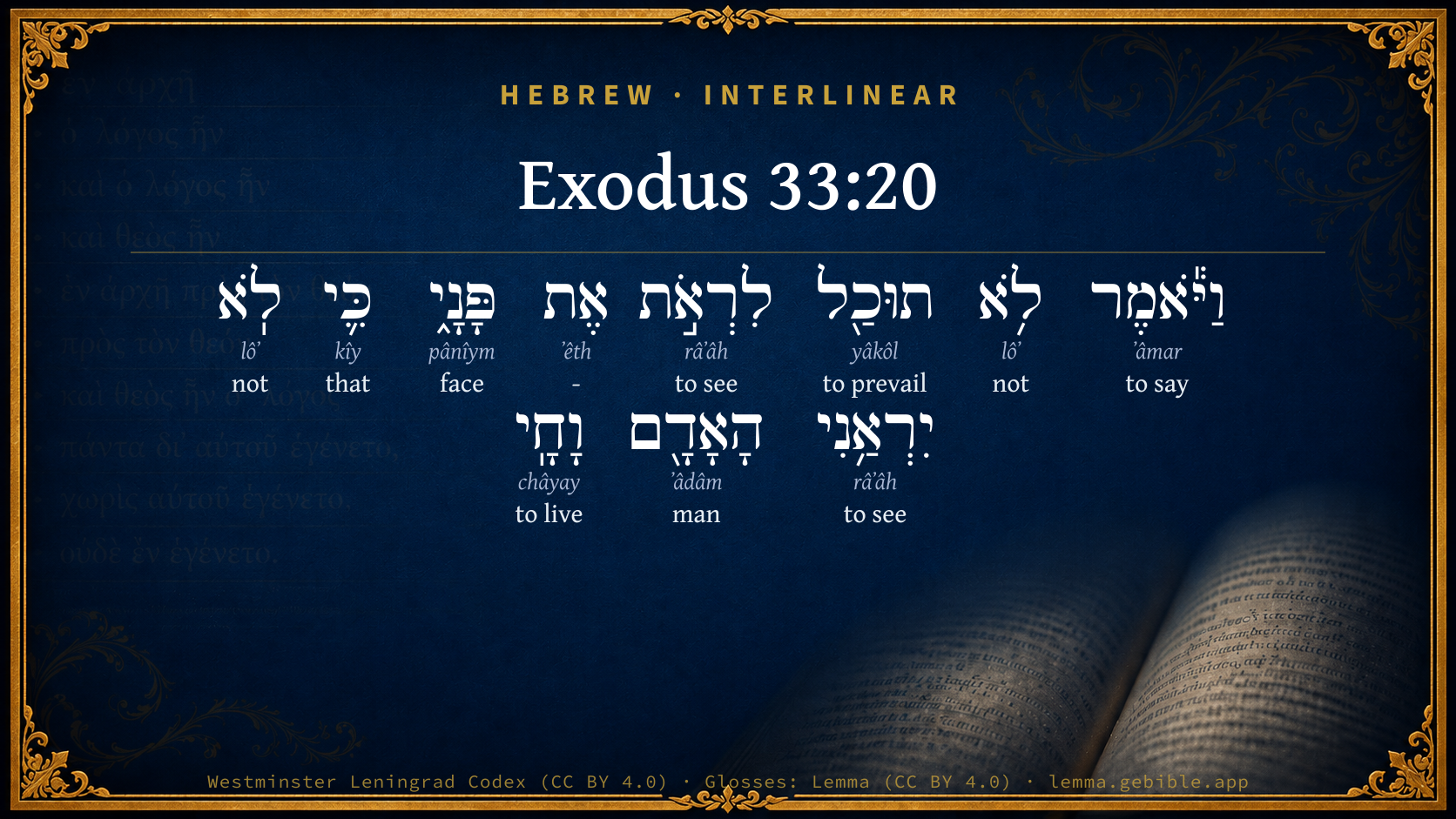
Hebrew (Westminster Leningrad Codex) Exodus 33:20 appears in the Hebrew Old Testament. The text above is from the Westminster Leningrad Codex. Each word links to its Strong’s number, a concise gloss, and parsing drawn from the Open Scriptures Hebrew Bible morphology. Click any word for its full Brown-Driver-Briggs (BDB) entry.
Download image
Cite this verse

Exodus 33:20 (World English Bible). Public Domain. Lemma interlinear Bible study tool, https://lemma.gebible.app/v/exodus/33/20.

Show BibTeX & RIS
BibTeX
RIS
English Translation
He said, "You cannot see my face, for man may not see me and live."
World English Bible · Public Domain
Download a study sheet

One document with this verse’s original text, its word-by-word gloss line, the meaning frame, cross-references with their text, attributed commentary, and full source and license credits — printable, and it pastes into notes with its structure intact.

This verse Autodidact and up

Study sheet (.html) Plain text (.txt)

A passage Seminary Student

Up to 50 verses in one chapter. A passage sheet keeps up to 6 commentary sources and 12 cross-references per verse, in the order this page ranks them, and says so on the sheet whenever that leaves anything out. Ask for a single verse and you get the Autodidact verse sheet above.

Everything on this page stays free to read, with no account — the sheet is a download of what is already on screen, not access to it.

Want to remove ads? Support Godless Engineer
Compare translations 3

The same verse in 3 English versions, stacked beneath the original-language interlinear above. Click any original word for its lexicon entry.

Each is an independent rendering of the whole verse — the interlinear is not word-aligned to these translations.

Highlighted words mark where these versions differ — a whole-verse word diff, not a word-by-word alignment.

  • World English Bible Public Domain
    He said, "You cannot see my face, for man may not see me and live."
  • King James Version Public Domain
    And he said, Thou canst not see my face: for there shall no man see me, and live.
  • unfoldingWord Literal Text CC BY-SA 4.0
    But he said, “You are not able to see my face, for mankind can not see me and live.”

unfoldingWord Literal Text — © unfoldingWord, licensed CC BY-SA 4.0. Word-aligned USFM3 via Door43 (git.door43.org/unfoldingWord/en_ult).

Versions to compare (up to 4)

3 of 4 selected

Show all 18 translations

Every available English version of this verse, each an independent rendering of the whole verse.

  • World English Bible Public Domain
    He said, "You cannot see my face, for man may not see me and live."
  • Berean Standard Bible Public Domain
    But He added, “You cannot see My face, for no one can see Me and live.”
  • Majority Standard Bible Public Domain
    But He added, “You cannot see My face, for no one can see Me and live.”
  • King James Version Public Domain
    And he said, Thou canst not see my face: for there shall no man see me, and live.
  • American Standard Version (1901) Public Domain
    And he said, Thou canst not see my face; for man shall not see me and live.
  • Revised Version (1885) Public Domain
    And he said, Thou canst not see my face: for man shall not see me and live.
  • Geneva Bible (1599) Public Domain
    Furthermore he sayde, Thou canst not see my face, for there shall no man see me, and liue.
  • Douay-Rheims (1899) Public Domain
    And again he said: Thou canst not see my face: for man shall not see me and live.
  • Young's Literal Translation Public Domain
    He saith also, `Thou art unable to see My face, for man doth not see Me, and live;'
  • Literal Standard Version CC BY-SA 4.0
    He also says, “You are unable to see My face, for man does not see Me and live”;
  • Unlocked Literal Bible CC BY-SA 4.0
    But Yahweh said, “You may not see my face, for no one can see me and live.”
  • unfoldingWord Literal Text CC BY-SA 4.0
    But he said, “You are not able to see my face, for mankind can not see me and live.”
  • Darby Bible Public Domain
    And he said, Thou canst not see my face; for Man shall not see me, and live.
  • World Messianic Bible Public Domain
    He said, “You cannot see my face, for man may not see me and live.”
  • Webster's Bible Public Domain
    And he said, Thou canst not see my face: for there shall no man see me, and live.
  • Free Bible Version CC BY-SA 4.0
    But you won't be able to see my face, because no one can see my face and live.”
  • Bible in Basic English Public Domain
    But it is not possible for you to see my face, for no man may see me and still go on living.
  • JPS Tanakh (1917) Public Domain
    And He said: 'Thou canst not see My face, for man shall not see Me and live.'

Literal Standard Version (2020), Covenant Press — licensed CC BY-SA 4.0. Text via the HelloAO Bible API (eBible.org). Unlocked Literal Bible (unfoldingWord) — licensed CC BY-SA 4.0. Text via the HelloAO Bible API (eBible.org). unfoldingWord Literal Text — © unfoldingWord, licensed CC BY-SA 4.0. Word-aligned USFM3 via Door43 (git.door43.org/unfoldingWord/en_ult). Free Bible Version, Dr. Jonathan Gallagher — licensed CC BY-SA 4.0. Text via the HelloAO Bible API (eBible.org).

Word by word

More ways to search: Search by grammar → Find every occurrence → Compare this word →

Practice this passage: Drill this verse → Learn its vocabulary →

וָחָֽי
châyay
H2425
“and · to live”
Conjunction + Verb, Qal, Sequential Perfect, 3rd Person, Masculine, Singular
Part of Speech
Conjunction + Verb
Stem
Qal
Form
Sequential Perfect
Person
3rd Person
Gender
Masculine
Number
Singular
Full BDB Definition

Origin: a primitive root [compare H2421 ]

TWOT: 644

to live, have life, remain alive, sustain life, live prosperously, live for ever, be quickened, be alive, be restored to life or health - (Qal) - to live - to have life - to continue in life, remain alive - to sustain life, to live on or upon - to live (prosperously) - to revive, be quickened - from sickness - from discouragement - from faintness - from death - (Piel) - to preserve alive, let live - to give life - to quicken, revive, refresh - to restore to life - to cause to grow - to restore - to revive - (Hiphil) - to preserve alive, let live - to quicken, revive - to restore (to health) - to revive - to restore to life
  1. וַיֹּ֕אמֶר ʼâmar H559 “and · to say” Conjunction + Verb, Qal, Sequential Imperfect, 3rd Person, Masculine, Singular
  2. לֹ֥א lôʼ H3808 “not” Particle, Negative
  3. תוּכַ֖ל yâkôl H3201 “to prevail” Verb, Qal, Imperfect, 2nd Person, Masculine, Singular
  4. לִרְאֹ֣ת râʼâh H7200 “to see” Preposition + Verb, Qal, Infinitive Construct
  5. אֶת ʼêth H853 “-” Particle, Direct Object
  6. פָּנָ֑י pânîym H6440 “face(s) · my” Noun, Common, Both, Plural, Construct + Suffix, Personal, 1st Person, Common, Singular
  7. כִּ֛י kîy H3588 “that” Conjunction
  8. לֹֽא lôʼ H3808 “not” Particle, Negative
  9. יִרְאַ֥נִי râʼâh H7200 “to see · me” Verb, Qal, Imperfect, 3rd Person, Masculine, Singular + Suffix, Personal, 1st Person, Common, Singular
  10. הָאָדָ֖ם ʼâdâm H120 “the · man” Particle, Definite Article + Noun, Common, Masculine, Singular, Absolute

About this verse

These counts appear in no published source. They are computed here, from the morphology-tagged text and Lemma’s own curated glosses. What Lemma adds →

11
words
9
distinct lemmas
Pentateuch
section

Notable vocabulary

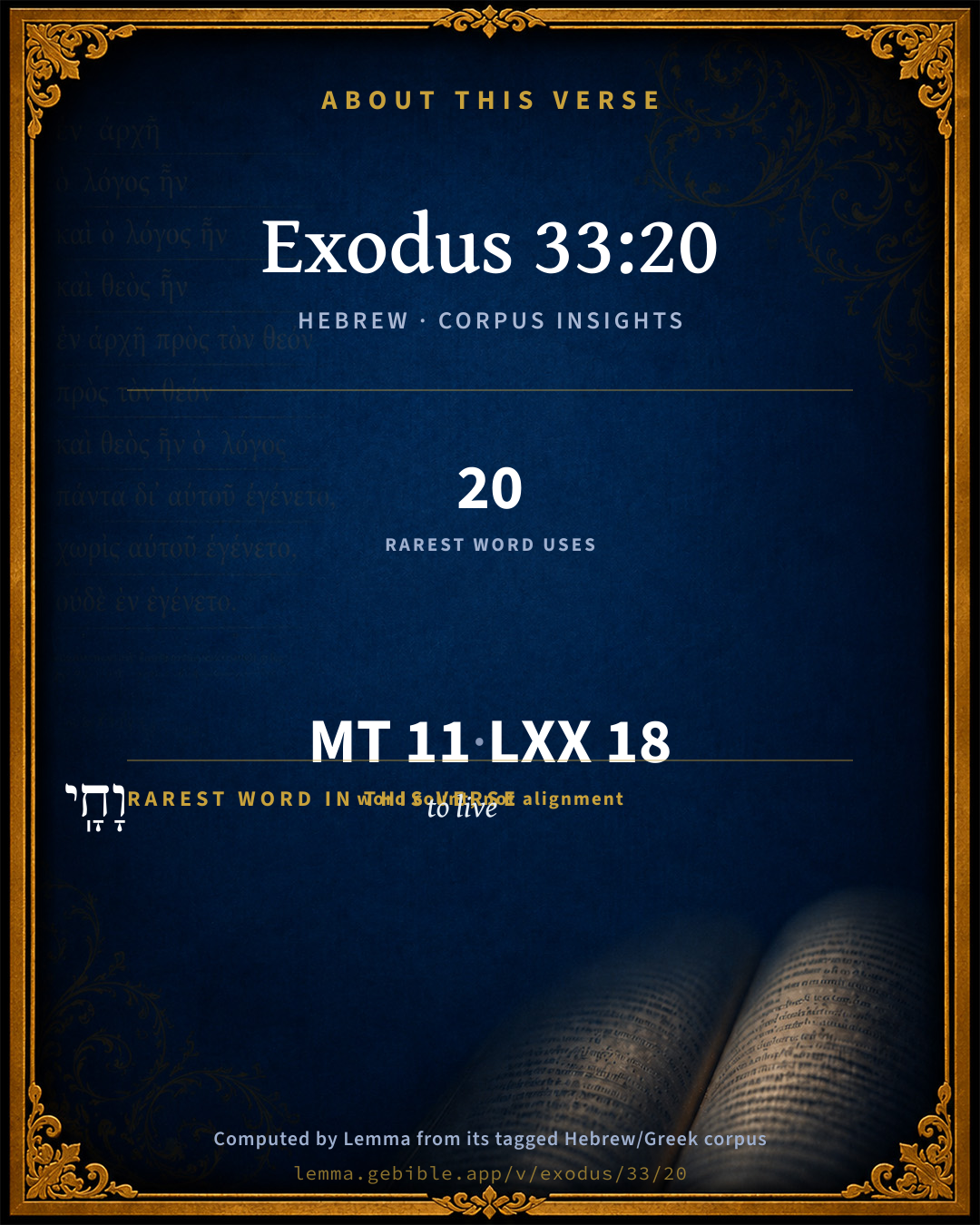
The rarest word here is וָחָֽי to live H2425 — appearing just 20 times in the whole Hebrew Bible.

Shared distinctive vocabulary

וָחָֽי to live H2425 occurs in 20 verses of the Hebrew Bible. Also found in:

Grammatical profile

  • 5 verbs
  • 2 nouns
  • 1 conjunction
  • 3 particles

Verb forms

  • וַיֹּ֕אמֶר Qal · Sequential Imperfect
  • תוּכַ֖ל Qal · Imperfect
  • לִרְאֹ֣ת Qal · Infinitive Construct
  • יִרְאַ֥נִי Qal · Imperfect
  • וָחָֽי Qal · Sequential Perfect

Repetition

Words recur within this verse — often emphatic in Hebrew:

  • לִרְאֹ֣ת to see H7200 ×2
  • לֹ֥א not H3808 ×2

Hebrew & Septuagint length

In English translation the verse runs 15 words from the Hebrew and 21 from the Septuagint (LXX English) — the Septuagint runs noticeably longer here. See the side-by-side →

A rough comparison of the two English renderings, which tokenize alike — not a word-level alignment.

Word counts can differ between the Hebrew and the Greek without any difference in meaning — e.g. the Hebrew direct-object marker אֵת has no separate Greek word, and Greek often adds the article ὁ.

In the original languages it is 11 Hebrew tokens and 18 Greek tokens — but the two are counted differently (Hebrew bundles its prefixes and suffixes into one token; the Greek is in lemma form), so that isn’t a like-for-like length.

Cross-references

9

Topical passages linked to Exodus 33:20 in the Treasury of Scripture Knowledge — connected by theme and wording, ordered by reader-vote popularity; previews shown in the World English Bible.

  • Genesis 32:30 Jacob called the name of the place Peniel: for, he said, "I have seen God face to face, and my life is preserved."
  • John 1:18 No one has seen God at any time. The one and only Son, who is in the bosom of the Father, he has declared him.
  • 1 Timothy 6:16 who alone has immortality, dwelling in unapproachable light; whom no man has seen, nor can see: to whom be honor and eternal power. Amen.
  • Isaiah 6:5 Then I said, "Woe is me! For I am undone, because I am a man of unclean lips, and I dwell in the midst of a people of unclean lips: for my eyes have seen the King, Yahweh of Hosts!"
  • Judges 6:22 Gideon saw that he was the angel of Yahweh; and Gideon said, Alas, Lord Yahweh! because I have seen the angel of Yahweh face to face.
  • Judges 13:22 Manoah said to his wife, We shall surely die, because we have seen God.
  • Deuteronomy 5:24 and you said, Behold, Yahweh our God has shown us his glory and his greatness, and we have heard his voice out of the midst of the fire: we have seen this day that God does speak with man, and he lives.
  • Exodus 24:10 They saw the God of Israel. Under his feet was like a paved work of sapphire stone, like the skies for clearness.
  • Revelation 1:16–17 He had seven stars in his right hand. Out of his mouth proceeded a sharp two-edged sword. His face was like the sun shining at its brightest.

Cross-references courtesy of OpenBible.info (CC BY 4.0).

Hebrew and Greek witnesses Masoretic Hebrew ↔ Greek Septuagint

The same verse in the two great witnesses to the Old Testament, shown verse-for-verse.

Here the Septuagint runs noticeably longer than the Hebrew — LXX2012 (modern English Septuagint) 21 words vs World English Bible 15. A rough length comparison of the two English translations, not a word-level alignment — read both below.

These are two independent witnesses, not word-aligned to each other, and the Septuagint is shown in lemma (dictionary) form.

Hebrew Exodus 33:20 Masoretic · Westminster Leningrad Codex

וַיֹּ֕אמֶר לֹ֥א תוּכַ֖ל לִרְאֹ֣ת אֶת פָּנָ֑י כִּ֛י לֹֽא יִרְאַ֥נִי הָאָדָ֖ם וָחָֽי

He said, "You cannot see my face, for man may not see me and live."

World English Bible · Public Domain

Greek LXX Exodus 33:20 Septuagint · lemma form

καί εἶπον οὐ δύναμαι ὁράω ἐγώ ὁ πρόσωπον οὐ γάρ μή ὁράω ἄνθρωπος ὁ πρόσωπον ἐγώ καί ζάω

And God said, You shall not be able to see my face; for no man shall see my face, and live.

LXX2012 (modern English Septuagint) · Public Domain

Hebrew: Westminster Leningrad Codex (CC BY 4.0). Greek: Septuagint (public domain); English from LXX2012 (modern English Septuagint) (Public Domain). How the Septuagint differs from the Hebrew →

Targum (Aramaic paraphrase)

2

The Targum is the ancient Jewish Aramaic paraphrase of the Hebrew Scriptures — an interpretive translation, not the Hebrew text itself. Onkelos (literal) and Pseudo-Jonathan (expansive) render the Torah, and Jonathan the Prophets. Coverage is partial: where no permissively-licensed English translation exists for a verse, only the Aramaic is shown. This is verse-level text, not a word-by-word alignment to the Hebrew.

  1. Targum Onkelos Torah (Genesis–Deuteronomy)
    וַאֲמַר לָא תִיכוּל לְמֶחֱזֵי יָת אַפֵּי שְׁכִנְתִּי אֲרֵי לָא יֶחֱזִינַנִי אֶנָשָׁא וְיִתְקַיָם:

    (no public-domain English translation for this verse)

    Targum Onkelos — Aramaic: “Onkelos Genesis” (public domain); “Onkelos Exodus” (public domain); “Onkelos Leviticus” (public domain); “Onkelos Numbers” (public domain); “Onkelos Deuteronomy” (public domain). English: “Sefaria Community Translation” (CC0 1.0 (public-domain dedication)); “J.W. Etheridge. The Targums of Onkelos and Jonathan Ben Uzziel on the Pentateuch. London: Longmans, Green, 1862” (public domain). Text via Sefaria.

  2. Targum Pseudo-Jonathan Torah (Genesis–Deuteronomy)
    וַאֲמַר לֵית אֶפְשַׁר לָךְ לְמֵיחְמֵי יַת סְבַר אַפַּי אֲרוּם לָא יַחְמִינַנִי אֵינָשָׁא וְיִתְקַיֵּים

    And He said, Thou canst not see the visage of My face; for no man can see Me and abide alive. And the Lord said,

    Targum Pseudo-Jonathan — Aramaic: “Targum Jonathan on Genesis” (public domain); “Targum Jonathan on Exodus” (public domain); “Targum Jonathan on Leviticus” (public domain); “Targum Jonathan on Numbers” (public domain); “Targum Jonathan on Deuteronomy” (public domain). English: “The Targum of Jonathan ben Uzziel, trans. J. W. Etheridge, London, 1862” (public domain). Text via Sefaria.

Commentary

Notes on Exodus 33:20 from classic Christian and Jewish commentators (each source and its license shown beneath its notes). The classic Christian expositions comment on the surrounding passage and are grouped to its opening verse, so a note may address several verses; the Jewish commentaries on the Tanakh (Rashi and others) are per-verse, so they appear only where the commentator wrote on this verse.

Lemma curates 59 commentaries, every one of them public domain or Creative Commons licensed, each selected and text-cleaned for this edition rather than reprinted as found. About our sources →

Trapp's Complete Commentary

John Trapp

Exo 33:20 And he said, Thou canst not see my face: for there shall no man see me, and live.

Ver. 20. Thou canst not see my face.] Otherwise than in his words and works. {Rom 1:20} As we cannot see the sun in rota, in the circle, but in the beams. Some have seen Mercabah velo harocheb, as the Hebrews speak, {a} the chariot in which God rode, but not the rider in it: they saw some created image, or glory, whereby he testified his more immediate presence, but not himself.

No man shall see me, and live.] But be oppressed and swallowed up with majesty: as the sight of the eye is dazzled with the sun; or a crystal glass broken with the fire.

{a} Rab. Maimon.

John Trapp, A Commentary or Exposition upon All the Books of the Old and New Testament (1647–1656) — public domain. Text from a community e-Sword module.

The Biblical Illustrator

Joseph S. Exell

Exo_33:20-23

My face shall not be seen.

Gods glory must be veiled from human sight

If God had revealed all His glory--if He had not put the shadow of His hand upon Moses, if He had not revealed merely His skirts, as it were, as He passed by--Moses would have been overwhelmed. And this explains to you what is often said in Scripture, No man can see God and live,--not because God would destroy the man, but because the glory would be so intense that it would overwhelm him. Moral grandeur may be overpowering, and we learn in history that there have been cases where mental emotion has struck dead the physical economy. A celebrated American astronomer was watching the transit of Venus over the suns disk; he believed that that transit would take place at a specified moment; and when he saw the shadow of the planet appear on the disk of the sun, such was his excitement or gratification, that he fainted away from excess of joy. Sir Isaac Newton was so overcome by the sense of the magnitude of his discoveries, or of the extent of what he saw in consequence of the great principle he had laid down, that from excess of feeling he was unable to carry out his own grand calculations, and others had to do it for him. Now, if excess of knowledge, of joy, or prosperity, have these powerful effects upon the human frame, we can conceive that too grand an apocalypse of God would be unbearable now; just as the eyeball would be blinded by excess of light. But you can conceive what a splendour and majesty we shall behold when we see God, not through a glass darkly--the smoked glass or lens through which we look at great brightness--but we shall see Him face to face. And what a change will have passed upon us when we can bear to look upon Deity and not shrink! (J. Cumming, D. D.)

There is a place by Me, and thou shalt stand upon a rock.

The believers standing place

To those who like typical texts, there is a peculiar charm in such as this: a place by Me, and a rock for a standing place. What suggestions--

1. Of the believers firm foundation--the Rock.

2. Of the believers fellowship with God--a place by Me.

3. Of the believers favour with God--a vision of His glory. (A. T. Pierson, D. D.)

The place by God, or the right standpoint

The guide-books name the time when rainbows may be seen on some of the many waterfalls which abound in Switzerland. One day, when I was at Lauterbrunnen, I went to the famous Staulbach Fall (980 feet), and sat down by the flagstaff, and waited and watched. Others did the same, and we all went away disappointed. Next day one of my friends said he would show us how to find the rainbow. So I went again, and saw a most lovely one, and stood almost in the centre of it. Then I found that not only were sunshine and spray necessary to produce a rainbow, but also that those who would see it must stand between it and the sun, i.e., it could be seen only at a given point. Then I perceived that those who would see the glory of God could see it only in the face of Jesus Christ, and that the reason why so many fail in this respect is because they do not take the right standpoint. (Gavin Kirkham.)

The standpoint of the Cross

I was talking about Christ to an impenitent neighbour the other day. He said: Why cant I feel about Him as you do? I have read the Bible a good deal. I have heard a good deal of preaching. Yet I cant get up any enthusiasm in regard to this Saviour that you talk so much about. I said to him: You make me think of my visit to the White Mountains some years ago. We were told that there was a wonderful piece of natural statuary there--a mans face, chiselled, as it were, out of a granite cliff. We went to see it. We found what we supposed was the cliff, but there was no appearance of human features--no form or comeliness such as we had been told of. We were about to turn away disappointed, when a guide came along, and said, You are not looking from the right point. He led us up the road a few rods, and then said, Now turn, and look. We did so, and there was the face as distinct as any of ours, though of gigantic size. Until we reached the right spot we could see only a jagged rock, and not a symmetrical face. The vision of the form and comeliness depended upon the angle of observation. And it is so with you, my friend. Come with me under the shadow of the Cross. Come there as a penitent sinner. Look there upon that visage so marred more than any man. Realize that the mangled, thorn-crowned Sufferer is dying for you, and you will see in Him a beauty that will ravish your soul. (T. L. Cuyler.)

.

The Biblical Illustrator, edited by Joseph S. Exell (c. 1880s–1900s) — public domain. Text from a community e-Sword module.

Joseph Benson's Commentary

Exo 33:20. Thou canst not see my face — The full display of my glory, that light inaccessible, before which the angels stand, but which would be insufferable to mortal eyes; this no man can see and live.

Joseph Benson's Commentary on the Old and New Testaments (1811–1818) — public domain. Text from a community e-Sword module.

Tyndale Open Study Notes

Tyndale Open Resources

33:20-23 God longs to show us his character, but to see his face (his essence) and his glorious presence (33:22) would be to die. Moses was permitted a glimpse of that, but nothing more.

Tyndale Open Study Notes — © Tyndale Open Resources, licensed CC BY-SA 4.0. Text via the HelloAO Bible API.

Geneva Bible (1599)

Geneva Bible translators

For Moses saw not his face in full majesty, but as man’s weakness could bear.

Geneva Bible (1599) marginal notes — public domain. Text via Bolls.life.

Adam Clarke's Commentary

Verse 20. No man see me, and live.] The splendour would be insufferable to man; he only, whose mortality is swallowed up of life, can see God as he is. See 1Jo 3:2. From some disguised relation of the circumstances mentioned here, the fable of Jupiter and Semele was formed; she is reported to have entreated Jupiter to show her his glory, who was at first very reluctant, knowing that it would be fatal to her; but at last, yielding to her importunity, he discovered his divine majesty, and she was consumed by his presence. This story is told by Ovid in his Metamorphoses, book iii., table iii., 5.

Adam Clarke's Commentary on the Bible (1810–1826) — public domain. Text from a community e-Sword/MySword module.

The Cambridge Bible for Schools and Colleges

gen. ed. J. J. S. Perowne

20. The thought that no one could ‘see God,’ at least in His full glory, ‘and live,’ is often expressed in the OT.: cf. Gen_32:30, Deu_4:33; Deu_5:24; Deu_5:26, Jdg_6:22 f., Exo_13:22, Isa_6:5.

The Cambridge Bible for Schools and Colleges (gen. ed. J. J. S. Perowne; Cambridge University Press, 1878–1918) — public domain. Text from a community e-Sword module.

John Gill's Exposition

And he said, thou canst not see my face,.... Meaning not his form, his essence, his very nature, and the glory of it, that Moses must know he could never see; but the brightest displays of his grace and goodness in Christ, the fullest discoveries of it, which are too much for man, in the present state of things, to have, who sees in part, and but through a glass darkly, not face to face, or in the most complete and perfect manner; it is but a small part and portion of God, and of his ways and works, as of creation and providence, so more especially of grace, salvation, and redemption by Jesus Christ, that is known of him; the things of the Gospel in their full perfection are what eye has not seen; and particularly were more hidden and unseen under the legal dispensation; this face was covered with types and shadows, and dark representations of things; though, in comparison of that state, we now, with open face, behold the glory of the Lord, yet still it is through a glass darkly, and we have not the clear and full view of things as will be hereafter:

for there shall no man see me and live: if there was to be such a revelation made of the grace and goodness, and glory of God in Christ, as it really is in itself, it would be too much for mortals in the present state to bear; it would break their earthen vessels in pieces; the full discovery therefore is reserved to a future state, when these things will be seen as they are, and men will be in a condition to receive them; otherwise we find that men have, in a sense, seen the face of God in this life, and have lived; though many, and even good men, have been possessed with such a notion, that if a man saw God he must die, see Gen 32:30.

John Gill's Exposition of the Whole Bible (1746–1763) — public domain (CC PDM 1.0). Text via the HelloAO Bible API.

Haydock's Catholic Bible Commentary

My face, even in my assumed form. (Menochius) --- The effulgence would cause death, as was commonly believed, Genesis xiii. 16. To behold the divine essence, we must be divested of our mortal body, 1 Corinthians ii. 9. (St. Gregory of Nazianzus, or. 49.) (Haydock) --- Moses, therefore, did not see it on earth, though he had greater favours shewn to him than the other prophets, Numbers xii. 6. (Theodoret, q. 68; St. Chrysostom; &c.) (Worthington)

George Leo Haydock (1774–1849), Haydock's Catholic Family Bible and Commentary, 1859 edition — public domain. Excludes Psalms (Douay-Rheims chapter numbering differs from Protestant) and Deuterocanonical books (Catholic canon only).

Matthew Poole's English Annotations

My face; either,

1. My essence. But that no man can see, neither in this life, nor in the next. Or rather,

2. My glorious presence. This may note either,

1. God’s purpose that that blissful vision of God in glory shall be given to no man here, but is reserved for the future life. Or rather,

2. The impossibility of the thing from man’s weakness, which is such, that if God should display all the beams of his glory to him, it would certainly astonish, overwhelm, and destroy him.

Matthew Poole's English Annotations on the Holy Bible (1683–1685) — public domain. Text from a community e-Sword/MySword module.

The Pulpit Commentary

No man can see me and live. The inability proclaimed in these words is not an absolute inability to see God, but an inability to see and survive the sight. Jacob, when he wrestled with the angel, marvelled that he could see God, even in that intermediate way, and live. (Gen_32:30) It may well be that actually to see God, while we are in the flesh, would kill us.

The Pulpit Commentary (1880–1919), ed. H.D.M. Spence-Jones & Joseph S. Exell — public domain. Text from a community e-Sword module.

John Wesley's Explanatory Notes

Thou canst not see my face - A full discovery of the glory of God would quite overpower the faculties of any mortal man. I will make all my goodness pass before thee - He had given him wonderful instances of his goodness in being reconciled to Israel; but that was only goodness in the stream, he would shew him goodness in the spring. This was a sufficient answer to his request: Shew me thy glory, saith Moses; I will shew thee my goodness, saith God. God's goodness is his glory; and he will have us to know him by the glory of his mercy, more than by the glory of his majesty. And I will be gracious to whom I will be gracious - In bestowing his gifts, and is not debtor to any, nor accountable to any; all his reasons of mercy are fetched from within himself, not from any merit in his creatures, and I will shew mercy on whom I will shew mercy - For his grace is always free. He never damns by prerogative, but by prerogative he saves.

John Wesley, Explanatory Notes Upon the Whole Bible (1754–1765) — public domain. Text via the GEBible commentary corpus.

Scofield Reference Notes

C. I. Scofield

my face

Cf. (See Scofield "Joh 1:18").

The Scofield Reference Bible (1917 edition), notes by C. I. Scofield — public domain. Text from a community e-Sword module.

Rashi

Rabbi Shlomo Yitzchaki (Rashi)

ויאמר לא תוכל וגו׳ AND HE SAID, THOU CANST NOT [SEE MY FACE] — and even when I make all My goodness pass before you I shall not allow you to see My face.

Rashi on the Tanakh — English translations: “The Judaica Press complete Tanach with Rashi, translated by A. J. Rosenberg” (CC BY 4.0); “Pentateuch with Rashi's commentary by M. Rosenbaum and A.M. Silbermann, 1929-1934” (public domain); “The Metsudah Tanach series, Lakewood, N.J” (CC BY 4.0); and “The Book of Joshua, Metsudah Publications, 1997” (CC BY 4.0). Text via Sefaria.

Ramban (Nachmanides)

Rabbi Moshe ben Nachman (Ramban / Nachmanides)

FOR MAN SHALL NOT SEE ME AND LIVE. This does not mean that man could see Him, but must immediately die; it means that before he could grasp the sight, his soul would depart from him, for even of the vision of the angels it is said, by reason of the vision my pains are come upon me, [and I retained no strength].

Ramban (Nachmanides) on the Tanakh — English translation: “Commentary on the Torah by Ramban (Nachmanides). Translated and annotated by Charles B. Chavel. New York, Shilo Pub. House, 1971-1976” (CC BY 4.0). Text via Sefaria.

Lesson kit

Teaching starters — assembled from the data on this page, not authored interpretation. Every prompt links to the verse data it draws on. Edit before teaching.

Exodus, in the Pentateuch, opens this verse with 11 words (9 distinct Hebrew lemmas). Its most distinctive word is châyay (“to live”). The Greek Septuagint runs longer here. A historical commentator’s framing appears above. Read the whole chapter for the surrounding context.

Discussion questions

  1. What does “to live” (châyay) contribute to the verse as a whole?
  2. Genesis 3:22 shares the word «to live» with this verse. How do the two illuminate each other?
  3. “to see” occurs 2× in this one verse. What is the effect of the repetition?
  4. Compared with the Hebrew, the Septuagint runs longer here. What questions does that raise?
  5. These translations render this verse differently. What is at stake in choosing one wording over another?
  6. The verb «וַיֹּ֕אמֶר» is Qal Sequential Imperfect. How does its form color the action?
  7. Reading how Trapp's Complete Commentary and The Biblical Illustrator read this verse, where do the two commentators agree and where do they part?

Things to notice

Reading settings

Reading text

Shown beneath each verse's original-language words.

Old Testament
Old Testament edition

Read the OT as the Masoretic Hebrew (MT) or the Greek Septuagint (LXX).

English shown for the Greek Septuagint (in the Hebrew ↔ Greek comparison).

Comparing translations? Open the Compare panel on any verse page to stack up to four side by side.